



Abstract
Setbacks at career transitions can have an enduring impact on how people enact their subsequent careers. Drawing on an enacted sensemaking perspective, we examine the micro-mechanisms of career choice and navigation with and without a setback experience. Empirically, we conducted 42 interviews with Austrian apprentices and compared their career transitions and subsequent navigation through abductive analysis. We found that the apprentices overcoming setbacks at the outset of their careers engaged in more deliberate sensemaking, leading them to aspirations and expectations associated with thriving and career growth. Conceptually, we present a model of enacted sensemaking during career transitions, showing how the expectations and aspirations people enact lead to different kinds of possibilities within their career space. Contributing to career setback and sensemaking literature, we further show how deliberate sensemaking continues to shape individuals’ awareness of possibility beyond the setback experience.
Keywords
Introduction
Understanding how people make sense of and navigate career transitions through bounded social space is of interest to individuals constructing their careers and a key question in career studies (Gunz & Mayrhofer, 2018; Louis, 1980a). Career transitions, such as taking up a job, learning a profession, and retiring, are passages between sequentially held positions covering a significant time before and after the position change (Ibarra & Barbulescu, 2010). Such transitions are usually planned periods of personal change which provide structure and orientation for navigating the next passage (Louis, 1980a). However, people also encounter career setbacks, e.g. failing to pursue or being denied a desired career path (Obodaru, 2017; Vough & Caza, 2017). These unexpected events require them to reevaluate and redirect their careers from planned to alternative transitions. Career setbacks, then, being frequently linked to transitions, are important for individuals, organizations and society to understand because they impact how people make transitions and construct their careers (Vough & Caza, 2017).
Career scholars have studied setbacks mostly as adverse events to career choice and opportunity (Akkermans, Seibert, & Mol, 2018; Seibert, Kraimer, Holtom, & Pierotti, 2013). These studies generally take a macro-perspective, measuring predetermined predictors and outcomes of career success, rather than exploring the micro-processes individuals use to deal with setback experiences and navigate unexpected transitions (for an exception see Mansur & Felix, 2020). Yet, understanding how people navigate possibility in bounded career space after setbacks is valuable, given the potential positive outcomes of setbacks. Indeed, that negative and painful experiences have a significant role in shaping individual and organizational outcomes is increasingly recognized in organization studies (e.g. Alacovska & Kärreman, 2022; Garcia-Lorenzo, Sell-Trujillo, & Donnelly, 2022; Hibbert, Beech, Callagher, & Siedlok, 2022). In this study, we take a sensemaking perspective (Weick, 1995) to understand how people interpret setbacks and enact their career transitions. Prior studies show that setbacks lead people to reevaluate their careers but have not examined the process of how these reevaluations influence subsequent career enactment. We explicate the micro-mechanisms of setback experiences and enactment during crucial career moves.
Empirically, we examine the apprenticeship transition in the early stages of young workers’ careers, focusing on the micro-processes of career choice and enactment with and without setback experience. Building on the social constructivist view that people subjectively interpret and negotiate shared understandings (Sandberg & Tsoukas, 2020), we analysed personal narratives from 42 interviews with apprentices in working-class occupations in Austria. About half directly chose an apprenticeship-based career path (‘direct-choice group’); the other half initially sought higher education for a professional career but, experiencing a setback, redirected themselves into an apprenticeship (‘setback-experience group’). Comparing these groups, we find that the setback experience led people to engage in a more deliberately enacted sensemaking and ultimately into growth-based careers, whereas people who directly chose the apprenticeship were more embedded in routine and continued in steady work-career paths.
We derive a model of enacted sensemaking during career transitions and make two main contributions. First, in contrast to existing boundary-focused career scholarship which examines setbacks from a macro-perpective, we uncover the micro-processes through which individuals deal with setbacks and show that these experiences can contribute to their career progress. Our model highlights the recursive relationship between career interpretation and enactment, explaining how people with similar beginnings can progress into different career paths during and beyond the transition. Second, we contribute to the literature on career setbacks and sensemaking. While prior research indicates career transitions can lead people to engage in deliberate sensemaking (Louis & Sutton, 1991), we show that deliberate sensemaking continues after the transition. Overcoming setbacks at the outset of one’s career leads young individuals to enact cognitive frames associated with thriving and growth. People benefit from leaving the comfort zone of routinized familiarity to enact the available possibility in their career space.
Theoretical Background: Micro-processes in career transitions
Setbacks and transitions in bounded career space
Career scholars conceptualize careers as sequences of transitions ‘of a career actor’s positions and condition within a bounded social and geographic space over their life to date’ (Gunz & Mayrhofer, 2018, p. 18). People navigate their careers through this career space from one transition to the next, some phases being longer than others but all being important stages in life. Entering an apprenticeship, a professional career, or retiring are examples of career transitions. We view transitions from a processual perspective as a movement across bounded career space over a significant time, covering the period before, during and after the transition itself (Ibarra & Barbulescu, 2010).
For each transition people enter a career space that is bounded by entry conditions and the possibilities that they can achieve within and in preparation for the next transition (Gunz & Mayrhofer, 2018). Entry and exit are restricted through institutionalized conventions of qualification and demonstrable skills (Abbott, 1995). The possibilities are bounded objectively and subjectively (Gunz, Peiperl, & Tzabbar, 2007). Subjective boundedness derives from what choices people are aware of, and find appropriate to pursue, in that space during their transition, informed by prevailing beliefs in society and relevant occupations (Gunz et al., 2007). Despite the boundary-focused career scholarship’s emphasis that career space is structurally bounded (Inkson, Gunz, Ganesh, & Roper, 2012), career space may be more malleable than we assume because subjective boundedness implies that people actively construct their careers based on their perceptions.
Transitions are often planned and societally and professionally structured (Louis, 1980a) but individuals’ perceptions also play a role. For instance, when people encounter setbacks like being unable to pursue an aspired career path through job loss or denied promotion, they face an unexpected event that requires a change of course (Vough & Caza, 2017). Being major events, career setbacks shape people’s perceptions of available opportunities and ultimately their future career possibilities (Akkermans et al., 2018; Obodaru, 2017; Vough & Caza, 2017). Boundary-focused career scholars have called for efforts to understand the micro-mechanisms of movements across bounded career space (Inkson et al., 2012). Understanding how individuals navigate such unexpected career transitions can provide a key insight into the micro-mechanisms of career construction.
Career scholars studying setbacks have examined their role in people’s career choice rather than the process of how people experience and navigate them (Seibert et al., 2013). Taking a macro-perspective, these studies conceptualize setbacks as disruptive and extraordinary events (Akkermans et al., 2018, p. 4). By and large, career research views setbacks as negative shocks that people need to be protected from. Only some scattered voices mention that setbacks constitute opportunities for people to gain awareness of possibilities that could lead to positive long-term outcomes (Mansur & Felix, 2020). For instance, after setbacks and intense negative experiences such as long-term unemployment, illness and trauma, some individuals more actively engage with their careers and overcome the negative consequence of their setback (Garcia-Lorenzo et al., 2022; Hibbert et al., 2022). Yet, we miss a lens to conceptualize how individuals’ setback experiences shape their career constructions.
A sensemaking perspective to setbacks in career transitions
Sensemaking theory provides a lens to study the micro-mechanisms of setback experience and navigation during career transitions (Vough & Caza, 2017). Enacted sensemaking is a process of recursive interpretation and enactment where people ‘create the materials that become the constraints and opportunities they face’ (Weick, 1995, p. 31). When people encounter unexpected events or violated expectations, they try to resume their activity by adapting and applying cognitive frames, i.e. schemes for interpreting and enacting their environment (Weick, 1979). While people constantly make sense of what is going on, recent conceptualizations differentiate sensemaking by its deliberation. Sensemaking is usually immanent, i.e. ongoing and taken for granted, and involved-deliberate sensemaking requires only some deliberate attention (Sandberg & Tsoukas, 2020). Major events such as setbacks, however, require people to fully engage in detached-deliberate sensemaking directing their attention to two key questions: understanding why the event occurred and what it means for moving forward (Obodaru, 2017; Vough & Caza, 2017).
Studies of sensemaking during career transitions show that when people face an uncertain event, they select cues from their environment and imbue them with meaning (Vough & Caza, 2017). Subjective meanings, attitudes and perceptions form cognitive frames that inform people’s interpretations of uncertain situations and define their relation to things or events (Vough & Caza, 2017; Wrzesniewski, Dutton, & Debebe, 2003). People devise frames, creating plausible narratives about their experiences (Sandberg & Tsoukas, 2015) and formulate strategies based on their frames for moving forward (Weick, 1995). For example, the meanings and attitudes in managers’ frames about retirement lead them to enter or postpone that transition (Vough, Bataille, Noh, & Lee, 2015). While studies examine sensemaking during the immediate event, it is unclear how the process afterwards influences the enactment of possible career space.
Existing studies examine how people make sense of setbacks but they lack a processual view to follow how their interpretations influence subsequent career enactment. These studies show people deriving positive interpretations from their setback experience, which authors propose help people grow in their future career path. For instance, Obodaru (2017) shows that interpretations that people develop about past setbacks influence their satisfaction with their existing careers. In a conceptual paper, Vough and Caza (2017) theorize that how people make sense of denied promotions yields different setback understandings, including negative perceptions but also interpretations encouraging the individual to see it as an opportunity for learning and growth. These studies show the value of a sensemaking approach to understanding individuals’ interpretation of setbacks but do not go on to examine how interpretation directs further career enactment. An exception is Schabram and Maitlis’ (2017) study of how animal shelter workers deal with daily work challenges. While career setbacks differ from everyday challenges, the study demonstrates the value of a processual view and methodological approach to studying individuals’ subsequent career enactment following their sensemaking after a setback.
In sum, boundary-focused career scholarship takes a macro-perspective that highlights setbacks as negative shocks that bound careers but misses how these events transpire into career path enactment. Sensemaking literature, in turn, treats setbacks as a context for sensemaking but does not explore how the sensemaking outcomes shape individuals’ subsequent career space navigation. In this study, we examine the process of enacted sensemaking during career transitions, comparing young individuals who encountered a setback before their apprenticeship transition with those who entered the apprenticeship directly. We ask: How do individuals make sense of and enact a career transition with and without prior setback experiences and subsequently navigate possibility in bounded career space?
Research Design
Contextualizing the data
Apprenticeship in Germany, Austria and Switzerland is institutionalized and standardized. It combines on-the-job and classroom training, the former usually provided by organizations, the latter by vocational schools. Over a period of usually three years, apprentices acquire work-related skills and finish with a certification for the job market. Young people may apply for an apprenticeship after nine years of compulsory schooling. This way of entering the workforce corresponds to a specific socioeconomic position and occupational level, encompassing blue collar, service, sales and craftsmanship occupations. In Austria, about 75% of apprentices enter their programmes after mandatory schooling, mostly at age 16 (Oberwimmer, Vogtenhuber, Lassnigg, & Schreiner, 2019). While they have other educational options, including upper-level education, 40% of young people in Austria eventually choose an apprenticeship to begin their work career (Dornmayr & Nowak, 2020).
The apprentices in our sample differ in cultural and geographical backgrounds and were employed by different organizations, all factors shaping their interpretations. Nevertheless, the institutionalized training environments in the organizations create common ground among them (Ibarra & Obodaru, 2016; Sonenshein, Dutton, Grant, Spreitzer, & Sutcliffe, 2013).
Sample
We draw on 42 semi-structured interviews (Urquhart, 2013) with apprentices at several Viennese vocational schools specialized in the largest Austrian occupational fields: crafts and trades, commerce, industry, and tourism and leisure. Apprentices come from different Austrian states and organizations to undergo classroom training in Vienna. Education authorities permitted us to conduct this study. School personnel greatly supported us by gathering a balanced interviewee selection. We aimed for gender balance in the sample irrespective of gender distribution in the sectors. Interviewees were aged 16 to 25 (average 19), seven being in the first year of training, 17 in the second, and 18 in the third (sample description in the Appendix, Table 1).
Analytical strategy
Interviews lasted between 22 and 55 minutes (465 transcript pages). Participants gave reasons for their career choice and explained their aspirations, workplace situation and career interpretations. Interviews were recorded and transcribed verbatim. We first conducted 12 interviews to see apprentices’ reactions to the questions and gain insight into their stories. We then adapted the interview protocol and a year later collected 30 more interviews. Our analysis was abductive. We switched between data and literature to inform our findings in each round of coding and discussion (Van Maanen, Sørensen, & Mitchell, 2007). We strove for data trustworthiness by open discussions with the interviewees, through feedback discussions, and seeking triangulation, deriving the mechanisms presented in the findings (Lincoln & Guba, 1985). The first author collected the data; the second was the critical sparring partner in the analysis. Our data analysis involved two phases. In the first step we coded the data to learn how interviewees navigated their career transitions. In the second we developed a process-oriented model of how they navigated their career space.
In the first step, we coded the narratives to learn how young workers navigated the apprenticeship transition. Narratives are important sources for understanding how people make sense of career experiences (Gabriel, Gray, & Goregaokar, 2010). Following career literature (Gunz & Mayrhofer, 2018; Inkson et al., 2012), we coded and categorized factors influencing what skills and qualifications participants had obtained and what professional and tangible support in the job search they received. We further coded how they interpreted their choice, i.e. the experiences, interests, orientations and expectations that informed their choice. Next we coded their career interpretations, identifying what education (abstract and theoretical school knowledge), training (applied and on-the-job learned skills) and work (work-career meaning) meant to them (Wrzesniewski et al., 2003). These aspects are properties of cognitive frames that inform sensemaking (Weick, 1995).
While discussing these categories, we noticed that around half (22/42) of the interviewees talked about aspiring to a professional career but could not meet the requirements. They described this experience as a form of career setback, for instance: ‘I was one year away from graduation and totally failed in school’; others were more subtle: ‘I had serious difficulties keeping up in school.’ Additionally, five of those who directly chose the apprenticeship reported trouble finding a suitable position: ‘It was really very difficult for me to find an apprenticeship.’ Coding these setback experiences, we discovered that the apprentices with and without setback experience presented differing accounts about how they understood and enacted their careers. Apprentices elaborated their setback experience as a reason for their ambition to obtain more training and skills. Moreover, a subgroup in the direct-choice group who struggled to find a position and experienced unemployment resembled the setback group in their interpretations and enactment (5/42). Seeking alternative explanations for these group differences, we compared the data along demographic, geographic and socioeconomic lines. The setback and direct-choice groups were similar in these respects. We interpreted this as support that the setback experience and not prior factors influenced their sensemaking.
In the second step, to understand how the setback affected subsequent career interpretation and navigation, we worked towards developing a process-oriented model. We temporally ordered the codes according to how they appeared in each interviewee’s narrative. For each, we placed the codes in relation to the key career events (e.g. direct career choice or setback event). We saw that individuals bracketed their narratives into past, present and future sequences. To construct meaning, they cycled between these sequences in the narratives, from which we identified interlocking sensemaking cycles. Taking this approach, the cross-sectional data gained process-oriented quality. While the narratives themselves are retrospective recollections and constructions, they express temporal sequences of individual experience (Weick, 1995). The data capture the perspective of insiders temporally ordering and making sense of a significant event and the career sequence that followed (Langley & Tsoukas, 2016).
Comparing the coded sequences of interviewees’ career events and interpretations let us analyse the data further for similarity and difference within and between groups. Three key aspects featured prominently and helped us understand how the individuals interpreted and enacted their careers. First, we found that the process resembled the classical sensemaking model with four steps: ecological change, enactment, selection and retention (Weick, 1979). Second, we saw the importance of temporality as individuals cycled between past, present and future to make interpretations (Sandberg & Tsoukas, 2015). They bracketed their narratives into past experiences and decisions, present efforts to enact their careers, and future aspirations. On these dimensions the direct choice and setback groups were similar. Third, we distinguished participants’ sensemaking deliberation (Sandberg & Tsoukas, 2015, 2020). Here the groups differed. Setback-group interviewees spoke more deliberately about their past, goals and career possibilities than most people in the direct-choice group. We compared the groups (direct-choice and setback-experience) for their sensemaking cycles and enacted sensemaking process. We discovered no substantial differences in the temporal and processual mechanism. However, the evaluation and enactment of possibility in bounded career space differed profoundly, yielding different understandings leading to alternate frames for enacting career possibilities.
To ensure the groups differed in no other important respects, we reviewed the transcripts for accounts of their original motivation for choosing the career. The setback-experience group did not voice any greater ambition when discussing their original career path. They seemed interested in a professional career, but the school-based system was unsuitable. Being thrown off track by this experience, they rejected this career path. We concluded that setbacks at the outset of a career led to deliberation, greater awareness of career options, and more motivation to enact one’s career proving themselves successful. We then abstracted the similarities and differences in the group comparison and derived a model of enacted sensemaking during career transitions. In the discussion we explain how the model applies to career transitions and setbacks generally, depicting important steps of enacted sensemaking and opportunity seeking in bounded career space.
Findings
We present interviewees’ career interpretations and enactment during a career transition, covering the time before and after entry into apprenticeship. Initially the interviewees’ career paths looked similar due to a shared social background and apprenticeship path. However, the group with an earlier career setback showed different interpretations and enactments during the transition. Eventually the two groups enacted possibility in the same career space into increasingly divergent career paths (Figure 1).
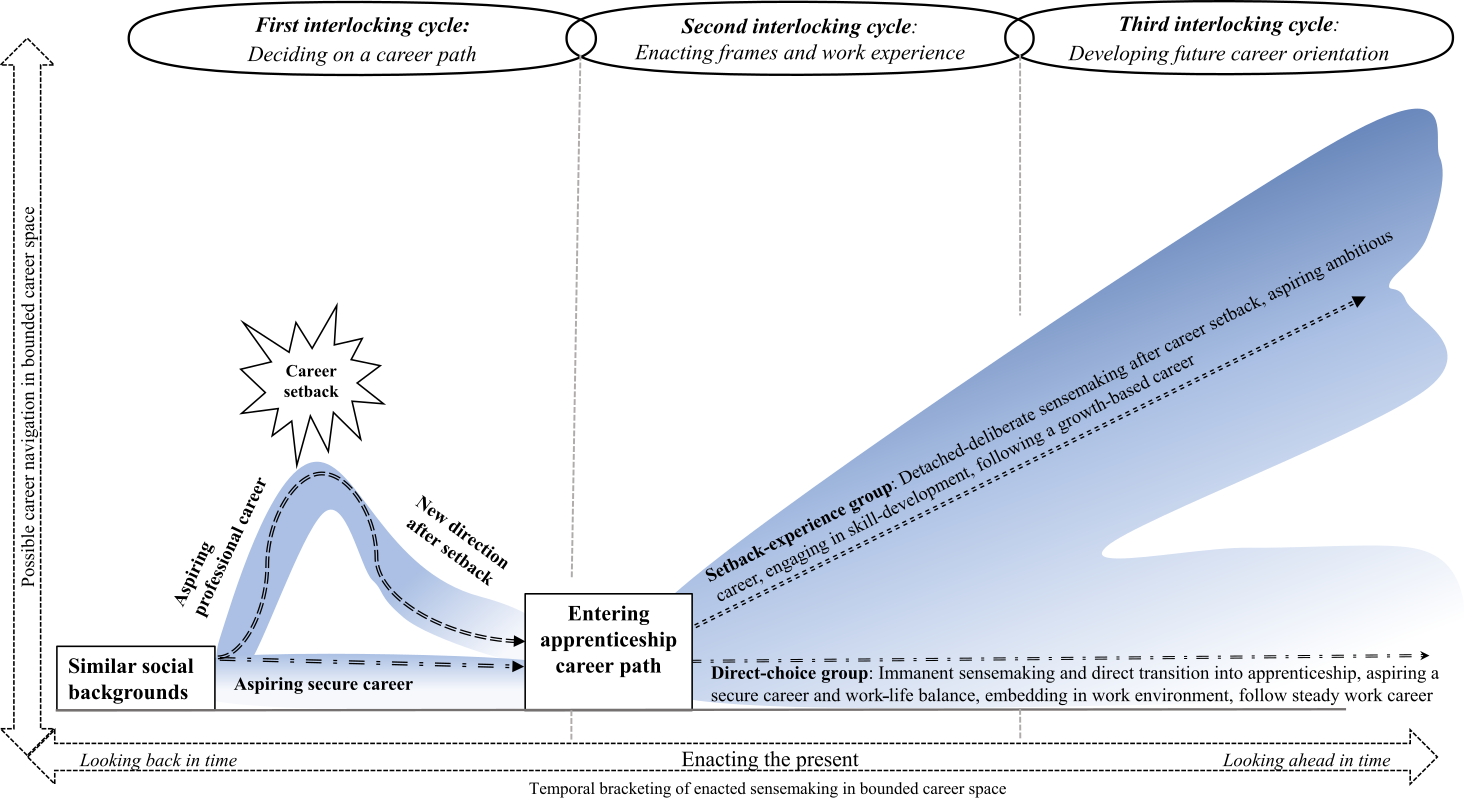
Overview of career movement at apprenticeship transition.
Navigating career transitions along interlocking cycles of enacted sensemaking
The different career paths of the direct-choice group and setback-experience group evolved in three interlocking cycles of sensemaking. The setback-experience group practise a form of sensemaking leading them to enact more ambitious careers than those of the direct-choice group. We show that when facing a transition, individuals’ career choices are influenced by their sensemaking frames through which they interpret and enact the possibilities of their evolving career path.
First sensemaking cycle: past experience and deciding on a career path
Overview
The first cycle concerns apprentices reviewing their past when deciding about and preparing for their career transition. Their interpretations inform their cognitive frames, which include orientations, interests, past experiences and career interpretations, e.g. meanings of education, training and work. The apprentices evaluate their credentials (e.g. prior school and training credentials) and social background support. These criteria provide direction and help the individuals enter the apprenticeship transition.
Direct-choice group
Individuals chose the apprenticeship-based path directly after school, usually compulsory schooling, based on their orientations (financial autonomy, employment security), occupational interests and career interpretations. They aspire to a secure career and follow a familiar career path from their social background. These aspects inform what possibilities they identify.
Aspiring to a secure career
The direct-choice group’s choices are driven by aspirations for a secure career. We find them interpreting the opportunity for a linear career progression by pointing to financial and employment security. Financial autonomy drove Patrick’s main orientation: ‘First of all, being more independent in terms of money.’ Anna chose apprenticeship by comparing office work to electronics. An electronics career was attractive because she assumed it was well-paid and relevant for the future, both aspects indicating job security and achievability through the apprenticeship: First of all, I considered what I wanted to do. I didn’t want to work in the office (. . .) I thought I might want to do something with electronics, because that’s also, I don’t know, future-oriented and such. And that’s why I had to do an apprenticeship. Then I did my research into what professions in electronics there are and which companies offer jobs. And then I also looked around at which companies are more famous or better known, so that you have a better chance of being employed elsewhere later if you don’t stay there after your apprenticeship and where I thought the environment would also be nice. I visited one organization beforehand and decided pretty quickly to work there. I was there and I noticed the people are all very nice, the environment seems nice, so I immediately thought, okay, I’ll work there, because everything fits. (. . .) That’s also a future-oriented company, which makes it more likely that you earn good money, because these electronics jobs are well paid.
Following a familiar career path
Social background experiences shape the trajectories the interviewees feel comfortable pursuing. Grounded in knowledge from family, school and personal experience (e.g. summer internship), these individuals find working in certain occupations familiar. This knowledge provides salient cues that inform their career orientation, expectations and aspirations. For Lukas, hospitality was the most salient. He chose what was familiar: It’s in my family a little. My uncle ran two restaurants. He started out as a dishwasher and was then a waiter for three years and also finished his apprenticeship in a hotel. (. . .). My father was also in the food service sector, and I just tried it out.
Many in this group rely on their social backgrounds for their decision and finding apprenticeships. Claus got his position through a family friend: ‘That was arranged by an acquaintance. He also works for [company] and learned that some people had dropped out and then he asked me if I wanted this spot. He then arranged an interview for me.’ Family members and social ties provide information and may even arrange the job positions.
How the direct-choice group make sense of their choice resembles an immanent sensemaking form, as it is ongoing and integrated in direct flow and familiarity from school to apprenticeship. The interpreted cues reveal a salient, familiar and secure path that direct-choice individuals find attractive. This group develops cognitive frames that let them understand the work career-path reality and construct expectations and aspirations accordingly. They consider careers which provide the comfort of familiarity and security. After making their decision, familiarity and social background experience support an easy transition into apprenticeship. Individuals start their apprenticeship expecting routinization into a steady work-life balance.
Setback-experience group
Individuals have social backgrounds similar to the direct-choice group. However, early in their careers they had experienced a setback. The majority report having failed to pursue their originally chosen professional paths (e.g. getting into university) and a subgroup chose the apprenticeship directly but had significant difficulty finding a position and experienced unemployment. This crucial experience required them to reevaluate their careers (Vough & Caza, 2017). Reviewing their setback experience, vocational interests and career interpretations (i.e. meaning of career, training and work), they eventually decide on the apprenticeship. In making sense of what happened and how to proceed, they distance themselves from their original career path by imagining how it was a poor fit for them. By contrast, the familiar apprenticeship-based career path is where they identify the possibility for success. They aspire to a successful career while redirecting themselves and entering the apprenticeship career transition.
Reevaluating the career path
People in this group at first feel thrown off track after the setback. Tim discontinued qualifying school after failing: ‘I was one year away from graduation and totally failed in school, and then I said no to that.’ Tina found school becoming increasingly harder and eventually admitted to herself: ‘To be honest, I wouldn’t have successfully pulled through.’ As a response, these individuals reinterpret their prior choice and future career options. They distance themselves from their failed qualifying high-school career path and juxtapose it to its opposite: a hands-on apprenticeship career. These individuals select cues which let them maintain and develop a positive self-concept by drawing on their strengths and interests. Seeking an alternative, many associate qualifying school and university with theoretical learning that is not for them. They prefer the applied learning that apprenticeships offer. Georg remarked: ‘Doing something practical – that’s what always interested me and that’s why an apprenticeship.’ Also, Ralf highlighted his strengths. ‘I’m a handy type of person. Even though I’m pretty smart still I prefer working with my hands.’ They emphasize interest in the applicability of training and work, making apprenticeship the sensible choice.
Knowing the path from their social background gave these interviewees additional assurance. Birgit connected the apprenticeship to family: ‘My uncle does something with technology, and my grandfather, he was a metal worker. It seems to run in the family.’ Tina, distancing herself from her prior career path, highlighted the wish for the apprenticeship, underlining its familiarity: Actually, I always wanted to do an apprenticeship, because my father used to be a locksmith, and I was always involved in that, holding screwdrivers in my hand as a small child, and so on. That’s why I’ve always been interested in doing something technical.
Redirecting to a stable career path and taking initiative
The individuals identify the apprenticeship-based career path as a guiderail after their setback, associating it with stability and success. Jonas, like many in this group, associated the apprenticeship path with long-term stability: ‘It is very important for me to do an apprenticeship. Because, I want to have a job later on (. . .) I want stability. I want to have a stable ground through this occupational path.’ Interviewees feel competent with this alternative, which promises success. Amal felt confident about her successful achievement with this path: ‘This way I’m standing with both feet on the ground (. . .) I myself am achieving all this, without anybody’s help.’
Moreover, choosing the apprenticeship track allows the setback-experience group to take initiative and control over their life. Georg recounted that after discontinuing the qualifying high-school path he was feeling down, not knowing what to do. Then he figured: If I just sit at home and do nothing, I will become nothing and if I make an effort and work to become something, the chance is at least higher. I mean, that doesn’t mean I’ll succeed, but if I do something, I can achieve more.
Ahmet also made a point of taking control of one’s career, saying ‘Everyone has to achieve themselves what will make them eventually happy.’ Having dropped out of school, he said, ‘I had to overcome my weaker self and start applying.’ To succeed, Ahmet felt, ‘you will only get something when you have really worked hard for it.’ Similarly, Stefan reflected that he consciously took initiative of his career after the setback: ‘Everything that I did or didn’t do at school was entirely reliant on my own doing. After this experience I really took everything into my own hands and it was my goal to make it.’ Daniela reflected that failing in school made it hard for her to pull herself together and take initiative, but she did it: After not going to school anymore the most important thing was that I dared to do something and that I said to myself, I want to do this and the school and teachers and what not will see. . . and then I thought to myself, I have to be confident and say, I can do this . . . so everyone is responsible for their own future. You have to make something out of yourself. You can’t say it’s somebody’s else’s fault just because something didn’t work out. Every time you fail somewhere, you have to pick yourself up and start again, even though it’s really hard and it’s different for everyone. For me, it’s always hard when something doesn’t work out how it’s supposed to. You just have to tackle it and try again.
The setback experience leads apprentices to take stock and consciously reinterpret their career orientation and interests. They derive a strong desire to take initiative in their careers and prove themselves successful in the apprenticeship path. This deliberate process leads them to rebuild their cognitive frames and enter the next transition with a positive self-concept and ambitious career initiative. Thus, contrary to the direct-choice group who want to transition into a secure and steady career, the setback-experience group adjust their cognitive frames to enact an agentic career that would demonstrate accomplishment in the apprenticeship career space.
Second sensemaking cycle: enacting career frames and work experience
Overview
The second cycle concerns the present apprenticeship, during which the apprentices’ actions and choices at work are influenced by and recursively inform their cognitive frames, particularly their career interpretations. By career interpretations we mean people’s understanding of education, training and work (Wrzesniewski et al., 2003). The apprentices’ career interpretations along with their work expectations and aspirations inform how they enact and evaluate their work, leading them to different possibilities.
Direct-choice group
Members have a security and employability-driven attitude towards training and a means–end view of work. They reaffirm these meanings through actions. Their work experience strengthens their perception of the apprenticeship as applied training having more value than general education due to the employment opportunities and security it provides. They consequently embed themselves further into their occupational and organizational environment.
Reaffirming transactional career interpretations
Most in this group regard theoretical education distantly. The apprenticeship as applied training is considered valuable because it provides long-term employment and security. Work, a means-end deal, is done for money and security, not primarily for self-development. Thomas saw the apprenticeship as a source of security: ‘The apprenticeship honestly isn’t that important. All that’s important, really, is that I’ve completed a qualification.’ Sonja thought similarly: ‘You need an apprenticeship because school is simply not enough anymore. You wouldn’t be able to master an occupation in practice right after school.’ Some find the work unsatisfactory, monotonous, or deficient, but nevertheless important because it gives security. Sonja described her organization as a place of transaction: ‘I can earn my money. Yes, this is what I like about it. And besides this – I don’t know, I wouldn’t work.’
These apprentices highlight work-leisure balance as more important than extra-curricular training and additional credentials. They justify their disinterest in obtaining a dual qualification, combining the apprenticeship with a qualifying high-school certificate or when discussing career-development opportunities in their organizations. For example, Adrian’s organization granted him the possibility of a double qualification. Concerned about his work-life balance he decided against the extra credential: Um, I thought about it, but I think there’s not enough time for everything. Now, look, I go to work, five days of work, then I want to go home, have my peace, engage in my hobbies, play soccer, go to the gym or something else and on weekends I’d also like to have some quiet and not that you now, um, sit down and study.
Enacting career by embedding into the environment
The apprentices experience present work largely based on organizational atmosphere, social cohesion and positive relationships with co-workers and superiors. Oftentimes they see them as family. Through daily experiences the direct-choice group solidify their cognitive frames and enact their careers accordingly. Hani was satisfied that her organization offers a fair, family-like work environment: They pay attention that everything is right, the salaries, that we don’t work overtime, they always ensure that the apprentices, yeah, that everything fits. Actually – in the organization, particularly in our department, it’s very good. We totally [have] our thing going. We’re a little like a family.
The direct-choice group enact cognitive frames confirming their prior expectations, orientations and meanings. Doing so, they follow the typical linear apprenticeship path. How they enact their apprenticeship, like not seeing or being interested in additional qualifications, limits the opportunities of their career space. Their experiences match their expectations; they remain content continuing their routinized career enactment.
Setback-experience group
The individuals in this group strive to realize their aspirations for a successful career, reevaluating and enacting their frames at work. The recursive relationship encourages them to explore possibilities in the career space and develop important skills. These individuals see the importance of work and training for career success.
Generating agentic career interpretations
Setback-experience apprentices display a positive interpretation of training and work, seeing them as related, and begin to develop positive interpretations also of education – but only insofar as it benefits their apprenticeship. Noting how on-the-job training benefits society, they link it to their successful self-concept. The apprenticeship certificate is highly valued as a prerequisite for future success and career development. While downplaying theoretical education compared to training and work, they recover a positive attitude to it when it could help their careers. Tim was demotivated and rejected theoretical education after discontinuing qualifying high-school, yet he seized the opportunity to earn a double credential in his training: Yes, I’m also doing my qualifying degree now. That is, a vocational baccalaureate. Because it’s better for the future and because you have training and additional qualifications. That’s very important.
Amal stressed the value of life-long learning and work as meaningful and fun: ‘So, actually education is important until the very end. (. . .) Work should be fun and you know, and I should learn something along the way.’
Enacting career by proactively building skill-sets
The setback-experience group enact their understanding by taking additional training, deeming it useful for ambitious career moves beyond an apprenticeship. This reveals a self-development perspective, i.e. they judge their workplace more by its available training and less by its social environment. Ahmet judged his organization by the development opportunities he received: ‘Because we have regular training sessions, because actually no matter what questions you have, even if they’re stupid questions, they’re answered right away and then you really understand your field.’ He actively increased his skills, stating ‘Well, when I'm interested in something, I want to expand my training. I do that, actually. I try to advance my skills as much as I can.’ Likewise, Jakob engaged in qualifying opportunities besides his training, being convinced that further development is important: I’ll probably extend the training by half a year to obtain this additional training contract. We can choose between a mechatronics engineer, safety engineer, or dispatcher. And I’ll sign up for dispatcher. It’ll take another six months and then there’ll be additional training for mechatronics engineers. And I’ll also take the qualifying degree classes. So, I started evening school in the second year, with mathematics, and this year I’ll get the qualification degree. I thought, this degree can never be wrong, if you have it, you have it. Education is important to me. Well, I think you can’t really develop if you don’t continuously work on your further development.
In the second cycle, the setback-experience group enact their reevaluated career frames which let them identify and seek opportunities for career growth made available through additional qualification during the apprenticeship. The resulting work experience helps to solidify development and growth-oriented understandings and enact them further at the workplace. Through additional qualifications these individuals develop skills and expand possibilities in their career space. Recursively, they adapt their sensemaking frames allowing them to pursue a growth-oriented career path.
Third sensemaking cycle: developing future career orientations
Overview
The third cycle concerns the development of future career orientation. Apprentices reassess their frames informed by their perception of future career possibilities and direction. Comparing expectations to experiences yields an expectations-experience (mis)fit which helps apprentices create frames for future career orientations and aspirations. While career aspirations between the two groups have some overlap, they mostly move into two significantly different directions. Comparing the two groups with each other and against the Austrian distribution 1 shows that those in the setback-experience group pursue far higher qualifications and have further-reaching aspirations than those in the direct-choice group.
Direct-choice group
This group’s present and aspired work situation remains informed by work through a transactional lens, which leads them to aspire to a steady career over time. Being focused on security and contentment, they speak little about possibilities in the future. Thus, they continue embedding themselves in their current work environment.
Envisioning security and a steady work career
These individuals compare career expectations with their present experience, evaluating their fit. Most are content with their experiences and strive to be embedded in the organization in the long term. Judged by their work and career evaluations, the expectation-experience fit lets these people continue in a steady, security-oriented career. Reviewing her choice and work experience, Serap felt she knew her work and was reassured in her path: ‘I’m working in a field that I understand and know a lot about (. . .) this is actually the most pleasant way possible.’ Her orientations still matched present work experiences and informed her aspirations: ‘Because, as I mentioned earlier, I want to be independent. I want to have my own money and I want to afford my own apartment.’ Serap interpreted the meaning of her work through her security-oriented aspirations: ‘When I think about work and I think to myself, I want a job and I want to work somewhere, then I think that I want a safe job where I’m not at risk.’ Sonja was also content with her situation in the company. She would finish her apprenticeship this year but had not given much thought about the next transition: ‘I don’t know, everything actually suits me the way it is.’
Direct-choice apprentices reevaluate and stabilize their cognitive frames for their orientations, meanings, expectations, and aspirations. The frames support aspirations and career orientation to remain on a secure path. These individuals rarely mention alternatives; other possibilities seem non-salient. Instead, they continue embedding themselves in their occupation and often in the same workplace. Thus, the direct-choice group continue along a linear career path, leading to a steady career over time.
Setback-experience group
In the third cycle setback-experience individuals adjust their frames and derive from them their near-future expectations and aspirations for moving forward. These factors motivate them to envision and strive for development and growth, leading them to undertake activities for a growth-based career.
Envisioning development and a growth-based career
Upon experiencing success and agency in the second cycle, these individuals reevaluate their frames for expectations and aspirations accordingly, which reinforce ambitious career enactment. They explain what career paths are fitting and worthy of pursuit. Their descriptions of future possibilities reveal what career space they identify as navigable in the future. They detail already set-in-motion plans for further training, higher education and entrepreneurial opportunities. Johanna, looking back, deemed the apprenticeship was the right choice: I’ve looked back and considered what I think the right thing is for me and it remained the same. (. . .) The most important thing for me was that I’d be happy again, that I like my work and that I want to continue building my career. (. . .) I’m happy and I want to do that and I can envision my future. (. . .) So the next achievement is further training – of course, this is a personal decision and everyone has to decide for themselves whether you want to work your way towards achieving something so that you can get further up into a managerial position. I’d like to get ahead and become an entrepreneur.
Others also expect to actively enact their careers by building skills and earning more qualifications. These ambitious moves span possibilities in their career space beyond standard apprenticeship careers, which normally plateau in a foreman position. For their future, they see themselves in leading roles on higher career paths, ones which they found impossible or unattractive at the outset, like attending qualifying school or taking university courses. Individuals in this group have clear future plans which they actively pursue. Alex planned to leave his organization, gain more experience elsewhere, then run his own business: ‘I plan to work seasonally at different places. And then continue my education, finish my qualifying degree, and really take over the business.’ Sarah hoped to stay in her organization to obtain a higher qualification at evening school. Her long-term aspiration was to study: ‘I hope I can move into a permanent position and I can continue working in the company and catch up on my higher qualifying exam at evening school and later study automotive engineering.’ For others, such as Daniela, an entrepreneurial path became salient: I want to open my own pastry shop. Because I can do the bookkeeping myself and have the commercial background and now also this training. So, after the apprenticeship I would like to do a master of crafts certification and then open my own pastry shop.
After their setback, these individuals focus on career development, obtaining extra training and qualifications. This proactive engagement helps them identify and enact a wide space of career options. Achieving an expectation-experience fit, they develop aspirations for leadership or founding their own business. In sum, by enacting career space options and obtaining qualifications, they navigate bounded space that is non-salient and thus impermeable to the direct-choice group. Over time, this leads these individuals to a growth-based career.
Group comparison across three interlocking cycles of sensemaking
Our group comparison shows the important differences between the groups (Figure 2).
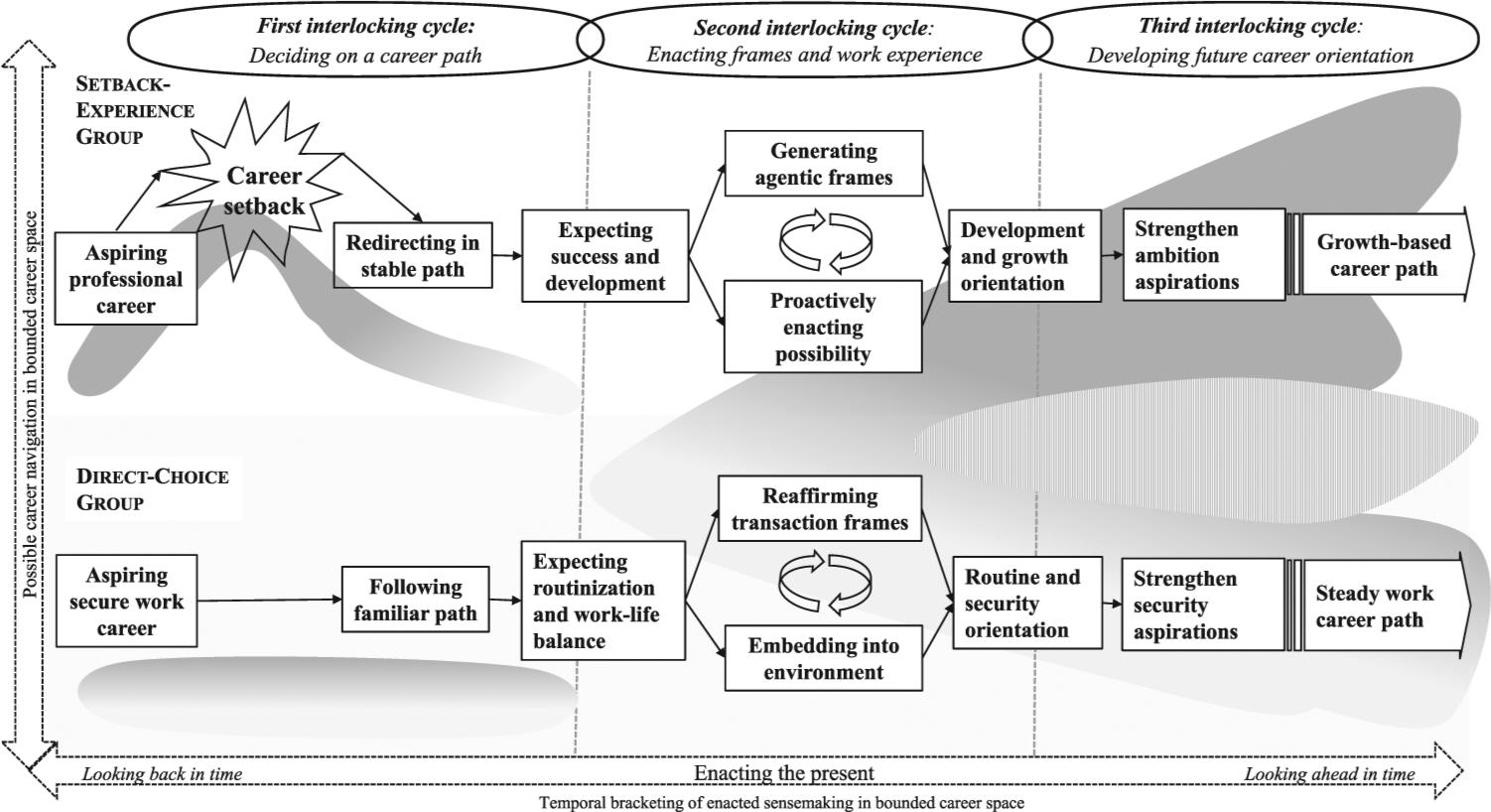
Group comparison – three interlocking sensemaking cycles and possibility enactment in bounded career space.
First, among the setback-experience group there is more deliberate sensemaking compared to the direct-choice group. This leads to different cognitive frames for individuals transitioning into the apprenticeship. The setback-experience group, being unable to pursue the professional path, redirect themselves into a secure path after a detached-deliberate mode of sensemaking. They enter the apprenticeship with greater aspirations for success and development. The direct-choice group pursue a secure career aspiration and follow a familiar career path which seemingly requires no special attention, allowing an immanent sensemaking form. They enter the apprenticeship expecting routinization and work-life balance.
Second, the groups differ in how they enact their present apprenticeship. The setback-experience group proactively builds skills, which generates more agentic career interpretations. Over time, they strengthen their aspirations for an ambitious career, motivating them to further identify and pursue the possibilities available in their career space. As a result, more opportunities open up to them. The direct-choice group enacts their apprenticeship by embedding themselves into their workplace, which reaffirms transactional career interpretations. Gradually, they reinforce their security-based aspirations. As a result, fewer opportunities outside the standardized path appear salient or attractive.
Third, the groups differ in their orientations and aspirations about their future careers. Setback-experience individuals solidify their orientation towards growth and development. Acquiring additional qualifications and tangible skills related to possible career trajectories, these individuals follow what we call a growth-based career, one spanning possibilities that extend beyond the standardized apprenticeship path, including professional and entrepreneurial paths. Direct-choice individuals solidify their orientation towards security. Maintaining a routine and forgoing pursuit of possibilities that fall outside the standard apprenticeship path, like higher education or additional skills, they follow a steady career.
Beyond the clear differences there are also areas of overlap between the groups. In a few cases certain conditions led to enacted sensemaking that resembled more the other group’s career progression. In the direct-choice group, four apprentices have aspirations partly resembling those of the setback-experience group. These young workers feel connected to their workplace, like others in their group, but also aspire to develop and become experts in their fields. They aspire to remain in their organizations at least until they make the most use of the training opportunity before moving on. For instance, Anna started with a standard apprenticeship contract but worked to turn it into a double certification: ‘This was not in my initial contract but I’ll get a double credential which allows me to gain an additional qualification. (. . .) I want to move further to mechatronics with this additional qualification.’ Individuals like Anna had higher aspirations than others in the direct-choice group. However, we found their aspirations tended to development within their occupation, rather than the greater aspirations of the setback-experience group which spanned deliberate plans for professional development and entrepreneurship.
In the setback-experience group three apprentices developed no stronger aspirations and instead continued on a secure path. One reason for this was a deep resentment against any theoretical or university-based training system after their setback, which constrained future possibilities. For instance, Jonas rejected a school-like training form and preferred having a safe position: ‘I don’t feel like learning anymore. I hated it to just be sitting around, I’d rather do something clever. After the apprenticeship, I’ll try to stay in this position because I want to have a solid basis with this profession.’ Another reason is that some apprentices, like in the direct-choice group, find that embedding themselves leads to favourable arrangements in their organization. For example, David found a place where he had good relations with the company owner, giving him a good career outlook: ‘I get along with the boss very well. (. . .) I would like to stay for now and then I’ll see what I want to do.’
Discussion
We investigated how individuals make sense of, and enact, a career transition with and without prior setback experiences and subsequently navigate possibility in bounded career space. We studied apprentices’ narratives of their transition as a process of three interlocking sensemaking cycles comprising past experience, present enactment and future aspirations. From our findings, two contributions merit special attention. First, to boundary-focused career scholarship we present a model detailing the micro-mechanisms of enacted sensemaking during career transitions. Second, we contribute to career setbacks and sensemaking literature by showing that through setback experiences people engage in more deliberately enacted sensemaking, which leads them to pursue growth-based careers.
Advancing micro-processes in career transitions
Our first contribution is a model that explains how individuals make sense of and enact career transitions. We thereby respond to boundary-focused career scholarship’s call to better understand micro-mechanisms in careers (Inkson et al., 2012), in particular during career transitions as important periods of personal reorientation and position changes in life-long careers (Gunz & Mayrhofer, 2018; Louis, 1980a). We align the three cycles in our data into the transition process and draw on Weick’s (1979) sensemaking conceptualization. Our model shows core mechanisms and steps of individuals’ navigation through bounded career space by making sense of and enacting a career transition (Figure 3).
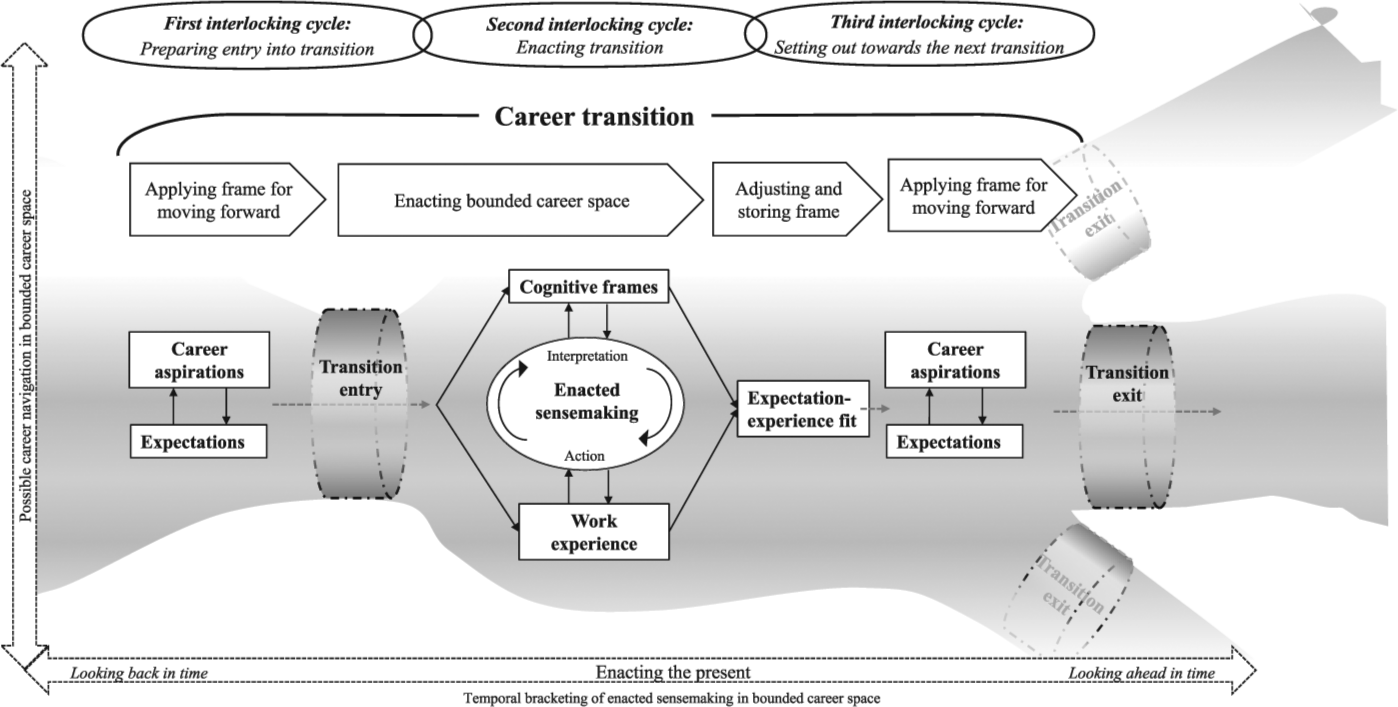
A model of enacted sensemaking during career transitions.
Preparing entry into transition – developing career aspirations and expectations
Each transition is prompted by external or internal change, e.g. career timetable requirements (Roth, 1963), professional interests and career setbacks. The choice for the next transition can be planned and structured (Louis, 1980a) but unexpected occurrences such as setbacks also necessitate transitions (Obodaru, 2017). Before transitioning, people adjust and apply their cognitive frames that inform their transition preferences. To make a choice they apply their frames to evaluate their interests, meanings and orientations, thus projecting past and present experiences and orientations into the future, ultimately creating aspirations. In careers research the temporal perspective on career navigation has been largely treated unidirectionally as a linear process towards the future (Mayrhofer & Gunz, 2020). By contrast, our model underscores conceptualizations of sensemaking incorporating the simultaneity of past, present and future as people cognitively cycle back and forth in time when enacting their career space (Sandberg & Tsoukas, 2020). Individuals entering the same transition may be enacting different paths based on their prior aspirations and expectations. While ostensibly having ample choice for career paths, they choose one route for their next career move and develop expectations for the immediate future. This helps them make a career choice and enact the necessary action to enter the career space of the transition.
Enacting transition – enacting cognitive frames and work experience
Having decided on a direction and entering the transition, individuals enact the work environment. The navigation of bounded career space is a recursive process of enacting their environment based on their cognitive frames informing career interpretation, and adjusting them based on work experience. Recursively moving between interpretation and enactment, people identify, evaluate and enact different possibilities in the career space. A virtuous spiral of enactment and interpretation can lead people to discover more opportunities and reaffirm earlier motivations. Individuals may take up additional training and qualification opportunities or prioritize leisure and work routine. The different ways of possibility enactment significantly shape people’s career paths. They range from choosing a secure career path, seeking possibility that is familiar within one’s occupational and social background, to actually spanning and altering their bounded career space, identifying new opportunities, and opening up space that is atypical for their work environment.
Setting out towards the next transition – adjusting experiences with expectations and career aspirations
Recursively enacting the work environment and readjusting their cognitive frames, people solidify their career interpretations and action patterns in their career space. In the last phase of the transition people have solidified their frames and readjust their career aspirations and expectations for the near and general future. This again lets them choose the next transition and move forward in their careers. For each transition, the career space that people navigate is bounded by the possibilities they can perceive and achieve in preparation for, and within, the next transition. Because of the recursive relationship between interpretation and enactment, people who have similar beginnings can develop significantly different career interpretations leading to divergent paths during and beyond the transition.
Our study showcases that career spaces are bounded but that people can span and change them through their interpretation and enactment. Our model shows that expectations and aspirations enacted during a career transition can lead to taking up different kinds of possibilities within the bounded career space, eventually leading to different exits and career paths. Our conceptual model expands the view on career setbacks in bounded career scholarship that highlights career shocks as mere obstacles that people need to be protected from (Akkermans et al., 2018; Seibert et al., 2013). Examining career setbacks from a macro-perspective without looking at individual post-setback career development may miss a silver lining of setbacks. Setbacks, even if they are experienced as shocks in the short term, provide an opportunity for individuals to readjust aspirations and expectations, leading to more growth-based careers.
The role of setbacks and sensemaking deliberation on career progression
Our second contribution expands the role of career setbacks in long-term career progression and sensemaking deliberation. Specifically, we position setback experiences within a career context and show mechanisms through which setbacks contribute to growth-based careers. We further show how deliberate sensemaking shapes individuals’ awareness of possibility long after the setback experience.
We extend existing research on sensemaking during career setback events (Conroy & O’Leary-Kelly, 2014; Vough & Caza, 2017) by showing how this experience impacts the career process afterwards. We explain the processual dynamics of enacted sensemaking and career navigation after setback experience. This is an important insight because we find that people in the long term develop different enacted sensemaking paths in the same career space. We contribute to the career setbacks literature showing that a setback experience has the potential to significantly impact people’s career interpretation and enactment, helping them reorient themselves after their unexpected experience and build growth-based careers.
Our findings demonstrate how experiencing a career setback can redirect individuals into growth-based career paths. Some papers suggest that experiencing a setback may not only lead to negative career narratives but also that people may learn from them (Hibbert et al., 2022; Vough & Caza, 2017). We advance this research by uncovering how people after setbacks are, at first, thrown off track, but later develop frames that lead them to seek possibilities in their career space more proactively and deliberately. In contrast to previous studies showing people merely addressing or moving on from setbacks (Alacovska & Kärreman, 2022; Garcia-Lorenzo et al., 2022; Obodaru, 2017), we demonstrate the possible positive implications of such experiences. We propose that the setback can push people to recognize and enact a career path with greater possibilities. Enacting their careers this way lets these individuals seek and identify possibilities such as earning qualifications and credentials that open up more opportunity. Overcoming setbacks at the outset of one’s career, then, leads people to enact orientations, aspirations and meanings that are associated with thriving and growth in the work orientation literature (Sonenshein et al., 2013; Spreitzer, Sutcliffe, Dutton, Sonenshein, & Grant, 2005).
Our findings also illustrate that sensemaking deliberation matters not only during setback events but also beyond them. While prior research has shown that career transitions can lead people to switch cognitive gears into detached-deliberate sensemaking (Louis & Sutton, 1991), we reveal how deliberate sensemaking can continue after the transition. In our findings, the people who transitioned following direct-choice career paths embedded themselves quickly into familiarity and routine, embedded in the flux of day-to-day sensemaking. By contrast, those people who experienced setbacks first made sense in a detached-deliberate way, then maintained a level of deliberation, remaining aware of their aspirations and pursuing them more consciously. In so doing they were more aware of the possibilities in their bounded career space than those who directly chose and carried on in their familiar and routinized paths. This is an important implication for the sensemaking literature, where scholars have assumed that people engage in deliberate sensemaking during a setback but return to an immanent sensemaking form soon after the event has transpired (e.g. Sandberg & Tsoukas, 2020). In contrast, our findings point to the persistence of deliberate sensemaking as a contributor to career success after setbacks. We take from this that in order to enact the available possibility in the career space, people benefit from leaving their zone of routinized familiarity associated with immanent sensemaking.
Limitations and future research
Study limitations reveal research opportunities. Although we examined retrospective accounts, from a sensemaking perspective such accounts capture not only the past but also individuals’ present and projections of their future in temporal sequence (Weick, 1979). From this perspective and following other study methodologies (Schabram & Maitlis, 2017; Weick, 1995), retrospective accounts help capture processual enacted sensemaking in career transitions. Within the spectrum of different kinds of process studies (Langley & Tsoukas, 2016), the current research is a ‘weak-process’ study, reconstructing how past events influenced individuals’ present and future meanings and enactment. Future studies might take a ‘strong-process’ approach to capture career sensemaking and navigation through a longitudinal setting with several data collection points. Future studies could also look at post-setback career trajectories with a broader time horizon beyond the five years that we retrospectively captured.
Focusing on newcomers’ careers helps us grasp emergent career-building perceptions and provides opportunities to study cognitive processes and action pronounced in early career transitions (Louis, 1980b). Researching other groups, like professionals or late-career-stage individuals, could deepen insight into career transitions and career space enactment. Finally, we looked at one kind of setback experience, inability or difficulty to enter the desired career path. Other setback types, contextual (e.g. global pandemic, economic recession, war) and personal (e.g. serious illness), may trigger different kinds of enacted sensemaking and result in varying career constructions. We encourage researching different types of setbacks to further understand how people construct their career space after setbacks.
Footnotes
Appendix
Interview data, sample description.
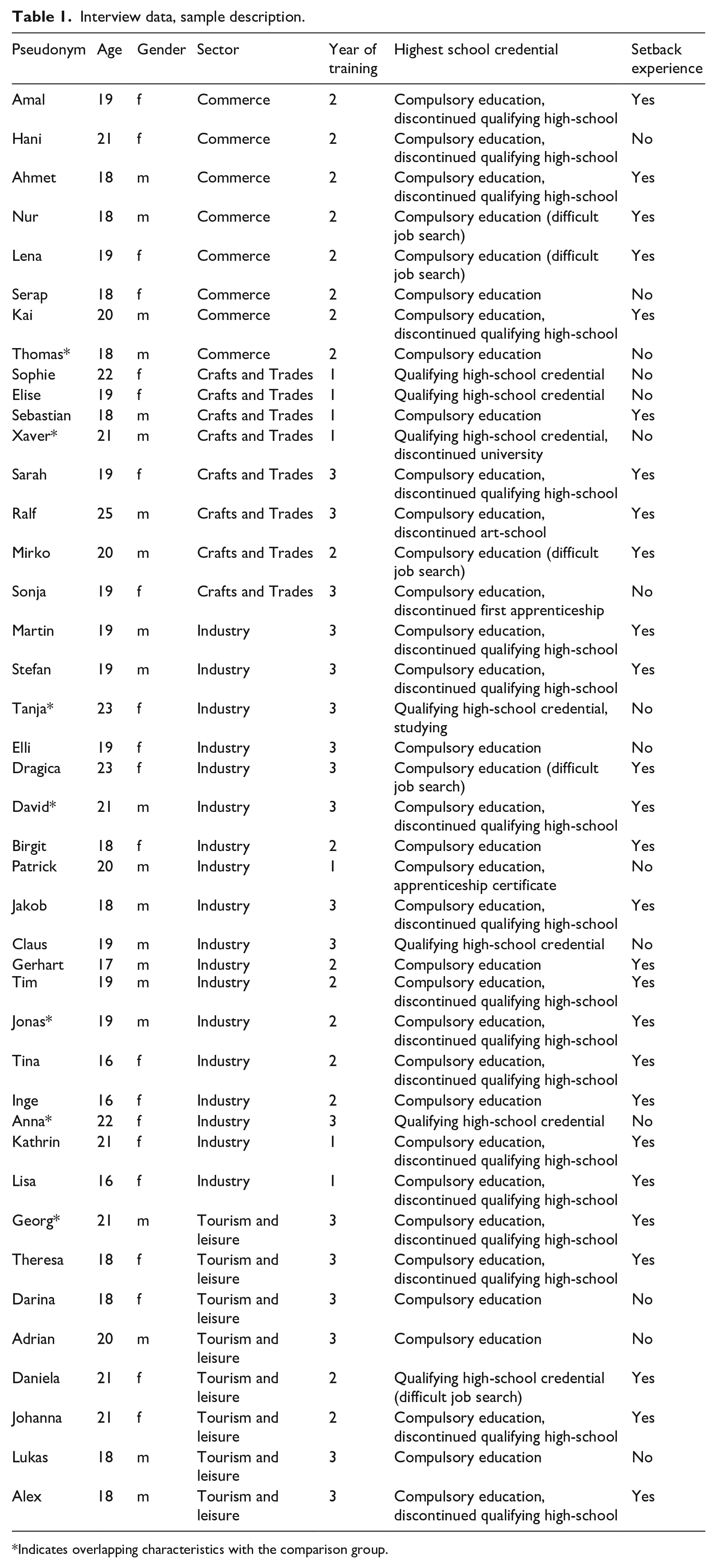
| Pseudonym | Age | Gender | Sector | Year of training | Highest school credential | Setback experience |
|---|---|---|---|---|---|---|
| Amal | 19 | f | Commerce | 2 | Compulsory education, discontinued qualifying high-school | Yes |
| Hani | 21 | f | Commerce | 2 | Compulsory education, discontinued qualifying high-school | No |
| Ahmet | 18 | m | Commerce | 2 | Compulsory education, discontinued qualifying high-school | Yes |
| Nur | 18 | m | Commerce | 2 | Compulsory education (difficult job search) | Yes |
| Lena | 19 | f | Commerce | 2 | Compulsory education (difficult job search) | Yes |
| Serap | 18 | f | Commerce | 2 | Compulsory education | No |
| Kai | 20 | m | Commerce | 2 | Compulsory education, discontinued qualifying high-school | Yes |
| Thomas* | 18 | m | Commerce | 2 | Compulsory education | No |
| Sophie | 22 | f | Crafts and Trades | 1 | Qualifying high-school credential | No |
| Elise | 19 | f | Crafts and Trades | 1 | Qualifying high-school credential | No |
| Sebastian | 18 | m | Crafts and Trades | 1 | Compulsory education | Yes |
| Xaver* | 21 | m | Crafts and Trades | 1 | Qualifying high-school credential, discontinued university | No |
| Sarah | 19 | f | Crafts and Trades | 3 | Compulsory education, discontinued qualifying high-school | Yes |
| Ralf | 25 | m | Crafts and Trades | 3 | Compulsory education, discontinued art-school | Yes |
| Mirko | 20 | m | Crafts and Trades | 2 | Compulsory education (difficult job search) | Yes |
| Sonja | 19 | f | Crafts and Trades | 3 | Compulsory education, discontinued first apprenticeship | No |
| Martin | 19 | m | Industry | 3 | Compulsory education, discontinued qualifying high-school | Yes |
| Stefan | 19 | m | Industry | 3 | Compulsory education, discontinued qualifying high-school | Yes |
| Tanja* | 23 | f | Industry | 3 | Qualifying high-school credential, studying | No |
| Elli | 19 | f | Industry | 3 | Compulsory education | No |
| Dragica | 23 | f | Industry | 3 | Compulsory education (difficult job search) | Yes |
| David* | 21 | m | Industry | 3 | Compulsory education, discontinued qualifying high-school | Yes |
| Birgit | 18 | f | Industry | 2 | Compulsory education | Yes |
| Patrick | 20 | m | Industry | 1 | Compulsory education, apprenticeship certificate | No |
| Jakob | 18 | m | Industry | 3 | Compulsory education, discontinued qualifying high-school | Yes |
| Claus | 19 | m | Industry | 3 | Qualifying high-school credential | No |
| Gerhart | 17 | m | Industry | 2 | Compulsory education | Yes |
| Tim | 19 | m | Industry | 2 | Compulsory education, discontinued qualifying high-school | Yes |
| Jonas* | 19 | m | Industry | 2 | Compulsory education, discontinued qualifying high-school | Yes |
| Tina | 16 | f | Industry | 2 | Compulsory education, discontinued qualifying high-school | Yes |
| Inge | 16 | f | Industry | 2 | Compulsory education | Yes |
| Anna* | 22 | f | Industry | 3 | Qualifying high-school credential | No |
| Kathrin | 21 | f | Industry | 1 | Compulsory education, discontinued qualifying high-school | Yes |
| Lisa | 16 | f | Industry | 1 | Compulsory education, discontinued qualifying high-school | Yes |
| Georg* | 21 | m | Tourism and leisure | 3 | Compulsory education, discontinued qualifying high-school | Yes |
| Theresa | 18 | f | Tourism and leisure | 3 | Compulsory education, discontinued qualifying high-school | Yes |
| Darina | 18 | f | Tourism and leisure | 3 | Compulsory education | No |
| Adrian | 20 | m | Tourism and leisure | 3 | Compulsory education | No |
| Daniela | 21 | f | Tourism and leisure | 2 | Qualifying high-school credential (difficult job search) | Yes |
| Johanna | 21 | f | Tourism and leisure | 2 | Compulsory education, discontinued qualifying high-school | Yes |
| Lukas | 18 | m | Tourism and leisure | 3 | Compulsory education | No |
| Alex | 18 | m | Tourism and leisure | 3 | Compulsory education, discontinued qualifying high-school | Yes |
Indicates overlapping characteristics with the comparison group.
Acknowledgements
We thank the three anonymous reviewers and Senior Editor Jasper Hotho for providing generous guidance for improvement throughout the review process. Hugh Gunz, Derin Kent and Patrick Shulist provided invaluable constructive comments on previous drafts. William Gallagher supported us greatly with stylistic and proofreading edits. We are enormously grateful for their help.
Funding
The author(s) disclosed receipt of the following financial support for the research, authorship, and/or publication of this article. The first author received support for this research by a grant from the Austrian Chamber of Labour.
