




Abstract
The effects of different temporal structures among actors in interorganizational projects can be hugely consequential, especially for large societal projects. By applying a temporal translation view to a real-time study of an interorganizational project, we studied the influence of differences between such structures during the collaboration. We found that the three participating organizations, having distinctly different temporal structures, adopted different modes of translation, which we identified as integrative, adaptive and transformative. These different modes of translation affected dramatically how the project unfolded, as they impacted differently the time and effort required to adapt to common schedules and deadlines. Our study contributes a processual extension of entrainment theory by shedding light on entrainment as ongoing accomplishment enabled by a translation view. It also contributes to a processual understanding of the temporality of interorganizational projects.
Introduction
On 4 January 2000, Norway experienced the second largest railway accident in its history. In the wake of the accident, Parliament approved the development and implementation of an ambitious and novel national emergency communication system, which would extend emergency communication in real time to police, fire and health services. The three project-partner organizations (Police, Fire and Health) would synchronize their implementation of the system through an interorganizational project managed by a project management team (PM). The project, however, became hampered by critical delays at various stages of execution, culminating in the withdrawal of Health towards the end of the project.
From following the project in real time, we have been able to analyse how various delays happened as project partners struggled to translate between their temporal structures and PM’s scheduling. Police were able to translate relatively effortlessly as they had to carry out only limited changes to their homogeneous temporal structures. Importantly, their temporal structures did not differ significantly from PM’s scheduling in terms of complexity. Fire needed to effect more extensive change to their temporal structures to adhere to project scheduling than Police. This meant that Fire were only able to translate scheduling into their temporal structures later in the project, which became a challenge for PM and the entire project. Health, however, struggled more than the other two partners to adapt their significantly more complex and multi-level temporal structures to PM’s scheduling, and were not able to complete their translation in time. Encouraged by the successive translation by Police and Fire, PM intensified scheduling efforts to bring Health into line. Health, however, having trailed the other two organizations from early on, withdrew from the collaboration, as the time left before the deadline did not permit Health to adapt to PM’s scheduling.
The case shows how delays may threaten the execution of important societal projects with large actors. It also shows important challenges of adapting to external entrainment efforts that are manifested by common scheduling and how those challenges create dilemmas for collaborating actors. Moreover, it shows how entrainment as process is more unpredictable and dynamic than reflected in entrainment theory, which is dominant in explaining actors’ adaptation to temporal dynamics in their external environment (Sandra, Segers, & Giacalone, 2021). Scholars, such as Ancona and Chong (1996), Khavul, Pérez-Nordtvedt and Wood (2010), McGrath (1990), Pérez-Nordtvedt, Payne, Short and Kedia (2008), and Shi and Prescott (2012), have emphasized how actors become synchronized to dominant external rhythms, or so-called Zeitgebers such as common schedules and milestones. However, this stream of research has largely considered entrainment as an outcome of process rather than the process itself. It has also tended to consider actors as monolithic and dominated by singular temporal structures, which partly explains why different temporal structures in interorganizational collaboration has not become a focus of research.
We expand on recent studies (Granqvist & Gustafsson, 2016; Hilbolling, Deken, Berends, & Tuertscher, 2022; Jarvenpaa & Välikangas, 2022) that view the temporal structures of actors as important for understanding entrainment dynamics in interorganizational collaboration. In particular, the importance of varying degrees of complexity of organizations’ temporal structures in interorganizational projects remains understudied in organizational research even though prior research has emphasized the importance of different degrees of complexity and interdependence between internal temporal structures of collaborating organizations (Dille, Söderlund, & Clegg, 2018; Lenfle & Söderlund, 2019; Stjerne, Söderlund, & Minbaeva, 2019).
While accounting for the temporal structures of collaborating actors, we focus on the ongoing interplay between actors’ temporal structures and external entrainment efforts. To explain such interplay, we apply a temporal translation view, which enables us to explore the multiple ways that actors adapt their temporal structures to entrainment efforts. A temporal translation view has yet to be integrated into entrainment studies, as indicated by the recent review by Sandra and colleagues (2021). Such a view also responds to recent calls for more process-temporal theorizing of temporary organizations (of which interorganizational projects are an important part) (Bakker, DeFillippi, Schwab, & Sydow, 2016).
The paper is structured as follows. First, we provide a theoretical background for our study, focusing on entrainment, temporal structures and a temporal translation view. Second, we present the research setting and methodology, followed by empirical material and analysis of how the three partner organizations performed different modes of temporal translation and how these modes affected PM’s scheduling attempts during the project, ultimately culminating in a breakdown of the collaboration. Finally, we conclude with discussion and implications for research.
Discrepant Temporal Structures in Dominant and Emerging Entrainment Views
It is commonly accepted that temporal coordination is principally aimed at entraining actors’ temporal structures (Geiger, Danner-Schröder, & Kremser, 2021) to obtain sufficient synchronization of activities among collaborating actors. Whereas scholars offer different definitions of temporal structures, there is agreement on temporal structures defined as the ongoing patterning of activities and events that are particular to an individual, group or organization (McGrath, 1990; Orlikowski & Yates, 2002; Rowell, Gustafsson, & Clemente, 2016). Temporal structures play important roles in interorganizational collaboration where some synchronization is needed and can significantly affect project outcome when actors need to adapt to external scheduling. However, such structures evolve over time to become embedded in actors’ sense of identity (Schultz & Hernes, 2020), which means that changing them may demand significant effort and time. Consequently, disrupting socially meaningful temporal structures of organizations to synchronize with external scheduling may provoke resistance and prove challenging for managers.
While interorganizational collaboration requires some form of entrainment for its accomplishment (Hilbolling et al., 2022), dominant entrainment theory does not capture well the various degrees and extents of temporal coupling that may take place between actors (Blagoev & Schreyögg, 2019) and consequently does not address the complexity introduced by temporal structures. Entrainment research has demonstrated the importance of coordination in interorganizational collaboration (Pérez-Nordtvedt et al., 2008; Shi & Prescott, 2012) but remained largely focused on ‘when’ to the exclusion of ‘what’ or ‘how’ (Engwall & Westling, 2004). Moreover, the ‘when’ has been narrowly defined as the achievement of fit between phase and tempo of actors (Pérez-Nordtvedt et al., 2008; Shi & Prescott, 2012). Organizational-level entrainment can occur by organizations synchronizing (i.e. tempo matching and/or phase aligning) their ongoing activities to those of the external environment (i.e. the Zeitgeber), as proposed by Pérez-Nordtvedt et al. (2008, p. 788). However, this view overlooks the internal organizational processes that make such synchronization difficult and hence time consuming, which, in the case of public projects with non-negotiable deadlines, becomes challenging to manage (Dille & Söderlund, 2011; van Berkel, Ferguson, & Groenewegen, 2016).
Recent extensions of entrainment theory have explored entrainment by considering the complexity of actors’ temporal structures and thus have responded to Ofori-Dankwa and Julian’s (2001, p. 427) call to explore how ‘individuals or organizations can shift or adjust their time orientations to effectively entrain or “detrain”.’ Their call is consistent with Standifer and Bluedorn’s (2006) observation that the degree of synchronicity as an outcome of entrainment depends on the degree of similarity (or dissimilarity) in the temporal structures of actors involved. As part of extending entrainment theory, Hilbolling et al. (2022, p. 137) emphasize entrainment as ‘loosely coupled episodes’ enabled by informal ‘process-based mechanisms’. These authors conducted a study of interorganizational collaboration involving actors with incongruent temporal structures. Taking an institutional perspective, Granqvist and Gustafsson (2016) observe how entrainment in the educational sector is more like an evolving process than driven by output, and how entrainment therefore can take different directions over time depending on the interplay between actors’ temporal structures.
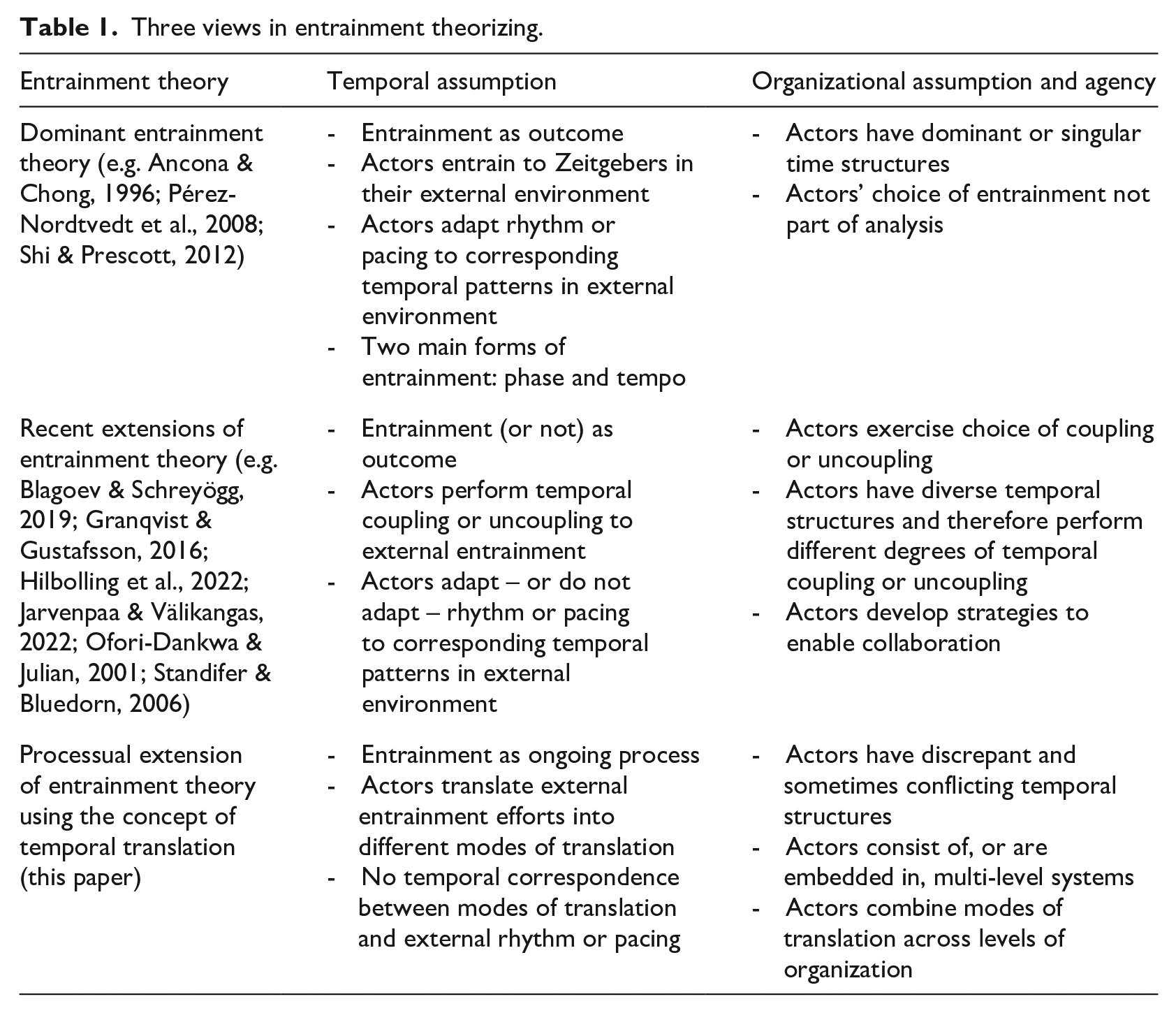
Together, these contributions confirm the need to explore the complexity and interplay between actors’ temporal structures and how those structures may engender different forms and processes of adaptation to external entrainment efforts. We will in the next section discuss how a temporal translation view (extending from the two former views) may account better for the effects of discrepant temporal structures during interorganizational collaboration. In Table 1, we provide an overview of the three different views in entrainment theorizing.
Three views in entrainment theorizing.
Discrepant Temporal Structures in a Temporal Translation View
A temporal translation view invites analysis of the evolving interplay between entrainment efforts and actors’ temporal structures during the collaboration while acknowledging that at any time only part of actors’ structures is mobilized towards entrainment. For instance, it is important to account for varying degrees of uncoupling (Blagoev & Schreyögg, 2019), such as when organizational actors orient certain parts of their temporal structures towards external scheduling while keeping other parts unchanged. Drawing inspiration from the sociology of translation (Callon, 1986), Hernes and Schultz (2020) contributed the concept of temporal translation to explain how actors fold multiple temporalities (such as near and distant time orientations) into one another as an alternative to maintaining those temporalities in a state of tension. A temporal translation view enables understanding of how actors basically retain their temporal identities while adapting those identities sufficiently for collaboration to occur. For instance, such a view invites analysis of how an organizational actor may progress slowly compared to others due to negotiating more interfaces between internal temporal structures than other, more temporally homogeneous actors. Ontologically, there is a strong parallel with the theory of boundary objects (Star & Griesemer, 1989), which explains how boundary objects may enable sufficient collaboration to occur between actors of diverse identities.
The concept of temporal translation, as we apply it here, addresses how actors may selectively adapt temporal structures at different hierarchical levels due to external entrainment efforts. Scholars have observed how organizational actors may selectively adopt norms or decouple from norms due to external pressures (Heese, Krishnan, & Moers, 2016). We find translation to be particularly useful in relation to temporary interorganizational collaboration where actors must continually navigate between their internal structures and external scheduling while finding themselves running out of time from the beginning (Lundin & Söderholm, 1995).
Therefore, it is important to understand and clarify how project managers may handle discrepant temporal structures of collaborating organizations that demand varying degrees of time and effort to adapt to external entrainment efforts. In interorganizational collaboration, actors do not necessarily observe the inner workings of their partners but may instead adapt their internal processes selectively to conform to other actors’ (such as PM’s) entrainment efforts. Thus, we ask the research question: How do actors adapt to entrainment efforts in view of their different temporal structures and what are the effects thereof on the unfolding of the project?
Empirical setting
We base our research on a case study of an interorganizational project where an external PM was given the responsibility to synchronize implementation of a new technology in three large public services. The duration of the interorganizational project was imposed externally and there was an explicit fixed deadline. While time efficiency is inherent in project management, the immutability of the deadline can exacerbate the need for time efficiency, which in turn can lead to clashes between a project and larger, more complex organizations (van Berkel et al., 2016).
The characteristics of public services’ temporal structures have been emphasized in previous research. For example, Borglund and Nuldén’s (2006) study of police work in Sweden suggests a temporal structure that is highly structured, uniform and oriented towards linear scheduling. Fire, on the other hand, as Dille and colleagues (2018) observed in their Norwegian study, was a mixed-time orientation in that the central level had a longer and more linear-oriented planning horizon than locally embedded fire departments that were oriented towards immediate action and shorter sequences (see also Geiger et al.,’s (2021) study of firemen). Healthcare organizations have been observed to be more resistant to change, given that they consist of diverse professional groups with varying temporal structures (McGivern et al., 2018). For example, Zerubavel’s (1976, 1979) extensive study of hospital time structuring as sporadic and loosely coupled, yet discernible as sharing some rhythm at different levels, reflects the heterogeneous temporal structures that we observed in Health. A related observation is made in Heese and colleagues’ (2016) study, that the hospital sector resorted to selective adaptation to norms due to complex goals and fragmented internal organization.
As such, interorganizational projects like the one we studied can be described as extreme cases because they involve actors with discrepant temporal structures and an immutable deadline. An advantage with such extreme cases is they often ‘reveal more information because they activate more actors and more basic mechanisms in the situation studied’ (Flyvbjerg, 2006, p. 229). Arguably, our case provides an ideal setting to explore external entrainment efforts in interorganizational projects involving partners with discrepant temporal structures.
Methodology
Project context
The interorganizational project was to implement a new national emergency communication system in Norway, occasioned by the railway accident previously mentioned. The emergency network is rooted in TETRA (terrestrial trunked radio) technology, which is a separate radio network developed for rescue and emergency communication. For the project to succeed, the new system (communication centrals and radio terminals) had to be implemented in all three services, and therefore their involvement was vital, including their core operational duties. PM was situated in the national directorate for emergency communication and was given the overall responsibility for project implementation, which included system implementation synchronization with the three partners. Deadlines and phases of implementation were stipulated by the Norwegian Parliament.
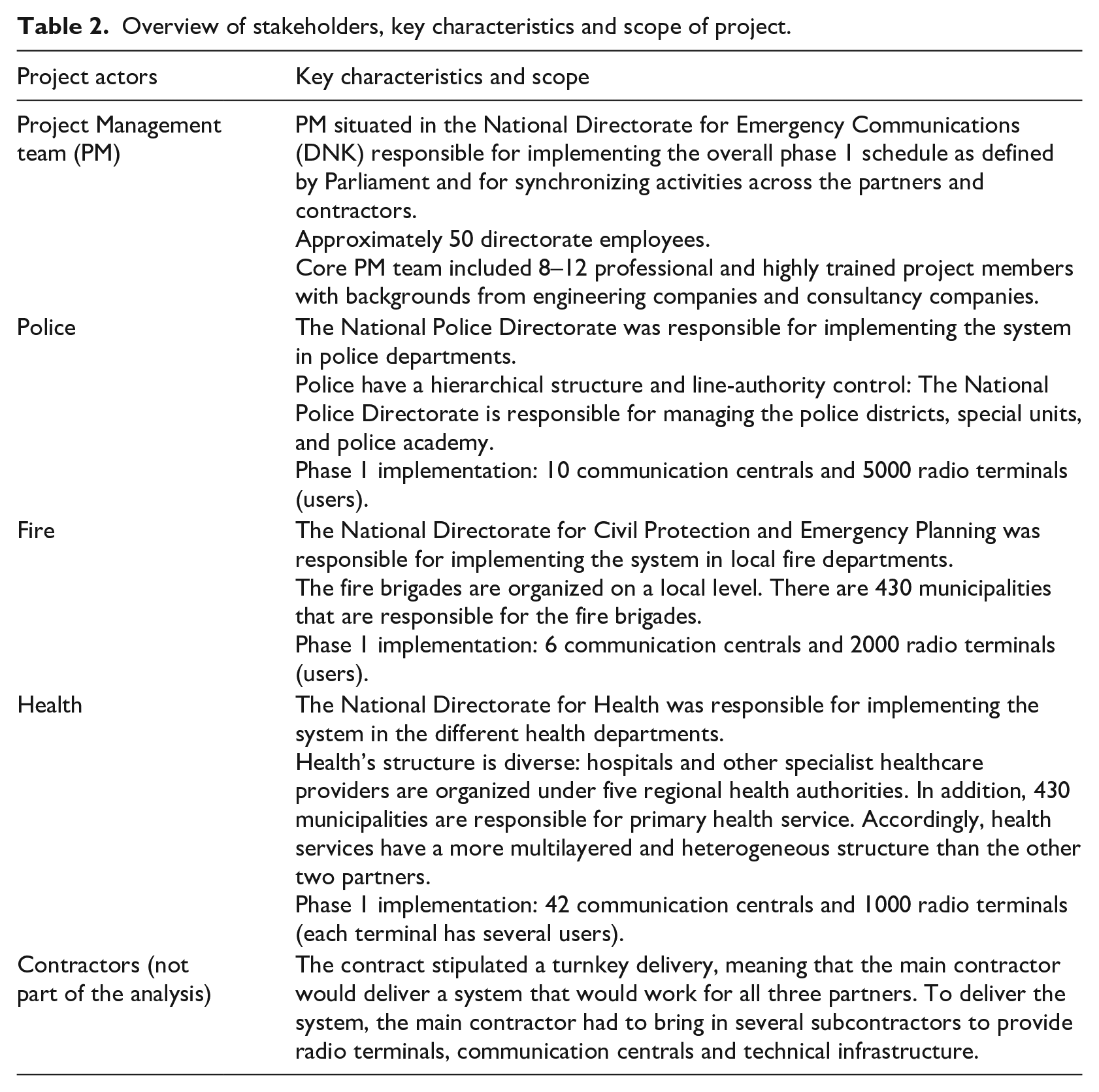
The project was intended to be executed in two sequential phases. Phase 1, from January 2007 to August 2011, encompassed the development and implementation of the system in the southeast of Norway, and phase 2 involved nationwide implementation. The main reason for phased implementation was to test the system for quality control and preparation before moving to full-scale implementation. To start phase 2, the Parliament had to evaluate and approve the project. We followed phase 1 of the project. In Table 2, we provide an overview of participating actors, their key characteristics, and the number of communication centrals and radio terminals.
Overview of stakeholders, key characteristics and scope of project.
Data collection
We followed the project processes in real time (Blomquist, Hällgren, Nilsson, & Söderholm, 2010; Cicmil, Williams, Thomas, & Hodgson, 2006), working inductively to establish categories of temporal coordination as the study proceeded. We gathered historical project data from public documents and other published sources, conducted interviews, and observed the project’s in-house management meetings in real time. The first author observed 12 meetings totalling approximately 30 hours over a nine-month period (September 2010 to May 2011). Meeting participants included the main project manager, the sub-project managers and several other key members of the project, including representatives of project management support and planning. Tape recording of the meetings was not permitted; therefore, the first author took extensive notes to document the different themes discussed. This approach was particularly important due to the study’s aim to allow key concepts and observed patterns to emerge. The meeting notes were written in a field log within 24 hours following the end of the meetings. In addition to the meeting notes, a diary and field log were vital parts of the research process. Here, following Orton (1997), the first author registered initial and emerging interpretations and continuously discussed the observations from the meetings with other members of the research team.
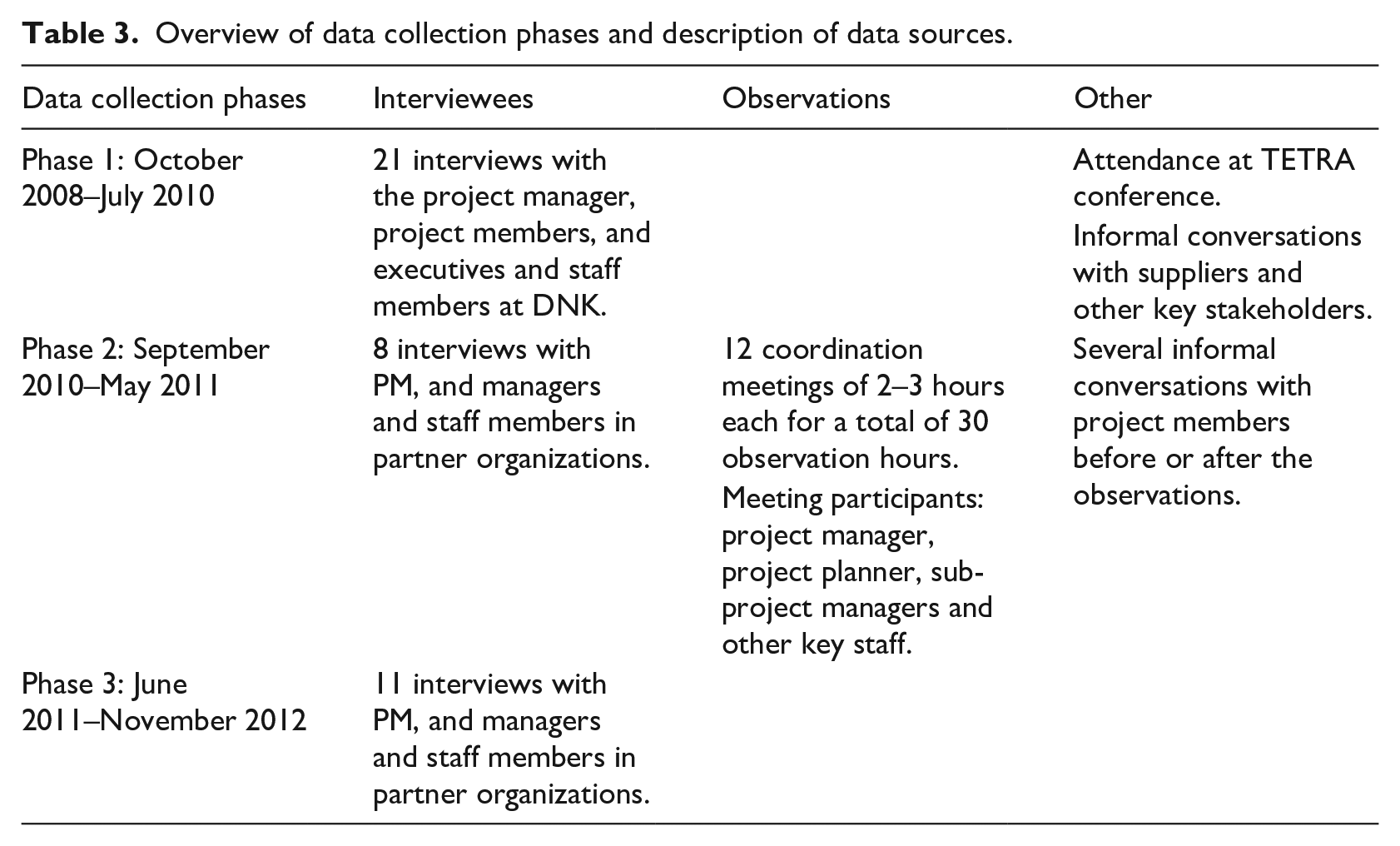
In addition to the observations, 40 interviews were conducted between 2008 and 2012. Prior to the observation period, 21 interviews were conducted with PM, top managers, and other staff members. During the observation period, we conducted eight interviews with the project manager and other members of his team so they could elaborate on themes discussed at observed meetings. Additionally, 11 interviews were conducted after the observation period to verify our observation interpretations. We conducted interviews with managers and staff members from Health, Fire and Police to supplement PM members’ internal perspectives. Table 3 gives an overview of the data collection phases and a description of data sources.
Overview of data collection phases and description of data sources.
Each interview lasted 2 to 2.5 hours, and they were semi-structured to allow the interviewees to reflect on issues they identified as critical to project progress. Interviews were taped (with the interviewees’ approval) and transcribed, and we adapted interview guides continuously throughout the research process, as new issues emerged, and as more detailed accounts were required. Interviews and observations were supplemented with internal and public document studies to extend the scope of empirical investigations.
Data analysis
Following Langley’s (1999) recommendations for process research, our analysis consisted of multiple approaches and different stages. First, we used a timeline to plot key events and develop an initial narrative to help us chart chronological event histories (Miles & Huberman, 1994). In this process we scrutinized conversations from management meetings, resulting in extensive lists of topics and discussions from each meeting, which were supplemented with interview data. We also presented initial interpretations to project core team members for inspection. The initial empirical data indicated that many of the problems addressed in the meetings and interviews related to time issues. In their entrainment efforts, PM kept returning to discussions of issues with the tempo and sequence of activities in the partner organizations, and PM continuously struggled with differences between the participating organizations. Police pushed for progress, while Fire and Health lagged behind the scheduled plan.
Next, we analysed and compared several sources, including PM meeting conversations, interviews with members of PM, interviews with other project members, and interviews with the three partner organizations. Interviews with people from partner organizations allowed us to include perspectives and actions of different parties during the project, and to go beyond the ‘single-party focus’, which dominates research on interorganizational relations (Lumineau & Oliveira, 2018). Following Reinecke and Ansari (2015), we used time as a ‘sensitizing concept’ in the sense that it ‘does not “provide prescriptions of what to see” but can “suggest directions along which to look”’ (Blumer, 1954, p. 7, as cited in Reinecke & Ansari, 2015, p. 624).
We then coded the data chronologically and registered 149 quotes that were related to time issues. Most of the quotes from PM meetings and interviews with PM members concerned deviations from schedule and how the three partners adapted to one another in terms of higher or lower pace.
Interviewees from the three partner organizations, however, revealed that PM’s focus on ‘scheduling and re-scheduling of activities’ had been an ongoing problem in the collaboration. By comparing quotes, we could understand how, on the one hand, PM’s increase in scheduling, and on the other, the diverging temporal structures among the three partners, combined to create different major synchronization problems. We were particularly intrigued by Health’s pattern of adapting to PM’s scheduling. Health managed to meet the deadline in the end, although our data (PM’s schedule) showed that they increasingly lagged behind schedule. This paradox inspired us to explore the concept of temporal translation, which focuses on how actors adapt their internal temporal structure to external entrainment efforts.
We compared our findings with analyses from prior research, which helped us understand what occurred during the project’s execution. Throughout this step, we moved back and forth between case data and emerging concepts from the literature (Eisenhardt & Graebner, 2007). The iterative process between previous research and our observations indicated that many of the problems addressed in the meetings and interviews related to the discrepancy between PM’s entrainment efforts that were manifested by different scheduling attempts, and the partner organizations’ temporal structures. In addition, our data showed that the partners’ ability to adapt to and incorporate PM’s schedules were performed at different times during the project. We then analysed how the partners’ adaptation to PM’s scheduled pace diverged and how PM reacted to each of those diverging adaptations. The differences among the partners’ adaptations confirmed the usefulness of the concept of temporal translation, which, as mentioned above, captures more complex patterns of adaptation of temporal structures than are captured by surface manifestations (Hernes & Schultz, 2020). These observations enabled us to identify three modes of temporal translation, and how and when the translations were performed, generating different scheduling reactions from PM during the project, which consequently affected the unfolding of the project. Appendix 1 provides additional illustrative data for the modes of temporal translation we identified (available as online supplementary material).
Findings
We show in Figure 1 how the three partners deviated from PM’s scheduling. The figure shows that Police’s progress corresponded with PM’s scheduling while Fire’s deviated from the schedule until midway through the project. In contrast, Health’s deviations from PM’s scheduling escalated, ultimately culminating in collaboration breakdown. In subsequent sections, we analyse how the partners’ deviations from PM’s scheduling were related to what we identify as different modes of translation. Then we show how these different modes of translation affected PM’s scheduling and led to the breakdown.
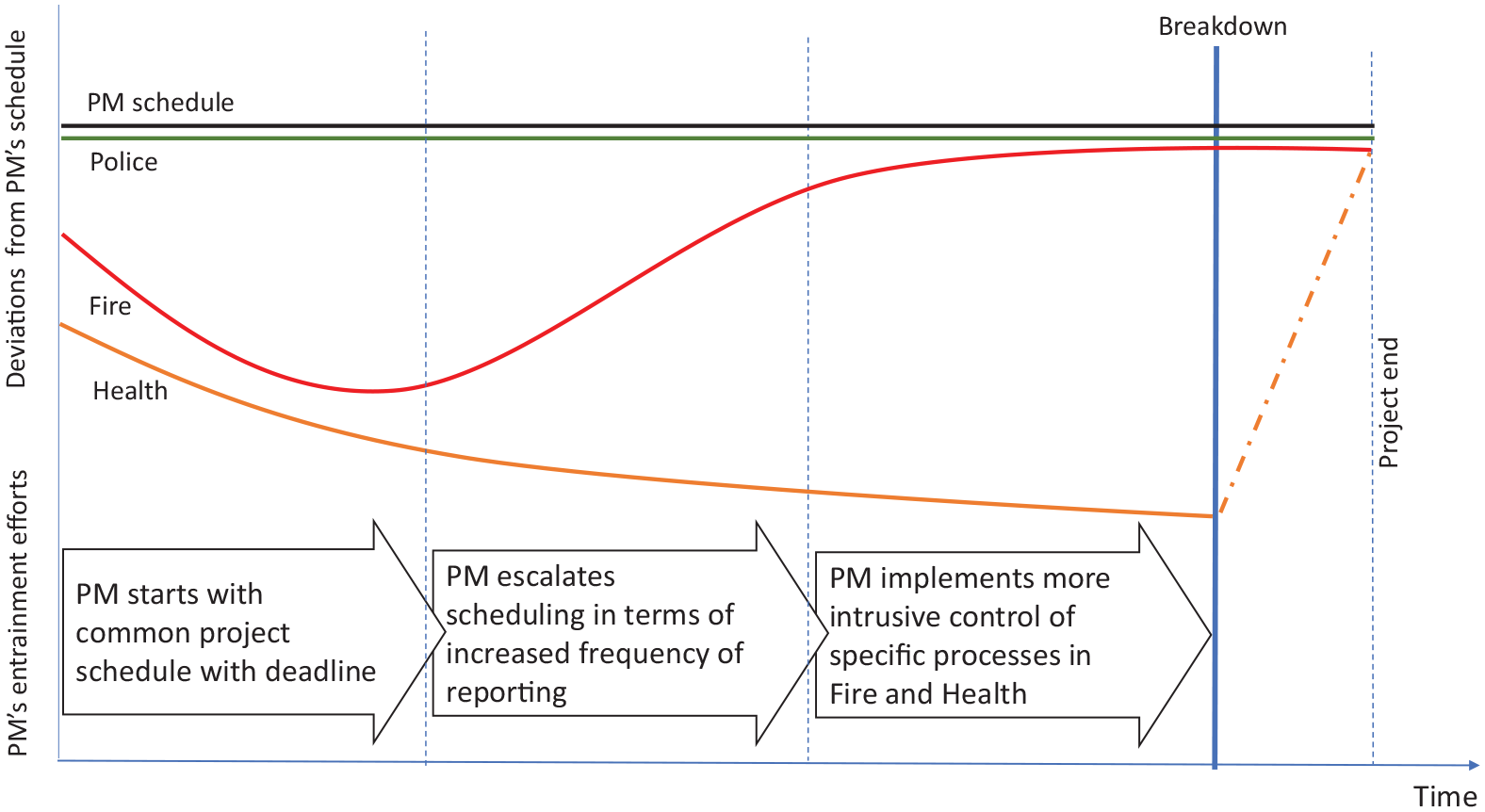
Partner organizations’ deviation from PM’s project schedule during the project.
Police’s integrative translation
We noticed early in the project how Police could relatively easily integrate PM’s scheduling into their temporal structures, which were largely consistent with the temporal structuring methods employed by PM. PM consisted of professional and highly trained project managers tasked with keeping a strict schedule. With a focus on deadlines, they employed sophisticated scheduling techniques, such as network planning techniques, work breakdown structures, and detailed differentiated plans for each of the partners. By employing these linear scheduling techniques, PM thought they were in ‘control of the project’. In interviews, PM referred to this as having managed to establish ‘a believable schedule’.
The main challenge, from Police’s perspective, was that PM’s scheduling was too complex and that it lacked local anchoring: The project management competence of PM was all about making those great schedules. Enormous timetables that never actually work. . . . The designs are great, but if they don’t work, they’re practically dead upon arrival. . . . This is what I experience from working with this PM; their focus has been more on making schedules than making sure that those schedules are anchored in our reality. (Police manager)
Police were able to overcome these scheduling issues by simplified scheduling and drawing boundaries around their work processes early in the project. By doing so, Police could integrate PM’s scheduling rapidly to their internal temporal structures and pursue a path paralleling the one stipulated by PM, as shown in Figure 1.
Simplified scheduling
We were directed to this observation as Police seemed to adjust to PM’s scheduling by formulating their own simplified version of the schedule laid out by PM from early in the project: We made our own schedule. It actually flipped everything, because PM was supposed to own the schedule. We weren’t supposed to make our own schedule. . . . We don’t have much education in planning or project management, and our scheduling is actually very simple. But our way of doing things made it easy for us to communicate with the police districts, from management to police chiefs. This is a schedule that the local police chiefs can understand, and I can understand. It is also a schedule that PM can understand. (Police manager)
This simplified schedule incorporated decision points that were synchronized with Police’s budgeting cycles and resource allocation. As a Police manager explained: I think I can spend two minutes to explain in a simple way how scheduling is done in Police. John [code name] comes down to us on the fourth floor, and then the four of us sit down in front of a board and then we start drawing. Because we know what actually works and which bits belong together in Police. It’s like building with Lego. . . . Then our goal is to come up with something simple that John can bring with him to his decision-making meetings. We can very easily get an overview of what is going to happen in our organization over the next five years. That is one small A4 page. Our scheduling process is actually that we sit down with the knowledge that we have about what is going on in our organization, how the various departments work, . . . and then we piece these bits together. Is there more to be said about that? It is simple.
Drawing boundaries
Another part of Police’s translation involved setting boundaries for PM’s interference in Police’s internal processes. A Police manager explained how they, early on, ‘told them [PM] that all information is going through us, that they [PM] were not allowed to send out a single message to the police departments’. Importantly, Police could draw this boundary because of a hierarchical structure and culture of adhering to official channels of communication, factors that enabled them to translate the scheduling by PM to their internal temporal structures’ core processes. This observation is illustrated in the following statement: Police officers are of course individuals with opinions, but the police department is a command organization, everyone is very conscious about that, who is in charge, it is the police director at the top of the hierarchy and the local police chiefs out in the districts. That’s the way it is. And it has been an advantage that we have been able to build on in this project. Our people are used to doing the things they’re told, but that doesn’t mean they don’t think. . . . Our point of departure is that the schedule should be a line of reasoning. It should be a schedule that we agree on and that can be understood on all levels. On the lower levels more detailed schedules must be made, of course. (Police manager)
Police’s integrative translation enabled them to synchronize their main processes, keep pace with the schedule set by PM, and progress at a higher tempo than Fire and Health. In turn, this affected PM’s scheduling and how they dealt with growing project delays in Fire and Health.
Fire’s adaptive translation
Whereas Police could integrate PM’s scheduling into their temporal structures early, Fire were challenged by performing more extensive adaptation of their temporal structures before they could accelerate their rhythm and pace to synchronize with PM’s scheduling. Fire did not have the centrally managed and homogeneous temporal structure that Police did. A simplified schedule that could be rapidly implemented by Fire was therefore not seen as an option. However, Fire had temporal structures that were principally aligned with PM, but the concepts and work processes used by Fire differed from PM’s frameworks. To adapt to PM’s schedule, Fire therefore strove to familiarize the project vocabulary and advance the project work processes in their organization. Figure 1 shows how Fire, after some delays, were gradually able to catch up with PM’s scheduling.
Familiarizing project vocabulary
A central feature of Fire’s translation was that they conceptually transformed PM’s scheduling into their temporal structures by adjusting project information to familiar vocabulary for local fire fighters. For example, a Fire manager explained how he tried to remove complicated English terms, words and expressions that were used by PM: PM didn’t just bring a technology, they also brought a tribal language, and that has been one of my hobby horses. . . . We have deliberately tried to simplify and translate the language that PM operates with, which are complicated English project terms. . . . So, we have tried to decouple some of the tribal language of PM in relation to our user. I’ve considered that to be one of our tasks. So, in the project [internally in Fire], I have tried to reduce this extensive use of tribal language.
This vocabulary adjustment was considered important, not only to enable fire managers to make sense of PM’s scheduling in relation to internal temporal structure, but also to provide internal legitimacy for the project scheduling throughout the fire departments.
Advancing project work processes
An additional aspect of Fire’s adaptive translation was to integrate more advanced project structures and project thinking into their departments, to connect Fire’s ordinary work structures with PM’s advanced scheduling. Fire fighters are, as a manager from Fire expressed, ‘not as personnel in the police departments, highly educated professionals, that are used to rely on hierarchy and centralized planning’. Rather, as the manager described, they are ‘artisans’ and ‘crisis-driven’, relying on ‘intuition and knowledge-in-action’. Also, issues arose because the timeframe was ‘too long, much longer than fire fighters were used to’ (Fire manager). Consequently, Fire had problems adapting the complexity of PM’s scheduling into their processes. As a Fire manager explained: We probably had some deficiencies here [Fire]. We were lacking a culture for how to manage a project, i.e. the networking mindset and how to solve complex tasks across multiple departments. So, in the beginning, it was very time consuming . . . we did manage to fine-tune it more as a project eventually. We did. At first it was mostly an ordinary task that was performed.
As the Fire manager explained, this was something they succeeded with: Eventually, we established a fairly good internal project structure. We established a matrix organization in the project, with project managers and owners for the various processes. We also made delivery descriptions, with defined delivery dates and who was going to do what, to make it more efficient. It was good to get a little more structure in the project, it made it easier for us.
As we will return to below, Fire’s adaptive translation allowed PM to take a more intrusive approach to the implementation process when delays began to accumulate midway into the project.
Health’s transformative translation
Health could not readily integrate or adapt PM’s scheduling to their internal temporal structures because of the multiple layers and nested nature of those structures. In Health, the combination of centralized units, strong regional departments and several local departments, combined with strong professions, results in multilayer temporal structures: There are five regional healthcare enterprises that work more or less as legally independent entities. Once a year they get commissions from the ministry. In addition, there are 430 municipalities that we must deal with. . . . If we want something to happen in the health enterprises or in the municipalities, then we must inform them one or two years ahead if we want it to be included in the budgets. (Health manager)
Hence, Health faced the challenge of trying to integrate PM’s scheduling into an internally complex system combined with a longer-term perspective. The outcome of this process is what we identify as transformative translation. The prominent elements of Health’s transformative translation were the dynamics between prospecting the future and adapting to local planning cycles.
Prospecting the future
While milestones and deadlines were important to Health, they were, as one Health manager expressed, ‘subordinate to the long-term transition that was going to take place in the health sector’ due to the new emergency network. Adjustment to PM’s schedules thus did not hold the same value for them as it did for PM. The most important thing for Health, with the entire emergency communication project, was its adjustment to and support of their overall mission: PM sees only how far we have come at this point in time, then what is going to be the next deadline . . . if I am to stand over there [he points at the end date of the project on the whiteboard] and look backward and see what we accomplished where we stand now, it is of lesser importance when we actually reach our final deadline. (Health manager)
Rather than adapt to PM’s scheduling, Health had to act in accordance with their larger societal mandate because the emergency system would imply significant change for the long term. Health saw this approach as more important than what a Health manager referred to as ‘micro project plans’ and a ‘short-term perspective’ exercised by PM. Health realized that ‘in the bigger picture’, they had to include multiple interdependent processes of organizing, some of which were not directly part of the project: You need to work with a 10-year perspective in the health sector because the organizations are so large and heavy, such heavy structures with regulations, financing systems, etc. . . . you may well introduce the radio [an accessory of the new national emergency system], but people may not use it if it is not prescribed in the regulations. Then you may have missed the target. This is why the technological component is really a minor part of the bigger picture, but you need to see the bigger picture. (Health manager)
Health’s translation included these multiple interdependent processes of organizing that were not directly part of the project. Health thought that including them was necessary for successful system implementation.
Adapting to local planning cycles
Health’s transformative translation was also exhibited in their shorter planning cycles. One example was the adjustment to their shift rotation cycles. To make the training of the new system possible, employees in different health departments (hospitals and emergency wards) had to be taken out of the rotation for 14 days. A major problem was that PM did not understand how the planning cycles in the health departments worked if changes were made: A change in the shift plan must be announced three months in advance. We have tried to tell PM that we need time, at least three to three and a half months notification, to make such changes. They [PM] don’t understand that. They simply don’t understand it. They think that we can just wallow around. They don’t understand the mechanisms in the working world and the governance mechanisms in our sector. (Health manager)
From Health’s perspective, PM’s approach simplified their activities to the extent that using the term ‘project’ became a burden in the health departments. The project schedule that was imposed by PM could thus not be allowed to define ‘what, how or when’ activities could be performed in Health: Our people must do what they always do. This is not just about participating in a project. The activities don’t differ from other tasks. To call them [their activities] a project was regarded as a misnomer. Even though one could put the project label on some of our activities that was not what defined what should be done, when and how. . . . To them [Health’s employees], the project was something simple, it was just a delivery. (Health manager)
A Health manager explained that they therefore ‘had to take responsibility and do this our way’, which meant they rejected PM’s schedule and implemented the system within their own schedule: We carry out the project together with the operating organization, get it assembled, get it configured, and finally everything is tested. By doing so we involve the departments in a way that make them feel that they know that this actually works in practice and that they have the competence they need. We involve them in a managed and carefully planned process. And then we have a decision-making process in terms of whether they can start using the whole system or only partly, because they are very concerned about everything being safe. In this way, we gain local anchoring and legitimacy. We create change by involving them. That’s the way we’ve done this.
Modes of translations’ influence on PM’s scheduling
PM was dealing with a strict deadline set by Parliament, and the fact that Police could integrate their scheduling early on led PM to assume they could entrain the other partners to their schedule. That is not to say that PM was unaware of the temporal differences among the partners. However, rather than focusing on the differences among partners, PM thought that Police, which were well placed to meet the overall deadline because of their integrative translation of PM’s scheduling, could serve as a good example for Health and Fire.
From PM’s point of view, progress issues arose because Health and Fire were too ‘occupied with focusing on formalities and bureaucratic structures’ (PM member). PM’s interpretation of the situation was that the two partners did not understand the severity of the situation, and PM saw it as a necessity to put pressure on them to prioritize processes critical to meeting the scheduled milestones. Accordingly, PM decided that more focus on time, in terms of frequency and intensity of controls, and what they referred to as ‘time management’, was the only way forward (see Figure 1): We have adopted time management and that is where we are now. We were delayed, and we had to change the way things were done. We saw that we had to manage and control them [Health and Fire] better timewise. There is a revised schedule here now, that we must follow. That sets limits for the phase that we’re in right now. And it has been a great help, really, in this too, because when we were negotiating with one of the subcontractors, Police came to us and said that you know what, we are going to start now and use TETRA. Police said: We are going to start now. (PM member)
This new time management approach, which was an intensified scheduling effort by PM, emphasized differences between translations performed by Fire and Health, which in turn affected how they dealt with the two partners.
For PM, Fire’s limited ‘project understanding’ was considered a major problem. A member of PM explained how they were forced to adopt more responsibility for implementation in Fire because of growing delays: Fire have a bad project understanding. They have no understanding of time and progress. We need progress. This is a complex jigsaw puzzle that we are doing. Some of those things are their responsibility, so I have wished for a much more responsible party there [Fire] who has a good idea of what is critical and what is not. . . . I think it’s incredibly tiresome to work with someone who doesn’t see the whole picture and lacks control.
Instead of waiting for Fire to act and take responsibility for the implementation process, PM increased their influence to ensure progress and gain insight into Fire’s management. PM decided, therefore, to solve progress problems by having more people work with Fire to ensure they focused on the right sequence of activities, as indicated in Figure 1: The situation was that we were delayed. Therefore, we had to examine the local implementation processes. . . . This demanded more and more of our resources. However, this made it clear to us that they did not have their things on track, and we had to go in and do their job for them . . . so, we’ve had to become much better at pressuring them and demanding that they do what they are supposed to do. And that’s where the sparks have flown, we’ve had to go in and direct things in a strict way. (PM member)
Having ‘to go in and do the job for them’ meant that PM would simply enforce their scheduling in any situation: We intrude into their areas so we can make progress. We have one man on site who oversees the implementation process. He ensures [that] what we want [is done], and that progress is made. Fire don’t agree with everything that we try to do on the local level. We are trespassing on their property, but we’ve done that to ensure progress. (PM member)
This detail-oriented and intrusive approach (Figure 1) worked in that it enhanced PM’s ability to detect and solve progress problems. It also corresponded well, in terms of timing, to the adaptive translation Fire had performed.
Having entrained Fire into their scheduling, PM thought they could do the same with Health; however, it proved disastrous, at least from PM’s perspective.
PM interpreted surface manifestations of Health’s scheduling as simple delays whereas Health had to contend with multiple interconnected temporal structures throughout their organization. Despite knowing that Health were larger and more complex than the other two, PM did not probe beyond the surface of Health’s translation of PM’s scheduling. Rather, Health were seen as a risk to the entire project: We are following a tight schedule now. Guys, we need to prioritize. We must ensure they maintain a sufficient pace . . . we must get Health going! Do what you must do! We must be creative; we must ensure they have sufficient pace, we must ensure we fix this final milestone. (PM member)
PM’s ‘creative’ approach was by becoming more controlling by increasing the frequency of reporting. PM requested more frequent updated schedules from Health, hoping that increased reporting would enable them to focus on critical milestones. As a PM member expressed in the meeting: ‘It’s important that we receive updated information on milestones [from Health], that we maintain continual focus on the right and critical sequences for the “go live” activities now’. Receiving updates were, in PM’s view, fundamental since the deadline was approaching and dependence between activities had increased. However, PM’s escalation of scheduling did not solve the delay problems. Therefore, PM sought to increase their influence further to ensure progress and gain additional insight into Health’s management, a strategy that had worked well with Fire. However, in contrast to Fire, Health refused to accept what they saw as interventionist acts: PM try to overrule our assessment and enter our organization through the back way to explore for themselves. They speak with users in our organization, ask them if there could be other ways of doing this and that. (Health manager)
Health responded by excluding PM from their internal meetings and refusing to provide ongoing information. Subsequently, to translate PM’s tightening of scheduling into their [Health’s] temporal structures, Health completely changed their strategy. Instead of the sequential approach unilaterally imposed by PM, Health decided that all districts were to go live simultaneously with the emergency system, a decision that was effectively a rejection of PM’s scheduling. PM was baffled: Health wanted to commence with everything simultaneously, instead of a gradual introduction. Right now, I’m unsure of how they want to implement the various systems. It’s the internal plan that we’re calling for, from their side . . . from our side, we must gain insight into things that are critical to our project. And when we don’t have insight, it’s a major problem. (PM member)
In internal PM meetings, Health’s strategy became referred to as the ‘Big Bang’: The situation in Health is worse than we first thought. We have been deluded; they have no control. They will not let us attend meetings. They have changed strategy. They are going for a Big Bang . . . they are skipping the testing period. The question is, have they planned this sufficiently? (PM member)
PM was terrified by Health’s approach. In their view, it was not based on careful and detailed scheduling, which they deemed necessary: There is a lack of decision points. We will make sure they get their deliveries. But they have not revised the schedules that were signed a year ago. We know what is critical and we have been fighting. We have to realize that Health are causing the problems themselves. (PM member)
Health’s pattern of scheduling could not be incorporated into PM’s scheduling because PM used a take-it-or-leave-it approach. PM unilaterally imposed their scheduling without regard for differing temporal structures between the partner organizations.
Eventually, Health met the scheduled deadline. However, PM could not explain what happened. In a subsequent PM meeting they expressed relief, but they were surprised and expressed confusion regarding how Health completed the project on their own. They concluded: ‘You never know with Health.’ Despite the tension, the focus shifted from Health’s surprising achievement to nationwide rollout planning.
While PM could not understand how Health met the deadline, Health viewed their process as the only way. A Health manager explained that it was necessary to abandon PM’s process, to ‘adjust the project to reality’. This strengthens the idea of Health’s transformative translation; changes to Health’s internal temporal structures would be too drastic to adhere to PM’s renewed scheduling efforts. Having left the collaboration, Health could instead pursue their own scheduling, adapted to their temporal structures, which enabled them to change the sequence of the testing period and thereby speed up and meet the final deadline.
The fact that Health could rearrange their structures and meet the deadline in the end might indicate that Health could have adapted to PM’s scheduling earlier if their translation had started earlier. But in projects like this, where each day matters, Health’s extensive translation process became a challenge for the overall accomplishment of the project.
Discussion and Implications
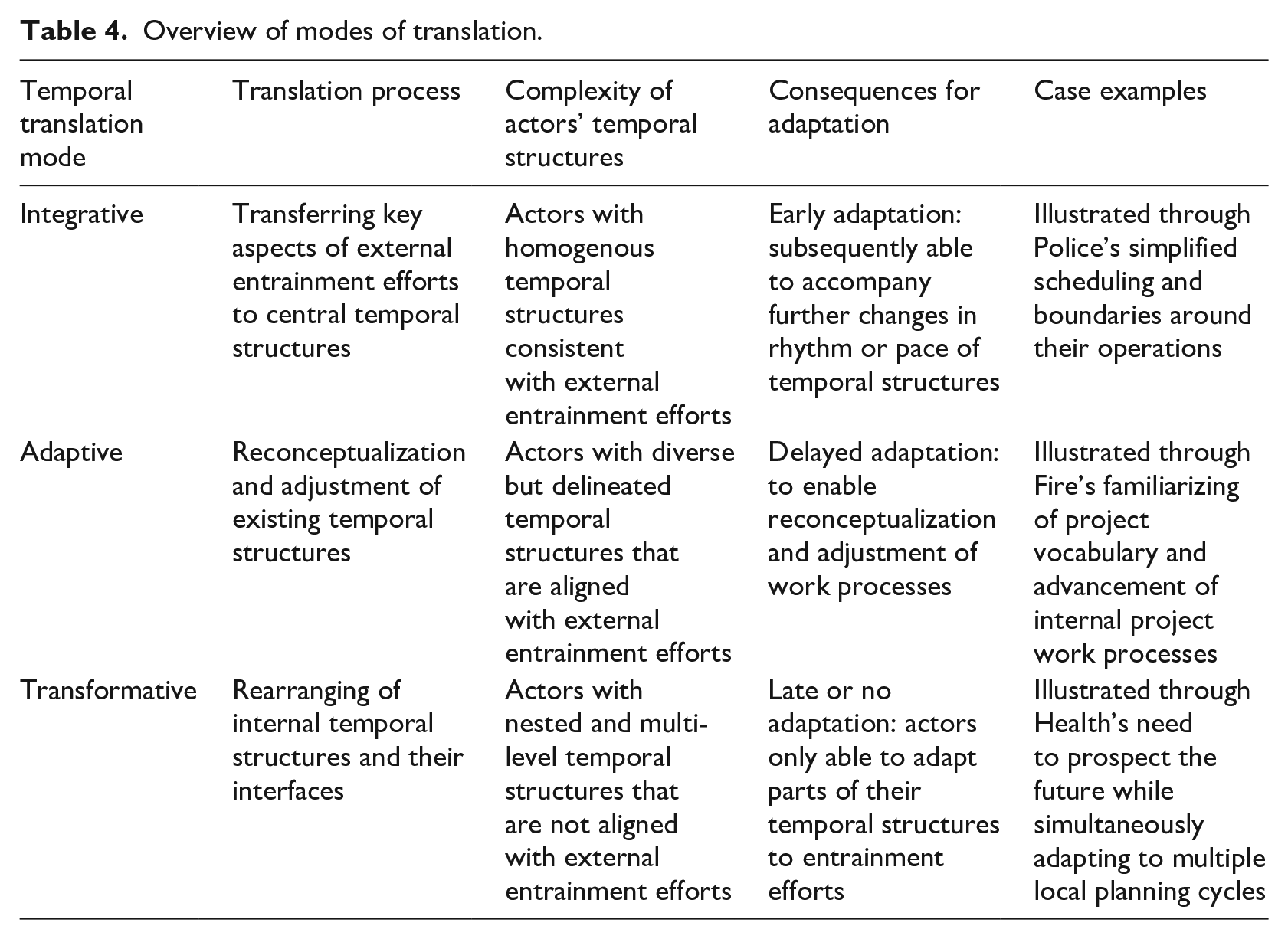
Our findings show how partners in an interorganizational project translated between their temporal structures and exogenous entrainment efforts manifested by PM’s scheduling, and how their translations affected the unfolding of the project. The different extents of temporal translation depicted three modes – integrative, adaptive and transformative – that varied in terms of how, what and how much the partners needed to translate between PM’s scheduling and their own temporal structures. The more complex the partners’ temporal structures were relative to PM’s scheduling, the more time and effort they needed to translate PM’s scheduling into their own temporal structures. Yet, as indicated by our analysis, it was the dynamic between the partners’ translations that had the most effect on the unfolding of the project since it shaped the PM’s interpretations of delays, and thereby their choice to intensify scheduling efforts. See Table 4 for an overview of the three modes of translation performed by the three partners.
Overview of modes of translation.
Interplay between the three modes of translation and management challenges
The integrative mode of translation is illustrative for how adaptation to external Zeitgebers (Ancona & Chong, 1996; Pérez-Nordtvedt et al., 2008) can happen relatively smoothly if key aspects of external entrainment can be transferred to internal temporal structures. As our study shows, this was possible because of corresponding temporal structures between external entrainment efforts and actors’ temporal structures. It is also a mode that is visible early in the collaboration, as shown in our data.
The adaptive mode of translation illustrates how actors’ adaptation to external entrainment involves reconceptualization and adjustment of internal temporal structures, simply to get organization members harmonized with external entrainment efforts. For example, Fire managed to adapt to PM’s scheduling by ‘familiarizing’ staff with project vocabulary which was followed by an ‘advancement’ of internal project work processes. Yet, as our case indicates, there should be an initial alignment between external entrainment efforts and an actors’ temporal structures to reach such collective understanding (Standifer & Bluedorn, 2006).
In contrast, the transformative mode of translation reflects how actors with multi-level and nested temporal structures can only partly or with great difficulty adapt their temporal structures to external entrainment efforts during a project. For a partner that must perform transformative translation, and thus a larger rearranging of temporal structures, uncoupling may as we observed be necessary to meet the final deadline. Uncoupling can be beneficial as it allows more flexibility and enable actors to adopt novel forms of temporal structuring (Blagoev & Schreyögg, 2019). Health, the partner that performed transformative translation, uncoupled from the collaboration to pursue their own adaption of temporal structures, to then join collaboration when the deadline approached. Decoupling from entrainment by management typically happens late in the process when catching up with scheduling becomes an insurmountable problem.
Extending entrainment theory
Our real-time data enables us to suggest extension of entrainment theory by what we label entrainment as ongoing accomplishment that focuses on processual temporal dynamics (Hernes, 2022) between actors during collaboration, and which extends dominant (Ancona & Chong, 1996; Pérez-Nordtvedt et al., 2008) as well as recently emerging entrainment theorizing (Hilbolling et al., 2022; Jarvenpaa & Välikangas, 2022). Our findings extend dominant entrainment theory by analysing the effects of differences in temporal structuring of collaborating actors and how entrainment efforts are translated to varying degrees by the different actors. Our findings also extend recent entrainment research. This research stream addresses temporal complexity in interorganizational collaboration but assumes lack of entrainment may be resolved through temporal collaborative mechanisms or repertoires that are developed and maintained by actors during the collaboration (Hilbolling et al., 2022; Jarvenpaa & Välikangas, 2022). Our study suggests a more complex interplay between entrainment efforts and collaborating actors’ temporal structures during the collaboration as it moves from the beginning towards the deadline. We will return to this point below in our discussion about the role of dwindling time in temporary organizing.
Extending theory on temporality of temporary organizing
Our study contributes to understanding the temporality of processes (Stjerne & Svejenova, 2016) in temporary organizing as they unfold in real time. Interorganizational projects tend to be characterized by temporal tensions between collaborating actors (van Marrewijk, Ybema, Smits, Clegg, & Pitsis, 2016). Yet, the existing literature focuses mainly on how to overcome tensions by applying different strategies (Dille et al., 2018) or practices (Stjerne et al., 2019). Such a focus tends to overlook the effects of dwindling time, due to fixed deadlines (Lundin & Söderholm, 1995), as projects unfold (Vaagaasar, Hernes, & Dille, 2020), which not only influences the time that problems surface, but also the time required to intervene and bring actors back into common scheduling.
More precisely, our study shows the effects of dwindling time available to make changes as deadlines draw closer, which calls for more attention to the timing and nature of entrainment efforts in interorganizational projects. A problem of temporary organizing is that members realize the need to change late in the process, often about midpoint (Gersick, 1989) or later (Vaagaasar et al., 2020). As shown, this problem becomes acute when collaborating actors have discrepant temporal structures because the inertia created by deeper-level temporal structures may come to management’s attention too late in the process in relation to the required time to overcome that inertia. Moreover, our study suggests that transformative translation may take the longest to detect because the actors performing this mode struggle with complex and nested temporal structures that may be largely invisible to other actors, including management. This suggests a double temporal dilemma, whereby managers must deal with the most time-consuming translation in the face of dwindling time to deal with the problems that are discovered late in the process (Vaagaasar et al., 2020).
Implications for managing interorganizational collaboration
Our study identifies management challenges yet to be addressed in project management research. Clashes between linear scheduling and larger organizations’ temporal structures are not surprising, but the challenges posed by diverging temporal structures to managing interorganizational projects deserve more attention. Our study suggests how a high degree of temporal discrepancy among project partners may restrict project managers’ ability to identify and cope with temporal differences early in the process, which in turn, may make management overly confident about the efficacy of scheduling. Such confidence may lead managers to intensify scheduling rather than considering alternative actions, as shown in our data. When progress is unexpectedly slow, entrainment efforts may fail when the temporal structures of one or more partners exceed a certain level of complexity. Surface manifestations may be misleading, and what appears as temporal adaptation may hide complex interacting temporal structures deeper in the organization. This corresponds to recent findings by, for example, Hüe (2022), who found in his study of a religious organization in France, that the organization adapted only partially to rhythms by external stakeholders, but in ways that were largely invisible to those external stakeholders. In such cases, intensified use of scheduling with some actors because it worked with other actors may well backfire, as shown by our study.
This might have been avoided in the project analysed by us, if PM had paid more attention to the temporality of temporary organizing and identified the most demanding translation processes early in the project. For example, examining the deeper temporal structures of Health at an earlier stage of the project could have led to a different outcome, as would realization on the part of PM of the time and effort that Health would require to adapt to the demands of the project. Considering Health’s temporal structures with more temporal reflexivity (Reinecke & Ansari, 2015) could have enabled translations that would have led to a better outcome. Such reflexivity, however, may come at the price of sacrificing efficiency in projects enabled by linear time models.
Further research on temporal translation
Our study involves a single case in a specific context, so further research is needed to explore the effects of different temporal structures in other temporary organizations, where entrainment to common schedules is important. In our case, the complexity of temporal structures turned out to be consequential, but other features of temporal structures than complexity may also be consequential for a collaboration. Moreover, further research might address how varying degrees of flexibility regarding deadlines may affect entrainment efforts during project execution. For example, how would more flexible deadlines affect the relationship between external entrainment efforts and translation processes as managers are allowed more time to detect and remedy underlying problems?
Conclusion
We are witnessing the emergence of projects as the pinnacles of a ‘project society’ (Jensen, Thuesen, & Geraldi, 2016; Lundin et al., 2015). Collaborative projects between organizations and institutions globally are pervasive. Managing and participating in projects is notoriously challenging, not least because, as noted by Lundin and Söderholm (1995), actors are always running out of time, from the start. Therefore, theorizing interorganizational projects and other temporary forms of interorganizational collaboration takes on added importance and demands particular focus on actors’ experience of moving through time and how they perform in-time adaptation to ongoing entrainment efforts.
Supplemental Material
sj-docx-1-oss-10.1177_01708406221137841 – Supplemental material for Stuck in Temporal Translation? Challenges of discrepant temporal structures in interorganizational project collaboration
Supplemental material, sj-docx-1-oss-10.1177_01708406221137841 for Stuck in Temporal Translation? Challenges of discrepant temporal structures in interorganizational project collaboration by Therese Dille, Tor Hernes and Anne Live Vaagaasar in Organization Studies
Footnotes
Acknowledgements
We are grateful to interviewees who have shared their time, thoughts and knowledge. We also want to thank the three anonymous reviewers and senior editor Jörg Sydow for their constructive and helpful comments in revising this article for publication.
Funding
The author(s) disclosed receipt of the following financial support for the research, authorship, and/or publication of this article: Tor Hernes received funding from the Velux Foundation, project No. 00021807.

Supplemental material
Supplemental material for this article is available online.
Author biographies
References
Supplementary Material
Please find the following supplemental material available below.
For Open Access articles published under a Creative Commons License, all supplemental material carries the same license as the article it is associated with.
For non-Open Access articles published, all supplemental material carries a non-exclusive license, and permission requests for re-use of supplemental material or any part of supplemental material shall be sent directly to the copyright owner as specified in the copyright notice associated with the article.
