




Abstract
Our paper investigates the dynamic interplay of narratives of individual and collective leadership within a professional service firm, where an organizational narrative of collective leadership prevails. We explain how it is possible for ‘everyone’ to claim a leadership identity for themselves while simultaneously granting a leadership identity to the collective. We identify multiple leadership archetypes embedded in individuals’ identity narratives, representing their differing senses of themselves as leaders and their alignment with the organizational narrative of collective leadership. These archetypes are mutually constitutive, representing centripetal and centrifugal tendencies in relation to the organizational narrative of collective leadership. We show how individuals committed to collective leadership nevertheless construct an individual leader (the Avatar identity archetype) to embody the collective on their behalf, and this enables them to grant leadership to the collective in the abstract. We emphasize the persistent sacralization of leadership in individual and organizational narratives, even in avowedly collectivist contexts, and the value of narrative-based perspectives in highlighting practitioners’ ability to navigate and accommodate the messy coexistence of collective and individual leadership. Our study shows the importance of integrating dialectically the individual and collective dimensions of leadership, emphasizing the mutually constitutive nature of individual and collective leadership narratives.
Introduction
If you've ever watched Star Trek there is a group called the Borg. The Borg is a collective. They are this mass of things that go forward. If bits drop off, like limbs and heads, it's completely replaced. And that's what this firm is. The individual absolutely is irrelevant. The firm is all that counts. (interviewee 23)
The quotation above is intriguing. It expresses, in metaphorical terms, an organizational narrative 1 in which the individual is entirely subsumed within the collective. In this paper we explore whether there is still space for individuals to construct their identity as leaders when an organizational narrative of collective leadership prevails.
In recent years many leadership scholars have emphasized that leadership is not simply the purview of individual ‘heroes’, working within established hierarchies, but requires collective participation (Denis, Langley, & Sergi, 2012; Ospina, Foldy, Fairhurst, & Jackson, 2020). Scholars of collective leadership focus on collaborations among multiple individuals in formal and informal leadership positions (Gronn, 2002), where distinctions between leadership and followership are mutable and contested (Empson & Alvehus, 2020). Leadership is sometimes presented as inherently collective (Ospina et al., 2020), since individuals’ leadership claims become meaningful only when reciprocally granted by ‘followers’ (DeRue & Ashford, 2010). At the extreme, some scholars argue for redefining leadership entirely in terms of a collectively produced direction, alignment and commitment (Drath et al., 2008).
The collective turn in leadership research potentially marginalizes individual leadership – so that individual/collective becomes another example of ‘dichotomization’ within the leadership literature (Collinson, 2014, 2020), which potentially masks the tensions and ambiguities within everyday leadership situations. Some scholars have suggested that individual and collective forms of leadership can coexist, interact and potentially support one another (Gronn, 2009; Holm & Fairhurst, 2018; Pearce & Sims, 2002). However, to our knowledge, no work has investigated how individuals narrate their own identities as leaders when embedded in settings characterized by an organizational narrative of collective leadership.
The dialectical tension between our urge for individuation (Jung, 2014) and our search for validation through identifying with a social group (Tajfel & Turner, 1985) represents a fundamental paradox within the human psyche. Individuals may be reluctant to abandon their individual leadership narratives, given the persistence of the social-cultural discourse of ‘heroic’ leadership. This discourse is variously described as ‘the romance of leadership’ (Meindl, Ehrlich, & Dukerich, 1985), ‘leaderism’ (O’Reilly & Reed, 2011), and the ‘sacralization’ of leadership (Grint, 2010). Drawing on Kreiner, Hollensbe and Sheep’s (2006) language, we suggest that individuals may struggle to situate their ‘I’ as an individual leader within the organizational ‘we’ of collective leadership. Thus, we ask, How do individuals construct their identity as leaders while sustaining an organizational narrative of collective leadership?
To address this question, we present an inductive study of leadership narratives within an elite professional service firm. Leadership often appears collective in such organizations, reflecting the contingent and contested power relations that typify professional partnerships and the corporate professional service firms that seek to mimic them (Empson, 2017; Empson & Langley, 2015). The firm we studied is an extreme case with an unusually deep commitment to the collective, expressed in the opening narrative fragment and explored more fully later in this paper. Through detailed narratives of 34 individuals, identified by their colleagues as ‘leaders’, we explore how notions of individual and collective leadership are articulated and become consequential.
We identify multiple individual leadership archetypes embedded in individuals’ identity narratives, which represent their differing senses of themselves as leaders and their alignment with the organizational narrative of collective leadership. We demonstrate how these archetypes are mutually constitutive, embodying centripetal and centrifugal tendencies. We show how individuals committed to collective leadership nevertheless construct a single individual leader – represented by the Avatar archetype – to embody the collective on their behalf, which enables them to grant leadership to the collective in the abstract.
We emphasize how it is possible for ‘everyone’ to claim a leadership identity for themselves individually, while simultaneously granting a leadership identity to the collective. We contribute to studies of collective and individual leadership, and to studies of leadership in professional organizations. We emphasize the persistent sacralization of leadership in individual and organizational narratives, even in avowedly collectivist contexts, by highlighting practitioners’ ability to navigate and accommodate the coexistence of collective and individual leadership through narrative. Specifically, our study shows the importance of integrating dialectically the individual and collective dimensions of leadership, emphasizing the mutually constitutive nature of individual and collective leadership narratives. Our research contributes, therefore, to a deeper understanding of leadership in general, and also helps clarify and advance collective leadership as a theoretical construct, highlighting the potential of a narrative approach.
Collective and Individual Leadership: Oppositional, Hybridized, and Dialectical
A growing body of theory, encompassing diverse streams of research, has explored leadership as a collective or ‘plural’ phenomenon (Denis, Langley, & Sergi, 2012). This body of work highlights the inherently relational nature of leadership and how multiple leadership actors are involved in its co-creation.
Ospina and colleagues (2020) identify two distinct perspectives. The first views collective leadership empirically as a phenomenon, a distinct type of leadership, whereby leadership is spread among multiple organizational members, rather than predominantly associated with one individual. Notions such as shared, dual and distributed leadership express this idea (Bolden, 2011; Denis et al., 2012; Empson & Alvehus, 2020; Gronn, 2002; Reid & Karambayya, 2009). A second perspective, on which this paper builds, views collective leadership ontologically as a lens for considering leadership of any kind. This argues that leadership emerges from interactions that produce collective direction so can potentially be viewed as decentred from individuals (Crevani, Lindgren, & Packendorff, 2010; Drath et al., 2008; Raelin, 2016). Other studies, such as DeRue and Ashford (2010), regard individuals as central to leadership dynamics but emphasize the reciprocal process through which they come to be accepted as leaders by their colleagues. From this perspective, leadership, though potentially initiated by individuals, is still ontologically collective and relational because it cannot exist unless granted by others.
Related to the type-lens distinction, some scholars have questioned mainstream ‘leader-centred’ perspectives (Wood, 2005) that locate leadership in the traits of specific individuals, arguing instead for perspectives that view leadership as a process (Crevani et al., 2010) or practice (Raelin, 2016). From this social constructionist perspective, leadership may involve people who can be identified as ‘leadership actors’ (Fairhurst, 2007), but can also exist independently. Thus leadership is decentred from specific individuals, recognized instead by what it produces in terms of shared meaning and direction.
These broad conceptual distinctions suggest three somewhat different ways in which individual and collective notions of leadership can be positioned in relation to one another.
Collective and individual leadership as oppositional
When viewed as a ‘type’, collective leadership is most often constructed in opposition to individual leadership, as an either-or ‘dichotomy’ (Collinson, 2014). For example, Gibeau, Reid and Langley (2016) discuss formal ‘co-leadership’ structures (oriented around pairs of individuals who share roles), contrasting them with unitary leadership structures (oriented around individual leaders). Such co-leadership structures may be better suited to pluralistic settings such as cultural organizations, health care and professional services (see also Reid & Karambayya, 2009).
Others look beyond specific organizational contexts to argue that collective leadership is inherently superior because it implies ‘democratic’ values and a higher degree of employee participation (Nielsen, 2011; Raelin, 2016). Reflecting this ideological turn, debates about collective leadership framed in normative terms have been characterized by considerable tension and sometimes even passion (Collinson, 2018; Raelin, Kempster, Youngs, Carroll, & Jackson, 2018). Raelin (2011, p. 203), for example, sees the practice perspective on leadership not simply as a conceptual choice, but as linked it to what he calls ‘leaderful’ practice, to convey the value of democratic perspectives where everyone participates. Nielsen (2011) promotes the value of ‘leaderlessness’ to make a similar point, contrasting ‘rank-based’ (hierarchical, individually-oriented) vs. ‘peer-based’ (horizontal, collectively-oriented) approaches, with the latter presented as both instrumentally and ethically more desirable. Finally, the concept of ‘anti-leadership’ (Sutherland, Land, & Böhm, 2014), observed in anarchist social movement organizations, emphasizes even more deeply a value-commitment to collectiveness, despite the tensions this may raise.
These approaches treat individual and collective leadership as oppositional, either because they are viewed as contingent on context, or because the latter is deemed normatively superior. Collinson (2014) argues, however, that such strong either/or oppositions may fail to recognize the ongoing interaction and fluidity between individual and collective forms of leadership.
Collective and individual leadership as hybridized in organizational practices
Some studies have reached beyond oppositional conceptualizations to investigate how collective and individual forms of leadership work in combination. For example, Gronn (2009) argues for ‘hybrid leadership configurations’, incorporating both individual and collective elements. Similarly, in positivist survey-based studies, Pearce and Sims (2002) show that shared leadership contributes more strongly to performance when individual ‘vertical’ leadership is also present.
Studies adopting a lens rather than type perspective, and drawing on social constructionist approaches, have also begun to consider individual and collective forms of leadership in interaction. For example, Holm and Fairhurst (2018) reveal the interplay in a study of team meetings. They find that, while leadership authority appears shared in momentary conversations, longer-term outcomes are typically determined by individual hierarchical leaders.
Finally, adopting a symbolic interactionist view, DeRue and Ashford (2010) contribute indirectly to understanding the potential interrelatedness of collective and individual forms of leadership, offering an important conceptual building block for our own study. They argue that leader and follower identities are continually renegotiated through an iterative process of ‘claiming’ and ‘granting’, raising the possibility that leadership actors may swap identities over time.
Collective and individual leadership as dialectic tension expressed through narratives
The above-mentioned studies reveal some of the complexity associated with interactions among individual and collective forms of leadership. Yet, they do not explain how individuals experience and articulate the dialectic tension between collective and individual leadership within their organizations. This is particularly intriguing given the prevailing social-cultural narrative of leadership that is more ‘heroic’ and individualized (Grint, 2010; Meindl et al., 1985; O’Reilly & Reed, 2011). Although some leadership scholars seek to move the focus of leadership research away from leader-centred views, several studies have shown that practitioners naturally associate the notion of leadership with individual influence. For example, Schweiger, Müller and Güttel (2020) illustrate how, even when trained in collective leadership practices, EMBA graduates tend to revert quickly to heroic conceptualizations of leadership on returning to work. Even in their study of ‘anti-leadership’, Sutherland and colleagues (2014, p. 767) explain that informants’ ‘understanding of leadership was broadly in line with the mainstream emphasis on individuals in hierarchical positions’.
This raises the question of whether narratives of individual leadership will work their way into individuals’ identity constructions, even when their organizational narrative privileges collective leadership. Given the range of alternative approaches discussed above, there is room for a more nuanced understanding of how individuals narrate their leadership identities in the context of an organizational narrative of collective leadership. This leads to a more in-depth presentation of our conceptual framing for this study, grounded in a narrative perspective.
Narrative Perspective on Leadership Identity
Many scholars portray identity, both individual and collective, as fundamentally constituted through narratives. As summarized by Brown (2022, p. 4), narrative identity ‘is a person’s internalized and evolving set of self-relevant stories and story fragments’. The narrative elaboration of identity is an ongoing process, implying both self-definition and aspiration, i.e. storytelling about ‘who we are and who we want to be’ (Humle, 2014, p. 70). Individuals craft identity narratives by drawing upon a range of discursive resources, including those supplied by their organization and the broader social-cultural context (Brown, 2019). As Humphreys and Brown (2002, p. 439) note, ‘people author narratives not just to account for their organizations and other communities, but to “enact” versions of themselves and their relationships to other social categories’.
Narratives can be viewed variously as ontology, epistemology, theoretical lens, data and method (Rantakari & Vaara, 2017; Rhodes & Brown, 2005). Specifically, Rantakari and Vaara (2017) refer to multiple perspectives, including ‘narrative construction’ which emphasizes how narratives are used to socially construct reality, and ‘narrative agency’ which examines how narratives constitute organizational phenomena. Our approach integrates these two perspectives; we see narratives both as a way in which individuals make sense of organizational phenomena and as a means by which such phenomena are produced, maintained and potentially challenged. These perspectives do not imply that narratives are fully coherent, completely shared, or stable (Brown, 2022). Furthermore, as individuals in organizations engage in narrating their selves, they are also narrating their organizations. Therefore examining narratives allows us to appreciate the interplay between what is expressed both at the individual and organizational level.
Narratives, in particular those relating to identity construction, are often portrayed as embodying tensions, as individuals struggle to position their selves amid diverse competing pressures and discourses. For example, Brown, Lewis and Oliver’s (2021) study examines the identity narratives of business school deans, revealing tensions in their attempts to reconcile their established identity as researchers with their emerging identity as leaders. Nyberg and Sveningsson (2014) examine identity narratives of individuals struggling to position themselves as ‘authentic’ leaders, while nevertheless restraining their authenticity, and show how they develop ‘metaphorical selves’ to accommodate these tensions. Levay and Andersson Bäck (2022) examine tensions underpinning nursing home managers’ espoused ‘caring leader’ identities. While these, and other, narrative-based studies illustrate the tensions that people may experience in their leadership identity, we know of no prior work that focuses directly on the construction of individual leadership identity narratives alongside organizational narratives of collective leadership.
Collective Leadership in Professional Contexts
Studies of collective leadership emphasize how it can serve a functional purpose in pluralistic professional environments (Denis et al., 2012; Empson & Alvehus, 2020). In professional partnerships in particular, competing interests and contested power relations may be structurally embedded, as both ownership and profits are shared among professional peers (Greenwood & Empson, 2003).
Empson and Alvehus (2020) identify three relational processes through which professional peers co-construct collective leadership. ‘Legitimizing’ describes how the most commercially successful individuals can claim, and be granted, a leadership identity. The study finds that being granted a leadership identity by peers does not automatically translate into leadership authority. This authority rests on two further relational processes. ‘Negotiating’ involves leaders asserting control while colleagues continue to exercise autonomy, and ‘manoeuvring’ involves leaders behaving politically while colleagues continue to perceive them as having integrity. Ultimately, Empson and Alvehus (2020) argue, the complex power dynamics embedded within these relational processes represent an unstable equilibrium. Professional peers claim and grant leadership identity and authority on a contingent, contested, and ultimately fluid basis.
With limited formal hierarchical distinctions among partners, more informal means of social control may be mobilized in an attempt to align the interests of individual partners with the interests of the partnership as a whole. One means of reconciling the tension between the individual and the collective is to deliberately amplify ambiguity in leaders’ roles and responsibilities to perpetuate a sense of equality among peers (Empson, 2020). Another is for partners to sustain an organizational narrative which privileges the collective, i.e. the ‘partnership ethos’ (Empson, 2017). As the professional context is likely to give rise to organizational narratives of collective leadership, it constitutes a setting where our research question becomes particularly salient, as outlined below.
Research Design and Methodology
This paper represents part of a broader study by the first author into collective leadership in professional service firms. During data collection, one firm (Alfred Weber 2 ) emerged as an extreme case.
Research context
Alfred Weber’s website describes it as ‘the world’s leading advisory firm’ in its sector. Established more than 50 years ago by the founder, Alfred Weber, at the time of the study the firm had revenue of US$ 600 million, 400 professionals (200 partners and 200 ‘pre-partners’), offices in 40 countries, and over fifteen practice areas and industry groupings.
Various features make Alfred Weber atypical in its sector. It is a partnership, with equity apportioned equally among all partners, whereas most competitor firms are corporations. Competitors typically share profits through an individualized ‘eat what you kill’ model, but Alfred Weber partners are remunerated through a ‘lockstep’ system, sharing profits according to tenure. Unlike most professional partnerships, the firm does not recruit from university, but focuses instead on mature hires. Whereas many partnerships maintain an ‘up-or-out’ structure, most professionals join Alfred Weber expecting to be promoted to partner. Candidates are typically interviewed by up to 40 partners, and can be eliminated at any stage if interviewers identify a lack of fit, ensuring that recruitment and socialization processes are co-terminous.
The firm has many formally designated ‘office leaders’, ‘practice leaders’, ‘sector leaders’, and ‘leaders of the X practice in country Y’, as well as an elected board and executive committee (ExCo). Most leadership roles, including CEO, are appointed by the chair. The two most significant formal leadership roles, chair of firm and chair of partners’ meeting, are elected by the partners. The ultimate decision-making body is the partners’ meeting. Taken together, the firm’s decentralized governance structure, egalitarian remuneration system and collectivist values underpin a powerfully articulated organizational narrative of collective leadership.
Data collection
The first author conducted 34 interviews following a snowball sampling method. The chair was first asked to suggest colleagues whom he recognized as leaders (i.e. in DeRue and Ashford’s (2010) terms, colleagues ‘granted’ a leadership identity). These interviewees were then asked to identify colleagues they recognized as leaders. Some interviewees held titles such as ExCo member, board member, office head, and practice head; others held no formal leadership role; two were not partners. 3
Interviews typically lasted approximately 90 minutes and were recorded and transcribed. Questions were deliberately broad and designed to elicit interviewees’ narratives with regard to claiming and granting leadership identity. For example: ‘Do you consider yourself a leader of the firm?’, ‘Describe a specific situation where you believe you exercised leadership’, ‘Why do you consider [X] to be a leader?’, ‘Describe a specific situation where you believe [X] exercised leadership.’ Wherever possible, the interviewer explicitly encouraged interviewees to tell ‘stories’ to illustrate their statements.
Data analysis
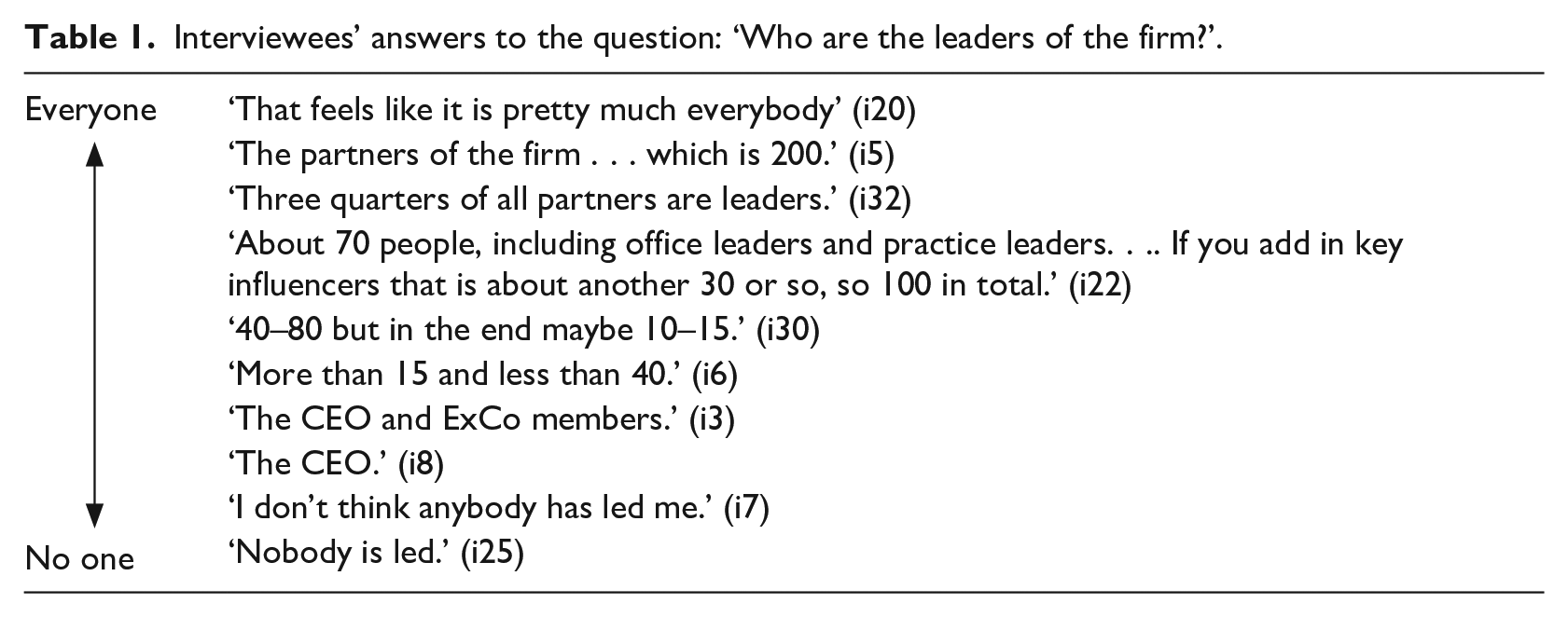
As typical with inductive research, data analysis was elaborate and iterative (as represented in online Appendix 1). The first author began by identifying all those granted a leadership identity by their colleagues. She found that responses to the question ‘Who are the leaders of the firm?’ varied from ‘everyone’ to ‘no one’ (Table 1). Making sense of these responses represented the central empirical puzzle that inspired this paper. Subsequent analysis, outlined below, was conducted collectively by all authors.
Interviewees’ answers to the question: ‘Who are the leaders of the firm?’.
Organizational narrative of collective leadership
We initially selected four interviews for in-depth reading (current chair, one practice head, one office head, one country head). We prepared detailed notes, identifying and examining interviewees’ intriguing statements about collective leadership, and stories about how it was enacted. After comparing notes and questioning nuances in interpretation, we analysed the remaining 30 interviews. We noticed a remarkable degree of conformity in how interviewees talked about the firm’s values, but identified three distinct variations in their talk about collective leadership. We noted where interviewees’ claimed leadership identities for themselves and granted them to others.
To move beyond abstraction, we identified numerous detailed narratives of specific acts of leadership. This led us to focus on the dynamics of the twice-yearly partner meeting. Worley (2019) refers to the ‘performative and ritualistic role’ of meetings, emphasizing how individuals’ actions in meetings ‘assist in enacting and reifying the social narratives which bind individuals to the broader whole’ (p. 596), including organizational narratives of leadership. Focusing on the performative and ritualistic role of the partner meeting enabled us to examine how, in narrating stories about collective leadership, interviewees claim individual leadership for themselves and grant it to specific others. In exploring how the abstract organizational narrative of collective leadership is sustained by colleagues recounting acts of individual leadership, we began to identify the mutually constitutive nature of individual and collective leadership narratives.
Individual leadership identity narratives
We then delved deeper into interviewees’ narratives (see online Appendix 2 for an interview excerpt with accompanying analysis), exploring how they justified claims to be a leader and constructed their leadership identities. We also examined how they granted leadership to others. We noted variations in how closely individuals aligned themselves with the organizational narrative of collective leadership, again interrogating the interrelationship between individual and collective leadership narratives.
Combining these two dimensions (individual leadership identity and alignment with collective leadership narrative) led us to identify seven leadership identity archetypes, as will be explained, which embody centripetal and centrifugal tendencies in terms of their alignment with the collective leadership narrative. Consistent with Jungian concepts of archetypes, in some cases interviewees drew upon terms present in prevailing societal discourses of individual leadership (e.g. ‘servant’). For other archetypes we chose terms reflecting how interviewees described themselves more generally as leaders (e.g. ‘challenger’). As explained later, the term ‘avatar’ was inspired by one interviewee, quoted at the start of the paper, who referred to the firm as being like the ‘Borg’.
Mutually constitutive leadership identity narratives
To answer our research question fully, we then analysed how the seven leadership identity archetypes related to each other. We developed a framework to represent these dynamics (Figure 1).
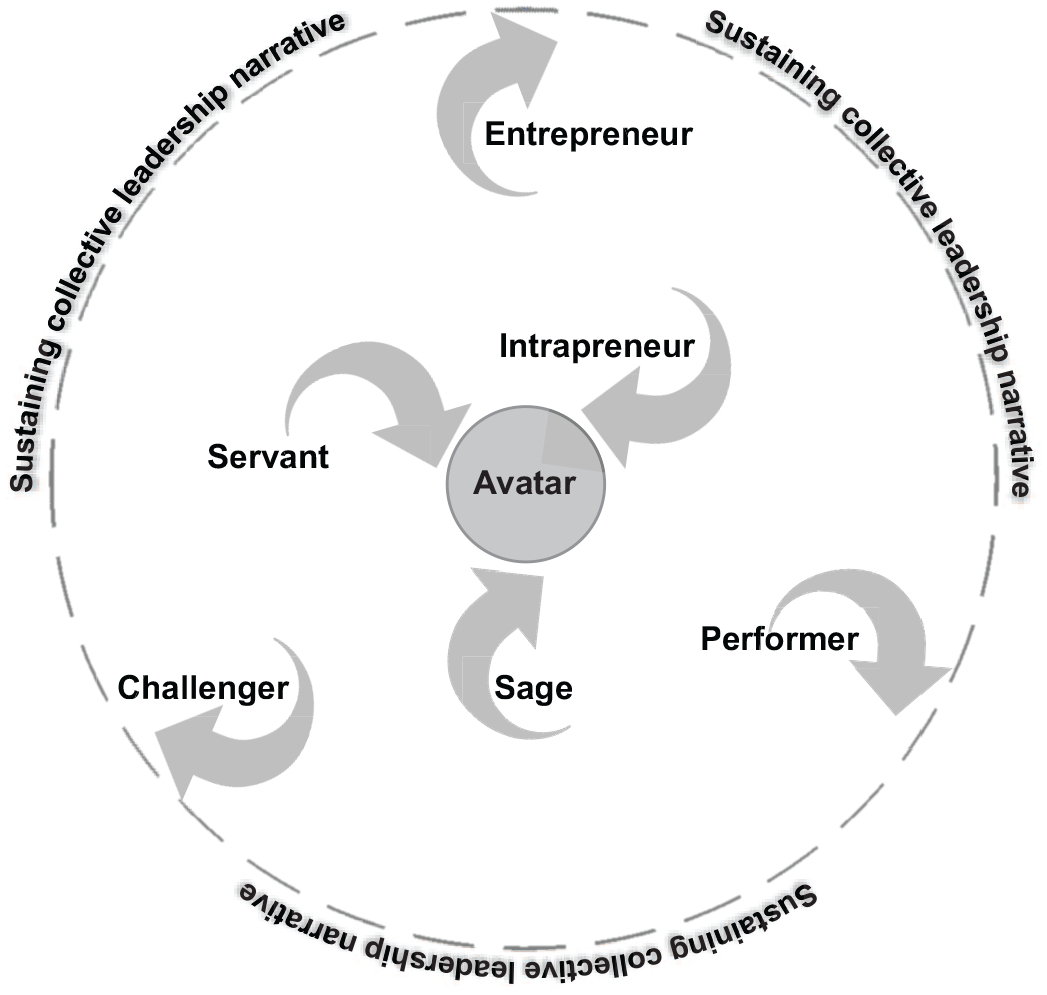
Mutually constitutive identity narratives of collective and individual leadership.
Below we focus on the organizational narrative of collective leadership, illustrating its enactment through accounts of the partner meeting. We then introduce the seven leader archetypes, and develop the framework that draws these elements together.
Organizational Narrative of Collective Leadership
We are all enculturated with the idea that we are leaders. (i11)
4
It’s fairly unique in the respect that nobody’s led. (i23)
When asked ‘who are the leaders of the firm?’, interviewees’ answers range from ‘everyone’ (i.e. universal) to ‘no one’ (i.e. absent), as summarized in Table 1. Interviewees also expressed a third variation (i.e. ‘holistic’), whereby individual leadership is subsumed within the collective and can only be understood as a unified whole. These variations on the collective leadership narrative reflect subtly different conceptualizations of leadership.
Variations on a theme
Universal: ‘Everyone’ is a leader
The universalizing version of the collective leadership narrative emphasizes shared responsibility for leadership. In other words, interviewees grant leadership to all 200 fellow partners, regardless of their formal leadership position.
What are the real leadership positions? Who has stuff they have to do and if they don’t do it well, bad things happen? That feels like it’s pretty much everybody. (i20) I don’t think of leadership as being the chairman and I don’t think of leadership as being the ExCo. I suppose I think of it as the partners. (i5)
Absent: ‘No one’ is a leader
For the second variation no one claims or is granted leadership. Interviewees highlight the absence of authority for those in formal leadership positions. As one interviewee says: ‘I wonder if anyone at any time really becomes a leader in our firm because, basically, (we) don’t want to be led’ (i17). In other words, no one is claiming followership either. Consistent with a partnership perspective, this ‘absent’ variation emphasizes colleagues’ freedom to act autonomously within a collective understanding of culturally appropriate behaviour.
It’s a relatively unrestrained environment. . . It’s confined by certain rigid principles that are extended into accepted behaviours. But the space you can travel in is a large one with very few road signs or limits. (i1)
Holistic: A family, an organism, the Borg
The third variation bridges the gap between the universal and absent variations. Interviewees imply that leadership is subsumed within the collective, i.e. leadership is granted to the collective in the abstract, rather than to individuals in the specific.
‘If you’re in, you’re part of the family. . . We are collectively the parent. We are parents to each other. We all feel that.’ (i25)
‘The firm is like a very, very big organism that moves in a particular direction and there’s no real brain.’ (i24)
5 : ‘If bits drop off, like limbs and heads, it’s completely replaced. And that’s what this firm is. The individual absolutely is irrelevant. The firm is all that counts.’ (i23)
This holistic variation emphasizes a strongly conformist organizational narrative based on collectivist values. By implication, all individuals become followers of the collective. Two interviewees make semi-serious references to the firm being a ‘cult’. Noncongruent behaviours are referred to as ‘against the religion’ (i10). ‘You won’t find any heretics here’ (i25). Interviewees describe themselves as ‘disciples of Alfred (the founder)’ (i23), and ‘blessed to be in the firm’ (i10). They refer to the firm’s ‘gospel stories’ (i12) and draw on religious terms: ‘We’re Calvinist’ (i1); ‘The Jesuits are a model for the firm’ (i12); the firm is ‘a kind of nirvana’ (i25). Though the founder retired more than ten years previously, interviewees emphasize that his legacy still has powerful resonance: ‘We are all just poor copies of Alfred’ (i25). As another explains: ‘Alfred’s immortality is not Alfred the man; it is Alfred the concept’ (i23). Interviewees refer to this as ‘The Alfred Weber way’ (i9). By invoking ‘Alfred the concept’, interviewees sustain the collectivist values and organizational narrative of collective leadership.
By articulating these three variations on the collective leadership narrative, interviewees express complex and apparently inconsistent perspectives on leadership. The universal and absent variations both reflect leader-centred conceptualizations of collective leadership – understood as something that emanates from specific individuals. 6 In the universal variation each partner is granted leadership by their colleagues. The absent variation is implicitly leader-centred; because leadership is not located in any individual, interviewees conclude that there is no leadership. The third, holistic variation reflects a more explicitly decentred conceptualization. Here interviewees are clear that leadership is happening (unlike the absent variation), but present it as embodied by the collective, rather than in specific individuals.
Interviewees recognize apparent inconsistencies in their conceptualizations of collective leadership, using terms such as a ‘pretty fuzzy picture’ (i5), ‘mercurial’ (i18), and a ‘subtle dance’ (i25) to describe how leadership happens in the firm. As one says: ‘There is no centre of Alfred Weber. The only centre I can think of is the partners’ meeting’ (i4). Below we show how the abstracted organizational narrative of collective leadership is sustained by interviewees narrating specific acts of individual leadership at the partner meeting, thus highlighting its ritualistic role. In so doing we begin to explicate the subtle dance through which the collective leadership narrative is enacted.
Narrating collective leadership in action
Just being in that room is magical, and people love that, and that’s what kind of keeps them together, just the story telling that happens in that room and the history that’s related in that room, it makes you passionate about the firm. (i29)
Interviewees describe their twice-yearly two-day partner meeting as an opportunity for the 200 partners to publicly enact their commitment to collective leadership. The meeting is described as having ‘real sanctity’ (i29), as ‘something mystical’ (i21), at which the long-retired Alfred seems to ‘still be in the room’ (i21). The term ‘the room’ is repeatedly invoked by interviewees to express the location of their abstracted sense of the collective. ‘There is power in the room to stop things, to initiate things, to move things on’ (i30).
Interviewees offer detailed narratives of individual leadership in the context of the ‘room’, during which they explicitly claim leadership for themselves and grant it to specific others. They talk about when they have felt moved to speak, when they have persuaded ‘the room’, and how they have gone about doing it. To explain why they view particular colleagues as leaders, they recall examples of how these individuals influenced key debates. In doing so, they reassert the narrative of collective leadership, by emphasizing that they are collectively responsible for holding each other to account.
In the meetings, there are people who'll call bullshit on something. [i5] would do that. [i26] would do that. [i6] would do that. I would do that. Go public as the conscience or the counterpoint. . . . [i17] is one. [i24] also. . . And then there are individuals who, when they stand and speak, the entire room goes quiet because people want to hear every word. There are people who can turn an entire discussion. . . I have a lot of admiration for those people. (i1)
One incident, which happened more than fifteen years prior to the research study, was narrated unprompted by three interviewees. The first, (i32), offers a simple high-level summary.
I can think of one incident where a partner made a motion. I actually forget what exactly it was, but there was a discussion. And the discussion was so controversial that the partner said that he would withdraw his motion because, even if the motion had gone through, the voices against would have been so strong that it didn’t feel right. There was a roaring applause for that. . . The way he withdrew his motion, that was awesome. (i32)
Two other interviewees’ descriptions of this incident are analysed in detail below to demonstrate how the organizational narrative of collective leadership is sustained by narrating individual acts of leadership (i.e. claimed by and granted to individuals, while ultimately granting overall leadership to the collective).
The Office Head (i25), speaks of how he introduced, and then withdrew, the proposal: The [XYZ] office wanted to do something really quite controversial, to introduce this new line of business. We, in [XYZ] had put together a fantastic case for why we wanted to go down that route.
He, therefore, begins by claiming leadership on behalf of his office (‘we’), without naming specific colleagues. He then moves on to make emphatic leadership claims for himself: I gave a great speech and I was delighted. . . I presented it really bloody well because I was given a fantastic lot of facts and slides and I knew the brief and I was very persuasive. And I answered the questions well and I’d done a huge amount of pre-selling.
He then briefly acknowledges how unnamed colleagues influenced the leadership dynamics.
But there was a minority of partners who felt passionately that this was a big mistake . . . So we had a big, big debate. . . And despite all the opposition, we got about a 75% or 80% vote in favour; so all the [XYZ] partners were cheering.
Here he is still referring to ‘we’ as the heroes of the leadership narrative. But below, he switches to ‘I’, making himself the hero. Paradoxically, he does so by recounting how his intervention granted implicit leadership to the wider collective: And I decided, in a split second, that this was not a good idea to steamroller a 20% minority. I said, ‘We’re delighted we’ve won this vote, but it’s not right for an 80% majority to trample on 20%, having heard and seen how passionately this minority feels about what this means in terms of our values and our strategy. So we withdraw the motion.’. . . And I know that got me enormous respect, not just from the 20% but also from most of the 80%.
Having individualized the collective by referring to his own views and actions, and those of colleagues in the [XYZ] and other offices, he concludes his account by reasserting the organizational narrative of collective leadership: ‘That is a very, very important cornerstone of our philosophy; you don't trample on a minority if a minority feels passionately about something, passionately enough to threaten the whole value system and structure and spirit of the firm.’ (i25)
By withdrawing his original proposal, he reaffirms the organizational narrative of collective leadership, granting leadership to the collective in the abstract, whilst also asserting his leadership claims. His leadership claims are granted by colleagues, who consider his action to be ‘awesome’ (i23).
The third narrative comes from (i10), who argued against the proposal. His detailed narrative emphasizes the ebb and flow of discussion amongst multiple colleagues, demonstrating how individual acts of leadership coalesce to sustain the organizational narrative of collective leadership. He starts his story: Many years ago, our colleagues in [XYZ] office came up with a proposal to launch a new practice and, if proven successful, to extend it to other markets.
He, therefore, begins by granting leadership to the collective within the [XYZ] office. He then identifies [i23] as a leader for having initiated the proposal.
The background of the study was done by [i23]. . . . So [i23] created a very, very, compelling proposal. . . It was very compelling superficially. But if you were to analyse it carefully, as I did (emphasis added), it didn’t make any sense.
He thus starts to position his own leadership intervention and to develop his own ‘hero’ narrative. Only now does he grant leadership to [i25]: [i25] opened by quoting Shakespeare and I can still see him, holding a hand-held microphone. He said ‘Ideas are neither good nor bad, only an intelligent discussion makes them so.’ And he started a brilliant discussion, very open, very balanced, encouraging everyone to share their views and perspectives. It lasted about two hours.
He then grants leadership to a variety of unnamed colleagues, acknowledging the multiple ways in which individuals contribute to the collective leadership dynamics: There were those in favour because they had read that this line of business is the future. ‘Clients would like it blah, blah, blah. So we need to do it.’ Then there were some like myself saying ‘I did the number crunching. This is bullshit. This will never be profitable.’ And then there were others who looked beyond the numbers. I can remember a guy from Scandinavia saying ‘I joined a classy consulting firm, I didn’t join a shitty firm doing work like this, this is a matter of religion.’
His story builds to its denouement.
Then the time came to vote. These types of decisions require only a simple majority. And I don’t remember the exact numbers but the decision was approved (and) there was a huge silence in the room. You could listen to the noise of a pin dropping on the carpet.
The office head [i25] who introduced the proposal, now returns to the centre of the narrative: I remember seeing [i25] with two colleagues either side. He spoke with one, he spoke with the other and said, ‘Wait a minute, I heard the noise in the room, I felt the heat of the discussion and I really believe that this will divide us. . . . So we will retire the proposal because we think the damage of the potential division of the partnership is significantly higher than the opportunity costs of launching this practice.’
In his final statement (i10) reaffirms the narrative of collective leadership: It was a dramatic case of how significant, how important, how crucial, how essential, how fundamental consensus is for our decisions.
This section established that an organizational narrative of collective leadership prevails within Alfred Weber. That narrative can take multiple forms – universal, absent and holistic – and can encapsulate interviewees’ stories of both individual actions and collective will. We showed how individuals construct and sustain the organizational narrative of collective leadership by recounting individual acts of leadership, by themselves and by others. Taken together, the partner meeting narratives express the ‘subtle dance’ (i25) of leadership in Alfred Weber.
A dance typically comprises individual performers in interaction – dancers may take it in turns to perform individual choreography, dance in partnership with others, and join together in a collective dance. We now examine in detail the variety of ways in which individuals construct their identity as leaders – in effect we explain how interviewees describe their individual ‘choreography’ – before exploring how their narratives come together in the ‘subtle dance’ of collective leadership.
Constructing Individual Leadership Identities Within an Organizational Narrative of Collective Leadership
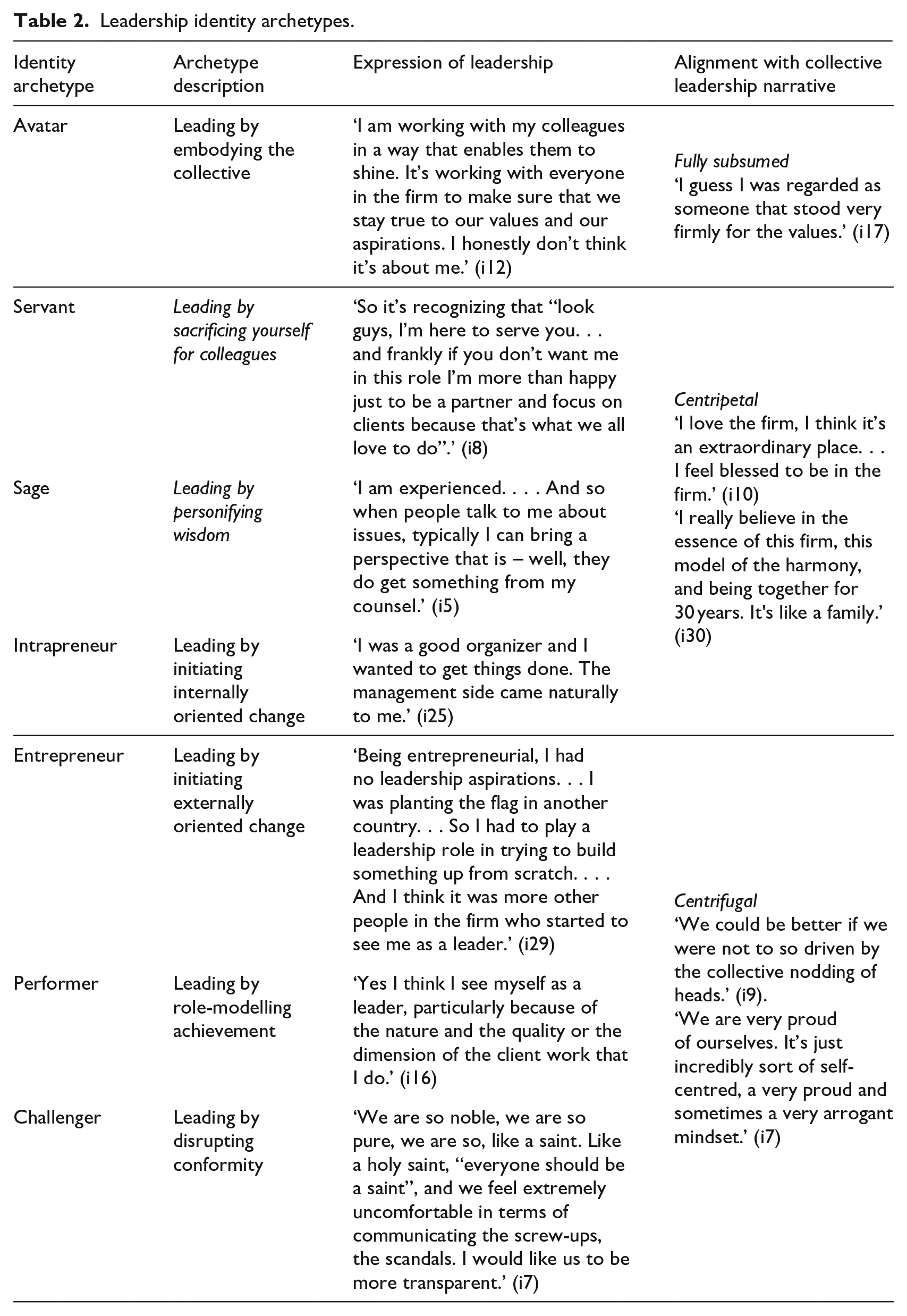
As is typical in narrative studies, when analysing how interviewees talk about themselves and others, we see considerable complexity and nuance. Nevertheless, we identified several broad themes consistently articulated by interviewees. We refined these themes into distinct leadership identity archetypes (summarized in Table 2), each of which encompasses two dimensions. The first dimension represents how interviewees describe themselves as leaders. Some archetypes reflect prevailing social-cultural narratives of individual leadership while the final archetype, the avatar, is specific to collective leadership. The second dimension represents interviewees’ alignment with the organizational narrative of collective leadership. Each archetype embodies centripetal or centrifugal tendencies (i.e. reflecting the extent to which interviewees are aligned with the collectivist values of the organization). We do not suggest that individuals situate themselves uniquely within any single archetype, but rather that these archetypes constitute common themes reflected in our informants’ narratives.
Leadership identity archetypes.
Centripetal archetypes
The servant, sage and intrapreneur archetypes represent leadership narratives that are most closely aligned with the collectivist values and organizational narrative of collective leadership, but still encompass individual leader identities, in subtly different ways.
Servant: Leading by sacrificing yourself for colleagues
The servant archetype is associated with an explicit narrative of self-sacrifice while occupying formal leadership roles. It is sometimes attributed explicitly to specific others: ‘He gave up his office leadership role because he wanted to become a servant for the whole’ (i28). Interviewees also describe their own behaviour in a way that conforms to the social-cultural narrative of servant leadership: I take care of the office and I am responsible for all the staff. So I am a leader, but I am a special leader, in a way, because I try not to be dominant. . . . In our office meeting I said, ‘Guys, I’ve been doing this for five years now. My strategy has been to do all of the administrative stuff, as much as I can, myself, so that you are free.’ And I said, ‘It kills me. It eats me up. . . I’d be grateful if you would take on part of it.’ (i32)
In the servant narrative, interviewees claim leadership by explaining how they have given up the client work they ‘love to do’ (i8, Table 2) for others’ benefit, and in so doing have lived according to the organization’s collectivist values.
I could only grow this office by giving my clients to the younger ones and saying ‘I trust you.’. . . I was a low biller because I passed all the client relationships onto others. I am suffering from that fourteen years later but, because of this, the whole office grew. (i21)
Sage: Leading by personifying wisdom
In contrast to the servant archetype, individuals expressing the sage identity archetype claim more informal influence, explaining that their advice is regularly sought by colleagues who value their insights.
I probably spend between one and two hours a day with people walking into my office saying ‘Can I ask you a question?’. . . So I’m a sounding board, mentor, problem solver, idea generator. And I’m a technical expert in [ABC] . . . So I’m seen as sort of a global resource who knows as much if not more about [ABC] than anyone else. (i2)
People claiming this identity present themselves as long-serving professionals, with a strong track record, who avoid formal leadership roles (i5, Table 2) but are trusted by colleagues to speak on behalf of the collective. The following comments are characteristic: Well people think of me as a leader, I don’t think of myself as a leader. . . I don’t have a high need of power. . . I do have a passion for being a thinker, a researcher and someone who can in a very compelling way communicate. (i10) Now, do I think of myself as a leader? Reluctantly yes. I don’t want to be a leader. . . I’m a leader in the sense that, for whatever reason. . . people listen and trust what I say. (i23)
Intrapreneur: Leading by initiating internally oriented change
Individuals who claim they lead by improving the effectiveness of the firm, by initiating changes in internal systems and structures, articulate the intrapreneur archetype. The intrapreneur has some similarities with the servant archetype, because it is associated with taking responsibility for internal management (i25, Table 2), but here the emphasis is on initiating changes which challenge and disrupt the status quo, albeit in order to advance collective goals. ‘I like sort of driving things through. . . I love challenge and change’ (i22). An office leader describes his experience of taking over from a colleague who was more focused on business generation than internal management: I came into an established office that had this rainmaker person in charge . . . I had to turn it into a more integrated office and team of people with an understanding of who does what to serve the overall goals. (i28)
These centripetal archetypes reflect deep commitment to the organizational narrative of collective leadership, alongside a strong desire to support colleagues and the business in different ways. Interviewees often talk in terms of their willingness to give up time they could be spending on fee-earning work, whether by taking on ‘the administrative stuff’ (servant), being a ‘sounding board, mentor, problem solver’ (sage), or by driving change (intrapreneur).
Centrifugal archetypes
As with the centripetal archetypes, individuals who articulate the entrepreneur, performer, and challenger archetypes express a strong sense of themselves as leaders. However, their leadership claims are accompanied by a more ambivalent and sometimes critical positioning in relation to the organizational narrative of collective leadership. Individuals who articulate centrifugal archetypes are protective of their autonomy, express an external orientation, and see themselves as more inclined to challenge the status quo. They nevertheless remain broadly supportive of the organizational narrative of collective leadership, presenting their critique as necessary to ensure the healthiness of the ‘organism’ (i22).
Entrepreneur: Leading by initiating externally oriented change
By contrast to the intrapreneur, interviewees narrating an entrepreneur archetype present themselves as focused on initiating and leading externally oriented change, developing new business frontiers and building support for their vision (i29, Table 2). Typical of this is (i15’s) lengthy narrative (analysed more fully in online Appendix 2) about building a highly successful practice.
We made the most profound change to the firm in 20 years. . . Most people don’t even know that I did it (emphasis added). . .. I bet if you polled the office here, half of the office wouldn’t even know that I was responsible for it. (i15)
In his discretely heroic narrative, (i15) simultaneously sustains the organizational narrative of collective leadership, while claiming a leadership identity for himself, as shown through the interchangeable use of ‘I’ and ‘we’. Similar to (i25)’s partner meeting narrative, he encapsulates the subtle dance of leadership through his detailed narrative, by claiming leadership as an individual in the privacy of the interview, while sustaining the narrative of collective leadership among colleagues, where supposedly ‘we’ rather than ‘he’ initiates and executes change.
Interviewees who express the entrepreneur archetype articulate an external orientation, so may initially appear less closely aligned with the collective than previous archetypes. For example, (i15) explicitly abjures a follower identity.
I honestly have been here long enough to say that I don’t think anybody has led me. . . And I think that’s why it keeps people like me in the firm because I’m my own boss. (i15)
Yet, he simultaneously recognizes the value of the organizational narrative of collective leadership as it creates a space for him and other entrepreneurially minded colleagues: ‘[The] environment liberates exceptional people to do extraordinary things’ (i15).
Performer: Leading by role-modelling achievement
Like the entrepreneur, the performer archetype is articulated by individuals who appear relatively less aligned with the collective leadership narrative. In the privacy of the interview they are unapologetic in claiming their superiority to colleagues, in terms of income generation and quality of work. As one explains: I am respected because I (have been) extremely profitable. . .for many many years so I have nothing to prove, so I have total independence, (but) I am all the time pushing and always working like a crazy guy. (i14)
Like the sage, performers may not occupy formal leadership positions. Rather they claim a leadership identity as role model, by setting the bar high in terms of the profitability and quality of client work (i16, Table 2). This, they argue, earns them the respect of colleagues who therefore grant them authority to challenge the status quo. One speaks of how he ‘throws bombs at big decisions’ (i26) when he sees a potential threat to the commercial success of the firm. By influencing key decisions in this way, they are drawn into the collective leadership dynamics, even though they may not have formal leadership responsibilities.
Challenger: Leading by disrupting conformity
The challenger archetype represents individuals who identify themselves as leading by critiquing the prevailing consensus (i.e. people who ‘call bullshit’ (i1) in meetings). If the prevailing consensus is for change, then they may argue to sustain the status quo (i.e. unlike the intrapreneur and entrepreneur archetypes, who consistently push for change). More typically the challenger archetype is associated with explicit acts of resistance. As one interviewee explains: ‘I’m a leader of agitation. I’m a leader of making sure we don’t atrophy’ (i23). They emphasize how they regularly issue challenges at partner meetings and elsewhere. Yet, in challenging the organizational narrative of collective leadership, and ensuring it does not atrophy, they are also helping to sustain it.
For 12 years I was the union employee screaming from the shop floor. I was a battering ram. I kept pointing out the emperor had no clothes and showed dynamic proof of that. (i18)
While the entrepreneur and performer archetypes can be accommodated within the collective leadership narrative, the challenger archetype represents a more explicit provocation. It represents an alternative version of the hero leadership narrative – the hero as ‘battering ram’ (i18). Yet even (i18) tells a story of how, to win support for a project, he convened a broad group of colleagues across geographies and practices, thus recognizing his dependence on the collective. And (i9), quoted in Table 2, who criticizes the firm, nevertheless recognizes the collective leadership narrative, noting that ‘we’ are ‘driven by the collective nodding of heads’. This tension between individuation and identification is expressed particularly reflexively by (i23), the ‘leader of agitation’ quoted previously: Nobody condemns you for being sort of contrarian. They almost feel sorry for you, which is why I do believe it’s a cult. . . It’s like ‘You're not converted yet? Well, you will be. We will make sure.’. . . And one day, I might actually buy the Kool-Aid and I want to, I really do want to, and I’m envious of people who have. (i23)
Ultimately this ambivalence helps explain why interviewees who articulate the challenger archetype, and the other centrifugal archetypes, remain within the firm. While pushing against the constraints of the collectivist values and the organizational narrative of collective leadership, they are attracted to what they represent. By remaining and ultimately conforming, they contribute to sustaining the organizational narrative of collective leadership.
Avatar: Leading by embodying the collective
The centripetal and centrifugal archetypes embody individuals’ conflicting and ambiguous relationships with the collective. Centripetal and centrifugal forces draw bodies towards and away from a central point. The central point in the organizational narrative of Alfred Weber is the avatar, at once central to and subsumed within the subtle dance of collective leadership. The avatar represents individuals who are allowed to lead the collective because they are seen as its personification. While they may be granted a leadership identity by their colleagues, they are circumspect in claiming it for themselves. For this reason, the avatar archetype is best revealed and understood relationally, from the perspective not simply of those who appear to claim the identity, but of peers who grant it to them.
The term ‘avatar’ refers to an ‘incarnation of a deity and the embodiment of a person’ (Merriam-Webster, n.d.). At Alfred Weber, the ‘deity’ is Alfred. Both Alfred the man and ‘Alfred the concept’ (i23) are granted the ultimate leadership identity. ‘As time goes on, Alfred becomes more deified by those who didn’t know him’ (i12). In a firm where ‘everyone and no one is a leader’, all are free to construct their individual leadership identity, while simultaneously articulating the organizational narrative of collective leadership. But there is a step beyond, the ultimate act of leadership, which is to represent and incarnate ‘Alfred the concept’.
The person who has the greatest influence on the firm is still Alfred himself, not so much directly but through his disciples. . . The three Chairmen since Alfred, they are absolutely enraptured by the organization. (i23)
The current and past chairs see themselves, and are seen by others, as ‘caretaker of the values’ (i11), ‘guardian of the culture’ (i27), ‘embodying the values in a very, very tangible way’ (i12). For example, (i25) in the partner meeting narrative was subsequently elected chair by his colleagues. This was in part, he suggests, because he had publicly prioritized preserving the integrity of the collective, by withdrawing his proposal to retain the support of the minority.
Returning to the metaphor of the Borg, if Alfred Weber is the Borg, then the chair is the Borg Queen. In Star Trek the Borg Queen is an expression of the Borg’s overall intelligence, ‘not a controller but the avatar of the entire collective’ (Wikipedia, n.d.). The avatar leadership identity is claimed by, and granted to, the chair of the firm and chair of the partners’ meeting. As three past and present chairs describe their roles: . . . always to keep the value system absolutely alive and front of mind. And that’s the key, because the whole thing is founded on the value system. That’s our ultimate guide for everything and that’s the secret of the firm. (i25) I see a big part of my role as getting consistency around the language and around the narrative, our narrative, our story as a firm, the gospel stories. (i11) We always said that we are equals but someone has to be first among equals. That is more or less something you do because you feel you have to, not because you want to. (i17)
Those who articulate the avatar archetype believe that they have a deep understanding of the hopes and fears and interpersonal dynamics which constitute the collective will. As one Chair explains: What makes this firm tick is my ability to give my colleagues . . . energy and focus to make them feel better about themselves and the firm. So a lot of my work is one-on-one, telephone calls, face-to-face meetings, listening to them, helping them be better people. (i11)
Colleagues share this view, granting (i11) the leadership identity he claims. One describes this chair as: ‘a kind of a miracle in terms of communication. I mean this guy is communicating 24 hours with everybody’ (i33). Another chair adopts language which suggests colleagues see him as omnipresent and omniscient, a sort of compassionate deity: They all feel that I know what is making them tick and what is on their minds, and that I have their interests at heart and I am following their progress and watching them through their ups and downs. (i25)
Consistent with the avatar archetype’s embodiment of the collective, this apparent omniscience is associated with self-abnegation. One chair explains that he sees himself as ‘working with my colleagues to enable them to shine. . . I honestly don’t think it’s about me’ (i12). These views are shared by colleagues: I think you actually need to genuinely believe that getting what you want is not that important. It’s about getting people to get what they want, and then ensuring what they want is right. (i6)
Colleagues recognize that those they elect to embody the organizational narrative of collective leadership also exert considerable influence as individual leaders. But, while omniscient and omnipresent, individuals who embody the avatar archetype are not omnipotent. They understand that they are only permitted to lead the firm because they embody the collective: I feel that I have a very strong mandate from my colleagues to lead this firm and run this firm, and I use that mandate. But I use it consciously because . . . the mandate could be withdrawn from me any day. (i11)
Mutually Constitutive Identity Narratives of Collective and Individual Leadership
The coexistence of multiple leadership archetypes within the firm has the potential to undermine the organizational narrative of collective leadership; yet they do not. Instead they serve to reinforce it. This puzzle, as one chair says, is ‘a mystery to all of us’ (i11). Interviewees emphasize there is ‘a model of leadership’ (i13) in their firm and, without being able to define or explain it, recognize its recursive nature. ‘This model is incredibly self-correcting, self-motivating, self-reinforcing.’ (i11). Our framework (Figure 1) expresses and clarifies the ‘fuzzy picture’ (i5) that emerges from interviewees’ accumulated narratives of individual and collective leadership.
Figure 1 represents how the leadership identity archetypes, and the centripetal and centrifugal tendencies they embody, coexist in productive tension, enabling individuals to grant leadership to the collective while simultaneously claiming leadership for themselves. Interviewees emphasize that, on their own, they are insufficient (‘I am thinking of myself as an incomplete leader’. i24). They recognize that, for the organizational narrative of collective leadership to be sustained, individuals need to accommodate colleagues who articulate a variety of leadership identities. In this way the individual identity archetypes are mutually constitutive so that colleagues can co-create and sustain the ‘subtle dance’ of collective leadership.
The centripetal archetypes of servant, sage and intrapreneur represent individuals who most clearly manifest the organizational narrative of collective leadership. While they value the status quo, they recognize that the firm needs to evolve to remain resilient – the ‘organism’ needs to adapt to survive. Individuals who articulate the centrifugal archetypes of entrepreneur, performer and challenger ensure the organism does not atrophy. While the entrepreneur and performer archetypes push the boundaries of the firm, the challenger questions and tests the prevailing consensus, but never too much.
In sum, the archetypes drawn on by organization members are co-constitutive of the subtle dance of leadership, each implying a contribution to the collective, but in symbiotic ways. As shown in Table 3, interviewees who embody the avatar archetype express particular sensitivity to this mutual interdependence. One chair speaks of how he relies upon two colleagues who embody centrifugal (challenger) and centripetal (sage) archetypes respectively: The more difficult they are, the better they are . . . They’re a pain in the arse but they’re well worth having. (i25) He’s unbelievably sensitive and wise. I often go to him for – I mean, he really knows what makes the firm tick. (i25)
How chairs talk about their colleagues.
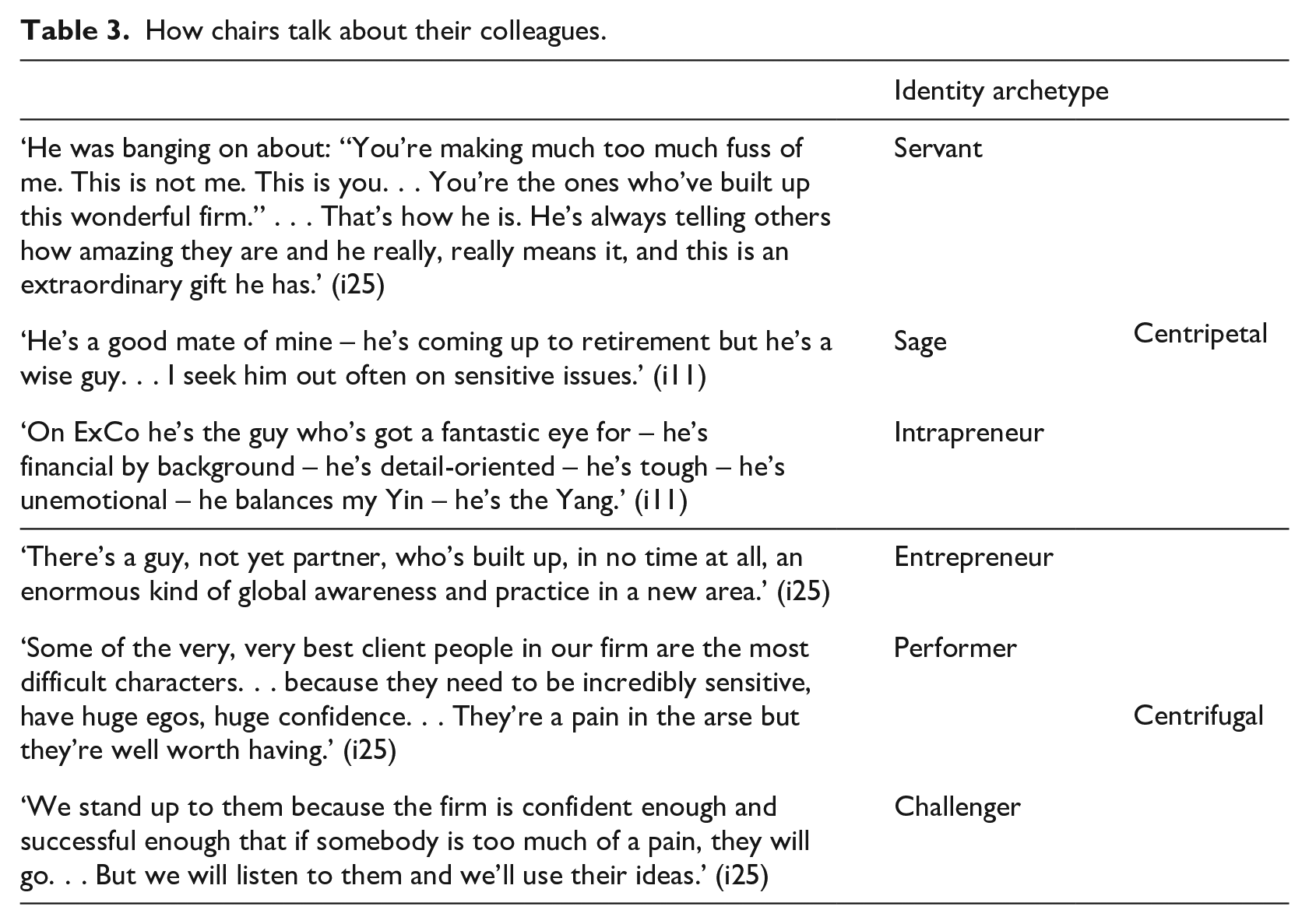
Or as another chair describes a colleague: ‘He balances my Yin – he’s the Yang’ (i11).
The chairs, represented by the avatar archetype, lead by understanding and drawing upon the distinctive capabilities of colleagues who articulate very different identity archetypes. They embody the organizational narrative of collective leadership but are not ‘the big boss’ (i6).
There is no real big boss. I mean even [the chair] is not a real boss. . . I think he’s a wonderful man and he’s the right man for the job, and I think he’s doing it superbly, but he’s not the big boss. (i6)
The ‘big boss’ is the collective. Members of the collective may claim an individual identity for themselves and grant it to specific colleagues on specific occasions, but they grant ultimate leadership identity to the collective.
Discussion and Conclusions
In this study, we set out to answer the question: how do individuals construct their identity as leaders while sustaining an organizational narrative of collective leadership? Our study explored a variety of leadership and identity narratives, both individual and organizational, and revealed their interrelationships. We identified multiple leadership identity archetypes embedded within individuals’ narratives, the centripetal and centrifugal tendencies they embody, and showed how they coexist in productive tension. We revealed how individuals committed to collective leadership nevertheless construct a single individual leader identity (the avatar) to embody the collective. We return now to the theoretical foundations of our paper to discuss how our study contributes to this literature.
Individual and collective leadership narratives: Beyond oppositional, hybridized and dialectical
As outlined earlier, previous research into collective leadership and its relationship with individual leadership has encompassed a range of perspectives, which we labelled oppositional, hybridized and dialectical. Our study’s core contribution is to explore this relationship as articulated in narratives. By focusing on narratives, we reveal how practitioners themselves conceptualize collective and individual leadership, and offer a novel perspective on their interrelationship, consistent with a collective leadership as ‘lens’ perspective (Ospina et al., 2020).
As explained earlier, much research in this area treats individual and collective leadership as oppositional. While some appear to glorify the individual leader as a heroic ideal (Meindl et al., 1985), others advocate collective leadership as normatively superior (Nielsen, 2011; Raelin, 2016), or as a distinctive form well suited to certain settings (Gibeau et al., 2016). Collinson (2014) suggests that such either/or oppositions fail to recognize the ongoing interaction between individual and collective forms of leadership. Our study demonstrates that the narrative perspective provides an opportunity for more integrative thinking, while avoiding normative judgments on collective leadership. By focusing on how individuals actually talk, our study has highlighted how individuals can articulate strongly held individual leadership identities within their narratives, and grant leadership identities to specific colleagues, while also aligning themselves with an organizational narrative of collective leadership. We emphasize that, rather than viewing individual and collective leadership as binary opposites, individual and collective leadership narratives can coexist and may even be mutually constitutive.
Other studies have reached beyond oppositional conceptualizations to investigate how collective and individual forms of leadership are hybridized in everyday interactions. Examples include Holm and Fairhurst’s (2018) analysis of meetings, where both collective and individualized leadership are simultaneously practised. Our study adds to practice perspectives by showing how people accommodate both individual and collective leadership through narratives. In so doing, we draw on DeRue and Ashford’s (2010) notions of claiming and granting of leadership identities, but transpose them from relational interactions to individual narratives. We find that, within an organizational narrative of collective leadership, everyone may claim a leadership identity for themselves while simultaneously granting a leadership identity to everyone else. Equally, while some may argue that ‘no one’ is a leader, no one appears to be claiming a follower identity either. The follower identity is, in effect granted to the collective by the collective.
Studies that conceptualize collective and individual leadership as representing a dialectical tension emphasize that practitioners tend to associate the notion of leadership with individual influence (e.g. Schweiger et al., 2020), and may ‘default’ to individualized conceptualizations of leadership even while seeking to resist it (Sutherland et al., 2014, p. 767). Our study confirms that societal discourses of individual leadership are drawn on by our interviewees, but goes further to show that practitioners can sustain a more complex relationship with notions of individual and collective leadership than previously suggested. Specifically, they appear to construct an individual identity as a leader while sustaining an organizational narrative of collective leadership. We emphasize that the fragmented and fluid nature of narratives noted by others (Brown, 2022) makes it possible to bridge this dialectic, as described below.
Messy coexistence of individual and collective leadership in narratives
Our study reveals that, through narratives, practitioners are able to accommodate a remarkable degree of ambiguity within their notions of leadership. Their ability to articulate a strong individual leader identity while professing commitment to an organizational narrative of collective leadership is not a sign of confusion. On the contrary, it exposes practitioners’ complex and delicate narrative work, by which they accommodate centred and decentred conceptions of leadership. In this study, practitioners are able to articulate three variations on the collective leadership narrative – universal (everyone a leader), absent (no-one a leader) and holistic (leadership subsumed in the collective) – and to express subtly different perspectives on leadership more generally.
This suggests that different ontological perspectives on collective leadership are not simply a topic of academic debate (Ospina et al., 2020; Raelin, 2011), but coexist in practitioner narratives. Indeed, we suggest that these different ontologies may play a role in sustaining the collective narrative. Our analysis reveals that both the centred (universal and absent versions) and decentred (holistic version) of leadership are performed in narratives, sometimes by the same individual within the same interview, enabling them to shift between a focus on the self (individual archetypes) and a focus on the collective (organizational narrative). This coexistence points to a further intriguing observation: it seems that even a supposedly decentred conceptualization of leadership needs some kind of centre, but that centre may be a collective narrative, embodied in an individual (i.e. the avatar).
By revealing the counterintuitive way in which practitioners can conceptualize leadership as simultaneously individual and collective, our study emphasizes the value of working with participants’ narratives. Within the collective leadership literature, alternative conceptualizations abound. Scholars have sought to create coherence by ‘organizing’ the multiplicity of studies into conceptual frameworks (e.g. Denis et al., 2012, Ospina et al., 2020), in the process highlighting the lack of theoretical convergence. Kelly (2014) has gone further to suggest that the proliferation of conceptualizations suggests that leadership is an empty signifier, ‘creat[ing] a space through which possible meanings can be negotiated and navigated’ (p. 914). In our study we have been able to accommodate a variety of meanings of both individual and collective leadership, by focusing on the narrative work our interviewees perform, and the linguistic nuances they express in navigating the ambiguity of leadership.
Kelly (2014) suggests that something important is lost when researchers try to impose neat theoretical frameworks upon participants’ understandings of leadership. We agree. Our focus on practitioners’ perspectives reveals something central about leadership: in spite of researchers’ attempts to ‘tame’ the concept, it remains inherently messy, ambiguous and nuanced. Yet, rather than criticize or dismiss perspectives that place individual and collective leadership as oppositional or hybridized, our study adds to these perspectives, highlighting how a different relationship between individual and collective leadership – that of dialectical coexistence – emerges in practitioners’ narratives. In the spirit of Kelly’s (2014) provocation, we invite researchers working on collective leadership – and on leadership more generally – to make room, analytically, for elements that might initially appear contradictory.
Dissociating leader identity from leader authority in professional service firms
Finally, building on our analysis of the claiming and granting of leader identities through narratives, our study contributes to understanding collective leadership in professional service firms. In particular, by identifying the avatar archetype, we conceptualize a potentially distinctive feature of senior leadership in professional partnerships – the leader as the individual who most closely embodies the collective, by role modelling the values of the partnership as a whole. The construction of the avatar reveals both a persistent attachment to social-cultural discourses of individual leadership and an ongoing sacralization of the heroic leadership narrative (Grint, 2010; Schweiger et al., 2020), even among colleagues who elect their leader from within their peer group. This suggests that, regardless of how powerfully an organizational narrative of collective leadership is articulated, and no matter how ambiguous and contested the power dynamics (Empson, 2020), individuals may need to construct an individual leader to embody collective leadership on their behalf. However, while granted a leader identity by colleagues, authority to lead derives from the individual leader’s ability to embody the collective.
Empson and Alvehus (2020) argue that professionals grant leadership identities to colleagues who are particularly successful at winning business (a relational process they term ‘legitimizing’). In our study, however, few claim market success as the source of their legitimacy as leaders (the performer is the exception). Instead a variety of alternative narratives are mobilized to legitimize leadership identity claims. Extending Empson and Alvehus’ (2020) emphasis on the distinction between leadership identity and authority, our study emphasizes that professionals may claim a leadership identity (i.e. present themselves as leaders) but not claim a leadership authority (i.e. present themselves as lacking the authority to lead). Similarly, colleagues may grant leadership identity to specific colleagues, but not grant them leadership authority. In both cases this is because authority is located in the collective, and an individual’s claim to authority lies in being seen to embody that collective. This more nuanced interpretation of the relationship between leadership identity and leadership authority has potentially significant implications for future research.
Boundary conditions and future directions
We focused on a single extreme case, where an organizational narrative of collective leadership was strongly articulated and widely shared. This is a potential limitation of the study. However, we suggest that the multiple individual leadership identity archetypes, and the centripetal and centrifugal tendencies they embody, may be found in any organization with a strongly professed narrative of collective leadership and might be present in many other contexts where formal leadership roles and informal power are widely distributed among expert workers. Based on our study (and its inevitable limitations), we see three significant opportunities for future research.
First, it would be interesting to examine individuals’ leadership identity narratives in the context of alternative organizational narratives that do not privilege collective leadership. For example, where the organizational narrative privileges hierarchical forms of leadership, will individuals’ identity narratives inevitably fall into the categories of leader and follower? Is it possible that those placed in follower roles might still construct a privately held identity as ‘hero’? And where the organizational leadership narrative is contested, how do individuals construct their leadership identity narratives in relation to colleagues? Might this contestation help explain fractious relations between doctors and hospital managers, faculty and university deans, or artistic directors and their CEOs? And where the organizational leadership narrative is ill-defined, how do individuals construct and enact their leadership identities? Without pre-existing organizational narratives of leadership, what other discursive resources do individuals draw upon?
Second, we have argued that the archetypes embodying centripetal and centrifugal tendencies coexist in a dynamic equilibrium. It would be interesting to explore the impact of disruption to this equilibrium. For example, how will the collective leadership narrative be affected by changes in organizational membership? If post-heroic and heroic models of leadership are not gender-neutral, what might be the impact of a significant change in gender composition? What if individuals who articulate archetypes representing centripetal tendencies come to dominate? Or a merger brings about an influx of individuals who articulate archetypes embodying centrifugal tendencies? Or a chair is appointed who cannot fulfil the function of avatar because they cease to be recognized as embodying the collective? These situations merit further research.
Third, our study drew almost entirely on interviews, and did not focus on practices per se. It would be interesting to examine leadership narratives alongside leadership practices, both at an individual and collective level, through observational as well as interview methods. Can collective leadership narratives exist independently from individual acts of leadership or is one dependent on the other? When an organizational narrative of collective leadership is articulated but not enacted, how do individuals position themselves as leaders, and how do they sustain the narrative ‘myth’ of collective leadership? Adopting a more critical perspective on identity formation raises questions such as: What happens when an individual articulates a particular leadership archetype that is not validated by their colleagues, for example when the self-professed ‘sage’ is seen by colleagues as a ‘fool’, the ‘servant’ as a ‘doormat’, or the ‘challenger’ as an ‘irritation’? Similarly, a more critical perspective might explore some of the ‘darker’ aspects hinted at by the metaphor of the Borg, by examining the interplay between organizational narratives and practices in constructing consensus.
Above all we encourage future research which views leadership from a narrative perspective, bringing together concepts of collective leadership and individual identity, to shed new light on these phenomena and their mutually constitutive dynamics.
Supplemental Material
sj-pptx-1-oss-10.1177_01708406221135225 – Supplemental material for When Everyone and No One is a Leader: Constructing individual leadership identities while sustaining an organizational narrative of collective leadership
Supplemental material, sj-pptx-1-oss-10.1177_01708406221135225 for When Everyone and No One is a Leader: Constructing individual leadership identities while sustaining an organizational narrative of collective leadership by Laura Empson, Ann Langley and Viviane Sergi in Organization Studies
Supplemental Material
sj-pptx-2-oss-10.1177_01708406221135225 – Supplemental material for When Everyone and No One is a Leader: Constructing individual leadership identities while sustaining an organizational narrative of collective leadership
Supplemental material, sj-pptx-2-oss-10.1177_01708406221135225 for When Everyone and No One is a Leader: Constructing individual leadership identities while sustaining an organizational narrative of collective leadership by Laura Empson, Ann Langley and Viviane Sergi in Organization Studies
Footnotes
Acknowledgements
We would like to thank the participants at the Co-Lead Net International Conference, University of Winnipeg, Manitoba, 2019, our editor Christine Coupland, and three anonymous reviewers.
Funding
The author(s) disclosed receipt of the following financial support for the research, authorship, and/or publication of this article. This research was funded by the Economic and Social Research Council of Great Britain. RES-062-23-2269. Empson, Laura ‘Understanding the dynamics of leadership in professional service firms.’

Supplemental material
Supplemental material to this article is available online.
Notes
Author biographies
References
Supplementary Material
Please find the following supplemental material available below.
For Open Access articles published under a Creative Commons License, all supplemental material carries the same license as the article it is associated with.
For non-Open Access articles published, all supplemental material carries a non-exclusive license, and permission requests for re-use of supplemental material or any part of supplemental material shall be sent directly to the copyright owner as specified in the copyright notice associated with the article.
