




Abstract
In seeking to explain the persistence of the informal economy – defined as the set of economic activities that are illegal yet legitimate to some large groups – scholars often focus on instrumental economic factors; in doing so, the role of morality is often overlooked. In response, we conduct a qualitative study of Pakistani counterfeit bazaars, to understand how market participants construct moral legitimacy in a way that justifies participation in, and thus contributes to sustaining, the informal economy. We reveal how the terms ‘counterfeit’ (representing the informal economy) and ‘authentic’ (representing the formal economy) function as an oppositional pair, both within the emic perspective of market participants but also within a baseline etic perspective of Western Intellectual Property regimes. Compared with this baseline, we find that market participants engage in three types of semantic transformation (invalidation, reframing and inversion) that shape moral assessments of authentic and counterfeit consumption. Through our study, we first contribute to a better understanding of how legitimacy in the informal economy is constructed. We also contribute to theory on ‘legitimacy as perception’, indicating how moral legitimization can occur through a dynamic of binary opposition between what is deemed to be ‘moral’ and ‘immoral’. Our final contribution is towards understanding how morality around counterfeit consumption is constructed.
The informal economy – comprising economic activities that are illegal yet legitimate to some large groups (Webb, Tihanyi, Ireland, & Sirmon, 2009) – is an important but understudied part of the global economic landscape. Recent estimates indicate that 61% of the entire world’s working population operate in the informal economy, rising to a striking 90% of employment in the lowest-income countries (Bonnet, Vanek, & Chen, 2019). In recent years, management scholars have shown interest in this phenomenon to understand how individuals and organizations engage in economic activity in the absence of legal and regulatory institutions such as property rights and contract enforcement mechanisms (Godfrey, 2015; McGahan, 2012; Sutter, Webb, Kistruck, Ketchen, & Ireland, 2017).
Nevertheless, these prior accounts predominantly treat the informal economy as the antithesis of the formal economy (Nason & Bothello, 2022). Informal economic activities are perceived as the product of settings described as ‘other worlds’ (Gibson-Graham, 2008, p. 614) or ‘institutional voids’ (Bothello, Nason, & Schnyder, 2019). Informal and formal are thus cast into mutual opposition (Sassen, 1994): the informal economy is illicit, inefficient and immoral in relation to a putatively legitimate, efficient and moral formal economy (La Porta & Shleifer, 2014). Accordingly, while some research has shed light on potential positive aspects of the informal economy (Bruton, Ireland, & Ketchen, 2012; London, Esper, Grogan-Kaylor, & Kistruck, 2014), the majority of research in this area – implicitly or explicitly – focuses on how to replace informality with formal economic activity by, for instance, reducing costs of business registration (Benhassine, McKenzie, Pouliquen, & Santini, 2018), increasing benefits of formality (De Mel, McKenzie, & Woodruff, 2013) and most importantly, introducing laws that enforce market exchange and intellectual property (IP) rights (De Andrade, Bruhn, & McKenzie, 2016). These efforts are coupled with demand-side proposals to ‘educate’ the consumer to shun products emanating from the informal sector (Davidson, Nepomuceno, & Laroche, 2019; Hamelin, Nwankwo, & El Hadouchi, 2013).
Despite these interventions and numerous other efforts by formal economy actors – multinational firms, governments and IP associations – the informal economy remains pervasive and vibrant (Ulyssea, 2020). Researchers have thus far only offered economic arguments for informality, such as resource constraints (Fajnzylber, Maloney, & Montes-Rojas, 2011) or tax avoidance (Marcouiller & Young, 1995). We argue that a focus on instrumental motives has thus far prevented us from better grasping the drivers of informal economic activity, specifically what makes it culturally and morally legitimate in the eyes of local participants beyond an instrumental cost–benefit analysis.
We propose that to address this issue, we require accounts – i.e. the moral justifications, rationalizations and excuses of individual behaviour (Scott & Lyman, 1968) – from those who actually participate in the informal economy. In this study, we employ theory on moral legitimacy, i.e. ‘a judgement about whether the activity is “the right thing to do”’ (Suchman, 1995, p. 579) to better understand how and why these individuals participate in informal economic activity. Aside from its suitability in understanding our phenomenon of interest – based on the predominant definition of the informal economy as illegal but legitimate to some large groups (Webb et al., 2009) – more recent contributions have revealed how legitimacy becomes manifest through the aggregation of individual perceptions (Suddaby, Bitektine, & Haack, 2017). Accordingly, our research question is: How is the moral legitimacy of the informal economy constructed by its participants?
To answer this research question, we developed a qualitative case study of the informal economy of Pakistani counterfeit apparel marketplaces (i.e. bazaars). We do so as ‘authentic’ vs ‘counterfeit’ consumption represents a microcosm of the binary opposition between the formal (legal) and informal (illegal) economies. Our field work is comprised of five focus groups and sixty interviews with market participants (consumers, retailers and suppliers) between 2012 and 2016, constituting an ‘emic’ perspective of how market participants viewed authentic and counterfeit consumption. We contrasted this with a baseline, formal economy IP (intellectual property) centric viewpoint, that we label as the ‘etic’ perspective. While the emic viewpoint is subjective, describing how participants assign meanings to their behaviour (Harris, 1976), the etic viewpoint is ostensibly ‘objective’, focusing on universalistic explanations of behaviour independent from local meanings.
By comparing the two perspectives, we find that the moral legitimacy of informal economic activity is contingent upon the presence of three ‘semantic transformations’. In the Pakistani bazaars, the mobilization of these semantic transformations not only changes the meaning of ‘authentic’ and ‘counterfeit’ but is also closely intertwined with the moral legitimacy of counterfeit consumption. Our findings further suggest that the moral assessment of informality is contingent upon setting. Although the notion of place is implicit in informal economy studies, rarely is its role theorized explicitly in this literature, particularly as it pertains to moral assessments that drive economic behaviour.
Aside from the phenomenological contribution of better understanding how the informal economy is sustained, we also contribute to recent discussions on legitimacy – specifically on ‘legitimacy as perception’ (Suchman, 1995; Suddaby et al., 2017). Our study reveals how moral legitimacy is a collective perception that, under certain conditions, depends on a dynamic of binary opposition (de Saussure, 1983) – in our case, between ‘authentic’ and ‘counterfeit’. In other words, moral legitimacy can be ascribed to an activity that is set in opposition to another that is deemed to be immoral. Our contributions thereby extend the literature on legitimacy as perception by revealing micro-level mechanisms of moral legitimization. We finally contribute to the literature on counterfeit consumption, illustrating how the morality of counterfeit and authentic is closely related to a binary opposition along material, functional and contextual dimensions.
Literature Review
The binary opposition of informal and formal economies
Given how the informal economy varies across different geographical contexts, researchers have struggled to establish a universal definition of the phenomenon (Godfrey, 2011). However, most studies employ a legalistic understanding where economic activities that occur outside of applicable law are classified as informal, e.g. unregistered businesses or undocumented labour (Ulyssea, 2020). We follow the well-established definition of the informal economy by Webb and colleagues (2009, p. 492), as ‘the set of illegal yet legitimate (to some large groups) activities through which actors recognize and exploit opportunities’. The informal economy therefore involves settings where transactions are largely guided by norms, values and tradition rather than formal rules (Mair, Martí, & Ventresca, 2012; Webb, Bruton, Tihanyi, & Ireland, 2013).
In focusing on the absence of legal institutions, though, the informal economy is understood as the antithesis of the formal economy; as Sassen (1994, p. 2289) notes, ‘the scope and character of the informal economy are defined by the very regulatory framework it evades. For this reason, the informal economy can only be understood in terms of its relationship to the formal economy.’ As established by scholars who study binary opposition though, such pairings also (in)advertently result in moral assessments (Coslor, Crawford, & Leyshon, 2020; Sgourev, 2021; Weber, Heinze, & DeSoucey, 2008). For instance, the informal economy is variously labelled as the unregulated, shadow, black, unofficial, grey and underground economy (Ketchen, Ireland, & Webb, 2014). This oppositional treatment results in a focus on the undesirable outcomes of missing legal institutions, including tax evasion, the undermining of regulation, the retardation of innovation and productivity and even fraud, corruption and organized crime (Marcouiller & Young, 1995; Raustiala & Sprigman, 2006).
More recent contributions have sought to challenge this dichotomy between formal and informal. Uzo and Mair (2014), for instance, refer to the ambiguity of formal institutions as a primary reason for organizations to defy formal rules in the Nigerian movie industry, while Saka-Helmhout, Chappin and Vermeulen (2020) demonstrate that informal institutions can promote innovation. We note though, that such studies represent a minority of work on the informal economy. The vast majority of scholarship displays implicit value judgements where ‘formal’ equates to moral and/or ‘informal’ equates to immoral. For instance, in a survey of scholars at a leading entrepreneurship journal, Ketchen and colleagues (2014) reveal that a third of respondents consider that informality can be studied through crime or social deviance theories. The prevailing view on informal economic activity, then, is that what is illegal is also immoral (Bothello et al., 2019).
As a consequence of these implicit moral judgements, management scholars have been ill-equipped to apprehend the sources of legitimacy that undergird informal economic activity beyond a logic of instrumental exchange. This is particularly salient when examining the morality of informal economy participants (Godfrey, 2011), who are unlikely to view their engagement as immoral in the same way as their counterparts in the formal economy. In fact, there is an unexplored possibility that those participants may consider their activities as being just as legitimate as those in the formal economy (if not more so), despite the illegality of it. Nevertheless, such examinations of context-specific morality in the informal economy are absent. We therefore leverage the conceptual lens of moral legitimacy to identify how informal economic activity is morally justified and rationalized.
The moral legitimacy of the informal economy
Given the definition of the informal economy as a set of illegal yet legitimate economic activities (Webb et al., 2009), we employ the literature on legitimacy to examine how an informal economy is sustained. Legitimacy is defined as a ‘generalized perception or assumption that the actions of an entity are desirable, proper or appropriate within some socially constructed system of norms, values, beliefs and definitions’ (Suchman, 1995, p. 574), and can be divided into three types, namely, pragmatic, cognitive and moral legitimacy. When applied to economic activity, pragmatic legitimacy occurs through self-interested calculations by participants (i.e. a ‘logic of exchange’ where a product or service fulfils the wants and needs of a client), while cognitive legitimacy develops when such economic activities become taken for granted (Aldrich & Fiol, 1994; Lee & Hung, 2014). Moral legitimacy, however, involves normative evaluations, and determines whether stakeholders view an economic activity as ‘the right thing to do’ (Suchman, 1995, p. 579). Given our interest in the informal economy, we focus on this form of legitimacy as it is particularly useful for understanding why organizations and individuals operate within a context beyond economic (i.e. pragmatic) motives.
Although early work treated legitimacy as a ‘property’ that could be gained or lost (Suchman, 1995), more recent contributions indicate that legitimacy can also be a process of micro-level social judgements or evaluations by constituent stakeholders (Cederström & Fleming, 2016; Suddaby et al., 2017). The legitimacy undergirding the informal economy, in this conceptualization, is based on participants viewing their economic activities and exchanges as appropriate within some institutionalized set of collective judgements. This perspective of ‘legitimacy as perception’ (Suddaby et al., 2017) proves germane for understanding moral legitimacy at a micro level of analysis, as normative evaluations are ostensibly derived from actors adhering to or deviating from institutionalized norms and values, thus determining whether an activity is (im)moral (Demers & Gond, 2020).
We propose that this view of moral legitimacy can also be advanced through the analytical tool of ‘accounts’, i.e. ‘socially approved vocabularies which neutralize an act or its consequences when one or both are called into question’ (Scott & Lyman, 1968, p. 46). Accounts can include excuses or justifications: excuses involve admitting that an action was immoral but with rationalizations that explain away personal responsibility for the act, while justifications involve acceptance of responsibility for a particular act (and/or any related consequences), while denying that the act itself was immoral. We suggest that examining accounts of informal economy participants can reveal a more fine-grained delineation of what moral legitimacy means within a particular context.
Moral legitimacy as a product of place
An important implication of our argument is that moral legitimacy in the informal economy is contingent upon place (Preyer & Peter, 2005). Drawing from social geography, we treat place as ‘a meaningful location’ (Cresswell, 2004, p. 7), in other words, as an interaction of physical geography with material forms and meaning systems (Gieryn, 2000). Place provides a sense of rootedness (Relph, 1976) and is imbued with a range of social meanings through human activities (Grey & O’Toole, 2020). The question of ‘Where am I?’ is intimately tied to the questions of ‘How should I act?’ and ‘What is moral?’
Recent contributions have highlighted how informal economies are characterized by institutional complexity that is unique from one setting to the next (Nason & Bothello, 2022). Many places in which the informal economy operates are confronting the imposition of new formal economic relations brought about by globalization (Walby, 2009) that undermine local forms of knowledge peculiar to the practices of value creation and exchange in that place (de Sousa, 2014). It does so through ‘moral expulsions’ (Sassen, 2014) or the exclusion of local knowledge, culture and products from the socio-economic domain by classifying them as fundamentally existing outside the boundaries of global morality, i.e. the set of neoliberal values and norms (Van Lent, Islam, & Chowdhury, 2022). Despite such expulsions, the local persists with all its alternative economic arrangements and moralities, coexisting as an unruly antithesis of globalization. Such places, labelled as ‘polyvalent’ (Lawrence & Dover, 2015), contain multiple moralities that are legitimate to different audiences in varying degrees, providing symbolic resources not only to the dominant way of organizing but also its resistance (Sanson & Courpasson, 2022; Venkataraman, Vermeulen, Raaijmakers, & Mair, 2016). To examine how such a dynamic of place-based moral legitimacy may unfold – in a such a way that it legitimizes an informal economy – we conduct a qualitative examination of counterfeit bazaars in Pakistan.
Context: Pakistani counterfeit bazaars
As an empirical site, we chose to study the Pakistani market for counterfeit apparel (the physical locations of which are called ‘bazaars’), as we viewed the binary opposition between ‘counterfeit’ and ‘authentic’ as a microcosm of the opposition between ‘informal’ and ‘formal’ economies, respectively. 1 For instance, researchers have pointed out several negative effects of counterfeit consumption on authentic consumption including infringing copyrights, reducing incomes for formal economy firms, damaging firm and brand reputation, and avoiding taxes (Bian, Wang, Smith, & Yannopoulou, 2016; Davidson et al., 2019; Eisend, 2019). The consumers who willingly buy counterfeit products are portrayed as unethical and immoral (Chaudhry & Stumpf, 2011) and in need of education (Davidson et al., 2019).
We chose Pakistan as it is a country marked by the encroachment of foreign brands, despite being relatively underdeveloped in many formal market institutions (Qadeer, 2006). The proliferation of modern forms of retail such as upscale shopping malls has not only set new standards of taste and fashion through branded goods but has also instilled a certain exclusivity by making it inaccessible to the masses. These conditions have produced a large parallel economy for counterfeits in Pakistan for most mass-market commodities, ranging from clothing to bags to watches. A report estimates that, in 2017, the size of the Pakistani informal economy was 56% of the formal (Khuong, Shabbir, Sial, & Khanh, 2021).
Despite the relatively recent emergence of branded goods and their counterfeit counterparts, the bazaars themselves have existed for centuries, and are characterized by place-based specificities such as trust-based relationships, despite the seemingly chaotic organization (Geertz, 1978). We contend that the existence of the bazaar provides a rich context to study patterns of moral justifications provided by market participants, since we find a multilayered society in which modernity and tradition are layered on one another (Lieven, 2012). Combined with the ostensible illegality of selling counterfeits, the bazaars function as an ideal setting for examining place and moral legitimacy in shaping the informal economy.
Research Methodology
We opted to pursue an inductive, qualitative case study approach to examining our phenomenon of interest (Yin, 2009). We included both primary and secondary sources of data: the former comprised interviews and focus groups with cultural insiders, revealing an ‘emic’ view of the informal economy where individuals narrated their behaviour (Morris, Leung, Ames, & Lickel, 1999; Ren, 2021). The latter source of data was based on texts (reports, handbooks, agreements, policymaking documents) of the informal economy by formal economy actors, providing an external vantage point to the Pakistani context; this formed the ‘etic’ perspective. We proceed to detail these two perspectives.
The emic perspective on the informal economy: Focus groups and interviews
In the ‘emic’ perspective, ‘interpretations of the social world can, and for certain purposes must, refer to the subjective meaning of the actions of human beings from which social reality originates’ (Schutz & Luckmann, 1973, p. 62). The first stage of data collection began in 2012 and was exploratory in nature, involving the use of five focus groups in Pakistani universities and cafes with counterfeit buyers. We used these to develop familiarity with the context and to uncover the variety of different experiences and perspectives from counterfeit consumers (Morgan & Hoffman, 2018). We selected male and female participants from metropolitan cities of Pakistan aged between 18 and 35 years, with each session lasting an average length of two hours. For each focus group (averaging eight participants), one moderator was assigned to facilitate the discussion and one to take notes (Krueger, 2014).
Following this, we conducted sixty semi-structured qualitative interviews in the bazaars between 2013 and 2016 through purposeful sampling (Patton, 2002), directly approaching participants within the counterfeit bazaars (Appendix 1 contains a demographic overview of our interviewees). We used the insights gained from the focus groups as a basis for the interview protocol. Each interview began with open-ended and unobtrusive questions to develop rapport with the interviewee. The duration of each interview was between 80 to 120 minutes. We recruited additional participants through referrals, and as we approached sixty interviews, we realized that we had reached a saturation point in terms of themes and content (Guest, Namey, & Chen, 2020).
Importantly though, the information from the focus groups shaped how we approached the field and structured our questions: rather than minimizing our obtrusiveness, we chose to exploit our outsider status as a strategy (Harrington, 2002). In particular, our questions about the purchase of counterfeit products triggered participants to enter an ‘ethical moment’ (Zigon, 2007), where they justified, rationalized or excused their participation in counterfeit consumption. We documented how consumers narrated a resolution of their ethical moments.
The etic perspective on the informal economy: Intellectual property regime texts
We collected texts from intellectual property (IP) rights organizations, initially as a means to develop a better comprehension of the global phenomenon of counterfeiting. However, we observed early on that these texts, generated by organizations and regulatory actors within the formal economy, contained significant moral language around the distinction between authentic and counterfeit products. For instance, an OECD and EUIPO (2019) report on counterfeits was crafted to ‘assist policymakers in formulating effective solutions to combat and deter this scourge’ [our emphasis] (p. 4). These texts ultimately became useful as sources of data rather than simply providing context. We chose the ten most salient transnational IP regimes, agreements and ratified conventions, drawn from mentions during the 2021 World Symposium on Geographical Indicators and used these to examine the distinction in these documents between the terms ‘authentic’ and ‘counterfeit’ (see Appendix 2 for a list of sources).
Data analysis
We coded and analysed the transcripts of the sixty interviews as well as the ten IP documents by employing the well-established constant comparison method (Glaser, Strauss, & Strutzel, 1968; Strauss & Corbin, 1998) using the qualitative coding software NVivo 12. Figure 1 outlines the process: we began with the emic data, with a first-order coding of accounts made by market participants when they were put into an ‘ethical moment’. We then proceeded to engage in first-order coding of both the perceptions of market participants regarding differences in counterfeit and authentic apparel, as well as the distinctions between the two terms observed in the etic data. We then engaged in second-order coding to aggregate the first-order codes into larger themes which included the moral justifications by informants. We used this to create a taxonomy of three prototypical market participants situated along a ‘moral spectrum’.
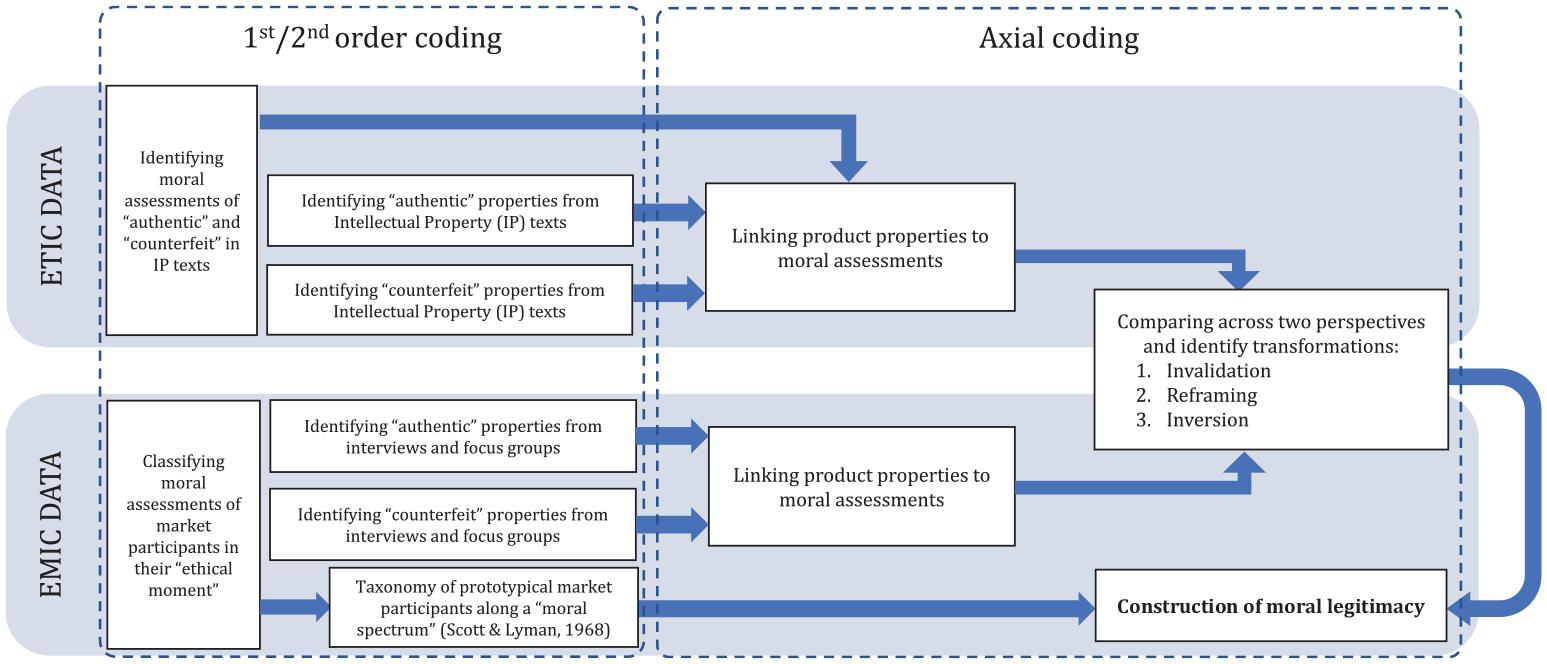
Data Analysis Process.
The next stage involved axial coding: we sought to identify the attributes associated with the terms authentic and counterfeit – for both etic and emic data – that could be juxtaposed, i.e. set as oppositional pairs. These were the attributes that maintained or undermined the semantic opposition between ‘authentic’ and ‘counterfeit’. The third stage continued the axial coding process by drawing relationships between emic and etic data: we examined the oppositional attributes across the two perspectives to see which could be compared and contrasted. We ultimately settled on five attributes, namely material quality, brand impact, market segmentation, market ontology and market origin (outlined in Appendices 3 and 4 with representative excerpts). As we explain in the findings below, we conceptualized the differences between the emic perspective and the etic baseline as forms of ‘semantic transformations’ by market participants (see Appendix 5 for further detail on frequency of codes). The final step involved returning to the interviews and linking those semantic transformations to the prototypical market participant along the moral spectrum. To ensure the trustworthiness of the data, two co-authors engaged in coding an overlapping subset of data to ensure inter-rater reliability (~85%).
Findings
Semantic transformations
The first stage of our findings involves examining how etic and emic perspectives differ with respect to the concepts of ‘authentic’ and ‘counterfeit’. By comparing the emic and etic data, we highlight how market participants transform their conceptual understanding of the five key attributes associated with the labels authentic and counterfeit through what we term invalidation, reframing and inversion (see Figure 2). Understanding the transformations provide a basis for us to then reveal the moral legitimacy of economic activity in these settings, which we examine in the subsequent section.
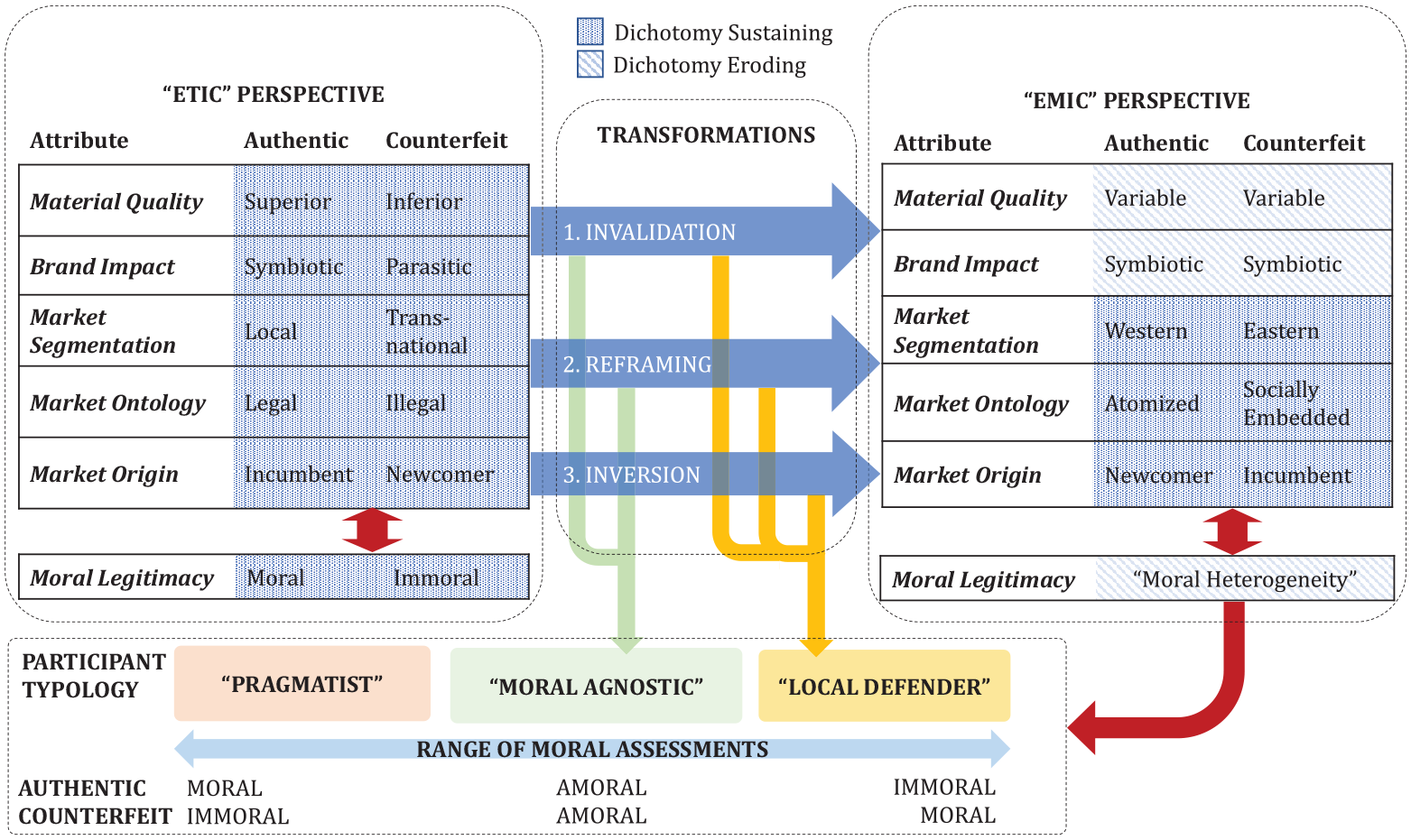
Semantic Transformations.
Invalidation
The first transformation involves invalidating those attributes that, within the etic perspective, maintain the opposition between authentic and counterfeit products. Doing so undermines the hierarchy between authentic and counterfeit, introducing uncertainty in the minds of consumers about whether the two terms are indeed different. For instance, with respect to material quality, the IP regimes that undergird the etic perspective construct a distinction between authentic and counterfeit, where counterfeits are unambiguously inferior compared with the original. The United Nations, for instance, states that ‘the buyer sacrifices the quality of the original product and is tempted to buy the counterfeit due to: the price and the status value associated with owning the good in question’ (UNICRI, 2011, p. 35). Within the emic perspective, however, this perception of inferiority of counterfeits does not necessarily hold. We observe two ways of invalidating the opposition between authentic and counterfeit products: (1) turning dichotomy into variation, and (2) valorization.
Turning dichotomy into variation
First, in contrast to the etic perspective that views counterfeits as universally inferior in quality, bazaar participants recognize that imitations vary widely in terms of construction and materials used. Many consumers are cognizant of where to buy ‘A-class’ copies that are materially identical to the authentic product in virtually every respect, including packaging and material craftsmanship: Levi’s original or fake, both almost have the same life. They look the same and possess the same charm. Then why should I go for an expensive one with higher costs? A-class counterfeits cannot be recognizable. (interviewee 27)
A handful of sellers even reveal how some counterfeit apparel is repurposed from the leftover stock of authentic international brands manufactured in Pakistan. Although brand owners instruct their suppliers to destroy the remaining inventory, some suppliers violate those instructions. A seller (interviewee 4) of counterfeit products remarked on this practice: ‘Sometimes we put our tags on the leftover stock, which seems to be unethical, but the only other option is to burn it.’ This practice further undermines the perception of ‘quality’ as a distinguishing attribute between authentic and counterfeit, which is revealed through a quote by interviewee 16: ‘Why pay more if the same [material] quality product [emphasis added] is available at a lower price?’ Therefore, rather than being placed in a dichotomous opposition to the ostensibly higher material quality authentic brand (as observed in the etic perspective), bazaar participants perceive a gradation of quality of counterfeits, ranging from very cheap knock-offs to high-quality counterfeits indistinguishable from (if not identical to) the original.
Second, consumers perceive that the quality of ‘authentic’ products is itself variable. Although genuine international brands are nearly universally perceived as being of high quality, this is offset by the fact that Pakistani designer brands, despite being authentic, are viewed considerably less favourably in terms of craftsmanship and material quality. Accordingly, the feature of high quality, as applied to genuine products within the etic view, does not resonate with these consumers. In fact, the presence of high-quality counterfeit products means that consumers are oftentimes inclined towards purchasing those imitations of international brands over the genuine national brands. Interviewee 33 says: We prefer to buy counterfeits of international brands over local brands since A-class copies are better than top [genuine] local brands. The packaging and designs of these copies are attractive compared to local brands. . .
Accordingly, when consumers emphasize the variability in material, production and design among both counterfeit and authentic products, they are semantically invalidating the basis of distinguishing the two labels using the attribute of ‘material quality’ (as observed within the etic perspective).
Valorization
A second subset of attribute invalidation occurs where an attribute is valorized for both terms; as a result, that attribute no longer serves as a semantic source of opposition. In these cases, the hierarchy of a binary opposition, where one term is superior to its counterpart, is broken. More specifically, from the etic perspective, authentic products and brand reputation have a mutually reinforcing relationship: the characteristics of the product (e.g. material, craftsmanship, design) distinguish it from other products, while the brand reputation further entrenches this uniqueness in the minds of consumers. Counterfeits, on the other hand, are considered as detrimental to the reputation that authentic brands have painstakingly built; they are considered ‘dangerous for the consumers, for society, and hits [companies] hard in terms of profit and reputation’ (Global Initiative against Transnational Organized Crime 2017, p. 4).
From an emic perspective, however, some participants perceive no such distinction between authentic and counterfeit: When we wear counterfeit clothes with their brand names, many people see it. The designs are good so people like it, appreciate it, and ask from where did I buy this beautiful dress? I never tell them from the counterfeit market. I always tell them I buy from original shops. In this way, I am benefitting the authentic brands instead of harming their sales. (interviewee 58)
Bazaar participants such as the informant above acknowledge that counterfeits capitalize upon the brand name of authentic products; nonetheless, they are also adamant that the former helps increase brand exposure for the latter. In other words, counterfeits do not ‘steal’ from the authentic brand, but rather are perceived as extending the reach and the accessibility of the brand to a previously untapped population. This viewpoint stands in contrast to the etic perspective where counterfeiting is perceived as a ‘parasitic act’ (WIPO, 2008, p. 154) upon the reputation of authentic products; instead, the emic perspective reveals a more symbiotic relationship between authentic and counterfeit, where both serve to enrich the brand. As such, the etic distinction between the two labels using qualities such as ‘symbiotic’ and ‘parasitic’ no longer holds: both labels are valorized for their positive brand impact, thus undermining this dimension of opposition.
Reframing
In this set of transformations, market participants retain an opposition between authentic and counterfeit for a given attribute rather than erode it; nonetheless, they reframe what the attribute means. This is first observed in the transformation of the etic distinction between authentic and counterfeit as being of ‘local’ and ‘foreign’ origin, respectively. As indicated in Appendix 3, the terms are often associated with spatial segmentation: WIPO emphasizes how authentic products are about local heritage, as they ‘exemplify the ability of many tradition-bearing communities to combine tradition with the influences and cultural exchanges characteristic of modernity for the purpose of maintaining their identity and improving their social and economic circumstances’ (WIPO, 2008, p. 56). In contrast to this local embeddedness, counterfeit goods are perceived as operating within transnational/global supply chains, that are ostensibly exploiting local crafts. A joint OECD and EU report comments that, ‘regarding the provenance economies for counterfeit and pirated goods imported to the EU, information. . . shows that, as with world trade, their scope is wide and global’ (OECD & EUIPO 2019, p. 55). The local/transnational distinction thus operates as a key source of opposition for the etic perspective.
From an emic perspective, authentic and counterfeit products are still distinguished through spatial segmentation; compared with the etic perspective, however, the geographic division is drawn along different lines. Informants cite the origins of the authentic brands as being from ‘Western’ countries, while counterfeits are the products of ‘Eastern’ nations. One market participant (interviewee 48) succinctly captured this sentiment: People want to buy expensive brands from fashion designers because this is culturally suitable. . . Is this really Muslim or Pakistani culture? No sir, these clothes are just too different from our traditions. It’s just that no one cares about old traditions anymore and everyone wants to wear what is advertised in London or America.
In this quote, the informant is stating that fashions from the West (London or America) are displacing Eastern traditions (Muslim or Pakistani culture). This emic opposition between authentic and counterfeit is therefore based on a very different perception of geographic segmentation compared with the etic perspective. Market participants view Western (authentic) goods as subverting local tradition, with counterfeits being an Eastern resistance to this infringement. One interviewee said ‘[Counterfeits] benefit my country, but this is not at all the case for authentic brands.’ These spatial distinctions therefore form the basis of the emic opposition between authentic and counterfeit, in contrast to the etic perspective that generates a spatial division based on ‘local’ authentic goods and ‘global’ counterfeits.
A similar dynamic occurs for the attribute of market ontology. Consistent with their origin in the formal economy, IP regimes view authentic products as the outcome of law and property rights that reward innovators: ‘The protection of the creative work is based on. . . the incentive that this protection provides with respect to research and innovation’ (UNICRI, 2011, p. 13). Counterfeit products, on the other hand, are associated with actors who operate outside the law. Much of the discourse from IP regimes highlights the criminality behind counterfeits, for instance, ‘organized criminal groups are. . . playing an increasingly important role in these activities, using profits from counterfeiting and piracy operations to fund other illegal activities’ (OECD & EUIPO, 2019, p. 3).
From the emic perspective, the separation between legal and illegal is often not a salient distinction between authentic and counterfeit, respectively: our informants instead make a distinction between bazaar retailers with whom they have established personal relationships (who happen to sell counterfeits) and impersonal chain stores (that happen to offer authentics). One seller (interviewee 51) compared his previous experience working in authentic apparel retail with his current job selling counterfeits: I used to work as a salesman at HSY [Hassan Sheheryar Yasin, a well-known Pakistani designer] Studio’s outlet [where] the prices were fixed. But then I decided to open my own shop here. Now I have to fight with the customer on price. . . Some customers have developed trust in my shop, and they don’t bargain much but the majority is never satisfied with price. The only good thing here is that everyone pays in cash. This market is old, and people pay by cash since they trust in this market.
This vendor is commenting on how one of his former business practices (i.e. pricing) in the formal economy was independent of the customer, indicating a universal arms-length transaction. This aligns with our observation that authentic products are not embedded in the local context, but rather operate in outlets or malls of major cities like Karachi and Lahore. In the bazaars, by contrast, pricing is not a fixed practice but contingent upon personal relationships; negotiations are more aggressive when merchants are outsiders, and more relaxed when there is pre-existing trust between the two parties. Embeddedness is therefore crucial in making economic activity more viable for merchants.
As such, the emic opposition between authentic and counterfeits maintains a distinction of market ontology but framed differently from that of the etic perspective. The etic perspective privileges legality, and accordingly views authentic and counterfeits as residing in, respectively, legal and illegal economic spheres. The emic distinction, as revealed in our interviews, emphasizes trust-based arrangements, and thus views counterfeits as socially embedded. Authentic apparel, by contrast, is a product of the formal economy relying on impersonal and transactional interactions between atomized market actors.
Inversion
Inversion involves flipping the positions of an oppositional pair with respect to a given attribute. We observe this occurring with ‘market origin’ for counterfeit and authentic. From the etic perspective, the texts from the IP associations treat the origin of the product as based in the phases of ideation and design (Frontier Economics, ICC & INTA, 2016); this conceptualization views imitation as impairing incentives to engage in innovation. The term ‘intellectual property’ itself emphasizes the rights associated with the idea. As an example, the OECD and EUIPO report (2019) remarks that, ‘in the globalized world, the rising importance of IP has also created new opportunities for criminal networks to free-ride on others’ intellectual assets and pollute [emphasis added] trade routes with counterfeits’ (p. 13). Authentic products are therefore seen as ‘incumbent’ entities, while counterfeits are free-riders, i.e. ‘newcomers’ that function as an illegitimate challenge to this incumbency.
The emic perspective inverts this origin in two ways. First, while IP proponents consider ‘origin’ in terms of ideation and design, participants in the counterfeit markets predominantly consider the origin of the product to be the point of material inception, i.e. where it is crafted. Given that the manufacturing facilities for many authentic products are predominantly in low-cost countries, this negates the ‘incumbency’ argument of the etic perspective that privileges authentic over counterfeits: If you really agree with the brand idea, then I ask: who generated the brand? The benefit of branding goes to [the] firms. I think this is unfair as the benefit should go to the actual producer. (interviewee 37)
The inversion happens with a second point, namely that the marketplaces studied in Pakistan have a rich history manufacturing and selling apparel long before foreign brands entered the country. Consumers and retailers consider that this domestic economy has been, and continues to be, threatened by the influx of foreign apparel brands that manufacture their products in developing countries because of lower labour costs: This market is one of the oldest markets of Karachi and some of the shops here were first set up in the ‘70s. The big shopkeepers in Karachi and their [authentic] brands only came in the market a few years ago. The manufacturing of local [counterfeit] products and international branded products are from the same factories, so [those] are more trustworthy for me. (interviewee 44)
For buyers and sellers, the idea that authentic apparel is ‘incumbent’ while counterfeits are ‘newcomers’ makes little sense given that these products are inextricable from the spatial context in which they are sold. Given that the bazaars predate the arrival of formal shopkeepers and their brands by decades (if not centuries), the opposition is inverted – counterfeits and their marketplaces are the original entities, while authentic brands are foreign incursions.
In summary, by comparing the five attributes across emic and etic data, we identified three transformations made by market participants: invalidation, reframing and inversion. We now proceed to examine how the presence (or absence) of those three transformations are intertwined with differing assessments of moral legitimacy regarding the consumption of counterfeits. The lower section of Figure 2 illustrates how the transformations are connected to different moral assessments by participants of the counterfeit markets.
Accounts and moral legitimacy
Within the etic texts of the IP associations, authentic and counterfeit are consistently juxtaposed along a moral dimension – authentic is unequivocally ‘good’ while counterfeit is unequivocally ‘bad’ (Figure 2). For instance, the Berne Convention (1886) frames the right to authorship as part of the creator’s ‘moral rights’. Similar language is used elsewhere, where the International Trademark Association lists the negative impacts of counterfeiting, including ‘the value of lost lives, the costs incurred in anticipation of crime, and the physical and emotional consequences of crime’ (Frontier Economics et al., 2016, p. 51). This perspective associates moral with authentic; counterfeiting is seen to not only undermine the ‘benign’ and advantageous effects of intellectual property rights but is also viewed as deleterious to the enterprise of building authentic brands (Raustiala & Sprigman, 2006).
In contrast, the emic data contains a variety of moral perspectives among buyers (i.e. consumers) and sellers (i.e. retailers and manufacturers). We divided responses according to the taxonomy of different ‘accounts’ along a moral spectrum, identifying how participants legitimized their behaviour through different types of excuses and justifications (Scott & Lyman, 1968). Using this distinction, we proceed to outline three prototypical types of market participants: pragmatists, moral agnostics and local defenders.
Pragmatists
The first group we identified in our data were labelled ‘pragmatists’. In terms of moral judgements, these market actors, explicitly or implicitly, agreed with the assessments contained within the etic perspective that authentic products are moral and counterfeits immoral. These individuals nonetheless rationalized their behaviour by minimizing their responsibility for counterfeiting. Specifically, pragmatists engaged in an excuse that Scott and Lyman (1968) refer to as ‘scapegoating’, where participants consider that the behaviour in question is a response to the behaviour or attitudes of another. The following quotes prove illustrative, the first from a seller and the second from a buyer: This is not my problem if buying fakes is illegal. Don’t you think that the city government knows that this big market exists?. . . Ethics or a lack of it is the responsibility of the government. (interviewee 6) As a consumer, when something is available in the market, then it is my right to buy. Obviously, it is unethical from the perspective of retailer because they exploit the awareness of original brands. I need it, and I have to buy it. (interviewee 20)
In these types of excerpts, informants deny personal responsibility by attributing the responsibility of moral enforcement to other actors such as vendors, the government, police or ‘society’, or downplaying immorality compared to larger societal issues. However, through such excuses and self-defence of their consumption, we can nonetheless observe that these scapegoating arguments tacitly accept the premise that counterfeits are indeed immoral. For instance, both interviewees (among others) mention that some aspects of counterfeits are ‘unethical’, which also carries assessments for authentic products: taken as logical contraposition, the implication is that legal (authentic) products are ethical – or at least more ethical than counterfeits.
The vast majority of pragmatists in our sample did not engage in any of the three transformations that we outline above. Unsurprisingly, the emic perspective of these individuals regarding authentic and counterfeit attributes featured little difference compared with the etic perspective. As such, their perceptions of the material and symbolic attributes of authentic and counterfeit products generated a similar moral assessment to that of the etic perspective – namely that authentic products were good and counterfeit products were bad. Nonetheless, they engaged in counterfeit consumption because of pragmatic concerns around affordability and convenience.
Moral agnostics
In the middle of the spectrum is a group that we label ‘moral agnostics’, who do not associate authentic and counterfeit with any moral assessments. These individuals are either ignorant of or surprised by the idea that counterfeit purchases constitute a moral dilemma. One interviewee said ‘I cannot see any ethicality in buying counterfeit brands. I am sorry [but] you are wasting my time by discussing this unimportant issue.’ We observe a similar defense from interviewee 18: There is no standardized definition of ethics; every person has their own definition . . . We did not make a clear distinction between ethical and non-ethical issues. We did not learn from childhood that counterfeits are bad.
These types of accounts can be examined as either excuses or justifications. For example, Scott and Lyman (1968) refer to the excuse of ‘appeal to defeasibility’, where individuals defend their behaviour by pleading innocence, i.e. they engaged in counterfeit consumption because they did not know better.
In terms of semantic transformations, our analysis first revealed that these market participants engaged in attribute invalidation. For instance, one informant had the following incensed response to being triggered into an ‘ethical moment’: Are you making fun of me? I don’t know why you so-called educated people are trying to make our life difficult by inventing words [such as counterfeit]. I am also not sure why you think in terms of a moral or immoral purchase. A purchase is a purchase. . . I really do not understand why this question of morality even exists. (interviewee 60)
As highlighted earlier, attribute invalidation undermines the opposition between authentic and counterfeit. This is illustrated in the quote, as the interviewee apparently did not perceive the two terms as distinct and consequently could not assign a moral assessment to them. Accordingly, we observe that the practice of attribute invalidation is sufficient to dissolve the semantic separation – and by extension the moral opposition – between authentic and counterfeits.
However, in our analysis we also observe a subset of morally agnostic consumers who engage in attribute reframing, invoking a ‘denial of injury’ justification (Scott & Lyman, 1968, p. 51). This is a rationalization of behaviour that focuses on the permissibility of the act from a consequentialist perspective, emphasizing how no stakeholder (of relevance) is adversely impacted by counterfeit consumption. In other words, given that the authentic and counterfeit apparel are for different audiences, the consumption of the latter does not impair consumption of the former; accordingly, counterfeits were morally permissible given that they did not harm anyone: I don’t know why you think in terms of a good or bad purchase. A purchase is a purchase; we are poor, so we purchase fake; there are others who are rich; they purchase from big shops where branded clothes are available. There is no question of good or bad here. (interviewee 54)
In contrast to previous quotes, this interviewee reveals a recognition of difference between authentic and counterfeit products (‘branded’ vs ‘fake’) yet does not acknowledge or admit their difference in moral terms. Based on our analysis, we identify that the attribute reframing of market segmentation (‘rich’ vs ‘poor’) and market ontology (authentic products from ‘big shops’) separates authentic and counterfeit into different audiences. Since morality is determined by a referent audience, the terms authentic and counterfeit cannot be contrasted as ‘good’ or ‘bad’.
Local defenders
In our sample, the subset of consumers that we term ‘local defenders’ perceive that the rights for clothing belong with the manufacturer and user rather than with the brand owner. Counterfeits are also deemed morally legitimate as they provide a way to counteract the efforts of Western influences to define what is ‘right’ for them. To these individuals, the subversive effect of counterfeit apparel is not only admirable but also moral.
Using Scott and Lyman’s (1968) taxonomy, we observe two justifications that apply to local defenders. The first is ‘appeal to loyalties’, where the informants justify that their act is permissible as it is on behalf of another party to whom they owe allegiance. In our context, we observe interviewees claiming that their counterfeit consumption is on behalf of their country or community, making statements like ‘we use pirated books for [our] ethics lectures’ (interviewee 12). The second justification is a ‘denial of a victim’, where the participant views their act as morally legitimate since the victims were deserving of harm: ‘When the original company cheats me [by charging high prices], then their loss is no matter for me [if I buy counterfeits]’ (interviewee 37). This quote is from the same interviewee who spoke earlier of the ‘unfairness’ of benefits going to the firm rather than to the actual producer. His purchase of counterfeits is therefore an attempt to redress this inequality.
In our analysis of this subgroup, we find that these participants are those who engage in all three transformations, invalidation, reframing and inversion. As an example, interviewee 28 invokes all three: Original brands just cash [in on] their names - they have many faults. These brands are the ‘bojh’ (burden) on society. There is a minor difference in quality but high difference in prices. Also, the accessibility of fake brands is higher, and it facilitates people [in their clothing needs]. . .. The branded firms are sponsored by the West. When the British were here, they looted all our wealth; they called India sonay ki chirya [golden sparrow]. They taxed us and from that money bought our goods to be exported to Britain. Was this ethical? Now they are saying that we should act like good kids and pay them for designs that an Asian employee might have generated. (interviewee 28)
This individual deploys all three justifications, invalidating attributes such as material quality (‘minor difference’), reframing the attributes of market segmentation (authentic brands from ‘the West’) and inverts the attribute of market origin (‘[they] bought our goods’). The resulting moral assessments can be absolute, in the sense that authentic products are immoral and counterfeits moral. However, in the example above, this local defender also occupies a relativist position, where counterfeits are, if not ‘good’, at the very least more moral than authentic products.
Discussion
Through our examination of Pakistani counterfeit bazaars, we revealed a heterogeneity of viewpoints among market participants regarding the moral legitimacy of their activity, which contrasted sharply with the Western, etic perspective that unambiguously views authentic products as moral and counterfeits as immoral. To summarize, we compared the emic and etic perspectives and identified three types of semantic transformations, which we labelled as invalidation, reframing and inversion. We then classified the viewpoints of our participants into three types of consumers (pragmatists, moral agnostics and local defenders), revealing how their moral assessments of authentic and counterfeit were closely intertwined with their mobilization of the three transformations. Specifically, pragmatists, who engaged in no transformations, viewed the two labels in a manner that was virtually indistinguishable from the etic view, and therefore shared a similar moral judgement that authentic products were moral and counterfeits immoral. Located at the other end of the spectrum were the local defenders, who inverted this moral assessment because they engaged in all three transformations of attributes of authentic vs counterfeit products. In between were the moral agnostics, who engaged in partial transformations (either invalidation or reframing): they either did not perceive a difference between counterfeit and authentic, or did not consider the two to be comparable on moral terms. In studying the broader dynamics between informal and formal economies, we make multiple contributions.
The first is towards understanding the phenomenon of the informal economy: prior studies in management conceptualize the informal economy as being illegal but legitimate to some large groups (Webb et al., 2009) with little interrogation of what precisely makes such activity legitimate beyond instrumental motives. By examining how market participants construct moral legitimacy around their activities, we can explain the emergence and persistence of informal economic activity beyond simplistic economic arguments (e.g. consumer poverty or tax evasion). In doing so, our findings also reveal striking heterogeneity among participants regarding the construction of alternate moral meanings around their counterfeit consumption. Far from being monolithic in terms of motivations and behaviour, we demonstrate that informal economy participants de- or reconstruct the binary opposition of authentic/counterfeit through justifications, excuses and rationalizations (Scott & Lyman, 1968), but do so in a way that nonetheless legitimizes their behaviour. As Lee and Hung (2014, p. 30) aptly note, ‘no one advocates immoral over moral activities, but morality is defined differently by diverse social groups’. Our study, therefore, offers a counterpoint to prior studies that have treated the informal economy as immoral, and even criminal (Ketchen et al., 2014).
Importantly, our study also contributes towards an understanding of how place-based ‘polyvalence’ – i.e. the presence of multiple and competing meanings, values and institutions in a particular site (Lawrence & Dover, 2015; Seremani, Farias, & Clegg, 2022) – influence the legitimacy of an informal economy (Nason & Bothello, 2022). The socio-economic sites of the Pakistani counterfeit markets feature an increasingly dominant formal economy that has come into conflict with, and seeks to morally expel (Sassen, 2014), traditional bazaar arrangements. The tension between these two opposing forces nonetheless provides a means of legitimization for the informal economy: many market participants see themselves as ‘resisting’ a foreign incursion upon their local spaces through counterfeit consumption. In this sense, the morality of their participation in the informal economy is, in some cases, derived through opposition to formal economy meanings, values and institutions. Our examination of the Pakistani bazaars therefore illustrates how the relationship (or more accurately the tension) between alternative moral claims in a polyvalent place can be used as a basis of legitimacy for informal economy participants.
Second, we provide a theoretical contribution to the literature on legitimacy, specifically on ‘legitimacy as perception’ (Suchman, 1995; Suddaby et al., 2017). Through our study, we unveil how moral legitimization can operate through a micro-level dynamic of binary opposition, where an activity is deemed ‘moral’ insofar as it can be contrasted against another activity that is deemed ‘immoral’. Studies in categorization have revealed a similar dynamic of oppositional pairing within, for instance, the grass-fed beef market (Weber et al., 2008) or ballet (Sgourev, 2021), but the impacts of this opposition on legitimacy judgements have not thus far been examined directly. Our study reveals how the moral legitimacy of certain behaviours and values (in our case, around counterfeit consumption) can be relational, i.e. based on the perception that an opposing set of behaviours and values (around authentic consumption) is illegitimate.
Relatedly, we also provide a methodological contribution by highlighting the usefulness of ‘accounts’ (Scott & Lyman, 1968) for studying legitimacy. In our study, pragmatists conceded the immorality of counterfeit consumption but assigned responsibility elsewhere (i.e. employing an ‘excuse’) while local defenders accepted responsibility but denied its immorality (i.e. employing a ‘justification’). In this sense, excuses largely invoke pragmatic legitimacy, while justifications feature an additional layer of moral legitimacy. The literature on accounts may therefore serve as a useful analytical tool to discern what type of legitimacy is invoked in rationalizations of behaviour, particularly when applied to interview data and other narratives (Demers & Gond, 2020; Ren, 2021).
Third, our study contributes empirically to the literature on counterfeit consumption (Raustiala & Sprigman, 2006). Prior work in this area suggests that authentic and counterfeit operate as binary opposites with respect to morality, where authentic and counterfeit products are seen as, respectively, ‘good’ and ‘bad’ (Chaudhry & Stumpf, 2011; Hamelin et al., 2013). Our study challenges this: the semantic transformations (invalidation, reframing and inversion) of material, functional and contextual attributes also transform the morality of counterfeit consumption. In some cases (for instance, with moral agnostics) the distinction between counterfeit and authentic collapses completely, along with any moral assessments of the two labels. Accordingly, our findings suggest that the moral (il)legitimacy of counterfeits and authentic products are closely tied to their material, symbolic and place-based attributes.
Limitations and future research
We note certain limitations and scope conditions for our study, which also open areas for future research. The first is with respect to the choice of authentic and counterfeit products as representative of the formal and informal economy, respectively. We recognize that the choice of apparel might be unique (for instance, with respect to status signalling), which may not apply to other industries. The binary opposition we observe might not hold for products that, for example, have health and safety implications (e.g. medication or drugs). Similarly, some informal economy industries may not have a corollary pairing within the formal economy (e.g. sex workers), meaning that different types of legitimization processes may occur for those products or services.
A second limitation concerns our focus on moral legitimacy. In order to understand the informal economy as a space of illegal yet legitimate economic activities (Webb et al., 2009), we recognize that other forms of legitimacy may be important that are outside the scope of our study, for instance pragmatic and cognitive legitimacy (Aldrich & Fiol, 1994; Suchman, 1995). We believe that future research can examine not only how the informal economy is sustained along these bases, but also the interrelationship among the different forms of legitimacy in enabling economic activity (Cederström & Fleming, 2016).
A third potential limitation involves the specificities of place. We elected to study Pakistan as it is a society that is experiencing a clash between tradition and modernity (Qadeer, 2006): it was therefore a polyvalent place par excellence. In this sense, the country provided an ideal context to understand an emic perspective that featured substantive differences from formal economy etic perspectives. Beyond this, there are certainly contextual specificities associated with the Pakistani bazaars, for instance, a history of manufacturing garments or strong communal and religious ties among the participants. Other contexts would feature a very different set of cultural and institutional arrangements. We believe studying similar phenomena in different contexts with different boundary conditions might lead us to new understanding of the informal economy (Nason & Bothello, 2022). We suggest that future research should consider examining informal economies in other countries or even within Western countries themselves, in order to tease out additional explanations of how the binary opposition between informal/formal occurs.
Conclusion
We used the context of Pakistani counterfeit bazaars to understand how local participants legitimized their engagement in an informal economy. We highlighted two perspectives: an etic view that constructs the binary opposition of authentic/counterfeit based on IP protection regimes and an ‘emic’ perspective in which consumers have de- and reconstructed this binary opposite by transforming its attributes. These semantic transformations (invalidation, reframing and inversion) correspond with a diversity of local moralities that help rationalize counterfeit consumption, in turn creating moral legitimacy that sustains the informal economy. Hence, instead of conceptualizing the informal economy as immoral or deviant, it is more fruitful to position it as a vibrant socio-economic system, one that varies not only from one place to another, but also within places. The informal economy, then, should be understood as phenomenon that is rich and diverse in its own right, with a plurality of values, morals, identities and behaviours among its participants.
Footnotes
Appendices
Frequency of occurrence of identified themes in interview data.
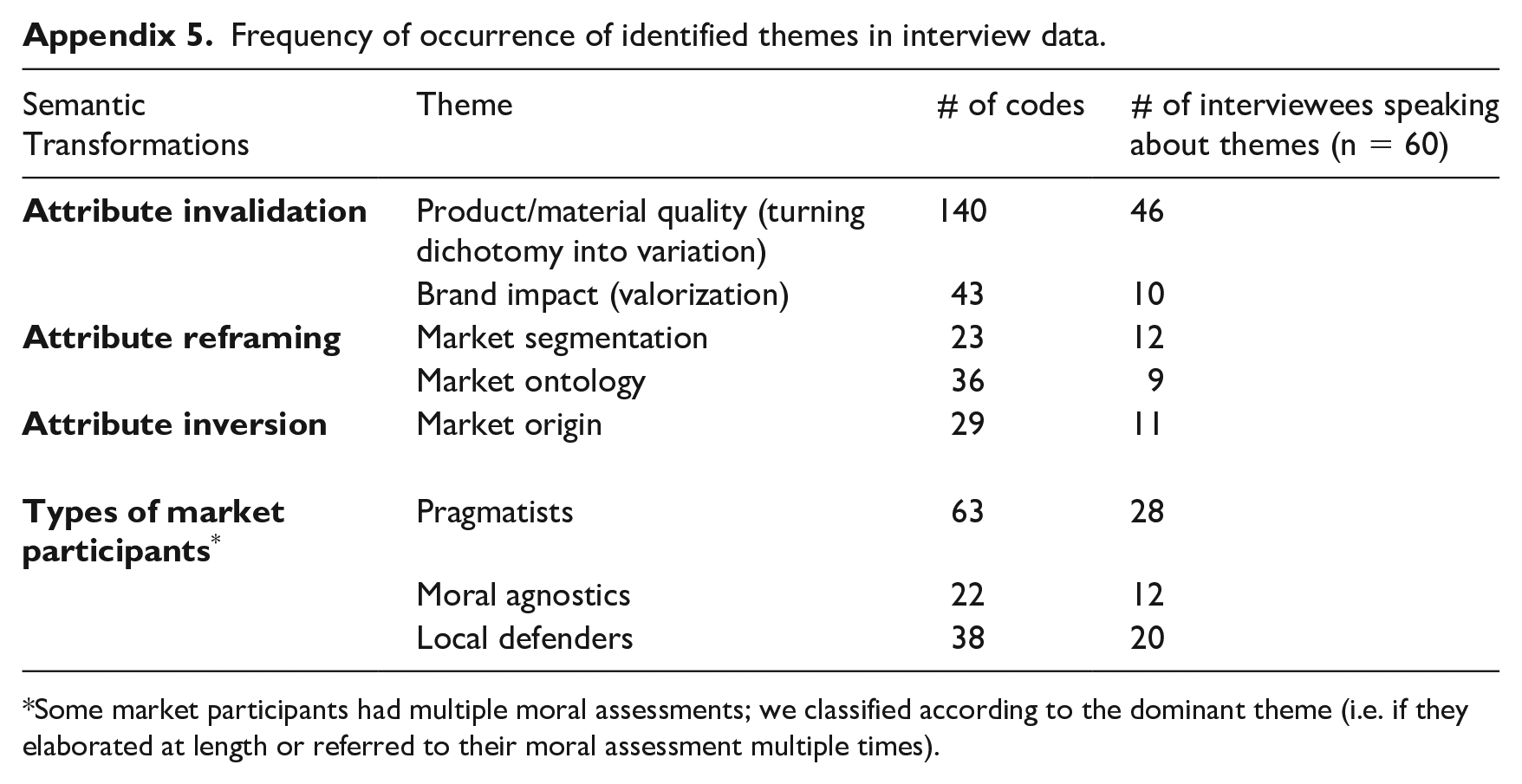
| Semantic Transformations | Theme | # of codes | # of interviewees speaking about themes (n = 60) |
|---|---|---|---|
|
|
Product/material quality (turning dichotomy into variation) | 140 | 46 |
| Brand impact (valorization) | 43 | 10 | |
|
|
Market segmentation | 23 | 12 |
| Market ontology | 36 | 9 | |
|
|
Market origin | 29 | 11 |
|
|
Pragmatists | 63 | 28 |
| Moral agnostics | 22 | 12 | |
| Local defenders | 38 | 20 |
Some market participants had multiple moral assessments; we classified according to the dominant theme (i.e. if they elaborated at length or referred to their moral assessment multiple times).
Acknowledgements
We extend our authentic (pun-intended) thanks to our associate editor Beth Goodrick, our editor-in-chief Renate Meyer and three anonymous reviewers for their support and constructive comments throughout the review process; their guidance resulted in a much stronger, coherent and polished manuscript. We are also grateful for the feedback we received from Silvia Dorado and participants of the UMass Boston Organization and Social Change (OSC) series, as well as Ambra Mazelli and participants of the Asia School of Business (ASB) seminar series. All four co-authors contributed equally to this manuscript.
Funding
The author(s) received no financial support for the research, authorship, and/or publication of this article.
