




Abstract
This psychoanalytic study of affective labour focuses on its two central elements: human contact and love. It is based on a multi-sited organizational ethnography of the fine dining sector in Istanbul, Turkey, where new restaurant areas known as ‘show kitchens’ place chefs in face-to-face contact with patrons. To understand the psychosocial processes of affective production, we analyse chefs’ and patrons’ experiences of encounters in and around ‘show kitchens’. We demonstrate that affect is produced through unconscious contact mediated by socio-cultural representations, which are hegemonized by the ethos of love for one’s job. We contribute to the extant literature on affective labour by studying the desirous interplay between producers and consumers of affect. Specifically, we theorize the role of the psyche in affective production, and offer a new, psychoanalytic conceptualization of affective labour. We conclude by discussing our conceptualization’s organizational and political implications.
Introduction
‘The first robot chef is coming soon!’ announced CNN Türk (2018), referring to a newly developed robot with artificial intelligence and bionic arms that prepared and cooked food by mimicking human gestures. Although the claim was that the robot could follow recipes to the letter, Turkish Twitter was unimpressed. ‘It would not have the taste of hand [idiosyncratic delicious flavour]’, commented one user. ‘Is it going to add its love [prepare food with loving care]?’ asked another ironically (CNN Türk, 2018). These light-hearted responses employing Turkish expressions convey a truth about culinary labour, namely that it is a form of affective labour requiring human contact and love.
This article explores the psychosocial dynamics of human contact and the ethos of love involved in affective production, drawing on an ethnographic study of the Turkish fine dining sector. Over the last decade, high-end restaurants in Turkey have adopted a new architectural style called the ‘show kitchen’, a (part-)open kitchen extending culinary production to the dining room (see Figure 1). 1 This spatial reorganization has turned cooking into a spectacle and significantly expanded contact between chefs and diners. Meanwhile, representations of culinary work in the media have shifted from low-skilled, dull, blue-collar jobs to skilled, artistic ones requiring creativity and passion. These glorified representations have found their way into professional kitchens, as restaurants have adopted ‘love for cooking’ as an employment criterion. A new generation of ‘educated cooks’ (as our interlocutors called those who had attended culinary school) joining the sector has responded to this call by expressing passion for their jobs. As a result, chefs’ close interactions with patrons and love for their jobs have become pivotal to affective production and consumption in Turkish fine dining restaurants.
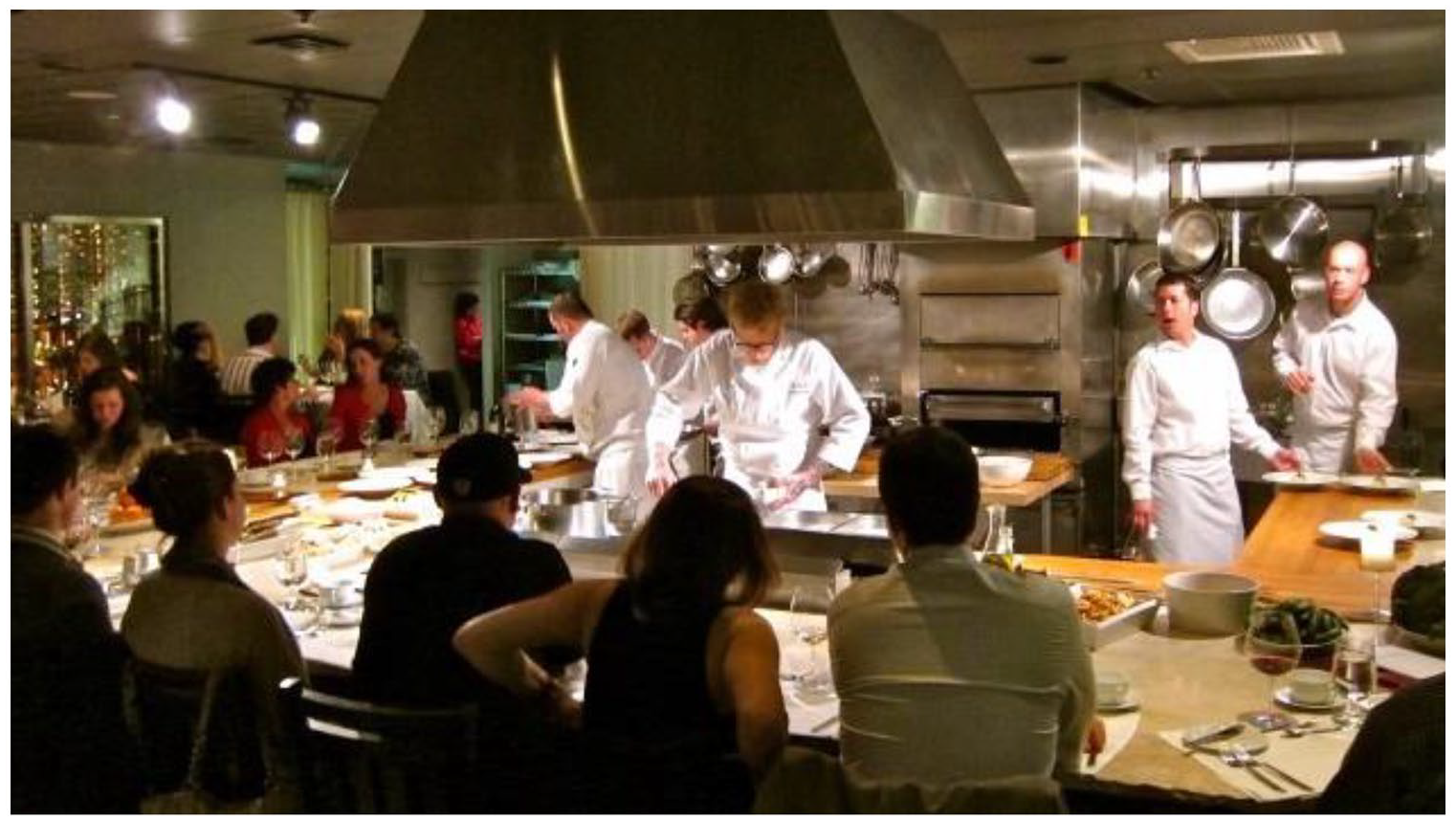
A show kitchen1.
We define affective labour as the paid or unpaid work of producing wellbeing, joy and sociality by deploying embodied affect and engaging one’s psyche (Özdemir Kaya, 2019, p. 11). Research often associates affective labour with the care, catering and entertainment industries (Dowling, 2007; Ducey, 2007; Wissinger, 2007), but it is also key to organizational and social cooperation, network formation and reproduction of the workforce in other sectors and outside the formal economy (Carnera, 2012; Clough, Goldberg, Schiff, Weeks, & Willse, 2007; Hardt, 1999; McRobbie, 2010). Labouring in the affective mode requires interpersonal skills, emotional engagement and human contact (Dalla Costa, 2007; Hardt, 1999; Hochschild, 2012; Rose, 1983; Weeks, 2007; Whitney, 2018). Underlining its qualitative differences from menial and cognitive labour, also known as labour of the ‘hand and brain’ (Rose, 1983), affective labour is often metaphorically called ‘labour of the heart’ (Weeks, 2007, p. 238). Love is considered vital to affective labour as a means to incite positive feelings in others (Fairchild & Mikuska, 2021, p. 3; Hochschild, 2012, p. 19; McRobbie, 2016, p. 110; Weeks, 2007, p. 239). Some also argue that contemporary (post-Fordist) capitalism cultivates love to increase workers’ affective productivity (Dowling, 2007; Lazzarato, 1996; Mumby, 2016; Peticca-Harris, Weststar, & McKenna, 2015).
Social theorists’ (e.g. Hardt, 1999; McRobbie, 2016; Oksala, 2016) postulation that human contact and love are involved in affective labour is rarely examined in empirical settings (for exceptions, see Alacovska, 2020; Dowling, 2012; Wissinger, 2007). Unconscious psychosocial mechanisms, in particular, remain unexplored, although affective labour theorists hint at the role of the psyche in affective production (e.g. Whitney, 2018, p. 648). We study these mechanisms by drawing on a Lacanian ontology centred on desire, whereby affect is a product of socio-symbolic relations unfolding in the unconscious sphere (Fink, 2004; Kenny, 2012, p. 1178; Lacan, 1988, p. 57).
In researching and theorizing the role of the psyche in the production of affect, we contribute to extant literature on affective labour that explores conscious emotion management (e.g. Hochschild, 2012; Mann, 1997; Vincent, 2011) and preconscious embodied modulation of affect (e.g. Ducey, 2007; Hardt, 1999; Wissinger, 2007). While these works have produced important insights into purposeful deployment of emotions, and ‘faking’ emotional engagement and the productive role of body in service contexts, they rarely elaborate on the unconscious interplay of desires at work. The Lacanian psychoanalytic approach addresses this gap by showing how affect intersects with and rests on symbolic significations that psychically mediate and shape embodied relations in various social contexts. This, we suggest, can be fruitfully employed to explain the rise of ‘love for one’s job’ in the high-end culinary sector in Istanbul, and more broadly in what we call ‘the late capitalist enjoyment and experience economy’.
This article is specifically concerned with how the post-Fordist ideological construct of ‘love for one’s job’ fuels affective production by mediating the desire-infused interplay between producers and consumers of the dining experience. We address three research questions: how is affect produced in service encounters in the high-end culinary sector; what role do human contact and the ethos of love play in its production; and what are their unconscious psychosocial mechanisms? We begin by reviewing the affective labour literature and introducing the Lacanian conceptual framework. We then contextualize the research by explaining how affective labour has become part of chefs’ work in the Turkish fine dining sector. Having explained our ethnographic methodology, which is multi-sited and involves Lacanian interpretation, we analyse affect-producing interactions between chefs and patrons in a show kitchen. We conclude by proposing a psychoanalytically inflected definition of affective labour and discussing the implications for theory and practice.
Emotional and Affective Labour
The foundations of affective labour theory were laid by feminist studies of ‘emotional labour’ concerned with ‘commercialization of human feeling’ (Hochschild, 2012) in ‘face-to-face or voice-to-voice’ (Payne, 2009, p. 349) service-sector work (e.g. Harris, 2002; Korczynski, 2003; Vincent, 2011). Emotional labour refers to trying to feel and display organizationally prescribed or socially expected feelings (Harris, 2002; Hochschild, 2012, p. 29). To achieve this, the worker must show ‘will’ and ‘effort’ (Hochschild, 2012, p. 40), requiring ‘the ability to exercise cognitive control’ (Mann, 1997, p. 5).
The term ‘affective labour’ was coined by philosopher Michael Hardt (1999) and is a Spinozist-Deleuzian reconceptualization of ‘emotional labour’ that ‘draw attention to the body’ (Hardt, 2007, p. ix). Hardt defines affects as pre-discursive, bodily and ephemeral sensations (Hardt, 1999; Hardt & Negri, 2000, p. 292). They are products of bodies acting upon other bodies ‘independently of any will power of the mind’ (Thanem & Wallenberg, 2015, p. 241). It is argued that affect is an immediate (i.e. non-mediated) and autonomic response to an encounter emerging from bodily contact or proximity (Bell & Vachhani, 2020, p. 684; Ducey, 2007, p. 191; Clough et al., 2007, pp. 65–66). Affect ‘passes from body to body, human and nonhuman, as a relational “field of forces”’ (Bell & Vachhani, 2020, p. 684, emphasis in original). Accordingly, affective labour is defined as modulation, conveyance and redirection of affective flows to produce ‘a feeling of ease, well-being, satisfaction, excitement, passion’ (Hardt, 1999, p. 96; see also Arvidsson, 2007; Ducey, 2007; Wissinger, 2007).
Hardt’s conceptualization has been taken up by critical scholars, including organizational researchers, who understand affective labour as the production of pleasurable encounters that enhance consumers’ affective capacity to generate profit (see Dowling, 2012, p. 2). For example, Wissinger looks at fashion modelling, which ‘calibrates bodily affects, often in the form of attention, excitement, or interest’ (2007, p. 251); Ducey analyses the ‘ripple in and between bodies coming together as organisms, individuals, forces, and institutions’ in the United States healthcare industry (2007, p. 203); and Dowling shows the ‘affective resonance’ (2012, p. 111) emerging from the embodied contact between patrons and a waitress performing gendered and sexualized labour. While emotional labour theory emphasizes conscious emotion management, affective labour theory focuses on the embodied ability to affect and be affected, which eludes such control (Ducey, 2007, p. 191).
Building on these two traditions, recent feminist scholarship argues that affective labour operates at both conscious and bodily levels, which are interlinked (e.g. Fairchild & Mikuska, 2021; McRobbie, 2016; Oksala, 2016; Weeks, 2007; Whitney, 2018). Organizational scholars of affect similarly argue against an ontological separation of affect and emotion, or body and mind (e.g. Ashcraft, 2017; McCarthy & Glozer, 2022; Otto & Strauß, 2019; Pors, 2019; Pullen, Rhodes, & Thanem, 2017). However, these theorizations do not consider the role of psychic desire, which is a centrepiece of Lacanian ontology of the subject, on which we draw to explain the production of affect in the neoliberal late-capitalist workplace. Lacanian theory explicates how these two registers of subjectivity, i.e. body and mind, produce affect by intersecting in a third register: the psyche (Dey, Schneider, & Maier, 2016, p. 1454).
Extant research acknowledges the role of the psyche in affective production. For example, Weeks (2007, p. 241) writes that love performed as part of affective labour ‘extends to the affective life of the subject, into the fabric of the personality’. Others refer to the ‘psyche’ (Whitney, 2018, p. 648) or use psychoanalytic concepts such as ‘affective investment’ (Balance, 2012, p. 14). However, these authors neither elaborate theoretically on the psyche, nor study it empirically.
Drawing on Lacan, this article presents a new, psychoanalytic conceptualization of affective labour, focusing on unfolding of love and human contact in the psychic sphere, which escapes conscious control yet is also irreducible to affective resonance between bodies. This conceptualization captures ‘the unmanaged organization’ (Gabriel, 1995), which we can perhaps translate as the ‘unmanaged heart’ in our discussion. It also conceptualizes affect as relational dynamics between two or more interactants (individuals), or between agents and aspects of their material environment within social domains as relational scenes (Slaby, 2016).
Lacan and the production of affect
Psychoanalytic literature contributes to the social sciences by exploring the psychic dynamics of social phenomena (see Arnaud, 2002; Arnaud & Vidaillet, 2018). We adopt Lacanian psychoanalysis specifically because, in conceptualizing affect, it connects all three registers of subjectivity: conscious, unconscious and body (Resch, Hoyer, & Steyaert, 2021, p. 790).
Organizational scholars have used Lacan to investigate emotional attachment to work, organizations, norms and ideologies, including the ethos of love for one’s job (e.g. Bloom, 2016; Dey et al., 2016; Driver, 2013; Ekman, 2013; Kenny, 2012; Kenny, Haug, & Fotaki, 2020; Spicer & Cederström, 2010). They argue that individuals submit to circulating discourses (norms, rules and laws) in the process of gaining social recognition that constitutes them as socially viable subjects (Fotaki, 2017). The dominant neoliberal discourse compels them to express ‘love for their job’, while subjection to this occurs through the psychic desire to be recognized (Lacan, 2006). We build on this literature, not to examine attachment to harmful ideologies and exploitative working arrangements as in previous research (e.g. Driver, 2013; Resch et al., 2021; Roberts, 2005), but to explain the production of affect as a commodity in service jobs.
Lacan argues that we are born into a discursively produced society fraught with contradictions, creating ambiguity about social expectations and our social place (Costas & Taheri, 2012, p. 1199). This enigma incites our desire to become part of the symbolically constituted society, to which we then form an affective attachment (Lacan, 1999, pp. 44–45). The Lacanian literature calls this phenomenon ‘symbolic identification’, which denotes identifying with a socio-symbolic structure such as an ethos or ideology (Hook, 2011, pp. 109–110). The process of identifying with the symbolic order is a precondition for subject formation (Fotaki, 2009, 2010). In other words, becoming a subject implies submission to the social norms and prohibitions embedded in the socio-symbolic structure, leading to a split between the conscious and the unconscious (Müller, 2013). In a vain effort to unify the split self, subjects form imaginary identifications (Picard & Islam, 2020, p. 397), for instance with their mirror image in early childhood development (Böhm & Batta, 2010, pp. 351–352), with their peers (Roberts, 2005, pp. 630–631) or with hegemonic cultural representations (Hook, 2018, p. 130). Identification with such images is necessary to paper over the cracks in collective and individual subjectivity, allowing subjects to enjoy an ephemeral sense of being unitary and fulfilled (Resch et al., 2021, p. 790).
For Lacan, symbolic identification is a necessary condition for the production of affect, because it charges bodies with libido, animating and sexualizing their parts (see Copjec, 1997; Gorzs, 1999, p. 270). Once this condition is met, affect is produced through embodied intersubjective contact and mediated via the imaginary register of the psyche (Lacan, 1999, p. 6; Stavrakakis, 2008, p. 1054), prompted by desire. Overall, according to Lacanian psychoanalysis, body, discourse and imagery are intertwined in affect production (Dey et al., 2016, p. 1454; Glynos & Stavrakakis, 2008, p. 262; Lacan, 1988, pp. 57, 293; Picard & Islam, 2020, p. 398). This means that affect is ontologically inextricable from ‘the symbol’, which ‘is imminent in affect’ (Fink, 2004, p. 52). Drawing on this conceptualization, we study the unconscious mediation of affective labour in high-end culinary settings in Istanbul. Specifically, we examine how hegemonic discourses of ‘love for one’s job’ suffuse the subjects’ sense of self and the intersubjective play of desire unfolding in the imaginary register of the psyche. Neoliberal ideology relying on passion for work evokes subjects’ strong desire for identification and attachment to such discourses (Özdemir Kaya, 2019). Research shows that these are particularly strong in creative industries such as entertainment, and increasingly in culinary work (Gill, 2009; Gregg, 2009; McRobbie, 2016; Tasselli, 2019).
According to Lacan, love is the desire for the love of ‘the Other’ (with a capital ‘O’), which is the agent that emerges as an effect of symbolic identification and represents society in the psyche (Lacan, 1999, p. 4). It is desire for social recognition (the love of the Other) rather than desire for a particular person, identity or object (desire for the other) (Lacan, 1999, p. 5). It is also a sublimated form of desire fundamental to the constitution of a subject that overdetermines all imaginary identifications (Lacan, 1999, pp. 4–5). Therefore, from a Lacanian perspective, affective attachment to the socio-symbolic system dominated by the ideology of ‘love for one’s job’ qualifies as love. In contrast, affective attachment to one’s job overdetermined by this ideology is only a desire whose object may change over time. Love’s different meanings in Lacanian and everyday discourses may lead to confusion. Therefore, in this article, we use the Lacanian concepts of symbolic identification and imaginary identification, which help us conceptualize these two forms of attachment.
In conducting this research, we were struck by how often our interlocutors invoked love, especially to describe chefs’ performance in the show kitchen and interactions with patrons. This manifests a new conception of culinary work as passionate, which finds expression in diverse empirical forms, including discourse, imagery, cultural artefacts and embodiment. We examine these to understand the link between contact, love and affective labour. As detailed in the next section, transformations within the Turkish fine dining sector embody the post-Fordist primacy of affective production, and elevation of love as its necessary condition (Hardt, 1999; Lazzarato, 1996; McRobbie, 2016). Studying these shifts allows us to explore psychosocial mechanisms of affective production in the culinary setting, sustained by desire circulating between chefs and diners and their attachments to the ethos of love. Drawing on this analysis, we propose a psychoanalytic conceptualization of affective labour that accounts for its ideological overdetermination and producers’ and consumers’ unconscious agency.
Turkish Fine Dining in Transition
In the 1980s, neoliberal economic restructuring redistributed income towards a tenth of the metropolitan population, changing the class composition in Turkey (Ahmad, 2010, p. 198). Foreign direct investment, privatization and expansion of the finance and service sectors created a new industrial and professional class known as ‘third world cosmopolitans . . . and new consumers’ (Altan-Olcay & Balta, 2016, p. 1109). Overall, this period saw a rapid escalation of consumerism, with niche consumerism aimed at specific demographics. At the same time, investors in the tourism and hospitality sector benefited from preferential state credit (Buğra, 2003). These socio-economic changes helped develop a high-end culinary sector concentrated in Istanbul, reviving Turkey’s haute cuisine and restaurant sector, which had been decimated by the First World War and the political turmoil of the early republican era (Özdemir Kaya, 2019, pp. 46–74).
In the 1990s, to meet demand for qualified staff in the booming hospitality industry, new higher education institutions began to research gastronomic tourism and the riches of Turkish cuisine (e.g. Baysal, 1996; Halıcı, 1991; Sürücüoğlu & Akman, 1998). Exchanges with Western culinary literature encouraged adoption of the concept of culinary work as an artistic, scientific and passionate pursuit (see Gomez & Bouty, 2011; Lane, 2014; Louisgrand & Islam, 2021; Slavich, Svejenova, Opazo, & Patriotta, 2020). The Western-influenced view of high-end dining as a multi-sensory experience and an art form merged with local culinary traditions, culminating in the ‘New Anatolian Kitchen’ (Cappelen & Strandgaard Pedersen, 2021; on the institutional origins of fine dining, see Gomez & Bouty, 2011, pp. 927–928). Over time, glorified representations of culinary work became hegemonic, as both local (e.g. movie Alone; TV show Refika’s Kitchen; Vedat Milör’s restaurant reviews in Hürriyet) and international (e.g. movie No Reservations; Netflix series Chef’s Table; Anthony Bourdain’s memoir Kitchen Confidential) gastronomic media expanded and were widely consumed in Turkey. Hundreds of private culinary schools and workshops established in the 2000s propagated these representations, helping to transform the image of culinary practice and attracting thousands of students from middle- and upper-middle-class backgrounds. 2
Since the last century of the Ottoman Empire, male cooks from the north-western city of Bolu had dominated haute cuisine in Istanbul, including the imperial kitchen (Samancı & Bilgin, 2010, p. 341). Their control of the sector was consolidated by recruitment through kinship, retention of recipes and experiential knowledge as trade secrets, and gatekeeping, which somewhat continues to this day. This business model changed radically with the opening of culinary schools as an alternative pathway (Özdemir Kaya, 2019, pp. 66–74).
The international architectural trend for ‘show kitchens’ (see Figure 1) in top-tier restaurants, moving food production fully or partially into the dining room, has also driven the sector’s transition. This has turned chefs’ work into a spectacle to be consumed by patrons alongside the food served, while restaurants have benefited from the culinary arts discourse, enabling them to repackage their service as a ‘fine dining experience’ (see Dowling, 2012). The latter is an affective commodity evoking feelings such as excitement and satisfaction (Dowling, 2007, p. 120). We argue that show kitchens make chefs pivotal to this affective production, expanding interactions between chefs and diners.
As chefs’ affective labour in show kitchens has become central to profit making, restaurants have changed their recruitment logic and criteria to attract chefs who will produce the best customer experiences in face-to-face encounters. Good manners, foreign language skills and culinary education, as well as age, gender, class and appearance, influence employment decisions more than ever in high-end restaurants, especially for positions in show kitchens (see McRobbie, 2016, p. 107; Vincent, 2011, p. 1378; Witz, Warhurst, & Nickson, 2003, pp. 37, 47). More intriguingly, our research shows that ‘love for one’s job’ has become a key criterion (see Figure 2).
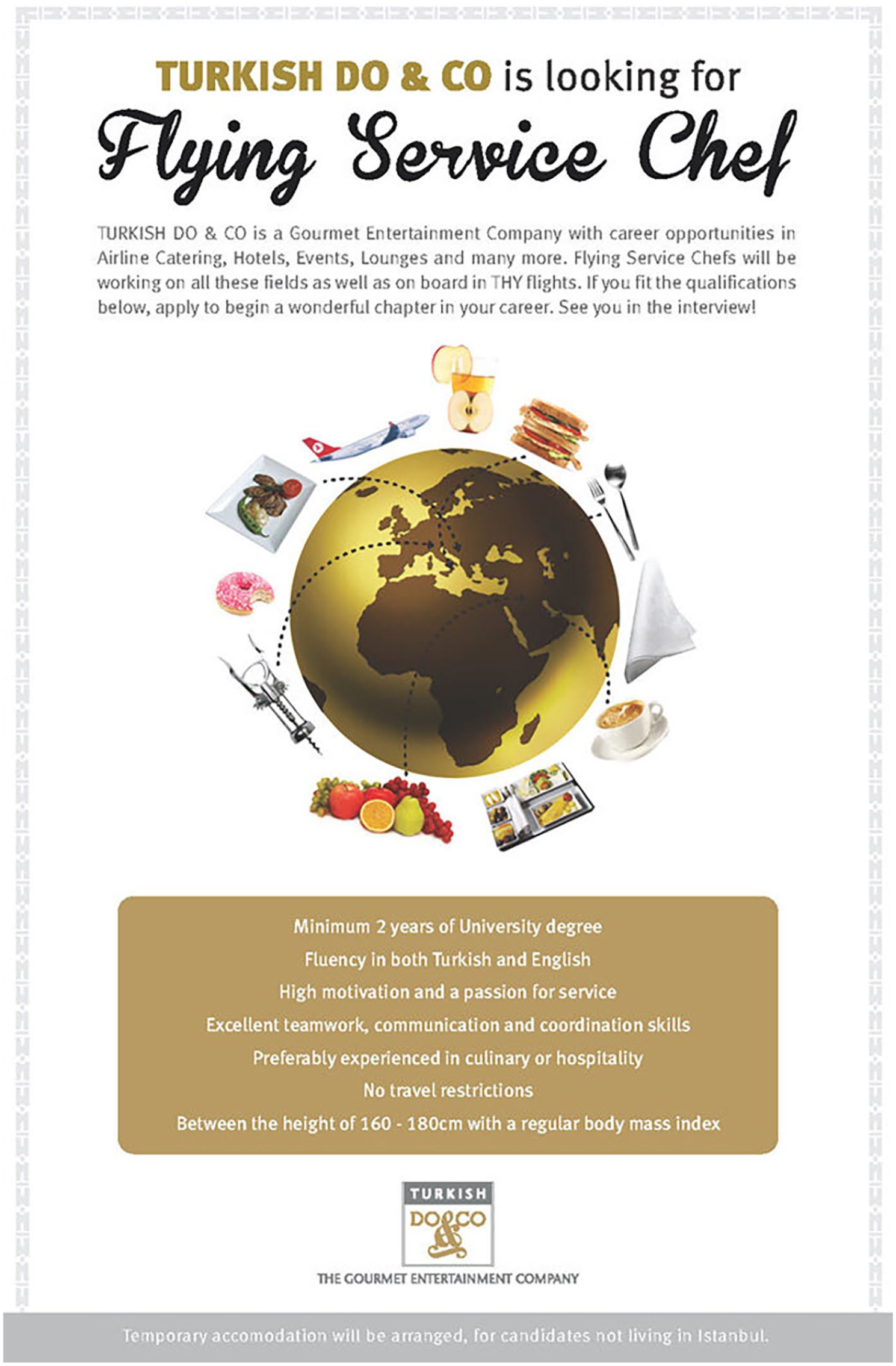
Job advertisement by one of the largest catering companies in Turkey.
As a result of these changes to employability standards, cooks from Bolu have lost their privileged role as gatekeepers in many top-tier restaurants. Educated cooks have become more employable than self-trained ones, challenging the sectoral domination of male chefs from Bolu. For example, an HR manager in a prominent culinary school stated that 50% of cooks in the Turkish fine dining sector are ‘educated’. At a fine dining restaurant where we undertook our fieldwork, all but two of the 14 culinary staff were educated cooks, and more than half, including the head chef, were women.
Nevertheless, this opening up of the profession to hitherto excluded groups has been achieved at the cost of making aspiring chefs perform intense affective labour. Thus, there has been a shift in how fine dining chefs engage with their work. Contemporary chefs commonly describe culinary work as creative and enjoyable, echoing the media’s dominant reference to culinary production as an artistic pursuit (see also Gomez & Bouty, 2011). They also define their relationship with work as love, as the interview excerpts shared in the analysis section demonstrate.
This transformation of the Turkish fine dining sector epitomizes the broader post-Fordist capitalist shift that gives primacy to immaterial production (Carnera, 2012, p. 71; Hardt, 1999; Lazzarato, 1996), and the consequent ‘feminization’ 3 (McRobbie, 2010, p. 62; 2016, p. 95) of sectors from which women have traditionally been excluded. Circulation of discourses and imagery around ‘the culinary arts’, the emergence of the culinary education sector, adoption of the show kitchen style and changing employment criteria have all reshaped the sector to maximize the production of affect. As argued earlier, these changes have turned chefs into affective labourers, enhanced their contact with patrons, put love at the centre of their professional identity and work, and increased women’s participation in the sector.
Research Methodology
This article is based on a multi-sited, psychosocial organizational ethnography of the fine dining sector in Istanbul, Turkey, integrating Lacanian interpretation with an ethnographic methodology. In combining a psychoanalytic epistemology with conventional qualitative methodologies (e.g. Driver, 2013; Ekman, 2013; Picard & Islam, 2020; Resch et al., 2021; Vidaillet & Gamot, 2015), this study falls within critically rather than clinically orientated Lacanian organizational research (Arnaud & Vidaillet, 2018). We investigate the affective element of human contact in restaurants by interpreting interlocutors’ accounts psychoanalytically. These interpretations are one of three lenses through which we interrogate our data, the other two being inductively created themes and sensitizing concepts. This section presents our fieldwork, our psychoanalytic method of interpretation and our broader analytical work.
Ethnographic fieldwork
We build on ethnographic methodology, which enables us to study micro-level psychosocial mechanisms of affective labour within their meso- and macro-level contexts (see Burawoy, 2000, p. 343; Nicolini, 2009; O’Doherty & Neyland, 2019, pp. 450, 453; Ybema, Yanow, Wels, & Kamsteeg, 2009, pp. 6–7). A multi-sited approach is adopted to observe how affective labour is performed across the sector, and to trace circulation of the ethos of ‘love for one’s job’ through discourse and imagery (Marcus, 1995, p. 96; Van der Waal, 2009).
The field was processually constructed by establishing interconnections between events (e.g. culinary events and meet-ups), sites (culinary schools, high-end restaurants and cafés), actors (e.g. culinary school students, chefs, restaurant owners) and artefacts (e.g. movies and TV shows) through longitudinal fieldwork conducted between June 2012 and September 2013, and between February and April 2016.
We used the conventional ethnographic methods of participant observation, semi-structured interviews and desk research to develop an ethnographic understanding of affective labour and the ethos of love. Author 1 collected the data, consisting of 30 days of participant observation, 32 semi-structured, tape-recorded interviews with 24 interlocutors (between 15 minutes and 2.5 hours in length), 15 informal interviews with 15 interlocutors, 4 semi-structured interviews through email correspondence with an interlocutor, and archival data (e.g. interviews with chefs, culinary documentaries, food blogs and recruitment websites). We have assigned pseudonyms to all interlocutors and anonymized organizations.
We inferred affectivity exclusively through a psychoanalytic interpretation of discursive data, rather than embodied interactions or our own affective responses to interview/fieldwork situations. This meant that we did not adopt clinical data collection methods (Arnaud & Vidaillet, 2018). This methodological choice was based on Lacan’s conceptualization of affect as ontologically and empirically inseparable from discourse and imagery, leading him to argue that affect is not ‘a kind of ineffable quality which must be sought out in itself’ (Lacan, 1988, p. 57), ‘located in the extra-discursive sphere’ (Dey et al., 2016, p. 1454).
According to Lacan, affect does not lend itself to observation in isolation from discourse (Lacan, 1988, p. 293). Organizational scholars similarly argue that language is the only medium that allows researchers to approximate, make sense of and write about affect, however inadequately (Keevers & Sykes, 2016, p. 6). Therefore, as in previous Lacanian research (e.g. Bloom, 2016; Cederström & Spicer, 2014; Dashtipour & Rumens, 2018), including ethnography (e.g. Kenny, 2012; Müller, 2013), we used discursive methods to locate and analyse unconscious and affective phenomena. Lacanian discursive methods differ from conventional discourse or narrative analysis, and are well-suited to exploring complex and ambiguous sites of identification (Fotaki & Harding, 2013; Fotaki, Long, & Schwartz, 2012). For epistemological coherence, they are often structured around polyvalent signifiers used as points of entry into the unconscious, as discussed next (see Arnaud, 2002, p. 697; Driver, 2009, p. 496; Holt, 2004, p. 264; Stein, 2007, p. 1228).
Lacanian interpretation
Lacanian theory considers conscious discourses as fantasy narratives from which the unconscious thoughts and desires it seeks to grasp are banished (Costas & Taheri, 2012, p. 1200). In order to access the unconscious, one must engage with the other (analysand/interlocutor) through what Lacan calls the ‘symbolic axis’ (Fink, 2004, p. 5) of communication (see Figure 3).
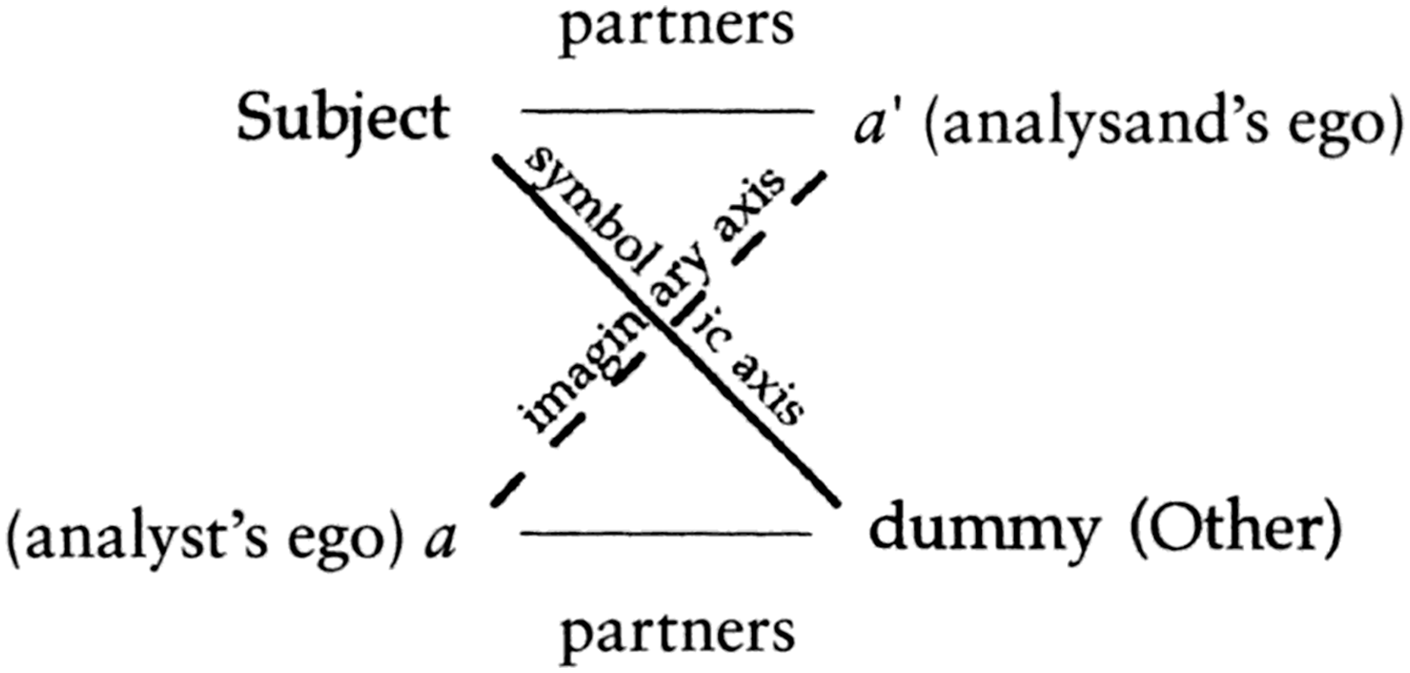
The four parties involved in analysis (source: Fink, 2004, p. 5).
The symbolic is ‘a chain of signifying elements’ (Fink, 1995, p. 10) representing repressed wishes or thoughts that take a life of their own outside consciousness (Fink, 1995, p. 8). In the unconscious, these undergo condensation and displacement through which they attract ‘phonemes and letters’ (Fink, 1995, p. 8). As a result, new polyvalent signifiers such as neologisms, homonyms and double entendres are produced (for examples, see Lacan, 1999, pp. 4–18).
Although the conscious self keeps a lid on the unconscious, these unconscious signifying elements frequently intrude into conscious discourse through parapraxes, slips of the tongue, puns, witticisms, idiomatic expressions, and so on (Arnaud, 2002, p. 697; Driver, 2008, p. 65; Fink, 2004, p. 10; Lacan, 1999, p. 22; 2006, p. 737; see also Kenny, 2012, p. 1190; Fotaki & Harding, 2013). Parapraxes are a sign of unconscious thoughts resisting articulation, while the other phenomena reveal suppressed thoughts through their secondary meanings.
Our interpretative strategy relied on identifying and analysing idiomatic expressions, as one form of polyvalent signifier found in the discursive data (e.g. formal and informal interviews, archival material). An idiomatic expression has a figurative meaning that communicates a conscious thought, and a literal sense that exposes unconscious thoughts, feelings or wishes (Fink, 2004, p. 10). We noted that signifiers within discourse can be marshalled to overcome emergent anxieties manifested affectively (Parker, 2005a, 2005b). For example, meslek bulaştı is a Turkish culinary expression enunciated by (usually experienced) cooks when a trainee or commis (junior) chef is injured at work. It marks and celebrates the injury as an initiation into the culinary profession. Its figurative meaning is ‘you have joined the tribe’, welcoming the novice chef into the professional ranks. However, its literal meaning translates as ‘you have caught the trade’ or ‘you have been contaminated with the trade’. Based on the literal meaning, the psychoanalytic interpretation would suggest that the culinary profession is seen as a disease or harmful substance causing suffering and pain. While celebratory on the surface, the expression reveals an unconscious disdain for the profession, and tacitly warns of the suffering awaiting those embarking on this career (see Gill & Burrow, 2018 on fear, violence and intimidation in the fine dining sector).
Idiomatic expressions are especially conducive to social research because their meaning is socially produced, reflects collectively held beliefs and is available to all native/fluent speakers of the language, whereas the meanings of other polyvalent signifiers (parapraxes, slips of the tongue, puns, witticisms) may be highly context-specific and open to widely differing interpretations. Therefore, using expressions as a point of entry into the unconscious minimizes the risk of projection (i.e. imposition of one’s own affective experiences and thoughts onto others) by the researcher and maximizes opportunities for readers to evaluate their interpretations (Fink, 2004, p. 10). Another reason for using them is that the Turkish language is rich in culinary idioms, and our interlocutors invoked these frequently, providing us with ample material for analysis. This interpretative method, adopted from the psychoanalytic technique (e.g. Fink, 2004, p. 10), might be applied in other contexts where languages are similarly rich in relevant idiomatic expressions. Alternatively, researchers might focus on other polyvalent phrases (slips of the tongue, puns, witticisms, etc.) for wider applicability. Next, we explain our ethnographic analysis of the broader context within which affective exchanges occur.
Ethnographic analysis
The analysis moved iteratively between ethnographic material, theory and fieldwork throughout the research (Kenny, Fotaki, & Vandekerckhove, 2020, p. 6; Nicolini, 2009; Vidaillet & Gamot, 2015, p. 997). We recorded ‘sensitizing concepts’ (Charmaz, 2003, p. 259, cited in Bowen, 2006, p. 3) taken from the literature review, using NVivo. We then created themes inductively from the ethnographic data (Costas & Taheri, 2012, pp. 1202–1203). A key emerging theme concerned culinary idiomatic expressions, and each expression was added as a sub-theme. The ethnographic material was coded into both sensitizing concepts and themes (see Table 1), and we interpreted the idiomatic expressions using the psychoanalytic method described above.
We chose expressions most relevant to the research questions, and analysed excerpts featuring these by drawing on the psychoanalytic interpretation of the selected expression, as well as the themes and sensitizing concepts into which we coded the excerpt (see Table 1). Each provided us with a lens for ‘seeing, organizing, and understanding’ (Charmaz, 2003, p. 259, cited in Bowen, 2006, p. 3) the ethnographic material. Finally, we wove the emerging insights and our ‘broader set of intuitive understandings of the fieldwork situation’ (Van der Waal, 2009, p. 36) into an ethnographic narrative through textwork (Ybema et al., 2009, p. 10) in light of Lacanian theory.
Affective Production in the Show Kitchen
Forming imaginary connections between chefs and patrons
Fine dining restaurants increasingly use a range of strategies to expand contacts between chefs and patrons, including dynamic, eye-catching culinary tasks such as flambés (creating flames in a hot pan by pouring in alcohol) in the show kitchen.
The show kitchen aims to build a bridge between the patrons and cooks, and the thing that it produces. . . Things happen out there [in the dining room] while you work in the show kitchen, and often you can’t lift your head up to have a look. But the motivation there gives you a direction.
4
Also, the kitchen is a place where there are noises, colours, heat, smell, and for someone who is watching it from outside, it can be enticing. . . Ignition of a pan, for example. . .
In this interview excerpt, Batu, an educated male chef in his early thirties, explains how the show kitchen establishes a connection between chef and patron, thereby producing ‘the thing’, which likely refers to affect resisting signification (see Beyes & De Cock, 2017, p. 62; Fotaki, Kenny, & Vachhani, 2017, p. 4; Keevers & Sykes, 2016, p. 6). According to Batu, this happens through ‘noises, colours, heat, smell’ in the show kitchen enticing patrons. The show kitchen appears in his description as an image in the Lacanian sense, i.e. as a ‘visual, auditory, olfactory, gustatory, tactile, or other’ (Fink, 2014, p. 27) object feeding into the imaginary register of the psyche. Such images, Lacanian theory contends, become objects of drive and imaginary identification, giving ‘partial enjoyment’ (Glynos & Stavrakakis, 2008, p. 262) because the imaginary identification is always incomplete. Thus, the excerpt suggests that the imaginary register of the psyche mediates the contact between chef and patron. The show kitchen serves as an image that entices patrons and evokes affect. However, it is important to remember that one does not have access to others’ affective experiences. Indeed, Batu professes that he is too busy to even ‘lift your head up to have a look’ at the dining room, so his comment on diners’ enticement by the show kitchen is but imagined. This imagination drives and motivates him, suggesting that he identifies with and enjoys the show kitchen and projects his experience onto patrons.
Batu’s presumption of patrons’ affective responses to the show kitchen is confirmed in an account by Seda, a patisserie student, of eating at a restaurant with a show kitchen: He [shows you] how lovingly he prepared it, knows the temperature [for cooking]. When he says ‘this [meat] comes from the back, the waist, the legs of the animal’, you think ‘he explains this to so many people, yet his enthusiasm and smile are still intact’. I mean, you begin admiring the chef. The way he cooks, his happiness. . . I can’t say it is erotic love, but a connection is nevertheless established, because he performs [his job] with passion and feeds you [with love]. There is indeed an emotional connection there that we may call romantic. You know what they say: ‘I poured my love into it [the food]’. He pours passionate love [into the dish] and you eat it.
Like Batu, Seda claims that an affective connection is formed between chef and patron through their contact in the show kitchen. In her words, this connection is ‘romantic’, if not ‘erotic’, which indicates that it is affectively charged. In saying ‘he pours his passionate love and you eat it’, Seda plays on the literal sense of the idiomatic expression sevgisini katmak to describe an affective transmission. The figurative meaning of the expression is performing a task/job with love, while its literal sense is ‘adding/pouring/blending in one’s love’. The literal sense attests to her experience of affective transmission resulting from their contact. Seda feels as if love is physically transferred from the chef to herself through the medium of food. Nevertheless, she also explains that her affective response is to the chef’s discourse and demeanour, not his physical presence. This means that her actual source of enjoyment is the chef, or rather her imaginary identification with the chef, as is also apparent in her concluding comment: ‘Yes, maybe everyone [all the patrons] eats it [chef’s love]. But at that moment, it feels like it’s uniquely for you. I mean, it makes you feel special.’
Both Batu’s and Seda’s accounts show that contact between chef and patron in the show kitchen produces affect because the imaginary register of the psyche mediates their embodied encounter. Their imaginary identifications with the ‘show kitchen’ as a captivating spectacle and with the other party (patrons for Batu, the chef for Seda) and their own subject positions (Batu as the one running the spectacle and enticing patrons, Seda as the one for whom the show is put on) build a ‘bridge’ or ‘connection’ between chef and patron. This imaginary bridge temporarily closes the divide between them and provides partial enjoyment. As discussed earlier, the entry into the symbolic order creates an irredeemable chasm within and between subjects. The imaginary identification papers over these cracks temporarily and gives them enjoyment owing to a fleeting sense of unification with the other (see Harding, 2007). In addition to the contact involved in affective labour, Seda’s account provides insights into the element of love, as we explore next.
Overdetermination of imaginary connections by the ethos of love
Seda is attracted to the chef because she interprets his discourse and demeanour as signs of love for his job and expressions of care for her. Her fascination stems from perceiving him as performing a ‘labour of love’ for her, making her feel special. This exemplifies how certain others, identities and objects are elevated to a special status in the unconscious and given an alluring ‘je ne sais quoi’ (Hook, 2008, p. 5). In imaginary identification, we ‘enter into the drama . . . equipped with memories and beliefs’ (Harding, 2007, p. 1769) and identify with those deemed socially desirable in ‘hegemonic discourses, images, and fantasies . . . broadcast all around us’ (Fink, 2014, p. 53). In this case, we see how the ethos of love turns a chef into an object of desire for a patron by signifying their embodied encounter.
The overdetermination of contact in the show kitchen by the ethos of love is also illustrated in another account. Tezer, a high-end café owner and manager, says: Sitting at a table facing the [show] kitchen and observing is the thing that I like most. . . In small kitchens, where it is evident that they perform their jobs with love, show care for the dish, and see them decorate [the plate] with a plant using tweezers and all really makes me. . . To see that it is prepared meticulously. . . I wouldn’t be that much [impressed] by the kitchen of an ordinary restaurant. Someone grills like crazy on one side, another stuffs pilaf [rice] in a dish. . . that may not be that. . . It probably wouldn’t evoke pleasant feelings, I don’t know. I like to see those people’s meticulousness. When you see them adding value to what you eat, it is like you are already favourably disposed toward them.
Here, Tezer explains that, for her, observing chefs in show kitchens at high-end restaurants meticulously preparing and decorating dishes is the most enjoyable part of dining. She emphasizes that she would not be impressed by any old show kitchen. She particularly enjoys the chefs’ precision, concentration and complete application to the task, making it ‘evident that they perform their jobs with love’. Her interpretation of chefs’ demeanour as an embodiment of love makes her ‘positively disposed’ towards them and happy to pay more for the experience. The excerpt also shows how the mediation of chefs’ performance through the ethos of love makes them alluring to their patrons. This magnetism is economically valuable as it contributes to profit generation.
Symbolic mediation applies not only to patrons’ experience of consuming the dining experience, but also to chefs’ experience of producing it, as revealed in a remark by Ahmet, a self-trained patisserie chef and culinary school instructor: You need to entirely focus on what you are producing with all that you have. Love. . . You know they say el tadı [delicious idiosyncratic flavour] – for that el tadı you have to give it your soul. And what you receive from the customer, the satisfaction, has to affect you incredibly. That. . . That is why you need to. . . I think that’s what distinguishes people.
Here, Ahmet argues that cooks produce el tadı if they ‘fully focus on what you are producing’, ‘give it your soul’, ‘love’ their job. El tadı, a culinary expression, has the figurative meaning of distinctive delicious flavour (see Table 1). It denotes an elusive flavour that only those with exceptional talent can create, and literally translates as ‘taste of the hand’. Its literal sense implies that the cook’s body has a unique taste, which is mixed into the food while handling it and then materially transmitted to consumers, giving them pleasure. Like sevgisini katmak, it attests to the transmission of affect, which is imagined as a result of an unmediated bodily contact.
Examples of coding.
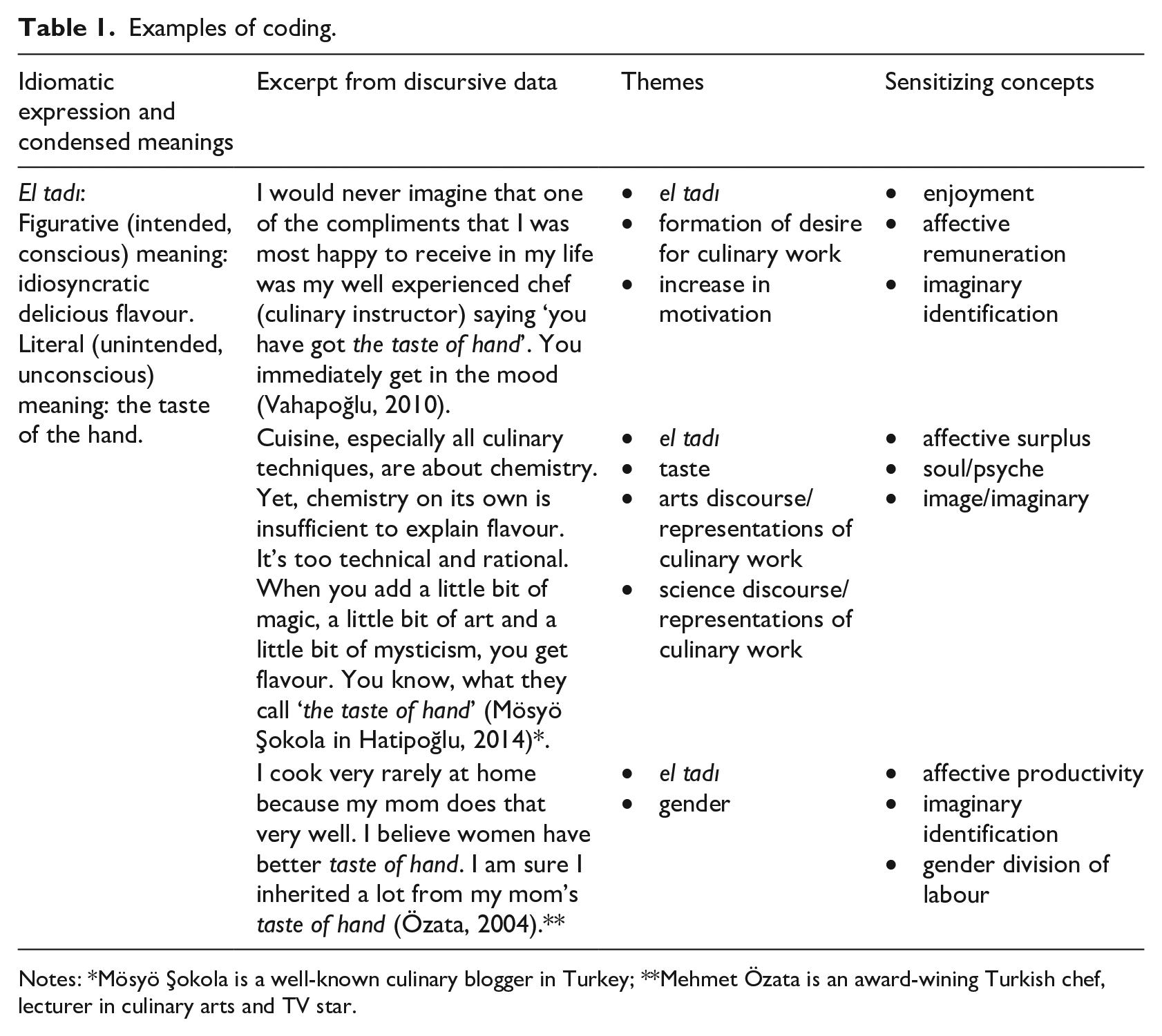
Notes: *Mösyö Şokola is a well-known culinary blogger in Turkey; **Mehmet Özata is an award-wining Turkish chef, lecturer in culinary arts and TV star.
Despite thinking at an unconscious level that he can transmit affect through direct bodily contact with patrons, Ahmet also strives to involve his soul in his work in order to form affective connections. He tries to entice patrons to identify with him by attaining the previously mentioned special status. Probably because of his repeated exposure to the idealized image of modern chefs as passionate, he believes he can achieve his goal by displaying deep love for and complete dedication to his job. Thus, the ethos of love shapes how he performs affective labour. He also responded as follows to our question about the qualities he seeks in a candidate when recruiting for his team: ‘Firstly, they love their jobs very much. I sometimes, owing to my years of experience, look at their eyes and can tell. . . I mean, the person has a passion for the job.’
In Seda’s, Tezer’s and Ahmet’s accounts, the ethos of love for one’s job appears as a discursive construct signifying bodies and their encounters, rendering them attractive and affectively productive, as well as impacting on other practices in the sector such as recruitment (see Figure 2). Patriarchal notions of work also shape this ethos of work, as we explain next.
How the ethos of love blurs boundaries between patriarchy and capitalism
I very rarely cook at home because my mom does that very well. I believe women have better el tadı. I am sure I inherited a lot from my mom’s el tadı. (Özata, 2004)
In this quote, award-winning Turkish chef, culinary arts lecturer and TV star Ahmet Özata argues that el tadı is more common among women and is even passed on to their offspring as if it were an innate quality. Thus, he genders and naturalizes el tadı, which is often attributed to primary carers, and associates it with unpaid domestic labour. Furthermore, the transferability he attributes to el tadı from his mother, an unpaid carer, to himself, a paid chef, suggests permeability between the logics governing unpaid domestic care settings and paid commercial service settings. The boundary between the two seems blurred, as Seda’s and Tezer’s expectations of loving care from chefs also demonstrate.
Feminist scholars have long highlighted the difficulty and undesirability of simple distinctions between paid and unpaid work (for a discussion, see Fotaki & Harding, 2013, ch. 6; Daskalaki, Fotaki, & Simosi, 2020). Drawing on the concept of reproductive labour, Italian socialist feminists in the 1970s brought together organizing and political analysis in arguing that women’s unpaid work within the home is not outside capitalism, as proposed by orthodox Marxist theory (Dowling, 2007, p. 125; Fortunati, 2007, p. 145). On the contrary, it contributes directly, and indeed subsidizes the state and capital by reproducing the workforce through the unpaid work of cooking, cleaning, sex, childcare, elderly care, etc. (Federici, 1975). During the influential ‘Wages for Housework’ campaign, they argued for expansion of the concept of productive labour beyond the factory, warehouse or port bounds to include work in the community and at home (Federici, 2017; Daskalaki et al., 2020; Mandalaki & Fotaki, 2020).
Nevertheless, the connection between paid and unpaid spheres of gendered work is not limited to the sphere of production. They also share the state of being invisible, unrecognized and undervalued at an ideological level (Dowling, 2016). Exploitation of women’s domestic labour hinges on the patriarchal discourse of the ‘labour of love’ (Federici, 2012) that genders, naturalizes and glorifies this type of work while denying its economic value. However, traditional male labour is devalued when many women enter ‘closed’ male professions. Nevertheless, this lowering of gender barriers also creates a workforce affectively attached to their work that capital can better exploit. These affective attachments, we propose, originate in the psyche’s desire for fulfilment, which is actively sustained by discourses of love and passion for one’s job as a precondition of employment. It is thus perhaps no coincidence that the wages and working conditions of fine dining cooks in Turkey have deteriorated as women have entered the sector in increasing numbers. Simultaneously, the ethos of love has become hegemonic, affective labour more crucial for profitability and self-sacrifice widely encouraged in the sector (Özdemir Kaya, 2019, pp. 1–15; also see Gregg, 2009, pp. 209–211). Ahmet’s words capture this link between production of affective surplus, i.e. el tadı, and workers’ selflessly provided loving care for the other: The logic is to see your job not as work but as a calling, and doing it to make the other party happy. The more that person gives of themself to their job, the more they are concentrated, the more they do the job to add to the people’s taste and make them happy, the more el tadı is transmitted.
As shown here, intrinsic to the ethos of love is the idea that affective labourers must sacrifice themselves for the happiness and welfare of others. Once used to legitimize unpaid domestic labour, today ‘labour of love’ is mobilized to squeeze all productive capacity out of the paid affective labourer (see also Whitney, 2018, p. 640).
Summary: The psychosocial dynamics of affective production
In this section, we have shown how contact between producers and consumers of affect is mediated through the imaginary and symbolic registers of the psyche. Our analysis demonstrates that chefs and patrons respond affectively to their in-person encounters in show kitchens. These responses result from their imaginary identifications with each other, with the show kitchen as an imaginary object in the Lacanian sense, or with both. Chefs imagine themselves enticing patrons by displaying their love for cooking and creating a pleasurable spectacle in the show kitchen, while patrons are indeed enticed because they read the chefs’ performance as embodiment of love for one’s job and care for patrons. The imaginary connection between producers and consumers of food is overdetermined and affectively charged by the ideology of love for one’s work as an expression of love and care for the other. The latter appears to be connected with the ‘labour of love’ discourse used to glorify and naturalize women’s unpaid labour. Each person participating in this encounter becomes an object of desire for the other. An affective surplus emanates from signification of their embodied encounters by this ethos of love. This surplus increases producers’ motivation and affective productivity, consumers’ enjoyment, the restaurant’s custom, and ultimately profits.
Hence, we argue, first, that affect is produced in response to intersubjective encounters mediated by socio-cultural representations in the unconscious sphere. Second, we suggest that the ethos of love for work is the hegemonic ideology shaping these representations and overdetermining affective production in the contemporary Turkish fine dining sector. Third, this ethos is closely related to patriarchal representations of women’s unpaid labour as ‘labour of love’. The next section explores the theoretical implications of these findings, especially for affective labour scholarship.
Developing a Psychoanalytic Approach to Affective Labour
As previously discussed, extant literature on affective labour examines ‘commercialization of human feeling’ (Hochschild, 2012) in the service industries such as care, catering and entertainment. The founding theory of emotional labour focuses on labourers’ management of their own and consumers’ emotions to create positive and profitable service encounters (e.g. Hochschild, 2012; Mann, 1997; Vincent, 2011). On the other hand, Spinozist studies of affective labour look beyond conscious emotion management to explain the body’s agency and productivity in these encounters (e.g. Ducey, 2007; Hardt, 1999; Wissinger, 2007). Building on this intellectual tradition and Lacanian psychoanalytic theory (e.g. Kenny, 2012; Resch et al., 2021; Vidaillet & Gamot, 2015), we introduce a third perspective that focuses on the psyche. This allows us to answer our first research question regarding production of affect in service encounters. We argue that this is achieved through contact between producers and consumers of the dining experience in an unconscious scene in which desires play out. This novel insight contributes to the literature by unearthing the psychic roots of transpersonal affectivity, and pointing to the unconscious as the site of affective production.
We address the second research question regarding the role of human contact and the ethos of love in affective production by employing Lacanian theory, which offers unique opportunities to develop an understanding of affect in the context of some salient trends in cultural theory and philosophy (Slaby, 2016). Importantly, its connections to the neoliberal ideology governing the enjoyment economy of the late capitalist workplace bring unique insights into the importance of affective underpinnings for its functioning. Affective labour theory (e.g. Hardt, 1999, pp. 95–96) and research (e.g. Wissinger, 2007, p. 258) emphasize the pivotal role of human contact and love in producing affect. Our study expands this literature by uncovering mediation of this contact through the unconscious, shaped by the ethos of love.
Thus, we explore the unconscious psychosocial mechanisms of contact and love, as stipulated in our third research question. Our analysis shows that chefs endeavour to entice patrons by demonstrating their love for the job, while patrons’ gaze is tinted by the ideology of love for work that attracts them to chefs who appear as caring and passionate. We demonstrate that affect during their contact originates from an encounter in the imaginary register of the psyche, where each party projects their desire onto the other and the encounter itself. However, these desires are incited by the circulating discourse of passion for work which, to derive pleasure from this experience, all participants must internalize prior to their encounter in the restaurant. The ethos of love signifies patrons’ and chefs’ bodies and their contact affectively charging all participants by mediating their relations through the symbolic register of the psyche.
The link between passionate work and affective labour has long been postulated, especially in post-Fordist philosophical and sociological accounts (e.g. Lazzarato, 1996; McRobbie, 2016; Weeks, 2007). However, the Lacanian theoretical apparatus on which this study draws provides a more nuanced approach to the psychosocial mechanisms through which subjection to the ethos of love increases affective productivity. We empirically demonstrate and theorize the desirous interplay between producers and consumers of affect, which is overdetermined by the ideology of love for one’s job, by employing the Lacanian concepts of imaginary and symbolic. This is our second contribution.
Finally, our psychoanalytically informed conceptualization offers a complementary perspective to feminist theory. It contributes to dispelling the myth that affective labour and the love it involves are timeless, effortless and natural (for women), which is used to legitimate exploitation of affective labourers who are unpaid at home and underpaid at work (Federici, 2012). The originality of this article lies in exploring the psychic link between ‘conceptual mediation and affective immediacy’ (Mazzarella, 2009, p. 294), or ideology and affective production, which further evidences the political nature of the love involved in affective labour. We demonstrate that the ideological and productive functions of the ethos of love (i.e. generating consent for exploitative work arrangements and producing affect as a commodity) are interlinked, co-dependent, embedded in psychosocial relations and concretized in post-Fordist production.
Thus, we propose a new definition of affective labour as the production of affective goods and services through unconsciously mediated, intersubjective contact, overdetermined by the ethos of love characterizing the enjoyment and experience economy of late capitalism. This conceptualization points to the psyche as the scene of affective production where discourse pierces the body and produces affect. It explores the unmanaged heart that escapes conscious emotion management yet is still shaped by ideology. Therefore, this article expands current knowledge of affective labour, explaining its conscious (e.g. Hochschild, 2012; Mann, 1997; Vincent, 2011) and preconscious (e.g. Ducey, 2007; Hardt, 1999; Wissinger, 2007) facets by theorizing its unconscious psychosocial dimension. This goes to the heart of questions occupying theorists of affective labour relating to surplus (economic) value creation and appropriation in late capitalism and workers’ resistance to this exploitation (Dowling, 2007; Hardt, 1999; Karppi, Kähkönen, Mannevuo, Pajala, & Sihvonen, 2016; Muehlebach, 2011). Our analysis shows that political contestation between workers and employers over affect and its economic value goes beyond the workplace into the entire socio-cultural sphere, extending to the unconscious.
Concluding Remarks
We conclude by considering the concrete organizational, social, economic and political implications of our proposed conceptualization of affective labour. These are apparent in the Turkish fine dining sector, for example in changing recruitment criteria, the emergence of ancillary sectors such as culinary education and gastronomic media, and feminization of the industry, as previously discussed. Restaurants and chefs in Turkey and elsewhere strive to make profits by perfecting the consumer experience in situ, and by devoting immense effort to shaping socio-cultural representations of culinary work and fine dining (see Özdemir Kaya, 2019, pp. 105–127; Slavich et al., 2020). As shown in this article, fervent mobilization of the ethos of love for one’s job is central to these efforts, since it not only colours and animates patrons’ experiences of fine dining, but also legitimizes the deterioration of chefs’ pay and working conditions (Özdemir Kaya, 2019, pp. 160–165). ‘Labour of love’, once used to label women’s unpaid care and domestic labour, is now expected from paid culinary workers in Turkey, as evidenced by our interlocutors’ reports of rampant deunionization, subcontracting, falling wages, understaffing, and emotional and physical abuse (Özdemir Kaya, 2019, pp. 148–156). Most importantly, this phenomenon leads organizations/capitalists to draw workers’ bodies, psyches and minds into arenas of political contestation in order to maximize affective production (Carnera, 2012, p. 71; Fleming, 2014; Hardt, 1999; Lazzarato, 1996).
However, it is important to remember that the hegemonic representations driving these forces ‘necessarily remain incomplete and contestable’ (Dey et al., 2016), while bodies and embodied interactions producing affect are ‘open to transformations in meaning and functioning, capable of being contested and resignified’ (Gorzs, 1999, p. 270). This is a crucial psychoanalytic insight provided by our framework. We must also stress that generations of feminist scholars and activists have engaged in such resignification. They have fought over the social and economic value of affect and for its fair distribution in society, emphasizing the complex interpersonal and communicative skills it requires, and explaining the enormous mental, bodily and emotional effort it takes. This has led to their demand that affective labour be recognized and adequately remunerated at home and in the workplace (Dalla Costa, 2007; Dowling, 2016; Federici, 2012; Hochschild, 2012; Rose, 1983; Weeks, 2007). We contribute to this counter-hegemonic struggle by demonstrating the psychosocial mediation of intersubjective contact in affective labour through contemporary discourses of love for work. Our conceptualization denaturalizes love and politicizes the contact involved in affective labour. Future scholarship might strengthen this struggle by building links between affective labour, ideology and hegemony to consider how the ethos of love may be contested.
Footnotes
Acknowledgements
We would like to express our gratitude to Ceren Özselçuk, Nick Lewellyn, Erol Sağlam, Kate Kenny and Cem Demiray for their comments on earlier drafts. We sincerely thank senior editor Timon Beyes and the three reviewers, from whose insights and suggestions this article has benefited immensely.
Declaration of Conflicting Interests
The author(s) declared no potential conflicts of interest with respect to the research, authorship, and/or publication of this article.
Funding
The author(s) disclosed receipt of the following financial support for the research, authorship, and/or publication of this article: The article is based on D. Derya Özdemir Kaya’s PhD research at Warwick Business School (WBS), which she pursued with a WBS scholarship and a WBS bursary.
