




Abstract
A person’s social position shapes whether and how they can influence organizational change. While prior research establishes people whose social position combines outsider-ness and insider-ness as important change agents, we know little about how they influence change. We analyse a peer coaching initiative in Canadian hospitals to explain how outsider-insiders – in this case, organizational outsiders with professional proximity – advance change. Peer coaches were able to influence change by establishing and enacting a dual outsider-insider role and associated role expectations. We advance theory by showing that role expectations emphasizing duality that are rooted in social position, but created through social interaction, are a key mechanism by which the potential of outsider-insider social positions can be activated and mobilized to influence change. We advance theory on social position generally by highlighting the potential for integrating a symbolic interactionist perspective – focused on role expectations – into Bourdieu’s theory of fields.
Who you are and the position you occupy shapes whether and how you are able to influence organizational change. Much research has examined how a person’s hierarchical positions, as senior or middle managers, impacts their abilities to influence change (Gioia & Thomas, 1996; Huy, 2002; Maitlis, 2005). Extending this work, a growing body of research has drawn on Bourdieu (1977) to develop theory about the impact of a person’s social position in organizational change (Battilana, 2006, 2011; Comeau-Vallée & Langley, 2020; Ernst & Jensen Schleiter, 2021; Lockett, Currie, Finn, Martin, & Waring, 2014). This work develops the idea that a person’s social position is multi-dimensional – extending beyond hierarchical position – and shaped by their biography and career experiences (Gomez & Bouty, 2011; Lockett et al., 2014). People’s experiences give them a unique social position in a field that shapes both their point of view about what change is desirable and the resources they can draw on to effect change. The key insight from research on social position is that an individual’s position both in an organization’s hierarchy and in the larger field interact to jointly influence their organizational change role.
This literature on social position has advanced theory for conceptualizing the roles of diverse organizational insiders in the change process. For example, it helps us understand how a senior manager from a low-status profession might pursue different changes, and be able to draw on different resources than a front-line worker in a high-status profession (Battilana, 2011; Lockett et al., 2014). While not explicitly drawing on Bourdieu, research on management consultants suggests that people occupying a social position as pure outsiders – organizational outsiders who are positioned as elites in the larger field – can also play an important role in organizational change (Mosonyi, Empson, & Gond, 2020).
Less explicitly theorized is the potential role for people with dual social positions that combine outsider-ness and insider-ness in organizational change. Prior research suggests that this duality of outsider-ness and insider-ness can be important for enabling organizational change. For example, Meyerson and Scully (1995) show that tempered radicals – organizational insiders whose gender, race, or political commitments give them a degree of outsider-ness – occupy a unique social position with a distinctive point of view that may make them more likely to play roles as change agents. Strike and Rerup (2016) suggest that trusted advisors – organizational outsiders with whose trusting relationships with organizational members gives them a degree of insider-ness – may also play important roles in change.
While prior research gives us good basis for concluding that dual outsider-insiders have unique potential as change agents, we know little about the process by which they shape change. Ocasio, Pozner and Milner (2020) note that while a person’s social position in a field might shape their point of view and resources in ways that give them the potential to influence, this potential must be activated and mobilized in order for change to happen. To the extent that it explicitly theorizes dual outsider-insiders, prior work has focused on theorizing the existence of different types of dual outsider-insiders and establishing their likely importance as change agents (Meyerson & Scully, 1995; Simmel, 1971; Strike & Rerup, 2016). It has not yet explored how the potential of this dual social position is activated and mobilized to influence change.
To develop theory about how people whose social position combines outsider-ness and insider-ness influence organizational change, we draw on participant observation of an initiative to improve efficiency in Canadian hospitals using peer coaches. We specifically examine the role of individuals who are outsiders to the organization, but insiders in that they are professional peers who occupy similar roles in other organizations in the field. We examine the role of these outsider-insiders in a particular type of change – operational change that responds to problems that people experience in their day-to-day work – a type of change that is difficult to accomplish in practice (Howard-Grenville, 2005; Kellogg, 2011). We look at an early stage of this change process – deliberations leading to a coalition of insiders agreeing to take responsibility for implementing a specific solution to an operational problem, i.e. a shared operational change vision. While this outcome does not always mean that change will successfully be accomplished (Kellogg, 2011), it is an important outcome that increases the likelihood of successful change. Given the specific empirical focus of our study, rooted in a theoretical interest in people who combine outsider-ness and insider-ness, we address the research question: How do people whose social position combines organizational outsider-ness with professional proximity help insiders to converge on a shared operational change vision?
We find that outsider-insiders and organizational insiders activate the potential of the dual social position via their social interactions by linking their position with a specific set of role expectations (Bechky, 2006; Okhuysen & Bechky, 2009). They mobilize their potential when they enact these role expectations in ways that push insiders to converge on a shared operational change vision. Our research advances theory in two ways. First, we extend work that focuses attention on the importance of people with a dual outsider-insider social position by theorizing the process by which they influence organizational change. Second, in focusing attention on role expectations as the key mechanism by which outsider-insiders influence change, we identify a new mechanism that might be important for understanding the processes by which people’s social positions generally might be activated and mobilized to achieve change. In doing so, our work has broader implications for the potential theoretical space for a symbolic interactionist perspective in Bourdieu’s theory of fields.
Social Position of Organizational Change Agents
Bourdieu conceptualizes fields as structured systems of social positions within which struggles for power, recognition, or advantage take place (Bourdieu, 1977; Bourdieu & Wacquant, 1992). A social position is a person’s location in a structural context that is produced by their movement through a field (e.g. their upbringing, education and other life experiences) over time and shapes how they act and interact in a field by structuring the types of capital that they possess – i.e. the social, economic, cultural, bureaucratic and symbolic resources that they can draw on. In addition, social position structures a person’s point of view, i.e. the enduring dispositions that guide how they perceive and act in the world.
Researchers have noted that a person’s social position, in structuring their capitals and dispositions, impacts the types of organizational change they might pursue, as well as their ability to achieve change. For example, Battilana (2011) shows that an individual’s hierarchical position, their professional status, and the status of the organization they work for together shape which organizational changes they see as advantageous to pursue. Lockett and colleagues’ (2014) study of initiatives to move cancer genetics from hospitals into community settings in the UK shows that a person’s journey through the field – for example as a doctor who previously worked at high-status research-based institutions compared with a nurse who started in community-based care and advanced in her career to a senior management position – can lead them towards different dispositions. The former developed a disposition oriented to her own profession, while others that they studied developed more cosmopolitan dispositions that recognize that their ability to achieve change depends on the perceptions and actions of people in other professions or types of organizations. Their dispositions structure the types of change that they can envision, and hence pursue. In addition to structuring what change people pursue, social position, by structuring the types of capital that people can access, can influence their ability to achieve change.
Duality of Outsider-ness and Insider-ness in Organizational Change
Work on social position looks primarily at either organizational insiders or pure outsiders in change processes. The substantial work on organizational insiders theorizes that a person’s hierarchical position, network position, professional status and status within their own profession will structure and delimit the types of change that they will pursue, as well as their ability to mobilize diverse capital to accomplish change (Battilana, 2011; Battilana & Casciaro, 2012; Comeau-Vallée & Langley, 2020; Currie & Spyridonidis, 2016; Lockett et al., 2014). Research also highlights that management consultants’ elite positions in a field and access to external knowledge will structure their capitals and dispositions as pure outsiders in ways that define the types of change they might pursue, as well as the resources they can draw on (Mosonyi et al., 2020).
While less explored, prior work raises the potential that people who combine outsider-ness and insider-ness – i.e. have duality within their social position – can be important change agents. A duality involves oppositional tendencies that are defined in relation to one another – e.g. insider/outsider, good/bad (Farjoun, 2010, 2017). In a duality, these oppositional features are simultaneously present because a minimum threshold of each element must be maintained (Ashforth & Reingen, 2014). The oppositional tendencies within dualities exist in a both/and rather than either/or relationship. Examples of dual social positions include the tempered radicals and trusted advisors noted above (Meyerson & Scully, 1995; Strike & Rerup, 2016). Other examples include women chief residents in surgery in the United States who are innate outsiders to the hyper-masculine cultures of the organizations in which they have achieved high-status positions (Kellogg, 2011), and French cancer centre directors whose international career experience inform their efforts to push for disruptive change (Castel & Friedberg, 2010). These examples of dual outsider-insiders echo Simmel’s (1971) short sketch on ‘the stranger’, conceptualized as a person who is part of a social system, but simultaneously stands outside and confronts it.
Bourdieu’s work gives us insight into why this dual outsider-ness/insider-ness is both empirically important and theoretically meaningful. For Bourdieu, people’s distinctive social positions define not just their dispositions or taste, but also the social distance between themselves and others. As a result, people across different social positions interact with one another in ways that maintain or reinforce that distance (Bourdieu, 1977). In the context of organizational change, distance is often perceived as beneficial. This distance can come with a distinct perspective that can shed new light on habitualized ways of acting (Clegg, Kornberger, & Rhodes, 2004; Strike & Rerup, 2016). At the same time, too much distance can make it difficult to interact or can lead to distrust, inhibiting pure outsiders from effectively bringing about change (Howard-Grenville, 2007). This suggests that some dual outsider-ness and insider-ness can allow people to develop a point of view that allows them to initiate organizational change that breaks with habitualized ways of doing things, while having the trust and acceptance that comes with a degree of insider-ness. While we have good basis for understanding the potential theoretical and empirical importance of the duality of outsider-ness and insider-ness within a social position for research on organizational change, our knowledge of these potentially important dual social positions is incomplete. The potential of any social position must be activated and mobilized in order for an individual to achieve change (Ocasio et al., 2020). The process by which individuals influence change will differ depending on their social position, and how it shapes their disposition, capitals and ways of interacting with others. This suggests that prior theorizing can be enriched by developing insight into how dual outsider-ness and insider-ness within a social position can be activated and mobilized in order to bring about change.
Data and Methods
Empirical context
We draw on participant observation of a government initiative that was designed to use people who combined outsider-ness and insider-ness to facilitate organizational change. The initiative involved using peer coaches – people employed as practising health professionals in the Canadian province of Ontario who visited other hospitals as part of a coaching team to help staff identify changes that could improve perioperative efficiency – i.e. efficiency in the full process of planning for, delivering and recovering from surgery. The ‘perioperative coaching program’ was part of Ontario’s Ministry of Health’s (‘the Ministry’) strategy to reduce surgical wait times and increase hospital efficiency. As part of the programme, hospitals could request a visit by a team of peer coaches that would help them identify possible sources of inefficiency and develop plans for the problems they identified. This programme was voluntary (e.g. hospitals were not required to participate, coaches were health professionals who voluntarily signed up to serve as peer coaches), broad in focus (e.g. hospital insiders could address what they perceived as the main sources of inefficiency), advisory (e.g. the coaches had no authority to mandate changes) and free of charge to the hospital.
The peer coaches were organizational outsiders who had field positions that were proximate to organizational insiders. Mirroring the different professional statuses in the field, the four-person teams reflected major roles in perioperative care, including a physician and three clinical managers and administrators (e.g. OR managers, director of perioperative care, VP of patient care). The use of coaches from outside the focal hospital but with similar roles in their home organizations to insiders makes our setting ideal for developing knowledge of the process by which people who combine outsider-ness and insider-ness influence organizational change.
Each three-day coaching visit unfolded in phases. An initial phase involved 1½ days of interviews and focus groups with stakeholders in the perioperative programme. This was followed by an issue prioritization phase, in which coaches summarized the main issues raised, and gave hospital staff and physicians a chance to identify issues that they felt were of highest priority. In the final, action planning phase, coaches and a group of hospital staff and physicians discussed each of the priority issues, proposed changes, agreed on what would change and developed a formal plan and timetable for implementation.
Data and analysis
Our research draws on observation by the first author (‘the observer’) of seven coaching team visits over a six-month period, as well as of the training programme for one of two cohorts of coaches and two workshops where coaches and Ministry staff met to discuss the coaching initiative. The observation was shaped by the structure of the coaching programme. At each of the seven sites we had access to – referred to as Brew, Royal, Eagle, Mayberry, Academic, Lake and River – the observer participated in a conference call between coaching team members and hospital staff prior to the visit, activities formally scheduled as part of the visit, and informal socializing and conversations among coaches. During the coaching visits, the observer shadowed coaches. Each of the seven visits involved 35 to 40 hours of observation over three days. The observer was able to use a laptop to type his field notes in real time during most of his observations, allowing him to gather rich field notes with close paraphrases of much of what was said. The excerpts presented below are quoted from our field notes.
While observational data is the primary data source for our analysis, we also used archival data – the action plans and reports created for each coaching visit – to supplement our observations. These were helpful in allowing us to identify the solutions that insiders committed to implementing, as well as the group of people who publicly committed to implementing solutions.
From the start, we engaged in an inductive process of data analysis that sought to understand the coaching process as it unfolded (Charmaz, 2006). The first author analysed the field notes from all seven hospitals to develop process narratives for each coaching visit. These narratives were not explicitly focused on the coaching role, but revealed strong common processes across hospitals in terms of how the coaches and insiders expressed expectations about the coaching role (specifically, insider-ness and outsider-ness), and the ability of the coaching process to achieve a shared operational change vision related to issues that had proven challenging to address in the past. This led us to focus on the distinctive social position and associated role expectations.
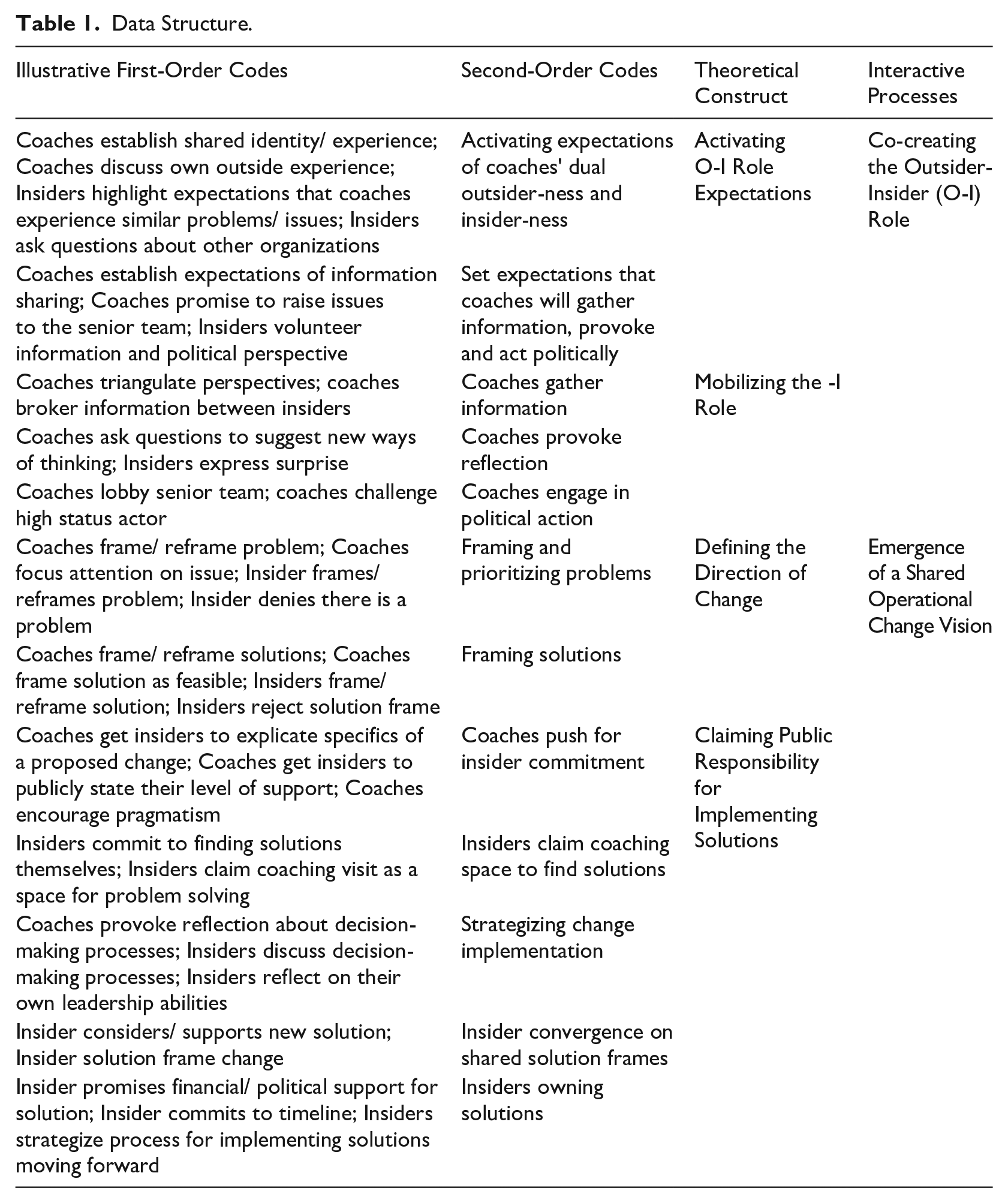
Given our emergent focus on the outsider-insider role, three researchers began with independent, exploratory coding of the same set of field notes focusing on the coaches’ role in change. We coded specific practices that the coaches engaged in, interactions between coaches and insiders, and actions of insiders. We compared and contrasted this independent coding of the field notes to develop a common understanding of the types of actions and interactions we were observing and how they fit into change processes. We then divided up the remaining six sets of field notes so that each was coded by two researchers. All three researchers discussed and debated potential refinements to the coding and discussed how to group first-order codes into second-order codes, and theoretical constructs. Table 1 presents the resulting coding diagram.
Data Structure.
We then turned to a process-oriented analysis of how the coaches and the role expectations they established were important to the change process. Here, we focused on issues raised in the coaching process, and followed discussions of individual issues forward over the course of the coaching visits (Langley, 1999). For each hospital, we first developed a single-issue narrative for one of the operational problems that had proven intractable in the past that was resolved, as indicated by the fact that it was included in the action plan produced through the coaching visit. The issue narratives involved extracting raw segments of our field notes that pertained to a single issue to allow us to more clearly analyse the coaches’ role as the issue unfolded, focusing on an issue where the coaching process helped lead to a shared operational change vision. We then went back to our field notes and earlier field memos to develop narratives for a fuller set of issues in each hospital.
All of the narratives reflected the structure of the coaching visits, which were organized as a series of meetings along with OR observations. For each meeting, our narratives specified (1) what the coaches started with (e.g. knowledge from their own organizations, shared experiences with insiders, knowledge from previous meetings), (2) how role expectations rooted in the coaches’ social position were co-created through interaction, (3) how coaches increased their local knowledge or capacity for political action, (4) any evidence of a shared operational change vision among insiders, and (5) how the emergence of a shared vision among insiders was the result of interaction among coaches and insiders. This analysis tracking issues over the course of the coaching visits revealed a remarkable consistency in the coaching process across organizations.
Findings
We find that the coaches’ social position as organizational outsiders with professional proximity is activated and mobilized in order to bring about a shared operational change vision through a symbolic interactionist mechanism. This mechanism involves the coaches and insiders defining and enacting the coaches’ dual outsider-insider role and associated set of role expectations. A role is a set of expectations associated with a position (Bechky, 2006; Okhuysen & Bechky, 2009). Organizational research on roles highlights their socially constructed nature, showing how roles are constructed and recreated through ongoing processes of social interaction. Role expectations may enable particular courses of action that are unavailable to somebody who occupies a different role, with a different set of expectations (Okhuysen & Bechky, 2009).
This interactive process of role construction and enactment is critical to understanding how the coaches’ social position as organizational outsiders with professional proximity allowed them to influence change. The coaches and insiders activated the coaches’ social position, i.e. their structural location, by establishing the duality of the coaching role through their interactions. In doing so, they also defined a specific set of role expectations that are attached to this dual role. They mobilize the potential of the coaches’ social position when they enact the coaching role and associated role expectations – which became a resource that the coaches could draw on as change agents – in a way that pushes insiders to converge on a shared operational change vision. This happens through a process in which the coaches and insiders interact to frame and reframe problems and solutions that impact perioperative efficiency.
Establishing the duality of the outsider-insider role and associated role expectations
We found that coaches and insiders activated the potential of their social position by establishing the duality of their role as outsider-insiders as well as associated role expectations. The duality of the outsider-insider role was rooted in the coaches’ social position, i.e. their structural location in the highly professionalized healthcare field, but made salient through interactions. The role expectations associated with this dual role were co-constructed through social interaction.
Duality of the role
Insiders and coaches set expectations about the coaches’ dual outsider-ness and insider-ness, in part, discursively. They rooted this duality clearly in the coaches’ distinctive social position. This was evident in the ways the coaches introduced themselves and approached initial information gathering as well as the ways insiders asked questions and lobbied the coaches for support. For example, in their first meeting with the senior management team at Brew hospital, the coaches began by highlighting their social position as organizational outsiders with professional proximity, describing their career experiences and current roles as working health professionals in other hospitals. They went on to set additional role expectations.
We are peers. We’re not here as a review. . . . [We want to] meet with all levels. . . and would like see this team again. . . to give senior execs summary of what we have.
In many hospitals we see common themes. Remember we are peers. . . We will share wisdom and take things [that we learn] back with us to our own organizations.
The more participation better. [I want to make a] specific plug for physician participation. . .
Let me start by asking, have you been on many visits and seen common themes?
Here, the coaches set expectations about their dual insider-ness (e.g. we are peers, referencing their own jobs) and outsider-ness (e.g. highlighting their outside experiences) – rooted in their social positions – and expectations that they would gather information. In asking about the coaches’ experience in other organizations, and about common themes, the CEO displayed his expectations of the coaches’ expertise, insider-ness to the context and outsider-ness to the organization.
Across our sites, interactions consistently set expectations about the coaches’ outsider-ness to the organization by emphasizing their experience with other organizations. For example, on the first day of the facilitation visit at Mayberry Hospital the CEO revealed expectations of outsider-ness by saying ‘We are very big into having fresh eyes come in. . .People here have been here a long time [with] no experience in any other setting,’ highlighting the diversity of perspectives that accompanies their outsider-ness. Interactions focused on the coaches’ insider-ness by highlighting their shared identity or experiences, rooted in their proximate field position as professionals. Sometimes, the presentation of insider-ness was overt and simultaneously emphasized the coaches’ outsider-ness, such as when one of the coaches at River Hospital explained that ‘We are peers. . .people who are living with exactly what you are living. We experience the same types of problems. You live every day chasing tails – we all do in our own institutions.’ Other times, it was more strategic, such as when an administrator coach at Lake Hospital reported using ‘war stories’ about her own surgeons as an icebreaker so that insiders, who were nursing managers, were more willing to open up to her. These war stories reinforce her proximate field position as a clinical manager with a nursing background, who might face similar challenges engaging with doctors. By establishing dual outsider-ness and insider-ness that is rooted in their social position, the coaches established credibility and an ability to empathize with insiders and understand the complex issues that they face, on top of their ability to offer a fresh, outside perspective. Once these dual role expectations were activated, the outsider-insider role could be mobilized. This happens, in part, by the creating a broader set of role expectations associated with the dual outsider-insider role.
Role expectations associated with duality of outsider-insiderness
As they interacted through the process of developing a shared operational change vision among insiders, outsider-insiders and insiders elaborated on additional role expectations. This includes the expectations that outsider-insiders will gather information, provoke new ways of thinking and act politically.
Expectations that the outsider-insiders would gather information as part of their role were activated and reinforced through explicit statements encouraging insiders to share their perspectives, as well as through the behaviour of insiders. For example, at Royal hospital, the coaches explained ‘we’re here to share problems and to develop solutions – local solutions that fit your situation here. Nothing that you say will be associated with a name. . . .We would appreciate frank information.’ Furthermore, when insiders volunteer information about what they perceive as their priority issues and political perspectives, they were setting expectations about their information sharing with the coaches.
A second expectation associated with the outsider-insider role was the expectation that the coaches would provoke new lines of thinking. They did this by asking probing questions about current practices. This could involve coaches asking provocative opening questions, such as in Academic hospital: ‘In a perfect magical world, you would have a perfect environment. What changes would you make to get there?’ It also included more specific actions by coaches to provoke in the context of a substantive discussion, such as when the physician coach at Academic, in the midst of a conversation about the challenges of handling higher acuity patients, stated ‘To be controversial, should you have the ability to staff a 300-bed ICU when you need it?’ Insiders also highlighted their expectations that the coaches would be provocative when they stated that they were looking for ‘fresh eyes’ or wanted to ‘step back’ from their regular ways of seeing and doing things. The importance of provoking new lines of thinking as a role expectation is exemplified by the frequent discussion of challenging ‘sacred cows’ as part of the outsider-insider role in all of the coaching visits we observed. For example, when a coach at Mayberry asked a question about sterilization practices, and was told that it was traditional practice that had not been questioned, she responded ‘A lot of hospitals have moved [to a different practice], [there are a] lot of huge sacred cows [that are] difficult to change.’
Finally, a third expectation associated with the outsider-insider role was the expectation that the coaches would play a political role in the organization. The coaches enacted their roles by acting politically, in offering political advice, lobbying the senior team, or challenging high-status actors. For example, a coach, in speaking to the nursing director at Mayberry hospital, offered political advice by identifying a nurse who indicated her support for change, and who could potentially help the insider director build support among her front-line staff, saying that ‘You need people with that kind of energy.’ The coaches also regularly presented themselves as neutral political actors who could raise issues to the senior team. They did this at Royal during a focus group with physicians when they stated: ‘One advantage is we can go right up to the senior management of the hospital. Any issues you have to push up to them [we can] voice.’ In turn, the insiders also embraced the expectation that the coaches would provoke and confront when they claim to want to use the coaches to lobby other organizational insiders. For example, the director of perioperative care at Academic hospital lobbied the coaches to convince senior management to ease their ability to admit certain patients to intensive care beds, commenting, ‘We want to highlight at the senior team level that this is an issue that we want to move on. We know where to go, but we need reinforcement.’
There was a temporal dynamic to the emergence of the outsider-insider role expectation. As coaches and insiders enacted the outsider-insider role through their early interactions, this strengthened and reinforced the role and associated role expectations. For example, enabled by their early role expectations focused on information gathering, coaches developed local knowledge through their interactions with insiders, and used this local knowledge in later interactions. In some cases, the local knowledge that they shared was surprising to some insiders. For example, at Mayberry, the coaches were able to broker perspectives on an issue regarding whether to treat or transfer elderly surgical patients, drawing attention to the fact that different people had different views on how to handle the issue – an insight that was surprising to the surgeons at the hospital. Brokering perspectives reinforced the outsider-insider role by highlighting the coaches’ access to local knowledge, and hence the expectation that they were there to gather information and use this information in a way that helped guide insiders towards a shared operational change vision.
There was a similar temporal dynamic to other role expectations. As coaches asked provocative questions, or engaged in political actions in their early interactions, this strengthened and reinforced the expectations associated with their outsider-insider role. As a result, insiders became more likely to lobby them or interact with them as people with political influence in the organization, or to look to them to be provocative and help them think in new ways. In this way, the role expectations, once activated, were a mechanism that enabled the coaches to mobilize the resources that accompanied their dual social position.
Mobilizing the outsider-insider social position to develop a shared operational change vision
The potential of the coaches’ distinctive social positions and the associated role expectations were activated and mobilized through interactions between outsider-insiders and insiders that were focused on developing a shared operational change vision. A shared operational change vision emerged through two phases: defining the direction of change and insiders claiming responsibility for implementing a solution. Through these interactions, the outsider-insider role evolved in two ways. First, as highlighted above, enacting the outsider-insider role activated and reinforced role expectations. Second, as discussions moved from a focus on defining the direction of change towards getting diverse insiders to publicly claim responsibility for implementing solutions, the outsider-insiders’ enactment of their political role became more prominent.
Defining the direction of change
Defining the direction of change involved interactions framing diverse problems and solutions, and prioritizing issues as important. Role expectations were important in allowing outsider-insiders to gather diverse perspectives on problems and solutions and to bring them up for open discussion. At Brew, the coaches enacted their role expectations in interaction focused on the inadequate physical space of the OR. In this case, diverse insiders agreed that physical space was a priority issue, but framed differing solutions to the problem. Administrators preferred an incremental approach to renovating the OR, while surgeons preferred a major renovation.
The outsider-insider role expectations were important in shaping interactions around the issue, allowing the coaches to quickly gather information about the diverse perspectives within the organization. For example, the director of perioperative care – enacting his expectation that the coaches would play a political role – lobbied them to influence the chief of surgery:
What you will get from the surgical group is they want to see the big renovation, and are not interested in seeing the small ones.
So you need our votes, do you?
Yes, I welcome your votes.
Later, the chief of surgery made the contrasting solution frames clear to the coaches in stating that he preferred creating a ‘grand plan for the whole space,’ displaying his expectations about the outsider-insiders’ role in gathering and sharing information and facilitating communication:
Let’s not move walls as a patchwork solution. Let’s sit down and come up with a grand scheme. . . I would hope this sort of process, its voluntary and I was keen on doing it, shows we are ready to go. It is an opportunity to speak to the administration through the process. . .
While the diverse insiders prioritized the inadequate physical space in the OR as an issue, and were aware of the differences in solution frames, they were unable to come to agreement on a way forward. Diverse insiders, enacting their expectations of the outsider-insider role, communicated their perspective to the coaches and explicitly lobbied them in an attempt to either influence other insiders, or come to some agreement on a path forward.
At Eagle, the OR manager, who was also a coach in the same programme at other organizations, was the only one who seemed to believe that an inadequate process for cleaning the OR was an issue. Here, the coaches enacted their role in order to support the insider OR manager. The OR manager raised the issue of terminal cleaning – a final thorough clean of the OR that provincial standards mandate at the end of each day – in an early conversation with the coaches:
Terminal cleaning is a BIG issue – it is not managed by me, but by another [senior manager for facilities]. It happens once a month, if there is staff. I tried to show her the [provincial professional body for OR nurses] standards, but she wasn’t having it, saying she did not have the staff.
The coaches then leveraged the role expectations that they established and linked with their social position to focus attention on cleaning as an issue to diverse other insiders. Enabled by the expectation that they would gather information from diverse sources, they asked various other people about terminal cleaning, focused insiders’ attention on it as a potentially important issue. At the same time, they highlighted the duality of their role, rooted in their distinctive social position, in discussing their knowledge of external standards, and their familiarity with how terminal cleaning was done in their own work. For example, in the context of a conversation with support staff about what it would take to speed up cleaning in between cases, one of the coaches, an OR manager in her own organization, asked:
what about terminal cleaning?
We try on long weekends. . . . Once a month on long weekends and she does it. . . unless something happened and we need terminal cleaning, we do as fast as we can.
I guess you do not want to hear that the standard is once every 24 hours. . .
[insiders seem SHOCKED. . .]!?!?!?
Is that done anywhere?
Yes
. . .I have 7 ORs. . . they go into whatever room’s finished at three. . . start in there, move furniture and do walls floors etc. . . .
Wow.
Claiming public responsibility for implementing a solution
A shared operational change vision involves more than having open discussion about problems, solutions and priority issues. It requires diverse insiders to converge on a solution frame, and to publicly commit to implementing a solution. In this second phase of the coaching visits, the coaches’ enactment of their political role became more prominent. For example, at Brew early interactions raised diverse perspectives on how the hospital should address the limitations of the physical space in the OR. These different perspectives had previously prevented the organization from addressing the issue. After triangulating across the diverse perspectives, and drawing on their own judgments based on their own work experiences, the coaches pushed insiders towards a shared solution frame by publicly challenging the chief of surgery. In introducing the space issue in the action planning phase – in which the diverse groups involved with perioperative care prioritized issues and developed a plan for working on them – one of the coaches – emphasizing her outsider-ness by suggesting insights into the Ministry’s perspective – attempted to encourage pragmatism:
If you look at the large picture, the Ministry is looking at other facilities that need space more. How do you respond if they put you on the back burner for several years?
Later, while nurses and nursing managers, facilitated by the coaches, brainstormed about how the current space could be reconfigured to better meet their needs, the chief of surgery revealed his ongoing skepticism, commenting, ‘I am confused. Are we going after ultimately solving [our space problems] or after how we shuffle our space within walls that are currently constructed?’ Here, they played a political role:
We want to begin to work on plans for resolving the issue. The easiest solution is to get 2 million. You may or may not have that ability. But something that fits in your capacity and resources at this point, [we can] discuss here.
A contingency plan to me means ‘What should we do with what we got?’ I think since we have the group together, we should decide ‘What do we ultimately want?’
What would be helpful then? What discussion are you looking for?
In affirming that their role was to work towards solutions that fit the hospital’s current resources, and expressing doubt that a big build was feasible, the coaches challenged the chief of surgery and labelled his solution frame as unrealistic. They then pushed him to publicly state, and hence commit to, what feasible solution he was looking for. In response, the chief of surgery modified his frame of both the problem and solution, converging with the incremental renovation solution favoured by administrators and went on to pledge his political support. Interestingly, he suggested that his own expectations about the coaches’ outsider-insider roles – as a conduit for communicating with both the administration and the ministry – gave him the space to compromise:
I want to be sure – going through with this contingency plan – that the administration and ministry understand that the true solution is [a new OR]. Having said that, this is what we can do for now. . . As long as that is emphasized, I have no problem. . . moving forward with this.
This marked a turning point in discussion of the issue with insiders claiming the coaching space to advance their own solutions. The chief of surgery’s pledge of support kicked off a brainstorming process in which the diverse insiders clustered around a table and started drawing up a remodeled floor plan. The chief of surgery, previously opposed to incremental changes, was an eager participant. After the brainstorming section, the coaches attempted to finalize the action plan items focused on physical space by asking insiders who would be accountable for pushing the action plan items forward to completion. Accepting shared accountability to advance the solution, the chief of surgery volunteered to work with the director of perioperative care to assemble a group of physicians and nurses who would meet with an architect and develop blueprints. In doing so, he provided needed political support that, combined with explicit financial commitments from senior management, signalled that there was enough insider ownership of the proposed solution for the organization to move forward with a shared operational change vision for addressing the physical space problems.
Political action by the coaches was similarly important in getting support for meeting standards for terminal cleaning at Eagle. While the coaches were able to focus attention on terminal cleaning as an issue to diverse insiders, including the cleaning staff themselves, cleaning staff alone could not leverage the financial resources needed to hire the staff needed. The coaches acted politically by directing the CEO to commit the needed resources. In doing so they enacted the role expectation that they would act politically. This expectation was made explicit by the CEO at the start of the coaching visit, when he noted, ‘You can tell us as managers [about problems] . . . tough love can happen. You can say this is how you [as senior managers] can be contributing.’ The CEO was surprised to hear that the organization was not meeting provincial standards for terminal cleaning, despite the fact that the insider OR manager has been raising the issue for some time. The coaches, enabled by the expectations associated with their outsider-insider role, were able to be more efficacious than she had been. The CEO’s response (‘the most important high priority right away is terminal cleaning?’) indicated that he was converging on a solution frame, shared with the OR manager and staff and managers for housekeeping, that would enable the hospital to meet the mandated provincial cleaning standard.
Critical importance of role expectations
The examples above illustrate the importance of the role expectations in enabling coaches, with their social positions combining outsider-ness and insider-ness, to play a role in moving insiders towards a shared operational change vision. For example, at Royal hospital, the physician coach helped establish expectations about his outsider-insider role by telling senior managers that their OR committee was ineffective:
How effective is the OR committee? [Many yes nods while CEO describes diverse committees. . . . ] . . . Just to finish up . . . The OR committee is not effective any more – [it] used to be. Why is it not effective and what would make it effective?. . . What mechanisms do you have in place to communicate? When I asked what the core services are. . . it was not clear.
[Surprised] Should have been crisp.
In relaying his newly acquired local knowledge, he reinforced expectations that the outsider-insider role involved gathering information. In bluntly relaying his perspective, and in asking senior managers to think about their decision-making structures and messaging, he was enacting, in practice, the expectations that he would act politically and provoke new lines of thinking.
It was expectations about the outsider-insider role – above and beyond the coaches’ dispositions or external knowledge (a form of capital that is associated with their social position as organizational outsiders) – that enabled their actions in defining a shared operational change vision. The contrast between Eagle’s OR manager’s inability to shape the operational change vision at her own organization, where she did not play an outsider-insider role, and in other organizations where she did play an outsider-insider role underscores the importance of role expectations. Despite the fact that she was a coach in other hospitals, and hence had external knowledge, Eagles’ OR manager was not able to get the support needed to meet provincial standards for terminal cleaning in her own hospital. Though she envisioned making changes that would allow her hospital to meet standards, and though various staff in the hospital did state that she had great knowledge about OR standards, staff at Eagle sought advice from and acknowledged the expertise of the coaches in a way that they did not from their own OR manager.
The coaches, as outsider-insiders, were able to gain senior managers’ support because of the expectation that they would act politically and because of the fact that insiders recognized their expertise. In contrast, it was clear that diverse insiders were less heedful of the advice and authority of the OR manager. For example, in the context of a discussion about dysfunctional communication patterns in the organization, the OR manager vented about how she was regularly undermined in her job.:
I find, the docs, if they do not get the answer they want, go to [director of patient care] or [chief of staff], and [they] will override what I do. Do what you want then! . . . . Either support me if you want it to run smoothly or cost effectively. . . or you run it!
When they [docs] go running off to tell mummy or daddy – they don’t really provide all of the information.
In contrast with her own organization, insiders at Lake hospital did look to Eagle’s OR manager as an expert. Her authority as an outsider-insider was apparent in a field note at Lake hospital where the observer shadowed Eagle’s OR manager while observed in the OR. Her authority as an outsider-insider allowed her to engage in interactions where she started to build political support for having a more formal process for trailing and purchasing new products. Early in the observation in the OR, she had an exchange with an OR nurse:
[to OR Manager Coach] What do you use after cases to clean? We use sterile water, which is a waste of money.
We use the spray stuff. Have you seen it?
We trialled it. . . but never got it.
Do you like it?
yes. . . .
When you want something new, is there a place you can go to. . .a staff meeting?
If a surgeon wants something there is a process.
But if you want something?
Later, she talked about the device that the chief of surgery was trialling to focus attention on purchasing processes at Lake as a potential issue, as indicated in this field note.
The OR manager coach asks the chief of surgery how the trials get going, and what the process is for purchasing new products. . . . The RN First Assist, an OR nurse with specialized training, interjected.
I can tell you from my end. I go to [conference for OR nurses in the province], see the displays, and if something seems useful. . .
Is there a procurement committee?
[describes something in a low voice] I cannot just decide myself, but it does not seem like there is a full committee. . . [chief of surgery later discusses the need for a process]
As the contrast between Eagle’s OR manager’s limitations in getting support for terminal cleaning in her own organization – despite her expertise – and her ability to build support around issues in her capacity as a coach at Lake makes clear, role expectations are key to shaping the coaches’ ability to effectively engage with insiders in defining the direction of change. Her disposition would likely not vary across settings. Nor would we expect that the type of capital she could draw on, including professional training and expertise, would explain the difference.
An exchange at Brew hospital between two coaches who were nurse managers in their home organizations helps further illustrate the importance of the dual outsider-insider role, and associated role expectations. The exchange highlighted the lack of support from the physician on the coaching team, who did not attempt to provoke thinking and act politically as they expected. An excerpt from a field note illustrates:
[the coaches] ask me about team dynamics. . . and start talking about them. They observe that they felt that [coach who is a physician] did not back them up in the focus group with the hospitals’ physicians – and did not challenge and push the hospital physicians on specific practices. They emphasized that on other coaching visits, the full team, including the physician coach, really pushes physicians on the same issue. They comment that each of them brought up or challenged certain practices. . . and were shot down [by insiders]. That was when physician [coach] could back them up . . . . but he did not. They both note that they felt it was an opportunity lost.
These examples, both the contrasting expectations of Eagle’s OR manager in her home organization and when she was a coach, and of the case when one coach did not enact the role expectation that he would provoke, confron, and act politically – despite the fact that his social position allows for this – underscores the potential importance of people occupying a distinctive, socially recognized role as outsider-insider in shaping processes of developing a shared operational change vision.
Process Model of How Dual Outsider-Insiders Influence Change
Figure 1 presents our process model of how the coaches activated and mobilized the potential of their social position as outsider-insiders in ways that generated a shared operational change vision among insiders. In the background of our model is the field context. The field context defines the coaches’ distinctive social position, i.e. their structural location, as organizational outsiders with a proximate position in the field – that gives them a degree of potential insider-ness. The coaches’ position becomes a basis by which coaches and insiders, through interaction, construct and enact the duality of the outsider-insider role and activate associated role expectations. The centrality of role expectations in the figure – between social position and interactions focused on an operational change vision – underscores their importance as a mechanism by which the potential that comes with their social position is activated and mobilized. The figure shows that the coaches’ role expectations were mobilized through dialogue that occurred during interactions focused on achieving a shared operational change vision. Consistent with our symbolic interactionist perspective, enacting these role expectations in early interactions focused on defining the direction of change strengthened and reinforced these role expectations. As interactions shifted towards a focus on insiders claiming responsibility for implementing agreed upon solutions, the coaches’ enactment of their political role became more prominent. This further reinforced the role expectations that were rooted in the coaches’ social position. Through this iterative process in which the outsider-insiders’ distinctive role expectations were jointly enacted and strengthened, insiders ultimately converged on a shared operational change vision.
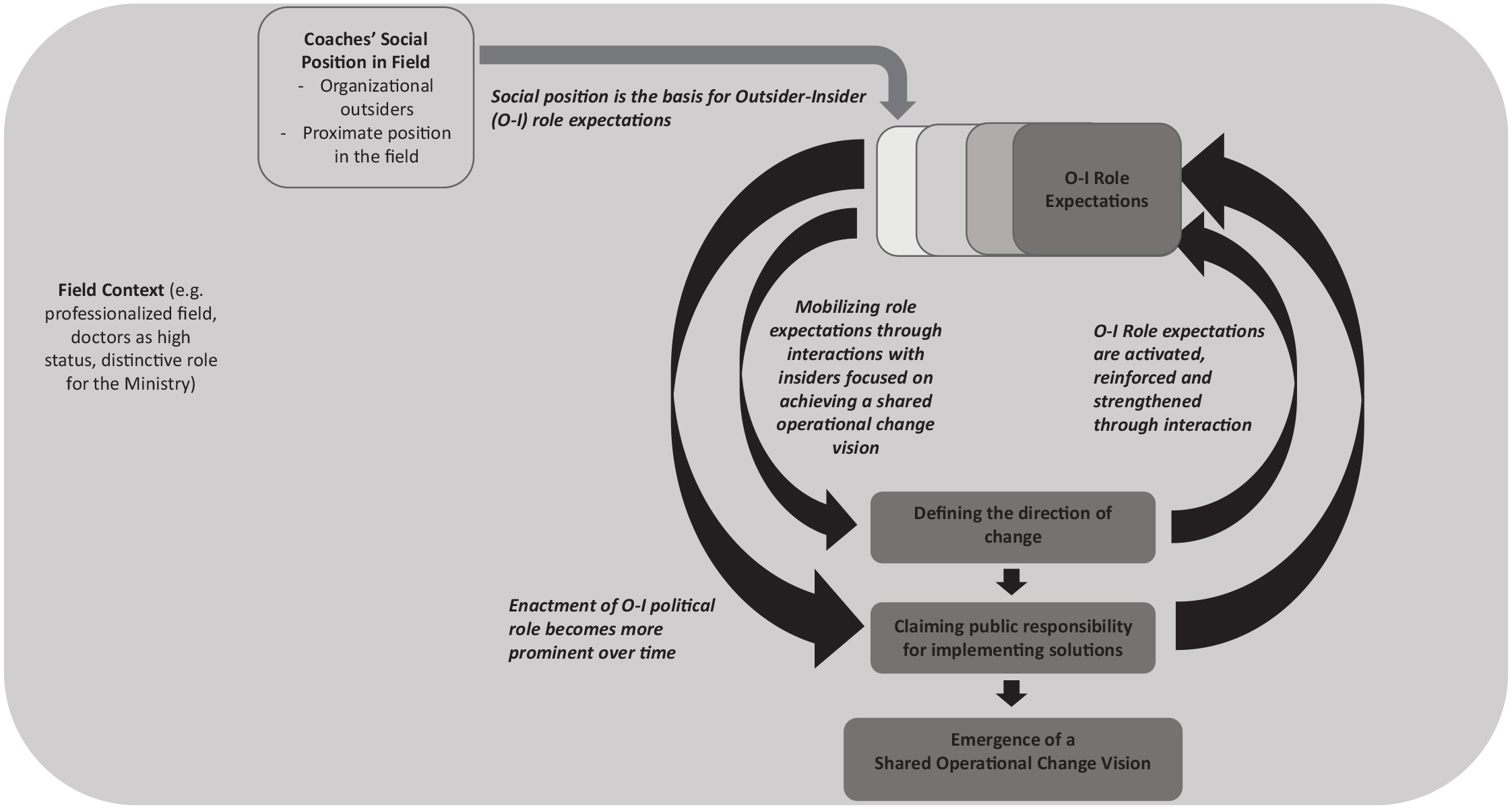
How organizational outsiders with a proximate field position can bring insiders towards a shared operational change vision.
Discussion
Our research focuses attention on dual outsider-insiders as important change agents whose role in organizational change is (1) rooted in a social position that combines elements of outsider-ness and insider-ness, (2) recognized as distinctive and (3) socially constructed through interaction. By focusing attention on the potential importance of the dual outsider-insider position in influencing organizational change and, in particular, the process by which this potential is activated and mobilized, we advance theory in two ways. First, we focus attention on the importance of people whose social positions combine outsider-ness and insider-ness, and develop theory to explain how they can influence organizational change. Second, we advance theory on social positions more generally by identifying a new mechanism – role expectations – for conceptualizing how a person’s social position might shape their ability to achieve change.
Some prior research does point to specific social positions that combine outsider-ness and insider-ness and highlights that these social positions may be important in influencing change, but stops short of theorizing how this happens (Meyerson & Scully, 1995; Strike & Rerup, 2016; Wickert & De Bakker, 2018). We extend this prior work by theorizing the process by which people whose social positions combine outsider-ness and insider-ness can have impact. In a recent review of research using Bourdieu’s theory to explain power and politics in organizations, Ocasio and colleagues (2020) note that the mechanisms linking social position, capitals and organizational actions and outcomes are poorly specified, and ‘mostly assumed rather than explained’ (p. 304). We extend prior research showing that people with social positions that combine outsider-ness and insider-ness may be important change agents by developing theory to explain how they are important – through a socially interactive process in which insiders and outsider-insiders establish and enact role expectations in ways that lead insiders to converge on a shared operational change vision.
This focus on role expectations develops theory that can help us better understand which social positions might take on an outsider-insider role in organizational change. It allows us to see connections between disparate social positions that have been identified in prior research. Prior work looking at people whose social positions combined outsider-ness and insider-ness focus on the contextual differences that might make a specific group of people distinct, such as tempered radicals (Meyerson & Scully, 1995), women surgeons in an ‘iron man’ culture (Kellogg, 2012), trusted advisors (Strike & Rerup, 2016) and organizational misfits (Kleinbaum, 2012). Our work suggests that as long as people in these disparate social positions are able to advance change because of expectations about their dual outsider-ness and insider-ness, they are potentially members of the same category.
Our focus on role expectations also raises the potential that people in a range of social positions can be constructed as outsider-insiders, with a similar set of role expectations to the ones we identify. Hence, while we examine organizational outsiders with a proximate position in the field to organizational insiders, the outsider-insider role may be broader. Outsider CEOs are one example (Datta & Guthrie, 1994; Zhang & Rajagopalan, 2010). Their name suggests the duality of role expectations as both outsiders and insiders with considerable formal authority. Moreover, they are hired often explicitly with some of the role expectations we identify, i.e. expectation that they will provoke new ways of thinking leading to change, or act in ways that challenge existing political coalitions (Karaevli & Zajac, 2013). Management consultants with strong firm or industry ties are another example of people who might play a dual outsider-insider role. While researchers have often theorized consultants as positioning themselves as distant elites within their field with access to external knowledge (McGivern et al., 2018; Mosonyi et al., 2020), research acknowledges that some consultants may be deeply embedded in an industry, or have long and multi-faceted ties with a single organization (Werr & Styhre, 2002). This can give them a degree of recognized insider-ness that allows them to effectively take on an outsider-insider role.
At the same time, there are limits to who can take on an outsider-insider role that are structured by the field. For example, while the coaches in our study in general were able to highlight their proximity in the field and professional legitimacy in order to display their insider-ness, we observed that the physician-coach was often critical in playing the role of provoking and acting politically with other physicians. This underscores the fact that fields define legitimate participants and credible sources of information, an insight noted in prior research on social position (Currie & Spyridonidis, 2016). Not all people who occupy social positions that are outside of the organization, but proximate in the larger field will have the legitimacy and credibility that the coaches had in our case. Future work can fruitfully explore the varieties of outsider-insiders, rooted in a range of different objective social positions, to develop more robust knowledge about what social positions and contextual conditions might offer potential for defining and enacting a dual outsider-insider role.
Our focus on role expectations as the mechanism by which the potential of social positions combining outsider-ness and insider-ness is activated and mobilized can also help us explain inconsistent findings in prior work examining dual outsider-insiders. Research on corporate sustainability and social responsibility officers provides one example. Corporate sustainability and social responsibility officers are organizational insiders whose field positions – as individuals who are mandated to introduce new values and goals into an organization, frequently with career backgrounds in social movement organizations – give them a degree of outsider-ness (Augustine, 2021; Howard-Grenville, 2007; Wickert & De Bakker, 2018). Nevertheless, these outsider-insiders have to achieve a greater degree of insider-ness, beyond simply being hired, in order to have any impact. Prior work shows that once hired, they must also learn local norms and develop strong relationships with diverse insiders in order to effectively advance social issues (Howard-Grenville, 2007; Wickert & De Bakker, 2018). While achieving credibility as insiders is critical to allowing them to have any impact, it can come with a cost. This same insider-ness – in driving sustainability and social responsibility officers to edit themselves and limit their ambitions to pursuing changes that would be palatable – can prevent them from realizing the goals that they were hired to pursue (Augustine, 2021). In developing theory focusing attention on role expectations, we generate insights that can explain what can make other potentially dual outsider-insiders effective. Our work suggests that corporate sustainability and social responsibility officers would need to establish the duality of their role–and the associated expectation that they will provoke insiders and push them beyond their comfort zones on sustainability and social responsibility issues, but in ways that work towards the benefit of the organization – in order to have impact while avoiding cooptation. Our research leads us to believe that the duality of role expectations can be important for other people with social positions that combine organizational insider-ness with both outsider-ness in the field and a specific mandate to bring new values and goals into their organization. Additional examples include corporate diversity officers (Berrey, 2015), and military mental health professionals (DiBenigno, 2018).
In focusing attention on interactions in which people define and enact role expectations, we identify a mechanism that might be important for understanding the processes by which people’s social positions generally – beyond outsider-insiders – might be activated and mobilized to achieve organizational change. Most research on social position focuses on the actions that can be taken by actors – as change agents – as a result of their position. These actions are structured by the dispositions and access to different forms of capital that get attached to a person’s social position. In contrast, we focus attention on the importance of role expectations that were constructed through interaction as a key mechanism. In doing so, we complement prior research on social position by emphasizing the importance of the expectations that others have of a specific role. Our research, in highlighting the importance of role expectations, shows that two people with similar dispositions or views of the world are differently able to bring about change. These differences are not due to differences in access to different types of capital (e.g. social networks, local knowledge, etc.). Instead, role expectations made insiders more receptive to the outsider-insiders playing the part of change agents.
This focus on socially constructed roles complements prior theory on social position by theorizing a space for symbolic interactionist mechanisms. Bourdieu was deliberate in drawing a contrast between his theory of fields and symbolic interactionism (Bourdieu, 1977; Bourdieu & Wacquant, 1992). He theorizes social positions as ‘objectively defined, in their existence’ (Bourdieu & Wacquant, 1992, p. 97). Nevertheless, Bourdieu’s theory does leave space for a constructivist perspective, particularly in the domain of practices that are influenced but not determined by field structures. Currie and Spyridonidis (2016) acknowledge this potential in noting that people have some agency in enacting their social positions, including in how they position themselves in their interactions with others. We extend their work by emphasizing that the agency that people have in enacting their objective social position can include agency in defining their roles and role expectations, as well as the role expectations of others.
This integration of role theory into research on social position suggests the need for more research in two domains. First, though our focus is on role expectations as a different mechanism than disposition, we expect that there are likely interactions between social positions, role expectations and dispositions. For example, while our data allows us to show how the outsider-insiders and insiders co-created a specific set of role expectations that was productive in moving insiders towards a shared change vision on important issues, it is also likely that the outsider-insiders, given their role, would have a disposition that would allow them to take into account a wide range of perspectives and points of view (cf. Lockett et al., 2014). This is consistent with recent work that shows that organizational insiders’ participation in change teams can shape people’s dispositions in ways that disenchant them from their regular job, and motivate them to take on roles where they can further advance change (Huising, 2019). Future work can fruitfully explore the interrelationship between role expectations and dispositions, and how they interact in processes of organizational change.
Second, more research is needed to theorize the boundary conditions defining the zone of practices that are influenced, but not determined, by field forces. Other papers based on this empirical research offers some insight. While the coaches were recognized as dual outsider-insiders, and able to bring about some progress on issues that had been intractable in the past in all seven hospitals of our study, within each hospital, the coaches were generally unable to gain support for changes in clinical practice, or changes in areas that would challenge physicians’ jurisdictional authority (Nigam, Huising, & Golden, 2014, 2016). Consistent with research highlighting the deeply institutionalized nature of physician authority (cf. Abbott, 1988; Currie & Spyridonidis, 2016; Huq, Reay, & Chreim, 2017; Lockett et al., 2014), this suggests that practices that are core to the jurisdictional stakes of high-status actors will be more strongly determined by historically rooted structures in a field, and less changeable through local interaction and role construction. Prior research offers additional insights that might define the potential space for symbolic interactionist mechanisms within Bourdieu’s work. For example, Kellogg (2012) empirically shows that hospitals differ in their ability to adopt new practices that challenge historically rooted surgical identities, suggesting that roles can be enacted in ways that either alter or maintain identity-linked practices. In contrast, Wiedner, Barrett and Oborn (2017) highlight the inability and unwillingness of GPs to challenge higher-status, hospital-based colleagues in their new role as purchasers of hospital services. Wiedner, Nigam and da Silva (2020) show that dispositional misalignment prevented managers from challenging and collaborating with GPs, despite an initial desire on the part of both managers and GPs to collaborate. This suggests intra-professional and inter-professional hierarchies limit people’s ability to interact in in new ways that challenge those hierarchies. More work is needed to more fully understand the conditions in which people have discretion to enact and shape roles that are linked to but not determined by their social positions as well as the implications of this zone of discretion for the potential to achieve different types of organizational change.
Conclusion
While people whose social positions combine outsider-ness and insider-ness have great potential as change agents, this potential often goes unrealized. We advance theory on the process by which outsider-insiders can influence change. We show that the potential of social positions that combine outsider-ness and insider-ness can be activated and mobilized through a process of defining and enacting a dual outsider-insider role and associated role expectations. It is the social recognition of this role, and the associated expectation that outsider-insiders will gather information, provoke and act politically, that allows them to simultaneously establish the credibility that comes with insider-ness and maintain the provocativeness that comes with their outsider-ness. While we analyse a specific outsider-insider role, rooted in a particular social position and government programme, our hope is that future work can explore the fuller range of outsider-insiders who might have important parts to play in precipitating organizational change. We further hope that our focus on roles and role expectations will be generative in helping inspire future research examining the linkages between objective social positions, socially constructed roles and organizational change.
Footnotes
Acknowledgements
We would like to thank Ruthanne Huising, Jo-Ellen Pozner, Daisy Chung, Santi Furnari, Sebastien Mena, Kelly See, Sam MacAulay, Marlys Christianson, Sujin Jang and Harry Scarbrough for comments on previous versions of this manuscript.
Funding
The author(s) received no financial support for the research, authorship, and/or publication of this article.
