



Abstract
Technology invites a reconsideration of organization and organizing by calling attention to mediated forms of value production among loose social collectives outside formal organizational boundaries. While the nascent concept of organizationality holds potential for such a re-conceptualization, the processes through which loose social members become invested in co-orientation and collective effort require further empirical and theoretical exploration. In this paper, we link organizationality research with critical media studies on affect and technology to theorize how affect holds provisional collectives together while promoting new modes of value extraction. Empirically, we draw from an ethnographic study of hackathons – transdigital innovation spaces where participants act with and through technology – and suggest three intertwined processes as part of an affective circuit that stokes and directs affect. The paper’s contribution is threefold. First, by analysing how affective circuits bind, integrate and co-orient action among loose members, we contribute to understanding organizationality as affectively constituted. Second, by showing how hackathons leverage desire for community, we offer a critical perspective on affective capture and argue that organizationality involves novel modes of value production. Third, we complement theorizing of hackathons by exploring them as sites of organizationality, focusing on the provisional, relational and affect-rich nature of new forms of organizing in the digital age.
Keywords
Introduction
Technology has changed the fabric of organizations (e.g. Beverungen, Beyes, & Conrad, 2019; Castells, 2000; Zammuto, Griffith, Majchrzak, Dougherty, & Faraj, 2007), yielding new organizational arrangements that are flexible, dispersed, virtual and often non-hierarchical, including online communities (e.g. Faraj, Jarvenpaa, & Majchrzak, 2011; Faraj, von Krogh, Monteiro, & Lakhani, 2016), online content providers or platforms (e.g. Gillespie, 2010). The fluidity of those arrangements with respect to their boundaries and membership structures have challenged conventional understandings of organizations (e.g. Dobusch & Schoeneborn, 2015; Puranam, Alexy, & Reitzig, 2014) suggesting that value production in the digital age is no longer carried out only by organizational members but increasingly among loose social collectives and flexible networks that are mediated by technology (Castells, 2000). In response to those changes, organizational scholars have shifted their attention to organizing that lies beyond and outside formal organizations (e.g. Mumby, 2016; Wilhoit & Kisselburgh, 2015). Within this emerging body of research, the nascent concept of organizationality (Dobusch & Schoeneborn, 2015; Schoeneborn, Kuhn, & Kärreman, 2019) is particularly promising for rethinking organization and its technological condition. Relaxing the assumption of an organization as a stable entity, organizationality focuses on how loose social collectives can become organizational. Used as an adjective rather than a noun (organization) or verb (organizing), organizationality emerges ‘whenever (human or nonhuman) actors come together to co-orient their actions and start acting on behalf of a collective other’ (Schoeneborn et al., 2019, p. 487). This raises the question of how such co-orientation for collective action under temporal, fluid and loose conditions is achieved and why people willingly engage in collective effort around digital production.
While extant research on organizationality has considered the communicative and material practices that give loose social collectives actorhood vis-a-vis external audiences (Dobusch & Schoeneborn, 2015; Wilhoit & Kisselburgh, 2015), less is known about the internal dynamics that constitute organizationality (Blagoev, Costas, & Kärreman, 2019) and how – distinct from activist collectives (Dobusch & Schoeneborn), biker communities (Wilhoit & Kisselburgh, 2015) or coworking spaces (Blagoev et al., 2019) – organizationality might involve new forms of value production and extraction not attended to so far. Such a consideration seems important as new forms of organizing often leverage intrinsic motivation or social recognition (rather than financial rewards, e.g. Puranam et al., 2014) to stimulate creative collaboration, while creating potentially precarious relationships in the context of digital production (e.g. de Vaujany, Leclercq-Vandelannoitte, Munro, Nama, & Holt, 2021; Gregg, 2009, 2015; Kellogg, Valentine, & Christin, 2020; Zukin & Papadantonakis, 2017). A better understanding of why members are drawn in to co-orient their actions and willingly engage in collective efforts and new forms of (digital) value production is thus a critical addition to the literature on organizationality.
The current study draws upon a qualitative study of hackathons to examine the internal relational dynamics that make up organizationality. We examine hackathons in particular because they involve temporal, transdigital spaces that are made possible, mediated and performed through technology, assembling loose members to hack (improve, fix) existing software or to develop new prototypes (e.g. Lifshitz-Assaf, Lebovitz, & Zalmanson, 2020; Lodato & DiSalvo, 2016). Hackathons thus constitute a paradigmatic case of technologically mediated production and connectivity outside formal organizational boundaries (e.g. Kolb, Dery, Huysman, & Metiu, 2020).
As an analytical lens to better understand organizationality in such contexts, we draw upon affect theorizing, and specifically a body of research emanating from critical media studies to understand digital production under conditions of loose membership (e.g. Dean, 2006, 2010; Hillis, Paasonen, & Petit, 2015; Just, 2019). We mobilize the concept of affective circuits that stoke and direct affect to form (online) collectives and complex chains of production (Dean, 2015b, p. 235). According to the political and media theorist Jodi Dean (2006, 2010), online networks are driven by participants’ desire for social connection and community, engaging but also potentially exploiting members’ affective relationships by locating value production in free participation and the affective relations of the workers. Dean’s (2006, 2010) understanding of affect as a driver of value production, and its working specifically through the urge for relationality, is valuable as a point of departure because the collective is understood as foundational to activity but also as escaping full realization. It thus parallels organizationality in its drive toward organization but also in the ephemeral and fleeting character of the collective. We thus extend Dean’s theorizing on affect to the question of organizationality, with its fluid and temporary boundaries, through the case of hackathons.
To preview our findings, we identify three intertwined processes that feed collective effort and co-orientation: circulating affect, through which relational encounters are coordinated to disseminate and direct affect; intensifying affect, in which affect is heightened through practices of arousal that increase participation; and capturing affect, through which affect is harnessed into value-producing activities. Building on Dean (2010, 2015a), we discuss those processes as affective circuits and theorize how affect provides a binding mechanism that enables organizationality and new modes of value extraction in and through technology.
Our resulting contribution to understanding the interrelation of organization and technology is threefold. First, by analysing how affective circuits bind, integrate and co-orient action among members, we complement existing studies on organizationality by clarifying the internal relational dynamics that render provisional loose collectives organizational. Second, promoting a critical reading of affect’s organizing powers, we show how hackathons leverage desire for community while maintaining temporary and fragmented structures that thwart stable community. This dynamic exemplifies new modes of value production that the literature on organizationality has not recognized so far. Third, we complement emerging literature on hackathons by examining these events through the lens of organizationality, focusing on the provisional, relational and affect-rich form of association characteristic of contemporary forms of organizing.
In what follows, we present our argument by reviewing research on hackathons as an empirical phenomenon and linking it to the emergent discussions of organizationality. Next, we draw on affect as the paper’s analytical lens to frame our research question. Introducing our empirical approach and analytical strategy, we then present and interpret our findings around affective circuits in the context of hackathons. Finally, we expand on the theoretical implications of our findings, drawing out our contributions and building a research agenda around organizationality and affect.
Theoretical Framework
Hackathons and technology
Once a sub-culture in the margins, hackathons have become part of the mainstream (Turner, 2006). Traditionally organized by non-profit organizations and open to the public, NGOs, corporations and government agencies have turned to hackathons to create (software) innovations, and ‘explore possible futures’ with and through technology (Irani, 2015, p. 804; Gregg, 2015; Söderberg & Delfanti, 2015). Staged as intensive, 24–48 hours lasting events, hackathons combine elements of open-source software production and online communities (e.g. Faraj et al., 2011, 2016) with aspects of start-up weekends and technology conferences (e.g. Dey, Schneider, & Maier, 2016; Katila, Laine, & Parkkari, 2019). Taking place outside formal organizational boundaries, hackathons offer participatory production and creative, fun work in peer communities, blurring the classical lines between enjoyment and work, freedom and control (e.g. Gregg, 2015; Irani, 2015; Söderberg & Delfanti, 2015).
During hackathons, software and computer engineers, data scientists, business analysts, designers and other professionals from various backgrounds adopt and act through technology to create rapid prototypes and solutions (e.g. Coleman, 2013; Irani, 2015; Lodato & DiSalvo, 2016; Lifshitz-Assaf et al., 2020). Participation is voluntary and free; the infrastructure needed to leverage a hackathon involves information and communication networks and (open) data along with participants’ own mobile devices and hardware. Despite the fact that hackathons could take place virtually (production is digital), most are conducted in a physical space to enable direct interaction among the hackers. Coleman (2013) refers to this choice as reminiscent of hacker conferences’ focus on direct interaction to fix challenging problems and leverage the community offered by face-to-face interaction. Hackathons are thus transdigital in that they take place physically while also being heavily invested in digital connectivity (Sundén, 2015, p. 136).
Scholarship on hackathons has studied their potential for innovation and product development (e.g. Lifshitz-Assaf et al., 2020), as well as their work and labour implications (e.g. Gregg, 2015; Zukin & Papadantonakis, 2017). Science and technology studies (STS) scholars have positioned hackathons politically at the intersection of networks and social movements, society and organization (e.g. Irani, 2015; Lodato & DiSalvo, 2016; Söderberg & Delfanti, 2015). At the same time, organization-informed studies of hackathons are rare. Recently, Lifshitz-Assaf and colleagues (2020) have shown how hackathons’ temporality impacts innovation and coordination, describing hackathons as ‘contemporary ways of organizing’ that are situated ‘outside the organizational context’ and ‘without clear structures’ (p. 9). In a similar vein, Seravalli and Simeone (2016) highlight the malleability of hackathons’ boundaries by casting them as boundary organizations providing temporary spaces for diverse groups (such as open-source software developers and firms) to collaborate. Both note hackathons’ ephemerality and flexibility with respect to membership, boundaries and structures, calling attention to a closer – organizational – understanding of hackathons and the conditions under which organizing is achieved.
Together with other new arrangements made possible by technology such as online communities (e.g. Faraj et al., 2016), platforms (e.g. Gillespie, 2010) or hacker collectives (Dobusch & Schoeneborn, 2015), hackathons exemplify how organizing digital production increasingly takes place beyond and outside formal organizations (Mumby, 2016) in fluid and changing social constellations. The growing body of research on organizationality accounts for those shifts and is introduced in the next section as a way to conceive of hackathons in organizational terms.
Organizationality
The organizationality concept lends itself particularly well to rethinking notions of organization vis-a-vis its technological conditions (Beverungen et al., 2019) by exploring how organizations can be (re)constituted through communicative, social and material practices (e.g. Blagoev et al., 2019; Dobusch & Schoeneborn, 2015; Wilhoit & Kisselburgh, 2015). First introduced by Dobusch and Schoeneborn (2015) in their analysis of the hacker collective Anonymous, the notion of organizationality shares with Wilhoit and Kisselburgh’s (2015) concept of organization-ness an interest in what renders fluid social collectives that exist outside formal organizations organizational.
Organizationality derives from the communication-as-constitutive-of-organization (CCO) perspective (Ashcraft, Kuhn, & Cooren, 2009) and is grounded in a relational ontology, committed to exploring ‘the unfolding relations that bring things of all kinds into being’ (Kuhn, Ashcraft, & Cooren, 2019, p. 102, emphasis in original). Rather than a state of being or not-being, organizationality aligns with a processual understanding of organization as becoming (e.g. Beyes & Steyaert, 2012, 2013; Helin, Hernes, Hjorth, & Holt, 2014) by bringing attention to the degree to which social phenomena temporarily crystallize into states of organization(ality) (Dobusch & Schoeneborn, 2015; Schoeneborn et al., 2019, p. 487). In principle, such crystallization can be achieved whenever (human or nonhuman) actors come together and engage in the production of coordinated action ‘by co-orienting to both one another and to their common pursuit’ (Schoeneborn et al., 2019, pp. 482, 487). This minimal definition adheres to conceiving organizations as systems of coordinated action in which the integration of effort is a central concern involving cooperation as well as coordination to achieve its purpose (Puranam et al., 2014). Yet different from other organizational theories, the concept of organizationality does not start from a fixed organization but attends to how seemingly unorganizational social arrangements become organizational, even if only provisionally, rendering any crystallization of organization inherently temporary (e.g. Dobusch & Schoeneborn, 2015; Schoeneborn et al., 2019). While not yet explored from a critical perspective as a source of value extraction, such provisional crystallizations of collectivity do seem to raise the question of how value is produced and concentrated from within the precarity of fleeting organizationality, and why members would be drawn to invest their efforts in such collectives.
So far, Dobusch and Schoeneborn (2015) have provided an in-depth understanding of how a hacker collective with latent and unclear membership achieves organizational identity and actorhood through carefully staged identity claims, while Wilhoit and Kisselburgh’s (2015) study of a loose collective of bike commuters examines how material and spatial practices can constitute a collective with an ‘amplified voice’ (p. 581), which is able to instigate change. Blagoev and colleagues (2019) complement those examinations by shifting attention from external audiences to the inner workings of organizationality. In their study of freelancers and gig workers in a coworking space, the authors highlight how informal social practices such as rituals and routines (re)constitute formal organizational qualities including sociality and productivity. While their study does not directly address the question of value production, it does hint at the benefits of collective effort in the form of sociality for its members and invites a closer examination of the relational dynamics undergirding organizationality to help understand how co-orientation and collective action are built up and ‘flow’ (Kuhn et al., 2019, p. 102; Schoeneborn et al., 2019, p. 480).
Building on the above discussions, we turn our attention to affect as a mechanism by which loosely connected members become invested into provisional collectives in the absence of solid supports and formal structures. While affect has been discussed as a valuable lens for organizational scholarship (e.g. Beyes & Steyaert, 2012, 2013; Fotaki, Kenny, & Vachhani, 2017; Jakonen, Kivinen, Salovaara, & Hirkman, 2017; Karppi, Kähkönen, Mannevuo, Pajala, & Sihvonen, 2016; Kenny, Muhr, & Olaison, 2011; Resch, Hoyer, & Steyaert, 2021), knowledge about ‘how affect emerges, travels and is transmitted between bodies’ (Fotaki et al., 2017, p. 8) is still undertheorized. In addition, the link to technology-mediated organizations and new forms of value extraction has remained largely unexplored. A notable exception, Just’s (2019) recent analysis of the GamerGate controversy, examines how affect constitutes digital organizations by harnessing ‘affective intensities towards desired (emotional and economic) outcomes’ (Just, 2019, p. 723). How such organizationality mobilizes affect to enrol members in emerging collectives, however, requires further attention.
Affect
Affect theorizing involves an ‘amalgamation’ of theoretical traditions (Paasonen, Hillis, & Petit, 2015, p. 4; Seigworth & Gregg, 2010). Broadly speaking, affect is ‘the name we give to those forces – visceral forces beneath, alongside, or generally other than conscious knowing, vital forces insisting beyond emotion – that can serve to drive us toward movement’ (Seigworth & Gregg, 2010, p. 1). Unlike emotions, affect is pre- and trans-personal, that is, it is relational (e.g. Manning, 2009), moving between bodies and working through ‘flows of imitation’ that configure collective experiences (Thrift, 2008, p. 237). Sensed through the body, affect does not rest within an individual body but circulates, enabling a collective body-becoming (Manning, 2009, p. 95) that can comprise human as well as nonhuman actors including materiality and technology, sharing in common with the organizationality approach a relational ontology and an interest in how things come into being.
Despite the fact that affect tends to be elusive and difficult to operationalize (Fotaki et al., 2017; Keevers & Sykes, 2016), it is seen as ‘an intrinsic variable of the late capitalist system’ (Massumi, 2002, p. 45), a mobilizing power and key driver of worker organization and action (e.g. Jakonen et al., 2017; Karppi et al., 2016; Resch et al., 2021). As such, affect is not just a force for organizational transformation and emancipation (e.g. Beyes & De Cock, 2017; Fotaki et al., 2017) and a promising lens for understanding ‘the intensities and forces of organizational life’ (Beyes & Steyaert, 2012, p. 52), but linked to contemporary systems of value production as we find it, for instance, in processes of digital production and consumption on social media (e.g. Karppi et al., 2016; Paasonen et al., 2015; Pybus, 2009; Terranova, 2005).
From this perspective, Dean’s (2006, 2010) treatment of affect in digital organizing is particularly insightful for contextualizing affect within a technologically mediated process of value production. In line with other critical media scholars, Dean (e.g. 2006, 2010) problematizes technology as both promoting individualization (separation) and stirring desires for social bonds and community, creating a drive towards participation and connection, which is fuelled by affect. To Dean (2015b), affect involves movement, ‘a thought, memory, or perception is affective to the extent that it opens up or indexes something beyond me. The dimension of affect is this “more than a feeling” that imparts movement’ (p. 238) towards community with others. Key to her argument is that digital network technologies promise to satisfy the desire for community by offering access and participation. Yet, these promises are never fully realized and ensnare participants in affective circuits or ‘loops of drive’ (Dean, 2015a, p. 99). Collectively held visions of togetherness and participation obscure the fragmentation of technologically mediated organization, driving participation ever further. In other words, while technology leads to individualization it also incurs the desire to overcome it by promising community. Importantly, this community is never achieved but remains a spectre. Working like a social binding technique, affect in technology-mediated contexts instigates affective flows that (seemingly) create collectivity and capture ‘subjects, intensities, and aspirations’ (Dean, 2015a, p. 94). Those flows can be channelled into new modes of value extraction (Dean, 2006, 2010, 2015a, 2015b; see also Pybus, 2009; Terranova, 2005), converting workers’ affect into value at the point of production (e.g. Just, 2019; Karppi, 2015; Karppi et al., 2016; Terranova, 2005). Ultimately, production takes place because the incompleteness of connection instigates a whole series of compensatory and creative solutions that cover up the ‘lack’ produced by its incompleteness (Dean, 2015b) in the form, for example, of (compulsive) online activity. Dean’s (2006, 2010, 2015a, 2015b) work thus offers important insights into how digital production might harness affect to drive value production and expropriation, suggesting that ‘contemporary information and communication networks are essentially affective networks’ (Dean, 2015a, p. 94).
Dean’s (2006) analysis of online communities, and the ways in which workers’ affective investment in peer-connected environments creates a ‘buzz’ from which surplus value can be cultivated and extracted, without having to offer employment or invest in permanent infrastructure, shows a striking parallel to how hackathons are set up (e.g. Gregg, 2015; Irani, 2015). Provisional and peer-based in nature, hackathons have also been described as affect-laden and festive, offering ‘tribal’ experiences and enchantment that seem ‘central to [the event’s] unfolding’ (Coleman, 2013, p. 59). Given this parallel, we employ affect theorizing (and Dean’s approach in particular) as an interpretive analytical lens to clarify the relational dynamics that generate organizationality in loose social collectives. Mobilizing affect to elucidate our understanding of organizationality in the context of hackathons then translates into the empirical research question: How do relational and affective dynamics make possible co-orientation and collective effort for value production during hackathons?
Research Design and Methodology
While the networked character of digital technologies lends itself particularly well to internet and social media researchers to trace and document affect in online environments, for example, through an analysis of online posts as communicative acts (e.g. Just, 2019), physical spaces enable the in-situ study of relational dynamics of co-location in shared spaces such as coworking or maker spaces (e.g. Blagoev et al., 2019; Gorbatai, Dioun, & Lashley, 2021; Jakonen et al., 2017). Hackathons as transdigital spaces (Sundén, 2015) combine aspects of digital and physical spaces, providing the opportunity to explore bodily and affective dynamics (Gherardi, 2019), while also being intensely connected to the digital (e.g. many work processes are documented and commented on online).
Methodologically, we adopted an ethnographic approach to explore the underlying dynamics constituting hackathons (e.g. Van Maanen, 2011). Ethnography provides an openness to include aspects of interest that become relevant as immersion in the field builds up. This was also the case in our study. To clarify, our initial approach to hackathons was driven by an interest in how organizing is achieved under fluid and ephemeral conditions. We entered the field with a focus on practices and relational dynamics and had some preconceptions and expectations with respect to the general build-up and rituals (including the presentation of challenges, the pitching, the midnight snack) drawn from academic literature (e.g. Coleman, 2013; Gregg, 2015; Irani, 2015; Lifshitz-Assaf et al., 2020; Lodato & DiSalvo, 2016; Zukin & Papadantonakis, 2017) and popular media reports (published in outlets such as wired.com, medium.com, fastcompany.com, theatlantic.com). Based on those readings, we entered the field with an interest in how organizing unfolds in the absence of clear structures. During fieldwork we noticed intense moments of excitement, urgency and flow around value production which led us to turn to affect theory and the work by Dean (2006, 2010, 2015a, 2015b), in particular, leveraging affect as interpretive analytical lens to offer a theoretical understanding of our empirical data.
Data collection
While ethnography involves prolonged immersion in the field (e.g. Van Maanen, 2011), hackathons never last long enough for the ethnographer to be exposed to a single, stable culture. The fragmented nature of these cases implied that familiarity with their dynamics was best achieved by moving among and across several events, in the style of multi-sited ethnography (Marcus, 1995). We chose six events across Europe that took place in close temporal succession so as to achieve a form of condensed immersion in the field even as it was fractured. The events show some variations with respect to for-profit vs. non-profit orientation, participation, duration and award structure – variations that are also noted in existing literature (e.g. Gregg, 2015; Irani, 2015; Lodato & DiSalvo, 2016; Zukin & Papadantonakis, 2017). Our study does not focus on direct comparison between the events but instead tries to highlight processes and dynamics that were relevant across events; nevertheless, working across the hackathons helped to nuance those processes and to understand the relation between the specific events and the broader phenomenon (Marcus, 1995). Table 1 provides an overview of the six hackathons in an anonymized way, briefly characterizing each event and indicating the kind of data that was collected.
Overview of hackathons and empirical data.
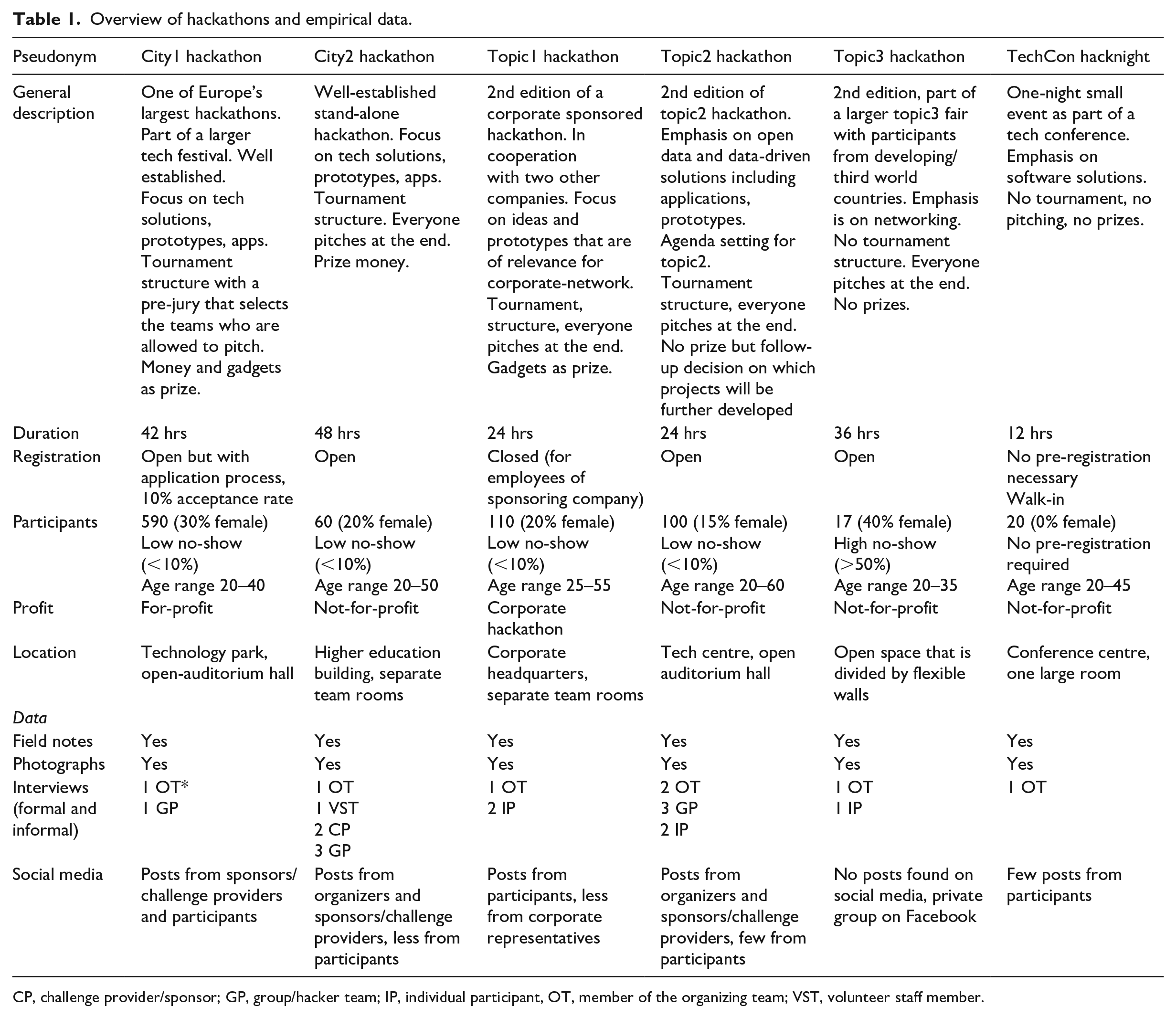
CP, challenge provider/sponsor; GP, group/hacker team; IP, individual participant, OT, member of the organizing team; VST, volunteer staff member.
Fieldwork across the sites included primarily non-participant observations documented as fieldnotes and photographs, complemented by formal interviews with organizers and individual participants (recorded and transcribed verbatim) and more informal interviews and conversations with sponsors, staff and groups of participants during the event (recorded and transcribed verbatim or documented in fieldnotes). The formal interviews with organizers and participants were negotiated either beforehand (via email) or during the event (personal contact) and took place during or after the event. The more informal interviews and conversations were naturally occurring and not set up. They took place in the lounge areas, at the coffee bar or during meals at the hackathons. As our initial interest was broadly on questions of organizing collective action, the formal interviews addressed how to communicate, orient and provide direction for participants, asking for situations when things had worked well and when they had not. Participants were asked about how they had experienced the event, what motivated them to participate, and how dynamics and work differed at hackathons compared to their regular work setting. We also collected artifacts (such as stickers, pins, gadgets, promotional material and brochures available at the hackathons) and followed the events on social media and screened other online material (videos, webpages, blogs) whenever it was available. We attended all six events for the full running time, except for small breaks to get some rest. The corporate-sponsored Topic1 hackathon, different from the other events, offered hotel rooms for out-of-town participants while employees went home for the night, so that no team work took place during the night at this specific hackathon.
We kept field diaries describing and commenting on what was happening and also noting our own sensory experiences (Strati, 1999), paying attention to how we felt about what was going on around us, including the exhaustion after staying up all night with the hackers, the excitement as the deadline was approaching or the boredom when ‘things were not happening’. Attention to such sensory aspects has been discussed as an important source of data for understanding organizational dynamics (e.g. Beyes & Steyaert, 2012, 2013; Gherardi, 2019; Strati, 1999).
Data analysis
Our analytic approach was abductive, prioritizing engagement with the field site, yet with a theoretically driven research interest and in the ‘service of theorizing’ (Van Maanen, Sørensen, & Mitchell, 2007, p. 1149; Alvesson & Kärreman, 2007). Starting with a theoretical interest in organizationality, abduction allowed us to inductively elaborate its processes while also borrowing deductively concepts and ideas from affect theory to problematize our findings around the precarious nature of organizationality and its intertwinement in processes of value production, ultimately leading to a refined understanding of organizationality. Our approach thus unfolded iteratively, comparing data and literature patterns in an attempt to elaborate the latter as we progressed (Locke, Feldman, & Golden-Biddle, 2020).
Based on the fieldnotes, photographs and interviews, the first step involved writing field reports for each hackathon, paying particular attention to what might influence the organizing of the event, including the sequencing, space, material artifacts, official rules, participants’ activities and overall atmosphere (Langley, 1999). This was followed by systematically open-coding all interviews and fieldnotes with the qualitative data analysis software package Atlas.ti (version 8.4.4). The codes included formal aspects (such as orientation and clarity) that participants noted with respect to the organization of the event as well as aspects of how they experienced the event (fun activities, satisfaction, sense of achievement). Interpreting those instances in terms of their relevance to co-orientation and collective effort, we integrated the open codes into second-order themes to reflect practices of organizing including spatio-temporal sequencing, staging excitement and realizing achievement. At this point, we also made use of the social media posts and tweets, as well as the photographs and visual material that we screened. However, we did not engage in specific netnographic (Kozinets, 2015) or visual (Pink, 2007) analysis but used those data as illustrative artifacts to support or challenge our interpretation. The social media posts were particularly revealing in moments of contrast between the online build-up and projected atmosphere (e.g. with respect to excitement) and the felt presence at the event, instigating a critical reflection on our own involvement as both participants and outsiders, and our movement between affective immersion and a critical position, which supported our discussions about how to interpret both empathetically and critically our source material (Schaefer & Alvesson, 2020).
In a third step, we turned to affect literature to develop and deepen our inductive insights towards theoretical understanding (Locke et al., 2020), attending to how affect might emerge and travel (e.g. moments that seemed to ‘catch fire’ or ‘die down’) and where it was channelled in a specific direction during co-orientation. We went back to the second-order themes and bundled them into three affective processes related to organizationality. Because our interest lay in a dynamic consideration of how affect might unfold, we focused on affective processes rather than taxonomic categories. Table 2 provides an overview of our data structure and documents the emergence of the three affective processes that we label circulating affect, intensifying affect and capturing affect.
Data structure.
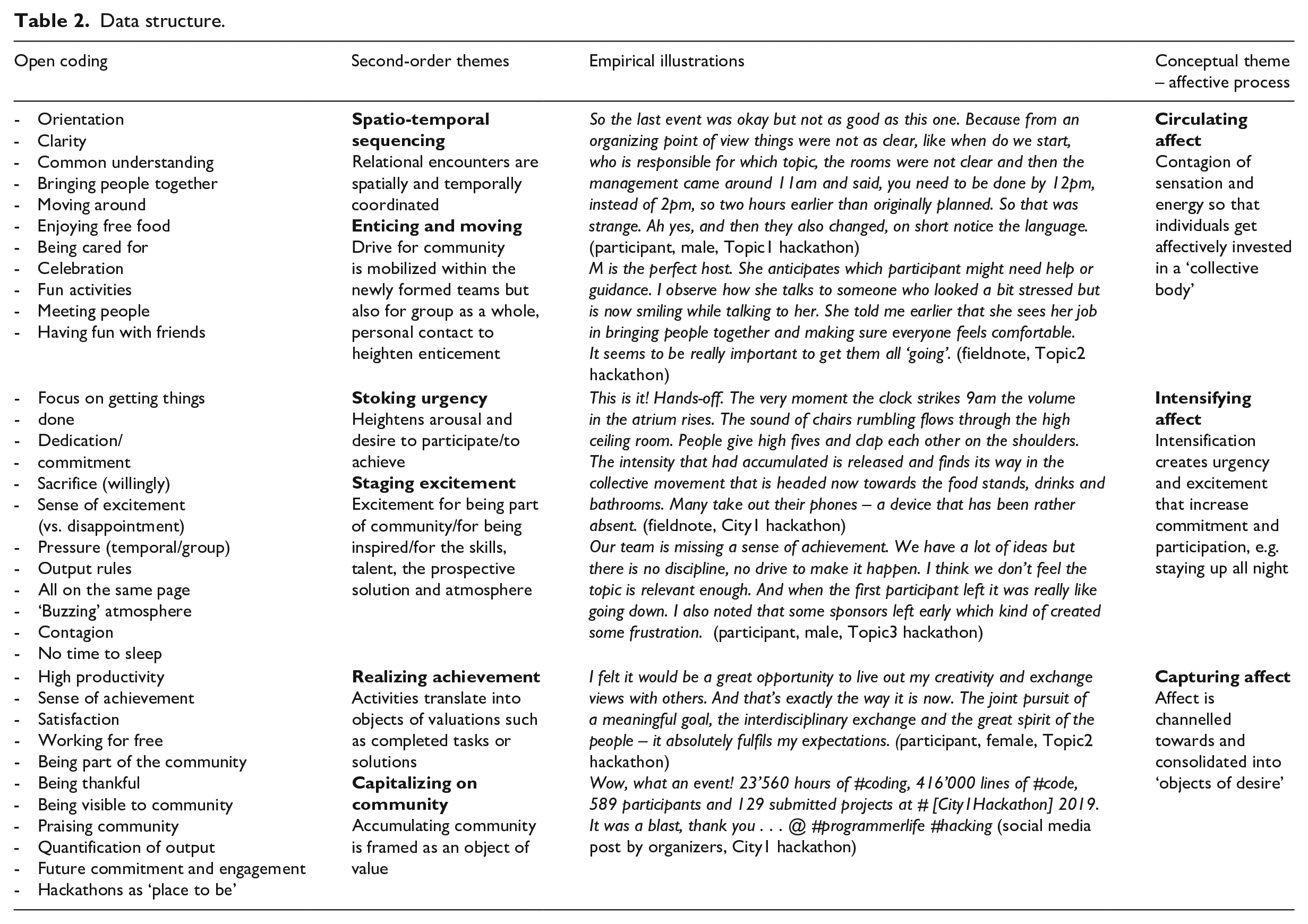
While empirically intertwined, we separate the three affective processes analytically for reasons of clarity. Below, we explicate our findings, drawing both on empirical moments of achieving organizationality and moments of failure.
Findings
Circulating affect
We term circulation of affect the setting of bodies in motion and maintenance of collective energy. Circulation promotes provisional stability of action and coordination without establishing permanent structures, emphasizing personal engagement and group contagion through collectivizing activities. It involved diverse affective flows, from encounters and spontaneous participation, data and communication flows, to flows of consumption of drinks and food, and flows of time and spatial arrangements. Mobilizing such flows required setting the stage for encounters to take place via practices of spatio-temporal sequencing and enticing and moving bodies. Figure 1 provides visual illustrations of those practices including photos of the material setting of team tables and work spaces as well as opportunities for encounters (at the bar or table tennis).
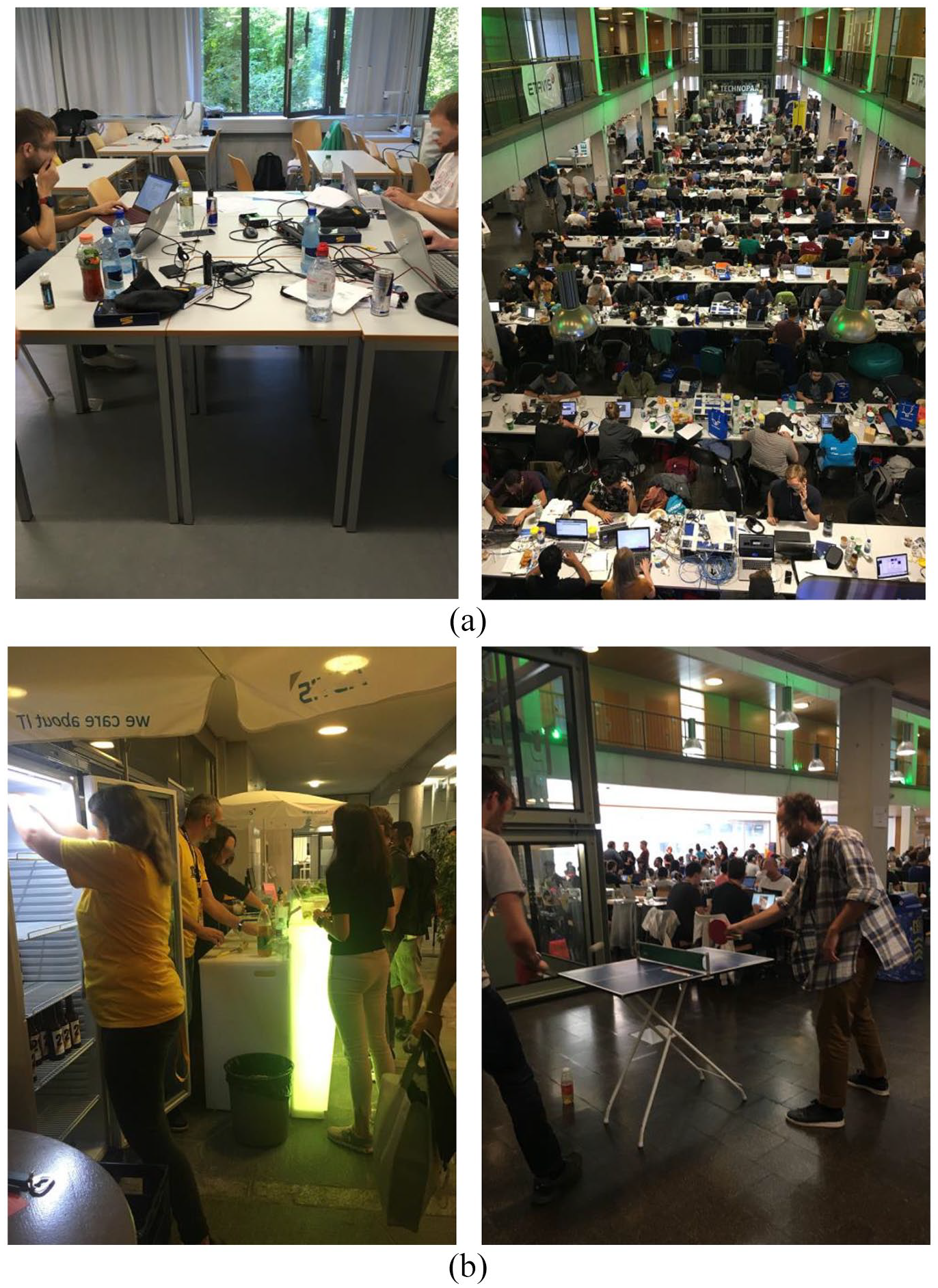
Photos illustrating the circulation of affect.
Spatio-temporal sequencing
Temporal sequencing refers to the tracking and spacing of time during the hackathon, crucial to supporting the self-organization of teams and maintaining affective flows. Time setting (and adhering to time limits) conferred an organizational aspect to otherwise undefined spans of activity. As one organizer explained, setting up a hackathon involves artificially constructing a limited time frame to co-orient and mobilize action.
So, you got limited time. You got these datasets and these technical possibilities, you got these social possibilities, you were networking with very diverse individuals, right? And then, you just go! (organizer, male, Topic2 hackathon)
The main activities marking the time of the hackathon were the opening ceremony, pitching of challenges, team building, start of project work, ‘hands-off’ (the moment when all teams terminate their work and submit the source code for jury inspection), pitching solutions and award ceremony. The countdown to ‘hands off’ tended to be featured prominently on large screens, providing a collective coordination device. The omnipresence of the diminishing time-flow – 21 hours, 19 hours, 7 hours, 2 hours – paced and synchronized activity. Participants generally began by sketching a production schedule, setting milestones, rationing discussion and projecting the moment when a prototype, and then a demo, should emerge. During this time, members negotiated how much time would be needed for refinement at the end. While these steps were not formally organized, they provided an aspect of organizationality that, despite its informality, was relatively homogeneous among project teams.
That temporal sequencing provided orientation in a fluid environment was often mentioned in the interviews, including moments of ‘breakdown’ when temporal markers were not followed. Ambiguity around the time schedule caused momentary interruptions in the flow of expectations, generating anxiety among members. As a result, members expressed little flexibility around time issues, which exerted a form of normative control. A lack of time control was not seen as adding flexibility to organizing but rather as removing a key buttress to an otherwise fragmented and temporary event.
The organizers just started the beamer even though the first morning session was originally planned for 10.45am. But they postponed it. Like last night when the opening was supposed to start at 6.30pm but because too few people had checked-in, they had postponed it to later. The continuous postponing creates a somewhat negative dynamic it seems. Overall, participants’ involvement is rather low, there is no ‘buzz’. People don’t participate, they don’t connect, and don’t seem to get in the right flow. The constant postponing of scheduled times seems to make things worse (fieldnote, Topic3 hackathon)
The sequencing allowed the directing and shaping of affective activity within a set-up that rendered time artificially scarce. It induced a rhythm among participants that was amplified by the spatial aspect of the hackathons. These were either large atrium halls, emphasizing a sense of ‘being in it together’ or separate team rooms that provided spaces for concentration. The design and set-up of the open spaces contributed to building a ‘buzzing’ atmosphere that stood in contrast to spaces that were segmented or separated.
It is 1 am and I am quite amazed by how lively this space still is. Lots of participants are still up and working.. . .It reminds me a bit of working in the library late at night to prepare for an examination. . . Here, it seems to be similar even though there is much more murmuring. It might also be this open space, which is massive. The co-presence of all those people together does create a special energy. The whole scene is very different from what I saw last month at City2 hackathons where teams were in individual rooms separated by long empty corridors that gave a feeling of emptiness. This here is much more exciting. Like a bee-hive with an electrifying buzz. (fieldnote City1 hackathon)
In contrast to the pod-like workspaces, the open atrium allowed for contagion and imitation. In these open spaces, the constant flow of working at night was witnessed by all, accentuating the ‘buzz’ of production, in contrast to sectioning off this flow in separate team rooms. Walking down the empty hall during City2 hackathon, for instance, had a sterile, bureaucratic feeling, as the teams worked in separate rooms. To find out ‘what was going on’ it was necessary to enter the individual rooms, blocking affective flows or contagion among the larger body of people.
Enticing and moving
We term enticing and moving the circulation of people and goods during hackathons, which lent a sense of materiality and traceability to the events. The ‘moving bodies’ created organizationality by establishing somewhat predictable circuits of food consumption, work and leisure activities. Hackathons often offer their participants free food and beverages, a seemingly superficial perk that is nevertheless iconic of hackathon culture. Refrigerators heavily stocked with drinks, and a constant flow of warm lunches, dinners and (midnight) snacks (pizza, fruit, sweets) pervaded the spaces during the events. Even when the budget was low (e.g. TechCon Hacknight or Topic3 hackathon) food and drinks were plentiful. The sense of a ‘full care package’ and ‘all inclusive’ created a carnivalesque ambience. Work was intense, but consumption was seamless, a metabolic circuit seemingly connecting pizza-box, hacker-brain and computer. Sharing meals and circulating food provided an organizing flow of objects and moments of contact. Like the water cooler effect, food and drinks brought participants into contact, facilitating encounters and informal chats (e.g. Keevers & Sykes, 2016). In addition, human bodies – those of the participants but also of the volunteers and the organizers – provided both sustenance and work-discipline by fostering orientation. At City1 hackathon, City2 hackathon and Topic2 hackathon, several volunteers (mostly female) acted as hostesses, smiling, charming, enticing participants and taking care of them, while feeding their frenzy.
Keeping bodies in motion and workers entertained ensured the circulation and sustenance of a productive atmosphere. Entertainment equipment such as play stations, pin-ball machines or tabletop football, massages or yoga classes produced further moments of encounter. Here again, the mobilization of bodies involved collective activity and movement. Such activities supported bonding and relief from the intense work schedule, enticement for tired bodies and flow to further participants’ mobilization.
In sum, circulation of affect worked ‘en passant’ through background practices when time, space and bodies meet to build up an initial sense of community. Attempts to over-organize sometimes backfired, as noted in one instance where the circulation of T-shirts produced difference rather than communal flow. At Topic1 hackathon, the organizers had distributed T-shirts of different colours to mark participants’ different backgrounds and skills – programmers received black T-shirts, business analysts, grey T-shirts, etc. Participants began to joke about the differences between ‘real’ und ‘unreal’ hackers, accentuating difference and thus marking a fracture in the tribal-mind feeling that spread across the space at other hackathons. Like the separate team rooms, the T-shirts were supposed to facilitate organizing by helping participants to identify each other and concentrate on their work. However, they proved dysfunctional in the creation of a more collective sense of community.
Intensifying affect
While the circulation of affect produced a continuous flow in the ‘backstage’, the intensification of affect induced collective motivation among participants that pushed them to persist. In other words, organizationality was provisionally structured by circulating affect, but fuelled by affective intensification, which motivated persistence in the face of heavy competition and gruelling work hours.
Stoking urgency
During opening ceremonies, participants were not only welcomed but sponsors also pitched their challenges – problems or questions to occupy the participants’ attention and work. These pitches employed affectively intense language, stressing the relevance of their challenge while paying tribute to the skills needed to solve challenges and urging participants to step up to the task. Addressing them directly and putting forth a plea sparked attention and heightened a sense of collective presence and co-orientation in the room. For example, organizers exclaimed imperatives such as: ‘There is data. It is great! And you can help us make it even better’ (organizer, male, Topic2 hackathon). ‘We need YOU! We need your innovations’ (sponsor, male, City2 hackathon).
Like the final pitches by participants, such challenge presentations were strictly time-limited, down to the second. Their brevity and intensity increased the energy and disciplined members for precision and not to get lost in details. Rapid speaking was ubiquitous and created a sense of urgency as each pitch captured the room and left no space for debate or discussion.
Time limitations also added to affective intensification, especially as the deadline for handing in source code (the ‘hands-off’ moment) approached. Participants were reminded that ‘only 10 more minutes are left until projects need to be submitted’ inducing stress but also heightening activity. Coffee consumption, energy drinks and sugary snacks were in high demand and tired faces strained to continue to the last minute until the pressure was relieved. Social media posts added to this affective intensification, showing, for example, teams that stayed up all night to get their work done (see Figure 2).
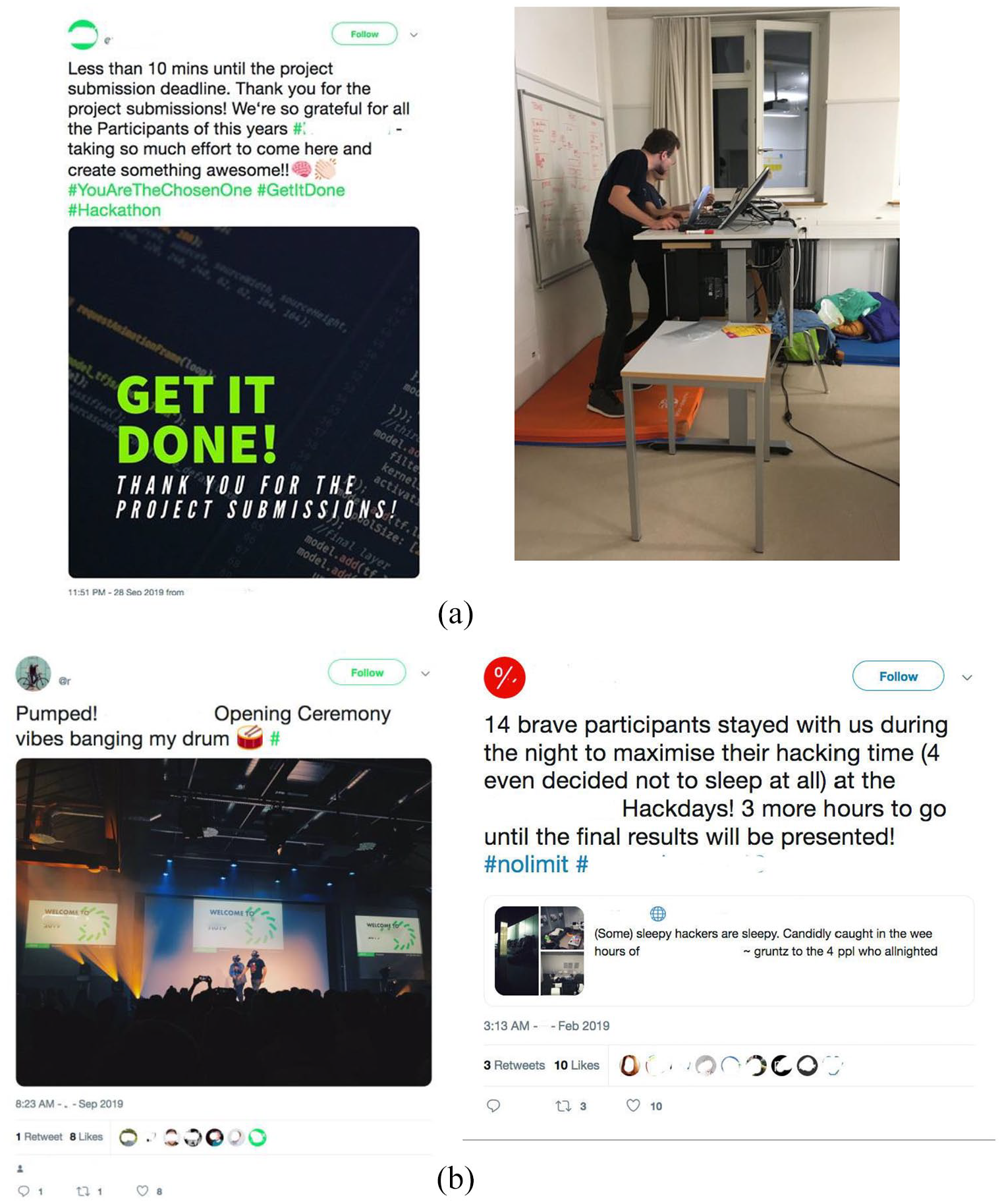
Photos and social media posts illustrating the intensification of affect.
Working through the night, the sense of urgency mobilized participants to push themselves to their limits. It was further intensified by small, ritual-like interventions like the midnight pizza delivery. Across sites, the pizza delivery marked a milestone of intensity and fed into the time regime while also causing excitement and a sense of camaraderie – sharing a meal at midnight while the rest of the city slept. It created a sense of urgency and pressure to produce that was simultaneously solemn and exciting. Because co-location and presence were important for accumulating affective intensity, some participants voiced disappointment when others left the hackathon to spend the night at home or in hotel rooms, as was the case in the corporate sponsored Topic1 hackathon.
In moments where fatigue was overwhelming, hackers usually pushed chairs together as makeshift beds, or crawled into sleeping bags beside their laptops. Images of exhausted workers were circulated on social media to project the commitment and productivity of the event. In this sense, exhaustion was ‘celebrated’, drawing humorous comments while consecrating the sacrifice of participants in meeting their deadlines.
Staging excitement
Beyond urgency, co-orientation and collective effort were further intensified, affectively, through a cultivated sense of wonder and excitement involving idolizing high performers, affirming skills and talents, and digitally boosting high-energy moments. Throughout the hackathons, celebrations abounded around skills, ideas, achievements and sponsors. Excitement among participants and on the stage were mirrored and thereby further intensified through sponsors, organizers and participants who turned to social media to express, validate and find support for their excitement, using terms like ‘Pumped. A blast! Amazing. Brave. WOW. #GreatWork #GreatMinds #YouAreTheChosenOne #Proud.’
Mobilizing positive and energetic language, the hackathons were constituted as desirable places by infusing them with an enticing atmosphere. Social media posts (see Figure 2) boosted and projected elation, making it at times difficult to separate the event itself from the digital images that shaped post-hoc memories. The social media posts staged urgency but also excitement, achievement and community, creating a curious dissonance between the analog and the digital. The online build-up and projected atmosphere mediatized and accentuated the event, making it look more intense and exciting than our own personal impression of the events sometimes suggested, raising questions about how being connected to the digital partly compensates and intensifies the ‘staging’ of actual sensations on site.
One of the most affectively intensive celebration moments revolved around the presentation of the final pitches. The atmosphere, already electrified as presenters were often nervous, was heightened through the commentaries, strict time regime and interaction with the audience. The intensification of anticipation through staging pitches and the relief following them contributed to intensified sensations in the room, climaxing as jury decisions were announced. Looking back at the last hackathon event, one organizer concluded: Great. It was really. . . every team really was great. I don’t know. Just – I love it! Pitches are the most stressful and, in a way, unpleasant time for people, because, you know, it’s like the big test. . . But everyone feels so great and relieved [afterwards]. Just like crossing the finish line. (organizer, male, Topic2 hackathon)
Overall, affective intensification gave a sense of collective engagement and attunement to collective practices. These moments allowed organizationality to emerge in a given instant and obscure questions of foundations, whether the organization and its momentary collectivity would leave a lasting trace.
Capturing affect
We term ‘capturing affect’ the process by which value is realized and extracted from collective affective processes. This includes the two practices of realizing achievement and capitalizing on community. Given its profit-oriented aspect, compared to circulation and intensification, capturing affect is a more surreptitious process, revealing itself ‘between the lines’ of collective efforts. While the participants spoke positively and enthusiastically about their achievements and production, the collective spirit of this production can be seen as standing in contrast to the creation and concentration of surplus value for some of the hackathons as part of their business model. As an extractive process rooted in the collective dynamics of intensification and circulation, capturing affect rests on making affect durable in ways that can be eventually converted into economic value (Dean, 2010; Jakonen et al., 2017; Karppi et al., 2016; Mumby, 2016, 2020).
Realizing achievement
We describe as ‘realizing achievement’ the ways in which affect is concretized in objects that are valued via the hackathon. The circulation of affect sets in motion opportunities for encounters that provided the potential for innovation, production and consumption (Jakonen et al., 2017). In our case, affect was channelled and counter-balanced by pragmatic and solution-oriented imperative of ‘getting things done’ and a bias to action conducive to the hacker community (e.g. Coleman, 2013; Irani, 2015).
According to the hackathon business model, value is extracted directly from people who are working for free on software problems, writing code and developing prototypes. Slogans such as get it done, make it work and just do it! were employed throughout the events. Printed on T-shirts and worn by volunteers (e.g. at City1 hackathon, City2 hackathon) or on pins and stickers, participants were incited to focus on producing output: solutions in the form of lines of code and prototypes. Software engineers were touted for their general tendency to fix problems in existing contexts so that systems could be quickly ‘up and running again’. Such practices privileged solutions over identifying root causes, and simplification over problematization and contestation. Given the limited time allowed, solutionism seemed like the only viable way to achieve results. Once the teams decided how to address their challenge, it became crucial to stick to the plan and not to get lost in debating alternatives or critical questioning. As one participant explained, ‘One of the most difficult things is to stick to what you have decided in the first place and trust that it is going to work’ (participant, female, City1 hackathon). Such a focus on solutionism was exacerbated through the temporal urgency and a focus on performance outcomes. Discussing with one of the organizers the economic value and rationale behind hackathons, he explained: It is this thrill of having accomplished something what drives us to invest our time here. It is this possibility for a short-term high intensity commitment that does not require any bureaucratic follow-up. We just do it, get it done, that’s it! (organizer, male, TechCon Hacknight)
This sense of accomplishment and productivity has been described in the literature as ‘affect of efficiency’ (Mackenzie, 2008). Participants accepted the required exertions involved in producing such affective intensities. As another participant noted, ‘To see what is possible in short time and to really create something from 0 to a prototype within 40 hours is a great feeling’ (participant, female, City1 hackathon). Capturing those ‘high’ moments of achievement and joy by sharing them on social media fed back into processes of intensification, hinting at the intertwinements of the affective processes.
Overall, the experience of successfully accomplishing something induced a rush and sense of excitement that some hoped to translate into their formal organization. For example, one participant noted how insightful the event had been by exemplifying the culture change his company is currently struggling with. While inside the formal organization agile collaboration was difficult to achieve, the hackathon had provided a moment of ‘real connection and collaboration’ and created an excitement about the possibilities.
This is amazing, you know. When about 100 people participate in the event leaving it with sparkling eyes, saying ‘Ah, now I understand how agile collaboration can work, now I understand how the IT department and line mangers should work together, because this event really illustrated how we can do it!’ (participant, male, Topic1 hackathon)
Enticement through value production was, nevertheless, contingent on participants’ abilities to experience themselves as skilful and able to meet the task demands. High levels of frustration abounded when participants were not able to recruit sufficient numbers of collaborators to work with them on a challenge. At other moments, when teams lacked particular skills needed for task completion, a lack of energy and a sense of tedium ensued (cf. McCarthy & Glozer, 2021), illustrating how ‘flows of imitation’ (Thrift, 2008) can lead to affective disenchantment. Ultimately, the intensification and circulation of affect depended on a credible promise to be able to ‘make it’ with a recognized solution, couching organizationality in a solutionist ethic (Morozov, 2013) from which value can be extracted.
Capitalizing on community
Besides software solutions and quantified lines of code as outputs (see Table 2 for additional example and Figure 3 for illustration), value was produced by positioning hackathons as a desirable platform for learning and socialization, enticing participants into the ‘hacker way’. Addressing the participants as #YouAreTheChosenOne (see above, Figure 2) created a sense of elitism, privilege and value for the participants. In this sense, rather than a context for action, organizationality and the experience of collective action provided a platform for members to build social status and reputation, as well as a mechanism for generating lucrative products. Both depended on leveraging the sense of community as a source of capital (social or economic).
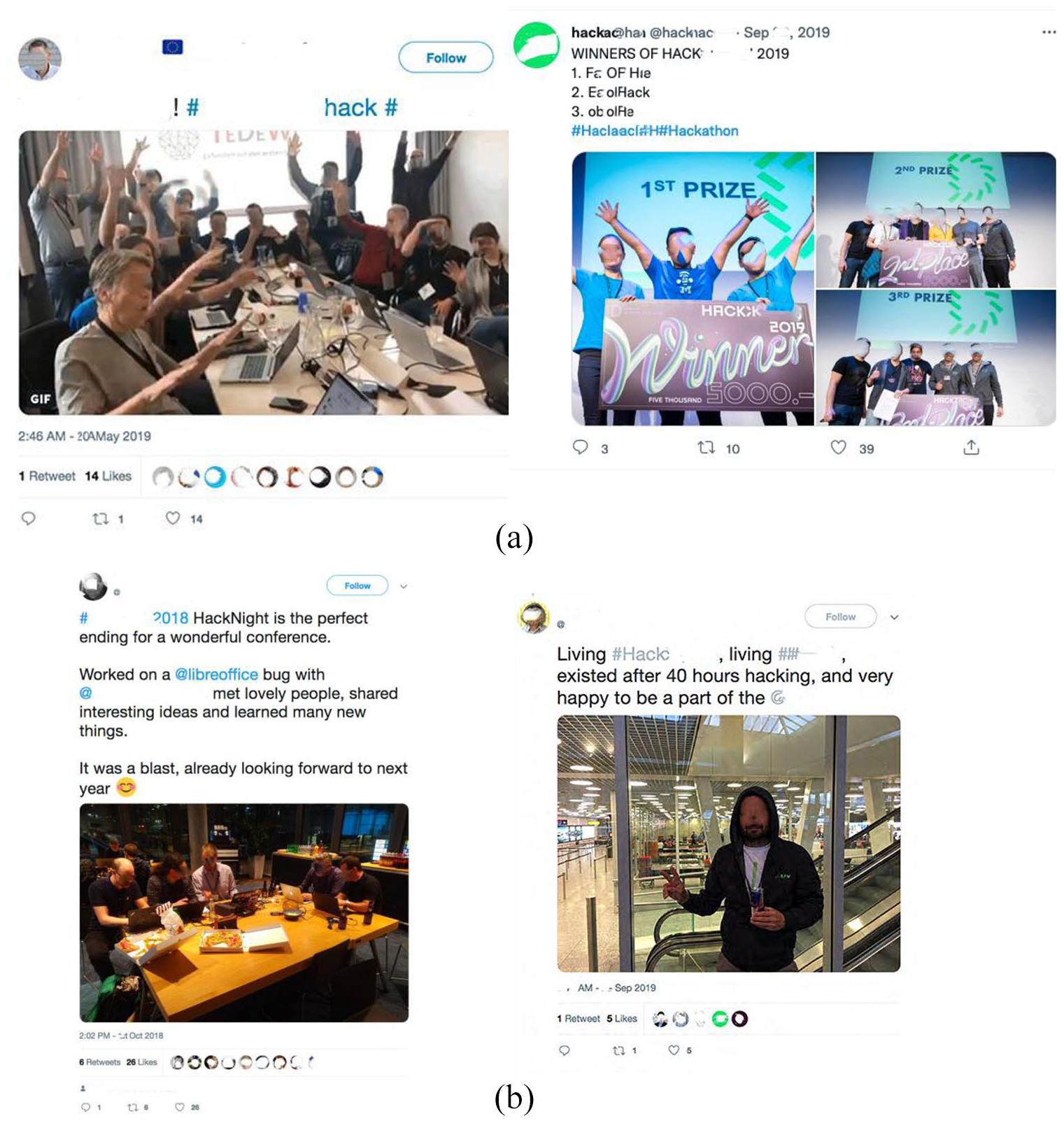
Social media posts illustrating the capture of affect.
During conversations, participant often emphasize how ‘proud and energized’ they felt ‘working amidst so many clever and like-minded people’ (e.g. participant, female, City1 hackathon). Others expressed and shared this sentiment on social media (see Figure 3).
In social media posts such as shown in Figure 3, participants were able to present their group project in ways that projected success, teamwork and competitiveness, with many of these posts demonstrating a winning project or relative value of the produced outputs. Such posts constituted the community as one of differentiated value production and themselves as the beneficiaries of the work. Visibility to a desired community thus acted as a reward structure that substituted community pride over financial rewards (e.g. Puranam et al., 2014), rendering the community attractive without regard to financial profit by the participants.
Overall, participants, enticed by the affective ‘pull’ and excitement of the event, articulated few critical voices around the precarity and hardship of the hacker way. For instance, disregarding the body’s usual rhythms and the need for sleep in order to work as long as possible was accepted and even celebrated. In fact, several participants struck a victory pose and proudly expressed their ‘survival’ after 40 hours of hacking. During a group interview, participants explained that the hackathon’s temporality, coupled with entertainment and fun, legitimized work intensification, making it ‘certainly worth the experience’. Three male participants of City2 hackathon jokingly spoke about how they had to call in sick at work after their participation in a hackathon the year before where they had worked for 36 hours non-stop. Talking about it, the affective pull of this experience was still palpable as a collective complicity among them, reconstituting a moment of collective action as memory of sociality and productivity.
While both practices, realizing achievement and capitalizing on community, were viewed positively among many participants, they invite a complementary critical reading. Dean’s (2006, 2010) perspective explicitly brings attention to how the double movement between supporting new forms of community through affective bonds, on the one hand, and exploiting these bonds through value expropriation, on the other, creates a dilemma as to how to understand the community thus produced. Bringing together communities around shared interests provides a source of social recognition and personal meaning; yet such encounters, particularly in their temporary and ephemeral aspects, raise suspicions that communitarian desires are easily exploitable for free labour and that affect, in addition to a basis for community, can be channelled into value-producing forms, a foundational feature of capital formation in the digital age (Dean, 2010) whose ramifications do not seem to be evident to the hackers we interviewed and observed.
In sum, affective circulation, intensification and capture constitute distinct yet interrelated processes allowing organizationality to provisionally coalesce and then dissipate, with the traces of organizationality captured in the form of new software solutions and temporary experiences of community.
Discussion and Conclusion
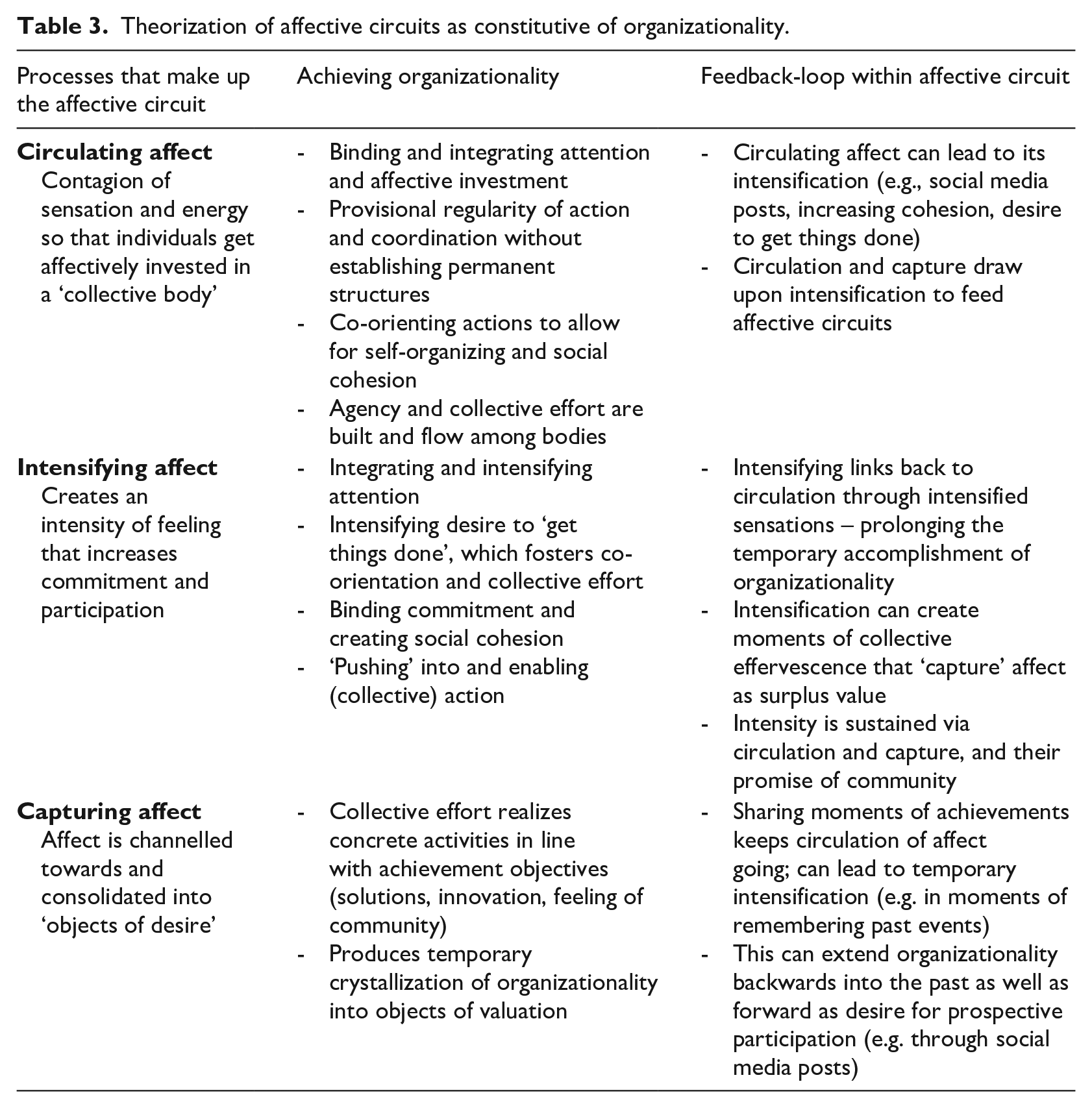
We began our study by trying to understand how ‘organizing without an organization’ is accomplished in technologically mediated collectives. Turning our attention to hackathons as a paradigmatic case of collective action outside organizational boundaries, we drew from the emerging body of research on organizationality (Dobusch & Schoeneborn, 2015; Schoeneborn et al., 2019) to explore the relational dynamics that turn loose social collectives in technology-mediated settings organizational. We drew upon Jodi Dean’s (2006, 2010) theorization of affect as binding technique to explain engagement in collective effort around digital production. Empirically, we identified three affective processes involving circulating, intensifying and capturing affect. Borrowing from Dean (2006, 2010), we now theorize the intertwinement of these three processes as affective circuits and discuss their implications for deepening understandings of organizationality and affective organizing in the digital age. Table 3 summarizes this theorization, putting forth affective circuits as constitutive of organizationality.
Theorization of affective circuits as constitutive of organizationality.
Organizationality and affective circuits
Organizationality emerges from affective circuits through which affective encounters are enrolled in circulation, further intensified, and directed into modes of value capture. Through the process of affective circulation, participants’ attention is mobilized towards collective action, provisionally holding groups together in moments of co-orientation without establishing permanent structures. Co-orientation promotes provisional cohesion and self-organizing to mobilize agency and accumulate collective efforts. Affect is intensified by the temporary and urgent nature of the event, binding commitment, producing heightened sensations and the drive to ‘get things done’. The loose collective is figured as a momentary organization to create value, after which it dissolves, leaving its traces in the form of product solutions, innovations and a memory of community that is consecrated in social media displays.
While analytically distinct, the three processes of circulation, intensification and capture are intertwined in practice, building on and feeding back into each other. For instance, affective circulation creates intensity through feedback and contagion (e.g. Thrift, 2008) as affect is reinforced by the presence and recognition – both physical and digitally mediated – of others. Affective intensification is akin to classical accounts of ‘collective effervescence’ (Durkheim, 1912/1995) through which groups come to see themselves as entities; distinct from the classical variant, however, in the techno-production model, surplus affect is generated and captured in the value creation process (Dean, 2010). Thus, the aspect of capture creates the possibility for exploitation within the affective circuit, suggesting the need for a critical theorization of affect (Dean, 2010) and its implication for technology and organizationality.
Capture itself, however, has an intensity-generating aspect, feeding back into intensification, for example, during the tournament architecture of the event which is highly energizing. In such moments, ‘pitching’ an idea and having it capitalized becomes an anchor-point for affective intensity and dreams of success, a fantasy combining social recognition, communal unity and capital creation in an affect-generating system (Dean, 2010). Sharing moments of achievement (in real time or retroactively) further nourishes the circulation of affect that can reconstitute momentary intensifications. Sharing also extends the temporality of organizationality both backwards (as dearly held memories of participation in the event) and forward (creating the desire for future participation) (cf. Vásquez & Cooren, 2013). Intensity, in turn, arises from the desire for circulation (i.e. socializing and sharing affectively laden encounters) and capture (i.e. seeing one’s creation ‘win’ a prize). The emerging organizationality – maintained through the promise of community – operates through circulation and draws upon intensity to feed circuits of desire, giving rise to value capture (Dean, 2010). Figure 4 sketches the intertwinement of the affective processes visually.
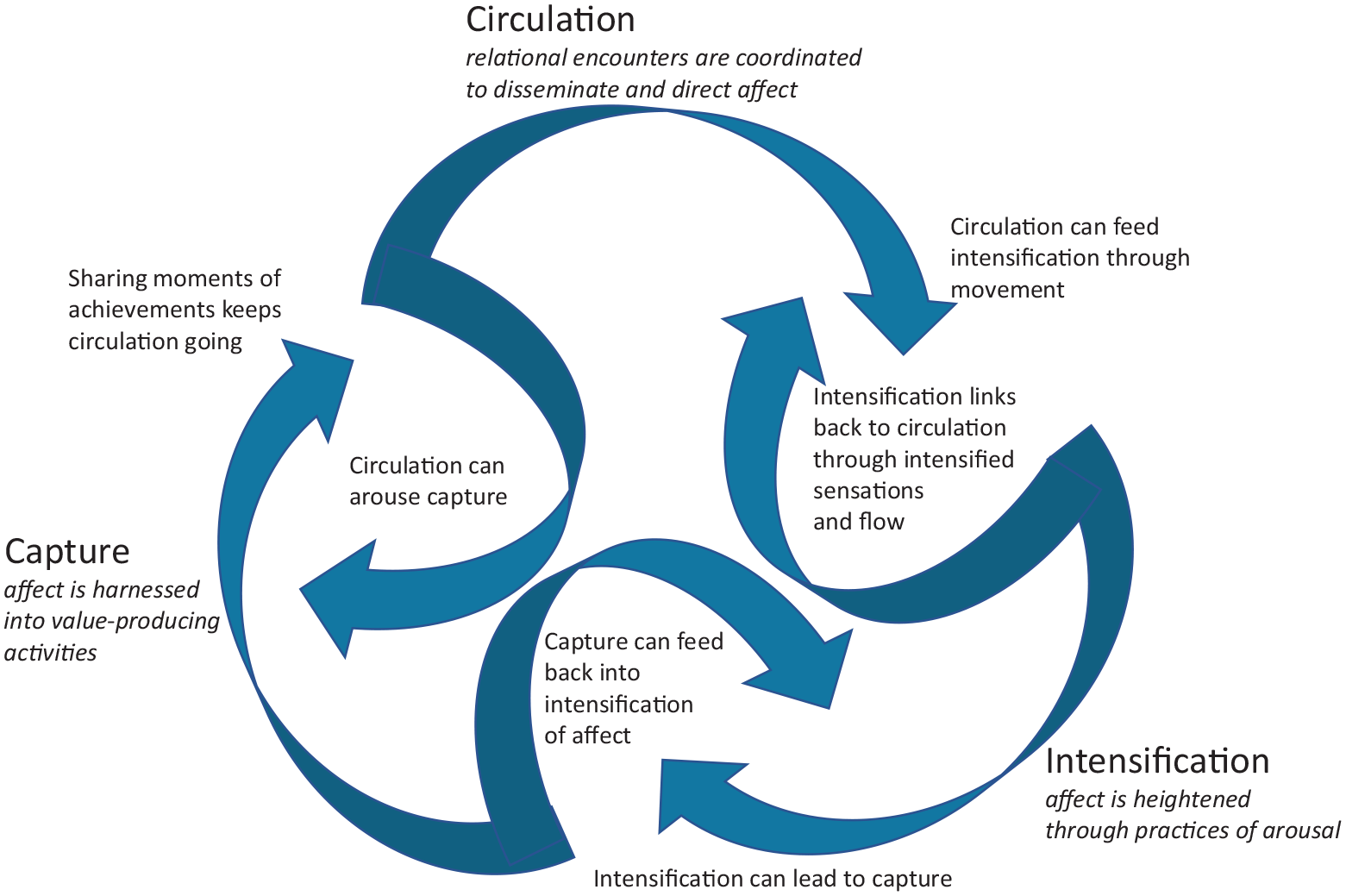
Visual flowchart of affective circuit.
Our findings offer a contribution to the emerging literature on organizationality (Dobusch & Schoeneborn, 2015; Schoeneborn et al., 2019) by specifying the relational and affective dynamics by which participants seek co-orientation, social cohesion and a sense of community. Similar to Wilhoit and Kisselburgh (2015) and Blagoev and colleagues (2019), we note the centrality of co-location and embodied practices for organizationality to emerge. These include moving and enticing bodies, stoking urgency and staging excitement which help to move, co-orient and circulate affect among bodies, creating experiences of enjoyment and sociality that motivate collective action, even if the organizationality thus produced remains inherently precarious.
Moreover, emphasizing the internal relational dynamics of organizationality, we complement existing knowledge on organizationality as informal practices and routines (Blagoev et al., 2019) by highlighting the affective dynamics at play. In line with Reckwitz’ (2012) argument that any social practice is linked to affective dynamics, we encourage future research to explore how affect undergirds or drives social (Blagoev et al., 2019), spatio-material (Wilhoit & Kisselburgh, 2015) and cognitive/communicative practices (Dobusch & Schoeneborn, 2015) of organizationality. As noted above, classical statements of group stabilization through affect (e.g. Durkheim’s 1912 ‘collective effervescence’) apply to long-standing cultures, but their provisional application to organizationality opens up avenues for future research. Given that classical accounts presume that maintaining a collective is valued, research is needed in contexts (such as hackathons) where this assumption is not obvious and requires explanation.
Our research also points to the relevance of technology and technological mediation in the affective constitution of organizationality. Dean’s (2006, 2010) understanding of affect specifically focuses on digital contexts, problematizing technology because of its ability to stoke desires for collectivity, as digital technology fragments and individualizes while nevertheless promising ‘access’ and ‘participation’ (Dean, 2006) and social connectivity (Kolb et al., 2020). The hackathons that we studied show elements of this digital context but the complex mixture of physical and digital infrastructures, coupled with the highly embodied aspects of affective organizing (moving bodies, food practices, arousal through pitches), complicate questions about the ‘materiality’ of affect (cf. Gherardi, 2019). As noted above, when the physical experience struggled to ‘keep up’ with its virtual image on social media, it was difficult to see the origin point of affect as embodied presence or encounter. In such moments, it seemed as if the digital fantasy of affective encounter (as documented in social media posts) generated affect as much or more than the encounter itself. Such a finding is consistent with Dean’s (2015b, p. 238) description of affect as based on ‘lack’, as a ‘movement which estranges the subject from its experience’ and thus generates affective intensity from the desire to restore an imagined harmony. While an in-depth analysis of the social media and transmedial aspects of organizationality was outside our scope, future research could examine the interplay of fantasy and materiality, across media types (on- and offline), in generating and capturing affect.
Such a focus could also elucidate how organizationality directed towards internal and external audiences (Blagoev et al., 2019; Dobusch & Schoeneborn, 2015) might be intertwined, feeding off and into (or against) each other. Analysing hackathons’ social media posts would help situate the events spatially and temporally (Vásquez & Cooren, 2013), providing an opportunity to probe how organizationality extends temporally backwards – through memories and social media traces – but also forward as drive or desire for participation in the future. In sum, future research should examine when and why affect relocates to virtual spaces as it becomes technologically mediated and decoupled from bodies, and the implications of such transmediality for how affect constitutes online organizing and organizations (e.g. Just, 2019; McCarthy & Glozer, 2022).
While our discussion so far has considered how affect as a binding mechanism constitutes organizationality, below we discuss affect’s other ‘effect’ as enabling value extraction from organizationality.
Affect as technology of organizing
While our primary theoretical contribution is toward organizationality, we also offer a critical reading of affects’ organizing power. This is crucial as the shift from affinity groups (Dobusch & Schoeneborn 2015; Wilhoit & Kisselburgh 2015) to sites of value production such as coworking (Blagoev et al., 2019) or hackathons calls for a reflection on the political economy of organizationality as a practice of mobilizing social relations for economic value. While critical studies of affect have already noted the relational and interpersonal qualities of affect (e.g. Fotaki et al., 2017; Jakonen et al., 2017; Karppi et al., 2016; Resch et al., 2021), these take on particular purchase in the context of organizationality, where they are mobilized to support provisional structures which are inherently precarious (Dobusch & Schoneborn, 2015; Schoeneborn et al., 2019), ‘permanently beta’ and in flux (Blagoev et al., 2019, p. 17). In these circumstances, organizationality itself becomes an object of desire, leveraging the desire for community to produce value (Dean, 2010) but crystallizing only temporarily before dissipating again. In our case, hackathons leverage desire for community while maintaining temporary and fragmented structures that thwart stable social community. Affect produced in the context of structural fluidity is therefore prone to exploitation, providing an input that can be converted into a capital, a new form of accumulation and dispossession (Dean, 2010). This warrants an understanding of affect as technology of organizing as it allows value capture under the guise of community (e.g. Mumby, 2016, 2020). In this way, scholarship interested in affect as constituting organizationality should take into account the political nature of affect even while (and as a part of) understanding the productive possibilities of affect’s organizing and constitutive powers (e.g. Beyes & De Cock, 2017; Fotaki et al., 2017; Just, 2019; Resch et al., 2021).
A critical reading of how affect is implicated in systems of value production – variously termed as communicative capitalism, affective capitalism or informational capitalism (e.g. Castells, 2000; Dean, 2006; Jakonen et al., 2017; Karppi et al., 2016) – provides a corrective to overly agentic conceptions of affect as unstructured moments of freedom (cf. Hemmings, 2005); rather, our approach to affect, while appearing at the edges of structure, is ambivalent regarding the kinds of freedom it affords. Despite the fact that affect is often described as ‘indeterminate and imminent’ (Kuhn et al., 2019 p. 108; emphasis in original), unruly and escaping any attempt to manage it (e.g. Beyes & Steyaert, 2013; Jakonen et al., 2017), affect in the digital economy is increasingly ‘captured’ and instrumentalized within digital business models (e.g. Dean, 2006, 2010; Karppi, 2015; Karppi et al., 2016). Hackathons’ provisional structures, arising from channelling affect, provides a good illustration how agency can turn back upon itself as capture (Dean, 2010), raising important questions about the agentic nature of affect and its potential to escape and transform value-producing systems from within. We therefore invite future research to investigate the conditions under which affect may block or interrupt organizationality, including practices that resist capture. As we noted throughout the findings, we encountered several moments across the sites when affect seemed not to flow, did not spread or intensify (Thrift, 2008), hindering the achievement of collective effort and organizationality. We call on future research to investigate such moments in greater detail and to explore the conditions under which loose social collectives remain loose and social by resisting organizationality, problematizing the entwinement of agency and affect and exploring its political implications for a critical conception of technology and organizing.
Second, and relatedly, our empirical focus has been on the value-producing powers of affect, based on enticement, excitement and flow. This focus reflects a critical motivation stemming from our mobilization of Dean (2006, 2010) to understand the power of affect in technological production. Despite this critical intent, critical or reflective voices among participants and organizers of hackathons were rare. Thus, while the processes we describe (and particularly affective capture) provide a groundwork for a critical theorization of affective circuits, future research might want to take a closer look at the negative effects of affect’s organizing powers. Whether these negative consequences come from the breakdown of affective circuits, or from their success in the guise of community leading to potential exploitation, leaves room for further exploration.
Hackathons and new ways of organizing
Our study also offers a contribution to the literature on hackathons and new ways of organizing. Hackathons may be seen as learning and network platforms or as spaces of escape, transgression and disruption where solutions are developed and new forms of participation through technology are made available (cf. Gregg, 2015; Irani, 2015; Lodato & DiSalvo, 2016; Seravalli & Simeone, 2016; Söderberg & Delfanti, 2015). We contribute to this body of research by outlining how hackathons achieve their effects without recourse to formal structures, hierarchy or membership. As others have noted, hackathons can be seen as a new way of organizing (e.g. Lifshitz-Assaf et al., 2020; Puranam et al., 2014), taking place outside formal organizational boundaries, drawing from unconventional, informal, non-hierarchical and unstructured practices made possible by technology. Our use of the organizationality concept emphasizes affective flows and investments as constitutive of organizing and implies that affect can inform the broader turn towards new arrangements that take on the form of organizational ‘happenings’, offering participants affective experiences that blur the boundary between work and leisure, production and consumption. Like start-up weekends (Dey et al., 2016) coworking spaces (Jakonen et al., 2017) or maker festivals (Gorbatai et al., 2021), hackathons enchant participants and stir excitement, energy and a sense of connection so that participants become invested in those events and new forms of working (see also Resch et al., 2021).
Our use of critical media studies has been helpful in problematizing technology as both individualizing and promising to overcome this individualization through new forms of social connection. As technology continues to fragment stable organizational arrangements, new ones will emerge to counter the lack and longing to reconstitute community. Our theorization of affective circuits can thus be extended to other contexts that promise community and connectivity (e.g. de Vaujany et al., 2021, Kolb et al., 2020) and help explain the affective dynamics that render collectives organizational. To the extent that such renderings constitute forms of affective capture, however, hackathons (and other spaces) may also illustrate new forms of value production that exemplify ‘the inexhaustible expansion of capital into increasingly restless, elusive spaces’ (Beyes & Holt, 2020, p. 11). While hackathons, maker festivals or fab labs used to be for nerds and hobbyists, they have become mainstreamed as spaces of production and consumption. As such, future research could examine the conditions under which the openness of hackathons and other new arrangements provide escape from the domination of formal structure and when this openness exposes members to new forms of commodification.
To conclude, network technologies engender fluidity and ephemerality that give rise to new requirements to ‘keep things together’, mobilizing available resources to constitute and keep organizational moments in stasis, at least until the required production has been achieved. Affective circuits provide a glue strong enough to provisionally constitute such resources, without solidifying into formal structures that would resist dissolution. In this way, hackathons exemplify the processes of liquification and reconstitution that are emblematic of organizing in the digital age comprising technology, organizationality and affect.
Footnotes
Acknowledgements
We would like to thank our handling editor, Jean Clarke, the four anonymous reviewers, and the participants from the roundtable session at the 2019 Organization Studies Summer Workshop on Technology and Organization, for their valuable and constructive feedback.
Funding
The author(s) disclosed receipt of the following financial support for the research, authorship, and/or publication of this article: Nada Endrissat received funding from the Research Initiative of the Bern University of Applied Sciences, grant number 1994 DPT_W.
