



Abstract
Research has identified improvisation as a creative and open activity that can be harnessed to encourage innovation and learning within the organization. In this paper, we present improvisation as a covert phenomenon, occurring in a climate of mistrust and fear of censure, and disconnected with wider organizational learning. Drawing on qualitative evidence of a Fire Service in the United Kingdom, we explore hidden improvisation, and identify the conditions and processes that can connect these local deviations to wider processes of learning. We show that while most improvisations remain hidden and contained to avoid wider scrutiny, certain conditions of frequency, connectedness and scale escalate events to become more visible to supervisors and managers. The learning outcomes from these visible improvisations will then depend on management’s interpretation, evaluation and translation of improvising behaviours. Dependent on prior relationships of trust and credibility, middle management perform a key brokering role in this process, connecting previously hidden improvisation to wider organizational systems and structures.
Keywords
Introduction
Jazz (Barrett, 1998) and theatre (Vera & Crossan, 2004) are the most often deployed metaphors to explore the potential of improvisation in organizations (Hadida, Tarvianen, & Rose, 2015). These metaphors suggest an almost playful approach to improvisation, encouraging an open and engaged set of techniques and activities. Through minimal structuring, a culture of experimentation, and open trusting communication (Barrett, 1998; Bigley & Roberts, 2001; Moorman & Miner, 1998; Weick, Sutcliffe, & Obstfeld, 1999), organizations allow improvisers the freedom to deviate from established norms, producing innovations that are subsequently fed back into the organization through wider learning processes (Crossan, Lane, & White, 1999). Approaching improvisation from this perspective brings into view the enabling structures that empower individuals to create (Schildt, Mantere, & Cornelissen, 2020). Seen as a positive force for change, studies encourage organizations to develop a context where improvisation can flourish (Moorman & Miner, 1998). Viewing improvisation as an open activity (Crossan et al., 1999; Miner, Bassoff, & Moorman, 2001; Moorman & Miner 1998) prior research assumes that outcomes are exposed to the scrutiny of the wider organization and thus provides the potential for wider collective learning (Crossan et al., 1999; Vendelø, 2009).
However, in a high reliability organization (HRO), or safety-critical organization, where processes are often standardized for good reasons of coordination, predictability and security, improvisation assumes a contrasting character (Wolbers, Boersma, & Groenewegen, 2018). In these contexts, improvisation may occur to cope with transient ambiguous circumstances (Miner et al., 2001) and to manage the unforeseen (Weick, 1998). In such high pressure and unpredictable environments, improvisation is discouraged, becoming a hidden process (Cunha, Clegg, & Kamoche, 2012), and as a result, the potential to learn is significantly constrained. Since previous conceptualizations of improvisation examine it as a creative and open activity and link the phenomenon to innovation and learning (Barrett, 1998; Vera & Crossan, 2004), we know about learning in organizations where improvisation is encouraged. Our study seeks to explore the learning process in organizations where improvisation is potentially dangerous and likely to be discouraged, such as in HROs and other safety-critical organizations. Our knowledge of when, why, or how improvisation might result in wider organizational learning in this context is limited. To fill this gap, we pose the following research question: Under what conditions and processes does hidden improvisation lead to organizational learning?
To answer this question, we examine the case of a Fire and Rescue Service in the United Kingdom and explore how the organization responds to incidents of improvisation by firefighters and managers. Firefighters operate under conditions of time pressure, uncertainty and dynamism, which affords an interesting and relevant context to study improvisation and its consequences in a significant occupational setting. It is a setting that also has potential to generalize findings to other safety-critical organizations, such as other emergency services, aircraft operations, or any type of HRO.
We make two key contributions to knowledge. First, we highlight the phenomenon of hidden improvisation and identify key differences from the more widely researched open improvisation. Our findings reveal that hidden improvisation occurred, in most cases, disconnected from wider organizational processes, due to the autonomous working of the crews. Under this curtain of privacy (Bernstein, 2012), local actors seek to contain improvisations, covering up outcomes or only sharing these locally. Even when local management becomes aware, they interpret and evaluate events with a view to containing them at a local level. Our study presents it as a covert activity, born out of necessity to meet immediate goals, hidden from view, and not directly encouraged within the organization. Here the primary aim is not learning or innovation, but trying to solve a mission-critical and immediate problem-at-hand (Miner et al., 2001; Suarez & Montes, 2019). These findings support the view that most improvisations do not lead to wider learning (Miner at al., 2001), and our results add to this debate by highlighting the conditions that disconnect those learning processes.
Second, we theorize the process through which hidden improvisation leads to organizational learning. We show how the context of improvising shaped wider learning, and how the approaches taken by improvisers and managers led to different learning outcomes. While other scholars have highlighted the local nature of improvisation (Miner et al., 2001), it is unclear, if, when and how such local actions can lead to wider organizational learning. We find that improvisations that occur frequently, are of large scale, or that are connected to other procedural breaches, lead to a formal after-action review process, in which middle and senior management interpret and evaluate actions surrounding the event. We further show that middle management plays a significant role in connecting hidden improvisation to wider learning through a process of brokering between the improvising firefighters and wider audiences, and this is shaped by several factors. First, interpersonal trust between the improviser and manager facilitates communication, ensuring that the improviser is open and candid as they explain and report events. Second, this trust is built up through interpersonal relationships (Reagans & McEvily, 2003; Swift & Hwang, 2013), which can facilitate the interpretation, evaluation and translation of actions for a wider audience (Hoe, 2006). Third, the social confidence of the broker and the perceived credibility of potential knowledge sources are important to encourage improvisers to report and explain their actions, and importantly translate this in a favourable manner to those higher up the organization’s hierarchy who would, in their turn, further interpret and evaluate events.
Improvisation and Organizational Learning
Open improvisation and organizational learning
Improvisation involves acting in the moment as one spontaneously reacts to unforeseen events through experimentation and creativity (Barrett, 1998; Batista, Clegg, Cunha, Guistiniano, & Rego, 2016; Vera & Crossan, 2004) in a specific focal context (Suarez & Montes, 2019) and when the outcomes will be uncertain (Fisher & Barrett, 2019). Improvisation is thus an intentional break from traditional procedures to enact an immediate solution in ambiguous circumstances with the resources available. Past research has highlighted the importance of key structures and processes to support the improviser, as they step outside their comfort zone. Most of this research assumes a creative character (Hadida et al., 2015), with metaphors drawn from jazz (Barrett, 1998) and theatre (Vera & Crossan, 2004) used to inform improvisation in organizations.
Here the improviser is encouraged to ‘give it a go’ and explore new ways of behaving and reacting to unfolding events. In these more creative contexts of jazz and theatre, improvisers are driven by the goal of producing something new, in an environment where errors are allowed (Barrett, 1998). Organizations manage these departures from established practices through minimal structures, which empower improvisers to be flexible and creative in dealing with the unexpected (Barrett, 1998; Bigley & Roberts, 2001; Brown & Eisenhardt, 1997; Moorman & Miner, 1998; Weick et al., 1999). Since the systemic structures influence the interpretive frames of the improvisers (Schildt et al., 2020), the organization creates a shared purpose, which provides a trajectory of commitment and overall goals for improvisation (Cunha et al., 2012; Schildt et al., 2020). This might be achieved through credos, stories, myths, visions, slogans, mission statements and trademarks (Weick, 1990). These artefacts provide abstract and broad guidance, without being overly prescriptive about the actual behaviours that are expected.
Research from this tradition generally involves examining an organization’s response to a changing environment (Hadida et al., 2015). Common topics researched include the creative use of resources (Sonenshein, 2014), new product development (Akgün, Byrne, Lynn, & Keskin, 2007), innovation (Vera & Crossan, 2005), capitalizing on successful improvisations (Ferriani, Garnsey, & Lorenzoni, 2012), and project management (Leybourne & Sadler-Smith, 2006). For example, Ferriani and colleagues (2012) argue that open attitudes to improvisation and learning allowed microchip manufacturing organizations to embed learning into the organization to capitalize on technological advances. The common theme in this research is that through the minimal structures, open trusting communication and developing culture of experimentation (Barrett, 1998; Bigley & Roberts, 2001; Moorman & Miner, 1998; Weick et al., 1999), firms can integrate improvisation into the wider process of organizational learning (Crossan et al., 1999).
Frequent and persistent improvisation can lead to the emergence of local norms (Breslin & Wood, 2016) or local short-term learning (Miner et al., 2001), where learning remains at the individual or group level. However, improvisation can also lead to organizational learning when changes in SOPs and rules become institutionalized (Crossan et al., 1999). This involves the selective retention of lessons learned from the improvisation event (Moorman & Miner, 1998) and a process where analysis of the event occurs over a longer time period, allowing assessment of effectiveness, refinement and experimenting with options (Barton, Sutcliffe, Vogus, & DeWitt, 2015; Cunha, Vieira da Cunha, & Kamoche, 1999; Fisher & Barrett, 2019; Lampel, Shamsie, & Shapira, 2009). Open communication is thus critical to drawing out wider lessons from improvised actions.
In summary, most of the prior literature on improvisation locates the phenomenon within an organizational context where experimentation and the potential disruption of existing practices is encouraged (Barrett, 1998; Vera & Crossan, 2004). In these organizations, errors and mistakes are tolerated (Barrett, 1998; Crossan & Sorrenti, 2003), and structures and processes are in place to support the creative exercise of improvisation. These organizations seek to build interpersonal trust, alongside the continual and open exchange of ideas (Vera & Crossan, 2004), which are seen to be crucial in facilitating the subsequent interpretation and evaluation of improvised actions through the learning process (Crossan et al., 1999).
What happens when improvisation is hidden?
Meeting these conditions of experimentation, trust and communication can be a challenge in safety-critical organizations, as the outcomes of improvisation are not always positive (Cunha et al., 2012). In this type of scenario, improvisation can also disrupt the coordination necessary to ensure predictability in a complex workflow (Wolbers et al., 2018). Moreover, as noted above, improvisation is influenced by systemic organizational commitments (Schildt et al., 2020) and, as a result, developing a culture of experimentation can be severely constrained due to the high risks associated with errors (Lipshitz, Popper, & Oz, 1996), or discouraged by punishments that might accompany improvisation that is deemed unacceptable (Fisher & Barrett, 2019). For example, in a study about the sinking of the Costa Concordia, Giustiniano, Cunha and Clegg (2016) found that improvising had tragic consequences when the captain improvised in such a way that his actions contradicted the values of the organization and put passenger safety at risk. In some organizations, improvisation has the potential therefore to be dangerous and is not considered as creative or experimenting; rather, it is more likely to be the result of expedient actions to deal with ambiguity and uncertainty when actors (firefighters in our study) are solving difficult ambiguous problems in real time (Wolbers et al., 2018). Improvising in this type of scenario is an action of last resort, which is normatively discouraged (Fisher & Barrett, 2019), since the consequences of improvising might be catastrophic. Improvising, if it does occur, may be hidden for fear of consequences (Fisher & Barrett, 2019).
How does the organization learn when improvisation is not open nor encouraged, but hidden behind a veil of secrecy? Several studies have shown the limited potential for wider learning when improvisations are hidden. Batista and colleagues (2016), for instance, found that emergency room medical workers often needed to improvise solutions that contradicted accepted protocols to protect patients’ health, but then felt obligated to hide their improvisations to avoid scrutiny. Improvisation was thus pushed into the ‘under-life’ of the organization and was not formally recognized or discussed publicly (Batista et al., 2016). Bernstein (2012) shows how factory workers hide improvisation and innovations from management, even though their improvisations increase efficiency. In such a context, improvisers recognize that speaking up is likely to be a risky behaviour, one that they attribute to concerns about personal consequences (Detert & Edmondson, 2011; Edmondson, 2003; Milliken, Morrison, & Hewlin, 2003). Thus, the culture of trust and communication, that is seen to be so crucial in open improvisation, is replaced with mistrust and lack of disclosure.
Impaired communication also makes the subsequent interpretation and evaluation of improvised actions more difficult, as these involve reflection-on-action (Yanow & Tsoukas, 2009) by managers, who may not have experienced the immediate problem-at-hand (Miner et al., 2001). Evaluations are thus based on a different set of interpretations arising both because of the de-contextualization of events (i.e. generic ‘lessons learned’ from specific actions), and the time that has elapsed since the improvisation occurred (Berends & Antonacopoulou, 2014). The importance of trust and communication is also highlighted in a study by Barton and Sutcliffe (2009), who showed that firefighters were better able to respond to unexpected circumstances when individuals could voice concerns about the trajectory of actions being taken. Commanders who actively sought out such voices increased the chances of a successful outcome when dealing with ambiguous and uncertain events (Barton & Sutcliffe, 2009; Barton et al., 2015). This sharing of information is critical in an incident command system, as individuals create a shared understanding of the event, which helps to coordinate the improvised actions of different team members (Bigley & Roberts, 2001) as they react to fast-changing situations.
In summary, in a safety-critical organization, where improvising is discouraged or dangerous, improvising is more likely to be hidden, which constrains opportunities for organizational learning. Thus, in these cases, connecting local improvisation events to wider organizational change requires moving the improvisation activity from a hidden action to an open process that allows others in the organization to evaluate such actions, and discern the efficacy of any learning that might be applied and shared more widely. We seek to add to knowledge in this area by studying the conditions and processes of improvising that might elevate it from hidden to open, and thus provide the opportunity for this organizational learning to occur.
Case Background and Methods
The focus organization is a large UK Fire and Rescue Service employing approximately 2,500 staff in operational and non-operational posts. The organization serves both densely populated (2.7 million residents) and industrial areas; staff operate its 38 fire stations 24/7 with full-time professional firefighters attached to a specific station and watch (a work shift comprising crews of four firefighters). UK fire services specifically acknowledge the need to integrate localized improvisation when dealing with unpredictable events, and they include details in the policy guidelines for what they call dynamic risk assessments (Fire and Rescue Authorities, 2013). The dynamic risk assessment refers to the process by which operational crews assess risks in dynamic, fast-moving situations, and may improvise procedures to meet operational imperatives. The dynamic risk assessment is thus a situationally interpreted guideline that allows firefighters to adapt behaviours to the local conditions regardless of wider rules or standard operating procedures (SOPs).
Data collection
During the study, we conducted a total of 27 semi-structured interviews over six months: three at the strategic level (one individual was interviewed twice), six with middle management, seven with watch managers, and 10 group interviews with crews (one group included nine firefighters). In total, we interviewed 59 firefighters. We conducted the crew interviews in groups since they work closely together and shared the experiences that we were asking them to recall. This helped build a consensus about the sequence of events and a collective response to decisions taken among the watch. In total, we completed 35 hours and 25 minutes of interviews, which we transcribed. We also collected documentary evidence regarding policies and procedures for post-event analysis and debriefing, as well as incident reports and newspaper articles. Interviews and document analysis allowed us to explore the nature of the incident described, and to follow through reports and outcomes that occurred following the incidents.
Our interviews were focused on critical events using retrospective accounts (Chell, 1998; Flanagan, 1954). This type of data collection procedure is particularly useful for exploring the trajectory of events by investigating the surrounding background, processes and outcomes, and the meaning that these had for those involved (Chell, 1998). Our probing questions allowed us to explore conditions and emotions, to clarify understanding, and to corroborate perspectives across interviewees when they were discussing the same incidents. The focus of the interviews were 34 separate events or ‘shouts’, as the firefighters call them, to which they were deployed. Some events involved just one case of improvisation, but others involved several different and sometimes connected incidents of improvisation.
As part of our informed consent procedures, we asked participants not to share information that would compromise them legally, assured them of anonymity and gained their agreement to record the interviews. It was a concern that the interviewees might be reluctant to speak about their acts of improvisation, since these usually, but not always, involved a breach of their SOPs. However, the extent of the discussions, and the depth of the descriptions of the events they did share, provided us with a significant data pool from which to draw. Moreover, some of this activity was reported in event debriefs and newspaper reports that we read to corroborate accounts, and we thus assessed that there was a significant degree of candour in the stories told. The incidents discussed were primarily actions taken to save lives, where firefighters improvised procedures after an extremely quick assessment of risk, or where the circumstances were uncertain or ambiguous, and improvisations were made to mitigate that uncertainty.
Data analysis
We began our analysis by reading the transcripts, and using NVivo 12, identified 34 separate improvising events described by the firefighters. To classify the events as relevant to the study, we used the definition of improvisation identified above: an intentional break from traditional procedures to enact an immediate solution in ambiguous circumstances with the resources available. Thereafter, to analyse the unfolding process (Van de Ven & Poole, 2005), we used four strategies to interrogate the data.
First, we applied temporal bracketing (Denis, Langley, & Cazale, 1996) to define phases in the process, and drawing on our NVivo analysis, mapped key moments using an Excel spreadsheet. This allowed us to establish three key moments: a priori conditions or actions; transitioning to the escalation of improvisation activity; and then transitioning to the after-action review phase. These phases were clearly distinguished through the act of improvisation, during which a series of in-the-moment decisions resulted in an escalation of consequences, leading at times to multiple acts of improvisation. This multi-phase process of before, during and after improvisation was found consistently throughout the narratives given in the transcripts.
Second, we further probed these phases using key questions to guide our analysis. In the first phase, we were interested in understanding a priori conditions: what activity or experience preceded the event and might have prompted the need to improvise? Here we noted four factors that preceded the improvisation event: resources, training, procedures and experience (Table 1). In the second phase, we explored the improvising act itself: who was improvising and what risk was involved; did it escalate; what was the approach of the improviser and others involved (such as managers)? Almost all the improvisers described their actions in terms of motivations to save life, or to save property, and these acted as guiding principles against which they justified their actions. Finally, in the after-action phase, we considered who was involved in reviewing the activity, key outcomes and whether learning activities followed. Here we noted the important roles of the improviser and supervisor in relation to the event (see Appendix, Table 1).
Third, we categorized incidents according to learning outcomes, thereby addressing our research question of understanding the conditions and processes under which hidden improvisation might lead to wider organizational learning (Table 1). Most of the events (19 in total) were contained and only affected those directly involved in the improvisation act, including two events where the supervisor censured the improviser, and where learning remained hidden and local. Another six events resulted in the reinforcement of organizational rules following a formal review and/or censure of those involved. A further six events spread beyond those directly involved, resulting in informal learning within the wider group or organization, and showed evidence of emerging norms (although two of these also involved reinforcement of existing procedures). Only three events led to formal organizational learning resulting in changes to procedures (one of these also involved reinforcement of some parts of the rules). We therefore see the process of wider learning from local acts of improvisation as a continuum, with most incidents remaining at the local level, some extending beyond to influence group learning informally, and a few events impacting wider practices formally within the organization, either by reinforcing existing procedures or defining new procedures. While no specific patterns were found for the antecedents, key differences were found between learning outcomes, in terms of who was improvising, how the improvisation escalated, and the approach taken by the improviser and supervisor (see Table 1).
Fourth, and drawing on this comparative analysis, we created process diagrams of typical improvisation events within each of the four learning outcome categories: i.e. local informal learning (procedural drift), wider formal learning (reinforcement of procedures), wider informal learning (emerging norms) and organizational learning (new SOPs), although there are clearly some overlaps between these categories. These process diagrams allowed us to visualize how events unfolded over time, and drawing from additional data in Table 1, we generalized key conditions and processes to create our process model (see Figure 1). In the findings section, we use a narrative approach (Buchanan & Dawson, 2007) to present vignettes that illustrate how these processes unfolded for each of the four different learning outcomes highlighted in Table 1. The cases show key differences in the conditions and processes that connected hidden improvisation to wider organizational learning.
Findings
Hidden improvisation
This first incident is a typical example of how improvisation remained local and hidden from the rest of the organization. The crew in question were called to a local park pond where they found a man struggling to keep his head above water. The normal SOP for such incidents is to call technical support for a boat rescue if the firefighter could not safely wade into the water. The crew, which consisted of four firefighters, had never experienced such a call, but they had all practised limited water rescues, which also highlighted the dangers of trying to do this in firefighting attire. Following an initial evaluation of the situation and fearing that the man would be unable to keep his head above water for much longer, the crew commander and one crew member decided not to follow the SOP, but to enter the water, and wade out to the struggling man. However, within a few steps, they quickly found themselves out of their depth. They then decided to improvise, and they tied ropes around their waists and swam in full gear out to the stricken man, and successfully rescued him.
Strictly speaking we probably shouldn’t have done what we did but what we did was nothing different to what we’re trained to do in the first water rescue things, you know when we all went to the swimming pool. We went to the swimming pool, you get your fire kit on, this is brigade training, you get your fire kit on. [Watch E]
While the crew felt that they had successfully assessed the risks, and saved a life, they feared potential reprimand for not following procedures. As a result, they subsequently falsified the reporting of the incident by stating that they had only waded out and did not swim out to save the man. The incident thus remained local and was covered up.
I don’t think you can really trust anyone because, unless you know them, because some would probably think yes great, well done, but others might think hang on a minute. . . if it was in the press then there would have been questions asked then and I reckon you’d have had the bloke at Tech Rescue saying well you shouldn’t have been doing that, you shouldn’t have been entering the water. [Watch E]
The incident was shared among the crew, leading to local informal learning and potential procedural drift. By keeping the incident in the ‘crew family’, because they did not trust that they would not be reprimanded, they closed down the possibility for wider learning. With hidden improvisation the actions are contained and, while there were other incidents where the watch supervisor became aware of improvisations (for example removing a breathing apparatus facemask to give air to a victim when rescuing them from a fire, see Table 1), the supervisor kept the review of the improvisation local through informal debriefs and reprimands. The outcome was the same: hidden improvisation and local learning. This ‘watch closure’ was a common occurrence and seemed to be driven by a desire at all levels to avoid scrutiny and potential censure.
Reinforcement of organizational procedures
Some improvisations escalated quite quickly, and they could not be contained at the local level as supervisors and managers became involved. When this happened, they were usually reviewed and widely shared within the organization, but did not necessarily result in formal change. Instead, as shown below, the reinforcement of existing rules occurred. The fire service had introduced several rapid response units (RRUs), which were small fire vehicles staffed by a maximum of three firefighters, for the purposes of tackling small fires and incidents. These vehicles restrict the ability of crews to put on equipment before arriving at the scene of the incident and had limited capabilities in terms of supplying water to a live fire. Firefighters had relatively little experience in using the RRUs and, consequently, procedures were being improvised to suit the circumstances of each incident.
It has its limitations. It doesn’t have the big water tank, it hasn’t got the length of hose that people want, that they feel comfortable with, that they’ve been brought up with. . . they’re cheaper to actually staff, they’re cheaper to purchase. . . There’s a 26, 27 percent reduction in central government grant. [Watch Commander A, PRC Officer]
These vehicles were discussed in a few improvisation events, but one stood out. It related to a fire alarm call received from a care home. The RRU, which was staffed by two firefighters and a crew commander, arrived at the scene to find an elderly resident at the door. The crew had visited this care home on several occasions before, and the crew commander assumed this was yet another false alarm. On entering the building, the crew commander could see white acrid smoke emerging from the corridors within. The resident at the entrance indicated that the smoke was coming from a resident’s flat at the end of the corridor. The commander dismissed guiding SOPs and decided to improvise.
We walk through the main entry and walk through into a partition door and it’s just, it’s just smoke down, and I am like holy shit. And that’s the first time we thought it’s straight up to 100 miles an hour now. [Crew Commander A] says get your BA on and he goes off into it. [Firefighter A]
First, the crew commander moved into the corridor without breathing apparatus, as he felt he could reach the flat in question, and so attempt a ‘snatch rescue’, without wasting valuable time ‘donning up’. After all, the RRUs prevented attending firefighters donning up on route. Second, he entered the flat through a fire door without supporting water supply, used in the event of a flash back (he later argued that from the smell of the smoke, he dismissed the potential for the latter). Third, he instructed one of the firefighters to call for back-up and to make a call that he was deploying one firefighter with breathing apparatus. This alerted management that he was breaching procedures as they would normally deploy at least in pairs, and the breathing apparatus equipped firefighter moved into the smoke-filled building on his own.
[Firefighter A] actually said he felt vulnerable when he went round there on his own, which I, well my heart sank because I thought oh god. Not because it’s getting me in trouble but because it was highlighting that he went round there on his own and he felt a little bit vulnerable. [Crew Commander A]
On entering the smoke-filled flat alone, the watch commander found the elderly resident struggling to breathe. He proceeded to carry the resident out of the flat, into the courtyard adjacent to the building, just as the firefighter with breathing apparatus entered the building. As the latter moved into the smoke-filled flat, the watch commander shouted instructions through the courtyard window directing the firefighter to the source of the fire (i.e. a pot on the cooking stove). The fire was quickly extinguished and given the extent of fire injuries (i.e. smoke inhalation), the crew commander also called a Performance Review Command (PRC) officer. The crew commander felt that this incident clearly demonstrated the inadequacies of both the equipment and associated procedures of the RRUs and wanted this to be reviewed.
The tank holds so little water; you couldn’t even do a door entry and the tank would be empty if there is not an available hydrant right outside. [Crew Commander A]
The initial call for one breathing apparatus and the arrival of the PRC officer resulted in the improvisations becoming visible and open to review. Furthermore, since the improvisation led to multiple connected breaches, and a call for back-up, it would have been difficult to contain locally. Immediately after the incident, the PRC officer held an informal debrief with the crew commander and the two firefighters. Because the PRC officer was aware of other incidents involving the RRUs, he followed up this event with a formal in-depth review involving the crew and the service lead responsible for the introduction of the RRUs. It emerged during this debrief that similar incidents had occurred, where a firefighter had completed a ‘snatch rescue’ (i.e. without breathing apparatus) the week before. There was a concern that this was an emerging trend and they felt that these incidents unnecessarily put the lives of firefighters at risk.
For safety reasons they concluded that rules relating to the donning up of breathing apparatus, fire doors, buddying up and water supply needed to be upheld. Existing procedures relating to the use of RRUs were thus not changed, with crews informed that they should call for additional support on arrival at incidents of this nature, and to adhere strictly to rules and guidelines when entering buildings. A report was completed on the incident and no further action was taken.
In the debrief newsletter. . . It doesn’t say who or why, it just says that procedures have been broken here and they just talk about there is a new trend or certain operations or procedures have to be looked into. [Crew Commander A]
To stop informal trends emerging, the information on this incident was disseminated by newsletter, providing information to all firefighters to reinforce procedures; it did not, at this time, raise any formal changes to existing rules.
Emerging norms and new SOPs
Some local improvisations resulted in the emergence of norms, or procedural drifts that then led to wider organizational learning, primarily because the frequency of their occurrences brought them to the attention of management. For example, a set of SOPs related to the attendance at fire incidents within high-rise domestic buildings was being breached systematically. The procedures stipulated that crews should approach the suspected fire from the floor immediately below, with crews fully equipped with breathing apparatus, and with the fire hoses fully charged with water, and thereby ready to apply at the scene. These rules were drawn up following a serious high-rise fire at a different fire service a few years previously. It was seen that while junior or inexperienced incident commanders followed these rules, more experienced commanders started to adopt a different approach. Before setting up crews and resources on the floors below the suspected fire, the latter commanders would decide to improvise by approaching the door of the flat and assessing the probable cause of the fire.
If it was me, I would have popped my head round the door, had a look, it would have been a pan on the stove. [Watch D]
While this improvisation clearly breached the procedures relating to high-rise fires, incident commanders argued that such a dynamic risk assessment could rule out the possibility that the fire was localized, contained and easily dealt with, such as a cooking pot fire. Incident commanders would look for tell-tale signs that the fire was more severe, such as feeling a hot door, or seeing black pulsating smoke coming through the gaps in the door (the latter being a sign of a possible back-draft fire). In brief, this initial assessment involved the commander ‘popping their head around the door’ to see what they were dealing with before committing significant crew and resources.
Similar improvisations by more experienced incident commanders became a frequent occurrence within the fire service. Indeed, crews recalled incidents in which inexperienced crew commanders followed procedures instead of ‘using their common sense’. On one occasion, the attending crew set themselves up with breathing apparatus, fully charged hoses etc. on the floor below the suspected fire. In the time that this procedure was complete, the fire (which was a burning cooking pot) had burnt itself out. The crews then flooded several flats as they emptied the fully charged hoses. These incidents resulted in the emergence of informal norms across crews, and procedural drift. It was further seen that while attending crews were frequently breaching the high-rise rules, they were covering up such breaches, and not formally reporting them. Instead, it became evident to senior management from real-time comments during the incident to command centre, that assessments were being made before deploying crews and equipment as per the procedures. Furthermore, because of the frequency of these breaches, senior management increasingly felt the need to act.
On one hand it says they’ve used something quite innocuous, on the other hand, in their stop messages, in their messages from the incidents, they’re suggesting they’re using different equipment, because they don’t want to bring attention to the fact that they didn’t really do it the way it says it in the book. [Group Commander A]
Given the safety-critical nature of high-rise incidents, senior management therefore decided to formally review the SOP for high-rise flats. Having previously acted as a crew and watch commander, the presiding manager reviewing these incidents felt that the breaches might have some validity. This prior experience afforded him the trust of frontline crews, and through informal debriefs he constructed a picture of when and where such breaches might be permissible. He felt that the language used in the SOP gave incident commanders no flexibility in how they dealt with changing circumstances on the ground and persuaded other senior management that a change was needed. Specifically, the use of the word ‘must’, which was used for every action in the procedure, was changed to give incident commanders the option of circumventing specific actions, and procedures were redefined.
The original procedure on that was nineteen pages long, it had the word must in it once on every page. He’s redrafted the procedure on that to match this new procedure, which we haven’t published yet. . . And I’ve told him, you’ve got to take that word out. [Group Commander A]
The frequency of the improvisations and emerging norms made the improvisations visible to senior management and led to a procedural review. The safety-critical nature of high-rise fires meant it was important to have consistent procedures, but incident commanders also needed flexibility when assessing that risk. The procedures were changed to promote both safety and flexibility. While this is an example where emerging norms were raised to the level of review due to frequency of improvisations, we noted other emerging norms (such as lifting trucks or cars using spreading equipment – see Table 1) that had not yet reached that level of scrutiny.
New standard operating procedures
A further incident which resulted in formal organizational learning related to a period of riots which occurred through the region. Here the connectedness of rules, the scale of the incident and the involvement of senior management meant the improvisation quickly became visible and triggered an immediate wider review of related procedures. Before the beginning of the riots, several existing SOPs were in place outlining key operational procedures to follow in the event of civil disturbance. These procedures had been developed following race riots that had occurred in the 1980s, and covered several activities, including: the creation of geographic boundaries or ‘polygons’ to contain rioting activity; setting up ‘rendezvous points’ outside these polygons where fire crews would meet with police before entering the contained area; and the establishment of ‘safe routes’ where crews entered polygons under police protection.
At the start of the incident, three different command centres were set up to manage individual fire incidents (Incident Command Centre), wider firefighting resources (Fire Control Centre) and liaison with other emergency services such as the police and ambulance service (Events Control Suite, ECS). It quickly became apparent that the existing SOPs were inadequate given the rapid escalation of rioting activity throughout the city. Facilitated by social media, activity began to spring up in various parts of the city. Initially, and in accordance with prior rules, the lead ‘gold command’ located at the fire control centre, in communication with ECS, placed a polygon around the affected area. As the situation escalated, this was gradually extended to include new incidents of rioting. As one senior officer noted: Whether it was just the volume that was coming in and it was literally, you know, I don’t know how many calls we had that night, it must have been upwards of 300 or 400, whether I just never had that time to think actually. [Group Commander C]
Because rioting incidents expanded geographically, the polygon rule began to break down and policing resources came under increasing levels of pressure. They could no longer provide support to fire crews entering containment areas. With this breakdown of both the polygon and safe route rules, the gold command at fire control decided to pass decision-making authority (e.g. the resourcing and mobilization of fire crews) to the fire commanders located at ECS, given that the latter has greater access to real-time information.
It became obvious very quickly that the ECS [Event Control Suite] from a fire point of view, and an ambulance and a police point of view, became force control if you like for mobilization for that period of about 48 hours, which is completely different to the way we normally operate. [Group Commander C]
This initial improvisation of the command-and-control procedures by gold command led to several further improvisations of other procedures which were strongly interconnected. Given the fast pace of events, the fire commanders at ECS set up a manual log of incidents and key decisions made. For instance, in the absence of police protection, they decided not to mobilize fire crews into an affected area, if they could see rioting activity and therefore could not guarantee a safe entry and exit route. Flexi-duty officers, who attend large-scale incidents, were co-located at designated fire stations so they could co-deploy with the crews, instead of deploying direct to the scene or RV point. This improvisation of the safe route rule required two interrelated improvisations.
First, ECS commanders decided to change the procedures with regard to attaching fire appliance hoses to static water hydrants. By attaching fire engines to hydrants, crews would be unable to make a quick exit from the scene, if rioting activity were to start in the local area. Instead, crews were informed to empty their tanks onto the fire and leave. Second, and as a result, the ECS commanders also decided to relax the recall rule, which stated that crews should not leave a fire unless it was completely extinguished. Fire commanders were thus improvising new procedures ‘in the moment’ as they struggled to cope with a fast-moving and emerging situation. In addition to the interconnectedness of the improvised rules, decisions made had scale with immediate implications for the entire region in terms of command and control, the use of polygons, safe routes, use of fire hoses, rendezvous points and fire recalls.
Within a matter of hours on the first night of rioting, all the previous operational notes and procedures pertaining to riots had broken down, and were being improvised in the moment, first by gold command at the fire control centre, and then by the fire commanders at ECS. Given the likelihood that rioting would continue in the days ahead, the commanders at ECS decided to rewrite these operational notes at the end of the first night. Area Commander A at gold command noted that he had complete trust in the actions taken by the commanders at ECS, as he had previously worked with both on similar emergencies. The next day in an operations briefing this led to a new SOP. For example, under the new safe route rule, it was now considered acceptable not to attend to a car fire, if that fire was located in an unsafe area, if it was not adjacent to other buildings and no lives were at risk. Likewise, given the new recall rule, crews could leave a fire still burning in a building once they had emptied their fire tanks.
And I sat down for about an hour, because the second day I was in the incident room in the morning. . . And I ended up writing a briefing paper for the TRV crews that went to XX crews and basically that said if you get this, and they were only bullet point one liners, it virtually absolved, it didn’t absolve them but almost absolved them of our normal procedures. [Group Commander C]
The new SOP was disseminated widely to fire stations and crews, with fire authorities (i.e. regional governing bodies) being informed. The riots continued for two further days, during which time the new procedures were followed, and indeed continue to be in place.
Discussion
In this study we unpack the conditions and processes that provided opportunities to learn from hidden improvisation in the context of an HRO, revealing four different learning outcomes as a result. Abstracting from the vignettes above and drawing on wider data across all events (Table 1), we have generated a model of these improvisation and learning processes as depicted in Figure 1. Drawing on this conceptualization of the improvisation/learning process, we make two key contributions to knowledge. First, we highlight the phenomenon of hidden improvisation and identify key differences from the more widely researched open improvisation. Second, we theorize the process through which hidden improvisation leads to organizational learning. We show how the context of improvising shaped wider learning, and how the approaches taken by improvisers and managers led to different learning outcomes. We expand on each of these below.
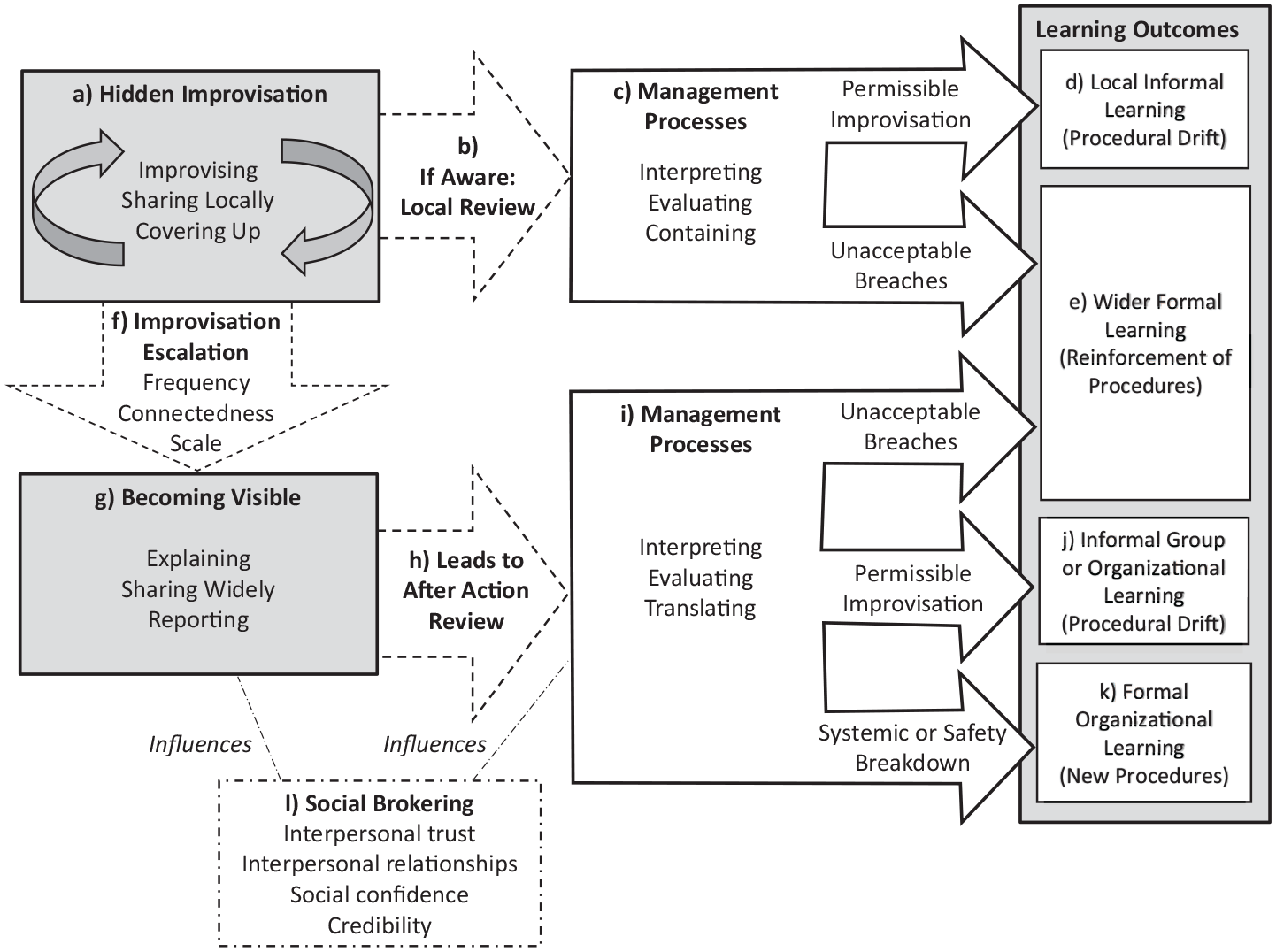
Hidden Improvisation and Learning in HROs.
Hidden improvisation
Our findings reveal that hidden improvisation occurred, in most cases, disconnected from wider organizational processes, due to the autonomous working of the crews (Table 1 and Figure 1a). Under this curtain of privacy (Bernstein, 2012), local actors seek to contain improvisations, covering up outcomes or only sharing these locally, represented by the circular arrows within the box. In many cases, local managers are unaware of improvisations occurring. Even when local management becomes aware (Figure 1b), they interpret and evaluate events with a view to containing them at a local level (Figure 1c). If unacceptable breaches were deemed to have occurred, then the improvisers are censured through a reinforcement of existing procedures (Figure 1e). Where the improvisation is seen to be acceptable, then the improviser is supported (Figure 1d), resulting in local informal learning that can lead to procedural drift (Snook, 2000). Regardless of the outcome of this evaluation, information on local improvisations is contained (see Table 1). Thus, improvisers and supervisors collude to hide improvisation and close off any opportunities for organizational learning. Any learning will be only by those involved in the improvisation at the individual or watch level.
As surfaced in our discussions with the front-line firefighters (e.g. the water rescue), a key concern was that their actions would not be understood if they were interpreted and evaluated by managers who were not present at the event. Indeed, interpreting and evaluating involves reflection-on-action (Yanow & Tsoukas, 2009) by managers, who may not have experienced the immediate problem-at-hand (Miner et al., 2001). Evaluations are thus based on a different set of interpretations arising both because of the de-contextualization of events (i.e. generic ‘lessons learned’ from specific actions), and the time which has elapsed since the improvisation occurred (Berends & Antonacopoulou, 2014). Clearly, the more the local managers can place themselves in the moment and are able to capture the improviser’s reflection-in-action (Yanow & Tsoukas, 2009), the better able they are to interpret and evaluate the improvisation event. Thus, crews and supervisors often do not have the same frame of reference, with the latter also using interpretive frameworks reflective of wider organizational concerns (Schildt et al., 2020). Management is working with abridged accounts (Weick, 1993), and within systemic power structures that influence interpretation (Schildt et al., 2020). This potential for misinterpretation, coupled with a culture of fear and mistrust, explains why so many improvisations remained hidden and beyond scrutiny.
This contained and ‘hidden’ perspective of improvisation offers novel insights into organizations that perform under critical conditions. Previous research has identified improvisation as an innovative open activity that can be harnessed to encourage innovation and learning (Barrett, 1998; Vera & Crossan, 2004). In these studies, the focus is on the creative processes and potential of improvisation (Fisher & Barrett, 2019) to improve performance (Vera & Crossan, 2005) or efficiency (Bernstein, 2012), where improvising feeds into a wider organizational learning (Crossan et al., 1999). Our study presents a different phenomenon, a covert activity, born out of necessity to meet immediate goals, hidden from view, and not directly encouraged within the organization. Here the primary aim is not learning or innovation, but trying to solve a mission-critical and immediate problem-at-hand (Miner et al., 2001; Suarez & Montes, 2019). The context is not one of experimenting to improve products or processes but one where decisions are crucial, and could be the difference between life, severe injury, or death. While the organization is aware that firefighters may need to improvise as events are unpredictable, the firefighters still know that if their superiors become aware of their actions, they could be disciplined and potentially face legal action (Cunha et al., 2012). As a result, this generates a climate of silence throughout the organization (Morrison & Milliken, 2000) and improvisers (and sometimes their supervisors) try to hide breaches from management. These findings support the view that most improvisations do not lead to wider learning (Miner et al., 2001), and our results add to this debate by highlighting the conditions that disconnect learning processes.
The default position in this context is to contain and hide the improviser’s actions. This is different from other innovative organizational contexts; structural and cultural conditions give improvisers the latitude to deviate from prevailing norms and procedures. For example, minimal structures act to dismantle organizational hierarchies, and transfer responsibility to the improvisers themselves (Bigley & Roberts, 2001). Alongside this, experimental cultures (Vera & Crossan, 2004) give improvisers the freedom to depart from procedures without the threat of disciplinary action. Individuals are thus not discouraged from improvising, and, as a result, are less inclined to cover up their actions. In organizational settings where improvisation is encouraged, the process might resemble the bottom part of our model (Figure 1g–k) where improvisations are enacted and explained openly (rather than reluctantly), shared widely and reported, leading to after-action review. Further research is needed here to explore the extent to which the specific context of HROs and safety-critical organizations is responsible for discouraging departures from prevailing rules that leads to this hidden improvisation. Clearly, in our study, there were also events when learning from hidden improvisation occurred, but this was only when the improvisation could no longer be contained.
Connecting the improvisation process
Certainly, other scholars have highlighted the local nature of improvisation. Miner and colleagues (2001), for example, argue that improvisation can inhibit long-term learning since the improvised actions, and their outcomes, are transient and local. Furthermore, Fisher and Barrett (2019) note that improvisation in a context where the organization normatively discourages it, such as a safety-critical organization, can lead to workers hiding it. It is unclear, however if, when and how such local actions can lead to wider organizational learning. We found that there was not only the potential of learning from hidden improvisation, but that certain conditions and processes facilitated it. Despite firefighters’ efforts to contain events at a local level, the context of some improvisations makes them more visible within the wider organization (Figure 1f). Those improvisations that occur frequently, are of large scale, or which are connected to other rule breaches, lead to the local event being escalated (see Table 1), and the improvisation becomes more visible to others outside of the event. As a result, the improviser must formally explain and report the actions surrounding the breach, and it is shared widely (see Figure 1g).
First, the more the improvisation is interconnected with other rules and procedures, then the more likely one improvisation will spark a chain reaction, leading to further improvisations. As a result, the improvising act becomes more noticeable to the external world. In the case of the riots or RRU discussed above, individual improvisations directly resulted in other associated rules also having to be improvised. Second, the scale of the improvisation acts to expand immediately the action beyond the local level. For example, improvisations in relation to the riots had an immediate impact on the entire region. Third, the more frequent these acts of improvisation, then the more likely other crews will encounter similar situations. For example, there were frequent after-action reports referring to the improvised on-route donning up of breathing apparatus as crews were mobilized to incidents. Such was the frequency of these breaches, they became the norm and attracted the attention of senior management. In these scenarios, the escalation of local improvisation leads to a formal after-action review process (Figure 1h) involving middle and senior management, who interpret and evaluate actions surrounding the event. However, instead of seeking to contain events, managers must translate lessons learned to wider parties within the organization (see Figure 1i).
This after-action review can result in three different learning outcomes: (a) when breaches are considered to be unacceptable because they have potential safety implications, wider formal learning is achieved through the reinforcement of norms and procedures (Figure 1e); (b) when breaches are considered to have been an acceptable dynamic risk assessment, information is shared and vicarious wider informal learning can occur with potential for group-level emerging norms (Figure 1j); or (c) when management consider procedures to be a systemic or safety-critical issue, organizational learning can occur through the development of new organizational procedures (Figure 1k). The more middle and senior management are involved in the acts of improvisation, then the more likely wider organizational learning will occur. This involvement may limit the challenges associated with interpretation, evaluation, and translation noted above.
Our findings show that once the hidden improvisation becomes visible, middle management plays a significant role in connecting hidden improvisation to wider learning through a process of brokering between the improvising firefighters and wider audiences, and this is influenced by several factors (see Figure 1l). First, interpersonal trust between the improviser and manager facilitates communication, ensuring that the improviser is open and candid as they explain and report events (Figure 1g), in the belief that brokering managers would not misuse this knowledge (Andrews & Delahaye, 2000; Detert & Edmondson, 2011; Reagans & McEvily, 2003; Renzl, 2008). Improved communication further helps the manager interpret and evaluate events as they occurred (Figure 1i). However, such trust in management can be impaired in hierarchical power structures typical in fire services (Adler & Borys, 1996; Swift & Hwang, 2013), where individuals may fear negative repercussions from sharing knowledge (Renzl, 2008).
Second, this trust is built up through interpersonal relationships (Reagans & McEvily, 2003; Swift & Hwang, 2013). Sharing a similar working background and experience as the senders and/or receivers of information can thus facilitate the interpretation, evaluation and translation of actions for a wider audience (Hoe, 2006). High quality relationships (modelled as shared goals, knowledge and mutual respect) can also foster psychological safety (Edmondson, 2001), enabling organizational members to engage in learning from events (Catino & Patriotta, 2013). Furthermore, when the knowledge is sensitive, complex and tacit, strong ties are crucial to facilitate sharing (Hansen, 1999). Here we noted instances when firefighters mentioned a level of trust in some middle managers who they believed would support them and act in their best interests (see Table 1). For example, the PCS officers involved in several incidents, including one of the breathing apparatus events and the RRU event, actively encouraged wider sharing of information (Figure 1g), reassuring the firefighters involved that they would be treated fairly, highlighting the potential for wider learning. By spanning boundaries, knowledge brokers thus act as interlocutors of knowledge between levels of the hierarchy, seeing the world from different perspectives (Reagans & McEvily, 2003). This allows them to recognize the need for sharing and to frame such sharing in a language that recipients in the network or other levels can appropriately interpret and evaluate (Tortoriello, Reagans, & McEvily, 2012).
Third, the social confidence of the broker and the perceived credibility of potential knowledge sources are important factors when brokering knowledge. While social confidence is linked to the perceived approachability of information sources, the credibility of the knowledge source is linked to the credibility of the individual (Andrews & Delahaye, 2000). In this study, brokers of knowledge shared similar backgrounds as frontline crews, rising through the ranks of the fire service. As a result, they spoke the same language as the frontline crews but, crucially, also had the confidence and trust of senior managers. This foot in both camps helped them reach sources of local knowledge by encouraging improvisers to report and explain their actions, and importantly translate this in a favourable manner to those higher up the organization’s hierarchy who would interpret and evaluate it.
Like more creative and innovative organizational contexts of improvisation, post hoc interpretations and evaluations become less problematic through good interpersonal relationships supported by communication and trust (Barrett, 1998; Crossan & Sorrenti, 2003). These were infrequent events, and a general fear of censure and lack of trust pervaded the studied organization. Furthermore, open improvisation, as proposed by Barrett (1998) and Vera and Crossan (2004), suggests a normative approach by management that encourages improvisation. In our case organization, management not only discouraged improvisation, but also attempted to keep a lid on breaches, only pursuing a formal after-action review process when their hands were forced, through an escalation of events (see Figure 1). While voicing concerns is seen to improve a firefighter’s ability to respond to unexpected circumstances (Barton & Sutcliffe, 2009), speaking up is challenging when individuals have a fear of the consequences (Cunha et al., 2012), or when they lack the confidence that their improvisation will be judged fairly (Barton et al., 2015; Fisher & Barrett, 2019; Weick & Sutcliffe, 2007).
Perhaps unique in a safety-critical context, hidden improvisation is a serious endeavour done out of necessity to cope with ambiguity and to meet an immediate need (sometimes to save life), but it is largely disconnected from the organization. The watch closes rank to protect their ‘family’ from unwanted scrutiny, thus limiting potential for wider learning. However, learning from hidden improvisation can occur when it becomes visible and management relationships allow them to act to interpret, evaluate, and translate the improviser’s activity for consumption in the whole organization.
Limitations and Further Research
While the findings of this study may be generalizable to other organizations, they may equally reflect the unique context of the case organization, in which improvisations occurred against a backdrop of fear of censure and lack of trust. While these contextual issues put boundaries on the research, the fast-paced decision-making environment that firefighters face occurs in many types of organization, such as hospitals, police forces, armed services, transport services and other types of safety-critical organization, such as HROs. Indeed, even in more mundane customer service organizations employees must respond to the unexpected and deal with situations for which they need to improvise, or for which they reach the limits of existing procedures as they deal with unforeseen circumstances. In these types of organization, it is likely that improvisation will be discouraged since outcomes of improvisation are uncertain when stability and predictability are at a premium. Thus, while this may be a solitary case study, the principles highlighted in our findings are worthy of examination in other settings to test the limits of generalization.
This study used retrospective narratives and documents from the organization, and not direct observations of the improvisation activity itself. Observing improvisation in this type of context has significant challenges. Assuming improvising acts could be observed, this would be in a dangerous environment and the research team would need extensive technical expertise to understand when firefighters were improvising. Other studies, particularly auto-ethnographic studies, may provide opportunities to do this and to provide first-hand longitudinal accounts into learning from hidden improvisation in other contexts.
Conclusion
In our study, we show how hidden improvisation occurs because of the autonomous and unpredictable context in which the firefighters operate. Their hidden improvisation is born out of necessity, done reluctantly, to solve an immediate problem. Firefighters seek to contain it. Only when improvisation escalates and becomes visible can management interpret, evaluate and translate that improvisation into lessons that can be embedded in wider learning in the organization. Unlike open improvisation, management does not actively encourage improvisation activity, but they can be alert to potential lessons, and middle management knowledge brokers, with their foot in both camps, are key to discovering and untapping this potential. Thus, there are practical implications for HROs and other safety-critical organizations.
Tools such as the dynamic risk assessment allow organizations, such as fire services, to improvise and adapt to fast-changing environments. However, when the outcomes of those actions are discouraged, the organization fails to learn from its experiences, and as a result, rules and procedures which are not fit for purpose persist. These failings may have dramatic consequences for the organization. While a combination of circumstance and individual middle-management brokering untapped some key lessons learned in this study, a culture of blame overwhelmingly acted to sweep localized improvisations under the carpet. Prior research has viewed improvisation as an open activity, and to reap the benefits of these actions, organizations need to develop a culture of trust and open communication. However, creating such a supportive culture against the background of public scrutiny and accountability is a significant challenge for organizations and policy makers.
After-action reviews are only as good as the information that is available. Learning from improvisation requires that everyone shares information and that those in positions of power interpret it sensitively. However, if threats of disciplinary or legal action are always present, this will inevitably create an inclination to cover up improvising actions. To gain access to key information about improvisations that occur out of sight requires significant trust, strong relationships and open dialogue between management and those improvising. Putting effort into building those types of relationship is key. Building those relationships requires that managers must be open to interpreting the actions favourably, unless the actions are so reckless that safety was obviously compromised. Building a no-blame culture will be a challenge, but the rewards will be an organization that can really learn from the actions of those dealing in real time with challenging and ambiguous circumstances.
Footnotes
Appendix
Event Comparison Table.
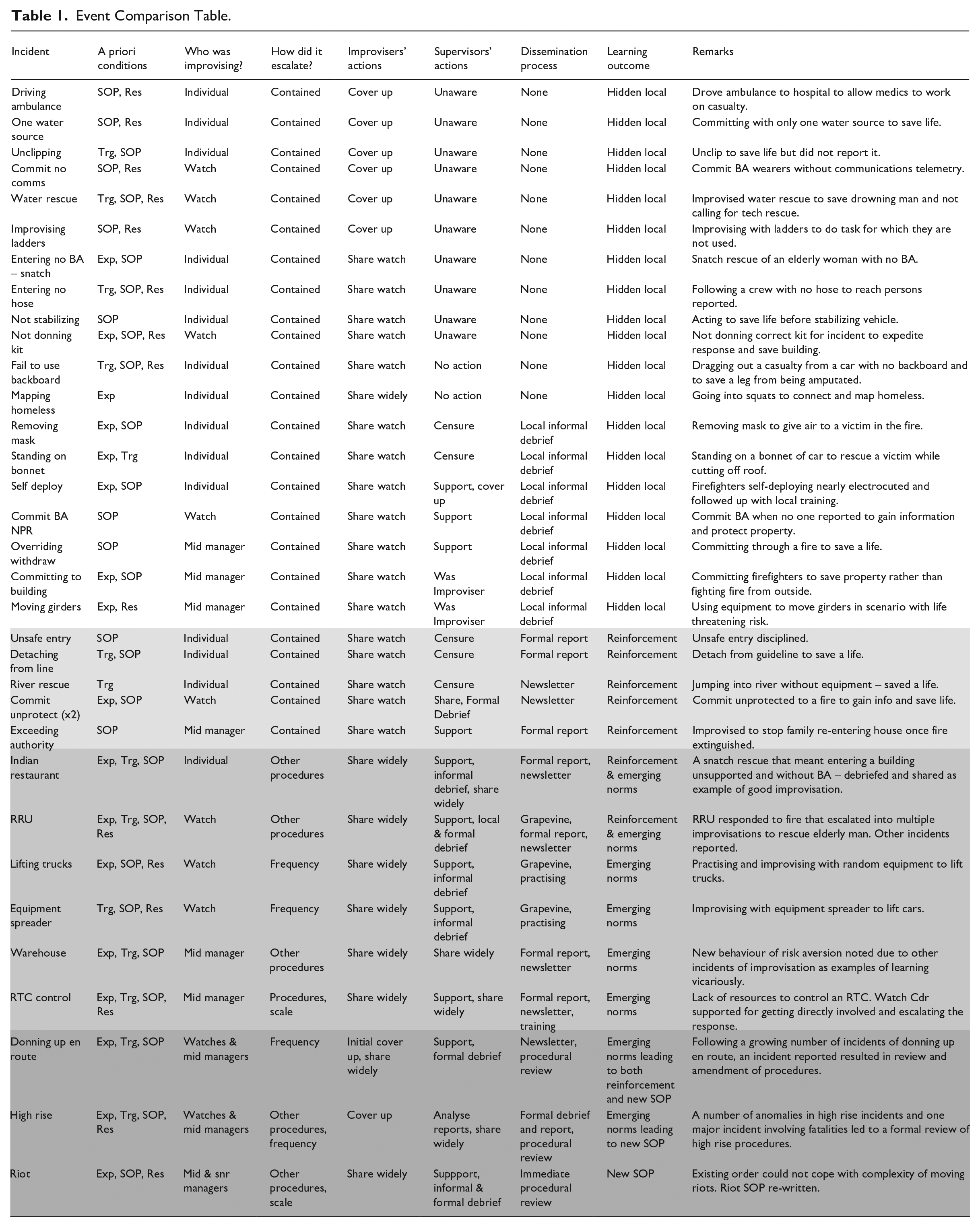
| Incident | A priori conditions | Who was improvising? | How did it escalate? | Improvisers’ actions | Supervisors’ actions | Dissemination process | Learning outcome | Remarks |
|---|---|---|---|---|---|---|---|---|
| Driving ambulance | SOP, Res | Individual | Contained | Cover up | Unaware | None | Hidden local | Drove ambulance to hospital to allow medics to work on casualty. |
| One water source | SOP, Res | Individual | Contained | Cover up | Unaware | None | Hidden local | Committing with only one water source to save life. |
| Unclipping | Trg, SOP | Individual | Contained | Cover up | Unaware | None | Hidden local | Unclip to save life but did not report it. |
| Commit no comms | SOP, Res | Watch | Contained | Cover up | Unaware | None | Hidden local | Commit BA wearers without communications telemetry. |
| Water rescue | Trg, SOP, Res | Watch | Contained | Cover up | Unaware | None | Hidden local | Improvised water rescue to save drowning man and not calling for tech rescue. |
| Improvising ladders | SOP, Res | Watch | Contained | Cover up | Unaware | None | Hidden local | Improvising with ladders to do task for which they are not used. |
| Entering no BA – snatch | Exp, SOP | Individual | Contained | Share watch | Unaware | None | Hidden local | Snatch rescue of an elderly woman with no BA. |
| Entering no hose | Trg, SOP, Res | Individual | Contained | Share watch | Unaware | None | Hidden local | Following a crew with no hose to reach persons reported. |
| Not stabilizing | SOP | Individual | Contained | Share watch | Unaware | None | Hidden local | Acting to save life before stabilizing vehicle. |
| Not donning kit | Exp, SOP, Res | Watch | Contained | Share watch | Unaware | None | Hidden local | Not donning correct kit for incident to expedite response and save building. |
| Fail to use backboard | Trg, SOP, Res | Individual | Contained | Share watch | No action | None | Hidden local | Dragging out a casualty from a car with no backboard and to save a leg from being amputated. |
| Mapping homeless | Exp | Individual | Contained | Share widely | No action | None | Hidden local | Going into squats to connect and map homeless. |
| Removing mask | Exp, SOP | Individual | Contained | Share watch | Censure | Local informal debrief | Hidden local | Removing mask to give air to a victim in the fire. |
| Standing on bonnet | Exp, Trg | Individual | Contained | Share watch | Censure | Local informal debrief | Hidden local | Standing on a bonnet of car to rescue a victim while cutting off roof. |
| Self deploy | Exp, SOP | Individual | Contained | Share watch | Support, cover up | Local informal debrief | Hidden local | Firefighters self-deploying nearly electrocuted and followed up with local training. |
| Commit BA NPR | SOP | Watch | Contained | Share watch | Support | Local informal debrief | Hidden local | Commit BA when no one reported to gain information and protect property. |
| Overriding withdraw | SOP | Mid manager | Contained | Share watch | Support | Local informal debrief | Hidden local | Committing through a fire to save a life. |
| Committing to building | Exp, SOP | Mid manager | Contained | Share watch | Was Improviser | Local informal debrief | Hidden local | Committing firefighters to save property rather than fighting fire from outside. |
| Moving girders | Exp, Res | Mid manager | Contained | Share watch | Was Improviser | Local informal debrief | Hidden local | Using equipment to move girders in scenario with life threatening risk. |
| Unsafe entry | SOP | Individual | Contained | Share watch | Censure | Formal report | Reinforcement | Unsafe entry disciplined. |
| Detaching from line | Trg, SOP | Individual | Contained | Share watch | Censure | Formal report | Reinforcement | Detach from guideline to save a life. |
| River rescue | Trg | Individual | Contained | Share watch | Censure | Newsletter | Reinforcement | Jumping into river without equipment – saved a life. |
| Commit unprotect (x2) | Exp, SOP | Watch | Contained | Share watch | Share, Formal Debrief | Newsletter | Reinforcement | Commit unprotected to a fire to gain info and save life. |
| Exceeding authority | SOP | Mid manager | Contained | Share watch | Support | Formal report | Reinforcement | Improvised to stop family re-entering house once fire extinguished. |
| Indian restaurant | Exp, Trg, SOP | Individual | Other procedures | Share widely | Support, informal debrief, share widely | Formal report, newsletter | Reinforcement & emerging norms | A snatch rescue that meant entering a building unsupported and without BA – debriefed and shared as example of good improvisation. |
| RRU | Exp, Trg, SOP, Res | Watch | Other procedures | Share widely | Support, local & formal debrief | Grapevine, formal report, newsletter | Reinforcement & emerging norms | RRU responded to fire that escalated into multiple improvisations to rescue elderly man. Other incidents reported. |
| Lifting trucks | Exp, SOP, Res | Watch | Frequency | Share widely | Support, informal debrief | Grapevine, practising | Emerging norms | Practising and improvising with random equipment to lift trucks. |
| Equipment spreader | Trg, SOP, Res | Watch | Frequency | Share widely | Support, informal debrief | Grapevine, practising | Emerging norms | Improvising with equipment spreader to lift cars. |
| Warehouse | Exp, Trg, SOP | Mid manager | Other procedures | Share widely | Share widely | Formal report, newsletter | Emerging norms | New behaviour of risk aversion noted due to other incidents of improvisation as examples of learning vicariously. |
| RTC control | Exp, Trg, SOP, Res | Mid manager | Procedures, scale | Share widely | Support, share widely | Formal report, newsletter, training | Emerging norms | Lack of resources to control an RTC. Watch Cdr supported for getting directly involved and escalating the response. |
| Donning up en route | Exp, Trg, SOP | Watches & mid managers | Frequency | Initial cover up, share widely | Support, formal debrief | Newsletter, procedural review | Emerging norms leading to both reinforcement and new SOP | Following a growing number of incidents of donning up en route, an incident reported resulted in review and amendment of procedures. |
| High rise | Exp, Trg, SOP, Res | Watches & mid managers | Other procedures, frequency | Cover up | Analyse reports, share widely | Formal debrief and report, procedural review | Emerging norms leading to new SOP | A number of anomalies in high rise incidents and one major incident involving fatalities led to a formal review of high rise procedures. |
| Riot | Exp, SOP, Res | Mid & snr managers | Other procedures, scale | Share widely | Suppport, informal & formal debrief | Immediate procedural review | New SOP | Existing order could not cope with complexity of moving riots. Riot SOP re-written. |
Acknowledgements
We would like to acknowledge the hard work of the editors Frank Wijen and Renate Meyer, and the anonymous reviewers who provided excellent support and feedback in the revision of this paper. We would also like to thank Mike Zundel and Penny Dick for helpful comments on drafts of this paper. Finally, we would like to acknowledge Noel Johnson and Dominic Elliot who were key members of the original project.
Funding
The author(s) received no financial support for the research, authorship, and/or publication of this article.
