



Abstract
Visual organizational research has burgeoned over the past decade. Despite an initially hesitant engagement with visuality in organization and management studies, it is now only proper to speak of a ‘visual turn’ in this domain of scholarly inquiry. We wish to take the opportunity provided by the Perspectives format to engage with prominent work published in Organization Studies, in appreciation of the diversity of approaches to the visual in organizational research, and highlight some generative tensions across this body of work. In particular, we have scrutinized six articles based on their treatment of signification (how the visual mode enables meaning-making and meaning-sharing in and around organizations), manifestation (how visual organizational artefacts and their properties relate to affordances) and implication (how visualization practices produce organizational outcomes). Inspired by the frictions and gaps across these articles, we developed three distinct perspective shifts that highlight the importance of the invisible, the immaterial and the performance within visualization. We conclude with a comparative matrix that maps different conceptualizations of visualization, and suggest opportunities for future research based on how we see the field of visual organizational studies evolving.
‘Nothing is more real than nothing.’
Prologue
We begin this Perspectives article on the visual by inviting readers to follow us on a brief journey into the fictional world created by Academy Award winning director Paolo Sorrentino in his highly acclaimed series entitled The Young Pope (2016). The scene involves a meeting at a Vatican residence between the newly appointed, young and handsome American Pope (magnificently enacted by Jude Law) and the Vatican’s Harvard-trained marketing director, and their ensuing conversation about media and sales strategy. The Pope, wearing the conventional white dress, stands next to a transparent white globe, emphatically holding a plain white dinner plate. White dominates the scene, and as will soon become clear, it materializes a series of conflicting resonances: Whiteness pertains to beauty; it equally connotes the synthesis of every colour derived from light, and the absence of colour from pigment. Thus white paradoxically interweaves the experientially perceivable and material with notions of emptiness, voids, the immaterial and the invisible. Pointing at the white centre of the plate, the Pope proclaims that plainness exemplifies the only type of merchandise he would be willing to authorize. When the marketing director notes that the plate does not have the Pope’s image on it, a lack that would constitute ‘media suicide’, the Pope boldly replies: I do not have an image [. . .] because I am no one. [. . .] I’m not worth forty-five, or even five euros. I am worth nothing. [. . .] You are gonna fire the Vatican’s official photographer immediately. No photographs of the Pope are to be issued. [. . .] And so, for my first address, you will see to it that the light is so dim, no photographer, no TV cameraman, and not even the faithful will see anything of me but a dark shadow, my silhouette. They will not see me because I do not exist.
To qualify the rationale behind his desire to be invisible, the Pope engages the marketing director in a series of riddles that firmly anchor his stance on issues of management beyond the mysteries of faith – issues such as sensemaking, legitimacy and the creation of value(s):
Who is the most important author of the last twenty years? [. . .] The author who has sparked so much morbid curiosity that he became the most important?
I wouldn’t know. I’d say. . . Philip Roth.
No. Salinger. The most important film director?
Spielberg.
No. Kubrick. Contemporary artist?
Jeff Koons. Or Marina Abramović.
Banksy. Electronic music group?
I don’t know the first thing about electronic music.
[. . .] Daft Punk. [. . .] Now do you know what it is, what the invisible red thread is that connects them all [. . .] in their respective fields? None of them let themselves be seen. None of them let themselves be photographed.
But you’re not an artist, Holy Father. You are a head of state.
Yes, of a city state so small that it has no outlet to the sea, and in order to survive, its leader has to make himself as unreachable as a rock star. The Vatican survives thanks to hyperbole. So, we, we shall generate hyperbole, but this time in reverse.
We leave it to readers to decode these quotes, but we seek to build on Sorrentino’s artistic seductions to hint at the very provocations that we develop in this article. In this fictional scenario, the Pope, who leads one of the world’s largest and oldest organizations, elaborates upon his stance towards visual aspects of management. He alludes to the generative interactions between the visible and the ‘in-visible’ – that which is not visible, but also that which is concealed with-in visualizations. These interactions are illustrated by the duality of the colour white as both a symbol of fullness and absence and by the Pope’s intention to remain invisible within the highly visual scenery of his first address. He also reveals how visualization can establish immaterial negative spaces by proposing plain white merchandise to afford unforeseen opportunities for the emergence of imaginaries, visions and fictions. Furthermore, his visualization strategy is meant not merely to produce predictable performative effects, but also to invoke playful engagement with ambiguous, polysemic and polycentric meanings. It is our intention in this introduction to the Virtual Special Issue to render these ideas conducive to visual organizational research 1 .
Introduction
During recent years, a wealth of contributions have highlighted the prominent role of the visual in organizations, processes of organizing, and organizational environments. They reflect the increasing ubiquity of the visual in many aspects of social life, which profoundly affects the ways in which we interpret, engage with, consume and make sense of information. In this way, visual organizational research is necessary for developing an understanding of contemporary organizational realities. There is little doubt that the linguistic and discursive turn in organization studies has forked into a visual turn (e.g. Bell & Davison, 2013; Boxenbaum, Jones, Meyer, & Svejenova, 2018; Höllerer et al., 2019). This development is further propelled by a lively exchange of ideas with such neighbouring disciplines as corporate communication (e.g. Kostelnick & Hassett, 2003), accounting (e.g. Quattrone, 2009), strategy (e.g. Knight, Paroutis, & Heracleous, 2018), and social semiotics (e.g. Kress & van Leeuwen, 2021).
In addition to the empirical relevance of the visual for organizations, pioneering work in Organization Studies and beyond has also shown how a focus on the visual generates new conceptual insights into a plethora of organizational issues. The spectrum ranges from the performative role of the visual in ensuring coordination (e.g. Kaplan, 2011) and generating new organizational fields, practices and markets, on the one hand (e.g. Pollock & D’Adderio, 2012; Puyou & Quattrone, 2018), to the way visual artefacts and visualization help in dealing with ambiguity, sensemaking and sensegiving, on the other (Doganova & Eyquem-Renault, 2009; Höllerer, Jancsary, & Grafström, 2018b). Research has also problematized the value-laden ways in which the visual represents and constitutes social reality (e.g. Espeland & Stevens, 2008; Graves, Flesher, & Jordan, 1996), drawing attention to its framing power and capacity to consolidate and reproduce social categories (e.g. Christiansen, 2018; Elliott & Stead, 2018).
This necessarily incomplete sketch of the literature raises the question of what yet another special issue (albeit a virtual one) may contribute to the advancement of this prolific area of academic study. Yet, for two reasons, we are convinced that it does. First, the ‘visual turn’ in organizational research is not an integrated paradigm, but an inclusive and diverse research programme propelled forward by a community of researchers from a variety of theoretical and methodological approaches (Meyer, Höllerer, Jancsary, & van Leeuwen, 2013). There remains ample opportunity to highlight and consolidate ideas that have yet to be broadly discussed. Second, the state of the literature is arguably characterized by an ocular bias in the study of the visual. This bias privileges the investigation of what is made materially visible within visualizations and largely leaves unattended what is concealed by and within visualization: visually created negative spaces. We argue that such negative spaces allow visual artefacts to break free from predictable performative effects.
Overall, our objective in this special issue is twofold: (a) to identify and instigate generative conversations among different approaches and to learn from their existing tensions and frictions; and (b) to sketch promising and innovative ways forward. In other words, we wish to assess and discuss the generative effects of this diversity and identify potentials for vital but hitherto neglected areas of organizational inquiry.
For the purposes of this article, we understand and define the visual broadly, as the visual dimension of organizing and organizational reality. Previous reviews of visual approaches in organizational research have highlighted the multi-dimensional character of the visual (e.g. Boxenbaum et al., 2018; Puyou, Quattrone, Mclean, & Thrift, 2012). Meyer et al. (2013), for example, identify five approaches (archaeological, practice, strategic, dialogical and documenting), each of which defines the role of the visual in organizational contexts in a slightly different manner. Bell, Warren and Schroeder (2014) mention epistemological aspects of the visual, but also cast images as circulating artefacts. They further relate the visual to social action in cultural contexts.
We build upon and condense these ideas into three primary vantage points or perspectives: signification, manifestation and implication. Each emphasizes a different aspect of the visual; bound together they show the concept in a different way and render it accessible to researchers. From the perspective of signification, the visual constitutes a mode of communication (e.g. Kress, 2010; Kress & van Leeuwen, 2021) that enables meaning-making in and around organizations. It can be distinguished from other modes based on its constitutive features (e.g. Meyer, Jancsary, Höllerer, & Boxenbaum, 2018). The verbal mode is linear and sequential, for instance, whereas the visual mode creates meanings holistically through spatial compositions (e.g. Barberá-Tomás, Castelló, de Bakker, & Zietsma, 2019). From the perspective of manifestation, the visual is instantiated in visual artefacts with distinct properties and affordances (Gibson, 1986) that enable organizational members to utilize them for specific purposes. Furthermore, from the perspective of implication, the visual is mobilized in practices of visualization – that is, putting ‘things’ (e.g. ideas, events, objects, people) into visual form (e.g. Latour, 1986) – generative of organizational outcomes. Visualizing ideas, for instance, is well suited to conscripting people into organizational agendas (e.g. Vásquez & Cooren, 2012).
In what follows, we use the three dimensions of signification, manifestation and implication as structuring devices to review six articles published in Organization Studies in the past few years: Barry and Meisiek (2010), Kornberger (2017), Arjaliès and Bansal (2018), Comi and Whyte (2018), Knight and Tsoukas (2019) and Lefsrud, Graves and Phillips (2020). We proceed by discussing these articles in pairs with the overall objective of revealing generative tensions between and across them. We do not wish to imply that each pair of papers covers only one of these three perspectives, as most of them engage with all three. But we do want to highlight one specific tension that each pair of papers illustrates best. Based on this discussion, we then highlight three distinct perspective shifts as a springboard for outlining innovative and promising avenues forward. In greater detail, these shifts draw attention to the invisible, the immaterial and the performance aspects of visualization as focal points that offer considerable potential for expanding our understanding of how visual artefacts signify, manifest and have implications for organizations. Importantly, we see these perspective shifts not as replacements for existing scholarship, but as avenues that can complement and generatively provoke research on the visible, the material and the performative.
Three Perspectives on the Visual in Organizational Research
Signification: The visible and the invisible
A substantial amount of work in organizational research focuses on how the visual mode of communication enables and constrains the ongoing interpretation and enactment of issues (e.g. Bell et al., 2014; Boxenbaum et al., 2018; Höllerer, Daudigeos, & Jancsary, 2018a). Social semiotics (e.g. Kress & van Leeuwen, 2021) suggests that different rules are involved in the construction of visual and verbal meaning. Accordingly, researchers from this and other theoretical perspectives explore the workings of the visual mode and how it influences organizations and organizing, individually or in combination with other modes (multimodality; e.g. Höllerer et al., 2019). This line of research includes the mediation of diverse interests by such visual artefacts as images and photographs (e.g. Elliott & Stead, 2018), scientific representations (Knorr-Cetina, 2001), business models and forecasting tools (Doganova & Eyquem-Renault, 2009), PowerPoints (Kaplan, 2011) and accounting systems (Briers & Chua, 2001) – thus supporting collective action and the creation and maintenance of organizational order.
A focus on ‘visual grammar’ means that most studies focus on visibilities – on what is directly accessible to the human eye. Accordingly, although most researchers agree that the visual provides potentials for signification rather than inherent meaning, existing research does stress its seemingly iconic and fact-like representation of social reality (e.g. Espeland & Stevens, 2008; Graves et al., 1996; Meyer et al., 2018). Our discussion of two selected articles (Comi & Whyte, 2018; Barry & Meisiek, 2010) shows, in contrast, that the visual is also noteworthy for the opposite reason: it may enable signification through invisibilities – what is not directly represented visually, and therefore not immediately accessible to analysis, but which emerges indirectly from engagement with visibilities. Treatments of the visual in these two articles occupy opposite ends of an ideal spectrum that spans the space from iterative convergence of visibilities progressively reducing ambiguity and uncertainty (Comi & Whyte, 2018) to never-ending exploration via invisible analogies that do not immediately serve any organizational purpose (Barry & Meisiek, 2010).
Both papers share an interest in sensemaking, sense-giving and future-making as prominent topics in organization research (e.g. Beckert, 2021; Gatzweiler & Ronzani, 2019; Weick, Sutcliffe, & Obstfeld, 2005). Although most work on visual sensemaking (e.g. Belova, 2006; Höllerer et al., 2018a) focuses on the visible, the two papers, in tandem, highlight a critical interplay between the visible and the invisible. Comi and Whyte (2018) explore how successive visualization practices (i.e. imagining, testing, stabilizing and reifying) allow organizational actors to move from sensemaking to action and future-making. They capture the way visual artefacts ‘sustain the transition to a realizable course of action’ as they ‘invite dwelling into their lines, materials and shapes’ (p. 25). In contrast, Barry and Meisiek (2010) explore the role of the visual beyond the immediately visible and representational. Their article illustrates the notion that analogous artefacts create meaning precisely through what they do not represent. The invisibilities evoked through analogies enable both ‘seeing more’ and ‘seeing differently’ – not within the artefact, but beyond and thanks to the artefact. They become more salient as practices move from collecting to experimentation, during which ‘employees think artistically themselves’ (p. 1519) and switch from art as a resource to art as a method for organizing. Thus, the two papers challenge traditional understandings of visual signification by providing relevant ideas on how the multiplicity of meanings that characterize organizations may contain organizing properties without the need for instantiation of shared knowledge, shared visions, or strategic ambiguity.
Accordingly, both what is seen and what is concealed by and within visualizations can become a locus of meaning emergence. In fact, both papers identify crucial interactions between the visible and the invisible. Comi and Whyte (2018) emphasize a process of progressive focusing in their discussion of the way emerging visual artefacts make visible and reify the future, thereby suppressing possible options. For them, a converging process towards an objectified visualization of what needs to be done is a precondition for action. The unfolding character of visual artefacts in their study also stresses the role of incompleteness in future-making. Visualizations are ‘stand-ins which compensate for a more basic lack of [the] object’ that they seek to represent (Knorr-Cetina, 2001, p. 176). Incompleteness, then, is key in prompting processes of questioning and answering: ‘Only incomplete objects pose further questions, and only in considering objects as incomplete do [organizational actors] move forward with their work’ (Knorr-Cetina, 2001, p. 176). Barry and Meisiek (2010) show that meaning construction may require the eschewing of a focus on the primary object of observation through analogies. Here, meaning emerges not primarily from the visible artefact itself, but from the tension between the artefact and the gaps and lacunas that every analogy inevitably entails (e.g. Black, 1962). For analogies and metaphors to work, they must rely upon a lack of correspondence – on a gap that becomes a creative and invisible space for sensemaking.
These tensions between visibility and invisibility as a source of meaning-making have significant implications for organizing. Comi and Whyte (2018, p. 25) observe how ‘visual artefacts are used to validate proposals, resist counterproposals and reach closure’. In contrast, Barry and Meisiek (2010) demonstrate how sensemaking relies upon a mobilization of the invisible through analogical tensions, in which meaning is emergent rather than objectified. The main takeaway here is that organizations can use visual signification both to reify and ‘close’ meaning through visibility and to ‘open’ novel meaning spaces through invisibilities. This tension presents novel and exciting opportunities for research to engage with the ‘ongoing, dynamic, interactive, process of manipulating symbols towards the creation, maintenance, destruction, and/or transformation of meanings’ (Ashcraft, Kuhn, & Cooren, 2009, p. 22).
Manifestation: The material and the immaterial
Extant research also highlights the relevance of the material properties of visual (or multimodal) artefacts – how specific manifestations of the visual pervade and influence organizations and organizing. Each visual artefact provides specific sets of affordances that imply different forms of usage and purpose (e.g. Kress, 2010). Such affordances can be understood as opportunities for interventions, interactions and interpretation offered by material configurations (e.g. Gibson, 1986). A critical area of application is how visual artefacts promote specific versions of ‘truth’ and help secure organizational legitimacy (e.g. Graves et al., 1996; Höllerer, Jancsary, Meyer, & Vettori, 2013). Previous, predominantly verbal research has shown the organizational relevance of competing versions of ‘truth’ and ‘fact’ that clash as actors externalize various framings (e.g. Creed, Langstraat, & Scully, 2002; Gray, Purdy, & Ansari, 2015) and legitimation strategies (Lefsrud & Meyer, 2012; Vaara & Tienari, 2008). Visual artefacts play a crucial role in these processes (e.g. Christiansen, 2018).
As a conceptual construct, affordances offer a ‘“third way” between the (constructivist) emphasis on the shaping power of human agency and the (realist) emphasis on the constraining power of technical capacities’ (Hutchby, 2001, p. 444) – the materiality of artefacts. As materiality both invites and constrains, affordances influence engagement depending on how visual content is deployed through features such as layouts, forms and patterns (Kress, 2010). Previous research has highlighted how affordances endow visual artefacts with the capacity to convey complex relations, appeal to emotions, and facilitate the placement of ideas that cannot be explicitly verbalized (e.g. Hill, 2004; McQuarrie & Phillips, 2005). The contrasting of two selected articles, however, shows that the use and purpose of visual artefacts is not purely tied to such material properties but also to their immateriality in the form of gaps and lacks, which may establish immaterial arenas for imaginaries, visions and fictions that are possible because of this immateriality.
These two articles draw from the pragmatics of language, unpack the factors that increase the legitimating power of visual communication, explore how the visual reflects and perpetuates normative standards, and reveal the potential of visual artefacts to create different realities and achieve political mobilization and disinformation. They further show how interactions between the visual and the verbal (and potentially other modes) may be crucial (e.g. Barberá-Tomás et al., 2019). Both also highlight the idea that visual artefacts are never neutral or factual; they do not represent but generate specific versions of social reality, particularly by virtue of how they appeal to emotions. Lefsrud et al. (2020) have developed a conceptual model of visual and verbal combinations in artefacts and how they evoke emotion, capture attention and motivate audiences to (re-)evaluate the legitimacy of organizations. Knight and Tsoukas (2019) emphasize how ‘truth’ depends on the respective ‘language game’, and how combinations of verbal, visual and other semiotic resources (as well as the technologies to modify and alter them strategically) allow actors to switch language games in a mediatized society.
The two selected articles differ in how they couple the effects of visual artefacts with their material properties. Lefsrud et al. (2020) suggest that the ways in which visual and verbal elements interact in material artefacts transmit discrete and broadly shared social meanings that influence evaluations. They crystallize relationships between the visual and verbal to the point of being almost invariant, assuming degrees of social regulation and the features of specific discourse communities. Their elaborate multi-stage model of (de-)legitimation assigns distinct affordances to visual and multimodal artefacts: They capture audience attention more forcefully than verbal text, shape audience inferences, and lead to re-evaluations of previous conceptions. In contrast, Knight and Tsoukas (2019) provide background on the importance of materiality and emphasize how the interplay of visual and multimodal signifiers offers unpredictable effects that can never be entirely foreseen, resulting in the potential for ‘alternative’ truths and facts. In this way, they stress that materiality does not determine interpretations, and visual artefacts can be appropriated for various agendas independent of their material properties and affordances. Rather than predicting the effects of concrete visual artefacts, they outline how multimodality provides opportunities for emphasizing or de-emphasizing contradictions and oppositions in the formation of discourses.
This tension has consequences for organizational practice. On the one hand, there is evidence that the design of organizational spaces and artefacts has distinct cognitive and behavioural effects (e.g. Eppler & Platts, 2009). On the other hand, we also witness the rise of a ‘post-truth’ culture (e.g. Foroughi, Gabriel, & Fotaki, 2019) in which the visual (and material) presentation of facts seems insufficient to convince large communities. Knight and Tsoukas (2019) allude to a decoupling of meaning production from the material world in contrasting the ‘means of symbolic production’ with the ‘means of material production’, and mention that ‘bullshitting’ (e.g. Spicer, 2020) – messages unconcerned with the truth – is ubiquitous in contemporary organizations. Accordingly, we believe that organizational research on visual artefacts needs to consider them both as material manifestations that can close meaning spaces and as arenas in which contradictions are constantly created and negotiated.
Implication: Performativity and performances
The implication perspective focuses on how the visual is mobilized in visualization practices that are meant to achieve desired outcomes. Such generative dynamics are often discussed as performativity (e.g. Steyaert, Marti, & Michels, 2012). As visual artefacts become enmeshed in webs of practices (e.g. Nicolini, Mengis, & Swan, 2012), they participate in the constitution of distinct and legitimate organizational realities. One topic in organizational research that has been investigated extensively relates to the multifaceted roles that visualization plays in defining what is seen as valuable and therefore worthy of attention. In an increasingly digitized and interconnected society in which myths of modernity abound, the struggle for attention has become an axial feature of the strategic agency of organizations. As Simmel (2008 [1903], p. 962) noted: ‘Modern competition, which has been called the struggle of all against all, is after all the struggle of all to gain the attention of all.’
Within this context, a performativity lens reveals how the visual and the calculative are entwined and implicated in defining what counts. In so doing, the visual and the calculative shape and inform individual, organizational and social behaviour via calculative technologies with such salient visual features as ratings, rankings, indices and indicators (e.g. Bandola-Gill, Grek, & Ronzani, 2021; Busco & Quattrone, 2015; Pollock & D’Adderio, 2012). These visualizations are central ‘not because they inform us on how things are but because they provide an orientation about what others observe’ (Esposito & Stark, 2019, p. 3) and, consequently, what they deem to be of value and importance. Visualization makes quantifications immediately accessible to the observer’s eye and therefore performative (Pollock & Williams, 2016). Less well researched, however, are the ways in which practices of visualization may establish sites and arenas for (often creatively and playfully negotiating) organizational meanings, evaluations and strategies, or be performances in and of themselves. Two selected articles engage with, and exemplify, this third tension.
Kornberger (2017) draws attention to the way practices of valuation can organize markets and highlights how valuation as an activity is always accompanied by visualization, which not only makes calculations possible, but can make numbers travel more lightly, and in so doing, attract attention and mobilize actors (Latour, 1986). Emphasis is placed on such visual artefacts as lists, matrices, diagrams and tables as the dominant material forms in which valuations and quantifications manifest and travel in the social realm. Arjaliès and Bansal (2018), on the other hand, qualify with empirical depth some of the valuation processes discussed here, by considering the interaction and potential clashes between visual artefacts and numbers in the evaluation of financial performance. Drawing from the accounting literature on the visual aspects of calculative technologies (e.g. Chua, 1995), the authors show how visualization can provide other frameworks for measuring worth.
Both articles place considerable emphasis on the performativity of visualization; it influences evaluation by attracting attention, structuring curiosity and creating emotional involvement (e.g. Boedker & Chua, 2013). For Arjaliès and Bansal (2018), part of the generative effects of visualization is due to the frictions between financial values, expressed in numerical formats, and other forms of judgement, such as environmental, societal and governance criteria (ESG), expressed in such visual format as emojis. Numbers and visualizations are, therefore, put in-tension: counting what can be made visible to explore what cannot be reduced to either numbers or figures (Quattrone, 2015). Kornberger (2017), on the other hand, stresses how the rivalry between organizational actors happens at the level of the valuation practice and how strategic agency is qualified by the ability of actors to cope with the constraints defined by practices of valuation, centrally including visualization practices and their ability to influence their definition.
Both articles therefore add a qualification to performativity: visualizations become material sites of dissonance (Stark, 2009), which work not because they inevitably define worthiness criteria due to their performative power. This power is always partial, as definitions are incomplete and rely upon emotions, subjectivities and forms of meaning-making that escape a univocal definition of what counts. Although visualization is constitutive of logics of appropriateness (March & Olsen, 1984) and therefore of values and evaluative criteria, it also establishes arenas for performances – for contestation and rivalry in situations in which these criteria are debated, questioned and re-invented. They are not only panoramic perspectives, but spaces for negotiating vistas and values. Further, when organizational actors internalize these competitive pressures, they tend to game the measures by developing cunning strategies to improve their scores rather than addressing what should be assessed. In this sense, Kornberger (2017) highlights how both defining and visualizing what counts is a key practice in the competitive ‘battlefield’ in which organizations interact (see Pollock, D’Adderio, & Kornberger, 2021).
The idea of visualization as performance has the potential to refocus practice approaches to the visual in organization research. Not only are visuals ‘a constitutive part of social practices’ (Meyer et al., 2013, p. 505), visualization as practice foregrounds visual artefacts as arenas of contention and organizing, and not only as inputs for organizational outcomes. Processes of visualization mobilize evaluative practices, create and shape sites for competitive activity, and orient actors towards what others deem worthy.
Perspective Shifts: Promising Avenues Forward
In what follows, we position the tensions we have illustrated in the previous section as a powerful point of departure to introduce what we label perspective shifts: an impactful refocusing of our common research agenda to envision novel and promising avenues for future research. These shifts are inherently interdependent, in the same way as the three perspectives on which they are based. With these shifts, we wish to encourage and offer inspiration for researchers to complement the focus on the performativity of visual artefacts embodying distinct social meanings, with an innovative focus on visualization-as-performance, which opens spaces for embracing immaterial and invisible unknowables.
The visual organization of meaning: Beyond the visible
The first perspective shift suggests a more comprehensive understanding of visual signification, involving the question of how visual artefacts orchestrate meaning by making things invisible – and the role that invisibility may play in organizational and institutional dynamics. Our current Western visual culture and conventions (Kostelnick & Hassett, 2003) equate the visual primarily with what the eye can see, thereby constituting an ‘ocular bias of our culture at large’ (Pallasmaa, 2012, p. 21), with modernity being the era in which panoptic visibilities rule organizations through calculative practices (Hoskin & Macve, 1986). We suggest that future research explore the in-visible more systematically, in the double and paradoxical sense of being not visible but also concealed with-in visualizations. By no means do we suggest that future research should abandon study of the visible aspects of visual artefacts. Rather, we suggest that one cannot be understood fully without understanding the other. Visibilities are always related to invisibilities, and every way of seeing also entails a form of not seeing (Brighenti, 2007; Küpers, 2014). Both the visible characteristics of artefacts and the invisible possibility spaces they offer may have equally important organizing properties and drive individual and collective actions.
Our primary sources of inspiration are the domains of art theory (e.g. Florensky, 2002) and visual rhetoric (e.g. Gries, 2015), but we were also informed by the interdisciplinary space that deals with the power of the negative – of what points to the invisible, the mysterious and the infinite, be it through the zero in mathematics, the vanishing point in painting and architecture, or imaginary money in derivative finance (Rotman, 1987). In all these approaches, relationships between visibilities and invisibilities rely upon proportion and techniques of perspective in the technical sense of the word, which speaks to the way visualization works, and also to the need for a shift in approaches to visualization in organization studies. As Rotman (1987, p. 17) noted, perspective creates ‘the illusion of being drawn frontally into the picture towards the vanishing point’. Maps, too, quintessentially combine the visible and the invisible, as they can never fully visualize what they intend to represent: they require a proportion that implies an irreducible gap. Visualizations ‘never quite catch up with the empirical object’ (Knorr-Cetina 2001, p. 185); they signify due to the gap that a proportion entails and relies upon (Florensky, 2002). In this sense, invisibilities are crucial in any visual signification and should be considered more systematically in visual analysis.
Perspective and proportion are relevant to organizational research, as they imply specific forms of ratio-nality (Quattrone, 2017), imposing a view that organizes the (meaning) space from a focal point and deceives viewers – who are assumed ‘to be more or less immobile’ (Florensky, 2002, p. 211) – into believing what they see with their eyes. Organizations do not consist of immobile actors, visions and beliefs, however – of single ratio-nalities. They are political arenas (March & Olsen, 1984), wherein multifocal points exist in dissonance (Stark, 2009). When observing organizations in action, therefore, actors do not pursue clear, shared or taken-for-granted objectives but rather in-tensions (Quattrone, 2015). Therefore visualizations cannot provide stable, persuasive and holistic views of the future unless this stability is understood as a proliferation of difference. That is also why artists like Vermeer (in The Artist in the Studio) and Velasquez (in Las Meninas) played with multifocal points and vanishing points to make us reflect on the process of picture-making and viewer engagement rather than the picture itself (Rotman, 1987). If we wish to understand the complex processes of organizing, we simply cannot reduce visual artefacts to their visible closures and alignments dictated by one unified perspectival gaze. These closures and alignments are all ‘highly convincing illusions’ (Rotman 1987, p. 27), sustained by the gaps and lacks that are to be filled by the audience as they generate structures of ‘wanting and desire’ for unattainable perfection (Knorr-Cetina, 2001, p. 185). Grasping the complex role of the visual in organizing requires an understanding of how these generative illusions are sustained by and through invisibilities. Consequently, we call for more research on how invisibilities in any visual artefact create boundary conditions and opportunities for organizing.
Researchers could benefit from asking such questions as, ‘What does this picture lack; what does it leave out? What is the area of erasure? Its blind spot?’ (Mitchell, 2005, p. 49). Future visual researchers could question the generative power of that absence and how it supports or contrasts the visible in the construction of narratives that sustain organizing. Researchers studying hybrid organizing (e.g. Battilana & Lee, 2014), for example, could investigate how the interplay between the visible and the invisible generates the structures that retain diversity by providing an illusion of sameness beyond homogeneity. Researchers of institutional change (e.g. Seo & Creed, 2002; Micelotta, Lounsbury, & Greenwood, 2017) could study how incomplete and illusory signification through visualization opens spaces for reflection and change: ‘[The] vanishing point [. . .] offers the spectator the possibility of momentarily becoming, via a thought experiment, the artist’ (Rotman, 1987, p. 19) – and therefore the organizer.
Our ideas should also be valuable for research on organizing collective action during crises (e.g. Dwyer, Hardy, & Maguire, 2021; Gatzweiler & Ronzani, 2019; Kornberger, Leixnering, & Meyer, 2019). Think of the Covid-19 pandemic and the plethora of visual artefacts that accompanied the daily release of contagion data: different attempts of visualizing a pandemic provide various opportunities to accept or reject scientific assessment or governmental action. Those who comply with unprecedented impositions may do so either because they accept the prescribed vista or because they see beyond the data and are influenced more by fear of the unknowable (Agamben, 2020). Those who reject it may rely on the same impossibility of perfect representation (i.e. the gaps in the visualized data) to construct other narratives or reject science in block. The agencies of both parties are influenced by what cannot be seen and cannot be known and by what these visualizations cannot reveal. Accordingly, future research could explore the interaction between the visible and the invisible in meaning-making processes during crises.
The visual manifestation of reality: Beyond the material
A second perspective shift concerns the productive tension between the materiality of visual artefacts and immaterial aspects of organizational reality. We contend that visualizations are not merely material manifestations of knowledge (e.g. Jones, Meyer, Jancsary, & Höllerer, 2017). Rather than attempting to materialize truth claims authoritatively, their materiality may instead serve as a springboard for embracing the unknowable – the mystery. We encourage future research to study in greater depth how visualization establishes negative spaces as arenas for the negotiation of immaterial imaginaries, visions and fictions. The spatial and material properties of visual artefacts make them uniquely suited as containers (not to be confused with the conduit metaphor of organizational communication – see the critique by Cornelissen, Durand, Fiss, Lammers and Vaara, 2015) for organizing spaces of contention and in-difference (Quattrone, 2017; see also Stark, 2009). The material invites and demands completion by the necessarily immaterial, and the focus therefore shifts from the materiality of the visual artefact to the immateriality of the realities it potentially generates.
Again, our inspiration stems from the field of rhetoric, which emphasizes the power of visual artefacts to mobilize immaterial imaginaries and mysteries. Visualizations as ‘rhetorical machines’ (from the Latin machina – crane – to be understood not as a mechanical engine but as an aid to imagination and invention; Bolzoni, 2001) were originally designed for that purpose. They were significant not because of the reality they truthfully represented but because they were ‘empty containers’, such as the shape of zero (0), which serves as a container for the infinity of positive and negative numbers (Rotman, 1987). Organizational charts, scorecards, magic quadrants, graphs, or strategy maps have genealogies that often lead us to the Middle Ages. They plunge their roots in rhetorical trees (Ong, 1961) and wheels (Bolzoni, 2001); magic quadrants (yes, as Gartner’s consulting product; Carruthers, 2015); and liturgical routes, labyrinths and mazes (Florensky, 2002). These visualizations draw upon videor, ‘the verb of imagination and envisioning’, not upon mimesis (Carruthers, 2013, p. 40). Accordingly, the colours, shapes and varieties of visual inscriptions in medieval paintings (Carruthers, 2013), as much as in contemporary dashboards, allow the viewer to imagine and manage meanings beyond those intended by the designer.
These ideas may prove valuable to organizational researchers, among others, who are investigating the interplay of the material and immaterial and how it may enhance our understanding of the elusive concept of institutions. Our shift in perspective suggests that visual artefacts go beyond materially manifesting logics of appropriateness (Zilber, 2021) and can become resources for institutional dynamics when they act as communicative spaces for a continuous negotiation of institutional values and social orders (Cornelissen et al., 2015). Although previous research has demonstrated how the creation of visual artefacts may support the theorization of novel institutional arrangements (e.g. Cartel, Colombero, & Boxenbaum, 2018), for instance, future researchers could explore how visualization not only manifests desired meaning, but also creates spaces for questioning the mysterious nature of knowledge and institutional goods and values à la Friedland (2018).
In addition, we encourage further research on organizational sensemaking that systematically explores the power of the negative through visualization. Extant verbal research has shown how organizations can be run through silence (Anteby, 2013), that ignorance can be generative (Essén, Knudsen, & Alvesson, 2021), and that secrecy can be a resource for organizing (Toegel, Levy, & Jonsen, 2021). Wandering around the page of a book, a multimodal dashboard, or indeed the architectural drawings in Comi and Whyte (2018) allows us to see visualizations as imagines agentes (active images) that demand a continuous negotiation of imaginary futures rather than imposing a shared view of the future. Paradoxically, one acts towards a future not because one shares this view with the others, but because one believes that that vision of the future is owned by everyone differently.
We also see value in research that integrates visual manifestations with those of other modes. Similar to meditative practices being supported by a multiplicity of senses beyond vision (e.g. taste, smell and tactile inputs), conceiving of the visual as a ‘container’ includes properties that go beyond the visual while being prompted by or anchored to it (e.g. the proximity of bodies in trading rooms; see Stark, 2009). Although multimodal studies in organization and management theory have begun to look at the interactions between the verbal and the visual (e.g. Meyer et al., 2018; Lefsrud et al., 2020), there is still much to be explored on how the sense of sight is linked to the others in embracing the unknowable and in prompting immaterial visions and imaginaries.
The implications of visualization practices: Beyond performativity
Our third and final perspective shift suggests the study of visualization sub specie ludi (under the aspect of play), focusing on the implications of visualization practices and foregrounding the play element underpinning their production and use. This perspective shift is a logical complement to the previous two: visual artefacts as spaces for generative interaction and imagination that combine visibilities and invisibilities are compatible with an approach to visualization that does not exclusively produce predictable performative effects. On the contrary, some visual artefacts can be seen as attractive for organizational practice precisely because they do not determine outcomes; rather they invoke playful engagement with ambiguous and polysemic meanings. In other words, we call for an exploration of the way visualization constitutes performances rather than having an inherent performativity. To us, then, a serious treatment of visualization-as-performance entails the placement of the element of play front and centre in the study of visualizations.
A valuable starting point for this line of inquiry is that of Dutch cultural historian Johan Huizinga, who sought to reinterpret the notion of play as an axial component of culture and civilization that manifests itself in various life spheres, including language, war, law, philosophy, art, religion and even business (see also Hjorth, Strati, Dodd, & Weik, 2018). To Huizinga, play always has a beginning and an end and therefore creates ‘temporary worlds within the ordinary world, dedicated to the performance of an act apart’ (Huizinga, 2016 [1949], p. 10). All manifestations of play are united by an element of fun that resists purely logical interpretations but is not foolish. In this sense, play is performance; it entails a literal or metaphorical ‘dressing up’ of the player to become another being. Hence, play is not a re-presentation of something; a play is action represented on a stage. In play, ‘representation is really identification [. . .] reproduced in action’ (Huizinga, 2016 [1949], p. 15). As Huizinga further expands, the Latin word for play – ludo – is indissolubly tied to illusion, which means ‘in-play’, and is semantically and etymologically linked to ‘alludo [allude], colludo [collude], illudo [illude] all [of which] point in the direction of the unreal, the illusory’ (Huizinga, 2016 [1949], p. 36). These considerations resonate profoundly with the ways in which producers and users are drawn to the invisible and immaterial aspects of visual artefacts.
We suggest that this approach to visualization could benefit future research on mobilization and coordination (e.g. Ferraro, Etzion, & Gehman, 2015; Seo & Creed, 2002). Some extant research has begun to unpack the ways in which interactive visualizations incorporate playful features that gamify and increase engagement with their otherwise technocratic content. For instance, Bandola-Gill and colleagues (2021, p. 48) show how such interactive data visualizations as the most recent wellbeing rankings by the OECD offer their content in an increasingly gamified manner to ‘position the user in the role of the creator whose own version of the world is being assessed’, facilitating a playful construction of possible realities (see Latour, 1986). Future researchers could explore how playful visualization facilitates coordination without explicit consensus, as in Ferraro et al.’s (2015) pragmatist version of robust action. As Huizinga (2016 [1949]) has argued, play is order, governed by rules and an immanent ethics that cannot be transgressed without the immaterial and illusory play-world collapsing (Hjorth et al., 2018). Visual gamification may enable hitherto under-researched forms of coordination. We therefore encourage research that further reveals how visualization creates artificial play worlds and how implicit rules of the game coordinate and mobilize action.
Visualization as play also inspires future research on power and resistance in organizations (e.g. Fleming & Spicer, 2008). We do not know enough about the felicity conditions that make these ‘visual games’ possible and how (to embed visualization in any meaningful organizing process) those who break the spell are successfully kept outside the game. In the same way, little is known about the factors that make such games fail. As Caillois (2001 [1958], p. 7) has argued, the play world and the game are not destroyed by the cheat who deliberately violates the rules: The game is ruined by the nihilist who denounces the rules as absurd and conventional. [. . .] The game has no other but an intrinsic meaning. That is why its rules are imperative, absolute [. . .] [and arbitrary]. [. . .] Whoever does not accept them as such must deem them manifest folly.
These considerations resonate deeply with the play worlds created by platform organizations, the product of which is the organization of a market and the creation and convening of trust infrastructures. Because valuation in this field builds heavily upon scores, ratings, rankings and panoptic surveillance (Kornberger, Pflueger, & Mouritsen, 2017), gamification requires that external values and norms of conduct be kept outside the play arena: ‘The gamified world becomes one that is [. . .] separate from the spheres of justice outside of it. Whether competition reflects anything real or anything that matters becomes immaterial’ (Davies, 2020, p. 201).
To the extent that playful performances inhere an element of competition, we also call for future research on visualization in strategy-making. The centrality that visuals acquire as loci of strategic agency (Bandola-Gill et al., 2021) or even as competitive battlefields (Pollock et al., 2021) resonates with the dual connotation that the play element had in ancient Greek: ‘An essential part of the play concept is concealed in the field of operation of the ἀγών [agon] [. . .] [which indicates] a verbal distinction between play and contest’ (Huizinga, 2016 [1949], p. 30). Such an agonistic dimension, meant as a performance on a playground that becomes the locus of dialectical conflicts that shape consequential behaviours, could inspire future research that aims to unpack how the production of visualizations is a locus of competition.
Coda
Visual research recently published in Organization Studies and elsewhere provides inspirations and novel ideas that will keep this field of scholarly inquiry vibrant and innovative. Our main objective for this Virtual Special Issue has been to draw selectively upon the richness of these works, in order to identify and highlight divergences in the treatment of the visual in organizational research, as a basis for outlining interesting and promising avenues forward. And yes, we intended to do so in a provocative manner: maybe somewhat counterintuitively, we have highlighted the invisible, the immaterial and the performance aspects of visualization as three pivotal topics with the potential to extend existing insights into visual artefacts: how they are able to signify, how they are manifested and what they imply for organizations. It seems essential to reiterate that these perspective shifts should not be at the expense of research on the visible, the material and the performative. Rather, we have demonstrated how they can complement and generatively unsettle the research field by revealing the importance of the invisible, the immaterial and of the performance within visualization.
In this final section, we condense ideas from the works we have reviewed, the tensions that we have highlighted, and the perspective shifts that we have proposed into a comparative matrix (see Figure 1) that visualizes how we can see the field of visual organizational studies evolving.
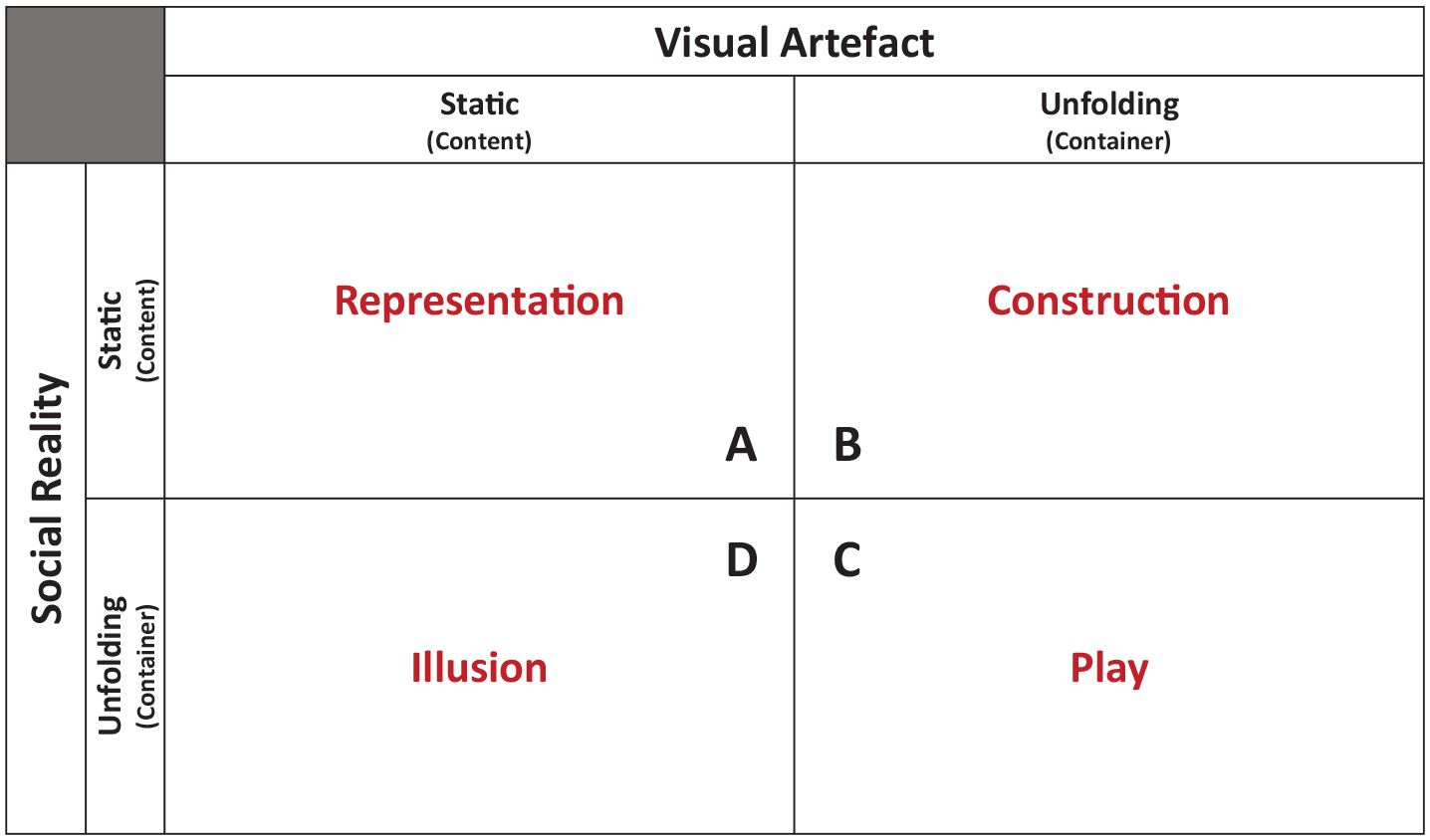
Mapping conceptualizations of visualization in organizational research.
The choice of this visual form is anything but cavalier. Beyond the visual appeal of medieval magic quadrants (Carruthers, 2015) and contemporary 2x2 matrixes used as consulting tools (Pollock & D’Adderio, 2012), we have chosen this visual artefact because it establishes a generative space (from Latin matris, womb; and matrice, mother) for reflecting and inquiring into different ways of conceptualizing visualizations, their signification, manifestations and implications for organizing and organizations. Similar to Burchell, Clubb, Hopwood, Hughes and Napier (1980), who explored how calculative practices can be studied beyond their representational role, our understanding of the visual can be classified and expanded for the roles it plays in organizations.
The axes relate and contrast different conceptions of a visual artefact and social reality. Each of them can be seen as either static or unfolding. A visual artefact is static when it is conceived of as a mere tool for representation that is meant to communicate a ‘given’ message through determinate rules of signification. In contrast, it is conceived of as unfolding when its shape and function are more fluid and when it is meant as a space for generating signification rather than simply conveying it. Social reality can be conceived of as static when it is supposed to exist objectively ‘out there’, or in objectivated and reified form when organizational actors take norms of appropriate behaviour for granted as indisputable aspects of shared stocks of knowledge. It can be characterized as unfolding when it becomes a dynamic space that contains never-ending contests for defining common norms of appropriate behaviour. By crossing these the two axes, we obtain four distinct approaches to visual artefacts, each with a specific idea of how and why they work in organizing and in organizations.
Quadrant A is the most conventional space. Most scholars in organization and management theory have long moved beyond a realist view of the social world and a functionalist understanding of visual artefacts. Recent trends concerning visualizations of large data sets and statistical analyses are still firmly inhabiting this space, however, and the qualities of visual artefacts such as graphs, pie charts and dashboards are judged according to their accuracy of representation (e.g. Berinato, 2016; Tufte, 2001).
Quadrant B marks the realm of constructivism and performativity. Here, unfolding visual artefacts embody and create socially constructed knowledge. This quadrant is populated by recent studies on the performativity of financial models and calculations (e.g. Arjaliès & Bansal, 2018; Mackenzie, 2008), rankings and evaluative devices (e.g. Kornberger, 2017; Pollock & D’Adderio, 2012) and various management tools that inform and allow organizational action (e.g. Star & Griesemer, 1989; Comi & Whyte, 2018). Visual artefacts are used as vehicles for either maintaining or challenging the relative stability of institutionalized knowledge (e.g. Cartel et al., 2018).
Quadrant C, in which several of our perspective shifts intersect, is currently less populated. Visual artefacts here are useful not because of the significations they embody, but because of the very signification work they demand and for the possibilities for action they offer. Some of the research we have reviewed touches upon this quadrant when it highlights the capacity of visual artefacts to prompt engagement with what cannot be seen (e.g. Barry & Meisiek, 2010), to create evaluative tensions among incommensurable entities (e.g. Arjaliès & Bansal, 2018) or to generate loci of competition (e.g. Kornberger, 2017). In all these instances, visualization can be seen as a form of play, both evoking games (as it attracts participants and incentivizes playing with invisibilities and immaterialities) and theatre (as it creates a stage for or constitutes itself as a performance). Participants are called upon to question, debate, dwell upon and play with the blind spots that visualization inevitably generates. Visualization indeed creates multifocal (Carruthers, 2013; Quattrone, 2017) and multivocal (Ferraro et al., 2015; see also Bandola Gill et al., 2021) artefacts that demand the embracing of mysteries and the unfolding of understandings. Accordingly, visual artefacts become containers; they embrace the potentially infinite significations that they help to accommodate. They can be conceived of as playgrounds, which recalls an arena for agonistic contests and the ludic dimension of what we do. This perspective on visualization results in what we dub a ‘neo-constructivist’ approach that highlights the constantly unfinished nature of social reality, emphasizing gaps and lacks and making them the cornerstone of the constructivist edifice. When one studies visualization and the construction of social realities, this approach acknowledges that invisibilities, immaterialities and spaces for performance matter as much if not more than what one can see and touch.
The etymology of the word ἀγών [agon] also cautions us about the risk of this contest becoming fierce and violent, as an end in itself and for self-interest rather than balancing individual and communal interests. This is when agonism leads to agony, and when ‘being in the game’ becomes ‘being gamed’: an empty and tricky, rather than enchanting, illusion. In quadrant D, visual artefacts are treated as authoritative conveyers of supposedly objective but unchecked content, which is then used instrumentally to profit from the unfolding of social realities. This is where populists use fake news conveyed through strong visualization in social media, to dominate contests for attention in a market for ideas, in which winning against competing language games is the ultimate objective (Knight & Tsoukas, 2019). Therefore, visualizations become as powerful as seemingly objective numbers (Espeland & Stevens, 2008), as they create illusions of truth. A realist approach to the visual (quadrant A) denies the mystery, a constructivist approach (quadrant B) tames it and neo-constructivist approaches (quadrant C) embrace it, whereas quadrant D is the space of post-modernism in its nihilist and cynical form – which attempts to erase the mystery or use it instrumentally. The search for praises and prizes is converted into a disenchanted competitive dispute for votes, likes and citations, which therefore become prices (Huizinga, 2016) and transform politics, relations and research into commodities. In contrast to quadrant C, unfolding realities are not embraced visually in quadrant D; rather, visual artefacts ‘spell out’ arbitrary static realities in ways that do not evoke mysteries but profane and break the spell. The ‘grammar’ of bullshitting (Spicer, 2020) is devoid of glamour (from grammaire and grimoire, originally the same word, combining the logical and the magical; see de Romilly, 1975). Quadrant D is where the adage ‘anything goes’ (Feyerabend, 1975) extends beyond a need for understanding and becomes a post-modern condition of emptiness (Lyotard, 1979).
Quadrants C and D highlight the idea that closures, reifications and meanings are, after all, illusory; they invite a move beyond the idea of constructivism that ends exactly where positivism begins: with the emphasis on res, a thing – albeit socially constructed. A more realistic and coherent approach to the mystery of organizing should also speculate on the no-thing and its power. In complementing the study of the visual with the invisible, the immaterial and the performance, we want to alert organization scholars that ‘nothing really matters’ (Mumford, 2021), and that current individual, organizational and social behaviour is driven not only by what we see or believe that we see, but also by what we cannot see and cannot know. Beyond the scope of this Virtual Special Issue, this attitude is possibly best exemplified by the entrepreneurial spirit – which is clearly driven by something that is not there yet. Therefore, unlike management, entrepreneurial action is triggered by what is not known until it is realized (see Hjorth et al., 2018).
We opened this Perspectives piece by recalling the words of a fictional Pope. We end it by turning to the real one, Pope Francis, and his first appearance on the balcony of the Roman Basilica, as the first Jesuit Pope in history and the 265th successor of St. Peter – not because we necessarily believe, but because we are curious about how people can come together despite an infinite number of beliefs. In closing his first homily, Pope Francis asks the masses: ‘And now, before I benedict you, I want you to pray for me. Let’s have a few moments of silence [. . .] and you pray for your new Bishop.’ In so doing, rather than making a difference by uttering a clear message to the masses, Pope Francis decides to embrace the mystery by remaining in-different (i.e. in the middle of the infinite differences which he faces). When facing the unknown (e.g. a mission into uncharted territory) or the unknowable (i.e. the mystery of God), and still having to be functional, it is best to behave perinde ac cadaver esset (‘as if s/he were a corpse’) and make a difference by remaining indifferent. Facing the challenge of engaging a multitude of unknowable views and unknown human beings in the mission of the Catholic Church, both the fictional and the real Pope create a space to be filled by the prayers of the faithful. Rather than treating communication as a conduit for a message, the materialized visual setup serves as a container for creating a community which embraces a potentially infinite number of messages in a holy communion. Not surprisingly, the three words share the same root. When organizing means dealing with difference, nothing is more powerful than nothing.
Footnotes
Acknowledgements
We wish to thank our three anonymous reviewers for their generous support in further developing our line of argument and appreciate the editorial guidance by the two Editors-in-Chief, Renate Meyer and Daniel Hjorth. Our thanks also go to Elena Giovannoni and Fabrizio Granà for some of the etymological insights provided. The usual disclaimers apply.
Funding
The author(s) received no financial support for the research, authorship, and/or publication of this article.
