



Abstract
Knowledge creation increasingly requires experts from diverse domains to collaborate in teams, yet the effect of expertise diversity on team knowledge creation is inconclusive. We focus on task uncertainty and informal leadership hierarchies – the disparity in team members’ engagement in leadership activities (task- and relationship-oriented) – to answer the questions when and why expertise diversity may hinder team knowledge creation. We develop a model in which informal leadership hierarchy mediates the conditional indirect effect of the team’s expertise diversity on its knowledge creation under different levels of task uncertainty. We test this moderated mediation model using multi-source data from self-managing project teams comprising collaborators from a pharmaceutical company and its research partners. We find that when task uncertainty is low, the indirect effect of expertise diversity on team knowledge creation is positive, whereas when task uncertainty is high, it is negative. This conditional indirect effect occurs via task-oriented but not relationship-oriented leadership hierarchy. Our findings provide insights into the mechanisms and boundary conditions for expertise diversity to hinder, rather than facilitate, knowledge creation in collaborations.
Keywords
Introduction
As organizations collaborate across specializations and organizational boundaries to seek complementary expertise, they increasingly depend on teams comprising experts with diverse educational backgrounds, work experience and knowledge networks (Bunderson & Boumgarden, 2010; Sydow, Lindkvist, & DeFillippi, 2004; Wuchty, Jones, & Uzzi, 2007). The uncertainty inherent in knowledge creation demands an adaptive approach to access diverse expertise (Bechky & Okhuysen, 2011; Bunderson, 2003) and substantial autonomy for team members to manage their knowledge creation process (Zárraga & Bonache, 2005). As a result, self-managing project teams are becoming the sine qua non of knowledge collaboration (Ben-Menahem, von Krogh, Erden, & Schneider, 2016; Klein, Ziegert, Knight, & Xiao, 2006).
Diverse expertise in teams has several potential benefits for collective knowledge creation, but it may require much coordination for the benefits of such diversity to eventuate (Faraj & Sproull, 2000). Diverse expertise increases non-overlapping knowledge components and leads to the novel combination of knowledge through the interaction among individuals with different perspectives (e.g. Fleming, Mingo, & Chen, 2007). However, different experts may each possess knowledge that is valuable for their respective specialized work (Dougherty & Dunne, 2012) but lack shared experience, common language, or mutual understanding to collaboratively create new knowledge (Bechky, 2003; Carlile, 2002; Cronin & Weingart, 2007). When uncertainty rises, these complications pose increasingly significant coordination barriers in knowledge collaboration (Faraj & Yan, 2009).
A particular coordination challenge associated with experts from diverse domains collaborating in self-managing project teams is the confusion and struggle over ‘who leads whom’ (Sydow, Lerch, Huxham, & Hibbert, 2011, p. 329). This challenge is even more salient in collaborations across organizational boundaries: outside collaborations, team members hold formal roles and responsibilities that may be situated at different hierarchical levels in their respective organizations; within collaborations, however, formal authority rooted in the employment contract of one organization does not readily extend to collaborators from the other organization(s).
The absence of any formal leader with authority over all collaborators requires team members to voluntarily come forward and assume leadership functions to handle group needs (Hiller, Day, & Vance, 2006). As individuals assume leadership functions to different degrees, a within-team informal hierarchy reflecting the disparity between ‘leaders’ and ‘non-leaders’ takes shape. Informal leadership hierarchy – a behaviour-based hierarchy reflecting the disparity in team members’ engagement in leadership activities (task- and relationship-oriented) – thus constitutes a coordination mechanism for self-managing teams. However, the efficacy of such coordination mechanism may differ drastically under high versus low task uncertainty (Bunderson, Van Der Vegt, Cantimur, & Rink, 2016). As a team task, collaborative knowledge creation involves different levels of uncertainty about technological (Song & Montoya-Weiss, 2001) or scientific elements (Liebeskind, Oliver, Zucker, & Brewer, 1996). Therefore, the effect of informal leadership hierarchy on team knowledge creation remains to be better understood.
In this study, we develop a moderated mediation model (Figure 1), in which informal leadership hierarchy mediates the indirect effect of expertise diversity on team knowledge creation under different levels of task uncertainty. We draw on research on status (Berger, 1977; Berger, Rosenholtz, & Zelditch, 1980) and hierarchy in teams (Bunderson et al., 2016; Magee & Galinsky, 2008) suggesting that informal leadership hierarchy is the critical mechanism transferring expertise diversity into team knowledge outcome. This hierarchy is either predominantly coordination enabling or conflict generating (Bunderson & Reagans, 2011; Greer, de Jong, Schouten, & Dannals, 2018; Magee & Galinsky, 2008; Tost, Gino, & Larrick, 2013), depending on the team task. Following this logic, we contend that investigating the effects of informal leadership hierarchy under different levels of task uncertainty can unveil in what situations the effect of expertise diversity on team knowledge creation is negative rather than positive.
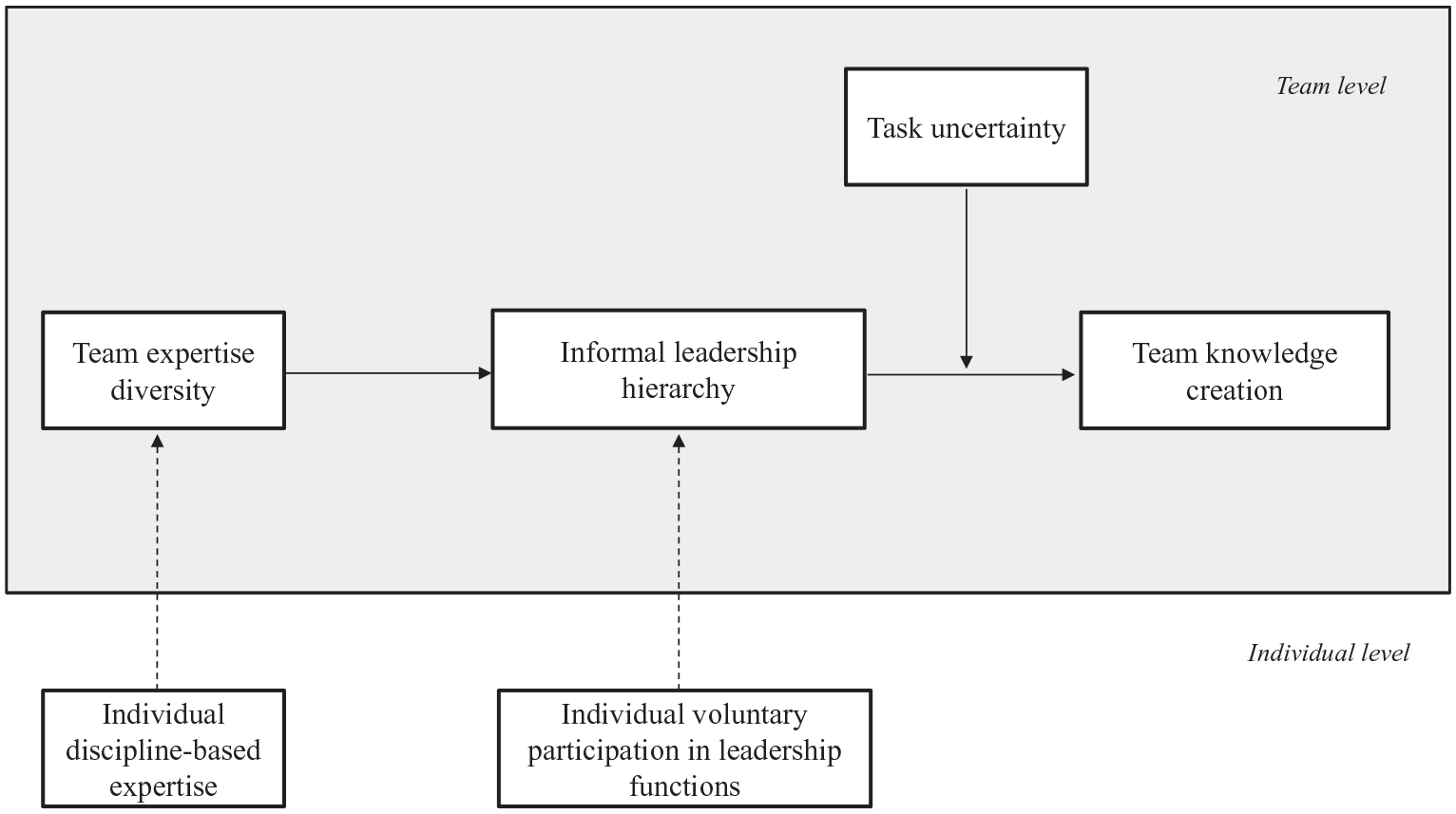
Theoretical Model.
Our theoretical contribution is twofold. First, we extend work group diversity research that has relied on team information processing (e.g. Hoever, van Knippenberg, van Ginkel, & Barkema, 2012; Huang, Hsieh, & He, 2014) as the main underlying mechanism linking diversity and team outcomes. Our investigation of the team’s informal leadership hierarchy reveals one critical, yet largely overlooked, reason why expertise diversity influences team knowledge creation. Second, we contribute to the ongoing discussion on whether hierarchy facilitates knowledge creation in teams and organizations (e.g. Bunderson & Reagans, 2011; Greer et al., 2018). Our findings show that informal leadership hierarchy has opposite effects on high versus low levels of task uncertainty and offer novel insights into the conditions in which such hierarchy is likely to hinder rather than benefit team knowledge creation.
Theory and Hypotheses
The basis of informal hierarchy in self-managing teams
Self-managing teams are groups of interdependent individuals who are fully responsible for their activities to achieve collective goals (Alper, Tjosvold, & Law, 1998). Underpinning such teams’ effective functioning is the members’ autonomy in deciding how to carry out tasks and allocate work (Langfred, 2004; Morgeson, 2005). Due to reduced reliance on external or directive leadership, team members must fulfil the various leadership functions. These functions range from the task-oriented, such as facilitating the meeting of team goals, to the relationship-oriented, such as maintaining the interpersonal dynamics within the team (Hiller et al., 2006; Morgeson, DeRue, & Karam, 2010). Team members’ varied social characteristics make them differently suited to carry out these leadership functions and their different engagement in these leadership activities then establishes an informal leadership hierarchy within the team (Bunderson & Boumgarden, 2010).
Indeed, much research has shown that self-managing teams rely on expertise-based coordination mechanisms (e.g. Ben-Menahem et al., 2016; Klein et al., 2006). Expertise diversity describes the within-team variety of knowledge (i.e. differences in kind or category) (Harrison & Klein, 2007) that arises from individual differences including educational backgrounds (Van Der Vegt & Bunderson, 2005), industry experience (Horwitz & Horwitz, 2007), specialized knowledge domains (Taylor & Greve, 2006) and organizational functions (Bunderson & Sutcliffe, 2002). For a research team, discipline-related knowledge is a critical input (Ben-Menahem et al., 2016) directly related to the team’s goals (e.g. creating a new drug). It constitutes a form of expertise power and signals status (French & Raven, 1959; Weber, 1978). Accordingly, we draw on status characteristics theory (Berger et al., 1980) and its antecedent expectation states theoryBerger, 1977) to explain the basis of informal leadership hierarchies in teams consisting of individuals who are equals as collaborators but differ in a prevalent social characteristic – disciplinary expertise.
The central thesis of status characteristics theory and expectation states theory is that power structures result from hierarchical differentiation, which is fundamentally a status-organizing process based on salient status cues. A status cue is a characteristic with two or more states, each of which is differentially evaluated in terms of desirability or competence. It can be either diffuse (i.e. applicable over a range of settings) or specific (i.e. applicable to specific tasks). Diffuse status cues include such social categories such as gender and race, whereas specific cues include educational background or professional training. A status characteristic becomes salient (i.e. usable cues in the immediate social situation) when it effectively distinguishes among team members (Berger et al., 1980). In research collaborations, disciplinary expertise creates a specific status cue about an individual’s competence for certain tasks (Nembhard & Edmondson, 2006). Discipline-based expertise diversity (hereafter, expertise diversity) thus leads to status differences within a research team.
Observing that some individuals have more opportunities to act and to influence others, sociologists (e.g. Correll & Ridgeway, 2003) have examined various hierarchical structures that manifest influence inequalities in groups. As a prime example of such structures, leadership hierarchy can be formal (official authority positions) or informal (naturally emerging differences in status) (Anderson & Brown, 2010). Because informal structures constitute the key coordination mechanisms in self-managing teams, we focus on behaviour-based informal leadership hierarchy, defined as the disparity 1 (Harrison & Klein, 2007) in team members’ participation in different leadership activities.
According to status characteristics theory and expectation states theory, expertise as a status cue should form the basis of informal hierarchical stratification in teams comprising members of different expertise. Insofar as a team’s goal is to create novel and useful knowledge, such a goal would generate pressure on team members to anticipate the relative quality of each other’s contribution to solving the problems at hand (Faraj & Yan, 2009). A member’s expertise (e.g. being a toxicologist or a biomedical engineer) provides cues for developing implicit anticipations of the relative quality of that member’s performance in the focal task (e.g. a toxicity test or maintenance of an experiment device). These anticipations, formed either by individual members or others, are referred to as ‘performance expectations’ (Berger, 1977).
Once developed, performance expectations may shape behaviours in a self-fulfilling way and in turn direct the status-organizing process (Berger et al., 1980). In the case of pharmaceutical research, for example, certain disciplines occupy a more or less central role depending on the stage of the workflow (Ben-Menahem et al., 2016) and members from certain disciplines are expected to undertake leadership activities corresponding to their expertise. A greater performance expectation of certain team members gives them more opportunities for participating in activities such as planning the workflow, voicing opinions and influencing team decision-making (Berger, 1977). Therefore, relative performance expectations likely create and maintain a hierarchy along the dispersion of specific leadership functions that team members perform.
Expertise diversity and informal leadership hierarchy within the team
We argue that expertise diversity relates positively to the degree of informal leadership hierarchy within the team because it increases the saliency of expertise as a status cue. Only when the state of discipline-related expertise – a status cue directly related to the task – differs between the two members will it evoke different performance expectations (Berger et al., 1980). Consider a concrete example of a pharmaceutical research team. A computer scientist and a toxicologist face the responsibility of planning the workflow to determine whether a compound is safe. The team likely expects the latter to be more proficient than the former at planning this particular task, because toxicologists have directly relevant expertise for this specific task.
The status spillover from having the suitable task-related expertise may make those team members also carry greater weight in the relationship-oriented leadership function. However, the positive association between expertise diversity and informal leadership hierarchy may be stronger for the task-oriented leadership function than for the relationship-oriented one, due to a higher relevance of expertise for specific tasks. According to EST, the saliency of a status cue also depends on the path of relevance, which indicates how well the team can expect a specific team member to perform a particular task, given their social characteristics. A social cue may have a longer or shorter path of relevance for different leadership functions, affecting the strength of performance expectation and the resulting behavioural differences underpinning a particular type of hierarchy (Berger et al., 1980).
Consider the earlier example of testing compound safety. While a toxicologist should have more relevant expertise in planning the workflow and solving problems associated with compound safety, they may not necessarily have more expertise in mentoring or supporting a fellow teammate. Put differently, the path of relevance is shorter in the first scenario than in the second. Discipline-related expertise is thus more important to the team when it forms expectations about which member would perform better in task-oriented leadership functions. Therefore, although we expect both relationships to be positive, the relationship between expertise diversity and a task-oriented leadership hierarchy should be stronger than that between expertise diversity and a relationship-oriented leadership hierarchy.
Hypothesis 1a: Expertise diversity relates positively to a task-oriented leadership hierarchy.
Hypothesis 1b: Expertise diversity relates positively to a relationship-oriented leadership hierarchy.
Hypothesis 1c: The relationship between expertise diversity and a task-oriented leadership hierarchy is stronger than that between expertise diversity and a relationship-oriented leadership hierarchy.
The moderating role of task uncertainty
Research on social hierarchy in teams suggests that the relationship between hierarchy and team outcome hinges on team task contingencies (e.g. Greer et al., 2018). For teams engaged in knowledge creation, task uncertainty constitutes one of the most decisive contingencies (Faraj & Yan, 2009; Liebeskind, 1996). We argue that task uncertainty moderates the relationship between informal leadership hierarchy and team knowledge creation, because such uncertainty dampens hierarchy’s ability to coordinate while enhancing its conflict-generating effect.
Scholars across fields (Anderson & Brown, 2010; Bunderson et al., 2016; Bunderson & Reagans, 2011; Greer et al., 2018; Magee & Galinsky, 2008; Tost et al., 2013) show that informal leadership hierarchy may have countervailing effects. On the one hand, leadership hierarchy creates a clear division of labour in leadership functions, thereby preventing the cannibalization of other team members’ efforts (Jackson, 1996). Social hierarchy enables coordination by integrating and aligning individual member actions, knowledge and objective towards the attainment of a common goal (e.g. Halevy, Chou, & Galinsky, 2011; Van Vugt, Hogan, & Kaiser, 2008). Such coordination-enabling processes facilitate the expedient combination of individual inputs and the in-depth processing of diverse information, thereby benefiting team outcomes (Greer et al., 2018). For example, members heavily engaged in planning and organizing the overall workflow may develop a more holistic understanding of the team’s task environment, which may enable them to allocate tasks and manage interdependencies accordingly (Crawford & Lepine, 2013). If everyone participates with equal intensity in planning and organizing, individual members’ efforts might prove redundant. Similarly, if everyone participates with equal intensity in problem solving, one member’s efforts could clash with – or even nullify – the effort of others, or create new problems and obstacles.
On the other hand, social hierarchy could brew conflict. Members at different levels of the hierarchy usually have divergent interests and perspectives (e.g. Bunderson et al., 2016), which could lead to intragroup conflicts (e.g. Bunderson & Sutcliffe, 2002). Moreover, hierarchy as inequality may elevate rivalry over rank (Bendersky & Hays, 2012), thereby stirring up conflict by motivating individuals to compete for higher positions in the hierarchical order (Magee & Galinsky, 2008), even when little difference in formal positions exists. Conflict and rivalry may distract members from task accomplishment, damage interpersonal relationships and hinder group cohesion, harming team outcomes (Greer et al., 2018). When the goal is knowledge creation, social hierarchy may be particularly harmful (Bunderson & Reagans, 2011; von Krogh, Nonaka, & Rechsteiner, 2012; Valentine, 2018), because concerns about gaining approval and resources from higher-status members make low-status members less likely to explore (Anderson & Galinsky, 2006; Foldy, Rivard, & Buckley, 2009).
Whether or not informal leadership hierarchy will harm or benefit knowledge creation in teams will depend on whether a task prioritizes the coordination-enabling or the conflict-generating process. Generally, task uncertainty entails the difference between the information needed for completing a task and the information available (Argote, Turner, & Fichman, 1989; Gardner, Gino, & Staats, 2012). For knowledge-intensive tasks, uncertainty means incomplete information about the target outcome and the cause-and-effect relationships (Dougherty & Dunne, 2012; Liebeskind, 1996). Uncertainty, as a state of ‘unknown unknown’ (Feduzi & Runde, 2014) where actors do not have complete knowledge of what to expect, differs from ambiguity, which implies ‘known unknown’ that begs clarity regarding the interpretation of an event or situation (Sydow, Müller-Seitz, & Provan, 2013). Due to the distinction between these two constructs, the accumulated insights on task ambiguity (e.g. Denis, Langley, & Cazale, 1996) may not be readily applied to task uncertainty.
We argue that task uncertainty moderates the relationship between informal leadership hierarchy and knowledge creation in collaboration teams for two main reasons. First, high task uncertainty makes it difficult for the team to gauge the demand for coordination, thereby obstructing the effectiveness of informal leadership hierarchy as an implicit coordination mechanism. Unclear cause-and-effect relationships increase the difficulty for teams to determine the domain of problem (Schulz, 2001), hindering a clear division of labour. Unlike task complexity, which increases the need for coordination (Bunderson et al., 2016; Greer et al., 2018), task uncertainty makes the existing heuristics for division of labour, resource allocation and integration of effort less useful. As a result, task uncertainty challenges team members’ established coordination patterns (Rico, Sánchez-Manzanares, Gil, & Gibson, 2008).
Second, high task uncertainty creates more room for intra-team conflict (cf. Hofmann, Lei, & Grant, 2009), making the conflict-generating process of informal leadership hierarchy more pronounced. As task uncertainty increases, so does the likelihood that problems arise from daily operations such as communicating plans, defining responsibilities and managing deadlines (Rico et al., 2008). Moreover, when coupled with information deficits about the task at hand, existing knowledge differences and task dependencies among members require more frequent reconsideration and updates (Carlile, 2002; Weingart, 1992). These interactions require additional time and effort for establishing shared languages, methods, or artifacts that help facilitate team functioning (Stasser & Titus, 1985).
Hypothesis 2a: Task uncertainty moderates the relationship between task-oriented leadership hierarchy and knowledge creation, such that the relationship becomes more negative as task uncertainty increases.
Hypothesis 2b: Task uncertainty moderates the relationship between relationship-oriented leadership hierarchy and knowledge creation, such that the relationship becomes more negative as task uncertainty increases.
A moderated mediation model
Team members’ coordination activities to integrate diverse input are essential for transforming the expertise within the team into collective knowledge creation outcomes (Majchrzak, More, & Faraj, 2012; Taylor & Greve, 2006). Studying pre-structured teams in laboratory experiments or hierarchical teams with designated project leaders, researchers have uncovered individual activities directly related to information processing within the team, such as information elaboration (Hoever et al., 2012) and knowledge sharing (Huang et al., 2014), as mediating mechanisms transferring team expertise diversity to team creativity. Expanding prior work, we examine a mediation mechanism that goes beyond team information-focused processes to include other task- and relationship-oriented activities.
Our argumentation thus far has shown that expertise diversity within the team relates positively to the two types of informal leadership hierarchies resulting from individual team members’ disparate voluntary engagement in the relationship-oriented and task-oriented leadership activities (hypothesis 1). These informal leadership hierarchies, in turn, have differentiated effects on team knowledge creation contingent on the level of task uncertainty facing the team (hypothesis 2). Together, these lines of reasoning suggest that team expertise diversity has an indirect effect on team knowledge creation by influencing the within-team informal hierarchies. In a nutshell, because expertise diversity increases within-team informal hierarchies, which will impede rather than facilitate collective knowledge creation under high level of task uncertainty, expertise diversity could indeed hinder team knowledge creation.
Hypothesis 3a: Task uncertainty moderates the indirect effect of expertise diversity on team knowledge creation via task-oriented leadership hierarchy, such that the indirect effects become more negative as task uncertainty increases.
Hypothesis 3b: Task uncertainty moderates the indirect effect of expertise diversity on team knowledge creation via relationship-oriented leadership hierarchy, such that the indirect effects become more negative as task uncertainty increases.
Method
Research context and sample
Pharmaceutical research features various degrees of uncertainty (Ben-Menahem et al., 2016). The development of a new drug takes between 10 and 15 years and encompasses three distinct phases before a drug enters large-scale manufacturing (Ding, Eliashberg, & Stremersch, 2014): drug discovery, clinical trials and Food and Drug Administration review. Given the high cost and complexity of research, pharmaceutical firms often collaborate with research institutes, universities and hospitals (Perkmann, Neely, & Walsh, 2011), especially for early-stage drug discovery. The resulting project teams comprise members from multiple scientific disciplines, including cell biology, medicine, chemistry, biomedical engineering and toxicology. The pharmaceutical firm and the partner organization may each appoint one or more individuals to be the champion(s) of the collaboration, yet such champions do not have formal authority over other participants. Participants in these collaborations typically have high autonomy in organizing their research tasks.
We collected data from the three research sites of InterPharma (a pseudonym for a leading pharmaceutical company), sampling research collaborations consisting of scientists from the research arm of InterPharma and various research institutions (predominantly universities and teaching hospitals). Participants collaborate in projects under collaboration contracts (e.g. research agreements) while working under employment contracts in their respective organizations.
Procedure
First, we conducted explorative interviews with 25 InterPharma scientists who were part of a research collaboration to understand the general setup of these collaborations. Second, using an internet-based survey, we collected data from two sources at three different times. We started by sending participants (N= 783, including team leaders and members) of all the eligible research collaborations an email with a link to our survey, asking them to report all control variables and their field of expertise. After three email reminders, 669 members from 187 project teams (an 85% response rate) responded to the first survey. Six months later, we asked respondents, except the 35 individuals who had left their projects, to report their engagement in various leadership behaviours. After three email and one telephone reminders, 511 members from 168 project teams (an 81% response rate) responded. For each survey they completed, respondents received a $10 gift voucher. 2
To reduce common source bias, approximately two months later, we asked senior managers at InterPharma to evaluate the knowledge creation and task uncertainty of project teams. These managers were voluntary ‘champions’ (not a formal job title) for collaboration projects rather than project leaders. While not directly involved in leading a specific project, these managers oversaw a large number of research collaborations. As they regularly benchmarked projects against each other, they were well informed about the tasks and performances of these collaborations. We received responses from 79 senior managers (a 77% response rate), evaluating 144 project teams. Each project was rated only by one manager, but 20 managers have rated more than one project. Finally, we paired all data sources, using a unique identifier for each team.
The minimum number of responding team members necessary for inclusion in the study was three per team. This criterion and list-wise deletion of incomplete responses resulted in a final sample of 99 teams. The average project in this sample had been running for 1.42 years (SD = 1.01) and had 4.74 (SD = 1.83) team members. The average response rate within the teams in our final sample was 88%. The final sample comprised 469 individuals, including 282 scientists from InterPharma and 187 from partnering research institutes. On average, participants were 44 years old, highly educated (86% holding as their highest degree a PhD or MD), and had spent seven years in their current organizational roles; 74% of participants were male. A series of t-test comparisons showed no substantial differences across the three sites.
Measures
Team knowledge creation
Research projects generate two types of knowledge (Gans, Murray, & Stern, 2017): products of immediate commercial value (e.g. a vaccine) and products that provide the foundation for future usages (e.g. the immunological mechanisms). Given the lengthy process of pharmaceutical research, it is difficult to capture the first type of knowledge creation. Indeed, it may take up to 15 years to bring a new drug to the market and return on research-related investment takes even longer to eventuate (Ding et al., 2014). Therefore, in this study we focus on the second type of knowledge. Previous studies have largely relied on publication data to measure this type of knowledge creation (Lundberg, Tomson, Lundkvist, Skår, & Brommels, 2006), yet this approach is inadequate for at least two reasons. First, firms may choose to keep secret some or all of the knowledge created in a research project (Gans et al., 2017). Second, not all of this type of knowledge can be captured in publication, which mainly represents the priority of academics (Gersdorf et al., 2019). For drug discovery scientists in companies, many other forms of knowledge creation are relevant and crucial as a collaboration outcome. As a scientist we interviewed described: It turns out in the past months some other academic groups have published similar data, so unfortunately, we couldn’t get our data out before others. But the information we generated provided a lot of support for the internal drug-discovery programme and geared at bringing in new therapeutics into the clinic in the next 18 months. It really helped refine our clinical development plans [in terms of] what patients we are going to target and what bio-markers might be used to identify those patients.
Because no existing scale precisely measures this type of scientific knowledge, we developed a new scale. Building on the insights we gained through explorative interviews, we first identified 10 items that capture relevant knowledge outcomes in previous studies. These items include three items to measure scientific knowledge created, from Choo, Linderman and Schroeder (2007), and seven items to measure technical knowledge created, from Lewis, Welsh, Dehler and Green (2002). We then modified the wording of these items to fit our context. An expert panel of six senior managers from InterPharma discussed the relevance of these items and selected the eight most suitable for pharmaceutical research collaborations.
We then validated this scale in a pilot survey with research scientists (N = 30) at a large public university. We ran an exploratory factor analysis with data from the pilot survey and removed three items with factor loadings of less than 0.4 (Hinkin, 1995). We then re-ran the factor analysis using the remaining five items. They loaded significantly on a single factor, explaining 49.92% of the variance. Additionally, we ran a confirmatory factor analysis of these items. The results confirmed the validity of this 5-item scale (χ2 = 5.02; df = 4; p = n.s.; CFI = 0.99; RMSEA = 0.05 and SRMR = 0.04). 3 All the items loaded significantly on the latent factor (p < 0.001, with z-values greater than 5.47). The final items (Cronbach alpha = 0.75) measure the extent to which (1) ‘solutions found in this project will be unique and innovative’, (2) ‘insights from this project will lead to follow-up projects’, (3) ‘results of this project will be published in a peer-reviewed journal’, (4) ‘this project will yield knowledge helpful to other ongoing projects’ and (5) ‘this project will lead to important scientific results’.
In line with studies on project teams (e.g. Eisenbeiss, van Knippenberg, & Boerner, 2008), we asked senior managers to evaluate the team knowledge creation. A total of 65 managers rated the knowledge creation of teams in our final sample on a five-point scale (1 = ‘very unlikely’ to 5 = ‘very likely’). On average, each manager evaluated 1.51 projects. To rule out the possibility that being evaluated by the same manager accounted for a significant amount of variance, we verified the independence of our observations by computing intra-class correlation (ICC) scores for the knowledge creation variable. The ICC(1) score was only 0.01, which is considered non-significant (values less than 0.05) and can thus be considered a legitimate reason for discarding a nesting effect (e.g. LeBreton & Senter, 2008). The ICC(2) score was 0.05, which is also very low (far below the 0.70 benchmark) (Klein et al., 2000). These low ICCs indicate that the level of non-independence in our data is unlikely to affect scale reliabilities or to produce incorrect rejection of the null hypothesis, especially when the group size is as small as ours. Consequently, these tests confirmed that observations can be treated independently in our model.
Team expertise diversity
We operationalized expertise diversity as the diversity in the team members’ discipline-related background (for a similar approach, see Bunderson & Sutcliffe, 2002). In response to our request, ‘Please select the scientific field that best describes your background and area of expertise’, team members indicated their primary discipline by using the widely adopted categorizations from the Nature Publishing Group.
4
With the detailed information from the team members, we computed the expertise diversity for each team using the Teachman entropy index,
5
calculated as
Team task- and relationship-oriented leadership hierarchy
To measure each team member’s engagement in task- and relationship-oriented leadership functions, we used the scale developed by Hiller et al. (2006). The task-oriented leadership function consists of 13 items (Cronbach alpha = 0.96) that measure planning and organizing (e.g. ‘I help organizing tasks so that work flows more smoothly’) and problem solving (e.g. ‘I am involved in identifying problems before they arise’). The relationship-oriented function consists of 12 items (Cronbach alpha = 0.90) that measure supporting (e.g. ‘I provide support to team members who need help’) and mentoring (e.g. ‘I instruct poor performers on how to improve’). Because these behaviours are voluntary and may not be fully visible to all other team members, we asked participants to rate themselves on a five-point scale (1 = ‘never’ to 5 = ‘always’).
CFA results show that the two-factor model (χ2 = 1081.35; df = 271; p < 0.001; CFI = 0.90; RMSEA = 0.08 and SRMR = 0.05) fits the data significantly better (a χ2-difference test showed a χ2 difference significant at p < 0.001) than a single-factor model (χ2 = 1713.60; df = 272; p < 0.001; CFI = 0.82; RMSEA = 0.11 and SRMR = 0.09). Moreover, all items load significantly on their respective dimensions (p < 0.001, with z-values greater than 10.56).
We calculated the task- and relationship-oriented leadership hierarchies using the Gini coefficient
Team task uncertainty
This construct concerns the uncertainty of the task faced by the team, collectively. Given that the project teams in our sample conduct scientific research, we focused on the scientific aspect of uncertainty in the team’s tasks. We adapted the five items used by Song and Montoya-Weiss (2001), rewording them to fit our research context (Cronbach alpha = 0.82). Sample items include ‘the scientific knowledge involved in this project is mature, i.e. the cause-and-effect relationships are well known’ (reverse coded) and ‘the changes in the scientific knowledge basis for this project are very unpredictable’. Senior managers with a broad exposure to various pharmaceutical research projects rated the uncertainty level on a five-point scale (1 = ‘strongly disagree’ to 5 = ‘strongly agree’).
Controls
To account for alternative explanations, we included several control variables in our models. Because team knowledge creation might depend on the number of members and the time they have been working together (e.g. Chiu, Owens, & Tesluk, 2016), we controlled for team size (measured as the number of team members) and team tenure (measured as the time in years since the project started). Given that both the physical location of the collaboration partners and the interactions among them may facilitate knowledge creation (e.g. Claudel, Massaro, Santi, Murray, & Ratti, 2017), we controlled for the co-location of team members (0 = at least one member is in a different location; 1 = all team members are in one location) and the interaction frequency among team members. Information about team size, tenure and co-location was obtained from InterPharma during the data collection. We measured the interaction frequency by asking participants four questions about their physical and virtual interactions with other team members. We then aggregated individual responses to the team level by taking a mean. Moreover, because divergent goals can obstruct team accomplishment (Edmondson & Nembhard, 2009), we controlled for goal asymmetry 6 within the project team.
Results
Table 1 shows the descriptive statistics and correlations among the study’s variables. To ensure that multicollinearity is not an issue, we computed variance inflation factor (VIF) scores. All VIFs are substantially below the conservative cutoff value of 5.0, with the highest VIF being 1.71. This analysis indicates that multicollinearity is unlikely to influence the results of the analyses.
Descriptive Statistics and Correlations for Study Variables.
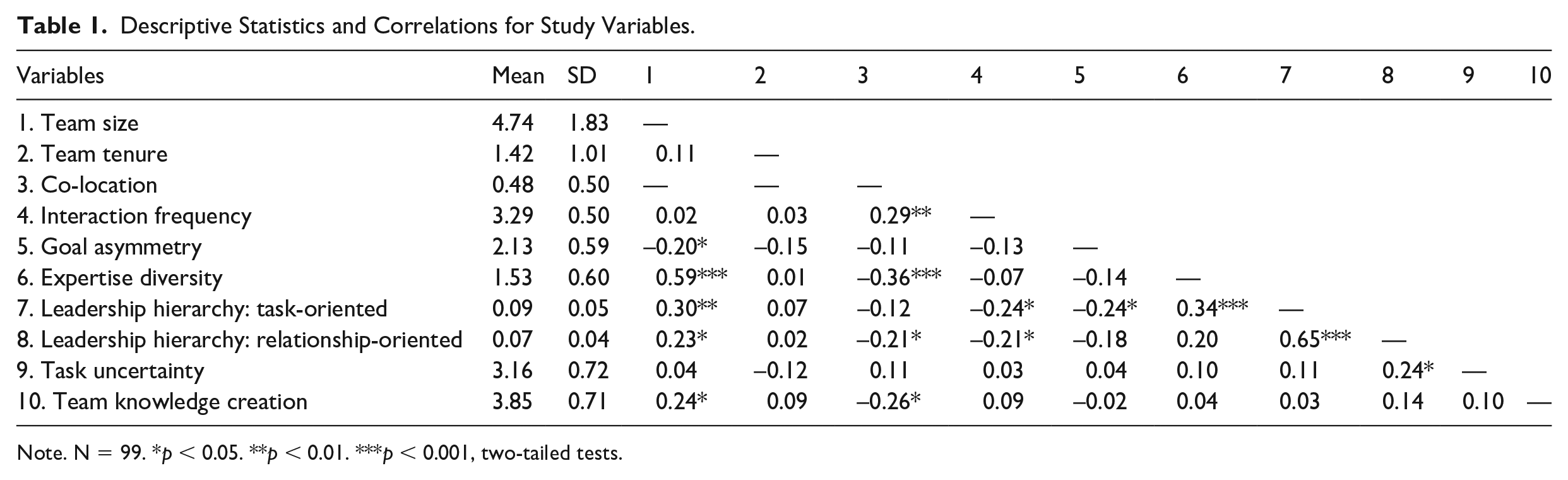
Note. N = 99. *p < 0.05. **p < 0.01. ***p < 0.001, two-tailed tests.
To test hypotheses 1 and 2, we used a series of ordinary least squares (OLS) regression analyses with standardized variables (Aiken, West, & Reno, 1991). Table 2 presents the results for the direct association between expertise diversity and informal leadership hierarchy. As model 2 in Table 2 indicates, expertise diversity relates positively and significantly to the task-oriented leadership hierarchy (B = 0.02, p < 0.5), thus supporting hypothesis 1a. Contrary to our expectations, model 4 of Table 2 indicates that expertise diversity has no significant association with the relationship-oriented leadership hierarchy (B = 0.00, n.s.). Thus, these results do not support hypothesis 1b. However, the fact that hypothesis 1a was confirmed but hypothesis 1b was not suggests a stronger relationship between expertise diversity and task-oriented leadership hierarchy than that between expertise diversity and relationship-oriented leadership hierarchy. A Wald test confirmed that this difference in strengths is statistically significant (F = 5.10; p < 0.05). Hypothesis 1c is supported.
Results of Regression Analysis Predicting Task- and Relationship-Oriented Leadership Hierarchy.
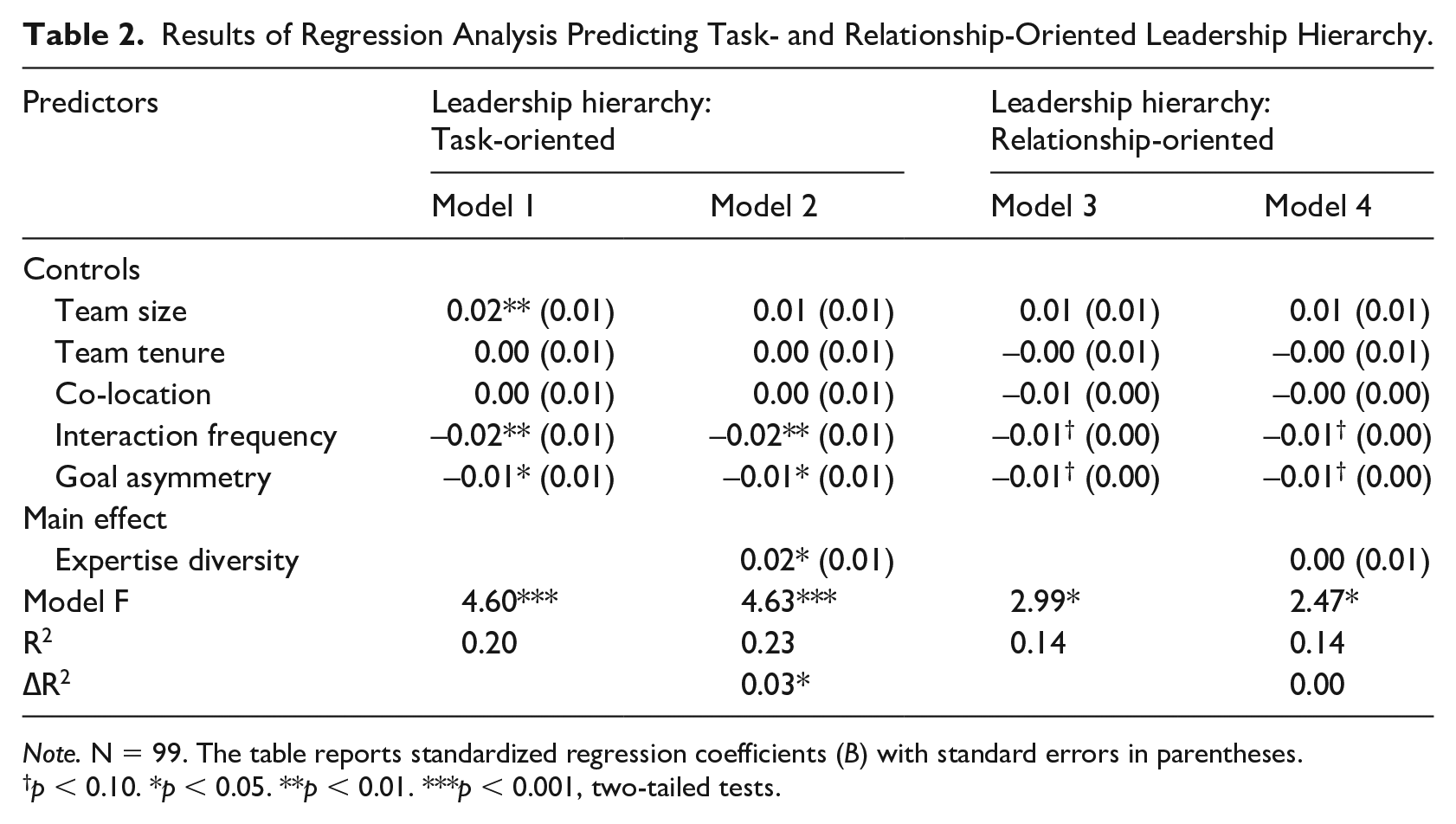
Note. N = 99. The table reports standardized regression coefficients (B) with standard errors in parentheses.
p < 0.10. *p < 0.05. **p < 0.01. ***p < 0.001, two-tailed tests.
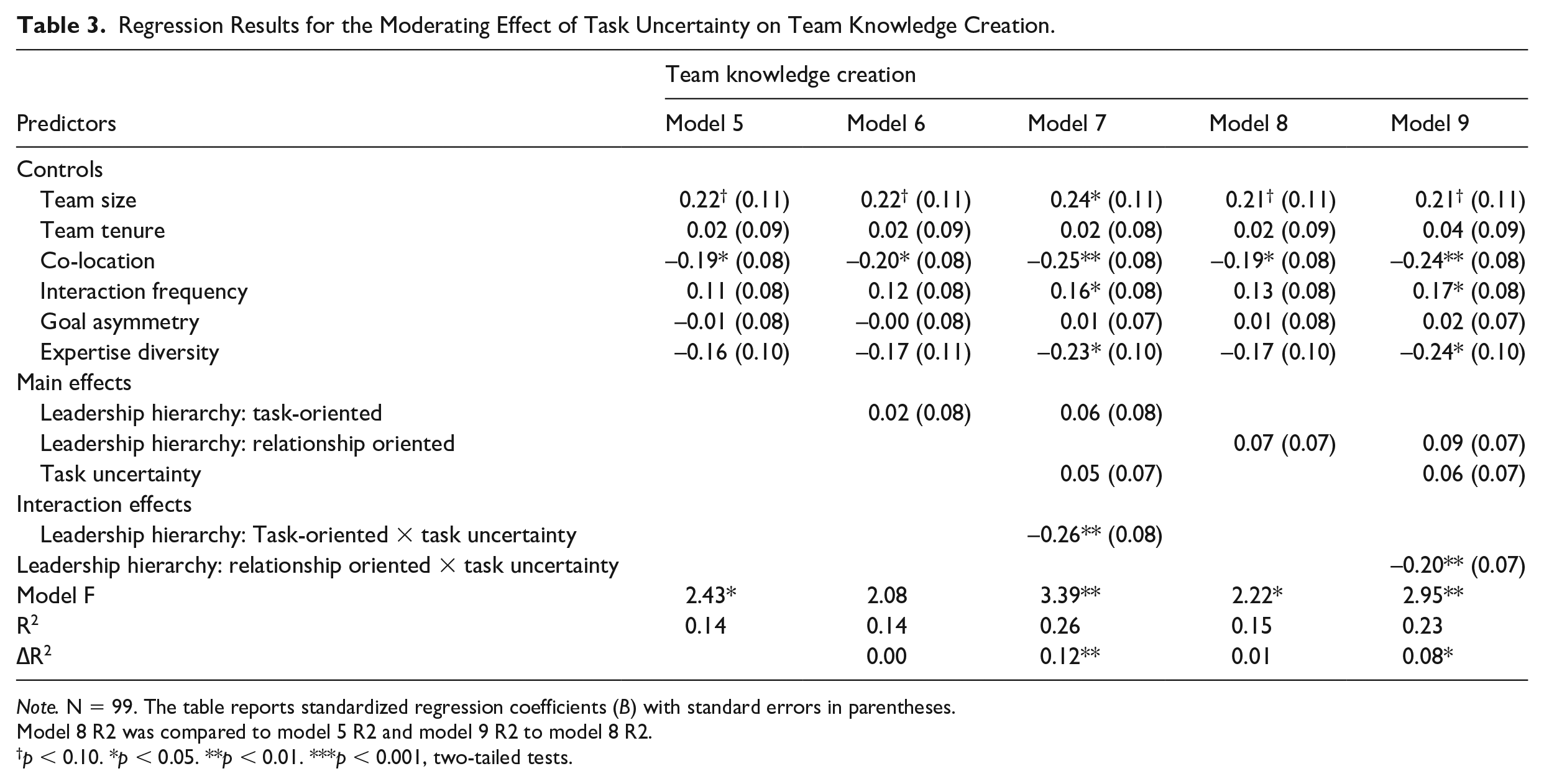
Table 3 presents the results for the moderating effect of task uncertainty. The results of model 7 in Table 3 show that the coefficient for the interaction of task-oriented leadership hierarchy and task uncertainty is significant and negative (B = ‒0.26, p < 0.01), supporting hypothesis 2a. To illustrate the nature of this relationship, we plotted the interaction in Figure 2. The grey area around the line represents the 95% confidence intervals. A particular value of the effect of task-oriented leadership hierarchy on knowledge creation is significant when its confidence interval does not include zero (Brambor, Clark, & Golder, 2006). Figure 2 shows that for teams facing a low level of task uncertainty, the effect of task-oriented leadership hierarchy on team knowledge creation was positive. However, this effect becomes negative when teams face a very high level of task uncertainty. These results fully support Hypothesis 2a.
Regression Results for the Moderating Effect of Task Uncertainty on Team Knowledge Creation.
Note. N = 99. The table reports standardized regression coefficients (B) with standard errors in parentheses.
Model 8 R2 was compared to model 5 R2 and model 9 R2 to model 8 R2.
p < 0.10. *p < 0.05. **p < 0.01. ***p < 0.001, two-tailed tests.
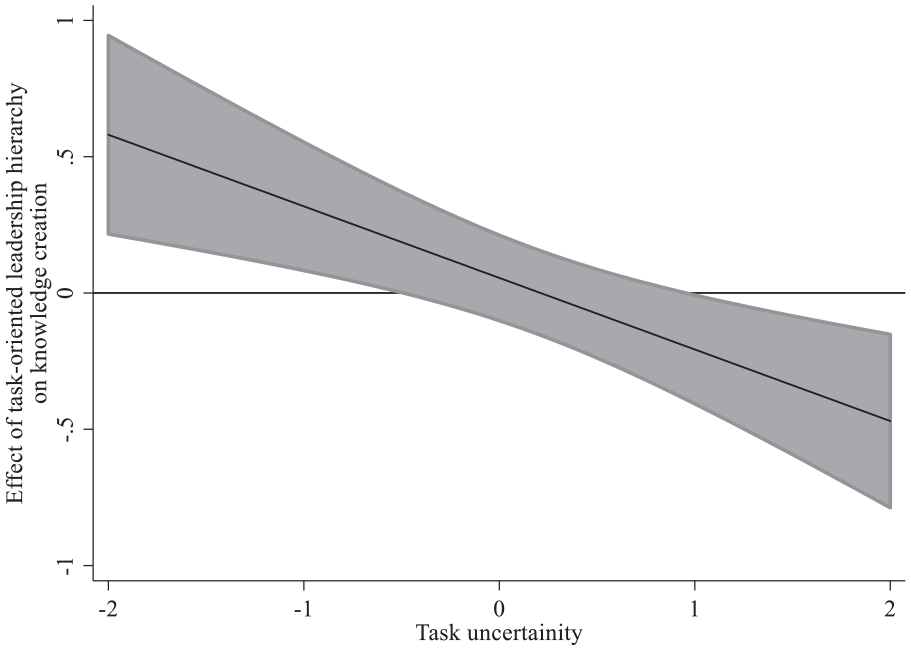
Interactive Effect of Task-Oriented Leadership Hierarchy × Task Uncertainty on Team Knowledge Creation.
The results of model 9 in Table 3 show that the coefficient for the interaction of relationship-oriented leadership hierarchy and task uncertainty is significant and negative (B = ‒0.20, p < 0.01), indicating support for hypothesis 2b. Figure 3, which plots this interaction, shows that for teams facing low task uncertainty, the effect of relationship-oriented leadership hierarchy on team knowledge creation was positive, while this effect becomes non-significant when teams face a very high level of task uncertainty. Nonetheless, these results lend full support to hypothesis 2b.
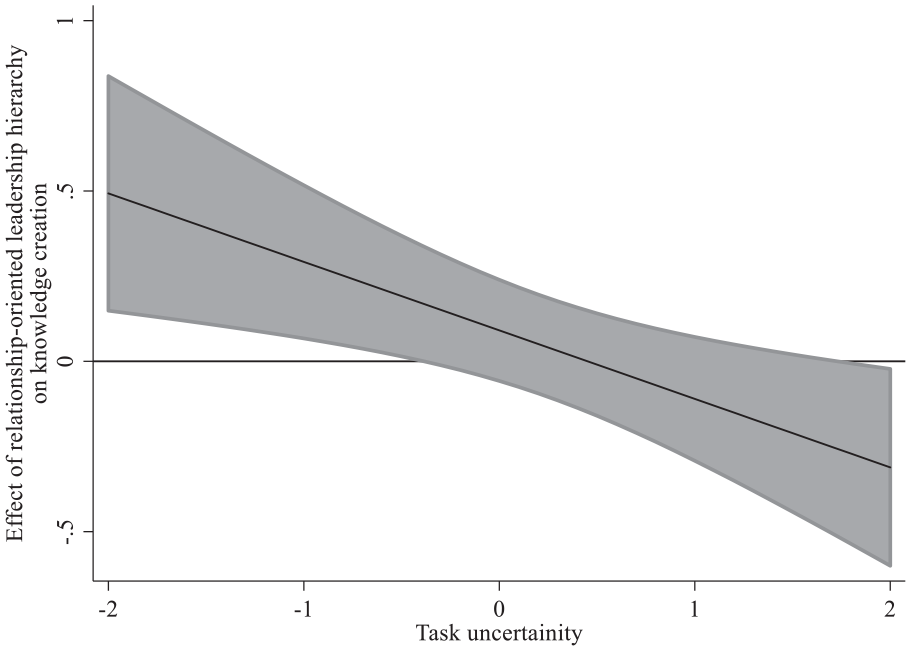
Interactive Effect of Relationship-Oriented Leadership Hierarchy × Task Uncertainty on Team Knowledge Creation.
Tables 4 and 5 present the results for our second-stage moderated mediation model to test if task uncertainty moderates the indirect effect of expertise diversity on team knowledge creation, via task-oriented (hypothesis 3a) and relationship-oriented (hypothesis 3b) leadership hierarchies. We used Hayes’ (2017) PROCESS version 3 statistical software to examine the conditional indirect effects by using a bias-corrected bootstrapping resampling technique (10,000 samples). In line with Hayes (2017, see also Preacher, & Hayes, 2004), we consider an effect significant if the bootstrapped 95% confidence intervals (CIs) will be on the same side of zero as the effect itself (i.e. either all positive or all negative).
Conditional Indirect Effects of Expertise Diversity on Team Knowledge Creation through Task-Oriented Leadership Hierarchy, Moderated by Task Uncertainty.
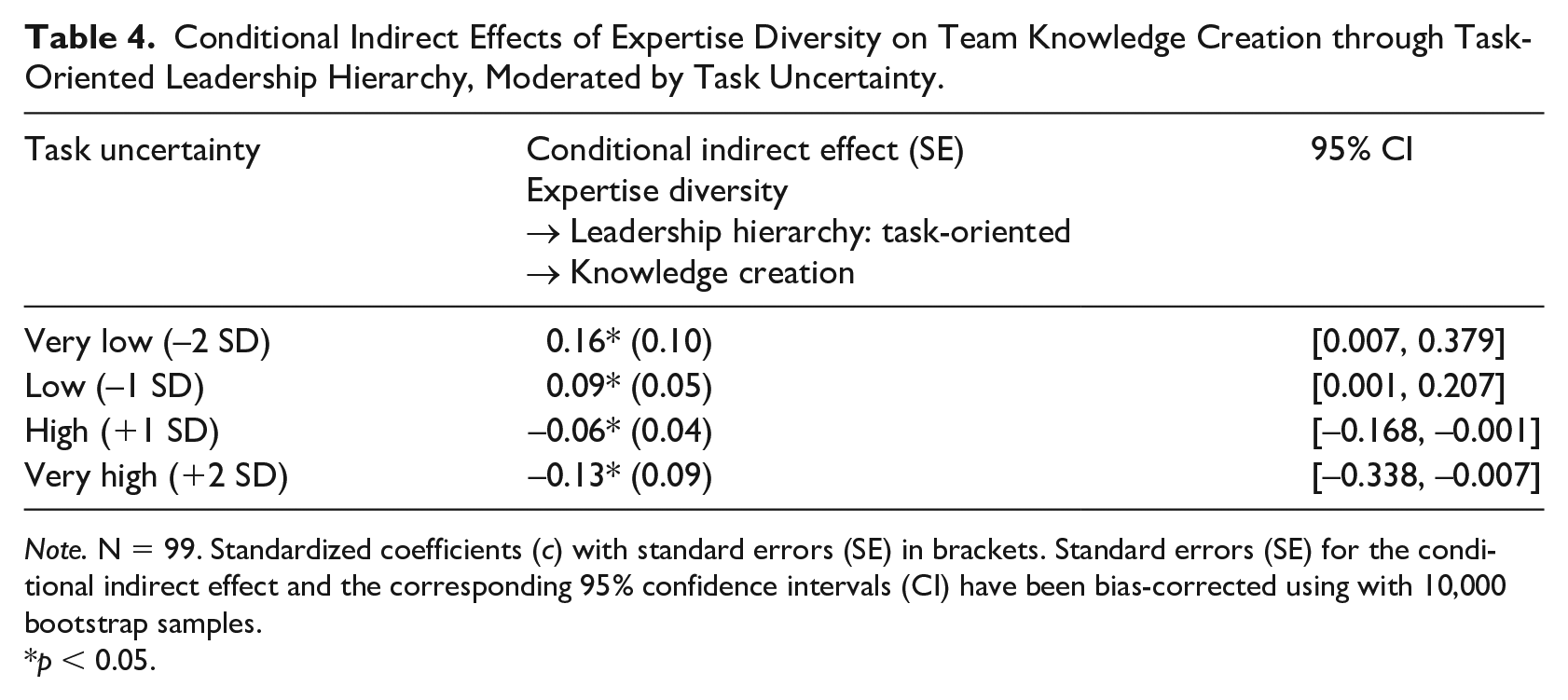
Note. N = 99. Standardized coefficients (c) with standard errors (SE) in brackets. Standard errors (SE) for the conditional indirect effect and the corresponding 95% confidence intervals (CI) have been bias-corrected using with 10,000 bootstrap samples.
p < 0.05.
Conditional Indirect Effects of Expertise Diversity on Team Knowledge Creation through Relationship-Oriented Leadership Hierarchy, Moderated by Task Uncertainty.
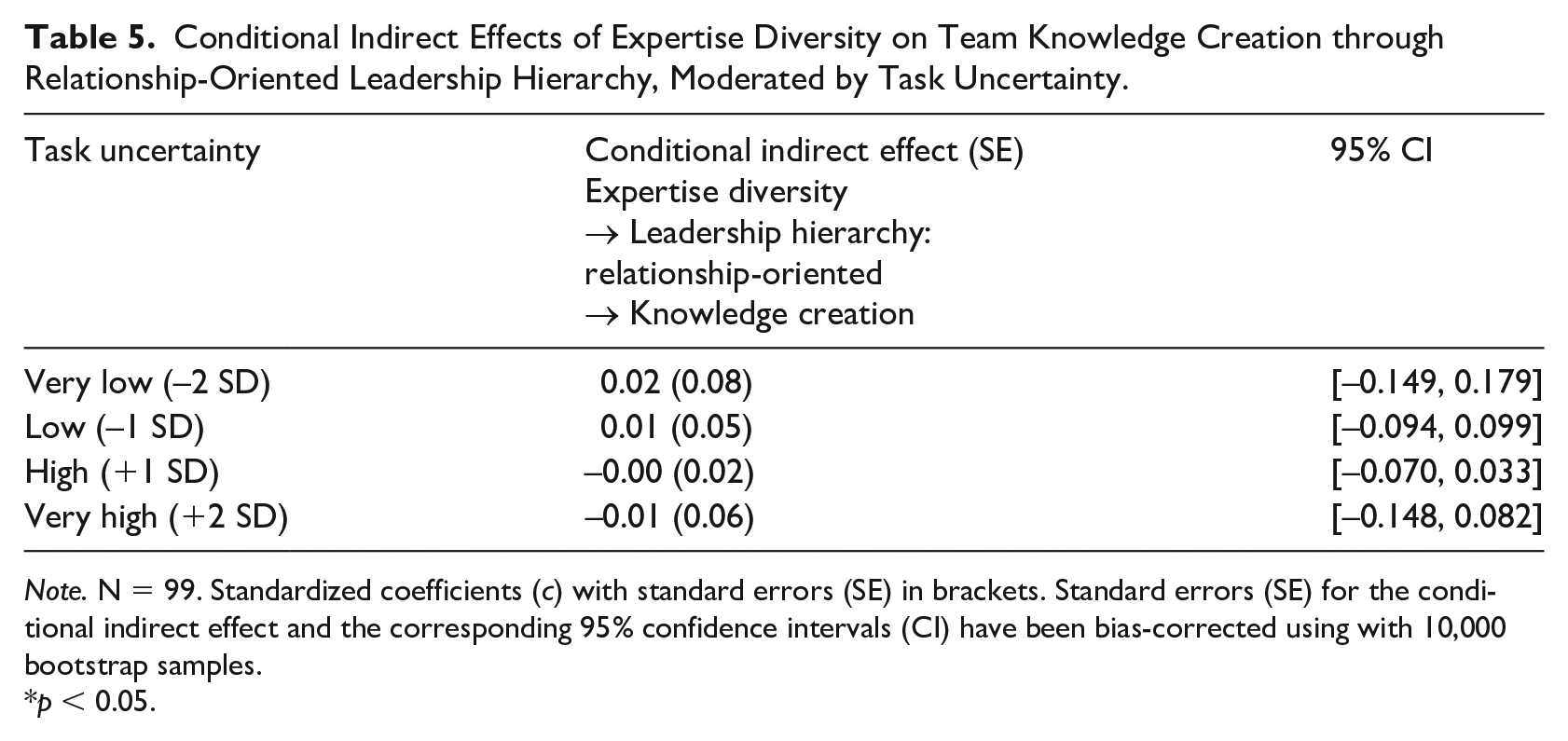
Note. N = 99. Standardized coefficients (c) with standard errors (SE) in brackets. Standard errors (SE) for the conditional indirect effect and the corresponding 95% confidence intervals (CI) have been bias-corrected using with 10,000 bootstrap samples.
p < 0.05.
The results in Table 4 show that for very low (two standard deviations below the mean value) and low (one standard deviation below the mean value) levels of task uncertainty, the indirect effect of expertise diversity on team knowledge creation was positive and significant (c = 0.16, p < 0.05 and c = 0.09, p < 0.05, respectively). For very high (two standard deviations above the mean value) and high (one standard deviation above the mean value) levels of task uncertainty, the indirect effect was negative and significant (c = ‒0.13, p < 0.05 and c = ‒0.06, p < 0.05, respectively). The index for moderated mediation was ‒0.07 (SE = 0.04, 95% CI = ‒0.176 to ‒0.004). Taken together, these results fully support hypothesis 3a.
The results in Table 5 show that the indirect effect of expertise diversity on knowledge creation via relationship-oriented leadership hierarchy was not significant at different levels of task uncertainty. The index for moderated mediation was ‒0.01 (SE = 0.03, 95% CI = ‒0.080 to 0.056). Taken together, these additional tests suggest that expertise diversity does have an indirect effect on team knowledge creation, and this effect takes place via task-oriented leadership hierarchy rather than via relationship-oriented leadership hierarchy. Thus, the results did not support hypothesis 3b. We performed a series of robust analyses and all results remain robust without any control variables and after excluding three identified outliers. Detailed results are available upon request.
Discussion and Conclusion
Pooling experts from diverse domains, collaboration teams are becoming increasingly important for knowledge creation in many modern organizations (e.g. Ben-Menahem et al., 2016). Because such teams are multi-disciplinary (Cummings & Kiesler, 2005) and more often than not self-managed (Faraj & Yan, 2009), they necessitate a renewed understanding of the relationships among expertise diversity, informal leadership hierarchy and team knowledge creation. This study investigates these relationships in pharmaceutical research collaborations. In a nutshell, we find that, high expertise diversity in teams indeed hinders team knowledge creation when task uncertainty is high. Such hindrance results from a task-oriented informal hierarchy whose coordination function is inhibited whereas conflict potential is enhanced by high task uncertainty.
Our analyses show that although expertise diversity is associated with a hierarchy in the task-oriented leadership functions, it does not relate to a hierarchy in the relationship-oriented leadership functions. Further, we find that when task uncertainty is low, the effect of task-oriented leadership hierarchy on team knowledge creation is positive, whereas as task uncertainty increases, this effect turns negative. Thus, expertise diversity has an indirect effect via task-oriented (but not relationship-oriented) leadership hierarchy on team knowledge creation, and both the strength and direction of this effect are contingent on the level of task uncertainty facing the team.
Empirically, a plausible explanation for the non-significant link between expertise diversity and relationship-oriented leadership hierarchy may be the range restriction of relationship-oriented leadership hierarchy, as most project teams in our sample demonstrated a rather low level of this type of hierarchy. Theoretically, because team members draw from distinct sources of power (French & Raven, 1959) when performing task- and relationship-oriented leadership functions, the saliency of task-related expertise may be rather limited for relationship-oriented leadership functions (Berger, 1977; Berger et al., 1980). This pattern reveals a subtle yet important difference between the two types of informal leadership hierarchy. In sum, our study provides not only empirical evidence of the existence of a within-team, informal hierarchy, but also a theoretical explanation of antecedents and consequences of the different types of informal hierarchies in teams.
Theoretical implications
Our study has implications for two literature streams – work group diversity and hierarchy in teams. First, our focus on informal leadership hierarchy as an underlying mechanism offers valuable input to the core debate in the work group diversity literature – whether and, if so, how task-relevant diversities (e.g. team members’ functional and educational backgrounds) benefit the team’s knowledge-related outcomes (Bell, Villado, Lukasik, Belau, & Briggs, 2011; Faraj & Sproull, 2000; Hülsheger, Anderson, & Salgado, 2009; Van Der Vegt & Bunderson, 2005). Previously identified mechanisms linking expertise diversity and team outcome typically relate to the team’s information processing 7 (e.g. information elaboration, knowledge sharing and team learning) (Hoever et al., 2012; Huang et al., 2014; Van Der Vegt & Bunderson, 2005). The coordination mechanisms indirectly facilitating team knowledge creation remain less understood. Our investigation of the team’s leadership hierarchy complements existing research by revealing an important reason why expertise diversity influences group outcomes.
Moreover, while scholars have long argued that team members’ engagement in leadership could be an important facilitator of teamwork when the team needs to handle knowledge-intensive tasks (Pearce & Conger, 2003), prior studies have largely focused on the actions or styles of formal leaders such as project managers or external mentors. To better understand team leadership in a collaborative, knowledge-intensive context, we have adopted a functional approach (Hiller et al., 2006; Morgeson et al., 2010), investigating informal leadership hierarchy as the disparity in team members’ engagement in leadership functions. While we are not the first to recognize that team members share responsibilities or engage in leadership to different degrees, we expand the collective leadership literature (e.g. Carson, Tesluk, & Marrone, 2007; Denis, Langley, & Sergi, 2012) by showing that team composition could promote inequality in team members’ engagement in leadership functions.
Second, our theorizing and empirical findings also extend the research on hierarchy in teams (e.g. Bunderson & Reagans, 2011; Greer et al., 2018; Magee & Galinsky, 2008). Despite wide recognition of hierarchy’s impact on team processes and outcomes (e.g. Greer et al., 2018; Magee & Galinsky, 2008), the literature has paid limited attention to the notion of informal leadership hierarchy. As counter-examples of other work teams that rely on formal authority for decision-making and task allocation (e.g. Cohen & Bailey, 1997), self-managing teams have been considered hierarchy-free. Yet, we demonstrate that even in these teams, hierarchical differentiation may occur as members become differently involved in leadership functions. Finally, we contribute to the ongoing discussion on whether hierarchy indeed facilitates collective learning and knowledge creation in teams and organizations (Bunderson & Reagans, 2011; Greer et al., 2018). Our findings showing that the effect of informal leadership hierarchy hinges on the level of task uncertainty highlight the importance of considering task characteristics when coordinating knowledge teams (Faraj & Yan, 2009). In effect, we offer a novel perspective into the conditions when such hierarchy is likely to hinder rather than benefit team knowledge creation.
Practical implications
Our research offers valuable recommendations for designing collaboration teams. As we find that high task uncertainty reduces the advantages of expertise diversity within a team, it follows that the level of diversity should match the nature of the problem that teams are designed to solve. When teams work on highly uncertain tasks, such as scientific exploration or the development of radically new technologies, limiting the degree of within-team expertise diversity may make sense. Managers external to the team can split larger teams into sub-teams, each displaying a critical mass of specific expertise (e.g. Ben-Menahem et al., 2016). Alternatively, managers can break down large complex tasks into smaller components and design teams around these tasks with a more contained level of uncertainty.
Given that the implications of informal leadership hierarchy vary across team tasks, organizations should implement measures (e.g. incentives encouraging team members to engage in leadership functions) with the specific tasks in mind. When teams face low levels of task uncertainty, maintaining a clear leadership hierarchy may help the team to better coordinate its efforts. In such cases, either external leaders or certain team routines that allocate leadership responsibilities according to the distribution of expertise can be helpful (Pearce, 2004). Conversely, when teams face high levels of task uncertainty, promoting a leadership hierarchy may not be desirable. Instead, team members with various expertise – directly or indirectly related to the task at hand – should be encouraged to step up.
Finally, most research teams (including those that we investigated) have no particular training on team leadership or team dynamics. In our exploratory interviews with scientists and technicians, many interviewees expressed more pressing concerns over teamwork and leadership-related issues than over scientific or technical challenges. In light of the strong bearing of informal leadership hierarchy on team knowledge-related outcomes, organizations will find it beneficial to provide teams with leadership training and to increase team members’ awareness of their responsibilities to share leadership functions within the team.
Limitations and directions for future research
Our study has a few limitations that call for future research. First, although our theoretical model builds upon strong conceptual and empirical foundations, we cannot draw causal conclusions from our data. Because we measured the study variables in different survey waves, reverse causality is unlikely (Podsakoff, MacKenzie, & Podsakoff, 2012). However, aside from disciplinarily expertise, other social cues (e.g. gender, age and dominance-related personality traits) could have also influenced the leadership behaviours of individual team members. To rule out alternative explanations pertaining to our theoretical model, laboratory or field experiments are required. Future research can also explore the influence of other social structures than the leadership hierarchy, such as friendship networks that reflect tie strength between collaborators.
Second, our independent variable focuses on one type of expertise diversity, which is based on the team members’ disciplinary background. While in the science and research context, disciplinary knowledge is the most salient and relevant distinction of individual team members’ expertise (Bunderson & Sutcliffe, 2002), one could well imagine other relevant differences (e.g. those rooted in different communities of practice). There are also other ways to conceptualize expertise diversity by, for example, capturing the different levels of expertise within the team. In the academic setting, this could be done by measuring the academic status diversity (e.g. Master’s students, PhD students and professors). Because our sample featured a mix of corporate and academic scientists, we could not explore this opportunity. A promising future research direction could be to compare and contrast the different types of expertise diversity and their impact on team process and outcomes.
Third, while most social hierarchies are relatively stable (for a review, see Magee & Galinsky, 2008), the informal leadership hierarchy in teams may evolve over time (Valentine, 2018). As within-team coordination demands vary across team life cycles, it may require particular structures and necessitate different task- and relationship-oriented leadership hierarchies. In our context, the different stages of a team’s research may draw on specific expertise, thereby causing changes in informal leadership hierarchy. Although in our study we have controlled for the project age, we could not precisely control for the team lifecycle or for the stage of research. Future research should explore the dynamic nature of the team lifecycle by analysing how informal hierarchy emerges and evolves during the project.
Fourth, our unprecedented access to InterPharma’s research collaboration provides an ideal context for exploring our research question, but it may constrain the generalizability of our findings. Teams in our sample consist of scientists who embrace a meritocracy culture. As a result, the degree of leadership hierarchy spans from low to moderate. It is likely that teams in which meritocracy is not part of the culture may resort to different, often more hierarchical, formal structures (Lee & Edmondson, 2017). Moreover, despite substantial variance in task uncertainty among the research projects in our sample, most of our teams were engaged in exploratory research work. On average, these teams face a higher baseline of task uncertainty than those in a general team population. Finally, as in most science, technology, engineering and mathematics contexts, teams in our sample feature a small percentage of women (26 per cent). Given these constraints on generality, we encourage future research to validate our findings in a larger variety of team and organizational contexts.
Footnotes
Acknowledgements
The authors thank Thomas Gersdorf for his excellent research assistance. They also thank Samer Faraj, Sharon Hill, Daniella Laureiro, Markus Perkmann, Marco van Gelderen, and participants at the CEIBS research seminar for their helpful feedback on earlier drafts of this manuscript.
Funding
The author(s) disclosed receipt of the following financial support for the research, authorship, and/or publication of this article. This research was partially funded by the Swiss National Science Foundation (Grant # 169441).
