




Abstract
Current debates and definitions of professionalism are primarily grounded in organisations, either as employing bureaucracies or service firms, that control and structure expert labour. This is problematic as it neglects the many neo-professionals that are self-employed. We draw on interviews with 50 independent consultants and find that, outside of organisational boundaries, they pursue a strategy of professional fluidity. This is a relational and market-driven approach that requires a multiplicity of roles and chameleon-like tactics. As opposed to notions of collegial, organisational and corporate professionalisation, professional fluidity is a co-constructed and agentic approach where validity and legitimacy are achieved primarily through relations with clients and collaborators rather than institutions or employing organisations. Through professional fluidity we contribute to a more holistic understanding of professionalism that is sensitive to the employment mode rather than knowledge domain and develops existing notions of who is a professional. This is important for wider debates on the current and future state of professions.
Introduction
Professions occupy an elevated status in society as trusted conveyers of expertise (Anteby, Chan, & DiBenigno, 2016; Freidson, 1984; Huising, 2015). They help to establish credibility and legitimacy, are a bolster to reputational capital, and help to identify trustworthy individuals (Groß & Kieser, 2006; Noordegraaf, 2007; Reed, 2018). Being seen as a professional helps to reduce risk and uncertainty for individuals and clients (Kitay & Wright, 2007). Recently, there has been much debate as to the meaning, nature and future of professionalism and it has become an increasingly contested field (Butler, Chillas, & Muhr, 2012; Heusinkveld, Gabbioneta, Werr, & Sturdy, 2018; Muzio, Hodgson, Faulconbridge, Beaverstock, & Hall, 2011a). There are many different routes to professional status (Ackroyd, 2016; Collins & Butler, 2019; Hodgson, Paton, & Muzio, 2015) with new occupations and corporate approaches challenging established collegial and organisational understandings (Abbott, 1988; Ackroyd, 2016) alongside professional and managerial hybridity (Noordegraaf, 2015).
However, despite the solo-practitioner model still being an option for many traditional collegial professions, much prior research on professions, and neo-professions in particular, assumes organisational employment. Following an ‘organisational turn’ in the study of professions (Barley & Tolbert, 1991; Faulconbridge & Muzio, 2008; Hinings, 2005), we argue that there are doubts as to how far existing conceptualisations can extend outside of the boundaries of such employment. Recent changes in labour markets, including a growth in self-employment (Ashford, Caza, & Reid, 2018; Spreitzer, Cameron, & Garrett, 2017) pose fundamental questions for our understanding of neo-professions (Leicht & Fennell, 1997; Smets, Morris, von Nordenflycht, & Brock, 2017).
This paper challenges the neglect of professionals outside of organisational employment, and specifically their professional status, which leads to an incomplete picture of individual experience of work, the complex relations between stakeholders and actors in and across occupational fields, and the wider ecosystem of expert labour that is dynamic and constantly changing (Abbott, 1988; Anteby et al., 2016; Maestripieri, 2019). Viewing whole industries, occupations, or knowledge domains as conceptualisations of professionalism is problematic (Kitay & Wright, 2007; Maestripieri, 2019). Corporate professionalism (Hodgson et al., 2015; Muzio, Kirkpatrick, & Kipping, 2011b), for example, by definition cannot cover independent variants. By addressing the neglect of self-employed neo-professionals we seek to more fully understand expert occupations and professions outside of organisational boundaries.
Drawing on 50 interviews with independent consultants, we identify the concept of professional fluidity. This is a relational approach to professional status whereby individuals adapt and blend in using a chameleon-like tactic according to market demand (Anteby et al., 2016; Maestripieri, 2019; Reed & Thomas, 2019). It stems from an ambivalence towards institutionalisation and requires alternative sources of legitimacy and validation. Professional fluidity is a novel theoretical approach that, as opposed to more macro-institutional understandings, is a micro-based approach (Reed, 2018) that is negotiated in relation to clients and markets. Furthermore, our work contrasts with the view that these workers would seek status and accreditation once cast loose of organisational bonds (Barley & Kunda, 2006; Muzio et al., 2011b; Petriglieri, Ashford, & Wrzesniewski, 2018).
Our research makes the following contributions. First, we develop the concept of professional fluidity that complements the collegial, organisational and corporate understandings. As such we address lacunas and contribute to a more holistic understanding of professionalism that includes clients, collaborators, professional bodies and other actors while also adding work context as an important source of variance (Maestripieri, 2019). Second, we question existing approaches that classify professionals based on the work done or the associations as part of a seemingly homogeneous project; there is much diversity within these domains and independent workers may have more in common with those in different knowledge domains than employed analogues. Third, we contribute to the literature on self-employment by focusing on a specific population of these workers, that is, consultants, and by showing the specific professional mechanisms through which these individuals survive and thrive. As such our work enables us to point to the future of the professions, that are increasingly situated outside of organisational boundaries (Galperin, 2017; Leicht & Fennell, 1997; Susskind & Susskind, 2015). Finally, we contribute to the management consulting literature by delving deeper into the world of independent consultants than previous work (Kitay & Wright, 2007; Maestripieri, 2019) and furthering our understanding of the understudied client–consultant relationship (Mosonyi, Empson, & Gond, 2020) which is brought into sharper focus here given the employment situation.
To put forward an empirically based conceptualisation of professional fluidity we review prior research on the professions, including the ‘organisational turn’, before discussing self-employment. We then detail our methodological and analytical approaches, and present our analysis. Finally, we outline, discuss and situate professional fluidity before considering future implications.
Existing Conceptualisations of Professions
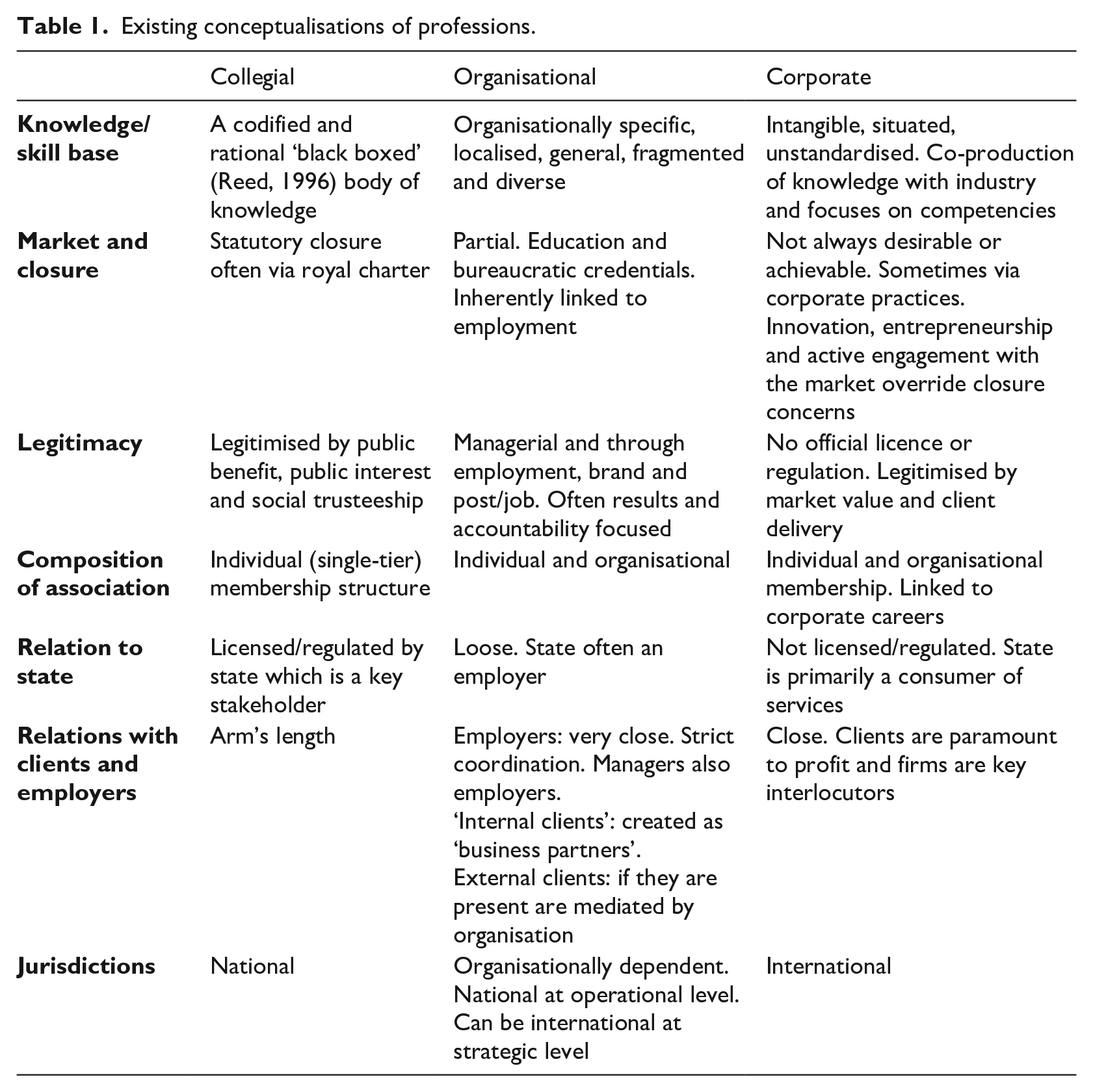
Professions are dynamic and constantly evolving (Hodgson et al., 2015). Traditional approaches proclaim unique characteristics (Brès et al., 2019): a position of public esteem and trust, abstract specialist knowledge mastered through study and socialisation, authority over clients, high degrees of autonomy, and altruistic tendencies based on explicit ethical codes (Leicht & Fennell, 2001). These characteristics establish legitimacy and credibility and provide a marker of quality to help users choose (Groß & Kieser, 2006; Kitay & Wright, 2007; Noordegraaf, 2007; Reed, 2018). Various attempts have been made to account for professionalism. Ackroyd (2016) identifies three: collegial, organisational and corporate. These are detailed and compared based on specific characteristics in Table 1 (adapted from Ackroyd, 2016; Muzio et al., 2011a; Reed, 1996). Importantly, these are abstractions, generalisations, and heuristics rather than rules or structural approaches (Brès et al., 2019; Collins & Butler, 2019; Hodgson et al., 2015; Muzio et al., 2011a).
The study of collegial professions focuses on classical solo-practitioner work (Gorman & Sandefur, 2011): the prototypical local doctor, accountant or country vet (Barley & Tolbert, 1991; Susskind & Susskind, 2015). Here, identity is occupationally derived and credibility comes from professional status which gives jurisdictional claims over certain practices and fields as part of the ‘grand bargain’ between professions and society (Anteby et al., 2016; Susskind & Susskind, 2015). They are regulated to varying degrees by a college of qualified membership (Ackroyd, 2016) which control both the production of, and the production by, producers (Hodgson et al., 2015). Despite solo practice formerly being the norm, organisations and partnerships have come to dominate this space. Knowledge and skills are based on a codified and rational body of knowledge (Reed, 1996) learnt via study with official institutions. Due to state intervention and the local basis of some knowledge, jurisdictions are normally national. In the collegiate model, knowledge and the labour market are controlled and policed by professionals themselves and these are often aided by state sanction and chartered status. What it means to be, and who is seen as, a professional is controlled by the profession itself.
Organisational professions depend on employment and are largely subordinate to managerialism (Ackroyd, 2016; Noordegraaf, 2007). Examples include accountants in private organisations and social workers in public sector organisations. Their knowledge is firm-specific, linked to local policies and technical tacit procedures. A general education means that their credentials and authority rest on employment and position in the bureaucratic hierarchy (Reed, 1996). This affects their professional socialisation and commitment to the profession and organisation (Wallace, 1995). As such, control and coordination come from employers although individuals could be members of professional associations. Such close alignment ensures that their jurisdiction is related to the organisation and its national status. Relations with clients are often mediated by the organisation both in terms of bureaucratic control and reputation. Here, what it means to be, and who is seen as, a professional is anchored to an employer.
Finally, many knowledge-intensive occupations including consultancy (Muzio et al., 2011a) have subscribed to corporate professionalism (Ackroyd, 2016; Reed, 2018). Here, professional knowledge is esoteric, non-substitutable and co-produced with clients (Hodgson et al., 2015; Reed, 1996). Legitimisation occurs through market value rather than public benefit and the market plays a key role in closure through competence and experience rather than regulations, although closure is not always achievable or desirable (Muzio et al., 2011a). The role of the state is of consumer and jurisdictions are as international as the firms. Underpinning this is the power of large organisations that have become a ‘key interlocutor and reference point’ (Muzio et al., 2011a, p. 448). Corporate professionalism challenges professional bodies given the co-production of legitimacy at the expense of corporate influence (Reed, 2018). Indeed, many individuals, alongside PSFs, are sceptical of membership (Muzio et al., 2011a; Reed, 2018; Reed & Thomas, 2019). For corporate professions what it means to be and who is seen as a professional is decided by the, often professional service, firm.
Nevertheless, professions can span or combine organisational, managerial and professional logics: a bricolage of old and new (Hodgson et al., 2015; Noordegraaf, 2015). For example, accountants and medical professionals have been subject to political pressures of neoliberalism to become organisational or corporate professions (Ackroyd, 2016; Noordegraaf, 2015). This aligns with a hybrid view that encapsulates necessary and pragmatic trade-offs. The tension between organisation and profession has long been evident and recently intensified (Noordegraaf, 2007, 2015; Wallace, 1995).
Although organisations started to play a more prominent role after the 1940s, a significant empirical and theoretical ‘organisational turn’ in the study of professions can be identified since 1990 (Faulconbridge & Muzio, 2008; Hinings, 2005). This is evident in three ways: the proletarianisation thesis, organisational employment, and the focus on PSFs. First, the proletarianisation thesis sees the subordination of professions to organisational, technological and market rationality as professionals become employees and services are sold in exchange for a salary (Maestripieri & Cucca, 2018; Muzio & Kirkpatrick, 2011; Susskind & Susskind, 2015). Second, most professional work takes place in organisational settings (Anteby et al., 2016). This increasing organisation focus is evident in collegial professions, such as medicine and law (Ackroyd, 2016) although there remains a complex interplay between organisations and profession with the former colonising the latter but professions becoming increasingly dominated by the interests of organisations (Muzio & Kirkpatrick, 2011). Finally, the explosion of interest in PSFs is further evidence for this organisational turn (Empson, Muzio, Broschak, & Hinings, 2015; Maestripieri, 2019; Smets et al., 2017; von Nordenflycht, 2010) with an assumption that PSFs are synonymous with the study of professions as a whole. We therefore see an overemphasis on PSFs with a downplaying of the wider sociology of the professions.
While organisations are clearly a key site for the interactions of various logics and professional projects (Heusinkveld et al., 2018), the growth of global PSFs challenges our understanding of the professions (Evetts, 2011). Moreover, the organisational turn has led to weaknesses in definitions and knowledge of professional work outside of organisations. Organisational and corporate professionalism place employment as central to their definition. While a changing world of work has been appreciated in work on professions (Leicht & Fennell, 2001; Noordegraaf, 2007, 2015; Smets et al., 2017), it has not necessarily been represented in associated typologies and conceptualisations. The tenets of organisational and corporate professionalism (Table 1) do not lend themselves to situations where corporate practices, bureaucratic credentials, organisational membership and hierarchical coordination do not exist; organisational employment with the firm is assumed. Yet it can no longer be the case that these cover homogeneous groups of employees subject to the same forms of control regardless of their mode of employment. Some professions, as we have seen, span multiple categories. Thus, significant segments of professional work are poorly understood compared to organisationally based work.
Existing conceptualisations of professions.
We now focus on consulting which is seen as a prominent corporate profession (Reed, 2018). Yet here professionalism is especially important as it confers credibility where there is no knowledge-base or central locus of control. Moreover, consultancy faces uncertainty and, as Kitay and Wright (2007) argue, constraints of legitimacy, efficiency and vulnerability. To mitigate these, consultants selectively deploy a variety of social roles, many of which are client-centric, such as being a professional, a prophet, a partner, a business person and a service worker. Consultants use these to construct occupational rhetorics. As such, professionalism in consultancy is still a resource on which consultants draw in a contingent manner to enhance claims to credibility (Alvesson & Johansson, 2002; Kitay & Wright, 2007). Yet the lack of credentials, and a knowledge base, means that the emphasis shifts to self-presentation, appearance and conduct (Kirkpatrick, Muzio, & Ackroyd, 2012). Rather than it being the outcome of a process of regulation and institutionalisation, it focuses more on discourses, rhetorics and behaviours; a discursive approach to professionalism that is commercially focused (Maestripieri, 2019). Nevertheless these rhetorics and approaches to professionalism focus on consultancy as a whole. Yet importantly for Maestripieri (2019) and Kitay and Wright (2007), the heterogeneity in work settings has more of a role to play in how professionalism is enacted than the knowledge base or barriers to entry as seen elsewhere. This is important given the organisational turn in professions as a whole, but also the underpinning assumption in consultancy of organisational employment (see Mosonyi et al., 2020).
Self-employment
Self-employment is complex and heterogeneous with different international definitions and overlaps with terms such as freelancer, contractor, subcontractor, and various other company setups, only some of which are relevant (Ashford et al., 2018; Cappelli & Keller, 2013; Spreitzer et al., 2017). We draw on legal definitions and labour force surveys from the United Kingdom (IPSE, 2018) to define ‘solo’ self-employed as those who work for themselves and run businesses on their own account without employees and who take responsibility for its success or failure. They have a contract for services rather than of service and do not have the same employment rights and responsibilities as employees. Rather than building an enterprise to grow and then be sold on, they engage in independent and self-supporting work that centres on a product, service or idea (Gratton in McKeown & Leighton, 2016).
Self-employment contrasts with the ‘standard’, full-time and dyadic employment relationship yet is a significant portion of many workforces (Ashford et al., 2018; Cappelli & Keller, 2013; Spreitzer et al., 2017). In 2016, 6.4% of the United States workforce was self-employed, 10.6% in Japan, 15.8% in the European Union and 25.5% in Korea (OECD, 2018). In the UK in 2017 self-employment accounted for around 15.1% of the total labour force (ONS, 2018). Importantly, the significant growth has been sustained and resilient since 2001 (Lockey, 2018). This is, therefore, not a cyclical but structural labour market transformation. The factors affecting the growth are myriad but include digital and technological enablers, changing social attitudes and needs based on demographics (Ashford et al., 2018; Lockey, 2018), a host of ‘izations’, the growing power of big business and desire for freedom and individualism where self-interest replaces class or company-level interest (Fleming, 2017; Švarc, 2016). Local employment protections are traded for increased freedom and autonomy although the costs and risks are transferred. Individuals perceive that they become more autonomous and independent as well as gain security from downsizing and managerial control (Lockey, 2018). While motivations vary, some choose it from a position of relative comfort and others are forced during lean times (Spreitzer et al., 2017). For organisations, self-employed individuals are an on-demand source of experience and knowledge that can work with existing knowledge stocks, helping to meet demand surges, and lower fixed costs (Spreitzer et al., 2017). They often perform important work for organisations by whom they are managed but not legally employed (Kinnie & Swart, 2020).
Self-employment is highly relevant for professions. Notwithstanding the fact that the biggest rise has been in Standard Occupational Group 2 ‘Professional Occupations’ (IPSE, 2018), the collegial understanding of professionals traditionally had a significant portion of sole practitioners (Freidson, 1989) and many professional associations have their roots in early-modern guilds (Smets et al., 2017). Yet most professionals are currently salaried employees (Evetts, 2003, 2011) and this is reflected in the organisational and corporate modes of professionalism whereby control is ceded to others with reduced autonomy and independence (Freidson, 1984; Reed, 2018). However, self-employment is becoming increasingly relevant for professionals again and professions are not immune from the wider workforce changes and trends outlined here. Changing work preferences and career expectations require change from professions and organisations as employers (Noordegraaf, 2007, 2015; Smets et al., 2017; Švarc, 2016). Furthermore, these changes are important for those looking to attract and utilise skilled labour that increasingly exists outside of organisations and employment.
To summarise, professions are vital to understanding how expert labour is controlled and operates. Yet we need to be attentive to the institutional context (Ackroyd, 2016; Maestripieri, 2019; Maestripieri & Cucca, 2018). Following an organisational turn in the study of the professions (Hinings, 2005) employing organisations have come to dominate our understanding (Ackroyd, 2016; Anteby et al., 2016). Given recent trends and changes in the world of work (Ashford et al., 2018; Petriglieri et al., 2018), we see this as an oversight; not only are organisational and corporate modes incompatible with self-employment, they also do not reflect the current reality of expert labour and neo-professions. This requires addressing if we are to fully account for the experience of professional status (Noordegraaf, 2007, 2015; Smets et al., 2017).
Research Design
Methodology
We conducted a qualitative study grounded in pragmatist philosophy and abductive inquiry that compares and iterates between theory and empirical material (Martela, 2015; Timmermans & Tavory, 2012). A pragmatist approach relies on experientialism to produce warranted assertions and guidance with inference to the best explanation that is historically contextual (Martela, 2015). Specifically, this paper derives from an investigation into the experience of bonds of commitment, a field dominated by commitment to an organisation alongside targets including professions (Kinnie & Swart, 2012; Wallace, 1995). We sought to challenge the assumption that one must be committed to an organisation. We chose to investigate consultants as it is an area that we are familiar with and there was a sizeable and largely understudied population. The ‘independent’ variation enabled us to challenge the organisational aspect. We did not set out to study professionalism; however, we expected a coherent ‘profession’ given previous work on professional commitment and consultancy (Empson et al., 2015; Kinnie & Swart, 2012; O’Mahoney & Markham, 2013).
Participants and empirical material
We completed semi-structured interviews with 50 independent consultants in the UK recruited via existing networks, professional networking websites and snowballing; conventional organisational access was difficult given their independent status (Petriglieri et al., 2018). The majority were approached via LinkedIn without any previous connections or contact (see online material Table A1). Independent consultants are loosely defined so theoretical selection criteria were used that triangulated theoretical domains. Participants required a high level of human capital demonstrated through their experience and tacit knowledge (Swart, 2006), multiple business clients, no employer (Cappelli & Keller, 2013) and work with low entry barriers (Kitay & Wright, 2007; von Nordenflycht, 2010).
Participant overview.
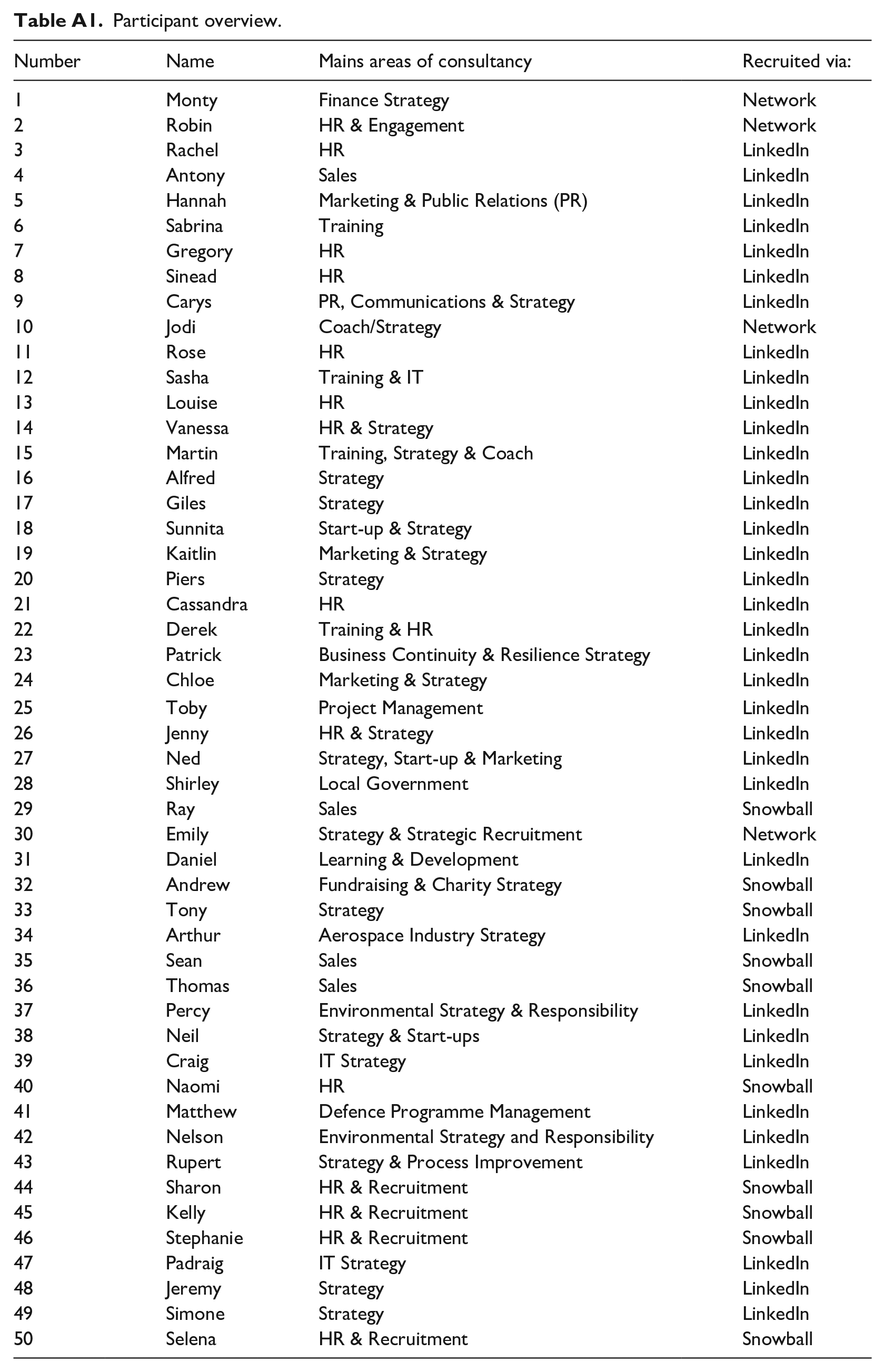
Interviews lasted between 50 minutes and 2 hours. Of the 50 interviewees, 23 were female and 27 male. ‘Independent consultant’ was the most commonly reported title and individuals grouped into five specialties (Table A1) although many straddled multiple fields (Kitay & Wright, 2007). This is a strength of our participant group, a sample of management consultants that cuts across and incorporates a wider scope of professional and occupational groups (Muzio et al., 2011a), which negates some of the limitations of studying one distinct profession or knowledge domain, an issue to which we return later. Although they self-identified as consultants, this usually followed a career in their respective field. Importantly, very few had been an employed consultant.
Interviews, which were recorded and transcribed verbatim, made use of the long interview (McCracken, 1988), participant drawings and the critical incident technique (Flanagan, 1954). The drawings facilitated exploration; they were a figurative and literal blank piece of paper rather than starting with preconceived ideas of professions (Wallace, 1995). This led to multimodal material and we refer to some of the metaphors drawn. These three methods enabled data and methodological triangulation in co-constructing empirical material.
The interview guide contained questions around experiences and motivations, such as ‘How do you describe what you do?’, ‘How did you come to work this way?’, and ‘How do you get new business?’ Participants were asked to identify important work relationships and entities. Clients, professional bodies and collaborators regularly emerged. Critical incidents were then used to explore these relationships and specific rather than general experiences. In the case of professional bodies participants were asked about their motivations and what they derived from membership. When they were not represented, we asked why.
Analysis
As part of the wider research project, we conducted a thematic analysis (Braun & Clarke, 2006). We generated initial codes from the interview transcripts by taking units of meaning and assigning labels. We collated codes into identified themes before grouping into aggregate themes. Throughout we reviewed to refine and check for relations between coded extracts and the overall themes. This analysis led to familiarity with the setting and empirical material, and alerted us to the importance of clients and the lack of organisational anchors. Based on our knowledge of previous work and theory (Timmermans & Tavory, 2012), we expected individuals to have a distinct and identifiable profession (Kinnie & Swart, 2012; Wallace, 1995) and to use this as a form of anchoring given the absence of organisational ties (Barley & Kunda, 2006). This was largely absent across the interviews and analysis. We therefore encountered a ‘breakdown’ (Alvesson & Kärreman, 2011); our findings could not be explained by our theoretical knowledge. We discussed this with colleagues and others while reading widely and constantly developing the mystery. We expanded and deepened our ‘interpretive repertoire’; that is, ‘the theories, basic assumptions,. . .metaphors, vocabularies, and knowledge’ (Alvesson & Kärreman, 2011, p. 48) that we used to confront empirical material. We did this through the literature on professions (Ackroyd, 2016; Anteby et al., 2016). In corporate professionalism we identified an assumption that professionalisation, membership of a consultancy association and qualifications would help those who were self-employed given that they do not operate under the auspices of an organisation (Donnelly, 2011; Muzio et al., 2011b). This contrasted with our empirical material which we reanalysed abductively and found distinct differences with the organisational nature of professional work.
We could not explain the professional status of these individuals and we sought to develop an explanation. Returning to our initial codes and framing we used ‘metaphorisation’ (Alvesson & Kärreman, 2011), including the metaphors that participants used, to explain the phenomenon in other language. This centred on fluidity, ambiguity and flexibility. Through repeated discussions and sense checks we developed these to connect to themes, such as the work that they did, their relationships with clients, professional bodies and organisations, and notions of validity, legitimacy and credibility as well as the wider landscapes of self-employment and consultancy. These are central facets of the professional fluidity that we present below. 1
Findings
In our findings we identify the themes which are key to understanding professional fluidity. First, we show an ambivalence towards institutionalisation, including professional bodies and organisations; this is an important precondition to professional fluidity and contrasts with the approaches outlined above. Our next three themes detail the market and client-oriented focus. We show the variety of work that independent consultants do as the foundation of their fluidity and an alternative view of ‘professional work’. Our third theme unpicks the multiplicity of personas that our respondents present externally, including metaphors such as the notion of being a chameleon. Finally, given the lack of many conventional markers of professional legitimacy and validation, we end by showing how these are sourced from collaborators and clients.
Ambivalence towards institutionalisation
Our participants related a range of attitudes towards institutions, particularly professional bodies, associations and employing organisations. Membership of professional bodies did not always align with their work label; consultancy as a community of practice or consultancy professional bodies such as the Institute of Consulting were not mentioned by participants. We see that this is symptomatic of a general ambivalence towards the outside imposition of norms, rules and control and show this through attitudes of positivity, apathy or cynicism, and outright rejection.
Those that were members of professional bodies were members of several. They maintained their membership to demonstrate active participation in a work-based community of knowledge. Some were influential members of local or national executive committees alongside and representing employed professionals. Membership helped them to demonstrate expertise: I’m a member of. . .the Institute for Sales and Sales Managers and there are groups on LinkedIn. . .I’m looking to become part of the Professional Speakers Association because, again, to demonstrate your expertise, one has to stand up and talk about it. (Ray)
As such, membership could serve as a proxy replacement for, or even deliberate avoidance of, qualifications or certification in certain industries: There is a Chartered Institute of Library and Information Professionals. I don’t have a background or qualification in that but I’ve done a lot of work. . . in that sector so I was a member of them for many years. (Carys)
Membership was often situated and time specific. It was linked to streams of work rather than necessarily a whole career; when the stream dried up, they would often leave and move on. Yet membership appears to have been personally driven rather than required by clients.
Nevertheless, this membership of and engagement with multiple professional bodies sometimes contrasted with a general apathy towards or questioning of such bodies; this only surfaced when directly asked: I’m not sure anymore [why I am a member]. The magazine I get sent doesn’t get opened and I put it in the recycling normally. I paid the fee last year but I thought, ‘What am I paying this for?’ I’ve been thinking about this for a while. . . maybe I’ll go home and cancel it. (Cassandra)
Some felt that they did not get much in return for their time, effort and money. Yet there was still a perception that they needed or ought to be paid-up members rather than a genuine desire: Whether I take advantage of them or not, I feel like I should [be a member]. So, what I probably should look at, if I was being really disciplined, is get[ting] rid of them and actually fully take advantage of the one I am a member of. But. . .I don’t. (Andrew)
The cynicism concerning professional body membership from some was pragmatic and also based on frustration directed at institutional bureaucracy: I was a member of the Chartered Institute of PR for many years and didn’t feel that they did anything for me apart from take my money, so I’m no longer a member. . . I was so fed up with their lack of organisation and bureaucracy. . .I’m not a big fan of membership bodies actually. You’d expect a lot of freelancers [to have] almost a requirement to be in a membership body, but no. (Carys)
This frustration was developed further by those who were outright hostile towards professional bodies as restrictive institutions. There was a strong, almost visceral, reaction from some: I don’t know what they are for, really. I have a slight fear of clubs. I’ve never seen the value of it to be honest with you. . . I don’t see the value or feel the need to join. I really don’t. . . And I don’t know what club I would join either because I don’t know what ‘this’ is. I don’t think there is a professional network for ‘this’. (Neil)
Rejection was therefore based on personal characteristics and values but was also linked to the centrality of flexibility in their work. The difficulty of defining what they did, as well as demands for freedom, meant that professional institutions were seen as neither needed nor helpful by some: I’m not a member of any professional bodies now. . . I’ve found for what I’m doing it doesn’t really help. In my industry, it doesn’t really do a lot of good, especially at a global level. (Chris)
The diversity of views that can be summarised as an overall ambivalence towards professional bodies demonstrates a straddling of these rather than a targeted or standardised approach. Moreover, membership of any was by no means a given.
In addition to ambivalent feelings toward professional bodies, participants were also rejecting the social structure of employment and organisations through their independent working. For many, entering this way of work was a way to ‘take control’ (Giles), either from an employer or manager, or from the vagaries of organisational change. Where redundancy was a catalyst, rather than seek employment, they turned to independent work. This was not always a reaction to events; some felt it was inevitable and the result of an innate rebellious streak ‘that doesn’t like control’ (Jeremy) or an inability to ‘toe the line. . .and become more corporate’ (Neil) thus escaping the corporate world through independent work. The outcome of this was a feeling of being in control and ‘entirely the master of my own destiny’ (Chloe), ‘I’m in control. . .no one else’ (Hannah). This was compared to and contrasted with ‘the corporate machine’ (Sean).
This section shows an overall ambivalence towards professional institutionalisation and the control of these structures. In contrast to existing understandings, there was no organisational requirement for membership of any professional body nor was it a requirement to practice or required by clients. It was outright rejected by some. Moreover, moving into independent work was a way of taking back control, rebelling and increasing perceived freedom and choice.
Variations of (professional) work
Our participants recounted a wide variety of tasks and client demands that they fulfilled. This included what might be termed as professional work, but also that which spanned the spectrum of Barley and Kunda’s (2006) gurus, hired guns and warm bodies. For the majority of their work participants required high levels of human capital; they did work of strategic consequence alongside senior leaders in multinational organisations ‘planning, where are we heading to, why, where do we want to get to’ (Andrew). This was the ‘high level. . .heavy lifting of thinking’ (Ray) that was ‘creating something leading edge, explosive, exciting’ (Vanessa). Many spoke of delivering bespoke and highly tailored work to clients in an ‘advising capacity, not employed to do a job’ (Vanessa); ‘I couldn’t configure your firewall. But I can develop an IT strategy for you’ (Padraig). As such, they worked at a much more senior level than that at which they had ever been, or could be, employed.
Many explained that their client work was esoteric and tacit in nature; that they were selling ‘a style of thought’ (Vanessa) or ‘myself, me, my brand’ (Shirley) and that ‘the proposition is the independence. . .and the straight answer you’ll get’ (Andrew). There was a perception that few else could do what they did and that clients came to them for that reason. Rarely was there a product or standardised work to sell.
While some of this was lucrative daily rate work, retainers were common. Many described being the on-call expert for clients. Although this was not always strategically important it was still seen as vital and time critical. Described as ‘bread and butter’ work, it provided financial security through a fixed or baseline level of income that enabled them to deal with the ‘famine and feast’ and doubts over ‘where the next piece of work is going to come from’ (Ned). This meant that they could pursue other more creative, bespoke and highly paid work.
Alongside this was more administrative work. As an independent consultant, they were ‘more of a businessperson than a HR person because I am my financial director. . .IT department. . .and bottle washer’ (Robin) which required knowledge of areas including tax, finance and law. This was coupled with unpaid time chasing payment and business development work. ‘I’m not a salesperson’ was a common refrain yet sales were needed for their future work and financial survival. It required the ambidexterity of exploiting existing work and clients while exploring and prospecting for new opportunities. Summarised as ‘I will be working on my business. . .not in my business’ (Kaitlin), this administration and business development work is normally done by specialist support staff in organisations.
There was, however, some work perceived as boring or mundane. Whilst paid, it was quite basic such as ‘marking some case studies’ (Emily) or ‘setting up a website for a friend’ (Padraig). This menial work clashed with perceptions of being a professional: I was asked to go and do some quite junior and not very exciting work as a favour. . .it was confidential and. . .they needed people they could rely on and trust. . .so I was asked to go and take notes. I don’t do notetaking. That’s not my job. I’m a professional. But I went because it’s a good client. I want to work with good clients and also there are no bad opportunities. (Stephanie)
Although this mundane work conflicts with perceptions of being a professional, it could still be intense and stressful: I’m not fussed what it is. . .I draw a line at cold calling research. . .not too long ago. . .I did a piece of work I would call proper monkey work. . .it was 3 days digging around on the websites of 1100 companies to see who their print solution provider was. . .the only way to do it was by putting a stopwatch on with a minute per company. So it turned into a challenge. . .but yeah, it was monkey work. (Ned)
Nevertheless, this ‘monkey work’ work could serve a purpose at multiple levels. There was a financial need; ‘good honest work’ (Emily) that was without the usual ‘buzz’ but filled a gap during a quiet period when the alternative was no work at all. This was also a form of social exchange, a favour to others. Finally, this work enabled them to vet and gain a toehold with clients that they could work with in the future, or even receive offers of employment. The risk was that the client saw them as a lower-skilled individual and would keep sending them this work rather than that deemed ‘professional’.
Fluidity and multiplicity of client-facing personas; being a chameleon
The nature of the work links to the wider avoidance of labels, categorisation and the relatively fluid persona that they presented. This can be summarised in a metaphor that regularly emerged, a client-centred camouflage of ‘being a chameleon’. The avoidance of labels or categorisation can first be seen in the professional networking site LinkedIn, a vital component of their online presence yet seen by some as ‘a nightmare’ because a fixed label ‘blows your cover’ (Ned) when trying to be seen as either an independent consultant or an employee of an associate consultancy. On the other hand, traditional business cards enabled multiplicity. Those that did carry cards, contrary to employed counterparts, carried and presented various kinds depending on the client situation and what they wanted to be. The same person could be ‘director’ or ‘management consultant’ across many different entities. As such, business cards helped them to be different people and maintain ‘that loose terminology of what you actually do’ by fulfilling ‘different things and do it in different parts of the world with different businesses’ (Derek).
This fluidity and vagueness were developed further using metaphors, talking about something through the language of another. We encountered comparisons with ‘a cloud. . .quite undefinable. . .when you try to grab it it’s not there’ (Sunnita), an ‘amoeba. . . it’s dynamic and can change shape and adapt. . .They’re fluid. . .or they’re not solid state, at least’ (Vanessa), wearing different hats for different clients, and ‘nailing jelly to a wall’ (Piers) when trying to explain what they do. These metaphors show a vagueness and multiplicity in what these independent consultants presented to clients, and were central to their existence. The chameleon metaphor focused on an ability to camouflage and ‘change colour to suit [the client]’ (Robin) and required thought to avoid issues and conflicts on a daily basis: ‘I have to remember who I work for and which business card. I’ll be different on different days’ (Derek). Being different people with different clients and constantly having to change to blend in could be tiring, risky and stressful, yet it was inherently part of their work life: I find that in the work that I do I’m a bit of a chameleon. I will be a different person with this client than with this client and with this client, depending on what they need. That’s part of my skills. . . you have to work in a different way. (Chloe)
This vagueness, indeterminacy and fluidity were relevant at every stage of client work, including the early engagement process, when the client did not always know what, or who, they needed.
It is worth developing the chameleon metaphor here, which is also present in the study of Reed and Thomas (2019) on the indeterminacy of PR professionals. First, chameleons change their skin colour to blend in as a reaction to the external environment. Indeed, some have evolved according to the vision of specific predators (Stuart-Fox, Moussalli, & Whiting, 2008). Hence being a chameleon is largely driven by the desires, demands and expectations of clients and is linked to being ‘whatever the client needs me to be’ (Vanessa). Second, for chameleons, this is an evolved survival mechanism for catching food or avoiding predators. This relates to the precarity of a self-employed position and wider constraints of being a consultant (Kitay & Wright, 2007). Here, the ‘catching food’ relates to winning more business and therefore maintaining a flow of income. Other responses exist for employed professionals and their organisations that are not necessarily options for independent workers in the competitive ecosystem of consultancy and professional work. As such they adopt a tactic of chameleon-like client-centred camouflage. Taken together, these metaphors and tactics represent a dynamism and multiplicity in the personas and role that these independent consultants presented to clients, and this was central to their existence.
Alternative sources of legitimacy and validation
Working outside of the structures of employment, participants were unable to rely on corporate hallmarks of professionalism or legitimacy. Moreover, they were not part of a formal sheltered profession with entry barriers, regulation, professional qualifications or accreditation. Yet legitimacy and validity, that is the perception of being authentic, authorised, genuine and bona fide which can lead to being a trusted and professional businessperson and advisor, were vital for the independent consultants in this research. They were financially beneficial by helping to secure more work. Furthermore, there were insecurities in a crowded consultancy industry and they needed a riposte to a discourse of self-negativity. This included doubts when starting out and embarrassment at working this way; a perception that they were scraping a living despite high billing and previous executive appointments for many. Piers compared himself and others in his position to ‘[B]ottom suckers, the barrel lickers, the people at the bottom of the consultancy chain. . . a grimy little sub-sector’. Some felt that this was a passing phase or trial, a chance to ‘scratch the itch’ before getting ‘a proper job’ (Antony) despite he and many others doing this for over a decade. To compensate for the lack of a corporate grouping or professional body, legitimacy was perceived to flow from collaborators and clients.
‘Collaborators’ referred to specific, self-employed and already known individuals. Because clients might be reluctant to contract with consultants who were ‘lone wolves’, collaborators helped to create an impression that they were bigger than they really were. This mimicry of larger organisations included having websites that looked like a formal consultancy with ‘our staff’ and ‘our clients’, ‘But it is just me. If you look at my website, it does appear that I’m bigger. . .. If I need, I’ve got four colleagues that I bring in. That’s how it works’ (Robin). This extended to ‘packing the room’ in client pitches and tender processes: All it takes is a phone call really and they’re fine, ‘we’ll help you, even if you want us to just go to a pitch to make it look bigger, fine, we’re not expecting any work’. . .We do that quite a lot. Making up the numbers. (Sandra)
Having a core of collaborators was part of a mutually beneficial relationship whereby ‘warm bodies’ gave the impression of a larger project team even if only one person would actually be working for the client, something that clients were often unaware of. It was a way of circumventing the lack of organisational membership and gaining legitimacy that, in turn, enabled them to win work and compete in the market. Importantly, this was achieved without obligation or formal ties of employment.
Collaborators were also used to borrow or collectively pool skills, reputation and credibility and again this was often in direct comparison to competitors and larger consultancy firms: They’re looking for the likes of McKinsey or EY and they’re going to be charged £12,000 a day. They come to us and we say that we can do this whole report in a week and it will cost you 10 grand. They’re going, ‘Hang on, this is dirt cheap compared to McKinsey’. . . You put [the bid] in and say, actually, there’s three of us working on this and the backgrounds are the following. Even if I don’t use them, I’ve got to show expertise and size behind me. . .Then you put it down: what they’ve done, where they’ve been, who they’ve worked with and you build it that way. (Arthur)
Here, Arthur highlights to the client the credibility of others that he works with regardless of their level of input. This was common; forming a community of collaborators who could be counted on to work or attach their name and reputation to others, to help secure work that they might not otherwise have been able to get: If it had just been me on my own, they wouldn’t have been interested. . . we look a lot more credible for that piece of work as a proper team. (Carys)
In addition to collaborators, current and previous clients played an important role in constructing credibility. This could be, as is common with service work, in the form of pre-engagement references such as referrals from satisfied, and sometimes ‘elite’ (Kitay & Wright, 2007), clients. Yet those that were just starting out spoke of doing free work to be able to get the client on their résumé. While it could lead to longer-term relations and pro-bono and speculative work are common in consultancy (O’Mahoney & Markham, 2013), here it was akin to unpaid internships to gain experience and credibility. Having clients and a track record of work helped to demonstrate that they were a good consultant, busy and in demand: It’s like when you’re house hunting. You want to know that other people are looking at the same house. . .Clients want to know you have other clients. . . But they want to be your number one and don’t want to know what you get up to with them. . . They want to know you are busy but they want to be your number one. (Chloe)
Much of this was impression management work. Clients assumed that unavailability was due to the consultant working with other clients rather than perhaps taking a day off. The impression of being busy with others meant that consultants were more likely to be competent, credible and in demand. This was a ‘vicious circle in a positive way’ (Derek) because clients would not take on a consultant who could not demonstrate experience, but once they could then more clients would.
Discussion
In this paper, we empirically develop professional fluidity as an approach that complements current understandings of collegial, organisational, corporate professionalism. We argue that professional fluidity is a relational approach to professional status whereby individuals adapt, change and blend in according to market demand. We discuss this further and identify two key mechanisms of professional fluidity: (i) the way in which legitimacy and validation are established; and (ii) the flexibility shown and required.
First, legitimacy and validation are neither established through external institutions such as professions or employing organisations but are sourced from collaborators and clients. Collaborators validate and legitimise each other as skilled and knowledgeable by choosing to work with others to borrow credibility and pool expertise. Rather than conflict, this relies upon collaboration, connecting and mediating across mutually beneficial relationships (Abbott, 1988; Anteby et al., 2016). This grouping together in project network organisations avoids the appearance of a ‘lone wolf’ to clients and in response to market conditions enables them to offer a wider range of services (Maestripieri & Cucca, 2018; Manning, 2017). Clients, as the central work foci, validate independent consultants by offering work and ratifying their competencies (Maestripieri, 2019). It is they who decide who will have work and the identity that they are required to show, and ultimately who survives and thrives – and who does not.
The need to be credible and legitimate, as well as pro-bono and ‘free’ work, is not new for consultants given the uncertainty of their work (Kitay & Wright, 2007; O’Mahoney & Markham, 2013; Sturdy, Wright, & Wylie, 2015). Both corporate and internal consultants use clients and collaborators as signifiers of quality. However, much of this credibility is derived from the clients, collaborators and overall reputation of the organisation or unit (Anderson-Gough, Grey, & Robson, 2000; Sturdy et al., 2015), which is not possible here. Hence, the lack of an organisational employer shifts the focus onto clients and collaborators to a much greater extent. Taking clients and collaborators together, we argue that professional fluidity requires individuals to become bricoleurs (Hodgson et al., 2015; Visscher, Heusinkveld, & O’Mahoney, 2018), using whatever is to hand and finding their own way rather than a stipulated path to institutional legitimacy and validity.
Clients and collaborators link to our second mechanism of flexibility. This is most evident in the categorical ambiguity of the labels presented and the variety of work that is done which is more varied for independent consultants (Kitay & Wright, 2007). Staying ambiguous and being a chameleon is an environmental adaptation and survival mechanism that is situationally deployed to enable agility; ultimately it leads to winning more business and continued self-employment based on client demands (Ashford et al., 2018; Maestripieri, 2019; Reed & Thomas, 2019). Furthermore, with professional fluidity, work is much more idiosyncratically negotiated. Depending on supply, this includes ‘scut work’ that ‘does not draw or display professional expertise and requires additional interaction with clients in which the professional is observed doing work that is physically, socially, or morally difficult or dirty work’ (Huising, 2015, p. 267). This scut work, while possibly damaging to professional reputation, can bolster their relational authority, professional self-image and overall success (Anteby et al., 2016; Galperin, 2017; Huising, 2015). The participants of Sturdy et al. (2015, pp. 111–12) warn to ‘never appear willing to be the minute taker, the admin’. Yet for our independent participants it can be vital to their work; it sustains them financially and there was not always a choice to turn it down. Moreover, there were many examples of this leading to more advanced work.
The primacy of clients emerges here due to the vacuum left by an employer and coherent profession for which the ambivalence towards institutionalisation is an important lever. Yet this primacy and the need, at times, to do scut work creates the conditions for client capture and dependency, whereby individual autonomy is ceded to powerful clients, (Gustafsson, Swart, & Kinnie, 2017; Leicht & Fennell, 2001; Nikolova & Devinney, 2012). In consultancy it has important implications for professional identity, and impacts on the interface between knowledge and power (Mosonyi et al., 2020) as the client now dominates. Furthermore, ethics, and an interest in public good, can be definitional aspects of a professional (Freidson, 1984; Leicht & Fennell, 1997, 2001) but client capture challenges this. Overall, professional fluidity with its rejection of institutions and the lack of organisational and professional shelter (Donnelly, 2011; Muzio et al., 2011b) means that clients may now come to dominate professionals (Huising, 2015).
We see that professional fluidity is a dynamic strategy that is relational and enacted in response to, dialogue with and underpinned by, the market (Muzio & Kirkpatrick, 2011; Noordegraaf, 2007; Reed, 1996). Individuals are defined not by their activities or who they are, but by their relations with others in the market (Anteby et al., 2016). Crucially, this is unmediated by employing organisations or professional bodies. Clients are central to professional fluidity as purchasers of consultancy services and, along with other market actors such as collaborators, are key enablers. Moreover, professional fluidity enables coping by being adaptable to market conditions, supply and demand. Changes in labour markets, for example, are sometimes the catalyst for entry into independent work (Spreitzer et al., 2017). Given the self-employed status this market approach develops different connotations compared to the institutional context seen in wider professions and specifically corporate professions (Muzio et al., 2011a; Muzio & Kirkpatrick, 2011; Reed, 1996).
Implications
Professional fluidity has significant implications for the wider definition and study of professionals. We now relate back to and reflect on the existing characteristics of professions shown in Table 1. First, in this relational approach knowledge and skills are tailored to clients, often alongside collaborators, rather than deriving from a body of knowledge and skills or an organisation, including a PSF. This knowledge base is often highly tacit, developed through previous employment and independent work. Second, traditional professional entry barriers do not apply. There is no closure and relations with the state are similar to other enterprises or private citizens. There are few jurisdictional implications given the mainly advisory nature of this work and the focus on personal knowledge and skills ensure portability across borders. Finally, there is no single professional body and attitudes towards them are ambivalent (Reed, 2018; Reed & Thomas, 2019); there is requirement from neither organisation nor profession to be part of any.
Developing this further, we argue that in the case of professional fluidity, professionalism is no longer derived from an extensive period of training and socialisation into a body of fellow professionals or contingent on role-specific organisational employment (Galperin, 2017; Leicht & Fennell, 1997, 2001; Muzio et al., 2011a). Instead, professional fluidity moves beyond trait-based understandings or a focus on control, jurisdiction and competition (Abbott, 1988; Brès et al., 2019) and leads to a professional status that is relational and co-constructed in collaboration with others (Anteby et al., 2016). We see that this opens an important future consideration for professional fluidity given changes in the world of work. Rather than work in established firms with relative rigidity and organisational boundaries, professionally fluid individuals are able, and need, to bridge across to other individuals and occupations. This bridging approach is underdeveloped (Anteby et al., 2016) but particularly relevant to self-employment (Susskind & Susskind, 2015) and evident here in the desire to create project network organisations with collaborators (Manning, 2017).
Second, as with Maestripieri (2019), we see that context and work setting are vital to understanding variations in our understanding of professional work. Professionalism cannot necessarily be purely anchored to the type of work or knowledge domain, the institutions that individuals are a member of or employed by, or their qualifications. Professionally fluid individuals are experts using their tacit knowledge to deliver customised and tailored solutions, i.e. work that is traditionally seen as professional. Yet they must also engage in more straightforward administrative work, simultaneously act as finders, minders and grinders (Maister, 1997), and selectively deploy the full range of the occupational rhetorics of Kitay and Wright (2007). There are parallels here with the cross-selling and implementation rather than pure advisory work seen in PSFs and consultancy (O’Mahoney & Markham, 2013). Here, it extends further to work seen as scut work. Importantly, this is taken on in relation to the market conditions; what is on offer and their own perceived level of choice.
Our work has clear implications for the future, and institutions, of professions. At a micro level, who is seen as a valid and legitimate professional is relationally negotiated individually in the nexus between client, consultant and collaborator(s). For professional bodies, this shows a further weakening of their positions as gatekeepers and their role as prominent actors in the world of expert labour. While this weakness is foremost in corporate professionalism (Collins & Butler, 2019; Muzio et al., 2011b), our findings develop those from elsewhere that individuals are sceptical of membership and, indeed, it is no longer required (Reed, 2018; Reed & Thomas, 2019). As such, and at a wider level, this paper adds to the evidence of the waning control of professional institutions and professions (Butler et al., 2012; Reed, 2018; Reed & Thomas, 2019). There is a growing appreciation in the professions literature that new contexts and demands are changing the professional landscape further (Muzio & Kirkpatrick, 2011; Smets et al., 2017). This is evident in the hiving off of professional autonomy (Huising, 2015), the lower entry barriers for some tasks done by professionals and therefore narrower role for those in the shelter of a profession (Galperin, 2017) as well as new labour models and technological change as outlined by Susskind and Susskind (2015). Taking these changes into account, we posit that professional fluidity will become even more relevant as collegial professions become more market-oriented (Ackroyd, 2016) and careers become increasingly dynamic and episodic; more individuals may choose this relational route to professional work.
Conclusion
In this paper we have developed an empirically based conceptualisation of professional fluidity based on interviews with 50 UK-based independent consultants. We argue that professional fluidity is a market-driven relational approach which requires an ambivalence towards institutionalisation, multiplicity of roles selectively deployed, and relies upon clients and collaborators to legitimise professional status instead of employers and professional bodies. There is a flexibility towards the labels used and the work done, which can incorporate specialised work that is tailored to the client but also lower-skilled and mundane administrative work that is not necessarily seen as professional (Huising, 2015; Kitay & Wright, 2007).
Importantly, the nature of the work relationship and organisationally independent aspect is an important differentiator rather than certain knowledge domains (Anteby et al., 2016; Maestripieri, 2019). Professional fluidity therefore complements our current understanding of professionalism with implications for how we understand client relationships in consultancy. Moreover, this approach can be applied to other neo-professionals (Reed & Thomas, 2019), and more traditional professions where market logics are increasingly prevalent (Ackroyd, 2016). This is especially relevant in labour markets where self-employment among ‘professional occupations’ and managerial roles is increasing (IPSE, 2018) and the acceleration of globalised intermediation of expert knowledge and work tasks (Susskind & Susskind, 2015). Indeed, these changes may have accelerated even more so given recent global events (Mundlak & Fudge, 2020). Practically, fluidity shows a circumvention and a reduced need for professional bodies, institutions of accreditation and state regulators.
This research poses further questions and highlights opportunities for future research, some of which are a result of limitations of our study or aspects that we did not or could not consider. First, we have focused on consultancy, yet other professional domains have also witnessed increased self-employed or alternative working (Noordegraaf, 2015; Smets et al., 2017; Spreitzer et al., 2017; Susskind & Susskind, 2015). We argue that it is applicable to other professions and professionals, although the differing requirements for professional status may lead to different inflections as is the case with heuristics of this kind (Hodgson et al., 2015; Reed & Thomas, 2019; Susskind & Susskind, 2015). Second, our study was limited to consultants based in the UK. As such, the professional fluidity that we have outlined here may be different in other national and legal contexts. Further cross-national or comparative research could consider different regulatory frameworks for self-employment (see Maestripieri, 2019) and also different influences such as state regulation of professionals, which may provide variations of professional fluidity or require different strategies. Third, we did not specifically examine independent worker-specific professional body offerings, yet this may be a practical consideration for them given different needs to employed analogues. Finally, our development of professional fluidity as applicable to those who work in but not necessarily for organisations is an important aspect (Kinnie & Swart, 2020). Further development of theory that is independent of employment would be fruitful.
Footnotes
Acknowledgements
We are grateful to Nick Kinnie for his support and valuable inputs to the wider research project from which this paper derives.
Funding
The author(s) received no financial support for the research, authorship, and/or publication of this article.
