




Abstract
We investigated connectivity demands as a work design characteristic and how its different enactments affect interpersonal relationships and outcomes in global work. Work design theory has seen a resurgence over the last decade as both work and the expectations of workers have evolved. Emerging technologies, in particular, have fueled higher levels of autonomy, greater interdependence, and more global collaboration. These trends, in turn, have sparked increasing recognition among scholars of the social characteristics of work design. Building on this burgeoning research, we identify a modern-day social characteristic of work, global connectivity demands, defined as the extent to which workers collaborate with distant colleagues, especially those that span significant time zone differences, thus requiring high levels of interaction across national boundaries. We examine how these demands are enacted by global professionals and what effects they have on outcomes, including relationships. We conducted initial interviews with 13 human resource directors, which confirmed that global professionals face strong pressure to connect and are being expected to communicate frequently with their distant colleagues, work after hours, and make site visits. Our study of 413 global professionals in an engineering firm then found that not all workers conformed to these connectivity demands, and that their choices shaped their interpersonal relationships with distant colleagues. We advance research on connectivity by interweaving it with work design theory to create a more multifaceted view of the role and effects of global connectivity demands. Our findings demonstrate that different enactments of connectivity may have different effects on interpersonal relationships and work outcomes.
Introduction
Over the last decade, scholars have updated work design theory to better reflect features of present-day work (Parker, Morgeson, & Johns, 2017; Parker, Wall, & Cordery, 2001). Most early research on work design assumed well-defined work with little interdependence or ambiguity, whereas current knowledge work is likely to be ill-defined and to require ongoing coordination with co-workers (Grant & Parker, 2009; Oldham & Hackman, 2010). The original formulation of work design theory also assumed that employees were co-located and communicated face-to-face with co-workers and managers (Oldham & Hackman, 2010). That simply is not true for many professional workers today, as evidenced by a rapid expansion in the number of global teams (Hinds, Liu, & Lyon, 2011), with many workers located in a different country than the headquarters of their employer (Raghuram, Hill, Gibbs, & Maruping, 2019). Concomitantly, connectivity demands are escalating (Kolb, 2008; Mazmanian, Orlikowski, & Yates, 2013; Wajcman & Rose, 2011), with increasing pressure to be “always on.” Constant connectivity has become a feature of modern-day work, especially for global workers (Dery, Kolb, & MacCormick, 2014). Despite these developments, existing work design research overlooks the demand for connectivity as a work design characteristic, creating a gap in current understanding of how global professionals respond to such demands and how their responses affect work outcomes.
Work design is a recognized antecedent of the dependent variables on which we focus in the field of management, including behavioral and psychological outcomes (Parker et al., 2017). Traditionally, work design research has examined how tasks and roles are structured, enacted, and modified to maximize positive outcomes (Humphrey, Nahrgang, & Morgeson, 2007). Currently, however, knowledge work is increasingly dependent on effective collaboration between workers, and more attention is being given to relational characteristics that promote or support social interaction between individuals (Grant & Parker, 2009; Parker et al., 2017). Simultaneously, it is recognized that employees, especially those with autonomy, proactively make changes in how they work (e.g., Frese & Fay, 2001; Grant & Ashford, 2008). Managers in uncertain and high-velocity environments “rely heavily on employees to adapt to and introduce changes in the nature of work and the methods used to carry it out” (Grant & Parker, 2009, p. 342). These theoretical advances have identified new, especially social, characteristics of work, as well as moderators and mechanisms that explain when and how they affect outcomes in co-located work settings (Grant & Parker, 2009; Morgeson, Garza, & Campion, 2012). The shift to global teamwork reduces opportunities for many of these social characteristics, including social support and feedback (e.g., Golden & Veiga, 2008), yet our current understanding of the social characteristics important to global work is lacking.
In parallel, researchers have been exploring the increasing demands for connectivity (Dery et al., 2014; Wajcman & Rose, 2011), defined as “the mechanisms, processes, systems and relationships that link individuals and collectives (e.g., groups, organizations, cultures, and societies) by facilitating material, information and/or social exchange” (Kolb, 2008, p. 128). Scholars of connectivity explore the relationship between available technologies, such as smart phones (e.g., Dery et al., 2014), the demands they place on employees, and how they are used to mediate connection between people (Kolb, Caza, & Collins, 2012; Mazmanian et al., 2013; Wajcman & Rose, 2011).
Research on work design and connectivity have thus far advanced separately. We therefore decided to explore the relationship between new perspectives on work design and recent theory on connectivity in an effort to integrate connectivity concerns into work design theory and, through that, better explain the behavioral and psychological outcomes for global professionals. Our questions concern how connectivity demands are enacted by global professionals and what effects these enactments have on relational, psychological, and behavioral outcomes. To find answers we interviewed 13 human resource directors in multinational organizations, the aim being to enhance understanding of the characteristics of global work, especially the connectivity demands. We then tested our hypotheses through a survey conducted among 413 global professionals from 30 different countries working for a multinational engineering company, complemented with LinkedIn data collected several years later. We use these data to extend theory on work design and connectivity for global workers. In doing so, we introduce global connectivity demands as a social characteristic of modern-day work, provide a more multifaceted understanding of connectivity behaviors, and demonstrate that different enactments of connectivity can yield different outcomes, especially relational outcomes, for global professionals.
Connectivity and Global Work
Research on connectivity highlights the role of technology in connecting people and helping to synchronize activities (Kolb, 2008). Much of it focuses on the increases in connectivity demands as contemporary knowledge workers communicate and coordinate via a variety of technologies, most of which are available 24/7. Scholars have documented, for example, how the advent of email and mobile technologies contribute to workers’ feelings of constant pressure to be available (e.g., Barley, Meyerson, & Grodal, 2011; Mazmanian et al., 2013) and how the proliferation of communication technologies has sped up work activities and escalated demands on workers’ time (e.g., Wajcman & Rose, 2011). Wajcman and Rose (2011, p. 957) also document employees’ involvement in the ongoing process of shaping “the interaction between the materiality of communication media and organizational norms, corporate culture, and employees’ perceptions of their work roles.”
Consistently with this, Kolb (2008) describes connectivity as either latent or enacted: workers have a choice in terms of whether to use the technologies available to them to connect. He states: “We may have fast internet, teleconferencing facilities, and other connective links with another actor/site (high connective potential), yet not experience high connectivity because we choose not to exercise our connective options” (Kolb, 2008, p. 129). This line of research builds on a long history of scholarship that argues that technology is not deterministic but is rather enacted (Barley, 1983; Orlikowski, 1992). Scholars studying connectivity refer to this as “connective choice” (Dery et al., 2014). To date, however, little has been written about the effects of such choices on the quality of work relationships, especially for those collaborating from far-flung places around the globe.
Global professionals are particularly liable to face connectivity demands. Varying distances and time zones force them to rely on mediating technologies in their interactions and in building strong interpersonal relationships (Hinds & Bailey, 2003; Wilson, Crisp, & Mortensen, 2013). There is evidence, for example, that time zone differences make global work more demanding (O’Leary & Cummings, 2007) because there are fewer overlapping hours during which to collaborate synchronously (Cummings, Espinosa, & Pickering, 2009).
The literature on global work abounds with examples of the challenging and time-consuming nature of building mutually supportive and close relationships across distances and time zones (Hinds & Mortensen, 2005; Jarvenpaa & Leidner, 1998; Walther, 1992). To combat this, globally distributed co-workers build interpersonal relationships by communicating frequently via technology (O’Leary, Wilson, & Metiu, 2014) during and outside of business hours (Espinosa, 2013; O’Leary & Cummings, 2007). Wilson, O’Leary, Metiu, and Jett (2008), for example, found that frequent mediated communication facilitated the formation of strong social bonds between geographically distant co-workers. O’Leary and colleagues (2014) further report that the effects of objective distance are eliminated when co-workers perceive themselves to be proximate, something that the authors attribute to employees conveying to distant co-workers that they are always accessible.
The role of site visits in developing interpersonal relationships is also emphasized in the literature on global work. Hinds and Cramton (2014), for example, found in their ethnographic study of 162 workers in global teams that such visits gave co-workers a deeper understanding of their distant colleagues, which helped them to build mutual trust and to collaborate more effectively. Mortensen and Neeley (2012) also considered the value of site visits in global collaboration: not only did the visitors learn more about the personal characteristics, relationships, and behavioral norms among their colleagues in the host site, they also saw their own site through the lens of the host. This first-hand experience was apparently associated with feelings of closeness and trust among collaborators. Overall, these studies attest to the importance of frequent communication, after-hours interaction, and site visits in connecting global professionals and allowing strong relationships to form.
Numerous studies on global teams report significant variance in the frequency of communication between members, the technologies used, and the depth of the communication. Jarvenpaa and Leidner (1998), for example, found that teams varied dramatically in how often they chose to meet, which affected the development of trust. Metiu (2001), having studied a US–India software development team, reported that the US-based members employed closure strategies, including being unavailable for communication. In both of the above cases, members of global teams made connectivity choices that affected relationships among distant members.
In sum, the literature on connectivity paints a picture of escalating demands for 24/7 connectivity that may have deleterious effects on workers, especially on work–life balance. Scholars have differentiated types of connectivity, but little is known about their varying effects, especially on workers’ interpersonal relationships. Research on global work, in turn, clearly demonstrates the importance of connectivity (frequent communication, after-hours interaction, and site visits) in developing strong interpersonal relationships. However, neither of these streams consider connectivity demands as a work design characteristic, or the effects on psychological and behavioral outcomes such as job satisfaction and turnover.
Advances in Work Design
The literature on work design focuses on the effects of work characteristics on outcomes, including interpersonal relationships, but largely neglects connectivity demands as a modern-day feature of work. Grant’s (2007) theory of relational work design has stimulated empirical studies on the social characteristics of work and the relational mechanisms that influence workers’ experiences, attitudes, and behaviors. He argues that the social structure has shifted as workers become increasingly interdependent, used to crossing organizational boundaries and working regularly with customers, suppliers, and other external actors (Batt, 2002; Grant & Parker, 2009; Griffin, Neal, & Parker, 2007). Relational characteristics are elements that promote or support social interaction (Morgeson & Humphrey, 2006). The basic idea behind relational work design is that an employer can (re)design the social characteristics of work as a means of motivating and engaging employees (Grant & Parker, 2009). A meta-analysis conducted by Humphrey and colleagues (2007), for example, established a relationship linking social characteristics (interdependence, feedback, social support) with reduced turnover intentions, increased organizational commitment, and higher job satisfaction.
More generally, the last decade of research shows that positive work outcomes depend on high-quality relationships with high levels of intimacy and support (Pratt & Dirks, 2007; Sias, 2009). It appears, for example, that co-workers who feel close to each other are more engaged, more open, and more competent (Dutton & Heaphy, 2003). They may also exhibit higher levels of work motivation (Baumeister & Leary, 1995) and psychological well-being (Cohen & Wills, 1985). Although not focusing on work design per se, these studies underscore the importance of relational elements at work.
Distance between co-workers may nevertheless hinder access to social resources and the development of interpersonal relationships in global work (Hinds & Mortensen, 2005; Jarvenpaa & Leidner, 1998; Walther, 1992), especially when time zone differences are substantial. It has been reported among members of global teams, for example, that distance and electronic dependence may be detrimental to trust and social cohesion (Hinds & Mortensen, 2005), and limit the common ground in communication and shared understanding (Cramton, 2001), given the restricted opportunities for informal communication and the building of social cohesion (Kiesler & Cummings, 2002; O’Leary & Mortensen, 2010). Ultimately, global virtual work may trigger feelings of isolation and loneliness (Jarvenpaa & Leidner, 1998) that produce adverse attitudinal and well-being outcomes. Behavioral reactions attributable to physical disconnectedness, such as absenteeism and social loafing, are also observed among distributed team members (Hertel, Geister, & Konradt, 2005). Together, these studies provide strong evidence that characteristics of global work such as geographic distance and electronic dependence impoverish relationships between workers and adversely affect psychological and behavioral outcomes.
Alongside a burgeoning literature on work design focusing on relational perspectives, scholars have explored how employees shape their work (Black & Ashford, 1995; Frese & Fay, 2001; Wrzensniewski & Dutton, 2001). The idea behind the “proactive perspective” on work design is that as work demands become increasingly uncertain and volatile, workers are called upon to adapt their work as the demands of the job evolve (Frese & Fay, 2001; Wrzensniewski & Dutton, 2001). They are encouraged to shape their work, for example, to increase the effectiveness and expand the scope of their work (Parker, 1998), expand or limit communication with co-workers (Rofcanin, Bakker, Berber, Gölgeci, & Las Heras, 2019), reduce uncertainty (Grant & Ashford, 2008), exercise creativity (Tierney & Farmer, 2004), and ensure a better match to their skills and preferences (Black & Ashford, 1995).
Although rare, at least one recent study (Rofcanin et al., 2019) has integrated the relational and proactive perspectives on work design, demonstrating that “relational job crafting” may expand or contract the “type, number, and meaning of interactions employees have with co-workers” (pp. 860–1). Overall, research on proactive work design indicates that as workers are afforded more autonomy and work becomes more unpredictable and volatile, employees adapt to contend with these demands, including relational demands, being agents in this process rather than passive recipients of work characteristics defined by managers. This perspective aligns well with research on connectivity, which similarly refers to an agentic process that gives workers some degree of choice in whether or not to respond to connectivity demands.
All in all, according to existing research on connectivity and work design, workers succumb to the demands of connectivity, albeit with some agency in how and to what extent. The literature on work design hints at the potential positive effects of connecting, whereas research on connectivity warns of the potential negative effects of being “always on.” Scholars focusing on global work take a multifaceted view, suggesting the need to consider not only whether or not to connect, and how often, but also to include non-electronic means (e.g., site visits) among the portfolio of options. We integrate these three otherwise parallel streams to develop hypotheses concerning how global professionals enact connectivity demands and what effects these enactments have on outcomes, especially the quality of relationships with coworkers. We tested our model (see Figure 1) with survey data collected from 413 global professionals in 30 different countries who were working for a Finnish multinational corporation. Based on our results, we propose a more nuanced conceptualization of connectivity that, coupled with agency, facilitates investigation into different connectivity behaviors and their effects on global professionals.
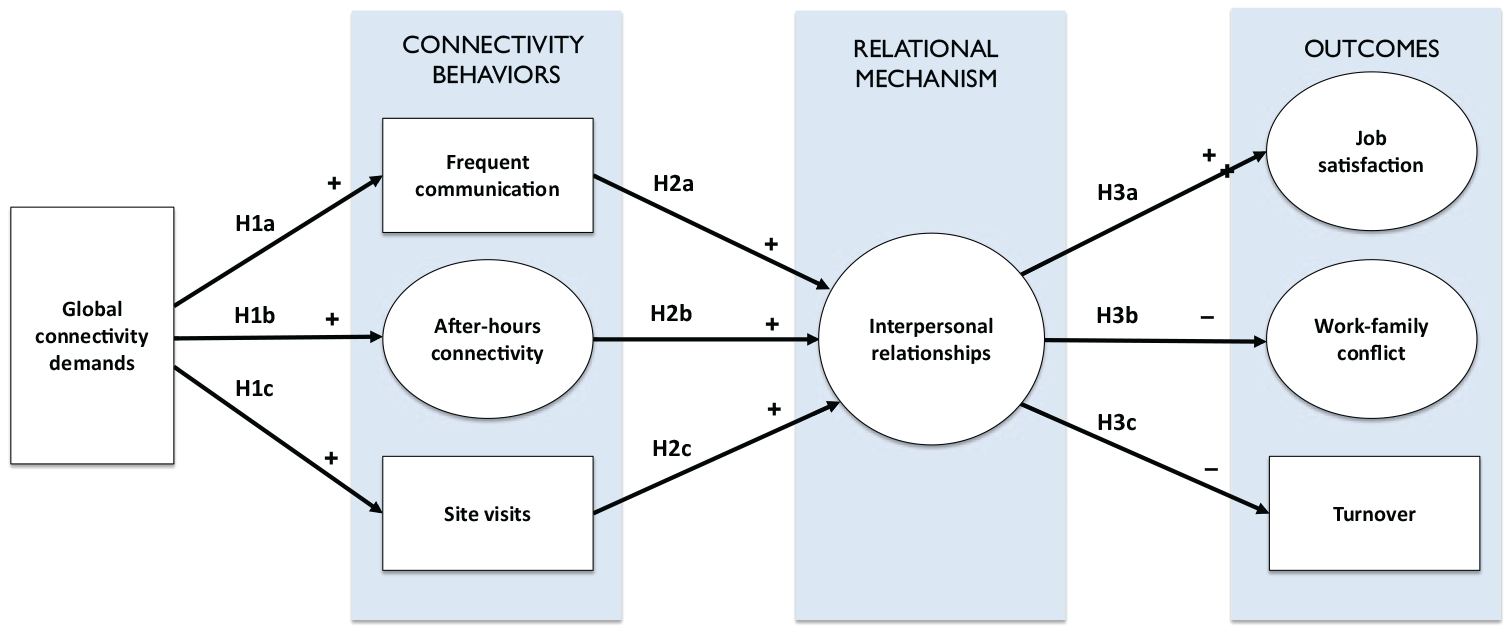
Hypothesized model regarding the effect of connectivity demands on connectivity behaviors, relational mechanism, and outcomes. Latent variables are represented by ovals; observed variables are represented by rectangles.
Theory and Hypotheses
Connectivity demands and behaviors
As mentioned above, recent research on relational and proactive perspectives on work design (Bruning & Campion, 2017; Parker, Bindl, & Strauss, 2010) suggests that employees exercise discretion in modifying their social environment by choosing how and how much to interact with co-workers, and thereby influence psychological and behavioral outcomes. At the same time, research on connectivity tells us that communication and mobile technologies have made it nearly impossible for workers to disconnect from work (Dery et al., 2014). Wajcman and Rose (2011), for example, report that the workers they studied felt the need to be constantly available. Kolb and colleagues (2012) temper this somewhat, suggesting that one can be optimally connected, and thereby choose what works best in any given situation. Researchers focusing on “connective flow” (e.g., Dery & MacCormick, 2012; Kolb, Collins & Lind, 2008) further argue that one can ensure an optimal level of connectivity by managing individual connectivity requirements according to work demands. MacCormick, Dery, and Kolb (2012), for example, found that some smartphone users are constantly connected, some resist connectivity, and some move between the two based on situational and personal demands.
Globally distributed professionals, whom we define as those collaborating across geographical distance with co-workers in different countries, may be particularly affected by escalating connectivity demands. They communicate, share information, and collaborate with distant colleagues through the frequent use of email, video and teleconferencing, and advanced collaboration systems (e.g., O’Leary et al., 2014; Weber & Kim, 2015). In addition to communicating frequently, these professionals seem to work increasingly both before and after normal office hours to enable synchronous collaboration with distant co-workers (Cummings et al., 2009; Espinosa, 2013; O’Leary & Cummings, 2007). Ambitious employees are also more likely to work after hours (Boswell & Olson-Buchanan, 2007), thus creating an escalating norm of always being available.
A less frequently discussed connectivity demand affecting global workers involves travel. Visiting distant co-workers’ office sites is considered a prerequisite for successful global teamwork based on the assumption that meeting face-to-face fosters stronger relationships and collaboration (Hinds & Cramton, 2014; Mortensen & Neeley, 2012). Apparently, more ambitious workers recognize this and opt to travel (Burke, 2000). According to Hinds and Cramton (2014, p. 794), effective site visits, which enable “becoming more familiar with one another’s communication and work styles, capabilities and interests, personalities, work and social roles, and the cultural context in which they are embedded,” play a crucial role in transforming interpersonal relationships among distant co-workers. Given this suggested link between global work and the connectivity demands it engenders, we posit that when global connectivity demands are high, team members are compelled to communicate more frequently, to be increasingly available after hours, and to visit each other more. We conceptualize this as a new work characteristic, which we call global connectivity demands, and hypothesize that global connectivity demands will result in more of all three connectivity behaviors.
Hypothesis 1a–c: Global connectivity demands increase connectivity behaviors with distant co-workers in the form of (1a) frequent communication, (1b) after-hours connectivity, and (1c) site visits.
Connectivity behaviors and outcomes: The mediating role of co-worker relationships
Despite the connectivity demands inherent in global work, workers may make different connectivity-related decisions depending on their personal preferences and situations, and these behaviors may affect their relationships with distant co-workers. As is clear from the literature on work design and connectivity, workers make choices about how to enact the demands they face regardless of exhortations to connect across distance. Research on work design shows that professional workers have agency in deciding how to respond to work characteristics such as autonomy, time pressure, and interdependence, and their ability to craft their work increases as work becomes more unpredictable (see Grant & Parker, 2009, for a review). In terms of person–environment fit in particular, it is suggested that employees intentionally adapt their behavior to ensure a better fit between personal and job-related values, needs, and capabilities (Baker & Faulkner, 1991; Black & Ashford, 1995; Nicholson, 1984). More specifically, recent research shows that workers may be “expansion-” or “contraction-oriented,” meaning that they can “increase or reduce the extent of communication complexity of their relational work environment” (Rofcanin et al., 2019, p. 861). In their diary study among MBA students, Rofcanin et al. (2019) found that those individuals who increased the extent of communication with co-workers (expansion-oriented) experienced higher work engagement and, in turn, received higher performance ratings from their managers, while those who reduced communication (contraction-oriented) were less engaged and received lower performance ratings. Despite these advances in research, not much is known about how relational job crafting affects interpersonal relationships at work.
The literature on connectivity also argues for a strong degree of agency in deciding when and how to connect. According to Kolb (2008), connectivity is both an enacted and a latent possibility, and actors decide on whether, how, and when to use a connective technology. The executives that Dery and colleagues (2014) sampled had agency, but primarily with regard to switching between work and non-work interactions, whereas disconnecting entirely from work was not considered viable. Overall, although workers face connectivity-related demands, they also tend to have some degree of agency in how they respond. We therefore posit that workers making choices vary in their connectivity behaviors, and that those who choose to connect more (i.e., frequent communication, after-hours connectivity, and site visits) have stronger relationships with distant co-workers.
We also argue that after-hours connectivity may be less advantageous than frequent communication and site visits because of the depleting demands it imposes. The job-demands resources model (Demerouti et al., 2001) classifies work characteristics as job demands and job resources, depending on their effects on individuals. Job demands require sustained effort and could therefore negatively influence work outcomes, whereas job resources may facilitate the achievement of work goals and stimulate personal growth. Although after-hours work may be a resource that enables global teams to coordinate tasks across time zones (Espinosa, 2013), research on connectivity clearly demonstrates the demands that it places on employees’ time and energy is depleting. Site visits could also be considered a job demand (Nurmi, 2011), but we suggest that the opportunity to travel, learn more about one’s own and other cultures, and connect face-to-face with colleagues have greater positive relational effects (see Hinds & Cramton, 2014; Mortensen & Neeley, 2012). We therefore propose that after-hours work is less advantageous than frequent communication and site visits.
Hypothesis 2a–c: Enacting connectivity through (a) frequent communication, (b) after-hours connectivity, and (c) site visits are associated with more positive work relationships with distant co-workers, but the effect is weaker in the case of after-hours connectivity.
Research on work design during the last decade attests to the influence of social characteristics and relationships on a range of work outcomes. Relational coordination (Gittell, Seidner, & Wimbush, 2010), feedback (Morgeson & Campion, 2003), and interpersonal cohesion (e.g., Morrison, 2004) all appear to affect psychological and behavioral outcomes such as motivation, performance, and turnover (Humphrey et al., 2007). It has been suggested that positive interpersonal relationships with colleagues make work more satisfying (Ryan & Deci, 2001; Sias, 2005), and improve organizational attachment and commitment (Jehn & Shah, 1997) as well as employee retention (Griffeth, Hom, & Gaertner, 2000; Hanisch, 1995; Holtom, Mitchell, Lee, & Eberly, 2008). Social support, which includes emotional, instrumental, and informational support from co-workers, also appears to ease work–family conflict by providing resources to cope with role-related expectations (see Michel, Mitchelson, Pichler, & Cullen, 2010 for a review). According to evidence from existing research, mainly conducted in co-located settings, work that is designed to support strong interpersonal relationships has positive psychological and behavioral effects.
Few studies on global work, however, have examined the role of interpersonal relationships on psychological and behavioral outcomes. In one notable exception, O’Leary and colleagues (2014) examined “perceived proximity” among members of virtual teams and found positive effects on satisfaction with team relationships. These results imply that global workers, like co-located workers, benefit from maintaining close connections with distant co-workers, which meets their needs for belonging (Baumeister & Leary, 1995; Kahn, 2009). We therefore hypothesize that:
Hypothesis 3a–c: Positive interpersonal relationships with distant co-workers will (a) increase job satisfaction, (b) decrease work–family conflict, and (c) decrease employee turnover.
Our final hypothesis is based on Grant and Parker’s (2009) theorizing on social characteristics as a distal, and the quality of interpersonal relationships as a proximal antecedent of outcomes. We posit that connectivity has an indirect effect on psychological (i.e., job satisfaction, work–family conflict) and behavioral (i.e., turnover) outcomes among global workers through positive interpersonal relations. This is consistent with Gibson and colleagues’ (2011) argument that forging close relations among distant co-workers could reduce the potential negative effects of distance and electronic dependence on employee experiences of global collaboration. However, it was beyond the scope of their study to test this empirically. We nevertheless suggest that after-hours work could strain rather than strengthen interpersonal relationships because of the sustained effort required to be “always on,” and therefore anticipate a smaller effect for after-hours connectivity than for frequent communication or site visits. Hence, we hypothesize:
Hypothesis 4a–c: Positive interpersonal relationships mediate the associations of (a) frequent communication, (b) after-hours connectivity, and (c) site visits with psychological (job satisfaction, work–family conflict) and behavioral (turnover) outcomes.
To test the above hypotheses we first conducted a pre-study to find out how organizations frame connectivity demands, and then we carried out a survey-based study.
Pre-Study: Understanding Job Demands
To better understand how organizations frame connectivity demands for global professionals and assess the three types of connectivity derived from the literature, we began by interviewing HR directors from 13 Finland-based multinational companies operating in the software, telecommunications, engineering, processing, and service industries. Twelve of them were women, and all were Finnish. The interviews lasted about 60 minutes and were conducted face-to-face, recorded, and transcribed. They were semi-structured in format, which allowed us to discuss the issues of most importance to our interviewees. We began by asking questions about the companies’ global strategies, why they used global teams, and what HR and management practices they implemented to support global collaboration. We also discussed their expectations of global professionals in their companies and their own experiences of working globally.
Despite the indicators from the literature concerning different connectivity demands, we opted to base our analysis on grounded theory practice (Charmaz, 2006; Glaser, 1992) to avoid the prioritization of existing categories of connectivity and to allow new ones to surface. Twenty-one codes emerged in the open-coding phase, which we subsequently grouped into higher codes. These included frequent communication (including task-related and relational communication via email, telephone, chat, and virtual meeting tools during business hours), after-hours connectivity (coded as being flexible with working hours; participating in online meetings outside of business hours; and using email, chat, and telephone early in the morning, in the evening, and during weekends), and site visits (consisting of codes for traveling to visit distant co-workers at their office sites, face-to-face collaboration during site visits, and building relationships during site visits).
Pre-study: Findings
Reflecting the literature on global work, the interviewed HR directors described frequent communications, flexibility in working hours, and traveling to meet distant co-workers as highly encouraged practices for global collaboration. For example, Jussi, HR director of an engineering company, explained that frequent virtual meetings and occasional site visits were necessary for successful global collaboration: “[Global workers] should keep regular contact by email, telephone, chat, and use video in meetings.” Carol, HR director in a high-tech firm, also emphasized flexibility in working hours when collaborating across time zones: “When we recruit people in global teams, flexibility is probably the most important thing [that we consider]. You must be flexible, easily accessible, and able to participate in meetings with collaborators in other time zones.” According to another HR director, flexibility and the ability to connect with team members after hours were basic recruitment criteria for global professionals: “These teams don’t share overlapping working time. Therefore, people have to be flexible. Either you come to work very early, or you stay very late to create common working time.” HR directors described time shifting as a management practice enabling global teams to maximize work time overlap among sites in different time zones and to engage distributed team members in efficient collaboration.
Readiness to travel was also emphasized by 11 of the 13 firms as a critical characteristic of a global worker. As Liisa, HR director in an engineering company that invested in site visits, explained: “distant collaborators should visit each other at least every other month and work together at least one week at a time.” Site visits were considered particularly important for relationship building and effective collaboration. According to Marja, HR director of a forestry company: “We need all global team members to get together in the beginning of a project and meet face-to-face twice a year after that in order to learn to work together and learn about each other.” In sum, the expectations of global professionals included frequent communication, a readiness to connect after hours, and a willingness to travel, all described as indispensable elements of global work.
Based on our deeper understanding of connectivity demands as articulated by the HR directors, we conducted a survey-based study of global professionals.
Survey-Based Study Method
We conducted a survey of global professionals to test our model of how connectivity demands, which are characteristic of global work, are enacted differently and how these different enactments affect work relationships and, in turn, psychological and behavioral outcomes. We also conducted interviews with 179 global professionals from the 13 multinationals described in the pre-study (see online Appendix 1 for the description of interview data and analysis). Following Hinds and Mortensen (2005), we interweave this interview data with our survey findings to provide a richer understanding of the connectivity behaviors we documented.
Survey
We surveyed 413 global workers (310 men and 103 women) at Escel, a multinational engineering company. Although headquartered in Finland, it operates in more than 50 countries in 1,000 locations and with 40,000 employees. Most employees are non-native speakers of English, the corporate lingua franca. Company representatives provided contact information for 949 global knowledge workers based at 103 company sites. We contacted these individuals via email and gave them information about the study with a link to our web-based survey. All the survey items were in English, in line with their typical work experience. Having removed cases with missing values, we had a usable sample of 413 global workers from 30 countries (79% from Europe, 13% from the Americas, and 8% from Asia/Oceania), a response rate of 44%. The average respondent worked for 46.3 hours per week with 15.5 distant co-workers. All the respondents were professionals employed in either technical or managerial positions. A total of 39% of them did engineering work in R&D and IT departments; 17% worked in administration, HR, and finance; 14% in supplies and logistics; 9% in marketing and sales; 6% in customer service; and 10% in upper management. Although the tasks varied, the complexities of each type of work created interdependencies that required frequent coordination and communication across distances and time zones. Of the respondents 79% with a spouse and 57% had dependents.
Measures
Global connectivity demands was measured by calculating the extent to which the global workers in our sample worked across a range of time zones, the differences ranging from 1–4 hours through 5–7 hours, to 8 hours or more rated on a scale from zero (never) to six (every day) (see online Appendix 2 for the survey items). We weighted the responses based on time zone overlap, so responses to 5–7 were multiplied by two, and responses to eight or more were multiplied by three. We then summed the responses to these three questions to give a measure ranging from zero (no collaboration across time zones) to 36 (daily across all time zones), and to capture the intensity of demands for connectivity in global work. Note that someone in Australia, Russia, or the US could be working across time zones, but not globally. We checked this and found that all the Australian (n = 4), all the Russian (n = 3), and 60% of the American (n = 45) participants worked globally across five or more time zones weekly or more frequently. Forty percent of the American participants worked a few times a month across five or more time zones, indicating that our measure of connectivity demands captures the work characteristic that constitutes the demand for connectivity in global work.
Frequency of communication was measured on a seven-point scale ranging from one (never) to seven (every day). The respondents rated how often, on average, they used the following media to communicate with their distant co-workers: e-mail, telephone, teleconferencing, videoconferencing, virtual conferencing, instant messaging, and chat. As O’Leary et al. (2014) suggest, responses concerning the individual technologies were averaged to create an overall index of communication frequency.
To measure site visits we asked the respondents to answer the question, with reference to distant co-workers in their highest-priority project team: “How many times (if any) have you visited the location of your distant co-worker(s) working with you in this particular project or working group?”
We developed items concerning after-hours connectivity and positive interpersonal relationships with distant co-workers following the recommendations of Mackenzie, Podsakoff, and Podsakoff (2011). To ensure content validity, we based our definitions of the focal constructs on previous theoretical and empirical literature, and on the interviews with global professionals (N = 179; see online Appendix 1), and generated items accordingly, which independent judges evaluated according to the construct definitions (Mackenzie et al., 2011). We developed four questions to measure after-hours connectivity, e.g., “How often do you read or reply to emails outside of business hours (8am–6pm)?” The respondents answered on a scale ranging from one (never) to seven (always). Five judges then evaluated the four after-hours work connectivity items and confirmed that they reflected our definition, “connecting with distant collaborators during non-work time.”
To capture the extent of strong and supportive connections between distant co-workers we generated five items to measure interpersonal relationships. This concept is consistent with other measures of high-quality co-worker relationships (Carmeli & Gittell, 2009), but focuses specifically on characteristics identified as essential for distant relationships such as perceived intimacy, support, and responsiveness (Kahn, 2009; Pratt & Dirks, 2007; Sias, 2009). The respondents were asked to think about and answer five questions with reference to the distant co-workers in their highest-priority project team, such as: “I can count on my distant co-worker(s) to lend a hand when I need help.” The responses were rated on a seven-point scale ranging from one (strongly disagree) to seven (strongly agree). Again, the items were evaluated by five judges to assess the extent to which they reflected our definition, “experienced intimacy and support in distant co-worker relationships.” We also conducted a pilot study to assess the items concerning after-hours connectivity and the interpersonal relationship measures (see online Appendix 3).
Job satisfaction was measured with four questions from the Job Diagnostic Survey (Hackman & Oldham, 1980) concerning satisfaction with tasks, growth opportunities, and being able to influence work-related decisions. The respondents rated their answers on a seven-point scale ranging from one (very dissatisfied) to seven (very satisfied). Work–family conflict was measured on Gutek, Searle, and Klepa’s (1991) four-item scale ranging from one (strongly disagree) to seven (strongly agree). Turnover data was coded from the respondents’ LinkedIn profiles three years after the survey data were collected: zero for those who were still employed by the same company and one for those who had changed employers.
Control variables
We controlled for travel frequency, rated in response to the question: “How many travel days did you have during the last six months?” We also controlled for gender (from the company’s HR department, 1 = female, 0 = male), age, living situation (1 = living with a spouse, 0 = living as a single person), parental status (1 = dependents living at home, 0 = no dependents living at home), tenure (number of years working for the company), and position (1 = managerial, 0 = not managerial). Finally, three dummy variables were used to control for geographic location (Europe, the Americas, and Asia).
Results
Table 1 presents the descriptive information and intercorrelations for all the study variables.
Means, standard deviations, and intercorrelations of the study variables (N = 413).
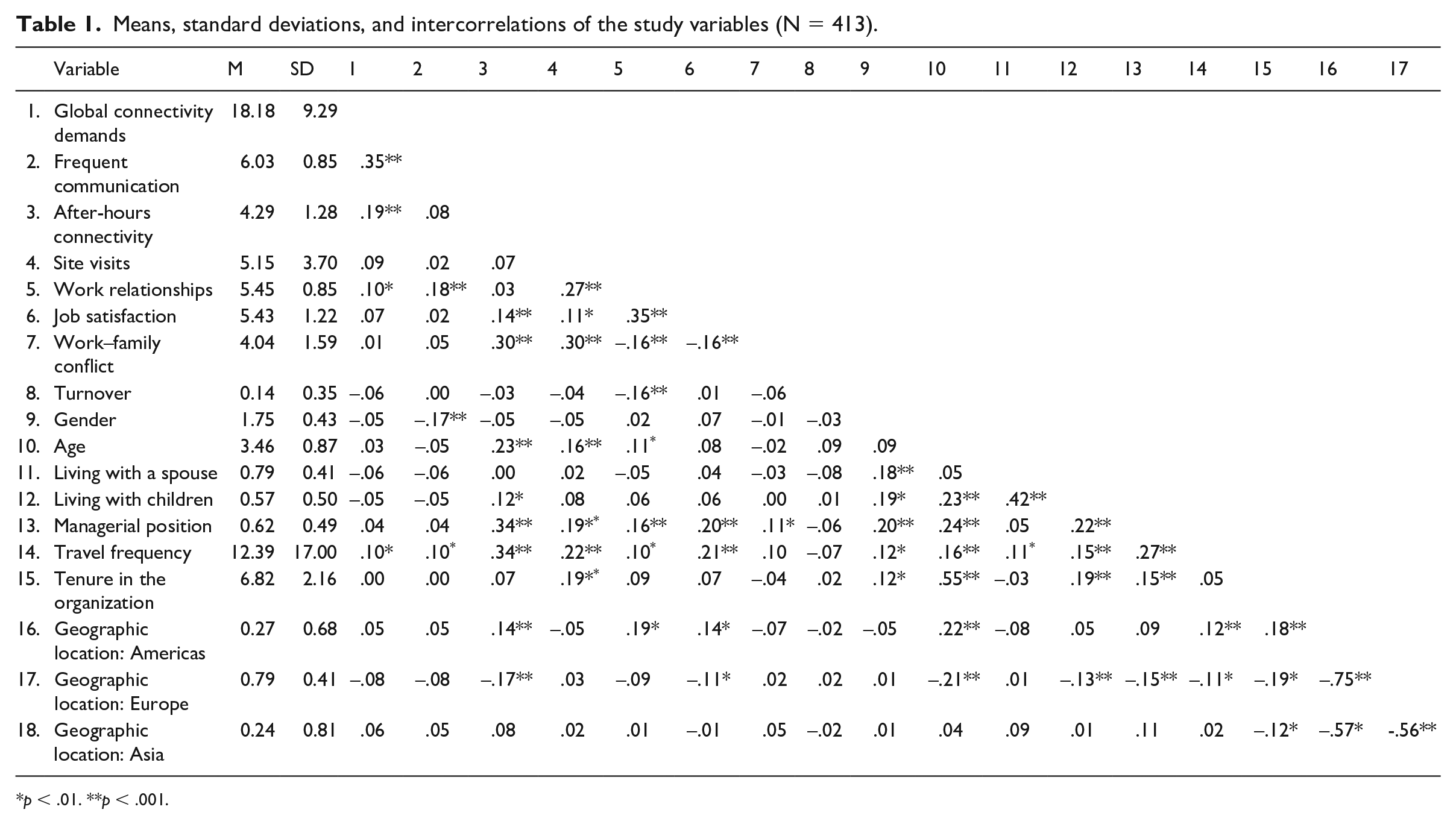
p < .01. **p < .001.
Measurement model and common method variance
Before testing our hypotheses, we conducted a series of confirmatory factor analyses using maximum-likelihood estimation to confirm the distinctiveness of the study constructs. The measurement model consisted of fourteen observed variables (global connectivity demands, mediated communication, site visits, turnover, travel frequency, marital status, parental status, age, gender, position, tenure, and geographical locations: the Americas, Europe, and Asia) and four latent variables (after-hours connectivity, interpersonal relationships, job satisfaction, and work–family conflict). One control variable, geographic location in Asia, which had no significant relationships with any other variables in our SEM model, was excluded from the final models. The 17-factor model fit the data well (χ2[281] = 467.90, p < .001; CFI = .95, RMSEA = .04, SRMR = .037): a model fits data well when the comparative fit index (CFI) is 0.95 or greater, when the root-mean-square error of approximation (RMSEA) is 0.06 or less, and when the standardized root-mean-square residual (SRMR) is 0.08 or less (Hu & Bentler, 1999). To examine the discrimination validity of our measures, we compared the 17-factor model to other theoretically plausible alternative models: it fitted the data significantly better than the six other models (see online Table 5: Comparison of alternative measurement models).
Common method variance (CMV) may be a factor in our analyses, in that many of the relationships we tested (except gender and turnover) were rated by the same source and were answered at the same point in time (Podsakoff, MacKenzie, Lee, & Podsakoff, 2003). In proactively addressing CMV concerns we followed the recommendations of Podsakoff et al. (2003) to incorporate procedural remedies into the study design (e.g., randomizing the order of the scale items, separating predictors and criterion variables). To assess the degree to which our data are subject to common method bias we applied Harman’s single-factor test, which is the most widely used for this purpose (Podsakoff et al., 2003). We loaded all items from employees onto one factor in an exploratory factor analysis to see whether one factor accounted for the majority (over 50%) of the covariance that would indicate CMV: we found that the first factor accounted for only 15.71% of the covariance. We also measured CMV by introducing a common latent factor into the 17-factor model and by subtracting standardized regression weights without the common latent factor from standardized regression weights with the common latent factor. The results did not exceed 0.2, which is the threshold value for common method bias. We therefore concluded that common method bias did not play a significant role in our results.
Hypothesis testing with the structural model. We used structural equation modeling (SEM) to test the hypothesized relationships. The model we tested (see Figure 2 and Tables 2a and 2b) fit the data well: (χ2[287] = 485.06, p = .001; CFI = .951, RMSEA = .041, SRMR = .041).
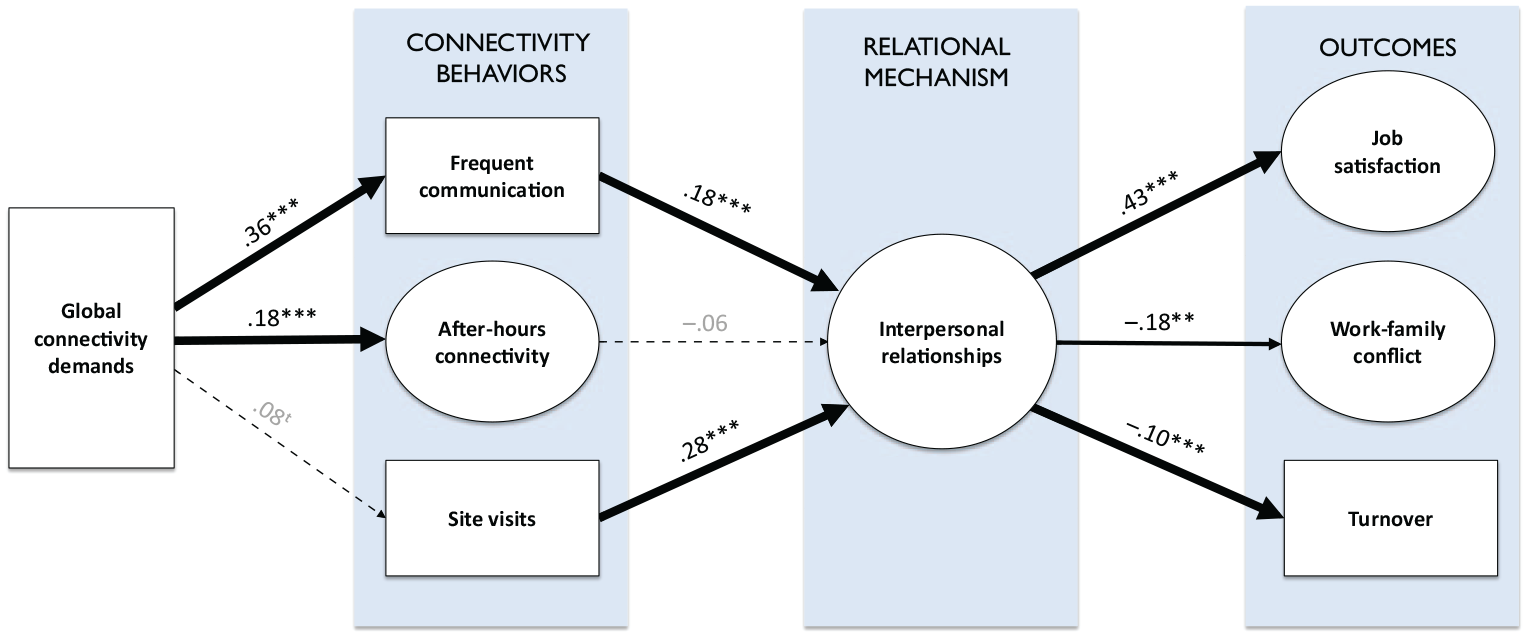
Structural equation model. Note: Standardized maximum likelihood parameter estimates for the hypothesized model, N = 413. This is a simplified version of the tested model. It does not show error terms, control variables, or the indicator variables of the latent constructs. Latent variables are represented by ovals; observed variables are represented by rectangles. Solid lines represent significant paths; dotted lines represent non-significant paths. ᵗ < .10, *p < .05, **p < .01 ***, p < .001.
Multi-group SEM analysis results: standardized maximum likelihood estimates predicting proximal and distal mediators for all respondents (N = 413), men (n = 310) and women (n = 103).
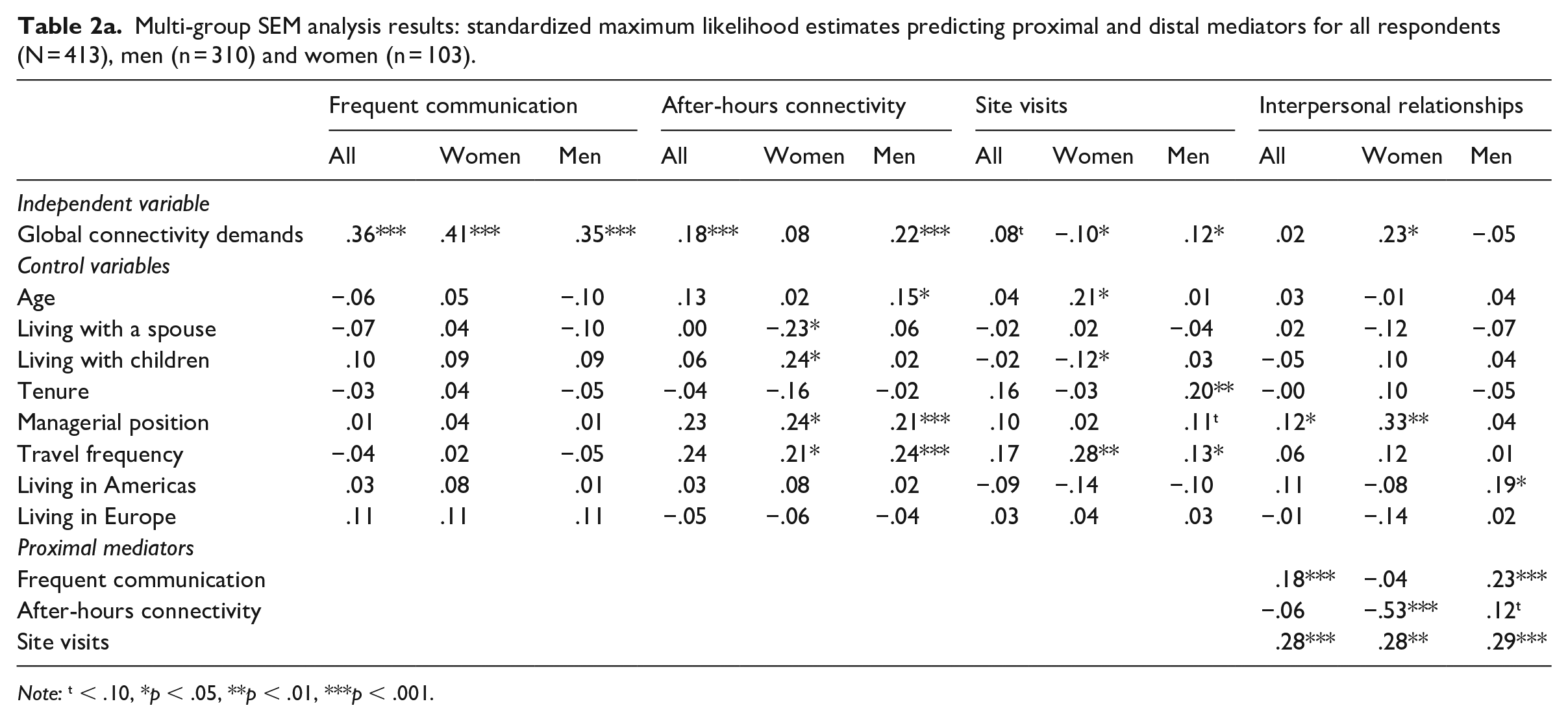
Note: ᵗ < .10, *p < .05, **p < .01, ***p < .001.
Multi-group SEM analysis results: standardized maximum likelihood estimates predicting outcome variables for all respondents (N = 413), men (n = 310) and women (n = 103).
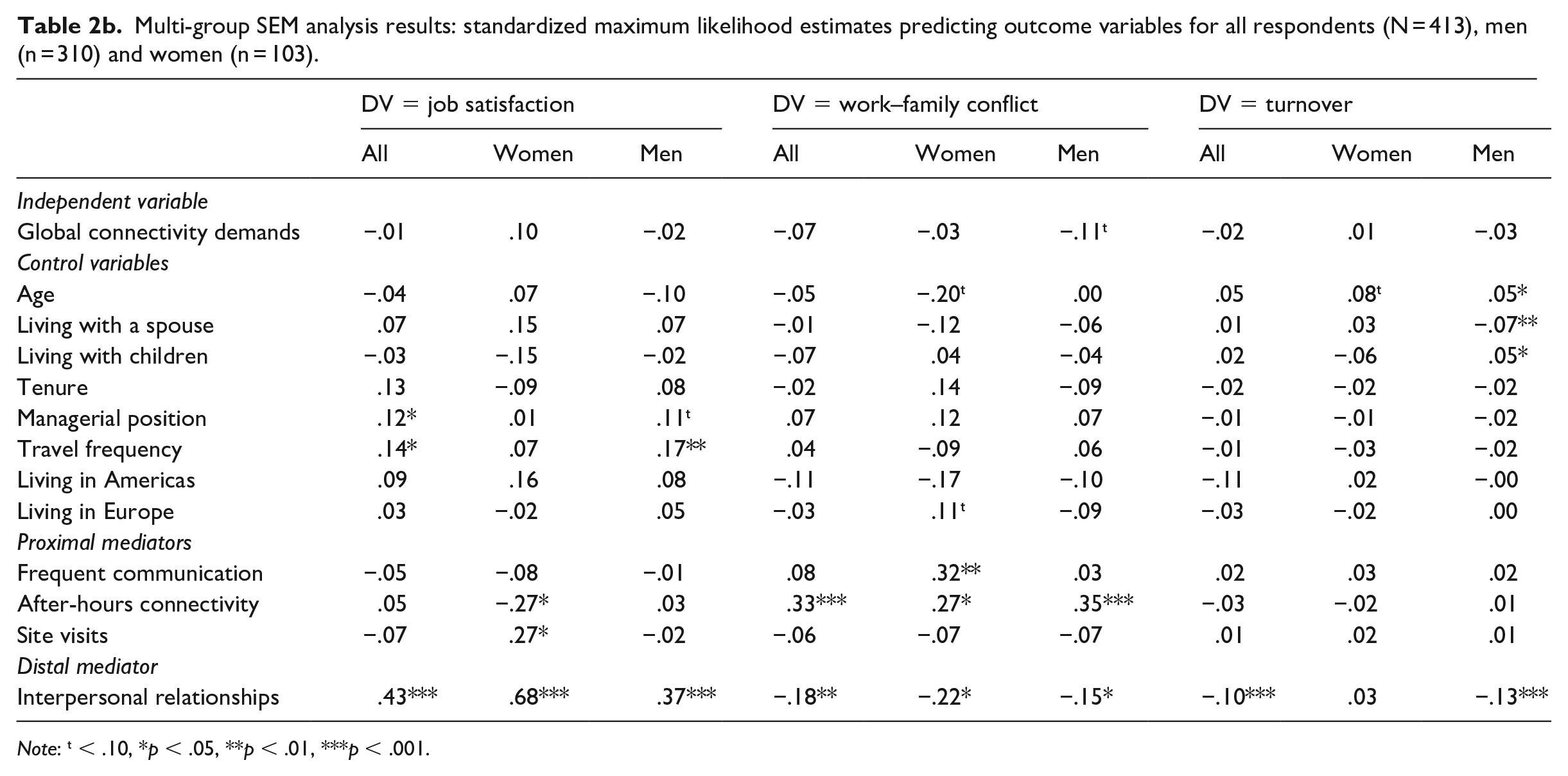
Note: ᵗ < .10, *p < .05, **p < .01, ***p < .001.
Connectivity demands and connectivity behaviors
Our first three hypotheses (H1a, H1b, and H1c) posit that global connectivity demands are associated with increased connectivity behaviors. Our results support this claim regarding frequent communication (β = .36, p < .001) and after-hours connectivity (β = .18, p < .001) but not site visits (β = .08, p = .08, ns), thus H1a and H1b are supported but H1c is not. Consistently with this, the global professionals we interviewed said that frequent communication was a prerequisite for successful global collaboration. As Jack, a software project manager on the US East Coast who collaborated with team members in Finland and Sweden, explained:
I use email and phone a lot. First thing in the morning, I open my e-mail and if there seems to be a lot [of] going on, I call [a co-worker in Sweden] and ask her to get me up to speed on what has happened [during their workday in Europe].
Alex, a mechanical engineer with co-workers in the USA and Finland, described how frequent mediated communication helped his team to stay on schedule:
My preference for communication is face-to-face first, and periodically followed by more or less frequent online meetings and telephone conversations but understanding that e-mail or chat is pretty much a daily requirement. Specifically, in our organization, where eight or ten time zones between us can cause delays.
Frequent communication outside business hours was also necessary, particularly when time zone differences reduced the time available for synchronous collaboration. According to Matias, who worked in a R&D team in Finland spanning eight time zones, with members in London and Dallas:
Global teamwork does not work if people are not flexible with their working hours. There is an implicit expectation that you should be always connected. My colleagues can call me at any time and I’ll answer.
The demand for after-hours work was not enacted evenly across our interviewees, however. Some chose to limit the time invested after hours, whereas others adopted after-hours work as part of their daily routine. Of those who remained connected after hours, some tried to limit their work to what they considered essential. They expressed their frustration, for example, when they received long messages in the evening that focused on trivial or personal matters.
Despite the weak relationships we found between global connectivity demands and site visits, the interviewees described travel as an essential component of connectivity with distant co-workers. As Mikko, a global engineer, explained: “I travel several times a year to meet my distant colleagues. It is one of the requirements of this type of work.” However, many interviewees said that they avoided traveling because it was time-consuming and added to the workload. Klaus, a Finnish global engineer working with team members in Asia and the Middle East, talked about the extra work involved in site visits:
I have decided that I make site visits only when necessary. Traveling is so time consuming and my tasks pile up at the home office while I’m traveling, and I have to make up for those tasks after returning.
Ville, a Finnish R&D engineer working with Indian and Chinese colleagues, echoed this: “Site visits add workload and I work 10-to-14-hour days during them. I must carry on my normal tasks on top of the work that we do [at the site of distant co-workers].” To minimize the extra work, many interviewees limited their site visits and responded to global connectivity demands by engaging in frequent virtual communication.
Connectivity behaviors and interpersonal relationships
We also posited (H2a, H2b, and H2c) that connectivity behaviors would relate to positive interpersonal relationships with distant co-workers, although less so regarding after-hours work. In support of H2a, frequent communication was significantly related to higher relationship quality (β = .18, p < .001), as were site visits (H2c) (β=.28, p<.001). However, after-hours connectivity (H2b) was not (β = −.06, p = .69, ns). Consistently with this, the workers we interviewed emphasized the importance of frequent communication for relationship building and social support. As Jane, who worked with distant co-workers in Sweden and Finland, said:
I have daily phone conversations with Kristina. The thing is, she is kind of the only one that understands what I’m going through. I feel pretty lonely in the US because no one in the US really knows the project.
Richard, a mechanical engineer in the US working with Finnish team members, emphasized the importance of frequent voice communication in relationship building: “I think the main way to maintain relationships is frequent verbal interaction in conference calls, really getting a human voice involved.”
Consistently with our quantitative analysis, the interviewees generally described site visits as desirable and positive. Many of them used the time to get to know their co-workers better and to build relationships and not only to discuss task-related matters. According to Maria, a Finnish member of a global finance team, it was essential to invest time in socializing and building relationships with distant co-workers during site visits, having lunch, dinner or even a quick coffee between meetings, for example, if distant collaboration was to be successful. As Gerry, a R&D engineer from the Netherlands, explained:
You have to become very intimate and familiar with each other’s knowledge and personalities. You have to travel to work together and mingle as much as possible. Trust is not a given thing; it has to be built.
We analysed our interview data to find out why after-hours work did not have the positive effects we predicted. It seems that there may be a dark side. Although some interviewees stated that after-hours connectivity helped in building interpersonal relationships with distant co-workers, others reported the opposite. Bernhard, a member of a R&D team working in Austria and collaborating with engineers in Finland and Shanghai, gave an example of after-hours bonding experiences. Engaging in informal communication after working hours allowed him to discuss issues unrelated to work with his colleagues in a relaxed atmosphere: “you develop close cooperation and a good state of communication and you talk about how the other person is doing.”
Others, on the other hand, particularly women, who remained connected were likely to have brief, work-focused interactions after working hours. They described attempting to deal with numerous email and chat messages while carrying out childcare and household chores during the evenings, responding only to the most urgent questions and those that could be answered quickly. As Marketta, a Finnish engineer from a global R&D team, explained:
If I need to have a chat with colleagues [after hours], I try to do it quite effectively. I might work 15 minutes every now and then if somebody needs an urgent response, but then the kids start screaming and I gotta go.
Others resisted sharing personal information during these after-hours meetings. They described their co-worker relationships as primarily business-focused rather than friendship-oriented. As Paula, for example, who worked with Danish, Finnish, and Japanese colleagues, explained:
I’m trying to keep a formal distance to these other members of my team. Even though we communicate often in the evenings [online], it’s only professional. It’s a good choice that I don’t tell my co-workers about my private life because they do not need that information for anything.
These workers took a more task-oriented approach to after-hours communication, for efficiency reasons or to protect their privacy, and their co-workers sometimes reacted negatively. Unwittingly, they projected a calculated and cold image that made them less appealing as colleagues. Co-workers described them as “very ambitious,” “tough,” and “achievement-oriented.” Rachel’s peers, for example, remarked that she may have accomplished a lot, but her co-worker relationships were not strong, as a female American colleague said: “Rachel and me, we are not very close. I don’t know her that well. She is a little cold, if you know what I mean.”
Overall, we found that after-hours connectivity could be used to strengthen interpersonal relationships, but not all workers were comfortable with it. When they tried to minimize communication and keep conversations task focused, relationships sometimes suffered.
Interpersonal relationships and outcomes
We posit in H3a, H3b, and H3c that positive interpersonal relationships are associated with psychological and behavioral outcomes. In support of all three, we found an association with increased job satisfaction (β = .43, p < .001), decreased work–family conflict (β = −.18, p < .01), and decreased employee turnover (β = −.10, p < .001).
We used percentile bootstrapping to test the mediator hypotheses (4a, 4b, and 4c), as recommended by Fritz, Taylor, and MacKinnon (2012). Bootstrapping is beneficial because it avoids power problems derived from asymmetric and other non-normal sampling distributions of an indirect effect (MacKinnon, Lockwood, & Williams, 2004). We followed MacKinnon, Lockwood, Hoffman, West, and Sheets’ (2002) recommendation for joint significance testing, simultaneously testing for mediation because this approach balances type 1 error with statistical power. It requires the paths from independent variable (IV) to mediator (M) and from M to dependent variable (DV) to be significant with the direct path from IV to DV present. To test partial and full mediation, we compared the hypothesized relationships IV → M → DV (without direct paths) with the alternatives (including direct paths), using χ2 difference tests (James, Mulaik, & Brett, 2006). More specifically, we created 5,000 bootstrapped re-samples with replacement from the original data to generate 95% confidence intervals (CI) for all the indirect effects of the model (MacKinnon et al., 2002; Preacher & Hayes, 2008). Significant mediation is established when the CI (95%) does not contain zero. We were only able to establish mediation for the variables with a significant path between both the independent (connectivity behavior) variable and the mediator, and the mediator and the outcome variable. Thus, it was clear from the outset that positive interpersonal relationships would not mediate the relationships between after-hours connectivity and the outcome variables.
Interpersonal relationships as a mediator
Hypothesis 4a, that positive interpersonal relationships mediate between frequent communication and the outcome variables (job satisfaction, work–family conflict, and turnover), was fully supported (see Table 3). As mentioned above, H4b was not supported because mediation was not possible. In support of hypothesis 4c, we found that interpersonal relationships fully mediated the associations between site visits and all the measured outcome variables, indicating that site visits may increase job satisfaction and decrease work–family conflict and employee turnover through a positive effect on interpersonal relationships.
Indirect effects of connectivity behaviors on outcome variables.
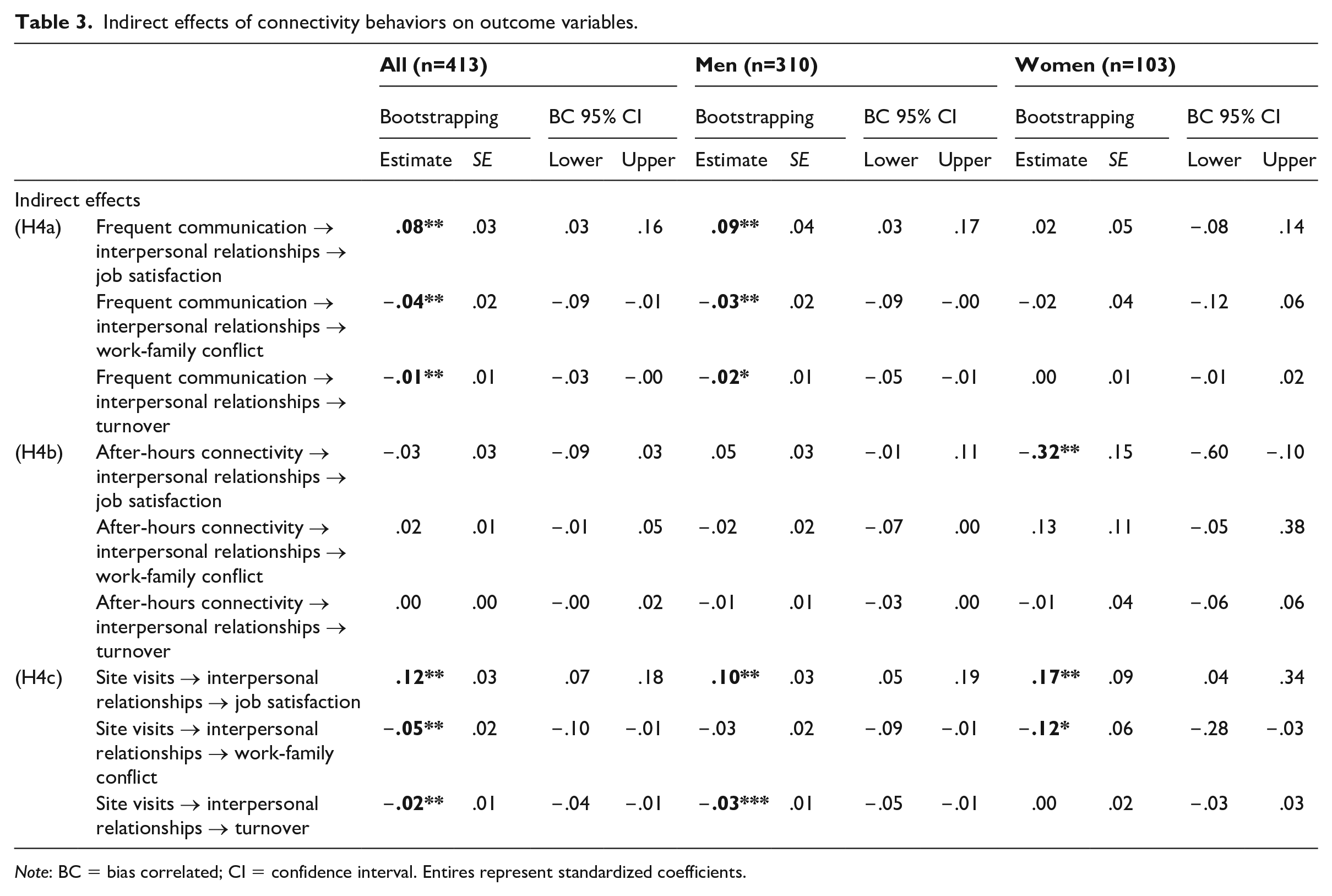
Note: BC = bias correlated; CI = confidence interval. Entires represent standardized coefficients.
Additional analyses
What became clear in our interviews was that men and women enacted connectivity in different ways and for different reasons. With after-hours connectivity in particular, women told us that they tried to minimize their after-hours communications and, when communicating after hours, kept it businesslike. Men, by contrast, described using non-work time to chat about personal topics and get to know their distant colleagues better. Given this, we examined gender as a moderator in our SEM model by conducting multi-group analyses to test whether the paths in our model varied by gender. First, we estimated a model in which structural parameter estimates were freely estimated for men and women. Next, we constrained parameter estimates of the hypothesized paths to be equal. We allowed the indicator variables to be freely estimated across groups; only the structural paths linking the constructs were constrained to be equal. The results of multi-group SEM analysis are presented in Tables 2a and 2b.
We found no significant difference between men’s (β = .35, p < .001) and women’s (β = .41, p < .001) frequency of communication when connectivity demands increased. We found, however, that global connectivity demands was positively and significantly linked with after-hours connectivity for men (β = .22, p < .001) but not for women (β = .08, p = .40, ns) and when this path was constrained to be equal, the model fit worsened significantly (Δχ2(1) = 3.82, p < .05), suggesting that gender groups are different at the model level (see Hayes, 2009). We also found that global connectivity demand was negatively associated with site visits for women (β = −.10, p < .05) but positively for men (β = .12, p < .05, Δχ2(1) = 11.59, p < .001).
After-hours connectivity was the only connectivity behavior whose effects on interpersonal relationships differed significantly between men and women. While the effect was positive and marginally significant for men (β = .12, p < .10), it was significantly negative for women (β = −.53, p < .001; Δχ2(1) = 21.15, p < .001). The effects of interpersonal relationships on job satisfaction and work–family conflict did not significantly differ between men and women, but the effect of interpersonal relationships on turnover was significant for men (β = −.13, p < .001) and not for women (β = .03, p = .98). This difference, however, was only marginally significant (Δχ2(1) = 2.81, p = .09) in the model.
A closer examination of our qualitative data affirms a gender difference and enriches our understanding of how men and women enact connectivity. While men and women in our sample tended to be equally active in communicating during overlapping working hours, women were less likely than men to describe after-hours connectivity. Men tended to describe compromising family time for work meetings as routine and reported staying connected with their distant co-workers via email or chat during evening hours and holding meetings when their families were sleeping. Tommi, a Finnish member of an R&D team, described how he lounges on his couch in the evenings while chatting with his distant colleagues. He said:
Quite often when the kids are eating, I take my PC and lay on the sofa and start chatting with my friends in Atlanta to see how they are doing. After 9 [pm] when my family [members] go to bed I also start taking calls.
Women, on the other hand, tried to limit monitoring email and chat messages during the evenings. Terhi, who worked with an R&D team, explained that “I have limited time to read and respond to messages in peace while carrying out childcare and household chores.” Women also reported less travel. They explained that spending nights away from home for site visits was difficult for them due to caregiving responsibilities. They tended to prioritize family activities and found it difficult to arrange time for site visits. Virpi, an environmental engineer, explained:
I try to minimize traveling to balance my life. A week-long site visit steals two of your weekends because you must travel during the weekend to be ready to work on Monday morning and you fly back home on the next weekend. It’s hard for my kids and I have realized that frequent traveling is not reasonable [for me].
Due to the disruption to their personal lives, women described being strategic about when to travel and how to use their time during site visits. They traveled for site visits when needed but not too often. Overall, our interviews suggest that global teamwork may entice workers to connect more frequently via technology during and after business hours and visit one another but that this pull may be stronger for men than for women. The women we spoke with recognized the importance of after-hours connectivity and site visits but reported having demands at home that made engaging in those connectivity choices difficult.
Discussion
Extensive research addresses the challenges of global work, but much less attention has been paid to job design and the implications for global workers. Parker and co-workers (2017) acknowledge this gap in their recent review of research on work design, calling for more consideration of global and distributed teams as a relevant context. At the same time, research on connectivity tells us about demands for connection and pressures toward 24/7 work, suggesting connectivity as a feature of modern-day work, but stops short of articulating how different types of connectivity might affect work design outcomes (relational, psychological, and behavioral). Thus, theory currently fails to explicate the relationships between varying connectivity demands, their enactments, and their effects. By integrating theory on connectivity and work design, we narrow this gap and extend theory in both areas.
We advance theory on connectivity by examining different types of connectivity, their enactments, and their effects. More specifically, we consider three types of connectivity, namely frequent communication, after-hours work, and site visits, and find that their enactments and effects vary. We were surprised that whereas communication frequency and site visits were positively associated with higher-quality interpersonal relationships, after-hours connectivity was not. This is in contrast to extensive research and folk wisdom implying that after-hours connectivity is essential in building and maintaining high-quality relationships at a distance. Revisiting our qualitative data, we found that after-hours connectivity was often experienced as an intrusion into workers’ personal lives and could be enacted in ways that undermined relationship building, rather than the reverse. In other words, workers complied with the demands of the job, but in ways that may have been counter-productive to high-quality relationships. Choosing to stay connected to work after hours may blur the lines between work and family time, resulting in conflict between the two domains (e.g., Boswell & Olson-Buchanan, 2007; Butts, Becker, & Boswell, 2015; Derks, Bakker, Peters, & Van Wingerden, 2016). In contrast the relational job crafting literature, which mainly describes benefits for expanded communications with co-workers (e.g., Rofcanin et al., 2019), our results indicate that not all expansion-oriented connectivity behaviors are positive and that different ways of connecting result in different outcomes. This highlights the importance of considering not only connectivity demands and behaviors, but also the effects of these behaviors on relationships and work-related outcomes (see also Wajcman & Rose, 2011).
Going beyond theories of media choice that similarly show that people choose from a variety of communication media based on the message content, media characteristics, and the situation (e.g., Hartmann, 2009; Trevino, Lengel, & Daft, 1987), we focus on the type of connectivity in the context of the work and its effects rather than on the medium or the message. Closer examination of workers’ enactments in future research would enhance understanding of the medium, the message, and the situation associated with different connectivity choices.
We also contribute to the literature on work design by adding global connectivity demands to the growing arsenal of work characteristics that advance understanding of modern-day work features and their effects. Hence, we integrate work design theory with recent research on connectivity to describe connectivity demands as a work characteristic, and to articulate its relationship with connectivity behaviors, social relationships, and outcomes. We also show that positive interpersonal relationships function as a relational mechanism through which connectivity influences outcomes of global work. Scholars have long known that global workers face connectivity demands, and that it is hard to sustain relationships at a distance, but we advance theory by integrating these observations into the work design framework (Figure 1), and empirically demonstrating their effects on job satisfaction, work–family conflict, and employee turnover (Figure 2). Capturing connectivity demands of different types and their effects on modern-day work enriches work design theory and provides a more robust framework for understanding the work of global professionals.
As Grant and Parker (2009) argue in their extensive review of research on work design, a one-size-fits-all approach is not satisfactory because it overlooks critical situational differences in modern work. Our results identify key characteristics of work design that have notable effects on globally distributed work. In particular, enacting connectivity demands by frequent communication and site visits provide means of interacting, making connections, and building relationships among distant co-workers. In addition, workers who had closer bonds with their distant co-workers reported more job satisfaction and less work–family conflict and were more likely to stay with their organizations. Earlier research examining the job characteristics model (Hackman & Oldham, 1980) in global work concluded that aspects of global work, such as electronic dependency and co-presence, alter relationships between work design characteristics and psychological states (Gibson, Gibbs, Stanko, Tesluk, & Cohen, 2011). Gibson and her colleagues also point out the critical role of intimacy between distant workers. We extend their pioneering work by testing a more comprehensive model that differentiates types of connectivity demands, evaluates enactments of connectivity, demonstrates the role of interpersonal relationships as a mediator, and establishes that enactments of connectivity demands through interpersonal relationships predict key outcomes. We thus offer a baseline relational work design model for global work (Figure 3) that incorporates this critical feature—global connectivity demands.

Relational work design model for global work.
Our work also contributes more broadly to the burgeoning literature on relational work design. In the past, the social aspects of work design have been neglected despite evidence that social relationships are vital to the success, satisfaction, and well-being of workers. Notwithstanding the consistent rise in the amount of teamwork and the number of large projects that necessitate close collaboration (Oldham & Hackman, 2010), research has largely neglected the role of interpersonal relationships among co-workers within the organization, focusing instead on relationships with beneficiaries such as customers (e.g., Grant, 2007). We therefore contribute to narrowing this gap by demonstrating that relationships with co-workers are an integral part of work design. Within work design theory, we also advance research on proactive work perspectives which emphasizes the agency that workers have in choosing how to enact work design characteristics. Although the relational and proactive perspectives are both important new directions for work design theory, they have, for the most part, been studied separately. We integrate these two streams by articulating how workers enact demands, specifically their connectivity behaviors, and how these choices affect relationships at work. While previous research on relational job crafting (Rofcanin et al., 2019) suggests that expanding or limiting communication with co-workers may have positive versus negative effects, respectively, on work engagement, our findings reveal a dark side of expansion-oriented relational job crafting.
Additional multi-group analysis of our SEM model (Tables 2a and 2b), supported by our qualitative interviews, implies that the cost of connectivity may be greater for women than for men. Although the added burden of connectivity for female professionals has been documented (Mazmanian et al., 2013), our results highlight the toll that after-hours work takes on interpersonal relationships and how that exacerbates work–family conflict for women. With these contributions, our study answers a call to look more closely at demographics, including gender, as a moderator in work design (Parker et al., 2017). To obtain a better understanding of the effects of after-hours work and site visits on men and women, we also explored the role of marriage and children in the propensity to work after hours and to make site visits. We found that living with a spouse reduced after-hours connectivity among women (β = −.23, p < .05), and that having children living at home hindered them from visiting other sites (β = −.12, p < .05), but this did not apply to men. This result aligns with our qualitative findings implying that pressures of social role conformity may place expectations on women to effectively manage the balance between home and work. It would therefore be useful in future research to focus on gender in other aspects of relational job crafting.
As with any study, ours has its limitations. First, it was cross-sectional, which prevents the testing of temporal relationships. Although the order of variables was theoretically based and we evaluated alternative models, we cannot rule out alternative causal directions, particularly the possibility that relationship quality affects how willing people are to work after hours and to make site visits. Given that our data on employee turnover was collected three years after the survey, questions of causality in predicting turnover are less of a concern. Future studies should test the interpersonal relationship items using longitudinal data, however, so that issues of temporal precedence can be better understood. We also stopped short of measuring performance. Rofcanin and colleagues (2019) demonstrate how relational job crafting affects performance, and there is reason to believe that the same applies to connectivity behaviors among global professionals, but this question remains open. It has also been reported that relational job crafting is a more dynamic process than previously thought. Workers may well change their connectivity behaviors based on changes in their home and work contexts. It would therefore be useful to consider how connectivity behaviors shift over time and the factors that influence it. Finally, we tested our model on globally distributed co-workers, but there is every reason to believe that positive interpersonal relationships are equally important in co-located work, and that connectivity may play a role. We are also aware that connectivity behaviors engendering close relationships in co-located work may well vary from those we report here, given that we focused primarily on behaviors relevant to global workers. It would be useful in the future to examine the context of connectivity demands that affect both behaviors and outcomes.
Overall, despite these limitations, we believe that this research advances and integrates current knowledge about work design and connectivity and, thereby, sheds light on how global connectivity demands and their enactments affect relationships, job satisfaction, work–family conflict, and employee turnover.
Supplemental Material
Global_work_design_OS_Online_Appendices_FINAL – Supplemental material for Work Design for Global Professionals: Connectivity demands, connectivity behaviors, and their effects on psychological and behavioral outcomes
Supplemental material, Global_work_design_OS_Online_Appendices_FINAL for Work Design for Global Professionals: Connectivity demands, connectivity behaviors, and their effects on psychological and behavioral outcomes by Niina Nurmi and Pamela J Hinds in Organization Studies
Footnotes
Acknowledgements
We thank the Special Issue editors and three anonymous reviewers for their guidance during the review process. We also thank Ingmar Björkman, Rebecca Piekkari, and Janne Tienari for their most helpful comments and suggestions on an earlier version of this paper.
Funding
This work was supported by The Finnish Funding Agency for Innovation, Tekes (Grant No. 2681/31/2014).

Supplemental material
Supplemental material for this article is available online.
Author biography
References
Supplementary Material
Please find the following supplemental material available below.
For Open Access articles published under a Creative Commons License, all supplemental material carries the same license as the article it is associated with.
For non-Open Access articles published, all supplemental material carries a non-exclusive license, and permission requests for re-use of supplemental material or any part of supplemental material shall be sent directly to the copyright owner as specified in the copyright notice associated with the article.
