




Abstract
Although innovation studies in developing countries acknowledge the importance of resources for firm innovation, their emphasis tends to be on bottlenecks created by resource constraints and institutional weaknesses. We address this shortcoming by exploring the relationship among firm resources and formal and informal institutions leading to innovation in these settings. By adopting a crisp-set qualitative comparative analysis of firms in sub-Saharan Africa, we confirm the thesis that informal institutions substitute underdeveloped formal institutions and in combination with firm-level resources afford firm innovation. More importantly, we find that informal institutions also complement more developed formal institutions in the presence or absence of high levels of firm resources or accommodate them in the presence of high levels of firm resources to support firm innovation. Our findings point to multiple paths that firms can take to be innovative that best fit their existing institutional context.
Introduction
Firms in developing countries – those that have experienced low economic growth and volatile and weak legal systems (Luo & Tung, 2007) – are widely recognized as engaging in innovation of an incremental nature that is often initiated by resource constraints (Fu, Pietrobelli, & Soete, 2011; Prabhu & Jain, 2015; Winterhalter, Zeschky, Neumann, & Gassmann, 2017). Such innovations are driven by entrepreneurs who identify solutions to cope with local problems at low cost (Singh, Gupta, & Mondal, 2012). Examples include sewing machines that work without electricity or water purifiers (Hossain, 2018; Radjou, Prabhu, & Ahuja, 2012). Yet, in order to be innovative, firms require a unique set of resources and capabilities (e.g. Teece, 2007). In developing countries, firms have limited access to resources and capabilities (Chliova & Ringov, 2017). More importantly, the mere possession of these resources does not automatically result in innovation (Sirmon, Hitt, & Ireland, 2007). The widespread lack of properly functioning institutions provides a major challenge for firms to be able to actually extract value from their resources and capabilities (Barasa, Knoben, Vermeulen, Kimuyu, & Kinyanjui, 2017).
Hence, firms face constraints on economic exchange where formal institutions in capital, labour and product markets and regulatory environments are weak or less efficient, what is labelled by Khanna and Palepu (1997) as institutional voids. In other words, institutional voids that undermine the workings of the market and increase transaction costs are largely seen as an impediment to entrepreneurship and innovation (e.g. Puffer, McCarthy & Boisot, 2010; Stephan, Uhlaner, & Stride, 2015). Firms are shown to rely on informal institutions such as social networks and close relationships with governments to fill the gap exposed by formal institutions (Mair & Martí, 2009; Miller, Lee, Chang, & Le Breton-Miller, 2009; Puffer et al., 2010). What is taken for granted in these debates is the substitutive nature of the interaction between formal – written rules that are officially enforced by the state – and informal – unwritten cultural and normative rules – institutions (North, 1990). This narrow focus on the substitutive nature of the relationship between formal and informal institutions risks missing much of what drives innovation in institutionally void settings. In addition, the role that firm-level resources can play in compensating for the weaknesses of formal and informal institutions is underplayed.
In this paper, we broaden the scope of innovation research in developing countries by examining a broader range of interactions between formal and informal institutions and firm resources. We explore how formal and informal institutions and firm-level resources interact in complementary ways as part of unique resource configurations to facilitate firm innovation. In order to better understand the role played by informal institutions in addressing institutional voids, we adopt a configurational comparative approach (Berg-Schlosser, de Meur, Rihoux, & Ragin, 2009) in four sub-Saharan countries. We ask whether it is a single path or multiple paths that lead to firm innovation in developing economies. The use of the configurational method is justified by our intention to match theory and empirics (Fiss, 2007). Formal and informal institutions operate as a constellation of conceptually distinct characteristics that commonly occur together (North, 1990). Similarly, resources are understood as bundles of complementary assets as envisioned in the original resource-based view (Barney, 1991), and are embedded in broader formal and informal institutions (Oliver, 1997). Hence, firm-level resources and institutions should be analysed as clusters of interconnected structures in relation to an outcome.
Our study contributes to the literature in two ways. First, by considering how formal and informal institutions relate to firm-level resources, we extend the literature on innovation in developing countries by accounting for the way firms can fill gaps that are exposed by formal and informal institutions via their resources to be innovative. Such compensation can reduce the extent to which institutional voids impact firms’ innovative behaviour in developing countries. Furthermore, resources may assume magnified significance in such settings (e.g. Goedhuys & Sleuwaegen, 2010). Consequently, we consider the nature of the interaction between formal and informal institutions and firm-level resources in relation to innovation (Doh, Rodrigues, Saka-Helmhout, & Makhija, 2017). This advances innovation debates in developing countries that focus on the impact of firm-level resources conditioned by limited formal institutional support on innovation independently from the quality of informal institutions (e.g. Barasa et al., 2017). Second, by adopting a configurational comparative approach (Fiss, Cambré, & Marx, 2013), we analyse the combinatorial influence of formal and informal institutions and firm resources on firm innovation in institutionally void contexts. We break with the predominant linear paradigm to capture complex causality where conditions ‘found to be causally related in one configuration may be unrelated or even inversely related in another’ (Meyer, Tsui, & Hinings, 1993, p. 1178). We also highlight multiple paths to firm innovation, so-called equifinality (Berg-Schlosser et al., 2009).
The remainder of the paper is organized as follows. In the next section, we review the literature on the role of firm-level resources and formal and informal institutions in firm innovation and explicate their complementary relationship. Following this, we discuss our sample and methodology. The subsequent section presents the results of our crisp-set qualitative comparative analysis (csQCA). Finally, we discuss the main implications of the study and provide concluding remarks.
Theoretical Background
Firm-level resources and firm innovation
The central tenet of the resource-based view rests on the notion that certain types of resources enable firms to generate superior rents (Wernerfelt, 1984). Valuable, rare, inimitable and non-substitutable resources enable firms to a create competitive advantage since they can distinguish themselves from competitors on the basis of these kinds of resources (Barney, 1991). However, firms must also be able to combine these resources in a unique way in order to be successful (Grant, 1991). These core assumptions of the resource-based view apply unequivocally to firms in developed and developing economies. Firms in developing countries also generate resources and capabilities to appropriate economic value and become more innovative (Goedhuys, Janz, & Mohnen, 2014). The means by which they create firm-level resources for innovation include internal R&D, entrepreneurial skills, and a variety of input factors (e.g. Bradley, McMullen, Artz, & Simiyu, 2012; Goedhuys & Sleuwaegen, 2010; Robson, Akuetteh, Westhead, & Wright, 2012). Our study concentrates on two firm-level resources that have been widely drawn on in previous studies that look at innovation in developing countries: human capital and managerial experience (e.g. Ayub, Kausar, & Qadri, 2017; Barasa et al., 2017; Robson et al., 2012; van Uden, Knoben, & Vermeulen, 2017).
Firms in developing countries are known to be confronted by severe human capital voids, which refer to ‘skill deficiencies of employees at the firm level and in underdeveloped human capital ecosystems at the country level’ (Wang & Cuervo-Cazurra, 2017, p. 38). These skill deficiencies can, among others, be found in literacy rates, the ability to understand and solve problems, and technical skills. However, human capital is critical for developing new knowledge (Smith, Collins, & Clark, 2005). More highly educated and skilled workers can be a direct source of innovation (Roper & Love, 2006), which often leads firms to engage in formal and non-formal training. Whereas formal training is frequently used to update employees’ obsolete knowledge (van Uden et al., 2017), non-formal training is often used to overcome gaps in the educational system (Fu, Mohnen, & Zanello, 2018).
In addition, the owners’ experience positively contributes to the small firm’s innovative performance in developing countries (Nichter & Goldmark, 2009). A manager’s experience implies the accumulation of a certain set of tacit skills, knowledge and capabilities that are required to select potential innovative ideas (Acquaah, 2012). Moreover, experienced managers might also have more detailed knowledge of informal firm-specific knowledge that could be used for innovative purposes (Sirmon & Hitt, 2003). In developed economies, managerial experience has sometimes been found to negatively affect innovation and creativity (e.g. Berg, 2016; Mueller, Melwani, Loewenstein, & Deal, 2018). Yet, a recent study conducted in sub-Saharan Africa empirically showed that managerial experience indeed has a positive relation with the innovative performance of a firm (Barasa et al., 2017). This positive effect might be due to the existence of a much larger gap between decision-makers and employees in firms in developing countries. It has been argued that the main challenge is not finding employees with the right skills but finding employees with any skills (Wang & Cuervo-Cazurra, 2017, p. 37). As such, the importance of managerial experience is expected to be much higher for firms in developing countries.
Yet, in a resource-scarce environment characterized by market imperfections and uncertainty, such firm-level resources may not be the core determinants of firm innovation. Whereas the resource-based view literature has long assumed that ‘economic motives drive resource procurement decisions and that economic factors in the firm’s competitive and resource environments drive firm conduct and outcomes’ (Oliver, 1997, p. 699), the institutional context can play a critical role for firms to become more innovative. Indeed, the value of firm resources must be understood in a broader context of the firm (Barney, 2001). As Peng, Sun, Pinkham and Chen (2009) argue, a firm’s strategic choice is not only driven by industry conditions and firm capabilities, but it is also a reflection of the formal and informal constraints of a particular institutional framework. This suggests that the level at which a firm is able to use its firm-level resources effectively and become innovative is probably also dependent on its institutional context (Sirmon et al., 2007).
Institutions and firm innovation
Academics have long recognized that differences in formal and informal institutions affect strategic choices of firms such as modes of entry (e.g. Brouthers, 2002; Meyer, Estrin, Bhaumik, & Peng, 2008), firm growth strategies (e.g. Peng & Heath, 1996), organizational structures (e.g. Murtha & Lenway, 1994) and innovation (Ayyagari, Demirgüç-Kunt, & Maksimovic, 2011). Ayyagari et al. (2011) demonstrate that the externally financed proportion of SMEs’ investment expenditures in developing countries is positively related to firm innovation as access to external finance facilitates capital accumulation necessary for the development of new products, processes or organizational models. These differences are, in particular, prominent in developing economies where counterparties cannot easily or efficiently come together due to the absence of specialized intermediaries such as auditors and regulators, underdeveloped factor markets, and limited information flows that support and facilitate transactions between buyers and sellers (Khanna & Palepu, 1997). In the absence of effective formal institutions, there is not a supportive environment, in particular, access to financial and human capital, to incentivize innovation (Castellacci, 2015).
Differences in institutional arrangements have motivated scholars to embrace a dynamic approach to examining how firms strategize to avoid or remedy (Kim & Song, 2017), compensate or substitute (Kingsley & Graham, 2017) or shape and reap the benefits of institutional weaknesses (Khanna & Palepu, 2010). Firms are seen to internalize functions, alter local conditions, or avoid operating in institutionally void settings altogether to reduce transaction costs (Doh et al., 2017). They can borrow institutions to build contract safeguards (Pinkham & Peng, 2017), and signal credibility by pursuing corporate social responsibility to access resources (Marano, Tashman, & Kostova, 2017). These strategies suggest that firms need to mitigate the impact of institutional voids before they can gain a competitive advantage through innovation. Although institutional voids can serve as opportunity spaces for agency in developing countries (e.g. Mair & Martí, 2009; McKague, Zietsma, & Oliver, 2015), they are often understood as constraints on innovation (e.g. Miletkov, Poulsen, & Wintoki, 2017). This is motivated by the widespread belief that institutions impose rules for legitimacy, serve as a source of knowledge, and allocate incentives and resources for innovation (Lu, Tsang, & Peng, 2008). The adversarial effect of institutional voids on firm innovation in developing countries is attributed to poorly functioning formal institutions that increase transaction costs and, in turn, the costs of innovation, and, ultimately, hinder the ability of firms to innovate (Zhu, Wittman, & Peng, 2012). The turbulence in the external environment distracts firms from focusing on innovation rather than ‘fire-fighting’ to address institutional impairments. Consequently, scholars have focused on ways in which informal institutions can fill the gaps exposed by or substitute for weak formal institutions (Peng, 2003; Puffer et al., 2010). However, informal institutions have also been observed, in comparative research in political science, to accommodate or complement formal institutions (Helmke & Levitsky, 2004). The coexistence of effective or ineffective informal institutions is seen as either enhancing or undermining the efficiency of formal institutions (Helmke & Levitsky, 2004). This calls for a broader consideration of how formal institutions interact with informal institutions to advance our understanding of the nature and implications of institutional voids for firm innovation in developing countries.
Firms are largely understood to rely on informal institutions to cope with deficiencies in formal institutions (Peng, 2003). For instance, Puffer et al. (2010) underscore the reliance on trust and networks to fill the gap exposed by the void of private property to achieve business objectives. Managerial ties are also shown to interact with absorptive capacity to facilitate knowledge sharing and innovation in contexts where reliable formal institutions are absent (Gao, Xu, & Yang, 2008). Such ties can enable access to a wide network of suppliers, accounting firms and law offices, and universities that provide technical knowledge, pool of product and process technologies and capabilities, or basic scientific insights on which firms can draw during their innovation process. These ties often serve as a private solution to limitations in contract law in the public domain. Network relations and trust can compensate for the absence of legal institutions and weak contract enforcement mechanisms, reducing transaction costs in product and factor markets (Castellacci, 2015).
However, not all firms are constrained by institutional voids similarly, nor are they able to recognize informal institutions to the same degree. Firms can leverage their internal set of resources to address institutional voids in their innovation activities (Barasa et al., 2017). Firms with higher levels of internal skills and resources can obtain complementary resources to enhance learning capabilities and boost innovation performance (McCarthy & Puffer, 2008). Yet, firms need to have prior related knowledge and experience, developed through an accumulation of internal resources, to be able to effectively absorb new knowledge offered by relatively stronger formal institutions or informal institutions. The extent to which firms can benefit from complementary resources made accessible by (in)formal institutions depends on their absorptive capacity (Cohen & Levinthal, 1990). As illustrated by Gao et al. (2008), a firm embedded in a community with low foreign direct investment can also be innovative by relying on its managerial ties with local partners where it has higher levels of absorptive capacity. In fact, a firm’s level of prior related knowledge can create monopolistic advantages for firms in institutionally void settings (Doh et al., 2017). For instance, on-the-job training and the presence of experienced managers could lead to the recognition that cultural norms that encourage cooperation and trust might be extremely valuable in lowering transaction costs as they help to build social capital and enable access to external resources (Meyskens, Robb-Post, Stamp, Carsrud, & Reynolds, 2010; Stephan et al., 2015). As such, these firm-specific resources can allow firms to effectively use informal institutions.
Empirical Analyses
Methodology
We adopt a configurational approach to identify combinations of resource and institutional conditions that result in firm innovation. We use the program fs/QCA 2.5 to conduct a crisp-set qualitative comparative analysis (csQCA) of the data, given the binary nature of our dependent variable. While an in-depth explanation of QCA is beyond the goal of our paper, we briefly explain its central characteristics. First, QCA is based on set relationships to describe attributes of cases (Fiss et al., 2013). This implies that QCA conceptualizes the connection between conditions and an outcome in terms of set membership (Fiss, 2007). Since we are using a crisp-set QCA, our set membership status is defined as either ‘fully in’ (assuming the value of 1) or ‘fully out’ (assuming the value of 0). In QCA, relations are expressed in terms of necessary and sufficient conditions. A necessary condition is a condition that is always present when an outcome occurs, whereas a sufficient condition is observed when an outcome occurs in the presence of a condition, but the outcome can also be produced by other conditions (Berg-Schlosser et al., 2009). Furthermore, conjunctural causation and equifinality (Berg-Schlosser et al., 2009.) are central elements in QCA. Conjunctural causation stipulates the idea that it is combinations of conditions – institutional and resource conditions in our study – rather than individual conditions that lead to the outcome, i.e. firm innovation in our study. Equifinality refers to the ‘multiple paths’ to an outcome where different combinations of institutional and resource conditions are associated with firm innovation.
To explore combinations of firm resources and formal and informal institutions that are sufficient for firms to be innovative, we used data of indigenous manufacturing SMEs in four sub-Saharan countries: Kenya, Ghana, Tanzania and Uganda. We selected these four countries as they are at similar stages of economic development, classified as low and lower middle-income countries (World Bank, 2016). These countries also have similar cultural habits. They value enduring, close ties to family and kin, experiencing solidarity with the collective. Such mode of valuing, called ubuntu, is institutionalized in the way productive forces and relations are arranged (Munene, Schwartz, & Smith, 2000; Wanasika, Howell, Littrell, & Dorfman, 2011). We chose firms in the manufacturing sector since these have been identified as being crucial for stimulating economic growth (van Biesebroeck, 2005). The firms in our sample can mainly be found in the food, textile, garment, wood, printing, chemical, plastics and rubber, fabricated metal products, and furniture sectors.
Data
We used survey data from the World Bank, in particular the World Bank Enterprise Survey from 2013, the Innovation Follow-up Survey from 2013 and the Innovation Capabilities Survey from 2015. The World Bank uses stratified random sampling, based on firm size, sectors and geographic regions. 1 For the sample of the Innovation Capabilities Survey, a sub-sample of the Enterprise Survey was used. It includes manufacturing firms only, keeping sectoral variation constant in our sample. The respondents to the survey were business owners or top managers of the firms. This dataset consisted of 783 firms: 201 in Ghana, 219 in Kenya, 179 in Tanzania and 184 in Uganda. To further increase comparability, we excluded large firms (100+ employees) and only retained SMEs. We also had to deal with some missing values, which we deleted list-wise. This resulted in a final sample of 594 firms with the following number of observations per country: 162 for Ghana, 140 for Kenya, 129 for Tanzania and 163 for Uganda.
Calibration
Prior to conducting QCA, we calibrated our data. In a crisp-set QCA, conditions need to be dichotomized: 0 is non-membership and 1 is full membership. We aimed to calibrate the survey data by drawing on pre-validated scales or proxies to measure constructs (Lewellyn & Fainshmidt, 2017; Misangyi et al., 2017; Schiehll, Lewellyn, & Muller-Kahle, 2018) as well as theoretical knowledge (Schneider & Wagemann, 2012). Often, however, there is no theoretical knowledge to support calibration (cf. Chappin, Cambré, Vermeulen, & Lozano, 2015). In such circumstances, calibration is often based on combining theoretical insights with empirical data (Ragin, 2000). Below, we outline our measures and calibration for each of the conditions.
Outcome condition
Our outcome is Firm Innovation. Concrete examples of innovations in our context of developing countries are delivering food products based on new ingredients such as yam chips or chicory, garments based on local fabrics, craftwork from organic waste, new types of palm oil-based cream, and energy-efficient cook stoves. We use data from the 2015 Innovation Capabilities Survey to measure firm innovation. In this survey, respondents from firms that were classified as being innovative received a set of questions – about the origin of innovative ideas and information, and the motivation to innovate – related to their innovative activities. The starting point for this classification is the Enterprise Survey, which was conducted prior to the Innovation Capabilities Survey in 2013. We use this classification to measure firm innovation, i.e. the data based on the question ‘Is this an innovating firm?’ Hence, the outcome is binary. Non-innovating firms are assigned a 0 and innovating firms a 1.
Causal conditions for firm innovation
Our causal conditions included firm-specific resources, institutional voids and informal institutions. Firm-specific resources were split into two different conditions: human capital and managerial experience, which are frequently demonstrated to have a positive relation with firm innovation (Barasa et al., 2017).
As an indicator of human capital, we used the training of employees (Roper & Love, 2006). Respondents were asked if there had been formal training programmes for the permanent, full-time employees. Firms without such a programme were considered to have a low level of human capital (non-membership), and firms with formal training as having a high level of human capital (full membership).
The measurement of managerial experience was based on number of years a manager had been active in the sector. Respondents were asked: ‘How many years of experience working in this sector does the Top Manager have?’ To dichotomize the condition, the cut-off point of 10 years was used. This is in line with Ayyagari et al. (2011), who also used the threshold of 10 years to indicate highly experienced managers. In sum, firms with a senior manager with less than 10 years of experience were assigned a 0, and firms with a senior manager with 10 or more years of experience were assigned a 1.
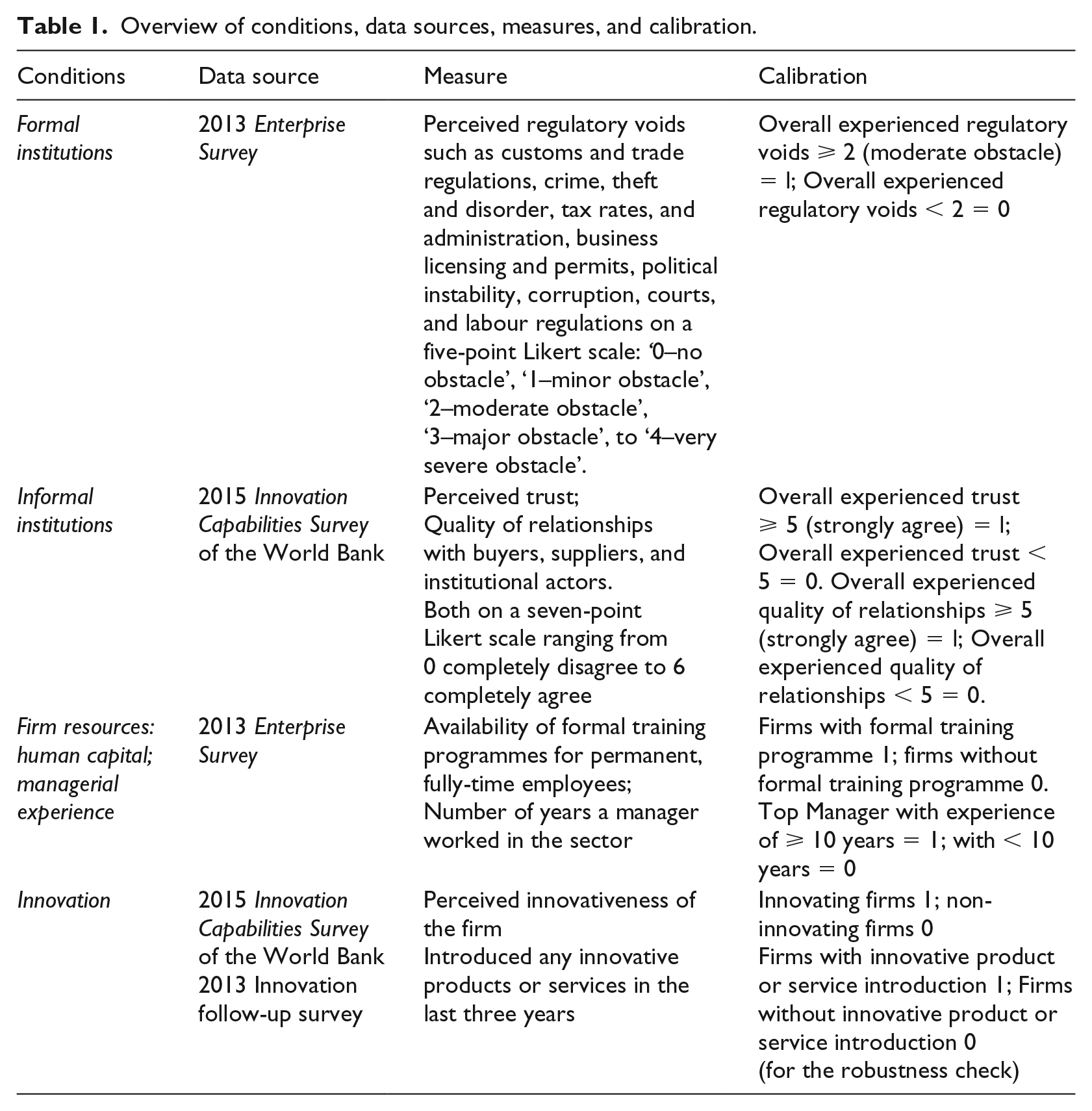
For formal institutional voids, we focused on perceived regulatory voids. Although institutional voids can occur in different institutional arenas, including political and legal systems, and product, labour and capital markets (Khanna & Palepu, 2010), previous research has focused on regulatory voids or the underdeveloped formally codified and enforced structure of laws in a nation (e.g. Manikandan & Ramachandran, 2015). In the questionnaire, respondents needed to reflect upon nine possible regulatory voids: customs and trade regulations; crime, theft and disorder; tax rates; tax administration; business licensing and permits; political instability; corruption; courts; and labour regulations. For each of the nine possible regulatory voids, respondents were asked to indicate to what extent they perceived the respective void as an obstacle: ‘0–no obstacle’, ‘1–minor obstacle’, ‘2–moderate obstacle’, ‘3–major obstacle’, to ‘4–very severe obstacle’. In order to see if these different regulatory voids could be merged into one condition representing the level of institutional voids, we conducted factor and reliability analyses per country. Based on the factor analyses (indicating one component) and an average Cronbach’s alpha of 0.818, an average was computed. For the calibration, a cut-off value of 2 was used. When firms overall experienced regulations as ‘no obstacle’ or ‘minor obstacle’, we took this to indicate the absence of institutional voids, assigning it a value of 0. When firms overall experienced regulations at least as a ‘moderate obstacle’, we categorized this as the presence of institutional voids, assigning it a 1.
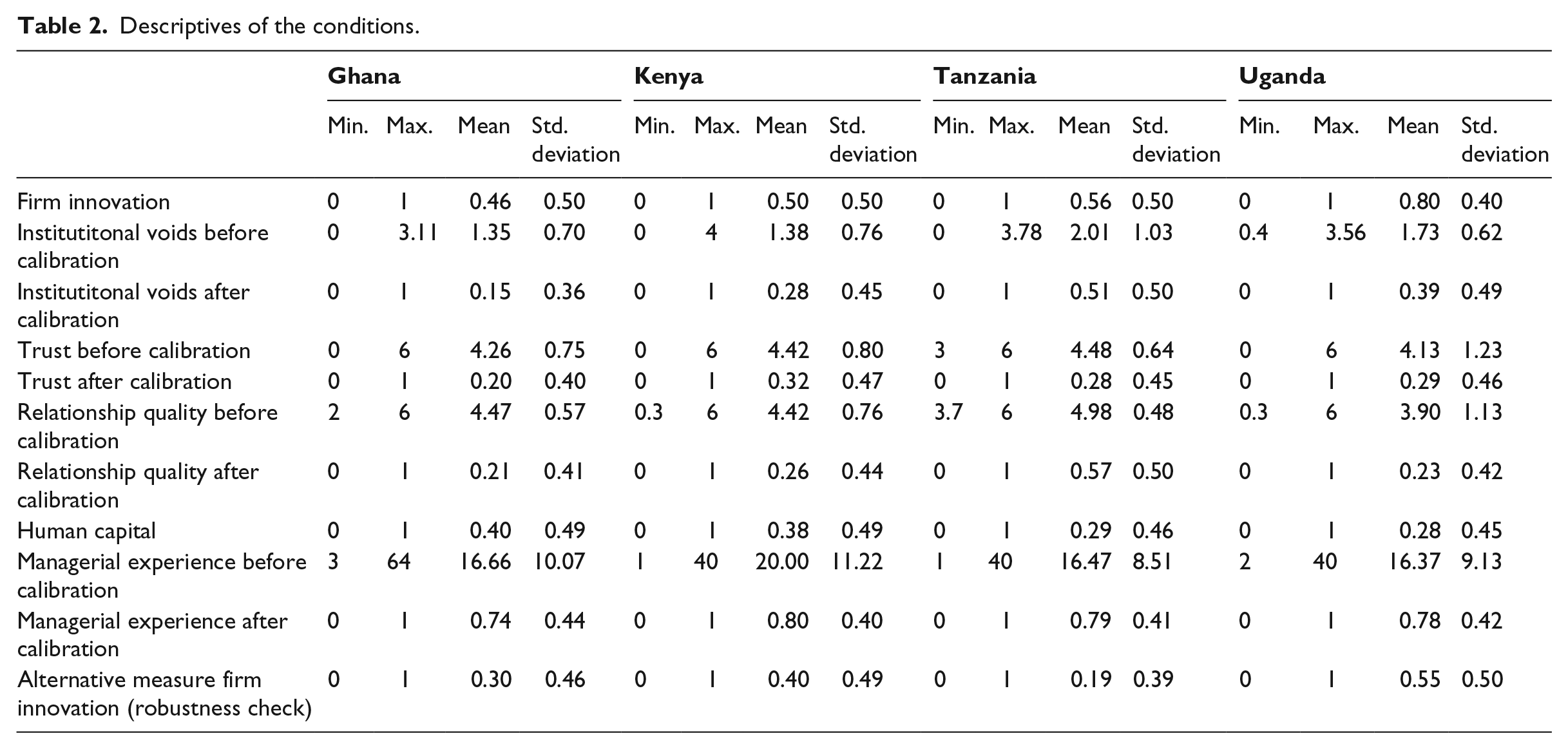
To capture informal institutions, we used two conditions: perceived trust and relationship quality (e.g. Meyskens et al., 2010). Trust was measured by a scale drawing on the measures of Ganesan (1994) and Zaheer and Venkatraman (1995). Respondents were asked to indicate the extent to which they agreed (seven-point Likert scale: 0 completely disagree to 6 completely agree) with the following statements: ‘This establishment and its partners have a high level of mutual trust’, ‘This establishment’s partners are always frank and truthful in their dealings with the establishment’, ‘This establishment’s partners stand by their words’ and ‘This establishment has the tendency to trust other organizations’. The interval scale captured how strongly a firm adopted a particular view. In order to see if these items could be collated into one trust condition, factor and reliability analyses were conducted per country. The factor analyses indicated that this was possible. Based on the reliability analyses, we removed the final statement of the scale (the average Cronbach’s alpha, after removing the statement, was 0.791). An average was computed of the remaining three items. Given that the average level of trust is relatively high for the different countries (between 4.2 and 4.4 on a scale from 0 to 6; see Table 2 for exact values), we used a cut-off value of 5 for the calibration: firms that at least strongly agreed were assigned a 1 (indicating high level of trust), whereas other firms were assigned a 0 (low level of trust). In other words, the degree of precision of the crisp set was defined according to the level of detail of the data (Basurto & Speer, 2012).
For the measurement of relationship quality, respondents were asked to indicate the extent to which they agreed (seven-point Likert scale: 0 completely disagree to 6 completely agree) with the following statements: ‘This establishment has very well established relations with buyers’, ‘This establishment has very well established relations with suppliers’, ‘This establishment has very well established relations with competitors’ and ‘This establishment has very well established relations with institutional actors’. Similar to trust, we first conducted factor and reliability analyses per country. The factor analyses again indicated one component. Based on the reliability analyses, we removed the third statement of the scale (the average Cronbach’s alpha, after removing the statement, was 0.628). Since this third item dealt with competitors (compared to items that dealt with buyers, suppliers and institutional actors), it could be explained that the response to this item was different from that to other items. Typically, relationships with competitors are different from those with buyers, suppliers and institutional actors. An average was computed of the remaining three items. Similar to trust, a cut-off value of 5 was used in the calibration: firms that at least strongly agreed were assigned a 1 (indicating high-level quality relationships), whereas other firms were assigned a 0 (low quality relationships).
For a concise overview of all the conditions, data sources, measures and calibration, see Table 1. For an overview of the descriptives of conditions (before and after calibration), see Table 2.
Overview of conditions, data sources, measures, and calibration.
Descriptives of the conditions.
Analysis
As a first step in the analysis, we ran a test to check if any of the causal conditions is necessary (if consistency score > 0.90; Ragin, 2006) for firm innovation. As the results in Table 3 show (all scores < 0.90), none of the conditions independently appear to be necessary for the occurrence of firm innovation in any of the four countries. The results of this first step are supportive of our configurational approach.
Analysis of necessary conditions for firm innovation.
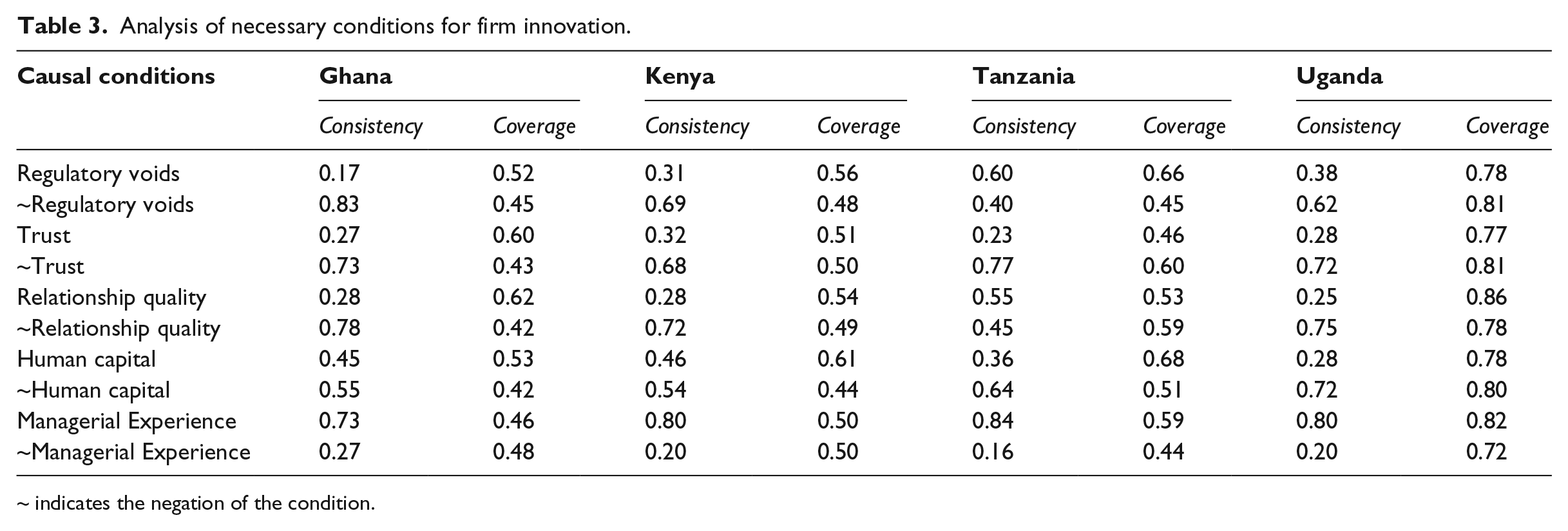
indicates the negation of the condition.
The second step was the construction of the truth table with all logically possible combinations of the conditions (Berg-Schlosser et al., 2009). The truth table also provides the number of cases that are nested in that particular causal combination. The idea of the truth table is to identify the configurations that result in the outcome; these are labelled primitive expressions (Legewie, 2013).
In order to reduce the table to intermediate and parsimonious solutions with different applications of counterfactual analyses in the presence of limited diversity, we used a frequency cut-off of 1 for all countries, which is a default setting to populate a truth table row to be included (Legewie, 2013), except for Uganda. In Uganda we had a relatively high number of firms that were innovative, hence had a high coverage, for which we used a frequency cut-off of 2. As suggested by Fiss (2011), the consistency threshold was set as 0.8. The expectations for the intermediate solution were grounded in theory: firm-specific resources and informal institutions should be present for the outcome Innovation, and institutional voids can either be present or absent for the outcome Innovation. We selected prime implications based on theoretical and substantive knowledge.
In the interpretation of our configurations, we sought meaningful patterns of interaction between formal and informal institutions with or without firm resources. We were particularly interested in patterns that did not conform to the substitutive relationship emphasized in the literature. The alternative interactions presented by configurations that we labelled as complementary and accommodating bundles are novel in the light of our theoretical position. Hence, we focused our discussion on these configurations in conjunction with the widely acknowledged substitutive relationship between formal and informal institutions. The remaining configurations are briefly mentioned in the results.
Results
Table 4 provides an overview of the results of our analyses for the four countries for which we use the notation suggested by Ragin and Fiss (2008). The presence of a condition is shown by a full circle (•). A crossed-out circle (⊗) represents the absence of a condition. The size of the circle distinguishes core conditions (large circles indicating a strong relation) from peripheral conditions (small circles indicating a weaker relation) (Fiss, 2011). An empty cell represents a ‘don’t care’ situation implying the condition can be present or absent (Fiss, 2011).
Configurations associated with firm innovation.
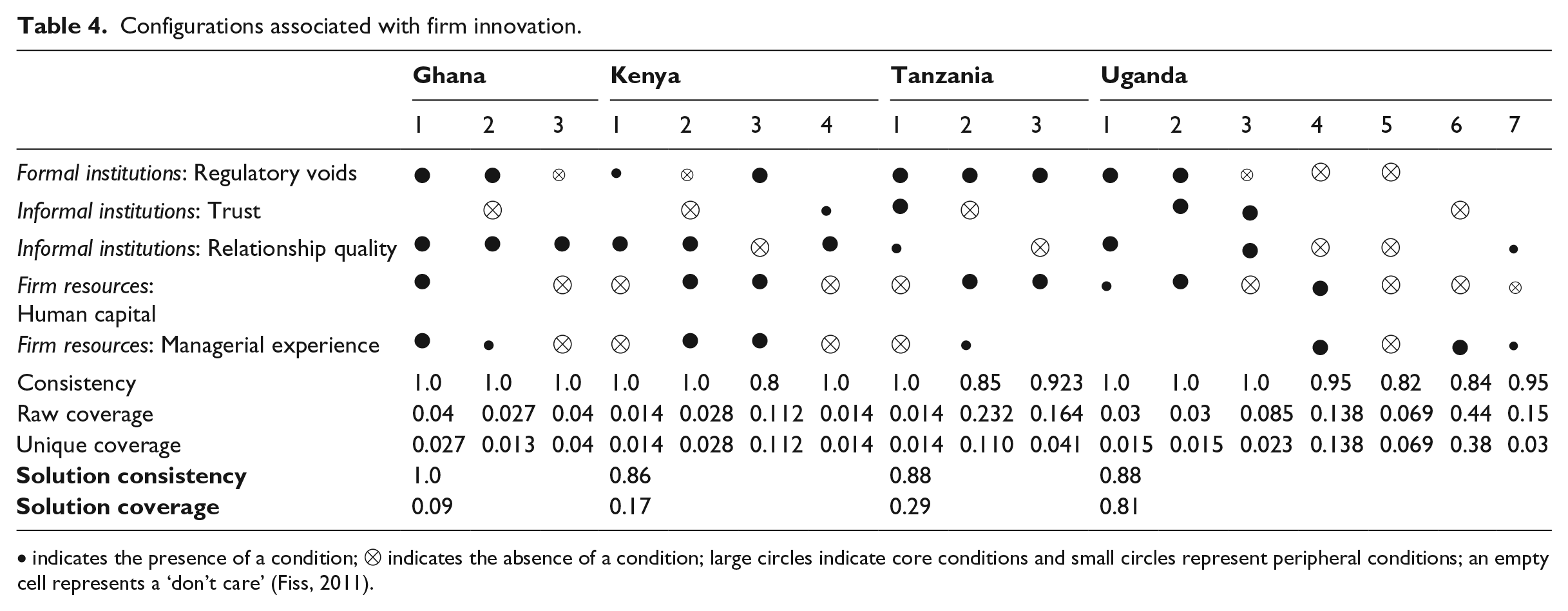
• indicates the presence of a condition; ⊗ indicates the absence of a condition; large circles indicate core conditions and small circles represent peripheral conditions; an empty cell represents a ‘don’t care’ (Fiss, 2011).
The analyses revealed 17 configurations that explain firm innovation: three for Ghana, four for Kenya, three for Tanzania and seven for Uganda. We examined the consistency and the coverage values to assess the quality of our model (Schneider & Wagemann, 2012). Consistency is a probabilistic expression of the empirical strength of set connections. Whereas coverage is a probabilistic expression of the empirical relevance of set connections. It captures the proportion of cases that is covered by all solutions of the model (Schneider & Wagemann, 2012). Consistency and coverage values, together, help to improve the interpretations of the solution formula. The solution consistency ranges from 0.86 to 1.0, which are all above the threshold of 0.8 (Fiss, 2011). The solution coverage varies between 0.09 and 0.81. This implies that the solutions of low coverage are influenced by other conditions that explain firm innovation. The raw and unique coverage are provided for each configuration. Raw coverage shows the proportion of memberships in firm innovation that are accounted for by each particular combination of mechanisms. Unique coverage is the proportion of membership in the outcome that is attributable only to the particular configuration (Ragin, 2006). The raw coverage of the different configurations varies between 0.014 and 0.44, and the unique coverage varies between 0.013 and 0.38.
There are six configurations where we observe a substitutive relationship of institutional voids with informal institutions resulting in the generation of firm innovation. However, firm-specific resources also play a role in these configurations. As configurations 1 of Kenya and 1 of Tanzania show, the substitutive relationship can occur in the presence of low level of firm resources (denoted as the absence of resources in Table 4). These configurations underscore the ability of firms to innovate despite low levels of firm-specific resources in the presence of both institutional voids and informal institutions as core conditions. Alternatively, the substitutive relationship is also observed in combination with the occurrence of high level of firm-specific resources (denoted by the presence of resources in Table 4) in configurations 1 and 2 of Ghana and 1 and 2 of Uganda. These capture the presence of institutional voids in combination with the presence of informal institutions as core conditions and high levels of firm-specific resources as either core or peripheral conditions in the generation of innovation. This suggests that informal institutions can take the place of missing or ineffective formal institutions to enhance their efficiency and support firm innovation. Hence, we propose the following.
P1: Firm innovation can be facilitated by a substitutive informal institution bundle where strong informal institutions are combined with weak formal institutions regardless of the level of firm resources.
Innovation can also occur in settings of more developed formal institutions. For instance, Kenya configuration 2 depicts the absence of institutional voids in combination with the presence of informal institutions and high levels of firm-specific resources as core conditions in the generation of innovation. However, the absence of institutional voids in combination with the presence of informal institutions and low levels of firm-specific resources can also be sufficient for innovation (configurations 3 of Ghana and 3 of Uganda). In other words, informal institutions can coexist with effective formal institutions, offering further support to firms in their efforts to innovate. Consequently, we propose the following.
P2: Firm innovation can be facilitated by a complementary informal institution bundle where strong informal institutions are combined with strong formal institutions regardless of the level of firm resources.
Unsurprisingly, we also observe firm resources to support firm innovation in a setting of more developed formal institutions and weak informal institutions. The absence of both institutional voids and strong informal institutions in conjunction with high levels of firm-specific resources is sufficient for innovation in Uganda (configuration 4). This suggests that informal institutions can offer incentives for firms to alter the substantive effects of formal rules but without directly violating them. Informal institutions may serve the interests of actors who dislike the outcomes generated by formal rules but are unable to change or openly defy these rules. For instance, an institutional environment can feature both a strong formal contract law and informal institutions that stress clientelism-based transactions. These contradictory institutions can lead to incomplete contracts or inefficiencies in their enforcement. Although such informal institutions may not be efficiency enhancing, they may enhance the stability of formal institutions by dampening demands for change in formal rules. We capture this finding by the following proposition.
P3: Firm innovation can be facilitated by an accommodating informal institution bundle where weak informal institutions and strong formal institutions are combined with high level of firm resources.
However, the results also reveal several other configurations. Some of these highlight the significance of firm-specific resources, indicating that firms can be innovative in settings characterized by institutional voids and weak informal institutions (configurations 3 of Kenya and 2 and 3 of Tanzania), which is due to their internal resources. In other words, despite the presence of institutional voids and the lack of support from informal institutions, firms can still innovate if they are in possession of high levels of firm-specific resources. There is also one configuration (Uganda configuration 5) that shows the absence of both institutional voids and strong informal institutions in conjunction with low levels of firm-specific resources to be sufficient for firm innovation.
Finally, we observe three configurations in which institutional voids do not play a role. Independent of institutional voids, the absence of informal institutions in combination with high levels of firm-specific resources (Uganda configuration 6) or the presence of informal institutions in combination with low levels of firm-specific resources (Kenya configuration 4) or the presence of informal institutions in combination with high levels of firm-specific resources (Uganda configuration 7) results in innovation.
Drawing on these propositions, we summarize the broad range of interactions between formal and informal institutions and firm resources that facilitate firm innovation in Figure 1. As the figure clearly depicts, informal institutions serve as assets for firms in developing the ability to innovate in contexts where formal institutions are both weak and strong.
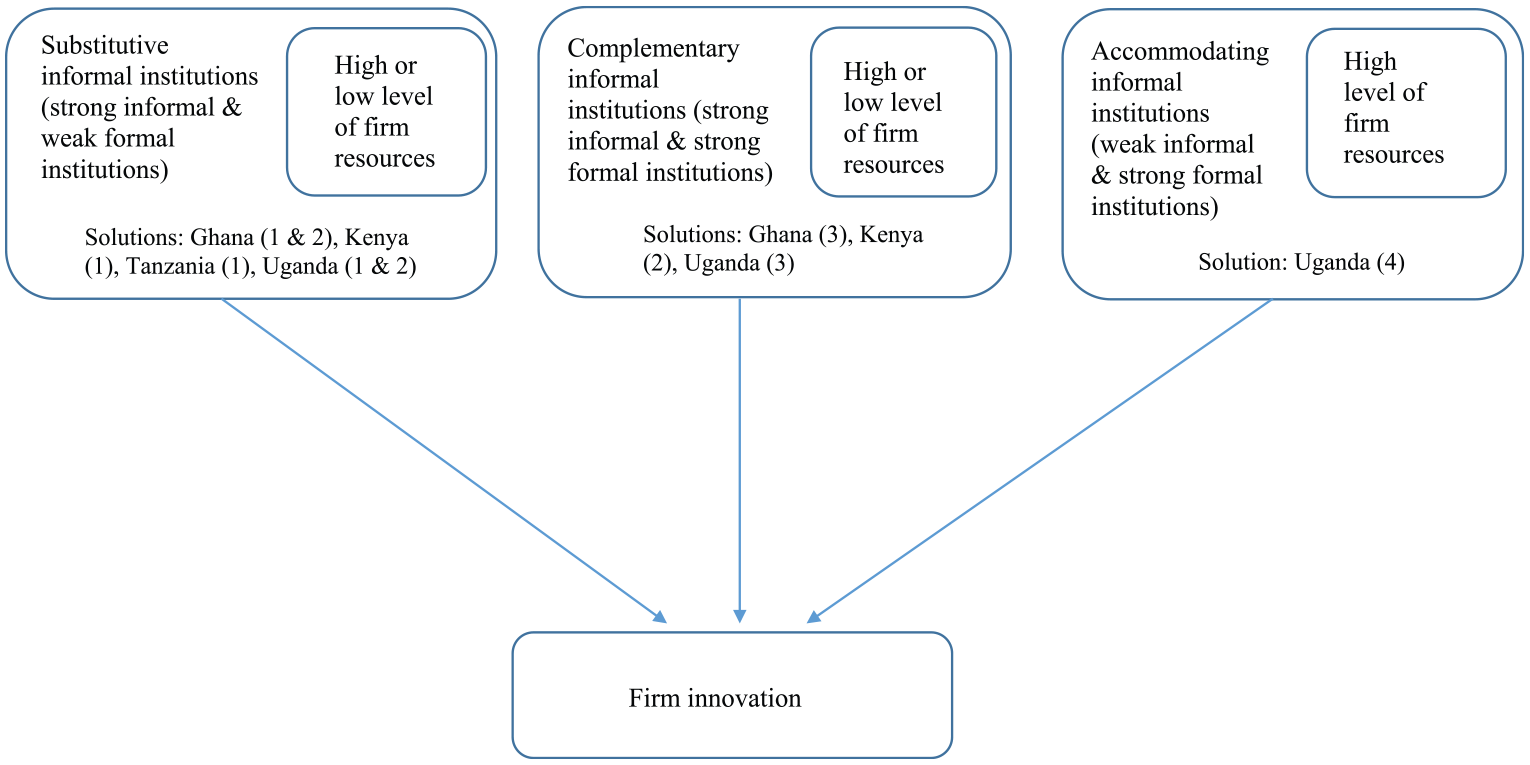
Configurations of informal institution bundles influencing firm innovation.
Robustness checks
In order to check for the sensitivity of the results, we conducted several robustness checks. First, we changed the cut-off values for the conditions and compared the solutions with the ones obtained in the original analysis (see the supplementary file). For formal institutional voids, we used 1 (‘no obstacle’) instead of 2 as a cut-off value. In other words, firms that scored a value larger than 1 (on a scale of 0 to 4) on formal institutional voids were considered as experiencing voids. This new calibration resulted in significantly more firms experiencing voids revealing 14 solutions. Nine solutions were either exactly the same as or almost identical to the solutions in the original analyses, but five additional solutions emerged: two for Ghana (strong informal institutions combined with low firm resources; and a substitutive effect coupled with low level of resources); three for Kenya (strong formal institutions; strong formal institutions combined with high level of firm resources; and a substitutive effect coupled with high level of resources). These findings capture the significant role of informal institutions, in combination with high or low levels of firm resources, in compensating for the risk exposed by underdeveloped formal institutions. Where formal institutions are effective, firms can be innovative either with or without high levels of firm resources. Please see the supplementary file for solutions that were no longer observed.
For informal institutions, we used a cut-off value of 4.5 instead of 5. The analyses for trust showed only few differences from the original analyses: 16 solutions of which 13 were exactly the same or almost identical to the original analysis. We also found three additional solutions: one for Kenya (a substitutive effect coupled with high level of resources) and two for Uganda (both strong informal institutions combined with low firm resources).
For the quality of relationships, the results were also very similar to the original analyses. We found 20 solutions of which 14 solutions were either the same or almost identical to the original findings. Yet, six additional solutions were found: two for Ghana (weak formal institutions not compensated by informal institutions or high levels of resources; a mix of strong and weak informal institutions and high and low levels of firm resources), two for Tanzania (both substitutive effects coupled with high level of resources) and two for Uganda (informal institutions combined with low and high levels of firm resources).
For managerial experience, we changed the cut-off value from 10 to 15 years of experience. The analyses with this changed cut-off value resulted in 15 solutions of which 10 were the same or almost identical to the baseline results. Five new solutions were displayed: one for Kenya (strong informal and formal institutions coupled with low level of resources), one for Tanzania (weak informal and strong formal institutions coupled with high level of resources) and three for Uganda (strong formal institutions; and informal institutions combined with low and high levels of firm resources). Since the measurement of human capital was binary, it was not necessary (nor possible) to use a different calibration.
Hence, changes in the cut-off value of formal institutional (regulatory) voids and managerial experience led to the weak informal/strong formal institution bundle and some substitutive and strong informal/strong formal institution bundles to disappear. These effects were captured in either new solutions or still prevalent in matching solutions that were generated by the recalibration. An exception to this is the weak informal/strong formal institutional effect in the robustness check for formal institutional voids. Given that our cut-off choice for managerial experience was based on theoretical insight (Ayyagari et al., 2011), we attach greater confidence to our original analysis. Similarly, the original cut-off values for regulatory voids are more realistic in the context of our study. The more stringent calibration of regulatory voids as firms that experience minor to very severe obstacles easily inflates the number of firms categorized as perceiving voids in developing countries. Given the challenges of operating in these countries, ‘minor obstacles’ should reflect relatively strong institutional settings. This can avoid overrepresentation and bias in our results.
In addition, we used an alternative operationalization of innovation. Instead of relying on the perception of firms as to whether they were innovative or not, we used the Innovation Follow-up Survey’s data on whether firms introduced any innovative products or services in the last three years (see Table 5). For Ghana, Kenya and Tanzania, our results were similar to those in the original analysis. Most configurations in the new analysis were (almost) identical to the original analysis with one configuration no longer being observed each for Ghana, Kenya and Tanzania. We also observed that the solution coverage is lower for Kenya (0.07) and Tanzania (0.08). For Uganda, only two out of seven configurations remained with this innovation measure and the solution coverage dropped sharply to 0.067. The low coverage explains the reduction in the number of configurations that illustrate innovation by resourceful firms under a substitutive effect of informal institutions. It also suggests that there are other conditions, which may be country-specific, at play (detailed in limitations and future studies) that our model does not consider when firms are asked about an introduction of a new product or service in the last three years.
Configurations associated with an alternative measure for firm innovation.
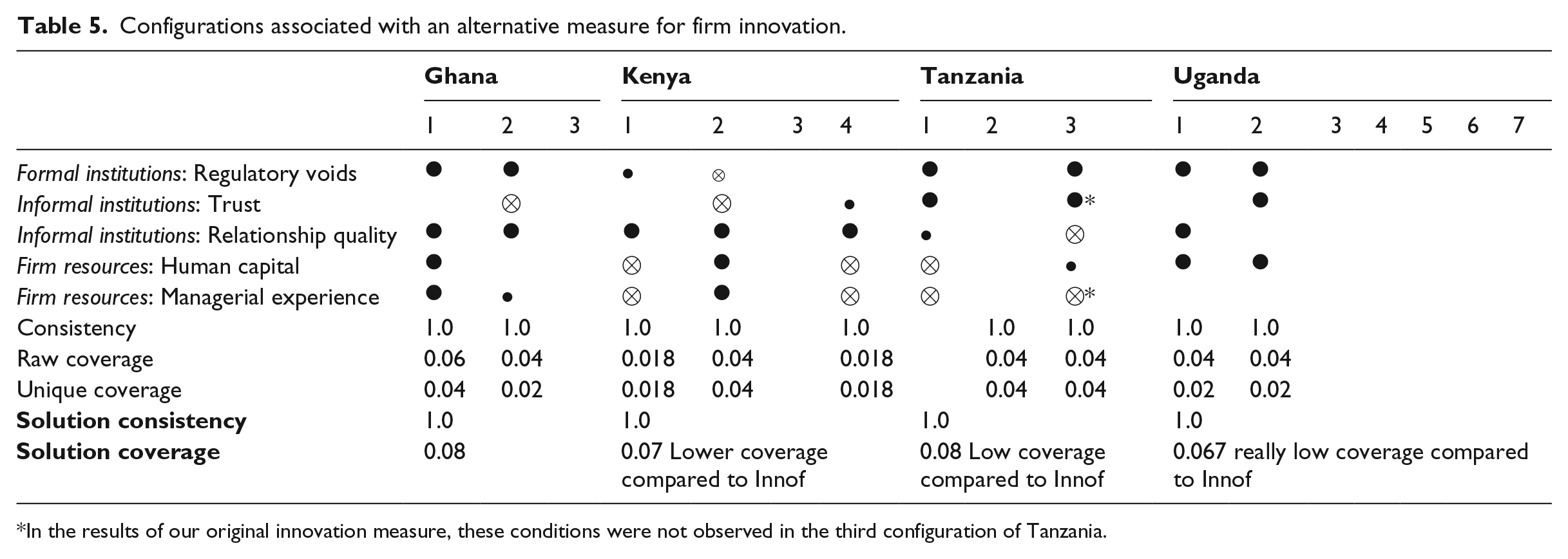
In the results of our original innovation measure, these conditions were not observed in the third configuration of Tanzania.
Discussion and Conclusion
This study contributes to the literature in two ways. First, we advance the literature on innovation in developing countries by demonstrating that informal institutions not only substitute weak formal institutions but also complement more developed formal institutions in the presence or absence of high levels of firm resources or accommodate them in the presence of high levels of firm resources to support firm innovation. The emphasis in previous innovation studies has been on the resource constraints of firms in developing countries (e.g. Bradley et al., 2012; Robson, Haug, & Obeng, 2009). This has prevented scholars from exploring how firms can overcome institutional barriers to innovation in these settings. Moreover, most innovation studies in these countries have incorporated formal institutions and largely ignored informal institutions (e.g. Oluwatobi, Efobi, Olurinola, & Alege, 2015; Barasa et al., 2017). Studies that have incorporated both types of institutions have largely focused on the substitutive role of informal institutions that enable access to resources where strong formal institutions are absent in firm innovation (Khanna & Palepu, 2010; Stephan et al., 2015). Given that new sources of value are generated by new ways of exchanging and combining resources, the informal institution of network relationships become a requisite for combining and creating knowledge (Cabrera & Cabrera, 2002). In line with the existing literature, we find that informal institutions can indeed substitute weak formal institutions to facilitate firm innovation where firms possess high or low levels of resources to work with these institutions. Extending this stream of research, our findings make clear that informal institutions can also complement relatively strong formal institutions in the absence or presence of firm-level resources to promote innovation in developing economies. This is evidenced among business groups enhancing rather than reducing their scope by extending network ties with more sectors of the economy when faced by new liberalization policies and strengthening of markets (Khanna & Palepu, 2010). Despite the transition to a formal legal market-oriented institutional setting, relational contracting and the cultivation of networks and social capital persist and are a source of competitive advantage in these countries (Carney, 2004). In fact, these informal institutions coexist with formal institutions to sustain a variety of capitalism, offering national comparative advantage (Carney, Gedajlovic, & Yang, 2009). As such, network relations and trust can complement the more effective regulatory environments to stimulate firm innovation, highlighting organizational resilience or the ability to adapt to changes in an economic and institutional environment (Castellacci, 2015). This finding challenges several studies that underscore the significance of networks and trust in developing economies that are characterized by ineffective regulations (e.g. Webb, Kistruck, & Ireland, 2010). Informal institutions play a central role in firm innovation even in the presence of relatively strong institutions.
Furthermore, we found that informal institutions that are relatively ineffective can accommodate strong formal institutions. Firms in settings characterized by weak informal and strong formal institutions can still innovate if they own high levels of relational and competitive assets (Peng, 2003). As various economies have evolved toward a rule-based, transactional market system with relatively strong formal institutions, relationships often have been found to be ‘necessary but insufficient for good performance’ (Peng & Luo, 2000, p. 487). In other words, competitive capabilities assume significance as a driver of firm innovation as formal institutions develop in a country and the benefits derived from relational contracting subside as transactions become more complex. This suggests that informal institutions can either be problem solving or problem creating, i.e. either enhancing or undermining the efficiency or performance of formal institutions (Helmke & Levitsky, 2004), in firms’ efforts to develop innovative products and services.
Second, the different types of interaction between formal and informal institutions necessitates a configurational approach to examining the joint influence of more or less compatible formal and informal institutions on firm innovation in conjunction with firm resources (see Misangyi et al., 2017). Hence, we analysed firms as clusters of interconnected structures in relation to firm innovation. Our results point to multiple paths that firms can take to be innovative that best fit their existing institutional context. In the absence of effective formal institutions, firms can draw on high levels of firm resources and/or effective informal institutions – high levels of trust and well-established relationships – to innovate. Our study demonstrates that firms in sub-Saharan Africa use networks based on mutual trust and/or build on well-established interactions to innovate. This supports the emerging view in developing economies that what matters for firm innovation is connectedness, not just firm-level resources (Gebreeyesus & Mohnen, 2013).
Managerial and policy implications
Most research on innovation relies on data gathered from firms in developed countries (Robson et al., 2009). There is scant attention to the relevance of innovation in firms that operate in developing countries. While one might argue that developing countries should concentrate on ensuring the provision of effective regulatory environments (Arnott & Stiglitz, 1991), our findings show that innovation is unlikely to be achieved solely with support from reliable formal institutions. Firms in developing countries have the potential to generate economic growth by accruing internal resources such as managerial experience and training, and/or acquiring external resources from trust-based networks and well-established relationships. Hence, our findings provide managers with recipes for when they can rely on internal firm capabilities and external institutional resources to generate innovation. There is no single perfect answer in terms of the best strategy for innovation. As illustrated by the second and third configurations in Tanzania, firms are able to innovate despite regulatory voids if they are in possession of high levels of firm resources. However, firms with low levels of resources are also able to innovate when faced with regulatory shortcomings if they are embedded in trust-based networks (e.g. configuration 1 of Tanzania). Interestingly, firms that operate in more effective regulatory environments can also be innovative, but only when they either own high levels of resources and/or they are embedded in trust-based networks and collaborative relations to access resources externally. This is in contrast to existing claims on the importance of networks and trust for innovation in developing economies that are marked by ineffective regulations (Webb et al., 2010). In conclusion, managers need to adopt strategies for innovation that fit best with the heterogeneous resources of their firms and institutional environments.
Policy makers are equally likely to benefit from the results of this study. Given globalization pressures for high-value production and the massive growth in demand for efficiency, developing countries are in need of new tools to enhance their competitiveness and innovation capacity. Our configurational analysis constitutes one of these tools as it promotes the idea of concentrating firm resources and institutions, and interconnecting and building value networks when firms and governments are faced with common challenges and opportunities. Where policy makers are unable to enhance the reliability of their regulations, they can offer incentives to nurture informal institutions (trust-based networks) as these are conducive to firm innovation regardless of the level of resources possessed by firms. With improvements in the regulatory system, incentives for either maintaining strong network and trust relations need to be retained or accessing and accruing resources by firms need to be provided. These equally valid pathways to firm innovation call for a holistic outlook on firm resources, network linkages and regulatory environments.
Limitations and future studies
The limitations of this study offer avenues for future research. First, this study uses a self-reported innovation measure for firm innovation. Even though this is a common practice (see, for instance, Ayyagari et al., 2011; Barasa et al., 2017; Gebreeyesus & Mohnen, 2013; Lederman, 2010), we are aware of its potential biases. Consequently, we re-ran our analysis using a more objective, albeit also self-reported, measure of whether the firm introduced an innovative product or service in the last three years. Our results were very similar for most countries, with the exception of Uganda. We therefore urge researchers to exercise caution in interpreting the results of our study, and encourage future studies to draw on non-self-reported innovation measures.
Second, the study operationalizes firm-level resources as training and managerial experience, and informal institutions as trust and well-established relationships. Although these are widely accepted proxies (e.g. Barasa et al., 2017; Goedhuys & Sleuwaegen, 2010; Landa, 2016; Murphy, 2002), they are not all-inclusive. Scholars have also pointed to other resources such as export activity, and other informal institutions such as family obligations (e.g. Robson et al., 2009) and nonfamily community ties (e.g. Khavul, Bruton, & Wood, 2009) as having a positive impact on firm innovation.
We also acknowledge that financial resources in the absence of well-developed equity markets in developing countries can have an effect on our results as firms that are weakly resourced in skills and managerial experience can have access to high levels of financial resources such as bank financing to benefit from the complementary effects of informal institutions. It would be interesting to explore whether in configurations of firm innovation facilitated by complementary informal institution bundles, financial resources either independently or in combination with other firm resources lead to firm innovation, and whether this varies across accommodating and substitutive informal institution bundles.
Third, our study shows trust-based networks to be an important enabler of innovation for SMEs with low levels of resources facing institutional voids as well as those operating in institutionally more supportive environments. Future research of a qualitative comparative nature can unravel the underlying mechanisms for how network connections facilitate innovation in developing countries. It is well acknowledged that network relations can provide financial or emotional support as well as knowledge and information to focal actors in pursuit of their goals (e.g. Qureshi, Kistruck, & Bhatt, 2016). However, these accounts emphasize types of network ties and characteristics of the overall network itself (Kilduff & Tsai, 2003). Ways in which such ties can enable or constrain innovation in contexts of institutional voids where social networks may be stronger and long-term (e.g. Narooz & Child, 2017) warrant further attention.
Fourth, our sample displays low solution coverage scores for Ghana (9 per cent) and Kenya (17 per cent). Hence, the solutions for these two countries explain fewer cases of firm innovation than those for Tanzania and Uganda. Having said that, the cases that configurations 3 of Ghana and 2 of Kenya can explain are exactly those that configurations supporting the conventional wisdom – the substitutive role of informal institutions – cannot explain, which makes these paths so empirically interesting. Consequently, future studies should include other causal conditions such as R&D intensity, financial resources, foreign ownership and international cooperation (Schmiele, 2012) to capture more cases of innovation in Ghana and Kenya. Although our study includes data from SMEs in four countries in sub-Saharan Africa, this empirical context does not form a boundary condition for the theoretical claims advanced here. The operationalizations of our conditions are equally applicable to other developing countries.
Fifth, it would be intriguing for future research to see whether different configurations stimulate different types of innovation. Innovations in developing countries rely more on the use of new processes and business models than technology. Hence, we expect our configurations to be associated with incremental innovation. If innovations include technology at all, then these tend to be developed by local firms of foreign multinationals (Govindarajan & Ramamurti, 2011). Where SMEs are connected to multinationals through alliances, their incremental innovations may reverse-diffuse to developed countries. Such diffusions may be captured by configurations where effective institutions that can maximize cooperation among alliance partners (Ireland, Hitt, & Vaidyanath, 2002) are complemented by firm resources, such as solution 2 of Kenya. It is difficult to estimate whether our study’s configurations can encourage radical innovations, because such innovations require technology (Ettlie, Bridges, & O’Keefe, 1984), which few SMEs in developing countries possess.
Around the world, policies to develop SMEs have been based on the presumption that they need to be resourceful and supported by a reliable institutional environment to be innovative. Although it is clear that SMEs can rely on informal institutions (close network relations) to reduce uncertainty and risks in developing countries, there is limited evidence for how relatively more effective institutional settings interact with network relations and SME resources to promote firm innovation. Our study provides insight into alternative – complementary and accommodating – interactions that can generate firm innovation either in the presence or absence of SME resources.
Supplemental Material
Supplementary_file_robustness_checks – Supplemental material for Multiple Paths to Firm Innovation in Sub-Saharan Africa: How informal institutions matter
Supplemental material, Supplementary_file_robustness_checks for Multiple Paths to Firm Innovation in Sub-Saharan Africa: How informal institutions matter by Ayse Saka-Helmhout, Maryse Chappin and Patrick Vermeulen in Organization Studies
Footnotes
Funding
The author(s) gratefully acknowledge the financial support provided by the UK’s Department for International Development (DFID, grant number PO5639). The funding agent had no involvement in study design; data collection, analysis and interpretation; and report writing.

Supplemental material
Supplemental material for this article is available online.
Notes
Author biographies
References
Supplementary Material
Please find the following supplemental material available below.
For Open Access articles published under a Creative Commons License, all supplemental material carries the same license as the article it is associated with.
For non-Open Access articles published, all supplemental material carries a non-exclusive license, and permission requests for re-use of supplemental material or any part of supplemental material shall be sent directly to the copyright owner as specified in the copyright notice associated with the article.
