




Abstract
In this paper we focus on the development of professional accountability systems as a form of systemic power to enhance institutional control, particularly on the associated institutional politics – the interplay between institutional control and institutional work by different (collective) actors. We address the dialectical nature of these institutional politics and identify three types of power tactics underpinning institutional work: attacking, anticipating and defending. Articulating these power tactics revealed the dialectical flux of power tactics between different parties, and how this in turn arose from and affected the development and strength of (new) systemic power. This shows how gaining institutional control over mostly self-employed professionals (veterinarians) through systemic power without legislation is a more sophisticated process than often assumed based on studies of professionals working in large service firms.
Keywords
Introduction
Organizational institutionalism has long been criticized for downplaying the role of power and for lacking an explicit analysis of power and institutions, ‘especially in terms of explicit empirical studies of this fundamental relationship’ (Lawrence & Buchanan, 2017, p. 501; see also Clegg, 2010; Munir, 2015; Suddaby, 2010). Three issues have been raised. First, although studies of institutional work focus on institutional agency and thus on conflicting interests (Helfen & Sydow, 2013; Lawrence & Buchanan, 2017), we still know relatively little about the power tactics that actors use to create favourable political contexts for the diffusion and translation of means for institutional control, especially in domains where governance is new or not yet fully developed (Hampel, Lawrence, & Tracey, 2017; Schneiberg & Lounsbury, 2008). Second, in those studies that do address power more explicitly, the relationship between power and institutional control seems to have been overlooked. For example, we still lack a deeper understanding of how discipline and domination and their associated accountability systems such as accreditation systems or quality registers often supported through technology, as forms of systemic power, function in different contexts, and how this might limit their effectiveness (Lawrence & Buchanan, 2017). Third, episodic and systemic power have so far mainly been studied in isolation, leaving institutional politics highly underexplored (Lawrence, Malhotra, & Morris, 2012). More empirical research is therefore required to better understand power in institutions (Lawrence & Buchanan, 2017).
Our study focuses on a setting in which different (collective) actors in a professional field battle over whether and how institutional control should be increased. Professionals in our study – Dutch veterinarians – work mainly in small businesses; large organizations through which individuals can be discursively manipulated or monitored are absent. This setting allows us to investigate how changes in institutional control result from a political struggle involving multiple social constituents with unequal power (Seo & Creed, 2002). Our analysis provides a deeper understanding of the role of power in the interplay between institutional work and institutional control among multiple actors over time. We respond to recent calls for the more explicit integration of existing theories of power in institutionalism research (Lawrence & Buchanan, 2017; Munir, 2015) and contribute to theory on power and institutions in line with the three knowledge gaps described above.
First, we take the perspectives of multiple actors into account when investigating the power dynamics that underpin institutional work (Reay, Goodrick, & Hinings, 2016). Many studies on institutional agency have addressed the social skills and strategic actions or ‘middle ground strategies’ (Oliver, 1991) necessary to maintain power or to resist institutional control (e.g. Currie, Lockett, Finn, Martin, & Waring, 2012; Fligstein, 1997), yet failed to explain how agency rests on different facets of power and the dialectic nature of these power tactics (Hargrave & Van de Ven, 2006). Our study thus provides a much needed, more fine-grained explanation of the underlying ‘political work’ that actors deploy on other actors (e.g. Reay et al., 2016).
Second, we explicitly investigate the role of systemic power in institutional control. Systems of accountability such as quality registers, accreditation systems, or forms of standardization (codes of conduct, guidelines, protocols) are all examples of systemic power (Banks, 2002; Seidl, 2007; Slager, Gond, & Moon, 2012): ‘power that works through routine ongoing practices to advantage particular groups without those groups necessarily establishing or maintaining those practices’ and through which institutional control manifests itself (Lawrence & Buchanan, 2017, p. 480). Literature on institutional work has mostly addressed systemic power as a resource or acquired advantage that provides a motive for institutional work, for example to maintain professional power (see Currie et al., 2012; or Rojas, 2010). Only a few studies have addressed the institutional work necessary to create or maintain systemic power (see Slager et al., 2012 on standardization work for an exception), yet not the specific mechanisms through which systemic power is used, nor how it supports particular episodic power tactics.
Based on our empirical insights regarding power tactics and systemic power, our final contribution lies in proposing a dialectical model of institutional politics. We build on Lawrence and Buchanan’s framework on institutional politics (2017) and add to it a dialectical perspective on institutional change (Seo & Creed, 2002). The dialectical perspective on institutional change advanced by Seo and Creed (2002) provides an explanation of how political action for institutional change emerges in the midst of institutional embeddedness. Yet their model says little about how the dynamic process following such political action affects subsequent institutional change, nor does it address the role of systemic and episodic power in this process. Our dialectical model of institutional politics integrates the dialectical process of institutional change and the role of systemic and episodic power. In doing so, we contribute to institutional work literature by providing further explanation on when and how particular forms of systemic power interact with episodic power.
In our analysis of institutional politics in a professional field with low institutional control, we followed the setting up of accountability systems in the Dutch veterinary profession. Both systems were an attempt to increase institutional control by launching new forms of systemic power: professional guidelines and a register to support upcoming legislation, and a quality register including an accreditation system. We followed this process from its inception in 2011 until some stability had been reached by 2015. This context provided an ideal setting to investigate the interplay between institutional control and agency, as ‘underlying institutional scripts are typically most apparent in times of conflict and struggle, or where an event has disrupted a pre-existing interaction order’ (Suddaby & Greenwood, 2009, p. 189).
Theoretical Background: Institutions and Power
Institutions are inherently about power – they are based on repetitively activated controls that are socially constructed and regulated by rewards and sanctions when actors depart from the prescribed pattern (Jepperson, 1991; Lawrence & Buchanan, 2017; Phillips, Lawrence, & Hardy, 2004). Power in this paper refers to ‘the dimension of relationships through which the behaviours, attitudes, or opportunities of an actor are affected by another actor, system, or technology’ (Lawrence et al., 2012, p. 105). Institutions and actors relate to each other in terms of power through two overarching dynamics: institutional control and institutional agency (Lawrence & Buchanan, 2017; Lawrence, Winn, & Jennings, 2001). Institutional control involves the effects of institutions on actors’ beliefs and behaviour; institutional agency describes actors’ institutional work to create, transform, maintain and disrupt institutions (Lawrence & Buchanan, 2017). Both dynamics rely on different modes of power: systemic power and episodic power. Systemic power congeals to form more enduring institutional structures and becomes embedded in social, technological, cultural and bureaucratic, regulating systems (Fleming & Spicer, 2014; Lawrence et al., 2012). Episodic power occurs in discrete episodes initiated by self-interested actors: the direct exercise of power (Fleming & Spicer, 2007, 2014). We will first elaborate on these modes of power separately, before addressing their dialectical nature and institutional change.
Institutional control: accountability instruments as systemic power
Institutional control is exercised through systemic power is closely associated with phenomena such as socialization and accreditation processes (Jepperson, 1991; Lawrence & Buchanan, 2017; Slager et al., 2012). Professional accountability systems – such as guidelines for professional conduct, standards and quality registers for accrediting professionals, codes of conduct, and protocols (Roberts & Scapens, 1985) – are forms of systemic power and thus a means of institutional control, since they revolve around ‘those aspects of a field that regulate behavior on an ongoing basis and set “the rules of the game”’ (Lawrence & Buchanan, 2017, pp. 482–3).
Two underlying faces of power have been attributed to systemic power: discipline or ‘subjectification’, and domination (Fleming & Spicer, 2014; Lawrence & Buchanan, 2017; Lawrence et al., 2001). Both are systemic because they mobilize institutional, ideological and discursive resources to influence professional activity and are often less visible than overt acts of power (Fleming & Spicer, 2014). Subjectification has its roots in a Foucauldian perspective on power and is regarded as a form of influence that ‘seeks to determine an actor’s very sense of self, it revolves around the constitution of identity [. . .] through regimes of surveillance and training’ (Lawrence & Buchanan, 2017 pp. 484, 486). Mechanisms that support or aim for subjectification include disciplinary regimes, constructions of identity, the articulation of a particular discourse, systems of talk and texts, which all construct a certain social reality that guides our behaviour and emotions, and governmentality (Fleming & Spicer, 2014).
Domination, the other face of power that underpins systemic power, works by ‘altering the range of options [. . .] often through “physical and social technologies that provide the basis for action”’ (Lawrence et al., 2001, p. 109). Domination is a form of power whereby actors establish influence through the construction of ideological values that become hegemonic and regarded as legitimate or standard, with little coercion or manipulation occurring openly (Fleming & Spicer, 2014). For example, particular assumptions and ideals are made to appear inevitable and therefore become unquestioned. These phenomena are often supported by material technologies, such as accreditation systems. These systems work without any episodic activation and construct their targets not as subjects but as objects (Lawrence et al., 2001), since the actions of professionals are routinely determined by technology with built-in criteria from a professional ideology of ‘good professional conduct’. A quality register, for example, is a collectively agreed indication of quality, and not conforming with it is not an option (Knights & McCabe, 1997).
Institutional control, including its technical systems, does not always go unchallenged, as has been shown by studies investigating institutional resistance and social movement and how they alter institutionalized ideological values and perceptions (e.g. Schneiberg & Lounsbury, 2008). Both the development and implementation of systems that provide systemic power (in the long run) and thus institutional control, as well as resistance to these attempts, require the use of episodic power tactics to ‘get certain things done or undone’.
Institutional agency/work: episodic power
The concept of institutional work emphasizes the deliberate strategies of actors as they skilfully and reflexively engage in activities to influence their institutional environments (Lawrence & Buchanan, 2017). Current descriptions and concepts of institutional work mainly focus on actors creating, maintaining or disrupting institutions and their support systems (systemic power).These strategies, however, also involve some degree of ‘political work’ (Lawrence & Suddaby, 2006) or ‘episodic power’ – power that involves strategic acts undertaken by actors with others by mobilizing resources, by engaging in contests over meaning and practices, and by developing, supporting or attacking forms of discourse and practice (Lawrence & Buchanan, 2017). Episodic power relies on two facets of power, namely ‘influence’ (manipulation) and ‘force’ (Lawrence & Buchanan, 2017; Lawrence et al., 2001). Influence, in terms of power, can be achieved through manipulation; ‘force’ predominantly resembles what Fleming and Spicer (2014) refer to as ‘coercion’, although it is not quite the same. Influence consists of a set of tactics that are available to strategic actors, most of which are examples of either influence or establishing the conditions under which influence is possible such as ‘agenda setting’, ‘wheeling and annealing’, ‘brokering’ or ‘networking to outliers’ (Lawrence et al., 2002; Fligstein, 1997). Influence through manipulation includes tactics whereby actors seek to either limit the issues that are discussed or fit issues within (what are perceived to be) acceptable boundaries (Fleming & Spicer, 2014). For example, brokering and networking with outsiders can establish agendas and subtly influence decision-making processes, as an individual’s position may act as a bridge between two different institutional actor(s), presenting them with the opportunity to shape the distribution of information and resources (Fleming & Spicer, 2014). Coercion (Fleming & Spicer, 2014) or ‘force’ (Lawrence et al., 2001; Lawrence & Buchanan, 2017) is the ‘direct, overt use of power to overcome another actor’s intentions or behaviors’ (Lawrence & Buchanan, 2017, p. 635). When force is used, other actors (‘targets’) are regarded and approached not as subjects – characterized by agency – but as objects, with the powerful actors leaving no choice regarding how to act (e.g. Lawrence et al., 2001). Coercion focuses on the direct exercise of power by individuals to get others to do something they would not otherwise have done (Fleming & Spicer, 2014). The two qualities needed by an actor to deploy coercion are their ability to reduce uncertainty (by virtue of their position), and/or their possession of resources considered valuable to other actor(s) involved (Fleming & Spicer, 2014). Force can be applied by states, for example, to disrupt or maintain institutions (Lawrence & Buchanan, 2017).
The dialectical nature of institutional politics
The concept of institutional politics addresses power as enacted and stresses the idea that actors are affected by others actors, by the social systems they are embedded in and by the technologies they work with (Clegg, Courpasson, & Phillips, 2006; Reay et al., 2016). Several authors have addressed the interplay of systemic and episodic power that is required to establish institutional change and institutional stability (e.g. Lawrence et al., 2001, 2012; Seo & Creed, 2002). For example, if actors have to rely on episodic power such as influencing decision-making processes, the institutionalization process will occur more slowly and the resulting institutional control will be unstable, whereas if actors can rely on systemic power such as disciplining and domination, one would expect greater institutional stability (Lawrence et al., 2001).
To address the issue of the lack of a dynamic, dialectical process perspective on institutional politics (see Introduction), we draw on a dialectical perspective on institutional change (Hargrave & Van de Ven, 2006, 2009; Seo & Creed, 2002). From a dialectical perspective, conflicts between opposing forces are synthesized into a (new) outcome: ‘the current thesis or institutional arrangement (A) is challenged by an opposing group espousing an antithesis (Not-A), which sets the stage for producing a synthesis (Not Not-A). This synthesis becomes the new thesis as the dialectical process recycles and continues’ (Hargrave & Van de Ven, 2006, p. 877). The concepts of conflict, power and politics are central to a dialectical theory of change (Seo & Creed, 2002), because ‘conflict is the core generating mechanism of change; power is a necessary condition for the expression of conflict; and political strategies and tactics are the means by which parties engage in these conflict’ (Hargrave & Van de Ven, 2006, p. 878). The collective action perspective on institutional change is one in which there is political action among distributed partisan (collective) actors, and embedded actors who try to resolve a problem or issue by changing institutional arrangements, using framing and mobilizing resources, and make use of political opportunities (Hargrave & Van de Ven, 2006). Based on this dialectical notion of institutional change, we aimed to explain how multiple actors’ episodic power tactics (institutional work) intersected with increased systemic power (institutional control) over an extended period of time.
Methods
Case context: Development of an accountability system to provide systemic power
Our case study was conducted among Dutch veterinarians, a professional field that lacked large professional organizations and thus organizational structures. There is only one educational programme that trains veterinarians in the Netherlands (University of Utrecht, Faculty of Veterinary Medicine, n.d.). Under Dutch law, only veterinarians are allowed to practise veterinary medicine and to prescribe, sell, and administer veterinary drugs. They play an important role in monitoring animal health and wellbeing on farms, and also in safeguarding public health. There are around 4,500 veterinarians in the Netherlands and approximately 1,200 clinics operating in one or more locations; 70% of veterinarians practise veterinary medicine, while the other 30% work for pharmaceutical companies, governmental institutions or in academia. Of those who practise as veterinarians, half work in a clinic specializing in pets, while the other half specialize in treating cattle, pigs and other farm animals. Approximately 60% are women (Professional Association, 2013), and half are self-employed, while the other half work in small clinics. Because of this, veterinarians mostly rely on internalized professional norms and values acquired during their education and maintained by the professional association and a professionalism discourse as well as through accreditation systems and feedback from peers.
At the time of our research, the abundant use of antibiotics in the Dutch cattle-breeding industry was regarded as a public health issue. Antibiotics had been routinely bought and used by cattle breeders, increasingly without reference to a veterinarian, which meant that they entered the food chain, supposedly resulting in antibiotic resistance in humans. The Dutch Veterinary Association (henceforth: the Association) was facing increasing demands for greater accountability. If the veterinary profession was unable to improve its self-regulation regarding the prescription of antibiotics, the Minister of Economic Affairs threatened to end the right of veterinarians to sell veterinary medication (letter of the Minister to Parliament, November, 2011). At the same time, the Dutch government announced that it would impose a new law with effect from 1 March 2014, known as the ‘By Veterinarian Only’ law, according to which antibiotic veterinary medicine, ‘in accordance with article 2.17, first paragraph, can only be administered and applied by a veterinarian’ (Government Gazette, nr. 23390, 22 August 2013, p. 1). To maintain the right of veterinarians to run a pharmacy the Association promised to improve its accountability regarding standards of professional conduct. This resulted in two projects initiated by the Association, which each resulted in the development and implementation of an accountability system. First, the veterinary profession would support the development of guidelines for the prescription of antibiotics, which would form the basis for the, ‘By Veterinarian Only’ law. The guidelines also legally required veterinarians to register with an independent body controlled by the Dutch Ministry of Public Health. They had to keep a record of the amount and type of antibiotics being prescribed and administered, which would be checked by the Authority for Veterinary Medicine, and any violations of the permitted amounts could be penalized by the Dutch Food and Consumer Product Safety Authority. Under the ‘By Veterinarian Only’ law, cattle farmers were obliged to work only with veterinarians certified by the ‘Foundation for Certified Veterinarians (FCV)’. As the law took effect in March 2014, it quickly helped to reduce prescriptions of antibiotics by 58.4% compared to six years earlier (policy document, Professional Association, March 2016).
Second, the Association announced the implementation of a Quality Register. Those on the Quality Register were obliged to take a certain number of formal (refresher courses in veterinary medicine) and informal courses (e.g. peer consultation sessions, self-reflection reports). Membership of the Association and inclusion in the Quality Register remained voluntary. Dutch veterinarians have neither a Bar nor a professional disciplinary tribunal.
Data collection
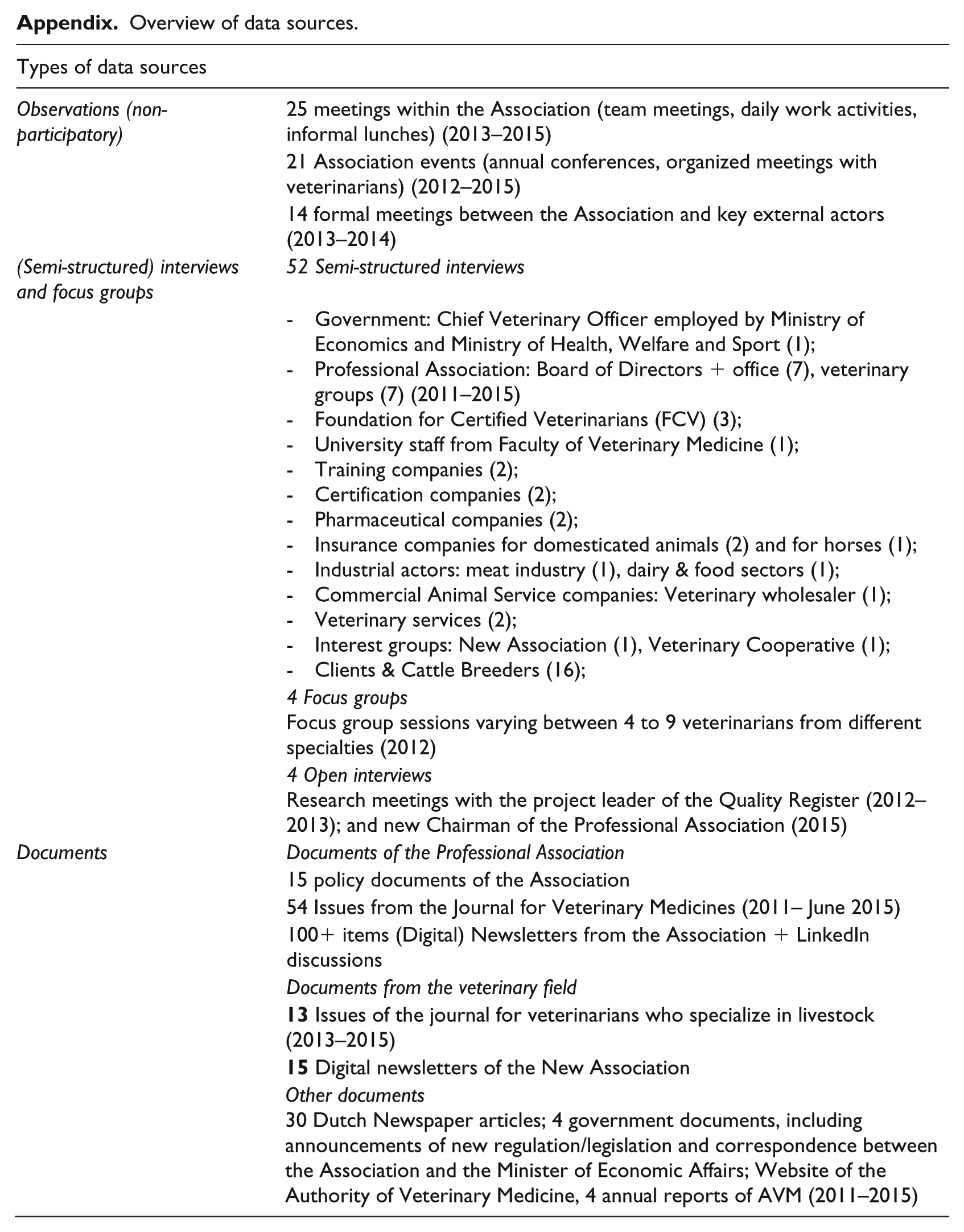
We collected multiple qualitative data sources in this study: in situ observations, interviews, focus groups, archived material (e.g. positions papers, internal policy documents of the Association) and secondary data (e.g. newspaper reports, government announcements, websites). A detailed overview of data collected can be found in the Appendix.
Observations and interviews
Between 2011 and 2015, one of the authors conducted specific observation sessions at the Association and held semi-structured interviews with board members of the Association and four focus group sessions. During the non-participatory observations, the researcher made extensive field notes. These data revealed how incidents and critical events were handled and negotiated.
We also conducted 52 semi-structured face-to-face interviews with other actors in the veterinary field (of between one and three hours each). The interviews and a few focus groups focused on three themes: (1) mapping the relationships and key actors in the veterinary field; (2) discussing perceptions of changes in the veterinary field and the professional role of veterinarians; (3) discussing accountability and the need for the development of the Quality Register. These semi-structured interviews enabled us to obtain both retrospective and real-time accounts (Gioia, Corley, & Hamilton, 2013) from the actors affected by the development of the accountability system.
Documents and (secondary) archival data
We obtained extensive documentary data from the Association including policy documents, position papers, veterinary newsletters and issues of veterinary journals. We were given access to the Association’s website and LinkedIn groups, which enabled us to follow communication among its members. Documents were also obtained from other actors in the veterinary field, such as newsletters from the new Association and issues of the journal for veterinarians specializing in livestock. Additionally, further secondary data was obtained to gain an insight into the external pressures for greater accountability in the veterinary profession, such as government announcements and articles from Dutch newspapers and websites.
Data analysis
Throughout our analysis, our aim was to extend existing theories by abstracting a single data point (or local knowledge) into aggregate social processes (or situational knowledge) that become institutionalized as structures of power (Suddaby & Greenwood, 2009). Our data analysis was characterized by an abductive approach and followed a process that iterated (hermeneutically) between the data and the literature.
We started by analysing the interviews and made observational notes using Atlas-ti. We constructed thickly descriptive, chronological narratives of the key actors within the profession’s network of relations, such as pharmaceutical companies, governmental bodies, universities and veterinary interest groups. Additionally, we conducted a document analysis in order to establish a chronological overview of the critical moments in the development and implementation of the accountability systems, as well as an overview of the actions of the key actors involved (Langley, 1999). We deconstructed the narratives and actions of seven key (collective) actors: the government, the Association, veterinarians, the New Association once founded, a veterinary cooperative (VetCo), a pharmaceutical company (Pharvet) and a foundation – ‘the Foundation for Certified Veterinarians (FCV)’, which included representatives of cattle farmers, the meat and dairy industry and veterinarians. 1 Table 1 provides a description of these actors and their interest in the accountability systems.
Description of (collective) actors’ and interests.
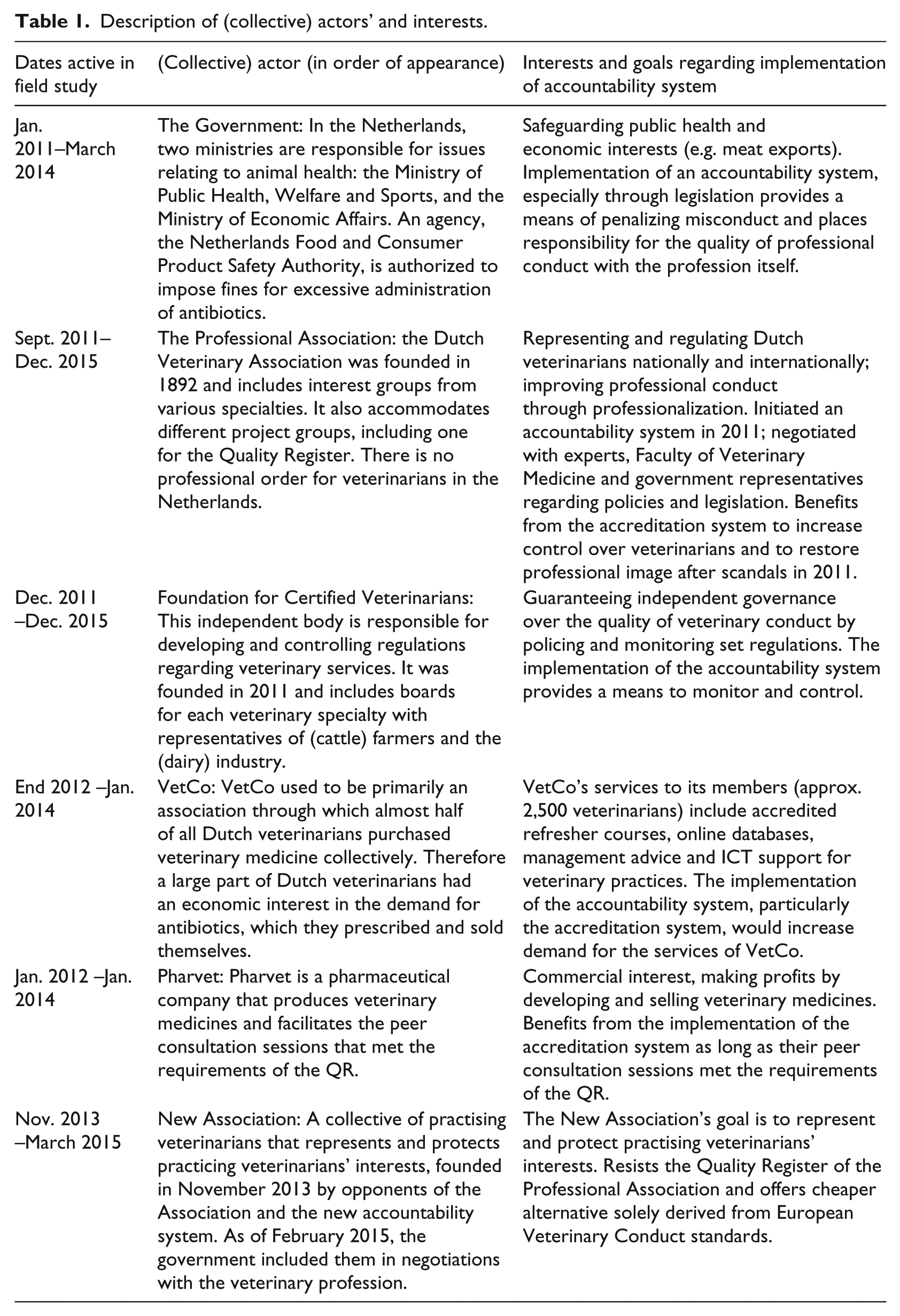
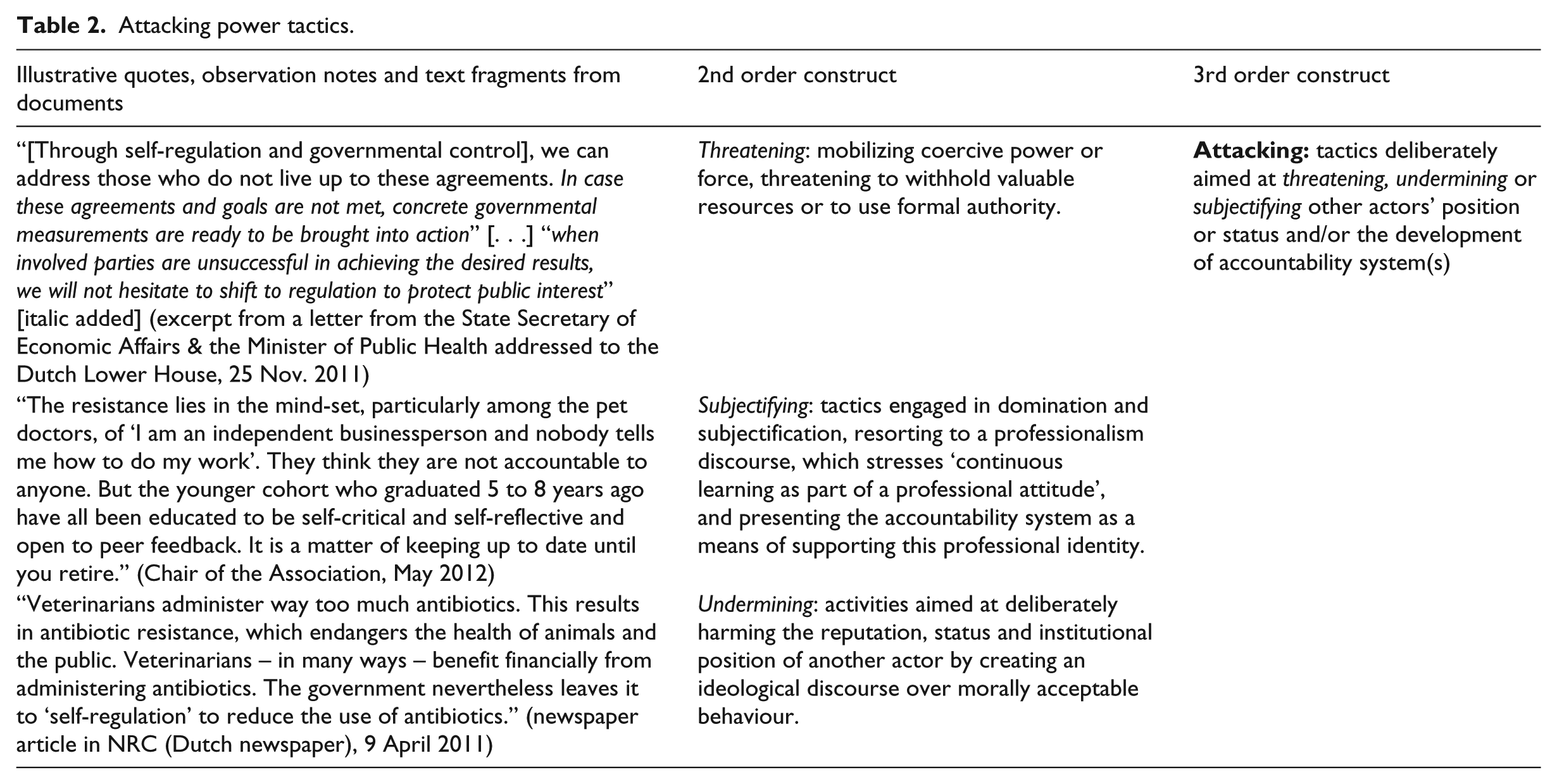
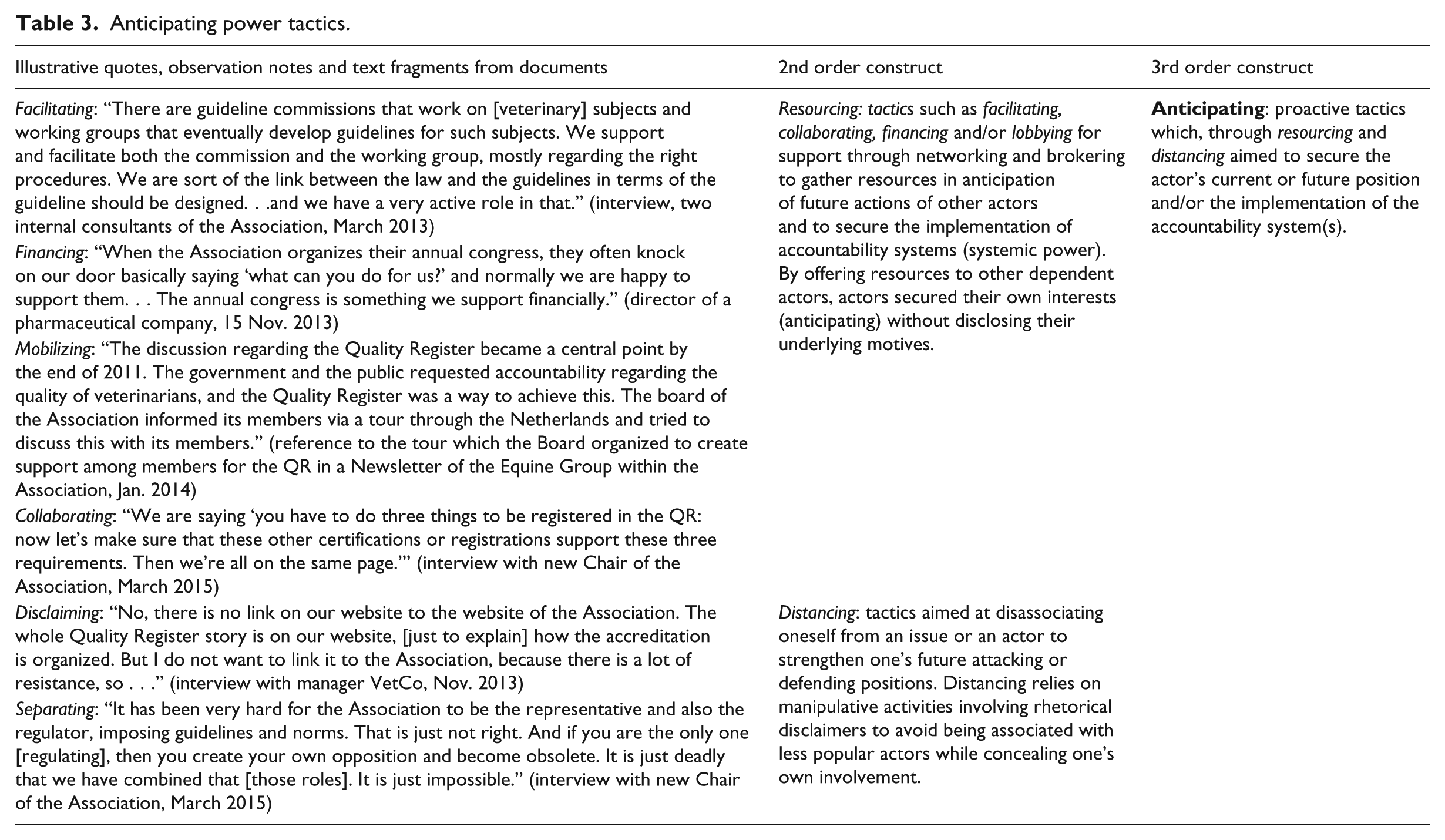
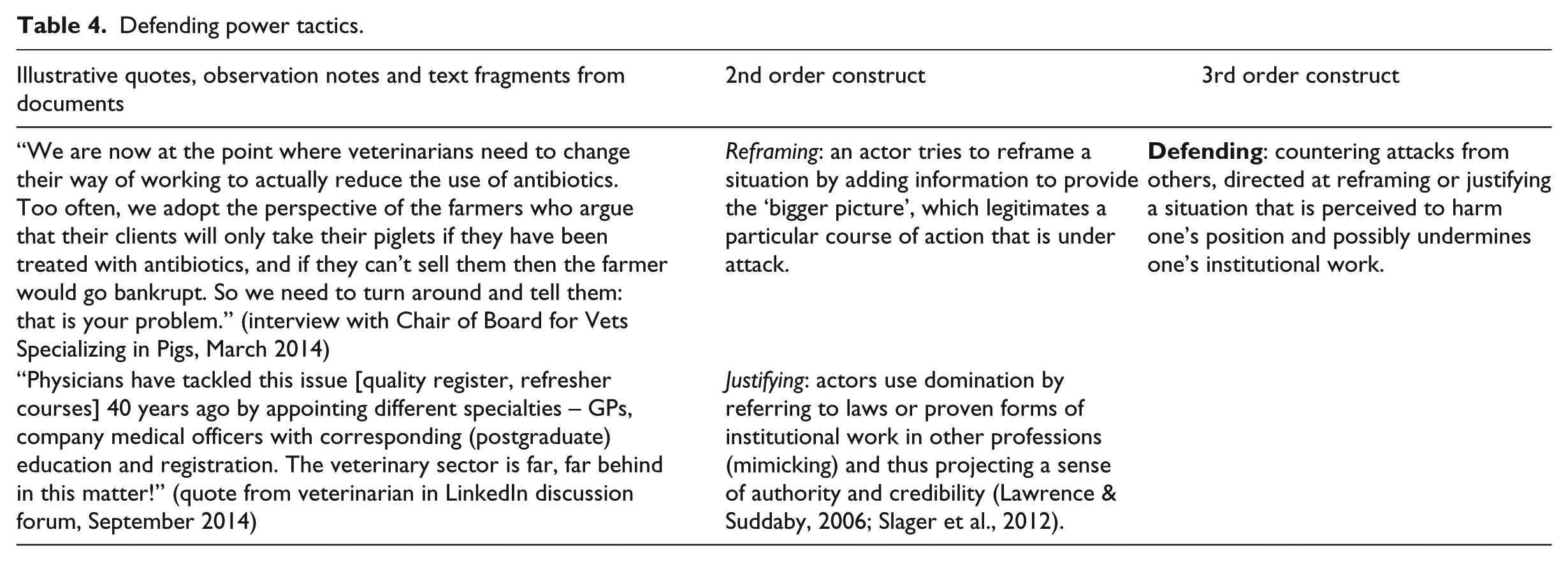
We continued by zooming in on the interactions between actors and coded which types of episodic power (influence/manipulation, or force/coercion) were used. We then categorized these into three forms of power tactics. Attacking refers to tactics deliberately aimed at threatening, undermining or subjectifying other actors’ position or status and/or the development of accountability system(s) (the creation of systemic power). Undermining and subjectifying were episodic power tactics that relied on existing systemic power (internalized professional norms and values, and domination through connecting with other dominant field actors). Anticipating refers to tactics which through resourcing (adding resources by facilitating/collaborating, financing and/or lobbying, brokering) and distancing (publicly disclaiming and separating) aimed to secure the actor’s current or future position and/or the implementation of the accountability systems. Defending involves countering attacks from others and is directed at reframing or justifying a situation that is perceived to harm one’s position and possibly undermines one’s institutional work. Tables 2, 3 and 4 provide illustrative data segments for each of these power tactics, as well as our coding structure.
Attacking power tactics.
Anticipating power tactics.
Defending power tactics.
We also noticed that actors relied on two different forms of systemic power and (re)created them through the development of different types of accountability systems. We therefore conceptualized systemic power in two different forms: subjectified systemic power and imperative systemic power. Subjectified systemic power mostly relies on professional norms and values internalized through education and training, ideologies and institutional and discursive resources, which in turn create room for manipulation (e.g. indoctrination). Many professions have long relied solely on this type of systemic power (Abbott, 1988). However, when a profession is criticized by external actors, regaining institutional control through subjectified systemic power is more difficult, as it does not allow swift intervention in critical situations. Imperative systemic power has its roots in coercion and domination facets of power. Actors using imperative systemic power rely on regulation that enforces compliance (Lawrence & Buchanan, 2017), or – as our study showed – on power created through domination (e.g. quality registers aligned throughout the entire sector) or on legitimacy to enforce regulation (e.g. government). Solely relying on imperative systemic power can – over time – lead to instrumental behaviour (e.g. Roberts, 2009), but it does allow quick intervention in times of crisis. In line with the two different forms of systemic power, we also conceptualized two different types of accountability systems that were developed: a compliance-based accountability system relying on imperative systemic power for which particular veterinarians were obliged by law to be registered, and an integrity-based accountability system relying on subjectified systemic power and voluntary registration (see more explanation in the Findings section).
These distinctions between different episodic power tactics and forms of systemic power supported by different types of accountability systems enabled us to identify dialectical alternations in institutional politics, labelled as either ‘thesis/anti-thesis’ or ‘synthesis’. We were able to bracket (Langley, 1999) three different periods: period I, which was characterized by uproar in the professional field with much attacking and defending power tactics (end of 2011 to mid 2012); period II, which was characterized by a period of ‘synthesis’ in which actors anticipated each other’s tactics and started to develop forms of systemic power (mid 2012 to mid 2014); and period III, which was characterized by two different trajectories in which the two types of accountability systems affected institutional politics differently: trajectory I was a period of ‘synthesis’, whereas trajectory II (partly running parallel to trajectory I) was characterized by rapid dialectical alternations of first attacking and defending, then anticipating, and then back to attacking and defending tactics (both trajectories took place between mid-2014 and the end of 2015).
Episodic Power Tactics Underlying Institutional Work
We identified three forms of episodic power tactics – attacking, anticipating and defending – as underlying mechanisms for institutional work that were used repeatedly by different actors. Power tactics were particularly salient regarding the design and implementation of the Quality Register initiated by the Association, but much less so regarding the development of guidelines in lieu of upcoming legislation in 2014. We will first present our data regarding the three forms of power tactics and then elaborate on how episodic and systemic power intersected to demonstrate the dialectical nature of institutional agency and control.
Attacking
Attacking involved the use of power tactics to undermine the position of another actor and/or the institutional work of other actors. We identified three forms of attacking: threatening, subjectifying and undermining. Threatening refers to the mobilization of coercive power or force and to threatening to withhold valuable resources (money, knowledge, security) or to use formal authority. These tactics were used by several actors. Veterinarians, for example, threatened to terminate their membership, leaving the Association with a loss of revenue. Such attempts undermined the development of the Quality Register, as its financing was based on an assumed increase in paid subscriptions. Particularly those veterinarians who were less affected by the antibiotics scandal were reluctant to register and openly threatened to terminate their membership if compelled to do so.
The government used its formal authority and threatened to strip veterinarians of their right to sell veterinary drugs, which was perceived as a serious threat to the profession since it would deprive veterinarians of an important source of revenue (see Table 2). To counter this threat the Association lobbied members of the Dutch Parliament and other stakeholders (e.g., pharmaceutical companies). The Association had to promise to improve the profession’s self-regulation mechanisms, especially regarding standards of veterinary conduct. Given the limited time to present the Quality Register to the Minister of Public Health, the Association had no choice but to concur and inform its members afterwards.
The Association and other advocates in favour of the Quality Register thus had to exert power on veterinarians, but since they had no formal authority to enforce registration, they engaged in domination and subjectification. They resorted to a professionalism discourse, which stressed ‘ongoing learning as part of a professional attitude’, and presented the Quality Register as a means of supporting this professional identity by organizing accredited refresher courses (observation notes, March 2012).
We have done numerous things regarding training and development that can be linked to the Veterinary Cooperative and it is all fine. . . . Everybody should find it normal that every day you try to become a bit better. (interview with Chair of Board for Vets Specializing in Domestic Animals, March 2014)
As the above quote illustrates, many activities were undertaken to show that continuous professional development was required. The italicised part of the quote illustrates the use of subjectification, since it refers to a supposedly internalized value of wanting to continuously improve oneself as a professional. The advocates of the accountability system drew on a professionalism discourse – and thus relied on subjectified systemic power in their use of episodic power – which aimed to shape the self-disciplinary professional identity of the ‘good vet’ (see Table 2 for more illustrations).
Prior to and during these intra-professional power struggles, the profession and the Association were fiercely attacked through the undermining work of other actors. Undermining refers to activities that aim to deliberately harm the reputation, status and institutional position of an actor by creating an ideological discourse over what counts as morally acceptable behaviour. For example, the media and the government undermined the profession’s reputation and status by taking issue with veterinarians profiting directly from the prescription of antibiotics, which was portrayed as a ‘perverse business model’ (Dutch newspaper, NRC, 9 April 2011). The Association was also subjected to undermining by other veterinarians, including its own members. On LinkedIn discussion platforms, the Association was often bashed for not being transparent about the cost of setting up the quality register and who would decide on the content of the guidelines. Some veterinarians accused the Association of having a significant financial motive for establishing the quality register, for which they would be able to charge high membership fees: I really question the integrity of the Association. [. . .] And I keep on paying and paying the veterinarian mafia that controls me and forces me to pay them on a yearly basis. (discussion on LinkedIn, 2012)
In sum, attacking work was performed by actors both outside and inside the profession. Actors who engaged in attacking tactics to unsettle the existing institutional order relied chiefly on undermining other actors’ position by questioning matters that had hitherto been hegemonically undisputed. The government, for example, partly disrupted the institutional order of self-regulation by announcing new legislation. They were in a position to rely on ‘force’ as a form of episodic power but obviously relied on imperative systemic power. Our data shows that attacking was also used by actors relying on subjectified systemic power, for example the Association, which was not in a position to force veterinarians to sign up for the Quality Register, and had to rely on professional norms and values to underpin their power tactics.
Anticipating
Anticipating refers to proactive attempts to safeguard one’s institutional work or position in the field. It requires predicting what other actors might do in the future or how one’s position or interests could become marginalized and jeopardize one’s institutional work. Anticipating tactics refer to attempts to mitigate threats to one’s position or interests that cannot be averted but whose impact should be minimized. It also involves influencing others as a precursor to future attacking or defending moves. We identified two categories of anticipating tactics: resourcing and distancing. Again, all actors adopted anticipating tactics toward each other and in favour of or against the implementation of one of the or both accountability systems.
Resourcing refers to activities such as facilitating, collaborating, financing and/or lobbying for support through networking and brokering to gather resources in anticipation of the possible future actions of other actors and to secure the implementation of accountability systems (systemic power). Actors used different methods to exert their power (either coercively, through force or through manipulation) by mobilizing their resources (financial assets, expertise, informal social ties) to secure their interests. By offering these resources to other dependent actors, actors secured their own interests (anticipating) without disclosing their underlying motives. For example, as the Association became financially stretched due to declining membership and its investment in the guidelines and Quality Register, VetCo became a critical actor. VetCo offered to pay the Association’s membership fee to the Veterinary Medicine Authority, an influential board in the veterinary professional field.
Currently, we pay three years’ worth of membership fees, which amounts to €100,000 annually, in order to have veterinary representatives within the Independent Authority for Veterinary Medicines. (interview CEO VetCo, December 2013)
Financing and facilitating was done through coercive power based on financial resources or the ability to reduce (financial) uncertainty. By resourcing the Association, VetCo could expect something in return in the future. In June 2014 and again at the beginning of 2015, the Association announced several changes to the Quality Register (see Table 3) so that VetCo’s peer consultation sessions conformed with its requirements.
What we want to do now is align all the other [ registers for specializations] with our quality register [. . .] We are saying ‘you have to do three things to be registered in the QR: now let’s make sure that these other certifications or registrations support these three requirements. Then we’re all on the same page.’ (interview with new Chair of the Association, March 2015)
This meant that members of VetCo automatically complied with the Quality Register, which would increase quality register registrations and in turn create more power for the system based on domination. Over time, the Association moved from a strict system of accountability towards a system that focused on the voluntary registration of educational courses (position paper of the Association, 2014).
Another form of resourcing to secure the implementation of the Quality Register and/or actors’ current or future position in the field was the mobilization of support, often using informal elite networks and communication to influence professionals’ sensemaking. As there is only one Faculty of Veterinary Medicine in the Netherlands, most veterinarians who graduate in or around the same year know each other fairly well.
I don’t have any formal agreements [with the Association]. Look at who is on the Board of the Association: some of these people were my classmates, they are my contemporaries, people I have known since university, so the communication is very easy and open. (highest veterinary official in Ministries of Public Health and Economic Affairs, April 2014)
This created a network that actors could rely on to influence decision making. For example, to ensure that the professional guidelines regarding antibiotics – which would later form the basis for legislation – were in line with common veterinary practice, the Association went to great lengths to influence the members of the Board of Veterinary Medicine: It is most convincing if the guidelines come both from us [the Association] and the Board of Veterinary Medicine. We ask them for advice and adhere to that closely. Of course, we could first create a guideline and then ask for their approval and they might say No, which would be a shame. It is such a small world and their role is to be independent advisors, so it is better to consult them first. (interview with Chair of the Association, May 2012)
Networking was also a tactic employed by the Foundation for Certified Veterinarians (FCV) to create guidelines that would be backed by all stakeholders in the sector, including representatives of farmers, the dairy and meat industry.
These stakeholders together decide the content of the guidelines that veterinarians will have to comply with. We deliberately opted for this [approach] to facilitate proper alignment between the quality register for our veterinarians and those of other actors in the production chain. . . . You want these things to be aligned. (interview with chairman of the Foundation for Certified Veterinarians, February 2014)
Networking also proved an important means of anticipating and securing the future imperative systemic power of the guidelines and the associated register of the Foundation for Certified Veterinarians (FCV). By brokering with powerful actors in the production chain, the FCV anticipated being able to dominate (once their Quality Register and guidelines were installed) and leave individual actors (veterinarian, farmer) with no other choice than to register with the FCV Quality Register.
Facilitating also proved a successful tactic for one pharmaceutical company to get its foot in the door with the profession. As the resources of the Association became stretched through lobbying activities and falling revenues from fewer than expected new registered members, the Association had to accept ‘help’ from other parties. Instead of offering financial support (as VetCo did), the pharmaceutical company chose to facilitate by organizing the back-office processes for peer consultation sessions.
We are sort of the motor behind [the peer consultation sessions, one of the requirements of the Quality Register]. We take care of administrative tasks. . . this allows us to commit to our vision of being a partner [for veterinarians]. It also provides us with a lot more contact with the profession than we would normally have commercially or professionally. (director of a pharmaceutical company, November 2013)
As the pharmaceutical company had previously facilitated peer consultation sessions, the Association was interested in their offer. The content of these peer consultation sessions had to be aligned with the requirements of the Quality Register, which would increase registered members and thus the systemic power of the Quality Register as leverage for domination.
Another power tactic within anticipating was distancing. Distancing means disassociating oneself from an issue or an actor to strengthen one’s future attacking or defending positions. Distancing actions were aimed at deliberately passing responsibility to another actor, in order to benefit from but not be held responsible for moves that might jeopardize one’s own reputation. Distancing rested on manipulative activities directed at a targeted audience that involved rhetorically disclaiming to avoid being associated with less popular actors while conveniently concealing one’s own involvement. Several examples of distancing emerged from our data.
Some individuals think or thought ‘You are enforcing the rules [of the Association]!’ But that is not our dispute and we did not [initiate the system], so do not blame us. If you are against these rules, be my guest. We still support you [as practising veterinarians]. We try not to get involved in the argument about how and why the Quality Register is being developed. And I think that is working out nicely. (interview with CEO PharVet, November 2013)
The CEO of PharVet explained how they carefully tried to stay out of the dispute between individual veterinarians and the Association, as this could have reflected negatively on PharVet. If their peer consultation sessions were perceived as ‘the long arm of the Association’, this might discourage veterinarians from participating and thus reduce PharVet’s chances of interacting with veterinarians. By focusing their discourse on ‘supporting the practising veterinarian’ and simplifying participation in peer consultation sessions, PharVet distanced itself from the Association. Similarly, VetCo tried to distance itself from episodic power play (see Table 3, quote with ‘disclaiming’). When questions regarding the need for a Quality Register increased again after the New Association was established, the FCV deliberately tried to stay out of these discussions to insulate themselves from any negative response to the guidelines.
Distancing can also rest on coercive power tactics in cases of separating – i.e. forming new groups to publicly distance oneself from those one disagrees with. Examples of distancing included the creation of a separate organization, or taking up the role of a representative by existing cooperative parties, such as the Veterinary Cooperative. Veterinarians were clearly looking for ways to separate representing and regulating roles within the profession.
There has been a lot of discussion over whether the Veterinary Cooperative should be reorganized into a representative for veterinarians, and there was a lot of support for that. This is odd – it implies that apparently people do not trust the Association to represent them, or that they feel insufficiently supported by the Association. (veterinarian in LinkedIn discussion forum, December 2014)
These new groups gave actors control over valuable resources (e.g. support, paying members) as well as a certain representative position, which had hitherto been reserved for one dominant actor. Another example of separating was the foundation of a new association in November 2013. The New Association claimed that it was impossible to act as a representative and a regulator at the same time, as the Association itself seemed to agree with (see Table 3, quote with ‘separating’). By setting up the New Association, opponents of the Quality Register formed an organizational structure and tried to present themselves as those who truly understood the interests of practising veterinarians, while pushing the Association into a regulating role: The strategy chosen [by the Association] complicates professional practice . . . The New Association is an advocate of practicable but not rigid guidelines. Guidelines should promote professional conduct – not replace a veterinarian’s expertise. The New Association focuses on representation and offers practitioners a platform to lobby from an independent position, to exert influence or relevant action. (website of New Association when founded in 2014)
As can be seen in the above quote, the New Association distanced itself from the activities and position of the Association. Although these separating activities initially anticipated veterinarians’ fear that the Quality Register would lead to an increased administrative burden, separating later led to a redefinition of roles (representing, regulating), and thus undermined the position of the professional Association as the sole representative. This, in turn, fragmented the representation of veterinarians vis-a-vis other institutional actors such as the government and European institutions, and jeopardized the position of the veterinary profession more generally.
Defending
Defending relates to power tactics that were deployed in response to attacks and which are always a reaction to an earlier action by another actor. Defending is aimed at reversing a situation that could harm one’s position, interests or reputation, either through (re)framing or justifying. Reframing, the first form of defending, implies that an actor tries to reframe a particular situation by adding additional information to provide a ‘bigger picture’, which legitimates a particular course of action that is under attack. For example, due to negative media attention, based partly on a report about veterinarians’ ‘perverse business models’ (see quotes under Attacking), both veterinarians and the Association relied on and referred to professional norms and values to explain (reframe) the complexity that their work involved and how their aim was not financial gain but first and foremost animal wellbeing.
If there is one cow with an udder infection and it has to have a dry-off period and antibiotics, then the vet has to come for that [referring to announcement of the ‘By Veterinarian Only’ legislation]. And they think ‘that is too expensive’, meaning they will dry off the cow without antibiotics and then the cow gets an udder inflammation, and that really turns into a problem. [. . .] I mean, animal wellbeing is the real problem here. (participant 9 in focus group session with practising veterinarians, April 2012)
In reframing, actors rely on subjectified systemic power through internalized professional norms and values. For example, to counter the government’s rhetorical attacks on the profession’s reputation, status and autonomy, the Association spent many months lobbying members of parliament and issuing press releases to push the point that only the veterinary profession could safeguard animal and public health and that taking away the pharmacy would only complicate veterinarians’ work of monitoring prescriptions and administering antibiotics (press release on website Association, March 2014). They finally succeeded, and the motion to remove the pharmacy was rejected.
Our data illustrate in particular how defending as a form of ‘counter-communication’ was interspersed with references to renewed professional norms and values (e.g. responsibility for ‘public health’ and animal wellbeing) to manipulate the political climate. For example, defending actors articulated new ideologies that would change the entire industry: We went from being accused of being drug dealers who only prescribed antibiotics to being responsible for animal health and wellbeing. The sectors where we have gained this responsibility, particularly the intensive cattle industry, are going to be totally reorganized by us [when the new legislation is in force], fully focused on public health and animal wellbeing. I don’t know how we could have done this any better. (interview with CEO of the Association, March 2012)
In justifying, actors use domination by referring to imperative systemic power such as laws or proven forms of institutional work in other professions and thus project a sense of authority and credibility (Lawrence & Suddaby, 2006; Slager et al., 2012) to justify the legitimacy of their action, or the illegitimacy of other actors’ actions. Justifying was mainly used to fend off attacks on the Quality Register and its compulsory nature (see Table 4 for illustrative data). Various actors used arguments that drew on other professional fields to justify the implementation of a Quality Register as a logical step for the veterinary profession and to justify the potential costs for veterinarians.
If you look at the recent development among dentists, they started increasing their prices without having a Quality Register. They ran into huge problems within half a year, because they could not be transparent regarding their activities. [. . .] Fortunately, we are doing this the right way. (interview with CEO of Association, March 2012)
Some veterinarians opposed to the Quality Register sought legal justification by filing complaints with the Netherlands Authority for Consumers and Markets, a regulator charged with competition oversight and sector-specific regulation on behalf of consumers. The complaints were filed after the Foundation for Certified Veterinarians launched their Quality Register in March 2014 as part of the new ‘By Veterinarians Only’ law, which required the prescription of antibiotics to be registered. According to the complainants, due to the By Veterinarian Only law, cattle farmers have no choice and other non-registered veterinarians are excluded. . . Veterinarians . . . are hindered in their veterinary practices by the Foundation for Certified Veterinarians, and the Association tries to connect their Quality Register to these new regulations. (decision document, ACM, 2013.205695).
However, this defending tactic proved unsuccessful, as the regulator rejected the complaints.
Building a Dialectical Model of Institutional Politics
Our findings elucidate a more dialectical relationship between systemic and episodic power in a professional field than previously assumed. We first elaborate on the different forms of systemic power and then explain how they intersect with episodic power tactics.
Subjectified and imperative systemic power
As Figure 1 illustrates, we conceptualize systemic power in two different forms: imperative systemic power (upper bar) and subjectified systemic power (lower bar). Our findings suggest that episodic power tactics are fuelled by and result in different forms of systemic power over time. Based on temporal bracketing three periods (I, I and III) were identified, depicted from left to right.
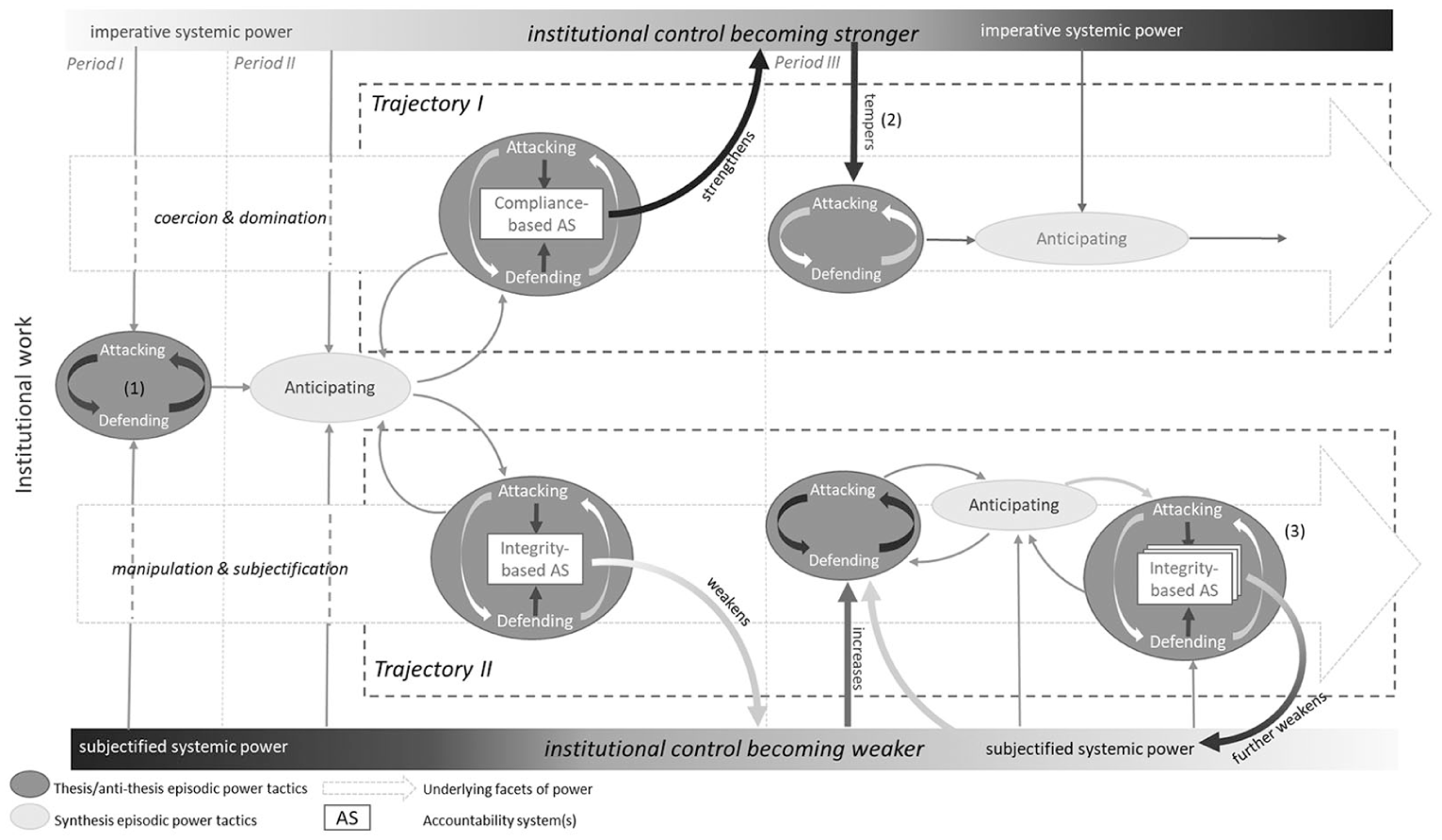
A dialectical model of institutional politics and the role of accountability systems.
Period I was characterized by a low degree of imperative systemic power and a high degree of subjectified systemic power. These conditions provided room for intense episodic power tactics aimed primarily at other actors with attacking and defending being most salient (see (1) Figure 1). For example, the government used systemic power by imposing legislation (attacking); and the Professional Association used professionalism discourse and referred to veterinary norms and values – a defending tactic relying on subjectified systemic power.
Period II was again characterized by episodic power tactics, yet this time anticipating was the most prevalent. All actors realized that they depended on each other, as no-one apart from the government was dominant enough to employ force or coercive power. Through ‘resourcing’ and sometimes ‘distancing’, actors started to create two different types of accountability systems: a compliance-based accountability system relying on imperative systemic power for which particular veterinarians were obliged by law to be registered, and an integrity-based accountability system relying on subjectified systemic power and voluntary registration.
The development of these two accountability systems marked the start of period III characterized by two different trajectories in terms of institutional politics (see Figure 1, trajectory I and trajectory II). Trajectory I was characterized by increased imperative systemic power (institutional control getting stronger), which tempered the intensity of episodic power tactics. Initiators of the compliance-based accountability system did not encounter much hindrance from episodic power tactics, as they mainly relied on coercive power backed up by existing imperative systemic power. The coalition with external actors continued to work on developing the required additional guidelines, which were formalized through the ‘By Veterinarians Only’ law in March 2014. After that, actors were disciplined through coercive regulation and compulsive accountability systems, creating manufactured consent. This helped to quickly reduce prescriptions of antibiotics. Trajectory II (see Figure 1) reflects the creation of an integrity-based accountability system, which resulted in unforeseen and unwanted consequences. Due to fierce power tactics, the integrity-based accountability system remained incomplete and only a few veterinarians registered. As a result, period III was characterized by rapid dialectical alternations of attacking and defending – anticipating – and again attacking and defending tactics. This resulted in multiple, fragmented quality registers (see (3) in trajectory II) launched by different actors. This heterogeneity in accountability systems meant that none of these registers became dominant and thus none acquired systemic power.
In our model we show how institutional control and institutional agency evolve dialectically over time: after a period of low institutional control (thesis), a period of resistance against this lack of control arises expressed through episodic power (antithesis). This antithesis creates momentum for anticipating tactics reflected in a period of creating new forms of systemic power, leading to more institutional control regarding particular issues and thus stability (synthesis). Over time, institutional control changed: it became stronger through imperative systemic power; while at the same time subjectified systemic power weakened. However, we suggest that any settlement is temporary, as new episodic power as a form of resistance to institutional control can trigger new attempts to alter or disrupt the institutional order.
Discussion and Conclusion
Taking a multiple-actor perspective on a professional field, this study breaks new ground by providing a dialectic model of institutional politics. We show how different forms of systemic power and associated strength of institutional control affect power tactics underlying institutional work, and the role of accountability systems as weaponry in institutional politics.
Our first contribution regards the relevance of power tactics for a much needed, more nuanced understanding of institutional work (Lawrence & Buchanan, 2017). We show that resisting or increasing institutional control is hardly the ‘skilful act’ of one particular actor (Hampel et al., 2017) or the result of mainly harmonious collaboration between a few key actors (Helfen & Sydow, 2013; Smets, Morris, & Greenwood, 2012). Based on definitions of episodic power (Fleming & Spicer, 2014; Lawrence & Buchanan, 2017), we introduce the concept of ‘power tactics’ as the episodic power-laden, strategic acts of a (collective) actor that anticipates what other actors (might) do in pursuit of their institutional work; but also strategic acts aimed at accountability systems as means of institutional control. Based on our data, we conceptualize three categories of episodic power tactics: ‘attacking’, ‘defending’ and ‘anticipating’. Anticipating’ other actors’ possible future actions, in particular, constitutes a strategy that illustrates how actors relate to other actors’ potential future power tactics and efforts to increase institutional control by implementing accountability systems. By elucidating the underlying power tactics of institutional work, we attend to ‘the most neglected aspect of institutional politics’” (Lawrence & Buchanan, 2017, p. 481).
Our second contribution lies in uncovering specific characteristics and mechanisms underlying systemic power, which has hitherto often been taken for granted in institutional research (Lawrence & Buchanan, 2017; Lawrence et al., 2001). So far systemic power was found to be most effective in institutionalizing radical change when key actors used persuasive language (Lawrence et al., 2012). However, absence of (large) hierarchical organizations through which institutional change can be steered through ‘everyday conversations as critical means’ seems to complicate institutional work (Lawrence & Dover, 2015). Our study confirms this, yet also provides a more nuanced understanding of how specific characteristics of systemic power lead to different mechanisms through which systemic power can serve as ‘weaponry’ in institutional politics. We distinguish two different forms of systemic power. Imperative systemic power is created through legislation and coercive power tactics and supported by compliance-based accountability systems; subjectified systemic power relies on subjectification based on professional norms and values and professionalism discourse and is supported by integrity-based accountability systems for which registration may be voluntary. This indicates a variety of mechanisms for systemic power that actors can employ differently in their power tactics and that have different consequences in terms of institutional politics, as illustrated by the two trajectories in our model. While the trajectory heavily infused with imperative systemic power and compliance-based accountability system tempered actors’ power tactics, the trajectory characterized by subjectified systemic power and integrity-based accountability system led to increased power tactics and a decrease of institutional control.
By including the perspective of multiple actors in our study, our third contribution to institutional work literature lies in empirically showing that systemic and episodic power have a dialectical relationship (Seo & Creed, 2002). By distinguishing the ‘attacking’ and ‘defending’ tactics, our model brings out the implicit thesis-antithesis conflict inherent in institutional work, while ‘anticipating’ addresses a broad category of actions that seek to anticipate other actors’ possible future actions and often result in synthesis. These insights add to Lawrence and Buchanan’s (2017) framework of institutional politics. They distinguish institutional control and systemic power from institutional work and episodic power, yet our data suggests that such a separation does not capture the full complexity of institutional politics. Episodic and systemic power seem to resemble more of a duality: ‘two essential elements as interdependent, rather than separate and opposed’ (Farjoun, 2010, p. 203). Institutional work scholars have mostly treated systemic and episodic power as two distinct entities that are at best recursively responsible for institutional change (Lawrence & Buchanan, 2017; Lawrence et al., 2001, 2012). Dialectical studies (Hargrave & Van de Ven, 2006; Langley et al., 2013; Seo & Creed, 2002) have recognized the dialectical nature of institutional change and even refer to issues of power, yet they fail to lay bare the underlying power mechanisms in bringing about institutional change. Our dialectical model of institutional politics explicitly addresses systemic and episodic power and explains the dialectical nature of institutional politics. This is an important addition to understanding institutional politics, as it provides a more thorough explanation under which conditions specific forms of systemic power (compliance-based or integrity-based accountability systems) are more or less suitable to effect institutional change, and how these forms of systemic power fuel different power tactics.
Our findings are based on a profession characterized by self-employment and small, privately owned enterprises; the circumstances of our case study may limit transferability to more structurally organized professions in which professionals work in larger organizations. Since these organizational structures carry varying degrees of systemic power and provide more or less room for monitoring, it is likely that the enactment of institutional control in these settings is different (see also Lawrence & Dover, 2015). Institutional politics, particularly in professional fields in which professionals are closely related to other actors, therefore remains an important subject for deeper exploration (Anteby, Chan, & DiBenigno, 2016; Lawrence & Buchanan, 2017; Lawrence et al., 2012). Especially when professions are characterized by being conducted in ‘scattered places’, such as veterinarians or dentists, and public interests (e.g. health) are at stake, it seems that the government can and should seek to support professions to safeguard professional discretion. In line with Clegg (2010), we argue that future research should reflect more critically on the outcomes of professions’ institutional work to resist institutional control.
Footnotes
Appendix
Overview of data sources.
| Types of data sources | |
|---|---|
| Observations (non-participatory) | 25 meetings within the Association (team meetings, daily work activities, informal lunches) (2013–2015) |
| 21 Association events (annual conferences, organized meetings with veterinarians) (2012–2015) | |
| 14 formal meetings between the Association and key external actors (2013–2014) | |
| (Semi-structured) interviews and focus groups | 52 Semi-structured interviews |
| - Government: Chief Veterinary Officer employed by Ministry of Economics and Ministry of Health, Welfare and Sport (1); |
|
| 4 Focus groups
|
|
| 4 Open interviews
|
|
| Documents | Documents of the Professional Association |
| 15 policy documents of the Association | |
| 54 Issues from the Journal for Veterinary Medicines (2011– June 2015) | |
| 100+ items (Digital) Newsletters from the Association + LinkedIn discussions | |
| Documents from the veterinary field | |
| Other documents
|
Acknowledgements
We wish to thank Patrick Vermeulen, Dirk Vriens, and Dvora Yanow for their insights and feedback on earlier versions of this manuscript. We are also very grateful for the instructive and helpful feedback we received from the three anonymous reviewers and last but not least – would like to thank Trish Reay for her encouragement and support throughout the process.
Funding
The author(s) received no financial support for the research, authorship, and/or publication of this article.
