




Abstract
Extant literature on organizational storytelling assumes storytelling to be context-bound, but does not empirically detail or theorize how storytelling might differ across organizational settings. In the context of members’ everyday work lives, organizational storytelling research tends to focus on the content of stories and not on the actual telling. By addressing this omission, this paper makes three contributions. First, we offer a generic framework for analysing storytelling in situ by zooming in on the situated occurrence of storytelling through a focus on four questions: (1) What makes an event tellable? (2) What triggers its telling? (3) What form does the storytelling take? (4) What work does it do? By using ethnographic data gathered on storytelling in everyday police work, we empirically substantiate this framework. Our second contribution, then, is to show how a setting-specific approach to studying storytelling may help to flesh out a fuller, more grounded account of story life in organizations. Finally, we propose a typology of different forms of setting-specific discourse – meeting-room talk, workstation talk, canteen talk and closed-door talk – which allows researchers to further sensitize organizational research to the situated nature of organizational discourse.
Introduction
Perusal of the extensive literature on storytelling in organizations gives the impression that organizational members spend a great deal of their working lives telling stories to one another. Research suggests that individuals tell stories to assist themselves in making sense (Boje, 1991; Brown, Stacey, & Nandhakumar, 2008; Colville, Brown, & Pye, 2012; Gabriel, 2000; Weick, 1995), in constructing identities and bonding (Brown, 2006; Ybema, 2014), in sharing knowledge, innovating and learning (Bartel & Garud, 2009; Brown & Duguid, 1991; Orr, 1996), in managing and strategizing (Barry & Elmes, 1997; Fenton & Langley, 2011; Mitroff & Kilmann, 1975) and in inciting or resisting change (Brown, Gabriel, & Gherardi, 2009; Buchanan & Dawson, 2007). As ‘the very fabric of organization is constantly being created and re-created through the elaboration, contestation and exchange of narratives’ (Brown, 2006, p. 735), stories can be viewed as playing ‘a fundamental role in the creation and reproduction of organizational reality’ (Mumby, 1988, p. 18).
Nevertheless, despite storytelling being considered innate to organizations, the literature offers surprisingly few descriptions and analyses of the very activity itself. Instead of treating storytelling as a situated occurrence, research has mostly focused on the contents of stories. As Whittle, Mueller and Mangan argue: ‘Existing research has tended to analyse stories on their own terms and pay less attention to how they are situated in and implicated in members’ everyday working lives’ (Whittle et al., 2009, p. 427, italics in original). As an exception to the rule, some ethnographic studies have investigated the ‘contexted occurrence of stories in conversations’ (Boje, 1991, p. 125). These studies combine an interest in stories’ contents with an interest in the activity of storytelling (Abolafia, 2010; Cunliffe & Coupland, 2012; Greatbatch & Clark, 2010; Whittle et al., 2009) as situated within particular organizational settings, that is, the place- and time-bound contexts in which particular social-material practices (Miettinen, Samra-Fredericks, & Yanow, 2009; Schatzki, 2006) occur. However, while some have suggested that stories and storytelling might differ from one organizational setting to the next (Boje 1991; Orr, 1996), this has never been systematically investigated. As a result, the literature deems organizational storytelling to be very important, but actually tells us very little about whether, where, when and how storytelling occurs in particular organizational settings. Our aim in this study, therefore, is not to investigate the contents and underlying meanings of stories, but to focus on the situated activity of storytelling through which stories are constructed. This allows us to provide a more intimate appreciation of how storytelling in everyday organizational life might vary along with the particular organizational setting in which it takes place.
By exploring this terrain, we offer three main contributions to the literature on organizational storytelling. First, to increase appreciation of the variety of storytelling entrenched in everyday organizational life, we combine insights from organizational storytelling research with insights from narrative studies elsewhere in the social and human sciences in order to develop an analytical framework. This framework focuses on which stories are deemed worthy of telling (story tellability), on which occasions (story triggers), in what form (story form) and to what effect (story work). Second, by applying our framework to ethnographic data on storytelling gathered at a Dutch police station, we are able to show how organizational members chose to tell and respond to stories in the face of expectations set by particular organizational settings. Our findings, therefore, show both the omnipresence of storytelling in police work and the variability of storytelling activities throughout the different settings of the police station studied. Finally, to sensitize organizational researchers to the impact of spatial settings, we develop a typology of four different forms of setting-specific discourse – meeting-room talk, workstation talk, canteen talk and closed-door talk – which allows us to more fully account for the situatedness of storytelling, sensemaking efforts, communicative practices, identity work and the like.
The remainder of this article is structured as follows. In the next section, we present the analytical framework we used for comparing storytelling across settings. Next, we explain the research methodology used in the case study, after which we present and analyze the situated storytelling of a team of police officers in a police station. Finally, we discuss the implications of our findings for theory and research.
A Framework for Situated Storytelling
Before developing a framework that allows for appreciation of the setting-specific varieties of stories and storytelling, we first define the central concepts: story, storytelling and organizational settings. Treated here as a synonym of the word narrative (cf. Brown et al., 2009), the basic elements of a story are events (often human acts), actors (human or non-human) and a setting (which might include temporal, spatial and socio-material aspects) (Chatman, 1978; Czarniawska, 1997; Maynard-Moody & Musheno, 2003). Although stories told in organizations might be of various lengths, these building blocks can be found even in a single sentence: Yesterday [temporal setting], we [human actors] arrested [event, human act] John [human actor] at the train station [spatial and socio-material setting]. Storytelling, then, refers to an instance in which someone tells someone else about events that have taken place or are taking place in a particular time and space (cf. Herrstein Smith, 1981).
As we define stories, they can, and often do, trigger emotions, and contain explanations and evaluations (Gabriel, 2000). Moreover, through the selection and connection of story elements, storytellers ‘emplot’ reality (Czarniawska, 1997, 2004); that is to say, they highlight a certain view of the elements at hand. Because, as an activity, storytelling does not have to result in rich, meaningful stories with a clear beginning, middle and end, even the ‘bits and pieces’ of stories (Boje, 1991), as well as the narrative forms that (appear to only) factually report on events (Whittle & Mueller, 2012, p. 131; Whittle et al., 2009, p. 427) are of interest to us.
Organizational settings are the place- and time-bound contexts in which particular social-material practices with particular purposes occur. A police briefing, for instance, is an organizational setting in which a team of police officers gather in a meeting room with tables and chairs. The briefing takes place at particular moments in time and is, amongst others, meant to update the officers present on what has happened within their district. The briefer, a more senior police officer, leads the meeting and shares recent developments by way of a PowerPoint presentation. Most organizational settings also function as discursive spaces, that is, ‘opportunities for talking and writing’ (Brown, 2006, p. 733). During a police briefing, for example, various stories are told about recent events. Organizational settings, then, form each story’s most concrete ‘context of construction’ (Hansen, 2006).
As previously stated, current literature fails to elaborate on how stories and storytelling vary across different settings. In his groundbreaking study of story performances Boje (1991), for instance, observed contextual differences, but did not engage in systematic comparisons. Orr’s (1996) study of technicians teased out the different ways in which stories effectively work for an occupational group, but his treatment of the particularities that came with certain settings was limited, as he mostly focused on the setting in which technicians were solving problems (see also Abolafia, 2010; Patriotta, 2003). In a similar vein, more recent setting-sensitive studies have tended to adopt a micro-perspective, zeroing in on the storytelling dynamics of a small range of conversations within a single setting (e.g. Whittle et al., 2009), consequently ignoring the variety of settings in which storytelling occurs.
The relative absence of in situ storytelling accounts may be due to the research methods and modes of analyses employed in organizational storytelling research. Researchers studying storytelling commonly generate their data through interviews (Greatbatch & Clark, 2010), which form a setting beyond the organizations themselves. Insofar as studies of storytelling rely on observational data, they often treat stories as instances of discursive struggle over organizational change, identity, strategy or learning, rather than studying storytelling in situ – that is, studying storytelling as an activity embedded in the context of day-to-day work. Interested only in story content, studies have generally skimmed over the particular settings, and ignored the conversational aspect of the storytelling (Whittle et al., 2009). Furthermore, comparing stories or storytellers (e.g. Brown, 1998; Buchanan & Dawson, 2007), a part of the literature has been primarily concerned with how different organizational actors construct organizational reality differently, rather than with how the telling of stories is different in different settings.
In a sense, organizational story research still falls prey to Boje’s classic critique that it studies ‘isolated, often anomalous stories plucked out of their natural setting’ (Boje, 1991, p. 125). If we wish to turn sensitivity to organizational settings into a critical touchstone for organizational story research, how must we then analyse storytelling as a situated activity? Which aspects of stories and storytelling might differ? Studies of storytelling in conversation analyses (e.g. Ochs & Capps, 2001; Polanyi, 1985; Sacks, 1992) and in organizational ethnography (e.g. Boje, 1991; Orr, 1996; Van Maanen, 1973) all focus on one or more of the following aspects: story tellability, story triggers, story forms and story work. These emphases lead to the following research questions: Which stories are worth telling? What triggers a story? What form do stories take? What work do stories do? Together, these questions form a four-part framework, which we will outline now.
i. Which stories are worth telling?
Organizational story research typically starts from the assumption that organizations can be considered vibrant storytelling milieux (Currie & Brown, 2003). Mangham and Overington (in Gabriel, 1991b, p. 858), for example, argued that ‘if we listen carefully to the talk around, it is not difficult to think that story-telling goes on almost nonstop’. By contrast, however, some well-known organizational story researchers have also made the opposite claim, arguing instead that storytelling in organizational life is largely absent. Gabriel, for instance, suggests that ‘organizations do not appear to be a natural habitat of storytelling’ and only ‘few organizations are spontaneous storytelling cultures’ (Gabriel, 2000, p. 240).
What, then, would make stories tellable, in a particular organizational setting? Two aspects seem to matter. Telling a story can take quite some time. Therefore, a potential storyteller has to claim the floor and others have to give up their right to talk for a while. Certainly, not every event is deemed worth telling a story about (Labov, 1972; Ochs & Capps, 2001; Polanyi, 1985; Robinson, 1981; Sacks, 1992). This is why storytellers often start with a story preface that will catch the attention of the audience. If someone says, ‘I just saw a man killed on the street,’ nobody will respond with ‘Who cares!’ (Labov, 1972, p. 370). It is a tellable tale. Various researchers of narrative (Bruner, 1990; Labov, 1972; Polanyi, 1979; 1985) have argued that storytellers normally claim that what they will talk about is strange, odd, unusual or uncommon. Stories, then, are normally not used to depict ordinary events and routines, but those things that deviate from the ordinary (see e.g. Tangherlini’s (1998, 2000) study of paramedics). To be sure, what is tellable might vary from one organization to the next, depending on the extent to which certain experiences have become routine for its members. For this reason, Boje (1991, pp. 115–16, 124) suggested that the routine character of policing would make most happenings not interesting enough to spell out.
For storytellers, it is thus crucial to know what is worth telling a story about. If they are too often off target, storytellers ‘will be considered boring, overly talkative, or generally socially inept’ (Polanyi, 1979, p. 211) or – if they go on telling stories nobody wants to hear – just nuts (Sacks, 1992). However, Robinson (1981; cf. Ochs & Capps, 2001) argued that expecting only uncommon experiences to be candidates for storytelling would seriously misrepresent everyday discourse. Tellability, he said, is relative to the relationship between the people involved in a conversation. People who have a more intimate relationship, such as spouses, share stories about ordinary experiences all the time. Perhaps stories’ tellability is contingent upon the organizational setting?
ii. What triggers storytelling?
If we know what topics are worth telling a story about, the next question is what actually occasions or triggers storytelling. In the setting of an open-ended interview, the researcher typically, though implicitely, asks for stories: ‘Could you give me a concrete instance of…?’ (Weiss, 1994, p. 74; Mishler, 1986). In the context of everyday conversations among friends and acquaintances, conversational partners will often respond to a story with another story, and more stories might follow. Such ‘second stories’ (Sacks, 1992) are told because ‘first’ stories remind those who hear them of previous experiences, or of stories that they have heard from others. Orr (1996) noticed that technicians engage in storytelling when they are talking about a machine problem. If there is no concrete problem at hand, the tellers of a second (third, fourth, …) story might react to a first story to show that they have understood what their colleagues’ story was about. In this sense, Tangherlini (2000) found paramedics ‘swapping’ stories about calls during the downtime periods, and, more recently, former police officer Robert Smith recounted spending ‘countless hours on patrol swapping work stories’ (Smith, Pedersen, & Burnett, 2014, p. 228). On the basis of a series of such stories, people who converse might even draw parallels and more general lessons about the topic of their stories (Boje, 1991; Ochs & Capps, 2001, pp. 208–12; Sacks, 1992).
iii. What form do stories and storytelling take?
To answer this third question, we noticed that stories and storytelling about the same set of events may take different forms. We will focus on two dimensions: the length of stories (a continuum from short to long) and the type of interaction that the activity of storytelling entails (a continuum from monologue to co-construction).
First, stories take different forms as a result of their contextual demands and opportunities. They are ‘tailored to current interactional concerns’ (Edwards, 1997, p. 289; Orr, 1996) as competent storytellers manage to adapt what they tell to the knowledge and interests of their audience (Polanyi, 1985). So, being reminded of a story does not lead to telling the story ‘as you remember it’ (Edwards, 1997). For instance, in the office supply firm Boje (1991) studied, stories once worthy of telling in full detail were increasingly told in abbreviated form or merely as a brief reference: ‘You know the story!’ Organizational actors cut down and clip off stories in the telling, engaging in ‘terse storytelling’ and ‘glossing’ or ‘ante-narrative’ (Boje, 2001, 2008) rather than the telling of full stories with beginnings, middles and ends. Likewise, Orr’s technicians did not want to ‘waste everyone’s time repeating the superfluous to make a well-structured story, particularly in the context of a service call when the technicians’ sense of their own professionalism requires a speedy resolution to the situation’ (Orr, 1996, pp. 125–6). In contrast, stories tended to be longer ‘during a time of relaxation, backstage at the branch away from customers and other nominates’ (Orr, 1996, p. 137). Therefore, we evaluate stories as being (relatively) short, long, or somewhere in the middle.
Second, storytelling as an activity can be characterized on a continuum between a monologue and a co-construction (Ochs & Capps, 2001). In a monologue, one storyteller holds the floor over a longer period with minimum interruption, such as when somebody gives a lecture to a large audience. On the other end of the continuum, two or more storytellers tell a story together, each bringing their knowledge and perspective to the table. Czarniawska (2004), for instance, shows excerpts in which public managers together engage in storytelling. Likewise, story swapping – exchanging stories on a certain topic – can also be seen as a form of co-construction. Finally, whether engaged in monologue or co-construction, storytelling involves the interactions and negotiations in situ (Edwards, 1997; Whittle et al., 2009), through which people develop a particular view of what happened.
iv. What work do stories do?
As a planning theorist looking at planners in a meeting, John Forester (1993, p. 29) argued that stories told in organizations ‘are not just idle talk; they do work’ and, in fact, do different ‘kinds of work’. The fourth part of our framework therefore concentrates on the kinds of work stories and storytelling can do for organizational members. In line with the argument in this paper, we assume that story work is done both by the storyteller, the story itself and the setting in which the storytelling occurs. Van Maanen, for example, pointed to the importance of war stories in the training of police recruits: The novices’ overwhelming eagerness to hear what police work is really like results in literally hours upon hours of war stories … told at the discretion of the many instructors. … Outside the classroom, the recruits spend endless hours discussing nuances and implications of war stories, and collective understandings begin to develop. Via such experiences, the meaning and emotional reality of policing work starts to take shape for the individual. (Van Maanen, 1973, pp. 410–11)
The stories helped the recruits to talk about things they had not experienced themselves. During training, many stories were told in order to develop ‘a sensibility for policing’ (Shearing & Ericson, 1991). Many organizational studies describe how storytelling is used for learning purposes as well as for identity work (e.g. Brown, 2006; Brown & Duguid, 1991; Chreim, 2005; Garud, Dunbar, & Bartel, 2011). Often, identity work has a political aspect to it: distinguishing between ‘us’ (who suffer, who do heroic things) and ‘them’ (who make us suffer, who do bad things) enables actors to construct, maintain and defend their moral character (Whittle et al., 2009; Ybema, Yanow, Wels, & Kamsteeg, 2009). Storytelling can also serve to bond with others (Sacks, 1992; Tangherlini, 2000). Responding to a story with a story, for instance, equals letting your conversational partner know that you had, or know about, similar experiences and thus share a(n) (occupational) life world.
Stories may thus do multiple sorts of work. They may help to make sense of the problems organizational members encounter (Orr, 1996). Confronted with equivocal events, organizational members ask themselves, ‘What is the story here?’ (Weick, Sutcliffe, & Obstfeld, 2005, p. 410). Engineers at a pressing plant at Fiat Auto, for instance, concocted detective stories to diagnose breakdowns in the operations (Patriotta, 2003). Through the telling of stories about problems encountered, information and knowledge are shared among organizational members. For those higher up in the organizational hierarchy, storytelling also offers ways to manage and strategize (Barry & Elmes, 1997; Fenton & Langley, 2011; Mitroff & Kilmann, 1975). Finally, the literature on organizational storytelling also shows how stories help to promote or oppose change (Brown et al., 2009; Buchanan & Dawson, 2007).
In sum, story tellability, story triggers, story forms and story work are all variable and might thus vary with the setting in which the storytelling is embedded. This framework may help us (and future researchers) to analyse such situatedness.
Methods
Research design
This paper analyses the situated storytelling of the operational force of a police station. In the literature on organizational storytelling the police form an interesting case. Boje (1991), for instance, suggested that police officers would hardly tell each other elaborate stories. The routine nature of much policing would limit its tellability and officers instead would exchange ‘coded, brief utterances’ (Boje, 1991, p. 116; see also Boje, 2006, p. 34). Others have suggested, but not empirically demonstrated, the opposite: storytelling would be normal in the backstage contexts of policing (Fletcher, 1996; Shearing & Ericson, 1991; Smith et al., 2014; Waddington, 1999).
We observed storytelling directly and over a longer period with the help of ethnographic fieldwork. Ethnographic fieldwork has a long tradition in organization studies (Fine, Morrill, & Surianarain, 2008; Van Maanen 2011; Watson 2011; Yanow, Ybema, & van Hulst, 2012; Ybema et al., 2009). It refers to a set of methods – observation, interviewing, study of artifacts – researchers use sequentially, simultaneously and comparatively to study organizations and their members. In the interpretive variant we use here (Ybema et al., 2009), it also entails a certain sensibility, a focus on meaning and meaning-making practices. It is well suited to studying the ‘meso’ level of discursive engagement (Boje, Oswick, & Ford, 2004), which is situated between the ‘micro’ of discrete conversations and the ‘macro’ of meta-discourses. Moreover, while ‘most narrative research favors textual data over contextual or ethnographic data’ (Hansen, 2006, p. 1057), ethnographic fieldwork allows the researcher to frequently observe and discuss the same ‘context of story construction’ (Hansen, 2006) over a longer period of time in order to encounter patterns that structure the practices observed first-hand. While story research usually extracts stories from their immediate context and delves into their contents and deeper meanings, ethnography allowed us to witness their production in natural settings (Czarniawska, 1998). In addition, ethnographic fieldwork enables researchers to move between settings in organizations, in order to compare the activities in place.
Empirical setting
The fieldwork site was a police district with over 140,000 inhabitants. The research focused on the operational force of the central police station in the district. The police station was located in Vinex, a town with about 70,000 inhabitants. The operational team, with a total of around 90 employees, included three operations managers and about ten community constables, some of whom also did relief work. Seven people working at the front desk, all women, formed a separate unit that handled customer service and intake. Access to the field was granted by the head of the district. The fieldworker was allowed to enter and exit the field whenever he wanted. When he went along with officers on calls, however, the officers would often indicate that they might drop him off at a safe spot in case a situation was likely to become dangerous. Such a situation did not occur during the fieldwork, however.
Fieldwork
The ethnographic fieldwork was conducted by the first author and took place from July 2010 to July 2012. The first fieldwork period consisted of approximately 100 hours of observation of police officers in their work environment at various times during the day: driving around, going on calls, interacting with citizens, typing up reports, holding briefings, having lunch, coffee and dinner. The fieldworker was able to observe many different officers and events. During his observations, he jotted down field notes on the narrative interactions of police officers with each other and with people they encountered (Emerson, Fretz, & Shaw, 1995), which led to notes on 189 stories and observations on storytelling as an activity. As a rule, the handwritten notes were turned into fuller, digital field notes within 12 hours following the fieldwork. After the first fieldwork period, the fieldworker wrote a short report and discussed this with various experts in the field of policing. In the report, the fieldworker discussed the kinds of stories told and noted some interesting differences between settings, like the prevalence of stories triggered by ‘landscape’ in the patrol car and by previous stories in the station canteen.
During the second period of fieldwork (April 2011 to July 2012), observing police officers’ daily business was combined with 25 interviews with team members. The interviews, open-ended in character (Weiss, 1994), allowed us to gain a fuller understanding of officers’ day-to-day work and their team. To generate stories, the fieldworker specifically asked them to recount experiences on the job. The interviews were digitally recorded and transcribed. From the interviews, the fieldworker distilled 289 stories (an average of 11.56 stories per interview, the lowest score in one (completed) interview being 5 and the highest was 22 stories). During the final nine months of the fieldwork, the fieldworker visited the police station on Thursdays to make additional observations on the occurrences of storytelling. The second round of fieldwork amounted to over 160 hours in the field across 36 days. It offered the opportunity to home in on the backstage of policing, i.e. those moments and settings in which the ‘performing’ officers could ‘relax’ and ‘drop their fronts’ (Goffman, 1959, p. 112).
Fieldwork-headwork iterations: setting matters
In general, our analysis took an iterative, abductive form in which one travels back and forth between research activities in the field, analysis and the literature (Miles & Huberman, 1994; Van Maanen, Sørensen, & Mitchell, 2007). As is common in ethnographic fieldwork, our data analysis began at an early stage. For starters, throughout the fieldwork the fieldworker made many theoretical and methodological notes (Strauss & Corbin, 1990). Observations and informal conversations in the field went hand-in-hand with the writing of analytic memos and the re-examination of some of the literature.
Having been both ‘collecting stories’ and ‘watching how they were made’ (Czarniawska, 2004, pp. 23, 36), the fieldworker became interested in the particularities of the stories and the storytelling in different settings: the theoretical focus in this paper. He had run across remarks in the literature pointing in this direction (Boje, 1991; Hansen, 2006; Orr, 1996), but nobody had either theorized this aspect systematically or described it in empirical depth. In fact, going back to the literature made him realize that most of the literature analyses story work and the differences between stories on the basis of interviews (Brown, 1998; Brown et al., 2008; Currie & Brown, 2003; Gabriel, 2000) and (still) takes the occurrence of storytelling itself for granted (Boje, 1991). After the first fieldwork period, the fieldworker analysed the data, noticed that setting mattered, turned it into the focus of the research, and went back to the literature to develop a framework for comparison. He used the second fieldwork period to ascertain relevant settings and to analyse the details of specific settings, which allowed the differences and overlap between them to crystallize.
Going through his fieldwork notes, the fieldworker then discerned four settings relevant for storytelling: the lunchroom, the desk area, the patrol car and the briefing. As police officers constantly moved from briefing and lunchroom to patrol car and desk area in the course of a working day, the four selected settings constituted the everyday scenery of their working lives. The daily interactions with citizens, while providing an inexhaustible resource for stories, did not themselves constitute a context for storytelling by police officers. We also did not include as another setting the various kinds of meetings that were occasionally arranged because they did not form a clear alternative setting in everyday policing. We did, however, add the interviewing as a separate setting because of the interesting contrast with the other four settings and its relevance to the debate on organizational storytelling.
Headwork-textwork iterations: how setting matters
After the fieldwork was completed, the data consisted of 25 interviews (with 289 stories) and field notes of over 260 hours of observation (generating, in total, approximately 350 stories – not counting the stories in the interviews). We included all sorts of stories in the analysis because a broad definition of stories and storytelling fits best (cf. Boje, 1991, 2006) when studying in situ storytelling and the variety of storytelling in different settings.
Having a large set of stories and observations at our disposal inspired us to then construct the framework for comparing stories and storytelling in different contexts that we presented in the previous section. This framework, which builds on work from, inter alia, conversation analysis and organizational ethnography (e.g. Boje, 1991; Ochs & Capps, 2001; Orr, 1996; Polanyi, 1985), helped us to appreciate the differences in storytelling in different settings by directing our analytic attention to the occurrence and triggering of stories in everyday organizational life, and the story’s form and the kind of work it does. We then scrutinized the data through the lenses of the five (empirical) settings and the four dimensions of storytelling laid out in the framework. Going back and forth between raw data and the framework’s categories, we detailed the contextual variety of police officers’ storytelling, adding specific criteria to the categories along the way.
For each setting, we first analysed what topics were considered tellable. In each setting, the work itself was the central topic of conversation, but a call’s recent occurrence, its relevance to the job or potential for drama or comic relief determined its tellability within a particular setting. Storytelling was triggered by storytelling itself, for instance, direct queries from colleagues (or the interviewer), the paperwork at hand or the immediate surroundings (radio, landscape, PP-presentation). The story form differed in terms of a story’s length (short – no more than a sentence or two, medium – a couple of sentences, or long – more than a couple of sentences) and the monological or co-constructed nature of its telling. The type of ‘work’ that stories did was highly diverse. Within each setting storytelling served a particular mixture of entertainment purposes, identity construction, meaningfulness of work, bonding, release of emotion, teaching, information-sharing and sensemaking of cases.
In our analysis, patterns emerged that differentiated storytelling in the different settings under study. In the writing stage we again went back to the data to strengthen our interpretation and to furnish the description with empirical depth and detail, selecting exemplary stories that represent the storytelling done in each of the settings studied (Tables 1 to 6).
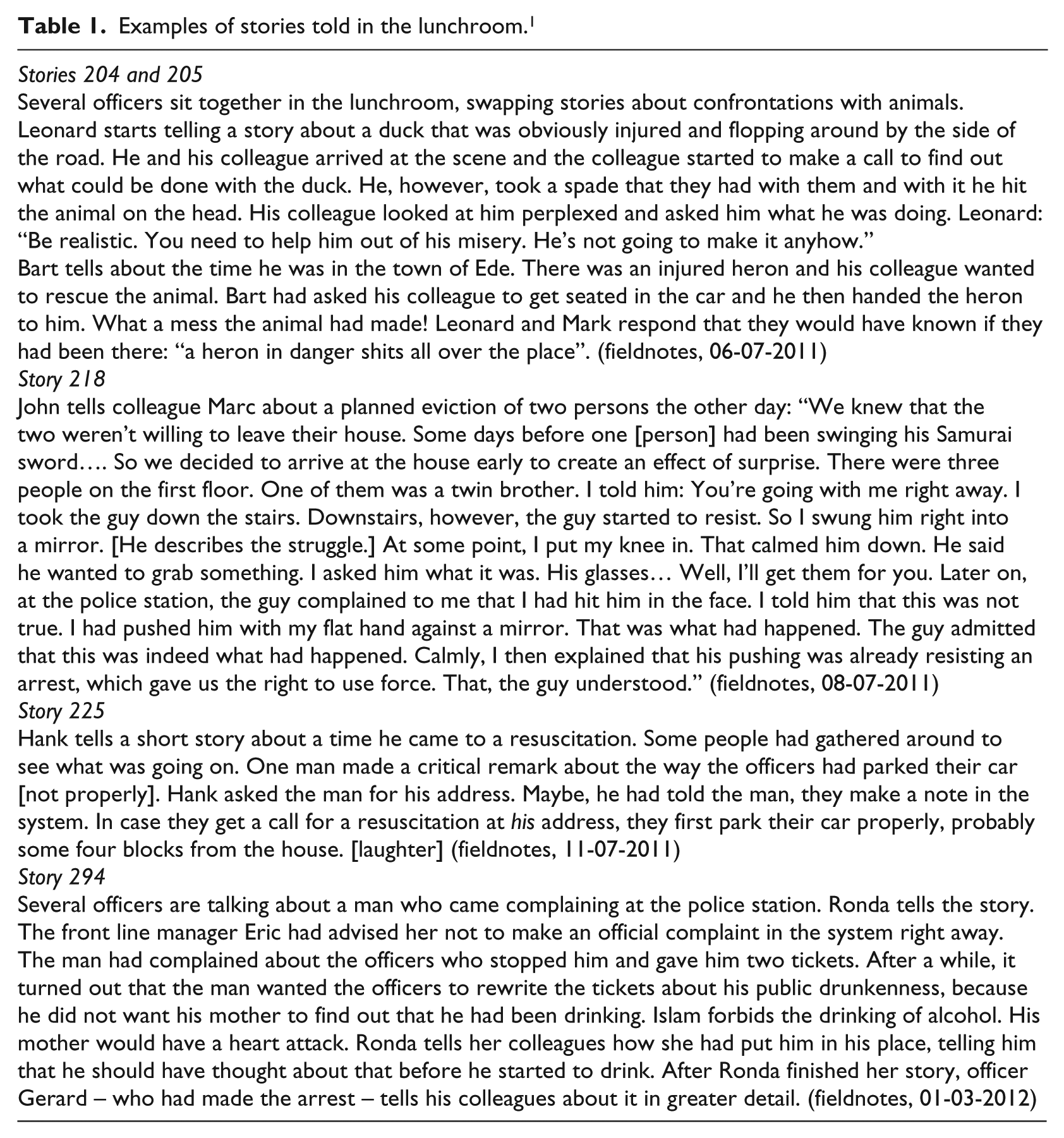
Examples of stories told in the lunchroom. 1
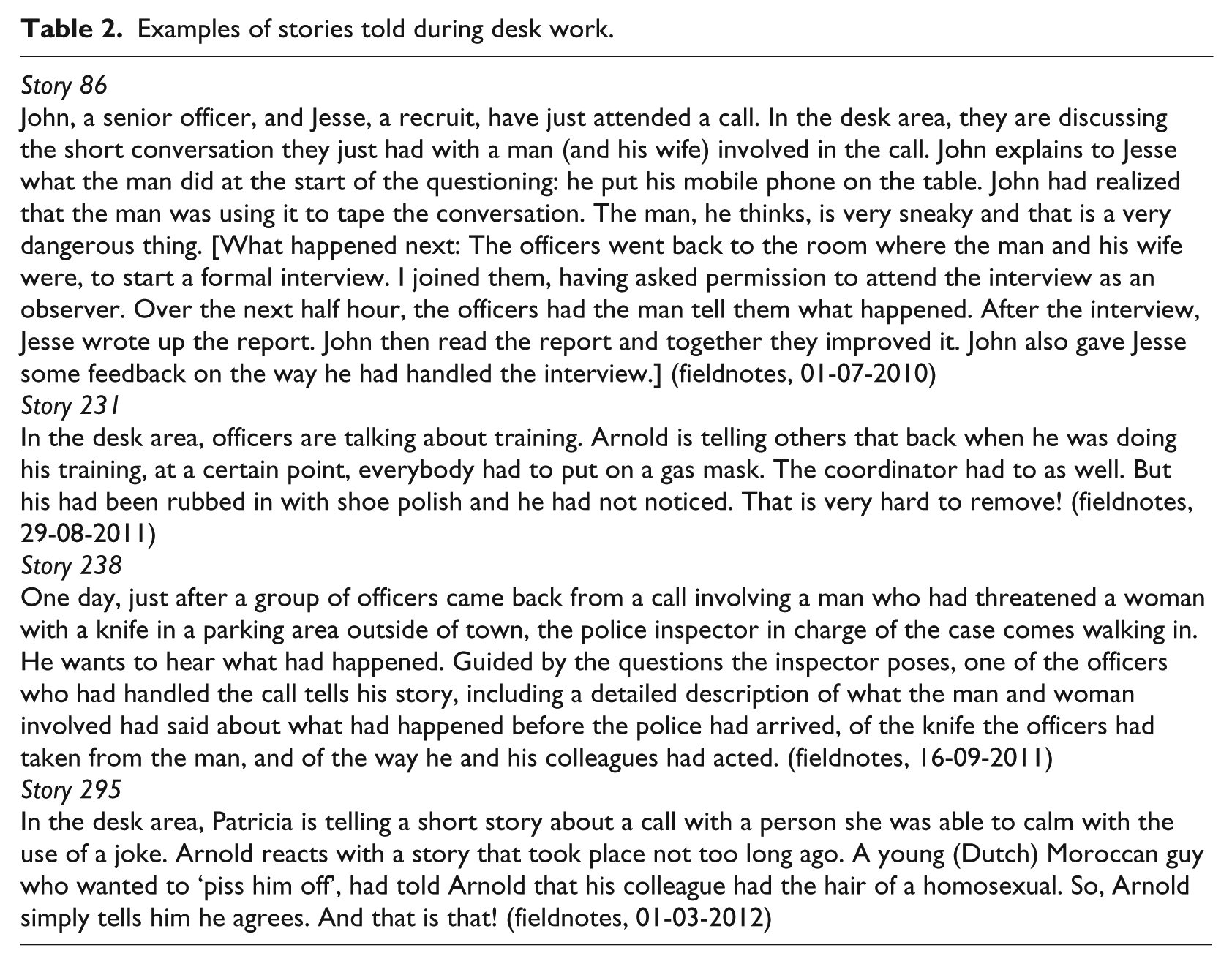
Examples of stories told during desk work.
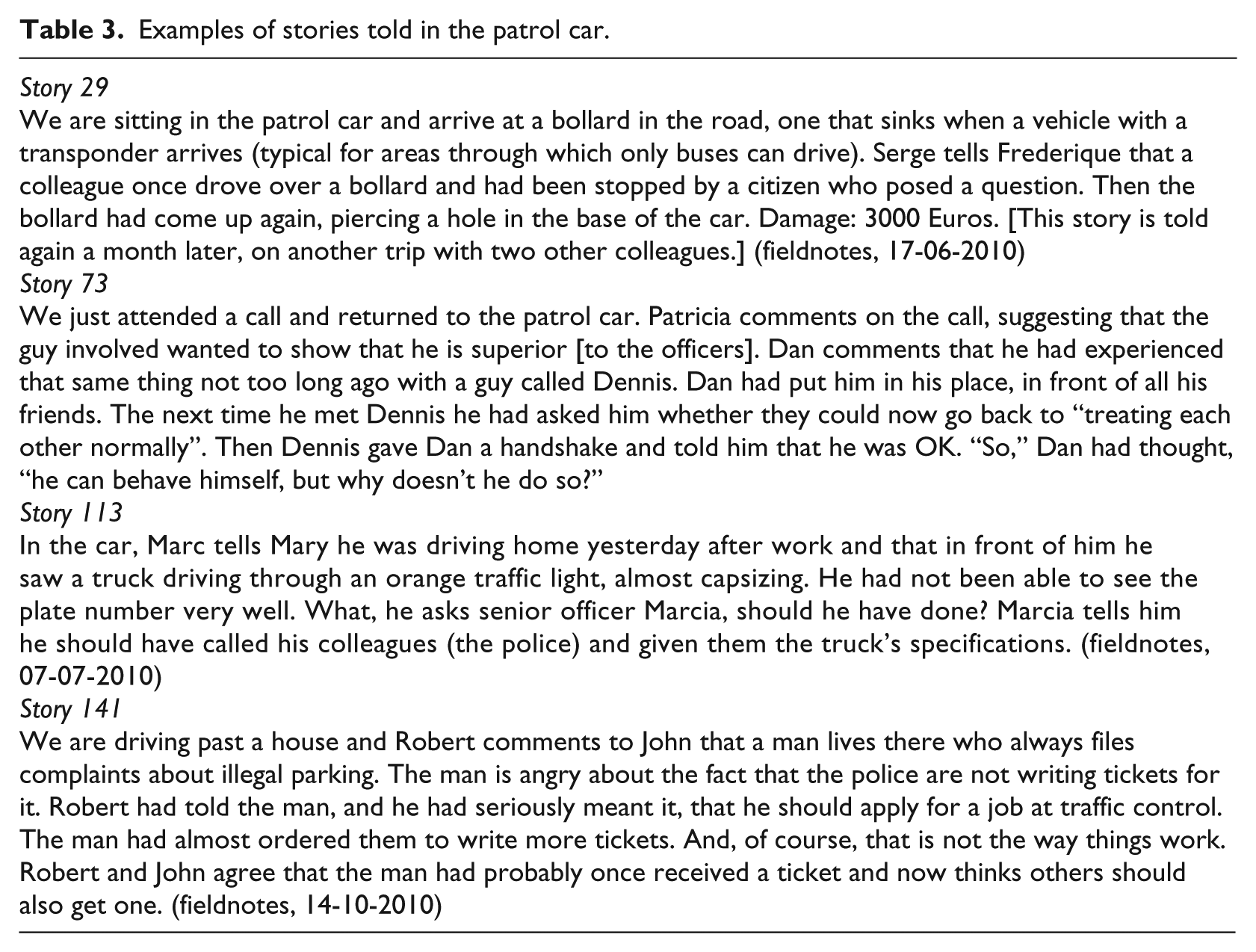
Examples of stories told in the patrol car.
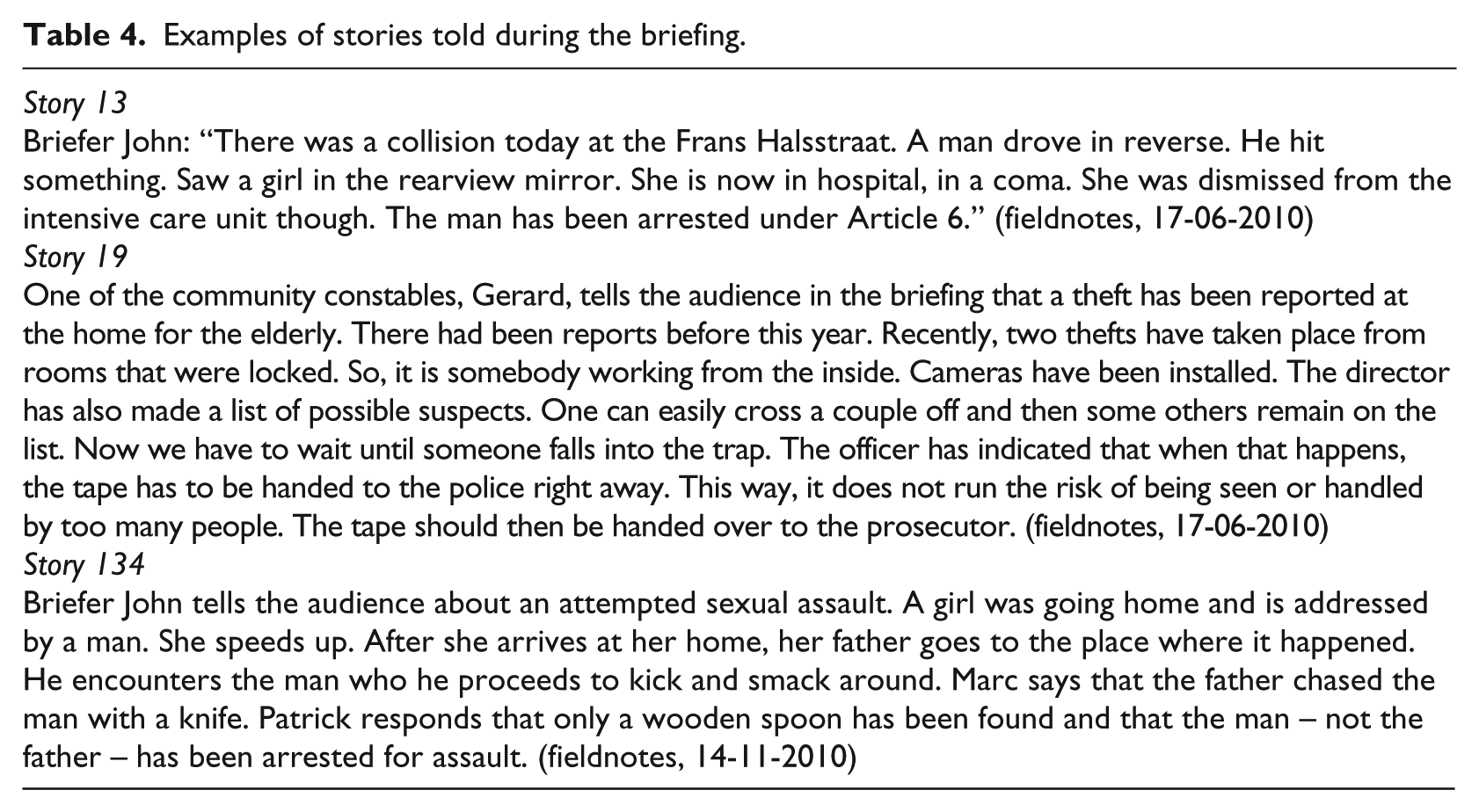
Examples of stories told during the briefing.
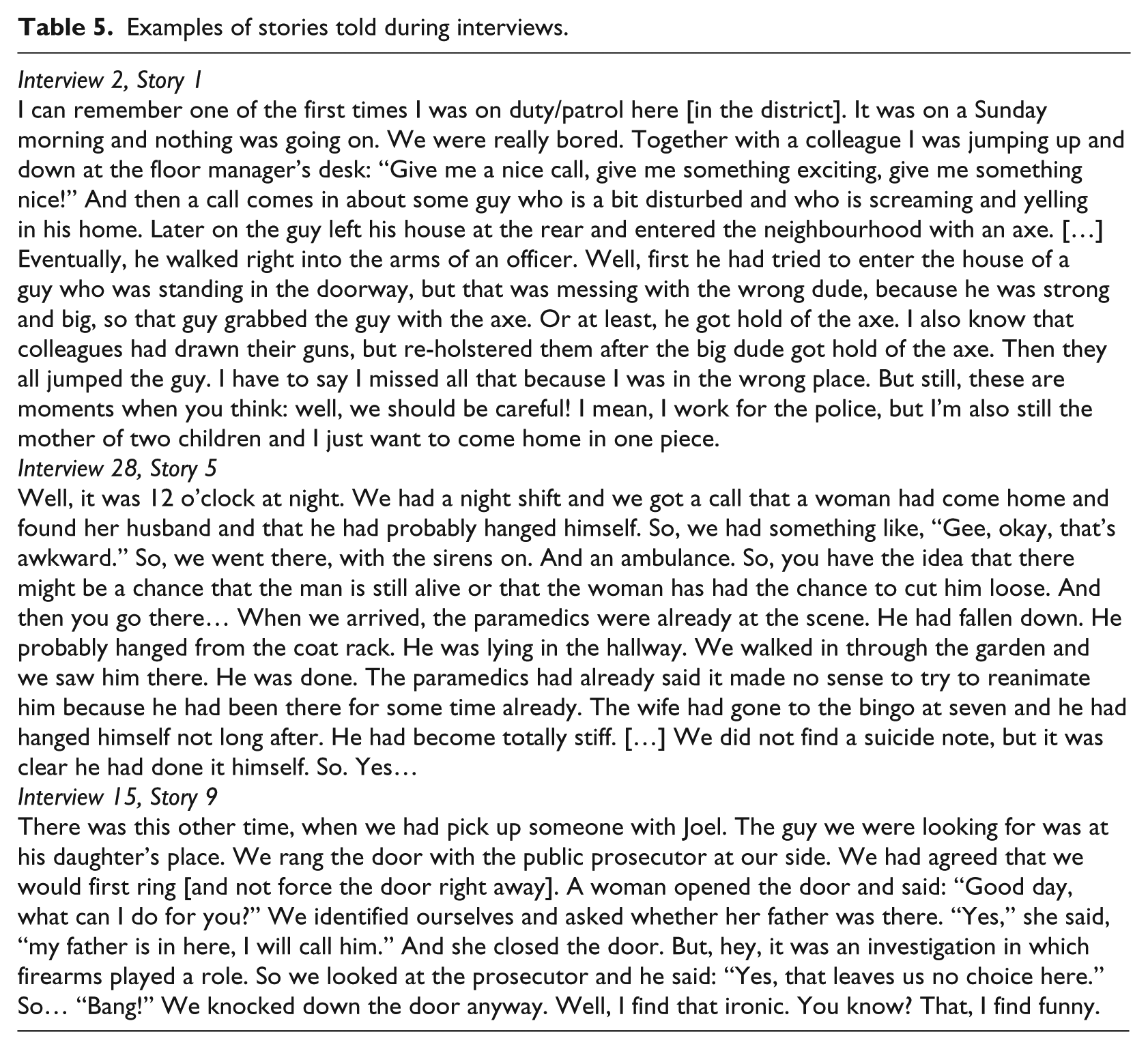
Examples of stories told during interviews.
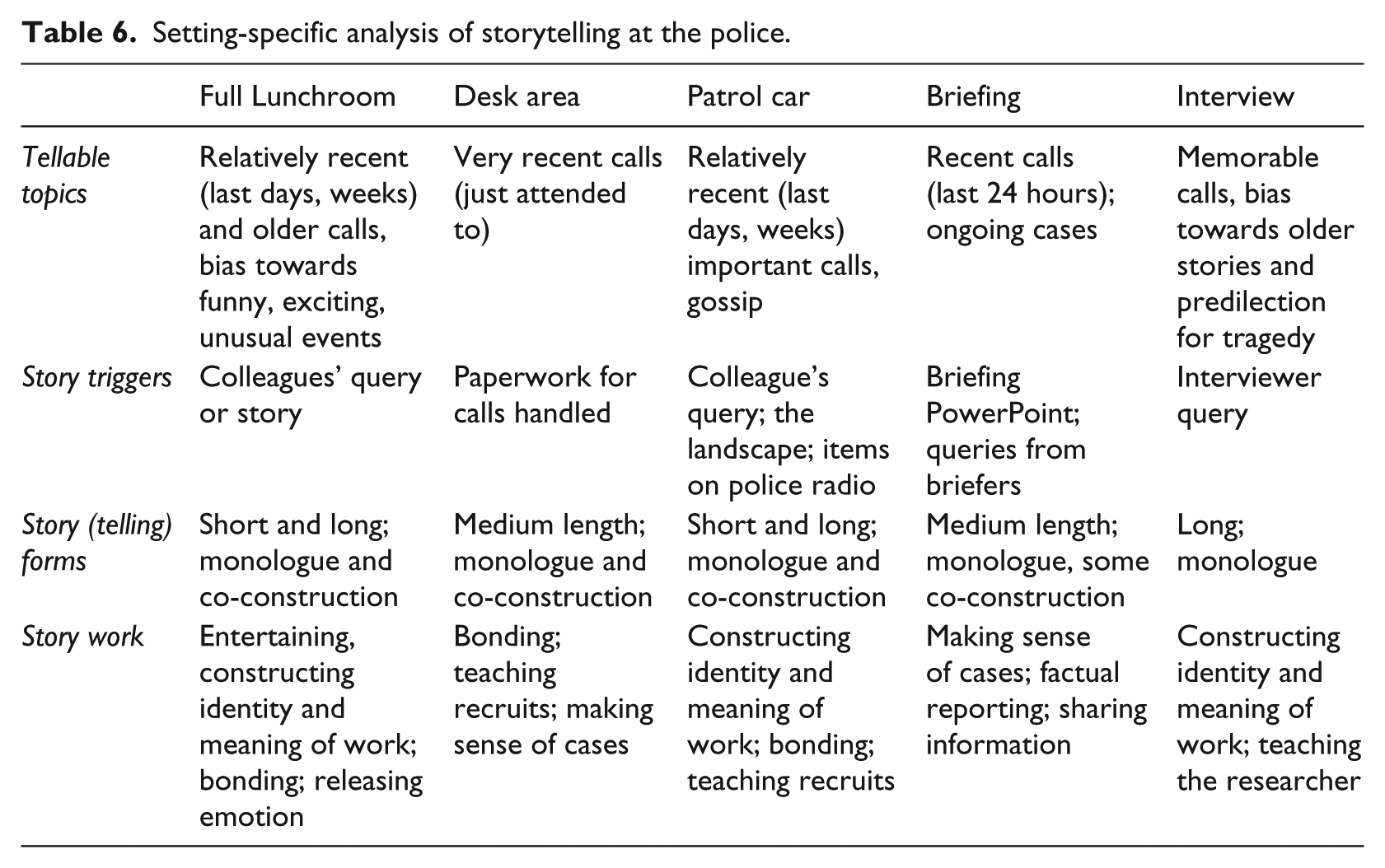
Setting-specific analysis of storytelling at the police.
Findings: Storytelling Among Police Officers
During the first weeks of our ethnographic fieldwork, we discovered that the police station we were observing was filled with storytellers. Stories, short or more fully rendered, were told all the time. Considering the number of stories told each day, the police department in Vinex fits the image of a ‘storytelling organization’ – in this department policing appears to be a thriving milieu for storytelling. In a little over 100 hours of observation during the first fieldwork period, we counted 189 stories. We missed a couple of stories because, during breaks and briefings, they were told one after the other, sometimes too rapidly for the fieldworker to make notes on all of them. Keeping this in mind, police officers’ storytelling averaged two stories an hour.
As officers usually sketched a situation in a few sentences or in one long sentence, telling a story might take up to half a minute. At times, officers only made a brief reference to a story, without describing what had happened (if we had counted these references as stories, the number 189 would have increased substantially). Police officers evidently considered their day-to-day experiences as highly tellable. Apart from the people working at the front desk and three team managers, all officers frequently got involved in the team’s storytelling, whether as storyteller or as listener. While storytelling abounded, it nevertheless differed from one (sub)setting to the next. To bring out the setting-specificity of storytelling, we structured and presented our findings by describing the storytelling for each setting that we could distinguish: the lunchroom, the desk area, the patrol car and the briefing. For the sake of comparison, we also included the interview situation. For each setting, we analysed the four building blocks outlined in the theory section: story tellability, story triggers, story forms and story work. Table 6, at the end of this section, summarizes the patterns that we discerned in the (sub)settings.
Having a break
The lunchroom, a 20 square-metre space on the ground floor of the police station with a big table and 16 chairs in the centre, was the place where officers gathered for their homemade or take-away lunches and dinners, and their coffee breaks. In a way, the lunchroom was the social heart of the team. It was the place where officers had a break from their work by telling stories to one another. It was unlikely, if not impossible, to sit at the table in the lunchroom with a group of officers for more than 20 minutes without hearing a story.
The tellable topics for conversation in the lunchroom ranged from recent experiences on the streets to changes in work schedules; from work-related matters such as the reorganization of the Dutch police force to private matters like holidays, and matters of general interest like the news. Not everything, however, was worth telling a story about. A fieldwork observation illustrates this point: Today, I [the first author] was on patrol with two officers. They got a call about a young sheep that was walking on the wrong side of a ditch. At the scene, the officers did not succeed in getting the sheep to move in the right direction, but when the owner of the sheep came, he managed to get the sheep back with the others. The next day in the lunchroom one of the officers involved in that call turned to another colleague and said, while staring at his plate: ‘Yesterday we also had a sheep.’ The colleague did not react to this and the storytelling officer did not try to force the story upon his colleague. (field notes, 03-07-2010)
Apparently, this set of events was tellable enough to offer up, but not exciting and thus not tellable enough to be interesting to the listener. Especially tellable were those events that were somehow funny, exciting or unusual. Also, highly popular as a topic were citizens who were regularly in trouble with the police, called the ‘usual suspects’. An officer then typically started a story saying, for instance, ‘You know who I ran into yesterday at the train station?’ Most tellable stories involved events that took place recently. If an incident took place some time ago, it would be old news. So, after some time (a month or more), minor incidents seemed less tellable. Even bigger incidents – like a shooting that took place during the fieldwork period – lost their tellability after some time, as everybody ‘knew’ the story and the officers got tired of talking about it. In conversations, a simple reference was enough to point at it, suggesting that ‘terse storytelling’ (Boje, 1991) is typical of worn-out stories.
Little was needed to trigger storytelling in the lunchroom. Police officers taking a break provided fertile ground for instance, by inviting storytelling with a question. Officers who just came back from a call were often asked: ‘What happened?’ or ‘Was it anything interesting?’ Often, however, such questions did not even need to be posed. When officers returned from a call, they automatically got the attention of others. If nobody was asking for a story, storytellers could start the ball rolling themselves with a question. To get the attention of colleagues, an officer might start a story with a question like, ‘Did you hear what happened to us last Sunday?’
Often, the story itself proved to be the best trigger for storytelling. When officers sat together to drink coffee or eat a sandwich, they frequently engaged in such ‘story swapping’ (Sacks, 1992; Tangherlini, 2000). One day, for example, a community constable started to tell a story about going to a woman’s house whose husband just had an accident. The woman had reacted to this message by saying that she was depressed. Another officer responded that he had gone to give similar bad news to a woman about her husband who had just had an accident. The woman in this case had reacted quite differently, asking: ‘But who is going to take the kids to school tomorrow?’ (field notes, 22-03-2012).
The theme of story swapping was not clear from the start. Certain happenings can trigger stories, but also, for instance, a certain (well-known) actor in a story can. The theme of story swapping was therefore normally decided by the second and even the third storyteller. Older stories could become more tellable again once story swapping took off, provided they fit the theme. Topics like resuscitations, dead bodies, a well-known colleague and usual suspects in particular led to elaborate story swapping. One evening, when the fieldworker was in the desk area, he heard officers in the lunchroom laugh loudly. Entering the lunchroom, he heard an officer telling a story about a search for drugs. A second storyteller told a story about the time he had to look for a man who was missing and found a smelly corpse. Others then jumped in to tell their own ‘horror stories’ about corpses, detailing the setting in which they had encountered the body, the moment of encountering the body, and the look and smell of it. Of the seven officers present, four told such a story (field notes, 12-04-2012, also see stories 204 and 205 in Table 1).
Stories in the lunchroom came in various forms. The more recent stories that the teller and audience found funny, exciting or unusual, could last a long time. The storyteller would elaborate on the more tellable part of such stories, i.e. the surprising, gruesome or comic details of what was said and done. Indeed, these tellings could become public performances by the storytellers. Such stories were frequently told by multiple officers who had witnessed the events. Second stories, stories from a more distant past told in response to more recent stories, would also be relatively long. Such storytelling typically took the form of a monologue (as others with knowledge about them would not be present). Finally, as illustrated above, the less tellable stories typically remained rather short and a monologue, a mere glossing (‘Yesterday we also had a sheep’).
Storytelling in the lunchroom would do various sorts of work. First of all, in a full lunchroom, good storytellers were performers who entertained their public (see e.g. stories 204, 205 and 225 in Table 1). They helped others to re-experience the excitement, to see the frightening and the tragic in a comic light. After exciting calls, telling a story would also release emotions. The storytelling itself bonded the officers. It worked as ‘social glue’, producing a shared understanding of particular kinds of events and the occupational world of policing. Telling stories, listening, reacting to them with evaluations and second stories also helped officers to construct identities for themselves (e.g. as heroic problem solver, see stories 218 and 294 in Table 1) and for others (e.g. incorrigible criminal or helpless victim), and to ascribe motives and interests to them. Citizens and, occasionally, a fellow officer could become the object of ridicule or pity. During story swapping, a sense of competition for ‘best story’ or ‘best storyteller’ might be seen, but it was mostly the celebration of the work in its vividness. Senior officers would often end story swapping with meta-conversational statements like: ‘Boy, what we have to deal with…’
Working at the desk
The patrol officers would use a desk area with hot desking, whereas the managers, the community constables and recruits at the beginning of their training had their own areas. The desk work ranged from writing reports for calls attended, phoning citizens and checking email. At the end of a shift the desks for patrol officers would all be occupied because officers preferred to end their shifts with paperwork. The desk areas, and especially the area where the patrol officers sat together, exhibited somewhat similar storytelling dynamics as the lunchroom. Often, officers would interrupt their work to tell stories. Calls that officers had to deal with in recent days or hours – the unusual and funny ones in particular – formed tellable topics here as well (see, for instance, story 231 in Table 2). When a new shift came on duty (every eight hours), the fresh officers would often come to the desk area to hear stories about recent events in the district. Such informal updates would typically take place in the desk area before the formal update during the briefing.
What made storytelling in the desk area somewhat different from that in the lunchroom was its relationship to the work being done in the desk area: writing up reports on cases (see examples in stories 86 and 238, in Table 2). The desk work itself was a main trigger of stories and storytelling. Storytelling often focused on recently handled calls, both usual and unusual. In preparation for and while doing paperwork, the ‘story of the call’ would be told and discussed. Storytelling would therefore often take the shape of co-construction.
Talking about the calls that had to be processed in the system helped the officers make sense of those calls – e.g. the events, the actors involved, the laws that should be applied, the procedures that had been followed and would have to be followed to deal with a certain problem. Telephone calls officers made from the desk area to citizens in the districts (e.g. witnesses, victims) also triggered stories. Like the storytelling in the lunchroom, the storytelling in the desk area would bond officers as a social group, albeit that this concerned mostly bonding between regular patrol officers and not bonding with the starting recruits and community constables who were sitting elsewhere. In the desk area, recruits learned from more senior officers how to deal with calls and write up reports. Finally, story swapping also took place in the desk area (see, for example, story 295 in Table 2).
In the patrol car
Between calls and desk work, for periods between one and three hours, officers were ‘on the beat’, driving through the urban area of the city and the countryside with its villages. Sometimes officers hurried to a call and at other times partners had specific assignments, like picking up a videotape from a petrol station that had been robbed. When they got into the car at the start of their shift and sat together for the first time in a couple of days or weeks, they updated each other. Since longer periods of time were usually involved, these updates normally focused on the more unusual happenings that had significance to the storytelling officer or the team. On one of the fieldwork days, for instance, one of the officers asked his colleague: ‘Experience anything lately?’ His colleague responded: ‘Something strange? Really strange…? We got a call about a suicide. I came in the hall and saw him hanging. It was someone I knew…’ (field notes, 03-07-2010).
In the patrol car, officers also had the opportunity to gossip and complain about others, even if they did not do that too often in the presence of the fieldworker. If the lunchroom and the desk area are the backstage region of the police station, the patrol car would be an even more confidential or intimate space.
Apart from colleagues’ queries in the car, the ‘landscape’ also often triggered stories. Driving through a neighbourhood that the two officers did not often visit, for instance, sparked stories about a hostage situation in the area and two well-known families living in the vicinity who got into a fight last year (field notes, 17-11-2011). In a similar vein, seeing a usual suspect on the street, getting a communication on the patrol car radio (between the incident room and officers on patrol in the district) or attending to a call brought associations to mind and triggered the telling of stories (see, for more examples, stories 29 and 114 in Table 3).
Stories told in the cars had various lengths. The landscape, for instance, often triggered very terse storytelling. But as the ‘conversational floor’ of the patrol car was much easier to hold than that of a lunchroom full of colleagues and during the briefing, they might become relatively long. In the car, rather ordinary events became tellable, also because partners often spent long hours in each other’s company with much time for talking (Robinson, 1981). Officers in a car sometimes ended up swapping stories about a certain topic. Like the storytelling in the lunchroom, the storytelling in the car allowed officers to give meaning to themselves and their work, to bond and, more than in other settings, to tell colleagues how they had personally experienced events. As recruits often went on their beats with a more senior officer (their mentor), storytelling also did more explicit educational work.
Briefing
Briefings took place three times a day – at the end of each eight-hour shift – in a separate 30-metre-square meeting room next to the lunchroom. Not surprisingly, briefing was a rather formal practice. Depending on the time of day and the day of the week, between five and fifteen officers attended a briefing. A senior officer led the briefing and used a PowerPoint presentation displaying standard items, such as vehicles and persons the officers had to keep an eye out for, as well as camera images of shoplifting. These were normally cases the police was dealing with and they were presented in narrative form, with events, settings and actors (see Table 4 for examples). The briefing would, however, start with a verbal summary of the calls attended to over the last 24 hours. The descriptions of these calls also took story form. When available, pictures of the suspects or vehicles involved were shown. In addition, community constables who were present were asked to give an update on what was happening in ‘their’ neighbourhood, which also triggered stories about recent events of interest to the police (see e.g. story 19 in Table 4).
The calls and cases talked about were those that had some relevance in terms of police business. Although the briefing offered some room for evaluative remarks and jokes, the work of storytelling in the briefing room was typically the sharing of information about recent happenings. The main forms of storytelling were monologues by the briefer, focusing on a specific call or a case handled in the last 24 hours. These monologues were mostly of medium length, including a clear beginning and end, but not too many details. However, the briefer regularly asked members of the audience if they had any additional information about a call, especially if the case was not yet closed. Take for instance this short story, told at the start of a briefing (field notes, 09-07-2011):
Mr. De Bruin runs into his ex[partner]. So, he thinks, let’s throw her on the ground. Colleague Hans, maybe you can tell the story better than I can.
Well, they had a relationship of nineteen months. Since a week or two, three, it’s over. They decided that together, they say. Nevertheless, when they encountered each other yesterday …, she yelled something at him. He got angry. He took her hands. Well, he says she fell backwards. She had no more feeling in the lower back and tickling in the legs, so she was transported to the hospital. Turns out she has a bruised back. He is still in [name of the city where the prison is]. He confesses to everything, so in that sense it’s easy…
Storytelling could also involve making sense of what had been and might still be going on in the district. Officers, for instance, had gone to a call where Person A filed a complaint about Person B and the officers had not talked to Person B yet. The story then had a beginning and a middle, but needed to get a proper ending. The officers present participated in this sensemaking effort when, for instance, they were asked whether they knew the actors involved or had heard anything about them.
Interviewing
A final setting that was studied is the interview. Most of the interviews with officers that were conducted for this research project took place in a large meeting room next to the lunchroom – the same room where the briefings were held. The setting of interviewing had a clear impact on tellability, triggering, form and work. The interviews were semi-structured and questions were asked about interviewees’ careers, events that they remembered well, and stories they had told others that triggered the telling of older stories that described calls that were highly memorable for the officers interviewed. These stories included, for instance, ‘first times’: the first resuscitation, the first suicide, the first time they had drawn their gun. As these first times had often been exciting and formative for the interviewee at the time they occurred, as stories they became tellable in the setting of the interview, whereas officers might not tell them to their colleagues in a full lunchroom room environment. The themes of stories varied from exciting or tragic incidents to comic episodes in the work life of the officers (see the stories in Table 5). The setting sparked a monologue with relatively lengthy stories. The following is an example of the way such triggering worked (Interview 13):
So, I would like to learn about the things you have experienced. They do not have to be the impressive ones, but perhaps you can think: What happenings have stayed with me over the years?
Yes, what do you remember? What comes to mind now? Yes, … a fatal car accident. A boy makes the wrong move on his moped, bumps into a stump with his chest, and passes away while you hold him… that stays with you. The resuscitation of a little baby. Fortunately, he makes it. That stays with you…
The interview questions triggered storytelling, but what is interesting to note is that some officers had a hard time remembering stories. On the other hand, these same officers seemed to have little problem telling their colleagues about the conflict with a driver they had yesterday or telling a second (third, fourth, …) story about a topic raised by a colleague. The more ordinary appeared not important enough to report to a not-so-intimate fieldworker in the setting of a formal interview. A topical story was more easily triggered during story swapping with colleagues. Nevertheless, many stories were told during the interviews: 289 stories in 25 interviews, which equals 11.56 stories per interview.
The long tragic tales (Gabriel, 1991a) officers told were clearly different from the main themes of storytelling in other settings. The work that stories did mostly gave meaning to police work for themselves, constructing a dramatic identity in front of a relative outsider. In a sense, interviewees were educating the fieldworker about the work of policing, even if the image of policing that the interviewer was presented with was tailored to the occasion (Dick, 2005). In Table 6 we summarize storytelling in the settings observed, drawing out the differences.
Discussion: A Setting-Sensitive Approach to Storytelling
Organization scholars take storytelling to be central to organizational life and assume that ‘organization halls and offices pulsate with a story life of the here and now’ (Boje, 1991, p. 106). By contrast, they also make the claim that ‘few organizations are spontaneous storytelling cultures’ (Gabriel, 2000, p. 240). As such, storytelling research builds on the assumption that organizations are vibrant storytelling milieux (Currie & Brown, 2003), while also purporting that organizational members rarely take the time to tell stories to one another. Unless we are willing to accept that all storytelling in organizations is merely the exchange of ‘bits and pieces’ of stories, then these two views seem to be in conflict. Over the last 25 years or so, research has failed to resolve this puzzle – hardly surprising, we believe, as it has been asking the wrong question. What has not been asked is whether and how different organizational settings trigger storytelling. Instead, the literature has by and large treated all organizations as constituting one single, uniform setting that consistently triggers storytelling in an identical way. With only a few exceptions (e.g. Boje, 1991; Orr, 1996; Patriotta, 2003; Tangherlini, 2000; Whittle et al., 2009), research has focused on the content of stories and actors’ narrative strategies rather than on the in situ telling of stories in members’ everyday work lives. Although some scholars do suggest that storytelling is context-bound (Hansen, 2006), storytelling research has barely addressed the question of whether storytelling does or does not take place in everyday organizational life and how storytelling might vary from one organizational setting to another.
Building on previous research, this paper set out to address this omission. Investigating the situated occurrence of storytelling, we have asked whether, when, how and for what reason organizational actors tell stories in the workplace. In order to answer these questions, we first designed a generic framework for analysing the variability and setting-specificity of storytelling across a variety of organizational settings. This framework directed our analytic attention towards four key issues: story tellability, story triggers, story(telling) forms and story work. We then used this framework to examine ethnographic data on police officers’ situated storytelling in everyday police work. We will now first discuss how the empirical specifics of our study contribute to existing studies of storytelling, and then explore the implications of our study, present a setting specific typology of organizational discourse, and end with limitations and possibilities for future research.
Contributions
By following members of a single organization as they moved from one workspace to another, we found that storytelling may be significantly different in different settings: which stories were told and in what form, on which occasions and for what purpose varied with the organizational setting. Before discussing the diversity of storytelling found within the police station, however, we must begin by discussing (and contextualizing) another finding worth mentioning: storytelling was both context-dependent and nearly omnipresent in this police station. The near omnipresence of storytelling suggests that the police – or at least this specific police station – might, in fact, be one of perhaps the few organizations that do have a true storytelling culture. For example, when we observed a handful of officers sitting together, we saw them continually recount recent and older incidents; adding up to a total of 189 stories in the first 100 hours of fieldwork. This finding suggests that abundant storytelling may be typical of police organizations.
When we compare the story density in our own interviews with that of Gabriel’s (2000), this finding is further strengthened. While his interviews with members from five different organizations recorded an average of three stories per interview (for a total of 377 stories in 126 interviews) – which included factual reporting and ante-narratives (which he called ‘proto-stories’) – the average number of stories in our interviews was much higher: 11.56 stories per interview (for a total of 289 stories in 25 interviews). 2 In sheer numbers, this is a remarkable difference, suggesting that police work invites constant storytelling on the part of police officers.
What makes stories so highly tellable within the setting of a police organization and what triggers their abundance? First, police work itself seems to exhibit high tellability. Although some suggest that the routine-like character of police work hardly triggers storytelling (Boje, 1991, pp. 115–16, 124; 2006, p. 34), our study actually suggests the opposite. It supports the view that policing, by definition, means dealing with situations that diverge from ordinary life – situations that most of us would consider exciting, terrifying, unusual or strange. Although not every situation was worth telling a story about, as the example of the (never-told) sheep story indicates, many situations were. Second, the officers we studied spent a lot of time together in patrol cars (without much work that demanded their full attention) and during extended breaks, which offered plenty of time and occasions for storytelling. In such a story-inviting setting, even the more mundane, everyday experiences became tellable (Robinson, 1981). Third, police officers’ storytelling competencies, we believe, also added to the culture of storytelling at this police station. As storytelling is engrained in policing, most officers are well-trained storytellers who are able to turn storytelling and story swapping into an enjoyable pastime.
Although we found that storytelling flourished among police officers themselves, storytelling also – as we have demonstrated in this paper – varied considerably across settings within the organization. Each particular setting studied had its own combination of story tellability, story triggers, story(telling) forms and story work. In the setting of police briefings, for instance, information about recent events had to be shared in a rather factual manner. Officers needed to be up to date on police business and, specifically, on what mattered to the daily business of the team. Within the setting of a briefing officers also dealt with ongoing and unfinished affairs, causing the actors involved to frequently ask themselves the diagnostic question, ‘What is the story here?’ (Weick et al., 2005, p. 410). In other words, during a briefing, ‘detective stories’ (Patriotta, 2003) were told that had a beginning and possibly a middle, but as of yet no end (Boje, 2001). Officers needed to first either find out what the end was or make sure there would be a proper end. Long, old and funny stories – just like telling second stories – would be inappropriate in the setting of a briefing.
By contrast, the factual reporting typical of a briefing was mostly absent during breaks. Having a break meant relaxing and not bothering others with boring facts, but rather entertaining them with the funny, the exciting and the unusual. As such, the story of an ordinary conversation with a local criminal would become tellable in the lunchroom if the storyteller highlighted its funny side, whereas that element did not improve its tellability in the setting of a briefing. Within the setting of an interview, rather long monologues ensued because no other officers could claim the conversational floor for their own stories. Indeed, the practice of conducting an (open) interview entails offering the interviewee an opportunity to tell his or her stories (Mishler, 1986; Weiss, 1994), which allows more space to tell tragic stories (Gabriel, 1991a).
Testifying to the significance of storytelling’s situatedness, we also found that when a setting changed, the storytelling followed suit, such as when the lunchroom filled up with officers. In a full lunchroom – because more people’s attention had to be drawn and kept in order for the storytelling performance to be successful – the tellability of stories was different than in a lunchroom with only a handful of officers. Similarly, when partners in a patrol car were summoned to go to an urgent call, the storytelling stopped as the officer’s attention shifted from dwelling on the past to being mindful in the present moment.
Between different organizational settings the main reason for variations in storytelling may be its specific role within the dominant practice(s) of a particular setting. The goals, operating rules and understandings inherent to a particular practice (Schatzki, 2006) may enable or even demand a particular type of storytelling, impacting a story’s tellability, triggers, form and the ‘work’ it does. In formal settings like meetings, the focus is on the work at hand, which invites and generates more succinct, factual and ‘dry’ storytelling, useful for sharing information and discussing current affairs. In such a context, lengthy, dramatized storytelling would be inappropriate. By contrast, downtime (e.g. during breaks, travel time, celebrations) is the opportunity for sharing and swapping more fully rendered stories and for storytellers to focus on the funny, the exciting or the unusual. In a similar vein, interviews also invite the telling of full stories – usually, however, with a focus on more tragic events that happened in a more distant past. Stories, as we can see, are tellable, triggered, take a certain form and do a certain kind of work within a particular setting, and storytellers tune their stories to the practices at play within that setting.
Implications
Our theoretical and empirical analysis has allowed us to show how a setting-sensitive approach to studying storytelling may help flesh out a fuller, more grounded account of story life within organizations. In the wider context of organizational storytelling studies, such setting-specificity may also have wider implications for received wisdom and research practice. It may explain, for instance, why Boje (1991, 2006) did not find many fully rendered stories. Having mostly recorded – as far as we can tell – managers’ meetings, his research led him to encounter ‘bits and pieces’ rather than stories with beginning, middle and end, such as those found in interview-based research (e.g. Gabriel, 2000). Clearly, merely relying on the storytelling data drawn from one setting may lead to misinterpreting not only the kind of work a story does and its symbolic gravity in a particular organizational setting, but also the meaning it has for storytellers and their audiences. Unless we are willing to accept the premise that organizational storytelling is the same across time and space, we must sensitize story research and management practices to the exact ways in which storytelling differs from one situation to another.
Methodologically, our study invites researchers to become more situationally sensitive and thus to reconsider their research methods for studying storytelling and, indeed, related topics. Often, organization studies adopt a decontextualized approach, privileging one particular research setting for generating knowledge above all others: that of the interview situation. By ignoring the situated act of storytelling (or, likewise, sensemaking, communication, learning, strategizing, or identity work), these studies implicitly assume that stories have a (similar) life outside and beyond the interview setting (Whittle et al., 2009). However, by focusing on storytelling, our comparison of different settings confirms that the tellability, triggers, forms and work of storytelling are, in fact, specific to a situation. Our study suggests that an interview, for example, constitutes a setting that prompts a particular type of talk we might call ‘interview talk’ – in part due to the questions posed and the distance temporally from recent or ongoing concerns. Police officers often told elaborate stories during our interviews, usually about memorable experiences from a more distant past and their meanings as a way of actively working on their professional identities in the presence of a relative stranger. In other settings, police officers sometimes engaged in more terse storytelling and story swapping about the more recent past, whether for entertainment purposes, bonding, the release of emotions, the exchange of information or the influencing of others. This testifies to the need not only to conduct interviews or hold conversations in settings that are different from that of a regular interview protocol, but also to include more participatory, observation-based methods in organizational research in order to explore storytelling outside the traditional interview. For a setting-sensitive approach, the starting point must be a researcher who goes into the field of study, samples different settings and situations, and, in both text work and headwork, places participants back in the thick of things at the various observed sites.
Analytically, a setting-sensitive approach has implications for research both into storytelling and a wide variety of other topics, such as organizational sensemaking, communication, learning, strategizing and identity work. While previous research has helped to bring out the storied character of these topics, it mistakenly builds on the silent assumption that organizational actors do indeed engage in storytelling and that stories do the same kind of ‘work’ in different settings. Consequently, such research has yet to shed light on the situated activity of storytelling in the context of everyday organizational life. Broadly speaking, our study invites organizational researchers to open up their field of vision, to notice different settings, and to more systematically and more sensibly investigate the situated performance inherent to, for example, storytelling, sensemaking and identity work in day-to-day work life.
Finally, in our approach to story work and story life, we have gone beyond the individual actors’ agential production of stories. Our analysis is premised on the assumption that story work – or, for instance, identity work or strategizing – is performed or produced at the intersection of agency and structure: sophisticated language users may tell ‘the right kind of stories to the right audiences at the right moment’ (Alvesson & Kärreman, 2000, p. 1132) and strategically ‘use’ a story to make it do particular work, but they always do so within a particular setting that itself is primed for a particular type of story work – for example, a full lunchroom invites entertainment and bonding, while a briefing asks for the swift handling of a case.
A new typology of situated organizational discourse
In order to direct organizational scholars’ attention to the intersection of discourse and settings, and to further sensitize them to the situatedness of discursive practices in organizational settings (Fayard & Weeks, 2007), we propose a typology that allows for a fuller account of the situated occurrence of different forms of organizational discourse. Building on both our empirical observations at the police station, and examples from organizational storytelling and discourse literature, we speculatively distinguish four types of situated organizational discourse (see Table 7). Each of these four types of everyday organizational discourse suits a particular setting and the particular practices conducted there or, to put it the other way around, the setting invites, prompts or primes a particular kind of talk. Each type is distinctive in terms of, first, its specific degree of (in)formality and focus on work-related matter and, second, the number of participants or size of the group.
Setting-specific organizational discourse: a typology.
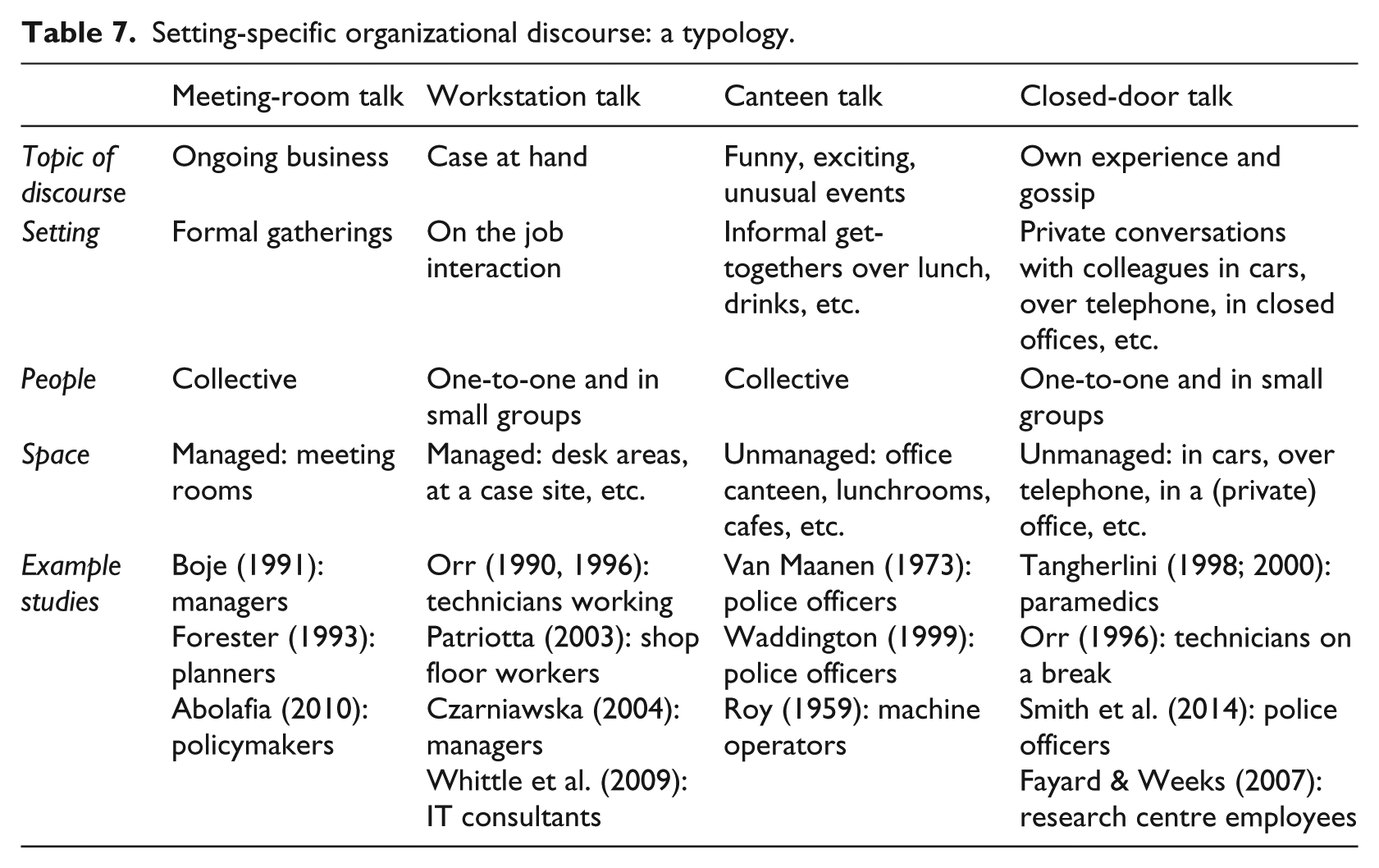
In our typology, meeting-room talk constitutes a first type of situated discourse. Gatherings that follow a formal agenda concentrate on the exchange of information or the discussion of ongoing business. Our analysis of police officers’ storytelling in briefings suggests that meeting-room talk may involve rather factual, work-related reporting and information-sharing through stories told in rather dry prose, with little drama and with high doses of occupational jargon while merely glossing over the past (Abolafia, 2010; Boje, 1991). Collective storytelling may then, in such cases, be as much about recollecting the past as about generating future action strategies, as is aptly illustrated by Forester’s planners (1993) and Abolafia’s policymakers (2010), who both use meetings to make sense of the past in order to generate appropriate future action for the collective involved.
Of course, people also get together and discuss work-related issues in more private settings outside of formal meetings and away from formal agendas, attentive audiences, or managerial ears. Together with a colleague, such as when working on a case, two officers may engage in what we call workstation talk. In our fieldwork, we saw that two or three officers sitting in the desk area would typically share work-related stories that helped them diagnose the latest calls, handle paperwork and work out a plan of action. In a similar vein, shopfloor workers (Patriotta, 2003), managers (Czarniawska, 2004), technicians (Orr 1990, 1996) and IT consultants (Whittle et al., 2009) have also been observed to engage in workstation talk to define, for example, the problem at hand, how to act on it, who should handle it and when to expect results. Importantly, the workers create what Patriotta (2003) calls ‘detective stories’, narratives in which facts are pieced together into a plausible account of what has happened or is going on. Workstation talk may also serve as a vehicle for instructing novices about an occupation (Orr, 1996).
Spaces that are even more backstage (Goffman, 1959) or unmanaged (Gabriel, 1995) – lunchrooms, dining halls, and cafeterias, or joint breaks for lunch, drinks, or celebrations – create the setting for canteen talk, a type of situated discourse that is informal and collective. During such get-togethers, police officers may, for instance, exchange war stories (Van Maanen, 1973), brag about catching crooks (Waddington, 1999) and, as we have seen in this paper, tell stories about funny, exciting or unusual events. With its bias towards highlighting the epic and comic dimensions of day-to-day work, canteen talk has entertainment value, bonds people and, as we know from Roy’s study of machine operators (1959), reaffirms participants’ identities. In such unmanaged spaces, all sorts of canteen talk – jokes, banter, mockery, and the like – may also serve to socialize members, to build coalitions between them, and to subvert non-members’ plans and policies.
Finally, when colleagues spend downtime together – like police officers do in the patrol car – they tend to engage in closed-door talk. This type of talk leans towards gossip, as well as people’s own personal experiences in work and beyond (Fayard & Weeks, 2007). In cars, over the phone, in offices, or in private, around photocopiers, water coolers and coffee machines, and in bathrooms, corridors and smoke rooms, colleagues bond, share secrets, let off steam, etc. If, for example, a canteen serves as a ‘backstage’, then these even more private spaces may be seen as the backstage behind the backstage. Compared to meetings, these spaces allow more room for actors to decide what to talk about and which form to use – such as ‘elaborate griping, use of dialect or sub-standard speech, mumbling and shouting, playful aggressivity and “kidding”’ (Goffman, 1959, p. 128) – although social and organizational customs may still be present as well. Observed when subjects were off the job or in a moment of downtime, studies of paramedics (Tangherlini, 1998, 2000), technicians (Orr, 1996) and police officers (Smith et al., 2014, p. 228) also describe closed-door talk in which storytelling contributes to the ‘development of an elaborate “presentation of self”’ (Tangherlini, 2000, p. 50). As with canteen talk, closed-door talk often involves people working on their identities in order to reaffirm their sense of collective self vis-a-vis outsiders. Unlike canteen talk, however, closed-door talk includes people’s engagement in self-questioning identity work: when they critically compare their individual selves to colleagues.
Limitations and future research
Our work has some limitations, the discussion of which may help formulate directions for future research. First, we (only) looked at how police officers at one Dutch police department told stories in five different settings. Future research should further explore the situated variety of storytelling in different organizations and settings. Nonetheless, the differences observed in how stories were told within the police department hold promise for further research into how storytelling may be different or similar (1) in different organizations (e.g. in police work versus care work), (2) at different moments in time (e.g. before and after a merger) and (3) within particular settings (e.g. comic versus tragic story forms in closed-door talk). When it comes to organization-specific variety (point 1), for instance, we expect that a storytelling culture will apply to organizations that both host strong occupational communities and have team members who work together either intensively and/or in close proximity, perhaps by sharing their daily breaks or by encountering a broad range of cases that must be dealt with collectively. If any combination of these factors is in place, we would expect storytelling to be potentially more frequent there than elsewhere.
Second, although the typology of organizational talk we introduced is setting-sensitive, it also, inevitably, provides an opportunity for simplification by offering more room for nuance. Take, for instance, our assumption that storytelling mixes with work practices (Nicolini, 2012; Schatzki, 2006) in a particular way. As a result, different kinds of storytelling may be possible in different (sub)settings; for example, one can expect settings that host formal practices (e.g. meetings) to generate meeting-room talk, which includes factual and unfinished stories, while settings that host informal practices (e.g. breaks) will likely provoke canteen talk, which includes fully rendered stories. Future research – including the role of technology and other non-human elements (Fayard & Weeks, 2007; Orlikowski, 2006), and storytelling in virtual settings – can help us better understand this range of possibilities. Likewise, future researchers may also want to consider how individuals perform their identities differently from one setting, situation, audience, physical space or podium to the next. When interacting with colleagues or clients, as opposed to with an interviewer, individuals may engage in different types of identity work. Our study suggests, for instance, that self-questioning identity work (Beech, Gilmore, Hibbert, & Ybema, 2016) might be more typical of reflexive moments in backstage situations (e.g. in a patrol car or, to a lesser extent, during interviews), while a situation involving a crowd of colleagues (e.g. in a full lunchroom) invites more self-affirming identity work. In line with a situational approach, future researchers may also want to be more sensitive to the power relations observed between the participants and their stories’ strategic values or aims (e.g. impression management, decision-making), especially when viewed in the context of organizational politics.
Third, our dataset did not allow us to analyse processual shifts in situated storytelling. However, adopting an explicitly process-based approach to ethnographic fieldwork (van Hulst, Ybema, & Yanow, 2017) may enhance researchers’ setting-sensitive understanding of an organization’s plurivocality; for instance, a researcher may choose to follow how one single story ‘travels’ throughout various organizational circles, each time offering a different or similar account of the same events (Dailey & Browning, 2014). Including other forms of empirical material, such as video, would also increase opportunities for analysing the processual dynamics of narrative practices (Vaara, Sonenshein, & Boje, 2016).
Finally, the ethnographic methods we used did not allow us to compare events on a textual level (Abolafia, 2010; Whittle et al., 2009). For organizational story researchers, combining an ethnographic approach with a textual one could be the next step to better understanding and comparing the dynamics of storytelling as they occur within and between organizations. In order to give further primacy to the actual activity of storytelling and its settings in terms of its spatial, physical, corporeal and material configurations and affordances, scholars may also adopt a practice, performative, sociomaterial or visual perspective in order to more closely analyse not only the time and space (and their demarcations), but also the actors and the audience, the words and the gestures, the barriers and the materials, the food and the drinks, and so on (in addition to how these elements constitute the activity of storytelling itself).
Conclusion
When studying organizational discourse, scholars commonly prioritize content over context. They commonly ask the question of ‘what’ – what is the content of the story told, the identity claimed, etc. – without connecting this information to the equally pertinent question of ‘where’ – where do organizational actors tell which stories, claim which identities, etc.? To address this omission, we have developed a setting-sensitive approach to stories and storytelling in organizations. Storytelling, we have argued, does not take place in a vacuum. Rather, it is intimately related to each particular organization’s settings and interwoven with the organizational practices that take place within those settings. By fleshing out a more varied, grounded and situated account of story life within organizations, we have (1) developed a generic framework for analysing situated storytelling, (2) empirically investigated how story tellability, story triggers, story form and story work differ from one setting to another, and (3) proposed a typology of different forms of setting-specific discourse. In sum, our work demonstrates that organizational research into, among other topics, storytelling, sensemaking efforts, communicative practices and identity work may benefit from greater sensitivity to its context, situation and setting.
Footnotes
Acknowledgements
We would like to thank Senior Editor Christine Coupland and anonymous reviewers for useful guidance and constructive feedback. We also wish to thank attendants of the 2013 Ethnography Symposium held in Amsterdam, colleagues within the Organizational Sciences department at Vrije Universiteit Amsterdam, and Leonore van den Ende and Anette Hallin, for their suggestions.
Funding
This research received funding from the Dutch Police & Science foundation.