




Abstract
Scholars adopting a relational ontology of organisational creativity have shifted attention away from a preoccupation with individual minds towards that which is enacted, emergent, shared, unpredictable and contingent. This article follows suit, yet breaks new ground by reconsidering how the mind plays an active role in unfolding creative interactions by building a bridge between literature on organisational creativity, aesthetics and philosophy of imagination. I draw on English Romanticism to craft a theoretical model of organisational creativity as an aesthetic and relational process of shared imagining. This model demonstrates how organisational members use primary and secondary modes of imagination and creative expression to develop, materialise and share perceptions and images of possible futures. By elaborating on their interplay, this article contributes to literature by theorising an active and generative role of mind that does not have the ontological shortcomings of leading theories. In turn, this has a number of implications for literature on entrepreneurship and organisational creativity in terms of situating and embodying creative thinking, explaining the intentionality and motivation for creative actions, overcoming perceptual differences and changing practices and routines.
Keywords
Introduction
He will watch from dawn to gloom
The lake-reflected sun illume
The yellow bees in the ivy-bloom,
Nor heed nor see, what things they be;
But from these create he can
Forms more real than living man
Nurslings of immortality!
According to leading theories of organisational creativity, intra-individual and environmental factors combine to influence the individual cognitive process through which novel and useful ideas are produced (Amabile, 1983; Woodman, Sawyer, & Griffin, 1993). Yet, these theories are increasingly challenged by scholars dissatisfied with the presumption that the individual and the social are two separate units that may interact without losing their distinctiveness (Bradbury & Lichtenstein, 2000; Fletcher, 2006; Hjorth, 2012; Strati, 1999). In response, a growing movement has embraced a relational ontology to rethink organisational creativity as an emergent, embedded, enacted and distributed phenomenon existing ‘in-between’ people, objects and places (Glǎveanu, 2014; Lombardo & Kvålshaugen, 2014; Sawyer, 1999). From this stance, organisational creativity is conceived of as emergent from and situated in shared activities or practices (Schatzki, 2006), characterised by inherent unpredictability and moment-to-moment contingency (Sawyer & DeZutter, 2009). Resulting creative outcomes cannot be reduced to or predicted from analysis of individual and environmental factors alone (Harvey, 2014). Accordingly, this radical orientation views the social as intrinsic rather than extrinsic by attributing creative outcomes to the flow of collaboration.
The recent turn towards relationality opens up new opportunities to reconsider and elaborate upon how cognition and aesthetics operate as organisational members jointly realise creative outcomes. Shifting towards practices as the ‘site’ where creativity arises (Schatzki, 2005) has a decentring effect, such that the individual mind is no longer the distinctive locale of creativity. As a result, leading theories of organisational creativity based on assumptions of individual distinctiveness are ill-equipped to envision the human mind as more social, more interdependent and more embodied than currently realised. On the other hand, relational-oriented scholarship has more often empirically explored dialogue (Harvey, 2014; Steyaert, Bouwen, & Looy, 1996) or practices (Hargadon & Bechky, 2006; Lombardo & Kvålshaugen, 2014), which risks yielding to yet another form of reductionism – this time of a social kind. Grounding creativity within practices, in other words, does not fully explain the sort of experience one has when being creative with others because it implies the mind is passively reflecting on the world rather than actively contributing to it. Therefore, there is a need to provide an explanation of organisational creativity that addresses the core puzzle of how the mind at once shapes and is shaped by organisational members as they jointly construct original performances or artefacts.
In this article, I follow an organisation studies tradition that seeks to close the divide between philosophy and organisation theory (Tsoukas & Chia, 2011) by bridging literature on organisational aesthetics (Linstead & Hopfl, 2004; Strati, 1992) and philosophy of imagination (Kind, 2016) in order to advance a theory in which organisational creativity is shaped by and shapes imagination. In particular, I redefine organisational creativity as an aesthetic and relational process of shared imagining, thus proposing shared images as the basis of organisational creativity. Drawing from English Romanticism, at the heart of the model lies the recursive interplay between the primary and secondary imaginations. The primary imagination encompasses the subconscious ability to blend and unify one’s immediate sensory experiences with memories. This allows one to perceive of something – sensed only fragmentarily – as full of possibility and emotionally meaningful. The secondary imagination – as a continuation of the first – explains the conscious ability to perceive something not currently present. Through their recursive interplay with creative expression, organisational members jointly form, materialise and manipulate shared images, overcoming initial subjectivities of sense, memory and perception. Consequently, by incorporating aesthetics, imagination and relationality, this theory maintains a generative role of mind but does not have the ontological shortcomings of current theories.
Theoretical contributions
I use this imagination-led theory of organisational creativity to spell out a number of contributions for organisational creativity and entrepreneurship literature. First, I propose an imagination perspective that goes significantly beyond classic and dominant notions of creative thinking (Csikszentmihalyi, 2013; Ford, 1996; Mumford, Mobley, Reiter-Palmon, Uhlman, & Doares, 1991; Wallas, 1926) by foregrounding creativity in practices. This allows me to elaborate on the ways in which creative thinking, one’s imagining and images, only make sense in terms of the way they are expressed, absorbed and elaborated on by others (Glǎveanu, 2014; Sawyer & DeZutter, 2009). My theory also breaks new ground by revealing the importance of actual and imaginary senses, which helps tackle the puzzling question of how organisational creativity can be simultaneously both corporeal and unreal (Strati, 1999). Contrary to common portrayals, an imagination-led theory conceives of creative thinking as neither restricted to an individual’s mind nor decontextualised from practices.
Second, I contribute by uniquely theorising the ontological characteristics of imagining and images that contribute to theories of creative action (Ford, 1996; Joas, 2005; Weik, 2012) by explaining the intentionality and motivation for creative acts. I demonstrate that the fleeting and suggestive nature of shared images guides joint sensemaking and creative behaviour, as well as providing a springboard for further imagining. Therefore, my work encompasses and clarifies competing notions of ‘creative synthesis’ (Harvey, 2014), ‘recombinations’ (Hargadon & Sutton, 1997), ‘scaffolds’ (Majchrzak, More, & Faraj, 2012) and ‘minimal structures’ (Kamoche & Cunha, 2001). Similarly, the nature and origin of shared images also reveals that an ‘entrepreneurial opportunity’ is not confined to an image in the entrepreneur’s head, but is situated, embodied, emergent and shared through recursive interactions between entrepreneurs and (possible) stakeholders (Popp & Holt, 2012).
My theory also contributes by integrating imagination into relational perspectives of organisational creativity. I carve out a space for imagination as an active and generative but situated and embodied mental power. This addresses recent conversations regarding creativity within practices and routines (Sonenshein, 2016) by arguing that members not only use reflection (Hargadon & Bechky, 2006; Hodgkinson & Healey, 2011) and practical knowing (Schatzki, 2006), but deploy an ability to imagine and share possibilities for radical or mundane change. I further explain how imagination provides an ability for geographically, culturally and occupationally diverse organisational members to transcend subjectivities of sense and memory (tacit knowledge) to create together, without going through the laborious process of making subjectivities explicit (Majchrzak et al., 2012; Nonaka & von Krogh, 2009).
Organisational Creativity: Opportunities for Conceptual Development
To properly position the contributions of imagination, it is useful to consider opportunities for conceptual development in organisational creativity and entrepreneurship literature. In this section, I review organisational creativity and its recent relational turn, as well as the uses of imagination thus far, in order to identify, embed and explain three opportunities for further development.
Leading comprehensive theories of organisational creativity argue that intra-individual factors and social environmental factors interact to influence the ability of organisational members to produce new and useful ideas (Amabile, 1983; Woodman et al., 1993). One strand of research focusing on intra-individual factors suggests that intrinsic motivation (Hennessey & Amabile, 2010) and prior knowledge (Ford, 1996; Shane, 2000) moderate one’s ability to realise novel and useful solutions by enabling or constraining their creative thinking process. Within this model, creative thinking is theorised as either a ‘four-stage model’ (Wallas, 1926), divergent thinking (Guilford, 1950), conceptual recombination (Mumford et al., 1991) or ‘flow’ (Csikszentmihalyi, 2013). A second, large body of research aims to uncover how individual creativity is influenced by group composition, group characteristics (e.g. norms, size, degree of cohesion) and group processes (e.g. approaches to problem solving, group consensus on problems and participation in decision making) (see Anderson, Potocnik, & Zhou, 2014 for a comprehensive review). Perry-Smith and Shalley (2003) and Perry-Smith (2006) further expand upon this literature by including analyses of how social networks influence individual creative thinking (see also Uzzi & Spiro, 2005). Accordingly, leading theories view an organisational member’s creative thinking ability – while moderated by intra-individual factors (intrinsic motivation, knowledge and expertise) and social environmental factors (group composition, characteristics, processes and social networks) (George, 2007; Zhou & Hoever, 2014) – as the sole cause of new and useful ideas.
Notwithstanding the insights provided by this lineage of research, organisation and entrepreneurship scholars have recently criticised the core assumption that the individual and the social are ontologically and analytically two separate units that may interact without affecting their distinctiveness (Bradbury & Lichtenstein, 2000; Fletcher, 2006; Mutch, Delbridge, & Ventresca, 2006; Schatzki, 2006). By adopting a relational ontology of the creative process, a new wave of scholarship views social relations as ontologically primary and entities as ontologically derivative (Hjorth, 2005; Lombardo & Kvålshaugen, 2014; Steyaert, 2007). In doing so, organisational creativity is redefined as a process of engagement in creative acts, regardless of whether eventual outcomes are deemed useful (Drazin, Glynn, & Kazanjian, 1999; Driver, 2008; Flexner, 1939; Nayak, 2008). This redefinition orients scholars towards studying supra-individual creativity arising from shared activities, or practices (Schatzki, 2006), in ambiguous and unpredictable situations (Sawyer, 2000). Rather than starting from the presupposition that individuals and the resources they bring to the group are the locus of creative ideas (Ford, 1996), organisational creativity is thought of as an emergent phenomenon in which ‘interaction among constituent components leads to overall system behaviour that [can] not be predicted from a full and complete analysis of the individual components of the system’ (Sawyer, 1999, p. 447). Accordingly, not only is one individually immersed in a complex social and cultural system (Csikszentmihalyi, 1988), but the successive words and actions of other organisational members alters the nature of individual involvement.
The notion that creative outcomes emerge through shared activities, and yet cannot be reduced to the contributions of individuals within that group, underpins Harvey’s (2014) theory of organisational creativity as a dialectical process of creative synthesis. The author argues that successful creative groups integrate their conflicting perspectives through situated interaction to reach a new shared understanding, or ‘creative synthesis’, that is unique to the collective. In turn, the synthesis ‘acts like a map that guides the development of ideas that are exemplars of the synthesis’ (Harvey, 2014, p. 325). This prompts groups to dynamically change or refine ideas about the synthesis itself. Akin to the notion of creative synthesis, Lingo and O’Mahony (2010) examine forms of ambiguity and related ‘nexus work’ through which network brokers synthesise and integrate ideas of others in ongoing creative projects. The authors argue that, depending on the form of ambiguity, brokers – as relational experts – use various practices to connect people, instigate synthesis of ideas and foster creative outcomes (also see Hargadon & Sutton, 1997). Similarly, Nonaka and von Krogh (2009) argue that differences in tacit knowledge create the conditions for creativity. This knowledge-based perspective argues that groups may develop new knowledge, evident in novel products and services, by ‘converting’ tacit knowledge to explicit knowledge and then reflecting, sharing and combining it in new ways.
Another line of research emphasises the enacted and embedded nature of organisational creativity. Here, possibilities and constraints are intertwined in joint creative action. To overcome constraints of knowledge differences, Majchrzak et al. (2012) find that organisational members jointly build a ‘scaffold’ upon which they can discuss options, apply ideas to imagined scenarios and stakeholders, and sustain their engagement. Similarly, rather than viewing organisational routines as constraining, Sonenshein (2016) re-envisions creativity as an inherent part of routines. Drawing on Feldman and Pentland’s (2003) dynamic perspective, Sonenshein argues that shared routines necessarily involve creativity because diverse actors regularly exercise creative agency as they move between revising abstract patterns of routines and devising new ways to engage with changing situations (see also Rosso, 2014). This resonates with Kamoche and Cunha’s (2001) idea that organisations can manage the contradicting demands of control and creativity by designing ‘minimal structures’, analogous with jazz musicians’ use of loosely shared structures, in which composition and performance merge to enable improvisation.
Relational-oriented research has also delved into creativity’s intersubjective dimension in order to understand the dynamic co-construction of new meaning. Hargadon and Bechky (2006) draw on Weick and Roberts’ (1993) notion of mindfulness to argue that each participant’s previous ideas and actions take on new meanings through successive thinking, acting and reflecting. The authors suggest that the shared activities of help seeking, help giving, reflective reframing and reinforcing precipitate moments of organisational creativity wherein each participant respectfully attends to and builds upon the comments and actions of others (see also Carmeli, Dutton, & Hardin, 2015). Steyaert et al. (1996) similarly argue that creative outcomes are the product of conversations in which new configurations of meaning are constructed. Investigating how actors sense-make through discursive practices, the authors emphasise that the quality of the dialogue and the exchange of feelings is important so that interpretive frames and personal values can be made explicit or rethought. Drazin et al. (1999) employ a sensemaking perspective to argue that periodic organisational crises inevitably entail contradictions and tensions that encourage members to change their shared frames of reference and collective belief structures toward renewed shared understandings of what activities are deemed creative. In sum, researchers adopting a relational ontology have developed a powerful new vocabulary that places emergence, synthesis, embeddedness and intersubjectivity as central to organisational creativity.
Imagination in organisational creativity and entrepreneurship research
Despite the fact that imagination has been increasingly viewed as influential in a range of human and organisational phenomena, recent comprehensive reviews of organisational creativity research reveal that it still plays little or no discernible role in contemporary theories (e.g. Anderson et al., 2014; George, 2007; Zhou & Hoever, 2014). Komporozos-Athanasiou and Fotaki (2015a) and Weick (2005) observe that scholars and managers alike have tended to be implicitly wary of imagination for its mistaken association with fantasising, believing it requires effective rational and managerial control to subdue (Hjorth, 2005). On the other hand, a growing number of scholars have begun to challenge the absence of imagination in organisation studies (e.g. Alvarez & Merchan, 1992; Carlsen, 2006; Cornelissen, 2013; Komporozos-Athanasiou & Fotaki, 2015b). Notably, Komporozos-Athanasiou and Fotaki (2015a, p. 1) proclaim that the ‘imagination is “where it all begins”, an inexhaustible psychosocial force driving organisations and organising, and setting the institutionalisation process in motion’ (see also De Cock, Rehn, & Berry, 2013; Komporozos-Athanasiou & Fotaki, 2014). The imagination is being recast as central to theorising about organisations (Cornelissen, 2006; Weick, 1989) as well as a whole host of organisational phenomena, including: leadership (Simpson, French, & Harvey, 2002); organisational change (French, 2001; Morgan, 1997); management education (Saggurthi & Thakur, 2016); framing (Werner & Cornelissen, 2014); and play (Hjorth, 2005). Notably, Weick (2005) argues that many recent disasters are the result of organisations favouring the reshuffling of remembered experience, rather than exploiting the imagination to create new ‘associables’.
Unlike organisational creativity research, entrepreneurship scholars have long regarded images and imagination as critical contributors to the creation of new organisations (Bjerke & Ramo, 2011; Davidsson, 2015; Hjorth, 2013; Sarasvathy, 2003). The economists Shackle (1979) and Buchanan and Vanberg (1991) have been influential in the field; they recognise that uncertainty, which is at the root of all future expectations, provides entrepreneurs an impetus to develop hitherto unexplored visions of the future, such that entrepreneurial choice is a choice ‘amongst imagined experiences’ (Shackle, 1964, p. 12). Thus, the entrepreneurial imagination is the ‘generation of hypotheses about how the world might be, look and act’ (Gartner, 2007, p. 624), echoing numerous scholars who claim that entrepreneurs use their imaginations to envision opportunities (Baron, 2006; Cornelissen & Clarke, 2010; Davidsson, 2015; Klein, 2008; Witt, 2007). Cornelissen (2013, p. 704), for example, contends that imagination seems to fuel the emotions and guide the inferential reasoning of entrepreneurs, allowing them to spot or create new opportunities by ‘blending different sets of ideas into a single guiding image, which, in turn, may trigger all sorts of inferential leaps’. Ramoglou and Tsang (2016) push back against this idealist vision of opportunity – in which opportunities exist only as images in the mind of entrepreneurs – by arguing that entrepreneurs use imagining within social contexts to formulate possibly real, yet empirically ‘unactualised propensities’. In a similar vein, Popp and Holt (2012) build an argument for entrepreneurship as an unfolding imaginative process embedded in social contexts. The authors illustrate the emergence of entrepreneurship as a revelatory ‘poetic power’ that comes into being through the imaginative act of ‘making present’ – bringing forward that which is not yet present (see also Chiles, Elias, Vultee, & Zarankin, 2013; Dolmans, van Burg, Reymen, & Romme, 2014).
Opportunities for conceptual development
Despite the gains made by attending to the relational nature of organisational creativity, and the role of imagination in organisation and entrepreneurship studies, there are still three main issues that need to be addressed.
The first opportunity relates to the need for further theoretical elaboration of the interrelations between creative cognition and organisational creativity when adopting a relational stance. Competing theories of individual creativity – i.e. ‘four-stage model’ (Wallas, 1926), divergent thinking (Guilford, 1950), conceptual recombination (Mumford et al., 1991) and ‘flow’ (Csikszentmihalyi, 2013) – all share an assumption that the mind is the ‘site’ of creativity, whether subconsciously or consciously. In a relational stance, this position is undermined as creative thinking is resituated within shared activities, in which dispersed and diverse bodies, materials and knowledge are (re)configured in new and unpredictable ways (Glǎveanu, 2017). Sawyer’s ethnographic work with improvisational theatre groups and jazz musicians, for example, demonstrates that while each member of the group contributes creative material, ‘an individual’s cognition and contributions only make sense in terms of the way they are heard, absorbed, and elaborated on by the others in the group’ (Sawyer, 2000, p. 182). And yet, displacing the role of the mind does not do away with it altogether. While it is commonly accepted among relational-oriented scholars that creative thinking occurs in situ, little progress has been made in theorising the process of mind through which organisational members imagine possibilities that are not currently present, and build upon and synthesise each other’s ideas. Harvey (2014) views the interactive experience as the origin of creative synthesis, which implies one reflectively incorporates ideas of others while also generating new ideas upon them. Similarly, ‘knowledge conversion’ theory (Nonaka & von Krogh, 2009) suggests that members make their tacit knowledge explicit, in order to reflect and recombine it in new ways. However, both place an emphasis on social interaction as the motor of recombination, implying a reflective and passive role for mind. In fact, current relational-oriented research has more often explored the role of dialogue, actions or practices, leaving unaddressed questions about how the mind is relationally and actively implicated in organisational creativity.
The second issue is the absence of aesthetics – the senses of seeing, hearing, feeling, tasting and smelling – in organisational creativity literature. This absence is exemplified by Strati’s (1999, p. 3) observation that ‘as soon as a person crosses the virtual or physical threshold of an organisation, s/he is purged of corporeality, so that only his or her mind remains’. The growing aesthetic approach to organisation studies has theorised the many ways in which the senses are responsible for provoking the emotions and actions of organisational members (Gagliardi, 1999; Hjorth & Steyaert, 2008; Linstead & Hopfl, 2004; Strati, 1999). Importantly, these studies have led to an observation that cognitive and bodily roots of knowing are not distinct phenomena but essentially intertwined (Strati, 2007). Few scholars have addressed how the mind and body are implicated together in creativity. The creativity of jazz musicians, for example, is bound to the important dimensions of sound, touch and sight, and the subconscious passion that can emerge from them. This is a notion that is under-developed in current literature on organisational creativity. Although a number of organisation scholars have called for inclusion of the senses (Hjorth & Steyaert, 2008; Linstead & Hopfl, 2004; Strati, 1992; Warren, 2008), there remains an untapped, rich opportunity to theorise how the interconnectedness of body and mind are shaping and shaped by organisational members as they jointly pursue creative endeavours.
Finally, despite the acknowledged role of the imagination in envisioning new opportunities and guiding creative behaviour in entrepreneurship studies, few scholars engage directly with the philosophy of imagination to fully theorise joint imagining and images (see Alvarez & Merchan, 1992; Komporozos-Athanasiou & Fotaki, 2014 for exemptions). Cornelissen (2013, p. 707) argues that the ‘singular focus on the static, condensed simultaneity of a single thought or symbol’ should give way to ‘study the plastic, dynamic nature of imagery and imagination and how emergent inferences, in turn, are realized within the institutional, technological, and economic constraints of a market or industry’. Few researchers to date have heeded this call. This is surprising considering that the philosophy of imagination remains a rich and burgeoning area of study (see Kind, 2016), including influential thinkers such as Aristotle, Hume, Kant, Husserl, Wittgenstein, Sartre, Vygotsky and Castoriadis, among many others. The field tackles questions related to: the nature of imagination; its relation to mental imagery, reasoning, learning, perception, memory and dreaming; its role in creativity and the creation of music, art and fiction; and others. A deeper engagement with the philosophy of imagination has the potential to address difficult questions related to the ontology of images and imagining, which remain unacknowledged and unanswered. This would move us towards a deeper understanding of relationally and aesthetically constituted cognition in organisational creativity and entrepreneurship research. In the remainder of this article, I demonstrate the value of engaging with and integrating the philosophy of imagination to attend to these three conceptual opportunities from one specific historical perspective: English Romanticism.
An Imagination Theory of Organisational Creativity
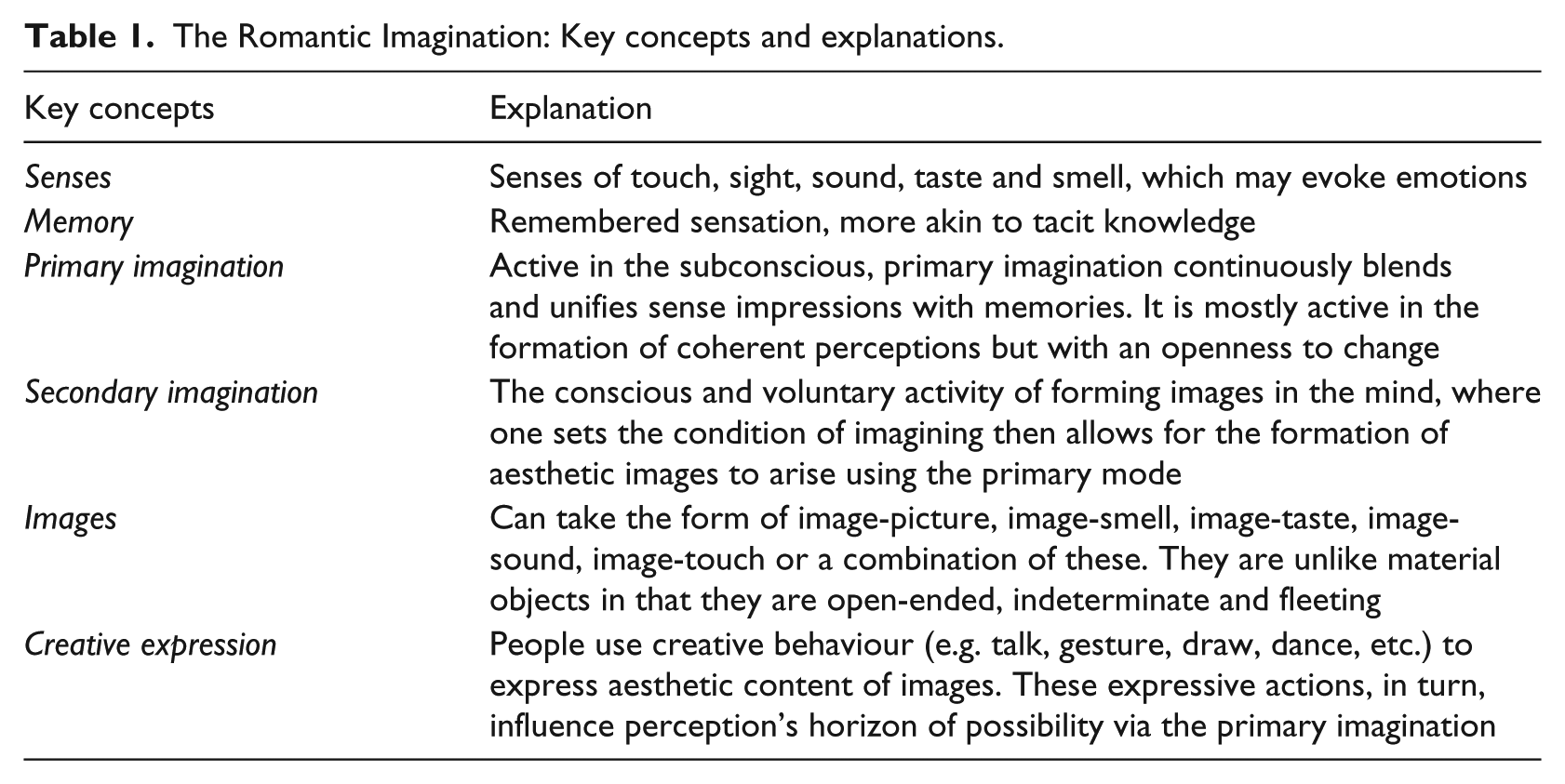
In this section, I build an imagination theory of organisational creativity by first reviewing the central elements of English Romantic thought: primary and secondary imagination, images and creative expression. Table 1 provides an overview. In the subsequent sub-sections, I utilise these elements to develop a conceptual model of organisational creativity, represented in Figure 1. Finally, I use empirical illustrations (Illustrations 1 to 4) of architects collaborating on design plans for a new building to bring my conceptual model to life.
The Romantic Imagination: Key concepts and explanations.
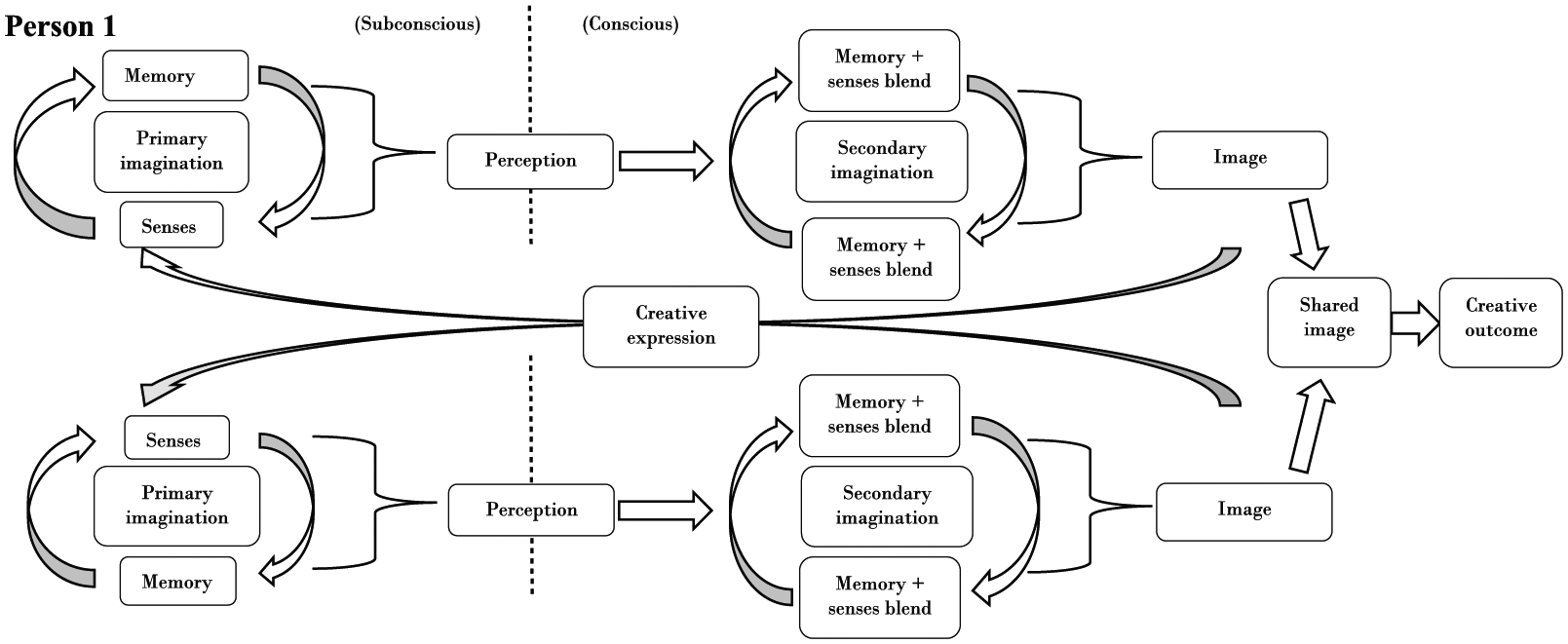
An imagination model of organisational creativity.
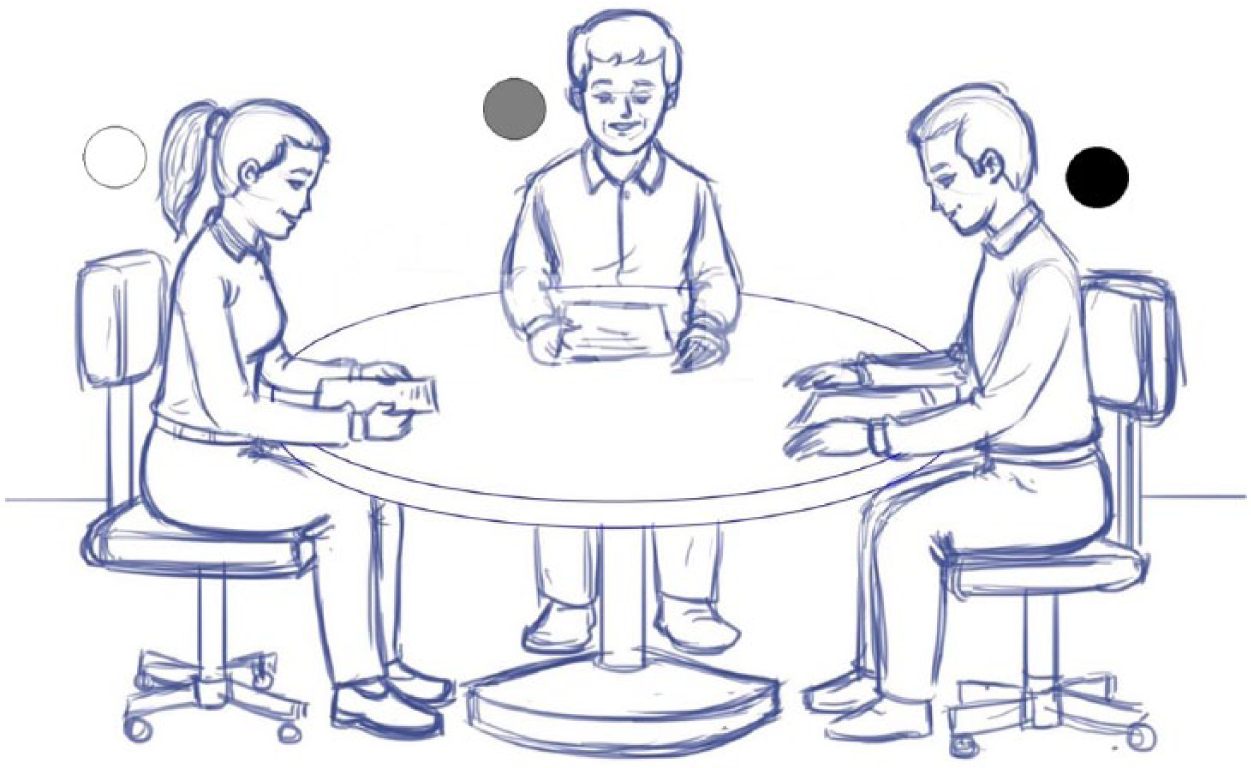
Primary imagination blends senses and memories to form open-ended but coherent perceptions.
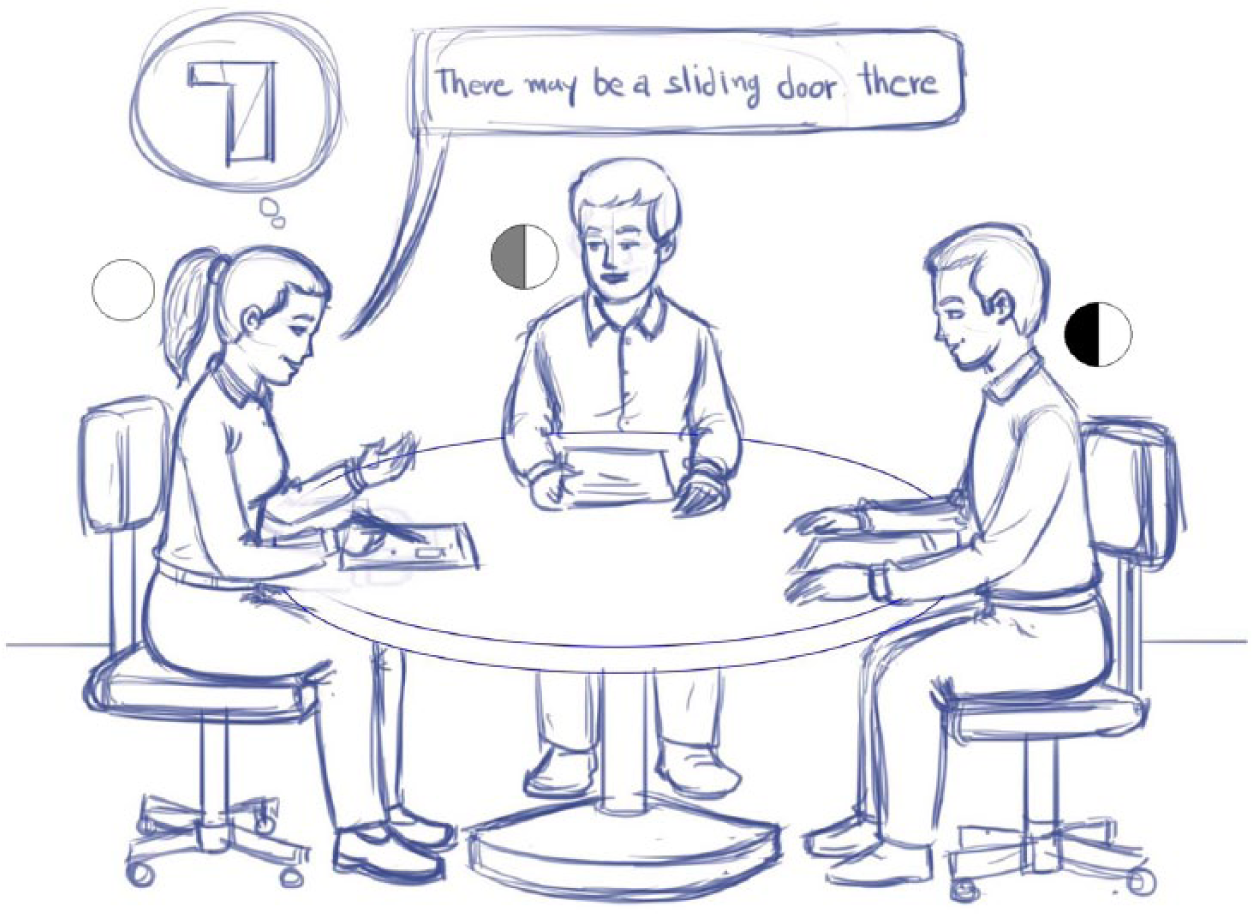
Secondary imagination is activated to form an image, communicated in expressive words and actions.
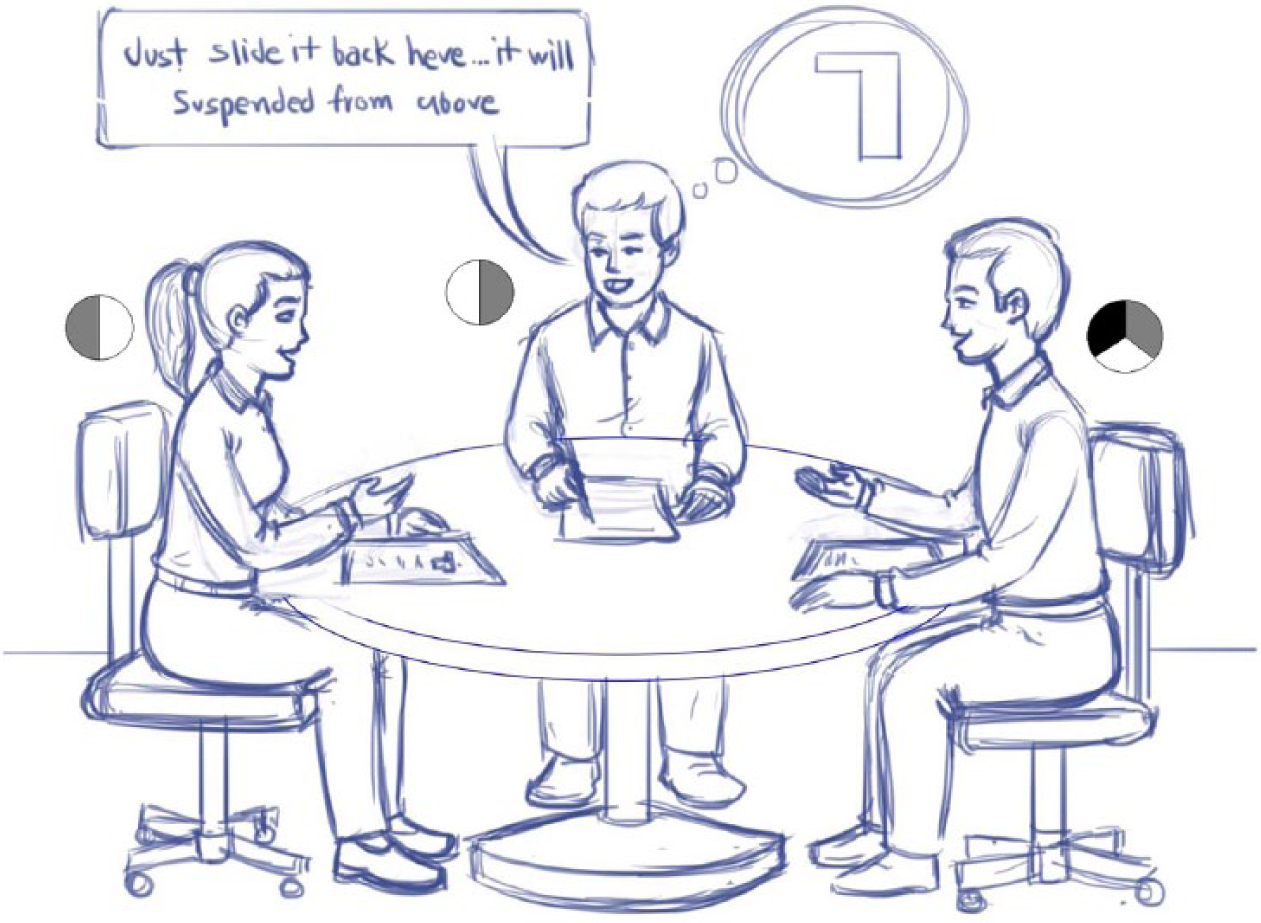
Secondary imagination is activated to form image based on altered perceptions and sensations from previous creative expression.
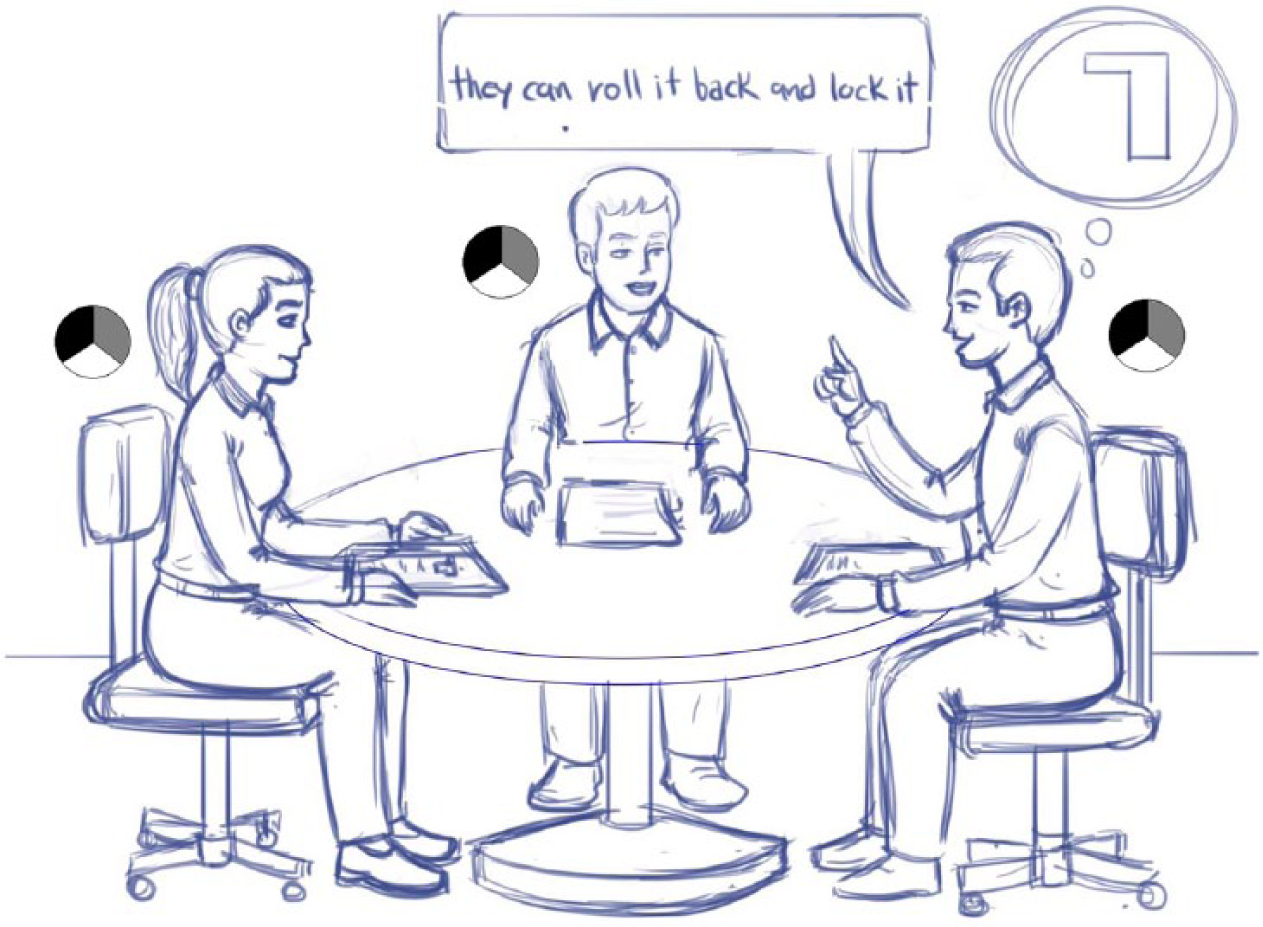
Iterative exchanges of perceiving, imagining and creative expression lead to emergent shared images, represented on the drafting paper.
English Romanticism was a literary movement that arose in the late eighteenth century as a notable shift away from the emotional restraint, order, logic and technical precision of the Enlightenment toward sensibility, feeling and imagination (Bowra, 1950). Although there are many philosophical perspectives of imagination that could serve as fruitful frameworks, such as Sartre, Vygotsky or Husserl, I draw from English Romanticism because it has long been recognised as instructive on issues of the body and mind, perception, imagery and imagining. Principally, English Romanticism exposes the interplay between the imagination’s role in everyday perception (primary imagination), and its equally important role in the conscious creation of images (secondary imagination) (Warnock, 1978). Contemporary literary scholars are careful to note, however, that Romanticism bears similarities to the philosophies of Kant and Schelling (their German contemporaries) and is a posthumous movement within which the views of Blake, Shelley, Coleridge, Wordsworth and Keats sometimes diverged (Bowra, 1950). Nevertheless, despite differences and fragmentation on points of detail,
If we wish to distinguish a single characteristic which differentiates the English Romantics from the poets of the eighteenth century, it is to be found in the importance which they attached to the imagination and in the special view which they held of it. (Bowra, 1950, p. 1)
Next, I review the central elements of English Romantic thought.
Primary and secondary imagination
Among the many psychological interests of the Romantics, the imagination was considered of central import for both perception and creativity. Coleridge (1817) conceptualised the imagination into two fundamental dimensions – primary and secondary modes.
The primary imagination describes the fundamental ability to blend and unify aspects of one’s sensory experience with memories. As such, the primary imagination is continuously and subconsciously active in forming perceptions of social situations and objects (Engell, 1981). The poets rebutted empiricist philosophers of the time by arguing that the senses or memories are useless for understanding perceptions unless they are ‘illuminated’, ‘irradiated’ or ‘informed’ by imagination (Coleridge, 1817). In Wordsworth’s poem ‘The Ruined Cottage’, imagination designates a provisional reconciliation of body and mind, wherein perceptions are the product of combinations of senses, emotions and memories, similar to Strati’s (1999) notion of aesthetic knowing. Similarly, perceptions are not solely based on past experience or knowledge. Wordsworth points out in ‘Intimations Odes’ that a person’s present state of mind shapes recollections of the past, underscoring the idea that one’s memories are often imaginative constructions combining present senses as well as past memories (Lau, 2002). While sensory experiences and memories are wrought by social and material processes, making the primary imagination empirically and socially anchored, its blending of senses and memories dispels ‘the film of familiarity’ from perception (Coleridge, 1817). For example, as an artist paints a portrait, she continuously and subconsciously uses primary imagination to blend senses from her environment (the feel of the canvas, the colour of the paint, etc.) with various memories in such a way that the layer of paint on canvas is not a static and meaningless object. Instead, it has emergent meaning and possibility. Accordingly, the primary imagination synthesises the senses and memories to construct a more dynamic, open-ended and meaningful reality than that of sensory experience or memory alone (Warnock, 1978).
The secondary imagination, on the other hand, is described by Coleridge as ‘an echo of the [primary imagination], co-existing with the conscious will, yet still as identical with primary in the kind of its agency, and differing only in degree, and the mode of its operation’ (Coleridge, 1817, p. 202). In other words, the secondary imagination is a continuation of the primary, but it is a conscious and voluntary activity. When activated, it brings forth images of something not currently present, relying on the functioning of the primary imagination as just described. Returning to the previous example, when the artist makes herself imagine the target person of her portraiture, her imagination operates in the secondary mode. Yet, she does not make herself imagine the exact details of the person in question. Rather, having forced the initial conditions, her imagination operates in primary mode (normally delegated only to perception) to create an image of the person that can be accessed consciously. Left to itself the primary imagination develops an image of something not present but in a reality-oriented way. Put differently, when people engage their secondary imagination they force the initial conditions, knowing that images will occur, will be consciously accessible and reality-oriented, but allow the rest of the imaginative exercise to unfold without interference. Suppose I ask you, the reader, to imagine a delicious cupcake and you comply. In doing so, you have activated your secondary imagination, acting on initial conditions that I set out. Yet, you do not consciously direct the details of the image of the cupcake (its flavour, colour, shape, etc.). Rather you allow them to emerge in your mind’s eye by letting your primary imagination operate. The secondary imagination, therefore, can be thought of as ‘perceiving in hypothetical mode’ (Murphy, 2004) relying on the same operation as the primary mode, only for perceiving that which is not present. Consequently, the secondary imagination is distinguished from fantasising because it establishes a link between what is perceived to be ‘real’ or ‘true’ and that which is considered totally ‘fictive’ or ‘false’.
Standing in contrast to the imagination is what Coleridge defines as fancy (1817, p. 415). While the primary and secondary imagination are a shaping or modifying power, fancy is different because it ‘has no other counters to play with but fixities and definities … it must receive all its materials ready made from the law of association’ (Coleridge, 1817). Weick (2005) uses the idea of a Pegasus as an example of fancy. A Pegasus is a combination of two ideas, wings plus horse. In this static association, neither idea changes nor interacts with the other, they are simply stuck together. The result is new because it does not exist in nature, but it is basically little more than a simple and single association of elements found in reality. On the other hand, imagination has at its disposal ‘the senses, emotions, intuition, intellect, will – all human powers brought into harmonious action’ (Coleridge, 1817) to create images that are analogous to original paintings in that there are no seams or joints through which an observer can discern its underlying constitutive parts.
Images and creative expression
As mentioned, the ‘objects’ of the secondary imagination are defined as images, which are only sustained as one activates the secondary imagination. As such, they are characteristically fleeting in that they ‘dissipate’ when imagining stops (Casey, 1974). Images are also characteristically suggestive in that they do not communicate detail or exact likeness, as a photograph; rather, they are suggestive of a certain essence or aesthetic ‘feel’ (Sartre, 1940) – that is, echoing the primary mode, they are comprised of a mix of emotions, memories and sensations such as image-touch, image-taste, image-sound, image-sight and image-smell (Warnock, 1978). Shelley’s poem ‘To a Skylark’ helps to illustrate this point. In the poem, Shelley writes that the skylark (a small bird) springs from the earth ‘like a cloud of fire’; it is as invisible as ‘a star of heaven in broad daylight’; and that the air and the earth are full of its voice as they are of moonlight ‘when night is bare…’ In each of these instances, the poet is communicating the feel of the skylark, disregarding the obvious fact that the skylark is not like a cloud, still less like a star and least of all like a moonlit night (Lynch, 1953). Shelley ties these images together because the essence of the skylark awakened in him leapt from one thing to another – from the sensation produced by moonlight to that produced by a haunting song. In doing this, the writer and reader actively feel the essence of the skylark in their imaginations, rather than through a detailed description of the skylark itself.
Throughout their poetry, the Romantics argue that highly original works occur when one skilfully ‘materialises’ images that form from the interplay between primary and secondary imagination. Creative acts – talking, gesturing, writing, dancing, drawing, painting and so on – are a result of one’s attempt at materialising their imaginings through expressing and communicating their suggestive content. As Wordsworth writes, poetic expression requires that ‘the feeling must “overflow” the poet’s mind … and to “flow over” into a material form, specifically, into the verbal description that is the poem itself’ (Wordsworth, 1802, p. 6). Similarly, Shelley views poetry as ‘the expression of the Imagination’ because it attempts to bring forth and account for the emotional effect images have on us (Holmes, 2013). Resonating with Joas (2005) and Weik (2012), the intentionality of creative acts is related to the content of the image, such that expressive words and actions are not preceded by rational calculation, and often diverge from normal words and actions associated with social practices. Therefore, creative expression does not transfer specific, tacit knowledge from one person to another, but rather invites ‘inference-making that transcends the similarities at hand’ (Meisiek & Barry, 2007, p. 1807). As a consequence, through enacting creative expressions, images are made publicly available, and thus shared, through novel talk and actions at play in interaction.
An imagination model of organisational creativity
In this section, I build and explain an imagination model of organisational creativity not only by mobilising each of the elements described above, but also by situating them in practices. As such, I theorise that creative outcomes are shaped by a four-moment process, wherein organisational members: (1) form perceptions of their shared environment using primary imagination; (2) convert subconscious imaginings into conscious images using secondary imagination; (3) enact creative expression to represent them; (4) sense each other’s creative expression in a way that contingently feeds back on perceptions, such that each member’s recursive imaginings are integrated into an emergent shared image and manifested in creative outcomes. These relations are visually described in Figure 1.
The model starts with a simple interaction between two organisational members, although this can be expanded to many individuals. Importantly, I take unfolding shared activities, or social practices, as the relational context of their situated interaction. Social practices are ‘structured action manifolds’ that are relationally enacted according to a characteristic organisation of the practice, such as ways of dancing, playing music, doing architectural design, etc. (Schatzki, 2006). As such, organisational members are defined broadly to include not only intra-organisational teams, but also multiple practitioners across organisational boundaries, such as entrepreneurs, managers, clients, designers, stakeholders, etc., who may regularly enter and exit collaborative engagement in social practices.
In the first moment, the primary imagination continuously synthesises sensory experience with each organisational member’s memories, connecting body and mind, to form meaningful but open-ended perceptions of their shared (physical or digital) environment. Person 1 in the model unknowingly applies her memories of a shared domain (tacit knowledge acquired through socialisation) to perceive her situation. Without this her intuitive grasp of the meanings of objects, technology and symbols associated with the social practice would be uninterpretable or insignificant. Nevertheless, she is also perceiving on a basis of blends between immediate senses and other memories from other realms of life that the primary imagination spontaneously draws upon. As Wordsworth reveals, non-domain-specific memories may be just as important as domain-specific ones in that they add emotional depth and possibility to perceptions. For example, suppose an architect and a client are brought together by the enactment of the shared practice of architecture. The architect and the client both conceive of a rudimentary architectural design as meaningful and significant. Yet, each individual also perceives on the basis of complex blends of senses and other memories, creating differences in possibility and meaning when it comes to the immediate perception of the design.
In the second moment the primary and secondary imagination work together to convert subconscious imaginings into conscious images. This is set into motion as Person 1 activates her secondary imagination. In doing so, she voluntarily sets the antecedent conditions of imagining, while allowing syntheses of sense and memory to come forth and be consciously accessible. For example, the architect activates her secondary imagination, calling forth a building-image, allowing the primary mode to fill in the shape, size, colour, and aesthetics of it. This image is not static and completed, but is more akin to an essence or aesthetics. Nevertheless, although it is imagined, the image is realistic by being underpinned by primary imagination and its blending of immediate senses and memories (moment 1).
In the third moment, Person 1 enacts creative expression to represent and share an image. Given the architect’s and client’s perceptions will initially vary significantly, due to differences in memory and tacit knowledge, Person 1’s image is original but ambiguous, fleeting and thus far inaccessible to Person 2. As such, she is pulled towards expressing her images in an attempt to capture and communicate its aesthetic content before it dissipates. Hence, as organisational members imagine and express images, they manipulate their bodies and materials to express and communicate images in ways that diverge from the routine enactment of practices, by: making familiar sensemaking unfamiliar; exploring new ways to communicate aesthetically; and making images more deeply meaningful. For example, as the architect consciously conceives of a building-image bubbling up from the primary imagination, she undertakes expressive utterances and gestures to express and materialise it. Since these actions and words are linked to the original and aesthetic nature of the building-image, gestures and talk communicate in new ways that diverges from the routine enactment of architectural practice and tacit knowledge.
In the fourth moment, the creative expressions of Person 1 not only materialises the aesthetic content of images, but has a feedback effect on the perceiving of both persons as they sense these expressive words and actions. Sensing creative expression provokes the primary imagination to incorporate and blend them with memories to renew and expand the horizons of possibility in perception. As such, Person 1’s image creation (moment 2) and creative expression (moment 3) subsequently guides Person 2’s perceptions and image creation, such that his image creation is contingent on previous enactments of creative expression. As the client activates his secondary mode, generates new images and takes creative expression to materialise them, elements of the architect’s image becomes integrated in the process. When the client and the architect collaboratively imagine, they move imagining and images from being contained in either’s mind into a shared, intersubjective space. When people engage and share imaginings they form ‘clusters of multiple links around one point’ (Weick, 2005, p. 428) such that their ideas grow exponentially. The iterative process of imagining, perceiving and sharing images through creative expression generates shared images and allows participants to perceive of situations in similar ways while materialising imagination in emergent, creative outcomes.
Imagination and organisational creativity: Empirical illustrations
In this section, I use empirical illustrations to further explain my conceptual model. I begin with a quick overview of Murphy’s (2004, 2005) study and turn to selective fragments and illustrations to flesh out the conceptual model.
The illustrations developed and described here are built upon Murphy’s (2004, 2005) ethnographic work, which included six months’ worth of video-recordings, observations, field notes and interviews of three architects at B+B Architects firm in Los Angeles. The empirical data centres around the observable talk, gestures and other actions taken as a team of architects determines the best way to configure the necessary components of the ‘service yard doors’ of the laboratory, using one architectural drawing as the anchor point of the interaction. The service yard is where deliveries for the building will be made and where much of the facilities equipment will be stored. I am interested in how these very specific observations illustrate my general conceptual model above. In particular, I wish to use a series of illustrations to show that what is being created by the architects is collaboratively imagined using iterative primary and secondary imaginations and creative expression.
Illustration 1 (corresponding to moment 1 of the model) shows the team of architects sitting around a desk facing one another, sensing their shared environment. Turning their collective attention towards the drafting paper on the table, the architects do not perceive the paper in front of them as a meaningless object, but regard its incomplete collection of rudimentary lines and symbols as meaningful and open to change, made possible by the primary imagination. In particular, Murphy notes that the architects execute a ‘professional vision’ such that they can make sense of a visual structure of information displaying where entities like walls and doors are located in measurements that, when read with proper tools such as scales, exactly correspond to the intended spatial layout of a real-world building. Nonetheless, what final shape the design will take is open to development beyond that which is represented on the drafting paper. For instance, many of the components of the final service yard area, especially the door, will constantly be in motion. This is a characteristic that is difficult to represent on a two-dimensional plan. Perceptions of the possible plan diverge as each architect bring with them different blends of memories rooted in the primary imagination (indicated with a white, grey or black circle next to each person in the illustration).
In Illustration 2 (corresponding to moment 2 and 3 of my model), one architect at the table wilfully activates her secondary imagination, forming an original image of ‘the service yard door’ in her mind’s eye. Rather than envisioning a detailed plan, however, she is sensing the door’s possible aesthetic – in this case, what imagined people would experience if the door was real. Since the door is imagined, she is ‘forced to use not only what is revealed on the plan to understand a building’s design, but to supplement it with other sorts of resources available to them to flesh out the building beyond what is graphically represented’ (Murphy, 2005, p. 122). Using words, gestures and sketches, she raises a suggestion (e.g. ‘there may be a sliding door there’), indicating its possible location as well its ontological status as ‘sliding’. In other words, she tries to imagine where the door will be and what it will look like by employing her hands and utterances to express ideas about the door. The architects each perceive these creative expressions (indicated in the illustration by the mixing in of white) using primary imagination to synthesise it with their own professional and personal memories.
In Illustration 3 (corresponding to moments 2 and 3 of the model), the second architect follows the first by activating his secondary imagination to form another ‘service yard door’ image. To express his image, he places his hand over the opening to the service area, the space where the first architect indicated where the door would be located, and pulls his hand back while describing the door with ‘just let it slide back here’. Like the first, using his hand to mimic the action of a sliding door, he expresses how he imagines people might experience it. But whereas the first architect neither accurately described the door’s relationship to the rest of the storage area, nor stipulated the nature of its motion (doors can slide back and forth and up and down etc.), he fills in the granularity of the first architect’s original image by specifying a particular motion of the sliding door and its relation to the surrounding context (e.g. ‘it will be suspended from above’). Again, each architect perceives these creative expressions (indicated by mixing grey into each circle), which are blended using the primary mode to further expand the horizon of possibility.
Illustration 4 (corresponding to stage 4 of the model) conveys how the shared, imagined ‘service yard door’ is built through the dynamic give-and-take flow of expressive actions, underpinned by the primary and secondary imagination. In particular, the third architect forms another image and utters that ‘they [imagined persons] can roll it back and lock it’, while moving his hand in the opposite direction of the first and second architects’ previous gestures. While the third architect’s imagining is partially structured and guided by the others’ prior indication of the ontology and motion of the imaginary door (indicated with a mix of grey and white), it is more vivid as he imagines new details in which users move and lock the door (indicated by mixing black into each circle). Thus, over the course of their interaction, the architects build on each other’s aesthetics of the imagined doors, which takes shape as they draw and represent it on the drafting paper. Said another way, images of the service yard door are not held captive in one architect’s head, but are the emergent and shared product of perceiving, imagining and creative expression. Reiterating the process for other parts of the imagined building, the architects methodically develop an original creative outcome manifest on the completed drawing paper.
Discussion and Research Implications
I have argued that scholars who adopt a relational ontology of organisational creativity have undermined classic theories of creative thinking by displacing the mind as the sole locus of creativity. Still, they have not answered questions regarding the active and generative elements of the mental experience one has when being creative with others. I offer a novel answer to this puzzle by arguing that organisational creativity shapes and is shaped by the imagination. I develop an alternative theory of organisational creativity in which organisational members use their imaginations to project possibility and meaning into perception, as well as wilfully to form images of something not currently present. Over the course of their interactions, images are materialised, perceived and shared, resulting in original creative outcomes. Accordingly, my theory permits us to view organisational creativity as situated and contingent upon unfolding imagining and creative expression, employing the actual and imaginary senses. In the remainder of this section, I further unpack the theoretical contributions for entrepreneurship and organisational creativity literature offered by this conceptual model.
First, an imagination-led theory of organisational creativity contributes by addressing the ontological drawbacks of classic and dominant notions of creative thinking. Adopting a relational ontology, I theorise the social as intrinsic to creative thinking by elaborating on the ways in which imagining and images only make sense in terms of the way they are expressed, absorbed and elaborated on by others. While my theory shares some of their insights – such as interplay of subconscious and conscious thought (Wallas, 1926), combining concepts (Mumford et al., 1991), diverging from routine thought patterns (Guilford, 1950) and sustained attention (Csikszentmihalyi, 2013) – classical theories conceive of the individual mind as the locus of creativity, which regulates the social environment as something external. On the other hand, my theory connects the primary and secondary imagination to the perception of actual and imagined scenarios, which, rather than being decontextualized or purely mental, situates and embodies creative thinking. In this way, an ‘entrepreneurial opportunity’ is not confined to an image in the entrepreneur’s head (Baron, 2006; Cornelissen & Clarke, 2010; Davidsson, 2015; Klein, 2008; Witt, 2007). Instead, images of opportunity are situated, embodied, emergent and shared through recursive interactions between entrepreneurs and (possible) stakeholders (Popp & Holt, 2012). Rather than subconscious and conscious creative thinking being influential at different moments in time (Wallas, 1926), I advance an integrated perspective of mind by depicting them as working in cooperative duality, which answers calls to theorise the relations between subconscious and conscious dimensions of creativity (George, 2007; Zhou & Hoever, 2014). Furthermore, my theory breaks new ground by revealing the importance of actual and imaginary senses in creative thinking. Following Wordsworth in particular, I argue that imagination forges a link between body and mind through the blending of sense and memory. This explains the formation of perceptions as, on the one hand, coherent, but on the other hand, as open-ended and sentiment laden – a notion which has found recent empirical support in neuroscience (Gaesser, 2012; Jaspers, Hoenig, & Hamilton, 1997; Kühn et al., 2014; Richardson, 2011). The secondary mode is conceived of as a continuation of the first, such that organisational members use imaginary senses to ascertain the emergent aesthetics of images. Thus, my theory uniquely combines and situates notions of sense, memory, imagining, images and creative expression to explain the puzzling ontology of creative thinking as both corporeal and unreal (Strati, 1999).
Second, this theory contributes by uniquely theorising the ontological characteristics of images, which has implications for theories of creative action in organisation and entrepreneurship literature. Because images are fleeting and suggestive, actors take expressive action to materialise their imagined aesthetics. This notion contributes to theories of creative action (Joas, 2005; Weik, 2012) by grounding the directedness (intentionality) and motivation for creative acts in imagination. Imagination also explains the situated use of aesthetic judgement (Harvey & Kou, 2013) by linking dialogue and gestures to the sharing and elaborating of images. In addition, I argue that practices and routines coincide with shared imagining and images that provides an alternative explanation for creativity (Sonenshein, 2016). Members not only use implicit and explicit reflection (Hargadon & Bechky, 2006; Hodgkinson & Healey, 2011) and practical knowing (Schatzki, 2006) to alter routines and practices, but employ an ability to imagine and share possibilities for radical or mundane change. Consequently, sharing images through creative expression invites inferences from others that transcend normal meanings of movements, words or objects commonly associated with unfolding practices (Cornelissen, 2013; Meisiek & Barry, 2007).
Finally, my theory contributes by integrating imagination into relational perspectives of organisational creativity. Similar to these perspectives, which argue that the emergence of novelty is the result of synthesising conflicting views (Hargadon & Bechky, 2006; Harvey, 2014; Steyaert et al., 1996) or diversities of tacit knowledge (Rescher, 1977), I recognise that differences between members’ perceptions set the conditions for creative outcomes. And yet, literature explaining the synthesis of conflicting views or tacit knowledge has overlooked the fundamental ability to form, materialise, share and synthesise images of possible futures to jointly construct creative outcomes (especially useful when there is little existing knowledge base on which to draw). Organisational members develop shared images that give rise to and structure joint sensemaking while also providing a springboard for further imagining. As such, I propose that the concept of shared images subsumes, re-labels and clarifies competing notions of ‘creative synthesis’ (Harvey, 2014), ‘recombinations’ (Hargadon & Sutton, 1997), ‘scaffolds’ (Majchrzak et al., 2012) and ‘minimal structures’ (Kamoche & Cunha, 2001) to explain the dialectical synthesis of conflicting perspectives by revealing their links to the imagination. Imagination therefore explains how geographically, culturally and occupationally diverse organisational members transcend subjectivities of sense and memory to create together without going through the laborious process of making details of tacit knowledge or conflicting perspectives explicit (Majchrzak et al., 2012; Nonaka & von Krogh, 2009). Consequently, future entrepreneurship and organisation research may make new gains by empirically studying when and why organisational members (do not) imagine together to co-produce images and enact creative expression within their institutional, technological and economic contexts.
Conclusion
Scholars adopting a relational ontology of organisational creativity have shifted attention away from a preoccupation with individual minds towards that which is enacted, emergent, shared, unpredictable and contingent. This article follows suit, yet breaks new ground by reconsidering how the mind plays an active role in unfolding creative interactions by building a bridge with literature on organisational creativity, aesthetics and philosophy of imagination. I draw on English Romanticism to craft a theory of organisational creativity as an aesthetic and relational process of shared imagining. To do so, I develop and illustrate a conceptual model that demonstrates how organisational members use imagination and creative expression to create, alter and share perceptions and images of possible futures. At the heart of the model lies imagining in a primary mode – a subconscious ability to synthesise senses and memory, mostly used to project meaning, emotion and possibility into perceptions – and a secondary mode – a conscious ability to realise images. By elaborating on their interplay with creative expression, this article contributes to literature by theorising an active and generative role of mind that does not have the ontological shortcomings of leading theories. In turn, this has a number of implications for literature on entrepreneurship and organisational creativity, by way of situating and embodying creative thinking, explaining the intentionality and motivation for creative actions, overcoming perceptual differences and changing practices and routines. I conclude that empirical studies of when and why organisational members (do not) imagine together within their institutional, technological and economic contexts will further entrepreneurship and organisational creativity scholarship.
Footnotes
Acknowledgements
I am grateful to the participants and conveners of 10th Organization Studies Summer Workshop for providing insights and encouragement at this study’s inception. I would also like to thank Wouter Stam, Elco van Burg, Floor van den Born, Karen Verduijn, Tom Elfring and other colleagues for their support and insight throughout the review process; Lisa Rebert and Sloane Markley for guidance on language and editing; and the three anonymous Organization Studies reviewers for their constructive comments on earlier versions of this article.
Funding
This research received no specific grant from any funding agency in the public, commercial, or not-for-profit sectors.