




Abstract
This paper uses data from a longitudinal, seven-year, cross-national study to explore the translation of a trade union idea. The aim of the paper is to examine and explicate the nature of the translation work undertaken to translate a trade union idea in a multi-organizational setting. In examining how the idea of the learning representative initiative was translated into the New Zealand context we draw upon a narrative analysis to reveal the complexities of the dynamic and ongoing translation of the idea and identify the nature of the translation work required. As such we contribute to the literature on the translation of ideas firstly by explicating the concept of real-time translation work in a novel empirical context, and secondly theoretically, by drawing attention to the distinctive characteristics of trade union translation work. In doing so we argue that translation work in this distinctive socio-political context requires ongoing vigilance and proprietorship of the idea by trade union actors and that such proprietorship is crucial in other cases where translators are coming from subordinate positions.
Keywords
Introduction
There has been an enduring interest within the management and organization literature in the translation of ideas across sectors, organizations and countries (Czarniawska & Sevón, 1996, 2005; Frenkel, 2005a, 2008; Morris & Lancaster, 2006). In understanding why ideas are translated and where they are translated to, some writers have considered how what can be seen as ‘fashionable’ management ideas have travelled across countries (Czarniawska & Sévon, 2005). For example: the travel of HRM and scientific management to Israel from the United States (Frenkel, 2005b); the movement of new public management ideas across England, Australia and Sweden (Solli, Demediuk, & Sims, 2005); and notions of lean management from Japan to the United Kingdom construction industry (Morris & Lancaster, 2006). In considering how ideas are translated, there has been a focus upon responses to ideas from those on the receiving end such as resistance to, or the welcoming of, the translated idea (Powell, Gammal & Simard, 2005), the processes of translation to eventual practice (e.g. Morris & Lancaster, 2006), and the vehicles through which ideas are translated, for example through discursive practices (Mueller & Whittle, 2011).
Despite the diversity in approaches to the translation of ideas, characteristic of much of the empirical literature in this field is the case that translators are managers within a given organization seeking to institutionalize the translated idea as a way of improving organizational performance (Erlingsdóttir & Lindberg, 2005; Solli et al., 2005). However, in terms of understanding how ideas are translated and how the business of translation is conducted and understood, it is useful to consider other forms of organizations to those traditionally researched in the management and organization literature to see what can be learned about translation work in different organizational and field contexts. The organizations in question here are trade unions. With the increasing influence of globalization on the international economy and the decreasing density of union membership worldwide there is an increasing concern or recognition that trade unions may have little influence in shaping events or circumstances for their members (Turnbull & Wass, 2007). As Foley (2006) highlighted, in an international environment dominated by free market ideology and few restrictions on the movement of capital, the pressures for high productivity and cost-cutting offer particular challenges. However, it may also be that there are possibilities for new and different forms of organizing through the sharing of ideas across trade unions internationally (e.g. Blyton, Martinez Lucio, McGurk, & Turnbull, 2001; Turnbull & Wass, 2007). Given this context of globalization, unions are a particularly interesting organizational form under-represented in the literature on the translation of ideas. Moreover, drawing attention to the translation work of groups who may be subordinate may offer us the opportunity to explicitly surface complex power relations within the translation process.
Our aim here is to explore the longitudinal translation of ideas, focusing upon a particular idea over a seven-year period. The idea in question is that of the trade union supported learning representative, first introduced in the UK in 1998. We consider how this idea was translated into the New Zealand context by New Zealand trade unions and other stakeholders with initial developments taking place in 2005. Why is this idea important? First, it is a potentially radical idea in terms of ownership of learning, in that individual workers are supported to both diagnose and address their own learning needs and those of their peers. Consequently it places workers’ learning and the responsibility for accessing it partially within their own hands. Second, it is seen by some within the trade union movement as a particularly important idea in that it enables unions to provide additional help to their members through access to learning, and also offers the possibility of strengthening organizing potential through recruiting more members through the initiative. Evidence from the UK suggests that a large number of new learners have accessed learning opportunities that may previously have been denied to them (Wallis, Stuart, & Greenwood, 2005) and variations of the idea have emerged in Finland and Denmark (Kolkka & Wesanko, 2006; Plant & Turner, 2005). Similar schemes have also been considered in other countries including Australia and Canada (ACTU, 2012; Centre for Workplace Skills, 2011). Third, this is a unique idea in that it is a deliberate response of trade unions in both countries to earlier neo-liberal governments that have sought to exclude them from discussions on workers’ education and training.
As Morris and Lancaster (2006, p. 207) suggest, ‘we know little about the processes through which actors translate broad ideas from different industry contexts into workplace practices’. Moreover, we also know little about the intricacies of what Waeraas and Sataøen, (2014, p. 251) describe as ‘real-time translation work’. How do the translators of ideas do translation in practice; how is the idea sold and how do the processes by which it is sold change over time? How do the relationships between different stakeholder groups and translators influence how the idea is edited? How do different translators negotiate the meaning and purpose of the idea? And how does the nature of the idea change through translation?
In examining how the idea of the learning representative initiative was translated into the New Zealand context, we draw upon a narrative analysis to reveal the complexities of the dynamic and ongoing translation of the idea and to identify the nature of the translation work required. As such we seek to contribute to the literature on the translation of ideas, first, by explicating the concept of real-time translation work in a novel empirical context and second, theoretically, by drawing attention to the distinctive characteristics of trade union translation work. In doing so we argue that translation work in this distinctive socio-political context requires ongoing vigilance and idea propriety by trade union actors.
The Translation of Ideas
Czarniawska and Sevón (1996, p. 16) used the metaphor of translation to outline the ‘travel of ideas’ across time, space and location. Their approach is located within the framework of Scandinavian institutionalism which challenges classic neo-institutional approaches (e.g. Di Maggio & Powell, 1991) by focusing upon the actual adoption of management ideas. As Wæraas and Sataøen (2014, p. 243) suggest, ‘management ideas are not “just” symbols as they are often portrayed in the neo-institutional literature – they turn into practice over time’. This use of the term translation is informed by actor network theory (ANT) and the sociology of translation (Callon, 1996; Latour, 1986, 1987; Serres & Latour, 1995).
Our interest here is in how translation occurs and by whom. Within the sociology of translation an important assumption is that the translation process assumes some kind of movement. Latour (1993, p. 6) suggested that translation implies ‘displacement, drift, invention, mediation, creation of a new link that did not exist before’. So, as Callon (1996) highlighted, translation is a process rather than a result. Czarniawska (1997) outlined the positive role of ‘friction’ in this process, suggesting that without such friction it would be a case of resident ideas and institutional logics remaining unchallenged. When talking about the development of science, Latour (1987) outlined the role of allies and actants that can be mobilized. Importantly, as Latour (1987, p. 137) suggested, ‘there are always people moving the objects along, but they are not the same people all along’. Maguire and Hardy (2009, p. 149) in their study of the de-institutionalization of DDT draw attention to the significance of these individual acts of translation and demonstrate how cumulatively over time they can change discourse and ‘re-configure power and knowledge relations within a field’. Given that in Latour’s view translation implies that nothing can be returned to its previous state (Harman, 2007), context will also change as a result of translation. How actors interpret the past is therefore an important part of the translation process as it can become ‘energy’ that enables movement (Latour, 1986, p. 267).
Given that this approach implies that each translation is unique and cannot be predicted in advance, there has been a focus within the literature upon how translations can be characterized; for example, through a range of editing rules (Sahlin-Andersson, 1996). Different authors have drawn attention to the different types of work required for translation to occur. Table 1 presents an overview of some of the key studies that focus explicitly upon idea translation. From Table 1 we can identify two broad approaches to translation work that have been identified in these studies. The first concerns the actual idea itself and the way the idea changes. Examples include Erlingsdóttir and Lindberg’s (2005) study of how the idea of quality assurance was initiated; Wæraas and Sataøen’s (2014) example of an idea being copied, added to or omitted from; and Morris and Lancaster’s (2006) study drawing on Sahlin-Andersson’s editing rules where an idea is reformulated, relabelled or re-contextualized. The second approach is where the focus is upon the processes by which translation happens. Such processes can include those of alignment, enrolment, congealment and hegemonic power as identified in Doorewaard and van Bijsterveld’s (2001) study. Alternatively there are linguistic forms of translation work such as Czarniawska’s (1997) work on narrative, Mueller and Whittle’s work on discursive devices and the re-telling of myths identified in Zilber’s (2006) study. It is important to point out that these two approaches are not mutually exclusive but are rather different angles researchers have taken to investigate the translation of ideas; indeed the changing nature of the idea itself is inextricably linked to the processes by which translation occurs.
Summary of key studies on translation work.
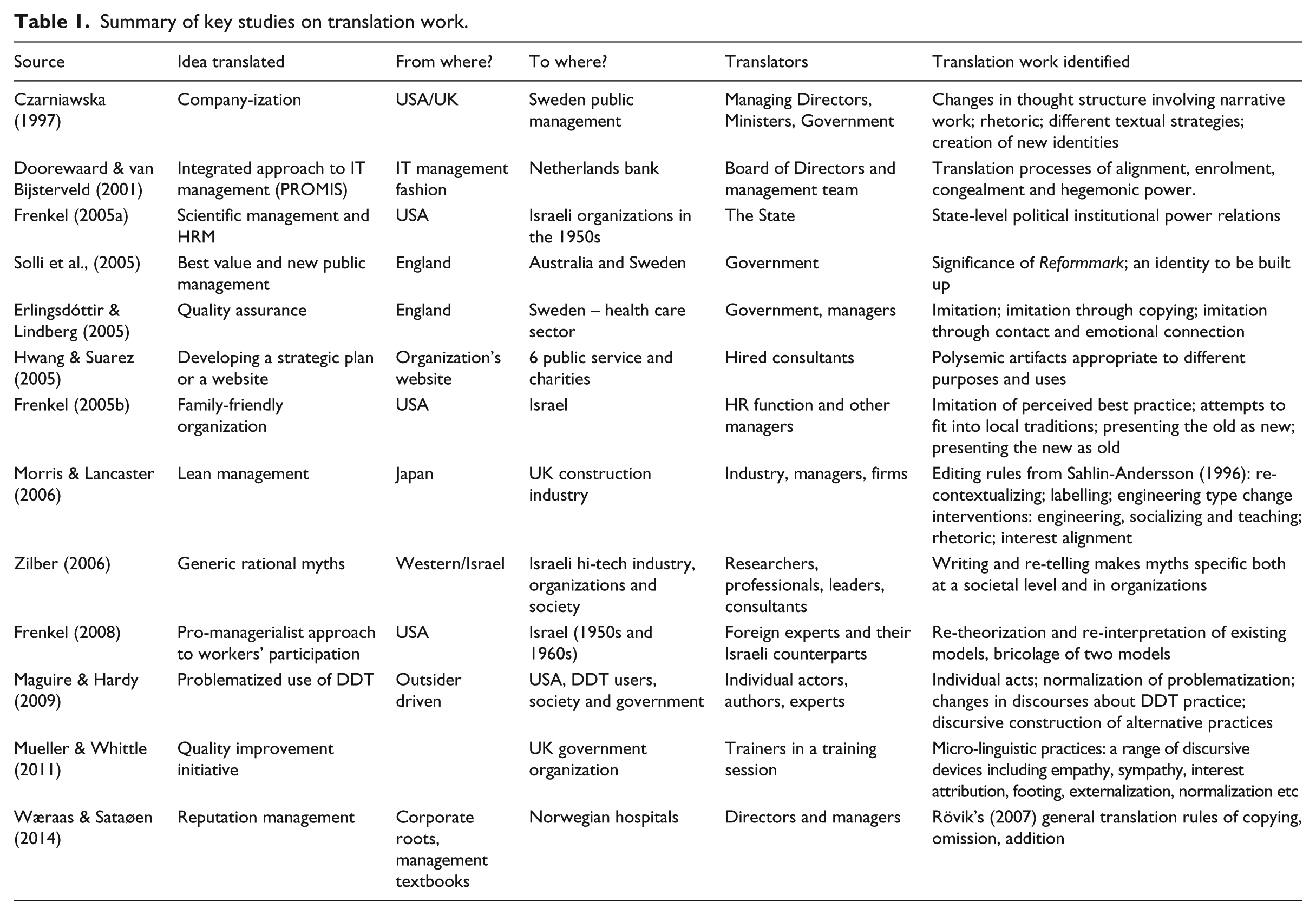
From Table 1 we can also see that the range of actors who may be involved in the translation process include government and the state, managing directors and CEOs, researchers, professionals, consultants, managers and trainers. However, none of these studies specifically focus upon trade unions or trade unionists as translators, although there is evidence that some trade union ideas have been translated globally, for example the organizing model (Hurd, 2004) and the living wage (Glickman, 1997). Trade unions and trade union members are different from the previously mentioned stakeholders in that they are traditionally in a subordinate position to capital within the employment relationship. Hence they may face different challenges when seeking to translate ideas across international boundaries. Although Harman (2007) notes, when discussing Latour’s philosophy, that no entity is inherently weak or strong, rather weakness emerges when an entity is cut off from its alliances, within this context the trade union translators are starting from an institutionally weaker position where they do not necessarily have the legitimacy accorded to other translators.
Although there is now a considerable body of work considering the translation of ideas, accounts have called for a more in-depth understanding of the experienced processes of translation. Sturdy (2004) argued that there has been a focus within the literature on popular and sustained ideas or innovations rather than those which ‘fail to get widely disseminated’ (Sturdy, 2004, p. 171). More recently, Wæraas and Sataøen’s (2014) study of the translation of the concept of reputation management into Norwegian hospitals concluded that on the basis of their results there is a need for further empirical studies that ‘focus on the regularities of translations, the variation in rules, and how their outcomes are connected with “real-time” translation work’ (Wæraas & Sataøen, 2014, p. 251). Furthermore, they argue for the need for an understanding of how alternative translations are negotiated and contested, given that the translation of ideas is an inherently political process.
In seeking to contribute to our understanding of the complexities associated with idea translation and to be able to identify what may be different when trade unions are translators, we explore the translation work by the different actors involved in the translation of the learning representative idea from the UK to the NZ context over a seven-year period. As such we seek to understand how the idea changed and the translation work required to facilitate implementation. We now turn our attention to the idea to be translated.
The Learning Representative Initiative: Past and Current Context
The idea under examination is a specific trade union initiative: learning representatives. In this section we initially provide some context to the idea and its location within the political contexts of the UK and New Zealand. We then look at the formation of the idea and the motivation for the translation of the idea from the UK to New Zealand.
After the Second World War, the pursuit of consensus by government in many countries led to the adoption of different forms of corporatist framework whereby the state interacted with representatives of capital, labour and others to regulate economic activity. This was manifest in the UK and NZ systems of vocational learning. For example, in the UK successive governments introduced sector-based, industrial training boards (ITBs), in 1964, to ensure proper vocational training in a number of industries (Sheldrake & Vickerstaff, 1987), and the Manpower Services Commission in 1973 to provide a national strategy for education and training (Ainley & Corney, 1990). Reflecting the consensus period of the time, the boards governing these different institutions were tripartite in character, comprising representatives of state bodies, trade unions and employers. Similarly, in New Zealand, the 1971 budget and subsequent legislation allowed the establishment of tripartite industrial training boards to regulate training in different sectors. However, both the UK and New Zealand subsequently experienced economic recession and their respective governments abandoned their corporatist policies.
In the UK from 1979 onwards successive Conservative governments introduced a series of laws designed to limit trade unions’ capacity to organize effective industrial action and excluded trade unions from the regulation of training. To try to overcome recession in New Zealand, the Labour Government of 1984–1990 undertook a series of reforms aimed at deregulating the economy and exposing industries to market forces and international competition (Harbridge & Walsh, 2002). These measures were extended by National Party governments from 1990 that introduced the 1991 Employment Contracts Act which prohibited compulsory union membership and abandoned the system of compulsory arbitration that had afforded trade unions an important role in their negotiations with employers (Barry & May, 2004). Additionally, vocational training was effectively privatized. For example, the Industrial Training Act (1992) established 52 industrial training organizations (ITOs) comprising employers – i.e. trade unions were excluded – in each relevant sector (Jordan & Strathdee, 2001).
In more recent years, in both the UK and New Zealand, left-of-centre political parties have led governments that have adopted some policies that diverge from those typifying the earlier neo-liberal period. While governments in both countries accepted what has become the dominant consensus ‘that vocational education and training is the key to economic growth and a prosperous future’ in a global marketplace (Jordan & Strathdee, 2001, p. 396), both have sought to give some rights to labour and trade unions to help realize those goals. In the UK, the Labour Party enjoyed electoral success in 1997, 2001 and 2005 and introduced a number of measures to support trade union educational initiatives. These include the establishment and funding of the Union Learning Fund (ULF) and the granting of statutory rights to trade union learning representatives (ULRs) (Wallis, Stuart, & Greenwood, 2005).
In the UK, learning representatives were first proposed at the 1998 annual conference of the Trades Union Congress (TUC). These proposals coincided with the 1997 New Labour government’s attempts to promote lifelong learning (Margolis, 2003). That government’s policy document, The Learning Age, promoted learning as a partnership between ‘employers, employees and their trade unions’ (DfEE, 1998, para. 3.10). It is important to note that this document was expressing a quasi-communitarian agenda where lifelong learning was seen as a means of social inclusion. Following many employers’ opposition to the functioning of ULRs (Clough, 2004), ULRs were granted statutory support by the 2002 amendments to the Employment Act. The statutory provisions allow people paid time off to train as ULRs and to: (i) analyse learning or training needs of other employees, advise those employees on learning and training matters and arrange learning and training; and (ii) consult with an employer about learning matters that affect employees. The number of ULRs increased from around 2,000 in 2001 to 6,500 in 2004 to 18,000 in 2008 and now stands at over 28,000. Significantly, large parts of the ULF’s funds have supported ULR-based projects extending learning opportunities to those who were previously excluded.
In New Zealand a Labour-led coalition enjoyed electoral success between 1999 and 2008. Like its UK counterpart, it was more sympathetic to trade unions than its immediate predecessors. The Labour-led coalition repealed the Employment Contracts Act and replaced it with the Employment Relations Act that came into effect in 2000, to encourage greater involvement of trade unions in collective bargaining (Harbridge & Walsh, 2002). In the field of vocational education and learning, trade unions were granted the rights to representation on the boards of ITOs and also given financial support for the learning representative initiative in the form of an allocation of NZ$1.12 million from the budget of May 2004. It is important to note that the NZ Learning Representatives (LR) project was ‘based on the British model’ (Farr, 2008, p. 513), implying a direct translation of the idea. Trade union officials had visited the UK to look at the scheme at work and there was a consensus of all stakeholders that the initiative would be based on the UK version. Part of the funds provided were for a scoping exercise that was conducted by the New Zealand Council of Trade Unions (NZCTU) between November 2004 and June 2005. This exercise had to identify the industries where the initiative was going to be introduced, demonstrate employers’ support for the initiative in those industries, prepare training programmes and materials and show compatibility of the initiative with Government objectives for productivity and growth. The remainder of the budget allocation was for the conduct of a pilot project for two years from July 2005 with the intention that 100 people would undergo training to be able to advise on learning opportunities. Examples from the pilot scheme could then provide a template for extending the learning representative initiative to other areas from 2007/8 onwards.
In 2008 the NZ government increased the funding to encourage further union involvement in the scheme, but towards the end of that year the political context changed. A general election held in November 2008 led to the conservative National Party winning the largest share of the votes, ending nine years of government by the social democratic Labour Party. A further general election in 2011 returned the same government, which introduced a range of austerity measures including reducing funding for LRs and focusing the reduced amount of expenditure upon funding training for more traditionally excluded groups and enhancing literacy levels in the workforce. To summarize, the idea to be translated was that of learning representatives; individual workers in a workplace encouraging others to engage in and access learning opportunities.
Methodology
The data presented here is part of an ongoing longitudinal programme of research about the operation of the LR initiative in both the UK and NZ (see Lee & Cassell, 2008; Cassell & Lee, 2012). The data was collected over a seven-year period that included three concentrated periods of fieldwork in New Zealand: five weeks in 2005, five weeks in 2008 and 10 days in 2012. Here we focus upon interviews with key stakeholders conducted jointly by both authors during those three periods, though during those seven years we also collected other data about how the scheme was developing, for example through maintaining contact with key stakeholders and through official published documents.
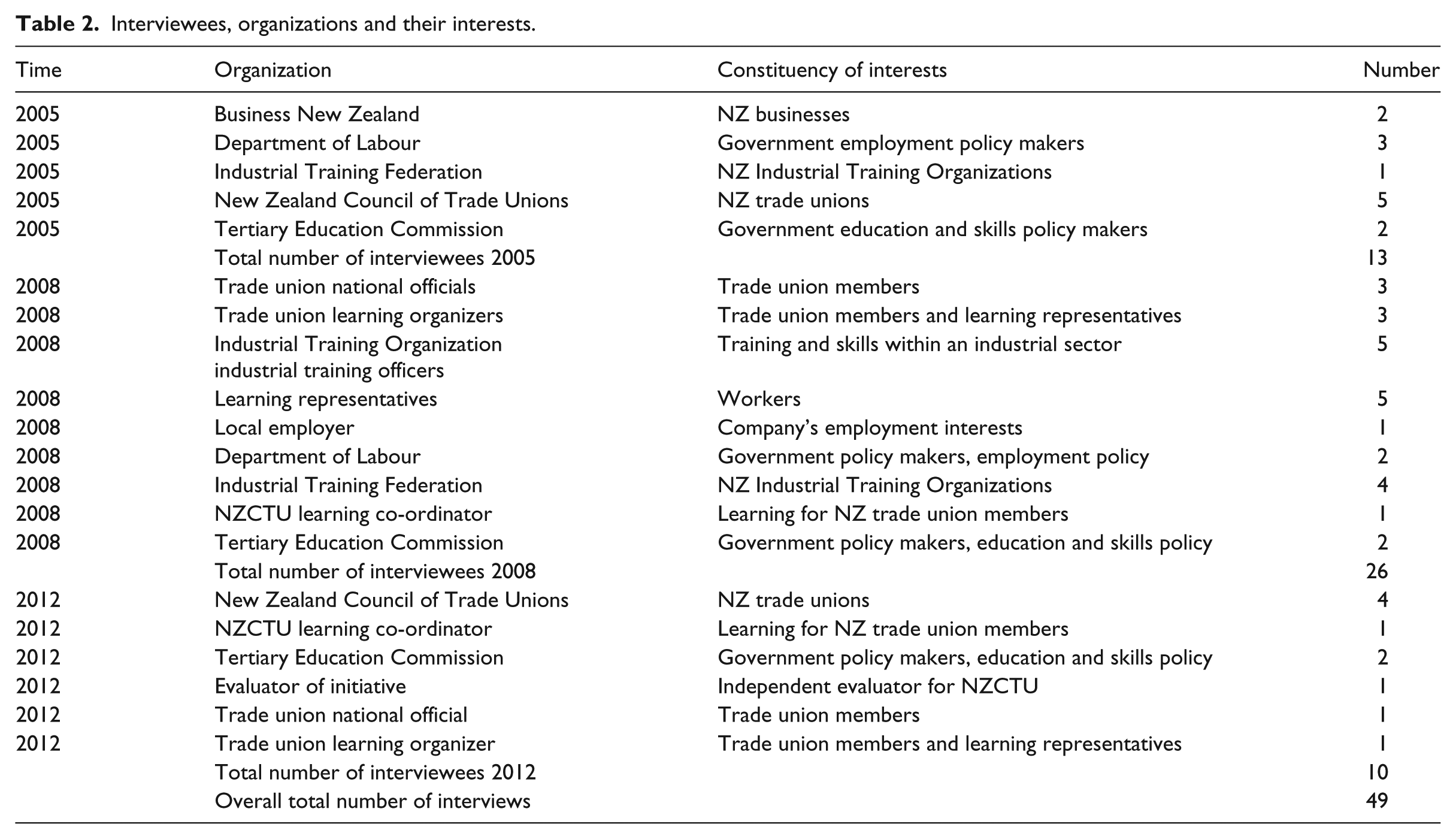
In examining how the idea was translated over a seven-year period it is important to note that different organizations were involved in the initiative at some periods more than they were at other periods. Hence this is reflected in the interview sample. In 2005 we interviewed representatives from each of the key organizations involved in discussions around the idea. These included Business New Zealand (BNZ); the Industrial Training Federation (ITF) who looked after the interests of New Zealand’s industrial training organizations; two government departments, the Tertiary Education Commission (TEC) and the Department of Labour (DoL); and officials of the NZCTU. In 2008 there were now examples of learning representatives starting to work in companies in two particular sectors: social care and distribution. So at this point the sample included trade union national officials and learning organizers of specific trade unions that covered those sectors; industrial training officers from the industrial training organizations (ITOs) that covered those sectors; an employer who was the first to engage with learning representatives; and some learning representatives together with interviewees from the DoL, ITF, TEC and NZCTU. Requests to interview BNZ at this stage were not successful. When we went back to interview in 2012, the political climate for the idea had changed as a more right-wing National-led government that was less supportive had been elected. Consequently neither BNZ nor the DoL participated either in the initiative or in the research at this stage. The employers – who were reported now to be hostile to the scheme – also refused to participate and the ITF were facing new challenges from the Government’s austerity measures and were unable to participate. Hence the interviewees came from NZCTU, those trade unions still actively involved, the TEC, and a researcher from a consultancy firm who had conducted a formal evaluation of the initiative. Therefore in line with other studies of idea translation (e.g. Maguire & Hardy, 2009; Morris & Lancaster, 2006) it was apparent that different actors played different roles at different stages.
When conducting the interviews we presented ourselves as researchers who had conducted research into other trade union learning initiatives in other parts of the world. Hence the interviewees were keen both to share their experiences with us and to ask questions about what was happening elsewhere. Table 2 outlines the different interviewees and the interests that they represent.
Interviewees, organizations and their interests.
In analysing the process of the idea translation, we used a narrative strategy where a detailed story is constructed from the data (Langley, 1999). Narrative analysis has potential here because, as has been highlighted by a number of writers, a focus on narratives draws attention to temporal issues (e.g. Brown & Humphreys, 2003), hence fitting with our longitudinal approach. There are a number of different ways of conducting narrative analysis and here we took a ‘composite’ approach (Maitlis, 2012, p. 495) where a narrative can be composed by a researcher from a number of data sources.
As Gubrium and Holstein (2009) suggested, a key element of narrative work is constructing linkages within the data. Therefore during the first stage of the analysis the first author read through the transcripts on a number of occasions with a view to detailing the key events and points where the idea changed. As Czarniawska (1998) highlighted, the same set of events can be organized and understood in different ways. Once the first author had produced an initial series of key events, the two authors then engaged in an iterative process of debate and negotiation about our initial interpretations of the key events and the changes that occurred to the idea, with the goal of mutual agreement on the analysis (King, 2012). In terms of quality of analysis, this was a way of ensuring the dependability of the analysis through being able to highlight how interpretations were being made (Guba & Lincoln, 1989). The next stage of this analysis involved the co-production by the two authors of a chronological narrative account of the context within which the idea changed and developed over the seven-year period. At this stage the focus was on detecting the connections between events, the evolving relationships between the different parties, and their contextual impact (Langley, 1999). Once the chronological account had been written, the final stage of the analysis involved a detailed re-reading of the transcripts to identify the translation work required around various events. This necessitated treating the participant accounts as interpretations of how the scheme was progressing, its relative successes and failures, and their role within it. Although there were agreed facts that form part of the chronological narrative account, for example the change in government, our account was primarily based on the interviewees’ interpretations. Hence in the section that follows we focus upon how the idea and the context developed or changed over time, and the translation work at the various stages from the research participant’s viewpoint.
Findings
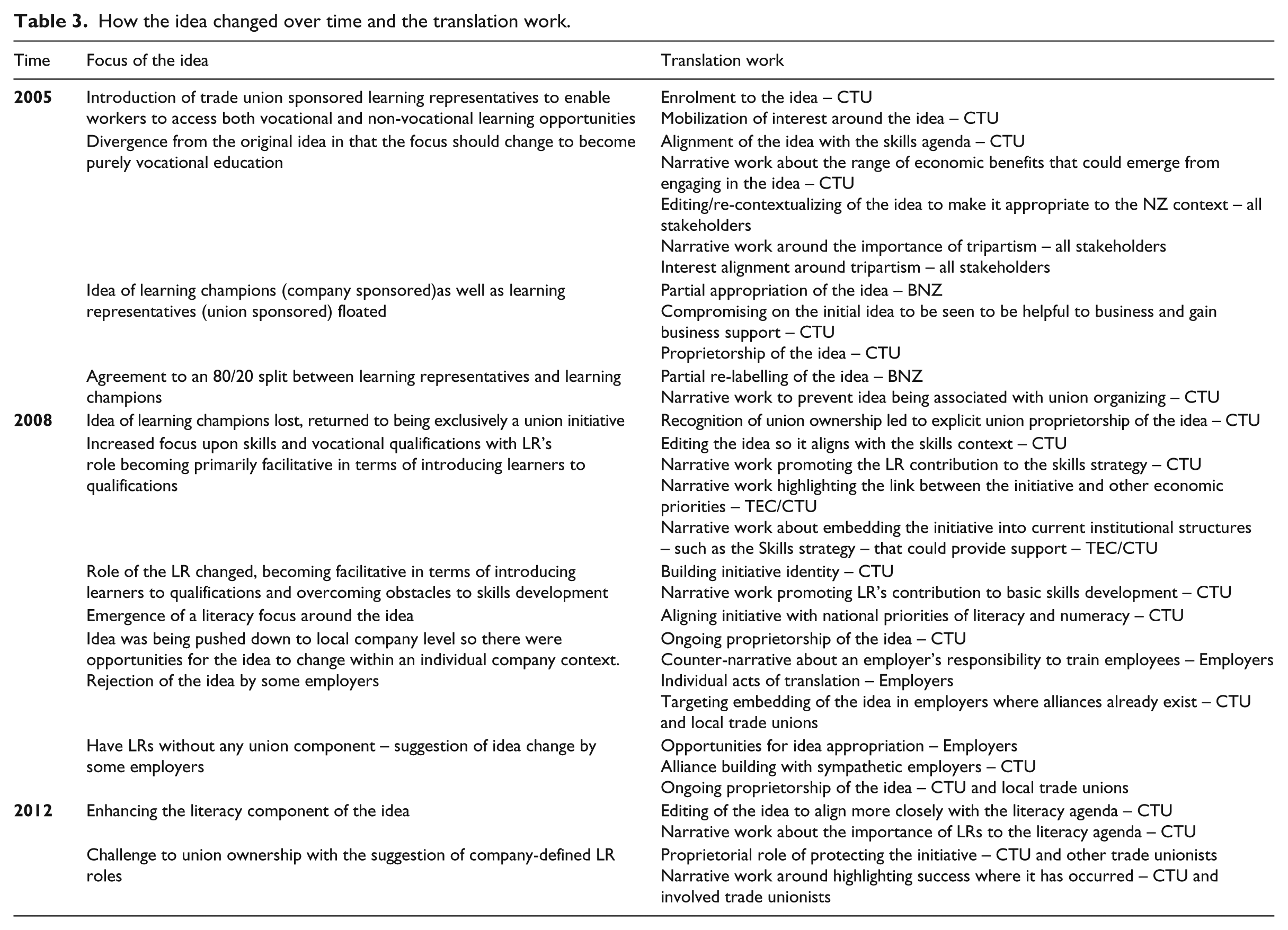
In this section we consider the findings at the three stages of fieldwork. A summary of the ways in which the idea changed during this period and the translation work required associated with those changes can be found in Table 3.
How the idea changed over time and the translation work.
In presenting the analysis we discuss each change in the focus of the idea as it evolved and the translation processes associated with those changes.
February–March 2005
In 2005 the initiative was in its first stage in New Zealand and the focus of discussion was upon how it would work in practice. Although the UK scheme was seen as an important starting point, interviewees were keen to point out how the NZ scheme needed to be different from the UK scheme for a number of contextual reasons in that NZ had smaller communities, a smaller public service, a smaller amount of money to devote to the scheme, lower levels of trade union density, and an endurance of long-standing Industrial Training Organizations (ITOs) responsible for vocational education. For example: We’ve picked up some good ideas from overseas but when you are trying to fashion them around what will work here … we are trying to, if you like … build from a slightly different base and different institutional arrangements. (NZCTU)
The first point of transition of the NZ initiative away from the UK idea emerged in the initial stages of conceiving the idea before implementation. In order to gain support from Skills New Zealand – a tripartite body – the CTU realized they had to align the idea with the skills agenda. Whereas within the UK the statutory rights of the LRs meant that they were protected and could focus upon both vocational and non-vocational forms of education, in New Zealand, engaging the support of other agencies was crucial and an alignment with the skills agenda enabled the enrolment and commitment of other stakeholder groups such as the TEC: There’s a sense that skills are one of the areas where there really are big wins for both sides so you don’t need to have, you know, does Business New Zealand win or does the CTU win or whatever. So as much as possible we want to reinforce that dynamic and agreement … And I mean they’ve managed to work very well together. (TEC)
The narrative work of NZCTU at this stage was focusing upon a whole range of economic benefits that the initiative could facilitate: It’s part of us constantly talking about being part of a high wage, high skill, highly productive economy and that New Zealand needs to transform to be able to, you know, basically survive in an increasingly globalized economy … I’m keen on this because it pushes the learning reps agenda right out into productivity, manufacturing excellence, employee participation in all those ventures. (NZCTU)
This selling of the advantages of the initiative enabled the contextualization of the idea into what were perceived to be key economic priorities for the New Zealand nation, and also, importantly, provided a way of enrolling other stakeholders to support it. In terms of the translation of the idea, the implication that a number of different purposes could be served by it enabled the mobilization of the different stakeholder organizations. However, the idea itself had now changed from the initial UK scheme where all types of learning could be pursued. To be applied effectively in the NZ context, the skills and vocational training element of it was paramount.
The narrative work of different stakeholders focused upon promoting the view that in relation to LRs, all parties had a joint interest and much to gain. This was a shared stakeholder narrative at this stage informed by a commitment to tripartism. For example, a BNZ interviewee pointed out that this was one area where business and trade unions had something in common: If I turned up at a meeting with a union official or the CTU guys as I do these days to talk about training, I would normally walk in knowing I’m going to speak to friends about it. That we might have slightly different views about how we should be doing it and we might have slightly different views about outcomes, but largely I’ll walk into the room knowing that the guys on the other side of the table from me will have the same interests. (BNZ)
For NZCTU, this was also pragmatic. They realized that if translation was to be successful then the lack of statutory support for the NZ scheme required the trade unions to be committed to a tripartite relationship where alliances could be formed. Such alliances would engender successful translation: The very fact that we have no legislation to resort to or anything means it’s only going to work where there’s a reasonable level of employer support – so I am beginning to suspect that we need to ensure that the learning rep has a good relationship with the employer. I don’t know how you do that but it is going to be vital – a working relationship – a partnership approach. (NZCTU)
Furthermore, the unions recognized that they needed to exercise some caution about sensemaking around the idea in relation to its union ownership and direction. A second change to the format of the idea came from BNZ who suggested that for some the role might be labelled as learning champions rather than learning representatives. This relabelling of the idea (Sahlin-Andersson, 1996) was initiated by BNZ as a way of ensuring that a proportion of LRs would be employer – rather than union – sponsored. Their bid to morph the idea caused problems for the unions: Someone had got it and changed the language. So the word union disappeared and it became the learning champions programme which sort of highly individualizes it and takes it away … So the first task was rebuilding collectiveness into it in a way and [getting] the union concept back into the proposal. (NZCTU)
This shift in the idea and potential appropriation of it by BNZ was problematic for NZCTU who wanted it to be union driven but needed the support of the tripartism in which BNZ were integral. Therefore at this stage a compromise was reached with an 80/20 split between learning representatives and learning champions. Awareness endured that this was a sensitive issue: We’re still having to be careful not to be seen to be using it in any way as promoting unions or using it to organize unions… We deliberately don’t use the language of organizing collective behaviour through learning reps. (NZCTU)
Hence during this initial stage a number of different forms of translation work were taking place. The idea itself had gone through a number of changes in being re-contextualized by NZCTU so that it was appropriate for the NZ context. The focus had shifted most notably away from the original UK idea in two ways: first, to a greater emphasis on skills and vocational learning with no element of non-vocational learning included, and second, with the suggestion that there be company-focused learning champions as well as learning representatives. There was also realignment taking place so the idea was clearly aligned with the skills agenda which would enable the successful enrolment of the different stakeholder groups. Hence translation processes included enrolment, mobilization, interest alignment and narrative work. Furthermore, the translation work of NZCTU also focused around their proprietorship of the idea. They were central, not just in their advocacy, but in their determination to both hold onto and protect the initiative.
February–March 2008
By March 2008 a pilot scheme had taken place and the implementation of the idea was developing. The key participant/actor from BNZ had left the organization and they had less direct involvement with the scheme now, hence the learning champions component of the idea had been lost and ownership had clearly returned to NZCTU. The idea had again evolved at this stage. Of particular importance was the emergence of a positive view of the current context that surrounded the development of a unified New Zealand Skills strategy by Skills New Zealand which could provide an appropriate context within which the LR initiative could flourish. Narrative work by both the TEC and NZCTU interviewees at this time highlighted the link between the idea and other priorities: I’ve been involved in Skills New Zealand since it was first set up. It’s kind of morphed and is now looking much more strategically; it’s gone beyond just looking at vocational education and training and raising the profile to look at how the tertiary system can support the needs of employees and employers to drive productivity and that’s where I see the learning representatives actually.(TEC) So the new skills strategy has now got a heavy emphasis on skills utilization. Now that means another role for learning reps because we have said from the start that learning reps will work best in the workplace where there is a training committee, where there are structured ways for reps to communicate and relate to management and work now not just on training needs and training ideas and workers’ learning aspirations, but workers’ real aspirations. It just keeps rocketing ahead. (NZCTU)
This had an impact upon how the idea was understood in that there was an even greater emphasis upon skills and the achievement of vocational qualifications. In terms of translation work, here the narrative was about embedding the idea into new institutional structures that could provide support and also highlighting the fit with the priorities of the different organizations involved. The role of the LRs also changed, editing the idea again in that their role was becoming primarily facilitative in terms of introducing learners to qualifications and overcoming their obstacles to developing skills. This positioned them as different from their UK counterparts whose role was to organize around a range of different types of learning. Here the identity of the initiative (Czarniawska,1997) was being constructed by the TEC and NZCTU and had an impact upon how LRs acted in practice.
There had also been a budget expansion of NZCTU responsibilities which had led to an increased focus of the idea around numeracy and literacy. Some of the interviewees highlighted that literacy was now recognized as an issue of national importance and, as one of the ITO interviewees suggested, was a ‘catchphrase of the moment’. Translation work of aligning with this national priority was a way of the trade unions highlighting where LRs could make a contribution: The learning reps programme is seen as a system for articulating employee demand for skills and for learning … but also suddenly now has a literacy focus … I know ministers see literacy as an election issue. It’s election year and it’s a very big issue. Indeed a lot of pre-election speeches from government are skills based. It’s quite a good time to be running a learning reps programme! (NZCTU)
This alignment work also had an impact on the changing nature of the idea. Given that all interviewees saw literacy as an important priority, at this stage the translation work of all involved focused upon editing the idea so it now included greater literacy concerns. Although the UK scheme also included basic skills provisions, the goals of such concerns in New Zealand now appeared to be exclusively vocationally focused. Hence the activities of NZ LRs were now differently focused compared with UK LRs.
The idea was now being pushed down to the local company level so individual trade unions and employers were becoming important players in the translation process. Although there had been some positive developments about the implementation of the initiative, now that the initiative was working at a local level, collective local agreements had to be signed in order for LRs to work in companies. This meant that a new set of organizations were becoming involved, who did not necessarily see themselves as having any interest in the idea. Trade unionists seeking to introduce LRs into those organizations were recognizing these tensions and some employers were suspicious of developments. As the one employer interviewed who was from the first company to negotiate about LRs suggested, there were potential concerns about who would do training: There is an area of potential disagreement between me and the CTU and it is this. The CTU would say, ‘****, what you should be doing is training all the supervisors and the bosses and I’ll train all the workers.’ Not on your nelly is the answer to that question. I will train whoever comes along to be trained and we will make sure that we train or we offer training to all people. (employer)
This highlights the difficulties in translation work when those conducting it are more generally in a subordinate position. Employers could challenge the narrative being promoted that this was a ‘win–win’ scenario for all concerned with a counter-narrative that training was the responsibility of employers, not unions. A different viewpoint about potential tensions came from a union national official: I mean, my assumption here with a lot of employers is anything that’s got an aroma of unionism, sometimes they’ll just oppose it. You probably get a little bit of that with the learning rep programme with the CTU involved – ‘Oh, this is just a plot by the unions!’ (national official)
As noted earlier, Latour (1986) argues that how actors interpret the past is an important aspect of enabling movement in the translation process. Here, the previous industrial relations climate was seen as impacting upon employer receptiveness to the idea. This suspicion also extended to local managers and the relationships between local managers and trade unions. The suggestion was that whereas negotiation about the learning representative initiative may have taken place with those at senior levels, local managers may not be familiar with it. As one trade unionist suggested, ‘the ones that are about three places removed [from the top], they’re quite suspicious of learning reps and they think we’re using it as a tool to undermine them’. So some trade union translators were now encountering resistance to the idea. This meant that if the idea was to survive then CTU had to focus implementation through re-aligning to areas or sectors where relationships with employers were already positive and where collective employment agreements already existed. Here translation work was about embedding the idea into contexts where success was more likely and acting within these contexts. Again, their proprietorship of the idea was important here with ongoing advocacy required.
Direction of the idea more generally now had the added dimension of being constructed locally in relationships between trade unionists and employers rather than just at NZCTU national level. Therefore NZCTU had less control over how the idea was being interpreted and implemented. As the employer suggested: Probably our organization would ideally see the union taking on this as a role without actually too much union linked into it because, I mean, we’ve already had one complaint from a manager saying that the learning rep was out touting for union membership, and at the end of the day there’s real boundary issues there as far as I’m concerned. So in many ways we want the union to sort of take off the union hat and just say they believe in the learning rep concept and they’ll work with any employee, be it union or non-union, and actually encourage learning and that we actually want to push quite hard. (employer)
Hence here the employer is suggesting another shift in the idea so that it became employer-led and owned. This draws attention to the significance of individual acts of translation (Maguire & Hardy, 2009). The union’s translated definition of the idea was being challenged with the argument that an individual employer had the right to implement LRs without them having any affinity to the union. The move to local level meant that local-level actors, notably employers, had the opportunity to appropriate the idea and re-define it in line with their own perceived interests. They were becoming important individual actors (Maguire & Hardy, 2009) in the translation process.
At this stage translation work was quite challenging because the interest alignment narrative that had worked so well previously was being disputed. The trade union respondents perceived that there was a need to continue to get buy-in from employers to hook them in to accept the idea in its current format, and for the unions to do more to promote the idea more generally. For them translation work needed to focus upon further interest alignment and alliance building so that the idea could become embedded within companies.
April 2012
The political climate in New Zealand had changed somewhat by 2012. The ongoing government austerity measures clearly placed boundaries around the opportunity for future potential developments. Although the scheme had worked well in some areas, the optimism that the interviewees had in 2005 and 2008 had largely disappeared. Moreover, previously built-up alliances had been dissolved. The general change in the political climate meant that there were tensions in what NZCTU prioritized. In a climate where the unions were seen to be under attack, other industrial issues could be seen as more important than a concern for workers’ learning. This was the case for union participants at both local and national levels. This change in context meant that the LR initiative was now seeking to survive in a difficult climate, hence there was a need for even more clearly defined logic rules (Sahlin-Andersson, 1996) about the possible contribution of the initiative. One way of addressing this was through enhancing the literacy focus, which became the final way in which the idea changed. Given the changes in government policy and funding, priorities had shifted even further towards the literacy agenda. An interviewee described the change in how the identity of the LR idea was now seen: So this particular project, which started very much around … the notion of a voice, advocacy, mentor support, however you want to call it, in the workplace. That’s been overlaid with a much greater emphasis on literacy, broadly defined, or across language and numeracy as well, and increasingly we will be under pressure to deliver around marginal groups, including Māori and Pasifika. (NZCTU)
The implication of constructing the identity of the scheme in this way was that LRs were still involved in an important part of the skills agenda through embedding literacy and numeracy in training and raising awareness of the issue among employers. Interestingly, in a climate where all the key stakeholders had seen their budgets cut, there was now little debate around who directed the idea which was now being positioned as a trade union sponsored idea to enhance literacy rates. In the context of government austerity measures, other stakeholders now had other priorities: So the quantum of investment from the government’s perspective in industry training has been cut back significantly … The whole vocational education training sector feels under huge pressure because of, first of all, the economic situation, meaning the kind of cost pressures, and the pressures driving firms has meant a fall-off in the number of traineeships, apprenticeships etc. (NZCTU)
Consequently, the narrative of a tripartite approach had all but disappeared. The change in government had also led to what was perceived as a very difficult environment for employer–union relationships: It’s just so much harder. In 2008 and 2009 it was very exciting. Things were growing; the learning rep programme was really growing. And then last year we noticed it was just so much harder to get employers on board. It wasn’t just that they weren’t interested in learning rep programmes; I think they were pulling back on their training budget anyway and didn’t want to be developing expectations within the workforce through a learning rep programme that they wouldn’t deliver on. (NZCTU)
One trade union national official summarized the impact of the changing political climate on local relationships with employers as ‘suddenly the ratbag employers become pricks, the reasonable employers become ratbags, and the good employers start to get difficult’.
In some areas the increased presence and influence of LRs had led to management resistance in that they were ‘getting far too empowered’ and getting the ‘kudos around learning’ that management would have preferred to keep for themselves. The relationship between the trade unions and government was also seen to have deteriorated with the legitimacy of union involvement in the learning agenda now seemingly lost: It’s a little bit depressing, to be honest, because we’re not dealing with a government that has any great commitment to try to make partnership work. They abandoned the skills strategy as being a talk shop, basically … But it did mean that you had government, employers and unions all talking the same language about an investment approach to people in the context of ongoing skills shortages and vulnerable groups pathways. Linkages with productivity and with a broader economic transformation framework, all of that is gone. (NZCTU).
This provided a different and more problematic context for translation and the union ownership of the idea was under threat in some places. One example was a manufacturing firm where they sought to have LRs without union involvement: The company will do something but they’ll turn learning reps into something different from what the CTU intended them to be, and I think that that’s a fundamental issue for the CTU in terms of going forward, as who prescribes the model of being a learning rep? Does the CTU say ‘This is the model! This is what a learning rep is and this is what you’re going to be doing’ and hold people to that, or do they let companies go off and do their own thing? … Certainly at that company the learning rep role was being turned into something that was quite different than what the CTU would have thought it should be. (evaluator)
Hence at this stage, previous forms of translation work had become unviable. Alliances with government bodies, industrial training organizations, employers and business organizations were all untenable in this new context. The only real opportunity that remained was to change the idea further to align the initiative with the literacy agenda and to narratively promote success where it had occurred. Moreover, as the extract above suggests, there was evidence that when operating at an individual company level, the format of the idea could shift again, in this case to represent primarily the interests of the employer. In these situations the ownership of the idea by the CTU had gone and the fundamental essence of the original idea, that of individual trade unionists facilitating the learning of their fellow workers, had been lost. Therefore the main translation work that remained was that of the trade unionists seeking to maintain their proprietorial role of protecting the initiative and narrative work of highlighting successes where they had occurred.
Discussion and Conclusions
Our aim through this analysis is to examine and explicate the nature of the real-time translation work required to translate a trade union idea. Earlier we identified that previous studies of idea translation have adopted two broad approaches to how idea translation occurs, the first focusing upon the idea itself and how it changes and the second upon the translation processes. In this case the longitudinal data enables us to see both of these different approaches at work. From Table 3 it is notable that the focus of the idea continuously evolved over the seven-year period. Although there is evidence from other empirical studies that ideas are re-contextualized to suit a given setting (for example, in Morris and Lancaster’s (2006) study of lean management), the scenario here was that in order for the idea to be protected and developed, ongoing change of focus occurred. This brings attention to the extent to which the translation work required in this example may be different from others in the literature, most notably as a result of the trade union focused nature of the idea.
To some extent, the trade unionists in this study were working in a similar way to the IT actors in Doorewaard and van Bijsterveld’s (2001) study, who continuously shaped and re-shaped change programmes based upon their own insights. Doorewaard and van Bijsterveld (2001) noted similar translation processes to those used in this case, in terms of alignment, enrolment and congealment; however, they also noted the role of hegemonic power processes in terms of others within the organization evaluating how the IT change might impact upon their own power position. The translators in their study had sufficient access to power and resources to make the translations happen and this is characteristic of other studies in the field. Those who lead the cause in other translation studies are often powerful actors: for example, the directors and managers in Wæraas and Sataøen’s (2014) study, the managing directors, ministers and government in Czarniawska’s (1997) account, and the industrial and firm-level actors in Morris and Lancaster’s (2006) study.
In terms of what is different in this case from previous studies and what characterizes trade union translation work, we would argue that an important form of translation work is around the union proprietorship of the idea. Why is this proprietorship important? First, proprietorship provided the overarching guiding framework within which the translation work was conducted and the different functions of the translation work required over the seven-year period. Given that this was a context where the trade unions were in a subordinate position, considerable vigilance and commitment from the translators were required. In a number of cases it was possible for the idea to be effectively hijacked by different interest groups such as BNZ or local managers, and when these incidences occurred the trade unionists responded by creating different types of alliances and adapting the idea appropriately to seek to ensure ongoing support. Evidence suggests that in this contested context where trade unions are constantly having to both defend and promote the legitimacy of their ideas, there is an ongoing fluidity of the requirements of translation work. Without vigilance, effective translation can be threatened. As Latour suggested in relation to the model of translation, ‘The spread in time and space of anything – claims, orders, artefacts, goods – is in the hands of people; each of these people may act in many different ways, letting the token drop, or modifying it, or deflecting it, or betraying it, or adding to it, or appropriating it’ (Latour, 1986, p. 267). It was these ongoing actions of others that the trade unions were vigilant of and responded to from within their proprietorial framework.
Second, the issue of retaining proprietorship is essential for translators who are in a subordinate position because once they lose control of the idea then they cannot get it back. However, there is an inherent tension between proprietorship and the building of alliances characteristic of the translation work outlined by Latour (1987), as the latter implies conceding some kind of control. An example here is Business New Zealand’s intervention regarding learning champions and CTU’s response of compromise. Sometimes the external context might encourage others to be involved in alliances that are slightly more favourable to those in subordinate positions, but at other times this may not be the case, so protecting proprietorship comes to the fore. We contend that this would be similar for other groups who seek to translate ideas but are institutionally positioned as subordinate.
In seeking to understand further why proprietorship was required, it is useful to consider what the unions in this case were trying to achieve. In Czarniawska’s (1997) studies she noted that where attempts to challenge institutional thought structures came from the highest status organizations in the field, resistance was less than when the changes did not threaten the legitimacy of others’ positions. However, in this case, the alliances built up during the first period of idea translation and the successful enrolment of other stakeholders to the union agenda meant that the narrative work of tripartism as common sense was seen as fitting with the prevailing institutional logic. Indeed the unions strategically opted for this approach which offered a legitimate role in a consensus group of interests with an agreed mission to improve the New Zealand economy. It was only once the unions were seen to challenge existing institutional thought structures which threatened the legitimacy of other interest groups – such as management’s responsibility to provide training at a local level, for example – that resistance started to emerge. The change in government meant that the unions were in a position of little legitimacy. Hence the changes could not be co-opted into the existing order (see Czarniawska, 1997). In the same way that Frenkel (2005a) noted the influence of state-level political institutional power relations, once these came into play, opportunities for the further development of the idea were effectively squashed. Whereas Maguire and Hardy (2009) described how sources outside of the institutionalized field successfully changed notions of the appropriate use of DDT, the trade unions here sought to act within the institutionalized field, recognizing the important need to build alliances with other actors. However, at the end of the study the most powerful actors had simply lost interest in the idea, leaving the unions with their proprietorial role of protect and defend.
Given this, it is interesting to question the extent to which this translation was successful or otherwise. Sturdy (2004) notes that there has been little attention in the literature to ideas that have failed to be widely disseminated. In this case, despite considerable efforts at translation work by the trade unionists involved, at the end of the fieldwork period there was some evidence of LRs working successfully but the idea was quite different from the original one to be translated. Why is this the case? In understanding why the scheme was successful in the UK but had limited success in New Zealand, contextual factors are crucial. Within the UK, the statutory rights of LRs from an initial government alliance meant that the initiative still had the opportunity to develop within problematic employment relations contexts and there was less need for the ongoing alliances, idea shifts and alignment that were so important for keeping the NZ initiative alive. In the UK these rights gave trade unions the legitimacy to own the agenda. In the NZ case the abandonment of tripartism undermined the legitimacy of trade union involvement in learning and hence meant that the context became too problematic.
Callon (1996, p. 223) suggests that at the end of a translation process, if successful, ‘only voices speaking in unison will be heard’. Here, after the seven-year period of fieldwork ended, the voices that had originally supported the idea were now struggling to be heard. We would question the extent to which voices speaking in unison will ever be heard in this kind of case where there is a politically contested terrain with different interest groups having different levels of institutional power and legitimacy. Indeed, in thinking about the future of trade union interventions it may be that a polyphony of voices is more appropriate. For example Carter, Clegg, Hogan and Kornberger (2003) argued from their case study of dock workers that the use of the Internet enabled new alliances and logics of action to be discussed and played out through different international trade unions. They argued that trade union organizing was successful precisely because it drew upon different voices with different ideas. It may be that globalization through polyphony actually offers opportunities for the international crossings of trade union ideas that can enable new forms of union legitimacy to be achieved. The union’s initial role in this case of introducing a new idea seen as of benefit to the whole economy was indicative of their ability to both manage polyphonic voices and interests and position themselves as having a legitimate role as translators in relation to the learning agenda. Indeed this could be seen potentially as a form of trade union identity work (Brown, 2014) where positioning in this role gave them a credibility and potentially enduring positive identity in this problematic context. Future research could further explore the links between translation and identity work. However, this positive identity and role was far harder to maintain once they were perceived to challenge institutional logics, which implies that such legitimacy is constrained once a translator in a subordinate position really starts to challenge. Hence the key issues of learning ownership remain.
In conclusion, in a field where there are ongoing calls for the need for studies that focus on real-time translation (e.g. Wæraas & Sataøen, 2014; Zilber, 2006) rather than using archival data, we have contributed to the literature on how we understand the translation of ideas first by explicating the concept of real-time translation work in a novel empirical context, second by drawing attention to the distinctive characteristics of trade union translation work and third, theoretically by highlighting the importance of proprietorship when subordinate groups take on translator roles. In doing so we argue that translation work in this distinctive socio-political context requires ongoing vigilance and idea propriety by trade union actors, and that when successful, the role of international idea translators may offer some legitimacy and positive identity positioning to unions in an increasingly globalized world. Furthermore, drawing attention to the translation work of groups who may be subordinate offers us the opportunity to explicitly surface complex power relations and their ongoing flux within the translation process. Finally, in seeing the translation of ideas as a process of translation work, we have drawn attention to the ongoing efforts required to sustain the successful translation of an idea.
Footnotes
Funding
This research was funded by British Academy Large Grant number LRG-42465 entitled ‘Investigating the sustainability of the Learning Representative schemes in the UK and New Zealand through a systemic analysis and longitudinal case studies’ and British Academy small grant number SG-39394 entitled ‘Investigating the New Zealand Learning Representative scheme’.