




Abstract
Extant literature indicates that the Niger Delta region has struggled with developmental issues for ages. Efforts by the government to tackle the perennial underdevelopment have met with failure, a situation that has necessitated the institution of diverse research to unearth the causal factors. Leveraging a combination of historical analysis and a survey involving 206 respondents, this study brings to the fore the principal drivers of poverty in the region, with mismanagement of funds and the apparent lack of citizen engagement emerging as the most significant predictors of poverty and underdevelopment. The study thus highlights the need for optimal management of financial resources and also emphasizes the centrality of citizen engagement and participatory communication in community development. The study argues that while funding is critical to development, no substantial development can occur without the active participation of the citizens, from the conceptualization to the execution of strategies and plans for development.
Introduction
As the world’s third-largest delta in terms of land mass, with a disparate accumulation of flora and fauna in addition to huge oil and gas deposits in commercial volumes, the Niger Delta Region plays a central role in Nigeria’s socioeconomic activities (Alakwe & Okpara, 2022). The economic importance of the Niger Delta is underscored by the fact that any disruption in oil exploration in the region has a concomitant effect on the global oil price and, consequently, on international energy costs. Demographically, the region is highly heterogeneous and consists of about 40 ethnic minorities speaking over 250 different dialects (NDDC, 2001). The region’s heteroglossic and polyglossic characteristics make interactions between communities, regional administrations, international oil firms, and international donor agencies challenging (Alakwe & Okpara, 2022). Politically, the Niger Delta region refers to all those states within and around the tributaries of the Niger River in the South-South, South-East, and South-West geopolitical zones of Nigeria. These include Abia, Akwa Ibom, Bayelsa, Cross River, Delta, Edo, Imo, Ondo, and Rivers States. These nine states are distinguished by substantial oil deposits, high population density, and diverse cultures, which are responsible for the region’s rich cultural heritage.
The region is considered the mainstay of the Nigerian economy as it harbors a significantly high level of crude oil deposits and natural gas reserves. Also, the region is characterized by diverse flora and fauna, arable land, forest reserves, and an adequate workforce. With such an array of resources, the expectation is that the Niger Delta ought to be among the most developed regions of the world. Contrary to expectations, there is an inverse relationship between abundant natural resources and economic development.
The Discovery of Crude Oil in the Region: A Paradox of Poverty in Riches
Crude oil was discovered in commercial quantities in 1956 in Oloibiri, an Ijaw community in present-day Ogbia Local Government Area, Bayelsa State. The discovery followed years of exploration by Shell D’Arcy and culminated in a total production capacity of 5,100 barrels per day (bpd) by 1958. After Nigeria gained independence in 1960, multinational oil companies like Texaco, Mobil, Agip, Elf, and Gulf Oil secured concessions to prospect for oil in the Niger Delta region, with the responsibility of setting prices and paying royalties and taxes to the Nigerian government. The discovery of oil in Nigeria has brought numerous societal and developmental challenges to the region, despite its potential for better life and expedited development. Despite its benefits, the region has been neglected by both the government and multinational oil companies.
The continued exploration of oil in the region has been associated with incessant oil spills that destroy both flora and fauna and also result in the degradation of the atmosphere through gas flaring. Also, of great concern is the lack of adequate compensation, health amenities, a good road network, pipe-borne water, and modern facilities for learning. Capacity-building programs for youth development are poorly managed, and there is an absence of opportunities for skill acquisition and development (Amaize, 2006). These challenges exist irrespective of some developmental efforts initiated by the government aimed at ameliorating the conditions of the people of the Niger Delta region and fast-tracking the level of development to align with the contributory potential of the region to the nation’s economy.
Developmental Initiatives in the Niger Delta
Crude oil was discovered in Oloibiri, in the present Niger Delta, in 1956. Right from the discovery, the government accorded the region special status and instituted diverse development programs targeted at galvanizing and expediting the development of the region. These include the following:
Niger Delta Development Board (NDDB)
The first effort of the government to address the backwardness and incidence of poverty in the Niger Delta came with the establishment of the NDDB in 1961 by the British colonial masters. This followed the Henry Willinks Commission report of 1957, which labeled the region as neglected and backward, with a high incidence of poverty. According to the report, the needs of those who live in the creeks and swamps of the Niger Delta are very different from those of the interior (UNDP, 2006). The report went ahead to highlight the difficulty inherent in attempts to understand the yearnings of a group of people for whom communication is difficult, education is so elusive, and accommodative structures are so scanty. Consequently, the Commission recommended that the region be accorded special attention regarding developmental programs. While this was laudable, the efforts did little to satisfy the yearnings and aspirations of the people as the activities of the board were truncated by the outbreak of the Nigerian Civil War in 1967.
Niger Delta River Basin Development Authority (NDRBDA)
In continuation of the developmental plans for the region, the Federal Government established the NDRBDA in 1972. Their activities were hounded by administrative bottlenecks and political scheming (Amaize, 2006); the few projects that were set up at that time all died due to poor maintenance. The NDRBDA is one of the 11 river basins established in 1976 by the Olusegun Obasanjo government to play a supportive role to the NDDB in addition to facilitating the development of other regions in Nigeria. The mission of the Authority was to meet the service requirements of the people where they are located satisfactorily and efficiently and to pay proper attention to the sustainability of the ecosystem. From the onset, the NDRBDA was destined to fail, as none of the board members appointed by the federal government to oversee its management were from the Niger Delta region. The authority achieved minimal impact as the board members, primarily politicians, saw their appointment as an opportunity to have a share of the national cake (UNDP, 2006).
OMPADEC (Oil Minerals Producing Areas Development Commission)
In response to the failures of previous intervention programs for the Niger Delta region and in a renewed effort to engender growth and development in the region, the then president, Ibrahim Babangida, established the OMPADEC in 1992. The sole purpose of the Commission was to address years of neglect and escalating levels of poverty within the region. To achieve this, the government set aside 3% of the total revenue accruing from oil for developmental efforts in the region.
The primary responsibility of OMPADEC was to ensure that all funds allocated to the development of the region were managed judiciously. With this development and in consideration of the enormous financial boost, the expectation was that, finally, the journey toward the development of the region had commenced. The general perception across the region was that the developmental challenges and environmental concerns within the region would be addressed (Omotola, 2007). Like all previous efforts to address the issues of the Region, OMPADEC failed miserably to promote the expected development. Most of the funds were misappropriated through corrupt acts, which have been entrenched in the system over the years. Funds disbursed for “completed” projects were paid to contractors with questionable addresses.
Niger Delta Development Commission (NDDC)
With the advent of democratic rule in 1999, President Olusegun Obasanjo repealed the Decree setting up OMPADEC and established a new commission with a reorganized structure to drive efficiency in the management of resources toward the development of the region. Thus, the NDDC was born in the year 2000. The vision of the Commission was to facilitate and expedite the equitable and sustainable development of the Niger Delta into a region characterized by social stability, economic prosperity, peace, and a regenerative ecology (NDDC, 2017). To carry out these functions, the Act provides that 15% of the monthly statutory allocation to the Niger Delta states from the federation account be made available to the Commission. In addition to this, all the oil and gas firms operating in the region were mandated to set aside 3% of their annual budgets for the Commission (NDDC, 1999). These contributions placed substantial financial resources at the disposal of the Commission to execute its mandates. The NDDC has been criticized for not providing adequate solutions to the environmental and developmental challenges in the Niger Delta Region, despite extensive projects executed over the years. The then Minister of State for Petroleum Resources, Ibe Kachikwu, claims that the over $40 billion spent has not led to meaningful development in the region (Idowu, 2016).
Ministry of Niger Delta
In response to the continued degradation of the Niger Delta region and renewed agitation by the people of the region, the late President Umaru Yar’Adua created the Ministry of the Niger Delta on September 10, 2008, to formulate and coordinate policies that will engender growth, development, and security in the region. The overarching intention was to address the perceived sense of exclusion, ecological degradation, poverty, and rising unemployment. The need for a coordinating Ministry of the Niger Delta was driven by the failure of previous intervention programs. Specifically, the Ministry was to expedite the region’s development by coordinating the activities of other government agencies, multilateral donor agencies and development partners, host communities, oil and gas companies, and other critical stakeholders in the Region (Ministry of Niger Delta, 2008). At variance with widespread expectations, the Ministry’s efforts in the region have not yielded the expected results due to mismanagement of funds, persistent poverty, youth restiveness, kidnapping, destruction of oil facilities, and ongoing ethnic agitation and crime.
The Federal Government Amnesty Program
After concerted efforts by the Federal Government of Nigeria, through the use of the armed forces and other intelligence agencies, to contain militancy and the wanton destruction of oil facilities in the Niger Delta region, and with no significant result to show for these efforts, the federal government instituted a Presidential Technical Committee on the Niger Delta. Its function was to investigate and propose a lasting solution to the perennial Niger Delta crisis, characterized by extreme militancy. The institution of this committee came with firm assurances that its recommendation would be treated with dispatch. A principal recommendation of the Committee was to grant amnesty to repentant agitators and militants in the Niger Delta.
In 2009, Nigeria’s President Umaru Musa Yar’Adua initiated the Presidential Amnesty Program (PAP) to grant pardons to militants who surrendered. The Office of the Special Adviser to the President on Niger Delta (OSAPND) was established to implement the first Disarmament, Demobilization, and Reintegration (DDR) program (Abazie-Humphrey, 2014). The strategic intent was to develop a homegrown DDR program run by Nigerians. Thus, the project had about 80% of the staff recruited from the Niger Delta states (Abazie-Humphrey, 2014). The DDR program began with a rehabilitation training facility in Obubra, Cross River State, but was deemed inappropriate due to the number of militants involved. In August 2012, 1,140 militants were allowed to choose a course from a pool of 150 business development courses. Schools were selected from various educational institutions and vocational training centers. By the end of 2012, 11,525 out of 30,000 registered ex-militants were enrolled in academic or vocational centers across Nigeria, while 4,929 were sent abroad to study in countries like Russia, Ukraine, the UAE, India, Ghana, the Philippines, and South Africa (Nigeria Stability and Reconciliation Programme, NSRP, 2014).
The Underdevelopment Conundrum: Where Does The Blame Lie?
The perennial underdevelopment witnessed in the Niger Delta Region has been a source of concern to diverse multilateral agencies, multinational oil companies, and successive governments in Nigeria. Extant literature lays the blame on insufficient funding (Akpabio & Akpan, 2010; Ikelegbe, 2011), corruption (Babalola, 2014), negative externalities of the oil industry (Ikelegbe, 2011), internal governance (Agbor, 2013), and most recently, lack of participatory communication (Alakwe & Okpara, 2022). This study, therefore, aims at identifying the most significant predictors of poverty and underdevelopment in the Niger Delta and thus facilitating a better understanding of the issues and how best to address them.
Corruption
Within the last three decades, the relationship between corruption and underdevelopment in Nigeria has attracted the attention of diverse scholars (Agbiboa, 2010; Aloko & Abdullahi, 2018; Babalola, 2014; Mustapha, 2008; Ojiji et al., 2021; Omotoye, 2011). According to the 2021 global corruption perception index report released by the Civil Society Legislative Advocacy Centre (CISLAC) and Transparency International (TI), Nigeria ranked 154 out of 180 countries (Ewepu et al., 2022). Corruption is a social phenomenon rooted in maladministration and deeply ingrained in citizens’ cultures. It manifests in ostentatious lifestyles, such as praise singing and partying, and is visible in both the private and public sectors, as well as on major city streets through extortion.
According to Agbiboa and Maiangwa (2012), corruption has continually defied all possible solutions. This fact, according to the study, is attributable to the low cost of corruption and the lack of political will to implement the diverse anti-corruption laws of the nation optimally. Babalola (2014) examined the impact of corruption as a factor militating on the development of the Niger Delta. According to his study, as oil revenue flows into Nigerian rentier state accounts, those individuals who wield political power and control state power from the federal level down to the local governments use their offices as conduits for personal aggrandizement (Babalola, 2014). The study further attributed the challenge of underdevelopment to nonexistent accountability and a lack of adequate control mechanisms for political office holders, especially state governors, which results in the diversion of funds meant for development to personal interests.
Internal Governance
The relevance of good governance in the development of the Niger Delta region is evident in extant literature. Diverse studies posit a causal relationship between good governance and the attainment of Sustainable Development Goals (SDGs) (Okara, 2011). Good governance is a prerequisite to the enactment of relevant laws and the formulation and implementation of policies that can deliver the dividends of democracy to the citizens right down to the grassroots (Piece, 2015). Good governance stimulates trust, engenders positive perceptions from the citizenry, and ensures accountability from political leaders and decision-makers (Arugu & Kalama, 2018). Consequently, an immediate fallout of the poor level of internal governance in the region is the total absence of essential human and infrastructural development and the attendant high poverty rate, irrespective of the substantial financial resources allocated annually to the region.
Agbor (2013) blames the region’s underdevelopment on poor internal governance, arguing that good governance is the most effective way to eradicate poverty and accelerate development. The study suggests that no meaningful government reform can achieve the desired results when governance is sluggish. It recommends a reorientation program for political leaders to ensure the emergence of qualified and benevolent individuals, addressing the region’s long-standing underdevelopment. In a related study by Akpabio and Akpan (2010), it was confirmed that the benefits accruing from crude oil exploration do not trickle down to the citizens in a significant amount. The study observed that this is a result of several factors: the politicization of benefits, deficient policies, lopsided revenue and infrastructural distribution, and a lack of transparency and accountability, among others.
Negative Externalities of the Oil Industry
Studies have placed allusive emphasis on the devastating effect of the oil exploration by international oil companies on the Niger Delta, linking it to the excruciating poverty that is a pandemic in the region (Anikpo, 1998; Balogu, 2009; Ebegbulem et al., 2013; Ikelegbe, 2011). Ebegbulem et al. (2013) argue that ecologically unfriendly activities of the international oil companies in the Niger Delta contribute significantly to environmental degradation, which, for communities that leverage agriculture and fishing for livelihood, promotes poverty.
According to the study, the exploration of oil and the attendant wealth generation came with negative impacts on the socioeconomic development of the region where the oil is produced and, by extension, on the entire nation. Experts in ecology and environmental studies believe that oil spillage is a critical contributor to the degradation of the environment. Available records indicate that between 1976 and the year 1990, 2,796 oil spills occurred in the Niger Delta, resulting in the release of a whopping 2,105,393 barrels of oil into the ecosystem (Ebegbulem et al., 2013). The exploratory activities of these oil companies thus impact negatively on the flora and fauna of the region. These studies concluded that the perennial underdevelopment of the region is squarely attributed to the activities of international oil companies.
Funding
Over the years, funding has proven to be a critical component of community development. No development program can be successfully implemented without adequate funding. In a report in The Guardian newspapers, the Ministry of Niger Delta blamed its inability to execute projects on the paucity of funds, claiming that this development had impacted negatively on the people of the oil-producing communities in the region (Abubakar & Akpan, 2015). In December 2017, the National President of the South-South Students’ Assembly, Michael Christianus, decried the challenge of funding in the educational sector in the region, making a case for the establishment of a Niger Delta Scholarship Board to help address the challenges of funding in the region (Wahab, 2017). Elsewhere, the Minister of Niger Delta Affairs raised the concern during the budget defense of his ministry. Lamenting the limited financial resources available to it and the poor release of budgeted funds, the minister sought the understanding of the Senate Committee to increase the funding allocation to the Ministry to address critical developmental issues in the region. According to the minister, the total sum proposed for the Ministry for 2021 is far from adequate in the face of the mandate and goals of the Ministry to meet the yearnings and aspirations of the people of the region (Osadebamwen, 2020). According to Enabulele (2020), what the law states differs from reality as the government struggles to implement the provisions of the laws. Questions still arise on how well the available funds have been judiciously utilized for the benefit of the region.
Citizen Engagement and Participatory Development Communication
At the center of the sustained developmental problems of the region is the evident absence of participation of the people in programs targeted at addressing the region’s economic development. According to Alakwe and Okpara (2022), governments at different levels and multilateral donor agencies come down to the region and carry out projects they fancy rather than those the people need. This contradicts the doctrines of participatory paradigms, which emphasize the significance of citizen participation, cultural identity, and the democratization of developmental procedures at both local and national levels. Since no one understands the local environment and the needs of the citizens more than the people, all plans to develop local communities must leverage the participatory communication approach. Any policy that ignores the importance of citizens in development is doomed to fail.
According to Shorthose (2020), developing better communicative values hinged on dialogue will result in more responsive and innovative communities, greatly enhance their cultural role, add a dynamic social infrastructural responsibility to their remit, and contribute to the cultural system’s entire democratic deficit. The success of developmental plans and projects is significantly influenced by a collective comprehension of resource requirements and a distinct understanding of the project’s benefits. The failures of various intervention strategies for the Niger Delta region appear to be a consequence of the emphasis on a small group of leaders, politicians, businessmen, and militants rather than the entire population. Poverty is reduced, not by enfranchising a handful of individuals, but via a comprehensive strategy that takes cognizance of the collective interests of the citizens of the region (Alakwe & Okpara, 2022).
Theoretical Frameworks for Community Development
The arguments presented in this paper draw extensively from the Rentier State theory propounded by Mahdavy (1970). The theory examines how resource-rich (oil) states generate rents externally and redistribute wealth internally in an attempt to unravel the puzzle of perpetual underdevelopment despite their major revenue streams. The theory originated from the critical observation that oil-producing states do not accumulate revenue through taxation of the citizenry but rather depend on externally generated rents accruing from the sale of oil. Rentier states were defined by the following three core features: First, revenues accruing from oil are paid to the government in the form of rent. The implication here is that the relationship between the product price and the market price is weak since oil is seen as a strategic commodity. Second, revenues from oil are always generated externally through marketing within the ambit of a global economy. Finally, revenues from oil are directly accrued by the state, which in most cases creates the challenge of redistribution of wealth (Mahdavy, 1970).
This study also relies on Freire’s (1970) seminal work on participatory communication, which emerged as a method for implementing development plans at the grassroots level. This paradigm emphasizes cultural identity, participation, and, most importantly, the democratization of community development processes, which allows citizens to express their opinions and concerns. Engagement in this context refers to the process through which understanding is created and encouraged for growth, as opposed to the transmission of information (Agunga, 1997). Participation entails providing a compelling reason for people to adopt new practices and lifestyles deemed beneficial, as opposed to forcing them to do so. Participatory developmental efforts focus more on the stakeholders and take into consideration some factors like the culture, language, and level of education of the people, factors that were hitherto neglected by preceding developmental paradigms. This has given rise to new areas of priority, as aptly captured in the SDGs.
Materials and Method
To investigate the research problem, this study employs a descriptive, exploratory, and mixed-method approach. A critical analysis of existing literature was used to highlight the causal factors for the Niger Delta’s perennial underdevelopment. Furthermore, the study used a quantitative approach that included surveys leveraging closed-ended questionnaire questions to determine the level of significance of the identified causal factors and to highlight the factor that is the most significant predictor of poverty and underdevelopment in the region. According to 2016 population estimates, the region’s total population is 42,508,334, representing citizens from Nigeria’s nine Niger Delta states. The questionnaire was divided into five sections, each representing one of the five factors thought to play a significant role in the Niger Delta region’s endemic poverty and underdevelopment. The questionnaire was then distributed through emails, WhatsApp platforms, and Facebook, with respondents responding through the same digital platforms. Finally, 206 responses were gathered from Nigerian citizens, men and women, living or working in the Niger Delta region. These responses were gathered over four months, coded using Microsoft Excel, and analyzed for significance using SPSS Pearson’s correlation. Results were further analyzed, leveraging multiple regression to determine the most significant predictor of poverty and underdevelopment in the Niger Delta.
Findings
This study seeks to explore the veracity of five factors with contributory potential to the underdevelopment conundrum in the Niger Delta. The research instrument was administered widely via digital platforms of email, WhatsApp, and Facebook with 203 returned valid. Data collected were coded and then analyzed using IBM’s SPSS statistical application. Each factor representing the independent variables was measured against the dependent variable of underdevelopment. Finally, the factors were tested to identify the most significant predictor of poverty and underdevelopment.
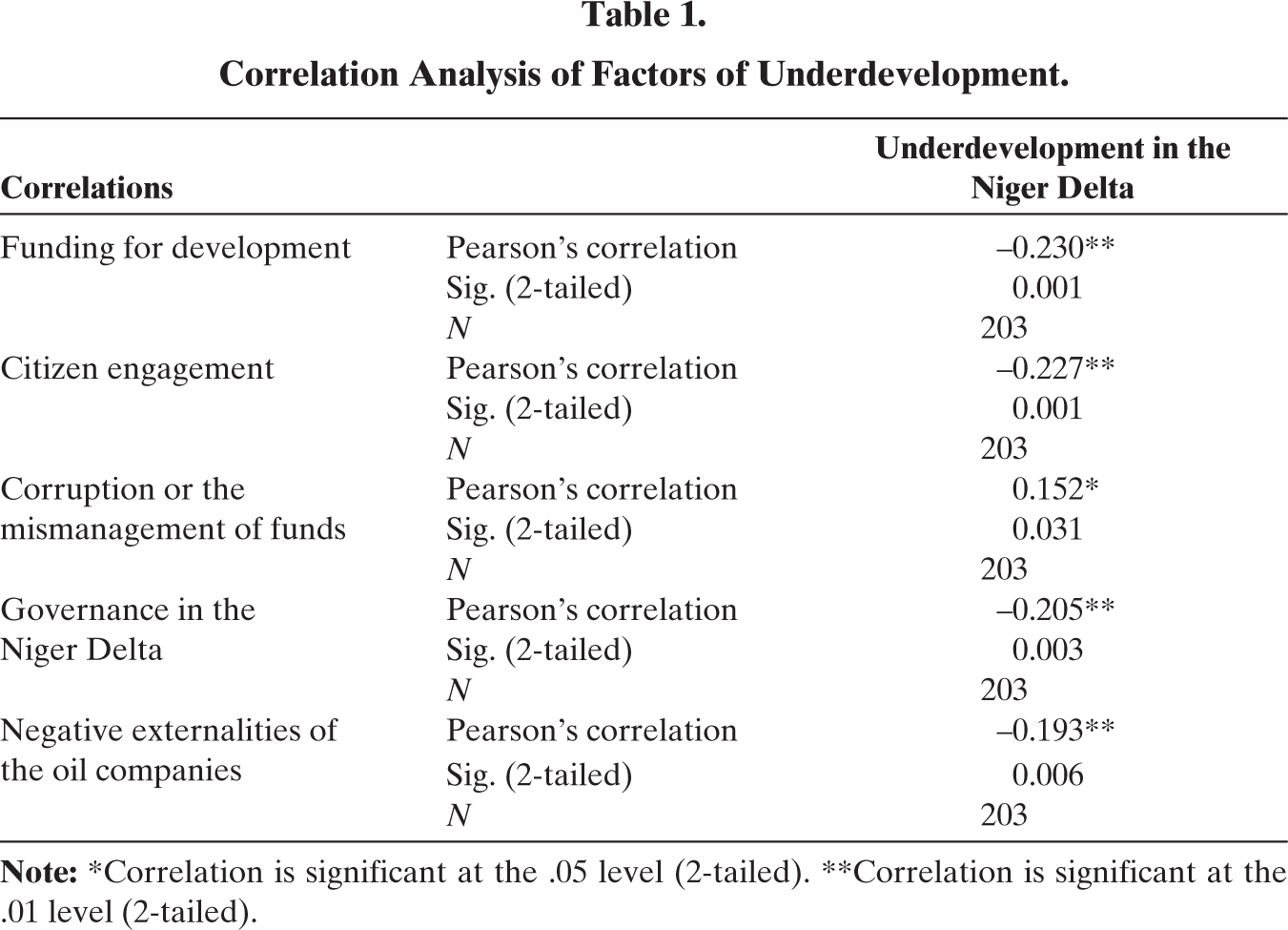
The mean values of all data from respondents show that all the factors evaluated in this study contribute significantly to the poverty and underdevelopment of the region, as follows: funding at 0.001; citizen engagement at 0.001; corruption at 0.031; internal governance at 0.003; and negative externalities of the international oil companies at 0.006. These are captured in Table 1.
Correlation Analysis of Factors of Underdevelopment.
To identify the most significant predictor, the correlates were put in a hierarchical multiple regression (see Table 2) to determine the impact of the predictors. In Model 1, the R2 change, 0.053, attributed to funding for development was significant, P < .001. Thus, in the first model, 5.3% of the underdevelopment in the Niger Delta is due to the lack of funding for development (β = –0.230, P < .001). In the second model, over and above funding for development, the R2 change, 0.021, attributed to citizen engagement in the Niger Delta was significant, P < .05. Thus, in the second model, 2.1% of the underdevelopment in the Niger Delta is due to the low level of citizen engagement in the Niger Delta region (β = –.158, P < .05). In the third model, over and above the change in the second model, the R2 change, 0.006, attributed to corruption or the mismanagement of funds in the Niger Delta, was not significant, P > .05. Thus, in the third model, the mismanagement of funds in the Niger Delta is not a predictor of underdevelopment in the Niger Delta region (β = .086, P > .05). In the fourth model, over and above the change in the third model, the R2 change, 0.006, attributed to governance in the Niger Delta, was not significant, P > .05. Thus, in the fourth model, governance in the Niger Delta is not a predictor of underdevelopment in the Niger Delta region (β = –.092, P > .05). In the fifth and final model, over and above the change in the 4th model, the R2 change, 0.004, attributed to IOC Development activities in the Niger Delta was not significant, P > .05. Thus, in the fifth model, IOC development activities in the Niger Delta are not a predictor of underdevelopment in the Niger Delta region (β = –.074, P > .05).
Multiple Regression on the Most Significant Predictor of Poverty and Underdevelopment.
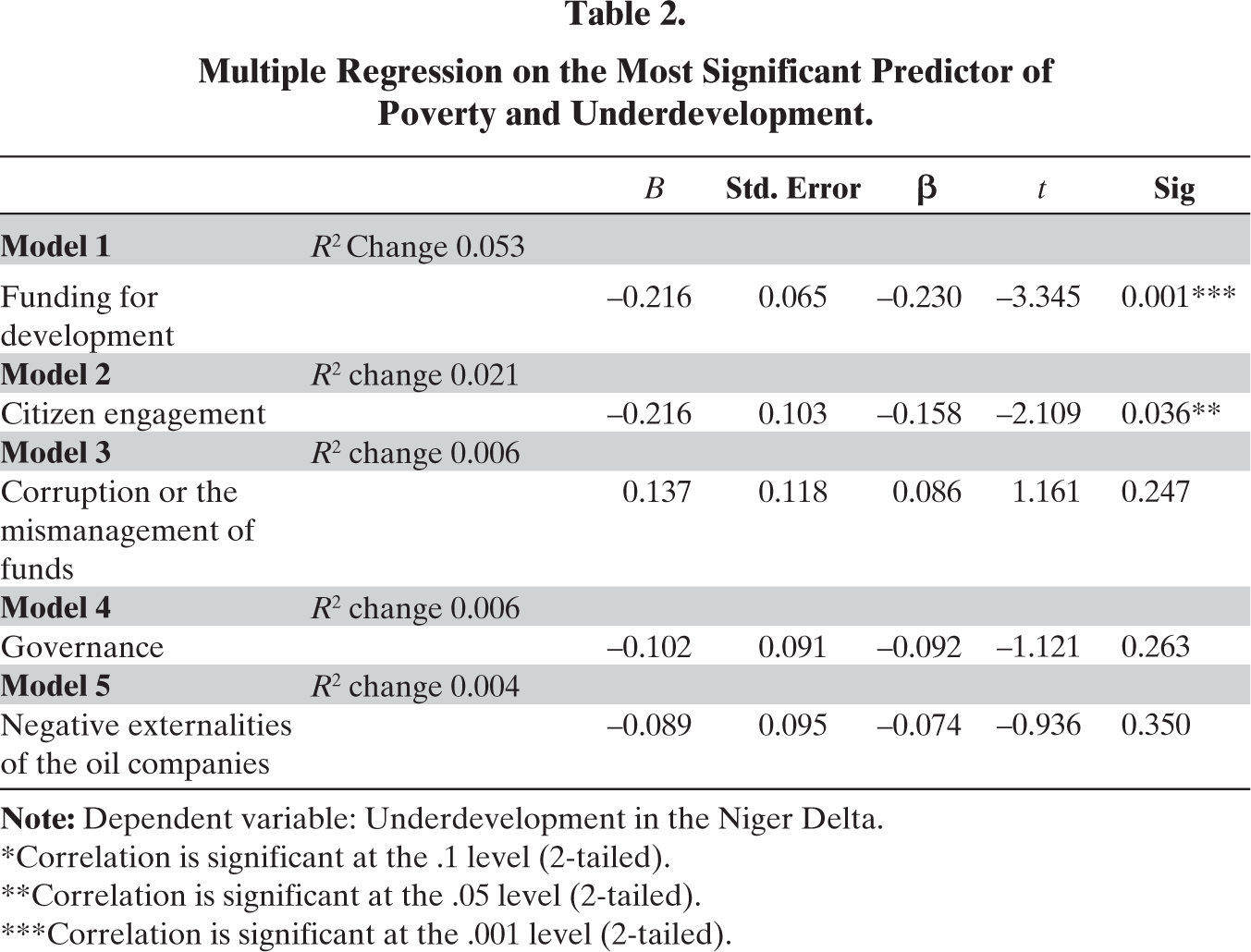
*Correlation is significant at the .1 level (2-tailed).
**Correlation is significant at the .05 level (2-tailed).
***Correlation is significant at the .001 level (2-tailed).
Discussion
Funding as a Critical Predictor of Development
This study supports the position of extant literature on the causal factors of poverty and underdevelopment. It reinforces the understanding that underdevelopment thrives where developmental funds are lacking, where corruption thrives with a poor level of internal governance, where citizens are rarely engaged in developmental plans and execution, and where principal operators in the extractive industry act without consideration of the physical environment. This seems to be the case with the Niger Delta region. According to the structuration theory of Giddens, every society mirrors the characteristics of the individuals that make up such a society. The implication, therefore, is that the poverty and perennial underdevelopment witnessed in the Niger Region can be attributed to human factors. When resources meant for human and infrastructural development are poorly utilized, the effect is usually glaring, as exemplified by the poor state of schools, hospitals, roads, and other social amenities.
In line with prior studies on the perennial underdevelopment of the region (Agbor, 2013; Akpabio & Akpan, 2010; Alakwe & Okpara, 2022; Babalola, 2014; Ikelegbe, 2011), findings confirm that the Niger Delta region is suffering from a hydra-headed problem that must all be addressed for the region to achieve the desired level of development. Aside from the funding challenge, the region grapples with corruption, poor internal governance, unhealthy practices by international oil companies, and the lack of optimal citizen engagement mechanisms.
Further analysis of the result indicates that the most significant predictors are funding and citizen engagement. Funding is significant to the extent that the lack of requisite funding will impede the growth and development of the Niger Delta region. Human and infrastructural development cost money. When this is lacking, both suffer. According to the World Bank (2016), adequate funding reduces poverty and inequality by increasing access to finance for the poor and vulnerable groups, facilitating risk management by reducing their vulnerability to shocks, and increasing investment and productivity, which leads to higher income generation. Money is essential and pervasive in the smooth and efficient operation of the economic system. It not only facilitates the automatic operation of the market mechanism, but it also provides the motivation required for economic progress (Savita, 2016). Thus, adequate provision of funds promotes productivity and economic growth. The implication is that the absence of funds, as well as the prevailing practice where citizens are not carried along in developmental plans, constitutes the most significant predictor of underdevelopment. Evidence exists that proves that funds are continually allocated to the Niger Delta region to address the perennial underdevelopment. This is validated by the provision of a 13% derivation fund, funds from the Federal Accounts Allocation Committee (FAAC), royalties from the international oil companies, budget allocation for the NDDC, budget allocation for the PAP, and the Ministry of Niger Delta. Within the context of funding, one can state unequivocally that the perennial developmental challenge in the region is tied more to the management of available funds and less to the paucity of funds. According to data from the National Bureau of Statistics and the Budget Office, the nine Niger Delta States received a total of N3,175,474,925,434 through the NDDC between 2011 and 2020, while the Ministry of Niger Delta received a total of N422,803,354,546 during the same period. In a similar vein, the total allocation to the nine states from the FAAC was approximately N10,573,910,000,000.00, whereas the expenditures for the PAP amount to N638,196,605,160.00. The preceding confirms that the total allocation to the Niger Delta region for the ten years presented is approximately N14,810,384,885,142.00. At the current exchange rate of N463.85 per US dollar (April 2023), this equates to $31,929,254,899.52 US dollars. This is in addition to royalties paid to host communities by international oil companies operating in the region. To comprehend the level of financial resources expended in the region over the past decade, globalecononomy.com data reveals that the average expenditures of the 36 African nations in 2022 were 7.84 billion US dollars. South Africa spent the most with 79.5 billion US dollars, while the Comoros spent the least with 0.12 billion US dollars (Global Economy, 2023).
Regrettably, despite the availability of these funds, the Niger Delta region still grapples with poverty and underdevelopment and ranks abysmally low on all developmental indices. The developmental paradox in the region underpins the propositions of the rentier state theory. Consequently, these allocated funds are squandered through mismanagement and corrupt practices. While funding remains essential to development, the challenge here is not so much the availability of funds as it is the prudent management of the available funds.
Importance of Citizen Engagement and Participatory Communication for Development
This study brought to light the centrality of citizen engagement and participatory communication in development. Aside from funding, the apparent lack of citizen engagement in the Niger Delta emerged as the second-most significant predictor of poverty and underdevelopment. Thus, at the heart of the developmental challenges faced by the region is the apparent lack of a participatory development communications strategy that will encompass the optimal engagement of the citizens in the conceptualization and execution of developmental projects. This will instill a high sense of belonging and ownership such that all monies, irrespective of how big or meager, will be judiciously used for both human and infrastructural development. Participation is essential to development because it grants all individuals the right to express their opinions and concerns, thereby making them partners in the development process. As Freire (1970) posits,
People should be encouraged to have a sense of ownership through shared experiences. If people are denied this participatory right, then it will be tough to prove to them that such developmental initiatives serve their best interests.
One can therefore assert that this lack of participation is at the heart of the development issues facing the Niger Delta region. The lack of participation results in people viewing developmental plans and projects with suspicion. It frequently results in higher project execution costs, a lack of ownership, a heightened sense of alienation, and the inability to capitalize on indigenous knowledge and expertise (Alakwe & Okpara, 2022). The belief, therefore, is that if the citizens are carried along in all developmental initiatives for the region, they will contribute their quota to ensure such initiatives succeed. This again confirms the view of Alakwe and Okpara (2022) that poverty is not eradicated by empowering a few but through a transparent and sustained strategy that encompasses the overall interests of the people of the Niger Delta region, both wealthy and poor (p. 214). According to Alakwe and Okpara (2022), citizen engagement and participation are virtually nonexistent as far as projects in the Niger Delta are concerned. The practice is that the government unilaterally conceptualizes, commissions, and executes projects without recourse to the people. Thus, there is a disconnect between what the people want and what the government is doing, which often results in a feeling of rejection. Consequently, if the citizens were involved, most of the abandoned projects would have been completed.
As posited in Alakwe and Okpara (2022), the people of the Niger Delta prefer a dialogic, participatory style of communication. This style of communication, it is believed, will facilitate belongingness, and increase the level of ownership of developmental projects, which will further encourage them to contribute to and monitor such development projects to completion. In the referenced study, the people are of the view that the top-down approach alienates them from developmental strategies and plans and the natural resources that they view as their heritage. The use of opinion leaders was also frowned upon due to a lack of trust arising from the significant exhibition of selfish tendencies that had always led to strife and tension in the land. The fact that, more often than not, the government adopts a top-down approach is seen as responsible for the general rejection of such development projects by the people.
It is not enough to provide funding and redistribute the same internally as highlighted in the rentier state theory without first understanding the people’s needs and desires. This might be the reason why such funds are almost always embezzled through the collaborative acts of some citizens in collusion with people in government. The failed promises, perceived marginalization, and sustained alienation of the people have led to a heightened level of apathy, suspicion, and disinterest in the developmental plans and activities of the government and other donor agencies in the region.
Conclusion
This study affirms that the perennial underdevelopment witnessed in the Niger Delta region of Nigeria can be attributed to diverse factors. These include funding, internal governance, negative externalities of the international oil companies, participatory communication (citizen engagement), and corruption. These factors coalesce, sustaining poverty and stifling the growth and development of the region. The study contends that the most significant predictor of poverty and underdevelopment in the region is funding and the lack of a participatory communication mechanism through which the citizens will be engaged in all developmental plans, right from the point of conceptualization of developmental projects to execution and evaluation. If funds allocated to the region for diverse developmental activities are used for the purposes for which they were appropriated, the pace of development will significantly increase, leading to a reduction in the poverty level.
On the other hand, if the people are adequately engaged and informed about plans for the region, the citizens will be willing to contribute their quota, leveraging the knowledge inherent in the local communities toward development. Such an approach will undoubtedly contribute significantly to redirecting the region to the path of growth. Most importantly, it is believed that such knowledge of developmental plans will significantly increase ownership of such projects and reduce the prevalence of corruption. The citizens will also be empowered to contribute toward such projects, from conceptualization to evaluation, and will be better informed to ask pertinent questions that relate to their individual and communal welfare, which will consequently result in a more progressive region.
This study, therefore, proposes that to ebb the tide of underdevelopment and stimulate the desired growth, the government, the international oil companies, and all the multilateral donor agencies operating in the region must institute communication strategies that will engage the citizens in a synchronous and dialogic fashion. This will be in addition to measures that will improve internal governance mechanisms, optimal management of financial resources, and healthy exploratory practices of the multinational oil companies operating in the region. These approaches promise to empower the people to actualize the development of the region.
Recommendations
This research has highlighted the strong relationship between corruption, citizen engagement, internal governance, funding, and the perennial underdevelopment in the region with its attendant poverty. Based on the research findings, this study recommends that adequate measures be put in place to track the flow of funds from governments and donor agencies and monitor how such funds are expended. The citizens of the region must learn to hold their political leaders accountable. To do this, there is a need for adequate information on budgetary allocations and other funds meant for the region. When this happens, the citizens will be adequately armed to query how such funds are spent.
More importantly, there is an urgent need for an in-depth understanding of the developmental needs of the Niger Delta region, the yearnings of the people, and a better understanding of the right approaches that will engender the growth and development of the region. This must be driven by a participatory style of communication that will drive citizen engagement. Such a model will position the people of the Niger Delta, the government at all levels, the oil companies, and other development agencies as both sender and receiver in a single, unique, synchronous, and communicative act. Here, the parties will see each other as partners in the quest for development. Thus, there is a need for a more rigorous exploration of dialogism as a theoretical approach to communication in relation to polyglossia (different languages) and heteroglossia (different viewpoints)—two principal features of the Niger Delta.
Footnotes
Declaration of Conflicting Interests
The author declared no potential conflicts of interest with respect to the research, authorship, and/or publication of this article.
Funding
The author received no financial support for the research, authorship, and/or publication of this article.