




Abstract
Colombia, like other countries in the region, is undergoing a moment of self-definition. At its heart lies the issue of development. The increasing plurality of competing development models and political economies, however, complicates the discursive landscape and defies conventional approaches. To make sense of this complexity, grid group cultural theory and its typology of four irreducible, mutually exclusive, and jointly exhaustive ideal-typical worldviews is proposed. Four distinct development models are identified in Colombia’s recent experience, illustrated by neoliberalism, developmentalism, post-development alternatives such as Buen Vivir and Vivir Sabroso, and a chimera.
Keywords
Introduction
A moment of reckoning has come to Colombia. An unpopular tax reform proposed in 2021 was the straw that broke the camel’s back and led to what seemed like the accumulation of decades of social dissatisfaction with the status quo, with some of the most widespread and violent protests in the country’s history. What is more, Colombia seems to have passed the proverbial point of no return in June 2022 with the presidential election of the first candidate not affiliated to right of center political movements and interests. Colombia, however, is not alone. Many countries in South America (e.g., Ecuador 2019, 2022; Peru 2022) have experienced social unrest regarding the direction they were heading and the avenues taken to get there (Garcés-Velástegui, 2022a).
At the heart of this state of affairs lies the issue of development, or who-is-owed-what-how-and-why in a polity (Garcés-Velástegui, 2023). Being an intrinsically normative term (Chambers, 2005), development suggests what is the desirable social state and how to get there. This means that no conclusive definition can be agreed upon, making it an essentially contested term (Garcés-Velástegui, 2022b), and that different development models and ideas advance distinct desirable social ends and means. They compete with each other for adherents and, ultimately, for translation into practice. In this sense, Colombia’s recent record shows two simultaneous phenomena. On the one hand, there is the dominance of one development model for at least the last half of a century. On the other hand, there is an increasing diversity of challenges to that model graining growing currency in multiple sectors.
Colombia’s development is in dispute; that is, it has become a problem. But development is no ordinary problem, but a wicked one since it is characterized by inter alia the lack of an exact definition and optimal solution (Garcés-Velástegui, forthcoming). To address wicked problems, it is necessary to construct clumsy solutions, which seek to be both legitimate and effective by incorporating the perceptions and preferences of the relevant parties (Verweij et al., 2006). However, development is in question and there is no short supply of alternatives. Indeed, from students to indigenous people to health workers to human rights activists, the 2021 demonstrations were characterized by the participation of a wide variety of sectors demanding for multiple changes in the government’s policy agenda. Moreover, in the last presidential election of June 2022, although the contest was framed as the well-known competition between a right of center and a left of center option, the number of issues in debate, their character, and the proposals made to tackle them paint a picture that defies such oversimplification.
How to make sense of this increasingly plural scenario and complex discursive landscape? The features of this situation seem to challenge traditional approaches based on left–right political analysis to both understand it and to provide plausible proposals to resolve it. Therefore, grid group cultural theory (CT) is proposed here to elucidate this matter as it provides a richer typology while conserving an adequate degree of parsimony (Hoppe, 2007; Mamadouh, 1999), which has proven to be more useful to account for the political climate, than conventional liberal-conservative approaches (see, e.g., Gastil et al., 2011; Jones, 2011; Kahan & Braman, 2003; Kahan et al., 2007).
From a functionalist perspective, the framework advances four mutually exclusive and jointly exhaustive ideal-typical ways of life, that is, four irreducible and distinct ways to understand the world and, thus, act on it. Since each entails an interpretation regarding essentially contested terms such as development (Garcés-Velástegui, forthcoming), it can prove useful to clarify Colombia’s wicked development problem. Furthermore, each also favors different ways in which the process of including the preferred solutions of all, that is, constructing clumsy solutions, is to take place (Verweij, 2014). Although, clumsy development models are ultimately political and the product of the public sphere, these messy institutions, so called because they tackle plurality head-on, are procedural alternatives that can inform both scholars, policy analysts and policymakers.
As a first step toward the construction of clumsy development models for Colombia, this article elaborates an argument in favor grasping the current political sphere from a plural rationalities perspective. To do so, it is structured in three sections. The first presents the most relevant aspects of the theory, elaborating its insights regarding the development debate. The second section applies those insights to the Colombian experience, emphasizing its most recent record, to map out the main development notions competing for execution. The final section concludes.
Cultural Theory and Four Development Models
CT, also known as plural rationalities theory, is the brainchild of many scholars from various disciplines such as Aaron Wildavsky in political science (Wildavsky, 2006); Christopher Hood in public administration (1998), Marco Verweij in international relations (Verweij, 1995), and Michael Thompson from an interdisciplinary perspective (1999). None, however, is looms larger than Mary Douglas, whose pioneer work in anthropology created the theory, which was subsequently enriched from others areas and perspectives. One novel and recent contribution has been made from the field of development studies to make sense of an increasingly complex landscape (Garcés-Velástegui, forthcoming).
CT proposes an account of the maintenance and change of ways of life. Subscribing to an interpretivist approach (Swedlow, 2014), this framework posits that people’s actions in the world depend on their views regarding the phenomena in it. By so doing, it stresses that it is not possible to separate perceptions and organizations of social relations from each other (Douglas, 1986).
To provide this account, CT focuses on cultural bias and social relations. First, cultural biases refer to the systems of meanings used by people to make the world intelligible and, by so doing, to justify specific social arrangements (Hoppe, 2007). Second, social relations denote people’s enduring patterns of relations and interpersonal dynamics (Thompson et al., 1990). Cultural biases and social relations are mutually dependent and reinforcing. On the one hand, beliefs and values, that is, cultural biases, lead to certain social structures and social relations which are legitimated by people’s acting according to them. Should people change their belief systems, social relations are likely to change as well. On the other hand, the continuous practice of given social relations and dynamics, which express certain cultural biases, preserve the latter. If practices change, cultural biases are also modified.
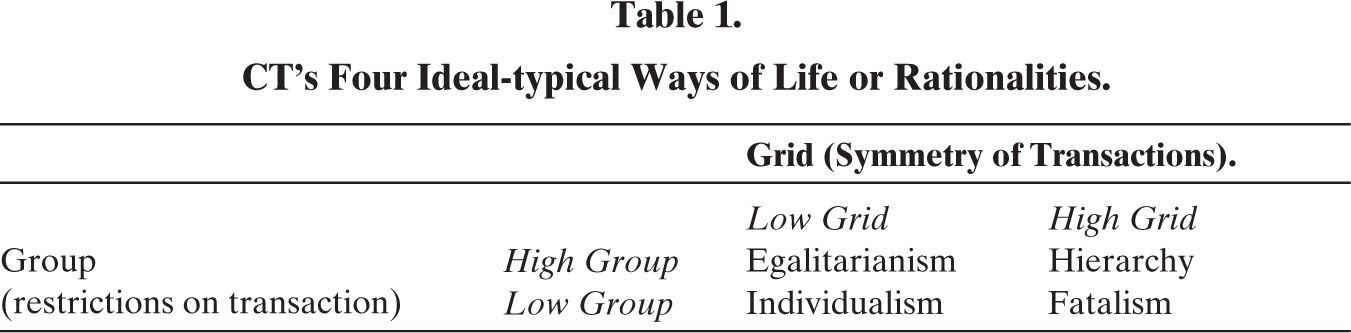
How to make sense of the virtually infinite number of cultural biases and social relations? They are explained by both internal and external factors, denoted as grid and group, respectively. Grid denotes the self-imposed rules and norms that connect people to each other. These are institutions that govern people’s relations. Thus, while low grid is evidence of few and flexible norms that can be negotiated and therefore entail symmetrical transactions among people, high grid point to multiple and stringent mandatory rules (Hoppe, 2007). Group refers to the importance of membership to a bounded social entity. In this case, whereas low group indicates weak belonging to a collective and thus entails unrestricted transactions among individuals, and high group means strong membership (Hoppe, 2007).
Significantly, and as a corollary of the above, because grid and group rule human behavior and decision-making, they also convey the degree of freedom or autonomy enjoyed by individuals (Lockhart, 1998; Thompson et al., 1990). As such, these two dimensions can provide an account of the notion and practice of liberty held by people. This goes beyond the unidimensional approach proposed by the conventional left–right spectrum used in politics (Gastil et al., 2011; Jones, 2011; Kahan & Braman, 2003; Kahan et al., 2007) to account for the preferences regarding the kind and degree of individual freedom and state action or intervention.
The combination of these two dimensions results in a typology of ways of life: individualism, hierarchy, egalitarianism, and fatalism (see Table 1). The latter is a rather passive whereas the other three are active (Hoppe & Peterse, 1993). Significantly, these are irreducible, ideal-typical, mutually exclusive, and jointly exhaustive, as well as interdependent ways of life. They are irreducible since they cannot be further simplified nor brought to another form or condition. They are to be regarded as ideal types in the Weberian sense (Altman & Baruch, 1998; Coyle, 1994), that is, considering that they find no illustration in neither history nor actual experience (Käsler, 1988). Nevertheless, they serve the purpose to elucidate social phenomena according to their fit with each category. Additionally, they are mutually exclusive because they lack redundancies or overlaps among them and jointly exhaustive because together they encompass all ways of life, so that none is left unaccounted for. To be sure, the literature points to one more ways of life: the hermit (see, e.g., Hoppe, 2007; Mamadouh, 1999) but since it is characterized by its self-reclusion from social life, it is of no relevance for this discussion. Finally, they are all interdependent because, as is fleshed out below, their existence depends on that of the others, whether as a complement of an antagonist (Thompson et al., 1990).
CT’s Four Ideal-typical Ways of Life or Rationalities.
The survival of ways of life depends on how well they can explain reality and predict events so that adherents to them can confidently act upon the beliefs and valued emanated from them. When those accounts fail, that is, there is a discrepancy between experience and expectation, individuals are stricken by surprise. When ways of life fail sufficiently often, adherents to them search for alternatives that offer more trustworthy accounts. Hence, the loss of one is the gain of another in a constant flux (Thompson et al., 1990).
Ways of life, also known as worldviews, solidarities, and outlooks, are referred to as rationalities as well. This is significant because each one offers a distinct notion of rationality and what is “rational” (Bell, 1997/2017). “Thus, CT simultaneously pluralizes and bounds rationality” (Swedlow, 2014, p. 703). Indeed, each way of life defines advances in a distinct definition for essentially contested terms, like development (Garcés-Velástegui, forthcoming).
Individualism and Neoliberalism
Individualism is at the intersection of low grid and low group. As such, this outlook promotes the most individual autonomy. This worldview regards human nature as self-seeking (Thompson, 2003) and nature as generous (Douglas, 1992a), providing a cornucopia of resources, and so they should be. Therefore, the focus is on advancing individual freedom and the system is regarded as anarchical, lacking a central authority, where institutions are only temporary and always negotiable. In this context, the market is the adequate social regime (Schmutzer, 1994), competition its control device (Hood, 1998/2000), laissez faire is the preferred governance mechanism, the system’s most important attribute is exploitability (Schwarz & Thompson, 1994), and autonomous decision-making is how choices are made. Hence, only the individual, the self, has intrinsic value; others and the environment have only instrumental one, to the extent they benefit the latter (Garcés-Velástegui, forthcoming).
Individualist development follows modernity’s tradition and furthers only one way: market-led. While the end is individual prosperity, the means are the exercise of individual freedom regulated by competition (Garcés-Velástegui, forthcoming). In terms of the ethics of development, a good life consists of material wealth accumulation, a just society is expressed as freedom of opportunity, and nothing is owed to nature as there is plenty of it for all (Garcés-Velástegui, forthcoming).
This worldview resonates with a neoliberalism as a development model. Although polysemic, the historical record offers important illustrations particularly in terms of the policies it induces. It has, for example, been summarized as the DLP formula (Steger & Roy 2010), which conveys the preference for reforms that put market above state: Deregulation of the economy; Liberalization of trade and industry; and, Privatization of state-owned enterprises. The most telling example is perhaps the Washington Consensus, proposing a number of development policies for Latin America. This decalogue was considered as the set of recommendations that would find agreement among the International Monetary Fund, the World Ban, and the US Federal Reserve (Williamson, 1993).
Hierarchism and Developmentalism
Hierarchism is produced by combining high grid and high group. Therefore, this worldview advances the least individual autonomy. According to it, human nature is flawed, but redeemable if the right institutions are in place (Thompson, 2003), and nature has limits or is tolerant (Douglas, 1992a) since it is not endlessly renewable. Thus, the focus is on the establishment and the institutional framework, where the system is regarded as a pyramid of authority, with a central authority on top, where institutions have intrinsic value since they reduce uncertainty in people’s conduct. This scenario favors hierarchy or bureaucracy as the social arrangement (Schmutzer, 1994), oversight as the pertinent control instrument (Hood, 1998/2000), the Leviathan as the governance scheme, controllability as the system’s most important feature (Schwarz & Thompson, 1994), and chain of command for decision-making. Consequently, only the system has intrinsic value; people and the environment have only instrumental one, and insofar they benefit the latter.
Hierarchical development also follows modernity’s tradition and advances only one: state-led. Whereas the end is system-wide material welfare within environmental limitations established by science, the pathways to it are central planning and cunning technical policies (Garcés-Velástegui, forthcoming). In terms of development ethics, a good life is climbing up the ladder following and enforcing the rules, a just society is one governed by the rule of law, and nature is owed usage to the extent science deems it appropriate (Garcés-Velástegui, forthcoming).
This outlook chimes with developmentalism as a development model. There are multiple instances on record of comprehensive government regulations to induce development. The illustrations, to some extent, are the policies implemented by some Asian and European countries during their development stage (Chang, 2003, 2008). There are, however, no exhaustive recipes to illustrate this model. A plausible list could arguably encompass government spending in public services, regulation of markets, and planning as well as interventions toward established societal goals (Garcés-Velástegui, forthcoming). Certainly, these policies are subject to change in accordance with science and technical expertise. The qualified development paradigms of “economic,” “human,” and “sustainable” development sponsored by influential organizations such as the United Nations exemplify this. What they share is a notion of development produced by a strong and well-functioning state, which entails considerable intervention over the economy, restricting the market, not leaving it to its own devices, but orienting it in the pursuit of well-defined goals.
Egalitarianism and Post-Development
Egalitarianism is found by merging low grid and high group. Thus, it restricts individual autonomy in terms of the collective but not in terms of institutions. For this outlook, human nature is inherently good but sensitive to influences from inegalitarian institutions (Thompson, 2003), and nature is ephemeral (Douglas, 1992a) or finite and vulnerable. It is a critical way of life that defines itself in opposition to others, that is, hierarchical and individualist, due to their inegalitarian tendencies. Therefore, they distrust and feel threatened by institutions from without and subscribe only to a collective moral fervor and rejection of the outside. In this sense, egalitarians prefer the clan or the enclave social arrangement (Schmutzer, 1994), mutuality as the control device (Hood, 1998/2000), the Jeffersonian as the governance model, sustainability as the system’s main property (Schwarz & Thompson, 1994), and consensus for decision-making. Accordingly, people and the environment have intrinsic value, they are meaningful in and of themselves.
Rather than egalitarian development, there is an egalitarian non-development best captured by post-development. Therefore, modernity and its pursuit of absolutes is rejected, and plurality is promoted instead. Thus, there are multiple legitimate ends and means regarding what “good change” means. Post-development is community-led, from the local level and grounded on particular experiences, embedded in a particular context. Its end is equal welfare for all (plurally defined) and a harmonious coexistence with the environment, and the means are mutuality and protection of nature (Garcés-Velástegui, forthcoming). As for development ethics, a good life is caring for others and for the environment, a just society is one prioritizing solidarity, and nature is owed conservation (Garcés-Velástegui, forthcoming).
“Development,” from this perspective, is a discourse, entailing an exercise of power of those defining it after themselves, the North, over those contrasting with the definition, the South. This discourse is deliberately imposing a normative idea of those using it (Escobar, 1995/2012) and shaping their self-perception (Esteva, 1992). The ends and means of development are regarded as the imposition of the interests of powerful countries and operationalized by international organizations, for example, International Monetary Fund, the World Bank, the United Nations (Development Program), and development agencies (e.g., USAID, GIZ). Consequently, post-development proposes alternatives to development, instead of development models. Defying mainstream policy recommendations and international best practices, these alternatives are found at the local level, in grassroots movements, vernacular cultures, rural communities, even in the informal sector (Rist, 1997; Ziai, 2007). There are notable examples from the around the globe (Garcés-Velástegui, forthcoming).
Fatalism and Apathy
Fatalism is at the intersection of high grid and low group. For this rationality, freedom is restricted by rules but not by affiliation to a collective. Fatalists see human nature as fickle and untrustworthy (Thompson, 2003) and nature as capricious (Douglas, 1992a) or unpredictable. They lay at the bottom of the pyramid and are always the rule takers, never the rule makers. Therefore, although they abide by them, institutions are seen as imposed and oppressive. Due to their self-perceived disenfranchisement, the zero-matrix is the preferred social arrangement (Schmutzer, 1994), contrived randomness is the control mechanism (Hood, 1998/2000), no preferred governance scheme is posited, since their vote is inconsequential, the most important feature of the system is copability (Schwarz & Thompson, 1994), and no decision-making procedure is advanced. Neither people nor nature have a particular value since the only valuable being is oneself, while others as well as the environment are unpredictable.
Fatalist development is a chimera. Since development is not something that simply happens but it is caused, it requires purposive agency. Given that this outlook sees the world as ruled by randomness, any and all attempts to produce an outcome is likely to fail. Therefore, development is a lost cause and fatalists have no development model to promote. Regardless of the model, they find themselves at the bottom; their ends and means are detrimental to them and oppressive (Garcés-Velástegui, forthcoming). Apropos of development ethics, a good life is beyond their grasp so the most they can do is survive; a just society is an illusion, and nature is owed respect or fear (Garcés-Velástegui, forthcoming).
That being so, no development model can be associated to this solidarity. In all models, whether market-, state-, or community-led, fatalists not only do not participate in the alleged benefits but are exploited to produce them. They are the definition takers, not the definitions makers; therefore, whatever its meaning, development is imposed on them and generated at their expense. They have no say and no deed, and even if they did, it would be inconsequential at best and self-harming at worst because of the unpredictability of the world. Indeed, underdevelopment is a likely outcome of enacting any development model.
Application of CT to the Development Debate.
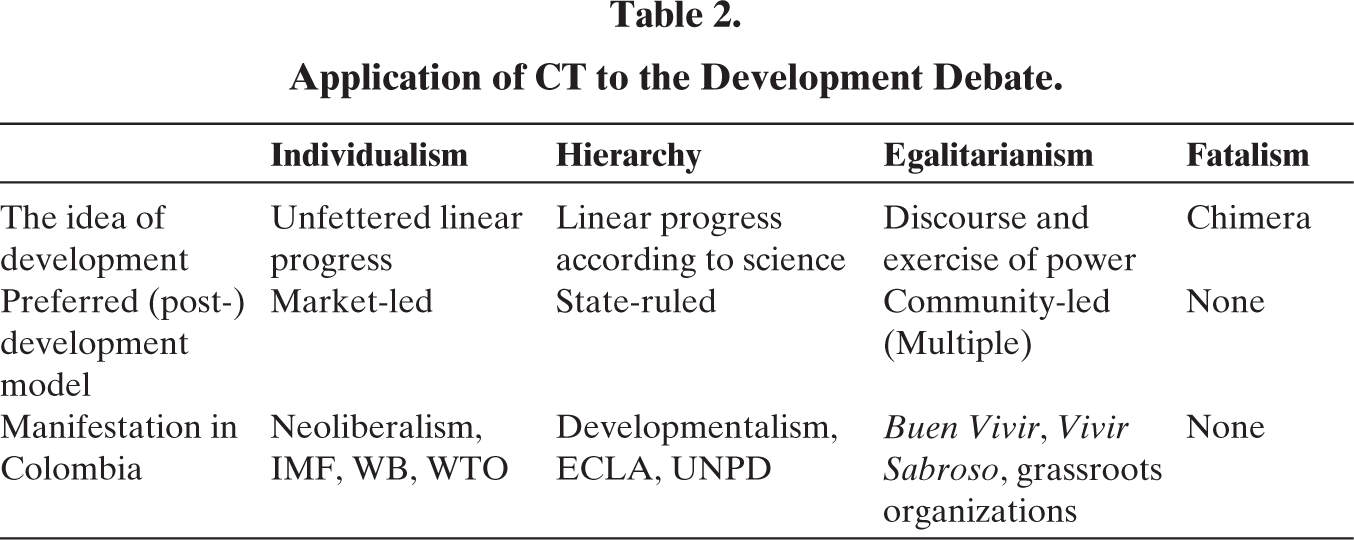
A summary of these ideal-typical development models is presented in Table 2 with their corresponding illustrations. These manifestations have different shapes and designs in different moments and places, showing the different distributions of influence and power within a polity, but they all coexist with each other. As mentioned above, they are interdependent, whether as complement or antagonist. What is more, although no synthesis of all four is possible (Mamadouh, 1999), CT accommodates the possibility of hybrids (Hoppe, 2007). Perhaps the most evident one is that between individualism and hierarchy (Douglas, 1992b). While the hierarchism–individualism diagonal is viable, the other diagonal, fatalism–egalitarianism, is only a latent one, due to the apathy and lack of agency of fatalists (Douglas, 1992b). Other hybrids are much less unlikely because of the very nature of worldviews (Hoppe, 2007).
Colombia’s Four Development Models
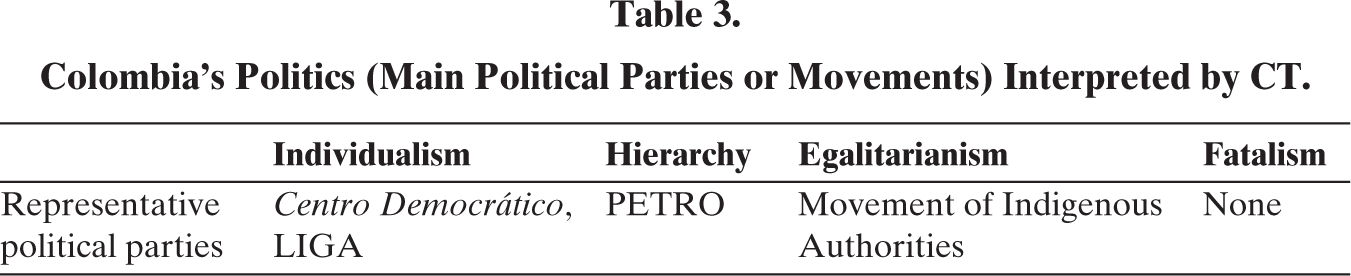
To different extents, recent occurrences as well as the current state of affairs in Colombia provide compelling evidence of expressions of these notions of development. To recall, since CT’s four ways of life are ideal types, so are the ideas of development derived from them. That means that the empirical manifestations that can be found in Colombia’s historical record do not fully correspond to either of them but they need not to. Their characteristics allow sufficient differentiation so as to associate them with each one and thereby clarify the multiplicity and complexity of the development models in the country (see a summary in Tables 2 and 3).
Individualism: The Neoliberal Market Above the State
Colombian individualist market-led development can be exemplified by the influence of neoliberalism. This is part of a widespread phenomenon that permeated the region at the level of ideas as well as at the level of practice (Garcés-Velástegui, 2022a, forthcoming). The 1980s and 1990s in Colombia were virtually dominated by neoliberal thought and unlike neighboring countries such as Ecuador and Venezuela, they prevailed throughout different governments until 2022. Modernization and industrialization through deregulation and non-intervention were the mantra of the epoch. This meant the introduction of market-friendly incentives, the expansion of political liberties, and reduction of state action. Austerity measures, privileging foreign debt payments, privatization of state own companies, and deregulation of labor currency exchange and trade are but a few examples.
This agenda was supported by powerful international financial organizations such as the International Monetary Fund and the World Bank on which the considerable share of a country’s spending depended. The clearest manifestation of the power exerted by these institutions over countries are the commitments agreed-upon via letters of intent. Results in Colombia were underwhelming, particularly when it came to people’s quality of life. In the 1980s, indicators failed to meet expectations or the promises made by neoliberals and only in the 1990s some meagre betterments were evidenced (Bulmer-Thomas, 2003).
Thus, Colombia’s neoliberal development model was wide-ranging, illustrating the reach of neoliberalism itself:
a set of economic theories linking disparate policies together into a coherent recipe for growth or modernization; prescriptions for the proper role of key actors such as labor unions, private enterprise, and the state; and an explicitly political project to carry out these prescriptions and ensure that actors play by the rules of the game. (Boas & Gans-Morse, 2009, p. 144)
Although most countries in the region seemed to have moved on from neoliberal policies by the turn of the century, Colombia appears as an interesting exception. The so-called left-turn that took place in Latin America did not affect the country. Consequently, to different extents, neoliberal policies continued to be promoted and implemented and so were their benefits and damages. While the market enjoyed a privileged position, which produced some levels of growth, it was not distributed so as to contribute to those most in need. By the end of the twentieth century, Colombia experienced the highest share of the population in extreme poverty, with a notorious increase in the 1990s.
In the twenty-first century, neoliberalism kept its hold over government. From 2002 until 2010, the Uribe administration, leader of the political party Centro Democrático, established a rather aggressive market-led development model, with important conservatist elements. From 2010 until 2018, Juan Manuel Santos became president, with the support of Partido Social de Unidad Nacional political party, and sought a more moderate stance, a third-way economic liberalism, without challenging the development model. Ivan Duque took office from 2018 until 2022, sponsored by the political party Centro Democrático, and advanced a deepening of the market-led development model.
Hierarchism: The Developmentalist State Above the Market
Hierarchical or state-led development in Colombia has been attested in different moments. Most clearly, the region went through it in the shape of a developmentalist stage, in the second half of the twentieth century and before the neoliberal age. Colombia experienced this development model under the influence of Keynesian-inspired policies during this period as well (Amézquita-Zárate, 2010).
These ideas have gained popularity in academic as well as policy circles in Latin America at different moments, most significantly in the second half of the last century (Garcés-Velástegui, 2022a, forthcoming). The Economic Commission for Latin America and the Caribbean’s (ECLA) was at the forefront of such efforts. Illustrated by the work of Paul Prebisch (1950), one powerful idea was the insight that the terms of trade proved to be detrimental to economies based on commodities and raw materials because, over time, the quantity of industrialized products from developed economies required increasingly larger quantities of materials from underdeveloped economies. This meant that the state of affairs was found to be harmful to developing economies and so was free trade since it exacerbates it. The implication of these findings were that state intervention was deemed necessary to provide some sort of protection from foreign competition. Although these ideas had influenced scholarly circles in Colombia, they were less successful to influence policy.
Developmentalism in Colombia was manifested in some protectionist initiatives seeking to avoid the negative effects of international trade. Arguably, these policies fall within the wider import substitution industrialization model that influenced the region. As its name suggests, this program sought to incentivize domestic industrialized production by blocking the import of specific products from without, due to the unsatisfied demand for them. To be sure, this was supposed to be a temporary measure only, until local production became competitive enough so as to be able to enter other markets and reap the benefits of free trade. That being so, it can be regarded as an instance of the infant industry protection project that has proven to be successful throughout history in different parts of the world; so much so that current developed economies reached their status by employing these and other state-centric policies (Chang, 2003).
The idea behind import substitution industrialization is that a backward country starts producing industrial products that it used to import, thereby ‘substituting’ imported industrial products with domestically produced equivalents. This is achieved by making imports artificially expensive by means of tariffs and quotas against imports, or subsidies to domestic producers. (Chang, 2008, p. 22)
Although persuasive theoretically, in practice these policies proved neither problem-free nor long-lasting in the region (Bulmer-Thomas, 2003).
These policies were pursued in Colombia in the second half of the 1960s (Amézquita-Zárate, 2010). Although these policies produced positive results in some indicators, it did so at the expense of high foreign debt, and high inflation, which became a burden too heavy to bear (Bulmer-Thomas, 2003). This context allowed neoliberal ideas to gain traction and eventually to take hold of government during the 1980s and 1990s throughout the region.
Currently, a new moment of state-led development seems to be starting with the election of Gustavo Petro in June 2022. Indeed, the policy agenda promoted during his campaign places the state on the steering wheel and seeks to direct the market to work in the direction established by the government. Progressive taxation, increased public spending to expand social programs, are but a few examples. To be sure, some policies are also market friendly and others community- and nature-oriented such as the concern for increased participation of indigenous peoples and environmental protection initiatives.
Egalitarianism: Community Above State and Market
Egalitarianism in Colombia, following the post-development insights, is to be found at the grass roots and local level. It is manifested in inherited wisdoms, circumscribed within specific communities. Because these are often excluded and marginalized segments of society, these ideas run counter to the mainstream, held by the dominant individualist or hierarchical worldviews. Although these outlooks may offer different types of development, they all fall within the program of modernity, privileging some views in detriment of others, “particularly the exclusion of the knowledges, voices and concerns of those whom, paradoxically, development was supposed to serve: the poor of Asia, Africa and Latin America” (Escobar, 2007, p. 20). By its very nature, egalitarianism favors diversity but in Colombia’s recent experience, by far the two most influential perspectives are those held by mainly indigenous communities as well as communities of African descent. While the first is known as Buen Vivir or Sumak Kawsay or “Good Living,” the second is known as Vivir Sabroso or perhaps best translated as “Luscious Living.”
Regarding Buen Vivir, it defies the idea of two states being distinguishable in terms of “development,” one earlier and inferior considered as underdeveloped and one later and superior seen as developed, defined by those deeming themselves in the latter (Acosta, 2013). Additionally, it also challenges anthropocentrism. Good Living implies a holistic view in which life itself lies at the center. Thus, it includes people and their quality of life but only as one part, equally important to others, composing the larger system of nature (Gudynas, 2011). Accordingly, Sumak Kawsay implies a movement from an anthropocentrism to a socio-biocentrism (Acosta, 2010).
‘Buen Vivir’ is inspired by the experience and practice of Sumak Kawsay (a life of fullness) by the Andean indigenous peoples who have been marginalised or subordinated throughout history in the name of development. (Villalba, 2013, p. 1428, emphasis in the original)
Buen Vivir, thus, rejects the notion of “development” as advanced by the modernist tradition because it conveys the idea of “a single good change,” one single destination, and one single way to it, established by some and imposed on all. Sumak Kawsay, conversely, is the inherently imperfect and continuously changing idea of living well generated within Andean indigenous communities (Gudynas, 2011). During the 2021 protests, this was illustrated by the demands promoted by the Movement of Indigenous Authorities of Colombia.
Concerning Vivir Sabroso, it also challenges the idea of modern development, as single linear process with only one desirable social state. It is part of the linguistic inheritance of the pacific communities and it “refers to a model of spiritual, social, economic, political and cultural organization, of harmony with the environment, with nature and with people” (Mena & Meneses, 2019, p. 50, author’s translation).
The roots of luscious living can be found in African philosophy, particularly in the notion of ubuntu. Ubuntu itself rejects modernity’s project and entails a break with development (Garcés-Velástegui, forthcoming). Based on an interdependence of all living beings, suggesting that oneness and wholeness are mutually constituting and indivisible (Ramose, 2001), it regards the welfare of one as dependent on the welfare of others and vice versa. This is summarized in the phrase “I am because of who we all are” (Mugumbate & Nyanguru, 2013). Ubuntu “is anchored on the ethical principle of the promotion of life through mutual concern, care and sharing between and among human beings as well as with the wider environment […]. Ubuntu philosophy understands life in its wholeness” (Ramose, 2015, p. 212).
Additionally, Vivir Sabroso also seems to resonate with muntu, another important notion for some African cultures, conveying an integral vision of the universe encompassing all beings, human, non-human, cosmic, and divine, intertwined in a stream that unites past, present, and future (Mena & Meneses, 2019).
Because these are inherently community-based worldviews, their manifestations are multiple and at the local level. While Good Living is shared among people in the highlands, Luscious Living is mostly restricted to the Pacific coast. Political parties are yet to fully embrace these notions and translate them into policy. Additionally, because plurality of views lies at their very core, it is difficult to indicate policy expressions of these ideas. Some common denominators can nevertheless be found, namely the importance of the diversity of cultures, people, and languages, which have an impact on social, cultural, and even judicial policies; the relevance of nature and its conservation leads to the rejection of extractivism whether from neoliberals or developmentalists.
These worldviews have sought participation in public affairs, to different extents, from the grassroots. Most recently, an illustration of indigenous activism could be found in the minga indígena that took place during the 2021 protests. Simply put, a minga is voluntary collective labor toward a common goal, characterized by social utility. While Sumak Kawsay itself did not play a prominent role in the demonstrations, the underlying pleas for equality and environmental protection expressed by indigenous communities, some of whom traveled from remote places to reach urban centers, spoke volumes for it. Perhaps the most telling example of the Afro-Colombian perspective is the latest presidential campaign, where vice-presidential candidate (at the time of writing, vice-present elect) Francia Márquez (Pacto Histórico—PETRO), of African descent, included Vivir Sabroso as part of the winning ticket. More than a slogan, it sought to convey a concern with improving the Colombian social fabric, with special attention to the respect for diversity of those traditionally disenfranchised in different ways, as well as changing the relationship the society has with the natural environment so as to prioritize conservation on the political agenda.
Fatalism: Apathy Either Way
Fatalists have little to say regarding either the social or means to be pursued. Therefore, their participation in discussing solutions is virtually absent. Although they may have preferences, the combination of their lack of self-perceived agency together with their belief of any action to be ultimately ineffectual curtails the search for any specific goals. Nonetheless, as elsewhere, fatalists in Colombia are a large segment of the population. They could be inconspicuous but make a considerable share of the citizenry. As an illustration, in the 2021 protests, which showed unusual participation and violence, the vast majority of the population avoided directly participating in the protests, in spite of being negatively affected by the neoliberal policies or quietly supporting them.
Colombia’s Politics (Main Political Parties or Movements) Interpreted by CT.
Conclusion
Colombia, like other countries in the region, seems to be undergoing a self-defining moment. At its core lies the issue of development, or who-is-owed-what-how-and-why. Because development is inherently normative, it sets the desirable ends and means for a polity, which also means it is inherently political, and thus permeates all of human action. In the last years, the dispute for development in Colombia seems to be characterized by increased plurality which makes the discursive landscape increasingly complex. This scenario defies conventional left–right politics and political analysis, requiring an alternative approach.
CT has been advanced as an answer to that plea. CT proposes an account of cultural viability providing a typology with four mutually exclusive and jointly exhaustive ideal-typical ways of life and notions of development, each illustrated by neoliberalism, developmentalism, post-development, and apathy. Thus, employing this approach to make sense of the current development debate in Colombia elucidates the current state of affairs with three distinctive active rationalities.
Neoliberalism, in different shapes and flavors, has virtually dominated the development debate in at least the last three decades. The most prominent example in the twentieth century is Centro Democrático with the Uribe and Duque administrations. Another, rather surprising, illustration is Liga de Gobernantes Anticorrupción that gained considerable support in the last presidential elections.
Developmentalism did not have sufficient adoption at the national level until the 2022 presidential election, with Gustavo Petro’s victory leading Pacto Histórico. Of course, it remains to be seen whether this ambitious agenda can be adequately and timely translated into policy and results.
Post-development has been found in significant movements illustrated by Buen Vivir and Vivir Sabroso. While the former is advanced by the indigenous communities mostly located in the highlands, the latter is supported by communities of African descent from the Pacific coast. Although plural in nature, these are local level initiatives promoting a better relationship among human and non-human beings based on ideas of equality and environmental protection. Perhaps best translated as “Luscious Living”, Vivir Sabroso has come to the fore due to the Francia Márquez’s victory as vice-president in the 2022 elections.
CT can prove useful to shed further light on Colombia’s struggle for development. First, it can contribute to assess the actual scope or share of the public sphere these outlooks have. By so doing, different explanations for current phenomena can also be explained, most pressingly the combination of hierarchy (developmentalism) with egalitarianism (Vivir Sabroso). Perhaps just as important, in both academic and practical terms, it can also enable the identification of the preferred messy institutions that can inform politics and policymaking to construct clumsy development models. Such insights can prove helpful to shed a modicum of light on the discursive landscape of other countries in the region, especially those underdoing reckoning moments.
Footnotes
Declaration of Conflicting Interests
The author declared no potential conflicts of interest with respect to the research, authorship, and/or publication of this article.
Funding
The author received no financial support for the research, authorship, and/or publication of this article.