




Abstract
This article analyses overall NGO accountability and accountability to beneficiaries in particular. It is based on the collection of qualitative data from four NGOs in Bangladesh. The participation of beneficiaries has been disaggregated into three phases for more analytical discussion: decision-making, implementation, and evaluation. The study results reveal that the participation of beneficiaries is much higher in the project/program implementation phase. The condition is alarming for the decision-making and evaluation phase, where participation is more rhetoric and sham rituals than the actual exercise. The study also identified some formal and informal mechanisms of participation.
Introduction
The present article focuses on assessing NGO downward accountability—on how and to what extent NGOs are accountable to their beneficiaries. The accountability of NGOs has emerged as a pressing issue. NGOs are being called upon to justify their performance in terms of better organizational and program accountability (Ngin, 2004). NGOs generally depend on donor funds, which give the donors an edge. On the other hand, governments provide the legal and regulatory environment within which NGOs function, thus giving governments significant leverage. Beneficiaries have the weakest leverage over NGOs, compared to donors and governments (Lloyd & Casas, 2006). In the NGO accountability domain, accountability to the beneficiaries is one of the most neglected fields. Prior studies on NGOs primarily focused on renowned and large NGOs. Whereas, the present research focuses on medium and small-size NGOs.
The objectives of the article are (a) to review literature on beneficiary participation in relation to NGOs; (b) to explore the policies and mechanisms used by the typical Bangladeshi NGOs to disclose information to the beneficiaries; and (c) to identify to what extent and how beneficiaries participate in various phases of the project/program.
Theoretical Underpinning, Model of NGO Accountability to Beneficiaries
Accountability of NGO
Edwards and Hulme (1996) define accountability as “the means by which individuals and organizations report to a recognized authority (/authorities) and are held responsible for their actions.” Fox and Brown describe accountability as “the process of holding actors responsible for actions” (Ebrahim, 2003). This perspective has been broadened by Cornwall et al. (2000), who have stated, “accountability is both about being ‘held responsible’ by others and about ‘taking responsibility’ for oneself.” However, NGOs are expected to be accountable for (a) finances, (b) governance, (c) performance, and (d) mission. Ebrahim (2016) provides the following definition which is treated as the central definition of accountability in this article.
Accountability is the process, through which an organization actively creates, and formally structures, balanced relationships with its diverse stakeholders, empowering these to hold it to account over its decisions, activities, and impacts, with a view to continuously improve the organization’s delivery against its mission.
Types of NGO Accountability
Accountability has been classified in many ways: micro-level and macro-level, formal and informal, short-term and long-term, functional and strategic (Mohabbat Khan, 2003), functional and social (Ahmed et al., 2012), broad and narrow (Bovens, 2007), hierarchical and holistic (O’Dwyer & Unerman, 2008), performance accountability and voice accountability (Hugo Slim, 2002), internal and external accountability (Tilt, 2005), upward, inward, horizontal, and downward accountability (Lawrence & Nezhad, 2009).
Out of the diverse types of accountability, the terms relevant to the present article are explained below:
Avina (1993, cited in Edwards & Hulme, 1996) identifies two distinct forms of accountability:
Functional accountability: accounting for resources, resource use, and immediate impacts. Strategic accountability: accounting for impacts that an NGO’s actions have on the actions of other organizations and broader environment. Similarly, Ahmed et al. (2012) mention two types of accountability: Functional accountability: based on conventional, technical, formal, economic, and top-down accounting reports directed at funders. Social accountability: informal, participatory; serve multiple constituencies; permit pluralistic negotiation; and incorporate multi-dimensional, sociopolitical, and ethical issues.
NGO Accountability Model: The Stakeholder Approach to NGO Accountability
In the stakeholder approach, NGO accountability transfers the “right to accountability” from exclusively those having authority over an organization to anyone who has been affected by the organization’s policies. It makes accountability a more inclusive and open concept. Using the stakeholders’ approach, Najam (1996) provided a comprehensive framework to address the accountability of NGOs (Figure 1).
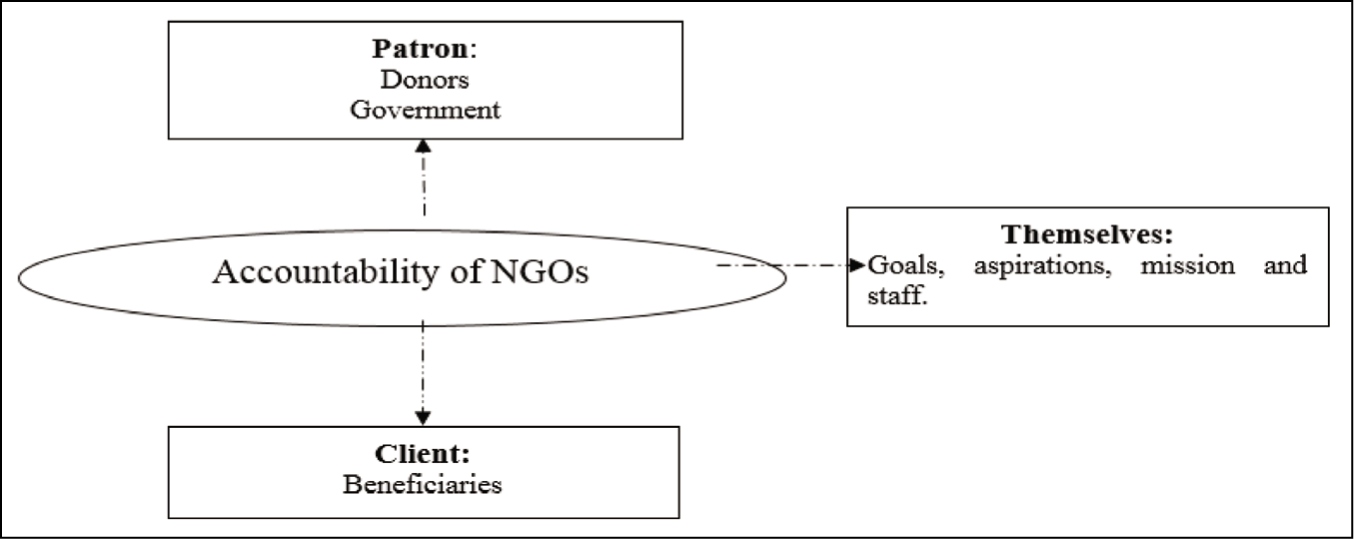
Najam’s framework comprises three distinct categories of accountability concerns. The model is premised on how NGOs interact with patrons and clients or beneficiaries (Mohabbat Khan, 2003).
The discussion of the present study is limited to the “accountability to the beneficiary”—this is also known as “downward accountability.” The accountability relationship that exists between NGOs and beneficiaries is also termed “social accountability.” Accountability to beneficiaries also falls in the domain of “micro-level” accountability; it entails shifting accountability to citizens and service recipients (Haque & Ali, 2006).
Model of NGO Accountability: Exit and Voice
Many years back, Hirschman (1970) provided a standard model of NGO accountability; which was later further expanded by Paul (1992). Paul states that accountability of beneficiaries can be secured when control is augmented with “exit” (i.e., the ability of beneficiaries to find alternative service providers) and “voice” (i.e., the ability of beneficiaries to influence the performance of the provider without seeking alternative providers) (Ngin, 2004; Paul, 1992).
“Voice” requires having access to information on implementing NGOs’ resources and activities. A beneficiary’s ability to exert influence on inappropriate or undesirable NGO interventions depends on how well they are informed. It is generally agreed that through participation in all phases of the project, beneficiaries would be able to articulate their needs and interests to implementing agencies (Ngin, 2004).
Considering the present situation where resource scarcity is so high, “exit” is not a realistic choice for beneficiaries. Therefore, expressing “voice” might be the option to influence NGO interventions.
Participation as a Means of Accountability
There are some good reasons to favor beneficiary participation in a development project: (a) Participation can help to mobilize resources and more work can be done with the same budget; it may use under-utilized labor and use indigenous knowledge. (b) Participation may help to design a better project. (c) Participation safeguards the impression that felt needs are served; beneficiary input can make the project suitable for their needs. (d) Participation can also generate a sense of ownership among beneficiaries. However, participation is not entirely without unmixed blessings. It may increase existing inequalities by favoring local elites (Finsterbusch & Van Wicklin, 1987).
Participation very often means nothing more than asking beneficiaries to agree with what NGOs have already decided. In many occurrences, NGOs consult only a few local people—usually in the form of “a meeting of grassroots activists for the poor”—to get the project approved (Petras & Veltmeyer, 2001). Only those inputs and demands from beneficiaries are accepted and included which are aligned with the NGOs’ interests.
In examining participation, it is useful to differentiate between different levels or types of participation (Ebrahim, 2003). In this regard, Arnstein (1969) presented a well-known model, applied by many scholars, for explaining participation. Arnstein used the “ladder” metaphor to explain the concept of participation (see Figure 2).
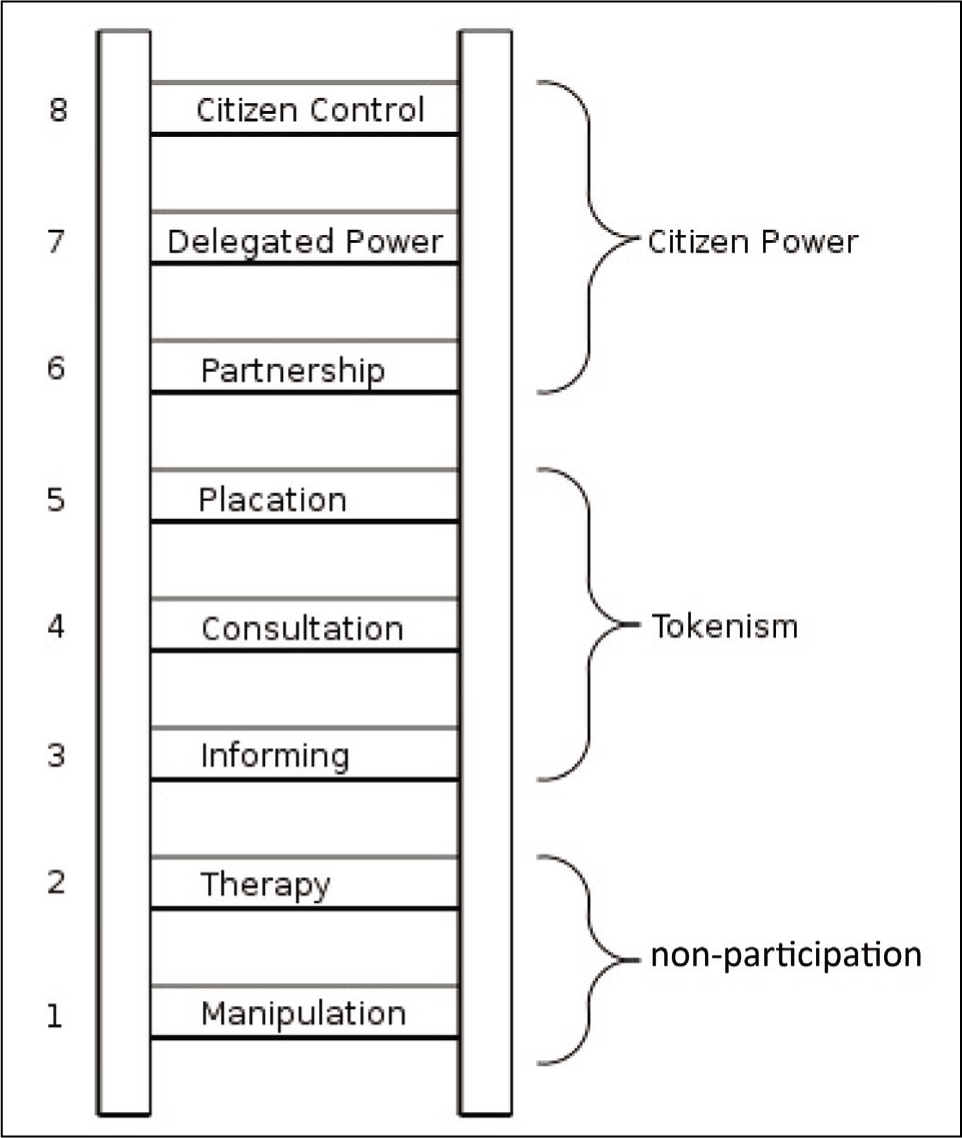
Arnstein opines that participation occurs on a continuum. In the “manipulation” phase (rung 1), people are placed on rubberstamp advisory committees/boards where people approve the authority’s predecided decisions. In “therapy” form (rung 2), participants come with a requirement or complaint, the authority treating this as a participant’s limitation instead of identifying the cause of the problem and its solution. Rungs 3 (information), 4 (consultation), and 5 (placing) create a “tokenism” phase, where participants can have the information (rung 3) and provide the opinion (consultation, rung 4). “Information” (rung 3) phase patronizes participants with a one-way flow of information—from officials to citizens—with no channel provided for feedback and no scope for negotiation. The usual method used for “consultation” (rung 4) involves attitude surveys, neighborhood meetings, and public hearings. However, if consulting is not combined with other modes of participation, this rung is still a “sham” since it offers no assurance that citizen concerns and ideas will be considered.
“Informing” (rung 3) and “consultation” (rung 4) are supposed to explain to, and hear from, citizens on policies and decisions, but these actions ultimately will not affect the outcome of the decision-making or planning process—this is why, the “informing” and “consultation” stages of citizen participation fit into the category of “Tokenism.”
“Placing” (rung 5) is a more improved form of participation, where participants are placed in a committee but with minor representation where they could be outvoted easily, or they can advise to make the plan, but their advice is subject to approval.
Rung 6 “partnership” allows making decisions in collaboration with participants and power holders. Here, people can negotiate and engage in power-sharing. The second-highest rung is “delegated power” (rung 7). It occurs when power is delegated to an agency or similar unit where the citizen has the majority of the seats and certain specified powers. The topmost rung is “citizen control” (rung 8). At this level, citizens have control over organizations and have substantial power to decide.
Arnstein’s model has been applied previously to discuss the relationship between government and citizens. Granted, a citizen–government relation is different from the relationship between NGOs and beneficiaries. Citizens pay taxes to the government. Many, therefore, argue that government has more obligation to be accountable to its taxpayers (citizens). However, it does not mean that NGOs should be less accountable to their beneficiaries.
Inspired by Arnstein, Ebrahim (2003) identifies four distinct types of participation:
Level 1: project information available to the public, organize public hearings, public meetings, surveys, or formal dialogue. In this phase, there may be consultation with community leaders, but ultimate decision-making lies in the hands of project planners. Level 2: participation includes public involvement in project activities and implementation, and possibly in the maintenance of services. Level 3: citizens can negotiate and bargain over a decision with NGOs. Level 4: people apply their own initiatives without NGO and state-sponsored projects.
In a similar manner, Kilby (2006) developed a schema of downward accountability:
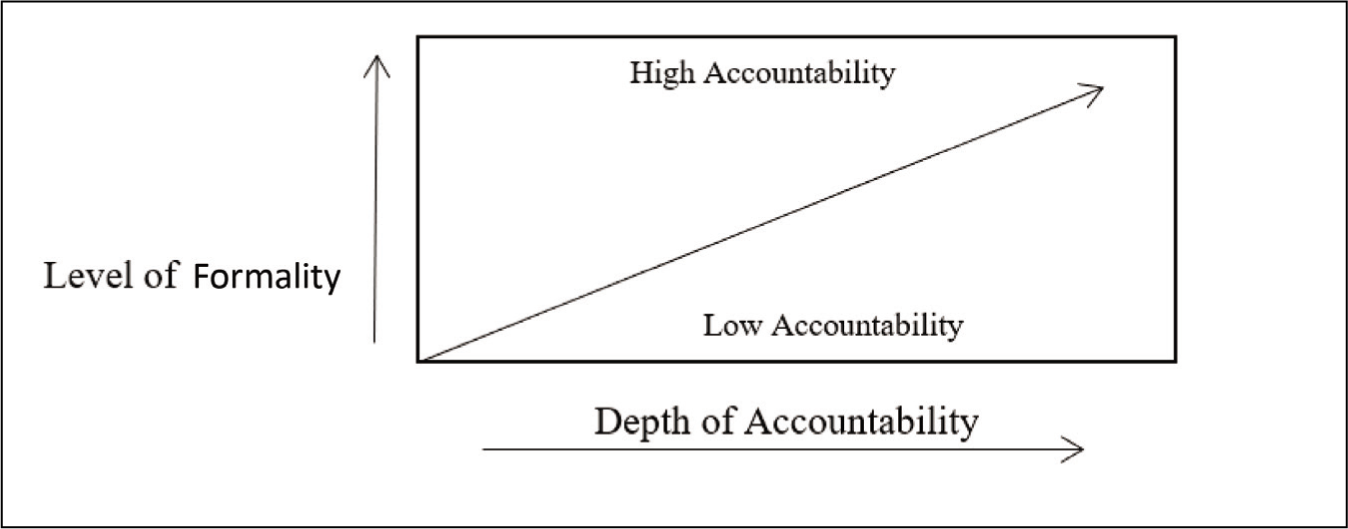
The level of formality: Formality indicators comprise (a) regular/discretionary meeting, (b) meeting timing (weekly/monthly), (c) openness of formal agenda, and (d) formal response to beneficiaries’ views. Depth of accountability: It refers to the feedback arrangements of an NGO to its beneficiaries. Here indicators are (a) to what extent an NGO member has access to management; (b) what knowledge beneficiaries have about NGOs; (c) what kinds of topics are discussed in the meeting; and (d) who generally speaks at meetings and the kinds of topics discussed in meetings (see Figure 3).
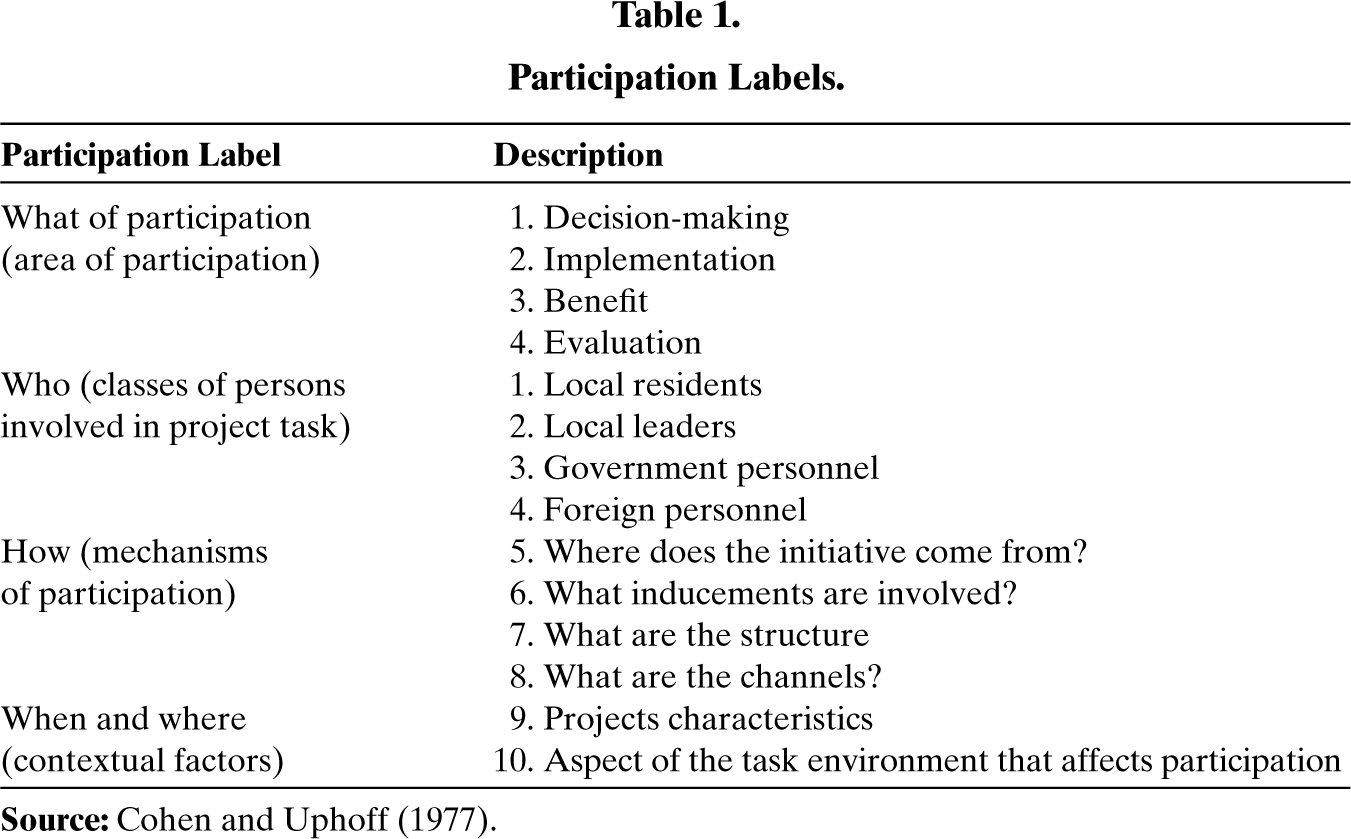
Cohen and Uphoff (1977) provided a thorough framework to deal with participation in development projects. They classified and disaggregated a maze of activities that can be included under label participation by discussing the what, who, how, when, and where of participation (see Table 1).
Participation Labels.
Methodology and Context of the Study
The study undertaken here was entirely qualitative to analyze critically how and to what extent NGOs in Bangladesh are accountable to beneficiaries. Four different NGOs were chosen considering their size, area of function, and origin.
The field study was conducted from 2013 to 2014. It included 23 (n = 23) in-depth semi-structured interviews that incorporated NGO officials, including top management (n = 3) and field officials (n = 6), beneficiaries (n = 8), NGO Bureau Officials (n = 3) (bureau is the government body to regulate NGOs working in Bangladesh), and experts (n = 3). Considering the sample size, purposive sampling was mostly used in the present research. A small degree of random sampling technique was applied for selecting beneficiaries and NGO field officials. Besides, a few field visits were conducted. The study also analyzes relevant literature and different documentary data (e.g., meeting minutes and annual reports) of selected NGOs.
Variables of the Study
The study employed two independent variables to assess the downward accountability of NGOs: (a) transparency and (b) participation.
Transparency indicates the way in which NGOs make information available about their activities and objectives. Stakeholders are unable to hold decision-makers accountable in the absence of accurate information. Transparency has become the international community standard response to accountability concerns (Hale, 2008). The International Monetary Fund and World Bank have added “clear” and “accurate” financial reporting as a part of their aid sanction. The European Union makes it obligatory to have a transparent policy-making procedure for its member countries.
In the present use, “transparency” refers to “the provision of accessible and timely information to beneficiaries and opening up of organizational process, structure, and procedure to assess by the stakeholders.” Fox (2007) states, “Transparency and accountability are closely linked: transparency is supposed to generate accountability.” The following hypothesis was drawn in this regard:
H1: The more transparency, the higher level of accountability will be observed.
The other variable—“participation”—refers to the contribution to and involvement of beneficiaries in the decision-making process and in other operational phases that are required to implement development projects. In the present study, participation is measured through beneficiary involvement in decision-making, involvement in the project by giving labor or funds, consultations with NGOs, or feedback arrangements. The World Bank (1994) delineates six mechanisms employed in its project and policy work to facilitate participation: (a) Information sharing, (b) consultation, (c) joint assessment, (d) shared decision-making, (e) collaboration, and (f) empowerment.
The concept of participation is often misused (Najam, 1996). Very frequently, participation means nothing more than allowing the local community to “agree with what [an]NGO already intend[s] to do.” Participation here becomes a mere “sham ritual” of picking functionaries and allowing previously chosen objectives. Hence, the second hypothesis is:
H2: “Rhetorical inclusiveness of beneficiaries in the various phases of projects creates a ‘just feel-good’ exercise for both local community and NGOs.”
Brief Profile of the Studies NGOs
NGO-1 (International NGO)
An international NGO (INGO) that provides funds to improve “literacy” and “gender equality” in developing countries, including Bangladesh. In order to maintain anonymity, this NGO is code-named “INGO.”
NGO-2 (National NGO)
A national NGO (NNGO). They work in collaboration with the mentioned INGO to increase the “reading habits” of school-goers. They set up small bookshelves/libraries in the classrooms of different schools. “NNGO” is the code name used for this organization.
NGO-3 (GRO1)
A local NGO involved in “microfinance projects;” provides loans only to women. They work in collaboration with another large NNGO. They work at the grassroots level.
NGO-4 (GRO2)
Another local NGO was selected that engaged in an awareness-raising program on tuberculosis control. They arrange campaigns in different factory premises, where factory workers are their beneficiaries. They hire medical doctors to provide lectures for their health-related awareness-raising program.
The third and fourth NGOs are working at the grassroots level, and hence, they are coded as GRO1 (NGO-3) and GRO2 (NGO-4).
The studied NGOs are service-delivery NGOs. The study findings are, therefore, generalizable only for service-delivery NGOs (typically provide a range of services to their beneficiaries, ranging from health and education to housing and rural development), not for other types of NGOs such as membership organizations, and policy advocacy networks.
Findings
Transparency
Dissemination of Information
Interviews disclose that beneficiaries are more or less informed about the service-related basic information. NGO staffs elaborately provide necessary instructions and guidelines, often in print materials. Information might lack thoroughness and sometimes triggers confusion among the beneficiaries. Consider the following case:
Confusion about Mobile Banking and Loan Repayment
A few years ago, a credit-providing NGO (GRO1) introduced a mobile banking system in collaboration with a private bank and a mobile operator company in an impoverished area of Bangladesh. Borrowers are not familiar with the modern banking system, so they encountered difficulties to cope. Borrowers could draw money from ATMs (automatic teller machine) but cannot repay installments using the machines. Many of them thought it would be possible to repay the loan through the machine pretty much like they can draw money from the ATM. The people were puzzled, and confusion was high. They went to the NGO representative and consequently that NGO took care of that issue.
NGOs usually have communication channels and techniques to circulate information. GRO1 has staff at the field level, and they typically arrange “information sharing meetings.” In the above case, nevertheless, the NGO failed to give proper instructions and reach out to all its beneficiaries.
Why were beneficiaries uninformed and confused about issues relevant to them? In response to this question, NGO officials responded:
We (NGO) often give leaflets, booklets containing information about our services and procedures. But, the loan borrowers (beneficiaries) do not read these articles. We also reach them in person and share information verbally.
Their claim is very likely to be true. Beneficiaries do not correctly read the supplied handouts. Most of the clients of that particular NGO were middle-aged and uneducated, so it is highly unlikely that those people are capable of reading. Hence, beneficiaries are uncomfortable with NGOs’ written forms of information sharing. It appears that these booklets and leaflets did not turn out to be an efficient way to convey information for that specific beneficiary group. Therefore, NGOs need to consider the demography and educational status of beneficiaries while drawing up strategies for circulating information and ensuring participation.
The selected NNGO works with schoolchildren (8–16 years), while GRO1 works with adult women. Beneficiary types differ significantly between NNGO and GRO1. Schoolchildren are young and they might face difficulty in communication with people. On the bright side, these school students can read and write, which can provide them with certain privileges over uneducated adults. As already said, the methods of communication should be set up based on the type of beneficiary.
In general, NGO officials claim that their beneficiaries have access to the NGO office to seek information and services. Although beneficiaries rarely visit the NGO office, they visit the office only when they face trouble regarding accessing and availing of NGO services. NNGO’s authority asserts that they have a very good reputation for providing information to their stakeholders, including beneficiaries. Their claim was authenticated during the field visit. Beneficiaries of NNGO were found to be well aware of the programs and activities. There are a few regular “channels” like information sharing meetings, training, annual reports, and various publications (e.g., leaflets).
It was also observed during interviews that beneficiaries are interested only in core service-related affairs. Beneficiaries do not get bothered about issues like transparency and accountability as long as they are getting uninterrupted services. One beneficiary stated, “How they (NGOs) run their businesses or raise money is none of our business. As long as they provide us required service, why should we be worried or made any complain or demand information?”
This statement reveals an interesting fact that the beneficiaries’ “unwillingness” to be informed is responsible for their ignorance. Beneficiaries are apathetic toward whether NGOs are functioning correctly or performing according to standards. Beneficiaries feel hesitant to convey their suggestions/feedback with comparatively more educated NGO staff. In Bangladesh, this appears to be related to existing societal power structures.
Beneficiaries were asked if they had ever visited the NGO office to obtain information. Many answered “yes,” they went to the NGO office at least for once, and they opined that NGOs satisfactorily handled them. Beneficiaries usually visit the NGO office when they come across any difficulties in availing NGO’s services. They never visit NGO’s office to seek information on their financial disclosure, funding sources, governance, reporting system, and evaluation mechanism. For example, when micro-credit borrowers faced difficulties in understanding the mobile banking service, they went to the NGO office only to get clarification.
In sum, beneficiaries are primarily aware of NGOs day-to-day activities. They have rarely questioned issues other than core service-related information. NGO officials stressed that they have a well-structured information disclosure policy and they respond to all requests for information and provide a justification for any denial of information. If there is any information gap, therefore, beneficiaries and NGOs should both take the blame for it. It would not be prudent solely to blame NGO officials. To a considerable extent, beneficiaries are also liable for their ignorance. Despite this fact, NGOs cannot avoid their responsibility. They are expected to make their beneficiaries more enthusiastic and informed to ensure downward accountability.
Overall, the field experience shows that while NGOs typically do well when it comes to disseminating general information, they fall short in other areas of their operations.
Use of Electronic Means
The websites of the first two examined NGOs are particularly well-developed. Both NGOs (INGO and NNGO) regularly upload annual reports, audit reports, and details of ongoing projects. The third one has a simple website with very basic information with no regular updates. It seems that they have a website only for the sake of having it, and it lacks relevant content and updates. The other local NGO did not have a website at all since their parent NGO has an elaborate website with regular updates such as uploading annual reports and other publications. Large-sized NGOs have more organized and up-to-date information on their websites compared to smaller NGOs.
Annual Report and Audit Report
NGOs publish annual reports and audit reports each year. These reports are excellent sources of information on the NGO’s vision, mission, activities, and revenues. Their annual reports are detailed and well-structured with a description of NGOs’ governing body list, description of core programs, training activities, budget, governance and management, and their geographic coverage.
NGOs share their “functional activities” to their beneficiaries; their strategic decision-making procedures and other technical aspects are not appropriately conveyed to the beneficiaries. NGOs’ annual reports and audit reports, to a considerable extent, focus on issues such as budget, expenditure, amount of fund/grant, and project cost. NGOs publish these reports at the end of the year, and these reports primarily contain previous year’s information, while beneficiaries are supposed to know these before or during the project operational phase.
Overall, NGOs maintain various information-sharing channels to disseminate information to their service recipients. Beneficiaries are also more or less satisfied with the responsive manner and information-sharing procedures of NGOs. However, NGOs do not always provide in-depth information, which often causes the beneficiaries’ confusion and dilemmas. NGOs are doing an excellent job in terms of ensuring “functional accountability.” However, NGOs are still far from a satisfactory level in communicating “strategic information” to their beneficiaries.
Participation
Participation in Decision-making
The governing body is the focal point for decision-making in an NGO, yet no beneficiary representation was observed in any of the governing bodies of the NGOs surveyed. All vital decisions and objectives are set by the NGO authority. Beneficiaries do not have any influence on the selection of board members. Board Members are mostly selected by the founding executive member(s) or by the top management.
NNGO has a school management committee (SMC) at the field level comprising teachers, guardians, and NGO officials. This committee is not entrusted with the entitlement to design an original project; instead, they can only bring about slight modifications in consultation with the head office and partner NGOs. Beneficiaries may provide significant input to the program plan, but the decision on the actual project layout is made beforehand. In addition, the attendance of the guardians in SMC meetings is very low, whereas the local elites regularly attend the meetings. Guardians justify themselves by saying that they do many activities to do to maintain a livelihood and, therefore, they could not manage time for meetings. The following statement of a guardian sums up the typical attitude of NGO beneficiaries: “We are working people; we have to work hard to earn our livelihood. We do not have the time to attend those kinds of meetings due to work pressure.”
It is apparent that higher ranked NGO officials and donors primarily dominate the decision-making process. NGOs consider people’s opinions seriously only when encounter high negativity about something among beneficiaries. For example, a few years ago, the NNGO terminated a particular project component (an educational book) after receiving several complaints about it from both instructors and parents. Branch offices conveyed the beneficiary’s feedback about that book to donors and NGO’s head office, and later, distribution of that particular book was halted. Considering beneficiaries’ feedback with such priority is not a common phenomenon. It suggests that beneficiaries can stand against the management at least in some cases. Mostly, actual policy-making power lies in the hands of governing bodies. The situation is worse in the case of two GROs. In response to a question, an NGO official said, “How is feasible to decide after consulting beneficiaries? For instance, if we decide our interest rate by consulting with our clients, they will always recommend a zero-interest rate, but we cannot afford to do this, can we?”
This sort of opinion suggests that field officials have negative perceptions about beneficiary involvement in the design phase. One possible reason might be a lack of knowledge regarding the concept of participation. The participation mantra is not widely understood by NGO staffs, particularly field staffs. This study has not found any sign of beneficiary participation in the decision-making phase in the case of GRO1 and GRO2.
GRO2 arranges various campaigns from time to time, which is a one-way lecture session for raising health awareness. GRO2 assigns medical doctors temporarily for the health-related “conscientization program” for factory workers. Beneficiaries can reach the doctors if they have something to share. However, doctors may or may not pass information to NGO officials. NGO officials remain present during the program, but GRO2 does not have any specified mechanisms to get feedback from their clients except when they ask doctors if any changes are needed. One may argue that at the least NGOs should include beneficiaries in discussion about the design phase of operations.
The findings from our case study allow us to conclude that beneficiaries are almost completely excluded from NGO decision-making.
Participation in Implementation
Compared to the design phase, participation in the implementation phase is much better. “INGO” and “NNGO” arrange a pre-construction meeting before every construction project. They have a school construction committee, where local people participate in various ways such as providing labor and supplying raw materials. All forms of contribution are converted into an equivalent amount of money. NNGO is expected to draw a 15% contribution from the local community. Sometimes the contribution exceeds 15%. The scope of beneficiary participation is reasonably satisfactory in “INGO” and “NNGO.”
Referring to the library service offered by the NNGO, students can borrow books from the library placed in each classroom. One or two students are called “Book Captain,” for each section to maintain the account of check-in/check-out of books. If any student needs a particular book, he/she can inform the Book Captain, who passes the request to the concerned NGO representative. This is indeed an innovative initiative to involve the beneficiaries in the implementation stage. It was challenging to include beneficiaries (school students) of such tender age. The learning is that it is always possible to devise a way to engage the beneficiaries; it just requires goodwill and sincerity. Some large international development NGOs have developed innovative downward accountability mechanisms using techniques such as storytelling, theatre, people’s art, and song focused on improving transparency, critical learning, and reflection in their development work (O’Dwyer & Unerman, 2010). Locally, INGO and NNGO could have established a separate library with a full-time librarian. Instead, they handed over the charge of books to the students, who are their beneficiaries. On the one hand, it saves NGOs the cost of assigning a separate workforce for maintaining the library. Also, the bookshelves do not require any extra room/space, since the book corner was set up in the classroom. So, it saves both money and space. In addition, it creates a sense of ownership among the students (beneficiaries).
GRO1 and GRO2 produce minimal opportunities for participation during implementation. The beneficiaries (credit borrowers) state that they do not have the scope to participate in the implementation of any components. NGOs involve them only when the NGO arranges an event, where beneficiaries have a role in preparing foods.
GRO2 does not have any noteworthy process or tool for the involvement of beneficiaries. They run awareness-raising sessions in different industrial areas for factor workers, in each session serving different beneficiaries since every time they arrange a campaign it is given in new factory premises. Due to the nature of GRO2’s function, it is difficult to engage its beneficiaries in the implementation phase. They may opt for devising ways with a view to increasing beneficiary participation. In this regard, the student involvement in the maintenance of the class library set up by INGO and NNGO is an excellent example of improvising.
Overall, beneficiary participation in the implementation phase is considerably high compared to other phases. Local NGOs have devised different mechanisms and strategies to integrate beneficiaries. The mechanisms and tools vary from NGO to NGO based on their type and work pattern.
Participation in Evaluation
There are no specified mechanisms readily available for beneficiaries to evaluate NGO run-projects except for minimal feedback opportunities on a recently completed project. Field observations suggest that beneficiaries take the opportunity during training or various meetings to convey their opinions. These sessions (training/meeting) are usually organized to focus on current and future projects, not to receive beneficiaries’ opinions regarding completed projects/programs. Yet, beneficiaries often express their opinions about completed projects through these channels.
A precise mechanism for receiving client evaluation is absent in the case of GRO2. The lack of fixed beneficiaries makes it difficult. Overall, beneficiary involvement is the least in the evaluation phase of operations.
Mechanisms of Participation
Mechanisms used by NGOs to ensure participation are discussed in the following subsections.
Regular Formal Meeting and Refreshing Session
Meeting is perhaps the most widely used means of downward accountability that provide a channel to receive feedback and share information. Out of four studied NGOs, two NGOs have regular formal meetings comprising beneficiaries and staff. The meeting is held weekly, fortnightly, quarterly, or yearly.
NNGO has a wide array of regular meetings with beneficiaries. They arrange monthly meetings where they discuss various day-to-day events and other activities such as small repairing functions and yearly sports activities. Participant numbers are usually small at the monthly meeting. Executive members annually sit with the SMC and discuss various strategic matters in that meeting.
GRO1’s donor NGOs arrange monthly and quarterly meetings in which they exchange various information and discuss diverse topics such as how beneficiaries are doing with the borrowed money and what is their investment situation. At the same time, beneficiaries can express their personal opinions about the activities and service quality in the meeting.
Formal meetings with beneficiaries are absent in GRO2. They arrange meetings only between the doctors (hired for delivering lectures to raise consciousness) and beneficiaries. Such campaigns take place in the presence of NGO staff, and beneficiaries can engage the NGO staff and express their views. It is not a formal channel of communication and there is no guarantee that field officials will convey the messages to the head office. Even when the messages are conveyed, there is a low possibility of providing feedback to the beneficiary.
During meetings, NGO staff are supposed to present agendas ranging from different aspects of projects to decision-making to the evaluation phase. NGO staff come to a meeting with a predetermined plan and discuss mainly what would be the duties of beneficiaries, how the NGO would implement plans, and provide an orientation to the project. Feedback mechanisms seem dysfunctional in those meetings.
Aside from formal meetings, NGOs arrange some “refreshing sessions” where beneficiaries tend to participate and communicate their views with NGO representatives. Usually, mid and large NGOs can organize such refreshing programs. Small local NGOs rarely organize such events.
Training
NGOs arrange training to disseminate information and train beneficiaries in various skills. Question and answer sessions or similar sessions are usually reserved for the training module, where beneficiaries can give their opinions and queries. Surprisingly, a good number of beneficiaries loudly raise their voices and criticize various issues. Also, beneficiaries might appreciate NGOs’ various steps they deemed worthwhile, well planned, and successfully implemented. The situation is more or less the same for all local NGOs studied.
Field Visit
Donors do not blindly rely on reports produced by NGO officials since facts in the report can be readily manipulated. Therefore, donor and partner NGOs often conduct regular as well as surprise field visits. Such visits provide beneficiaries an excellent chance to voice their concerns directly to NGO officials since beneficiaries can meet the donors/funders in person during field visits. Beneficiaries usually feel uncomfortable giving any negative feedback in the presence of field staff. Despite this barrier, some beneficiaries do not hesitate to share their views with NGO representatives.
During an interview session, one beneficiary expressed concern about whether NGO representatives, especially field-level officers, do convey beneficiaries’ messages accurately to the authority or not. If beneficiaries’ opinions are not reflected in actions, either field officials do not properly convey the messages to the authority or the message is appropriately carried, but the authority did not pay any heed to it or NGOs are not in a position to do so. In short, field visits may not be a reliable way to promote beneficiary participation, but it is still a useful mode of communication between NGO officials and clients.
Discussion: Linking Empirical Findings into Theoretical Framework
Arnstein’s Participation Ladder
If we try to fit the level of beneficiary participation of observed cases into Arnstein’s ladder, the first two NGOs (INGO and NNGO) would be at the peak of tokenism (placing: rung 5) phase.
The situation was much worse for GRO1 and GRO; they hardly cross the first rung (information: rung 3) of “tokenism.” Their position is somewhere in between “nonparticipation” and “tokenism.” Field data indicate that there are considerable formal modes of participation, but they do not have the required “level of depth.” There are rules to hold meetings regularly, with formal agendas in which beneficiaries are supposed to receive elaborate formal responses from NGO officials. These formal mechanisms are severely lacking the “depth of accountability.” NGO staffs virtually play the dominant role in this type of meeting where beneficiaries are merely an audience. NGOs arrange these sorts of formal feedback and sharing sessions to give beneficiaries the feeling that their opinions matter. NGOs apply “participation” as a tool that enables beneficiaries to agree with what NGOs already plan to do. Hence, beneficiary involvement is more “rhetorical” than real.
Beneficiary involvement is expected in all phases of NGO operation. However, beneficiaries’ voices are not heard in decision-making. Observed cases in the present study were service-oriented NGOs. Unlike the member organization, the beneficiaries of the service-organization are treated as external stakeholders and beneficiaries have a small voice in NGO activities and direction.
Ebrahim’s (2003) Level of Participation
The involvement of beneficiaries in the project implementation phase is substantial, while participation of clients in the “decision-making” and “evaluation phase” is very limited. Broadly, the NGOs studied in the present research belong to the “level 2” of Ebrahim’s participation level. The first two cases (INGO and NNGO) stand at the peak point of “level 2” and about to move to “level 3.” It appears that they are in the transition phase of “level 2” and “level 3,” whereas the latter two (GRO1 and GRO2) hardly cross the “level 1” border. Very little decision-making is entrusted to beneficiaries in GRO1 and GRO2.
One clear behavioral pattern was found that NGO staff have a high sense of self-esteem due to better education and social background. This attitude discourages the beneficiaries from raising their voices. Beneficiaries are often reluctant to question or criticize NGOs for fear of “biting the hand that feeds them” (Unerman & O’Dwyer, 2010, p. 481).
Kilby’s Accountability Schema: Level of Formality and Depth of Accountability
Another finding is that neither the “level of formality” nor the “depth of accountability” is well developed concerning downward accountability. The “level of formality” is relatively high in INGO and NNGO but is lacking in the other two observed local NGOs (GRO1 and GRO2). INGO and NNGO have regular meetings with formal agendas and systems for responding to beneficiaries’ opinions and views, whereas the “depth of accountability” is less developed in all of the studied cases.
The existing formal processes and mechanisms to engage beneficiaries is lacking adequate representation of beneficiaries with sufficient scope to raise their voices on topics discussed at meetings. NGOs arrange meetings and consult with the public, while the actual decision-making power lies in the hand of the NGOs. Usually, the objective of setting up this sort of “formality” without “depth” is to show that they responsibly hear the voice of the beneficiaries. In reality, beneficiaries’ voices are not considered with the utmost priority. This sort of formality is called “sham rituals.” NGO people do present information in a way that beneficiary will support NGO-driven decision. NGO usually present selective information and facts in favor of their own decisions, and by doing this, NGO staffs manipulate the opinions of beneficiaries. Beneficiaries usually participate in various meetings merely to rubber-stamp the NGO-made decision. Beneficiaries feel that they are contributing to the development and implementation of a project and that feeling makes them satisfied and proud to be a part of it. These practices may create a sense of ownership among beneficiaries but may not necessarily result in real participation. The evaluation phase is no different. They highlight their success factors and ignore their failures to provide a positive impression among the stakeholders. The formal arrangements for project evaluation are weaker than the decision-making phase.
Conclusion
NGOs exercise different means (e.g., annual reports, leaflets, meetings, information sharing, and training sessions) to disseminate information. Even so, NGOs are not much transparent to their beneficiaries. A study of Irish donor-development NGOs revealed that not enough pressure was placed on local NGO partners to demonstrate accountability to communities and that downward accountability on the part of local NGOs was often presumed or simply not addressed by many Irish donor NGOs (O’Dwyer & Unerman, 2010). In some cases, their studies in Ireland found that local partner NGOs sufficiently engage their beneficiaries. The Irish experience might have some relevance for the donor base of Bangladeshi NGOs. It indicates that donors or funders can do more to ensure meaningful downward accountability. So-called “ceremonial” contacts with beneficiaries are deemed insufficient for ensuring accountability (O’Dwyer & Unerman, 2010).
However, NGOs are not always to blame; beneficiaries’ unwillingness to be informed is a strong reason for their ignorance. Often, beneficiaries’ reluctance slows down the information flow. O’Dwyer and Unerman term this as “lack of demand from the beneficiaries’ side” to hold NGOs accountable. Beneficiary awareness is a crucial precondition for a transparent system. Transparency cannot facilitate accountability alone; it requires fulfilling other conditions as well. Field visits and interviews with beneficiaries reveal that many beneficiaries perceive NGOs to be doing a charitable task and doing them great favor; therefore, beneficiary deems that asking for accountability is too much. Their perception reflects traditional “need-based approaches” that view development as a need or a gift, motivated by and derived from charitable intentions and patronage relationships, rather than a reflection on rights (O’Leary, 2017).
Often various ostentatious participation rituals are arranged by NGOs where the scope of participation is insufficient. It might bring about only the mere “feel-good” sense among beneficiaries. NGOs often arrange these sorts of “sham rituals” due to the donors’ requirement, rather than ensuring the real participation of beneficiaries. This confirms H2 proposed in this study.
The flow of information is positively correlated with accountability. The current study presents a picture where beneficiaries are ill-informed and weak in holding NGOs accountable. This supports H1. In the present article, the participation of beneficiaries was disaggregated into different stages to provide more specific scrutiny. It was found that participation was weak in the decision-making and the evaluation phase. Participation of beneficiaries is much higher in the implementation phase compared to other phases. The condition of beneficiaries’ involvement in the decision-making and planning phase is worst. Participation is at the “tokenism phase,” thus still a long way to go to touch the rung of citizen power. A level of formality exists, but it is missing the depth of accountability.
This study identified several mechanisms of participation: meeting and refreshing sessions, training, and field visits. Interestingly, few of these were not developed to ensure participation, nor are they covered in the participation literature surveyed, but they act as useful channels for participation. Beneficiaries often take the opportunity to carry their voice to NGO officials during training, refreshing, or field visits.
Many previous studies affirm that NGOs are participatory and beneficiaries are noticeably satisfied with NGO activities and accountability state. This may evoke confusion that, unlike the findings of many prior studies, the present study has not shown a rosy picture of downward accountability of NGOs. It may be argued that there are two possible explanations for these counterintuitive findings that NGOs are doing better in terms of transparency and participation:
Government-run projects and programs are less participatory and harder to get information compared to NGO-run programs. People consider that NGOs are better in discharging different functions and have a better “supply chain” than the government. While providing judgment, beneficiaries make a comparison with similar state-run projects. Whenever citizens compare the situation of participation between NGOs and government, they find downward accountability of government is very dismal compared to its NGO counterpart, and people end up endorsing NGOs as better-performing entities in terms of accountability. The second probable explanation is that beneficiaries consider government-run projects as the “rights” they possess as a citizen of the country; therefore, they can demand service from the government. Government has obligation to provide services to the citizens. In contrast, many people consider that NGOs are not bound to provide service to the people; NGOs run activities as kindness toward them. In their view, NGOs are private philanthropic type organizations and that these organizations are not supposed to be accountable to beneficiaries, in which case demanding accountability from them is too much to ask.
This perception might have a substantial impact on beneficiaries’ evaluation of NGOs’ performance and accountability. This perception was widely observed in the beneficiaries’ responses and attitudes during in-depth interviews. If this is the actual situation, then it will open another loophole of NGOs downward accountability. NGOs and their staffs are not making their beneficiaries’ aware of their rights. NGOs thus present a distorted picture where beneficiaries have a wrong idea about how much NGOs are supposed to be accountable to beneficiaries.
Footnotes
Declaration of Conflicting Interests
The author declared no potential conflicts of interest with respect to the research, authorship, and/or publication of this article. The author confirms that this work is original and has not been published elsewhere, nor is it currently under consideration for publication elsewhere.
Funding
The author received no financial support for the research, authorship, and/or publication of this article.