



Abstract
The literature on clientelism covers the extent to which public budgets are politicized relative to specific groups of supporters. However, we know little about what drives the discretionary transfers from central to local governments. This article addresses this research gap and analyses the causes for such allocations in two East European countries: Hungary and Romania. The analysis draws on an original dataset that includes the transfers from central to local budgets in 2019 and the political affiliation of local governments. Our findings illustrate that the degree of decentralization and the electoral system can explain this type of clientelism.
Introduction
Clientelistic exchanges ensure electoral mobilization and favorable electoral outcomes, with discretionary resources, such as public services, social transfers, public contracts, or public employment being financed directly or indirectly from the public budget (Hopkin, 2006). The literature on electoral and organizational clientelism covers the extent to which public budgets are politicized relative to specific groups of supporters before or between elections (Kopecký et al., 2012; Stokes et al., 2013). However, we know very little about why budgetary clientelism takes a certain form. This overlooked but important form of clientelism regards a clientelistic relationship between central governments (the patrons) and local government leaders (the clients). As opposed to pork-barrel politics where local governments are simple brokers in the clientelistic pyramid (Evans, 2011), budgetary clientelism is closer to the horizontal clientelistic model in which public budgets incentivize political supporters. This involves politicized and discretionary intra-governmental transfers from the central to local governments.
The local level is relevant in politics because it is where the primary interaction between citizens and politicians takes place. Political communication at this level is more personal, and voters can associate a face with the benefits they receive. Local budgets matter for electoral clientelism because they allow for the distribution of public goods and services to the electorate to take place in a form that is likely to be effective. The effectiveness of clientelism at the local level can be higher because it is easier for political parties to deploy mechanisms of monitorization and control over citizens (Medina & Stokes, 2007). Citizens can also have larger scrutiny over the conduct of politicians at a local level, which raises the stakes of informal linkages. Consequently, officials at the local level can act as effective brokers in the clientelistic relationship between the central government and voters and they can maintain or develop broader clientelistic networks within the population. In budgetary clientelistic schemes, the local governments play a direct role as a supplier of goods and services, or an indirect role by monitoring the political support manifested by the clients (Medina & Stokes, 2007; Nichter, 2008).
As a result of these elements, in countries with high levels of electoral clientelism, we should expect a discretionary allocation of budgetary funds from the central to local governments. Hungary and Romania share key features that make them usual suspects for such behavior: they have highly clientelistic political environments, driven by state capture and politicization, in which diverse forms of clientelism are used (Fazekas & Tóth, 2016; Gherghina & Volintiru, 2017; Mares & Young, 2019). However, the evidence on budgetary transfers from the central to the local level is completely different in these two countries.
Figure 1 shows the distribution of transfers from the central to the local budget in 2019, before the most recent local elections in both countries. The transfers from the central to local budget are measured as the quantum per capita in Euros (EUR). 1 These transfers cover 64 municipalities (23 in Hungary and 41 in Romania), which are divided into three categories according to the partisan affiliation of the mayor, which is the highest elected office at the local level in both countries. These categories are party in opposition, party in silent agreement with the government, or party in government at the central level.
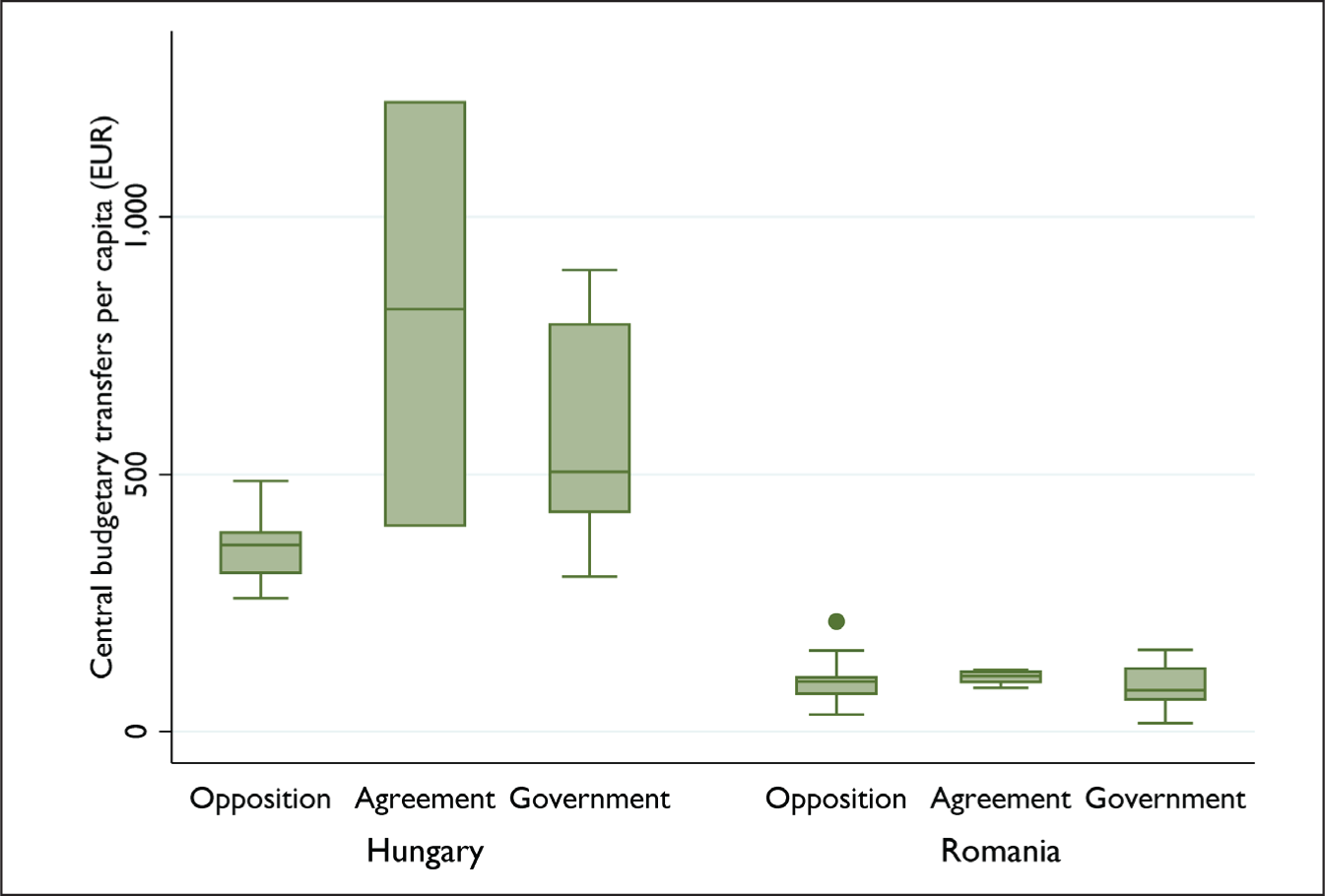
Hungary follows the pattern predicted by the theory and indicates a considerably higher distribution of public funds to those municipalities controlled by mayors coming from the parties in government (Alliance of Young Democrats—Christian Democratic People’s Party, Fidesz-KDNP) or supporting the government through a silent agreement (Jobbik). This is in line with earlier observations according to which municipalities ruled by the opposition mayors were over the past decade underfinanced from central budgets, received lesser European Union funding, and had limited access to credit markets to obtain additional funds (Vasvári, 2020). In Romania, leaving aside the much lower level of budget allocated per capita, the budgetary transfers to municipalities with mayors belonging to opposition parties (National Liberal Party, PNL) or those supporting the government (Democratic Alliance of Hungarians in Romania, UDMR) are on average higher than those for mayors belonging to the government party (Social Democratic Party, PSD). In general, it is unclear why these major differences occur between the two countries.
This article addresses this empirical puzzle and seeks to explain the divergent trajectories of budgetary clientelism in Hungary and Romania. Our qualitative analysis argues that decentralization and the electoral system can be the main variables, which explain the differences in the use of budgetary clientelism.
Our argument relies on the key idea that institutions matter: the scope of goods and services provided by local public officials depends on the degree of state decentralization, and the type of electoral system provides different links between the central and local levels of government. The identification of causes for budgetary clientelism is important because it sheds light on the heterogenous functioning of this important process. Our results reveal that patterns of budgetary clientelism are diverse and the discretionary allocation of funds varies according to institutional settings. The findings have implications both for the scientific study of partisan use of state resources and for policymakers who can understand how to prevent such instances.
The following section links budgetary clientelism to public resources and reviews the literature about budgetary clientelism in Central and Eastern Europe. Next, we provide information about the research design used for this article, with emphasis on the case selection and data. The fourth section provides background information on fiscality and local government in Hungary and Romania. The fifth section focuses on the two main explanations for the divergent paths of budgetary clientelism. The conclusions summarize the key findings and discuss the broader implications of this study for the broader field.
Unfolding Budgetary Clientelism
The classic model of clientelistic party machines includes the party at the center as the patron, which allocates the resources, the party at the local level as a broker, with the role to distribute resources and monitor the political loyalty of citizens, and citizens as the clients (Auerbach & Thachil, 2018; Gherghina & Nemcˇok, 2021; Kopecký et al., 2012; Stokes et al., 2013). In this model, local authorities are important access points or institutional intermediaries for the large variety of distributional policies that national governments undertake. They can mediate the preferential distribution of conditional cash transfers, 2 social services or public goods (Aspinall & Berenschot, 2019; Kemahlıog˘lu & Bayer, 2020; Stokes et al., 2013). The local governments have at their disposal several resources for clientelistic exchanges. The underlying logic across political contexts is the same: the use of public resources to ensure political survival. This reflects the foundational argument of the “politicians’ dilemma” that must choose between the use of public resources to advance public interests as opposed to channeling those resources to people or projects that help ensure the political survival of their political parties (Geddes, 1994).
There are two general causes that enhance the development of budgetary clientelism in Eastern Europe: the weak institutional capacity characterized by discretionary access to public resources (i.e., state capture) and a strong territorial presence of political parties implementing the political survival strategy based on clientelistic exchanges. First, clientelism is an embedded problem of poor governance since resources have deviated for political purposes, and it affects the quality of democracy. Countries with weaker historical administrative capacity have poorer quality of democracy (D’Arcy & Nistotskaya, 2017). Local governments in East European countries tend to have a much lower administrative capacity than their Western counterparts. They are more vulnerable due to the large subnational disparities in economic development, brain drain, and the poor attractiveness of public employment in local governments (Charron et al., 2014). Poor capacity at the local level limits the quality of public services and makes clientelistic mobilization strategies appealing.
The transitions in Eastern Europe created ample opportunities for state capture due to the regulatory vacuum, institutional weakness, and the party system instability in the first post-communist decade (Grzymala-Busse, 2008). Even after the accession to the European Union (EU), which proposes several anti-corruption institutional reforms and a continuous monitorization process, some of the newer member states use forms of state capture (Trantidis & Tsagkroni, 2017). The economic integration and various funding mechanisms from the EU allowed incumbent politicians to have more opportunities for state capture opportunities (Bratu, 2017; Kelemen, 2020). In the case of EU funding highly clientelistic mechanisms occur because they fueled the family members and closed allies of political leaders. The countries analyzed in this study provide different patterns of EU funding capture. In Hungary, this type of capture is generally dispersed across party strongholds (Vasvári, 2020). In Romania, it consists of highly localized budgetary clientelism towards the county of prominent party elites (Gherghina & Volintiru, 2017). 3
Budgetary clientelism can facilitate the distribution of local public resources directly to voters or can fuel private companies and party interests, which in turn contribute to electoral mobilization. If the latter applies, public procurement from local governments plays a crucial role in capturing public resources. Clientelistic systems in both Hungary and Romania rely on a complex web of public and private actors accessing and redistributing public resources. This is possible through extensive politicization of public procurement (Gherghina & Volintiru, 2017; Zgut, 2021).
Second, local political organizations and territorial presence are important components of a clientelistic pyramid. It is not just territorial coverage for electoral mobilization, but also roots in society and relationships of trust (Medina & Stokes, 2007; Stokes et al., 2013). The more power is concentrated in a central office, in both political and economic terms, the more likely it is that local governments become dependent agents of the party leadership. Dependent local leaders are more likely to become clientelistic brokers, that is agents of the political principle, rather than accountable to voters’ needs, that is agents of their constituencies (Aspinall, 2014; Volintiru, 2015).
Within a clientelistic system, local leaders act as party brokers and often have privileged access to jobs in the state apparatus (Kopecký et al., 2012). Across new democracies and transition countries, political parties identify ways to control state resources and reinforce existing clientelistic systems. The loyal appointees make sure public resources are distributed to party strongholds through budgetary allocations and discretionary public programs, or directly to citizens through conditional cash transfers or social programs (Silva & Jalali, 2016).
Hungary and Romania are quite similar with respect to the degrees of discretionary access to public resources and the territorial presence of political parties (Mares & Young, 2019). This means that the causes mentioned above cannot explain the differences in budgetary clientelism presented in Figure 1. This section suggests that two other determinants may explain the divergent paths: decentralization and the electoral system.
First, decentralized governance allows for better accountability at a local level and thus constrains the clientelistic machine (Lindert et al., 2007). Local accountability means sanctioning poor performance in office, including scandals of corruption (Bågenholm & Charron, 2020). The decentralized context improves the quality of local governments by creating a full virtuous circle. For example, the quality of public services is significantly better in local governments funded by their own local tax revenues rather than those funded by state grants (Gadenne, 2017). This is because state grants may be the subject of budgetary clientelism and thus diverted from their initial purposes. As an illustration, more than 20 percent of the grants that local governments in Indonesia receive to finance road projects are diverted (Olken, 2007). Central grants or conditional central transfers are not readily observable to voters, and as such, they weaken accountability and enhance the inclination of local officials toward the discretionary distribution of public goods and services (Martinez, 2020; Olken, 2007).
A decentralized governance structure has an impact on national social programs. Discretionary grant programs tend to be conditional clientelistic exchanges, and targeted social programs can usually be linked to pork-barrel politics. But, if they are not conditional upon electoral support and there is higher local accountability, such programs might have an important positive effect on alleviating poverty (Sugiyama & Hunter, 2013). Both countries in which the effect is identified as positive have a more decentralized governance system. As such, well-implemented redistributive policies have a constraining effect on clientelism by lowering the economic dependency of clients on political patrons (Frey, 2019; Gherghina & Volintiru, 2020).
Second, the majoritarian and proportional representation electoral systems use support in the territory differently. For majoritarian systems with first-past-the-post and single-member districts, the distribution of votes across the territory is highly relevant. To win the elections, political parties aim to have more votes than their opponents in most districts. They seek concentrated electoral support in particular areas rather than aiming for dispersed support throughout the entire country. The latter can harm the political parties especially when they are small (Calvo & Rodden, 2015). To secure votes within districts, political parties may use budgetary clientelism to ensure that its core voters remain loyal, to encourage voters with other political preferences to remain loyal, or to convince undecided voters.
The core vote model explains that political parties distribute benefits to their loyal supporters to maintain and stabilize their voting preferences for the long term (Cox & McCubbins, 1986; Cox, 2009). The swing voter model argues that parties seek to maximize their share of votes by distributing benefits to people who either support other parties or are undecided (Dahlberg & Johansson, 2002; Dixit & Londregan, 1996). Political parties could combine the core and swing voter approaches (Diaz-Cayeros et al., 2016; Gherghina, 2013). They can use clientelism in their core constituencies to ensure their loyalty and the same parties can also go for the swing voters to augment their support. The strategy adopted by political parties is influenced by their previous electoral support. If they had support from most districts in the previous election, then they are likely to adopt the core vote model.
In proportional representation systems, the concentration of electoral support is somewhat less relevant. The parliamentary seats depend on the result at a national level. This may encourage political parties to spread resources across districts. This system is likely to favor a combination of core and swing voter clientelism. The votes received in every district contribute to the national result and political parties may pursue small gains in the electoral strongholds of their opponents and large gains in their electoral strongholds.
Research Design
To illustrate the extent to which these two causes can explain the divergent paths of budgetary clientelism in Hungary and Romania, we conducted an analysis at the city level (Table 1). Both countries are divided into counties and we selected cities from each county. Hungary has 19 counties and 23 cities with county rights, many of the latter being the county seat. We selected 22 cities with county rights 4 to which we added the capital city Budapest, resulting in a total of 23 cities in Hungary. Romania has 41 counties and we took the capital city of each county, which includes also the country’s capital city Bucharest.
The Data Used in the Analysis.
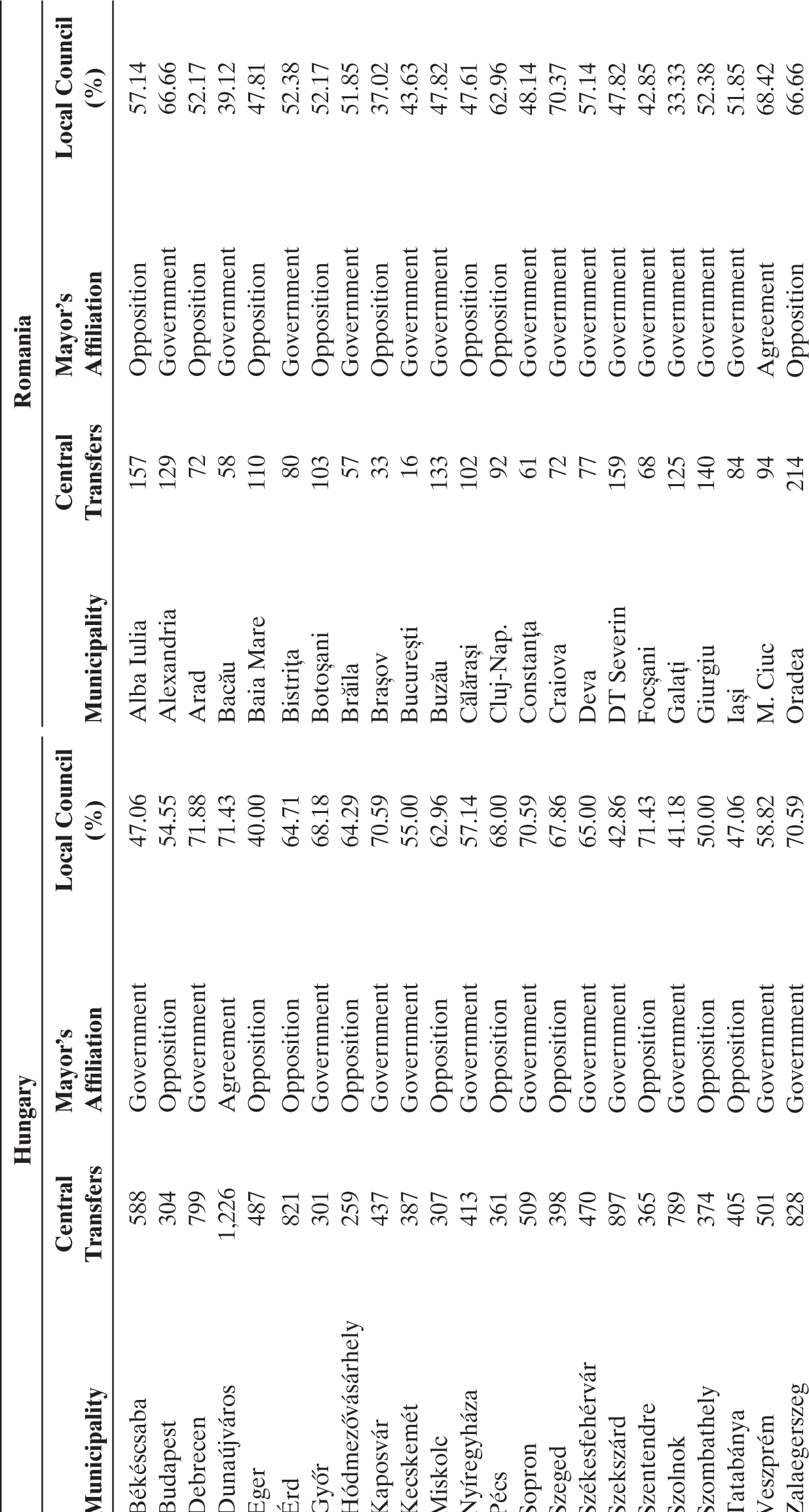
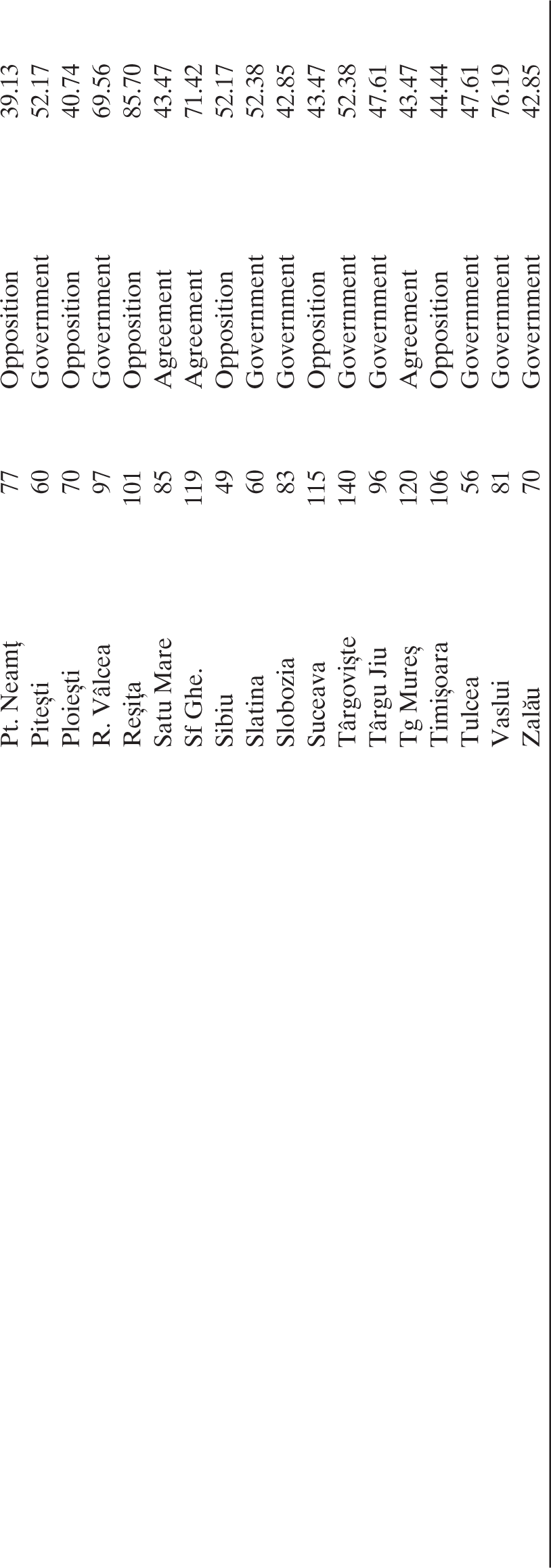
Based on the partisan affiliation of each mayor, we divide the cities into three categories: belonging to government parties, belonging to parties that are in agreement with the government, and belonging to opposition parties. In Hungary, there are several mayors who were independent at the time of data collection. We classify them as opposition following a desk review evaluation of their position towards the country’s government. Many of these independents supported the opposition united against the government for the 2022 national elections.
Our data about the distribution of transfers from the central to the local budget (per capita in EUR) comes from 2019, before the most recent local elections in both countries (October 2019 in Hungary and September 2020 in Romania). This pre-election period is crucial to observe potential budgetary allocations along clientelistic lines. We collect the data in 2019 also for the Romanian context because that was the last year with government continuity. In October 2019, the social democratic government lost a vote of no confidence and a caretaker government led by the liberals was announced. For comparability, we wanted to have in both countries a national government that was in office for several years. The local county’s political strength is presented in the last column.
We assess the decentralization in the two countries along their legal and financial dimensions. We assess the electoral system according to the procedures in that national election to understand the connection between the central and local governments.
In Hungary, the local elections take place roughly 1 year and a half after the national elections. By winning the local elections a political party has more than 2 years to strengthen its position in the territory for the following national elections. The national elections are organized since 2014 using a mixed-member majoritarian system in which 53% of the seats (106 out of 199) are elected through a first-past-the-post vote in single-member districts. The remaining seats are allocated based on votes cast for party lists in one nationwide constituency. Citizens have two votes: one for the single-member district candidates and one for the party list. The allocation of seats for the party lists takes into account the unused votes for candidates in single-member districts. Unused votes are either the surplus votes for winning candidates or votes cast for unsuccessful candidates. We would expect to observe budgetary clientelism following the core voter model.
The local elections in Romania usually take place half a year before the national elections and have often been an accurate indicator of how a political party will perform in the national elections in a specific county. At the national level, Romania uses 2016 a closed-list proportional representation system in which each county is a constituency with a magnitude proportional to the population. The allocation of seats is done at the national level according to the votes received in every constituency. Due to this allocation, the concentration of votes in the territory does not create major effects for political parties. As such, it is unlikely to observe budgetary clientelism following the core voter model and we would expect instead a dominance of the swing voter model or a combination with the core voter model of distribution.
As a further test to strengthen the effect of the electoral system on budgetary clientelism, we check how budgetary allocations are done in relation to the political strength of the local council. The latter is the equivalent of a Parliament at the local level. We calculate the strength of the local council as the share of seats belonging to the party or parties (in case there is a local-level coalition) supporting the mayor. This is calculated on a scale from 0 to 1: for example, if the mayor is supported by a coalition that has 60% in the council, the value is 0.6.
In addition to these two main causes for budgetary clientelism, we controlled for other potential determinants. The alternative explanations include the affluence of the local budget, the economic vulnerability, and the share of private companies at a local level. We tested also for these explanations to make sure that the budgetary clientelism is genuine and not the reflection of a spurious relationship. For example, the central government parties could try to support economically weaker localities and thus the difference between support obtained by mayors from different parties is an unintended consequence of that choice. The results indicate no statistical relationship between any of these variables and the budgetary allocations. For reasons of space, we do not report them in the article and we focus exclusively on the mechanisms that have an impact on budgetary clientelism.
Local Government and Budgets in Hungary and Romania
Intra-governmental transfers from central to local budgets are either conditional or unconditional. Conditional transfers are, among others, transfers from national investment programs, subventions, and earmarked allocations for decentralized services such as education or social services. The unconditional transfers include the equalization of personal income tax (PIT), corporate income tax (CIT), or value-added tax (VAT). Conditional transfers are by nature much more likely to be the object of budgetary clientelism. They are potentially influenced by inter-governmental or intra-party negotiations, but they are also much smaller than unconditional transfers.
Hungary has a predominantly urban-driven economic growth model, having two-thirds of its GDP coming from leading cities, while Romania is much more balanced with an even split between urban and rural contributions to the national economy. Counterintuitively, the balance of power between the central and local governments is much more centralized in the case of Hungary, where the central government outspends city halls 5.4 times over at the local level, while in Romania is at 3.0, much closer to the EU average ratio of 2.4. Local revenues in both countries are below the EU average of 10% of GDP, with total local government revenues in Romania at 8% of GDP, and in Hungary at 6% of GDP. Therefore, in both cases municipalities rely on central government transfers.
The Hungarian municipalities have a much weaker fiscal capacity than Romanian local governments, with smaller shares of fiscal collection from local activities and limited crediting permission. For example, local governments in Hungary cannot apply for credit without the prior approval of the central government, with certain exceptions for ongoing EU-funded projects. The co-funding requirements for EU funding are a heavy burden for local governments in many East European countries (Medve-Bálint & Bohle, 2016). The fact that in Romania there is clear indiscriminate support for local governments from the Ministry of Public Finance in providing them with the co-funding requirements, 5 improves their financial sustainability perspective. In contrast, for Hungary, the central government’s support for the co-funding requirements is politically conditioned (Medve-Bálint & Bohle, 2016; Vasvári, 2020), which amplifies the impact of budgetary clientelism in this country.
One of the most important local fiscal revenues for local governments in Hungary is the local business tax which is proportional to the turnover of companies and an incentive to support and develop the local business environment. In the context of COVID-19, the central government took over a large portion of the municipal local corporate tax revenues, halved the local business tax in November 2020, and then subsidized the politically loyal municipalities (Dobos, 2020). This brought about criticism not only from opposition cities that claimed local governments were practically dismantled in Hungary but also from Fidesz-KDNP mayors themselves who saw their attribution and resources further narrowed. This showcases the relatively weak standing of Hungarian mayors even within their own party.
In contrast, leading municipalities in Romania have a very strong political standing, with politically influential mayors. For example, the mayor of Cluj-Napoca (one of the top largest cities in the country) is Emil Boc who was prime minister between 2008 and 2012. Collaborative networks such as the Romanian Municipalities Association demonstrate a good working relationship between the opposition and mayors of the ruling coalition, suggesting a much more pragmatic approach in terms of local governance and party affiliation in this country.
Explaining Budgetary Clientelism: Decentralization and the Electoral System
Hungary and Romania have divergent trajectories in terms of decentralization, which increases the explanatory potential of this variable. In the aftermath of its EU accession in 2004, Hungary has gone through a decentralization reform and was considered next to Poland one of the “champions of decentralisation” in Eastern Europe (Swianiewicz, 2014). Starting with Fidesz-KDNP’s first government in 2010, Hungary has reversed the direction of its reform and has gone through a substantial recentralization process (Ladner et al., 2016). Budgetary transfers go hand in hand with specific attributions, and the local governments in Hungary have lost many of their attributions. For example, with the reforms initiated in 2011, the local governments lost their important functions as the central state took over the operation of the schools, hospitals, and stronger oversight for land-use decisions and caring functions expenditure. Local governments in Hungary continue to have attributions related to social housing, or even increased competencies in the field of police services. Overall, the consolidation of power within the central government led to budgetary clientelism in Hungary as both conditional and unconditional transfers to local governments become increasingly linked to political affiliation (Dobos, 2020).
Budgetary clientelism in Hungary is relevant both for operational purposes and in terms of city development potential. For the cities that receive large sums of budgetary allocations, central support is important for local development. For example, in Debrecen state-led support through subsidies for industrial development brought in a record level of foreign direct investments. Between 2015 and 2020, foreign companies invested almost €2 billion and created more than 6,500 new jobs (Ban et al., 2021). By comparison, in the opposition-led city of Göd, the Orban government has recently moved the only large-scale production plant in the locality (i.e., the Samsung plant) from local government control to that of a special economic zone under the control of the central government, thus depriving the local government of approximately one-third of its revenues from local taxes (Volintiru, 2021).
In contrast, Romanian municipalities received multiple attributions with subsequent decentralization reforms, currently overseeing such diverse public services as preschool and primary education, hospitals, and primary care centers, social assistance and caring functions, employment offices, common transport, housing, land planning, or police. With increased attributions came additional revenue sources, thus increasing the size of local budgets. This enhanced their autonomy vis-à-vis the central government for current administrative duties. If in 2016 almost half of the local revenues came from conditional central transfers (i.e., national investment programs such as the National Local Development Program, or earmarked revenues for health and education), now this category represents only 15% of the local budgets in Romania, as the share of unconditional transfers (i.e., local tax base) doubled, while own revenues representing a relatively constant share. The most important fiscal revenue at the local level in Romania is the property tax, which encourages a collaborative relationship between local governments and local business actors, such as property developers (World Bank, 2021).
In this context, the local governments’ financial capacity developed unevenly. The large cities led by the incumbent party mayors in 2019 such as Constanta or Galati have significantly lower amounts of spending from outside sources compared to similar-sized cities such as the opposition-led cities of Ias‚i or Cluj-Napoca (World Bank, 2021). Many of the opposition-led cities in 2019 in Romania saw their local revenue stream increase through either a decentralized EU funding system or local taxes derived from a larger fiscal base at the local level. Cities like Cluj-Napoca or Oradea witness a reversed brain drain, with high-skilled employees returning to work in higher value-added sectors such as ITC, as these are faster-growing cities than the capital city of Bucharest (Ban et al., 2021). For many of these growing cities, their fiscal collection potential is even higher than what they are currently collecting (World Bank, 2020). There is also a stronger engagement between local governments and local communities in many of the cities controlled by opposition mayors, such as Cluj-Napoca, Alba-Iulia, Oradea, or Iasi, including public deliberation practices such as participatory budgeting. This higher accountability and transparency of local budgets make the end purpose of budgetary clientelism (i.e., discretionary benefits to voters) harder to reconcile.
Given the very large subnational disparities in Romania, it is hard to make inferences on the quality of government of different political parties in Romania. In the 2020 national elections, many of the government electoral strongholds were located in poorer, worst-connected areas, than the more developed Transylvania region. What we can observe is that based on this decentralized structure of governance and finances in Romania, budgetary clientelism is less appealing for both patrons and local governments as potential brokers.
The Electoral System
In Hungary, the Fidesz-KDNP Alliance has won a two-thirds majority in all three national elections held since 2010. The 2018 elections were organized under the system described in the research design section. There is a high positive correlation of 0.52, statistically significant at the 0.01 level, between the central transfers per capita and the political affiliation to Fidesz-KDNP of the county capital mayors (the categories used for Figure 1). The value of the association coefficient indicates a clear tendency of higher central transfers to those municipalities controlled by the Fidesz-KDNP mayors.
The county-level results of the 2018 elections confirm the existence of a relationship between these allocations and electoral support. Fidesz-KDNP got roughly 49% of the party-list votes. Szekszárd, Zalaegerszeg, and Debrecen are three of the municipalities with the highest level of central transfers per capita. Their mayors belong to the government party and they are the capital cities of the Tolna, Zala, and Hajdú-Bihar counties. In the 2018 national elections, Fidesz-KDNP got more in these three counties more votes than its national share: approximately 53.5%, 52.5%, and 51.5%. At the other extreme, Budapest and Hódmezó´vásárhely (the city of Csongrád) are two of the lowest recipients of central transfers. The mayors in both municipalities are either independent or belong to opposition parties and Fidesz-KDNP has poor electoral support: approximately 38% in Budapest and 45.5% in Csongrád.
In Romania, the concentration of votes in the territory does not create major effects for political parties because the allocation of parliamentary seats takes place at the national level. One further empirical element, associated with the electoral system and results, the constraints of budgetary clientelism in Romania. The party in government at the time of data collection, the PSD, had the lowest electoral volatility in the country for two decades. Since 2000, it relies on a relatively stable core of voters around 30%–35% in the electorate; the 2016 national elections were an exception to this rule and the party gained more than 45% of the votes. As a result of this general electoral stability, the government party has several safe constituencies. Approximately one-third of the counties—especially from the Southern and Eastern parts of the country—vote traditionally with the social democrats. These do not change between elections and the government party has no major incentive to allocate more money than in other constituencies. On the contrary, from a strategic point of view, it makes sense for the social democrats to provide budgetary clientelism to those constituencies where the opposition parties are in control, hoping to swing voters. The negative value of the correlation coefficient (−0.16, not statistically significant) between central transfers and the affiliation of the mayor indicates that this happened to some extent.
The budgetary allocations in our dataset confirm this mixed strategy. The top four municipalities in terms of budgetary transfers are Oradea and Alba Iulia, where the mayors belonged to opposition parties, and Drobeta Turnu Severin and Târgovis‚te with mayors belonging to the PSD. The 2020 parliamentary elections returned results according to the mayors’ affiliation. The PSD result at the country level was approximately 29%, in the two counties with opposition mayors the party received 19% and 20.5%, while in the two counties with its own mayors the party received 38% and 45%. Figure 2 depicts visually these statistical associations.
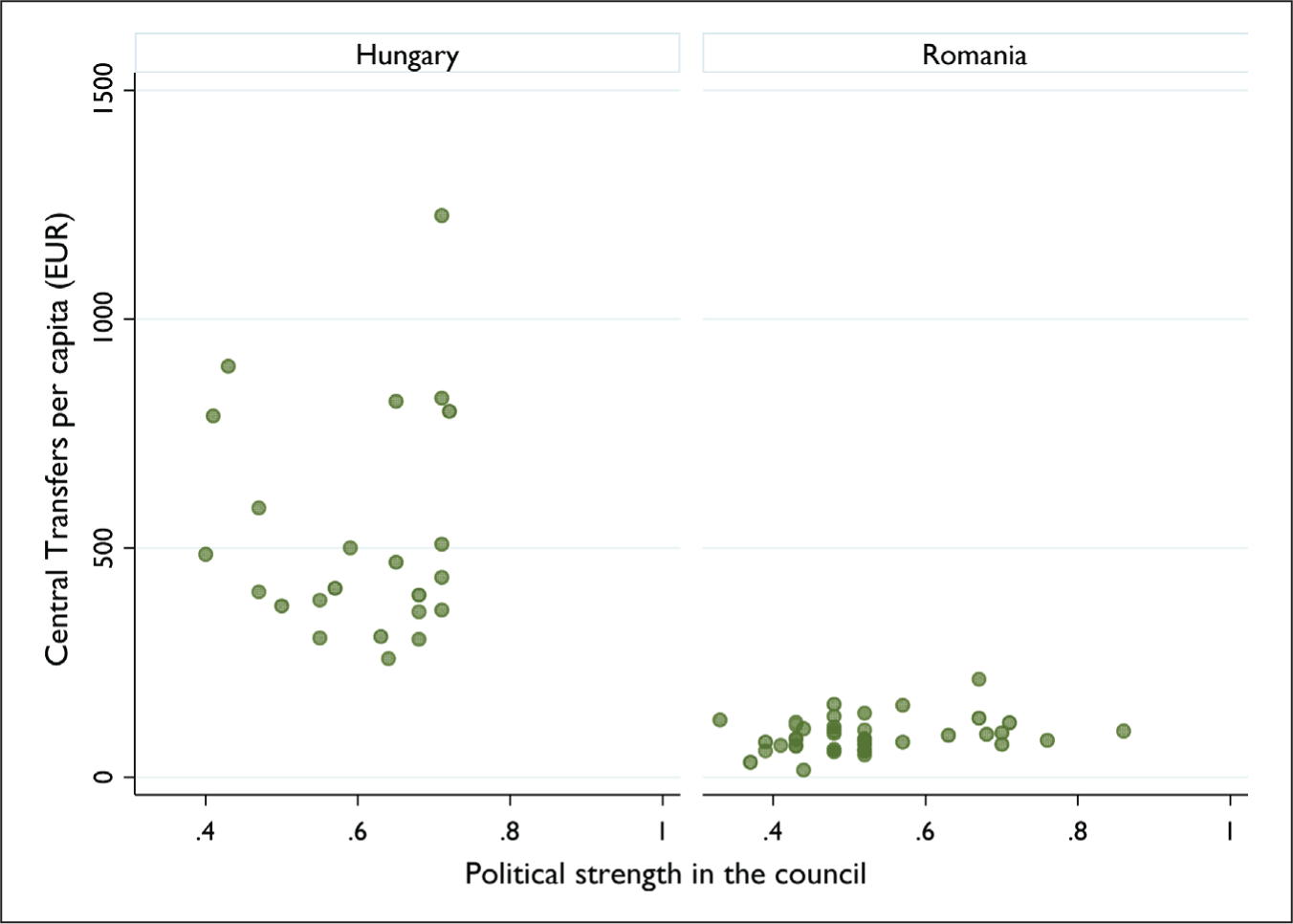
In brief, budgetary allocations have different purposes in the two countries. In Hungary, they are used with clientelistic purposes to reward the local affiliates to gain further support in the general elections. In Romania, they strengthen the existing status quo to deny change, which favors the party with high electoral stability. As a further test to strengthen this observation, we check how budgetary allocations are done in relation to the political strength in the local council, calculated as indicated in the research design section. In Romania, the correlation between budgetary allocations and the strength of the local council is positive (0.25, no statistical significance). In Hungary, there is no relationship between budgetary allocations and the strength of the local council, which is also reflected in the very low value of the correlation coefficient (0.01).
In Romania, the local council’s strength can play a role in facilitating budgetary allocations to a certain extent. Although this does not involve central budgetary clientelism, local political strength can help in informal negotiations on the annual size of budgetary allocations. The formula for central transfers is set in the Romanian legislation but the annual budgetary law that specifies how much each local government receives includes a relevant exception.
Article 5 in the Public Budget Law No. 50 / 2019 regarding the budgetary allocations reads as follows: “by the decision of the regional public finance director or the head of public finances in the county administration, the following share of income taxes will be distributed.” Accordingly, the share of income tax that goes back to local budgets can be increased exceptionally by the decision of particular county or regional public officials. As such, the local council strength in a county residence municipality could influence the county or regional employees especially since it can mean that both local and county administrations have the same political affiliation (e.g., Cluj-Napoca, Oradea). In contrast, the centralized Hungarian system of (discretionary) budgetary allocations is much less likely to be influenced by local negotiations.
Conclusion
This article has sought to explain the divergent path of budgetary clientelism in two countries with high levels of electoral clientelism. The results of our analysis illustrate that the extent of fiscal decentralization and the electoral system explain these different trajectories. These findings make a twofold contribution. First, relative to the literature on clientelism, they unveil the particular drivers of public money flow from national to local level governments beyond the general idea of vote-seeking. So far, much research has shown that politicized and discretionary intra-governmental budgetary transfers are an essential part of a clientelistic distributive system in which the central government can be seen as the patron and the local government as the broker. This article shows that the budgetary clientelism aimed to enhance electoral support in national elections varies across institutional settings. Our analysis shows that despite many similar factors that are conducive to clientelism (e.g., low institutional capacity, state capture, strong roots in society by the leading parties), there are two macros (system level) variables that explain the different patterns of transfer from central to local governments.
Second, the empirical evidence covered in the article provides relevant avenues for further development for both researchers and policy-makers. On the one hand, knowing the channels of budgetary clientelism can unveil the key role of local governments in gaining access to public resources and the conditions under which these resources can be maximized to develop local clientelistic networks through legal financing. Electoral clientelism is used in many countries around the world and access to resources lies at the core of the process. The discretionary allocation of the state budget helps in understanding the magnitude of access to resources and predicting the extent to which this will be possible in the future. On the other hand, such findings have important implications for policy-makers who can lower the incidence of budgetary clientelism by undertaking administrative and political reforms. Decentralization and electoral systems are broad domains in which reforms can be implemented to minimize the discretionary transfers of public money between levels of government.
Our study was limited to two countries, large municipalities and 1 year. Nevertheless, it yields results that can form the basis for further research. One avenue that is worth pursuing is the comparison with other new democracies from the post-communist region, with a different type of party system or experience with clientelism. By increasing variation on several characteristics, such a study will test the robustness of the two key mechanisms explored in this article. Another direction for further research could use semi-structured interviews with central and local political elites. This article identifies two general elements that favor or inhibit the use of budgetary clientelism. The information from interviews could add new determinants about the use of budgetary clientelism, which cannot be gauged with objective data.
Footnotes
Declaration of conflicting interests
The authors declared no potential conflicts of interest with respect to the research, authorship, and/or publication of this article.
Funding
Work for this article was supported through a project funded by the Romanian Executive Agency for Higher Education, Research, Development and Innovation Funding (UEFISCDI), Project Number: PN-III-P1-1.1-TE-2019-0460.