



Abstract
Open Science (OS) – an emerging global trend driven by advances in digital technologies and government’s commitment to greater transparency and value for money of publicly funded research – is at its early stages, even in countries with high R&D expenditures, such as South Korea. This study provides a comprehensive overview and analysis of Korea’s national OS approach, with a focus on exploring the current OS regulatory and technological environments it operates under, and uncovering its SWOT – strengths, weaknesses, opportunities and threats. It concludes that internal weaknesses, such as insufficient political will to promote OS, dominate other SWOT characteristics of Korea’s national OS approach. Thus, the highest priority should be given to strategies attempting to minimise both internal weaknesses and external threats, such as reinforcing domestic Open Access publishing ecosystem to mitigate Korean researchers’ dependency on large international commercial publishers.
1. Introduction
1.1. Open Science as an emerging field of academic research and practice
Open Science (OS) is an umbrella term used to distinguish a range of disparate initiatives and processes for making scientific knowledge freely available to the public. The OS movement of researchers and practitioners has emerged to advance openness, especially, but not only in, publicly funded research [1]. It is explained by the ‘taxpayer argument’ to enforce government accountability to citizens who pay for research via taxes [2], and by the expectation to increase the value of public funds invested in research by reducing duplicate, low-quality or difficult-to-find research work [3]. For example, a 2019 study commissioned by the European Commission (EC) estimated the annual cost of not having Findable, Accessible, Interoperable and Reusable (FAIR) research data at the level of EUR 10 billion within the European Union (EU) economy, which amounted to 78% of the Horizon 2020 budget per year; one of the indicators to measure that cost involved in duplication of funding in the EU public research [4].
Due to the multiplicity of actors, each with their different motivations and goals guiding different research communities and regions, it is difficult to provide a unified definition of OS. For example, a 2018 study [5] identified no fewer than 99 definitions of OS based on a systematic literature review. To ensure a consistent and collaborative implementation of OS across the globe, the United Nations Educational, Scientific and Cultural Organization (UNESCO) [6] in its recent Recommendation on OS provides a basic framework for OS policy agenda, defining OS as ``an inclusive construct that combines various movements and practices aiming to make multilingual scientific knowledge openly available, accessible and reusable for everyone; to increase scientific collaborations and sharing of information for the benefits of science and society; and to open the processes of scientific knowledge creation, evaluation and communication to societal actors beyond the traditional scientific community''.
OS is considered by UNESCO [6,7] as a critical factor to help achieve the United Nations Sustainable Development Goals (SDGs), with the potential of reducing existing inequalities in Science, Technology and Innovation (STI) by making the scientific process more transparent, inclusive and democratic.
OS can be divided into several components – ‘OS practices’ (sometimes called as ‘open research practices’ or ‘OS trends’), which embed openness and collaboration at different stages of the research process. Examples of OS practices usually include study pre-registration 1 (endnotes can be found at the end of this article before the reference list); Open Access (OA) to scientific publications 2 ; open research data sharing and Research Data Management (RDM); and opening up source code and workflows produced by researchers [5,8–11]. In academic studies and non-academic publications in South Korea – a country that traditionally has a large Research & Development (R&D) public agenda – OS practices are often classified into three categories: OA, open research data and open collaboration [12–14]. This classification is consistent with a few other publications [9,15], which mention these three categories as the main OS practices. The broad category of ‘open collaboration’ is still an ambiguous concept that is not well-defined in the publications that mention it [12–14]. Typically, it refers to the collaboration occurring during the research process through the use of Information and Communication Technologies (ICT) tools helping to enable communication among scholars via virtual research environments (e.g. virtual laboratories) and scientific social networks, participation in open peer review and/or engagement with the general public through crowdsourced and citizen science projects.
1.2. Aim and objectives of the study
The Internet and other digital technologies have had profound impacts on science by creating new ways of acquiring, storing, manipulating and transmitting vast digital data volumes and stimulating new habits of communication and collaboration among scientists. In particular, the emergence of Web 2.0 technologies, including social networking and Rich Internet Applications (RIA) user interfaces, has helped create the potential for networked science. One of the early examples was the Polymath Project, when a complex mathematical problem was solved thanks to online collaborative efforts among scientists on a blog run by the British mathematician Timothy Gowers [16]. Web 3.0 (Semantic Web) technologies, including Resource Description Framework (RDF) and Web Ontology Language (OWL) tools, created the potential to link different scholarly digital objects (e.g. research data, code, their metadata) and make them FAIR [17]. Nevertheless, while not undermining the significant role of the Internet in paving the way for the OS phenomenon, the existence of advanced digital technologies is necessary but not sufficient for the operationalisation of OS. R&D-related legal instruments, including funding agencies’ policies, also have had a significant impact on OS practices.
The aim of this article is to provide an overview and analysis of South Korea’s national approach to OS, using a case study method coupled with the use of a strengths, weaknesses, opportunities and threats (SWOT) analytical framework. Three specific objectives were set to accomplish this aim: (1) to describe the current state of play of regulatory and technological environments supporting OS in Korea; (2) to identify related SWOT and (3) to propose relevant strategies to address these SWOT factors.
South Korea has served as our case study due to the country’s recognised commitment to promote OS. For example, according to a 2019 study by a European R&D consultancy group ‘Science|Business’, Korea is one of the world’s leading countries in terms of its OS policy settings [18]. In addition, according to the results of a 2017 EC-Organisation for Economic Cooperation and Development (OECD) STI policy survey, South Korea is among those countries with dedicated policies and initiatives supporting OS [19]. In particular, the OECD acknowledged the 2017/2018 Korean initiative on sharing and reuse of publicly funded research data with the objective to promote big data-driven innovation at national level; the initiative was in line with the policy of the Presidential Committee on the Fourth Industrial Revolution [20].
2. Related work
Previous research has already provided certain insights into Korea’s national approach to OS. However, most of the relevant publications are in the Korean language, which limits their value for other researchers. Also, much of it is rather dated now, not accounting for recent changes, such as those induced by the adoption in 2020 of the National R&D Innovation Act [21]. Among those studies, there are some that address different policy perspectives of various OS practices [12,14,22,23], and those which focus only on individual OS practices, such as OA [24–26] or open research data [20,27,28]. Only a few publications have been peer-reviewed, while many represent reports or policy studies produced by public research institutes responsible for OS policy.
For example, a research team from the Science and Technology Policy Institute (STEPI) headed by Shin [12] published in 2017 a study based on the review and analysis of both domestic OS policies and policies of some foreign countries (EU countries, the United States and Japan). Among other things, the study includes the results of a survey to show the Korean researchers’ perceptions and use of various OS practices. For example, according to the reported survey results, 63.4% of all respondents said that they had never shared their research data, and more than half of the respondents answered that the proportion of their OA articles published during the last 5 years was less than 10%. The study draws attention to the lack of a comprehensive national OS policy on OA, open research data and open collaboration and provides some recommendations for policy development. Despite the fact that this publication is one of the most in-depth studies into the Korea’s stance in OS, it does not reflect the recent policy changes. Furthermore, Seo et al. [23] proposed in 2016 a policy direction, a roadmap and a detailed plan for the development and implementation of OS digital infrastructure and services by the Korea Institute of Science and Technology Information (KISTI). Although not a recent study, it provides basic insights into the design of the KISTI’s OS digital infrastructure. Among the recent studies on Korean OS policies is a 2021 research report produced by a KISTI team headed by Son [14]. The report has a specific focus on legal and regulatory issues related to various OS practices, as specified in domestic and foreign legislation. The study argues that OS is still in its infancy in Korea and that there is no a comprehensive national OS policy. Among the findings of this study are some recommended amendments to the Framework Act on Science and Technology [29] and the National R&D Innovation Act with the aim of incorporating explicit provisions encouraging OS. However, the report does not cover a number of important Korean legal instruments related to OS, such as the Academic Promotion Act [30] and policies of government funding agencies; at the same time, it discusses the laws which do not have direct relationship with OS (e.g. Technology Transfer and Commercialisation Promotion Act [31] and laws related to the disclosure of government information and data).
Several previous studies are devoted to Korea’s OA policies. For example, Shin [25] outlines the current status of OA in Korea and explores the potential impact of Science Europe’s Plan S initiative [32] on Korean OA policy development. Joung et al. [24] present the results of research on future OA policy directions to be implemented by the National Research Foundation (NRF), the main government research funding agency. In particular, the study discusses possible ways of supporting domestic journals to be converted to OA journals along with the directions for Article Processing Charge (APC) support arising with OA publications. There is also an earlier study [26], which comments on important OA initiatives in Korea and Argentina, compares both countries’ OA indicators and proposes several recommendations for cooperation between Asian countries in terms of fostering the ‘Diamond’ (non-for-profit) OA model – the model which has been widely adopted in Latin America.
Among prior studies focused on open research data, there is a case study report [20] prepared for OECD on the Korean Ministry of Science and ICT’s strategy (2018) aimed to promote sharing and reuse of research data from government-funded R&D, including pilot projects in data-intensive fields, such as genomics and biochemistry. To support that strategy, the above-mentioned research institute STEPI conducted a comparative study examining domestic and foreign institutional arrangements on data rights and responsibilities associated with publicly funded research [27]. The study found inhibitors for research data sharing in terms of uncertainty of data rights, which are barely specified in research agreements and contracts, and proposed certain policy recommendations.
Overall, the examination of Korea’s OS issues is scattered across domestic studies, most of which are not available for critical assessment by the wider international community of OS researchers and practitioners. Such studies do not paint a clear and holistic picture of the national OS approach, focusing instead on looking at discrete elements; consequently, they have not resulted in any systematic mapping out of distinctive features in a consistent manner, for example, by revealing SWOT.
In this light, this article is an attempt to reconnect the outcomes of previous Korean studies and to undertake our own study in the English language for those interested to learn from the Korean experience.
3. Methods
A case study approach is commonly used in the social science research as ‘an empirical method that investigates a complex contemporary phenomenon in depth and within its real-world context, especially when the boundaries between phenomenon and context may not be clearly evident’ [33]. In other words, a case study is appropriate when a researcher wants to understand a real-world case (e.g. OS) and assumes that such an understanding is probably to involve important contextual conditions pertinent to the case (e.g. a country’s unique context affecting operationalisation of OS) [33].
Triangulation among two or more sources of evidence is one of the recommended tactics to increase the validity of a case study. The main sources of evidence for our single-case study of Korea’s national OS approach were official documents and participant observation sessions. These are included in a list of the six major sources of evidence commonly used in doing case study research [33].
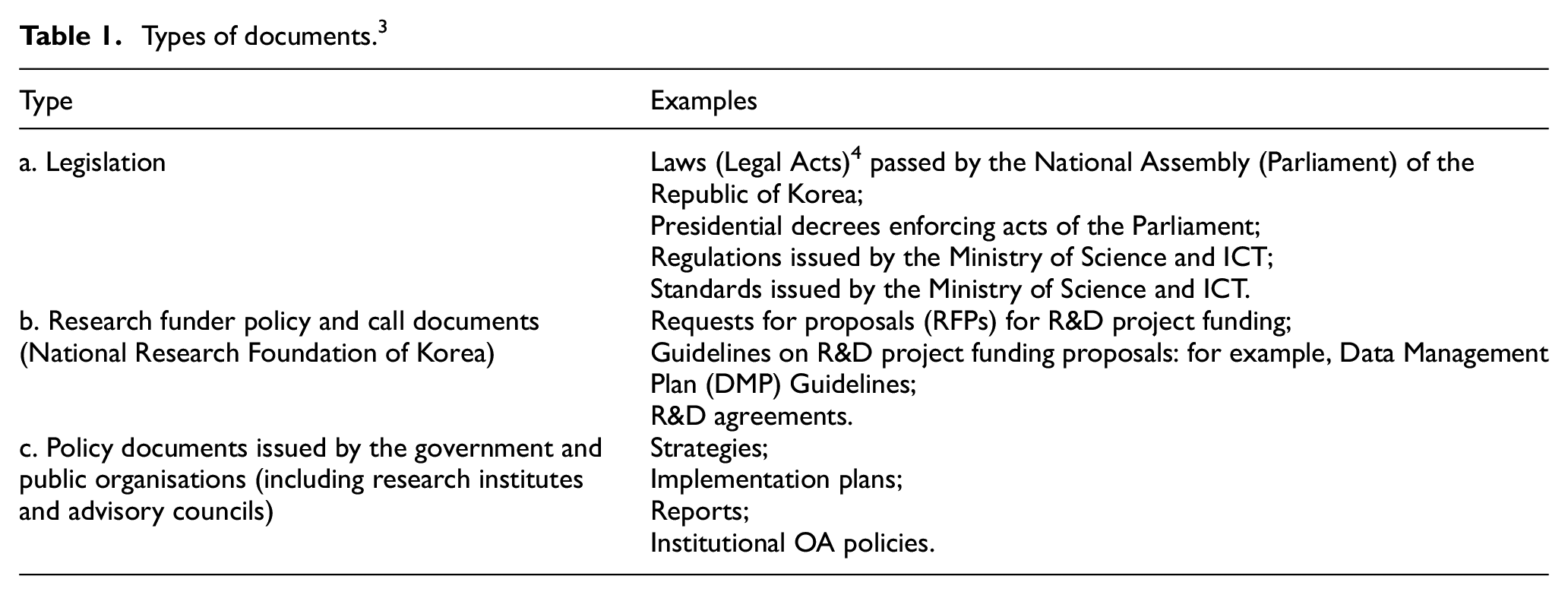
At the data collection stage, three broad categories of official documents concerning our case were collected, namely (a) legislation; (b) research funder policy and call documents and (c) policy documents issued by the government and public organisations (see Table 1). Furthermore, participant observation produced meeting notes when some of us attended a series of local events related to OS, such as a national forum on OA policy [34] and an internal webinar that discussed potential amendments to the current legislation for reinforcing OS practices. Direct interactions in a form of informal discussions with the key actors in national OS policy agenda setting generated additional notes.
Types of documents. 3
The collected sources of evidence were analysed using a document analysis approach in line with the methodological guidance proposed by Bowen [35] and based on deductive thematic analysis. Current OS theory and concepts of OS practices, mentioned earlier, helped to define thematic categories.
In addition to this document analysis, a SWOT analytical approach was applied to enrich the analysis of case study evidence and clearly map out distinctive features of the Korea’s stance in OS, including the identification of future directions and how the current state of play could be changed based on external factors. According to Yin [33], the analysis of case study evidence is one of the least developed aspects of doing case studies. Thus, the incorporation of a SWOT framework in a case study, as done in previous research [36–38], has a potential to increase the strength of a case study’s findings.
SWOT analysis, first introduced in 1950–1960s by the Harvard Business School to analyse case studies, is a well-known strategic planning method used to analyse internal and external organisational environments [39,40]. The strengths and weaknesses describe the performance dimension of the analysed subjects, such as the availability of certain capabilities or the lack of them, while the opportunities and threats help to portray the perspective future performance.
SWOT analysis can be applied to different units of analysis, well beyond profit-seeking organisations, including individuals, non-profit organisations, governmental units and countries as a whole [41,42]. This method is frequently used in academic studies as well [40,42]. For example, according to a previous study based on a systematic literature review [40], the most common fields of SWOT applications in published academic articles were agriculture, health and health care, tourism, general management of companies and marketing. However, SWOT analysis has rarely been applied to OS research; only a few relevant studies were found, such as those by Marlina and Purwandari [43] and Kruesi et al. [44]. By employing the SWOT analysis in this OS-related topic, we attempt to show the potential of OS as a domain for this kind of applied research. A TOWS matrix [45,46], a variation of SWOT analysis, was also used to develop relevant strategies for addressing combinations of the identified SWOT factors (e.g. strengths paired with opportunities, strengths paired with threats, etc.).
4. State of play of OS in Korea
4.1. National regulatory environment
The Korean government has proactively invested in e-Government infrastructure and services, as part of its national informatisation policy since the end of the 1990s, and especially following the adoption of the E-Government Act [47]. The latter was enacted in 2001 (initially titled as ‘Act on Promotion of Digitalisation of Administrative Work for E-Government Realisation’) and was the first law of its kind anywhere in the world [48]. Part of the agenda was enhancing access to, and utilisation of, government data. As a result, Korea has been acknowledged as a leader in open government data initiatives among OECD member countries [19,49]. In particular, the country has been regularly ranked at the top in the OECD Open, Useful, Reusable data (OURdata) Index on open government data since 2014. 5 Policies on open government data and access to public sector information [50,51] have helped to spread the awareness that, in principle, information produced with public funds should be disclosed to a broad audience [14].
However, in other respects, the OS policy domain in Korea is much less developed. There are no laws that explicitly stipulate OS, and other legal instruments related to OS are very limited; a summary of Korea’s major legal instruments related to OS is provided in Table 2. Nevertheless, there is growing political pressure to promote OS policies and practices. For example, in 2021, six of Korea’s major OS supporting organisations signed the ‘Joint Declaration’ to cooperate in promoting OA at the national level [52]. In addition, in 2021, a draft resolution for the National Assembly of the Republic of Korea (parliament) was prepared, which declared national commitments to promote OS practices for transforming scientific activities into a more open, accessible, transparent and democratic form. It was argued there that free access to scholarly information is considered as part of the realisation of the right to education guaranteed to citizens under Article 31 of the Constitution.
Summary of Open Science–related legal and quasi-legal instruments in Korea.

4.1.1. Laws on management and distribution of information from government-funded research
Some elements of OS policy can be found in the general provisions on management and distribution of research outputs and related information from government-funded research activities, which are scattered in several laws (see legal instruments Numbers 1–4 in Table 2).
For example, the Framework Act on Science and Technology and the related presidential enforcement decree (see legal instrument Number 1 in Table 2) designate the KISTI, 7 a public research institute under the aegis of the Ministry of Science and ICT (MSIT), to support various tasks of managing and distributing knowledge and information related to Science and Technology (S&T) and ‘national R&D projects’. In the Korean context, a ‘national R&D project’ is defined as a project selected by the head of the responsible central administrative agency 8 to promote a national R&D programme for which this central administrative agency provides funds. The national R&D programmes and projects cover not only S&T but also Social Sciences and Humanities (SSH), though the S&T field dominates. Thus, the Framework Act on Science and Technology laid the basis for the establishment of different OS-related digital information systems and services operated by KISTI (see section ‘Digital infrastructure operated by KISTI’ of this article).
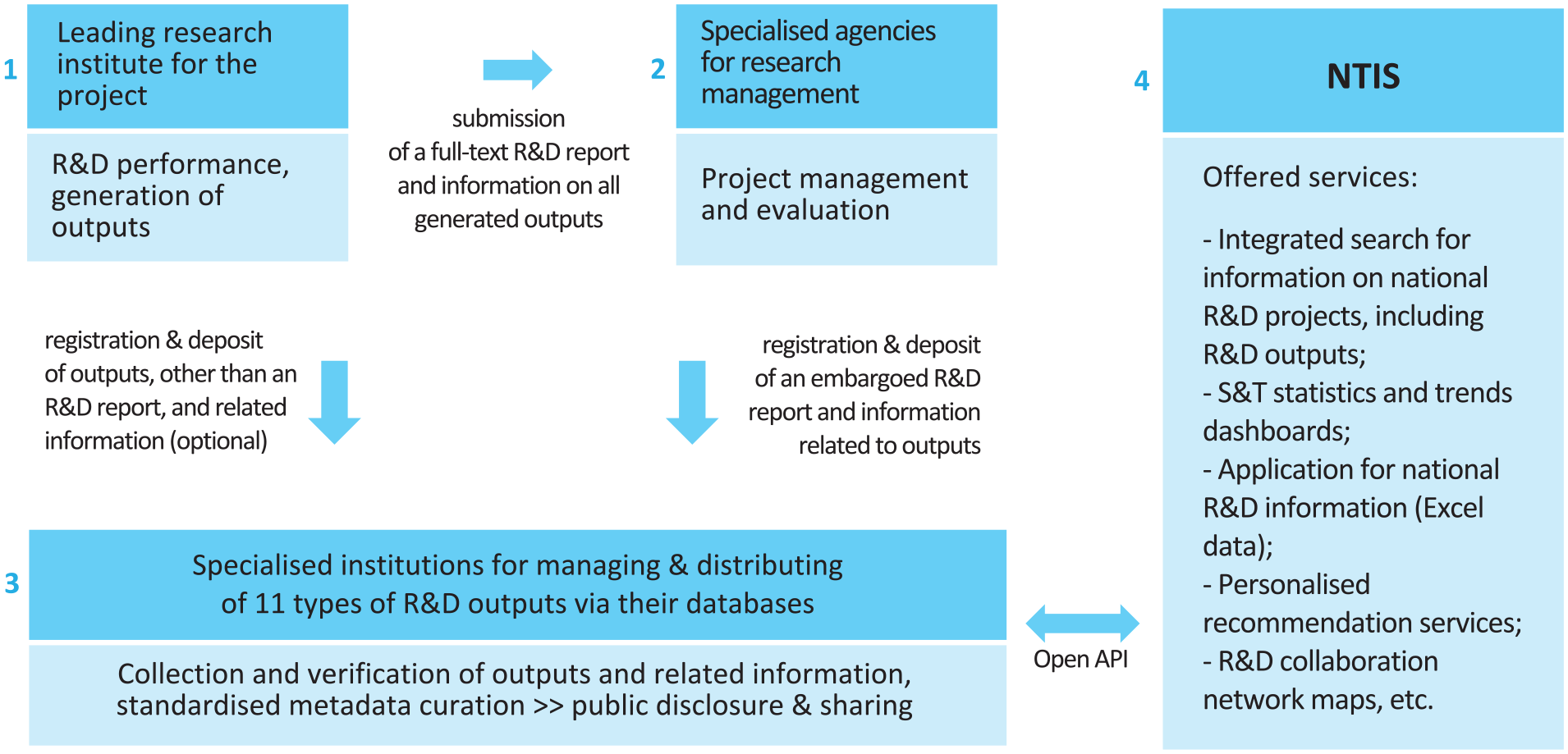
The National R&D Innovation Act (hereafter called ‘Innovation Act’) does not explicitly address OS practices, but its provisions related to the registration and deposit of outputs from national R&D projects via national databases, in principle, encourage Green OA in a broad sense (see legal instrument Number 2 in Table 2). In this context, OA is not limited to scientific publications but covers different types of R&D outputs. The presidential enforcement decree of the Innovation Act clearly lays down 11 types of outputs that can be derived from national R&D projects, such as: products, research facilities and equipment, academic articles, patents, R&D reports, technology summaries, biological resources, software, chemical compounds, new agricultural products and standards. According to Article 17 of the Innovation Act, after the completion of national R&D projects, researchers are obliged to submit a final report and information on all generated outputs (i.e. metadata) for registration in databases of the designated specialised institutions 9 in charge of particular national R&D outputs (R&D output management institutions). However, the law does not oblige researchers to deposit actual R&D outputs in those databases, except a full-text final report. The latter is expected to be held in the databases of those specialised institutions not being opened to the public until the end of an embargo period (usually 18 months) permitted to protect researchers’ intellectual property rights. In addition, the presidential enforcement decree of the Innovation Act provides a basis for operation and use of integrated information systems for management and distribution to the public of integrated knowledge and information related to national R&D projects. This pertains to the KISTI’s National Science and Technology Information Service (NTIS), 10 which integrates and provides, among other information, OA R&D outputs that are stored in the above-mentioned databases (more details of the NTIS system can be seen in section ‘Digital infrastructure operated by KISTI’).
In addition to the Innovation Act, the Act on the Performance Evaluation and Management of National Research and Development Projects and the related presidential enforcement decree also address, to some extent, the issues of registration and deposit of outputs from national R&D projects (see legal instrument Number 3 in Table 2). It refers to the provisions on the specialised institutions in charge of managing outputs from national R&D projects and on the establishment of databases of such R&D outputs. According to the law, such databases shall be linked to the KISTI’s integrated NTIS service.
The Academic Promotion Act (see legal instrument Number 4 in Table 2) covers issues related to the management and distribution of academic information (including outputs) produced by education and research institutions under the jurisdiction of the Ministry of Education. 11 For example, Article 6(3) requests researchers to report the results of academic activities supported by the Ministry of Education. It is specified that in case of violation of this provision, sanctions of suspending the payment of project funds and denying future funding for 1–10 years can be applied. However, the law and the related presidential enforcement decree do not provide a clear definition of ‘results of academic activities’. Moreover, some similar terms, such as ‘research outputs’ and ‘academic outputs’, are used interchangeably with ‘results of academic activities’ throughout the text of the law and the enforcement decree. Thus, it is difficult to understand the scope of the application of the legal provisions (e.g. if academic articles are included in those terms). In addition, the Academic Promotion Act and the enforcement decree do not impose any requirement on researchers to submit actual outputs, such as full-text articles, in addition to the requested ‘summary report of academic activity results’ and ‘information about academic activity results’. However, the enforcement decree lays down the requirement of reporting ‘other results prescribed by the agreement’ of academic support projects funded by the Ministry of Education (this can be the legal basis for submission of OA outputs). The Academic Promotion Act also has some provisions (Article 14) related to the establishment and operation of information systems and repositories for sharing and utilisation of academic information (including outputs). This serves as the legal basis, in particular, for the Research Information Sharing Service (RISS) 12 which provides OA to articles, research reports, theses, etc. produced by higher education institutions (more details of the RISS system can be seen in section ‘Digital infrastructure with a focus on the field of SSH’).
4.1.2. Explicit institutional policy on OA
The above-mentioned provisions in laws do not represent a proper national OA policy, but rather contain some elements related to OA, which can become a basis for future national OA policy development. The only policy in Korea which explicitly requires OA (Green route) to scientific publications and is registered in the international Registry of OA Repository Mandates and Policies (ROARMAP) is an institutional OA policy adopted by KISTI (see legal instrument Number 8 in Table 2). In accordance with this policy, KISTI researchers are required to deposit an electronic copy of the published version or the final author’s version of journal articles in the KISTI OA repository with a Creative Commons Attribution-NonCommercial (CC-BY-NC) licence. To foster OA policy, the institute provides different support mechanisms to cover costs arising with OA publishing in journals, such as support for individual APC costs of OA publications, including in hybrid journals, produced as a result of projects in the institute’s core R&D area (as part of the direct cost of a project); or OA publishing through transformative agreements. As for the latter, the National Research Council of Science and Technology (NST) ? a consortium comprising 25 government-funded research institutes, including KISTI ? concluded transformative agreements with Elsevier (2021-2023) and Wiley (2022-2024). Finally, it is worth noting that the KISTI OA policy permits an embargo period and exceptions for article deposition in the repository and the fact that it does not penalise non-compliance.
4.1.3. Legal instruments on research data sharing and management
The national policy on RDM, which applies to national R&D projects, has been outlined in the National R&D Information Processing Standard (hereafter ‘Standard’) enforced by the MSIT ordinance following the enactment of the Innovation Act (see legal instrument Number 6 in Table 2). However, the RDM-related provisions are not within the main scope of the Standard, being part of the Supplement chapter, and they are not mandatory. According to the Standard, central administrative agencies (e.g. ministries) can decide which national R&D projects they fund will need a Data Management Plan (DMP). For projects where a DMP is deemed necessary, the DMP is expected to be submitted at the time of the conclusion of the national R&D project agreement, confirming the responsibility of the R&D institute for managing the research data, and it shall be included in the final R&D report. The Standard does not say anything about sharing of research data after the completion of a project.
It should be noted that the RDM provisions stipulated in the above-mentioned Standard have a lower legal status, compared with the national policy on RDM that existed before the adoption of the Innovation Act and subordinate MSIT Standard [14]. Following the national Strategy on Research Data Sharing and Utilisation introduced by MSIT in 2018 [62], the first national RDM policy was elaborated in the amended provisions of the Regulation on the Management, etc. of National Research and Development Projects (hereafter ‘Regulation’) [63]. The latter was repealed by the Innovation Act in 2021. Compared with the current MSIT Standard, the repealed Regulation, enforced by the presidential decree, had a higher legal status. As with the MSIT Standard, the Regulation’s provisions were applied only to the projects where a DMP was deemed necessary by a relevant central administrative agency. Nevertheless, in contrast to the current Standard, the Regulation covered a broader scope of RDM by integrating a DMP into all stages of the national R&D process, including the project proposal stage and the subsequent management of information from national R&D projects.
An example of practical implementation of the above-mentioned national provisions on RDM is the policy of Korea’s main funding agency, NRF. 13 The NRF supports national R&D projects through the funds allocated by the MSIT and Ministry of Education. The open data sharing and RDM policy has been applied by NRF since 2018 (since the adoption of the above-mentioned MSIT Strategy on Research Data Sharing and Utilisation) and covers the NRF DMP Guidelines and relevant provisions in RFPs (see legal instrument Number 7 in Table 2). However, the policy is applied only to certain R&D projects for which a DMP is deemed necessary (e.g. projects in Biomedical Sciences, Neuroscience, 14 Material Convergence and Innovation). For such projects, NRF strictly requires researchers to submit a DMP as part of the application for R&D project funding (project proposals are denied the right to be considered and evaluated in case a DMP is not submitted together with other documents required for the application). The research data arising from the NRF funding are expected to be managed by a relevant R&D-performing organisation and be shared via a public repository, in accordance with a DMP. The NRF can provide funding to cover the costs associated with RDM as part of the full economic cost of an R&D project and it permits restrictions, including the embargo period, for sharing of actual data.
4.1.4. Legal instruments on releasing research software source code
The MSIT Regulation on ICT and Broadcasting Research Management (hereafter ‘Regulation on ICT’) addresses an OS practice, such as opening up software source code produced by government-funded researchers (see legal instrument Number 5 in Table 2). The Regulation on ICT permits two ways for open source sharing from software-related national R&D projects: (1) conducting the R&D projects using the open source software development method, or (2) distributing the results of a project, which was not initially performed using the open source software development method, as open software (e.g. for promoting underutilised technologies). The Regulation on ICT includes several measures to support open software, such as the provision of greater government support for R&D costs of projects to be conducted using the open source software development method and the exemption (or partial exemption) from the obligation to pay royalties to a central administrative agency. It should be noted that NRF considers software source code as a type of research data and include it in their open research data sharing and RDM policy.
4.2. National digital infrastructure supporting OS
According to various international comparative studies conducted, in particular, by the EC and OECD to measure countries’ performance related to the digital economy and digital transformation, Korea is among the top countries in the world in widespread Internet connectivity infrastructure, excelling especially in the speed of Internet connections [64–66]. In addition, Korea has been noted for its intensive R&D activities on ICT and investments in ICT diffusion in all sectors of the economy [64,65]. In particular, the country gives priority to Fourth Industrial Revolution technologies, driven by big data. For example, in 2017, the Presidential Committee on the Fourth Industrial Revolution 15 was established to promote data-driven innovation. The promotion of data infrastructures and services for R&D system innovation, including research data sharing and reuse in data-intensive fields, are part of the Committee’s plan [67]. Thus, a mature ICT infrastructure and a commitment to promote technologies for data-driven innovation have shaped the context for OS development in Korea.
4.2.1. Digital infrastructure operated by KISTI
As was mentioned in section ‘National regulatory environment’ of this article, the KISTI was designated by the government to support various tasks of managing and distributing of knowledge resources related to the S&T field and national R&D projects. To support domestic researchers, KISTI operates high-performance computing and data analysis resources, such as the world’s 38th fastest fifth-generation national supercomputer ‘Nurion’. 16 In addition, it provides multiple knowledge platforms and Artificial Intelligence (AI)-powered information services, such as the NTIS-integrated service for national R&D projects. As part of these infrastructures and services, OS is being promoted. The main KISTI services that support OS are depicted in Figure 1; the figure highlights an overarching knowledge infrastructure called ‘ScienceON’.
One of the oldest services within this infrastructure is NTIS, which has been provided since 2006 mainly by KISTI in cooperation with the Korean Institute of Science and Technology Evaluation and Planning (KISTEP) and the STEPI. A legal basis for operation and use of the NTIS service can be found in the laws mentioned in section ‘National regulatory environment’ of this article (see legal instrument Number 1–3 in Table 2). The primary goal of the NTIS service is to increase the efficiency of national R&D investment by preventing duplicated investments, which can be a result of management of information from national R&D projects by separate government organisations and institutions, and to improve R&D productivity by maximising the reuse of available R&D information. The NTIS is an integrated information system, which represents a portal that links distributed throughout multiple databases information on national R&D projects, and provides it in one place. The information includes standardised management information/metadata (e.g. project name and number, budget, names of R&D performing and funding organisations, names of participating researchers and their ID numbers, basic information about the produced R&D outputs, such as Digital Object Identifiers/DOIs), and links to open R&D outputs (e.g. full-text R&D reports, OA articles and open software), in case the latter are made publicly accessible in the databases of R&D output management institutions. Nevertheless, as explained in section ‘Laws on management and distribution of information from government-funded research’, the deposition of actual R&D outputs, except a full-text R&D report, is not mandatory. Figure 2 depicts the place of NTIS in the whole system of management and distribution of outputs from national R&D projects.

The system of management and distribution of outputs from national R&D projects.
Among other NTIS services are, for example, AI-powered personalised recommendation services based on user’s search history information analysis; R&D information on social issues delivered as a package; 17 request for downloading Excel data related to national R&D projects; visualisation of collaboration networks of researchers and research institutes on a particular R&D topic; S&T statistics and trends dashboards; etc.
Another essential KISTI service, part of the national OS digital infrastructure, is the Korea Open Access Platform (AccessON), 18 which was launched in 2020. AccessON is a single-point-of-access platform which provides an integrated search for and access to OA articles from domestic and international journals and repositories. To this end, AccessON uses the Open Archives Initiative Protocol for Metadata Harvesting (OAI-PMH) interface to collect metadata of OA articles from multiple sources, including OpenAIRE, Directory of Open Access Journals (DOAJ), Unpaywall aggregators, and CrossRef and ORCID registries. In addition to OA articles, the platform provides access to other information resources, such as OA policies and trends around the world (original text and metadata). Among additional AccessON’s services are self-archiving (national repository) service for domestic OA journals and researchers, including preprint archiving for researchers; an online co-authoring collaboration tool, including management of references, files and article’s versions; and a robust academic activity support system, including provision of information on predatory conferences and predatory OA journals.
The Korea Research Data Platform Service (DataON), 19 in full operation since 2020, is another component of KISTI’s OS digital infrastructure. The platform development was one of the core tasks of the 2018 MSIT Strategy on Research Data Sharing and Utilisation (see section ‘Legal instruments on research data sharing and management’ of this article). DataON is a platform which provides integrated search for metadata of research data (international data and domestic data from national R&D projects), including links to downloadable raw data files (e.g. datasets, images, open source software), if they are made available. The metadata is harvested through the OAI-PMH interface from various domestic and foreign data providers and repositories, including the following: four national specialised research data centres (Bio research, Materials, Large research facilities and AI research); institutional data repositories and international metadata aggregators, such as OpenAIRE, the Australian Research Data Commons (ARDC), and the Japanese Institutional Repositories Database (IRDB). DataON also serves for domestic researchers as a national data repository, where they may register, store and share their research data from national R&D projects (raw data can be stored either in DataON or in institutional repositories/data centres). In addition, the DataON platform provides a cloud-based research data analysis environment, such as JupyterLab, and an online tool for DMP creation.
Finally, KISTI’s Digital Content Curation Centre provides curation services for outputs (research articles, reports and data) from domestic S&T research (other than national R&D projects), aiming to increase their visibility and reuse. It should be noted that the above-mentioned KISTI platforms, such as AccessON, which basically harvest metadata of research outputs from external databases and repositories, do not provide the content curation services. The KISTI’s Curation Centre model, focused on a standardised semantic description of curated research outputs, represents an adapted version of the DCC&U (an extended Digital Curation Lifecycle Model based on the one developed by the UK Digital Curation Center) [68,69]. The KISTI’s curation services imply the creation or enhancement of research outputs’ metadata according to relevant standards, including DOI registration and identification of detailed information on research funding.
As can be seen from Figure 1, KISTI’s OS-friendly information services are linked to, and can be accessible through, a single interface called ‘ScienceON’. 20 ScienceON, launched in 2019, is an overarching knowledge infrastructure that provides ‘one stop service’ supporting researchers throughout the entire research process – from generating the idea for research to securing of intellectual property rights for research outputs. For example, on the ScienceON platform, researchers can search for various knowledge and information resources from NTIS, AccessON and DataON; in addition, they can store the search results, including downloaded research outputs, in their personal storage space called ‘MyON’ and can share them with collaborative researchers. In addition, the ScienceON platform is connected with other KISTI infrastructures, 21 including supplementary services related to OS (e.g. KPubS 22 and EDISON 23 ) and S&T information services which are not related to OS practices (e.g. STAR-Value 24 ). These other services are not discussed further in this article.
National Open Science digital infrastructure operated by the Korea Institute of Science and Technology Information (KISTI) and provided knowledge resources.
It is noteworthy that the ScienceON infrastructure and its integrated components, such as NTIS, DataON and S&T Content Curation Centre, are oriented towards S&T researchers and provide knowledge resources primarily from the S&T field.
4.2.2. Digital infrastructure with a focus on the field of SSH
There are several individual initiatives of relevance, but they are not connected and integrated in a single overarching infrastructure, as has been achieved for the S&T field (see section ‘Digital infrastructure operated by KISTI’). Among them, for example, are the Korea Social Science Data Archive (KOSSDA) and the RISS.
KOSSDA 25 is a non-profit digital archive of open SSH research data, which was established in 2006 as a ‘bottom-up’ initiative (initially aimed to provide only survey data) by the private foundation of Lee In-pyo, the chairman of the major domestic shoe corporation ‘Esquire’. In 2015, KOSSDA was transferred to Seoul National University’s (SNU) Asian Centre, which currently operates the data archive. KOSSDA is governed by a consortium of various data-producing organisations, including university research centres, government-funded and private research institutes, which voluntarily share their quantitative and qualitative SSH data (survey data, statistical tables, interview transcripts, observation records, etc.) according to a data deposit agreement. KOSSDA provides the data archiving and FAIR data management service for the deposited datasets so that any user can search for and download data, with the obligation to cite the data source. However, to download some of the survey datasets, an application explaining the purpose of the request must be submitted to protect personal information which might be associated with a particular survey. Along with research data, the data archive provides links to publications produced based on the KOSSDA’s data collection. Additional KOSSDA services include online statistical data analysis using ‘Nesstar’ software and education programmes and tutorials on data analysis. KOSSDA also participates in domestic research projects related to long-term RDM and it collaborates within the Network of Asian Social Science Data Archives (NASSDA). 26
RISS is an integrated system of shared electronic academic resources produced, owned and subscribed by domestic universities. The system, opened in 1998, is maintained by the Korea Education and Research Information Service (KERIS), a public institution funded by the Ministry of Education. RISS accumulates domestic and international articles, theses, research reports and educational resources (metadata, partially full-text outputs). However, in contrast to full-text theses, reports and educational resources available as OA, full-text articles require payment from users not affiliated with the RISS’s subscribing institutions. Since RISS provides paywalled access to academic outputs, we do not consider it as a full-fledged service supporting OA.
5. Discussion of SWOT analysis results and related strategies
5.1. SWOT of Korea’s national approach to OS
Our SWOT analysis has helped to further assess the Korea’s national OS approach, looking not only at the current state of play of OS in Korea but also projecting the country’s possible future directions. The results are mapped into a SWOT matrix (see Table 3). Strengths and weaknesses are treated in this study as mostly internal factors within Korea’s control. Accordingly, the revealed strengths include features that support OS, for example, the availability of potential funding sources to advance OS. The identified weaknesses are barriers that inhibit OS from achieving its full potential, for example, the absence or insufficiency of policy interventions, such as a lack of explicit OA mandates required by research funding agencies. However, the opportunities and threats are considered as mostly external factors beyond national control that have the potential to affect country’s OS position. Opportunities are understood as an entry point to exploit positive global trends or other external situations to strengthen Korea’s OS standing in the feasible future; for example, global collaboration and partnerships on OS triggered by the coronavirus pandemic. Threats are viewed, in this context, as negative global trends or external situations that might exacerbate further the existing national challenges or create new barriers preventing Korea’s stronger competitiveness in the OS domain. An example of threats is a risk of unfair pricing strategies by large international commercial publishers through transformative agreements, which can inhibit Korea’s transition to OA. Both strengths and opportunities tend to create more favourable conditions for OS progress, while weaknesses and threats may lead to the worsening of the current state of play in OS.
Korea’s Open Science profile based on a SWOT analysis.

The SWOT analysis shows that in our opinion, the weaknesses prevail over the strengths in the Korea’s national approach to OS; in particular, the lack of sufficient political will to promote OS is a key weakness. Some weaknesses are dependent on others. For instance, the lack of explicit requirements in national legislation and policies for public disclosure of government-funded R&D outputs results in a weakness of national OS digital infrastructures, which are currently mostly dominated by metadata rather than open research outputs and raw data. Among other weaknesses is a significant bias towards publishing outputs from government-funded research in international commercial publishers’ journals (both subscription and hybrid) based on the Impact Factor of these journals. For example, according to a previous study [24], 72% of all published articles from NRF-funded projects were published in 2018 in such overseas journals owned by large publishing houses; it was estimated that approximately 30% of those journal articles were published as OA.
One of the arguments explaining insufficient political will in OS promotion has been that domestic researchers tend to be unwilling to openly share their research outputs. However, this seems to be a logical consequence of the following factors: the availability of various laws and policy instruments, such as the Technology Transfer and Commercialisation Promotion Act [31], greatly incentivising technology transfer and commercialisation, and the lack of dedicated policy efforts to transform the traditional reputation economy of scholarly communication not rewarding OS practices.
5.2. Future scenarios of Korea’s OS strategies
Based on our SWOT analysis in Table 3, a TOWS matrix (see section ‘Methods’ of this article) was applied to formulate some recommended strategies for addressing the SWOT factors that we have identified. Table 4 depicts the TOWS matrix covering the four types of strategies aimed at maximising internal strengths and external opportunities and minimising internal weaknesses and external threats. These are as follows: (1) SO strategy that aims to use internal strengths to take advantage of external opportunities, (2) ST strategy that aims to use internal strengths to minimise external threats, (3) WO strategy that attempts to minimise internal weaknesses by taking advantage of external opportunities and (4) WT strategy that attempts to minimise both internal weaknesses and external threats.
TOWS matrix of possible strategies for Open Science development in Korea.

Since our SWOT analysis has revealed that, in our opinion, currently internal weaknesses dominate other factors and that there are a limited number of external opportunities potentially relevant to the Korean OS context, we argue that the highest priority should be given to defining and implementing WT strategies. We recommend three broad WT strategies: fostering multi-stakeholder working groups/fora as a coordinated national approach to OS development; amending national legislation by including explicit provisions on OS and reinforcing the domestic OA publishing ecosystem to become less dependent on large international commercial publishers.
The first WT strategy could help address the weakness of insufficient coordination between national stakeholders and a lack of whole-of-government approach to consistent development and alignment of national and institutional OS policies. At the same time, the proposed strategy, aiming at strengthening the country’s OS profile in a coordinated and systematic way, could also help overcome many of the potential external threats. Ideally, the strategy of establishing multi-stakeholder OS working groups and annual fora could result in an agreed national OS implementation plan – something similar to that has been achieved in the Netherlands [71] and France [72]. It should be noted that a need for a coordinated strategy to develop an overarching national approach to OS is not only an agenda for Korea. For example, this has been discussed in Australia through multi-stakeholder roundtables since 2020 [73].
The second WT strategy aims to address one of the major weaknesses of the current Korea’s OS position that we have identified, the insufficiency of legal instruments that explicitly encourage or mandate OS practices. In this regard, there has been discussion on to what extent and by which instruments should legislative and policy interventions related to OS be used [74,75]. There are some countries that have embedded explicit mandates and rights associated with particular OS practices, such as Green OA, in national laws (e.g. Article 30 of the French Digital Republic Law [76]; Article 37 of the Spanish Act on Science, Technology and Innovation [77]; Argentina’s Law on Institutional Open Access Digital Repositories [78]; and Article 25fa of the Dutch Copyright Act [79]). There are other countries, which do not have specific laws directly associated with OS and where OS policies are mainly driven by legally binding provisions imposed by research funders and institutions, including OS-related conditions in R&D agreements (e.g. the UK funders’ policies, such as the UKRI OA Policy [80] and NIHR OA policy [81]). However, taking into account the Korean legal system, we recommend the use of explicit basic provisions on OS in national laws because, otherwise, public institutions might choose not to develop OS mandating or encouraging policies. There is, of course, an argument that it is not enough to promote OS solely through just a ‘top-down’ approach (formal regulative measures stipulated in diverse legal instruments), but it rather should be done in combination with a ‘bottom-up’ approach aimed at engaging and incentivising research communities for OS practices[74,75,82]. Our recommendation, based as it is on our knowledge of both the Korean legislative process and Korean culture, is that the laws discussed in section ‘Laws on management and distribution of information from government-funded research’, such as the Framework Act on Science and Technology and the Innovation Act, should be amended, which in turn will further the development of funder and institutional polices on OS. In particular, a previous study by a KISTI team [14] and with which we agree, proposed to add new paragraphs to Article 6 of the Framework Act on Science and Technology, covering the following topics: declaration on the establishment of an ‘OS system’ by the government and the basic principles of that system; OA permitting unrestricted reuse of R&D outputs; research data generated in the R&D process; and open collaboration in the R&D process. The last three topics proposed to be included in the law are consistent with the classification of OS practices, which is commonly used in Korea (see section ‘Open Science as an emerging field of academic research and practice’ of this article).
Finally, the third WT strategy we suggest deals with the Korea’s OA-related weaknesses (e.g. lack of explicit national and institutional OA policies, high priority given to publishing in high Impact Factor international journals) as well as the threats of increasing further Korea’s dependency on large international commercial publishers (e.g. through great reliance on transformative agreements) and exacerbating a gap between Korea and the ‘Global North’ in terms of research visibility. In this regard, we propose several measures to reinforce the domestic OA scholarly publishing ecosystem, making it more competitive. These include creating opportunities for Korean researchers to publish their outputs in diverse, affordable, high-quality domestic OA venues (including transparent open peer review platforms [83] and journals) and be properly credited for such publications during research assessment procedures. Regarding the latter, there is an example of a good initiative in Argentina, which represents an attempt to encourage government-funded SSH researchers to publish in domestic OA journals [84]. As part of academic assessment of SSH researchers, the National Scientific and Technical Research Council of Argentina (CONICET) [85] recognises publications from domestic OA journals indexed in a regional bibliographic database ‘SciELO’ at the same level as publications from international journals indexed in Web of Science or Scopus. Furthermore, to address the threat of low visibility of Korean research, some efforts should be made to connect Korean OA journals to the broader research landscape through reputable global and regional bibliographic databases, such as Scopus, Web of Science, DOAJ and SciELO.
6. Concluding remarks
This study represents one of the first efforts to provide a systematic overview of Korea’s national OS approach. Using a case study method accompanied by the use of the SWOT–TOWS technique, we have highlighted its different features and attempted to provide some initial input into the development of possible strategies to minimise weaknesses and threats by taking advantage of the identified strengths and opportunities. Insights offered in this study might be useful to both academic scholars in OS policy research and practitioners who are willing to make local OS regulations and policies more robust and successful.
The results of this study show that despite growing pressure to promote OS agenda in Korea, the current state of play is dominated by multiple weaknesses. For example, among such weaknesses are the following: insufficient political will; inadequate coordination between national stakeholders and a lack of whole-of-government approach for a systematic implementation of OS; limited number of national and institutional legal instruments that explicitly encourage or mandate OS; lack of reward mechanisms for OS practices within researcher assessment procedures; strong national policies on technology transfer encouraging research institute to obtain intellectual property, etc. It is argued that the highest priority should be given to develop WT strategies attempting to minimise both internal weaknesses and external threats, such as reinforcing domestic OA publishing ecosystem to mitigate Korean researchers’ dependency on large international commercial publishers and their arguably unfair pricing policies. Among other recommended TOWS strategies, there are those which should take the advantage of external opportunities being able to strengthen Korea’s OS standing. For example, the current EC initiative on reforming the research assessment system [86] provides an opportunity for Korea to address its internal weakness by joining a global coalition of research organisations and agencies aiming to elaborate common principles, mechanisms and coordinated implementation plans to incorporate OS practices into researcher assessment.
It is also important to note that this study is not without its limitations. One limitation is the use of a SWOT approach that involves subjective statements. This limitation was alleviated to some extent by the fact that the SWOT was based on extensive sample of case study sources of evidence, such as Korean legislation and various policy documents. Furthermore, the recommendations resulting from this study (including the identified SWOT factors and strategies to address them) are not meant to be all-encompassing but rather to offer a starting point for future discussion and investigation. Future research might uncover other relevant SWOT characteristics of Korea’s national OS approach, for example, further exploring external opportunities and threats. Such further research might test the feasibility of some of our proposed strategies and develop a detailed roadmap to implement them. Another possible limitation of the study, which is one of the common limitations of a single-case study research, is generalisability of the results to different countries, as not all Korea’s lessons might be universally applicable to other nations, and approaches successfully adopted by other countries might not be applicable to Korea. However, the use of this study to better understand Korea’s national OS approach will, we hope, not only address some of Korea’s OS deficiencies but also lead to greater cooperation between Korean and foreign OS policymakers, researchers and practitioners.
Footnotes
Declaration of conflicting interests
The author(s) declared no potential conflicts of interest with respect to the research, authorship and/or publication of this article.
Funding
The author(s) received no financial support for the research, authorship and/or publication of this article.
