




Abstract
Digital ecosystem (DE) is a dynamic configuration of informational organisms, individual and organisational actors, which interact in the digitally networked and federated environment. Traditional approaches are challenged by the need for handling information in complex DE where information flows beyond the boundary of a single actor. This article presents the informational organism-interaction centric digital ecosystem information (DEi) framework for information operations, management, and governance. The DEi framework emerged based on the insights obtained through the application of well-known thematic network analysis and abstraction, reflection and learning techniques to 15 action design research projects across nine different industry partners in Australia. The DEi framework includes 27 topics that are organised into nine key knowledge and three focus areas. The DEi framework can be used by researchers and practitioners as a resource for designing digital information capabilities as appropriate to their context.
1. Introduction
Digital ecosystem (DE) is a digital technology–enabled network of interacting informational organisms or actors [1,2]. DE actors’ source, share and use information using digital technologies, such as Big Data, cloud, drone, fog, Internet of Things (IoT), mobile, robotics, and social [3,4]. Information is defined as a group of related data elements or facts that has specific meaning for a specific context [5]. DE actors include suppliers, partner, competitors, start-ups, regulators, communities, customers, users, employees, and volunteers. Information-handling across different interacting actors in distributed DE is an arduous task. This draws our attention to the following overarching main research question:
How to handle information in heterogenous and federated DE, where information flows beyond the boundary of a single actor?
This article presents the informational organism-interaction centric digital ecosystem information (DEi) framework to address this need for information operations, management, and governance. First, it provides an overview of the research background, motivation and method. Second, it presents the DEi framework. Finally, it concludes with key insights and future research directions.
2. Research background, motivation and method
Local and internally organisation-focused approaches to information-handling are challenged by the federated and connected DEi environment, where information-handling is not a straightforward undertaking [6,7]. This article addresses this important research and practical challenge and presents the DEi framework for operating, managing and governing information in DE. The DEi framework is emerged based on the analysis and insights from our research with nine industry research partners from government, financial environment, education, energy and software industry in Australia, across 15 applied research projects between 2012 and 2021 (see Supplementary Material for projects, abstraction, reflection and learning analysis and mapping) at the DigiSAS Lab, University of UTS. There were 16 projects in total; however, one of the projects did not involve the information component. It was more focused on blockchain technology governance. Thus, it was excluded from the analysis. The core research method and approach for these (information focused) 15 projects was the well-known action design research (ADR) [8]. However, each project has its own context and problem as noted in the supplementary material. Stages 1 and 2 focused on the problem formulation and building, intervention and evaluation of the proposed solution for each project. Stages 3 and 4 are focused on the generalisation (abstraction) of reflections and learning beyond single organisational and project context. This article reports insights in the form of DEi from Stages 3 and 4 of the ADR method (Figure 1).
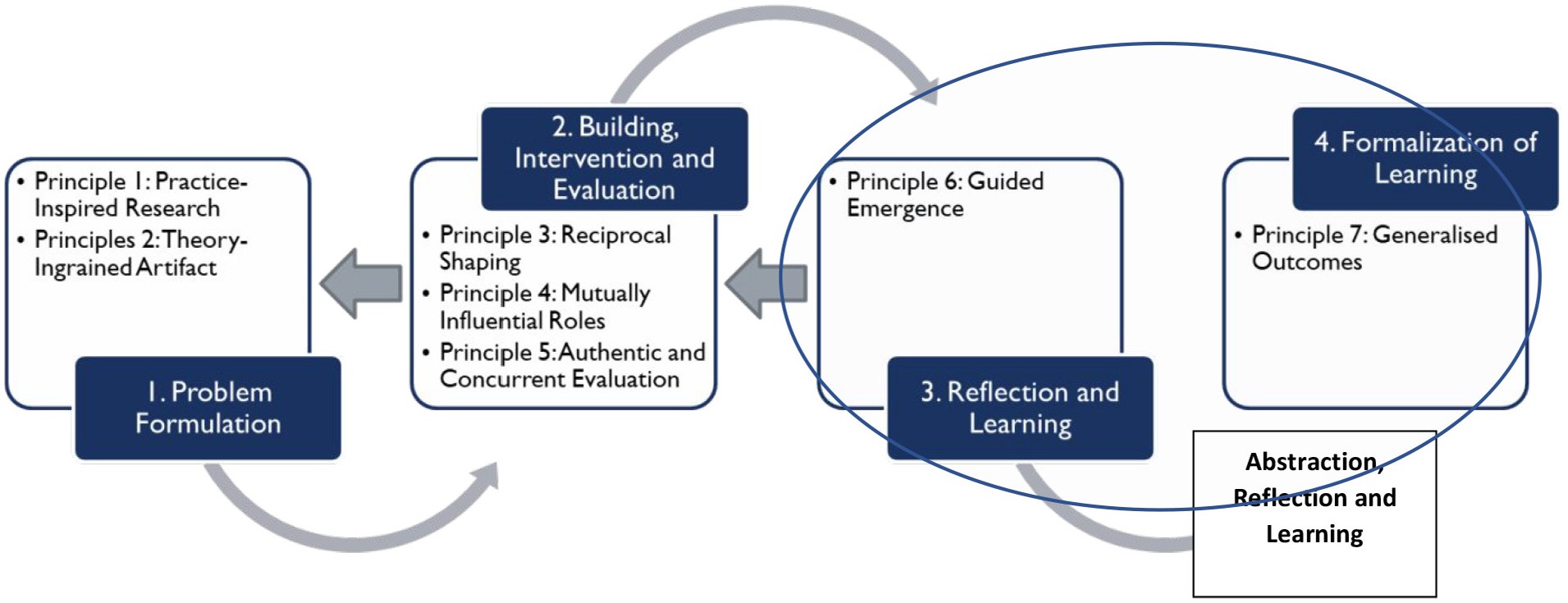
Action design research method (based on (8)).
The reflections and learnings from ADR [8] resulted in the form of key concepts derived from these industry research projects spanning nine organisations in Australia. Abstraction mechanism from the well-known qualitative thematic analysis approach [9] was then applied to analyse these concepts, which helped in defining basic (topics), organising (knowledge areas) and global themes (focus areas) that form the DEi framework. Hence, beyond individual deliverables from these projects (see supplementary material), the DEi framework emerged as a generalised outcome from the final ADR stage.
3. The DEi framework
The DEi framework is organised into 27 topics (basic themes), which are further organised into nine knowledge areas (organising themes) rolled up into three focus areas (global themes) for operating, managing and governing information in DE (Figure 2). In DE, information is discovered, collected, classified, secured, prepared, released, accessed, used, archived, purged, restored and recycled (information lifecycle) by different actors (a.k.a. informational organisms) and their interactions, which may span different enterprise boundaries. Thus, the information, actors and their interactions are core topics of the DEi framework, thus these are organised as the first knowledge area or basic theme of the DE, which is further organised into ‘Executing’ focus area or global theme due to its operational (information in use) executional nature (Figure 2). Therefore, unlike traditional well-known data framework [10], DEi is an actor-interaction centric framework, and it mainly focuses on the professional capability development in enterprises independent of any specific frameworks and their certifications. Similarly, other related topics are grouped into further relevant knowledge areas and respective focus areas using the abstraction, reflection and learning techniques (as indicated earlier).
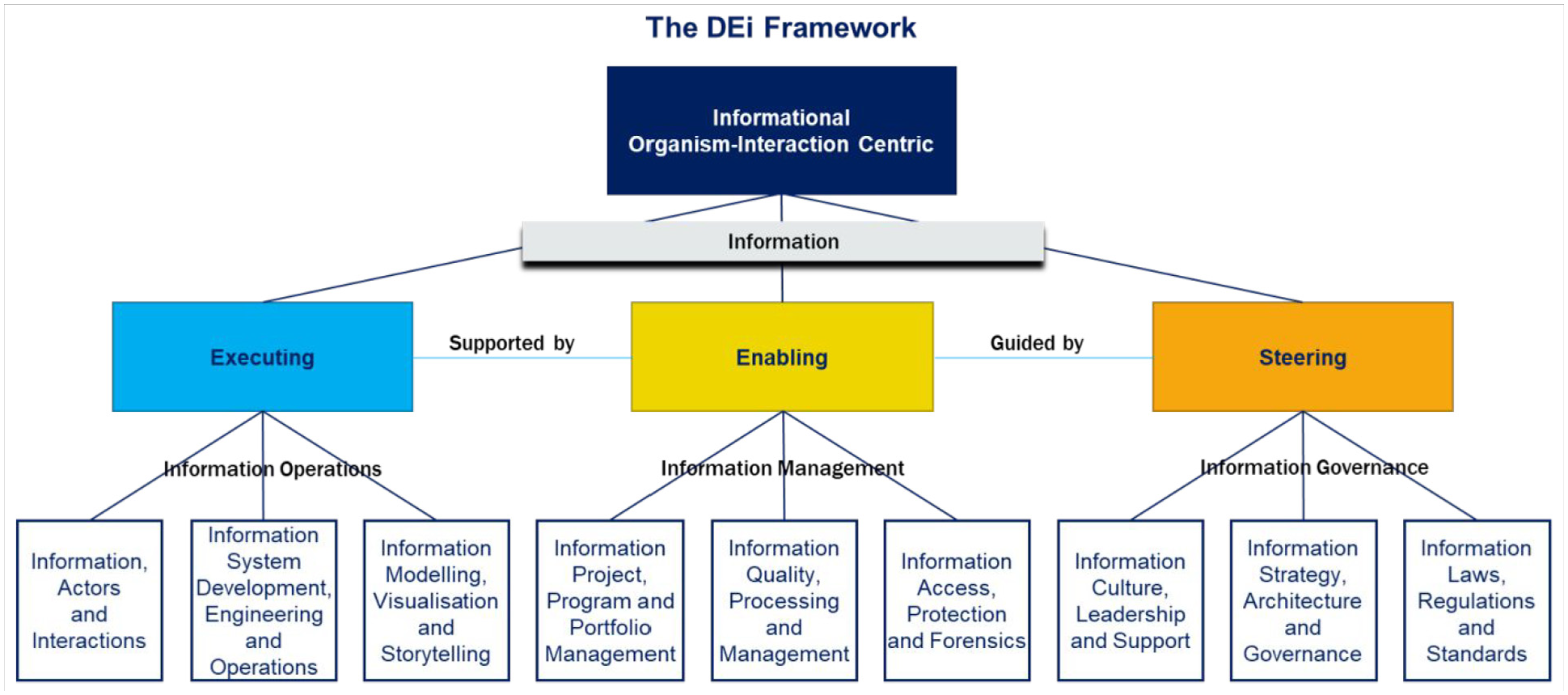
The digital ecosystem information (DEi) framework.
3.1. Knowledge areas
The DEi framework includes nine knowledge areas, where each knowledge area provides specific viewpoint on information in DE. The DEi framework knowledge areas are generic in nature and are not tied to a specific information capability or function. These areas can be adapted to establish specialist information capabilities. For instance, integrated knowledge area of ‘information quality, processing and management’ can be used to define a specific information quality management capability and training. Furthermore, knowledge area ‘information strategy, architecture, governance’ can be used to define integrated information governance capability. These knowledge areas can also be tailored and used to develop relevant professional information competencies and skills.
3.2. Focus areas
The related knowledge areas are further analysed to obtain three high-level focus areas (global themes): executing, enabling, and steering focus areas. Information operations in executing focus area are supported by the enabling focused area, which in turn is guided by the steering focus area (Figure 2). For instance, executing refers to knowledge areas that focus on operations: (1) information, actors and interactions; (2) information systems development, engineering and operations and (3) information modelling, visualisation and storytelling. Enabling focuses on information management and includes relevant knowledge areas of (4) information project, programme and portfolio management; (5) information quality, processing and management and (6) information access, protection and forensics. Finally, steering focuses on governance and includes knowledge areas: (7) information culture, leadership and support; (8) information strategy, architecture and governance and (9) information laws, regulations and standards. In a nutshell, these extracted knowledge areas across nine organisations in this research provide coverage for information operations, management, and governance focus areas in DE.
4. Conclusion, insights and future work
The DEi provides generic knowledge areas rather fixed capabilities or functions. This is a final generalised outcome of ADR research across nine organisations in Sydney, Australia, based on the abstraction, reflections and learnings from 15 projects between 2012 and 2021. The DEi provides 27 topics organised into nine knowledge areas for executing, enabling and steering boundary less information flows.
Insight 1: Executing focuses on information operations, in which different actors and their interaction handle information using information systems (e.g. geospatial information system, financial information system). This requires information system development, engineering and operations. Furthermore, operations involve information modelling, visualisation and storytelling.
Insight 2: Enabling focuses on information management via specific project, programme and portfolio. It also includes actual information quality, processing and its lifecycle management. Information access, protection and forensics enable secure information management.
Insight 3: Steering focuses on information governance and includes information culture, leadership and support; and information strategy, architecture and governance. This is also augmented and influenced by information laws, regulations and standards.
Future work will include using these knowledge areas and insights for developing situation-specific capabilities and platforms.
Supplemental Material
sj-docx-1-jis-10.1177_01655515221086593 – Supplemental material for The digital ecosystem information framework: Insights from action design research
Supplemental material, sj-docx-1-jis-10.1177_01655515221086593 for The digital ecosystem information framework: Insights from action design research by Asif Qumer Gill in Journal of Information Science
Footnotes
Declaration of conflicting interests
The author(s) declared no potential conflicts of interest with respect to the research, authorship and/or publication of this article.
Funding
The author(s) received no financial support for the research, authorship and/or publication of this article.

Supplemental material
Supplemental material for this article is available online.
References
Supplementary Material
Please find the following supplemental material available below.
For Open Access articles published under a Creative Commons License, all supplemental material carries the same license as the article it is associated with.
For non-Open Access articles published, all supplemental material carries a non-exclusive license, and permission requests for re-use of supplemental material or any part of supplemental material shall be sent directly to the copyright owner as specified in the copyright notice associated with the article.
