




Abstract
This article presents findings from interviews with 18 writers and artists in New Zealand, whose lives and work have potential heritage value. The objective was to investigate the perceived value of participants’ personal collections, the relevant management practices and challenges, and their potential effects on preservation and (re)use. The findings provide a characterisation of the personal information management (PIM) practices of writers and artists, revealed challenges common to organising personal collections across time and devices as well as those caused or increased by the nature of writers’ and artists’ work, and produce insights into the impact of perceived collection value and PIM practices on future access, preservation and (re)use of such collections.
1. Introduction
In their everyday lives, people collect information from a myriad of sources in various forms and organise that information in multiple and diverse ways. No matter what their organisation preferences or practices are, in time, they end up with a collection of physical and digital information items that can be wide and complex or very minimal and simple [1,2]. Information from such collections can be used for diverse purposes in daily life to fulfil multiple roles and meet diverse challenges [3]. To describe the collections created, owned or used by an individual and their family, we use the term personal collection in this article. We define personal collections as a collection of physical and digital documents and items created or collected, intentionally or accidentally, by an individual for their personal use in various life contexts, that is held and curated within their personal physical or digital space. Personal collections also have intangible dimensions, such as memories, sentimental and practical values, and emotions associated with documents and items. Other terms have been used in previous research to describe similar personal collections, each with their own focus or emphasis, such as: personal or family archives [4], immediate information space [5,6], personal space of information [3] and personal records [7]. Such collections are often investigated through the lens of wider process of personal information management (PIM).
Personal collections of all people can be of value to society by providing a democratic and representative approach to documenting and presenting history [8]. However, some people whose actions during their life produced something especially relevant or notable for future generations might have particularly valuable personal collections whose preservation and availability in the public domain could be of interest to society. Writers and artists are examples of such individuals and in this article, we focus on their personal collections and collection management practices. Personal collections of writers and artists, apart from being a source of information for their creators, can also contain relevant heritage materials worth preserving as heritage for future generations [9]; examples include unreleased music recordings and unexhibited paintings, versions of manuscripts or correspondence with publishers and readers, and other items documenting the social milieu of their time and place and providing further insight into the activities and perspectives of the collection’s owner. Understanding personal collections and management practices of writers and artists can thus deepen the understanding and support diverse social interpretations of works of art [10,11].
However, we argue that to access, understand and reuse someone’s collections depends on the clarity and efficiency of their organisation practices, and is impacted by the technological environments in which those collections are or have been created. In a series of live interviews with writers and artists about their book collections, Devitt [12] explains, ‘We talk about their books as a way into a broader conversation and context to reveal stories and insights into who they are and why they do what they do’. The present research has a similar motivation: to understand writers’ and artists’ personal collections through their content and management practices, and additionally to understand what might strengthen or diminish the chances of the collections’ preservation and subsequent reuse. With that motivation in mind, the objectives of the study were to investigate how writers and artists perceive the value of their personal collections, what practices they apply to manage their personal collections and what challenges they face in that management, how the perceived values influence their practices and what potential effects those practices might have on preservation and access to their collections in the future. Under the term value, we include writers’ and artists’ perceptions of the possible benefit or interest their collections hold for the owners themselves, for their families and for society, including heritage institutions that might acquire their collections.
What follows is a review of the relevant ideas and prior works, an outline of the methodology used and a presentation of the results of the study conducted. Finally, the manuscript ends with concluding remarks and indications for future work.
2. Literature review
Although surprisingly little is known about the PIM practices of artists and writers, there are some prior works on their general information sources and use, and there are numerous works on personal collections and the challenges of managing them. Here we review those that are relevant to the study objectives, while a broader and deeper review of PIM topics is provided elsewhere [3].
2.1. Artists’ and writers’ information sources and use
Previous research studied the use and management of information in the work of artists, but not abundantly. Primarily, the literature tells us that artists’ information behaviour is idiosyncratic: artists prefer visual information and need information for inspiration, visual reference, technical information, information about exhibition and sales, and trends in the art world [13–15]. Nature, artwork and artistic media, works of art seen in person, observation of other people and personal life experiences are information sources that inspire or guide artists’ work [16], as do television, films, novels, poetry, non-fiction books, travel, music and personal collections of photographs taken for inspiration [16,17]. Artists often document the artistic processes in the form of visual diaries, blogs and podcasts, thus recording the process of creating art, which they can reuse in later stages of their work [9] or simply preserve memories and document personal growth and identity formation [18].
Although scarce and lacking empirical findings on how creative writers gather, evaluate and use information in their creative work [19], prior works have explored some aspects of writers’ information habits, practices and collections. Such studies have examined (e.g.) how writers use libraries as a source of information [20] and what information retrieval tools and programmes libraries provide to writers [21,22]. It is unclear, however, to what extent such findings, or those about similar populations, might apply to artists’ and writers’ behaviour or practices with their personal information and collections [19].
2.2. Artists’ and writers’ personal collections and their value
Personal collections, understood as those owned or managed by an individual [3], are kept by many kinds of people as records and sources of information for various personal, familial, professional and community needs [23–26]. Such collections contain items in physical and digital format spanning multiple spaces and devices [27], usually consisting of records of their owner’s activities and interests, and thus comprise valuable personal information legacies [9,28–30] which must be managed over time spans (i.e. one’s lifetime) [31]. Personal collections, not just those of artists and writers, have thus been studied to examine their contents, management practices and value [32–34]. Notably, these collections pose challenges in their organisation and preservation arising from technological complexities or obsolescence, lack of context documentation and lack of practical skills, which making them critically endangered and challenging to study [29,35].
Like most people, artists keep collections which they use on a day-to-day basis as well as for potential long-term use and preservation [36], but much less is known about the resulting – and possibly unique – practices and challenges of managing such collections. Although in general, the value of a personal collection (and arguably the value of any kind of collection) ‘shifts depending on the context of interpretation and who is interpreting them’ (p. 213) [4], the value perceived or assessed by a personal collection’s owner is nonetheless a factor influencing their information management practices [37,38]. For artists, in particular, it is often the perception of the value of items in personal collections that will determine if artists invest effort into strategies for preserving the collection at all [18].
The personal collections of writers in particular have been identified as important to both the writers and to society because they provide information useful during the creation of the work and about the finished products, respectively [39–41]. The personal records writers keep provide details about their lives and the personal experiences that form the background to their works and can evoke the character of a writer and their surroundings [42].They are often used, for example, in writers’ autobiographies, where recollection of times and places is achieved through objects in personal collections [8]. While it is recognised that various agents shape writers’ personal archives [9], and in a way the creation of an archive is a type of performative act [33,43], research also noted ‘a lack of awareness that contemporary authors have about today’s cultural landscape and that they themselves should be involved in preserving the context of their work, which is as important as the work itself’ [44].
The value of such collections is therefore highly relevant to the long-term preservation and reuse of their collection, but it is not yet clear, however, how perceptions of value influence management practices or decisions that may lead to the successful persistence and reuse (or not) of such collections. These matters of collection persistence and reuse seem particularly important for writers and artists as they also produce valuable context about but also beside their works (e.g. in the form of discarded or revised earlier versions or various sources of inspiration [15]).
2.3. Artists’ PIM
How artists manage information in their personal collections can have an impact on the ways artwork is reused, transferred to collection institutions, perceived and preserved. Even though available resources provide preservation guidance to artists [45], research reports that artists’ practices vary, and artists often report a lack of specialised knowledge and skills to create and maintain their personal archives or lack the motivation to do so [26,46]. Some artists develop their own preservation skills, but are interested in gaining preservation ideas from other artists and experts [47]. Apart from time and resources perceived as necessary to invest in the management of personal collections, artists face additional challenges, such as technological challenges and emotional barriers, for example, unresolved feelings about the work [47]. There is an awareness that the preservation can maintain the integrity of an artist’s work, and that the ideas, concepts and processes are sometimes as important to preserve as the work itself [9,47]. More generally, despite the above advances in understanding the information practices of artists and further advances in understanding the PIM-specific practices of other demographic groups (e.g. scholars, students, engineers; [3]), little is known about artists’ practices – and even less about writers’ practices – along the traditional PIM categories of storing, organising and retrieving.
2.4. Summary
The primary theme among the literature reviewed above is that important details about the PIM practices of artists and writers remain unknown, especially the value, practices and challenges of managing their personal collections and the impact such factors have on collection preservation and reuse.
3. Research design
This research aimed to investigate the organisation, preservation, presentation and (re)use of personal collections of writers and artists whose life and work have potential heritage value. The research questions that guided this study were, therefore:
How do artists and writers perceive the value of their personal collections?
What practices do they apply to manage their personal collections?
What challenges do writers and artists face related to their personal collections?
We additionally combine the subjects of these questions to pose two further questions:
How do the perceived collection values influence writers’ and artists’ information management practices?
What effects might artists’ and writers’ PIM practices have on the preservation and reuse of their collections in the future?
A qualitative approach to research design was used to examine in-depth, multiple individual realities using purposive sampling and inductive analysis [48]. The research sample included 18 purposefully chosen participants (10 writers and eight artists of all kinds, interpreted broadly) in New Zealand, who were interviewed between August 2020 and January 2021. Participants were accepted only if they were productive in New Zealand’s creative sector (e.g. as writers, musicians, painters, sculptors, photographers, theatre performers and film designers). Participants were emailed or contacted through their social media pages and invited to participate in an hour-long interview about a list of topics given to them beforehand. Data collection took place during the COVID-19 pandemic; face-to-face interviews were conducted (a) at times not prohibited by New Zealand’s COVID-19 alert levels and restrictions and (b) with appropriate safety precautions. However, previously planned week-long observations of each participant’s collection and practices were rendered impossible and were thus abandoned. The interviews were semi-structured and allowed for additional topics to emerge during the conversations. There were three main topics discussed in all interviews: the content of the participants’ personal collections, participants’ information management practices and issues and challenges in managing their collections (see Appendix 1 for interview questions).
Interviews were transcribed, reviewed and verified by the participants, anonymised and then analysed. NVivo software was used to analyse the interview transcripts: transcripts were coded by identifying connections and patterns in the data and generating emergent themes in the first round of analysis, and then, a cluster of themes were identified in the second round of analysis [49]. We distributed 22 initial themes into three groups framed by the research objectives, and for clarity combined themes when appropriate (e.g. records and evidential value included several subthemes, such as records of work, records of relationship, records of time and records of place). The results section presents 14 themes under three main sections of value, practices and concerns. In the '‘Discussion’ section, we discuss further how these themes relate to one another and how they together answer the five research questions posed above.
4. Results
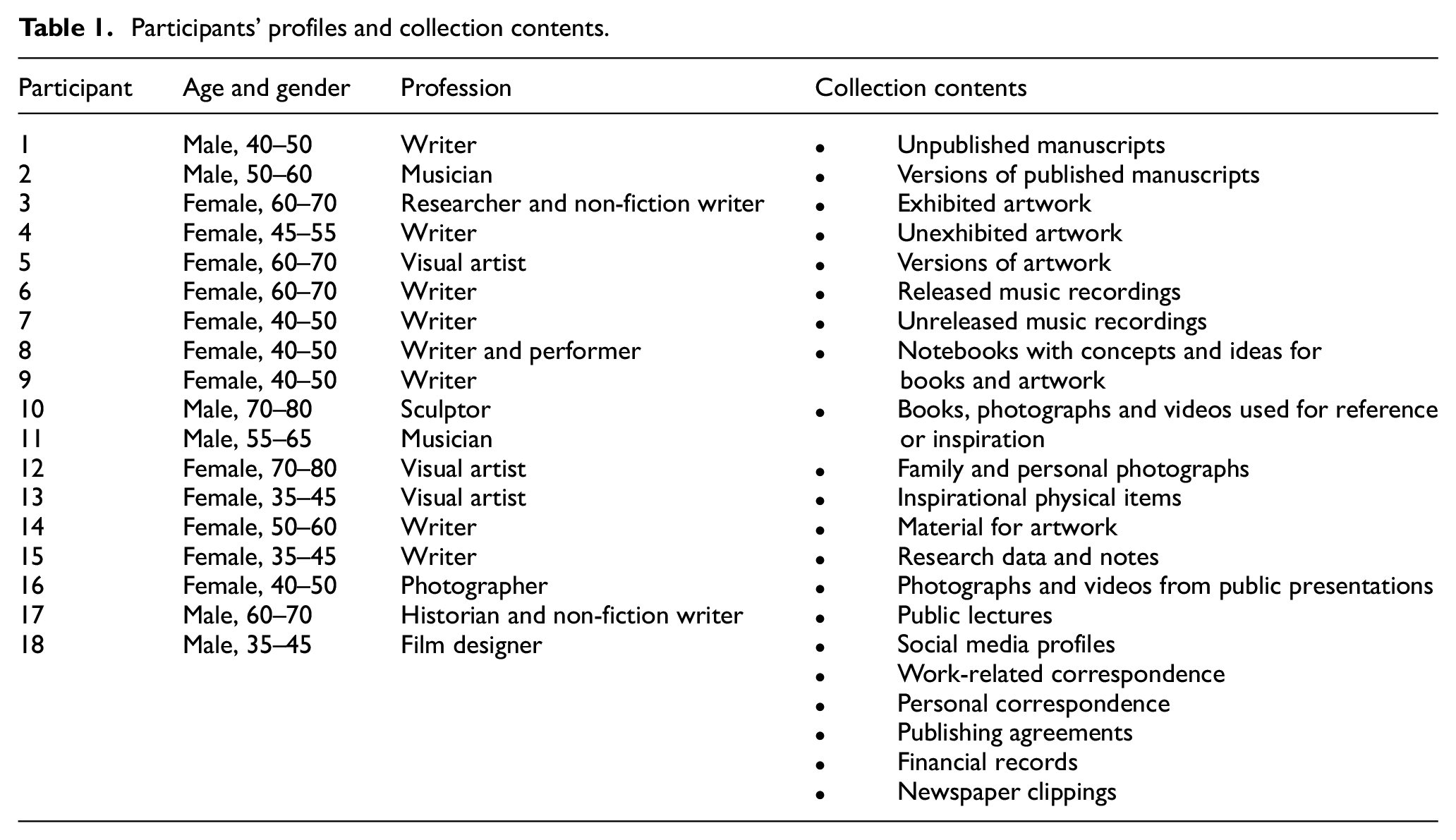
Ten writers and eight artists participated in the present study; 12 females and six males. All participants were national and international award winners influential in their field. Table 1 shows participants’ profiles and collection contents, which are made up of a variety of material in diverse forms and formats (e.g. published and unpublished versions of work, notebooks with concepts and ideas for artwork, social media profiles, correspondence, contracts with publishers and galleries, etc.). Those materials capture evidence of participants’ work, achievements, life events and reflect their interests, personality, and personal and professional relationships. In the remainder of this section, we present results through themes identified in the three main parts of the interview (the content, the practices and the challenges), and we consider their overall implications in the concluding discussion.
Participants’ profiles and collection contents.
4.1. Perception of value in personal collections
From the first part of the interview, where the participants discussed the content and use of their personal collections, the perception of value emerged in relation to several themes.
4.1.1. Records of work
Items in personal collections have evidential value and serve as records of work, for example, various versions of manuscripts, publishing or exhibition contracts, or research data collected in preparation of the creative work. Participants who are writers underlined the importance of the final published version as the most important record of their work. However, they reuse records of their work in secondary contexts. For example, P7 explained, ‘Sometimes I’ve gone back to use things for teaching, you know, examples to show how something has gone from one draft to another’. Similarly, P8 reflected, I have a document, well a folder, for each book that has got bits and pieces in it, and I found that very useful this morning talking to the classes … to say what my process was for writing [book] which I had completely forgotten about.
P16, an artist, explained the value of print orders to track her work: ‘So [the galleries] send me a print order, but I keep that print order because that’s the only time that I see who actually acquired the piece’.
Many of the participants were involved with various organisations, and their personal and professional creativity and significance blend. Their personal collections, in some cases, then hold items and records of institutional work. P18, a film designer, looks after material created not just by him, but entire teams and projects related to several films made by the company he works for.
4.1.2. Records of relationships
Personal collections document professional relationships, including interaction with fans, readers and consumers of artwork. Records of relationships are mostly digital and often scattered across various webpages, social media profiles and email accounts. P14 describes setting an author page up on both Facebook and Instagram as an archive of her work: I set up the author page on Facebook under the premise that people could join me on a journey. […] I’ve talked about different things about the author journey. The Instagram page was interesting in that I didn’t have any experience with it and I used to look at it and think ‘what is this, why are people using this medium, how can it be of value?’ and my [child] said to me ‘look don’t get too hung up about it, use it as a way to store a record of this journey like it is a visual image of the journey’ and I love it!
However, these records are rarely considered valuable and consequently, rarely preserved. P15, another writer, shares less enthusiastic views on the value of social media for her work: It is all to me a lesser form of communication. I’ve got Facebook, Twitter, Instagram. But I am very traditional in that if someone sent me a letter on paper I would keep it. […] but [social media] is not something I archive.
P7 explains often corresponding by email with readers but not archiving that correspondence in any way. ‘There’s one Gmail account that is just a big blurgh, and that tends to be where those kinds of things come to. I’m not sure I’d even know how to find those’. Similarly, P18 describes enjoying the interaction with fans in person at conventions and similar events, but not documenting or preserving many of the YouTube videos he created and associated interactions.
4.1.3. Records of time and place
While most participants saw the value in documenting their creative process, some indicated that their collections document challenges of the time and place in which they lived and worked, and the identity and the stories behind the work or the person. P3 and P8 described keeping a payslip they got for their first published work as a memento and a reminder of times in which creative work was not highly valued. P3 explained that her work and her collection provide good insights into the experience of being a woman writer.
P18 expressed views on the value of documenting collaborative creative force that goes into making a film: The amount of thought that’s put into that kind of stuff, I think has value and I know that our fans appreciate that value. So, in my professional work, preserving all those thoughts, those ideas, … they’re not the story of the films, they’re the story of the ideas behind the films, the collection of artwork and imagery of photographs from behind the scenes. I think that has tremendous value because it’s a document of that effort. Both physical effort and then also emotional and, and kind of, spiritual effort.
On the contrary, P7 opposed exposing anything but final work: When I think of my work, I think that I always want to take me out of the equation of the work. Like, what needs to exist is really just that final monograph. Because everything that sort of came before it could colour people’s views about how to read that, and I’d rather that they were reading it the way they wanted to read it.
4.1.4. Source of information for research and reuse
Participants agreed on the value of personal archives in studying history, arts and literature, and had often used archives themselves when researching for their creative work, but they expressed conflicting views on becoming a research subject themselves. ‘One part of me thinks the book should just stand alone on its own merit, and you don’t really need to know any more. But then people are really interested in the stories behind the stories’ (P6).
Participants agree that their collections have tremendous value for them but expressed uncertainty about the value of their collections for society. Debating further, they agreed their collections are valuable to someone researching their life and work and writing their autobiography. P17, a historian and non-fiction writer, explained that his collection contains ‘the raw materials a historian would use’ and consulting his material could be ‘a shortcut to doing primary research on whatever that topic was’.
P6 explained the value in reuse and rediscovery when she recovered a discarded manuscript, I had a big box that manuscripts went into to die, and went overseas for a year and I forgot about the story. Anyway, I was moving house so I was looking through that box and thought ‘Oh no this story has got good bones, and I could see then, after about four years, where it needed fixing’. Similarly, P11 explained releasing an album with live recordings that ‘I had sitting in the bottom of my box for 40 years that had never been played’.
4.1.5. Rethinking value
Older participants and those participants who experienced having to organise inherited collection gave more thought to the value of their collections. P11 explained, ‘I tend to try and keep things that are important to me, trundle around with them even though I should really get rid of them, but then suddenly 40 years later they seem to be quite important’.
P8 reflected on her friend dying recently and how working through his collections (trying to decide what to keep and where, what to discard, what to donate and to whom) and negotiating donation with a library made her ask questions such as ‘Where is this going to go? What is of use or value?’ P8 further explained, ‘I feel more the pressure of time to try and get some of these things down in a way that could be useful if anyone wanted them’.
P16 reflected deeply on the collection left by her late husband, who was an artist too. ‘So I have this incredible archive of his life’ and continued to explain how she stored his work for their child, including his social media: Social media is one of the better collections that represent a work that he’s made. You hit print, you send your money, and they will print a book of your entire social media history on Facebook or Instagram or whatever it is, and, you know my [child] will sit down and look at that book for hours, and it tells him more about [his father] than I could.
That experience influenced thinking about her work and collections: So, so, how do you do a music archive, how do you do a print archive, how do you do a personal photograph archive? I kind of feel more of an urgency, and more of a responsibility to get it in order because […] it would be an absolute mess for someone to have to clean up my work because I haven’t been very good about archiving and documenting it.
Observing how her elderly friends, also artists, decided on what should happen to their collections say: ‘But we don’t all live a ripe old wise age of 80 to have the foresight to be able to do that’.
Discussion around sharing values and wishes with family revealed that the participants did not yet have those conversations. P7 explains how her family wouldn’t know her wishes about some of the content in her collection and how ‘there is some work in there that I’m working on that isn’t for publication’, including biographical elements from her own life and lives of other people.
4.1.6. Whose value?
Participants reflected on the value of their collections trying to look at it from different perspectives. For example, P6 expressed notion that her collection is not valuable but that the collection of her mother the writer is, although her family is unsure what to do with it. P9 commented on her own perception of self-relevance saying, ‘I still think I’m a baby writer, and I haven’t really contributed yet’.
Some of the participants had interacted with galleries, libraries and museums or had interest to so and considered the potential benefit (value) to society if their collection would become publicly accessible. For example, P17 indicated extensive thinking on the possibility of donating his collection: Longer term I could see that a lot of the material I’ve got would be of interest to an institution like the Alexander Turnbull Library and I would certainly be willing to make that available to them. I did see recently that the Alexander Turnbull Library is no longer taking donations of materials from anybody. I’m not sure whether it is a staffing issue or an actual physical storage issue, hopefully they could see some value in the materials that I have, if not, there are other institutions that would potentially be interested in some of it, like regional repositories where I might have material on their particular area that could be of interest, so breaking it up, which, from the historian’s view is not ideal, as you would rather have the entire collection in one place, but that would be another option in terms of the future of those things. So that is certainly in the back of my mind, it is probably something I could, or should, stipulate in a will.
P11 deposited some of his recordings in the national library and saw the value in it because he could not access the recordings anymore as he did not have the technology.
P16 raised a question of responsibility for preserving someone’s work, I’ve seen artists die, and it is a mess. It’s a mess between the estates and it’s a mess between the galleries. Suddenly the work becomes in demand. I just saw [an exhibition]. Obviously, a curator has gone back and pieced together that life, but it seems to me we should take a little bit more responsibility to be piecing it together as we go along. But who are those institutions that say, this is an interesting collection that we need to protect, as a society?
4.2. Collection management practices
The second broad topic in the interview was collection management practices, and the themes identified here relate to factors that shape approach to managing collections.
4.2.1. Approaches to organising collections
While all participants used a hierarchical folder structure to organise their documents, they described different approaches depending on their work needs, type of materials created, technologies used or the number of devices used:
P9 described taking notes for her books: I’ve been switching a little bit between an actual physical notebook and just using the notes on my phone. But I tend to transcribe the notes on my phone to something, either on my desktop or actually in a notebook. I don’t know why. I don’t trust the phone notes for some reason.
P10 reported using emails to manage contracts with publishers: I often will actually use my email to manage them, like I’ll give them a label and like, use my email to find all of them. Because that’s the other thing is that contracts come in all sort of weird ways now. Some of them are links that I have to link and then go and sign over there, some of them are just PDFs.
P7 described creating and organising audio files through the programme Audacity: ‘Audacity produces like thousands and thousands and thousands of files, and what I’m doing is removing those and just keeping the mp3 final version, and also the raw version that I can edit’.
P17 said, Just having a programme that allows me to edit PDF documents has made a huge difference in terms of the way I organise materials. But in terms of the paper stuff, it is still fairly random, and I shove stuff in folders and hope that I can find it.
P7 noted the influence and importance of the interaction of her personal and institutional practices, Each company I’m working for has a different way, some people are using something like Trello, some people are using Google Docs, there’s all these different systems. So, I think that I try to work from my folder system into theirs, and that can be quite tricky sometimes, and time-consuming. But I never want to let go of my folder system ….
P8 offered a unique and creative view on her organisation practices: I actively resist lists or Excel documents. I just can’t think in that way. I like things to be like stories rather than columns. And I also like taxonomising things in unusual ways. So that was a real breakthrough to me when I realised that you could organise things by colour rather than by historical period. So, I like grouping things. The way that I want to. As an artist, I feel quite determined to organise things in the creative way, rather than according to the tradition or something.
P8 further explained, I would like to leave things behind, I would like to creatively organise them and not just leave lots of stuff for people. I mean I’m sure everyone says that, and I’m sure everyone intends to have everything organised, and then you just die or whatever. Yeah, the act of organising and managing those things feels like a creative challenge for me.
4.2.2. Self-reflection on the efficacy of practices
Participants reflected on their information management practices often with an underlying awareness that the practices could be better, even though it works for them. Notable examples include: I don’t back things up to the cloud. Sometimes I attach things to email, sometimes I put things on a memory stick but essentially on my desktop I have current projects I am working on … It is very rudimentary and problematic because say if my computer died right now, I would have 3,000 words of my novel draft that I have not backed up. It is really bad! (P15) I’m aware as a historian how frustrating it is when you come across something, a document, that is not dated, for example, or doesn’t have the name of the author on it, or an image that doesn’t describe who’s in it, those sorts of things. I am aware of the importance of trying to do those sorts of things for posterity’s sake, it doesn’t mean I always do that myself. (P17)
4.2.3. Motivation for change
While most participants stick to their own habits and established practices, in some circumstances, their practices change. P17 described the influence of working from home during the COVID-19 pandemic: I think it was last year I backed up my entire documents on my PC to OneDrive or Dropbox, I think both actually, and I’ve also taken to updating everything that I do onto a portable drive at the end of each day. I started doing that recently with the COVID thing, you know. If there is a lockdown next week, I can go home and I’ve got access to everything electronically at work.
P15 and P16 described the influence of migration from one country to another. ‘Because of this process of moving and moving again, I actually have very few documents, or pieces of paper or photographs in my personal archive at the moment. I do have things in storage’ (P15).
P9 shared views on priority driven change, ‘Organising my documents doesn’t seem like a priority unless I’ve had to do it because it takes up more time for me to find things, to get to my work than it does’.
4.2.4. Relying on memory and instinct to access and find information
Most participants know how to access and find their documents when they need them but agree that other people would not be able to do so easily. P14 explained, ‘Some of those tools that are available are not necessarily instinctive for people particularly. I think there are a lot of us who can handle their own filing system, but it is not necessarily the most instinctive’. P9 described relying on memory to find information in her notes: When I go to libraries, I tend to write things out. I put a title of the book that I’ve pulled from, but I don’t have an index, so then I’m like, ‘oh where did I read that thing about the thing?’ and I’m like ‘ah somewhere in here’. But I tend to remember the day more than I remember the title of the book. I need to figure out how to, how to make that better for me, so I can find it.
P18 described being left with documents created by colleagues leaving the company: I’ve inherited these other databases from other people, and hard drives full of, full of materials from the people who put together the behind the scenes DVDs, or from the costume department, or from an on-set photographer, and that kind of stuff, and so once you’re known to be a person who’s collating that stuff, it becomes magnetic and you kind of get it.
P18 further elaborated, I’ve inherited it all in the form of different databases from different people. None of that material is searchable. The file names from over here are totally different to the file names from over here. You can’t combine it all. I don’t even know what program we’d put it all together in. So, at the moment, all that stuff exists in like eight or nine different places, and there’s some duplication, and there’s all kinds of stuff.
Even though that material is on shared storage and other people in the company can access it, he is the one that is familiar with it and can retrieve items from it with relative ease. ‘It’s just that it would be harder for them to find, in the labyrinth of folders, to find everything’.
4.2.5. Emotional keeping or discarding
The conversation about keeping and discarding items in collections revealed the influence of emotions on personal practices. P9 illustrated, ‘My husband is like, “can we get rid of all this stuff? It’s just stuff”. I’m like, “no I can’t! It’s part of me!”’, P9 described ‘talking herself into not feeling bad about getting rid of emails’ because they do not capture great ideas but rather logistics of meetings and so on.
P7 described how deleting files makes her feel: Because I do a podcast, I’m often dealing with really big files, and I often have video files, I often have audio files, and the only way for me to manage them is that I delete some of the bigger files and that freaks me out. They seem like the wrong things to be getting rid of, but because they’re so big, they’re the immediate logical things to get rid of.
‘It weighs upon me that it’s not organised’ was P16 reaction to the increasing amount of information she produces.
4.2.6. Awareness of preservation challenges
Some participants were aware that digital information is fragile while some expressed uncertainty in availability of information online.
P16 explained how her partner encourages her to organise the collection: You have so much that I’ve never even seen, that certainly the public has never seen. We need to get these images locked down, you need to know where the original RAW file is. And I look at the box of hard drives and go, it’s somewhere in there, and any of those hard drives could not work one day when I plug them in, and they’d be gone.
P18 expressed concerns about the preservation of physical items: All the miniature environments from the movies, already it was degrading. Because everything you make for the film typically is temporary stuff, right? And so over time, plastics and polystyrenes warp, and colours change and the dust settles and destroys things.
Setting up an author page on Facebook, P14 reflected on its long-term availability, ‘I mean hopefully those things can be accessed again; I don’t know what happens if you close down your page, if it is still there for people to see, I don’t know. I think these things live on’.
4.3. Concerns in managing personal collections
After describing their management practices, the participants expressed concerns in managing their collections. They raised issues in relation to technology and copyright.
4.3.1. Concerns in relation to technology
Often mentioned was an issue of trust in long-term accessibility of information. P16 describes not trusting a software she uses to store her artwork: I don’t want to invest a lot of time in it. What if this business collapses, what if I’m paying this subscription and suddenly this business no longer exists and I have spent all this time and money putting everything into this particular database that is proprietary to these people?
P17 echoes the thought of not trusting the Cloud to ‘retain that material long-term’. P7 also raised issues of trust in technology: I was going through my Google Docs and I was looking at things that I couldn’t remember writing, and I suddenly thought, it’s quite possible this isn’t my writing. So that’s freaking me out. Not that I’d use any of it if I didn’t recognise it.
Dealing with increasing quantity of information prompted participants to discuss the issue of overload. P7 expressed being overwhelmed with the quantity, ‘How much weight I feel about how much content I’m producing, and then when I start to think about the social media as well, it makes me quite exhausted’. P7 further raised sustainability concerns: I’ve got every draft of a novel kept and I don’t know why I do that. That’s what I feel a bit uncomfortable about as well with the digital thing. Because I know that it’s using resource somewhere. I know a server farm is using electricity and making the world hotter.
P15 explained the reluctance to adopting technologies for work and organising purposes: I tried Scrivener, which is an organisation thing for writers and I just hated it as it wasn’t intuitive and I don’t like learning new technologies. I am a creative person and I want to write, I don’t want to be learning new technologies. I really like the idea of having this overarching system I can store everything in but it didn’t work out.
P16 gave an example of how development and improvement in technologies can also negatively impacts the presentation of artwork. She described printing a photograph for an exhibition originally created some years ago: The technology has evolved, so this print could be better, and at the same time, as I’m looking at it and thinking, we actually have to make it a bit more [bad] in order for it to stay consistent across the board from what it originally looked like.
4.3.2. Issues of copyright
Several participants mentioned copyright issues. P14 and P9 emphasised good relations with their publishers, so that, they feel confident in dealing with copyright issues. P11 explained how the national library might not want his master recording of a song due to unclear copyright. P11 added that ‘hanging out with artists’ resulted in having amazing material in his collection, for which it might be hard to determine who holds the right. Some writers explained that they are well informed about copyright in relation to their work, but expressed doubt their families would know how to deal with such rights after their death (P6, P7).
P18 also describes the complexity of intellectual property: ‘We just have copies of everything that we’ve been hired to produce. We don’t have any control over how those materials are presented to the world and used. We just look after them’.
5. Discussion
The objectives of this study were to investigate how writers and artists perceive the value of their personal collections, what practices they apply to manage their personal collections and what challenges they face in that management, how the perceived values influence their practices and what potential effects those practices might have on preservation and access to and reuse of their collections in the future.
The first research question asked how artists and writers perceived the value of their collections. Participants saw numerous kinds of value in their collections, including some vague but also some specific near- and long-term value for themselves, their families and for society: they view their collections as being valuable for providing a record of their works and relationships and for providing a source of information for later reuse and inspiration. They also acknowledged that the value of their collections changes over time, which they often return to and reconsider, and they also sometimes consider the value of the collection for other groups (e.g. audiences and preservationists).
While the personal, complex and fluctuating perceived value is probably common to most personal collections, and the broad value of a collection for a family is not unique to artists or writers (i.e. comparable with what was found in the previous studies [4,8,9]), it seems relatively unique that artists and writers explicitly consider the value of their collections for larger groups like society. Notably, they consider that value through the lens of private vs public and have sometimes conflicting opinions about what needs to be preserved and presented to the future generations, the final work of art or the creative process and accompanying stories.
The second research question was about artists’ and writers’ collections management practices. Participants’ practices were found to be idiosyncratic and varied (e.g. empathetic organisation and creative re-organisation), but some trends were common across the group. Notably, participants were generally found to be self-reflective about the efficacy of their practices and motivated to change, relied heavily on memory and instinct to re-find information in the collection, acknowledged that choosing what to keep and discard was emotional, and some had an awareness of preservation challenges.
Different work styles impact practices, and so does a unique artistic impulse in organising things in a creative way, reflecting idiosyncratic aspects in information management practices noted to some extent in previous research [14,16]. There was also some ambiguity about if social media correspondence is part of or valuable to the personal collections and if it is something to be actively managed or ‘benignly neglected’ [31].
The third research question asked which challenges artists and writers face in managing their personal collection. The results indicate participants are worried about the long-term access by themselves and others across time and changes in technology, and some struggle with the complications of copyright and intellectual property. Some of these challenges are common to organising personal collections [3]: all kinds of people today struggle to organise their collections across time [30] and various devices [27]. It appears unique to artists and writers that they are concerned with copyright, which is understandable given that the nature of their work and collections entails the monetisation and distribution of intellectual property that is also a meaningful part of their personal collection. Such concerns are especially important when collections change ownership (e.g. through inheritance or donation) and copyright complications could negatively impact collection reuse. One way to proactively address such issues is for writers and artists to provide targeted contextual information and instructions about the copyrighted material in order to help those who inherit collections to manage copyright issues confidently. How the provision of such context can best be done and supported (e.g. through training, best practices and focused tools) is thus an important area for future studies.
The findings presented so far can be further considered to answer the additional two research questions about the influence of the perceived values of personal collections on writers’ and artists’ information management practices, and the potential impact of artists’ and writers’ practices on the preservation and future reuse of their personal collections. Personal collections reflect their owner’s life and work by documenting their creative processes and events that influenced or inspired creative work. As such, they are kept for the practical purpose of reuse of information and because they reflect identity and memory. Creative processes and iterations of work are sometimes documented meticulously and sometimes depending not only on their owners’ personality and organisational style, but also on the perceived value of information in that process, either for later personal reuse or for family and societal legacy. While there was an agreement that personal collections are potentially valuable for future research of artwork and artists, participants expressed confusion over whether they are relevant enough and if it is their own collection that should be preserved. Some participants who saw their art as a voice for society emphasised the documentary value of both the final work and the process, in relation to time and place when the work was created, which aligns with views of artworks as documents always referring to something else [50].
Participants also shared their uncertainty over what exactly organisation, preservation and presentation should look like if the collection should leave their personal domain and become publicly available. While there were differences between writers and artists practices due to the nature of their artistic work (a novel, a painting and a recording), these were mostly in relation to storing and preserving of different types of files and formats. The alignment of general collection management challenges suggests that some portion of the body of knowledge on other creative populations may be used to inform research on artists and writers [19], and thus should be explicitly considered in future work.
However, as with prior works we saw that, while sharing some challenges, artists and writers also display ‘the unique documentary patterns of individuals and the expressions of an individual’s character and interior struggles’ [42,51]. Such uniqueness poses a challenge to the traditional approaches to acquisition and appraisal methods used by heritage institutions, as has been noted in literature discussing models and challenges of donation processes [51–54], and may therefore create tensions between individual and organisational practices [28,53,55]. As this research showed, the logic and transparency of individuals’ organisation practices (e.g. when navigating through a folder structure), the level of collection description (e.g. through added metadata) and steps taken to ensure longevity of the content (e.g. saving a digital item in a particular format), result from writers’ and artists’ ‘own way’ of managing information and as such, may influence whether other people can access and make sense of these collections. Several participants noted that it would be a challenge for someone else to find information in their collections, and even more, to make sense of it. One participant (P18) illustrated this point with an example, explaining that an archivist was employed to organise parts of the collection from a film project, but that the logic the archivist applied was an ‘outsider’s way of thinking’ and disrupted the initial order and sensemaking, he and his team applied to that particular collection. Therefore, successful transfer of collections, or their parts, can be enhanced by mutual relationships and understanding of practices to open dialogue between individual and organisational practices, and establish the basis for joint responsibility in preserving valuable collections.
The present study has some notable limitations. First, the data that could be collected were limited by social distancing restrictions in place during the COVID-19 pandemic, which (as noted above) precluded the intended week-long observations. As direct observation may reveal practices and challenges not apparent during reflection and self-reporting (i.e. in the conducted interviews), a follow-up study with such observation would be beneficial to more comprehensively understanding artists’ and writers’ PIM. Furthermore, data collection was limited to the specific cultural and geographical context of New Zealand and, as a result, the data reflect the experiences and views of a relatively small sample (n = 18) of a rather unique demographic group; therefore, the results may not generalise straightforwardly to other groups of people. The study nevertheless contributes to the growing body of literature in several ways:
It confirms previous findings about the factors that shape personal information practices, such as habits in the adoption of PIM tools and practices, emotions experienced while keeping organising, keeping and discarding documents and items, and the assessment of the value of information against the time and effort required by proactive PIM.
It extends previous knowledge by offering some unique insights into the information that exists in writers and artists’ collections, and the specific needs and practices of this population where public and private are highly intertwined. These insights highlight the interaction between attitudes about the value, approaches to managing collections and practices applied, that should be built into future studies of PIM practices of creative individuals. The insights also bring attention to how the perception of value and PIM practices might influence future access to personal collections, especially if the collections move to public domain through libraries, museums and archives.
It demonstrates the importance of studying the personal collections and management practices of writers, artists and other significant individuals; notably, the insights from such studies can inform services and tools to be developed in response to the real and often unique needs of creative people. Insights from such research can also inform ways towards more efficient collaborative efforts and shared responsibility between individuals and heritage institutions for preserving information of heritage value that originates in personal collections (e.g. proactive rather than reactive approaches to conversations about what is of value in personal collections and exploring how to best prepare for collection transfer).
6. Conclusion
The present study has provided an identification and characterisation of writers’ and artists’ values, practices and challenges with managing personal collections, and has considered which among those potential factors might strengthen or diminish the chances of the collections’ preservation and subsequent reuse. Beyond this contribution to filling a gap in the information science and PIM literature regarding artists and writers, a few implications of the findings for future works are considered below.
As the findings identified artists’ and writers’ idiosyncratic needs and practices, and a shared worry about future reuse of their collections, a promising direction for future research could be to explore the creation and use of tools that, beyond facilitating everyday PIM tasks, would help writers and artists organise and label content of their personal collections in a way that would help others who inherit or acquire their collections (e.g. family members or information institutions) to distinguish between different categories of content, make sense of the collection and respect their wishes (e.g. about accessibility of certain items).
To support individuals’ communication with information institutions, future research should explore at what point writers and artists feel ready to approach an information institution and plan the deposit of their collection, and at what point of significance do information institutions turn attention to personal archives of writers and artists. It also appears additional support for handling copyright and intellectual property, or outreach to publicise such support, would be useful. Hopefully, through such initiatives and investigations, support for writers’ and artists’ managing their personal collections will be adequate to help prevent frustration and the potential loss of a collection or access to it, thus ensuring good outcomes for PIM and cultural heritage.
Footnotes
Appendix 1
Declaration of conflicting interests
The author(s) declared no potential conflicts of interest with respect to the research, authorship and/or publication of this article.
Funding
The author(s) disclosed receipt of the following financial support for the research, authorship and/or publication of this article: This work was supported by the (Victoria University of Wellington, New Zealand, University Research Fund [222240]).
