



Abstract
Today’s students search, evaluate and actively use Web information in their school assignments, that is, they conduct an online inquiry. This current survey study addresses sixth-grade students’ self-efficacy beliefs in and attitudes towards online inquiry, and to what extent free-time and school-related Internet activity, gender and learning beliefs explain these. The questionnaire was administered in 10 schools to 340 sixth-graders in Finland. Exploratory and confirmatory factor analyses revealed three elements of self-efficacy beliefs: self-efficacy in Web searching, the evaluation of sources and synthesising information. Furthermore, attitudes towards online inquiry loaded into two factors: a positive and a negative attitude towards online inquiry. A structural equation model was used to analyse the effects of the explanatory variables on the factors. The results of this work suggest that gender and free-time Internet use predict most sixth-graders’ self-efficacy beliefs in and attitudes towards online inquiry.
Keywords
1. Introduction
The purpose of this study is to investigate six-graders’ self-efficacy beliefs and attitudes towards online inquiry. By online inquiry, we mean the process of searching for information on the Internet, evaluating the reliability of retrieved sources and writing a synthesis based on the sources. Teachers are increasingly assigning online inquiry projects in schools [1,2]. Current European curricula emphasise online inquiry as transversal, cross-subject competence even in primary education [3]. The Internet has also become an important source of information for primary school children who are often expected to find more than one relevant source and synthesise the main ideas of the sources to solve a school task [4,5].
Compared with traditional inquiry-based learning [6], online inquiry requires an additional set of skills. Kuhlthau’s [7] seminal research on the information search process (ISP) characterises the affective, cognitive and behavioural uncertainty faced by students in a genuine inquiry process. Early research into online inquiry showed that students need skills to plan their online inquiry process, monitor the information obtained and synthesise that information [8,9]. However, recent research convincingly reveals that students’ online inquiry skills are insufficient [10,11] and that teachers are experiencing serious difficulties when developing their pedagogical practices to overcome the challenge of missing skills in online inquiry (e.g. [10]).
Certain student characteristics, including attitudes, learning beliefs, self-efficacy and Internet use determine students’ effective interaction with the online environment. Previous studies concerning adolescents and adults indicate that students’ attitudes, self-beliefs and self-efficacy appear to predict online reading performance [12,13]. However, demands for using online sources already at an early age has substantially increased during the few past years, and hence, a better understanding of the role of these factors at the primary school level is urgently needed. As we acknowledge, the empirical evidence on the relationship of attitudes and self-efficacy beliefs in online inquiry (as discussed below), the majority of studies has concentrated on older adolescents and students in higher education, which still leaves scarce knowledge of primary school children. In addition, this study aims to contribute to the knowledge of online inquiry, and we further explore how these factors relate to other key student characteristics in this context, such as gender, learning beliefs and activity as Internet users. Finally, since measures adapted particularly for this purpose are still at the stage of development (see Putman [21]), novel self-report survey tools were developed and applied to assess students’ self-efficacy beliefs and attitudes towards online inquiry in primary education.
1.1. Online inquiry, attitudes and self-efficacy beliefs
The key concept of this study is online inquiry, as defined above, which is the process of searching for information on the Web, evaluating the reliability of retrieved sources and writing a synthesis based on the sources. Our participants were sixth-grade primary school students who more or less frequently work on project assignments requiring online inquiry skills. Thus, we operationalise online inquiry in terms of subtasks needed to complete the assignments by applying the theory of task-based information interaction [15]. The concept of online inquiry overlaps with online research used by some scholars [16,17]. The main difference is that we excluded lower-level subtasks included in the latter construct, such as the operation of Web browsers or email systems. Instead, we emphasise the link of online inquiry to the framework of inquiry-based learning (see, e.g., Lonka et al. [18]) and operationalise the concept of online inquiry accordingly.
Attitude is a ‘psychological tendency that is expressed by evaluating a particular entity with some degree of favour or disfavour’, as defined by Eagly and Chaiken [19]. In more recent conceptions, attitude has been characterised as a multi-component construct [20,21]. In this study, following Joyce and Kirakowski’s [20] model, we adopted the three-component framework, which defines the construct of attitudes more explicitly: affect (an individual’s feelings, likes or dislikes about the attitude object), cognition (an individual’s ideas and beliefs about the attitude object) and behavioural intention (an individual’s intention to act in a certain way regarding the attitude object). Putman [14] operationalised attitudes towards online inquiry as a component of the Survey of Online Reading Attitudes and Behaviours (SORAB) and validated it among fifth- and sixth-grade students.
Previous studies have indicated that attitudes contribute to online inquiry. Students with positive attitudes towards the Internet tend to be engaged in more activities within the Internet [22]. Attitudes also contribute to online inquiry skills. A positive attitude supports self-efficacy beliefs when using the Internet. Furthermore, students’ self-efficacy beliefs contribute to positive learning tendencies on the Internet. Student attitude is also viewed as an important indicator of student self-efficacy [13,20,23,24]. Yet today, direct evidence is scarce concerning attitudes towards online inquiry, especially at the primary level.
Bandura [25] defined self-efficacy beliefs as an individual’s confidence in their capabilities to organise and execute the course of actions required to perform a task or attain a goal. Bandura’s [26] seminal work showed how individuals with low self-efficacy avoid challenging activities and develop their competences to a lesser degree than individuals with high self-efficacy. Self-efficacy is also a significant predictor of students’ satisfaction and achievement in the contexts of online learning [27]. It contributes to online inquiry skills [28,29], but it is important to notice that self-efficacy beliefs are task- or domain-specific. The level of a person’s perceived competences may vary from task to task [30].
Actual information and communication technology (ICT) competences and previous ICT experience are related to the accuracy of students’ perceptions of their ICT self-efficacy [30,31]. Overall, students with high self-efficacy tend to exhibit higher online and digital competences [32], greater abilities to complete online tasks and courses [29] and better information search strategies on the Web [33]. However, the role of self-efficacy beliefs as a performance indicator is problematic because students having the least experience with a learning task tend to overestimate their skills in performing the task [30].
1.2. Learning beliefs
Hofer and Pintrich [34] define learning beliefs as a construct referring to students inherent knowledge about their learning. Learning beliefs play an important role in influencing actual learning [35]. Chan and Sachs [36] elaborate on learning beliefs along constructivist learning theories by differentiating between ‘constructivist’ and ‘reproductive’ conceptions of learning. In this framework, ‘constructivist’ students view learning as meaning-oriented to develop understanding and transformation of knowledge, while ‘reproductive’ students regard learning as accumulation of knowledge and memorisation [35]. Studies done by Chan and Sachs [36] and Law et al. [35] indicate that students with constructivist beliefs perform better in academic tasks than those with reproductive beliefs. This indicates that learning beliefs can facilitate or hinder the actual online inquiry performance.
In both studies by Chan and Sachs [36] and by Law et al. [35], students’ learning beliefs were observed to become more constructivist with age, and their learning beliefs were seen as probably to vary in different learning environments. Furthermore, students who held constructivist beliefs performed better in text processing and in understanding tasks than students with reproductive beliefs. The constructivist students reported their interest in seeking the meaning of the issue in contrast to the reproductive students, who believed that memorising was a better way to achieve a good performance [35]. Hence, it is plausible to assume that students’ learning beliefs are closely related to their online inquiry skills and processes.
1.3. Gender, ICT and the Internet
Different conditions and concomitant factors of attitudes, self-efficacy and learning beliefs must be considered to properly understand their role in inquiry learning. Some of these have been explicitly included in this study. First, several studies have shown that the use of ICT/Internet in free time outside of school supports the development of Internet skills [37,38] and is related, for example, to positive attitudes towards the Internet and Internet self-efficacy [24,39]. Second, gender differences have been reported, but they seem somewhat contradictory. Although a few studies suggest gender equivalence between boys and girls regarding Internet interest, use and skill levels [22,40], others have reported gender differences in the use of ICT and related activities [41–43].
Nonetheless, there seems to be evidence supporting gender differences in several variables concerning Internet usage and social interaction. Boys and girls approach computer usage in distinct ways and differ, for example, in their learning beliefs, attitudes, self-efficacy and online communication [24,29,40,41,44]. A meta-analysis of 50 articles about gender difference determined that boys still hold more favourable attitudes and learning beliefs towards technology use than girls [45]. In this study, both gender and Internet activity are included in the multifactor model for explaining self-efficacy beliefs in and attitudes towards online inquiry.
2. Research questions
The overall goals of this study were to develop a survey tool to measure students’ self-efficacy beliefs and attitudes regarding online inquiry in primary education. The empirical objective was to explore how students’ self-efficacy beliefs and attitudes relate to other student characteristics such as gender, learning beliefs and activity as users of the Internet. The study aimed to contribute to the existing literature by deepening the understanding of the complex relationships of these multiple concepts and by supporting the development of pedagogical tools and practices for teachers in online inquiry instruction.
The following research questions were formulated to achieve the goals of this study:
RQ1. What factors comprise sixth-graders’ self-efficacy beliefs in and attitudes towards online inquiry, and how are they related?
RQ2. What is the relationship between the sixth-graders’ (1) gender, ICT and Internet activity and learning beliefs and (2) their self-efficacy in and attitudes towards online inquiry?
3. Methods
3.1. Participants
The questionnaire was administered in 10 primary schools located in three medium-sized cities in Finland. The convenience sample of 340 sixth-grade students (n = 340; 164 girls and 176 boys) completed the questionnaire. Each participant had returned a signed parent’s consent. The students were informed that they were free to stop their participation whenever they liked. Most students were 12 (81.5%) or 13 (14.7%) years old. The everyday life of sixth-graders in the sample is characterised by a rich presence of ICT and the Internet. Most participants could use a computer at home (96.5%), and nearly all (98.8%) had a smartphone of their own. Most students reported that they could access the Internet using various options: 99.4% used a computer or tablet at home, 97.3% used their smartphones and all used computers at school. In Finland, practically all children go to their local primary school. We expect that our sample is balanced in terms of students’ socio-economic backgrounds since 10 schools were selected in different types of districts in three cities.
3.2. Instrument development
The survey instrument was developed in a cross-cultural research consortium of three universities in Finland and two universities in Chile. To establish a solid basis for cross-cultural comparative studies, the instrument was first constructed in the English language. When a consensus was reached about the contents in English, the survey was translated into Finnish and Spanish by national research teams. One independent expert translated the Finnish version into Spanish, and another independent expert translated the Spanish version into Finnish. The national research teams checked the translations to correct any anomalies or inconsistencies. The problems were negotiated and resolved collaboratively by the Finnish and Chilean teams. Thus, quite a large group of researchers and pedagogical experts contributed to the content validity evaluation of the instrument. Only data collected by the Finnish version were included in this study.
The self-report survey instrument consisted of four sections:
Information technology and Internet at home and school (adopted from Hautala et al. [46]).
Learning beliefs (adopted from Chan and Sachs [36]).
Self-efficacy beliefs in online inquiry (composed in the study, some items from Putman [14]).
Attitudes towards online inquiry (adopted mainly from Putman [14]).
The first section was intended to collect background data about the availability of ICT devices and the Internet to students and about the profiles in using ICT and the Internet for various purposes. The selected scales depended on the items’ nature. The availability of ICT devices or access to the Internet was inquired about with a binary scale (yes/no). The frequency of ICT/Internet use for defined purposes was asked on a 7-point scale (from ‘Never’ to ‘Daily, more than 2 h’) or on a 6-point scale (from ‘Never’ to ‘At least once a day’). The questionnaire could be used as such because it was originally created in Finnish and successfully applied in a previous study, see Hautala et al. [46].
The second section on learning beliefs was originally designed to measure differences in children’s implicit notions of learning [36]. Each item offers three fixed-choice answers to the student. One option is expected to represent more constructivist views than others. The sum of ‘correct’ answers is the measure of how strongly the student identified his or her role as the constructor of knowledge [36].
The point of departure in self-efficacy beliefs was factor F5 (Efficacy for Online Reading) in the SORAB instrument developed by Putman [14]. However, we found that most items dealt with technical Internet skills (e.g. use of the Web browser) and were not built on an explicit model of subtasks of online inquiry (or online research). Thus, a new design was made by modelling online inquiry into three subtasks: Web searching, the evaluation of sources and the use of Web sources (see, e.g., Leu et al. [47]). We subsequently designed new items for each subtask. The resulting scale included one generic item and four specific items for each online inquiry subtask. Each item comprises an affirmation that starts with the phrase, ‘I feel confident …’ and a 5-point Likert-type scale from ‘Strongly disagree’ to ‘Strongly agree’.
Attitude items were adopted more directly from the SORAB’s factors F3 (Anxiety) and F4 (Value/Interest). The former probes the individual’s negative and reserved feelings about using the Internet or doing online research. Eight items of the highest loadings were adopted from the Anxiety factor and one new item (no. 19) was composed. In the latter, the items are statements about positive feelings and beliefs related to use of the Internet in the learning context. Seven items were adopted from the Value/Interest factor and six new items (nos 9, 14, 15, 17, 20 and 21) were composed to cover the behavioural intention dimension in attitudes. A 5-point Likert-type scale, from ‘Strongly disagree’ to ‘Strongly agree’, was also used here.
The quality of the questionnaire draft was assessed in a pilot before the main data collection. The questionnaire was administered in three fifth-grade and three sixth-grade classes (n = 133, 63 boys and 70 girls). Ten pairs of student volunteers (n = 20) participated in post-interviews to help with the cognitive validation of the items (cf. Karabenick et al. [48]). Students’ comments or explanations were organised into item-specific chunks and analysed to identify needs for item-level edits. The logic and scales of the learning beliefs section were so different from the other sections that it confused the students. It was decided that the section would be introduced to students separately from the other sections. Exploratory factor analysis (EFA) revealed some weakly loaded items. Four items, both in self-efficacy and attitude scales, were reformulated. In addition, one attitude item was removed. The self-efficacy and attitude parts of the instrument developed for the main study are presented in a supplementary file assigned to the paper (supplementary material).
3.3. Data analysis
3.3.1. Data preprocessing
After creating a data file, the responses of students for whom the team did not have parental consents were removed, and the remaining data were anonymised. The data were checked both across subjects and items for non-numeric and out-of-range entries, multiple selections and missing data. The total number of acceptable responses was 340, which included some incomplete but still useful responses.
First, the EFA was used to explore the factor structure (number of the factors, factor structure and the level of the loadings). After that, using the results from the EFA analyses, an empirically and theoretically sound structure was formed. The two-factor confirmatory factor analysis (CFA) for attitudes towards and self-efficacy in online inquiry supports that structure. The CFA was conducted on the same sample as the EFA to elaborate any methodological discrepancies (cf. van Prooijen and van der Kloot [49]). No discrepancies were found. It can be assumed that the factor structure is ready for further processing and follow-up study on different data. Then, a Structural Equation Model (SEM) was conducted with the measurement model from CFA and four Explanatory variables like gender, students’ learning beliefs and their ICT use in school and in free time.
3.3.2. EFA
The EFA was conducted using software IBM SPSS 24.0 separately for the attitude and self-efficacy data to achieve an acceptable subjects/items ratio (min >10). The maximum likelihood extraction method with Oblimin rotation was used to explore the factor structure.
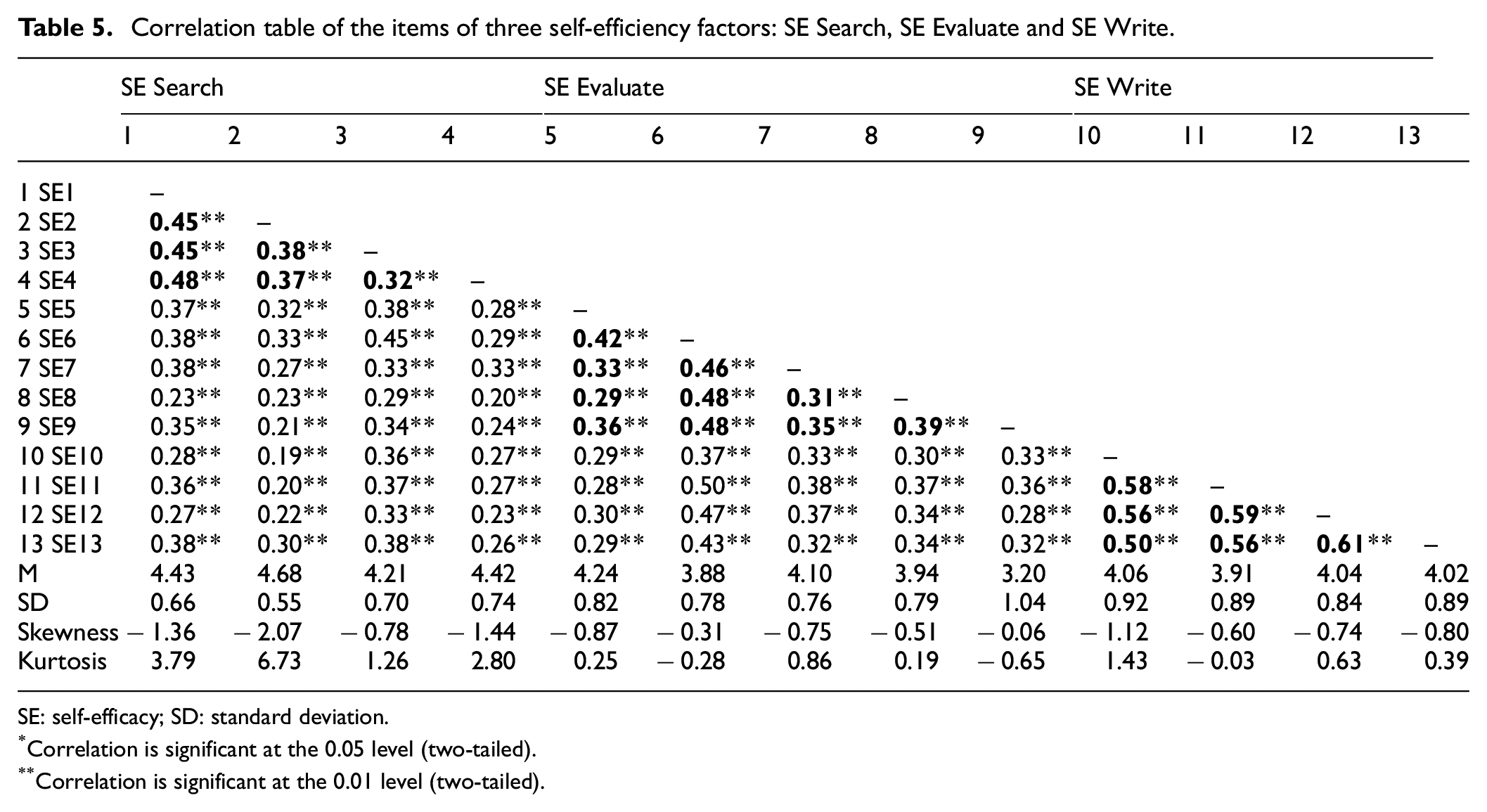
The Kaiser–Meyer–Olkin (KMO) measure of sampling adequacy was 0.91 for the self-efficacy (SE) data. This indicates that the EFA should yield distinct, reliable factors for self-efficacy beliefs (KMO >0.90 superb; Field [50]). The initial result indicated three factors with eigenvalues greater than 1 that explained 58.2% of the total sample variation. Furthermore, the Scree plot for self-efficacy indicates three underlying factors. The final EFA resulted in three self-efficacy factors of online inquiry (Table 1). Each factor was associated with one online inquiry subtask. Items related to Web searching were loaded into factor 1 SE Search, which encompassed four items (SE1 to SE4, Cronbach’s α = 0.75). The items related to the evaluation of Web sources loaded into factor 2 SE Evaluate (SE5 to SE9, α = 0.71). Source-based synthesis writing as factor 3 was labelled as SE Write and encompassed four items (SE10 to SE13, α = 0.84). The three factors accounted for 46.25% of the total variance. The correlation table and descriptive statistics for the self-efficacy items are presented in Table 5 (in Appendix 1).
Self-efficacy factor structure.
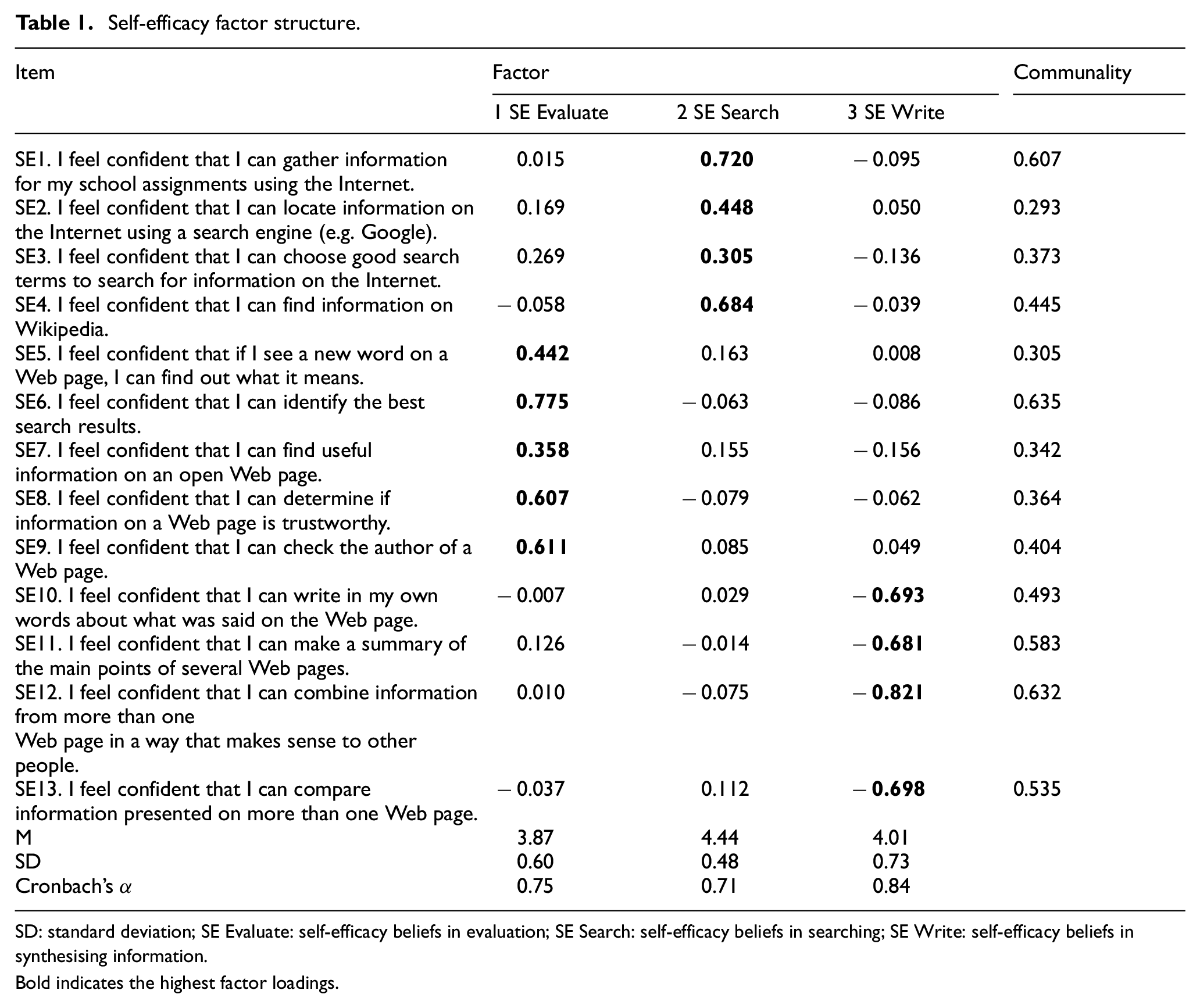
SD: standard deviation; SE Evaluate: self-efficacy beliefs in evaluation; SE Search: self-efficacy beliefs in searching; SE Write: self-efficacy beliefs in synthesising information.
Bold indicates the highest factor loadings.
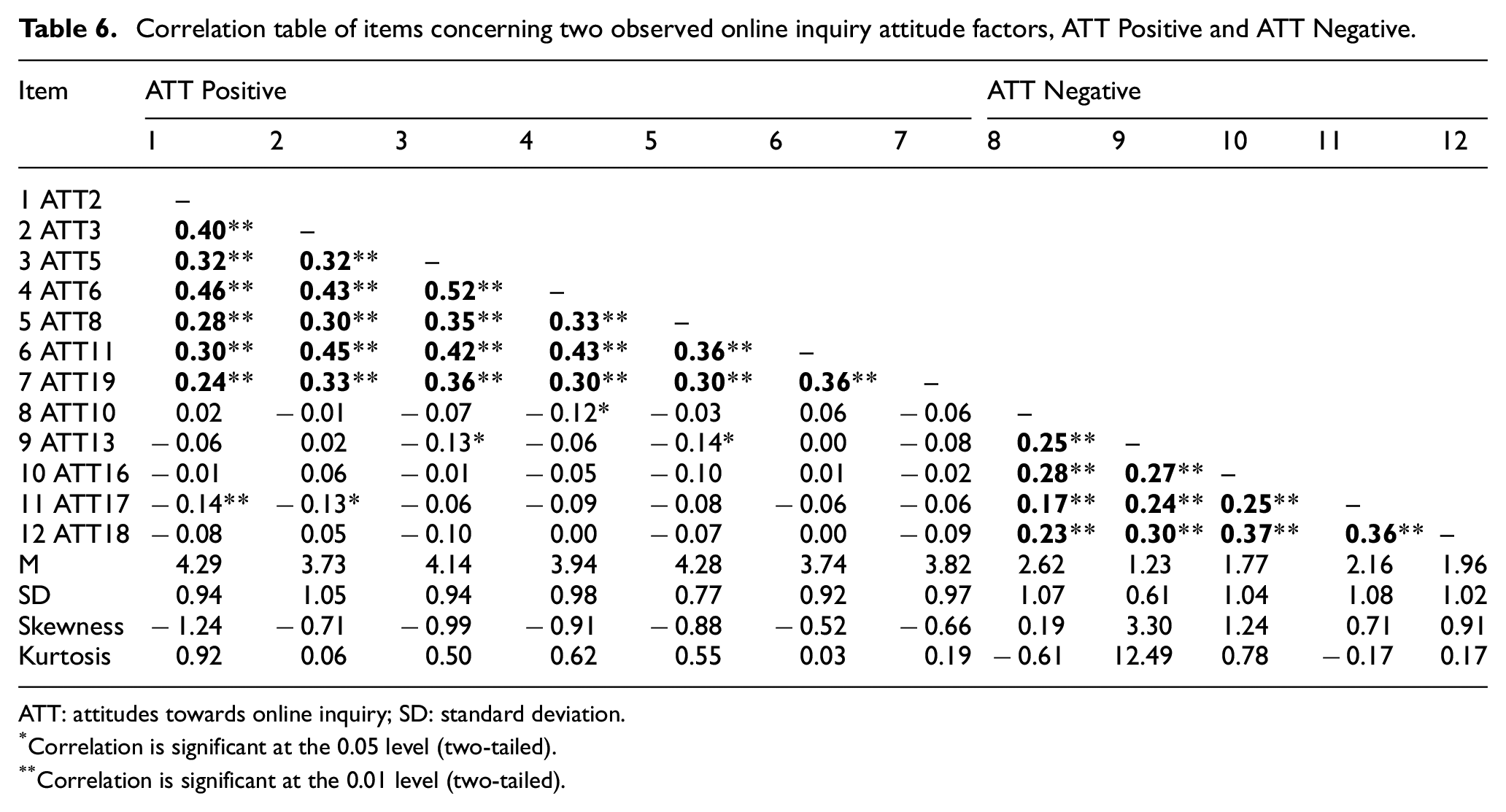
The KMO value for the attitude data is 0.81 and can be considered excellent (cf. [50], 647). The attitudes section contained 20 items. The results indicated five factors with eigenvalues greater than 1 that explained 53.3% of the total sample variation. The Scree plot for the attitude data indicates two underlying factors. Furthermore, items with low loadings and no clear allocation were excluded. In the final EFA, seven items loaded into a positive attitude factor labelled ATT Positive (ATT2, ATT3, ATT5, ATT6, ATT8, ATT11 and ATT19, α = 0.80). Five items loaded into a negative attitude labelled ATT Negative (ATT10, ATT13, ATT16, ATT17 and ATT18, α = 0.63) (see Table 2). The model explains 46.3% of the total variance. The correlation table and descriptive statistics for the attitude items are presented in Table 6 (in Appendix 2).
Attitudes towards online inquiry factor structure.
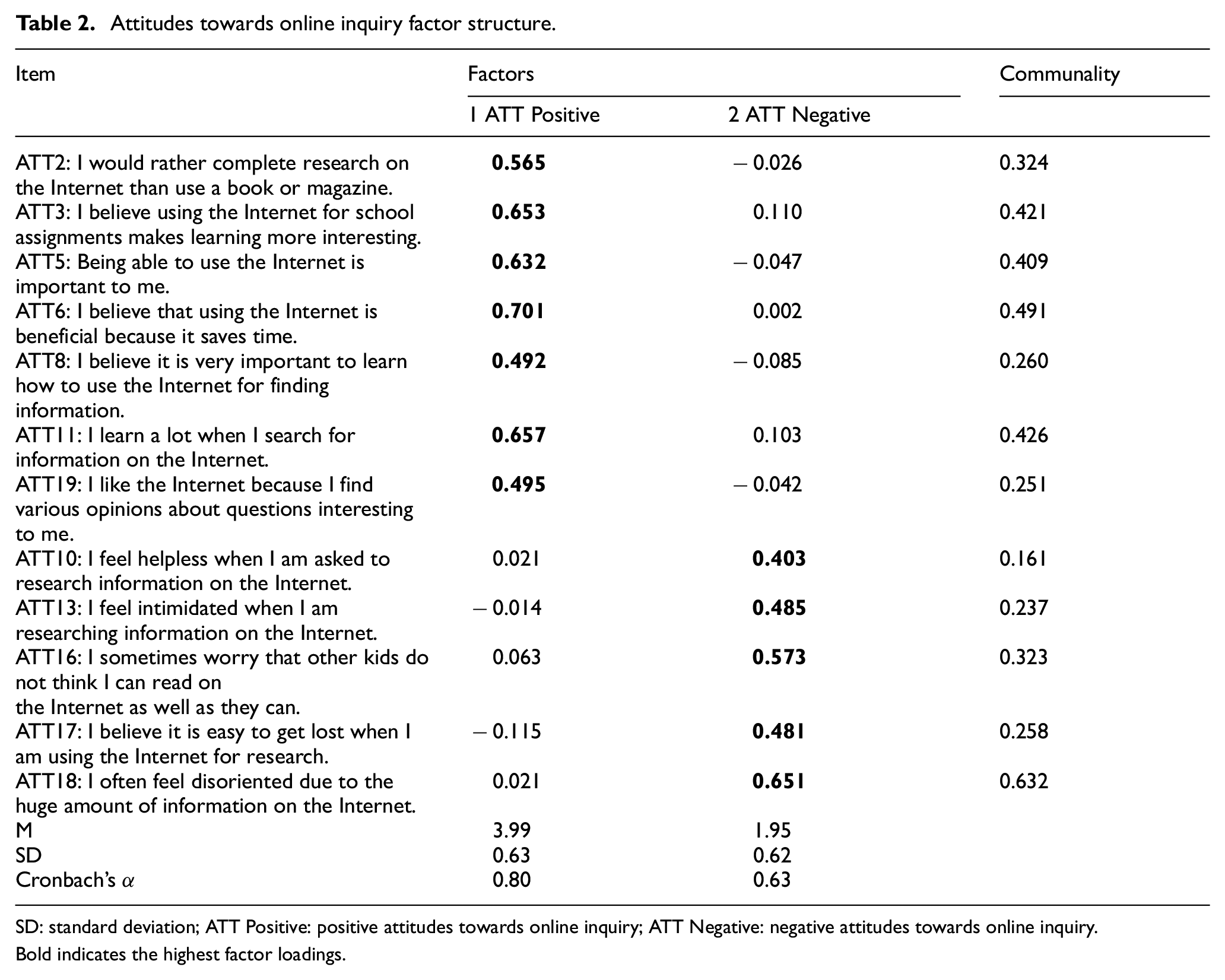
SD: standard deviation; ATT Positive: positive attitudes towards online inquiry; ATT Negative: negative attitudes towards online inquiry.
Bold indicates the highest factor loadings.
3.3.3. CFA
CFA with the five factors was performed using the software Mplus 8.0. The full information maximum likelihood estimation method with robust standard errors was chosen (cf. Muthén and Muthén [51]). This method has desirable statistical properties especially for not normally distributed items and for applied research for this kind of sample size with minor missing at random data [52]. A goodness-of-fit test was performed respecting the fit indices to be considered [53]. First, the minimum fit function χ2 was used. Due to the highly sensitive nature of the χ2 [54], the ratio of the χ2 statistic to its degree of freedom (χ2/df, χ2 = 365.90 and df = 265) was used and indicates an acceptable fit with a value of less than 2 [55]. Furthermore, these indices were evaluated and considered to be satisfactory [56]: Comparative Fit Index (CFI) = 0.95, Tucker–Lewis Index (TLI) = 0.94, standardised root mean square residual (SRMR) = 0.052, the Root Mean Square Error of Approximation (RMSEA) = 0.033 and the lower limit (LL) = 0.025 and upper limit (UL) = 0.042 of the 90% confidence interval of RMSEA. The Composite Reliability (CR) has an acceptable value, greater than 0.70 for all factors of the construct [57] whereas the Average Variance Extracted (AVE) values as presented in Table 3 are mainly less than 0.50, which indicates that the convergent validity of the instrument is not especially high.
Information concerning convergent and discriminant validity of the constructs: correlations between CFA factors, Composite Reliability (CR) and Average Variance Extracted (AVE).
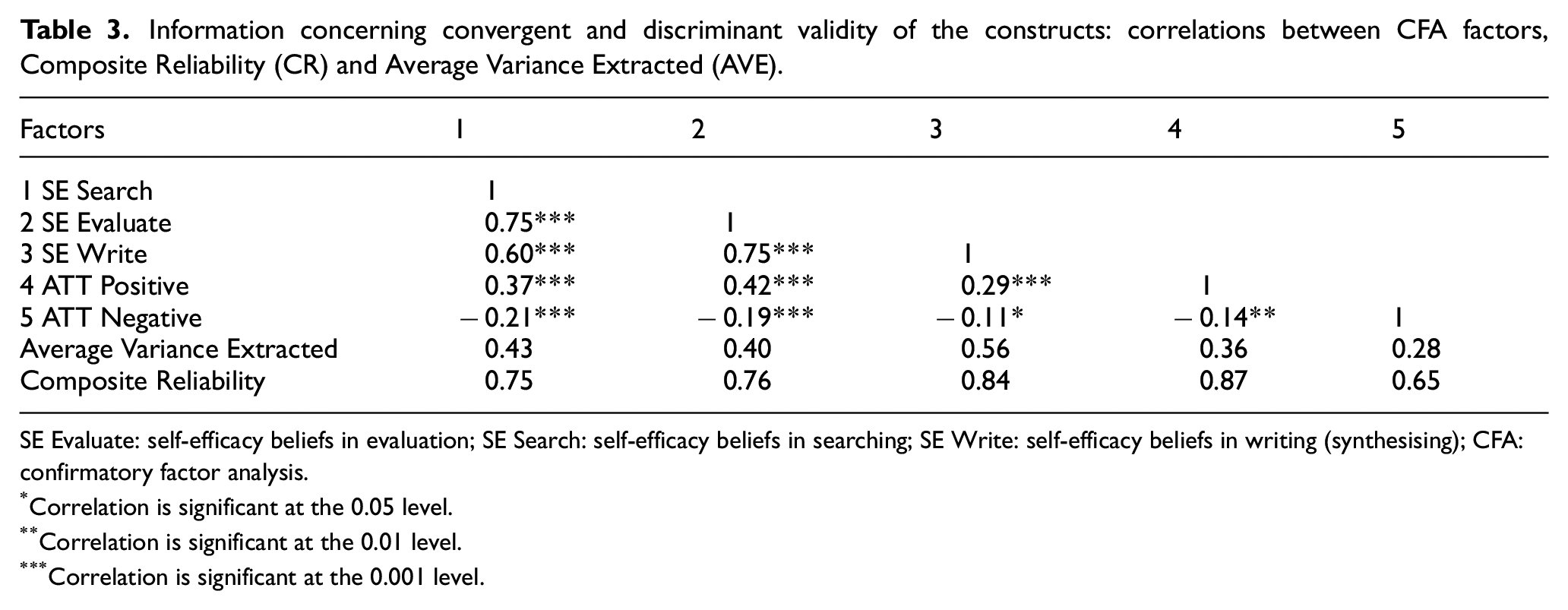
SE Evaluate: self-efficacy beliefs in evaluation; SE Search: self-efficacy beliefs in searching; SE Write: self-efficacy beliefs in writing (synthesising); CFA: confirmatory factor analysis.
Correlation is significant at the 0.05 level.
Correlation is significant at the 0.01 level.
Correlation is significant at the 0.001 level.
Discriminant validity of the constructs was evaluated using the AVE estimates of the factors and the correlations between the factors. One proposed criteria for discriminant validity is that the AVE values of the two constructs should be larger than the squared correlation between those [58,59]. This condition was met for the other factors, except for the latent variables SE SEARCH and SE EVALUATE (squared correlation 0.56 was larger than AVE 0.43 and 0.40) and SE EVALUATE and SE WRITE (squared correlation 0.56 was larger or equal than AVE 0.43 and 0.56). However, all correlations between the factors were less than r = 0.85, which has been used as another cut-off criteria of acceptable discriminant validity (see, e.g., [52]).
The correlations of the self-efficacy belief and attitude factors are presented in Table 3. The factors of self-efficacy beliefs correlate quite strongly with each other (r = 0.60–0.75), which indicates that the components of self-efficacy beliefs represent mutually dependent constructs. Positive attitudes towards online inquiry seem to correlate moderately with self-efficacy beliefs (r = 0.29–0.42), but negative attitudes only have weak negative (r = −0.11 to −0.21) associations with other components of the CFA model.
3.3.4. Explanatory variables
The model is processed according to four explanatory variables: gender, use of ICT and Internet for free-time and school purposes, and learning beliefs.
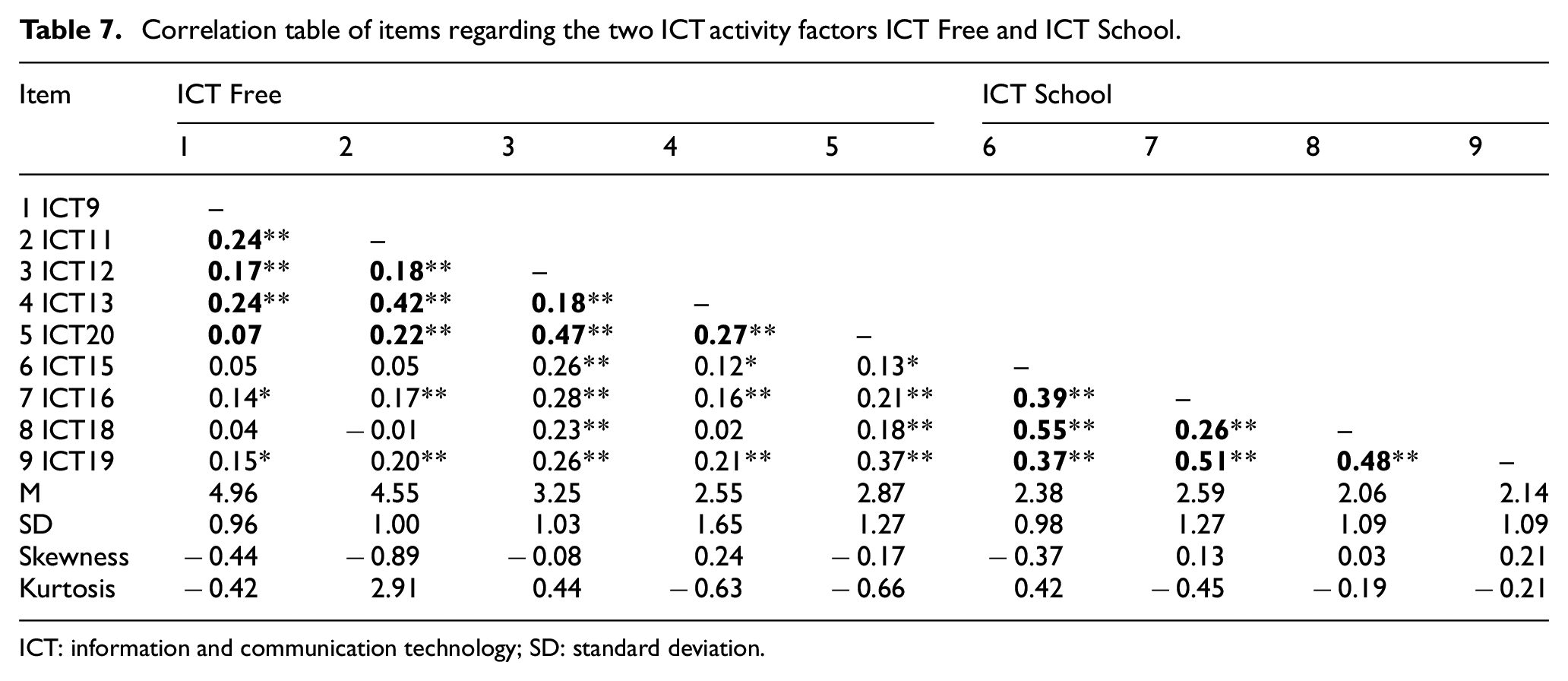
Exploratory factor analyses were conducted to examine the dimensionality of the nine items of the ICT activity questionnaire. Maximum likelihood estimation was used with the Oblimin rotation. The questionnaire consists of 9 Likert-type scale items, labelled here as ICT9 to ICT19 according to the order in the questionnaire. The KMO value is moderate (KMO = 0.70) and indicates that the data were suitable for a factory analysis. Two factors explained 35.56% of the total variance. The ICT Free factor consists of five items (ICT9, ICT11, ICT12, ICT13 and ICT20; α = 0.61) and illustrates the use of ICT for leisure. The second factor, ICT School, comprised of four items (ICT15, ICT16, ICT18 and ICT19; α = 0.74) and refers to the use of Internet services for school purposes (Table 4). Item ICT12 loaded rather equally into both factors. However, it was included in the ICT Free factor. Although the item’s content is generic, it is a sequence of items related to leisure activities. Furthermore, correlations between the items support this allocation (see Table 7 in Appendix 3).
ICT activity factor structure.
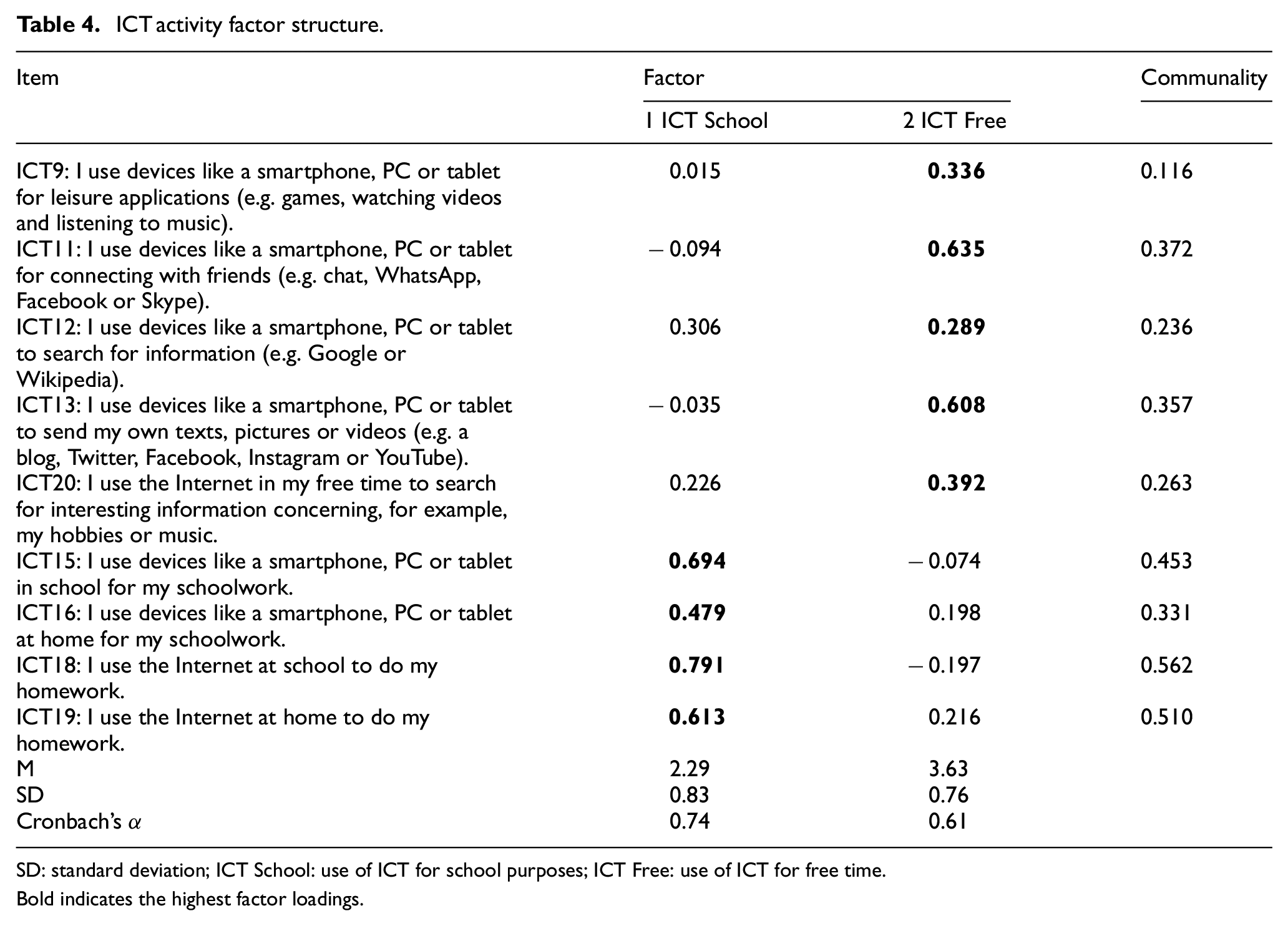
SD: standard deviation; ICT School: use of ICT for school purposes; ICT Free: use of ICT for free time.
Bold indicates the highest factor loadings.
Learning beliefs were measured by a count variable. The questionnaire includes nine main statements about learning beliefs, each with three possible answers, for example, (Item 1): The most important thing in learning is: (a) To remember what the teacher has taught you; (b) To practice lots of problems; (c) To understand the problems you work on.
The answers were scored with 1 indicating a deep constructivist orientation and with 0 for a reproductivist view. The correlation between all nine items showed correlations below 0.2 for three items. These items were excluded. The final scale was composed as the sum of the five learning belief items (translated as items 1, 2, 3, 4, 7 and 9 from Chan and Sachs [36]) with Cronbach’s α = 0.52, M = 3.36 and SD = 0.24.
The effects of the explanatory variables on the Self-Efficacy and Attitude factors were examined using SEM. SEM is a powerful and flexible tool for multivariate analysis, in which it is possible to have several dependent and independent variables in the same model. SEM also allows latent variable modelling, in which the measurement error variance is taken into account in the analyses. Model results were evaluated, especially the goodness-of-fit and the parameter estimates (regression coefficients) of the model.
4. Results
RQ1. What factors comprise sixth-graders’ self-efficacy beliefs in and attitudes towards online inquiry, and how are they related?
The SEM model presented in Figure 1 consists of five factors associated with four explanatory variables. The overall goodness-of-fit of the model was good: χ2 (345) = 496.98, CFI = 0.93, TLI = 0.918, SRMR = 0.051, the RMSEA = 0.036 and the LL = 0.029 and UL = 0.043 of the 90% confidence interval of RMSEA. Three factors are related to self-efficacy beliefs in online inquiry: Web searching (SE Search), evaluation of search results (SE Evaluate) and synthesising information across Web sources (SE Write). Two factors measure attitudes towards online inquiry, either positive (ATT Positive) or negative (ATT Negative). Figure 1 shows the associations between the five factors of the CFA measurement model and the four explanatory variables: (1) gender, (2) ICT activity at school (ICT School), (3) ICT activity in free time (ICT Free) and (4) learning beliefs. The solid lines represent the significant associations between the explanatory variable and the factor (*p < 0.05, **p < 0.01 and ***p < 0.001). The dashed lines indicate non-significant associations. The explanatory level R2 is in the range of R2 = 2%–28%.
RQ2. What is the relationship between the sixth-graders’ (1) gender, ICT and Internet activity and learning beliefs and (2) their self-efficacy in and attitudes towards online inquiry?
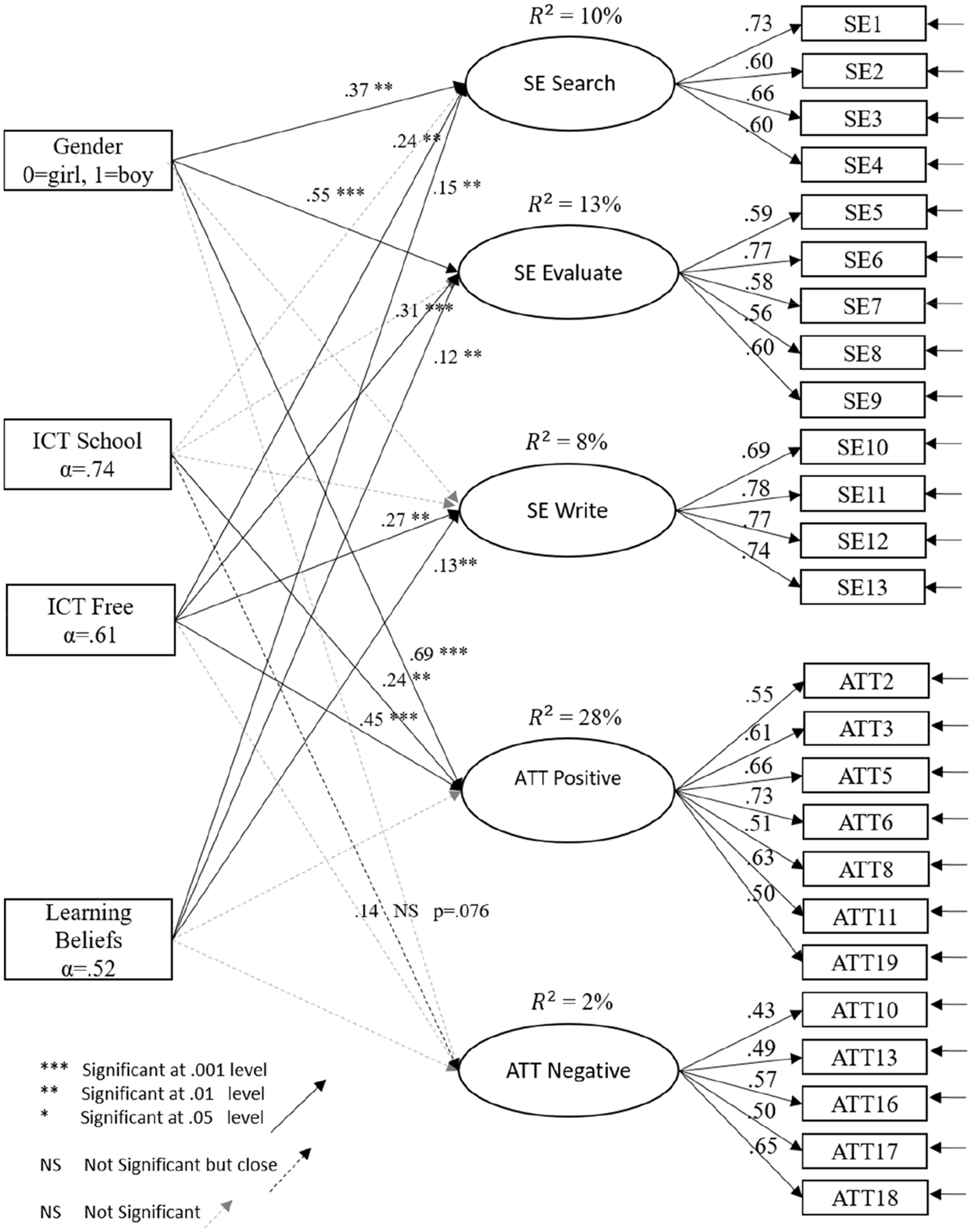
SEM model with CFA measurement model and explanatory variables. Standardised solution (stdY).
Gender was positively related to self-efficacy beliefs in Web searching (β = 0.37 and p = 0.005) and the evaluation of sources (β = 0.55 and p < 0.001). The relationship between gender and positive attitudes towards online inquiry also turned out to be statistically significant (β = 0.69 and p < 0.001). Thus, boys demonstrated more confidence than girls concerning their skills in Web searching and the evaluation of search results. Furthermore, boys had a more positive attitude towards online inquiry. The results indicate no gender differences in self-efficacy beliefs in synthesising information.
Using the Internet and ICT devices for schoolwork seemed ambivalent in relation to the attitudes towards online inquiry. The activity was associated with a positive attitude towards online inquiry (β = 0.24 and p = 0.001), but there was also a weak indication of a positive association with a negative attitude towards online inquiry (p = 0.076). This potential anomaly is elaborated in the discussion below.
Use of the Internet for leisure with all three self-efficacy factors: Web searching (β = 0.24 and p < 0.002), evaluation of sources (β = 0.31 and p < 0.001) and writing syntheses (β = 0.27 and p < 0.001), including a positive attitude towards online inquiry (β = 0.45 and p < 0.001). The more students used the Internet in their free time, the more confident they were of their skills in online inquiry, and the more positive their attitudes were towards online inquiry.
A constructivist orientation in learning beliefs related positively to all three self-efficacy factors. Learning beliefs were related to self-efficacy in Web searching (β = 0.15 and p < 0.001), evaluation of sources (β = 0.12 and p = 0.002) and writing syntheses (β = 0.13 and p = 0.001). The more constructivist the student’s learning beliefs were, the stronger they perceived their self-efficacy in all the subtasks of online inquiry.
5. Discussion
In this study, a survey tool was developed and preliminarily validated to examine sixth-grade students’ self-efficacy beliefs in and attitudes towards online inquiry. This study made an important contribution to current research by developing a survey instrument for young primary school students. This study extends the still-scarce work on scale development for primary school students’ self-efficacy beliefs in and attitudes towards online inquiry (cf. Putman [14]). Furthermore, the associations of these constructs to students’ gender, ICT/Internet activity and learning beliefs were investigated.
As an answer to our first research question, factor analyses confirmed self-efficacy belief scales in three subtasks of online inquiry: Web searching, evaluation of sources and synthesis of information. It was a step forward compared with the 11-item Efficacy subscale validated as a component of the SORAB instrument [14]. The advantage of our three-component self-efficacy scale is that it matches the core subtasks of online inquiry and the theoretical frameworks proposed for online research and comprehension (see Leu et al. [47]). To make progress in research, it is essential that self-efficacy beliefs are measured selectively for each online inquiry subtask since they require different types of skills. In addition, the CFA confirmed a two-factor model for attitudes towards online inquiry: one for a positive attitude and one for a negative attitude. The results corroborated the structure of attitudes validated in the SORAB instrument [14].
To answer the second research question, the SEM model was used to study how explanatory variables (e.g. the use of ICT and the Internet for free-time and school purposes, learning beliefs and gender) predict self-efficacy beliefs in and attitudes towards online inquiry. It turned out that boys possessed stronger confidence than girls in their Web searching and source evaluation skills. However, according to the Programme for International Student Assessment (PISA) tests of ninth-graders in Finland [60], girls are better than boys in all subtasks of retrieving, evaluating and interpreting information. Although the students in the PISA tests were 3 years older than those in this study, and although the test was based on printed materials, it can be assumed that sixth-graders share the same gender difference. The boys quite probably overestimated their skills. Previous research has found a general tendency among females to estimate their skills as lower than males (e.g. [31,61]), and people generally tend to overestimate their skills, especially in tasks with which they have little experience (e.g. [30]).
There was no difference between boys and girls in self-efficacy beliefs concerning the synthesis of information. The items of the synthesis factor dealt with the skills of collecting information from one or more Web pages and writing about a topic in one’s own words (see Table 1, SE10 to SE13). We may assume that the sixth-graders had more experience in writing tasks than in searching and evaluation tasks. This assumption is warranted since searching and evaluation earn little attention as explicit learning goals in primary or secondary education [1]. Writing is one of the key skills taught in primary schools, and students are, to some extent, familiar with the requirements of good writing. Thus, their self-reported perceptions of writing skills might be more realistic than for searching and evaluation skills (cf. Aesaert et al. [30]). Hence, the self-efficacy beliefs between boys and girls could converge in this task. Moreover, boys had a more positive attitude than girls towards online inquiry. The observed difference corroborates earlier findings that boys tend to have a more positive attitude towards technology use (cf. a meta-analysis by Cai et al. [45]). A negative attitude towards online inquiry had no strong associations with gender.
Both active school-related and free-time–related use of the Internet predicted a positive attitude towards online inquiry. Somewhat surprisingly, the active Internet use for schoolwork seemed also to predict a negative, that is, more reserved, attitude towards online inquiry. The potential ambivalence earns an extra comment. First, it is important to note that factors ATT Positive and ATT Negative (see Table 2) do not represent the opposite ends of one dimension. They are orthogonal factors (low correlation, see Table 3). For example, three items in the ATT Negative factor refer to the feelings of disorientation, helplessness or getting lost in the Internet. These feelings might appear when you have more experiences of uncertainty inherent in Web searching (cf. uncertainty principle by Kuhlthau [7]). Second, Web searching for free-time purposes differs drastically from the online inquiry required in the school assignment. Young students have been observed to be more successful in searching about self-generated topics defined in their own terms than more complex imposed topics typical of school assignments [62,63]. Thus, more active use of the Internet for school assignments might lead to observe the challenges of online inquiry. The student can have a positive overall attitude towards online inquiry, but, at the same time, they might understand some of the challenges in genuine inquiry tasks. Obviously, this observation leads to practical implications. The teacher should build scaffolds to help students to learn about these challenges and maintain their positive but realistic attitude towards online inquiry (see, e.g., Coiro et al. [64]).
Learning beliefs predicted self-efficacy in all three subtasks of online inquiry although the associations were relatively weak. The result indicates that students who regarded learning as a construction process and preferred to learn independently also saw their skills better in Web searching, evaluation of sources and writing syntheses. The link between learning beliefs and self-efficacy should earn more attention in future research. Taking these constructs into account in pedagogical designs, together with support for self-regulation [14] and critical thinking [65], introduces a potential to improve learning outcomes in online inquiry instruction (cf. Aesaert et al. [30]).
This study made an empirical contribution by enhancing the research of self-efficacy beliefs in and attitudes towards online inquiry among primary school students. Only a few studies have been published so far on this young student group (e.g. by Aesaert and colleagues [23,30]); this study confirmed what was known and further revealed new associations between the main constructs and explanatory factors. The study also provides practical implications. As the students demonstrated quite high self-efficacy beliefs and positive attitudes, the study offers a positive signal for teaching online inquiry skills. Furthermore, the students who already actively use the Internet for schoolwork have maintained positive attitudes towards online inquiry, but apart from that, from the skill development point of view, they also seem to have more realistic self-efficacy beliefs and perceptions of challenges of the Internet. Overall, the study offered new insights into the complex relationships of the multiple factors involved in online inquiry, thus supporting the further development of pedagogical tools and practices for teachers.
6. Limitations
As all surveys based on a convenience sample, this study has some limitations. It is probably that our findings may be generalised to West European countries where, in practice, all sixth-graders have Internet access both at home and at school [66]. Social desirability bias (SDB) was not formally controlled in data analyses because the questionnaire did not deal with sensitive issues, and the study was conducted in an authentic classroom situation. Because both the EFA and CFA were conducted on the same data sample, a follow-up study using a new data set is needed to complete the validation of the self-efficacy beliefs and attitudes measures. Furthermore, the questionnaire maybe subject to revision aiming at higher internal consistency results of the measurement. Especially items with low loadings or loading to more than one factor could be edited or deleted from the questionnaire in future. In self-efficacy beliefs, additional items on understanding of texts besides searching, evaluating and writing could clarify the construct.
In learning beliefs, negative attitudes and free-time ICT use, some factors suffer from low level of internal consistency. In future research, these items should be improved. The learning beliefs could be improved by applying a Likert-type scale instead of a binary one. The ICT use could have more dimensions where the purpose of use will become more obvious for the children. For example, a division of the construct into three dimensions could make it more tangible to children: (1) the use of ICT with the intent of learning, (2) the use of ICT for organising the everyday life and (3) the use of ICT for relaxation and fun. The ATT Negative factor could be thematically expanded by risks and threats like hacker attacks, identity fraud and phishing.
7. Conclusion
In conclusion, we emphasise the importance of the development and validation of tools that are not only useful for research but also serve in educational practice. This study showed that validated scales can be developed to study self-efficacy beliefs in and attitudes towards online inquiry among young primary school students. Gender, ICT/Internet activity and learning beliefs are the examples of student characteristics that are associated with self-efficacy and attitudes. This study further raises new questions for future research and practice about how self-reported attitudes and self-efficacy beliefs relate to actual inquiry skills, how they predict learning these skills in the long-term, and what affects attitudes and self-efficacy beliefs in teaching online inquiry. In sum, the rapid, continuous change and expansion of knowledge challenge the conception of learning and teaching in current schools. European primary school curricula have reacted to this challenge by emphasising both the active role of the learner in the constructivist sense and the importance of digital skills [3]. Hence, teachers need training in developing appropriate pedagogical practices to support realistic beliefs towards online inquiry and digital skills [67].
Supplemental Material
sj-pdf-1-jis-10.1177_01655515211043708 – Supplemental material for How do gender, Internet activity and learning beliefs predict sixth-grade students’ self-efficacy beliefs in and attitudes towards online inquiry?
Supplemental material, sj-pdf-1-jis-10.1177_01655515211043708 for How do gender, Internet activity and learning beliefs predict sixth-grade students’ self-efficacy beliefs in and attitudes towards online inquiry? by Eero Sormunen, Norbert Erdmann, Suzanne CSA Otieno, Mirjamaija Mikkilä-Erdmann, Eero Laakkonen, Teemu Mikkonen, Md Arman Hossain, Roberto González-Ibáñez, Mario Quintanilla-Gatica, Paavo HT Leppänen and Marja Vauras in Journal of Information Science
Footnotes
Appendix 1
Correlation table of the items of three self-efficiency factors: SE Search, SE Evaluate and SE Write.
| SE Search |
SE Evaluate |
SE Write |
|||||||||||
|---|---|---|---|---|---|---|---|---|---|---|---|---|---|
| 1 | 2 | 3 | 4 | 5 | 6 | 7 | 8 | 9 | 10 | 11 | 12 | 13 | |
| 1 SE1 | – | ||||||||||||
| 2 SE2 |
|
– | |||||||||||
| 3 SE3 |
|
|
– | ||||||||||
| 4 SE4 |
|
|
|
– | |||||||||
| 5 SE5 | 0.37** | 0.32** | 0.38** | 0.28** | – | ||||||||
| 6 SE6 | 0.38** | 0.33** | 0.45** | 0.29** |
|
– | |||||||
| 7 SE7 | 0.38** | 0.27** | 0.33** | 0.33** |
|
|
– | ||||||
| 8 SE8 | 0.23** | 0.23** | 0.29** | 0.20** |
|
|
|
– | |||||
| 9 SE9 | 0.35** | 0.21** | 0.34** | 0.24** |
|
|
|
|
– | ||||
| 10 SE10 | 0.28** | 0.19** | 0.36** | 0.27** | 0.29** | 0.37** | 0.33** | 0.30** | 0.33** | – | |||
| 11 SE11 | 0.36** | 0.20** | 0.37** | 0.27** | 0.28** | 0.50** | 0.38** | 0.37** | 0.36** |
|
– | ||
| 12 SE12 | 0.27** | 0.22** | 0.33** | 0.23** | 0.30** | 0.47** | 0.37** | 0.34** | 0.28** |
|
|
– | |
| 13 SE13 | 0.38** | 0.30** | 0.38** | 0.26** | 0.29** | 0.43** | 0.32** | 0.34** | 0.32** |
|
|
|
– |
| M | 4.43 | 4.68 | 4.21 | 4.42 | 4.24 | 3.88 | 4.10 | 3.94 | 3.20 | 4.06 | 3.91 | 4.04 | 4.02 |
| SD | 0.66 | 0.55 | 0.70 | 0.74 | 0.82 | 0.78 | 0.76 | 0.79 | 1.04 | 0.92 | 0.89 | 0.84 | 0.89 |
| Skewness | −1.36 | −2.07 | −0.78 | −1.44 | −0.87 | −0.31 | −0.75 | −0.51 | −0.06 | −1.12 | −0.60 | −0.74 | −0.80 |
| Kurtosis | 3.79 | 6.73 | 1.26 | 2.80 | 0.25 | −0.28 | 0.86 | 0.19 | −0.65 | 1.43 | −0.03 | 0.63 | 0.39 |
SE: self-efficacy; SD: standard deviation.
Correlation is significant at the 0.05 level (two-tailed).
Correlation is significant at the 0.01 level (two-tailed).
Appendix 2
Correlation table of items concerning two observed online inquiry attitude factors, ATT Positive and ATT Negative.
| Item | ATT Positive |
ATT Negative |
||||||||||
|---|---|---|---|---|---|---|---|---|---|---|---|---|
| 1 | 2 | 3 | 4 | 5 | 6 | 7 | 8 | 9 | 10 | 11 | 12 | |
| 1 ATT2 | – | |||||||||||
| 2 ATT3 |
|
– | ||||||||||
| 3 ATT5 |
|
|
– | |||||||||
| 4 ATT6 |
|
|
|
– | ||||||||
| 5 ATT8 |
|
|
|
|
– | |||||||
| 6 ATT11 |
|
|
|
|
|
– | ||||||
| 7 ATT19 |
|
|
|
|
|
|
– | |||||
| 8 ATT10 | 0.02 | −0.01 | −0.07 | −0.12* | −0.03 | 0.06 | −0.06 | – | ||||
| 9 ATT13 | −0.06 | 0.02 | −0.13* | −0.06 | −0.14* | 0.00 | −0.08 |
|
– | |||
| 10 ATT16 | −0.01 | 0.06 | −0.01 | −0.05 | −0.10 | 0.01 | −0.02 |
|
|
– | ||
| 11 ATT17 | −0.14** | −0.13* | −0.06 | −0.09 | −0.08 | −0.06 | −0.06 |
|
|
|
– | |
| 12 ATT18 | −0.08 | 0.05 | −0.10 | 0.00 | −0.07 | 0.00 | −0.09 |
|
|
|
|
– |
| M | 4.29 | 3.73 | 4.14 | 3.94 | 4.28 | 3.74 | 3.82 | 2.62 | 1.23 | 1.77 | 2.16 | 1.96 |
| SD | 0.94 | 1.05 | 0.94 | 0.98 | 0.77 | 0.92 | 0.97 | 1.07 | 0.61 | 1.04 | 1.08 | 1.02 |
| Skewness | −1.24 | −0.71 | −0.99 | −0.91 | −0.88 | −0.52 | −0.66 | 0.19 | 3.30 | 1.24 | 0.71 | 0.91 |
| Kurtosis | 0.92 | 0.06 | 0.50 | 0.62 | 0.55 | 0.03 | 0.19 | −0.61 | 12.49 | 0.78 | −0.17 | 0.17 |
ATT: attitudes towards online inquiry; SD: standard deviation.
Correlation is significant at the 0.05 level (two-tailed).
Correlation is significant at the 0.01 level (two-tailed).
Appendix 3
Correlation table of items regarding the two ICT activity factors ICT Free and ICT School.
| Item | ICT Free |
ICT School |
|||||||
|---|---|---|---|---|---|---|---|---|---|
| 1 | 2 | 3 | 4 | 5 | 6 | 7 | 8 | 9 | |
| 1 ICT9 | – | ||||||||
| 2 ICT11 |
|
– | |||||||
| 3 ICT12 |
|
|
– | ||||||
| 4 ICT13 |
|
|
|
– | |||||
| 5 ICT20 |
|
|
|
|
– | ||||
| 6 ICT15 | 0.05 | 0.05 | 0.26** | 0.12* | 0.13* | – | |||
| 7 ICT16 | 0.14* | 0.17** | 0.28** | 0.16** | 0.21** |
|
– | ||
| 8 ICT18 | 0.04 | −0.01 | 0.23** | 0.02 | 0.18** |
|
|
– | |
| 9 ICT19 | 0.15* | 0.20** | 0.26** | 0.21** | 0.37** |
|
|
|
– |
| M | 4.96 | 4.55 | 3.25 | 2.55 | 2.87 | 2.38 | 2.59 | 2.06 | 2.14 |
| SD | 0.96 | 1.00 | 1.03 | 1.65 | 1.27 | 0.98 | 1.27 | 1.09 | 1.09 |
| Skewness | −0.44 | −0.89 | −0.08 | 0.24 | −0.17 | −0.37 | 0.13 | 0.03 | 0.21 |
| Kurtosis | −0.42 | 2.91 | 0.44 | −0.63 | −0.66 | 0.42 | −0.45 | −0.19 | −0.21 |
ICT: information and communication technology; SD: standard deviation.
Acknowledgements
The study was part of the Enhancing learning and teaching for future competences of online inquiry in multiple domains (iFuCo) project funded by the Academy of Finland (grant’s no. 294186), and the National Commission for Scientific and Technological Research (CONICYT) in Chile (grant AKA/EDU-03). The authors thank the schools participating in the study. We are grateful to Elina Hämäläinen, Nina Kullberg, Teemu Mikkonen, and Tuulikki Alamettälä who collected the pilot and main study data in the schools, and Carita Kiili who contributed to the design of the study. We also thank Patricia Alexander and the members of the RIME research group for their valuable comments on the manuscript.
Declaration of conflicting interests
The author(s) declared no potential conflicts of interest with respect to the research, authorship and/or publication of this article.
Funding
The author(s) received no financial support for the research, authorship and/or publication of this article.

Supplemental material
Supplemental material for this article is available online.
References
Supplementary Material
Please find the following supplemental material available below.
For Open Access articles published under a Creative Commons License, all supplemental material carries the same license as the article it is associated with.
For non-Open Access articles published, all supplemental material carries a non-exclusive license, and permission requests for re-use of supplemental material or any part of supplemental material shall be sent directly to the copyright owner as specified in the copyright notice associated with the article.
