




Abstract
Transition forms a dynamic concept that has been underexplored within information literacy research and practice. This article uses the grounded theory of mitigating risk, which was produced through doctoral research into the information literacy practices of language-learners, as a lens for a more detailed examination of transition and its role within information literacy. This framing demonstrates that information literacy mediates transition through supporting preparation, connection, situatedness and confidence within a new setting and facilitating a shift in identity. This article concludes by discussing the important role that time and temporality, resistance and reflexivity play within transition as well as outlining implications for information literacy instruction and future research into time, affect and materiality.
1. Introduction
Information literacy plays a vital role in enabling learners to prepare for the future and to meet personal, academic and workplace goals. Transition, defined as the navigation of change [1, p.737], is a concept that encompasses developmental processes, including individual growth and shifts in role and responsibilities. However, while transition has started to be acknowledged within information literacy literature [2–4], a lack of empirical research means that it has traditionally been seen as a problem that can be ‘solved’ through better preparation, including the acquisition of information literacy skills, instead of a complex and socially situated process [5]. The emphasis on institutional norms means that transition has also typically been positioned as linear and chronological rather than as centred on the negotiation of subjective experiences. These issues mirror developments in the broader field of higher education, where increasing interest in widening participation and retention schemes has led to the positioning of transition as taken-for-granted, or as a concept that lies out with critical interrogation [1, p.736].
This article specifically addresses these issues by using the grounded theory of mitigating risk as a lens developed through doctoral research [6] to first, explore transition from an information perspective [7] and second, to examine the role that information literacy plays within transition. The grounded theory of mitigating risk was produced through an examination of the information literacy practices of language-learners and states that engagement in an unfamiliar setting constructs risks that catalyse the enactment of the information literacy practices that mediate transition [6]. While the grounded theory of mitigating risk has been presented in prior publications [6], this article specifically aims to use this emerging theoretical work as the basis for a more detailed examination of transition and the implications for information literacy research. As an emergent theory, the grounded theory of mitigating risk is localised rather than generalisable. However, in developing from one of the first full-length studies to explore transition through an information lens, it offers unique insight into the dynamics of change as well as the tensions and opportunities that underscore development within an unfamiliar information environment. In presenting a framework through which transition can be unpacked and explored, this article also positions the grounded theory of mitigating risk as the basis for future and ongoing research in the area.
2. Literature review
2.1. Transition
Early work that explores transition is attributed to the field of anthropology and the idea that human lives are marked by ‘rites of passage’ or changes in status, roles or relationship [8, p.322]. Since then, theories of transition have emerged from various fields as scholars and practitioners recognise the importance of turning-point experiences within workplace, social and educational contexts. Some of the most well-known theories have developed from the field of psychology, including Schlossberg’s [9] theory of transition and Tinto’s [10] model of student attrition. The emphasis on the development of coping strategies means that these theories, which originated in research that explores bereavement and suicide, position transition as a site of struggle and conflict. Literature from organisational studies has formed another fertile ground for the development of transitional theories and models. The three-stage model for handling change that is presented in Bridges’ [11] popular management consulting tome positions transition as both an obstacle for organisational functionality as well as something that can be overcome through planning and individual motivation. Both of these models have helped to direct research as well as popular understandings of transition to date [12]. However, the emphasis on internal dynamics and abstract systems means that this literature also limits our understanding of multiplicity and the generative opportunities that transitions bring as well as broader questions of materiality, among others [12].
Transition has been most comprehensively examined in education and nursing – two fields that are centred upon the mediation of change. Within the field of education, transition has traditionally been framed as a person’s movement between institutions or settings, such as from nursery to primary school or from secondary to tertiary education [13, p.122]. This approach, which is characterised by Ecclestone et al. [14] as the navigation of pathways, structures and systems, and by Gale and Parker [1] as an induction approach, positions transition as standardised or linear and as occurring in relation to normative patterns and social expectations, such as age-appropriate behaviour. More recently, the recognition that life course is marked by non-uniform experiences [15, p.xviii] means that researchers have focused on the processes of transition or the dynamics of development during this time [13, p.122]. Most famously exemplified by the ecological perspective, which draws from Bronfenbrenner [16] and emphasises interaction within fluid environments, transition has been characterised as a change in role as a person moves ‘between and across systems’ [17, p.6]. The focus on the overlapping contexts that influence development means that transition is understood to be constituted by the relationships and connections that surround a person [17, p.8]. However, the emphasis on individual experience means that the ecological perspective has also been critiqued for separating people from cultural processes [18, p.44] and for ignoring the power relations that produce the social contexts of transition [19, p.328].
Most recently, sociocultural approaches have started to become more commonly employed as an alternative theoretical perspective within educational transition research [17]. A sociocultural lens draws from the work of Vygotsky [20] as well as from Lave and Wenger [21] to position human development in terms of ‘people’s changing participation in sociocultural activities of their communities’ [18, p.52]. Connecting change to involvement in a community, rather than locating it in a person or in their environment [22, p.273], transition has further been characterised as ‘becoming somebody’ in a personal, educational or occupational context [14, p.7,1] although Fenwick [12, p.362] warns that the suggestion of a unified subject is problematic. Studies have also explored the concept of transition through the lens of capital and habitus. Drawing from the idea that transition into higher education is supported by the development of institutional habitus, which is linked to academic, social and cultural capital, a Bourdieusian lens highlights that the ability to mediate change is connected to a sense of belonging within an unfamiliar setting [23]. While some argue that Bourdieu’s theoretical framework underplays individual agency as well as the possibilities for a critical research agenda [24], concepts of habitus and capital offer insight into the dynamics of change within educational settings.
Within the field of nursing, the potential impact of health–illness transitions – such as diagnosis and rehabilitation, as well as developmental or life transitions, for example, ageing or parenting – has led to the establishment of nursing transitions theory as a framework for understanding and explaining transition. Nursing transitions theory is a mid-range theory that has been developed through the work of Afaf Meleis, among others [25]. Drawing attention to the nature of transition as well as to the environmental conditions that facilitate and inhibit change, transitions theory provides a comprehensive overview of movement and the associated impact on a person’s identity, relationships and role in society. The recognition that nurses are the primary caregivers of many people embarking on transition means that nursing transitions theory has also formed the basis for the design of appropriate therapeutic interventions [25]. Change and time form two of the tangled and complex concepts that underpin this theoretical framework. While change is often used indistinguishably from the concept of transition, transitions theory distinguishes between the two concepts by reframing transition as the shifts that a person makes to integrate the disruption into their life [26, p.121] and change as the external event that sets transition in motion [25, p.12]. Similarly, a focus on time means that transition is positioned as a process that occurs over time [25] rather than forming a linear or a normative journey with distinct stages [12, p.362].
More specifically, transitions theory offers a framework through which a person’s experience of transition can be assessed. Within this model, transition is understood to be structured through several essential properties; the meaning that people accord to transition, for example, which encompasses awareness, knowledge and preparation, is seen to alter the ways in which they perceive and respond to change [27]. Transitions theory also underscores the important role that community and social conditions play in facilitating and inhibiting transition. The emotional and informational support that is provided by peers is understood to be vital for transition [27, p.230], while the receptiveness of the new environment, which influences the opportunities to which a person has access, is seen to either stigmatise or enable the ways in which they engage with change. Finally, nursing transitions theory sets out a series of progress and outcome indicators to assess a person’s progress towards health or well-being. Centring feelings of connection as well as a greater sense of confidence, successful transition is also seen to rest upon the development of a fluid and integrative identity [25]. Both extensive and alert to human vulnerability, transitions theory provides a useful basis from which complicated dynamics of change can be explored. However, the emphasis on the rebuilding of individual mastery means that nursing transitions theory has also been critiqued for flattening the flow of social and emotional relations [12, p.359, 28, p.664].
2.2. Transition in information studies
Transition has not previously been widely explored within information research. Within information literacy research, transition has referred to events where people travel in one direction between two pre-existing and related activities [29, p.114], such as the move from secondary to tertiary education [2] or as a transfer student between colleges [3]. However, a focus on individual actions frames transition as the navigation of static institutions while negating the multiple and circuitous ways in which learners mediate the impact of these upheavals in their lives. The psychological perspective that tends to be adopted in the few studies that have explored the connections between transition and information literacy to date [30] further neglects to account for the structural forces that impact student engagement with change. More recently, studies have started to explore the challenges that international students face when they transition into a new academic environment [31]. However, the emphasis on the role that the academic library plays in supporting change obscures a broader understanding of the ways in which international students themselves mediate the impact of this time.
Transition has also been explored within the related field of information behaviour, although as with information literacy research, it has tended to form the context rather than the object of the study’s focus [32,33]. An exception is found in Willson’s [34] study of early career academics, which uses nursing transitions theory to demonstrate how during times of change, information behaviour is shaped by institutional goals and the actions of colleagues. Willson [35] subsequently expands upon these ideas to position transitions as ‘inherently unstable’ and as structured through both accurate and inaccurate expectations for the future. Another exception is found in the work of Bronstein [36], who draws upon an earlier version of nursing transitions theory to illustrate that perceptions of exclusion impact the transition of Spanish-speaking migrant workers by impeding information-seeking processes. Most recently, transition has been studied in relation to Lave and Wenger’s theory of situated learning [37]. The use of a situated learning framework, which positions transition as the renegotiation of identity, draws attention to the important role that social interaction plays in mediating change. However, research in the area remains limited in terms of scope and theoretical development.
While the concept of transition itself has been infrequently explored within information research, related ideas have been examined in varying degrees of detail. Ideas of change, for example, have been touched upon within workplace information studies, where the passage from novice to expert is signalled by a shift between textually and socially mediated knowing of a landscape [5] and the negotiation of meaning [38]. Transition has further been alluded to within studies of refugees, where information literacy has been seen to play an important role in helping forcibly displaced people to reconcile their established ways of knowing with those of their new setting [39]. Notwithstanding, these studies often present linear models of change and adaptation [40]. Ideas related to transition have also started to be explored within information literacy instruction. The idea of transformation, for example, is often invoked within information literacy through the perceived value of thinking like an historian or a lawyer [41], while the current focus on threshold concepts within the Association of College and Research Libraries (ACRL) Framework [42] brings elements of transition to the fore. However, while these ideas have been centred within institutional documents, there have been few studies that have explored the implications of these understandings in detail.
An idea that has played a far more prominent role within information literacy research is the concept of transfer. Transfer and the related notion of transferable skills have long been positioned as a core goal or learning outcome of information literacy instruction [2,43]. Drawing from the idea that information literacy is relevant in all walks of life, transfer is positioned as facilitating the utilisation ‘of knowledge and skills gained in one context in other situations’ [43, p.457]. Changing information environments and expanded conceptions of learning means that the concept of transfer is also used to justify the need for information literacy instruction in academic contexts. However, the idea that learners can easily transfer information literacy concepts between contexts and situations rests on a number of problematic assumptions, including the idea that knowledge and skills (1) exist as discrete competencies in static environments, (2) are ‘acquired’ and (3) are concentrated on individual behaviour [44]. Along the same lines, research that has specifically explored whether transfer occurs demonstrates that learners are rarely able to transport information competencies from one context to another [45]. A focus on transition consequently moves beyond the simplistic metaphor of transfer to emphasise the emotional and cultural dimensions of change as well as the impact that the affordances of a setting have upon a person’s ability to mediate difference.
3. The grounded theory of mitigating risk
This article uses the grounded theory of mitigating risk as a lens to explore the concept of transition in more detail. A brief overview of the grounded theory of mitigating risk and the empirical work that led to its development is presented here to situate this article as well as to establish the basis for the examination of transition. The grounded theory of mitigating risk states that the academic, financial and physical stresses that are created through engagement within new information environments catalyse the enactment of the information literacy practices that mediate transition to and within a new setting [6]. Produced through a recent doctoral study that explored the information literacy practices of undergraduates who were learning a language overseas, the grounded theory of mitigating risk offers a localised interpretation of the ways in which language-learner information activities support their transition to and within a new setting. However, in emerging from one of the few full-length studies of transition, it also offers an emergent interpretation of the role that information literacy plays in scaffolding complex dynamics of change.
The original research that formed the basis of the grounded theory of mitigating risk employed the concept of transition as a means to examine how undergraduate language-learners mediate change and re-establish ways of knowing within an unfamiliar context. To this end, the initial grounded theory study was driven by the following research question:
How do language-learners make sense of, transition into and come to know their new information landscapes?
Situated within an interpretivist framework, the original empirical research was informed by a theoretical framework that included nursing and education transitions theory. The study’s use of transitions theory foregrounded the structural forces that impacted language-learner engagement with change as well as the multiple ways in which they mediated the implications of their move overseas. The tendency to flatten ‘the complexity of social relations’ [12, p.359] within nursing transitions theory meant that educational transitions theory [17], which emphasises questions of agency and power, was used in conjunction with the more theoretically developed nursing transitions theory [25].
3.1. Methodology
The study’s sample comprised 26 language-learners. Selected through a maximum variation purposive sampling strategy, participants were all English-speaking undergraduate students from Australia, Canada, the United States and the United Kingdom who were learning one of the eight languages in 14 different American, Asian and European countries for a period of between 4 and 12 months overseas. Participants whose placements overseas lasted for less than 3 months were excluded to focus on interactions that went beyond a tourist experience. No language or country of residence abroad was excluded. Participants were recruited through emails that were sent to study abroad directors or year abroad coordinators at 190 universities as well as relevant listservs.
The study employed a constructivist grounded theory methodology [46]. Concurrent data generation and analysis, which was accompanied by reflective memoing, ensured that emerging theoretical claims remained centred upon participant–researcher interactions. Theoretical sampling was employed after the first round of recruitment to purposefully recruit participants from under-represented languages or regions while repetition of ideas subsequently indicated that saturation had been reached.
Semi-structured interviews and photo-elicitation were employed as methods of inquiry. Each participant was interviewed twice using a video conferencing tool for a total of 52 interviews, with an average length of 56 min. Interview questions explored typical activities in which information was expected to play an important role, including choosing a supermarket, opening a bank account and establishing leisure activities. Participants were additionally asked to take photos of anything that had helped them to learn about or to settle into their new setting. These photos were collected through the use of EthOS, a mobile ethnographic app. Participants took 160 images for an average of seven photos per participant.
Data generated using these methods were coded through constructivist grounded theory and situational analysis methods. Interviews were transcribed and subjected to an initial line-by-line coding process and a second focused coding process to create analytic significance. Situational analysis formed a supplemental and complementary method of data analysis that was employed to further analyse the complexities of social life [47]. Centring on the creation of situational maps and a relational map, the study rejected the creation of a positional map, which was seen to distance the grounded theory from its constructivist roots [48].
3.2. Findings
Findings from the study indicated that students engaged in a variety of information activities as they responded to challenges and opportunities within their new setting. Calibrating, which refers to the adjustments that language-students made through comparison to local practices, constituted the first of two categories of information activities that were identified in this study. Forming a way for language-students to build and evaluate their new understanding against the standards of local and expert practice, calibrating was constituted by the information activities of sifting, where students sorted through information to identify the core characteristics of a setting; observing, where students used the bodies of others as well as their own bodies to surface local practices; checking, which enabled students to validate the accuracy of information against the authority of local experience; and noting, which allowed students to remember the valuable yet unfamiliar information that was produced in place. Repositioning, which refers to the ways in which language-students situated themselves within and in relation to an information environment, formed the second category of information activities that were identified in this study. Arising from the imposition of barriers that threatened to exclude language-learners from their new information environments, repositioning was constituted by the information activities of triaging, which formed a way for students to determine both the importance and the urgency of the large number of demands on their time; mediating, which referred to how language-students built emotional support through reshaping and interpreting information about their time overseas for others; and archiving, where students collected and created information artefacts to represent their expertise over time. These information activities were subsequently drawn together under the overarching theme of mitigating risk. The overarching theme of mitigating risk illustrated how the uncertainty of a new information environment, coupled with the time pressures of students’ fixed stay overseas, combined to create academic, physical and financial risk. In calibrating their activities against the activities of locals and native speakers, students mitigated the risk of their new setting by connecting to local ways of knowing. In repositioning themselves within their new information environment, students mitigated the risk of remaining isolated from the informational affordances of a setting by reinserting themselves into the local community. Information literacy (as represented by calibrating and repositioning) was consequently understood as helping to mediate language-learner transition.
4. Transition and the grounded theory of mitigating risk
Findings from the original research study were subsequently conceptualised through the study’s theoretical framework to produce the grounded theory of mitigating risk [6]. The grounded theory of mitigating risk states that the academic, financial and physical stresses that are created through engagement within new information environments catalyse the enactment of the information literacy practices that mediate transition to and within a new setting [6], as demonstrated in Figure 1. This article will now use this emergent conceptual work as a lens to provide a more detailed examination of transition and its implications for information literacy.
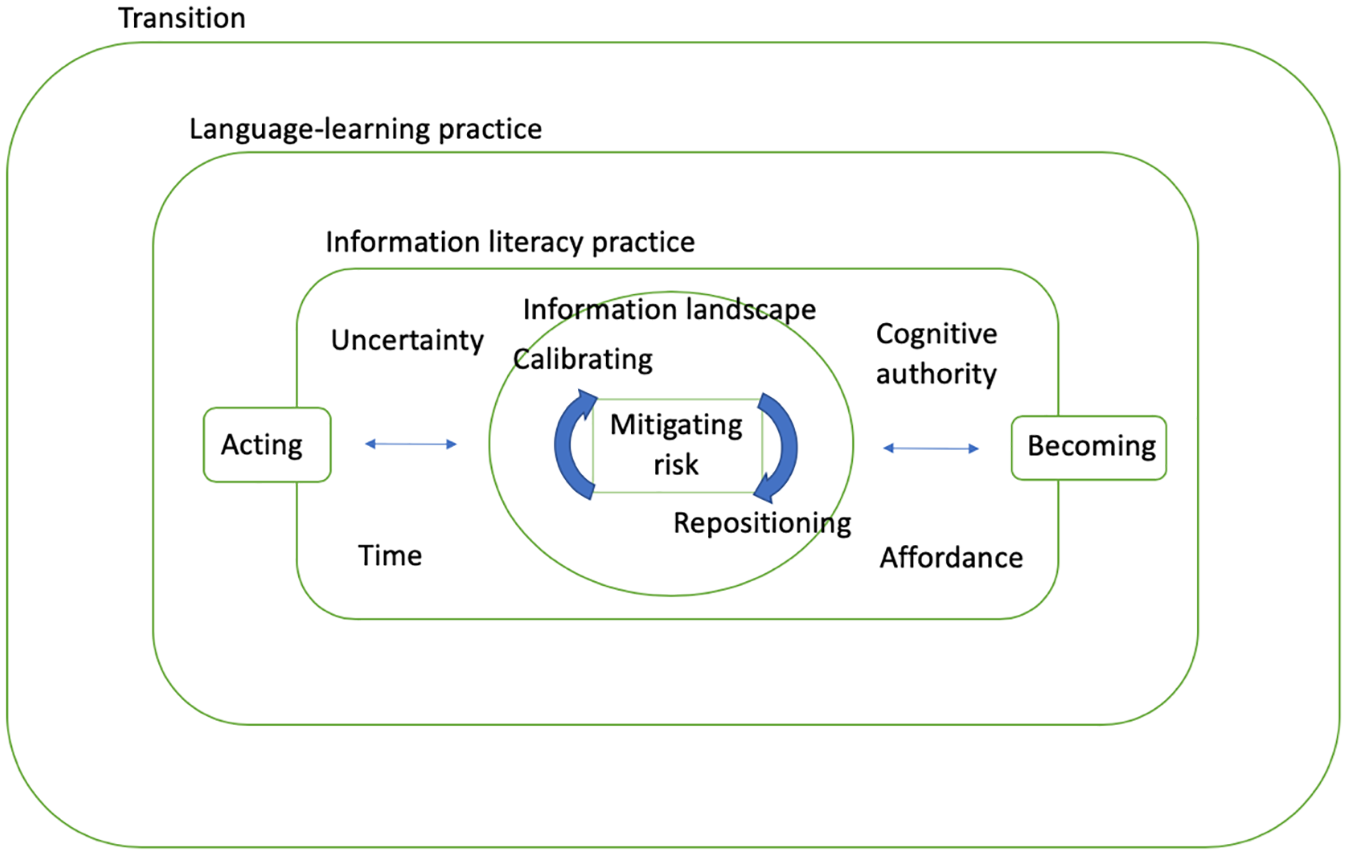
The grounded theory of mitigating risk.
4.1. Transition and information literacy
One of the major premises of the grounded theory of mitigating risk is the key role that information literacy plays in mediating transition. Within this framing, information literacy is positioned as a complex socio-material practice that facilitates increasingly dexterous performance, and supports the reconstruction of understanding within a new setting [5]. The emphasis on the navigation of change means that information literacy is seen to mediate transition through supporting preparation, connection, situatedness and confidence.
One of the key contributions of the grounded theory of mitigating risk is to demonstrate that information literacy supports transition through helping learners to prepare for a new information environment. Transitions theory has typically positioned transition as ‘extend[ing] from the first anticipation of transition until stability in the new status has been achieved’ [49, p.239]. Within this framing, anticipatory preparation has been seen to facilitate transition by building ‘knowledge about what to expect during a transition and what strategies may be helpful in managing it’ [25, p.22]. The important role that sifting and archiving play in helping language-learners to start mapping and orienting themselves to local ways of knowing before they leave home (as well as before the end of their stay) demonstrates that information literacy prepares newcomers for transition by operationalising access to the information sources that will help them to prepare for the shift overseas. At the same time, the grounded theory of mitigating risk also demonstrates that information literacy helps students to prepare for transition by validating their emerging identity as language-learners who will be travelling abroad; sifting through advice given by returned students is seen to confer a sense of legitimacy to students who are about to move overseas. Preparation for transition has often been understood in terms of readiness or the possession of pre-requisite skills and knowledge that a learner is perceived to need for success within a new setting [50]. However, in demonstrating that information activities enable language-learners to construct a sense of what to expect within a new setting as well as to envision their role within it, the grounded theory of mitigating risk positions information literacy as what Corsaro and Molinari [51, p.17] refer to as a ‘priming event’ for the production and interpretation of sociocultural knowledge.
People in transition cannot, however, be prepared for every eventuality. The inseparable nature of learning, practice and performance [52] demonstrates that transition can never fully be negotiated through anticipatory groundwork. Instead, the grounded theory of mitigating risk demonstrates that information literacy also mediates transition through helping to build and maintain the social relationships that will shape language-learners’ access to information. Transitions theory places considerable emphasis on the important role that the establishment of connection and interaction plays within a healthy engagement with change [25, p.24]. The important role that social connections play in introducing language-learners to local services and resources means that information literacy mediates transition by expanding newcomers’ frames of reference and opening up possibilities that may not have previously been available to them. Beyond the provision of practical assistance, the grounded theory of mitigating risk also draws attention to the key role that information literacy plays in fostering the social support that Meleis et al. [25, p.24] note as underscoring healthy transitional processes. The recognition that mediating information enables language-learners to establish shared narratives with friends and families demonstrates that information literacy mediates transition by helping to reinforce the reassuring emotional connections and structures that newcomers may need to maintain their engagement within an unfamiliar setting.
At the same time, the grounded theory of mitigating risk also extends understanding about the role that social relationships play during transition; language-learner engagement in observing, for example, demonstrates that information literacy helps to mediate transition by providing learners with the opportunity to imitate or mimic local activity and to become physically oriented towards transition. The grounded theory of mitigating risk also illustrates that information literacy mediates transition by helping learners to respond to and manage the potentially inhibiting impact of unexpected social dynamics. Transitions theory acknowledges that stigma and stereotyping may impact healthy transitional processes [25, p.23]. Language-learner engagement in repositioning, which forms a purposeful response to the risk of being marginalised within a new information environment, demonstrates that information literacy further helps to mediate transition by helping newcomers to negotiate social structures that could limit the quality and type of information to which they have access. Echoing the dynamics of legitimate peripheral participation [21], the emphasis on the power relations that construct the social context of transition reinforces that transition is mediated through a learner’s active involvement in a community rather than uniquely being located within personal motivation for change.
Another way in which information literacy helps to mediate transition is through situating newcomers within their new information environment. Becoming located through time, space and relationships has been recognised within transitions theory as forming an important indicator of a healthy transition [25]. However, the linguistic, cultural and physical barriers that language-learners face overseas demonstrate that the ability to become situated is not straightforward. Instead, language-learners are forced to reposition themselves in terms of their expertise as they both recognise and become recognised for their growing proficiency. These ideas illustrate that information literacy mediates transition through helping newcomers to situate themselves as competent participants within a new setting. On one hand, repositioning helps to locate language-learners by justifying their goals or ‘who and what they are’ within a transitional context [25, p.25]. On the other hand, repositioning helps newcomers to situate themselves by framing their activities in ways that are recognisable and acknowledged by others rather than as isolated and disconnected from local values. The emphasis on collective alignment means that the grounded theory of mitigating risk illustrates that information literacy facilitates transition by supporting a shift from individual to collective knowing as students start to think of themselves and their activities in terms of their connections and relations to others.
Finally, a focus on expertise means that the grounded theory of mitigating risk illustrates that information literacy mediates transition through supporting the development of confidence, which is positioned as another important marker of transition within nursing transitions theory [25, p.25]. Transitions theory positions confidence as shaped through the aggregation of ‘cumulative knowledge’ [25, p.25], which mirrors Kuhlthau’s [53] theory of uncertainty. Along these lines, the recognition that the recently returned students inspire confidence in language-learners suggests that information literacy mediates transition through helping newcomers understand that there is a field for the legitimate and ‘mature practice’ of what they will be doing [21, p.110]. More complexly, the confidence that language-learners build through mediating information to others illustrates that information literacy also facilitates transition by legitimising a growing sense of expertise or supporting the ways in which people are recognised as knowledgeable by others. Notwithstanding, the specificity of language-learner expertise, which tends to centre on a specific infrastructure, for example, bus travel or a health system, means that the grounded theory of mitigating risk recognises confidence as both situated and fluctuating rather than as accruable. The shifting shape of student confidence, as well as the important role that peers play in motivating learners, builds upon Kuhlthau’s [53] work by broadening understandings of expertise and the range of people upon whom learners rely.
4.2. Transition and subjectivity
A second major premise of the grounded theory of mitigating risk is that information literacy mediates transition through supporting and facilitating a corresponding shift in learner identity. The outcomes of transition have typically played an important role within nursing transitions theory due to the role that well-being plays within that profession [25, p.25]. However, given that a focus on ‘successful’ outcomes could be seen as risking ‘pathologising transitions’ by establishing normative transitional milestones [12, p.363], the grounded theory of mitigating risk positions the outcomes of transition as loosely marked rather than as centred on a fixed set of indicators. Refocusing attention on socially situated activity, an emphasis on the dynamics of change rather than its determinants positions transition in terms of becoming rather than assimilation or induction [1]. The recognition that information activities support a learner’s engagement in the situated and participatory practices that shape these processes of becoming subsequently highlights the important role that information literacy plays in facilitating identity transformation.
Perhaps unsurprisingly, the grounded theory of mitigating risk establishes the development of knowing as one of the most important outcomes of student transition. Language-learners face a number of challenges within an unfamiliar information environment, including the need to confront new responsibilities, such as complying with the legal and institutional requirements that govern their stay abroad, and completing time-sensitive tasks, such as finding accommodation. Students’ use of information at this time illustrates that information literacy mediates transition by enabling the construction of what Meleis et al. [25, p.26] refer to as mastery or the ‘skills and behaviors needed to manage their new situations or environments’. Students’ attempts to both map and position themselves within a new information environment demonstrates that information literacy also facilitates the development of mastery by scaffolding a reflexive understanding of the ways in which knowledge is situated within a new information environment. At the same time, the recognition that language-learners calibrate their activities against those of experienced others demonstrates that information literacy facilitates the construction of expertise by providing the feedback that contributes to learners’ understanding about the shape of competent activity. The emphasis on skilled performance positions transition as a ‘critically intensive learning period’ [52, p.556] rather than a site of transfer.
More expressly, the recognition that mastery of a situation cannot be separated from a shift in self-identity [8, p.324] means that the grounded theory of mitigating risk positions transition as centred upon the formation and re-formation of subjectivity. Before students move overseas, their conception of what it means to be a language-learner has been fabricated in relation to a classroom-based information landscape, as evidenced by their initial need to map and orient themselves to their new information environment. Within this classroom context, students’ language-learning identity is produced through their engagement with their teacher and their fellow English-speaking students and shaped in relation to the information sources that are legitimised and valued by the academy. In contrast, the social and material dynamics of an everyday information environment mean that students’ time overseas forms a very different learning experience. The recognition that language-learner information activities allow them to participate in the procedures of their new community demonstrates that information literacy mediates transition through helping learners to negotiate their roles within a setting. In further enabling learners to reflexively position themselves in relation to these new identities, the grounded theory of mitigating risk demonstrates that information literacy facilitates transition by supporting the reconfiguration of the self. The resulting emphasis on what Lave and Wenger [21, p.51] refer to as a ‘change in person’ means that the grounded theory of mitigating risk both acknowledges and gives prominence to the transformative impact of learning.
At the same time, the important role that community engagement plays in structuring student learning means that the development of subjectivity cannot uniquely be understood as a self-determined agentic process [1, p.360]. Instead, the recognition that language-learners build an ‘identity of participation’ [54, p.56] in relation to social ways of knowing recasts the construction of subjectivity as the development of intersubjective or shared understandings of practice. The grounded theory of mitigating risk consequently reframes transition as a transformation from acting to becoming, as learners move from engaging with information to learn about a practice to engaging with information to enhance practice [55, p.576]. Moving beyond a narrative of success and failure, a focus on acting and becoming illustrates that the development of subjectivity constitutes what Lave and Wenger [21, p.53] refer to as ‘an evolving form of membership’, rather than a one-way process of acculturation. The emphasis on fluidity further positions transition as a ‘multiple, complex, non-linear pathway’ [12, p.364] rather than a chronological or a neatly partitioned entry-passage-exit trajectory [56, p.256] with an identifiable endpoint.
5. Discussion
The grounded theory of mitigating risk positions transition as a period of change and upheaval in which the enactment of information literacy practices facilitates the development and reorientation of subjectivity within a new setting. Centred on the construction of connection, interaction and confidence, the grounded theory of mitigating risk also demonstrates how information literacy helps learners to mediate community and social conditions that both constrain and enable engagement within a new setting. These understandings draw attention to a number of observations related to the ongoing exploration of transition from an information perspective.
5.1. The affective materiality of time
One of the primary considerations to have emerged in this article is the complicated role that time, and particularly future time, plays within transition. Time remains unproblematised within transitions theory; while time span is positioned as a property of transition within nursing transitions theory, the underlying emphasis on developmental stages and journeys suggests that time has generally been understood as ‘flowing straightforwardly and linearly towards the future’ [57, p.441]. However, the recognition that information literacy helps learners to prepare for transition by creating anticipatory images of their new worlds draws attention to the importance of looking at rather than merely into the future [58, p.4]. The vital role that sifting and archiving play in helping learners to create a reality from which they can start to build their identity, for example, means that the grounded theory of mitigating risk illustrates that transition must be understood as produced through possible futures (including ones that may not arrive) rather than unfolding linearly from the present [cf. 59, p.456]. In further demonstrating that these preparatory activities are characterised by feelings of anticipation as well as hope and fear, the grounded theory of mitigating risk demonstrates that transition must also be understood as shaped by a future time that is felt affectively as well as actively. Frustrating the positioning of future time as a ‘neutral temporal space into which objective expectations can be projected’ [58, p.4], these ideas also complicate the perception that imaginative, forward-facing information activities must necessarily lead to information dissonance [32,35].
The problematisation of future time also reframes an understanding of the role that the present plays within transition. Within linear models of time, the emphasis on progression means that the present has often been positioned as separate from the future (and the past), an idea that has led to normative understandings of transition as well as the design of interventions that aim to manage change for vulnerable or ‘at risk’ populations [14]. However, language-learner information activities enable them to construct and feel the future ‘“in” and as the present’ [60, p.527]. These ideas mean that the grounded theory of mitigating risk demonstrates how temporal boundaries must be understood as blurred rather than as distinct or separate. They further disrupt chronological models of transition by reframing the development of subjectivity in terms of the present or day-to-day being rather than anticipatory processes of becoming that dangle, tantalisingly and perpetually out of reach [cf. 61, p.137]. They also complicate transition by positioning the present as an activity that expands or contracts in relation to the future (and the past) rather than as a slow and inexorable step on a projected personal trajectory [cf. 63, p.100]. The renewed focus upon the necessity of understanding learner actions within the moment rather than in terms of ‘future levels of competence’ [62, p.138] consequently suggests a possible reframing for information literacy upon ideas of alertness and keeping up with change rather than idealistic future events such as lifelong learning.
At the same time, a renewed emphasis on the role that future time plays within transition raises a number of methodological issues; given its slippery and ill-defined intangibility [60, p.525], how can we research the future from an information perspective? One answer comes in the application of sensory methodologies, which, as Coleman [60, p.527] points out, recognise ‘the significance of the … intangible to everyday life’. Enabling participants to document future imaginations as well as to probe, provoke and stimulate them [60, p.539], sensory-focused methods such as photo-elicitation and film-making also offer participants ways of experiencing, thinking and imagining futures that are different to those that are afforded by a community’s past [63, p.374]. The employment of photo-elicitation within this study of language-learners forms a testament to the ways in which photography can paint a rich picture of time and transition. Anderson [64, p.793] also advocates for the need to attend to the presence of the future within research studies as well as to reflect on the assumptions that are already embedded in our work. Forming a reflective approach to research, this approach could help to move the focus of transition beyond disruption towards an examination of the ways in which the future appears and disappears and is repressed and erased during intense periods of change [cf. 64, p.793].
5.2. Disidentification and resistance
Beyond problematising questions of time, the framing of transition as the development of subjectivity means that the grounded theory of mitigating risk draws attention to the complex dynamics of identity creation, including the important role that resistance plays in shaping the ‘change of persons’ [21, p.51]. The grounded theory of mitigating risk positions transition as centred on processes of becoming; more specifically, learners build understanding through increasingly competent participation in and identification with a community’s shared ways of knowing. However, language-learner engagement in repositioning, which forms a purposeful response to the social and community conditions that risk limiting their opportunities to engage with information within a new setting, suggests that transition must be understood as shaped in relation to the disconfirmation of identity as much as to legitimisation and acceptance. The frustration that language-learners express at being positioned as an outsider means that the grounded theory of mitigating risk illustrates how a sense of exclusion creates an ‘identificatory moment’ [65, p.272] in which students are forced to realise and respond both to how they understand themselves and how they are understood by others. Subsequent changes in activity, as students seek ‘confirming responses’ as well as to convince others of their legitimacy [66, p.37], further speak to how identity disconfirmation leads to a reflexive engagement with what it means to be a competent participant within a specific community setting.
The focus on exclusion subsequently draws attention to the role that resistance plays within transition. Resistance has not typically been celebrated within information literacy research, where student disengagement has typically attempted to be fixed through the implementation of active learning and motivation strategies, among other measures [67]. However, language-learner engagement in triaging, mediating and archiving marks a refusal to be situated in ways that do not meet their goals for this time overseas. The grounded theory of mitigating risk consequently suggests that resistance forms the means through which language-learners mark and express their developing identity; as Wenger [55, p.164] illustrates, our identities are produced by the practices in which we do not engage as much as by those in which we do. While these ideas underscore how student activity forms an active assertion of agency, they also illustrate how the construction of identity may take place within a ‘context of conflict and exclusion’ [65, p.273] that both constrains and enables the ways in which learners are able to mediate change. Relatedly, the dynamics of participation illustrate how language-learners also resist becoming sidelined from a new information environment by turning away from classroom identities, in a process that Colley et al. [68] label as ‘unbecoming’. Accentuating how students are simultaneously transitioning towards and away from specific identities, a focus on ‘unbecoming’, or what Wenger [54, p.155] briefly refers to as an outbound trajectory, also demonstrates the need to explore transition within the context of broader educational participation rather than just the initial entryway.
5.3. Reflexivity
The important role that disidentification and resistance play in shaping student identity means that the grounded theory of mitigating risk also demonstrates the important role that reflexivity plays within transition. Reflexivity has long been recognised as important within information literacy research [69], where it has often been framed as either individual mental processing or the internalisation of accepted information literacy skills and values. However, language-learner engagement in both calibrating and repositioning demonstrates that reflexivity does not merely centre on instrumental or technical capabilities. Instead, the recognition that calibrating focuses on the modification of performance through comparison to experienced others demonstrates that reflexivity also invites the creation of an ‘historical self-consciousness’ of identity in relation to others, as well as the shape of practice [70, p.158]. In further illustrating that engagement in archiving and mediating provides the means through which language-learners are acknowledged as proficient by others, the grounded theory of mitigating risk also demonstrates that reflexivity mediates expertise as well as the ways in which students recognise themselves as occupying a specialist role [cf. 70, p.158]. The emphasis on transcending the immediate to ‘think about the past, in the present for the future’ [71, p.43] provides a further indication of the ways in which the future (and the past) shape and structure student engagement in the present.
Students’ reflexive engagement in practice means that the grounded theory of mitigating risk demonstrates the active role that language-learners play in mediating transition. Somewhat surprisingly, both nursing [25] and ecological educational transitions theory [17] have tended to downplay the role of reflexivity within transition. Instead, the emphasis on professional roles in nursing theory as well as the separation of person from culture in ecological transitions theory means that people in transition are often positioned as passive or as recipients of expert assistance and as taking little interest in their own involvement in change [28, p.664]. In contrast, language-learners are constantly reflecting on or interpreting and adjusting the ways in which they participate and are situated within an information environment. These ideas mean that the grounded theory of mitigating risk positions transition as produced through a person’s active participation within their new setting rather than as occurring to people who have little control over their destiny. The study’s focus on community and social conditions as well as a transitional context in which there is no active mediator, such as a nurse or a librarian, further highlights how transition must be seen as negotiated rather than as needing to be managed through professional help. Importantly, the emphasis on reflexivity also speaks to the need to recognise the vital role that less visible methods of engagement play in facilitating transitional processes.
6. Conclusion
This article has used the lens of the grounded theory of mitigating risk as the basis for a more detailed examination of transition and the implications for information literacy research. The grounded theory of mitigating risk is an emergent theory which constitutes a situated and interpretive theorisation of language-learner activity rather than generalisable theoretical development. However, in originating from one of the first full-length studies to emphasise processes of change over time, it has significant implications for transitional research and practice.
Most importantly, the grounded theory of mitigating risk highlights the centrality of transition to our understandings of information literacy. Nursing researchers have long argued for the positioning of transition as a core concept within the discipline of nursing [25]. The important role that change and development play within the construction of information landscapes means that the grounded theory of mitigating risk positions transition as playing a similarly fundamental role within the field of information literacy. While the shift between novice and expert positions has long been recognised as key within information literacy research [5] as well as, more recently, through its embedding within institutional documents such as the ACRL Framework [42], the consolidation of these ideas under the umbrella of transition provides a theoretically rich structure from which the dynamics of change can be explored further. A focus on transition further helps to expand the scope of information literacy research beyond an emphasis on moral and ideological virtues towards a more useful examination of the role that the development of knowing plays in scaffolding processes of re-equilibration and restoration [13] during times of upheaval. The methodological and theoretical structures that were employed in the original empirical study [6], which was one of the first to explore information literacy through the lens of transition, mean that the grounded theory of mitigating risk forms a basis from which future theoretical work can be developed.
The focus on transition means that the grounded theory of mitigating risk also challenges recent interest in threshold concepts, which refer to the ‘core ideas and processes in a discipline that students need to grasp in order to progress in their learning’ [72, p.23]. Forming part of the theoretical underpinnings for the ACRL Framework [42], threshold concepts position transition as both transformative and irreversible as well as centred on troublesome ideas. However, the grounded theory of mitigating risk challenges these ideas by framing transformation in terms of identity construction rather than the acquisition of knowledge, as is the case with threshold concepts. Similarly, the recognition that transition is subject to forwards and backwards movement [8, p.325] means that the grounded theory of mitigating risk also questions the time-delimited shape of learning that is presented through the emphasis that threshold concepts place on irreversibility; language-learner attempts to prepare for the future and substantiate their learning through archiving further undermines ideas of cumulative progress. Threshold concepts also position transition as troublesome, which could be seen as corroborated by language-learner attempts to build emotional support through mediating information to others. However, the emphasis on connecting learners with the sources of knowledge that will support this intensive period of change demonstrates how transition can also be understood as a time of generative opportunity [6], or in terms of desire and curiosity as well as anxiety.
Beyond information literacy, this study’s information perspective means that the grounded theory of mitigating risk makes a number of contributions to transitions theory. Specifically, the important role that mobile phones and artefacts play within language-student activities overseas means that the grounded theory of mitigating risk brings a material focus to transitions theory. Materiality has not been widely explored in relation to either nursing or educational transition, despite the therapeutic role that objects have been seen to play within transitional processes [73]. The recognition that material objects enable students to both regulate and coordinate the enactment of information literacy practices as well as to sequence their activity over time illustrates the need to explore the role that tools, technologies and objects play within transition in far greater detail. Along the same lines, the grounded theory of mitigating risk also extends understandings about the role that time plays within transition theory. While transitions theory recognises that transition is ongoing and in flux rather than forming a linear journey [12, p.362], time has, nonetheless, typically been positioned as a container in which change takes place. In illustrating the important role that the past-present-future plays in shaping student activity, the grounded theory of mitigating risk illustrates how temporality orients and provides a multi-dimensional space for transition. The affective dimensions of time further demonstrate how transition produces intensive and improvisational activity rather than merely serving as the backdrop for change. The surprising absence of the body from nursing transitions theory also suggests a future avenue for transitional research.
Transition forms a complex concept that has a number of unexplored possibilities within information literacy research and practice. This article has used the grounded theory of mitigating risk as a lens to scrutinise these opportunities and to start a broader conversation about the information dimensions of transition as well as the implications for information literacy. Future research should build upon these beginnings to further explore the ways in which a transitional lens could open up new areas of information research and continue to theorise core concepts within the field.
Footnotes
Declaration of conflicting interests
The author(s) declared no potential conflicts of interest with respect to the research, authorship and/or publication of this article.
Funding
The author received no financial support for the research, authorship and/or publication of this article.
