




Abstract
Gender role attitudes can explain gender differences in occupational success and familial and domestic responsibilities. These attitudes are especially salient during emerging adulthood as young adults lay the first foundations for their future career paths and familial decisions. We aim to determine whether gender role attitudes in young adulthood have long-term consequences for occupational success and familial and household responsibilities 9 (M age = 31) and 18 years (M age = 40) later. The question will be addressed by using three waves of a longitudinal dataset from Germany (N = 4,812). Gender role attitudes were assessed in young adulthood in 2000/2001 (M age = 22), while the occupational success indicators, full-time employment, income, occupational prestige, and sector, as well as familial and household responsibilities, were assessed in the year 2009/2010 (M age = 31) and 2018 (M age = 40). The results show positive bivariate associations between young women’s gender role attitudes and their income and prestige at ages 31 and 40. For men, more egalitarian gender role attitudes were linked to lower income at age 31 when accounting for background characteristics. A positive significant bivariate association emerged between men’s early gender role attitudes and their occupational prestige at ages 31 and 40.
Although women’s participation in the labor market has increased significantly and women are more successful in their school careers, inequalities in the division of labor, familial, and domestic responsibilities remain (e.g., Buchmann & DiPrete, 2006). Persistent differences are evident regarding labor market participation (Becker et al., 2019; Judge & Livingston, 2008; Lietzmann & Frodermann, 2021) and in familial and household responsibilities (Offer, 2014; Roeters & Gracia, 2016; Ziefle, 2004). Gender role attitudes have been frequently offered as an explanation for these differences (e.g., Dicke et al., 2019; Duvander, 2014). Gender role attitudes are socialized from childhood and develop during adolescence (Ullrich et al., 2022). During the transition from adolescence to early adulthood, gender role attitudes have potentially important implications for future adult roles concerning career aspirations and familial and domestic responsibilities (Schoon & Polek, 2011). This raises the question of whether gender role attitudes, once manifested in young adulthood, are associated with lasting differences in occupational and domestic-related outcomes, including full-time employment, income, occupational status and sector, parental leave, and household responsibilities. Using a quantitative longitudinal dataset, we investigate the relationship between gender role attitudes and occupational success from young adulthood to middle adulthood. Moreover, we analyze the long-term links between gender role attitudes and occupational and domestic responsibilities for a more comprehensive understanding of actual practices in family contexts.
Gender Roles, Occupational Success, and Familial Responsibilities
Gender roles refer to normative expectations about the distribution of power and work between men and women, shaped by cultural and historical contexts and reflected in both societal norms and individual cognitive beliefs. Traditionally, the male role is assigned the role of family breadwinner, while the female role refers to social and domestic activities (Eagly & Wood, 2012). Thus, men are ascribed the higher-status position, operating in public and occupational spheres. Women, in turn, carry out the unpaid familial and reproductive work. Accordingly, their financial security depends on their partners (Fiske et al., 2007). Egalitarian gender role attitudes, which emphasize a gender-neutral distribution of reproductive, family, and economic responsibilities, are becoming increasingly relevant in efforts to reduce persistent inequalities. However, although research on a range of Western societies (Knight & Brinton, 2017; Scarborough et al., 2019) shows they have tended to become more egalitarian, inequalities in career success and family responsibilities remain.
Women continue to earn less than men and are less likely to reach higher-status positions (Becker et al., 2019; Buchmann & DiPrete, 2006; Schoon & Polek, 2011). In addition, women are more likely to take career breaks due to childcare, resulting in part-time work and lower earnings, negatively impacting their long-term promotion prospects (Busch, 2013; Ziefle, 2004). Explanations for this include that women tend to choose different occupations than men, often opting for socially oriented professions that are typically lower paid. Empirical findings show that women are overrepresented in low-paying, low-prestige occupations such as healthcare or the humanities, whereas men are overrepresented in science, technology, engineering, and mathematical fields (Busch, 2013; Parker et al., 2012). Since some jobs are perceived as more family-compatible, women are more inclined to take up gender-typical occupations that align with these expectations (Cortes & Pan, 2018). On average, however, male-dominated occupations are more flexible in terms of working hours and location (Baird, 2012). Men also tend to be attributed instrumental traits associated with higher competence, while women are attributed traits that are social in nature and perceived as less competent (Abele & Wojciszke, 2007; Fiske et al., 2007). Moreover, psychological differences in preference, such as risk assessment, self-confidence, or assertiveness, may further shape the division of gendered roles (Cortes & Pan, 2018; Eagly & Wood, 2012). Thus, the differential decision-making behavior could stem from the fact that (traditionally) men fulfill their role of the family breadwinner, while women follow domestic and reproductive activities.
Long-Term Effects of Gender Role Attitudes
Children and adolescents are exposed to family role models and develop attitudes toward gender roles they observe. These early gender role attitudes may therefore shape the perceived utility of educational and occupational options and related social desirability, which might influence later career outcomes (Eccles, 2011). Two main theoretical assumptions regarding the stability of attitudes are discussed: One perspective emphasizes the role of early socialization experiences, suggesting that attitudes formed early in life remain relatively stable over time. In contrast, other approaches propose that individuals continuously revise their beliefs in response to new information (Kiley & Vaisey, 2020). To understand the short- and long-term effects of attitudes, next to their stability and change, occupational career success is rather characterized by few, albeit major, decisions (e.g., choice of university subject, employer, etc.), while familial arrangements are characterized by small daily decisions (e.g., doing the household). Therefore, the mechanisms may vary, and a multidimensional perspective is essential when examining gender role attitudes and their associations with occupational and familial and household arrangements.
Young women with traditional attitudes may see their role in the household and family, which is why an investment in their professional career could be perceived as a norm violation (Baird, 2012) or could lead to cognitive dissonance (Judge & Livingston, 2008). Cross-sectional research has shown that women with more traditional attitudes were less likely to join the labor market, more likely to leave it, and more likely to reduce work hours (Stam et al., 2014), which has a negative impact on their income (Christie-Mizell, 2006; Judge & Livingston, 2008). Longitudinal research found that young women from Michigan with traditional gender role attitudes were less likely to be in occupations, such as physical science, mathematics, engineering, and technology (PMET), compared to non-STEM occupations in middle adulthood (Dicke et al., 2019). However, women with more egalitarian gender role attitudes may be more inclined to pursue higher education, aspire to well-paying occupations, seek professional advancement, and take shorter career breaks after becoming mothers. These behaviors, or a combination, may lead in the long term to higher earnings for women. Longitudinal research showed positive associations between egalitarian gender role attitudes, working hours, and hourly earnings over a 10-year course (Corrigall & Konrad, 2007).
Research concerning long-term effects of gender role attitudes has mainly focused on women, as shifts in gender role attitudes have primarily implications for women. However, men also shape gender segregation through their attitudes and subsequent decisions. Men adhering to traditional gender role attitudes typically prioritize their role as financial providers, focus predominantly on career success, and assign reproductive and caregiving tasks to women, in line with societal expectations. Judge and Livingston (2008) showed positive associations between traditional gender role attitudes and earnings for men, while Corrigall and Konrad (2007) found no significant effects between egalitarian gender role attitudes and occupational-related outcomes. Dicke et al. (2019) found no significant association between traditional gender role attitudes and the probability of taking up a traditional STEM (science, technology, engineering, mathematics) job. However, research that focused on the school context showed negative associations of boys’ traditional gender role attitudes and their general school achievement (Hadjar et al., 2012), while boys with egalitarian gender role attitudes showed a stronger increase in achievement in Germany (Ehrtmann & Wolter, 2018) and higher general interest (Ehrtmann et al., 2019).
Concerning family responsibilities, previous research highlighted that men with more egalitarian gender role attitudes participated more hours in housework (Evertsson, 2014). A Swedish study showed that gender equality was positively associated with fathers’ but not mothers’ parental leave time over a course of nearly 10 years (Duvander, 2014). For women in heterosexual relationships, the attitudes of their partners are particularly important for their decisions. For instance, research showed that their partners’ attitudes were associated with labor market exits (Khoudja & Fleischmann, 2018) and the amount of time women invested in domestic work (Dunlap & Barth, 2019; Evertsson, 2014).
In sum, previous research has identified that egalitarian attitudes show positive effects for women, while the results for men appear more heterogeneous. In addition, gender role attitudes are of high relevance in adolescence and emerging adulthood (Ullrich et al., 2022), but so far only a few studies have examined the long-term implications of these attitudes.
Individual and Contextual Factors for Occupational Success and Familial Responsibilities
When analyzing the gendered division of occupational and domestic responsibilities in Germany, it is crucial to account for regional differences, particularly between East and West Germany. Historically, gender role attitudes and the division of labor and family responsibilities developed differently in both regions. The widespread availability of childcare in East Germany contributed to higher female labor force participation and a more equal distribution of household responsibilities. In contrast, West Germany traditionally adhered to a more conservative family model, with women more often taking on household responsibilities. However, these patterns have shifted due to economic restructuring, particularly in East Germany, where declining job opportunities and structural disadvantages have led to new gendered employment dynamics, potentially reinforcing traditional gender roles and increasing inequalities in work and family life once again (e.g., Rosenfeld et al., 2004; Trappe & Sørensen, 2005). Previous research showed a persistent wage gap between East and West Germany, with wages being generally lower in the East (e.g., Nauerth & Pflanz, 2023). Therefore, it is crucial to account for regional variations in the analyses.
When examining occupational success, cognitive abilities, socioeconomic background, and education are among the most commonly studied explanatory variables. Research demonstrated that income and job prestige are higher with a more privileged background, a higher school and university degree. Moreover, individuals with higher cognitive abilities tend to aspire to more cognitively demanding jobs, which may be associated with longer working hours, higher income, and greater occupational prestige (e.g., Becker et al., 2019).
Concerning household chores, the socioeconomic and educational background should be of relevance, especially for women. Research suggests that women with a higher socioeconomic background, a higher school degree, and a university degree tend to postpone childbirth and are more likely to go back to work earlier (Ziefle, 2004). This, in turn, may indicate that their partners are more inclined to take parental leave and take up more household responsibilities. Hence, cognitive abilities, socioeconomic background, high school, and university degree will be included as covariates.
Next to individual background characteristics, it is important to control for the actual living situation. The most important predictors—especially for women’s occupational success and household responsibilities—are the presence of children. As already mentioned above, women are more likely to set back their careers when they become mothers (Busch, 2013; Ziefle, 2004). Therefore, we controlled for the number and age of children in some of the analyses.
The Present Study
This study takes a life-span perspective and aims to analyze long-term consequences of young adults’ gender role attitudes for occupational- and domestic-related outcomes over a course of nearly 20 years. Thereby, we apply—to our knowledge for the first time—a multidimensional perspective by using occupational success characteristics and familial and household arrangements. By using a longitudinal study on Educational Careers and Psychosocial Development in Adolescence and Young Adulthood (BIJU; Baumert et al., 1996), we can trace long-term consequences of young adults’ gender role attitudes (M age = 22) for occupational success and familial and household responsibilities both at ages 31 and 40. The research questions and the subsequent hypotheses were preregistered (Ullrich, Becker, & Scharf, 2023).
The first research question addresses how gender role attitudes of young men and women are associated with full-time employment, income, occupational prestige, and occupational sector at ages 31 and 40. Based on the aforementioned theoretical considerations and prior empirical findings, we hypothesize that women with egalitarian gender role attitudes should more likely work full-time instead of part-time (H1.1), have higher incomes (H1.2), and have a higher occupational prestige (H1.3) both 9 (M age = 31) and 18 years (M age = 40) later compared to women with lower egalitarian attitudes. Moreover, women with more egalitarian gender role attitudes should be more likely to carry out STEM-related jobs (H1.4). As the state of research is inconsistent for men, these relationships are examined exploratively for men.
In addition to career success, the study addresses domestic responsibilities. The second research question examines whether parental leave and household responsibilities vary by gender role attitudes. We assume that young women with more egalitarian gender role attitudes report at ages 31 and 40 that they took fewer months of parental leave (H2.1). In addition, young women with more egalitarian gender role attitudes should take up fewer household chores when they are living with a partner (H2.2). Beyond the preregistration, we (exploratively) examine the relationship between men’s and women’s gender role attitudes and whether their partner took parental leave in later life. For young men with more egalitarian gender role attitudes, we assume that they should report that they have taken a longer period of parental leave (H2.3) and should participate more strongly in household chores (H2.4) at ages 31 and 40.
Method
Data
The questions are examined using the longitudinal study on Educational Careers and Psychosocial Development in Adolescence and Young Adulthood (BIJU; Baumert et al., 1996). The data collection was led by the Max Planck Institute for Human Development in Berlin in cooperation with the Leibniz Institute for Science and Mathematics in Kiel. Sample selection took place in the German federal states of Mecklenburg-Western Pomerania, North Rhine-Westphalia, and Saxony-Anhalt. Schools from Berlin were included from the second wave onward. Secondary schools were sampled, and two seventh-grade classes from each school were invited to participate in the study 1991/1992 from the above-listed federal states.
The initial seventh-grade sample comprised N = 5,944 secondary school students in N = 212 schools and increased to N = 8,043 due to the inclusion of Berlin schools in the second wave. Researchers carried out an intentional oversampling of all upper secondary school students in the fifth wave due to drop-outs and the dissolution of existing lower secondary school classes as students entered upper secondary education. This increased the sample size back to N = 8,061. Trained test administrators collected data in classrooms up to students’ graduation (Waves 4 and 5). Surveys after students graduated from school were conducted via post. Addresses were collected in the 10th and 12th grades, which resulted in N = 5,292 valid addresses. Of these, N = 3,261 responded by Wave 6, N = 4,130 by Wave 7, and N = 2,687 by Wave 8. The BIJU study was conducted in accordance with the American Psychological Association’s principles for research with human participants. Written informed consent was obtained from all students and their parents. The study procedures and materials were evaluated and approved by the responsible ministries of education and the ethics commissions of the participating research institutions (Baumert et al., 1996).
The sample selection was preregistered prior to data analyses (Ullrich, Becker, & Scharf, 2023). The sixth wave was conducted in 2000/2001, when the participants were on average 22 years old. Data collection for the seventh wave took place in 2009/2010 (M age = 31) and for the eighth wave in 2018 (M age = 40). By using all available information from Waves 6, 7, and 8, the final sample comprised N = 4,812 participants (further information on the sample and the sample sizes can be found in the Supplemental Material). Participants were excluded when they had missing information on the gender item and/or on the weighting variable. The analyses were computed with sampling weights to correct for differential sampling probability by school type and survey wave.
Measures
Gender Measures
Gender role attitudes were assessed with six attitude-based items measuring egalitarian gender role orientations in the sixth wave (M age = 22; Krampen, 1979; see Table A1 in the Supplemental Material). 1 The recoded responses ranged on a Likert-type scale from 1 to 4, with higher values corresponding to egalitarian attitudes. CFA-testing confirmed the unidimensional structure of the scale, which exhibited acceptable reliability scores (McDonald’s Omega = 0.71). Gender roles were specified as a latent measurement model in all the analyses. To ensure that the scale was comparable between the genders, we tested for measurement invariance between men and women (Lomazzi & Seddig, 2020; Meredith, 1993). By allowing one correlation between Item 4 and Item 6 for women, the scale reached scalar invariance (RMSEA = 0.03; CFI = 0.95; TLI = 0.95; SRMR = 0.05).
For gender, the data were cleaned to be consistent across waves. Therefore, missing information was completed, inaccuracies (e.g., invalid responses) were adjusted, and the data were checked for validity. Men were coded with 0 and women with 1.
Occupational Success
Each measure of occupational success was assessed in Wave 7 (M age = 31) and in Wave 8 (M age = 40). The participants were asked whether they worked full- or part-time. In Wave 7, they had to report how many hours they worked per week. In Wave 8, they had to report whether they worked less than 35 hours per week or 35 or more hours per week. To ensure that the data on weekly working hours were comparable between waves, the open answers from Wave 7 were recoded into the same scale as in Wave 8 (regression results for actual hours worked per week from Wave 7 can be found in the Supplementary Material). In both waves, the participants who worked less than 35 hours per week were coded as 0, and participants who worked 35 or more hours per week were coded as 1. Of all participants who indicated that they were currently employed, 78.7% in Wave 7 and 67% in Wave 8 indicated that they were working full-time.
The personal income was measured by self-reports in Euros. Gross income was used to examine the income regardless of family situation. To normalize the distributional shape, a logarithmic transformation was employed as it makes the analyses more robust against outliers and facilitates interpretability and comparability between studies (Becker et al., 2019).
Participants had to report their occupational status, and unemployed participants had to report their last occupation. Occupational prestige was coded based on the International Standard Classification of Occupations (ISCO 2008; International Labour Office, 2012) and converted into the International Socio-Economic Index of Occupational Status (ISEI; Ganzeboom, 2010).
The occupational sector was assessed with the official classification system (KldB, Klassifikation der Berufe) of the German Federal Employment Agency (Bundesagentur für Arbeit, 2021a, 2021b). The KldB categorization is based on the ISCO categorization, with the KldB being hierarchically ordered in 10 sectors (a detailed description of the various sectors and a table with the gender distributions is found in the Supplemental Material, Table A2). The sectors were clustered as they offer different work environments that may be gendered (Simon et al., 2017; Wilkins-Yel et al., 2022). The selection of the clusters was based on theoretical considerations, the gender distribution in the various sectors of the BIJU study, and information on a time series coding of the KldB from the Statistik der Bundesagentur für Arbeit (Federal Employment Agency’s statistics) (2023) in Germany. The first cluster contains sectors with a strong emphasis on STEM-related jobs, which are generally male-dominated jobs. Two sectors were combined as the social and cultural sector. We combined these sectors as they seem to be especially attractive for women. The third sector contains nearly gender-neutral sectors and was used as a reference to both the STEM-related sector and the social and cultural sector.
Domestic Responsibilities
Analog to the occupational success indicators, each measure of domestic responsibilities was assessed in Wave 7 (M age = 31) and in Wave 8 (M age = 40). Participants who reported having a child were asked who took parental leave. They had the option to rate whether they and their partner took parental leave and specify the duration in months for each child (parental leave and partner’s parental leave). To analyze parental leave in greater detail, we extend our preregistered approach by examining the total number of months of parental leave taken by both the participant and their partner. The analyses using the dichotomous variable for both parental leave and partner’s parental leave are available in the Supplemental Material (Table A14).
Finally, participants were asked who was responsible for different types of household chores. Participants had the option to rate from 1 to 5, with 1 indicating their partner did all the chores and 5 indicating they did all these chores on their own. They also had the option to rate 6 when someone else was doing the task. Research has shown that cooking, grocery shopping, cleaning, laundry, and childcare are traditionally perceived as feminine chores, while repairs and installation are viewed as masculine chores; financial chores, however, are discussed as gender-neutral chores (Kroska, 2003). Due to the small size of masculine and gender-neutral chores, we focused on traditionally feminine chores. In addition, research has shown that masculine and female chores are not completely comparable, as masculine chores are less time-consuming, more controllable, and less routine (Barnett & Shen, 1997; Sweeting et al., 2014), which is why we focused on traditionally feminine chores. The household chores were recoded, with 0 indicating that they equally shared the task or someone else was doing the task, −1 indicating the man was mainly doing the task, or +1 indicating the woman was mainly doing the task (Sweeting et al., 2014). In the summarized scale, −5 indicates that the man was doing all the chores, while +5 indicates that the woman was doing all the chores. A 0 means that the couple equally shared the tasks or that someone else was doing the chores.
Control Variables
The region in the BIJU study was categorized into West Germany (coded as 0: North Rhine-Westphalia, Berlin West) and East Germany (coded as 1: Mecklenburg-Western Pomerania, Saxony-Anhalt, Berlin East). A total of 2527 participants were from West Germany, while 2285 participants were from East Germany.
Parental socioeconomic status was assessed through both parental occupational prestige and parental level of education. A total of four indicators for mothers’ and fathers’ occupational prestige were used: Two indicators stem from filled-in information from the first three waves, which were supplemented with information from the fourth wave, and two indicators were used from the fifth wave to control for measurement error. Thereby, occupational prestige was coded based on the International Standard Classification of Occupations from 1968 for Waves 1 through 3 (ISCO 1968; International Labour Office, 1968), with the ISCO-88 used for Wave 5 (International Labour Organization, 1990) and converted into the Treiman’s (1977) Prestige Scale. The scale assigns occupational prestige scores based on a standardized ranking of professions. The scale ranges from 6 to 90, with lower scores (6–32) representing occupations characterized by very low autonomy, manual tasks, and unskilled or semi-skilled labor. In contrast, higher scores (>64) indicate professions with high autonomy, such as freelance academics and managerial positions with extensive decision-making power. This scale provides a comparative measure of social status across different occupations and countries, allowing for a nuanced analysis of socioeconomic background (Treiman, 1977). In addition to occupational prestige, students were asked about the highest level of their parents’ general academic and vocational education. The survey revealed whether each parent had a higher general upper secondary schooling qualification (Abitur) or obtained a university degree, with a combined score of 0 indicating neither parent had an Abitur/university degree, and a score of 2 indicating both parents had an Abitur/university degree. The scale was latently modeled and tested for measurement invariance by gender, which reached a very good model fit (RMSEA = 0.04, CFI = 0.98, TLI = 0.98, SRMR = 0.04).
To measure the participants’ cognitive abilities, two subscales on verbal and figural analogies from the Kognitiver Fähigkeitstest (KFT; Heller et al., 1985) and two subscales on numeric and spatial reasoning from Amthauer’s (1955) Intelligence Structure Test (IST) were used (Becker et al., 2019; see also Ullrich et al., 2022). Figural analogies were assessed with 25 tasks, with students ranging from 0 (0.3%) up to 25 (4.3%) correct answers. Verbal analogies included 20 tasks, with scores spanning from 0 (0.4%) to all correct (1.1%). Numeric reasoning also compromised 20 tasks, with 1.1% of students who did not solve a single task up to students who solved all tasks correctly (3.3%). Spatial reasoning initially included 20 tasks, but one item was excluded since it was not solvable. Performance ranged from 0 correct answers (0.4%) to a maximum of 17 correct answers (0.1%). The KFT scales exhibited satisfactory reliability (figural: Cronbach’s α = .93, verbal: Cronbach’s α = .82), and the IST scales exhibited acceptable reliability (spatial: Cronbach’s α = .71/.70 [Versions A and B], numerical: Cronbach’s α = .90). The latent intelligence factor reached scalar measurement invariance between genders (RMSEA = 0.05, CFI = 0.97, TLI = 0.98, SRMR = 0.05).
As occupational success is determined by academic achievement, we controlled for the school degree obtained. Therefore, we took into account whether or not the participants reached a higher education qualification (Abitur) and whether or not the participants obtained a university degree.
Next to whether the participants have children at all, the number and age of children in the household are crucial factors for both occupational success and domestic responsibilities. Therefore, we controlled for the number of children in the household (ranging 0–6). In addition, we included dummy-coded variables indicating the presence of a child under 3 years old, a child between 3 and 6 years old, or a child over 6 years old in the household (further details on participants with children can be found in the next chapter).
Measures for Subsamples
It is important to note that certain analyses were conducted exclusively on specific subgroups, so the sample was restricted in some sets of analyses. Therefore, the following section outlines the variables used for the different subsamples. To examine whether participants worked full- or part-time, we first identified those who were employed in the seventh (M age = 31) and eighth wave (M age = 40). Employment status was based on participants’ current occupational situation. Participants who reported being unemployed, in vocational training, studying, on parental leave, in a traineeship, or doing something else were categorized as not employed and were not part of the analyses concerning the examination of full-time and part-time employment. In the seventh wave, N = 3,178 (77.2%) participants indicated that they were currently employed, while in the eighth wave, N = 2,301 (86.6%) participants indicated that they were currently employed.
When examining familial and household responsibilities, gender roles refer to arrangements of heterosexual partnerships. Therefore, beyond preregistration, only participants indicating they were heterosexual were considered. In the seventh wave, N = 3,639 (95.6%), and in the eighth wave, N = 2,272 (95.1%), participants indicated that they were heterosexual.
To answer the question of who is taking parental leave, it needs to be determined who has children at all. In the seventh wave, N = 1,406 participants (36.9%) indicated that they had at least one child, and in the eighth wave, N = 1,584 participants (67.8%) reported having children. Only participants who indicated that they are parents were included in the analyses on parental leave duration.
To determine how domestic tasks were organized in a relationship, only those participants who were currently living with a partner were considered. In the seventh wave, N = 2,625 (71.9%), and in the eighth wave, N = 1,861 (79.8%), participants indicated that they were currently living with a partner or spouse.
Statistical Analyses
To answer the question of how gender role attitudes of young adults are associated with occupational- and familial-related outcomes 9 (M age = 31) and 18 years (M age = 40) later, multiple multigroup regressions were applied. Since some of the hypotheses were formulated in gender-specific terms, the models were specified as multiple-group models by gender.
Income, prestige, parental and partners’ parental leave, and household chores have metric scale level, which is why they were estimated as linear regressions using the maximum likelihood estimator with robust standard errors (MLR). For examining full-time employment, logistic regressions with probit coefficients and odds ratios using the WLSMV estimator in Mplus were applied. To examine the occupational sectors, multinomial logistic regressions were used with the MLR estimator. The models were conducted separately for men and women due to the mathematical complexity of multinomial logistic regressions (algorithm = integration).
In all analyses, sampling weights were used. To account for the clustered structure of the data at the school level, the analysis option type = complex in Mplus was applied. A certain degree of sample attrition is, for the almost 20-year period of the study, nearly unavoidable. Missing data on our key variables ranged from 19.2% to 73.5%. The higher rates of missingness are largely due to design-related missing data, as certain questions—such as those regarding the division of household labor—were only asked of participants who were in a partnership (missing data rates for all constructs used and attrition analyses are provided in the Supplemental Materials, Table A6 and A7). Missing values were treated with multiple imputation by gender (Lüdtke et al., 2007), which has the advantage that no cases were deleted (e.g., listwise or pairwise deletion), and the risk of biased estimates was minimized. For this purpose, we used the mice (van Buuren & Groothuis-Oudshoorn, 2011) and miceadds (Grund et al., 2016) packages in R and created 20 datasets with 50 iterations, each using predictive mean matching. To control for the clustered data structure, the proportion of female students per school was calculated and included as a predictor variable in the imputation model. Missing values on the subsample measures were also treated with multiple imputation by gender. However, when working with imputed data in Mplus, it is not possible to directly use specific subsamples in Mplus based on variables that themselves contain imputed values. Therefore, individuals who should be excluded from the analyses were assigned a weight of 0 in the define option. This approach yields equivalent results to a conventional subsample analysis. However, it does not allow for precise reporting of the resulting sample sizes. To increase transparency, we included the proportion of individuals meeting the respective criteria in the tables.
Subsamples and Control Variables
The following provides a brief overview of the subsample used in each analysis and the corresponding control variables. Descriptive statistics on gender role attitudes, socioeconomic background, and cognitive abilities for the different subsamples can be found in the Supplemental Material (Table A8). With regard to the subsamples, only individuals in employment were considered when examining full-time employment. When examining familial and household responsibilities (parental leave and household chores), only participants indicating they were heterosexual were considered. Concerning parental leave, only participants who indicated that they have at least one child are examined. To determine how household chores were organized in a relationship, only those participants who were currently living with a partner were considered.
For every outcome, we conducted two models. The first model analyzes how gender role attitudes relate to occupational success and domestic responsibilities. In the first step, we do not include any background controls, except for income, where we account for full-time employment to avoid bias arising from differences in working hours. In the second model, we included the control variables. In each analysis, we controlled for region, cognitive abilities, socioeconomic background, secondary schooling, and tertiary degree. With the exception of parental leave, we controlled for the number and age of children in each analysis.
Results
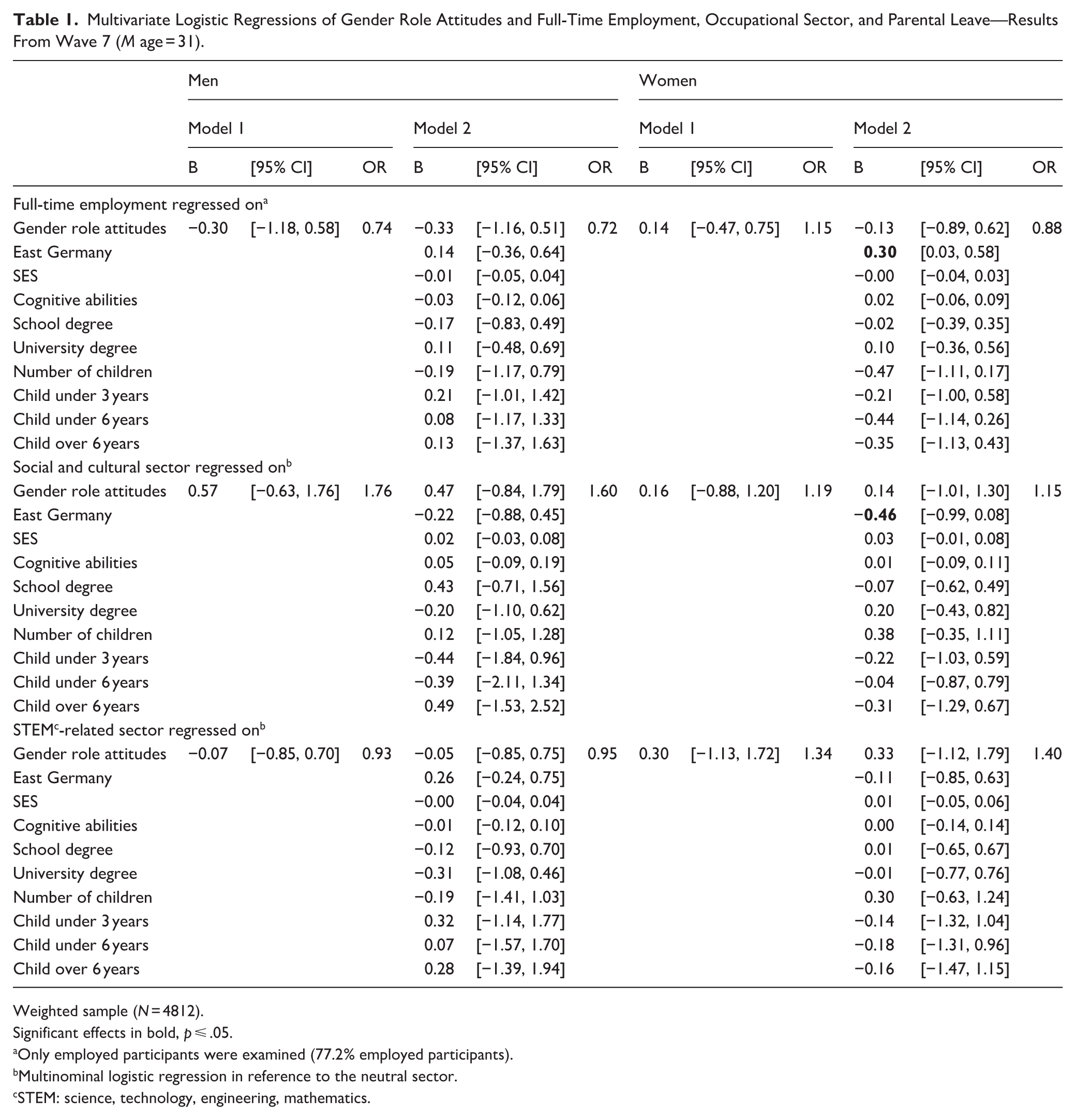
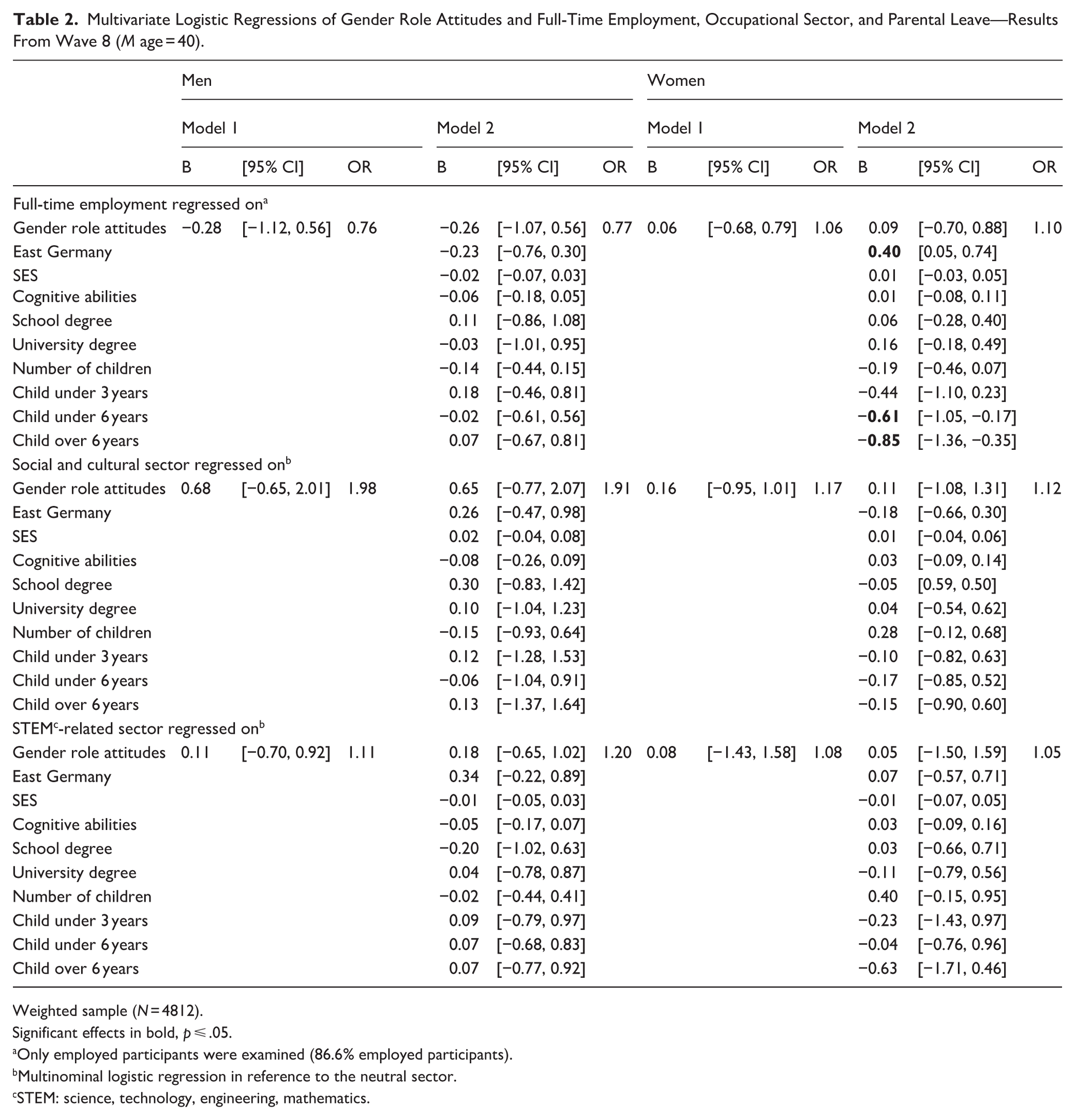
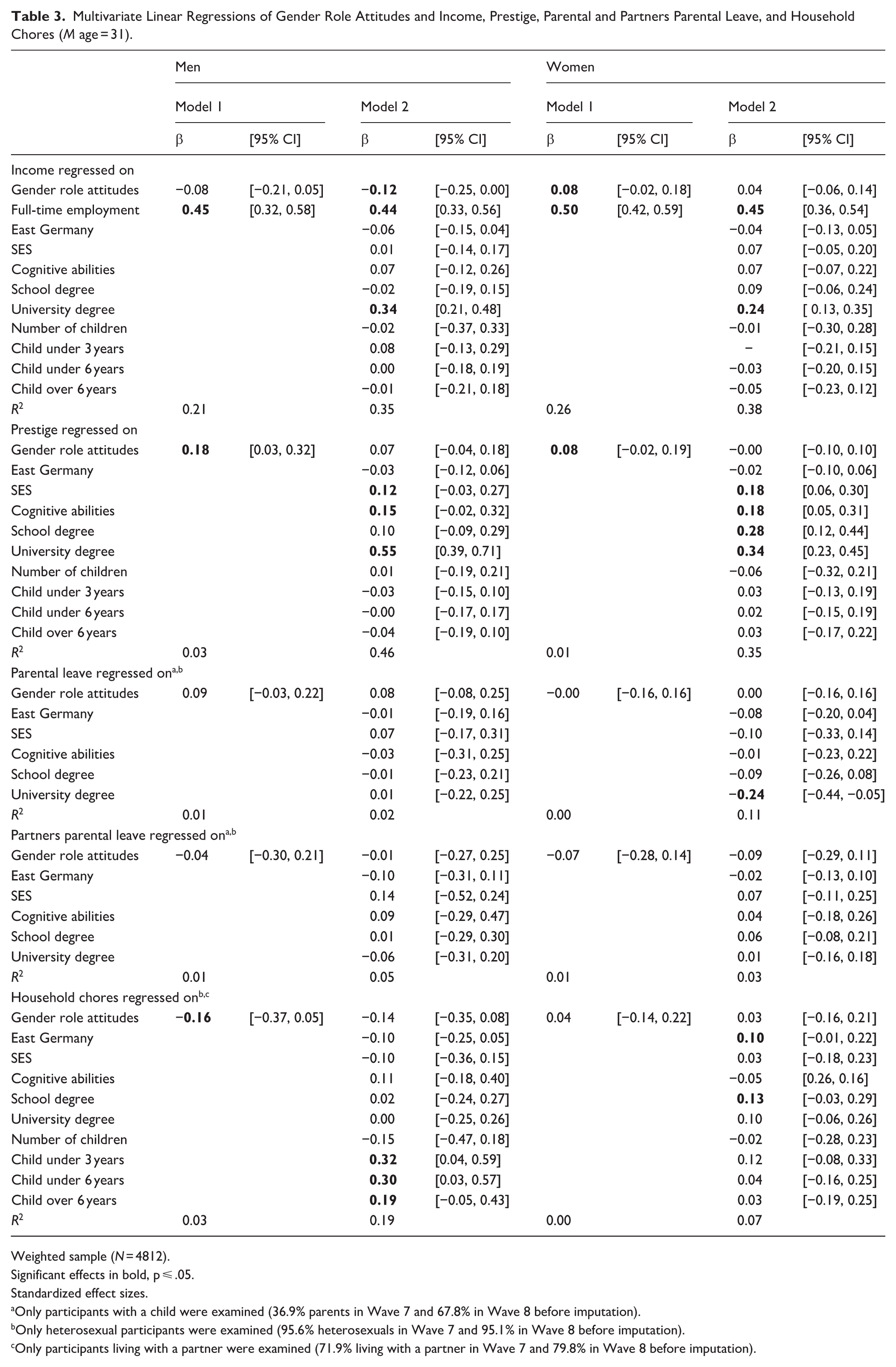
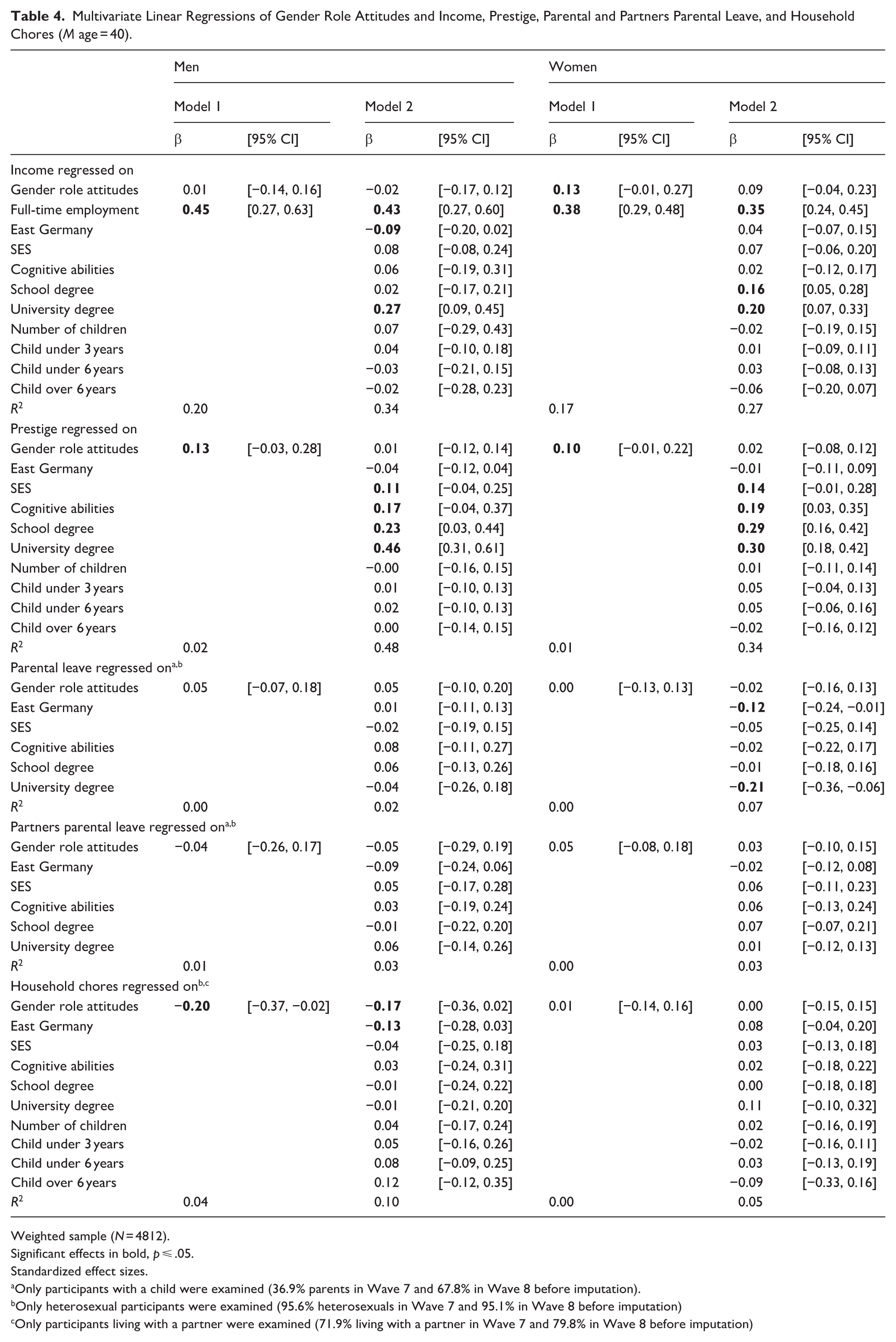
The overall means, the means by gender, the differences between the genders for all constructs, and the correlational analyses can be found in the Supplemental Material (Tables A3 and A4). Turning to the multivariate results to answer the question of whether gender role attitudes entail long-term consequences for occupational success (Tables 1 to 3), the results show—contrary to our assumptions (H1.1)—that gender role attitudes were not associated with full-time employment for women at ages 31 and 40 (Tables 1 and 2). Our findings suggest limited support for hypothesis H1.2. There was an indication that women with more egalitarian gender role attitudes in young adulthood reported higher income at ages 31 and 40 (Tables 3 and 4), even when accounting for full-time employment. However, this association did not reach statistical significance when additional background characteristics were considered, suggesting potential confounding effects. Concerning hypothesis H1.3, the bivariate results suggest that more egalitarian gender role attitudes of young women were associated with higher prestige at ages 31 and 40 (Tables 3 and 4). Again, when controlling for the background characteristics, this association no longer reached a sufficient level of significance. When examining the occupational sectors, we did not find a significant relationship between young women’s gender role attitudes and their choice of occupation in a STEM-related (H1.4) or social and cultural sector (Tables 1 and 2).
Multivariate Logistic Regressions of Gender Role Attitudes and Full-Time Employment, Occupational Sector, and Parental Leave—Results From Wave 7 (M age = 31).
Weighted sample (N = 4812).
Significant effects in bold, p ⩽ .05.
Only employed participants were examined (77.2% employed participants).
Multinominal logistic regression in reference to the neutral sector.
STEM: science, technology, engineering, mathematics.
Multivariate Logistic Regressions of Gender Role Attitudes and Full-Time Employment, Occupational Sector, and Parental Leave—Results From Wave 8 (M age = 40).
Weighted sample (N = 4812).
Significant effects in bold, p ⩽ .05.
Only employed participants were examined (86.6% employed participants).
Multinominal logistic regression in reference to the neutral sector.
STEM: science, technology, engineering, mathematics.
Multivariate Linear Regressions of Gender Role Attitudes and Income, Prestige, Parental and Partners Parental Leave, and Household Chores (M age = 31).
Weighted sample (N = 4812).
Significant effects in bold, p ⩽ .05.
Standardized effect sizes.
Only participants with a child were examined (36.9% parents in Wave 7 and 67.8% in Wave 8 before imputation).
Only heterosexual participants were examined (95.6% heterosexuals in Wave 7 and 95.1% in Wave 8 before imputation).
Only participants living with a partner were examined (71.9% living with a partner in Wave 7 and 79.8% in Wave 8 before imputation).
Multivariate Linear Regressions of Gender Role Attitudes and Income, Prestige, Parental and Partners Parental Leave, and Household Chores (M age = 40).
Weighted sample (N = 4812).
Significant effects in bold, p ⩽ .05.
Standardized effect sizes.
Only participants with a child were examined (36.9% parents in Wave 7 and 67.8% in Wave 8 before imputation).
Only heterosexual participants were examined (95.6% heterosexuals in Wave 7 and 95.1% in Wave 8 before imputation)
Only participants living with a partner were examined (71.9% living with a partner in Wave 7 and 79.8% in Wave 8 before imputation)
As the state of research concerning occupational success is inconsistent for men, the relationships were examined exploratively for men. The results revealed that young men’s gender role attitudes were not associated with their full-time employment at both measurement points (Tables 1 and 2). However, more egalitarian attitudes were associated with less income among men at age 31 (Table 3), when controlling for full-time employment and other background characteristics. As for women, we found a significant bivariate relationship between young men’s gender role attitudes and their occupational prestige at ages 31 and 40. However, when controlling for the background controls, the significant relationships vanished. When examining the occupational sectors, no significant associations were evident between young men’s gender role attitudes and the choice of a STEM-related or social and cultural sector (Tables 1 and 2).
Second, the study addresses the research question of whether parental leave and household responsibilities vary by gender role attitudes of young adults. The results show (Tables 3 and 4)—not in line with our assumptions (H2.1)—that young women’s gender role attitudes were not associated with their parental leave time and their partners’ parental leave time. In addition, we did not find support for our hypothesis H2.2 either; The division of household chores did not vary with women’s gender role attitudes. For young men with more egalitarian gender role attitudes, we assumed that they should be more likely to take parental leave (H2.3). However, this relationship also did not reach a sufficient significance level. Likewise, no significant relationship was found between young men’s gender role attitudes and their partner’s parental leave. Finally—as hypothesized (H2.4)—men who held more egalitarian gender role attitudes as young adults took over more household chores at ages 31 and 40. However, this effect was only statistically significant at age 40 when controlling for their background characteristics (Table 4).
Discussion
Previous research has aimed to describe the mechanisms behind gender differences in occupational and familial and domestic responsibilities (e.g., Becker et al., 2019; Dicke et al., 2019; Duvander, 2014; Judge & Livingston, 2008). Gender role attitudes are discussed as explanations that are formed, and particularly relevant, during adolescence and emerging adulthood (e.g., Ullrich et al., 2022). This suggests that adolescents already have perceptions about gender-appropriate roles for men and women, which may carry lasting implications for their later career paths and household involvement. Therefore, gender role attitudes seem to shape the utility or social desirability of occupational pathways early on, which is assumed to have a cumulative effect on occupational and familial divisions in later adulthood (Corrigall & Konrad, 2007; Dicke et al., 2019; Lietzmann & Frodermann, 2021).
Accordingly, the recent study aimed at determining whether gender role attitudes in young adulthood have long-term consequences for occupational success and familial and household responsibilities. For young women, initial results suggest that more egalitarian gender role attitudes in early adulthood were linked to income and occupational prestige at ages 31 and 40, which is in line with previous research (Corrigall & Konrad, 2007). However, these associations did not persist when accounting for relevant control variables. The (bivariate) results for men and their occupational success appeared to be more heterogeneous. Men with more egalitarian gender role attitudes in young adulthood reported higher job prestige at ages 31 and 40, but a lower income at age 31. These findings link to previous discussions on gender role attitudes (Judge & Livingston, 2008): Supporting egalitarian gender role attitudes is especially important for women to equally participate in the labor market. For men, it could be argued that egalitarian attitudes reduce the pressure of earning a living (cf. Chesley, 2017), which is why their income could be lower, since women may contribute equally to the household income. Previous research also showed positive associations between boys’ egalitarian gender role attitudes, their cognitive abilities (Ullrich et al., 2022), and their school success (Ehrtmann & Wolter, 2018; Hadjar et al., 2012). In line with this, we found a positive bivariate association between men’s egalitarian gender role attitudes and their occupational prestige. The results point to the ambiguity that egalitarian gender role attitudes might have for men.
Our second research question concerned the long-term effects of gender role attitudes for familial and household responsibilities. Contrary to our assumption, we found no associations between women’s gender role attitudes and domestic responsibilities. This might be explained on the one hand by the low variance among women who did not take parental leave after having a child, but on the other hand by the fact that the duration of leave may be more strongly influenced by current life circumstances. Moreover, previous research on couple dynamics suggests that men’s attitudes are particularly relevant for an egalitarian division of household chores (Dunlap & Barth, 2019; Evertsson, 2014). Accordingly, our analyses showed that young men with more egalitarian gender role attitudes take up more household chores at age 40. This implies that even if women hold more egalitarian gender role attitudes, their actual practice may be constrained by their partner’s expectations and adherence to traditional norms. As a result, women often bear a disproportionate share of care work, highlighting the significant implications of male partners’ perspectives for the division of household chores (Dunlap & Barth, 2019; Evertsson, 2014).
In summary, the present study was the first to apply a longitudinal multidimensional perspective by examining long-term consequences of young adults’ gender role attitudes for their occupational success as well as familial and household responsibilities over a course of nearly 20 years. Although previous research highlights gender role attitudes as a key determinant of gender inequalities, our findings provide only limited empirical support for this theoretically assumed relationship. However, at least on a bivariate level, young adults’ gender role attitudes seem to be linked to both the major decisions concerning career success and the smaller (daily) decisions concerning household arrangements.
Strength and Limitations
The large-scale longitudinal BIJU dataset provided an opportunity to examine long-term consequences of young adults’ gender role attitudes for their occupational success and domestic responsibilities. It was possible to draw on a large sample of N = 4812 participants. At the beginning of adulthood (M age = 22), the participants were asked about their gender role attitudes, while they reported at ages 31 and 40 about their actual occupational success and their familial and household responsibilities. Hence, the dataset tracks important stages of adulthood, when people build careers and experience family changes like becoming parents. Following recent recommendations, we modeled gender role attitudes latently, tested the scale for measurement invariance between the genders (e.g., Lomazzi & Seddig, 2020), and reached scalar invariance between the genders. Extensive sensitivity analyses can be found in the Supplemental Material.
Women’s gender role attitudes were not associated with the different occupational sectors. This finding is not in line with research of Dicke et al. (2019), who found that women with traditional gender role attitudes were less likely to be in PMET occupations compared to non-STEM occupations. One explanation might be the use of different sectors: Dicke et al. (2019) referred to science-related STEM occupations and differentiated between strong STEM-sciences and life sciences. Yet, we aimed to broaden the perspective in two ways: We used occupations with different occupational requirements and contrasted STEM-related occupations not only with life sciences but also with cultural sectors. This allowed us to apply a broader and more inclusive clustering of sectors. The KldB sectors allowed us to use occupations with mixed professional requirements. For example, each sector contained occupations with semi-skilled requirements up to occupations with highly complex tasks (Statistik der Bundesagentur für Arbeit, 2023). The differences in results may also indicate culturally differences, which in turn may provide a fruitful perspective for future research.
A strength of the current study was the use of important background characteristics like regional differences based on German federal states, socioeconomic background, cognitive abilities, school and university degree as well as the number and age of children. Correlational analyses revealed that gender role attitudes themselves vary with some of the background characteristics (more information can be found in the Supplemental Material). By controlling for these background characteristics, we might underestimate the effects of egalitarian gender role attitudes.
The BIJU dataset presents a unique opportunity to examine long-term associations of young adults’ gender role attitudes and their occupational success and domestic responsibilities over a course of nearly 20 years. While growth curve models would have been the most desirable analytical strategy to test the enduring effect of gender role attitudes and their relations to occupational success and domestic activities during adult development, participants of the BIJU study were only asked about their gender role attitudes up until early adulthood, by the age of 22. The results of the present study offer initial insights into potential long-term associations of gender role attitudes.
As expected, a selected sample attrition over the almost 20-year period of the BIJU study is nearly unavoidable. Previous research with the BIJU study demonstrated that the sample is positively selected with participants with higher cognitive abilities and more egalitarian gender role attitudes, socioeconomically more privileged participants, and women (Becker et al., 2019; Ullrich et al., 2022). This is particularly relevant in this context since these are key elements of the present study. In this study, attrition was less pronounced compared to previous analyses with the dataset (Becker et al., 2019; Ullrich et al., 2022), likely due to the already positively selected nature of the sample in the later waves (the attrition analysis can be found in the Supplemental Material). Therefore, it was important to use missing data strategies that allowed the retention of all participants. We used multiple imputation in R, which provided the opportunity to maintain the test power, which reduces the risk of biased estimates (Lüdtke et al., 2007). Nevertheless, a bias cannot be ruled out since we have to assume missing conditionally at random, which is why the effects might be underestimated since the variance might not be fully exploited (see also Becker et al., 2019).
Overall, associations between early gender role attitudes and later occupational success were either relatively small or not detectable at all. One possible explanation lies in Germany’s relatively early school tracking system, which assigns students to different school types based on their abilities (concominant their social background, Ullrich, Van Houtte, & Becker, 2023). These tracks lead to different educational pathways and qualifications and, consequently, to differing occupational opportunities. At the same time, these tracks provide different learning and developmental environments that may shape not only students’ career aspirations (Wicht & Ludwig-Mayerhofer, 2014; Zeddies et al., 2025) but also their gender role attitudes (Ehrtmann & Wolter, 2018; Ullrich, Van Houtte, & Becker, 2023). Because tracking is associated with aspirations and gender role attitudes, long-term occupational trajectories may already be shaped by these institutional pathways. As a consequence, the role of early gender role attitudes and their association with later occupational success may be less uniquely related, which may account for the weak or absent associations observed in our analyses.
Another explanation for the relatively small associations might be that attitudes assessed in adolescence or young adulthood may not translate directly into occupational decisions made in middle adulthood, as individual circumstances, life events, and changing societal norms can moderate early gender role attitudes. Thus, while early attitudes provide an important foundation, they represent only one of multiple pathways shaping later occupational outcomes, which explain the lasting correlations. Importantly, in light of the many other predictors previously highlighted as relevant for occupational success (e.g., SES, cognitive abilities, educational qualifications; e.g., Becker et al., 2019), it is noteworthy that we still observed significant associations with income over nearly 20 years. In addition, longitudinal research on much broader constructs such as personality and its relationship to occupational success indicators also showed similar effect sizes, which may put the effects reported here into a greater (more positive) perspective (Brandt et al., 2021; Damian et al., 2015). Further analyses of this specific kind based on longitudinal data structures provide an important insight for future research to examine overarching growth curve models, and would particularly benefit from additional information on gender role attitudes in adulthood.
Conclusion
Gender differences in occupational success and familial and domestic responsibilities remain, despite social change (e.g., Lietzmann & Frodermann, 2021; Roeters & Gracia, 2016). These differences are partly explained by gender role attitudes (e.g., Dicke et al., 2019), which are especially salient during adolescence and emerging adulthood (Ullrich et al., 2022). Therefore, we used a multidimensional and longitudinal perspective over a course of nearly 20 years to examine long-term consequences of early adults’ gender role attitudes for their occupational success and familial and household responsibilities. For women, we found some indication—although not very robustly—that early egalitarian gender role attitudes are linked to income and occupational prestige. However, for women, the division of domestic responsibilities seems to depend more strongly on life circumstances in later adulthood (e.g., their partner’s gender role attitudes). For men with more egalitarian gender role attitudes, occupational success appears more heterogeneous, indicating an ambiguity that egalitarian gender roles may have for men. However, a more equal distribution of household chores seems to be mainly shaped by men’s gender role attitudes. This hints at an important mechanism of gender inequalities, as young woman’s gender role attitudes do not seem to be associated with their actual familial and household arrangements in later life. In a future step, it would be of interest to examine the development of gender role attitudes from adolescence to adulthood against the backdrop of occupational success and domestic responsibilities, to gain deeper insights into their interplay and long-term consequences for gender differences. This study can serve as central point of reference in this endeavor.
Supplemental Material
sj-docx-1-jbd-10.1177_01650254261428033 – Supplemental material for Occupational and familial long-term effects of gender role attitudes
Supplemental material, sj-docx-1-jbd-10.1177_01650254261428033 for Occupational and familial long-term effects of gender role attitudes by Ricarda Ullrich, Michael Becker and Jan Scharf in International Journal of Behavioral Development
Footnotes
Acknowledgements
We are grateful to the BIJU study team and, in particular, the principle investigators of the BIJU study, Jürgen Baumert, Olaf Köller, and Kai S. Cortina, and Jenny Wagner for allowing us to use their dataset. Furthermore, we thank Roisin Cronin for language editing.

Ethical Considerations
The conduction of the study was approved by the relevant state school boards and the ethics commissions of the participating research institutions of the Max Planck Institute for Human Development in Berlin and the Leibniz Institute for Science and Mathematics Education in Kiel. Written informed consent was obtained from all study participants and their parents before the BIJU study began. The ethical standards of the American Psychological Association’s ethical principles for research with human participants were followed in the conduct of the study.
Author Contribution Statements Using CRediT
Funding
The authors received no financial support for the research, authorship, and/or publication of this article.
Declaration of Conflicting Interests
The authors declared no potential conflicts of interest with respect to the research, authorship, and/or publication of this article.
Materials and Code Availability
Supplemental Material
Supplemental material for this article is available online.
Notes
References
Supplementary Material
Please find the following supplemental material available below.
For Open Access articles published under a Creative Commons License, all supplemental material carries the same license as the article it is associated with.
For non-Open Access articles published, all supplemental material carries a non-exclusive license, and permission requests for re-use of supplemental material or any part of supplemental material shall be sent directly to the copyright owner as specified in the copyright notice associated with the article.
