




Abstract
We examined age-related differences in greed, how greed may be associated with sympathy (other-oriented emotion) across ages, and how greed, through its influence on sympathy, may be related to children’s prosocial actions (i.e., resource distribution and general prosocial behavior). Our sample included 6-, 9-, and 12-year-olds (N = 196; 50% girls; 30% Asian, 29% European origins) and their primary caregivers. Caregivers reported on children’s greed, sympathy, and general prosocial behavior. Children completed tasks to assess their resource distribution (i.e., giving and taking behaviors) in a lab setting. Results showed that average levels of greed did not differ across age groups. Greed and sympathy were negatively correlated, and associations were similar in magnitude across age groups. Greed (but not sympathy) negatively predicted giving behavior and positively predicted taking behavior. In addition, sympathy accounted for the association between greed and children’s general prosocial behavior, such that higher greed related to lower sympathy and, in turn, lower prosocial behavior. This work highlights the importance of considering self-oriented and other-oriented motives in understanding children’s prosocial development and offers valuable insights into addressing broader societal challenges related to resource inequality.
Introduction
Wealth inequality in many industrialized societies is stark, with a small percentage of the population controlling a disproportionate share of resources. For example, the top 1% of the richest individuals control nearly a quarter of the wealth in Canada (Hemingway, 2025) and a third in the United States (Rao, 2025). These statistics are consistent with reports showing that, while global poverty is generally declining, inequality is increasing (United Nations Development Programme, 2023). This suggests that these modern-day challenges are not a result of resource scarcity—rather, they may be driven, in part, by selfish interests such as greed. Greed, defined as an excessive desire for more goods or resources than are necessary, can contribute to economic inequality and resource-based conflict by motivating individuals to maximize self-interest (Seuntjens et al., 2015; Zeelenberg et al., 2025). While economists argue that greed is an important force behind economic growth (Oka & Kuijt, 2014), frequent experiences of greed are costly for others and broader societal wellbeing (Wang & Murnighan, 2011). Indeed, the self-focused nature of greed likely explains, in part, why it is positively associated with antisocial behaviors such as deception (Cohen et al., 2009). When confronting entrenched global crises such as resource inequality, the most effective solution may lie in redistributing wealth, reforming institutions, and addressing the psychological motivators of inequality, such as greed, particularly in early in development before these motivations become deeply-rooted.
While greed has been a topic of interest within philosophical, theological, and political discussions (Wang & Murnighan, 2011), little psychological research has focused on greed, particularly from a developmental perspective. This is surprising given that greed, like all other social-emotional skills, develops over time within interactions with others, and understanding the developmental pathways of greed and its behavioral consequences may help elucidate critical periods of intervention. Thus, in this cross-sectional study, we investigated children’s greed and its associations with core facets of prosocial development. Specifically, in children ages 6, 9, and 12 years, we tested: (1) age-related differences in greed, (2) associations between greed and sympathy across developmental windows, and (3) links between greed and both resource distribution and general prosocial behavior. We focused on these ages due to important developmental increases in prosocial emotions (such as sympathy) and behaviors during this period (Eisenberg et al., 2015). Children also understand ownership and ownership transfer by age 5, shift in their resource distribution preferences (e.g., from equality to equity to generosity; Shaw et al., 2016), and increasingly focus on social comparison as they develop into adolescents (Steinbeis & Singer, 2013)—factors that likely influence greed development.
The Development of Greed
Greed was first discussed from a developmental perspective within the psychoanalytic literature and was argued to emerge in the oral stage (birth to 18 months) from the interplay between innate aggressive drives and maternal deprivation (Klein, 1975). Psychoanalysts argued that greed increased into the second year of life, evidenced by children’s greed-related behaviors (e.g., use of the word “mine” and guarding of possessions; Klein, 1975). Outside of psychoanalytic works, research on the emergence and development of greed is nascent. van den Heuvel and colleagues (2023) were one of the first to explore greed in childhood, demonstrating that children’s (4- to 6-year-olds) greed was relatively low on average (M = 1.99 on a 5-point scale) and did not significantly correlate with age. Another study by Zhen and Yu (2023) demonstrated stability in children’s (ages 7–11 years) greed-like behaviors within a prisoner’s dilemma game. In the adolescent literature, although average levels of greed tend to be descriptively higher than those of children, correlations found between greed and age have been small, ranging between r = .04 and .14 (Liu et al., 2019, 2023; Seuntjens et al., 2016). While the broader developmental literature on moral skills suggests that children become less selfish and more other-oriented with age (e.g., increase in ethical guilt and decrease in happy victimizing; Malti et al., 2016), more research is needed to map greed trajectories. In this study, we contributed insight into age-related changes in children’s greed across middle childhood, late childhood, and early adolescence.
Children’s Greed and Sympathy
Understanding the links between greed and sympathy in children is vital because these two social-emotional capacities sit at opposite poles of moral and social development. Sympathy, defined as the feeling of concern for another, fuels moral engagement with others, while greed is thought to erode moral motivation over time (Malti et al., 2016; Wang & Murnighan, 2011). Greed and sympathy have often been discussed and studied separately; however, many social interactions require children to balance self-interest with other-oriented concern. For example, Dys and colleagues (2022) showed that children (ages 4 and 8 years) who oriented to self-serving stimuli (e.g., a treat) over other-oriented stimuli (e.g., a victim in a transgression context) tended to experience fewer prosocial emotions in response to hypothetical transgressions. Across contexts, while infants and young children often engage in both prosocial (e.g., helping) and selfish behaviors (e.g., aggression) as they learn about themselves and their social worlds (Hay et al., 2021), over time, they systematically behave more prosocially (on average). This is because they learn to regulate their self-oriented desires and concurrently advance in their other-orientation (e.g., sympathy and perspective-taking; Eisenberg et al., 2015). Research with adults has shown moderate negative associations between sympathy and greed (e.g., Bao et al., 2022); however, it remains an open question as to when in development this negative association begins to form.
Children’s Greed, Sympathy, and Prosocial Behavior
From dynamic systems and developmental cascades approaches, understanding how greed relates to children’s early behavioral outcomes has important implications for understanding prosocial trajectories. In this study, we investigated links between greed, sympathy (as a mediating variable), and two aspects of resource transfer (giving and taking), as well as children’s general prosocial behavior to capture how greed may affect tendencies to prioritize self-interest in a variety of social interactions. Our giving and taking tasks captured distinct yet related facets of resource transfer: the giving task involved sharing with a peer in need (i.e., engaging care concerns), while the taking task resembled a public goods dilemma where self-restraint benefited an anonymous collective (i.e., engaging fairness concerns).
Greed involves both acquisitiveness (high taking) and stinginess (low giving; Seuntjens et al., 2015). Giving and taking gestures, which emerge from 9 to 12 months (de Barbaro et al., 2016), are one of the first social gestures to develop and become central to expressions of prosociality. Despite their early emergence, sharing/giving of possessions (e.g., a toy) is challenging for toddlers but becomes more common by age 3 and on (Dunfield & Kuhlmeier, 2013). By middle childhood, children begin to demonstrate a preference for equal resource distribution among the self and others (e.g., Blake & McAuliffe, 2011) and enact generous giving by late childhood (e.g., Shaw et al., 2016). Still, individual differences exist, such that many children (ages 5–12) engage in “hoarding” across cultures—often more than those who engage in generosity (Cowell et al., 2017), and some evidence shows that greed may be at the root of low giving in children (van den Heuvel et al., 2023) and adults (e.g., Bao et al., 2022; Hoyer et al., 2024; Mussel & Hewig, 2019). Because giving requires the consideration of others’ needs, particularly in dyadic contexts when the recipient is present, sympathy is likely an important mediator to consider, such that greed may reduce giving through lapses in concern for others.
Compared to giving, taking involves different motivations with divergent repercussions (Keysar et al., 2008). In one set of studies by Vogelsang and Tomasello (2016), 3- to 5-year-old children responded differently to a partner’s giving compared to their taking behavior, such that children were more generous when they were on the receiving end of giving than when they were left with the same amount after an act of taking. Similarly with adults, individuals reciprocate selfishly to others’ acts of taking concurrently and over time (Keysar et al., 2008). In another study, greed (but not fairness concerns) motivated adults to give low offers to others and reject low offers for themselves across dictator and ultimatum games (Seuntjens et al., 2015). These findings suggest that giving and taking, while related, may be uniquely motivated by greed. On one hand, high greed may result in low giving due to a deficiency in other-oriented motivation, such that a self-oriented focus reduces the emotional “push” that sympathy brings in acts of giving. On the other hand, high taking may reflect a more direct manifestation of maximizing self-interest—i.e., a direct egoistic execution of self-gain motives. Thus, taking may be an active pursuit of personal gain, whereas giving reflects a prioritization of the needs of others.
Finally, regarding general prosocial behavior, no research to our knowledge has examined children’s greed in relation to their general tendency to engage in prosocial actions. Wang and Murnighan (2011) allude to possible associations, suggesting that individuals high in greed may be pre-occupied with self-gain and may miss opportunities to engage prosocially with others, resulting in low prosocial action over time. Indeed, greedy children’s prominent self-orientation likely results in them missing opportunities to develop an understanding of the needs of others and thus thwarts their prosocial behaviors (Dys et al., 2022). Furthermore, their orientation toward selfish maximalization may frame cooperation as competition, which may fuel acts of self-preservation (Bao et al., 2022; Krekels & Pandelaere, 2015). One of the only related studies with adolescents and adults ages 16–52 years showed negative links between greed and prosocial behaviors (Bao et al., 2022). Importantly, researchers found that sympathy was a significant mediator in this link, suggesting that, similar to giving, greed may diminish prosocial action by dampening individuals’ capacity to notice and extend concern to others.
The Present Study
This study had three overarching aims. First, we assessed age-related differences in children’s greed. Due to a lack of research on greed in our age range of interest and to contrasting trends in the literature, we had two competing hypotheses: while greed may increase from childhood to adolescence (as descriptively shown in studies directly assessing greed), it may also decrease (as indirectly evidenced by advances in children’s other-oriented sociomoral skills). Second, we examined associations between children’s greed and sympathy and tested age-related differences in these links. We expected that greed and sympathy would be negatively associated across age groups, with moderate correlations present in our 12-year-old group and weaker associations in the younger groups, as self- and other-orientated concerns likely require time to coordinate. Finally, we tested two models investigating the links between greed and children’s prosociality. Model 1 focused on the association between greed and children’s resource distribution (i.e., giving and taking), and Model 2 examined links between greed and children’s general prosocial behavior (i.e., parent ratings of children’s prosocial behavior across items reflecting helping, sharing, and volunteering). Across both models, we tested sympathy as a mediator to garner theoretical insight on its role in these associations. Our findings should be interpreted from this theoretical lens, as we cannot make claims about directionality nor causality. Regarding Model 1, we anticipated that greed would be negatively related to children’s giving behavior and positively related to children’s taking behavior. We hypothesized that sympathy would significantly mediate the link between greed and giving but not greed and taking. Regarding Model 2, we anticipated that greed would negatively predict general prosocial behavior and that sympathy would significantly mediate this link. We conducted simplified exploratory multigroup models to elucidate possible age-related patterns in associations between greed, sympathy, and our prosocial outcomes.
Method
Participants
A sample of 196 children ages 6 (n = 66; Mage = 6.03 years, SD = 0.64; 45% girls; 55% boys), 9 (n = 66; Mage = 9.07 years, SD = 0.70; 53% girls; 47% boys), 12 years (n = 64; Mage = 12.00 years, SD = 0.62; 52% girls; 48% boys) and their primary caregivers (98% biological parent, 87% identified as women) participated in this study. Our participants were ethnically diverse, including participants from European (29%), South or South-East Asian (14%), East Asian (14%), West or Central Asian (2%), Central or South American (8%), Middle Eastern (4%), African, (1%), and 5% reported their origin to be North American (non-Indigenous). Three percent reported multiple ethnic origins, and 7% chose not to answer. This is representative of the region from which the data were collected (metropolitan city in Ontario). Primary caregivers reported their highest level of education: University/college graduate (59%), postgraduates (28%), apprenticeship or trades school diploma (2%), high school graduates (5%), and 6% missing. Caregiver education was used as a proxy for socioeconomic status (SES) in analyses.
Procedure
This research was approved by the Research Ethics Board of the University of Toronto (protocol #35578) and was part of a larger study on children’s social-emotional development (from 2018 to 2019). Children and their primary caregivers attended a single laboratory session. Caregivers gave informed consent for themselves and their child, and children provided verbal assent. Children first completed the giving task, then a series of vignette tasks (not included in this study), followed by the taking task. Sessions, lasting about 30–40 min, were audio- and video-recorded for analysis. Caregivers concurrently completed a questionnaire about their child’s social-emotional and behavioral development and family demographics. After debriefing, children received a book of their choice as a gift.
Measures
Greed
Caregivers were asked to rate their child’s greed using four items on a scale from 1 (definitely not true) to 5 (definitely true). We used four items from a validated Dispositional Greed Scale (Seuntjens et al., 2015) that were most developmentally appropriate and that reflected various aspects of greed (wanting more, never being satisfied, thinking about additional acquisition). Adaptations for parent-report have recently been validated (van den Heuvel et al., 2023). The four items were “my child always wants more” (Item 1), “as soon as my child has acquired something, they start to think about the next thing they want” (Item 2), “my child is kind of greedy” (Item 3), and “it doesn’t matter how much my child has, they are never completely satisfied” (Item 4). Scale reliability was good (McDonald’s ω = .89). Items were aggregated to create a composite score for preliminary analyses and were used as indicator variables for our structural equation models (SEMs; details in the “Data Analytic Strategy” section).
Sympathy
Caregivers rated their children’s sympathy on four items from the Holistic Student Assessment adapted for use by parents on a scale from 1 (never) to 7 (always) (Malti et al., 2018). Items were “when my child sees someone being bullied, he or she feels sorry for them” (Item 1), “my child feels bad for other kids who are sad or have problems” (Item 2), “when he or she sees another kid who is hurt of upset, he or she feels sorry for them” (Item 3), and “likes to help people with their problems” (Item 4). We excluded Item 4 from the original scale because it explicitly emphasizes positive prosocial motivation (“likes to help”) rather than affective responding to others’ distress. Retaining Item 4 would have conflated sympathy with prosocial behavior, potentially compromising the measure’s conceptual coherence and discriminant validity. Items were aggregated to create a composite score for preliminary analyses (McDonald’s ω = .87) and were used as manifest variables for our latent factor creation with our SEMs.
Prosocial Behavior
Resource Allocation: Giving and Taking
Both giving and taking behaviors were assessed in zero-sum contexts emphasizing others’ needs. To measure giving, we adapted the dictator game (Kahneman et al., 1986): children received six chocolate coins for participating and were told that the researchers were collecting coins for newcomer refugee children—a marginalized high-need group in Canada. Children saw a gender-matched image and a simple definition of refugee newcomers to ensure understanding. They were informed that coins not given would remain theirs and be returned at the end. The child then privately divided the coins between two boxes—one for themselves and one for the newcomer peer. Giving was scored proportionally from 0 (no coins given) to 1 (all coins given).
To assess taking behavior, children were shown a clear box containing nine assorted treats (e.g., puzzles, candy, pencils, bouncy balls) chosen for appeal and age- and gender-appropriateness, favoring gender-neutral items when possible. The research assistant then introduced the box to the child by saying the following: As a thank you for answering all of my questions today, you get to take as many items as you want from this bin. But the more you take, the less there will be for other children to take when they come in to see us. You can put the items you choose in this bag. I will be waiting right outside the door, so when you’re finished, come out this way and we will walk to the waiting area to meet your [caregiver].
Similar to the giving task, we ensured that need was salient in both the giving and taking tasks by mentioning that the participants’ actions would have implications on others (a collective). Proportional scores were calculated based on how many items children chose out of how many items were available (0 = did not take any items, 1 = took all items).
General Prosocial Behavior
Caregivers rated their children’s prosocial behavior on five items from the Prosocial Behavior Subscale of the Strengths and Difficulties Questionnaire (Goodman, 1997) on a scale from 1 (not at all true) to 6 (always true). Items included: (Item 1) “is considerate of other people’s feelings,” (Item 2) “shares readily with other children (treats, toys, pencils, etc.),” (Item 3) “is helpful if someone is hurt, upset or feeling ill,” (Item 4) “is kind to younger children,” and (Item 5) “often volunteers to help others (parents, teachers, other children)” (McDonald’s ω = .85). Items were aggregated to create a composite score for preliminary analyses and were later aggregated across items as part of our subset-item-parceling approach in our SEM (details in the “Data Analytic Plan” section).
Covariates
We controlled for child gender and parental education (a proxy for SES) when predicting children’s prosocial behavior. Previous research has shown that girls engage in more prosocial behavior compared to boys (e.g., Eisenberg et al., 2015), and SES has been associated with individual differences in prosociality (Piff & Robinson, 2017). When predicting greed, we controlled for (1) the number of siblings in the home, as family size has been previously associated with greed (Liu et al., 2019) and (2) social desirability (using the Social Desirability Scale-17; Stöber, 2001), given the undesirable nature of greed.
Missing Data
A relatively small amount of data was missing (range = 1.5% to 6.1%) across our aggregated main variables (greed, sympathy, prosocial behavior, and giving and taking) and covariates (social desirability, siblings, and education). Little’s missing completely at random (MCAR) test conducted on all study variables was significant, χ2(98) = 132.19, p = .012, indicating that the data were not MCAR. We examined whether missingness on the main study variables was associated with study covariates; no statistically significant associations were detected. Assuming that data were missing at random, we used full information maximum likelihood (FIML) to incorporate all available observations in our SEM analyses.
Data Analytic Strategy
All analyses were conducted in R (version 4.4.2; R Core Team, 2024). According to Fritz and MacKinnon (2007), our sample size was large enough to conduct a simple mediation analysis within the SEM framework to detect small-medium effects with .80 power (minimum sample size when effects of both a and b paths are β = .|26| with bias-corrected bootstrapping is 148; based on similar effects in Bao et al., 2022; Malti & Krettenauer, 2013). Regarding our planned analyses, we first conducted descriptive statistics using aggregated observed scores for greed, sympathy, and general prosocial behavior. We assessed bivariate correlations across our study variables and examined age-group differences in our main predictor (greed), our mediator (sympathy), and our outcome variables (giving and taking and prosocial behavior). We employed a one-way analysis of variance (ANOVA) to test age-group differences in greed (first study aim) and conducted bivariate correlations split by age group (second aim) with a Fisher’s z test for size comparisons.
For our final study aim, we employed two SEMs using the lavaan package in R (Rosseel, 2012). We first fit our measurement models (confirmatory factor analyses). We created item parcels as indicators of latent variables with more than three indicators for better item-to-sample-ratio and a better-fitting model. We tested associations between greed, sympathy and resource distribution (i.e., giving and taking as simultaneous dependent observed variables). We created a latent factor for greed and sympathy. The second model was similar to the first, but with children’s general prosocial behavior as our dependent variable. We tested the fit of our measurement models prior to testing our structural models. As per recommendations by Fritz and Mackinnon (2007), we employed 5,000 bootstrap samples to test indirect effects. Both models included social desirability, number of siblings, caregiver education, and child gender (1 = girls) as covariates. Although our sample size was too small to draw conclusions from our multigroup models (multigroup models recommend at least n = 100 participants per group to ensure reliable parameter estimates, accurate model fit, and model convergence; Anderson & Gerbing, 1988), we explored age group-related differences in associations between greed, sympathy, and prosocial behavior in simplified models to serve as a starting point for future research (displayed in the Supplementary Material).
Transparency and Openness
This study’s design and its analysis were not pre-registered. Our data are not available on a third-party repository, as participants did not consent to having their data shared; however, we will respond to any questions or requests regarding the data as needed. All data analytic code and output are shared on OSF: https://osf.io/zesgf/?view_only=c18b18d44eed4c3eb5a67483add67d61.
Results
Preliminary Analyses
We first screened for outliers by converting our mean scores for greed, sympathy, prosocial behavior, giving and taking behaviors into z-scores and considered scores that fell above 3.29 or below −3.29 as outliers (corresponding to a significance level of ~ p < .001, indicating that such values are very unlikely to arise by chance under a normal distribution). One participant had lower than expected scores for sympathy and prosocial behavior, and three participants had higher than expected scores for taking behavior. Findings did not differ with and without these participants; thus, we maintained their data for final analyses.
Table 1 displays the mean scores, standard deviations, observed ranges, and bivariate correlations of our study variables. Children were relatively low in greed and high in sympathy and general prosocial behavior. On average, children gave away approximately half their coins and took approximately a quarter of the items. Greed was negatively associated with sympathy, giving behavior, and prosocial behavior and was positively associated with taking behavior. Among our covariates, greed was negatively correlated with social desirability, suggesting that the more caregivers reported conforming to norms and standards, the lower they reported their children’s greed to be. Sympathy and prosocial behavior were strongly positively correlated, while sympathy and prosocial behavior were surprisingly unrelated to giving and taking behaviors. Giving and taking behaviors were significantly negatively correlated.
Means, Standard Deviations, Observed Ranges, and Bivariate Correlations Between Our Study Variables.
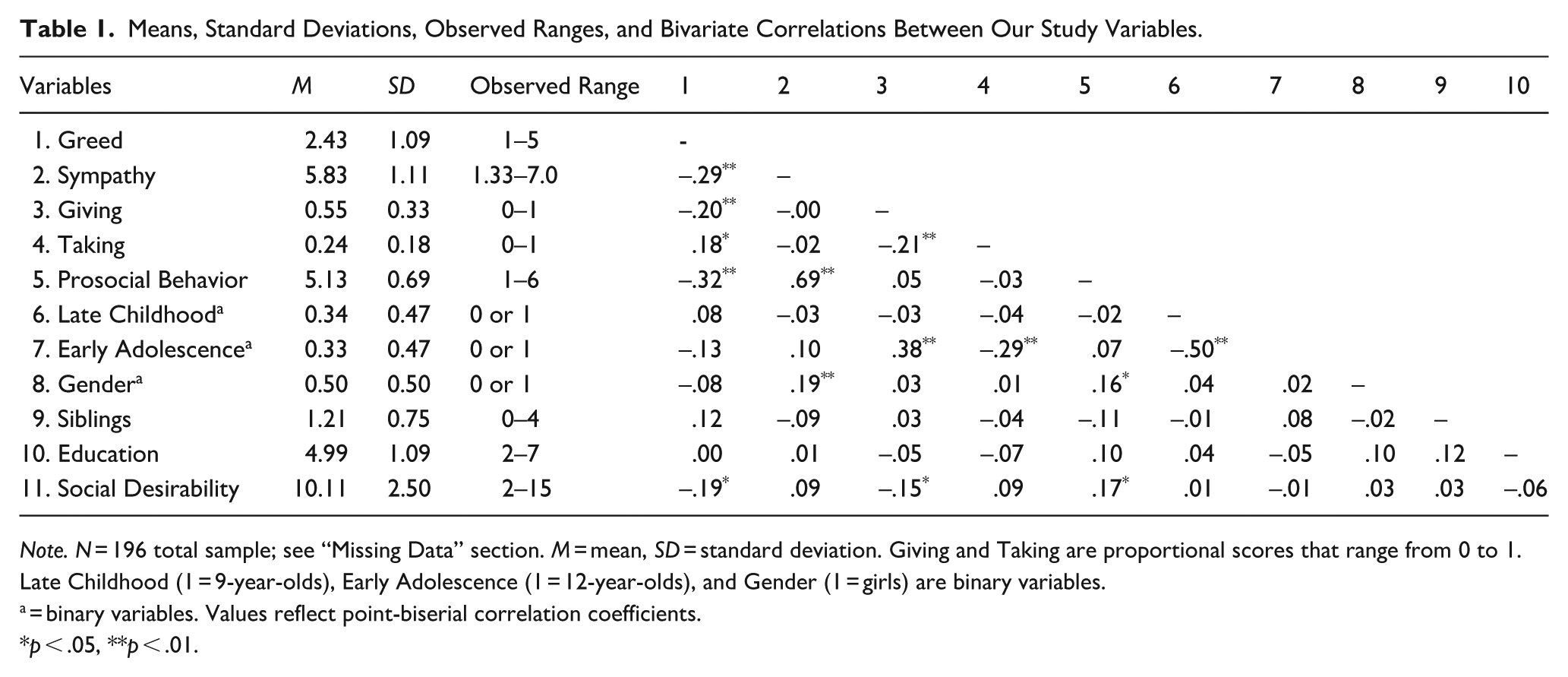
Note. N = 196 total sample; see “Missing Data” section. M = mean, SD = standard deviation. Giving and Taking are proportional scores that range from 0 to 1. Late Childhood (1 = 9-year-olds), Early Adolescence (1 = 12-year-olds), and Gender (1 = girls) are binary variables.
= binary variables. Values reflect point-biserial correlation coefficients.
p < .05, **p < .01.
The multivariate analysis of variance (MANOVA) testing age-group differences in sympathy, giving, taking, and general prosocial behaviors showed a main effect of age group on our study variables, Wilks’ Λ = 0.72, F(2,181) = 7.86, p < .001, partial η2= 0.14. Age group differences were found for giving, F(2,181) = 19.85, p < .001, partial η2 = 0.18, and taking F(2,181) = 14.21, p < .001, partial η2 = 0.14, behaviors (see Figure 1). The Bonferroni post hoc tests revealed that, for giving behavior, 12-year-olds gave approximately 20% more than 9-year-olds (p = .001) and 34% more than 6-year-olds (p < .001), and 9-year-olds gave 14% more than 6-year-olds (p = .026). For taking behavior, 9- (p = .007) and 12-year-olds (p < .001) took 9% and 16% fewer items than 6-year-olds, respectively. No differences in taking were found between 9- and 12-year-olds. No significant age group differences were observed for children’s sympathy nor general prosocial behavior.
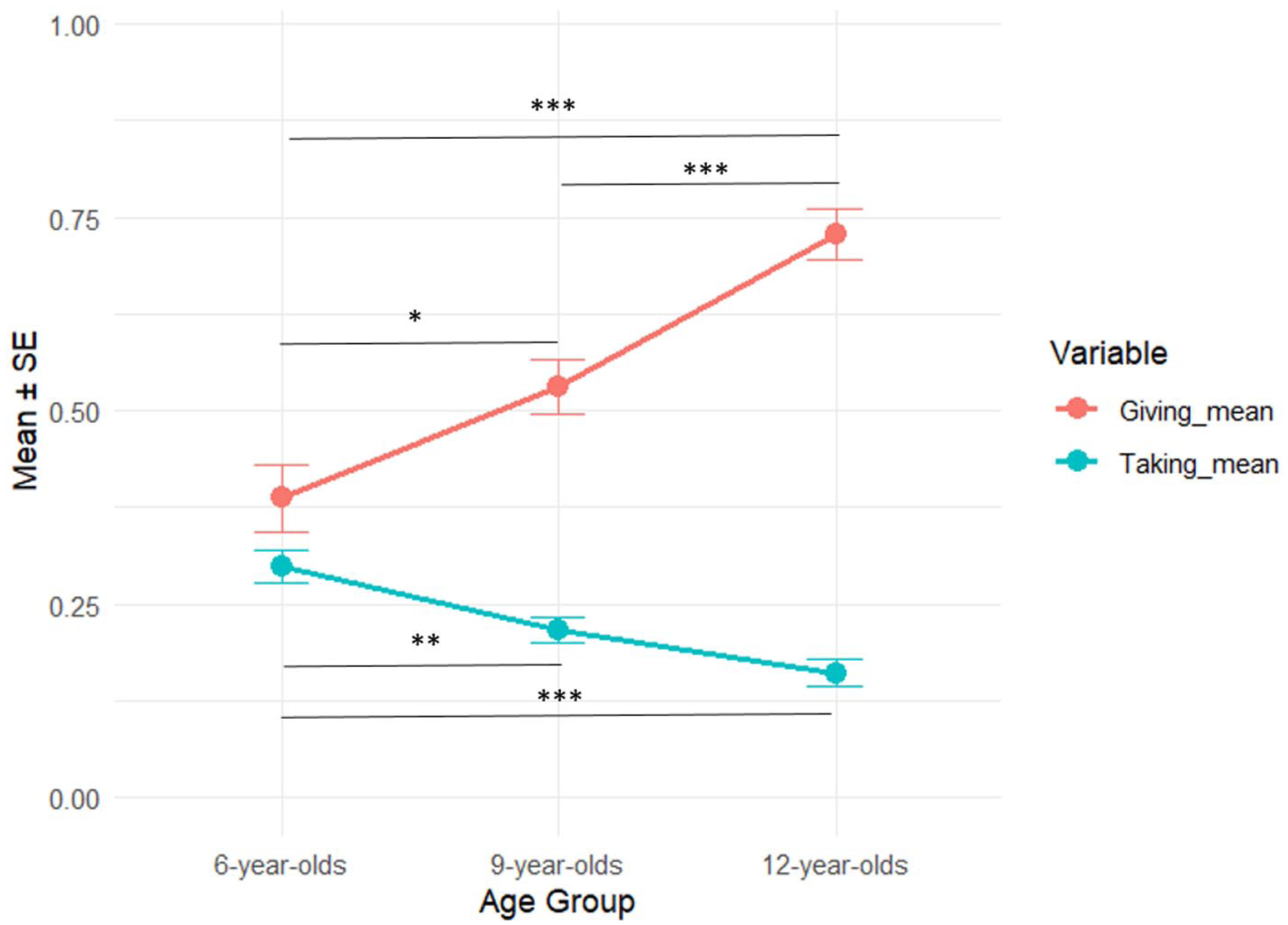
Means and Standard Errors of Giving and Taking Across Age Groups.
Age-Related Differences in Greed
Age-group differences in greed are plotted in Figure 2. Our one-way ANOVA did not show significant differences in children’s greed across age groups, F(2,187) = 1.63, p = .20, partial η2 = 0.02, although 6- and 9-year-olds’ mean levels of greed were descriptively higher (M6-year-olds = 2.51, SD = 1.17; M9-year-olds = 2.55, SD = 1.03) than 12-year-olds’ greed (M12-year-olds = 2.23, SD = 1.05).
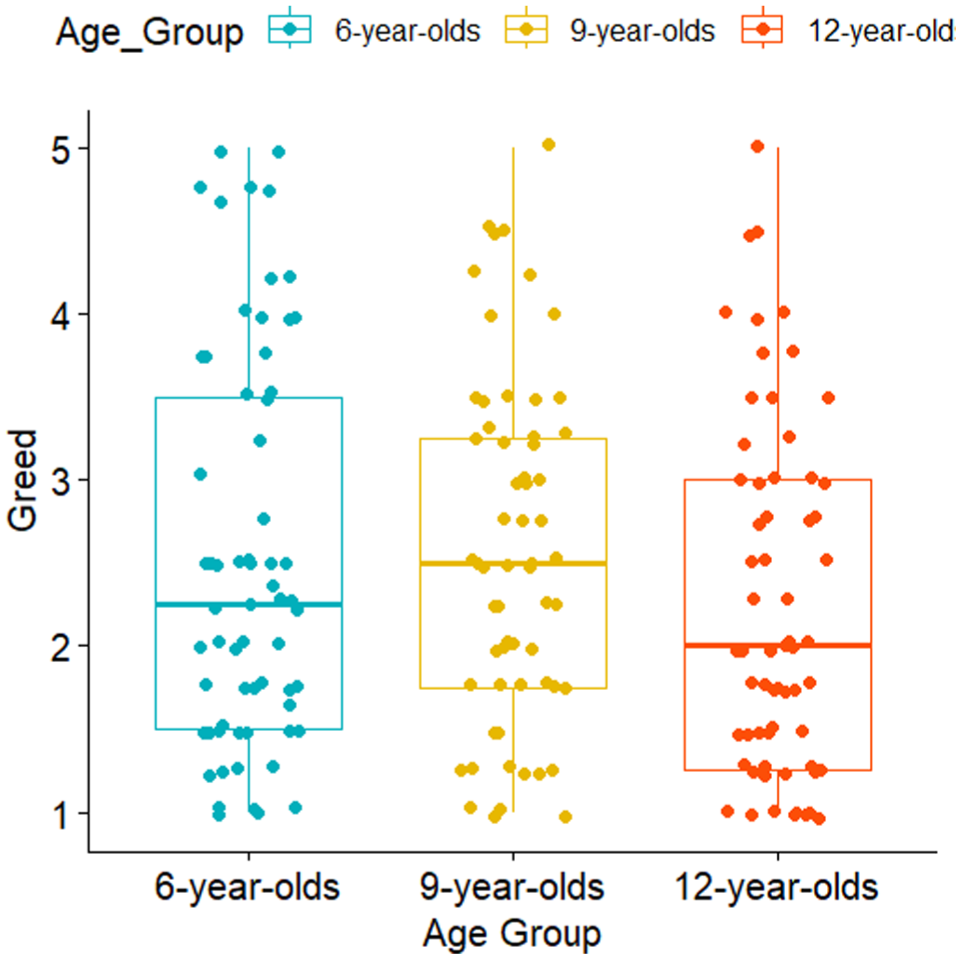
Box Plot of Children’s Average Levels of Greed Across Age Groups.
Correlations Between Greed and Sympathy by Age Group
We conducted bivariate correlations between greed and sympathy across our three age groups. We found that greed and sympathy were significantly (though weakly) negatively correlated in 6-year-olds (r = −.25, p = .049) and 9-year-olds (r = −.26, p = .045). The association was strongest among the 12-year-olds, r = −.36, p = .003, suggesting that greed and sympathy were most coordinated in early adolescence. However, a test of correlation comparisons did not reveal significant differences between the size of correlations across age groups (Fisher’s z range = 0.06–0.67, ps = .50–.95).
Greed and Sympathy Predicting Resource Distribution (Model 1)
Measurement Model
First, a confirmatory factor analysis (CFA) was conducted to assess the unidimensionality of the measurement items. Each latent construct was measured by at least three indicators (item-based approach). We initially ran our model including all four greed items; however, Item 3 (“my child is kind of greedy”) had the weakest factor loading and, within Model 2, strongly cross-loaded with our prosocial behavior latent variable. This item also had the lowest mean of the other items and the highest missing rate, suggesting that parents treated this item differently than the others. Thus, we removed Item 3 within both models to improve fit, resulting in a latent greed variable composed of three manifest variables (Items 1, 2, and 4). The model demonstrated good fit to the data: χ2(8) = 11.59, p = .171, comparative fit index (CFI) = 0.99, Tucker–Lewis index (TLI) = 0.99, root mean square error of approximation (RMSEA) = 0.048, 90% confidence interval (CI) = [.00, .105], and standardized root mean squared residual (SRMR) = 0.032. All factor loadings were statistically significant (ps < .001) and exceeded 0.70, indicating convergent validity.
Structural Model
The hypothesized structural model examined associations between greed, sympathy, and observed behavioral measures of children’s resource distribution (with social desirability, gender, caregiver education, and age group as covariates). The model demonstrated good fit to the data: χ2(53) = 69.11, p = .068, CFI = .97, TLI = .96, RMSEA = .039, 90% CI = [.00, .063], and SRMR = 0.046. Regarding our direct effects, we found that greed negatively predicted both giving behavior and sympathy and positively predicted taking behavior. However, sympathy did not significantly predict giving nor taking; thus, the indirect effects of sympathy in the relation between greed and giving (95% CI = [−0.013, 0.087]) and greed and taking (95% CI = [−0.06, 0.026]) were no different than zero. Figure 3 presents Model 1.
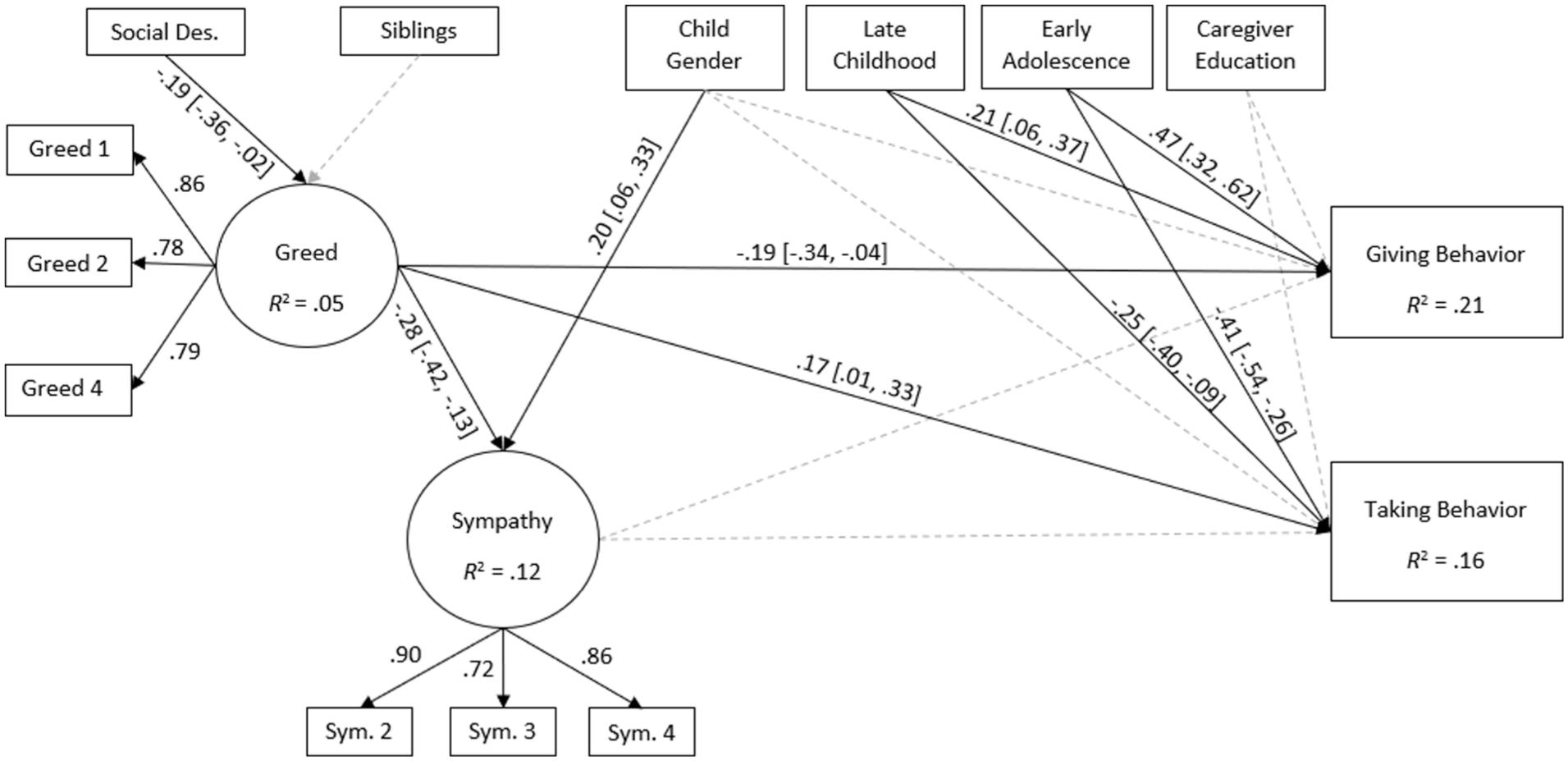
Greed and Sympathy Predicting Children’s Resource Distribution.
Exploratory multigroup models were conducted to examine possible age-related patterns in associations between greed, sympathy, and giving and taking. We reduced covariates to simplify our model given our small age group samples and only maintained gender and education. Findings are displayed in the Supplementary Material (Table S1). Greed was negatively associated with sympathy across age groups (while not significantly in 9-year-olds, the strength of the association was the same as in 6-year-olds). Sympathy was not significantly associated with giving nor taking. Greed was positively associated with taking in 6-year-olds and giving in 12-year-olds. Additional research is needed to replicate these associations with larger samples.
Greed and Sympathy Predicting General Prosocial Behavior (Model 2)
Measurement Model
Model 2 was the same as Model 1 except our dependent variable was general prosocial behavior. We conducted a CFA including greed, sympathy, and general prosocial behavior as latent variables, using subset-item-parceling to create the prosocial behavior variable and improve model fit (Matsunaga, 2008). We paired items that were conceptually similar, pairing Item 1 with Item 2, as these items reflect an orientation toward others’ needs, and Item 3 with Item 5, as these are helping-related items. The model demonstrated adequate fit except for a slightly higher than typically acceptable RMSEA: χ2(71) = 113.42, p = .001, CFI = .96, TLI = .95, RMSEA = .084, 90% CI = [.06, .11], and SRMR = .044. Although correlating certain residuals could have improved fit, we did not do so due to a lack of conceptual justification. All factor loadings were statistically significant (ps < .001) and exceeded 0.70, indicating convergent validity.
Structural Model
The hypothesized structural model examined associations between greed, sympathy, and prosocial behavior (with social desirability, gender, education, and age group as covariates). The model demonstrated adequate fit to the data: χ2(71) = 113.42, p = .001, CFI = .95, TLI = .94, RMSEA = .055, 90% CI = [.04, .07], and SRMR = .049. Findings showed that sympathy fully mediated the association between greed and prosocial behavior (indirect effect = −0.21, 95% CI = [–0.32, −0.10]). The direct effect of greed on prosocial behavior was non-significant (c’ path; β = −0.11, 95% CI = [–.26, .02]). Figure 4 presents Model 2.
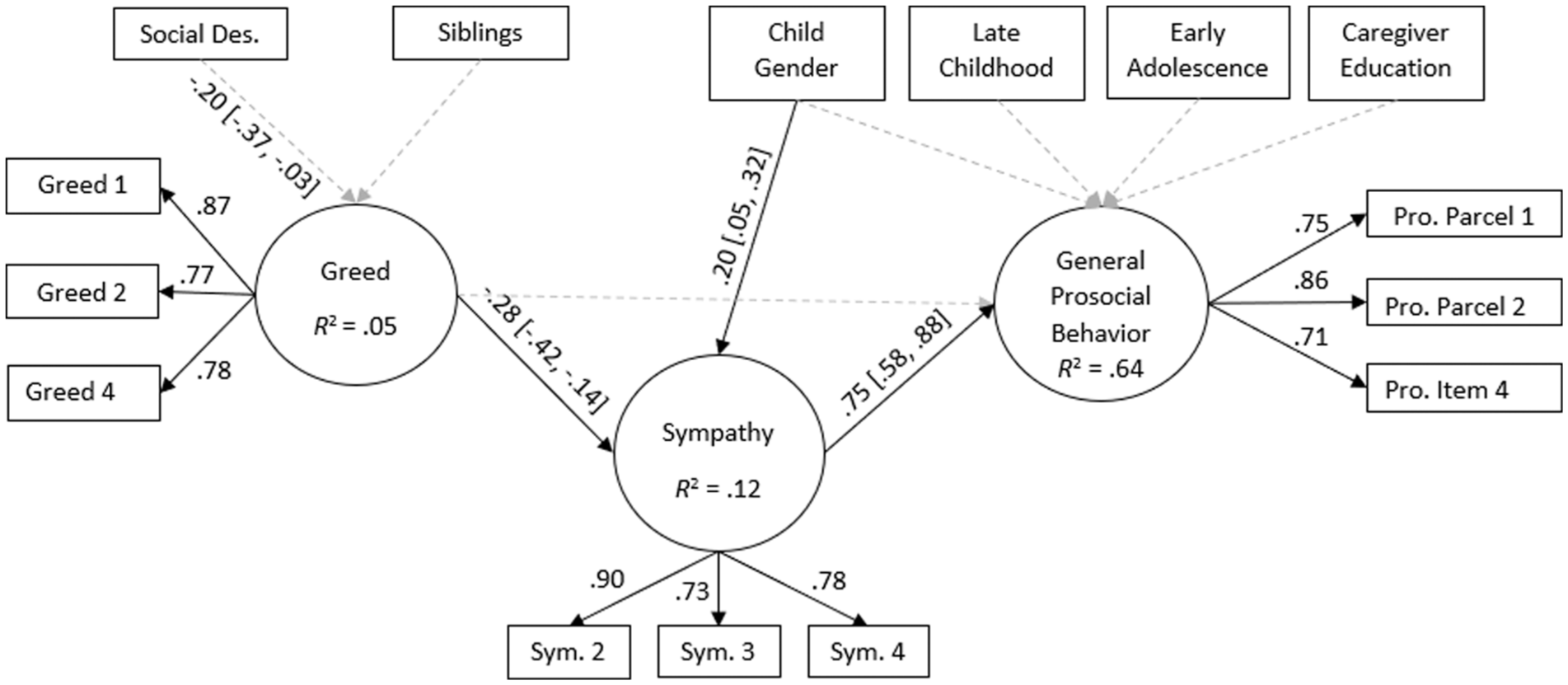
Greed and Sympathy Predicting Children’s General Prosocial Behavior.
Our second exploratory multigroup model was conducted to identify possible patterns in associations between greed, sympathy, and general prosocial behavior across age groups. As with our previous multigroup model, we reduced covariates, maintaining only gender and education. Findings are displayed in the Supplementary Material (Table S2). Greed was negatively associated with sympathy across age groups. Sympathy’s association with prosocial behavior appeared to strengthen with increasing age. Greed was only negatively associated with prosocial behavior in 6-year-olds. Findings should be interpreted with caution and need to be replicated with larger samples.
Discussion
This study is one of the first to provide insight into the development of greed and its associations with different types of prosocial behavior across the childhood years. We found that children’s greed, as rated by their parents, remained relatively low across 6-, 9-, and 12-year-olds and showed that the strength of negative association between greed and sympathy was similar across age groups. Our findings provided support for greed’s role in children’s prosocial development, both for how they distribute resources (i.e., giving and taking behaviors) and in their general acts of kindness. Sympathy was a significant mediator in the link between greed and general prosocial behavior (but not resource distribution), indicating that higher greed weakens children’s prosocial tendencies overall, primarily by diminishing their capacity for concern for others. Our research highlights the importance of considering both self- and other-oriented motivations in understanding children’s prosocial trajectories.
Greed was relatively low across 6-, 9-, and 12-year-olds in our sample, and we did not find significant mean-level differences in greed across age groups. This may be because children’s ability to exercise greed develops early and becomes entrenched as a social motive (Klein, 1975). Indeed, children begin to learn about ownership of resources around 2 years of age and use ownership information to guide their social behavior (Neary & Friedman, 2014). Zhen and Yu (2023) demonstrated stability in children’s (ages 7–11 years) greed-like behaviors within the prisoner’s dilemma game, such that children across ages comparibly increased their own payoff at the expense of a partner. Corroborating this work, our findings suggest that children from middle childhood to early adolescence use greed (though sparingly) as a social tool to a similar magnitude.
Associations between greed and sympathy were negative and moderate in size across age groups, with 12-year-olds showing the largest negative correlation (although comparison tests did not reveal significant differences across age groups). This finding shows that sympathy and greed become opposing forces as early as 6 years of age, likely because self- and other-oriented concerns are often pitted against each other in social interactions (e.g., sacrificing time with a toy when including a peer in play). It would be interesting to examine whether and how this association may change over the adolescent period. Adolescence is marked by important age-related improvements in socio-cognitive and moral capacities, such as better integration of multiple perspectives (Hollarek & Lee, 2022), and is a critical period for moral identity development (Krettenauer & Casey, 2015). At the same time, adolescents also tend to display heightened self-orientation, especially from early to mid-adolescence (ages 11–15), alongside self-preservative behaviors fueled by competition and social comparison (Crone, 2013). Additional research is needed to unpack possible non-linear trajectories of greed into and across the adolescent period and how they balance competing self- and other-oriented motives.
When examining links between children’s greed and their resource distribution (giving and taking behaviors), we found that children’s greed was negatively associated with their giving behavior and positively with their taking behavior. Sympathy, however, did not significantly mediate the link between greed and giving (contrary to expectations) nor taking, indicating that a lack of concern for others does not explain these relations. Within economic games, giving may heighten children’s awareness of what they have and trigger a sense of scarcity (self-focus; Brownell et al., 2013). Taking may incite a desire for self-enrichment, which may begin the chain of resource accumulation and maintenance. Our findings corroborate neuropsychological researcher showing that individuals high in greed tend to be less sensitive to positive and negative feedback from the environment (Mussel & Hewig, 2019). As such, when in a situation that involves resource distribution, children high in greed may simply be less aware of their need to adjust their actions to others (thus not implicating sympathy in their decision-making). Our exploratory multigroup model showed preliminary evidence that greed was positively associated with taking behavior in 6-year-olds and negatively associated with giving behavior in 12-year-olds, highlighting potential unique periods in which greed relates to specific resource distribution behaviors. Taken together, both giving and taking seem to go hand in hand with concerns of maximizing personal gain and children may not experience self-other conflicts in these behaviors (Liu et al., 2019). Results may have been different if the recipients/benefaciaries of children’s decisions were present.
Our last notable finding was that sympathy explained the association between greed and children’s general prosocial behavior (though directionality could not be determined due to the study’s correlational nature). Bao and colleagues (2022) found a similar effect of sympathy on greed and prosocial behavior among adolescents and adults, suggesting that, based on our findings, these associations already coordinate in the childhood years and continue to shape individuals’ behavioral trajectories as they grow. Children likely learn early on that sociomoral decisions often require consideration of self- and other-oriented concerns. Wang and Murnighan (2011) argue that when individuals confront a moral decision (e.g., to help), they experience conflicting self- (“hot” and quick) and other-oriented (“warm” and slow) considerations. This conceptualization holds the assumption that self-orientation is primary and automatic; however, both self- and other-orientations develop in tandem over time, and the emphasis of one over the other within socialization practices likely has cascading effects. For example, focusing attention on self-serving cues and competition may result in missed opportunities to practice prosocial acts and reinforce greed-related responses (Blandon & Scrimgeour, 2015; Dys et al., 2022). Our exploratory multigroup test showed some preliminary evidence that greed may be specifically related to prosocial behavior in 6-year-olds, suggesting that early environments that prioritize mutuality and cooperation may be important for tempering greed development and promoting prosociality.
Implications
Addressing greed in interventions aimed at fostering positive development may be crucial, particularly in the childhood years. Greed can drive cycles of selfishness and self-preservation, putting children at risk of peer rejection and mental health challenges (Mulvey et al., 2017). Many early peer conflicts involve property disputes (Blake & Harris, 2009), and children’s greedy behaviors can influence how their peers engage with them, potentially escalating hostility over time (Vogelsang & Tomasello, 2016). Thus, targeted interventions in early childhood (ages 6 or earlier) that allow children to practice both giving, equitable taking, and receiving as a beneficiary may be important for shaping their understanding of the emotional benefits of these behaviors (e.g., moral pride; Peplak et al., 2023).
As we have shown, greed also tends to oppose sympathy, whereby lapses in sympathy explain children’s dampened prosocial behavior. Zeelenberg and colleagues (2024) have recently argued that greed may inhibit individuals’ capacity to take others’ interest into account—not from a place of wanting to harm them but from a strong desire for excess. Self-preoccupation has social and moral down-stream effects, such that when children are high in greed, they may miss chances to practice attending to others, resulting in lower sympathy and expressions of care. Caregivers may inhibit children’s greed development by helping them notice how their actions affect peers (e.g., that selfish behaviors incite negative emotions in others), as well as practicing shifting perspectives (self, other, and the collective) toward longer-term cooperative goals (Sjåstad, 2019). Parents’ own mindfulness in these moments may also support these practices (van den Heuvel et al., 2023). Overall, identifying and addressing greed in children, particularly in early childhood, could be important for preventing negative long-term outcomes.
Limitations and Future Directions
This study has some limitations that may inform future research on children’s greed. First, developmental trajectories of greed could not be examined due to this study’s cross-sectional nature, which also limited our ability to test causality. Longitudinal research is warranted to unpack within-person changes in greed across the childhood years and elucidate directional associations between greed and sympathy. Second, we began our investigation in 6-year-olds and thus could not study the emergence of greed. Third, we measured greed within parent-reports, which provides only one perspective. Future research would benefit from multi-informant and mixed-method approaches. Fourth, although we used common attractive items within our giving and taking tasks, children’s preference for and valuation of these items may have decreased with age, which could have explained, in part, age-related shifts in these behaviors. We also did not counterbalance the order of the giving and taking tasks; thus, spillover effects from prior tasks could have affected children’s performance in the taking task (which was always presented at the end of the session). Finally, due to the relatively high levels of ethnic/racial and low levels of socioeconomic diversity within our sample of children, we could not meaningfully examine how various cultural and religious backgrounds related to children’s greed nor make claims about the generalizability of greed development across socioeconomic spheres.
Conclusion
While economists argue that greed promotes productivity and economic flourishing, greed is condemned and considered a core vice in many societies (Wang & Murnighan, 2011). Within modern capitalist cultures, greed is likely a major force of social inequality and divide—a global issue that requires intervention from multiple angles. Although much is to be learned about greed across the lifespan, this study provides one of the first glimpses into how greed is experienced in childhood and its moral-emotional and behavioral correlates. This work emphasizes the need for adults to recognize both selfish and other-oriented tendencies in children and the ways in which cooperative and competitive environments may shape these tendencies over time.
Supplemental Material
sj-docx-1-jbd-10.1177_01650254261423839 – Supplemental material for Social costs of selfishness: Greed relates to diminished sympathy and prosocial behavior in children
Supplemental material, sj-docx-1-jbd-10.1177_01650254261423839 for Social costs of selfishness: Greed relates to diminished sympathy and prosocial behavior in children by Joanna Peplak, Keng-hie Song, Sebastian P. Dys and Tina Malti in International Journal of Behavioral Development
Footnotes
Acknowledgements
We would like to thank the children and caregivers who participated in this research and the research assistants at the Centre for Child Development, Mental Health, and Policy who helped collect the data.

Ethical Considerations
This study was approved by the University of Toronto’s Research Ethics Board (protocol #35578).
Consent to Participate
All participants (parents and children) provided informed consent (children provided verbal assent) prior to study commencement.
Funding
The authors disclosed receipt of the following financial support for the research, authorship, and/or publication of this article: This work was supported by SSHRC (J.P., Canadian Graduate Research Scholarship #752-2016-1155; T.M., Grant #504464).
Declaration of Conflicting Interests
The authors declared no potential conflicts of interest with respect to the research, authorship, and/or publication of this article.
Data Availability Statement
Supplemental Material
Supplemental material for this article is available online.
References
Supplementary Material
Please find the following supplemental material available below.
For Open Access articles published under a Creative Commons License, all supplemental material carries the same license as the article it is associated with.
For non-Open Access articles published, all supplemental material carries a non-exclusive license, and permission requests for re-use of supplemental material or any part of supplemental material shall be sent directly to the copyright owner as specified in the copyright notice associated with the article.
