



Abstract
This longitudinal study examined how parent–child closeness, teacher–child closeness and language skills predicted and were predicted by emotion understanding in early years. Participants were 128 Hong-Kong-Chinese toddlers (74 girls; Mage = 33.03 months). Parents and teachers reported their closeness with each child, and children’s oral language and emotion understanding were tested at two timepoints 6 months apart. Hierarchical regression analyses revealed that the unique contribution of children’s language skills to their emotion understanding increased over time whereas that of parent–child and teacher–child closeness decreased, and language skills consistently had a greater influence on emotion understanding than relationship closeness did. Cross-lagged modelling analyses showed a unidirectional link from earlier parent–child closeness predicting later emotion understanding, a unidirectional link from earlier emotion understanding predicting later teacher–child closeness and a bidirectional relation between oral language and emotion understanding. This study connects children’s emotion understanding with their own characteristics and their social relationships in the family and classroom settings, providing a fuller picture of early emotional development across multiple contexts.
Keywords
Introduction
Emotion understanding (EU) refers to the ability to identify, label, predict and interpret emotional expressions and reactions in oneself and others (Denham, 1986; Saarni, 1999). EU plays a critical role in children’s social and academic development (Reschke et al., 2017; Voltmer & von Salisch, 2017). Pons et al. (2004) proposed a developmental framework comprising nine components of EU that typically emerge between the ages of 3 and 11. By age 3, children generally acquire two foundational components: recognition of facial expressions of basic emotions (e.g., happiness, sadness, anger, fear), and understanding of situational causes of emotions (e.g., anticipating another person’s happiness upon receiving a gift). As children grow older, their EU shifts from a reliance on external cues to an understanding of internal states, including desire, belief, reminder, regulation, hiding, mixed emotion and morality.
Although empirical research has focused on preschool-aged children (3 years and older), intervention (Giménez-Dasí et al., 2015; Grazzani et al., 2016) and experimental (Widen & Russell, 2003, 2010) studies suggest that children begin to acquire explicit emotion knowledge as early as 24 months, with notable improvements in labelling basic emotions between ages 2 and 3. The development of EU during early childhood is foundational for more complex emotional competencies (Pons et al., 2004). This study focuses on the early components of EU – emotion recognition and emotion situation knowledge – among toddlers aged 2–3 years and investigates the factors that support their development during this pivotal transitional period.
This research is guided by the model of emotion socialisation (Eisenberg, Amanda, & Spinrad, 1998; Eisenberg, Spinrad, & Cumberland, 1998), which explains how children develop understanding, experience, expression and regulation of emotions. In this study, we focus specifically on emotion understanding (EU). Within this framework, EU is shaped by child characteristics (e.g., temperament and language ability; Harris et al., 2005), parent characteristics (e.g., parenting style and responses to the child’s emotion) and broader environmental factors such as culture. Later refinements to the model (Eisenberg, Spinrad, & Cumberland (1998) incorporated scholarly commentaries that emphasised two key additions: (1) the importance of early relational constructs, particularly early attachment status and parent–child relationships (Thompson, 1998), and (2) the model’s transactional nature, wherein children’s emotionality both influences and is influenced by their own traits, parental behaviours and environmental contexts.
In early childhood, children primarily interact with parents at home and teachers in early childhood settings. However, prior research has typically examined emotion development within either the family or (pre)school context, rather than considering both simultaneously. This study addresses that gap by exploring how the quality of relationships with both parents and teachers, along with children’s language ability, may influence and be influenced by EU in toddlers aged 2–3 years over a 6-month period. This bidirectional perspective aligns with the transactional model of development (Sameroff, 2009; Sameroff & Mackenzie, 2003), which posits that developmental outcomes arise from dynamic interactions between the individual and their environment.
This study offers three key contributions. First, it integrates both interpersonal factors (e.g., parent–child and teacher–child relationships) and intrapersonal factors (e.g., early language skills) within a single model, providing a more nuanced understanding of EU development across multiple ecological contexts. Second, it examines bidirectional associations between children’s EU and these factors across two timepoints, addressing limitations of prior cross-sectional studies that could not establish directionality of effects. Third, it contributes novel insights into how very young children’s emerging EU abilities may both shape and be shaped by their relationships with key caregivers across home and early childhood environments.
Parent–Child Relationship Quality
Children’s earliest emotion experiences typically occur within the family context, making the quality of the parent–child relationship a critical factor in emotional development. Driscoll and Pianta (2011) conceptualised parent–child relationship quality along two dimensions: closeness, characterised by warmth, affection and open communication; and conflict, marked by opposition, disagreement or hostility.
Attachment theory offers a valuable framework for understanding parent–child relationships (Waters & Cummings, 2000). According to this theory, early attachment patterns – formed through interactions with primary caregivers – shape children’s internal working models of themselves, others and relationships, thereby laying the foundation for future social functioning (Ainsworth, 1989; Bowlby, 1982). In secure attachments, caregivers serve as both a secure base for exploration and a safe haven for comfort during distress. These experiences foster a view of the caregiver as responsive and the self as worthy of love and support, encouraging children to seek and maintain close relationships (Bowlby, 1982; Waters & Cummings, 2000).
Cassidy (1994) reviewed the role of attachment in young children’s emotional competence, noting that securely attached children tend to express emotions openly due to flexible and supportive emotional communication with caregivers. In contrast, children with insecure attachments often suppress emotional expressions in response to caregivers’ persistent indifference or rejection (see also Sroufe, 1996). Consequently, securely attached children are more likely to engage in supportive emotional exchanges than insecurely attached children, which can foster emotional competence, including EU (Laible & Thompson, 1998). Parent–child relationship quality has been validated as a proxy for attachment status (Driscoll & Pianta, 2011), suggesting that children in higher-quality relationships with their parents are likely to exhibit more advanced EU.
Empirical studies have consistently documented positive associations between attachment security and preschoolers’ EU, both concurrently (Laible & Thompson, 1998; Ontai & Thompson, 2002; Psychogiou et al., 2018; Rosnay & Harris, 2002) and longitudinally (Raikes & Thompson, 2006; Steele et al., 1999). Securely attached children tend to outperform their insecurely attached peers in recognising, predicting and explaining emotions, as well as in taking others’ affective perspectives. However, relatively few studies have directly examined how the quality of the parent–child relationship influences EU in young children. For example, Dereli (2016) found that parent–child closeness was positively, and conflict negatively, associated with understanding of negative emotions in 4- to 5-year-olds. More recently, Laugen et al. (2024) conducted a large-scale longitudinal study (N = 924) examining how relationships with parents, teachers and peers uniquely predict changes in EU between ages 4 and 8. EU was assessed using all nine components of the Test of Emotion Comprehension (TEC; Pons et al., 2004) at ages 4, 6 and 8. Parent–child relationship quality, based on child interviews at ages 4 and 6, was characterised by warmth, enjoyment and responsiveness. Findings indicated that high-quality parent–child relationships at age 4 uniquely predicted increases in EU at age 6, even after controlling for verbal ability, though this effect did not extend from ages 6 to 8.
Conversely, children’s EU may also influence the quality of their relationships with parents. Children with more advanced EU are better able to recognise and interpret emotional cues, respond appropriately and express their own emotions effectively. These skills may foster more positive interactions and secure relationships with caregivers. Drawing on the emotion socialisation model (Eisenberg, Spinrad, & Cumberland, 1998) and the transactional model of development (Sameroff, 2009), it is plausible that bidirectional relations exist between children’s EU and the quality of their parent–child relationships. Despite strong theoretical support, empirical research testing this bidirectionality remains limited, with most studies focusing on reciprocal influences between mothers and children in emotion regulation (e.g., Morelen & Suveg, 2012).
Teacher–Child Relationship Quality
Upon entering kindergarten, children spend substantial time interacting with teachers, who become primary caregivers outside the family context. As such, understanding children’s emotional development in early childhood is incomplete without considering their relationships with teachers–significant adults in their lives (Pianta, 1992; Verschueren & Koomen, 2012). Pianta (1992) conceptualised teacher–child relationships through the lens of attachment theory, viewing teachers as attachment figures within the classroom. Like parents, teachers can serve as a secure base for exploration and a safe haven during distress (Verschueren & Koomen, 2012; Zhong et al., 2025).
Teacher–child closeness and conflict have been considered as analogous to secure and insecure attachment relationships, respectively. Closeness is characterised by warmth, positive emotions and comfort-seeking behaviours, while conflict involves negative affect, friction and avoidance (Verschueren & Koomen, 2012). In close relationships, teachers and children are more likely to engage in co-constructive dialogues about emotional experiences, which may foster children’s EU (Spilt et al., 2021).
Empirical evidence supports the role of teacher–child relationships in promoting EU. Garner and Waajid (2008) found that teacher–child closeness was positively associated with emotion situation knowledge in 3- to 5-year-olds. Similarly, Torres et al. (2015) reported that teacher–child closeness at the start of kindergarten predicted gains in emotion recognition and emotion situation knowledge by the end of kindergarten. However, these studies primarily examined EU as a mediator linking teacher–child relationships to academic outcomes such as language and literacy abilities. A more recent longitudinal study by Laugen et al. (2024) specifically targeted EU as the outcome. Using the nine components of the Test of Emotion Comprehension (TEC; Pons et al., 2004), they found that teacher–child closeness at ages 4 and 6 predicted increases in EU at ages 6 and 8, respectively – effects that remained significant even after accounting for relationships with parents and peers.
Several studies have also explored how children’s EU may influence the quality of their relationships with teachers. Garner and Mahatmya (2015) and Garner et al. (2021) consistently found that higher levels of emotion situation knowledge were associated with greater teacher–child closeness in racially diverse samples of 4-year-olds. Notably, most prior research has examined unidirectional effects – either from teacher–child relationships to EU or vice versa – leaving potential bidirectional links understudied. Wu et al. (2018), using cross-lagged models, revealed reciprocal associations between teacher–child relationships and children’s empathy across three timepoints from ages 5 to 6. Hernández et al. (2018) found bidirectional links between children’s expression of negative emotions and teacher–child conflict over the same age range. These findings provide a strong rationale for examining the directionality of effects between teacher–child closeness and very young children’s emerging EU.
Early Language Skills
Language and emotion understanding (EU) are closely intertwined and may exert mutual influence (Cole et al., 2010). In social interactions, children rely on both receptive and expressive language abilities to identify, express and communicate their emotions, as well as to interpret the emotional states of themselves and others (Beck et al., 2012; Cole et al., 2010). By the age of 2–3 years, children begin to use verbal labels for basic emotions (Ruba & Pollak, 2020). Evidence suggests that children with language deficits may be particularly vulnerable to difficulties in EU, as limited language skills can hinder social engagement and reduce opportunities to learn about others’ emotions (Martin et al., 2015; Rieffe & Wiefferink, 2017). Conversely, EU may also support language development. Early language acquisition is thought to be driven, in part, by children’s desire to share their own emotional experiences (Bloom, 1998). Children who better understand their own and others’ emotions may be more motivated to engage in social interactions, which in turn require and reinforce the use of language (Curby et al., 2015).
A substantial body of cross-sectional and longitudinal research has demonstrated positive associations between language skills and EU in children from age 3 onwards. These associations have been observed in both directions: from language to EU (Beck et al., 2012; Bosacki & Moore, 2004; Cutting & Dunn, 1999; De Stasio et al., 2014; Ensor et al., 2011; Kårstad et al., 2015; Pons et al., 2003; von Salisch et al., 2013) and from EU to language (Curby et al., 2015; Grazzani et al., 2018; Ornaghi et al., 2016; Sarmento-Henrique et al., 2020; Tang et al., 2021). These studies have examined various aspects of both constructs, including receptive and expressive language, facial emotion recognition, emotion situation knowledge and understanding of complex emotions. For instance, Kårstad et al. (2015) found that receptive language at age 4 predicted growth in EU, as measured by the nine components of the Test of Emotion Comprehension (TEC), from ages 4 to 6. Sarmento-Henrique et al. (2020) reported that EU at age 3, assessed using four components of the TEC, predicted language skills at age 5.
Despite robust evidence for unidirectional associations, few studies have examined bidirectional relationships between language and EU. Strand et al. (2016), using cross-lagged models, found reciprocal influences between receptive language and EU in children aged 4 to 6, but not in those aged 3 to 4. Similarly, Rojas and Abenavoli (2021) observed bidirectional associations between expressive vocabulary and EU in 4-year-olds over the preschool year. Children with stronger vocabulary at the beginning of the year showed greater gains in EU by the end of the year, while those with better initial EU also exhibited stronger vocabulary growth. Notably, Slot et al. (2020) found bidirectional relationships between early language skills and socioemotional abilities – including emotion expression and regulation – in infants and toddlers under age 3. These findings underscore the importance of further investigating whether reciprocal associations between language and EU are already present in children as young as 2–3 years.
The Current Study
In summary, several gaps remain in our understanding of young children’s development of emotion understanding (EU). First, prior research has predominantly examined either interpersonal factors (e.g., parent–child or teacher–child relationships) or intrapersonal factors (e.g., language skills) in isolation. As a result, a comprehensive picture of EU development – one that integrates children’s individual characteristics with quality of their relationships across multiple ecological contexts – is still lacking. Second, most existing studies have focused on unidirectional pathways, either from these factors to EU or vice versa, leaving the potential for bidirectional associations underexplored. Third, much of the research on EU has concentrated on children over the age of 3, with limited empirical attention given to toddlers. More studies involving children under age 3 are needed to deepen our understanding of how EU emerges and interacts with both intra- and interpersonal factors during the earliest years of life.
The present study addresses these knowledge gaps by examining cross-lagged relationships among parent–child closeness, teacher–child closeness, early language skills and EU in 2- to 3-year-old children attending early childhood group settings across two timepoints. Guided by theoretical frameworks (Eisenberg, Amanda, & Spinrad, 1998; Eisenberg, Spinrad, & Cumberland, 1998; Sameroff, 2009) and informed by prior empirical findings (e.g., Laugen et al., 2024; Rojas & Abenavoli, 2021), we proposed four hypotheses: (1) parent–child closeness at Time 1 would positively predict children’s EU at Time 2; (2) teacher–child closeness at Time 1 would positively predict children’s EU at Time 2; (3) children’s language skills at Time 1 would positively predict their EU at Time 2; and (4) children’s EU at Time 1 would positively predict their language skills, their closeness with parents and teachers at Time 2.
Methodology
Participants
The sample consisted of 128 Hong Kong Chinese children aged between 2 and 3 years (54 boys and 74 girls; Mage = 33.03 months, SD = 3.55 months), recruited from local kindergartens. All children were raised in Cantonese-speaking families and had attended a pre-nursery programme at a local kindergarten for at least 6 months prior to participation in this study. Primary caregivers were invited to complete a background questionnaire and report on the quality of their relationship with the child. Most caregivers (75.00%) reported monthly household incomes ranging from HK$10,000 to HK$60,000. According to the Census and Statistics Department of the Hong Kong SAR Government (2025), the median monthly household income in Hong Kong was HK$30,000, indicating that the sample represented an average socioeconomic background. In addition to caregiver reports, the children’s lead teachers from their pre-nursery classes participated by reporting on their relationship quality with each of the child. No participants dropped out of the study between Time 1 and Time 2. In other words, all participants who joined the study at Time 1 provided at least some data at Time 2. Although there was no person-level attrition, item-level missingness was observed. Details on how missing data were handled are provided in the data analysis section below.
An a priori power analysis was conducted using the semPower.aPriori function from the semPower package in R (Moshagen & Bader, 2024). In structural equation modelling (SEM), two types of power analysis are commonly distinguished: global fit testing (i.e., assessing whether the overall model fits the data well) and local path testing (i.e., evaluating whether specific model parameters are detectable within the model; Jobst et al., 2023; Moshagen & Bader, 2024). Given our focus on detecting each hypothesised effect within the context of our conceptual model (Figure 1), we adopted the local approach to determine the sample size. Following the procedure outlined by Jobst et al. (2023), we first specified a population model based on our full conceptual model. We then defined a series of nested models by omitting one regression path at a time – each representing a hypothesis of interest. Comparing each nested model to the full model allowed us to determine the sample size required to detect a significant drop in model fit, using an alpha level of 0.05 and power of 0.80. In specifying the population model, autoregressive paths were fixed at .40 and cross-lagged paths at .20, reflecting medium and small associations, respectively, based on Cohen’s (1988) guidelines. The analysis indicated that a sample size of 196 participants was required to detect each of the six hypothesised effects. Given that our study included only 128 participants, the statistical power may have been insufficient to detect modest effects – a limitation we revisit in the Discussion section.
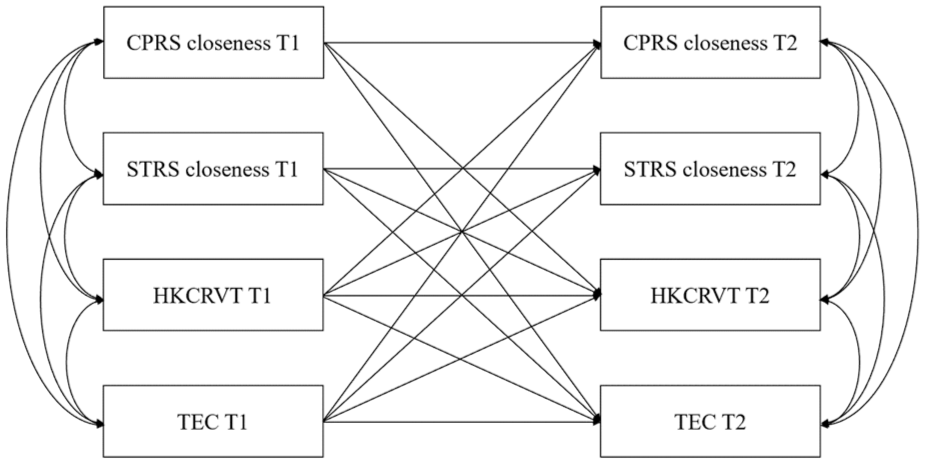
The Conceptual Cross-Lagged Model among Parent–Child Closeness, Teacher–Child Closeness, Child Early Language and Child Emotion Understanding.
Procedures
The study protocol, consent form and research materials were reviewed and approved by the Human Research Ethics Committee of The Education University of Hong Kong (Ref. no.: 2020-2021-0058). All parents and teachers gave written informed consent before any research procedures commenced. Child testing, and parent and teacher questionnaires were administered at two timepoints 6 months apart. Note that the procedures for Times 1 and 2 were identical. At both timepoints, trained research assistants visited the kindergartens and administered two tests with the children: the Test of Emotion Comprehension (Pons & Harris, 2000) and the Hong Kong Cantonese Receptive Vocabulary Test (Lee et al., 1996). The testing was conducted in a quiet room in the kindergartens and took 20–30 min. Short breaks were given when necessary. The children received a sticker as a reward for completing the tests. Moreover, the parents were invited to complete questionnaires regarding their demographic information and perceived relationship closeness with their child (Driscoll & Pianta, 2011). Lead teachers were also invited to complete a questionnaire on their perceived relationship closeness with each of the children (Pianta, 2001). Upon completing the questionnaires, the parents and teachers received a HK$100 gift voucher as compensation for their time.
Measures
Emotion Understanding
The Test of Emotion Comprehension (TEC; Pons & Harris, 2000) was used to measure emotion understanding in 2- to 3-year-old children. The TEC consists of nine components: recognition, external causes, desires, beliefs, reminders, regulations, appearance and reality, mixed and morality. For this study, two age-appropriate domains were selected: recognition (5 items) and external causes (5 items). Children were shown a picture book featuring a gender-matched protagonist displaying different emotions. In each item, children were asked to choose one out of four facial expressions (happy, sad, angry, scared, or alright) that matched the protagonist’s emotion in the scenario. Responses were scored dichotomously (0 = incorrect responses, 1 = correct responses), yielding a total score ranging from 0 to 10. To ensure that our toddler participants had the necessary vocabulary to engage meaningfully with the TEC subscales, a brief warm-up session was introduced prior to the test. This warm-up included four items (happy, sad, angry, scared) and assessed whether toddlers had the basic language ability to understand these basic emotion terms. Stimulus questions included prompts such as ‘Do you know what [basic emotion] is? Can you tell me how you know if someone is [basic emotion]?’. Performance on the warm-up was not scored; it served solely to confirm language comprehension and reduce confounding effects. All children completed the warm-up session. The TEC took approximately 5–10 min to administer. Internal consistency was evaluated using the theta coefficient, appropriate for dichotomous data (Zumbo et al., 2007). The theta coefficients of the TEC in this study were 0.74 and 0.75 at Times 1 and 2, respectively.
Oral Language Skills
The Hong Kong Cantonese Receptive Vocabulary Test (HKCRVT; Lee et al., 1996) was used to measure the receptive language skills of our 2- to 3-year-old children. The standardised test was developed for 2- to 6-year-old Cantonese-speaking children with local norms. The HKCRVT consists of 65 items; one point was given for each correct answer. In each item, children were asked to match a pronounced word to one of four pictures in the test plate. The four options included the target (e.g., 雞, chicken, /gai1/), a phonological distractor (e.g., 龜, turtle, /gwai1/), a semantic distractor (e.g., 鴨, duck, /aap3/) and an unrelated distractor (e.g., 糖, candy, /tong2/). The test required about 15–20 min to complete. The internal reliability coefficients (alpha) of the HKCRVT in this study were 0.81 and 0.82 at Times 1 and 2, respectively.
Parent–Child Closeness
The Chinese version of the Closeness subscale of the Child-Parent Relationship Scale (CPRS; Driscoll & Pianta, 2011) was used to measure parents’ perceived relationship closeness with their child. The Closeness subscale of CPRS consists of seven items; one sample item is ‘My child openly shares his/her feelings and experiences with me’. The parents rated each item on a 5-point Likert-type scale: 1 = definitely does not apply to 5 = definitely applies. A higher score indicates a closer and more intimate relationship between the parent and the child. The internal reliability coefficients (alpha) of CPRS in this study were 0.78 and 0.82 at Times 1 and 2, respectively.
Teacher–Child Closeness
The Chinese version of the Closeness subscale of the Student–Teacher Relationship Scale (STRS; Pianta, 2001) was used to measure teachers’ perception of closeness in their relationships with the child. This scale has been used with teachers of children aged 1–2 (Liu et al., 2020). The Closeness subscale of STRS consists of seven items; one sample is ‘My student openly shares his/her feelings and experiences with me’. The teachers rated each item on a 5-point Likert-type scale: 1 = definitely does not apply to 5 = definitely applies. A higher score indicates a closer and more intimate relationship between the teacher and the child. The internal reliability coefficients (alpha) of the STRS in this study were .82 and .87 at Times 1 and 2, respectively.
Data Analysis
To investigate the bidirectional relations among teacher–child closeness, parent–child closeness, child language skills and child emotion understanding (EU) across the two timepoints (see Figure 1 for the conceptual model), a series of cross-lagged models were tested using the lavaan package of R (Rosseel, 2012). Notice that the inclusion of the paths between child language, parent–child closeness and teacher–child closeness is supported by prior studies reporting positive associations between these variables (Burchinal et al., 2002; B. Y. Hu et al., 2021; Leiser et al., 2017; Liu et al., 2020; Pianta et al., 1997), although we did not put forward specific hypotheses concerning these paths. Four potential models were tested in our cross-lagged modelling analysis: (1) a stability model with only autoregressive paths that represent the relationship between variable X at Time 1 and Time 2 as well as the relationship between variable Y at Time 1 and Time 2; (2) a causality model with autoregressive paths and unidirectional paths from variable X at Time 1 to variable Y at Time 2; (3) a reciprocal model with autoregressive paths and unidirectional paths from variable Y at Time 1 to variable X at Time 2; (4) a full model with autoregressive paths and bidirectional paths between variable X and variable Y across Time 1 and Time 2. Cross-lagged models allow for examination of stability of each variable over time as well as crossed effects among variables over time. The nested models were then compared to find the best-fitting model.
First, we examined the variables for missing values. Table 1 shows that the rates of missing values ranged from 0% to 9.38%. Little’s MCAR test (Little, 1988) indicated that the data were missing completely at random, χ2(4935) = 3762.66, p = 1.00. To handle this, we performed multiple imputation using the mice package of R (van Buuren & Groothuis-Oudshoorn, 2011). This method provides unbiased estimates and retains information and statistical power, which outperforms listwise deletion and series mean replacement (Graham, 2009). Next, the variables were inspected for normality before modelling. The distributions of the variables were within the range of normality, with kurtosis and skewness values varying from −0.88 to 1.33. The teacher and child measurements were nested within 10 kindergartens (classrooms), and the classroom-level intraclass correlation coefficients (ICCs) ranged between 0.04 and 0.22. In light of this, the lavaan.survey package (Oberski, 2014) of R was used to correct for clustered-based standard errors. The lavaan.survey package allows structural equation modelling analysis of nested data by taking into account a complex sampling design. The analysis applied the maximum likelihood estimation (MLM) and provided estimates based on robust standard errors.
Descriptive Statistics and Pearson Correlations Among All Variables.
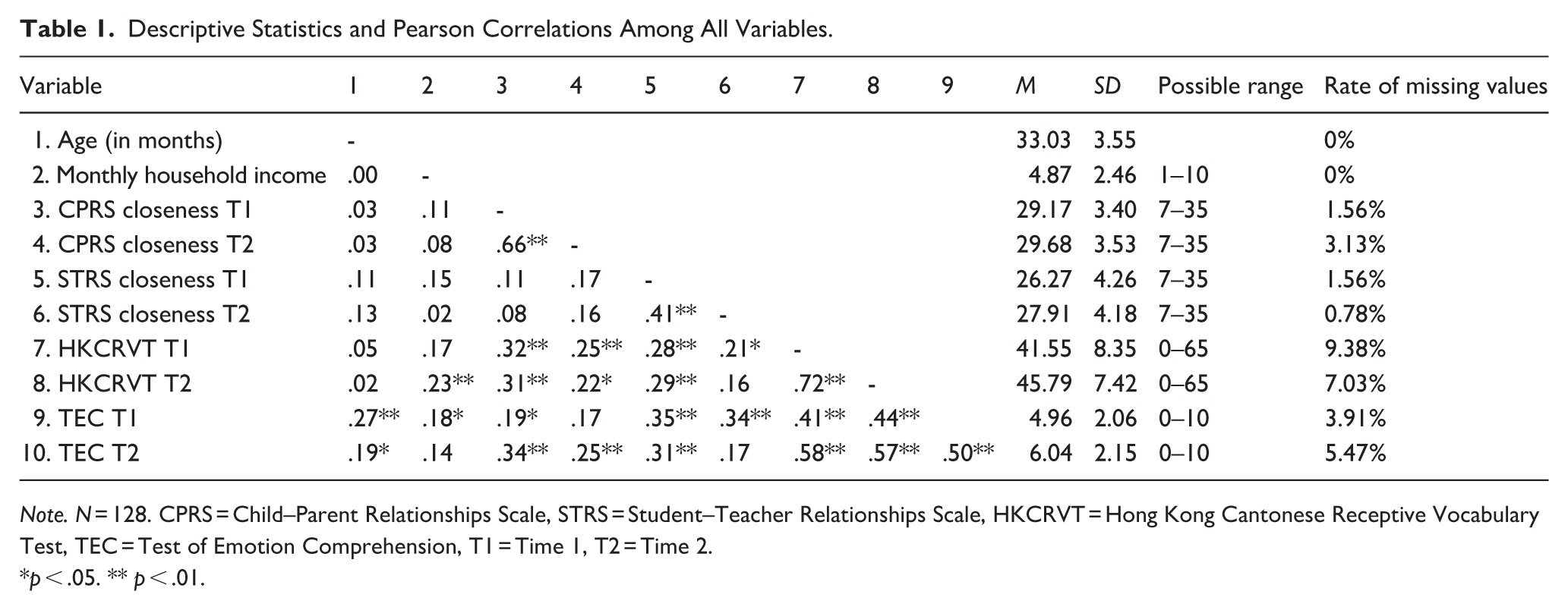
Note. N = 128. CPRS = Child–Parent Relationships Scale, STRS = Student–Teacher Relationships Scale, HKCRVT = Hong Kong Cantonese Receptive Vocabulary Test, TEC = Test of Emotion Comprehension, T1 = Time 1, T2 = Time 2.
p < .05. ** p < .01.
To address the present research aim of examining the cross-lagged relations among the study variables, we conducted a series of modelling steps. We started with a baseline model (Model 1). It included autoregressive paths for parent–child closeness, teacher–child closeness, child language skills and child EU between Time 1 and Time 2. Second, to examine the associations between the children’s language skills and their EU, we added unidirectional paths from language skills at Time 1 to EU at Time 2 (Model 2a) and from EU at Time 1 to language skills at Time 2 (Model 2b). Bidirectional paths between language skills and EU were included in Model 2c. Third, to investigate the associations between the two child variables with parent–child closeness, we added unidirectional paths from parent–child closeness at Time 1 predicting language skills and EU at Time 2 (Model 3a) as well as from language skills and EU at Time 1 predicting parent–child closeness at Time 2 (Model 3b). Bidirectional paths among these variables were estimated in Model 3c. Fourth, to examine the associations between the two child variables with teacher–child closeness, we added unidirectional paths from teacher–child closeness at Time 1 predicting language skills and EU at Time 2 (Model 4a) as well as from language skills and EU at Time 1 predicting teacher–child closeness at Time 2 (Model 4b). Bidirectional paths among these variables were estimated in Model 4c. Control variables (i.e., gender, age, monthly household income) and cross-sectional correlations were included in all the models. For each series, the nested models were compared using chi-square difference tests with Satorra-Bentler method. A significant chi-square difference suggests that the more complex model should be chosen because it fits the data better, whereas a nonsignificant chi-square difference suggests that the more parsimonious model should be selected. Given a large number of parameters (e.g., autoregressive and cross-lagged paths) that were evaluated in a model, Benjamini–Hochberg false discovery rate correction was conducted to correct for Type I error (Benjamini & Hochberg, 1995; Cribbie, 2007).
The model fit was evaluated by multiple indices, including the chi-square statistic (χ2) and degrees of freedom (df), comparative fit index (CFI), Tucker–Lewis index (TLI), root mean square error of approximation (RMSEA) and standardised root mean square residual (SRMR). Generally, a model is considered acceptable if the CFI and TLI are higher than 0.90 and the RMSEA and SRMR are lower than 0.08 (L. T. Hu & Bentler, 1999).
Results
Descriptive Statistics
Descriptive statistics and Pearson correlations among all the study variables are shown in Table 1. Parent–child closeness (CPRS) at the two timepoints were positively correlated with children’s language skills (HKCRVT) and emotion understanding (EU) (TEC) at Time 1 (0.17 < r < 0.32) and Time 2 (0.22 < r < 0.34). Similarly, teacher–child closeness (STRS) at the two timepoints were positively related to children’s language skills and EU at Time 1 (0.21 < r < 0.35) and Time 2 (0.16 < r < 0.31). Note that the correlations were not significant between parent–child closeness at Time 2 and children’s EU at Time 1 (r = 0.17), and between teacher–child closeness at Time 2 and children’s language skills (r = 0.16) and EU (r = 0.17) at Time 2. In addition, children’s language skills showed positive correlations with their EU over time (0.41 < r < 0.58).
Cross-Lagged Models
The model-building steps established autoregressive and cross-lagged relationships among parent–child closeness, teacher–child closeness, child language skills and child EU. Table 2 shows the model fit indices for each of the models and the chi-square tests comparing the fits across the models. The comparisons between Model 2a and Model 1 (Δχ2(1) = 20.31, p < .001) and between Model 2b and Model 1 (Δχ2(1) = 12.00, p < .001) showed significant chi-square differences in model fit, indicating that both Model 2a and Model 2b explained the data better than Model 1 did. Moreover, the significant chi-square differences between Model 2c and Model 2a (Δχ2(1) = 9.51, p = .002) and between Model 2c and Model 2b (Δχ2(1) = 19.41, p < .001) suggest that Model 2c had a better fit to the data than Model 2a and Model 2b. Thus, Model 2c was chosen at this step, which included bidirectional associations between child language skills and child EU in addition to the autoregressive relations of all the variables over time.
Model Fit Indices for Cross-Lagged Path Models.
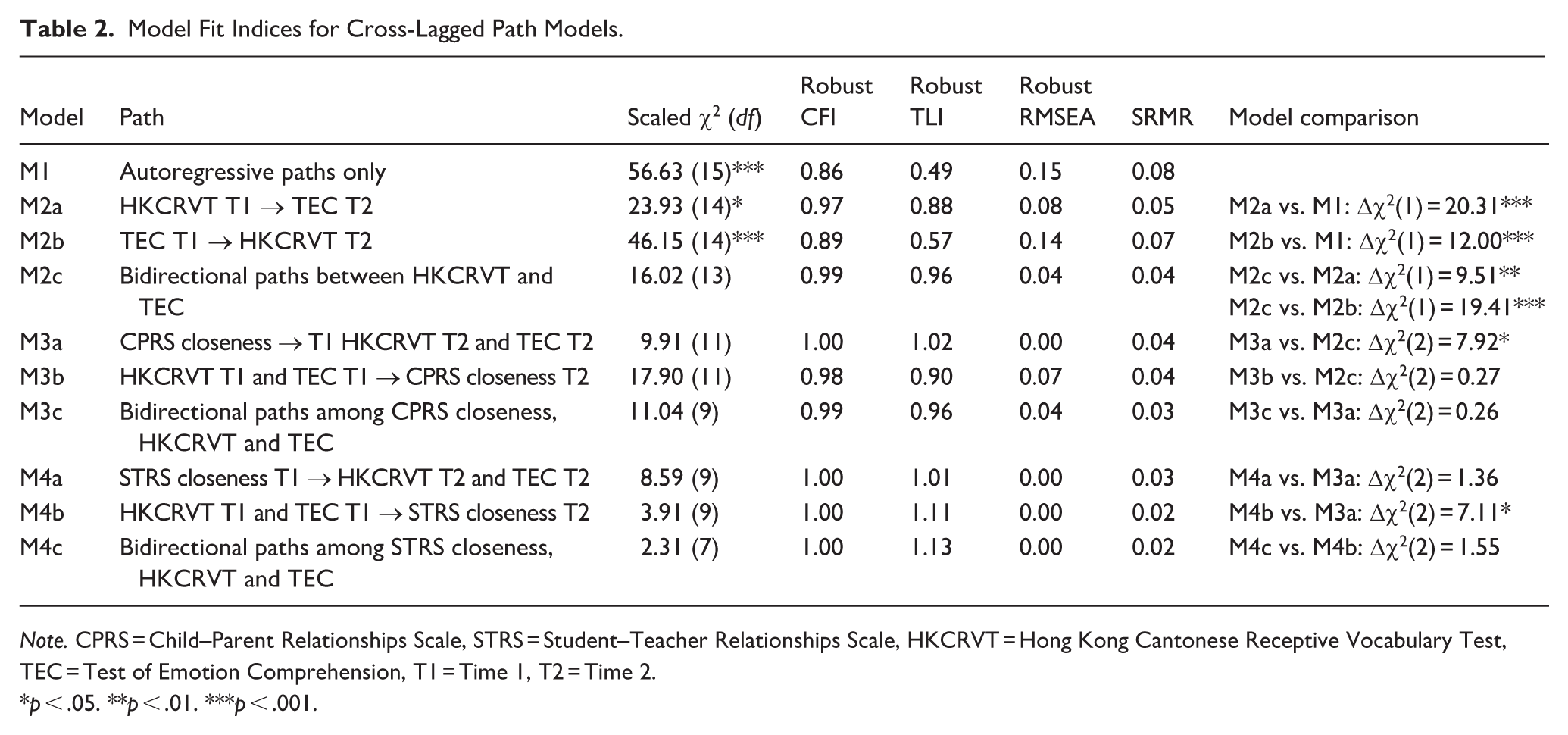
Note. CPRS = Child–Parent Relationships Scale, STRS = Student–Teacher Relationships Scale, HKCRVT = Hong Kong Cantonese Receptive Vocabulary Test, TEC = Test of Emotion Comprehension, T1 = Time 1, T2 = Time 2.
p < .05. **p < .01. ***p < .001.
Next, the comparison between Model 3a and Model 2c was significant (Δχ2(2) = 7.92, p = .019), suggesting that Model 3a accounted for the data better than Model 2c. Hence, Model 3a was selected at this step, in which the unidirectional paths from parent–child closeness at Time 1 predicting children’s language skills and EU at Time 2 were added. In the subsequent step, only the comparison between Model 4b and Model 3a was significant (Δχ2(2) = 7.11, p = .029), indicating that Model 4b explained the data better than Model 3a. Hence, Model 4b was determined as the final model. It additionally included the unidirectional paths from children’s language skills and EU at Time 1 predicting teacher–child closeness at Time 2.
Figure 2 illustrates the interrelations among the variables estimated in Model 4b. The effects of children’s gender, age and monthly household income were controlled for. All the autoregressive paths were significant, suggesting that parent–child closeness (β = 0.65, p < .001), teacher–child closeness (β = 0.34, p = .001), child language skills (β = 0.63, p < .001) and child EU (β = 0.28, p < .001) were stable across the two timepoints. There were significant cross-sectional associations among these variables at Time 1. Parent–child closeness was positively linked to children’s language skills (β = 0.32, p = .008). Teacher–child closeness was positively related to children’s language skills (β = 0.26, p < .001) and EU (β = 0.31, p < .001). Children’s language skills showed a positive relationship with their EU (β = 0.39, p = .001). At Time 2, however, there was only a significant positive association between children’s language skills and EU (β = 0.21, p = .003). All the estimates that were tested as significant remained significant (qBH < .05) after correcting for multiple comparisons.
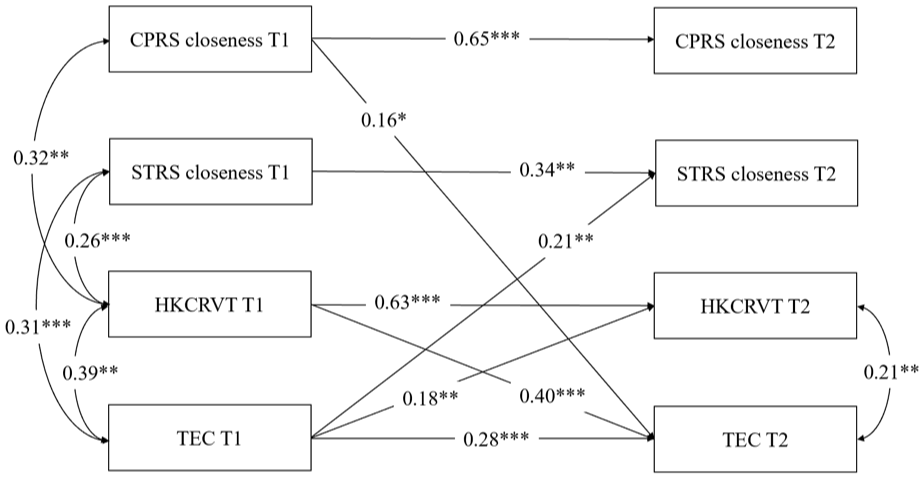
The Final Model (Model 4b).
After controlling for the autoregressive effects, we observed significant bidirectional associations between children’s language skills and their EU; prior language skills positively predicted later EU (β = 0.40, p < .001), and prior EU positively predicted later language skills (β = 0.18, p = .001). In addition, we found that parent–child closeness at Time 1 significantly predicted child EU at Time 2 (β = 0.16, p = .022). We also observed a significant path from child EU at Time 1 predicting teacher–child closeness at Time 2 (β = 0.21, p = .009). However, parent–child closeness at Time 1 did not predict child language skills at Time 2 (β = 0.07, p = .15); child language skills at Time 1 did not predict teacher–child closeness at Time 2 (β = 0.02, p = .79). All the estimates that were tested as significant remained significant (qBH < .05) after accounting for multiple comparisons.
Discussion
Using cross-lagged panel modelling, this study examined the longitudinal reciprocal relations among parent–child closeness, teacher–child closeness, early language skills and emotion understanding (EU) in toddlers aged 2–3 years, assessed across two timepoints 6 months apart. This modelling approach has been widely employed to estimate directional influences in longitudinal data. After controlling for age, gender, family income and autoregressive effects, our findings revealed bidirectional associations between children’s language skills and their EU. Moreover, early parent–child closeness predicted later child EU, while early child EU predicted later teacher–child closeness.
Parent–Child Closeness and Children’s Emotion Understanding
We hypothesised reciprocal relations between parent–child closeness and children’s EU (Hypotheses 1 and 4). However, our findings indicated a unidirectional relation from early parent–child closeness predicting toddlers’ EU – specifically emotion recognition and emotion situation knowledge, six months later. In contrast, early toddlers’ EU did not predict subsequent parent–child closeness. This suggests that closer and more intimate relationships with parents foster toddlers’ development of EU, but toddlers’ emotional competencies do not necessarily enhance the closeness of the parent–child relationship. This finding aligns with attachment theory (Bowlby, 1982; Cassidy, 1994), which posits that secure parent–child attachment relationships provide a safe and responsive environment for children to learn and practice emotional skills. Communication about emotions and mental states has been considered a key mechanism through which children develop emotion understanding (Denham et al., 1994; Laible & Thompson, 1998).
Our findings with 2- to 3-year-olds are consistent with previous research involving older preschoolers (Dereli, 2016; Laugen et al., 2024), which also identified significant positive associations between early parent–child closeness and subsequent children’s EU. In our study, a 1 standard deviation (SD) increase in parent–child closeness predicted a 0.16 SD increase in toddlers’ EU 6 months later, representing a small effect size (Cohen, 1988). This effect is comparable to that reported in Laugen et al. (2024), who also employed a longitudinal design and found that a 1 SD increase in parent–child relationship quality at age 4 predicted a 0.12 SD increase in children’s EU at age 6.
In contrast, we did not observe a significant path from toddlers’ EU to parent–child closeness. This may reflect the inherently asymmetrical nature of relationships between parents and very young children, even though such relationships are co-constructed. Harrist and Waugh (2002) described a developmental continuum from asymmetry to symmetry in caregiver-child interactions, noting that toddlerhood is characterised by a caregiver-led dynamic. This perspective supports the view that parents, particularly mothers, play a dominant role in emotion socialisation through coaching (Denham et al., 1994). Consequently, parents may exert greater influence over both the quality of the relationship and the child’s emotional development than the child does.
Teacher–Child Closeness and Children’s Emotion Understanding
We hypothesised reciprocal relations between teacher–child closeness and children’s emotion understanding (EU; Hypotheses 2 and 4). Our results revealed a unidirectional association: early children’s EU significantly predicted teacher–child closeness 6 months later, whereas early teacher–child closeness did not predict later children’s EU, after accounting for autoregressive and cross-sectional effects.
This finding suggests that toddlers with stronger emotion recognition and emotion situation knowledge may be more capable of engaging in group interactions and taking teachers’ affective perspectives, thereby fostering more supportive and intimate relationships with teachers. Teachers may also rely on children’s emotional competencies to guide their interactions and tailor their responses to children’s individual needs. Emotionally competent children may be perceived as easier to engage with, which in turn facilitates the development of closer teacher–child relationships. These results partially support the transactional theory of development (Sameroff & Mackenzie, 2003), highlighting children’s role in shaping their social environments and relationships.
Several studies using cross-lagged modelling have similarly found that child-driven models best explain the associations between children’s developmental outcomes and teacher–child relationships, including language abilities (B. Y. Hu et al., 2021; Liu et al., 2020), social skills (Wu et al., 2018) and emotional behaviour problems (Mejia & Hoglund, 2016). For instance, Liu et al. (2020), studying 1- to 2-year-olds in Hong Kong childcare centres, attributed the child-driven pattern to high child-teacher ratios, which limit teachers’ ability to engage individually with each child. In such contexts, teachers often care for large groups and are more likely to form warm and intimate relationships with children who actively participate and communicate effectively in the group. This explanation may also apply to the current study, where each teacher worked with an average of 11 children. In group settings with high child-teacher ratios, children’s individual characteristics appear to play a more influential role than teacher–child relationship quality in shaping their emotional development.
Children’s Language Skills and Emotion Understanding
Consistent with Hypotheses 3 and 4, we found longitudinal bidirectional relationships between children’s early language skills and their emotion understanding (EU). After accounting for autoregressive and cross-sectional associations, children’s prior language skills predicted their EU six months later, and children’s prior EU predicted their language skills over the same period. These findings suggest that toddlers’ acquisition of oral language may enhance their understanding of basic emotions and external causes of emotions, while increased emotion understanding may, in turn, facilitate language development.
Notably, the predictive effect of language skills on EU (β = 0.40) was stronger than the reverse effect of EU on language skills (β = 0.18), corresponding to medium and small effect sizes, respectively (Cohen, 1988). This asymmetry suggests that language capacity may play a more substantial role in fostering EU than vice versa. In this study, we assessed two early components of EU using the Test of Emotion Comprehension (TEC; Pons & Harris, 2000), which is specifically designed with linguistic simplicity. The TEC uses short verbal prompts alongside nonverbal pictorial responses, thereby minimising the influence of language on test performance. This design helps reduce potential measurement overlap and supports the robustness of the observed bidirectional relations.
Our findings align with previous research reporting reciprocal associations between language and emotion skills (Rojas & Abenavoli, 2021; Strand et al., 2016). For example, Rojas and Abenavoli (2021) found that expressive vocabulary at the beginning of the preschool year more strongly predicted EU at year’s end than the reverse in 4-year-old preschoolers. Our study extends these findings to a younger cohort of 2- to 3-year-old toddlers. Children with stronger language skills may have more opportunities for social interaction, which in turn cultivates emotion competence (Rojas & Abenavoli, 2021; Slot et al., 2020).
Despite robust evidence of associations between language and emotion skills, the mechanisms underlying their reciprocal influence remain contested. From a cognitive perspective, language serves as a medium for representing conceptual knowledge. Labels, as measured by receptive vocabulary, help children categorise both concrete and abstract concepts. Emotion understanding also involves conceptualisation, suggesting a shared cognitive foundation. Beck et al. (2012) supported this view by identifying a general ability factor underlying both language and emotion competencies in school-aged children. From a social perspective, social interaction plays a central role in the development of both domains. Vygotsky (1964) emphasised that children use language to express emotions and discuss others’ affective states. Bloom’s (1998) intentionality model similarly posits that language learning is driven by children’s desire to share emotions in social contexts. Finally, some researchers have proposed that general intelligence may underlie the strong associations between language and emotion abilities. However, De Stasio et al. (2014) found that understanding of simple emotions was primarily attributable to age and verbal ability, rather than fluid intelligence.
While our findings support the close link between language and emotion understanding, the current study cannot determine the relative contributions of these theoretical perspectives. Further research is needed to disentangle these mechanisms and explore their developmental trajectories.
Limitations and Future Directions
Several limitations of the current study should be acknowledged. First, the relatively small sample size (N = 128) may have limited the statistical power to detect small-to-moderate effects, particularly in certain cross-lagged paths. As such, the robustness and generalisability of the findings should be further evaluated using larger and more diverse samples. Second, the study employed only two measurement points within a 1-year period. Cross-lagged modelling with two timepoints has been criticised for conflating within-person variance (fluctuations within individuals over time) and between-person variance (stable differences between individuals; Berry & Willoughby, 2017). Future research should incorporate at least three timepoints to enable the use of models with random intercepts, which can better distinguish between these sources of variance. Third, the measurements of parent–child and teacher–child relationships relied solely on adult reports. To enhance data validity, future studies should include self-reports from both adults and children, alongside observational measures from independent trained raters, allowing for triangulation of perspectives. Fourth, the study used receptive vocabulary and understanding of basic emotions and their external causes as proxy indicators of language skills and emotion understanding, respectively. While informative, these measures capture only limited aspects of each domain. Future research should adopt a broader set of indicators – for example, incorporating expressive vocabulary to complement receptive vocabulary, and assessing understanding of both positive and negative emotions, as well as affective perspective-taking (Cooke et al., 2016) – to provide a more comprehensive evaluation. Fifth, the warm-up session we introduced to the Test of Emotion Comprehension (TEC) was not part of the original protocol. This adaptation may have influenced children’s responses on the TEC items. While all participants received the same warm-up questions, and thus any potential priming effect was consistent across the sample, we agree that this could affect comparability with studies using the TEC without such a warm-up. Sixth, only children’s age, gender and family income were considered as covariates in the analysis. Other potentially influential factors, such as children’s general intelligence (De Stasio et al., 2014), parental emotion socialisation (Denham et al., 1994) and classroom emotional support (Curby et al., 2015) were not accounted for. Including these variables in future research could offer a more nuanced understanding of children’s emotional development. Seventh, while the study examined reciprocal associations among parent–child closeness, teacher–child closeness, language skills and emotion understanding in toddlers, it did not explore the mechanisms underlying these associations. Potential mediating processes, such as emotional conversations with adults (Raikes & Thompson, 2006), warrant investigation in future studies. Finally, this study was conducted in Hong Kong, where children are typically dual language learners acquiring Cantonese-Chinese as their first language and English as their second. This linguistic context may influence both language development and emotion understanding. Therefore, caution is warranted when generalising the findings to children from different cultural and linguistic backgrounds. Nevertheless, given the ever-increasing global prevalence of bilingualism and multilingualism, the current findings remain highly relevant for populations in which children regularly engage with two or more languages.
Theoretical and Practical Implications
The present findings, drawn from toddlers aged 2–3 years attending early childhood group settings and focused on two early facets of emotion understanding (i.e., emotion recognition and situation emotion knowledge), offer important insights into early emotional development. Theoretically, this study makes a unique contribution by examining emotion understanding as both an outcome and an antecedent of caregiver–child relationship quality and children’s language skills within a longitudinal framework. Our findings extend prior research into older preschoolers by demonstrating that, as early as ages 2 to 3, closer parent–child relationships and more advanced receptive language skills each predict better emotion understanding. The reciprocal influences between receptive language and emotion understanding are shown for the first time in young toddlers. In addition, the study reveals children’s emotion understanding as a precursor to teacher–child closeness, challenging the common assumption that emotion understanding is primarily shaped by adult-child relationships.
Practically, our findings underscore the importance of warm, responsive parent–child relationships and strong language capacities in supporting toddlers’ emotional development. Parents and caregivers may benefit from targeted education programmes that emphasises strategies for fostering high-quality, intimate relationships and promoting children’s language development. Professional development for early childhood educators could also include guidance on how to support these efforts within home environments, bridging the gap between educational and familial contexts. Moreover, the finding that children’s emotion understanding predicts teacher–child closeness suggests that early interventions aimed at enhancing children’s emotional competencies may also improve classroom relationships and engagement. These insights have meaningful implications for curriculum design, teacher education and early childhood policy. Systematic efforts to promote emotion understanding in the early years – through integrated emotional and language learning experiences–may not only support children’s socioemotional wellbeing but also lay the foundation for stronger interpersonal relationships and more effective learning environments.
Footnotes

Funding
The authors disclosed receipt of the following financial support for the research, authorship, and/or publication of this article: The work described in this paper was supported by the Research Impact Cluster Fund (#04593; #04832) from Department of Early Childhood Education, The Education University of Hong Kong.
Declaration of Conflicting Interests
The authors declared no potential conflicts of interest with respect to the research, authorship and/or publication of this article.