




Abstract
Previous research indicates that men suffer more from partner separation and benefit more from cohabitation and marriage in their well-being than women. Targeting middle-aged and older adults, this study investigated whether men’s well-being declines more strongly following separation and increases more strongly when moving in with a partner or marrying in later life. We also examined whether gender differences are linked to emotional support from friends and family or vary by age. Using within-person longitudinal data from 2,840 participants in the Health and Retirement Study, we compared two-year changes in depressive symptoms and life satisfaction between individuals experiencing relationship transitions (separation, moving in together—with or without marriage—and marriage among cohabitators) and propensity-score-matched controls with stable relationship status. Men reported receiving less emotional support than women, but the transition effects did not vary by gender, emotional support, or age. Separation was not associated with declines in well-being. Moving in together, whether accompanied by marriage or not, was associated with increased life satisfaction, while marriage among those already cohabiting was not. Findings indicate that relationship transitions in later life affect men and women similarly. We discuss implications for the role of gender, emotional support, and age in relationship transitions.
How do relationship transitions affect well-being among men and women? Research across different age groups indicates that being in a relationship is associated with greater well-being benefits for men than for women (Coombs, 1991; Gove et al., 1983; Stern et al., 2024; Zhai et al., 2024). This gender difference may stem from men’s greater reliance on partners for emotional support (Wahring et al., 2026), which could result in stronger well-being changes during relationship transitions among men. As social networks and their perceptions change across the lifespan (Antonucci & Akiyama, 1987; Carstensen et al., 1999), we also examine whether age moderates gender differences. Using data from 2,840 middle-aged and older adults in the US Health and Retirement Study (HRS), we examined how relationship transitions (separation, moving in, and marriage) affect changes in depressive symptoms and life satisfaction. We assessed whether there are gender differences in these changes, whether gender differences are linked to emotional support, and whether they vary by age.
Overall, the experience of separation and moving in without marrying has become more common among middle-aged and older adults, whereas rates of lifelong marriage have decreased in the past decades (Brown & Wright, 2017), making it important to understand how these transitions affect well-being in later life. While prior work on relationship transitions in later life has often focused on loss-related transitions, such as divorce and widowhood (Chipperfield & Havens, 2001; van Scheppingen & Leopold, 2020), few longitudinal studies have, to our knowledge, examined gain-related transitions, such as moving in and marriage, in later life. We therefore adopt a broader view, examining both loss (separation) and gain (moving in, marriage) transitions. Importantly, unlike most prior research, we apply propensity score matching to compare individuals experiencing a transition with demographically similar individuals who are not experiencing a transition, which ensures that time and transition effects can be reliably disentangled. We also investigated the combined transition of marriage and moving in, to prevent possible biases from ignoring the co-occurrence of such transitions (Krämer et al., 2024), further examining whether their co-occurrence affects well-being differently than a single transition (marriage or moving in).
Gender Differences in How Relationship Transitions Shape Well-Being
As recently proposed based on findings from more than 50 studies, heterosexual men, as compared to heterosexual women, expect to benefit and benefit more from relationship involvement, are less likely to initiate dissolutions, and suffer more following dissolutions, suggesting that on a psychological level, men depend more on their partners than vice versa (Wahring et al., 2026). This pattern can be explained by gendered social norms: According to social role expectations that associate emotional vulnerability with women, men learn to avoid emotional disclosure toward friends and family (Eagly & Wood, 2012; Wahring et al., 2026). Low emotional disclosure limits men’s opportunities to receive emotional support, which is defined as intimacy, reassurance, and the ability to confide in and rely on one another (Schaefer et al., 1981). Emotional support satisfies the basic human need for intimacy and is a key psychosocial resource for coping, well-being, and health (Burleson, 2003; Reblin & Uchino, 2008; Reis & Shaver, 1988). However, men tend to receive less emotional support from friends and family than women (Carr, 2004; Galambos et al., 2018). In heterosexual couple relationships, men encounter a context in which emotional disclosure feels more acceptable and rewarding (Wahring et al., 2026). Consequently, they tend to rely more strongly on their partners as their primary source of emotional support (Liao et al., 2018).
Accordingly, relationship transitions should affect men’s and women’s well-being differently. Relationship dissolution represents a greater loss of emotional support for men than for women, whereas intensifying a relationship through cohabitation or marriage may enhance emotional support, particularly for men. These gender differences in reliance on partner support are expected to produce greater changes in well-being among men following relationship transitions.
Concerning separation, empirical evidence supports these assumptions. Longitudinal research from Canada and Germany, using age-diverse samples, shows that life satisfaction decreases, on average, more sharply for men than for women following divorce (Chipperfield & Havens, 2001; Lucas, 2005; Luhmann & Eid, 2009; van Scheppingen & Leopold, 2020). Focusing on young adulthood and midlife, some studies suggest that this gender effect extends to nonmarital relationships (Preetz, 2022), while others do not find gender differences in the effects of nonmarital dissolutions on depressive symptoms or life satisfaction (Wahring et al., 2025). Overall, prior findings support the assumption that men experience stronger declines in well-being following separation.
Regarding transitions into cohabitation and marriage, the empirical evidence is more inconsistent. Cross-sectional research from various countries and age groups suggests that cohabitation and marriage are more strongly linked to well-being among men than among women (Sonnenberg et al., 2013; Wright & Brown, 2017; Zhai et al., 2024). However, longitudinal studies offer mixed results regarding how moving in together, marriage among cohabitants, and marriage combined with moving in relate to well-being over time, and whether these effects differ by gender. A common issue is that marriage and moving in are often analyzed separately, even though they frequently co-occur, so observed “marriage effects” may actually reflect the effect of moving in that accompanies many marriages.
One study following the well-being trajectories of middle-aged and older adults over 20 years found that men’s well-being trajectories tended to be more positive if they married, whereas there was no such effect for women (Ho et al., 2024). Similarly, another study on young and middle-aged adults found that right after marriage, life satisfaction tended to decline among women but increase among men (Huntington et al., 2021). Still other research investigating both marriage and moving in as separate but possibly co-occurring transitions across different age groups found no gender-specific longitudinal effects of either transition on well-being (Blekesaune, 2018; Kim & McKenry, 2002; Luhmann et al., 2012). Overall, prior findings partly support the idea that men, as compared to women, may experience stronger increases in well-being when moving in with or marrying a partner.
Social Relationships and Age
The proposed gender differences in changes in well-being with relationship transitions and the role of perceived availability of emotional support may vary by age: According to Socioemotional Selectivity Theory (Carstensen et al., 1999), as people age and their perceived time left becomes more limited, they prioritize emotionally meaningful goals, leading them to focus on emotionally meaningful relationships and interactions over less meaningful ones. This results in a reduction in the total number of social contacts (Sander et al., 2017). Similarly, the Social Convoy Model (Antonucci & Akiyama, 1987) posits that people have a network of social relationships that varies in closeness and stability throughout life, with core relationships, such as those with close friends and family, being the most stable. As people age, they increasingly prioritize these close, stable relationships, while peripheral contact with acquaintances decreases in number and frequency. In sum, older adults often prioritize close, emotionally meaningful relationships (Antonucci & Akiyama, 1987; Carstensen et al., 1999). Therefore, older adults may derive greater emotional fulfillment from their closest social contacts than middle-aged adults. This expectation dovetails with empirical findings showing that older adults tend to experience interactions with their close social ties—including friends, family, and romantic partners—more positively than middle-aged adults do (Luong et al., 2011). As emotional fulfillment in social relationships generally increases with age, the absolute amount of emotional support received may become less relevant for well-being. At the same time, as people increasingly focus on emotionally meaningful relationships with age (Carstensen et al., 1999), men may also become more comfortable receiving emotional support from their friends and family. Consequently, gender differences in how well social needs are met may decline, leading to more similar effects of relationship transitions on well-being among men and women in later life.
Marital Status
Much of the prior research on separation in later life has focused on divorce, leaving it unclear whether nonmarital dissolutions have similar effects on well-being. Being married to a romantic partner may increase the personal significance of the relationship, and thus, separation from a spouse as opposed to nonmarital dissolution may be experienced as a greater resource loss. Accordingly, prior research found more pronounced well-being declines following relationship dissolution among married than unmarried adults below the age of 50 (Wahring et al., 2025).
The Present Study
Our study aimed to examine the effects of gender, emotional support before the transition, and age on changes in well-being following relationship transitions in later life. To address potential selection effects, we used matched control groups and estimated two-year change models to compare individuals who experienced a transition (separation, marriage, or moving in) with similar individuals with a stable relationship status. Drawing on longitudinal data from the Health and Retirement Study (HRS), which follows middle-aged and older adults in the United States, we examined the following hypotheses derived from our theoretical framework and prior empirical findings:
H1: Depressive symptoms will increase, and life satisfaction will decrease more strongly among men than women following separation. These gender differences will be associated with men`s lower levels of emotional support from friends and family (H1a) and more pronounced among middle-aged than older adults (H1b).
H2: Depressive symptoms will decrease, and life satisfaction will increase more strongly among men than women following marriage and/or moving in. These gender differences will be associated with men`s lower levels of emotional support from friends and family (H2a) and more pronounced among middle-aged than older adults (H2b).
In addition, we expected that being married before separation would be associated with steeper declines in well-being following separation.
Method
This study’s hypotheses and analysis strategy were preregistered (https://osf.io/bfnqc). All analyses were done in R, version 4.3.1 (R Core Team, 2023). Code for data preparation and analyses is provided on the OSF project site (https://osf.io/8ncmf).
Participants and Procedure
We used data from the Health and Retirement Study (HRS), a longitudinal biennial US panel study funded by the National Institute on Aging (grant number NIA U01AG009740) and conducted by the University of Michigan (2024a, 2024b). The HRS started in 1992. Every six years, a new, younger cohort was recruited. Today, the HRS includes 16 waves (30 years) of data collection from 8 birth year cohorts (with the oldest cohort born before 1924 and the youngest born between 1966 and 1971) of individuals aged 50–100+ years and their spouses or partners living with them. We used data obtained from 2006, the first wave assessing all the variables of interest, up to 2022, the latest published wave. In 2006, the sample consisted of 18,469 respondents; 6,283 new respondents started participating in 2010, and 4,368 new respondents started participating in 2016. Between 2006 and 2022, response rates ranged from 74% to 89% per wave.
The HRS biennial interviews are conducted by trained survey interviewers. Within the time frame of interest (2006-2022), half the sample received enhanced face-to-face (FTF) interviews in respondents’ homes, and the other half was interviewed by phone, alternating every wave. Participants were paid for their participation. Since 2016, new participants received 100$ for the baseline interview, 80$ for each core interview, and 20$ for a leave-behind questionnaire that was given to the other half of the sample each wave. Baseline interviews take about 2.72 hours, with follow-ups taking 2 hours.
Included in our report were all participants who experienced one of four relationship transitions, and propensity-score-matched control participants on age, gender, marital status, and education, with a similar baseline relationship status but no transition. We chose these matching criteria to account for the fact that separation is linked to education (Recksiedler & Stawski, 2019) and occurs more frequently among middle-aged than older adults (Brown & Lin, 2012). Baseline well-being was not included as a matching criterion, as we were also interested in examining baseline differences. The group of individuals who were separated were matched with a group of continuously partnered individuals (cohabiting or married). The group of unmarried individuals who moved in with a new partner was matched with a group of continuously single participants (non-cohabiting, unmarried). Importantly, the panel does not allow for differentiation between people in living-apart-together relationships and actual singlehood. Instead, the panel considers people who are married and/or cohabitating as partnered, and people who are neither cohabitating nor married as single. Separately, the group of individuals who moved in with and married a partner was matched with a group of continuously single individuals. Cohabiting individuals who married were matched with a group of individuals who remained cohabiting without marrying. Each pair of transition and control groups was matched exactly by gender, and using 1:1 nearest-neighbor matching without replacement and a caliper of .2 by age and education. For separation, we also included marital status (0 = unmarried, 1 = married) as a matching criterion. We only included participants in the matching procedure for a specific year if they had valid data on our matching criteria, our predictors, and the outcome variables, depressive symptoms (measured throughout all relevant years) or life satisfaction (measured from 2008 onwards) in the wave before and after the transition. We also excluded participants from our separation analyses for a particular wave if they repartnered before the first wave after separation.
Sample sizes after matching ranged from 400 to 1,146 (see Online Supplement S1 for sample sizes before and after matching and sample selectivity), providing adequate statistical power (> 80%; Faul et al., 2009) to detect gender effects of f = .04 to .07 or greater.
Altogether, 54% of the N = 2,840 participants assigned to at least one transition or control group were women. Age at baseline ranged from 30 to 95, with a mean of 62 (SD = 9.19). The mean number of school years was 13.16 (SD = 2.93). About 63% of participants were White non-Hispanic, 7% White Hispanic, 21% Black non-Hispanic, 1% Black Hispanic, 5% of other Hispanic, 4% of other non-Hispanic ethnicities, and 0.4% had unknown ethnicity. At baseline, 27% of the participants were married, 11% never married, 43% separated from a spouse or divorced, and 19% widowed (see Online Supplement S2 for sample descriptives of each transition and control group).
Measures
More detailed descriptions of our measures, including sample items, and information on reliability and validity, can be found in the Online Supplement S3.
Well-Being
Emotional and cognitive evaluative aspects of well-being were assessed using measures of depressive symptoms and life satisfaction, respectively. Depressive symptoms were measured using the sum of 8 items from the Center for Epidemiological Studies Depression Scale 8 Short Form (CES-D 8) (Radloff, 1977). Life satisfaction was measured from 2008 onwards by the item “Now, please think about your life-as-a-whole. How satisfied are you with it?” answered on a 1 (not at all satisfied) to 5 (completely satisfied) scale. As shown in our sample selectivity analyses (Online Supplement S1), our subsample was not representative of the full HRS sample. To ensure that effect sizes are interpretable relative to the broader population, we therefore converted depressive symptoms and life satisfaction scores to T-score units (M = 50, SD = 10), normed to the full HRS sample in 2006 (depressive symptoms) and 2008 (life satisfaction).
Emotional Support
Emotional support was assessed in a home questionnaire administered to half of the sample at every wave (with each participant being asked to complete the questionnaire every second wave). Thus, for half of the sample, we considered emotional support 2, for the other half, emotional support 4 years before the transition. We focused on emotional support 2 or 4 years before the first assessment after separation because we argue that men, on average, lose a more central resource of support through the separation and thus struggle more. Emotional support from children, family, and friends was assessed as the average response (1 = not at all to 4 = a lot) to three items. We first computed separate mean scores for each source (children, family, and friends). To capture the idea that receiving strong support from at least one source is most important, we then constructed our main emotional support measure as the maximum of the three source-specific scores. That is, for an individual’s emotional well-being, having at least one reliable source of support may be more consequential than the cumulative number of supportive sources, as additional sources may contribute little beyond the effect of the strongest supportive relationship.
Gender, Age, and Marital Status
Gender was operationally defined as a binary variable (0 = “woman,” 1 = “man”). Age was assessed as years since birth at the measurement before the transition and used as a time-invariant variable. We examined marital status (0 = unmarried, 1 = married) at the last measurement occasion before the transition as a covariate in our separation analyses.
Statistical Procedure
For received emotional support to be associated with gender differences in transition-related well-being changes, a prerequisite is that gender differences in received emotional support are present. Therefore, before the main analyses, we examined whether emotional support from friends and family was lower for men than for women. Using the full sample of participants in at least one control or transition group, we conducted a linear regression with gender as the predictor and emotional support from friends and family at the pre-transition assessment as the outcome.
In the main analysis, we examined hypotheses about the pre-post transition changes in life satisfaction and depressive symptoms for each of the four transition types (Separation, Moving In, Marriage, and Marriage and Moving In) using a series of latent change score models. We used latent change score models because they separate baseline differences from differences in within-person change (McArdle, 2009) and allow predictors and moderators to be linked specifically to within-person changes in well-being. In Model 1, we predicted the two-year latent change score by group (0 = control group, 1 = transition group), gender, and the group x gender interaction. In Model 2, we added the support variable and the group x support interaction. In Model 3, we added age and the group x age and gender x age interactions. For the models addressing separation, we included marital status as a covariate.
Results
Descriptive Statistics
Supplementary Table S4 reports descriptive statistics and intercorrelations among the key variables under study. Three aspects are of note. First, emotional support was skewed, as most participants reported receiving some or a lot of support, while only a few reported receiving little or no support at all (M = 3.24, SD = .71). Most participants reported few depressive symptoms (M = 1.62, SD = 2.10) and medium to high levels of life satisfaction (M = 3.72 SD = .83). Consistent with prior research (Batz-Barbarich et al., 2018; Salk et al., 2017), men reported significantly fewer depressive symptoms than women (Mmen = 1.43, Mwomen = 1.78, t(2598.7) = –4.25, p < .001), and similar levels of life satisfaction.
Gender Differences in Emotional Support
In line with our expectation, results from the linear model revealed that men reported less emotional support from friends and family than women (β = –.448, p < .001), with gender explaining 5% of the variance in emotional support.
Changes in Well-Being with Separation
The results of the Latent Change Models examining H1 (effects of separation and gender), H1a (effects of separation, gender, and support), and H1b (effects of separation, gender, support, and age) are shown in Table 1.
Results from Latent Change Score Models Examining Levels and 1-Year Change in Well–Being with and without Experiencing Separation, by Gender, Emotional Support, and Age.
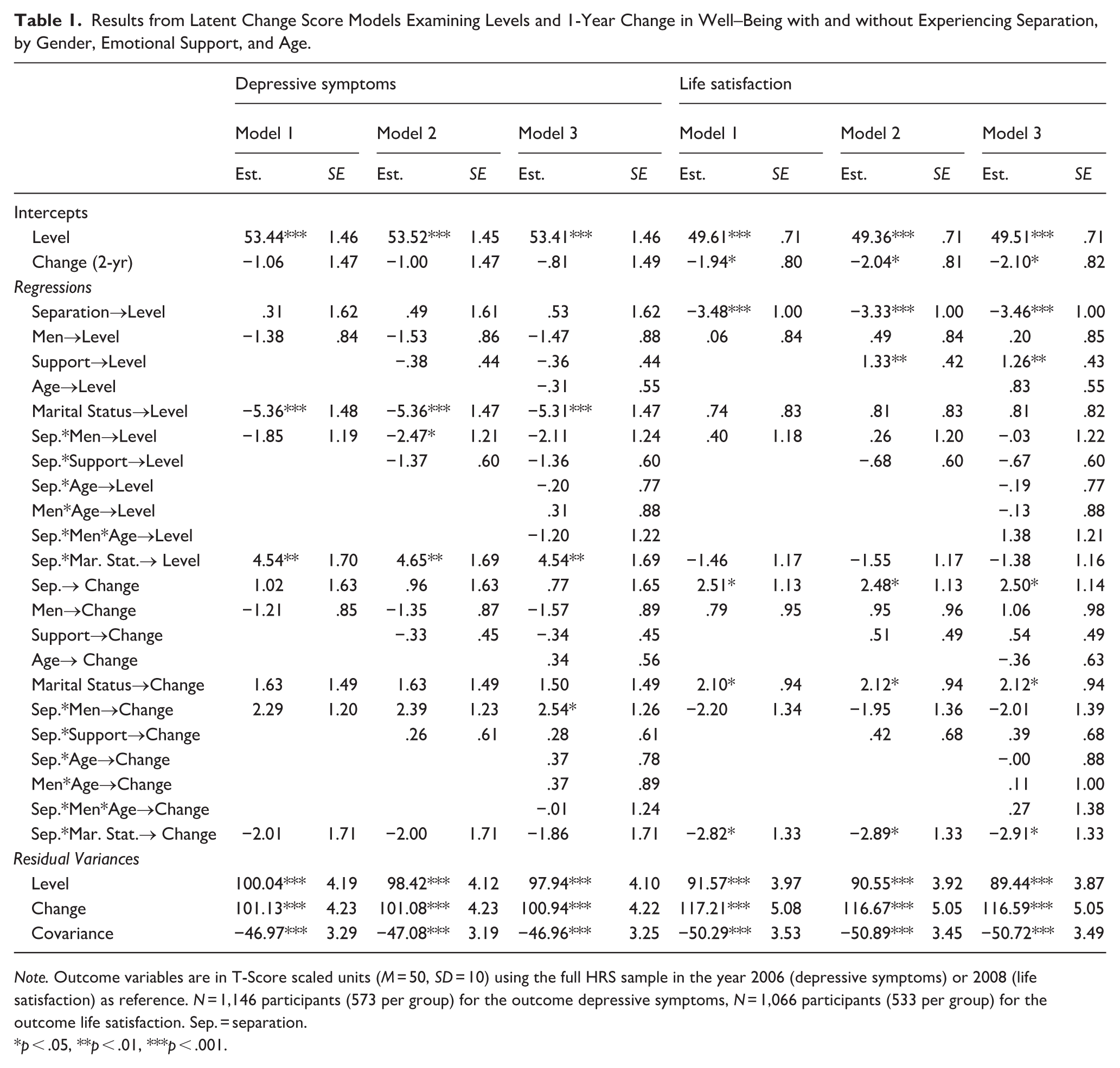
Note. Outcome variables are in T-Score scaled units (M = 50, SD = 10) using the full HRS sample in the year 2006 (depressive symptoms) or 2008 (life satisfaction) as reference. N = 1,146 participants (573 per group) for the outcome depressive symptoms, N = 1,066 participants (533 per group) for the outcome life satisfaction. Sep. = separation.
p < .05, **p < .01, ***p < .001.
Depressive Symptoms
In Models 1 and 2, there were no significant main or interaction effects of separation on changes in depressive symptoms. In Model 3, including main and interaction effects of age, the interaction effect of separation and gender was significant (β = .104, p = .043; see Figure S5 in the Online Supplement). However, simple slopes analyses indicated that depressive symptoms did not significantly change among separated men (β = .073, p = .247), separated women (β = –.022, p = .695), or unseparated women (β = .049, p = .381), whereas a significant decrease was observed among men who did not separate (β = –.135, p = .034). As the interaction effect was only found under consideration of age, it should be interpreted with caution. In sum, contrary to H1, men and women did not differ in depressive symptom changes following separation.
Life Satisfaction
In contrast to all other models, which did not show a significant change in the control group, the models on life satisfaction change following separation revealed a significant mean-level change, indicating that life satisfaction tended to decrease in both the transition and the control group (β = –.179, p = .015). Moreover, separation had a significant main effect (β = .144, p = .027), indicating that life satisfaction tended to decrease less strongly in the separation group than in the matched continuously partnered group. There were no significant main or interaction effects of gender on changes in life satisfaction in any model. In sum, H1, that separation would be associated with more pronounced decreases in well-being among men, was not supported. Emotional support and age did not interact with separation in predicting change in any well-being measure, and H1a and H1b were thus not supported.
The main effect of marital status (β = .096, p = .025) and the interaction effect of separation and marital status (β = –.111, p = .038) on changes in life satisfaction were significant. This indicates that married individuals who did not separate experienced smaller declines in life satisfaction than all other groups, whereas married individuals who separated showed steeper declines in life satisfaction than unmarried individuals who separated.
Changes in Well-Being with Moving in and/or Marriage
The results of the Latent Change Score Models examining H2 (effects of transition and gender), H2a (effects of transition, gender and support), and H2b (effects of transition, gender, support, and age) concerning the transition of moving in, marriage, and the combined event of marriage and moving in are shown in Tables 2 to 4. The main effects of the transitions on changes in depressive symptoms were not significant. Life satisfaction tended to increase when moving in (β = .117, p = .017; see Figure 1) and when moving in with and marrying a partner within the same period (β = .263, p < .001; see Figure 2). Marriage did not have an effect on changes in life satisfaction. There were no significant effects of gender, emotional support, or age on changes in either outcome following the transitions. Thus, H2, H2a, and H2b were not supported.
Results from Latent Change Score Models examining Levels and 1-Year Change in Well–being with and without Moving in, by Gender, Emotional Support, and Age.
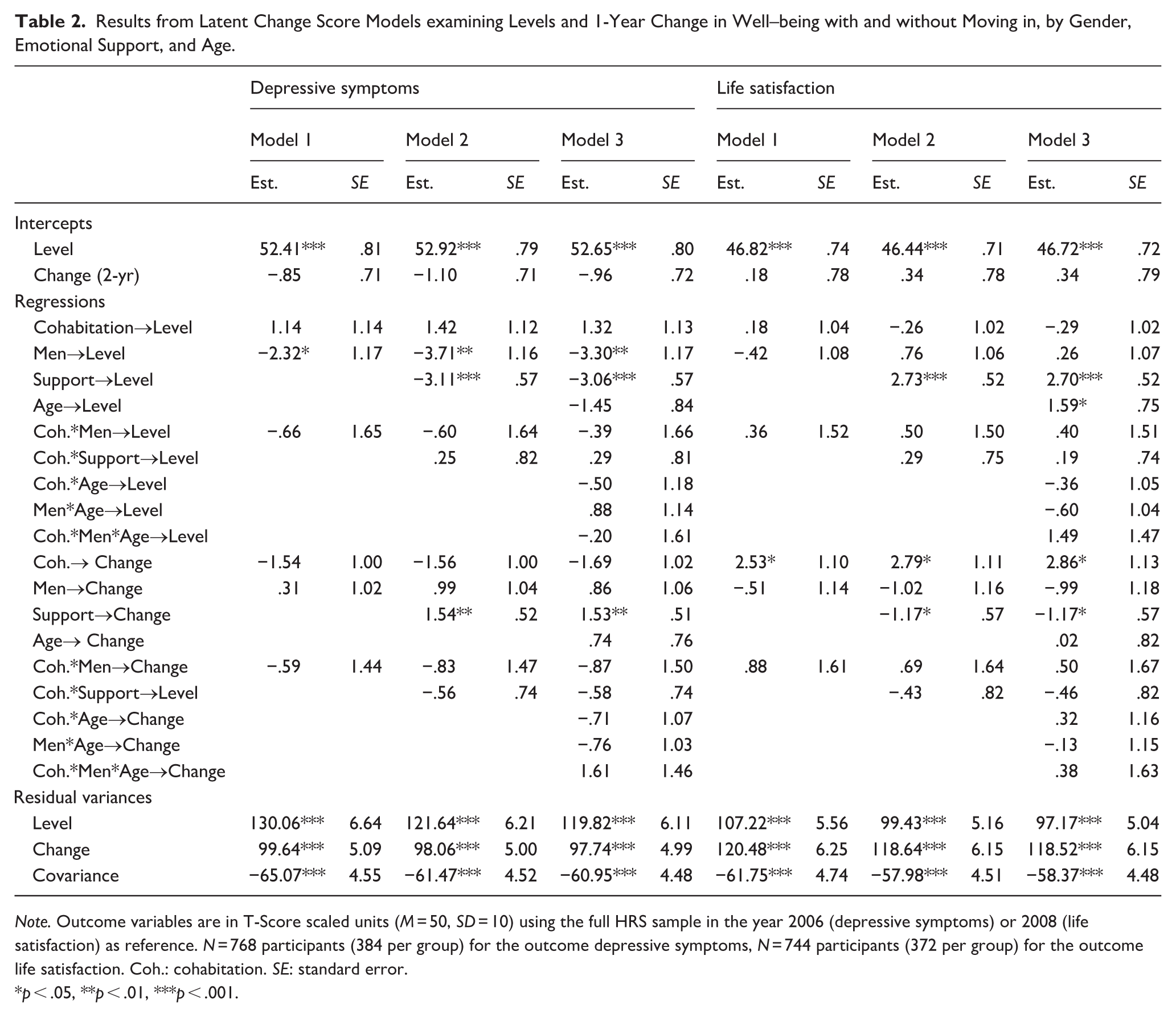
Note. Outcome variables are in T-Score scaled units (M = 50, SD = 10) using the full HRS sample in the year 2006 (depressive symptoms) or 2008 (life satisfaction) as reference. N = 768 participants (384 per group) for the outcome depressive symptoms, N = 744 participants (372 per group) for the outcome life satisfaction. Coh.: cohabitation. SE: standard error.
p < .05, **p < .01, ***p < .001.
Results from Latent Change Score Models Examining Levels and 1-Year Change in Well–Being with and without Marriage, by Gender, Emotional Support, and Age.
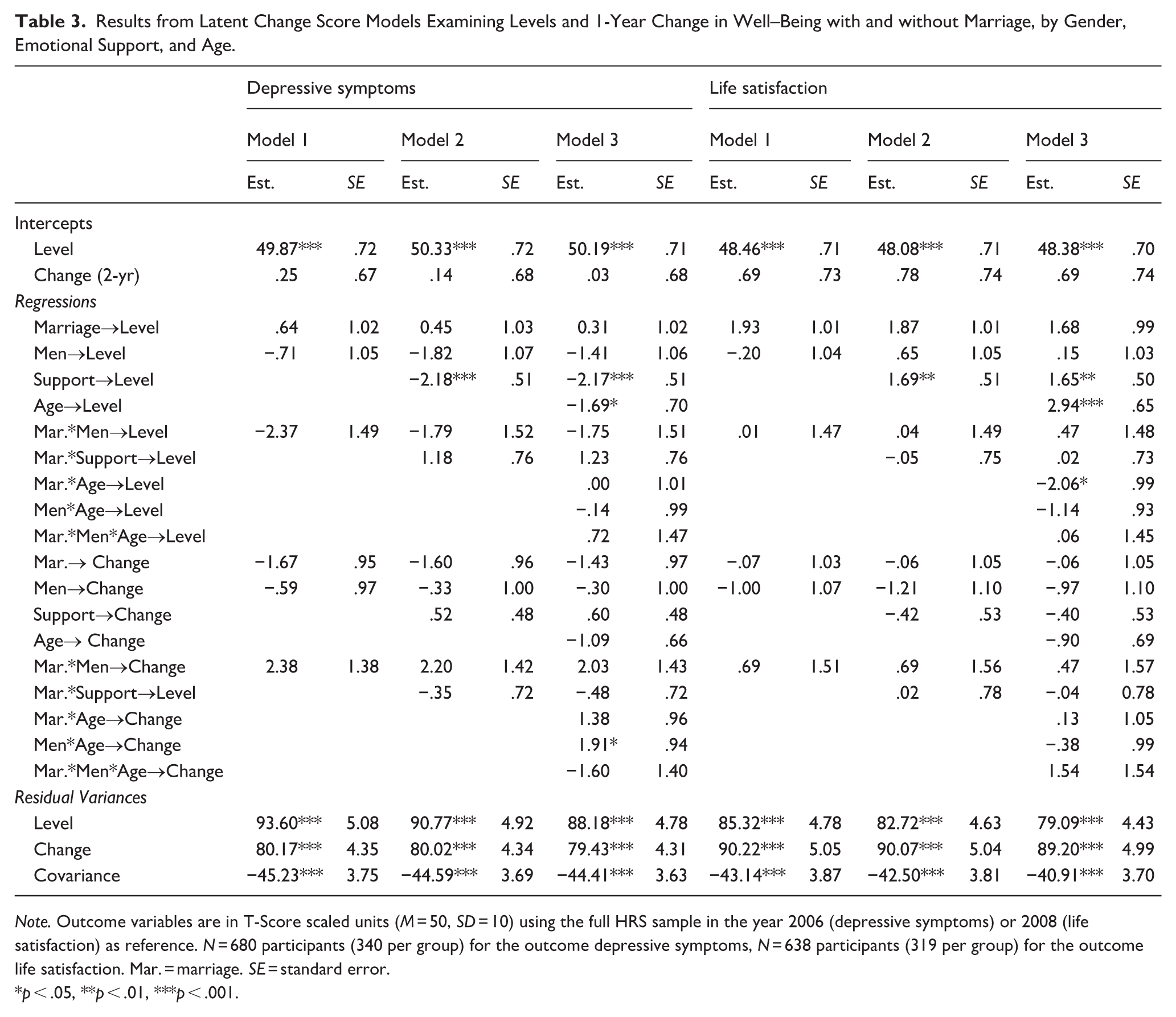
Note. Outcome variables are in T-Score scaled units (M = 50, SD = 10) using the full HRS sample in the year 2006 (depressive symptoms) or 2008 (life satisfaction) as reference. N = 680 participants (340 per group) for the outcome depressive symptoms, N = 638 participants (319 per group) for the outcome life satisfaction. Mar. = marriage. SE = standard error.
p < .05, **p < .01, ***p < .001.
Results from Latent Change Score Models Examining Levels and 1-Year Change in Well–Being with and without Marriage and Moving in, by Gender, Emotional Support, and Age.
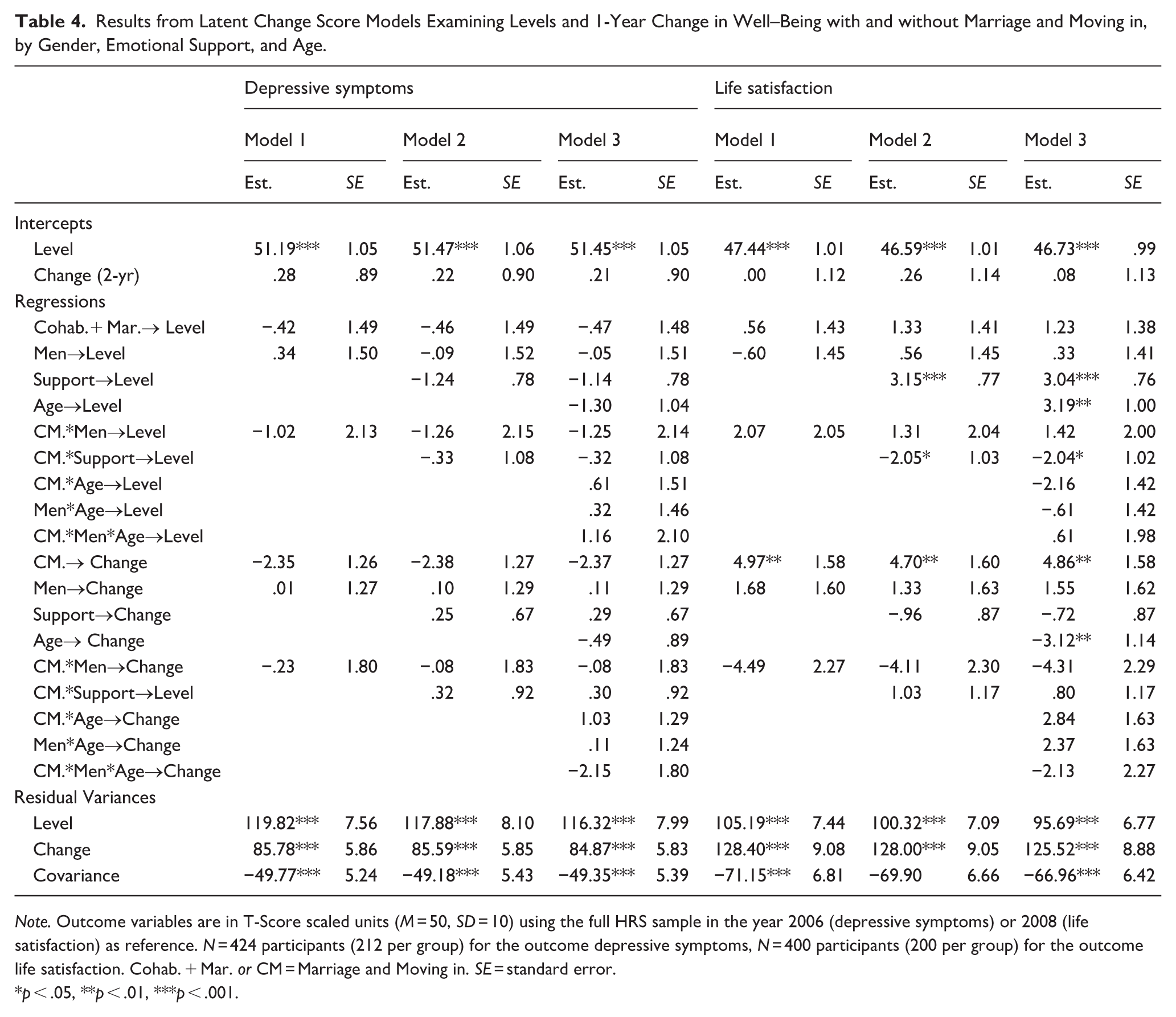
Note. Outcome variables are in T-Score scaled units (M = 50, SD = 10) using the full HRS sample in the year 2006 (depressive symptoms) or 2008 (life satisfaction) as reference. N = 424 participants (212 per group) for the outcome depressive symptoms, N = 400 participants (200 per group) for the outcome life satisfaction. Cohab. + Mar. or CM = Marriage and Moving in. SE = standard error.
p < .05, **p < .01, ***p < .001.
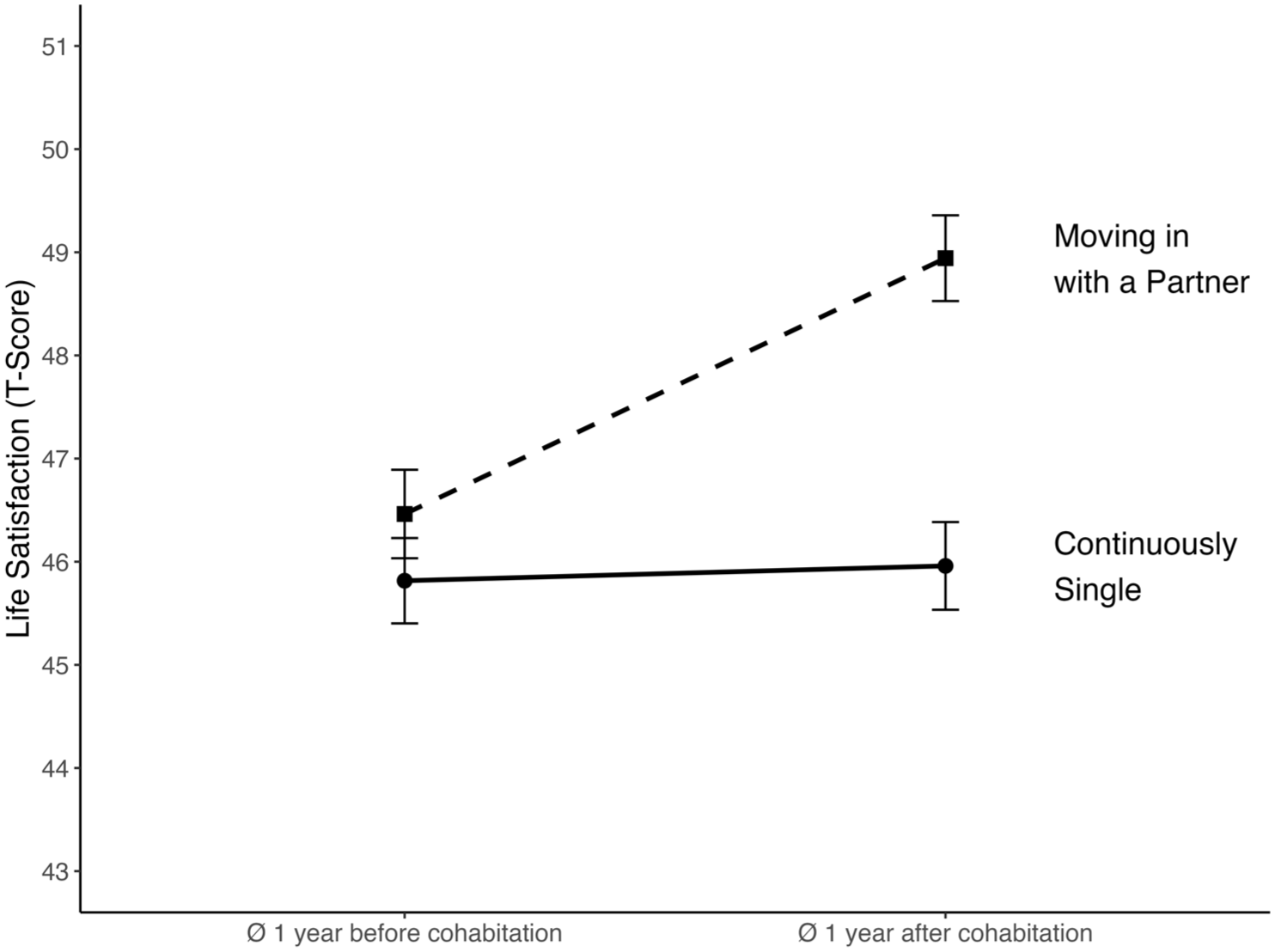
The Effect of Moving In on Life Satisfaction.
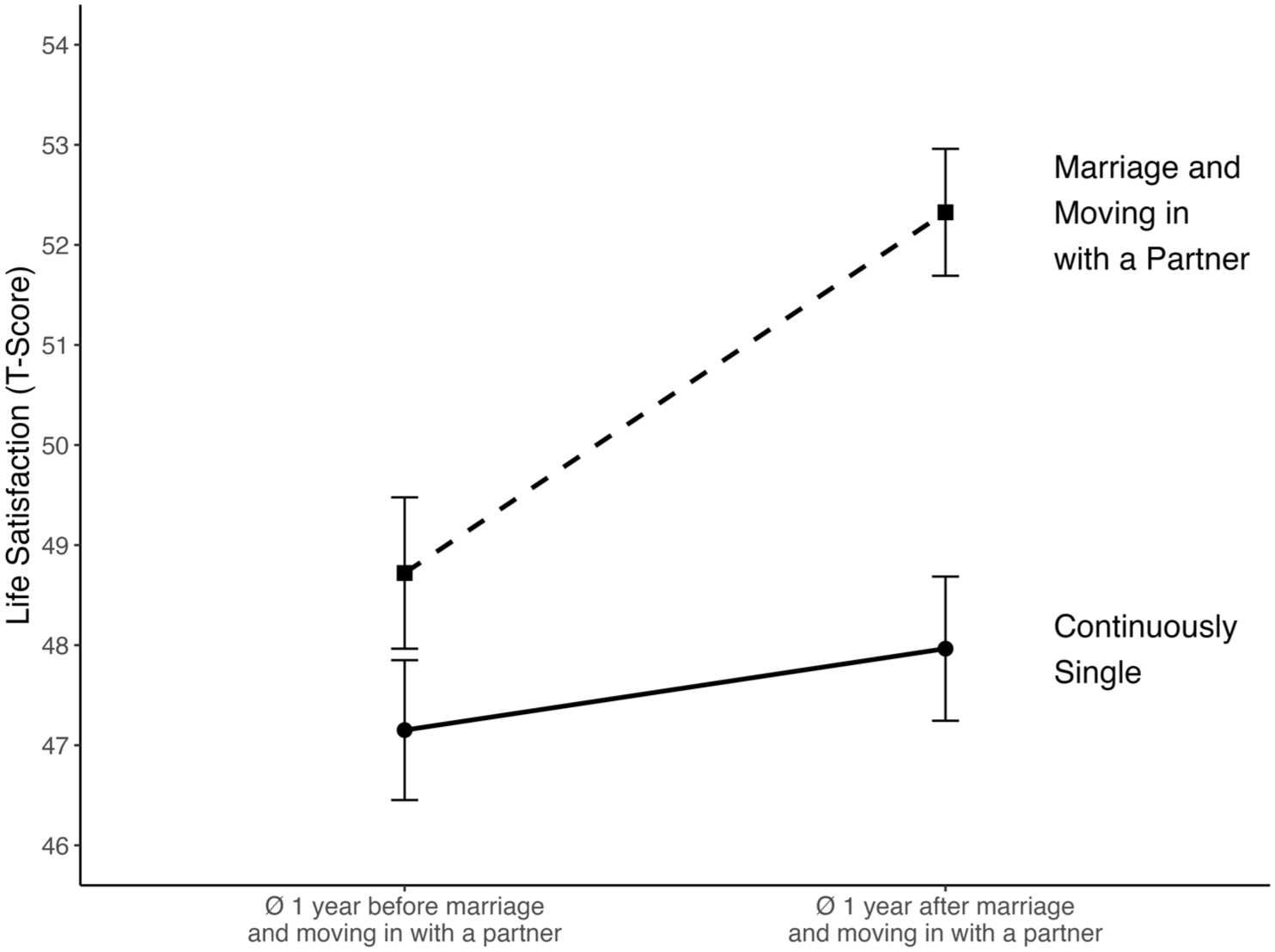
The Effect of Marriage and Moving In on Life Satisfaction.
Follow-Up Analyses
We acknowledge that using the maximum support score across the three sources deviates from prior research; therefore, we addressed this point in preregistered follow-up analyses. The direction and size of associations between emotional support and changes in well-being did not differ between the three operational definitions used to index sources of emotional support (friends, family, or children) or between the average and maximum score operationalizations across the three sources. Baseline associations for average support aligned closely with those for maximum support, showing consistently positive associations with life satisfaction and, in several models, negative associations with depressive symptoms. Child support was not linked to well-being in any of the models. In contrast, at baseline, friend and family support were positively associated with depressive symptoms in some models, whereas family support, but not friend support, was associated with life satisfaction in most models. Full statistical details are provided in the Online Supplement S6.
The take-home questionnaire, which included the emotional support measure, was completed by approximately 60% of recipients per wave, substantially reducing the sample available for constructing transition and matched control groups. To evaluate the robustness of our findings, we conducted non-preregistered follow-up analyses, replicating the matching and latent change score models on samples with and without emotional support data (see Online Supplement S7). Consistent with the main analyses, there were no significant main or interaction effects of marriage on either outcome, and moving in—whether combined with marriage or not—was associated with increases in life satisfaction. However, life satisfaction did not show a general declining trend in the separation analyses. Moreover, separation showed no main effect, but an interaction effect: life satisfaction decreased among men who experienced separation, but not among women. The unexpected decline observed in the main separation analyses, as well as the relatively smaller decrease among people who separated, should therefore be interpreted with caution, as these effects do not appear robust across changes in sample selectivity. In contrast, the robustness analyses support our conclusions regarding marriage, moving in, and the combination of marriage and moving in.
Discussion
In the present study, we examined whether men experience stronger declines in well-being following separation, and stronger well-being increases following moving in or marriage, whether these gender differences are associated with emotional support before the transition, and whether they are more pronounced among middle-aged than older adults. In contrast to our hypothesis, we did not find well-being decreases among men or women following separation. There was no evidence of gender-specific effects on well-being changes when moving in or when marrying. Differences in emotional support and age were not related to the size of transition-related effects in the main analyses. Moving in, whether combined with marriage or not, was generally associated with increases in life satisfaction.
The Effect of Separation on Changes in Well-Being
In our main analyses, life satisfaction declined in both the separation group and, surprisingly, even more so in the continuously partnered control group. However, this pattern did not replicate in the less selective follow-up analyses, in which separation was associated with decreases in life satisfaction among men but had no effect among women. Given this inconsistency and the unexpected decline in the matched control group, who experienced no relationship transition but were in continuous relationships, this effect is likely attributable to sample selectivity rather than a substantive phenomenon. We therefore refrain from interpreting this pattern theoretically. Overall, the inconsistency in findings concerning the separation analyses also suggests that our main analytic sample may have been too selective to adequately capture potential gender differences. Importantly, although men tended to report lower emotional support than women, the vast majority of both men and women received medium to high levels of support. Because emotional support was assessed in an optional home questionnaire, individuals with particularly low support levels may have been less likely to complete it.
Previous studies have reported gender-specific effects of separation on well-being (Chipperfield & Havens, 2001; Luhmann & Eid, 2009; van Scheppingen & Leopold, 2020). These gender differences may be driven especially by men with low support levels. For example, Carr (2004) found that widowed men showed a stronger desire for remarriage and dating than women, an effect driven by men with low emotional support from friends. This may reflect men’s greater reliance on their partner for emotional closeness. Our results thus contribute to the recently proposed theoretical model on gender differences across relationship phases (Wahring et al., 2026) by suggesting that such gender differences may be less universal than proposed and may apply primarily to men with particularly low levels of emotional support.
On the other hand, in the more general well-being domains studied here—life satisfaction and depressive symptoms—middle-aged and older men and women may adapt relatively quickly to life without a partner, such that negative effects for our main sample (and women in the follow-up analyses) are no longer detectable within the two-year observation window. However, well-being domains that are more closely tied to social fulfillment, such as loneliness, may show stronger and more persistent effects over time (Wahring et al., 2025). Although the HRS includes a multi-item measure of loneliness, it is assessed only every four years, which prevents its use in the present study.
The Effects of Marriage and Moving in on Changes in Well-Being
In contrast to our hypothesis, but in line with prior studies (Blekesaune, 2018; Kim & McKenry, 2002; Luhmann et al., 2012), we found that moving in and the combined events of marriage and moving in equally affected men’s and women’s well-being in a positive direction. These findings were replicated in robustness analyses that extended the main sample with participants who had not completed the emotional support measure. Returning to the theoretical model on gender differences across relationship phases (Wahring et al., 2026), our results suggest that, contrary to our initial reasoning, moving in or marrying may not produce gender-specific gains in emotional intimacy that are strong enough to translate into gender-specific changes in well-being. Instead, entering a relationship may be the more decisive transition for changes in emotional support, whereas levels of emotional support may remain relatively stable once a relationship is already established. Accordingly, a recent study in young adults found that transitioning from singlehood to relationship involvement was associated with increases in life satisfaction, particularly among men (Qin et al., 2025).
Unfortunately, in the HRS, individuals who are neither living with a partner nor married are categorized as single. In practice, however, some participants who move in with a partner may have been in that relationship for years prior to cohabitation. Conversely, many participants who moved in within our two-year window may have entered the relationship around the same time, meaning that what we interpret as an effect of moving in may partly reflect the well-established boost in well-being following relationship formation (Bühler et al., 2024). In summary, although our findings contradict the notion that moving in or getting married produces gender-specific changes in well-being, gender-specific effects of relationship formation later in life may still exist. We therefore encourage future research to distinguish more carefully between single individuals and those in non-cohabiting relationships whenever possible.
We did not find changes in well-being following the marriage of partners who had been cohabitating before marriage. Findings from the scarce prior research that differentiated between marriage of cohabitation, and the combined event of both transitions are mixed: One study on young and middle-aged adults reported a similar result as ours, in that marriage was only associated with a decrease in doctoral visits due to mental health complaints when accompanied by moving in, suggesting that mental health only benefited from the combined event (Kravdal et al., 2023). Other research focused on young and middle-aged adults found that marriage of cohabitating couples and marriage without prior cohabitation had equally positive effects on well-being (Lucas & Clark, 2006; Musick & Bumpass, 2012). Importantly, while cohabitation without marriage was rare and stigmatized a few decades ago, it is now common across different age groups (Wright & Brown, 2017). This societal shift may explain why earlier studies found stronger well-being benefits when moving in was combined with marriage, whereas today, the effect of marriage alone may be less pronounced.
Limitations and Future Directions
We note several limitations of our study measures, sample, and design. First, emotional support levels were generally high in our sample, limiting variability and potentially obscuring associations with well-being changes during relationship transitions. Moreover, participants with higher well-being—who also likely had higher support levels—were more likely to complete the emotional support measures than the full HRS sample, suggesting a potential selection bias in our sample. Future longitudinal studies should examine emotional support in less privileged samples. Second, we focused on emotional support before the transitions, but in the context of separation, support from friends, family, and children during the immediate post-transition phase may be particularly important. Although we emphasized the general importance of support for well-being, previous research highlights that social resources become especially vital during stressful times (e.g., DeLongis et al., 1988). Future studies should therefore aim to disentangle whether it is the loss of partner support or the availability of support from friends and family after the separation that is more important for well-being changes. Finally, while we focused on emotional support, other support types warrant attention. For example, instrumental support such as help with walking or eating may be crucial for well-being changes after separation, particularly if a partner was the main support provider before the transition. So far, HRS only assesses whether participants receive these forms of help, but not from whom. We therefore recommend including questions on support providers in future waves.
Our study focused on heterosexual cisgender men and women, so findings may not generalize to lesbian, gay, bisexual, transgender, queer, intersex, and asexual (LGBTQIA+) individuals, whose experiences may differ due to links between sexual orientation and gender-nonconforming behaviors and attitudes (Kahn & Halpern, 2019). In addition, our US-based sample reflects a Western, high-income context with a gendered division of labor, but social networks and gender roles vary cross-culturally. Future cross-cultural research could extend our findings by examining predictors of well-being changes in different countries. For instance, one study found emotional support more strongly tied to well-being in interdependent cultures such as Japan and the Philippines than in more independent Western contexts (Uchida et al., 2008).
A key limitation of our design is that we considered data from only one partner within a couple, which precludes dyadic analyses and limits conclusions about mutual influences within relationships. While data from both partners were available for a subset of couples, including them would have drastically reduced the analytic sample and likely increased sample selectivity. We therefore focused on individual-level reports. However, we encourage future studies to build upon our findings to study relationship transitions from a dyadic perspective.
Moreover, the panel data analyzed here were obtained at approximately two-year intervals, including pre-transition measurements about one year before and after each transition. Thus, for most participants, the data likely do not capture the immediate effects of transitions. These short-term effects may be stronger but also similar for men and women, as the mere occurrence of a relationship transition may elicit emotional reactions that are largely shared across genders. Our design also did not capture longer-term consequences or antecedents of relationship dissolution. For instance, prior research shows that divorce is often preceded by a multi-year decline in well-being, followed by a further drop in the year of divorce, and eventual recovery (van Scheppingen & Leopold, 2020). Over longer time periods, relationship transitions may have more pronounced effects on men’s well-being than on women’s, particularly for men who separate and do not repartner, as the lack of emotional support may lead to sustained declines. While HRS would, in principle, allow us to include additional waves before and after transitions, we chose not to include more distant time points to avoid a drastic reduction in sample size.
Conclusion
In summary, we found that separation was not associated with decreases in well-being among either gender. Moving in, whether this was accompanied by marriage or not, was associated with increased well-being, independent of gender, emotional support, and age. In contrast, marriage among cohabitating couples did not affect well-being. Our study underscores the importance of considering the potential co-occurrence of relationship transitions.
Supplemental Material
sj-docx-1-jbd-10.1177_01650254261419712 – Supplemental material for Relationship transitions and well-being in middle-aged and older men and women
Supplemental material, sj-docx-1-jbd-10.1177_01650254261419712 for Relationship transitions and well-being in middle-aged and older men and women by Iris V. Wahring, Urmimala Ghose, Christiane A. Hoppmann, Nilam Ram and Denis Gerstorf in International Journal of Behavioral Development
Footnotes
Ethical Considerations
The analysis was exempt from an IRB review because it is based entirely on archival data available in the public domain, which were collected in compliance with high ethical standards.
Consent to Participate
Before each interview, participants were provided with a written informed consent information document.
Consent for Publication
Not applicable.
Funding
The authors received no financial support for the research, authorship, and/or publication of this article.
Declaration of Conflicting Interests
The authors declared no potential conflicts of interest with respect to the research, authorship, and/or publication of this article.
Data Availability Statement
We used data from the Health and Retirement Study (HRS), a longitudinal biennial US panel study with repeated observations, sponsored by the National Institute on Aging (grant number NIA U01AG009740) and conducted by the University of Michigan (University of Michigan, 2024a, 2024b). A more detailed description of the study can be found in Sonnega et al. (2014). Data are freely available at https://hrs.isr.umich.edu/data-products. This study’s hypotheses and analysis strategy were preregistered (https://osf.io/bfnqc). Code for data preparation and analyses is provided on the OSF project site ( ).
).
Supplemental Material
Supplemental material for this article is available online.
References
Supplementary Material
Please find the following supplemental material available below.
For Open Access articles published under a Creative Commons License, all supplemental material carries the same license as the article it is associated with.
For non-Open Access articles published, all supplemental material carries a non-exclusive license, and permission requests for re-use of supplemental material or any part of supplemental material shall be sent directly to the copyright owner as specified in the copyright notice associated with the article.
