




Abstract
As technology becomes more ingrained in everyday life, people are increasingly faced with information about others. Social comparisons provide opportunities for evaluations, and thus, a chance for improvements, but they can also be sources of stress in cases where individuals feel less competent than the comparison target. Parents as a group are active comparers, but few studies have explored potential consequences of parents’ comparisons. In this study, we examined how parents’ comparisons on social media, as well as their positive and negative feelings while comparing, were associated with parental self-efficacy (PSE) and distress over time. We included 278 Swedish parents (85% mothers) of children below the age of 5. Parents offered data at three annual time points, and we performed cross-lagged panel models and mediation models including social comparisons, PSE, and distress (i.e., stress and depression). Results showed that negative feelings when comparing with others predicted decreases in PSE and increases in parents’ distress over time, and—with the exception of one significant reverse path in which depression predicted increases in parents’ general tendency to compare—there was little empirical support for effects in the opposite direction. In contrast, positive feelings when comparing, however, did not predict changes in PSE or distress. Hence, results suggest that parents’ beliefs and well-being are outcomes rather than predictors of parents’ comparisons, and negative feelings when comparing are of essential importance. These results imply that parents’ negative emotional reactions during comparisons can gradually erode their efficacy and increase distress, suggesting that such comparisons shape—not simply reflect—parental well-being.
Introduction
What makes a good parent, and how can you know if you are good enough? These are questions that many parents of young children ask themselves. To answer these questions, parents often observe other parents to get ideas about how to act and to evaluate their own capacities. From a developmental perspective, comparing oneself with others in similar situations can be particularly important when entering new roles in life, for example, when becoming a parent. Specifically, parents of young children are developing their parenting identity (Alstam, 2016) and comparing oneself with others may be a crucial aspect of the evolving process of becoming a parent. As technology becomes more ingrained in everyday life, parents’ comparisons often take place online, most commonly on social media platforms. In fact, most parents use social media daily (e.g., Glatz et al., 2023), and those who use it more frequently tend to make comparisons with other parents to a greater extent than those parents who use social media less frequently (Coyne et al., 2017; Sun et al., 2023). Consequently, parents today have more opportunities to make social comparisons, extending beyond their immediate social circles.
Social media can offer unique opportunities for parents to receive and give support. In fact, most parents appreciate the instant feedback and support that they receive on social media (Drafarova & Trofimenko, 2017; Egmose et al., 2022; Strange et al., 2018), and it has the potential to strengthen parents’ sense of competence. Specifically, seeing how other parents navigate similar challenges can offer useful benchmarks and reassure parents that they are not alone in their struggles. Even when parents compare themselves with others who appear to be doing well, these comparisons can serve as a source of inspiration and highlight opportunities for self-improvement. However, for other parents, comparisons on social media can result in feelings of not being good enough, which in turn can cause psychological problems (Egmose et al., 2022). This might be especially true when parents compare with celebrity influencers (e.g., InstaParents, see San Cornelio, 2021), as these parents often portray a lifestyle that is difficult to attain (Chae et al., 2024). Hence, social media provides a context in which both parenting struggles and successes are visible, making social comparisons a central mechanism through which parents evaluate themselves.
Despite the importance of comparisons for parents, only a handful of studies have explored how social comparisons influence parents, and none have examined the associations over time. The few existing studies have examined its relation to either well-being (e.g., depression) or parents’ beliefs (e.g., parental self-efficacy [PSE]; Bandura, 1997; Jones & Prinz, 2005), both well-established predictors of positive parenting practices (see Glatz et al., 2024, for a review). Because positive parenting is essential for child development and well-being, understanding its predictors is of importance. In this study, we take a developmental approach and examine changes over time in parents’ comparisons, well-being, and PSE—exploring the question whether comparisons on social media predict parents’ distress and beliefs, or vice versa. In addition, we test whether it is comparisons by themselves or rather feelings (both positive and negative) associated with these comparisons that are of importance for parents’ distress and beliefs.
Research on Parents’ Social Comparisons
Social comparison theory, developed in the early 1950s by Festinger (1954), describes the drive within individuals to make self-evaluations. Social comparisons help people evaluate themselves, as they think about others in relation to their own abilities and attitudes (Festinger, 1954; Gerber et al., 2018; Suls & Wheeler, 2000). Theory distinguishes between upward, downward, and lateral social comparisons (Wills, 1981). Upward social comparison involves comparing oneself to those who are perceived as more successful or competent, providing insight into potential self-improvement (Guyer & Vaughan-Johnston, 2018). In contrast, downward social comparison serves as a mechanism for self-enhancement, as comparing with those who are perceived as worse off can boost the person (Wills, 1981). Finally, lateral social comparison, or comparison with individuals perceived as similar, may serve as a tool for self-evaluation, helping individuals gauge their standing within a particular domain.
Comparisons take place in multiple contexts, but social comparisons online (e.g., on social media) typically differ from those offline, both in their content and in the comparison targets. Because people have greater control over what they share online than in offline situations, the image of parenting presented online is often narrower and more positively skewed. Importantly, this image may differ across online contexts, as some spaces allow more nuance while others are more constrained in what users are encouraged to share. For example, in some parenting forums, sharing challenges is more acceptable than in other, more public, forums. In general, research suggests that the overly positive representations commonly shown on social media might explain negative effects of internet use on people’s well-being (Verduyn et al., 2020; Yoon et al., 2019). Comparisons on social media can come to shape parents’ beliefs as well as their well-being, as it might work as a point of reference to model against. Ultimately, when comparing with others, parents recognize themselves as acting “correct,” and as “good” parents, which can have a positive impact on their views about themselves (Alstam, 2016; Plantin & Daneback, 2009; Price et al., 2017). However, the same processes might put a heavy burden on those who perceive themselves as “not good enough” parents, which might have a negative impact on their beliefs and well-being. Parents have described that social media often are used to “show off” a perfect life and parenting (Drafarova & Trofimenko, 2017). Similarly, comparisons with others might have either a positive or negative influence on parents’ level of distress, as evaluation of oneself is closely linked to general feelings of well-being (Festinger, 1954). As images online might present an overly positive view of parenting, social media is a suitable context to study reasons and consequences of parents’ comparisons.
In general, results show that parents who do more social comparisons also report worse well-being, more worries, and less sense of competence (Coyne et al., 2017; Egmose et al., 2022; Padoa et al., 2018). One study showed that following mothering profiles on Instagram (i.e., InstaMoms) was linked to more anxiety among mothers who tended to compare with others to a greater extent (Moujaes & Verrier, 2021). Another study showed that information online sometimes can result in negative feelings about oneself as a parent, because of positive images on social media (Drafarova & Trofimenko, 2017). Although the studies above have moved the field forward examining parents’ comparisons on social media, they have focused on social comparisons in general, without considering the full emotional context of the comparisons. In fact, theory argues that feelings associated with different types of comparisons are of importance for parents’ well-being and beliefs (Smith, 2000). Hence, an additional line of research deals with comparison-based emotions, and their impact on parents. Results from two studies on parents’ comparisons on social media (Amaro et al., 2019; Sidani et al., 2020) showed that when parents felt worse or less competent than other parents, they reported higher levels of depression (Sidani et al., 2020) and less parental satisfaction (Amaro et al., 2019). A recent study (Glatz et al., 2023) showed that negative feelings when doing comparisons on social media were linked to more distress and lower levels of PSE. Positive feelings when comparing predicted an increase in PSE, but it did not explain changes in parents’ level of distress. To advance the field, studies need to explore associations involving both general comparisons and the feelings that accompany them, to gain a better understanding of parents’ comparisons as a phenomenon shaping contemporary parenting.
The studies cited above suggest a negative impact of social comparisons on parents’ well-being and beliefs, with tendencies that negative feelings when comparing are of specific importance. One limitation with this area of research is the reliance on cross-sectional study designs. Therefore, little is known about long-term consequences of social comparisons. Hence, there is currently no answer to the following question: Are more social comparisons associated with reduced well-being and satisfaction or are parents with lower levels of well-being and satisfaction more prone to compare with others? There are theoretical and empirical support for unidirectional and bi-directional associations among parents’ social comparisons, distress, and PSE.
First, social comparisons might be associated with reduced well-being and satisfaction, as driven by mechanisms such as self-evaluation, social learning, and motivational goals. The function of self-evaluation, which is the foundation of social comparison theory, assumes that comparisons should result in positive or negative feelings and beliefs about oneself (Festinger, 1954). When people compare with others, they evaluate how they are doing, and they also get a sense of what is desirable or appropriate in a given situation (Bandura, 1977). These self-evaluations have the potential to change a persons’ beliefs and feelings about oneself (Gerber et al., 2018). These ideas, however, assumes that it is the emotions, rather than simply doing comparisons, that are of importance for potential consequences (Smith, 2000). More specifically, parents who feel negative when comparing with other parents might, as a result, feel less efficacious and more distressed. On the contrary, parents who feel positive when comparing with other parents would feel more efficacious and less distress. This would be a result of mastery feelings, as parents feel successful in their parenting role (Bandura, 1997). Hence, a first hypothesis about the direction of the association would stipulate a unidirectional link in which parents’ comparisons would predict changes in their distress and PSE.
Second, a persons’ well-being and beliefs can predict more frequent social comparisons, influenced by emotional states and validation-seeking behaviors. Earlier studies have shown that people compare themselves to manage emotions (Aspinwall & Taylor, 1993) and to reduce negative affect (Wills, 1981, 1991). Specifically, social comparisons might play a central role in coping with stressful life events (Taylor et al., 1983, 1990). This suggest that well-being might influence comparisons, and parents who feel more distressed would compare with other parents to a greater extent than parents who feel less distress. For parents’ beliefs, it is possible that parents with low levels of efficacy engage in social comparisons to get external validation or confirmation on their doubts (Bandura, 1997). Furthermore, it is possible that well-being and beliefs might determine feelings while comparing, in addition to predicting more comparisons in general. Specifically, when parents who feel less efficacious and more distress compare with other parents, this might result in negative feelings as the comparison exacerbate the negative feelings and inadequacy. On the contrary, parents who feel efficacious and low levels of distress would feel strengthened by comparisons, and, thus, feel positive when comparing. Thus, as a second hypothesis about the direction of the association is that parents’ distress and PSE would predict changes in their comparisons over time.
Third, social comparisons and personal factors might interact in a dynamic feedback loop, shaping and reinforcing each other over time. Specifically, people who experience worse subjective well-being tend to compare more than people with better well-being, but comparisons might also worsen peoples’ well-being (Verduyn et al., 2020). This describes a feedback loop, in which parents who feel distressed and low on efficacy might engage in comparisons that further decrease their well-being, leading to more frequent and potentially more negative comparisons. Hence, as a third hypothesis, there might be a bi-directional association in which parents’ comparisons predict changes in their well-being/self-efficacy and vice versa.
Fourth, the models above suggest a direct link between social comparisons and both PSE and distress. However, this relationship may be more complex than a straightforward association. Social comparison theory (Festinger, 1954) suggests that social comparisons can influence PSE and well-being through two key mechanisms. Comparisons might have an indirect effect by shaping a parents’ beliefs about their parenting abilities (i.e., PSE), which in turn impacts their well-being. For instance, consistently comparing oneself to seemingly more capable parents might lower PSE, leading to increased stress or depressive symptoms. In addition, comparisons might exert a direct influence on emotional states, where negative feelings triggered by comparisons lead to distress, which over time undermines a parents’ sense of efficacy in their parenting role. These mechanisms highlight the intricate ways in which social comparisons can shape both parental beliefs and well-being, through a mediational process.
The Present Study
In this study, we examined the longitudinal associations among parents’ comparisons, PSE, and distress (i.e., stress and depression as a proxy for parents’ negative well-being). In addition, to test the idea that it is parents’ feelings when comparing, rather than the comparisons in themselves, that drives the associations, we used measures of parents’ comparisons on social media in general (i.e., if they compare or not) as well as their positive and negative feelings when doing comparisons. We conducted theory-driven constrained cross-lagged panel models (CLPMs) to test for the direction of the associations between comparisons, on the one hand, and parents’ distress and beliefs, on the other hand. Furthermore, we examined the mediational roles of distress and self-efficacy. We used a three-wave longitudinal dataset including parents of children under the age of 5 at the first time point (T1). While people compare at all ages, parents of younger children often seek comparisons online (de los Santos et al., 2019) and they have shown to post more photos of their children online than parents of older children (Conti et al., 2024). This makes it an essential group to study social comparisons and their effects. We pose the following research questions and hypotheses:
Research Question 1: What is the direction of influence between social comparisons, on the one hand, and PSE and distress, on the other hand? We tested three competing hypotheses: More comparisons on social media will predict increases in distress and decreases in PSE over time (Hypothesis 1); More distress and lower PSE will predict increases in comparisons on social media over time (Hypothesis 2); There is a bi-directional association between comparisons and distress/PSE over time (Hypothesis 3).
Research Question 2: Are the longitudinal associations different for positive versus negative feelings when doing comparisons? We hypothesized that feelings (both positive and negative) when doing comparisons will be more strongly associated with parents’ distress and PSE than will comparison on social media in general (Hypothesis 4). Specifically, negative feelings will predict an increase in distress and decrease in PSE, whereas positive feelings will predict a decrease in distress and an increase in PSE. However, we hypothesized that negative feelings when doing comparisons will be more strongly associated with parents’ distress and PSE over time than will positive feelings when doing comparisons (Hypothesis 5). This hypothesis is based on the few earlier studies in which negative feelings have shown stronger associations than positive feelings when comparing.
Research Question 3: Do feelings of distress or PSE help explain how social comparisons affect parents? To explore this, we looked at two possible pathways: (1) The mediating role of PSE between comparisons on social media and parents’ distress (comparisons→PSE→distress), and (2) The mediating role of distress between comparisons on social media and PSE (comparisons→distress→PSE).
Method
Procedure and Participants
In this study, we used data from a larger project including 422 parents of children under 5 years of age at T1 (Mage = 1.29 years). Parents reported on an annual online survey at three time points. Time Point 1 (T1) took place in 2020, Time Point 2 (T2) 1 year later in 2021, and Time Point 3 (T3) an additional year later in 2022. Parents were recruited at family centrals (i.e., voluntary meeting place for parents at health care centers) in a mid-sized town in Sweden (population 154.000 in year 2019) or online (via advertisement on parenting sites and forums, parenting blogs, and on Facebook). No parents were deliberately recruited from the same family; thus, data should not be nested, and parents were treated as unrelated in the analyses. All parents responded to a survey via a secure online platform, which took approximately 20–30 min to complete. In compensation for participation, parents received 50 Swedish crowns (approximately 5 US dollars). This study was performed in line with the principles of the Declaration of Helsinki. Approval was granted by the Swedish Ethical Review Authority (Number: 2019-04790). This study was not preregistered, but the data are available from the corresponding author upon request.
For the present study, we included 278 parents with data at T1 and at least one consecutive time point (either T2 or T3, or both T2 and T3). Among these, 154 parents had data at all time points and 124 had data at two time points (either at T2 or T3). We compared parents who had data at all three time points (n = 154) with parents who had data at T1 and T2 (n = 95) or T1 and T3 (n = 29) to examine potential differences due to missingness. These groups differed significantly on two variables out of the 13 variables tested: Stress at T3 and positive feelings when comparing at T1. Those with data at all three time points reported more stress at T3 (M = 1.72; SD = 0.38) than parents with missing on either T2 or T3 (M = 1.55; SD = 0.32), t(181) = 2.21, p = .028. They also reported feeling more positive when comparing at T1 (M = 2.45; SD = 0.75) than parents with missing data (M = 2.24; SD = 0.78), t(273) = 2.22, p = .014. We also compared the groups on demographic variables, and the results showed that parents with no missingness were older (M = 33.46; SD = 5.20) than parents with missing data at one of the consecutive time points (M = 31.66; SD = 4.97).
Most of the parents were mothers (85%) and had a mean age of 32.65 years at T1 (SD = 5.17). Most parents had one (46%) or two children (41%), and there was an equal distribution of girls (51%) and boys in the sample (49%). Almost all parents (94%) lived together with a partner, either married or co-habitants. Most parents had a university degree (68%), 24% had a high school degree only. Concerning employment, 80% had a full-time job and the rest of the parents had a part-time job, were students, unemployed, or on sick leave.
Attrition Analyses
We excluded parents who offered data at T1 but not at T2 and T3. We compared parents who were included in our sample (n = 278) with parents who had data only at T1 (n = 149) on all variables at T1 (negative and positive feelings while comparing, PSE, stress, and depression). The two groups did not differ significantly on any of the variables. Hence, parents who were included in our study did not differ from parents who were excluded because they had data at T1 only.
Measures
Data were collected with a yearly survey including various parenting-related measures. Some measures were included at all times (e.g., parents’ distress, PSE) and other measures were included only at some of the time points (e.g., feelings when comparing at T1 and T2). The reason for differences in inclusion of measures was to avoid extensive surveys.
Since most of the instruments were not available in the target language, we undertook a translation and cultural adaptation process based on established guidelines for cross-cultural scale adaptation (e.g., Beaton et al., 2000). The procedure followed a multi-step approach aligned with the standards set by the International Test Commission (Hambleton, 2001). Initially, the research team reviewed all items to identify any culturally inappropriate content. Next, a researcher translated the items from English into the target language (forward translation), and a second researcher independently translated them back into English (back translation). The back-translated version was then compared to the original to identify inconsistencies, which were resolved through discussion. The translated items were pilot-tested with a convenience sample of 50 parents of children under 5 years old to assess clarity and cultural relevance.
Parents’ Social Comparisons on Social Media
A single item was used at T1 and T2 to measure parents’ comparisons on social media. “I compare with other parents on social media” and they responded on a Likert-type scale ranging from 1 (Strongly disagree) to 4 (Strongly agree). This measure was phrased similarly to earlier studies (e.g., Coyne et al., 2017; Padoa et al., 2018) to ensure replication of, and to build on, earlier findings.
Feelings While Doing Social Comparisons
We used two measures at T1 and T2 of parents’ positive and negative feelings when doing social comparisons on social media. These were developed for the specific research project and have been used in earlier publications (Glatz et al., 2023). These measures included four items each, which all had a strong basis in theory (Smith, 2000), earlier research, and social comparison scales (Allan & Gilbert, 1995; Amaro et al., 2019; Feinstein et al., 2013; Park & Baek, 2018; Sidani et al., 2020). The items captured parents’ positive and negative feelings regarding their own parenting in relation to other parents they see on social media. Parents responded on a Likert-type scale ranging from 1 (Strongly disagree) to 4 (Strongly agree). These measures were used in the present study to examine cross-lagged associations between feelings when doing social comparisons and parents’ distress and PSE.
The items of the negative feeling scale are as follows: “I get jealous when I see how other parents seem to be having it based on their posts and photos on SNS,” “When I see other parents’ photos and information on SNS, I feel like a bad parent,” “Based on other parents’ posts and photos on SNS, it seems as they are more in control of their parenting than I am,” and “I feel worried about my parenting and my child when I compare myself with other parents on SNS.” Cronbach alphas for the negative feelings scale were .79 and .83 at, T1 and T2, respectively. Items of the positive-feelings items are as follows: “Based on other parents’ posts and photos on SNS, I feel like I’m a better parent,” “When I compare myself with other parents on social media, I feel proud of the parent I am,” “I feel like a more competent parent than other parents I see on SNS,” and “When I compare myself with other parents on SNS, I feel satisfied with my parenting and my relationship with my child.” Cronbach alphas for the positive feelings scale were .84 at both T1 and T2.
Parental Self-Efficacy
To measure parental self-efficacy, we used the Karitane Parenting Confidence Scale by Črnčec and colleagues (2008). This measure was included at all three timepoints to enable examinations of cross-lagged associations with social comparison feelings, as well as potential mediations between social comparisons and parents’ distress. The scale consisted of 13 items covering both specific tasks, such as feeding and soothing, as well as items on general perceived competence. Examples are: “I can soothe my child when he/she is distressed,” “If my child has a common cold or a light fever, I am confident about handling this,” “I am confident about helping my baby to establish a good sleep routine,” and “I feel I am doing a good job as mother/father.” Parents responded to a Likert-type scale ranging from 1 (No, hardly ever) to 4 (Yes, most of the time). Cronbach alphas were .69, .74, and .76, at T1, T2, and T3, respectively.
Parental Distress
To measure parents’ perceived distress, we used two established scales. Similar measures have been used in association with social comparisons in earlier studies (Coyne et al., 2017; Moujaes & Verrier, 2021; Padoa et al., 2018; Sidani et al., 2020). These measures were used at all three time points in the present study.
First, we used the parental stress scale (Berry & Jones, 1995), which consists of 18 items measuring negative and positive components of the parenting role. Examples of items are: “The major source of stress in my life is my child(ren),” “Caring for my child(ren) sometimes takes more time and energy than I have to give,” “I enjoy spending time with my child(ren),” and “Having child(ren) gives me a more certain and optimistic view for the future.” Positive items were reversed so that higher values indicated more stress and negative feelings. Parents responded on a Likert-type scale ranging from 1 (Strongly disagree) to 4 (Strongly agree). Cronbach alphas were .87 at all three time points.
Second, we used the Center for Epidemiologic Studies Depression Scale (Radloff, 1977), specifically, the Swedish translated and validated version of this scale (for more information, see Gatz et al., 1993). Parents were asked to rate how often they experienced a list of 20 symptoms during the last week. Examples of symptoms are as follows: “I was bothered by things that usually don’t bother me,” “I felt that I was just as good as other people,” “I felt sad,” and “I felt hopeful about the future.” Some items were reversed, and higher values indicated higher levels of depression. Response options ranged from 1 (Rarely or none of the time) to 4 (Most or all of the time). Cronbach alphas were .92, .92, and .91, at T1, T2, and T3, respectively.
Statistical Analyses
We used Mplus 7.11 (Muthén & Muthén, 1998–2012). In all analyses, full information maximum likelihood (FIML) was used to handle missing data. FIML uses all existing information to estimate the parameters and has been identified as the least biased method of estimating missing information. To evaluate model fit, we report chi-square with degrees of freedom and p-value, and the following three indices: comparative fit index (CFI), root mean square error of approximation (RMSEA) with its associated confidence interval, and the standardized root mean square residual (SRMR). An SRMR value of ⩽0.09 together with a CFI value of ⩾.96 and an RMSEA value of ⩽.08 are considered indicators of acceptable fit (Byrne, 2012; Hooper et al., 2008). According to Hooper and colleagues (2008), an SRMR threshold of ⩽.09 is recommended for more complex models, in which stricter values (e.g., .08) may be too conservative. Finally, we used guidelines by Orth and colleagues (2024), to interpret the magnitude of cross-lagged regressions.
First, to answer Research Questions 1 and 2, we examined bi-directional associations specifically between social comparisons, on the one hand, and parenting aspects (i.e., PSE, stress, and depressive symptoms), on the other hand, between T1 and T2. This was done with two theory-driven constrained CLPMs in which cross-lagged paths were included only between the social comparison variables and the parenting aspects (PSE, stress, depression). Cross-lagged paths among the parenting aspects themselves were not estimated, as these were not relevant to our research questions and because our focus was specifically on the longitudinal associations between social comparisons and parenting factors. In the first model, we used parents’ reports on doing social comparisons on social media (one single item), and in the second model, we used parents’ positive and negative feelings when doing social comparisons, separated as two variables. PSE, distress, and the social comparison measures were used at both T1 and T2. Rank-order stability within all the variables between T1 and T2, within-time correlations among all the variables at T1 and T2, and cross-lagged paths between the variables from T1 to T2 were examined (see Figure 1 for the analytical model).
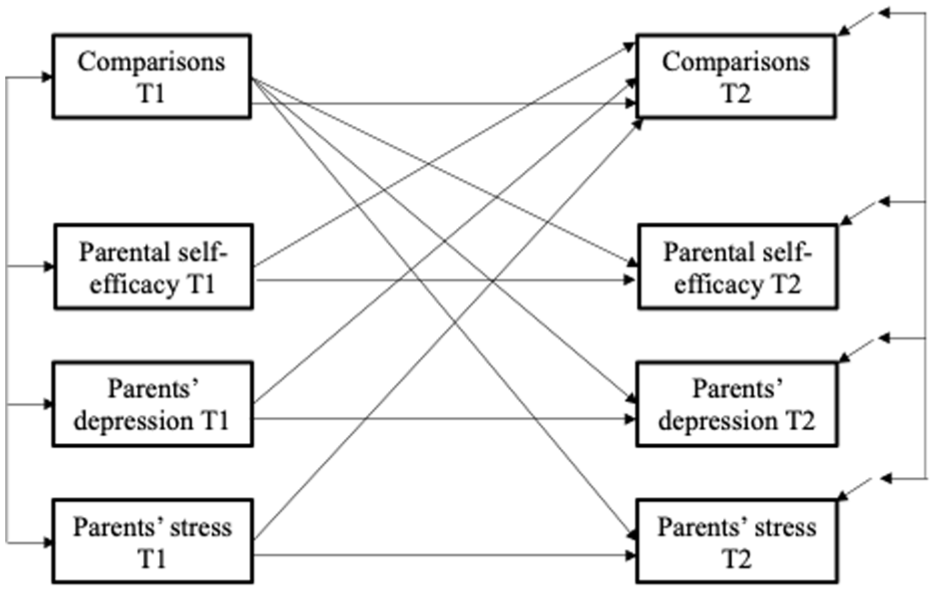
Theory-Driven Constrained Cross-Lagged Panel Model.
Second, and to answer Research Question 3, we conducted two mediational models: (1) social comparisons at T1 as a predictor of PSE at T3, using depression and stress at T2 as mediators (see Figure 2), and (2) social comparisons at T1 as a predictor of depression and stress at T3, using PSE at T2 as a mediator (see Figure 3). Because of the relatively small sample size, we ran these as separate models to avoid power issues associated with more complex models. To more accurately capture change across the three time points, we included stability paths in both the mediator and outcome variables—rank-order stability between T1 and T2 for the mediator (i.e., PSE or stress/depression), and between T1 and T3 for the outcome variable (i.e., PSE or stress/depression). These stability paths allowed us to examine the indirect effects from T1 to T3 while accounting for prior levels of the constructs. We also estimated within-time correlations among all variables at all time points.
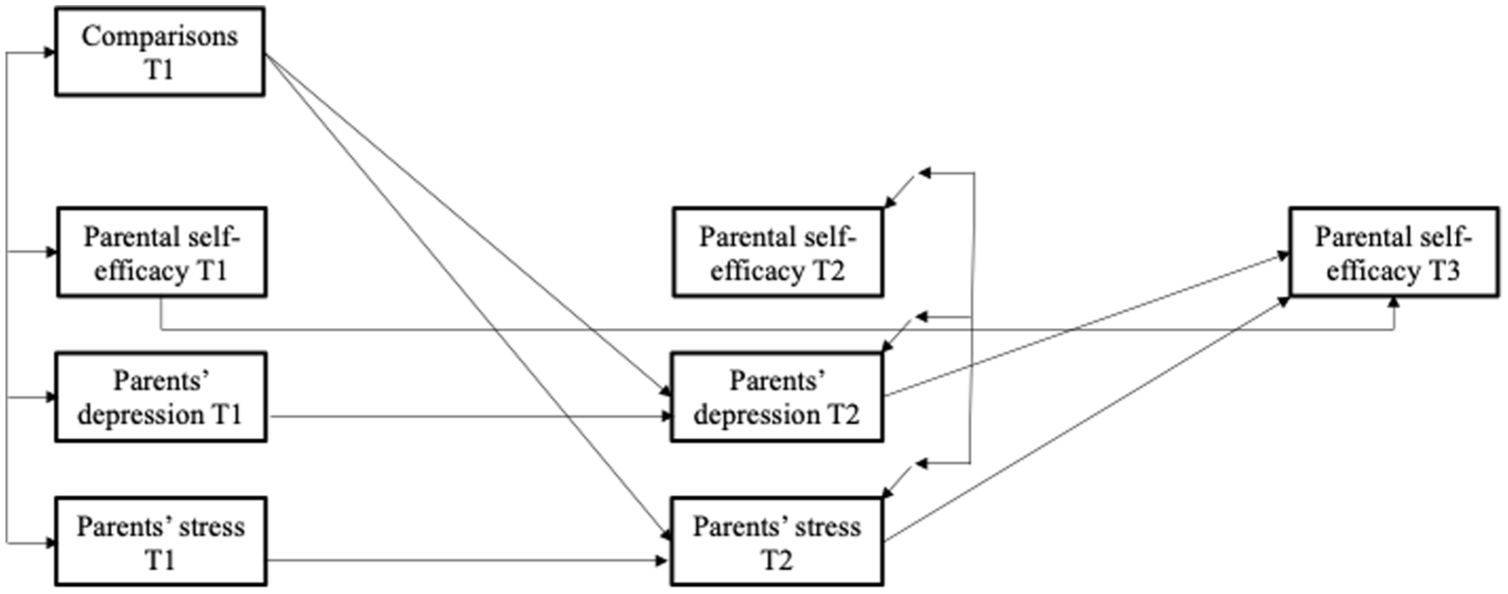
Analytical Model Testing Mediation With Depression and Stress as Mediators.
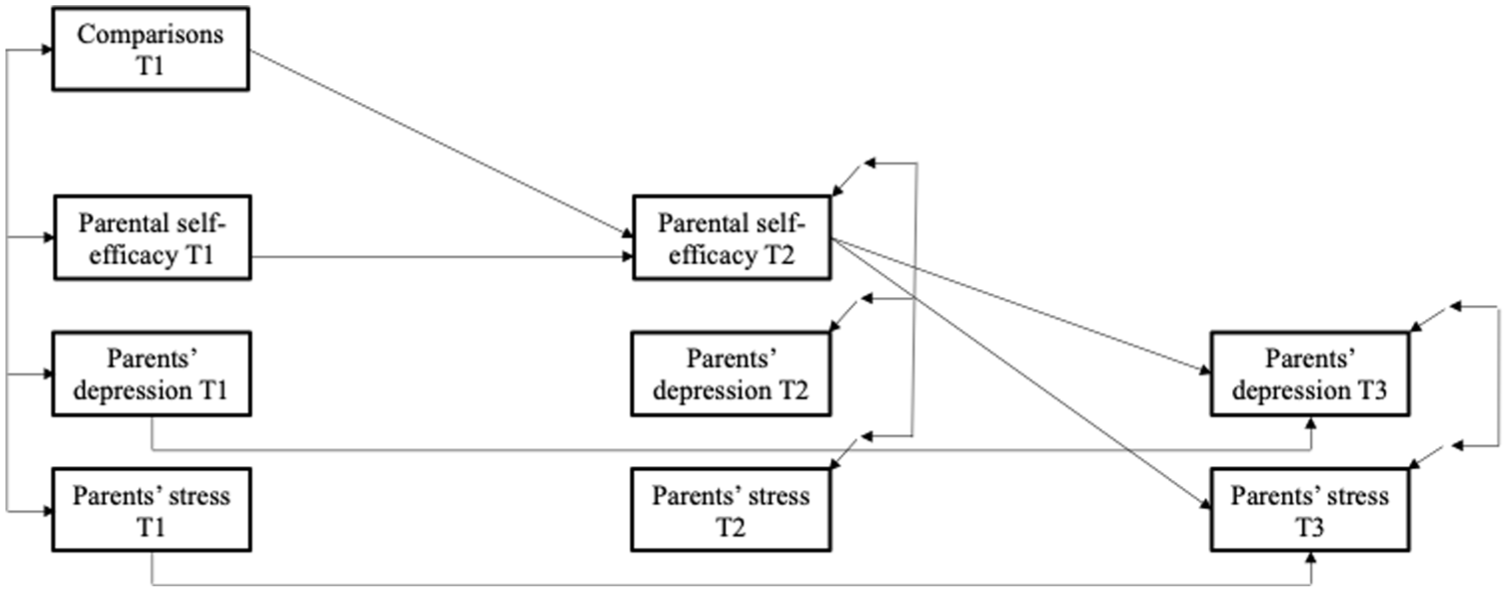
Analytical Model Testing Mediation With PSE as Mediator.
Results
Descriptive Statistics
As reported in Table 1, most measures showed strong absolute stability over time, with small differences between group-means at the different time points. Parents reported moderate levels of comparisons on social media (i.e., in the midpoint of the scale, Ms = 2.22 and 2.14; SDs = 0.88 and 0.84, for T1 and T2, respectively). Furthermore, parents reported higher levels of positive feelings when comparing (Ms = 2.36 and 2.37; SDs = 0.77 and 0.75, for T1 and T2, respectively) than negative feelings (Ms = 1.56 and 1.58; SDs = 0.56 and 0.57, for T1 and T2, respectively). Finally, absolute levels of PSE, stress, and depression were similar across the time points. On average, parents reported high levels of PSE, while their stress and depression levels were relatively low and similar in magnitude.
Means and Standard Deviations for all Study Variables.
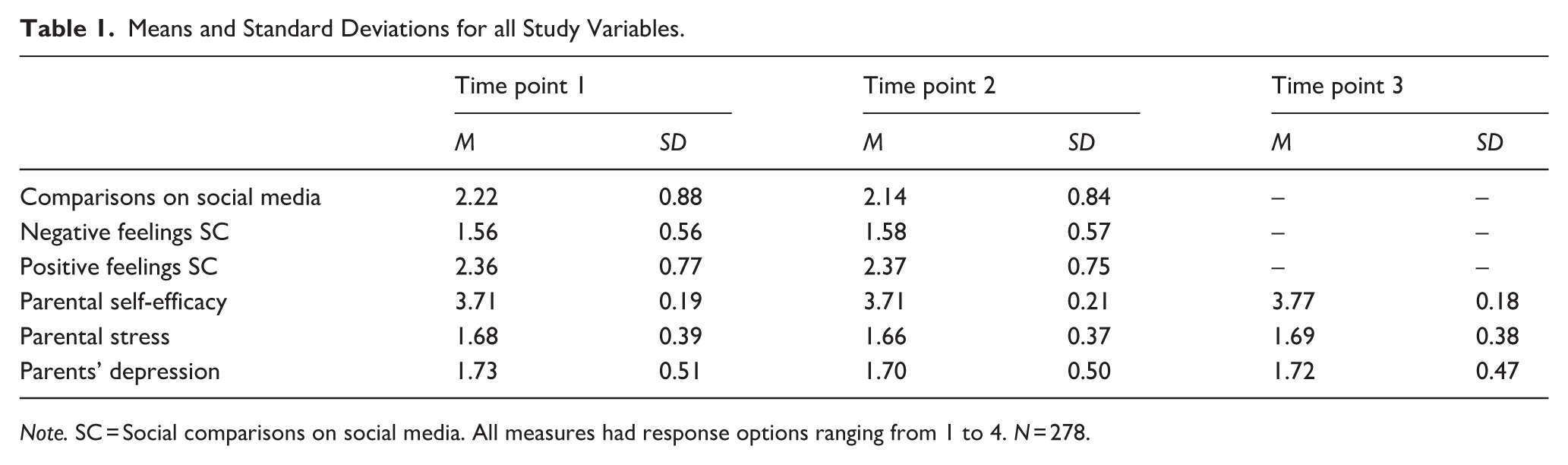
Note. SC = Social comparisons on social media. All measures had response options ranging from 1 to 4. N = 278.
We report bivariate correlations in Table 2. In addition to the absolute stability shown in the means above, all correlations between the social comparison measures at T1 and T2 were strong (rs = .64, .68, and .56, for social comparisons in general, negative feelings, and positive feelings, respectively), suggesting high rank-order stability and that individuals’ comparison patterns were quite stable over time. Similar correlation coefficients were found for distress (rs = .74–.83 and .61–.66, for stress and depression across T1, T2, and T3, respectively) and PSE (rs = .49–.61) across the time points. Comparisons on social media correlated significantly with both negative feelings and positive feelings when comparing. Correlations were somewhat stronger between comparisons in general on social media and negative feelings, than between comparisons in general and positive feelings. Analyses revealed consistent negative associations between social media comparison, as well as the negative emotions experienced during comparison, and PSE. These same comparison-related variables were also negatively associated with depression and stress. Positive feelings when comparing were not significantly correlated with PSE, depression, or stress.
Correlations Among Study Variables.
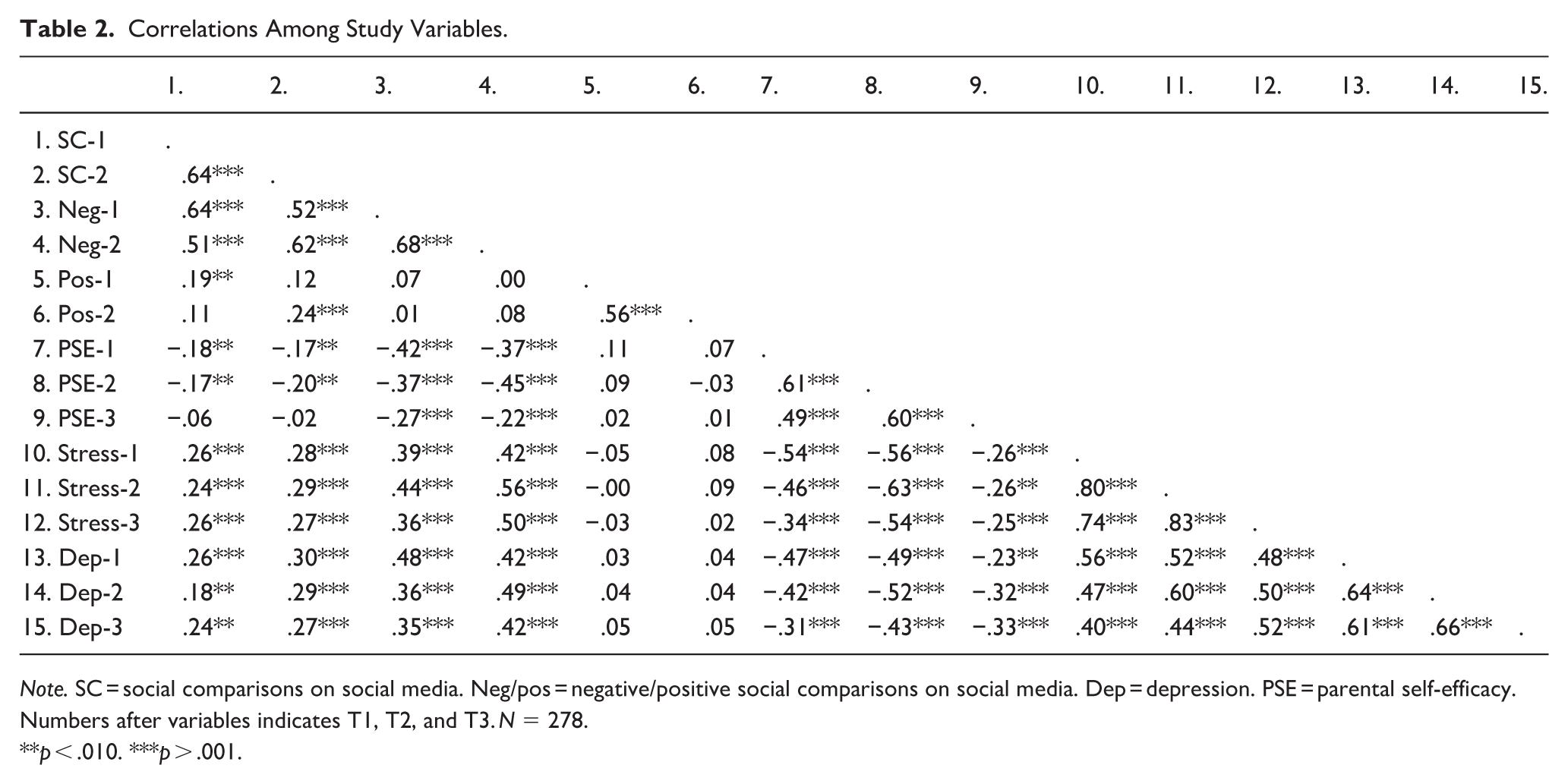
Note. SC = social comparisons on social media. Neg/pos = negative/positive social comparisons on social media. Dep = depression. PSE = parental self-efficacy. Numbers after variables indicates T1, T2, and T3. N = 278.
p < .010. ***p > .001.
What Is the Direction of Influence Between Social Comparisons, PSE, and Distress?
To answer the first research question, we ran a model with the single-item comparisons on social media, examining the cross-lagged associations with parents’ depression, stress, and PSE between T1 and T2. This model showed an acceptable fit to the data, χ² = 14.52 (5), p = .013; SRMR = .08; CFI = .99; RMSEA = .05 [CI RMSEA = .04–.13]. The results showed that comparisons on social media did not significantly predict changes in parents’ distress (i.e., stress or depression) or PSE (see Table 3 for cross-lagged paths, and supplementary material [Table S1] for results on stability and correlations). On the contrary, parents’ depression at T1 predicted an increase in social comparisons from T1 to T2 (β = .13, p = .048), which is considered a large effect (Orth et al., 2024).
Results From the Theory-Driven Constrained Cross-Lagged Panel Model—Social Comparisons on Social Media.
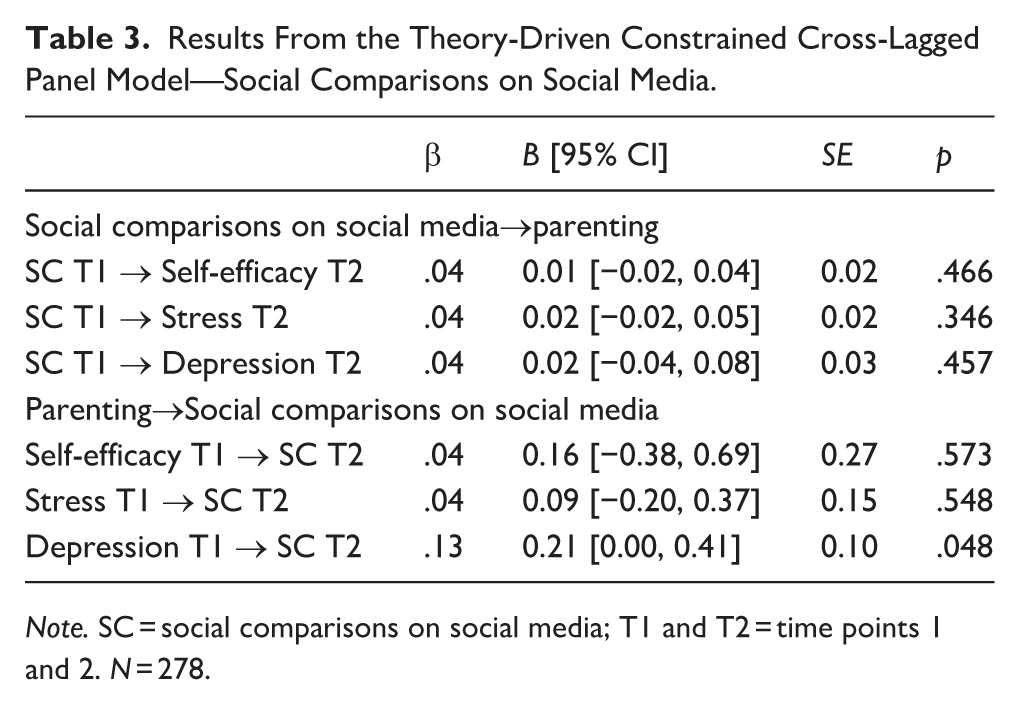
Note. SC = social comparisons on social media; T1 and T2 = time points 1 and 2. N = 278.
Are the Longitudinal Associations Different for Positive and Negative Feelings?
The second research question was answered with a cross-lagged model including positive and negative feelings when comparing. The model showed an acceptable fit to the data, χ² = 41.49 (8), p < .001; SRMR = .06; CFI = .97; RMSEA = .12 [CI RMSEA = .09–.16]. Cross-lagged paths are reported in Table 4 (see also supplementary material [Table S2] for results on stability and correlations). Although the RMSEA was somewhat higher than preferred (Byrne, 2012; Hooper et al., 2008), the values of SRMR and CFI indicated an acceptable fit to the data. Negative feelings when doing social comparisons were significantly predicting decreases in PSE (β = −.18, p = .001) and increases in parenting stress (β = .20, p < .001), both large effects (Orth et al., 2024). Negative feelings when doing comparisons showed a borderline significant association with depression (β = .10, p = .075). Positive feelings when comparing with other parents did not significantly predict changes in any of the parenting variables.
Results From the Theory-Driven Constrained Cross-Lagged Panel Model—Social Comparison-Feelings.
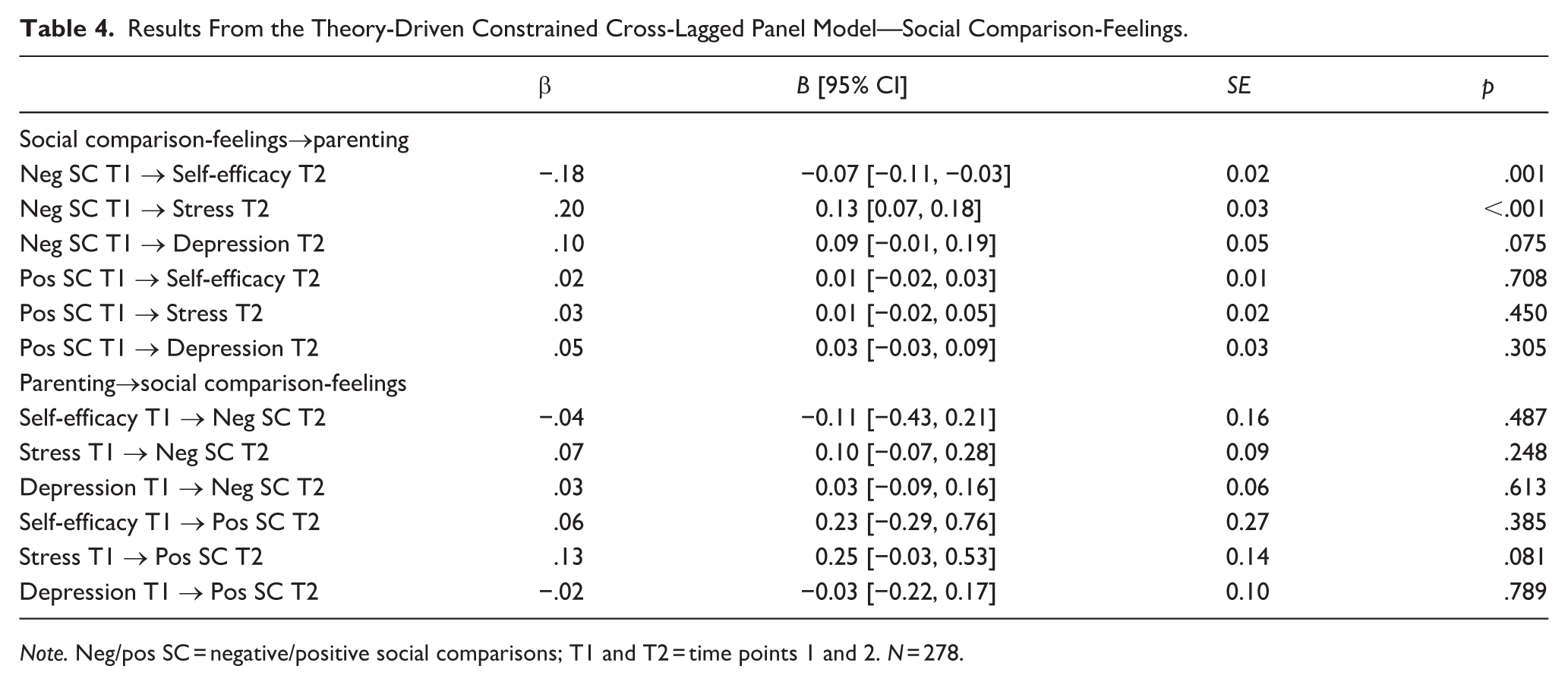
Note. Neg/pos SC = negative/positive social comparisons; T1 and T2 = time points 1 and 2. N = 278.
As reported in Table 4, PSE, stress, and depression did not significantly predict changes in negative feelings (βs = −.04, .07, and .03 and 0.03, ps = .487, .248, and .613, for PSE, stress, and depression, respectively) or positive feelings (βs = .06, .13, and −.02 and −0.03, ps = .385, .081, and .789, for PSE, stress, and depression, respectively). Hence, parenting variables did not predict changes in feelings when doing social comparisons.
Are Distress or PSE Mediators for the Association of Social Comparisons?
Expanding upon our results, and to answer Research Question 3, we ran two mediation models. In these models, we tested four mediations: (1) Negative feelings when comparing at T1 as a predictor of PSE at T3, using depression and stress at T2 as mediators, and (2) Negative feelings when comparing at T1 as a predictor of depression and stress at T3, using PSE at T2 as a mediator. We included all measures at T1 (negative feelings when comparing, PSE, stress, and depression) as predictors, to estimate rank-order stability over the time period. Hence, results represent changes between T1 and T3, while controlling for the baseline in PSE and parents’ distress. We ran these analyses only for negative feelings when comparing, as positive feelings and comparisons on social media in general were not significant predictors of the parenting variables in the former analyses.
Results showed that the analyses using PSE as a mediator were significant. Negative feelings when comparing predicted an increase in depression between T1 and T3, via a decrease in PSE (β = .03, p = .037). Furthermore, PSE was also a significant mediator for the association between negative feelings when comparing and an increase in stress (β = .03, p = .037). Hence, parents who reported negative feelings when doing comparisons decreased in PSE over time, which, subsequently, resulted in an increase in stress and depression. The two final mediations were not significant: Negative feelings when comparing did not predict changes in PSE via an increase in depression (β = −.02, p = .194) or stress (β = .00, p = .901).
Sensitivity Analyses
To explore if the patterns regarding negative feelings when comparing held for mothers and fathers, we ran the CLPMs using parents’ gender as a grouping variable. This produced a good fit, χ² = 34.84 (16), (mother χ² = 27.74, father χ² = 7.11), p = .004; SRMR = .06; CFI = .98; RMSEA = .09 (CI RMSEA = .05–.13). The results suggested some different patterns in how mothers’ and fathers’ feelings when comparing predicted parenting outcomes. Specifically, mothers’ negative feelings when doing social comparisons predicted decreases in their PSE (β = −.27, p < .001) and increases in parenting stress (β = .22, p < .001) and depression (β = .16, p = .010). For fathers, negative feelings when comparing did not significantly predict their level of PSE (β = −.24, p = .055), stress (β = .14, p = .144), or depression (β = .02, p = .886).
Discussion
In this study, we examined the longitudinal associations between parents’ comparisons on social media, on the one hand, and parental self-efficacy and parental distress, on the other hand. Results showed that parents who felt negative when doing comparisons decreased in their level of PSE and increased in distress over time, at least among mothers. In addition, the results also supported a mediation of negative feelings on parents’ distress via decreases in PSE. Positive feelings did not predict parents’ distress and PSE. Regarding the opposite direction, more depression predicted an increase in comparisons on social media. However, this was the only significant cross-lagged path going from well-being to parents’ comparisons. This study offers new insights and additional knowledge about a relatively common activity among parents and parents-to-be, namely comparing with other parents on social media. Theoretical and clinical implications of the results are discussed below.
As a first step in our study, and to answer Research Question 1, we examined the longitudinal associations between comparisons on social media and parents’ well-being and PSE. We started by testing the general comparisons on social media, not emphasizing emotions related to the comparisons. To do so, we used a single item that has been used in previous studies (Coyne et al., 2017; Padoa et al., 2018) framed as a statement asking whether parents do comparisons on social media. Earlier studies that have used this measure have shown that more comparisons on social media are linked with more negative outcomes, such as anxiety, stress, depression (Coyne et al., 2017; Padoa et al., 2018). In our study, one longitudinal association was significant: parents’ depression, weakly but significantly, predicted greater engagement in comparison on social media. Theoretically, depressed parents would compare with others to reduce negative feelings (e.g., Taylor et al., 1990; Wills, 1981), which is supported by this finding. However, this was only one significant path, and it was somewhat weak, thus, interpretations should be done carefully.
Interestingly, stress and PSE did not predict changes in social comparisons. One possible explanation is that depressive symptoms might heighten individuals’ sensitivity to self-evaluative information, making them more prone to engage in comparison behaviors than parents experiencing stress or lower PSE. Hence, this finding lends some support of Hypothesis 2, suggesting how parents’ feel can influence how much they compare on social media. None of the reverse pathways—comparisons predicting later parenting outcomes—were significant. The most probable reason for our lack of significant prediction is that we examined these associations over time. In fact, the bivariate correlations between comparisons on social media and the parenting factors reported in Table 2 are almost all significant, but the associations are not in the longitudinal statistical analyses. Hence, when controlling for stability in the factors, and examining one factor predicting change in the other, data do not support a significant association between social comparisons in general and parents’ beliefs and well-being.
In the next step to test Hypotheses 1, 2 and, 3, which all relate to Research Question 1, we ran models including measures of parents’ positive and negative feelings when comparing. The findings for negative feelings supported Hypothesis 1, suggesting that negative feelings predicted an increase in distress and a decrease in PSE over time. The reverse was not the case: distress and PSE did not significantly predict changes in negative feelings. Taken together, given the sole significant associations for general comparisons, we found more empirical support for unidirectional associations with effects going from parents’ comparisons (in general and associated feelings) to their distress and beliefs, suggesting stronger evidence of comparison-based effects than effects of beliefs or distress on comparison patterns.
With Research Question 2, we explored whether feelings when comparing are more important than the comparisons themselves (Smith, 2000). In support of Hypothesis 4, we found that feelings when doing social comparisons had an impact on parenting factors over time. As mentioned above, parents’ negative feelings when doing comparisons were systematically associated with the parenting factors (PSE, stress, and depression). This finding support earlier cross-sectional studies (Amaro et al., 2019; Coyne et al., 2017; Egmose et al., 2022; Glatz et al., 2023; Padoa et al., 2018; Sidani et al., 2020) that have shown an association between social comparisons and parenting, lending further support to the idea that comparisons on social media have negative consequences (Verduyn et al., 2020; Yoon et al., 2019). Theoretically, this result can be understood using the social comparison theory and the outcomes of self-evaluations (Festinger, 1954; Gerber et al., 2018; Suls & Wheeler, 2000). Specifically, a negative self-evaluation explains worsened well-being and reduced efficacy over time (Gerber et al., 2018). These findings also align with qualitative work (e.g., Egmose et al., 2022), which shows that parents often describe the emotional impact of comparisons—rather than the comparisons themselves—as shaping their sense of adequacy. Such accounts help explain why feelings during comparisons, particularly negative ones, were more strongly associated with parenting outcomes over time. Hence, comparisons influence how parents feel in relation to the other parent and the perception of either doing better or worse than the comparison target will impact parents’ overall well-being and sense of efficacy. Overall, then, our result showed that comparisons in general might not be of the greatest importance, but rather parents’ negative feelings when doing these comparisons.
In addition to negative feelings when comparing, we examined positive feelings when comparing. In support of Hypothesis 5, positive feelings showed fewer associations with parental self-efficacy and distress. Somewhat surprising, however, positive feelings were not only less strongly associated with the outcomes than were negative feelings, but none of the associations were significant. This finding raises new questions about the particularities of the digital context in everyday life in relation to social comparisons. What makes parents experience comparisons differently and why? And why are positive feelings not translating into positive impact on parental factors as suggested by the theory of social comparisons in general? One plausible explanation might be the specific characteristics of the material parents encounter online. Although social media can include idealized portrayals of family life, it also contains a wide range of content—from aspirational posts to candid accounts of challenges—and parents might weigh or interpret these sources differently than they do offline comparisons. In fact, a large part of the negative effects of the internet use can be explained by the extensive source of information that people compare with online (Verduyn et al., 2020; Yoon et al., 2019). In addition, because we tested negative and positive feelings when comparing within the same model, it is possible that negative feelings overshadow the impact of positive feelings, consistent with a general negativity bias (Baumeister et al., 2001). As parenting is a highly meaningful domain for many parents, even subtle discrepancies between their own experiences and the diverse—but sometimes selectively presented—content online might influence how comparisons are felt.
As the third research question, we examined mediational models. Results suggest that PSE might work as the mechanisms explaining how negative feelings while doing comparisons result in increased level of stress and depression. The model with stress and depression as mediators did not reach significance. An association between parents’ well-being (e.g., stress, depression, anxiety) and PSE have been established in the literature (Carless et al., 2015; Junttila et al., 2007; Suzuki, 2010), strengthening the finding in this study. However, since previous studies have been cross-sectional (for a review, see Glatz et al., 2023), our study contributes new insights by examining this association over time. The fact that parents’ beliefs (i.e., PSE) predict their well-being—and that both are influenced by comparisons with others—supports the idea that parents’ beliefs play a dynamic role in shaping their well-being and parenting practices (Sigel & McGillicuddy-De Lisi, 2002). In addition, according to Bandura (1997), a person with high levels of self-efficacy often remains optimistic and confident in their abilities, which would result in positive feelings and benefit their overall well-being. Persons with lower self-efficacy are less resilient and more often experience feelings of failure and depression. When applied to our results, a reduced level of PSE might worsen the negative consequences of feeling inferior to the comparison target, as it likely makes parents less resilient and more prone to getting caught in a spiral of negative thoughts about their parenting role.
Limitations and Future Research
This study has some limitations that warrant attention. First, the sample is not representative on some variables. For example, this is a highly educated sample of parents, and the majority had a co-parent. Furthermore, most parents were born in the country of data collection, which limits generalizability to other parents. The skewed distribution should be considered to avoid generalizing to the larger parenting population. Second, parents were recruited through parenting websites and family centers, which may have introduced selection bias. Those who participate in these settings are likely more interested in parenting-related topics and might feel a stronger need to excel in their parenting role. As a result, they might be more prone to comparing themselves with other parents and may also differ in their levels of distress and PSE compared to parents who are less involved in such contexts. Notably, participants in this study reported experiencing more positive than negative emotions when making comparisons. This could be influenced by social desirability bias, reflecting their motivation to present themselves as competent parents. Future research should replicate these findings using other recruitment methods to ensure broader generalizability. Third, the results regarding potential differences between mothers and fathers should be interpreted with some caution, as the father sample was very small (n = 43) in comparison with the mother sample (n = 235). The small father sample might have decreased the power to detect significant results, which might be the reason for different patterns in results between mothers and fathers. Although the number of fathers in this study is small, we chose to explore potential differences between mothers and fathers in an exploratory manner. This decision was motivated by the limited number of studies that include fathers, and our results might offer insights into possible differences in patterns.
Fourth, the analytical procedures involved some limitations. Most of the indices from the models showed good fit to the data, although the RMSEA values indicated poor model fit. Results from these analyses should be interpreted with this in mind. In addition, associations are examined over 1 year and only at two time points. It is not possible to conclude about directions of influence between these factors before or after these measurement points. Ultimately, future studies should measure these constructs at more time points over a longer, or different, developmental period. In a similar line, the results represent between-person changes, and not within-person changes, which would offer some more nuanced knowledge on processes over time. We used only two time points for each variable and were, consequently, not able to conduct Random Intercept Closs-Lagged Panel Models (RI-CLPM) accounting for within-person changes. For future studies, individual-level changes could be captured with the use of more time points and RI-CLPM.
Fifth, the measures of social comparisons have some limitations. As we do not measure the frequency of parents’ comparisons on social media, we do not know if this may be related to the outcome, that is, if the negative effects worsen among those who often compare themselves to others or vice versa. Similarly, the general comparison measure included only one item. Although single-item measures raise issues with validity, as it might not capture the complexity of the concept, this item is phrased similar to single-items in earlier studies. Hence, even if this operationalization has some problems, the possibility to replicate and build on earlier findings override the limitations.
Conclusions and Clinical Implications
In conclusion, this study showed that parents’ negative feelings when comparing with others on social media tend to reduce their efficacy and, in turn, have negative impact on their well-being as shown in greater distress over time. These results can be useful in providing advice or support to parents of younger children. For most parents, comparing with others on social media platforms do not impact their parenting or well-being in any direction. However, professionals need to be conscious of parents with negative feelings from comparing themselves to other parents, as such feelings might have a negative impact on their parenthood and their well-being. Therefore, professionals should include a screening of the social media activities when they work with parents who are showing doubts about their parenting capacity or parental distress to identify links between social comparisons and negative feelings. This is important knowledge for professionals working with parents and parents-to-be, as they can provide information about the possible consequences of comparing themselves to other parents on social media. Moreover, working to strengthen parents’ self-efficacy may reduce the negative impact of comparisons on parents’ well-being and help them feel more positive when comparing with others. This, in turn, could help them avoid the negative outcomes of social comparisons and possibly break downward spirals.
Supplemental Material
sj-docx-1-jbd-10.1177_01650254261419698 – Supplemental material for Parents’ social comparisons online, distress, and self-efficacy: A longitudinal examination of predictors and effects
Supplemental material, sj-docx-1-jbd-10.1177_01650254261419698 for Parents’ social comparisons online, distress, and self-efficacy: A longitudinal examination of predictors and effects by Terese Glatz, Kristian Daneback and Emma Sorbring in International Journal of Behavioral Development
Footnotes

Funding
The authors received no financial support for the research, authorship, and/or publication of this article.
Declaration of conflicting interests
The authors declared no potential conflicts of interest with respect to the research, authorship, and/or publication of this article.
Supplemental material
Supplemental material for this article is available online.
References
Supplementary Material
Please find the following supplemental material available below.
For Open Access articles published under a Creative Commons License, all supplemental material carries the same license as the article it is associated with.
For non-Open Access articles published, all supplemental material carries a non-exclusive license, and permission requests for re-use of supplemental material or any part of supplemental material shall be sent directly to the copyright owner as specified in the copyright notice associated with the article.
