




Abstract
This study examined whether daily variation in maternal phubbing (smartphone distractions in the presence of children) was associated with daily variation in child inattentive and oppositional behaviors. Daily diary data were provided by the mothers of 78 fourth graders (mean age = 9.20 years; age range = 8–10 years) studying in five elementary schools in Hong Kong. On each of five consecutive days, mothers filled in an online questionnaire in the evening on their own smartphone use and their children’s behavioral adjustment during the day. Multilevel autoregressive lag-1 models within the dynamic structural equation modeling framework were run separately for child inattentive behaviors and child oppositional behaviors. Results indicated that on days when mothers phubbed their children more than usual (compared to their cross-day averages), children showed more inattentive and oppositional behaviors than usual (compared to their cross-day averages), even controlling for children’s momentary behavioral changes on the prior day. Theoretically, findings pointed to the potential role of parents’ smartphone distractions during parent-child interactions in understanding day-to-day variation in children’s behavioral adjustment. Practically, findings highlighted the possible utility of helping parents manage their smartphone use as ways to promote their children’s positive development.
Keywords
Introduction
“Technoference,” defined as interruptions in face-to-face interactions due to the use of technological devices, such as televisions, computers, laptops, gaming consoles, and smartphones, has received increasing attention from researchers and practitioners (Coyne et al., 2025; McDaniel & Radesky, 2018). Among these technological devices, smartphones stand out for their versatile functionality, exceptional customization, and unparalleled convenience. Specifically, smartphones support a wide range of functions, including communication, entertainment, investment, information access, and task organization. Highly customizable, smartphones may also meet individuals’ social, psychological, and cognitive needs through tailored apps and personalized interfaces. Finally, the compact portability and instant access of smartphones ensure unmatched convenience, allowing smartphone use anytime, anywhere. Therefore, many users rely on their smartphones almost ceaselessly, sometimes even during in-person interactions (Al-Saggaf & O’Donnell, 2019). As a result, “phubbing,” defined as distractions by or preoccupations with smartphones in the presence of others, has been singled out as a distinct research focus, increasingly studied independently of the broader technoference (Frackowiak et al., 2024).
As parents often serve as the primary caregivers of children, their emotional availability and behavioral responsiveness are critical to children’s adjustment. However, as postulated by a multitasking theory, smartphone use during in-person interactions with children requires multitasking, which may lead to delayed, unresponsive, or inconsistent responses (Sansevere & Ward, 2021). Such emotional unavailability and reduced responsiveness may leave children feeling unsupported or neglected, potentially contributing to their adjustment problems. Feeling that their parents may prioritize their smartphones over themselves, children may show more problem behaviors. Furthermore, receiving less sensitive and engaging responses, children may have fewer learning opportunities and thus exhibit suboptimal development.
Indeed, research suggests that parental phubbing may have negative implications for child adjustment. For example, integrating 42 studies involving 56,275 participants, a meta-analysis documented positive correlations of parental phubbing with child internalizing and externalizing problems and negative correlations of parental phubbing with child self-concept and socioemotional competence (Zhang et al., 2023). However, reflecting the existing literature, the majority of these 42 studies had been cross-sectional (90%) and focused on adolescents (93%). Much fewer studies used longitudinal designs to examine the potential implications of parental phubbing for child adjustment. For example, using two waves of longitudinal data collected at a 7-month interval, Xu and Xie (2023) found that parental phubbing was associated with fewer prosocial behaviors among adolescents. In addition, using two waves of longitudinal data collected at a 3-month interval, Xie et al. (2025) found that parental phubbing was linked to more adolescent disordered eating. Finally, using three waves of annual panel data, Yang et al. (2024) and Wang and Qiao (2022) found that parental phubbing was linked to increases in adolescent aggression and decreases in adolescent self-esteem, respectively.
Although existing studies have provided important insights into the relationship between parental pubbing and child adjustment, nearly all of them have focused on between-person associations, that is, how children of mothers with varying levels of phubbing may be different from one another in adjustment. Within-person associations differ from between-person associations by focusing on how children may deviate from their usual selves when their mothers show varying levels of phubbing over time. As children are compared to themselves (rather than other children in the sample), within-person associations are not confounded by time-invariant factors, factors that do not vary over the study period (Curran & Bauer, 2011). To our best knowledge, only one study has examined the within-person association of parental phubbing with child adjustment: Using 14 days of daily diary data from 80 adolescents, Hu et al. (2023) reported a significant negative association of parental phubbing with child academic engagement. In addition to ruling out time-invariant factors as alternative explanations, the daily diary approach captured more “momentary” associations (Lischetzke & Könen, 2024): On days when parents phubbed more than usual, children were less academically engaged than usual.
The Present Study
Expanding on prior work, the present study used 5 days of daily diary data from 78 mothers of fourth graders to examine the within-person associations of maternal phubbing with child inattentive and oppositional behaviors. This data collection approach not only reduced mothers’ recall and reporting biases but also allowed us to capture the interplay of maternal phubbing and child adjustment as it unfolds in daily life (Lischetzke & Könen, 2024). We focused on mothers, as mothers continue to be the main caretakers of children and adolescents (Yaffe, 2023). Moreover, given that mothers spend substantially more time with children than do other family members, mothers provide relatively reliable reports of their children’s behaviors (Bornstein, 2014), making their reports particularly useful in single-informant studies like ours.
We focused on preteens (8- to 10-year-olds), as preteens are mature enough to interpret their parents’ phubbing behaviors as signs of distractions (Frackowiak et al., 2024) but are not independent enough to disregard parental attention as adolescents sometimes do, when they become increasingly focused on their peers rather than their parents (Lam & McHale, 2015). We targeted child inattentive and oppositional behaviors, as externalizing behaviors are more observable and thus can be more accurately reported by adults (Achenbach et al., 2016). This emphasis on child behavioral adjustment aligned well with the momentary timeframe of our daily diary approach, as these behaviors may reflect children’s immediate responses to their mothers’ use of smartphones during parent-child interactions.
Based on theory and research, we hypothesized that maternal phubbing would be positively associated with child inattentive and oppositional behaviors at the within-person level. Although within-person associations inherently control for time-invariant factors, they may also be affected by time-varying factors (Curran & Bauer, 2011). One important alternative explanation to rule out concerns the self-socialization of children: When children show more externalizing behaviors than usual, they may continue to perpetuate these behaviors and their parents may resort to their smartphones to cope with the associated stress on the following day (Vahedi & Saiphoo, 2018). Therefore, we controlled for the autocorrelation of child inattentive and oppositional behaviors to account for some child-driven effects.
Method
Participants and Procedures
Participants were the mothers of 78 children studying in five elementary schools in Hong Kong. Using publicly available contact information, we sent invitation letters to all elementary schools and made follow-up phone calls to explain our research purposes. Eventually, five elementary schools agreed to recruit families for us. Through these five schools, we sent invitation letters to all families with fourth graders (typically 8- to 9-year-olds). Only 90 families returned written informed consent and agreed to participate in the 5-day daily diary study. On each of 5 consecutive days, mothers were prompted via text in the evening to fill in an online questionnaire on their own smartphone use and children’s behavioral adjustment during the day. Of the 90 mothers, 78 provided at least one day of data (i.e., one observation). These 78 participating mothers provided a total of 316 observations, resulting in a compliance rate of 81%. Specifically, 7, 8, 5, 12, and 46 mothers provided 1, 2, 3, 4, and 5 days of data, respectively. The number of observations did not differ across mothers’ education levels (χ2 = 11.28, n.s.), but it did differ across mothers’ age groups (χ2 = 16.81, p < .05): A larger proportion (89%) of mothers aged between 41 and 50 years provided 4 or 5 days of data, compared to that (60%) of those aged between 31 and 40 years. This pattern possibly reflected that older individuals have greater routine stability and psychological maturity, making it easier for them to consistently complete the daily data collection (Lischetzke & Könen, 2024). Regardless of their completion rate, each participating mother received a supermarket coupon of HK$100 (about US$13) as compensation.
The mean age of children was 9.20 years (range = 8–10 years; SD = 0.47), and 68% of them were girls. Mothers varied in age, with 2% aged 30 years or younger, 44% aged between 31 and 40 years, and 54% aged between 41 and 50 years. Mothers also varied in education, with 34% having completed high school only, 24% having completed higher diploma or associate degree programs, and 42% having completed college degree programs. In comparison, of all women aged between 30 and 49 years in Hong Kong, 39% had completed college degree programs. Therefore, mothers in our sample seemed to be slightly more educated than their same-age peers in the broader population.
Measures
Maternal phubbing was assessed using the nine-item Partner Phubbing Scale (Roberts & David, 2016). The original items were adapted to evaluate mothers’ smartphone use in the presence of their children (rather than their partners). On each of 5 consecutive days, mothers used a 4-point scale ranging from 0 (Strongly Disagree) to 3 (Strongly Agree) to rate their phubbing during the day. A sample item was “If there is a lull in my conversation with my child, I will check my smartphone.” Ratings were averaged per day, such that higher scores indicated higher levels of maternal phubbing on a given day. Cronbach’s alphas ranged from .61 to .69.
Child inattentive and oppositional behaviors were measured, respectively, using the five-item subscale of inattentive-impulsive-overactive behaviors and the five-item subscale of oppositional-defiant behaviors from the IOWA Conners Rating Scale (Waschbusch & Willoughby, 2008). On each of 5 consecutive days, mothers used a 4-point scale ranging from 0 (Never) to 3 (Always) to rate their children’s behavioral adjustment during the day. Sample items were “My child hums or makes other odd noises” (inattentive behaviors) and “My child is uncooperative” (oppositional behaviors). Ratings were averaged per day, such that higher scores indicated higher levels of child inattentive and oppositional behaviors on a given day. Cronbach’s alphas ranged from .67 to .87 for child inattentive behaviors, and from .72 to .88 for child oppositional behaviors.
Data Analytic Plans
We conducted data analyses in two steps. First, using SPSS 30, we calculated the person-specific means of maternal phubbing, child inattentive behaviors, and child oppositional behaviors by averaging the daily scores per mother. We then computed the descriptive statistics of and correlations among these person-specific means. Second, using Mplus 8.4, we conducted dynamic structural equation models (DSEM; McNeish & Hamaker, 2020) separately for child inattentive behaviors and child oppositional behaviors. To account for the clustered structure of the data (i.e., daily observations were correlated within each mother) and the autoregressive effects of the outcome variables, we estimated multilevel autoregressive lag-1 (multilevel AR[1]) models within the DSEM framework, with Level 1 being Time (days) and Level 2 being Person (mother). To differentiate between the Level 1 (within-person) and Level 2 (between-person) effects of maternal phubbing, both the latent person-mean centered (centered around participants’ own cross-day averages) maternal phubbing and the latent grand-mean centered (centered around the sample mean) maternal phubbing were estimated simultaneously (Asparouhov & Muthén, 2016). Moreover, at Level 1, child adjustment at Time t was regressed on child adjustment at Time t-1, so that the within-person effect captured whether maternal phubbing at Time t was associated with changes in the momentary states of child adjustment between Time t-1 and Time t. Meanwhile, at Level 2, the person-specific means of maternal phubbing (across all days of data collection) constituted the between-person effect, which captured whether averages of maternal phubbing across Times were associated with averages of child adjustment. We estimated the model parameters using Bayesian Markov Chain Monte Carlo method with a minimum of 5,000 iterations. A significant effect was indicated by a 95% confidence interval (CI) that did not include zero. Random variance was estimated at Level 1, allowing for an estimation of individual variability around the fixed effects (Hox et al., 2017). Missing values were addressed with the Kalman filter approach equipped in Mplus (McNeish & Hamaker, 2020). Figure 1 shows the path diagram of the analytic model. The Appendix presents the model setup using equations.
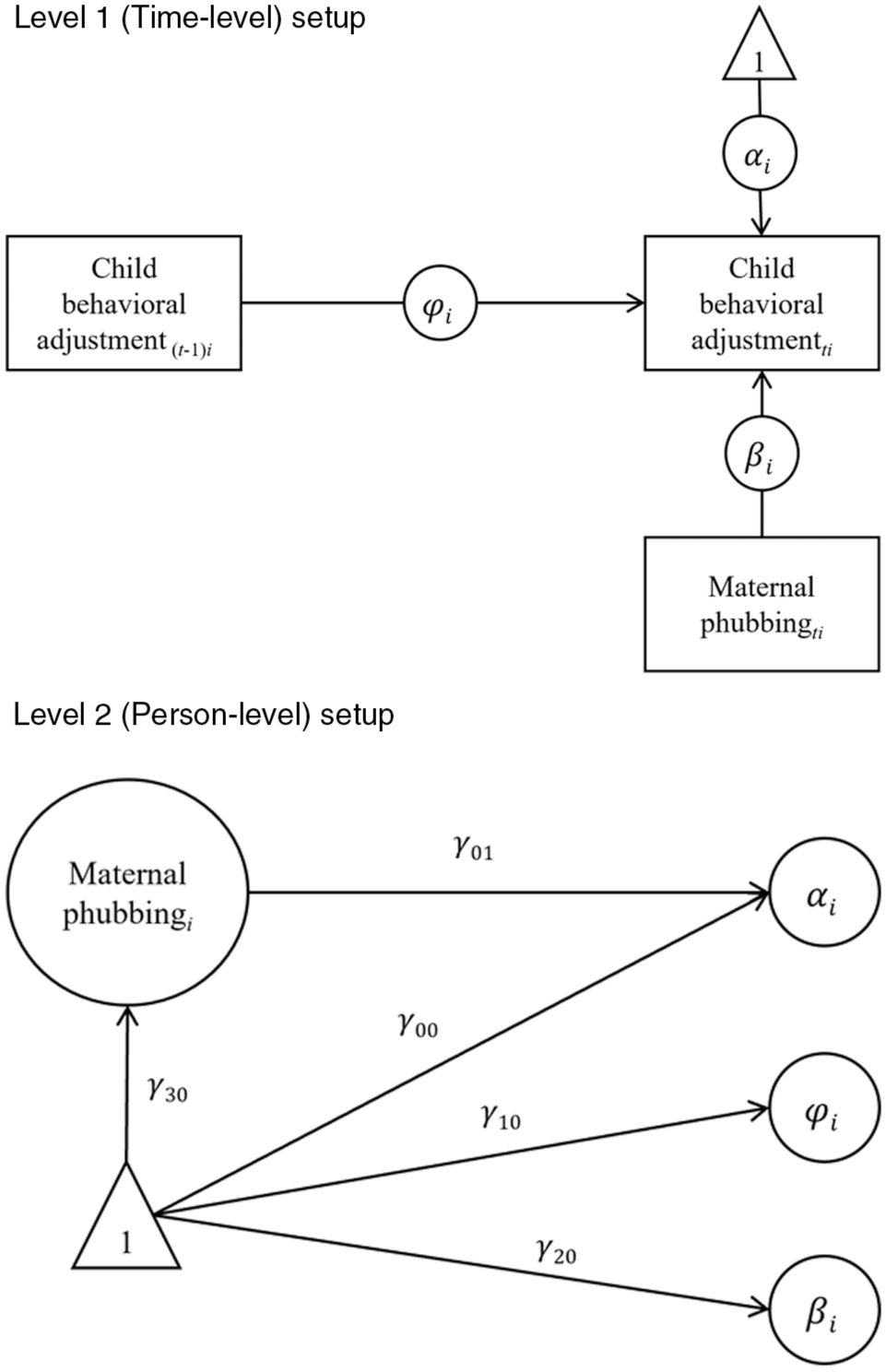
Path Model for the Dynamic Structural Equation Model. Level 1 (Time-level) setup. Level 2 (Person-level) setup. The subscript t indicates Time. The subscript i indicates Person. Residual variances are not shown for clarity.
Results
Descriptive Statistics
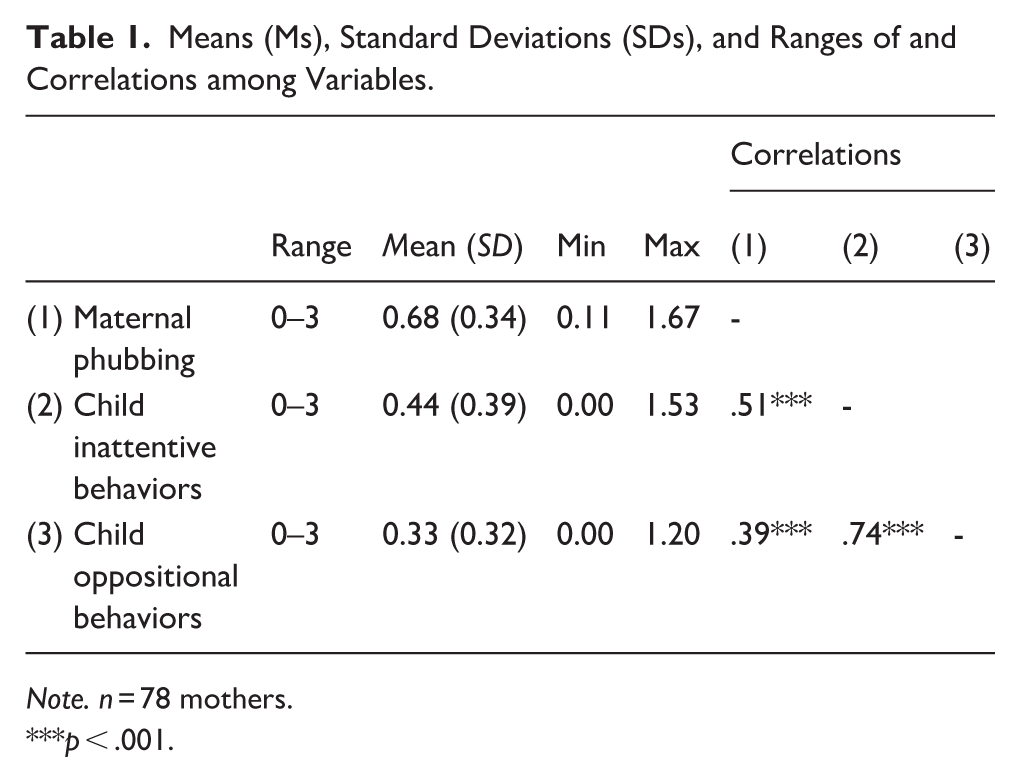
Table 1 presents the descriptive statistics of and correlations among person-specific means of variables. Based on the means, our sample appeared to be relatively well-adjusted, with both maternal phubbing and child inattentive and oppositional behaviors on the lower ends of the measures. Based on the correlations, maternal phubbing was positively associated with child inattentive behaviors (r = .51, p < .001) and with child oppositional behaviors (r = .39, p < .001) at the between-person level.
Means (Ms), Standard Deviations (SDs), and Ranges of and Correlations among Variables.
Note. n = 78 mothers.
p < .001.
Multilevel Models Within the DSEM Framework
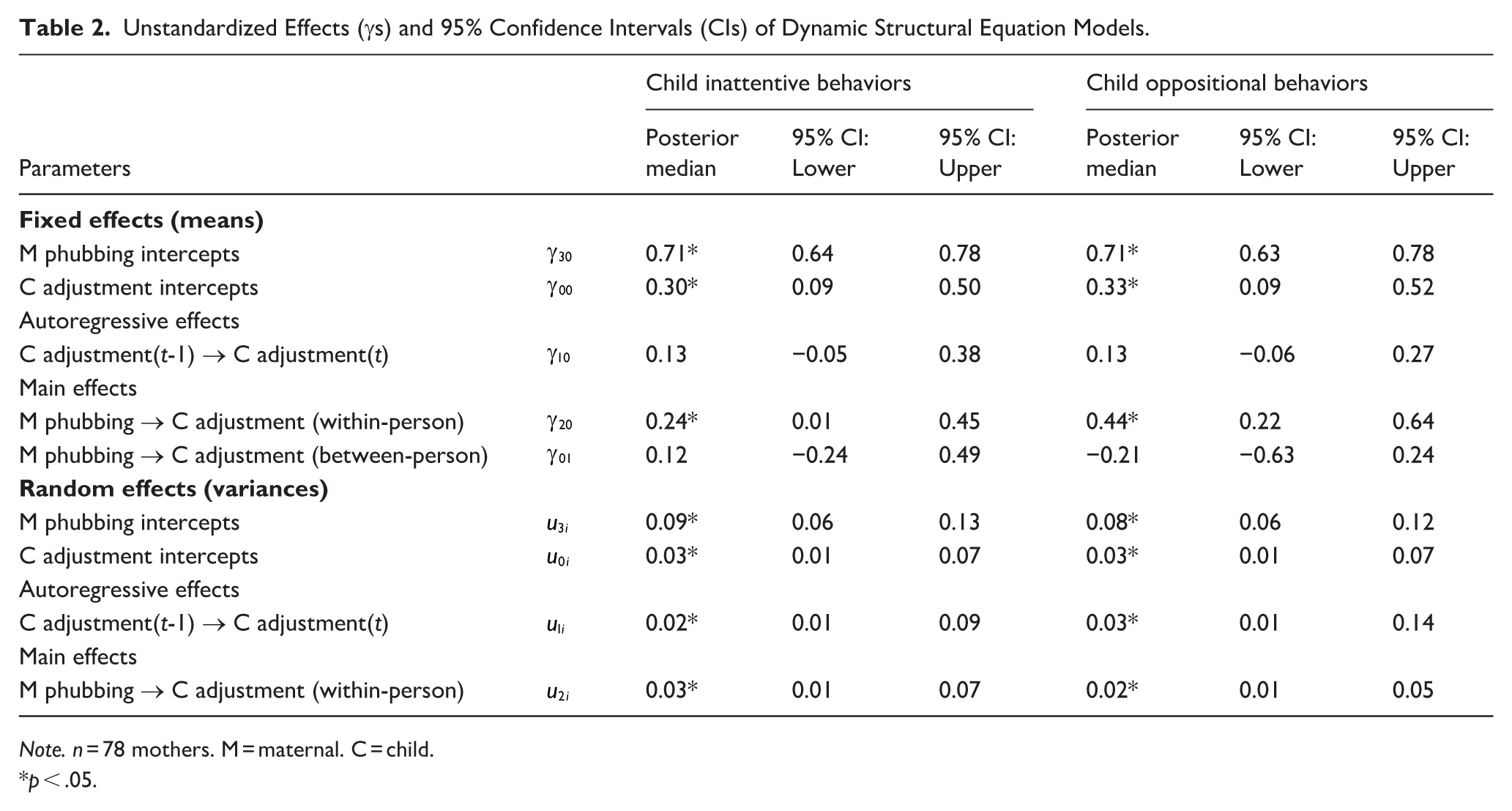
Table 2 presents the unstandardized fixed and random effects of the multilevel DSEMs. The model of child inattentive behaviors indicated that the fixed effect of maternal phubbing at Level 1 was significant (γ = 0.24, 95% CI = [0.01, 0.45]), suggesting that changes in maternal phubbing from the person-specific mean were positively associated with changes in child inattentive behaviors from the person-specific mean, even when changes in child inattentive behaviors on the prior day were considered. In other words, on days when mothers phubbed their children more than usual (compared to their cross-day averages), children showed more inattentive behaviors than usual (compared to their cross-day averages), even accounting for children’s momentary behavioral changes on the prior day. However, the fixed effect of maternal phubbing at Level 2 was not significant (γ = 0.12, 95% CI = [−0.24, 0.49]), suggesting that children whose mothers generally phubbed more (than the rest of the sample) did not generally show more inattentive behaviors (than the rest of the sample). Overall, the model explained 13% of the within-person variance in child inattentive behaviors, indicating a modest effect size (Ferguson, 2016).
Unstandardized Effects (γs) and 95% Confidence Intervals (CIs) of Dynamic Structural Equation Models.
Note. n = 78 mothers. M = maternal. C = child.
p < .05.
The model of child oppositional behaviors revealed similar results. Specifically, the fixed effect of maternal phubbing at Level 1 was significant (γ = 0.44, 95% CI = [0.22, 0.64]), but the fixed effect of maternal phubbing at Level 2 was not (γ = −0.21, 95% CI = [−0.63, 0.24]). Overall, the model explained 23% of the within-person variance in child oppositional behaviors, indicating a modest-to-moderate effect size (Ferguson, 2016).
Discussion
Most existing studies on the role of parental phubbing in child development have been cross-sectional and based on adolescents (Zhang et al., 2023). Our study added to the literature by focusing on within-person associations and controlling child behaviors on the prior day as a time-varying covariate. By comparing mothers and children to their usual selves, we controlled for all time-invariant factors, such as child gender and personality, maternal marital status and work characteristics, and household conditions and family economic status, which were likely to remain stable across our 5 day period of data collection (Curran & Bauer, 2011). By taking into account children’s momentary behavioral changes on the prior day, we also ruled out children’s self-socialization as an alternative explanation of our within-person associations (Vahedi & Saiphoo, 2018), allowing for even stronger inferences.
Expanding on Hu et al.’s (2023) daily diary study of parental phubbing and adolescent academic engagement, our findings showed that on days when mothers phubbed their children more than usual, children exhibited more inattentive and oppositional behaviors than usual. These results supported a multitasking theory, which posits that phubbing divides parents’ attention, leads to delayed, unresponsive, or inconsistent parental responses, and makes children feel unsupported or neglected even during in-person parent-child interactions, resulting in increased behavioral problems and poorer psychosocial competence among children (Sansevere & Ward, 2021). As smartphone use has been widely normalized, parents being distracted by or preoccupied with smartphones on a particular day may not have long-lasting implications for child development. However, the accumulation of these daily interactions may turn into consistent patterns of family dynamics and child characteristics. Given the critical role of undivided parental attention in fostering positive child development, future researchers should continue to explore how smartphone distractions affect the quantity and quality of parent-child interactions and children’s behavioral adjustment.
Though not the focus of our study, the between-person associations between maternal phubbing and child behavioral adjustment were not significant, probably due to our small sample size at the between-person level. Future investigators should use larger samples to document between-person associations along with within-person associations.
Practically, community education programs should be launched to inform parents about the potential negative implications of smartphone use in their children’s presence. As many parents rely on schools for up-to-date knowledge about child care, teachers should also be informed of these findings. In addition, family interventions should be developed to support parents in changing their smartphone use habits to promote their children’s positive development. With problematic smartphone use increasingly prevalent and phubbing widespread (Al-Saggaf & O’Donnell, 2019), it may be crucial to implement these initiatives promptly to address this growing concern.
Our findings should not be interpreted to mean that parental smartphone use—even in the presence of children—is inherently harmful. Evidence suggests that appropriate use, such as capturing family moments, seeking information during family discussions, co-using media, and staying connected with distant family members—can enhance family connectedness and parent-child relationships (Knitter & Zemp, 2020). Therefore, it is not smartphone use per se, but rather how smartphones are used, that may affect children’s behavioral adjustment.
Limitations and Future Directions
This research had several limitations. First, although we invited all mothers with fourth graders from the five elementary schools to participate in our daily diary study, only 90 agreed to take part, and just 78 provided at least one observation. This possibly reflected that parents in Hong Kong are unfamiliar with and find it burdensome to complete such intensive data collection procedures as daily diaries. Future researchers should consider increasing monetary incentives to encourage participation and completion in studies with more complex designs.
Second, due to time and resource constraints, we could only involve five (instead of all) elementary schools in this study. Moreover, both mothers and children in our sample tended to be relatively well-adjusted. Therefore, our findings should be generalized to the larger population with considerable caution. Relatedly, our focus on maternal phubbing, a specific form of technoference involving smartphone distractions, limits the applicability of our work to other technology-related interruptions, such as those caused by televisions, computers, or gaming consoles (Frackowiak et al., 2024). More generally, future researchers should deepen our understanding of this issue by recruiting representative samples of families with diverse risk profiles, examining various forms of device use by parents during parent-child interactions, and testing whether the relationship between parental distractions and child adjustment varies as a function of family risk or technology type.
Third, our findings relied exclusively on mothers’ self-reports and thus might be affected by common method variance. Future studies should retest our hypotheses by linking, for example, parents’ reports of their own smartphone distractions to children’s reports of their own internalizing symptoms and teachers’ reports of children’s externalizing behaviors. Fourth, the reliability of the phubbing measure was relatively low. One possible explanation was that it was designed to capture whether but not why parents used their smartphones in the presence of their children. For example, a mother using her smartphone to handle a work emergency may carry different meanings compared to one scrolling aimlessly through social media posts. Future researchers should assess not only the frequency of phubbing but also the motivation behind it.
Finally, although, according to Ferguson’s (2016) criteria (>4%), our model accounted for a practically significant portion of variance in child externalizing problems(13%–23%), our effect sizes were modest to moderate, indicating that maternal phubbing is just one of many factors that may shape child momentary adjustment. In particular, as fathers have been increasingly involved in childrearing, their roles in child development should not be overlooked (Lam & McHale, 2015; Yaffe, 2023). Future studies should examine whether maternal and paternal phubbing are uniquely associated with child behavioral adjustment.
Footnotes
Appendix 1
Acknowledgements
We thank the participating schools and mothers for their insights on parental phubbing and child adjustment. We also appreciate the research assistants and faculty collaborators for their contributions to this study.

Ethical approval
The present study was approved by the Human Research Ethics Committee of The Education University of Hong Kong (Reference no. 2017-2018-0465) on 28 August 2018.
Informed consent
All participants provided written informed consent and agreed to participate in the study.
Funding
The authors disclosed receipt of the following financial support for the research, authorship, and/or publication of this article: This study was supported by a grant by Research Grants Council, University Grants Committee, Hong Kong, China, to Chun Bun Lam (GRF 18620022).
Declaration of conflicting interests
The authors declared no potential conflicts of interest with respect to the research, authorship, and/or publication of this article.
Data availability statement
The data and analysis codes used in this study are not publicly available, but are available from the corresponding author upon reasonable request.