




Abstract
It is well established that some individuals prove resilient when faced with adverse experiences. Research on resilience, encompassing process, outcome, and trait perspectives, has aimed to identify key factors associated with resilience within dynamic, multi-level systems ranging from the individual to wider communities. Common individual factors, described here as resilience-associated traits, include problem-solving skills, meaning, optimism, and empathy, among others. According to theory and empirical research, adaptive processes during childhood are foundational for the development of these traits. In the current article, we propose a comprehensive model for the development of resilience-associated traits that elucidates this understanding. The model conceptualises this process as a multifaceted developmental outcome, reflecting traits, abilities, and behaviours across cognitive, social, emotional, behavioural, and physical domains. It considers the contribution of both genetic and environmental factors (from an ecological systems theory perspective), as well as their complex interplay, and emphasises individual differences in environmental sensitivity (i.e., differential susceptibility, vantage sensitivity), with some children being more affected by environmental influences across development than others. Finally, the model adopts a life course perspective by considering developmental origins of resilience-associated traits from the prenatal period to early adulthood, including the accumulation of supportive and challenging experiences over time and the notion of developmental cascades. Drawing on extant research, selected literature to support the model is reviewed, possible avenues for future research are highlighted, and implications for theory and practice are proposed.
Keywords
Resilience is a multifaceted concept stemming from the observation that individuals exposed to adversity display highly heterogeneous outcomes, with some developing psychological difficulties while others develop along a normative, or even positive, trajectory (Luthar et al., 2000). Various individual traits, such as cognitive flexibility (Bonanno, 2021) and hope (Ong et al., 2023), have been associated with resilient outcomes and conceptualised as one possible mechanism through which the dynamic process of resilience occurs. Much research (Fritz et al., 2018; Gartland et al., 2019; Llistosella et al., 2022) has focused on identifying these individual traits as well as the genetic and environmental factors associated with resilience more broadly. However, to our knowledge there is currently no model that synthesises the literature focused specifically on individual resilience-associated traits and their development. This article addresses this gap by providing a conceptual model from a developmental perspective on how resilience-associated traits are shaped from the prenatal period to early adulthood. We first establish relevant definitions of resilience with a specific focus on the trait perspective. Then introducing our proposed model for the development of resilience-associated traits, reviewing supporting literature from the extant evidence base for each aspect of the model. Finally, we identify current gaps in research and propose directions for future work to advance our understanding of the development of resilience-associated traits with implications for both theory and practice. Importantly, this article does not aim to provide a detailed systematic review or add new empirical data, but rather draws on current theory to propose a conceptual model for the development of these traits, using selected empirical evidence for illustrative purposes.
Conceptualising Resilience
There is some consensus on the overarching themes that fall within the concept of resilience (Kuldas & Foody, 2021). However, research in the field has led to considerable variation in the details of its definition, resulting in key conceptual challenges (see Troy et al., 2023 for summary). The sheer number of conceptual reviews attests to the fact that there is no commonly accepted definition (see Kuldas & Foody, 2021), with the variety of definitions broadly falling into three categories: resilience as a trait, outcome, or process (Popham et al., 2021).
Outcome-oriented approaches consider resilience as the end result, with resilience considered to be the maintenance or positive advancement of health and wellbeing following exposure to adversity (Fergus & Zimmerman, 2005; Kalisch et al., 2015). Whereas, process orientated approaches, view resilience as a dynamic capacity for adapting successfully to adversity, influenced by multiple factors and changes across time depending on the nature of adversity (Mecha et al., 2024). In contrast trait perspectives seek to understand how pre-existing individual differences in characteristics, abilities and behaviours, influence reactions to and outcomes of adversity exposure (Connor & Davidson, 2003; Ong et al., 2006). Trait perspectives could be viewed as falling on a continuum, with some studies focused on lower-order individual characteristics, others on broad domains from personality and temperament research such as the Big Five, and a further group that considers ‘trait resilience’ a conceptual framework suggesting a high-order resilient personality type, combining a number of more specific characteristics.
To research resilience-associated traits, there is a need to articulate what constitutes a resilient outcome. There is evidence of heterogenous outcomes even when an individual has been categorised as ‘resilient’ (Luthar et al., 1993; W. Masten & Wright, 2009). For example, an individual may exhibit resilience in the cognitive domain, with strong performance at school, while simultaneously struggling with social relationships. The timing and stability of resilient outcomes is a further matter of contention. For example, must resilience be immediately apparent after exposure to adversity and will it necessarily be stable? Moreover, one avenue of thought conceptualises resilience as the absence of pathology, whereas others have defined this to include evidence of positive wellbeing. As such, the literature commonly utilises multiple different definitions of resilient outcomes, limiting the ability to cross-reference between studies (Luthar et al., 2000). Research from the trait perspective has sought to identify the specific traits or capacities associated with many different conceptualisations of resilient outcomes, and this article draws on research from across these conceptualisations. Many of the resilience-associated traits listed in Table 1 can also be considered outcomes of resilience in their own right. For example, high IQ has been suggested to predict resilience but can also be understood as an outcome of resilience (e.g., those that achieve high IQ despite exposure to adversity can be considered resilient). While, in this article, we focus specifically on resilience-associated traits as predictors of resilience rather than outcomes, the methodology of studies often does not provide clarity as to which of these is being demonstrated. Previous thinking has implied a causal link from positive correlations between a given characteristic and a resilient outcome based on the assumption that there is relative stability over time to these characteristics (Goodman et al., 2017). However, as will be explored, these characteristics are more dynamic over time and influenced by contextual factors. Therefore, this article will also draw on an emerging body of prospective studies that is able to provide greater clarity as to the direction of the relationship.
Summary of Resilience-Associated Traits Across Different Domains of Functioning.
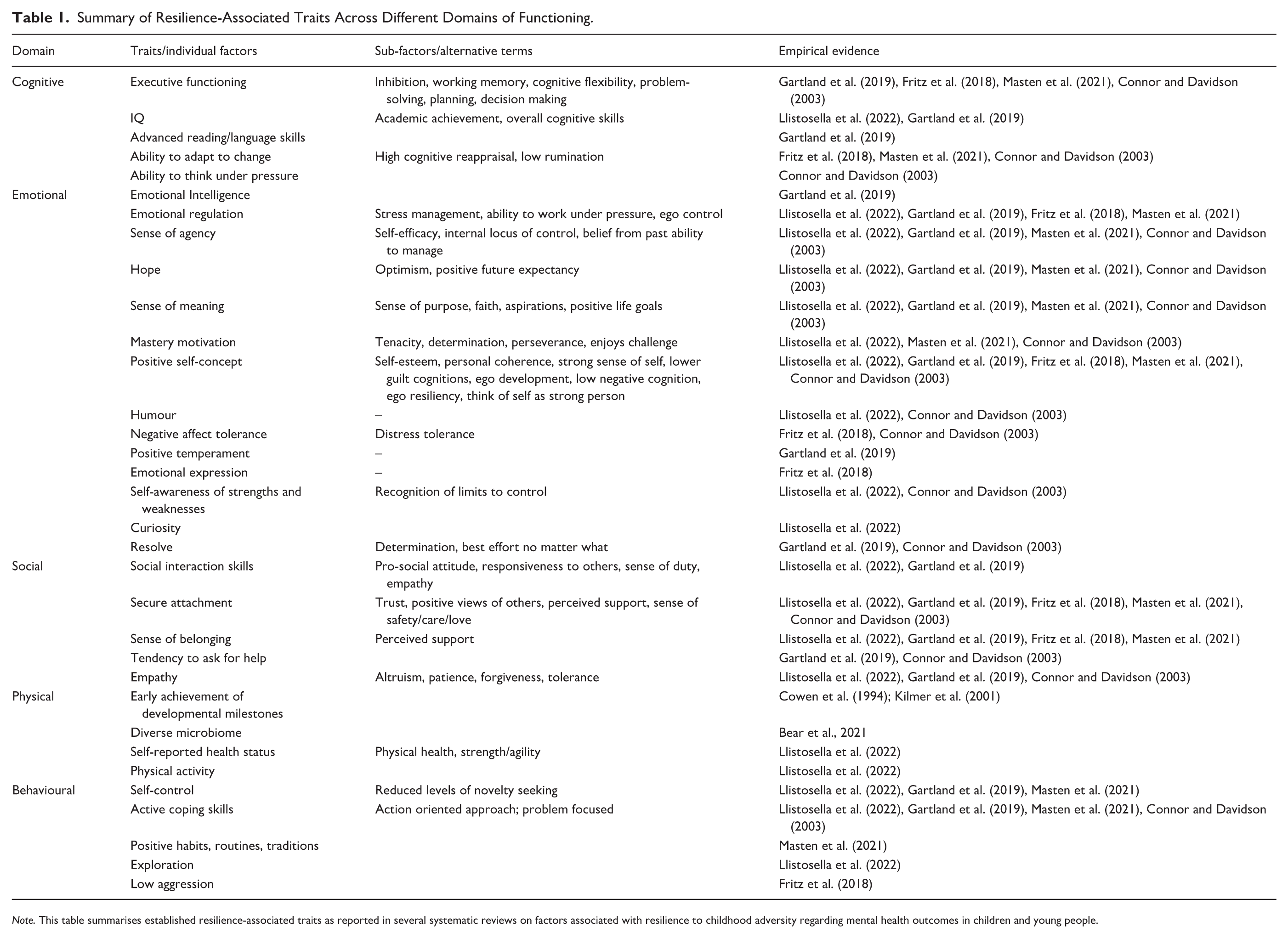
Note. This table summarises established resilience-associated traits as reported in several systematic reviews on factors associated with resilience to childhood adversity regarding mental health outcomes in children and young people.
Initially the trait perspective focused on perceived heritable characteristics, considered to be relatively stable over time (Luthans et al., 2007), with children being described as invulnerable (Anthony et al., 1978), or hardy (Maddi, 2016). Such approaches have come under criticism for overestimating the impact of a child’s inherited nature, while underestimating the role of environmental contextual factors, and in doing so have been seen to place blame on the individual (Kuldas & Foody, 2021). Luthans et al. (2007) propose an alternative approach in which resilience is viewed as human affective potentials, such as hope, optimism, empathy, all of which are relatively malleable and open to development in adaptive social and environmental contexts. This resonates with A. S. Masten’s (2001) tenet that traits associated with resilience form part of normative, fundamental, adaptive systems (together with contextual factors) that infer competence under both favourable and unfavourable conditions when given the required contextual elements to develop, referring to this as ‘ordinary magic’.
To summarise the definitions that will be used in this conceptual article, we focus on the development of the specific characteristics, abilities, and behaviours that contribute to an individual’s resilience when faced with adversity rather than resilience as an outcome or process. Moreover, while reference is made to ‘trait resilience’, we place greater emphasis on specific lower-order traits that have been identified in the literature to contribute to an individual’s resilience when faced with adversity, which we conceptualise as traits that predict broadly defined outcomes of resilience (e.g., the absence of mental health problems or positive wellbeing indicators despite exposure to adversity). Throughout we refer to these as resilience-associated traits. Evidence in support of specific characteristics is presented from two perspectives, those that have shown a particular lower-order trait to be associated with resilient outcomes as previously defined, and those that have demonstrated that a particular lower-order trait is associated with high scores on measures of trait resilience.
Importantly, while this article is focused on the development of individual traits associated with resilience, it explicitly views these traits as being only one component of several that contribute to the phenomenon of resilience. In addition, resilience can be considered at different levels of analysis, from the molecular to the behavioural and beyond the individual to the immediate and wider social context (A. S. Masten, 2024).
Given A. S. Masten’s (2001) assertion that resilience traits typically form part of common adaptive systems, it follows that established theories related to key developmental processes will also aid understanding how resilience-associated traits develop. Hence, this article aims to synthesise the developmental and resilience literature to provide a comprehensive conceptual model for their development. Enhancing our understanding of the development of these traits is of both theoretical and practical importance to promote resilience and positive development (A. S. Masten et al., 2021; Pluess, 2024).
Conceptual Model and Empirical Evidence
The proposed conceptual model for the development of resilience-associated traits draws on multiple theories and key findings from the fields of developmental psychology and resilience (for a graphic illustration of the model see Figure 1). The model first highlights the multifaceted nature of resilience-associated traits, dividing these into (at least) five key domains – emotional, social, cognitive, behavioural, and physical, to reflect a comprehensive and holistic perspective (A). The development of these traits is influenced by multiple factors with substantial evidence for the contribution of both genetic (B) and environmental factors (C). Adopting an ecological systems perspective (Bronfenbrenner, 1979), the development of resilience-associated traits is shaped by a range of supportive environmental influences nested within different systems and contexts (e.g., family, school, society etc.) as well as their effects over time (e.g., adaptive history). Furthermore, theories of stress inoculation (Dienstbier, 1989) or steeling effects (Rutter, 2012) suggest that exposure to manageable stress may play an important role too, beyond supportive experiences. In addition to main effects of environmental and genetic factors, the development of resilience-associated traits is also shaped by gene-environment interplay (D), with epigenetic processes playing a significant role (Smeeth et al., 2021). Theories of environmental sensitivity such as Differential Sensitivity (Belsky & Pluess, 2009) and Vantage Sensitivity (Pluess & Belsky, 2013), demonstrate how the impact of both positive and negative environmental inputs are moderated by individual differences in sensitivity (E). Moreover, the model highlights the importance of adopting a life course perspective, characterised by sensitive periods (Knudsen, 2004) when environmental inputs are especially impactful, most notably the prenatal period, early childhood and adolescence (F). Relatedly, notions of accumulation of advantage (Crystal & Shea, 1990) and developmental cascades (A. S. Masten & Cicchetti, 2010) are of relevance to understanding how resilience emerges across the life course.
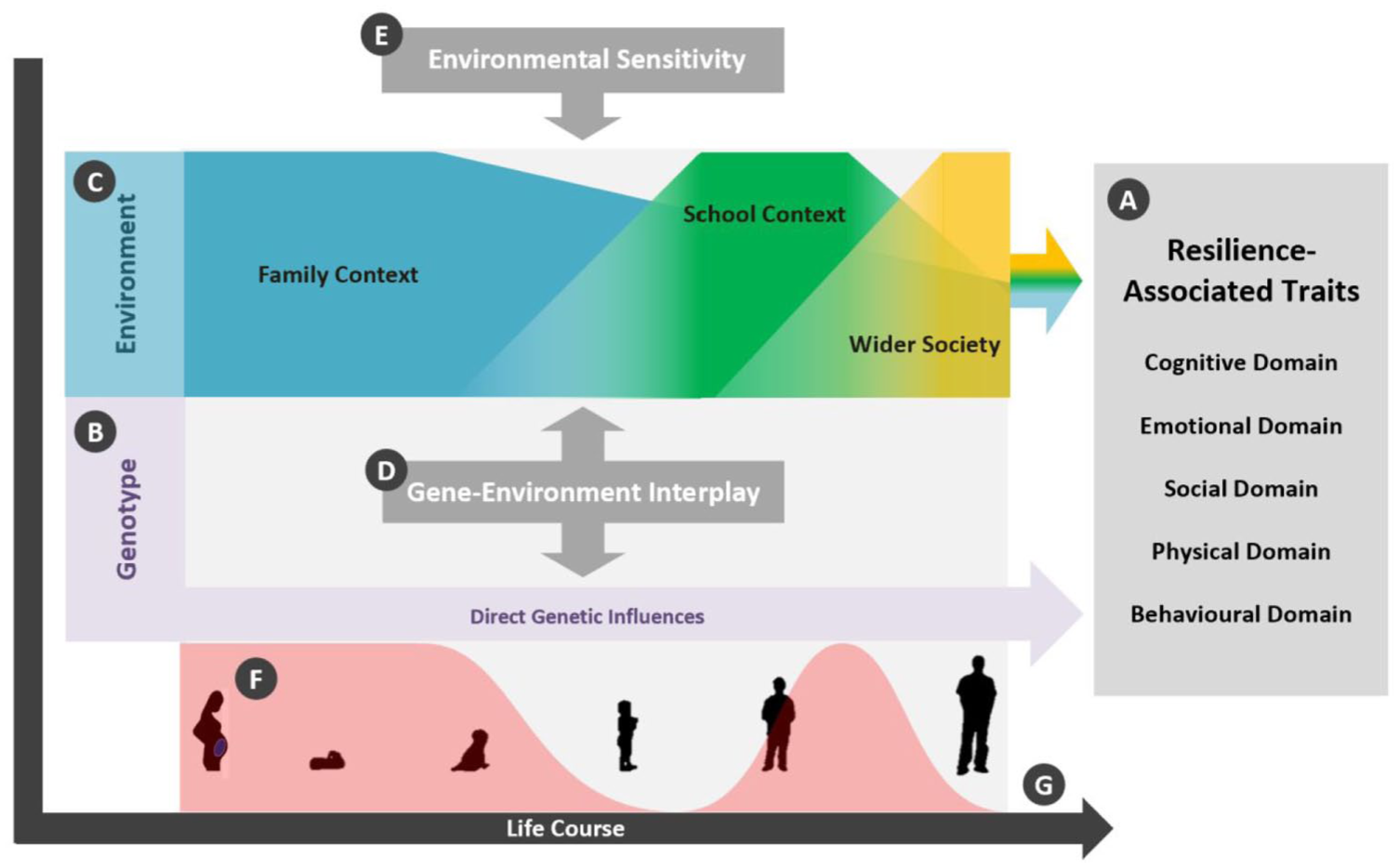
Conceptual Model for the Development of Resilience. This model depicts the development of trait resilience, defined as the characteristics, abilities, and behaviours – across multiple domains of functioning – that are associated with resilience to adversity (a). These resilience traits are shaped by genetic (b) and environmental factors (c), with the environment representing multiple systems with the family context being particularly influential in early childhood, followed by the school context and then the wider society (with complex mediating and moderating effects between systems). The development of resilience traits is further shaped by the complex interplay between genetic and environmental factors (d). Moreover, individuals differ in their environmental sensitivity, with some being generally more and some less affected by environmental influences (e). Relatedly, development is characterised by sensitive periods, with children during the prenatal period, early childhood and adolescence being more receptive to the impact of environmental influences (f). Finally, the development of resilience traits should be considered from a life course perspective, reflected in accumulation of experiences over time and developmental cascades (g).
In what follows, each aspect of the model will be described in more detail, alongside supporting empirical evidence selected for the purpose of illustration rather than methodological rigour.
The Multifaceted Nature of Resilience Traits
The model highlights the multifaceted nature of resilience-associated traits. As demonstrated in Table 1 and reflected in the model (A), there is no one individual trait that confers resilience but rather a range of characteristics across different developmental domains that together contribute to outcomes of resilience (Luthar et al., 2000). As such everyone can be seen to have a unique profile of resilience-associated traits. Moreover, these traits should not be considered binary outcomes (i.e., either achieved or not), but rather as a continuum of competence within each trait, with the ability to utilise that competence being impacted by environmental factors as well as the development of other traits (Bartels, 2015; Kendler et al., 2011; Malouff et al., 2008; Okbay et al., 2016).
The range of resilience-associated individual traits has been summarised in several conceptual reviews (Fritz et al., 2018; Gartland et al., 2019; Hu et al., 2015; Llistosella et al., 2022) and in publications focused on developing measures of individual psychological resilience (Connor & Davidson, 2003; Friborg et al., 2003; Hardy et al., 2004; Johnson et al., 2010; Martin et al., 2015; Prince-Embury, 2013; Resnick et al., 2011; Ryan & Caltabiano, 2009; Sinclair & Wallston, 2004; B. W. Smith et al., 2008; van Abbema et al., 2015; Wagnild & Young, 1993). Table 1 provides a summary of these identified traits. We propose that the development of resilience is a process that spans multiple domains, which overlap and interact in numerous directions where change in one domain could be accompanied by either change or stability in another (Ong et al., 2023). This may go some way to explain why those labelled as resilient may have very different levels of functioning at different times and in different contexts (Luthar et al., 2000). Our model divides resilience-associated traits into the domains of cognitive, behavioural, emotional, social, and physical functioning, to both provide a holistic picture and to support consideration of overlap and interactions between domains. The chosen domains broadly compare to those found in the systematic review of individual resilience traits by Llistosella and colleagues (2022) with the addition of a separate physical domain. It is important to note research has also identified specific higher-order personality or temperamental dimensions that are associated with resilient outcomes. A study by Shiner and Masten (2012) found that higher childhood conscientiousness, agreeableness, and openness and lower neuroticism were associated with greater adaptive success in age-salient developmental tasks, for both those who were not exposed to adversity and those who were, the latter thereby demonstrating resilience.
Cognitive Domain
The cognitive domain encompasses all resilience-associated traits linked with intellectual abilities, including executive functioning, memory, visuospatial and language skills (Lezak, 2004). The most extensive area of research has been on the impact of executive functioning. Mecha et al. (2024) conducted a systematic review on the relationship between executive functioning and resilience. Three studies found a significant relationship between higher working memory functioning and trait resilience. Evidence was less clear with regards to measures of inhibition with only one out of three reported studies finding a positive relationship. Seven studies looked at cognitive flexibility and overall were supportive of an association between higher scores on flexibility measures and higher scores on trait, process, and outcome orientated measures of resilience. While there is some evidence that higher childhood IQ scores are predictive of more positive developmental outcomes following adversity exposure, the methodology of these studies makes it hard to conclude whether this reflects a pre-existing protective characteristic or is a result of a resilience processes (Fergusson & Lynskey, 1996; Pargas et al., 2010).
Emotional Domain
The emotional domain encompasses abilities to both recognise and understand the emotions of the self and others, as well as being able to self-regulate emotions (Schore, 2015) and self-concept. Schneider et al. (2013) found that higher scores on emotional intelligence were associated with lower threat appraisals, smaller declines in positive affect, less negative affect, and reduced physiological stress responses when presented with stress. This has been supported by a systematic review (Collado-Soler et al., 2023) which found a strong positive relationship between emotional intelligence and resilience. The review speaks to the issue of whether emotional intelligence affects resilience or whether resilience actually improves emotional intelligence, stating that the majority of studies refer to emotional intelligence predicting resilience but without further details of the methodology to support this assertion. A qualitative study of Haitian street children (Cénat et al., 2018) indicated a sense of self-efficacy, spirituality, and hope to be associated with resilient outcomes and a study utilising interviews from the German National Health Interview (Wille et al., 2008) found an association with positive self-concept, but again in both the direction of the association is not clear. Prospective studies, where specific traits are measured prior to adversity exposure, are beginning to provide further insights with a predictive relationship to resilient outcomes being found for self-enhancement (similar to positive self-concept; Gupta & Bonanno, 2010); hope (Goodman et al., 2017); positive affect, perceived control and life satisfaction (Spooner et al., 2025); positive appraisal style, self-efficacy and optimism (Bögemann et al., 2023); individual self-esteem (Iyer et al., 2023); and lower rates of internalising difficulties (Letcher et al., 2023). It should be noted however that when using a lagged analysis approach, Goodman and colleagues (2017) only found a predictive relationship for hope, not grit, meaning in life, curiosity, gratitude or control beliefs.
Social Domain
The role of a strong social support networks for resilience is well researched (Holz et al., 2020). Social skills have been found to be predictive of resilient outcomes in a number of studies (Cénat et al., 2018; Pérez-González et al., 2017). A qualitative study (Forrest-Bank et al., 2015) of adolescents and young adults from public housing neighbourhoods found a theme of caring and compassion as being important to resilience alongside the behavioural component of contributing to others. Moreover, a further qualitative study of Alaskan native youth (Wexler et al., 2014) indicated the importance of creating systems of reciprocity and giving back in relation to resilience.
Behavioural Domain
The behavioural domain encompasses factors associated with activities or ways of interacting with the environment. One of the most researched areas is how coping style is linked to resilience. Active coping has been defined as being problem focused whereby action is taken to either reduce the demands of the stressor or to increase personal resources to manage it. This contrasts with emotion-focused or avoidant coping in which the focus is on regulating the emotional response or avoiding the stressor stimulus, respectively (Lazarus & Folkman, 1984). Self-control, the ability to regulate behaviours to meet long-term goals and values even when faced with short-term temptations (Baumeister & Alquist, 2009; Duckworth et al., 2019), is a further behavioural trait that has been shown to be positively associated with resilience (Şimşir Gökalp, 2023). Further links have been found with positive habits, routines, and traditions (A. S. Masten & Motti-Stefanidi, 2020) and a health-promoting lifestyle (Moreno et al., 2016). As previously described, it is important not to infer the direction of the relationship from these studies.
Physical Domain
While lesser studied in the resilience literature, our model includes aspects of the physical domain and how these relate to psychological resilience. For example, earlier mastery of key physical milestones, such as sitting unaided and walking, has been associated with greater stress-resilience later in childhood (Cowen et al., 1994), a finding that has been replicated in later studies (Kilmer et al., 2001). A systematic review (Llistosella et al., 2022), found multiple studies indicating a link between physical activity and resilience (Collishaw et al., 2016; Forrest-Bank et al., 2015; Moreno et al., 2016). Although the pathway between physical activity and resilience is not clear yet, it has been hypothesised that improved physical health enhances the body’s ability to manage the stress response when faced with adversity (Ozkara et al., 2016), while also potentially acting through the mediating variable of impact on mood and positive self-concept (Bedore, 2018; Silverman & Deuster, 2014).
Environmental Factors
Developmental systems perspectives elucidate how a child’s development is influenced by interactions with the environment across multiple levels or systems, with the caregiving and family environment being most dominant in the early years, shifting to involve greater influence of more distal systems in later development (Yates et al., 2003). Ecological systems theory (Bronfenbrenner, 1979) depicts these influences as multiple nested systems. The individual lies at the centre, surrounded by microsystems (social systems directly influencing the child, e.g., family, friends, school, but also physical aspects of the environment such as green and blue spaces), the mesosystem (the interactions between the microsystems), the exosystem (proximal systems that have an indirect impact on the child, e.g., parent’s workplace, local government), the macrosystem (wider social context, e.g., government, cultural norms, as well as the broader natural environment), and finally the chronosystem (time). This important perspective demonstrates the complexity of environmental influences and recognises the bidirectional nature of associations between systems and between the individual and their environments. While often used to portray environmental risk factors, this multi-level multi-system model is equally relevant to environments that promote the development of resilience-associated traits (Harney, 2007) as described in more detail in A. S. Masten’s (2001) developmental resilience model.
In our proposed model (C), we apply a simplified visualisation of Bronfenbrenner’s theory, with the immediate family having the greatest influence initially and maintaining a strong but decreasing influence throughout development, with increasing influence of school and peers, followed by the wider society as development progresses. In accordance with ecological systems theory, effects of societal and cultural factors are mediated by school and family factors but can affect the individual also directly, and the model posits interdependent effects between the individual and their surrounding environmental systems, with the systems impacting on the individual and each other, while the individual simultaneously impacts on the environmental systems (Sameroff, 2009). As will be further explored later, developmental timing of experiences can have differential effects on development (A. S. Masten, 2024), and as such, the model clearly indicates that the time of exposure, in particular with relation to sensitive and critical periods, should always be considered alongside environmental influences.
Several systematic reviews have sought to summarise the environmental factors associated with resilience. Llistosella and colleagues’ (2022) systematic review identified five environmental domains: culture, which encompassed faith-based support and ethnic identity; community, including social resources, connectedness, socioeconomic status, and safety and connectedness of the neighbourhood; school, including engagement and connectedness, teacher support, and school safety; peers, including both positive peer relations and support alongside peer competence and safety of these relationships; and finally interactions with family, which considers parenting quality, rules and routines, connectedness and cohesion and low levels of family adversity. Gartland et al.’s (2019) review of environmental factors associated with resilient outcomes divides environmental factors into family, school, and community, finding the strongest evidence for relationships with caregivers (i.e., family) for positive outcomes such as academic engagement. Further support is provided in the review of Fritz and colleagues (2018) who found strongest evidence for factors within the family domain, such as high family cohesion and parental involvement. Further research is needed to articulate to what degree the influence of these environmental factors on outcomes is mediated by their impact on individual characteristics.
Importantly, the different domains of resilience-associated traits may be shaped by both domain-general as well as domain-specific environmental factors. In other words, some environmental factors (e.g., positive parenting) shape resilience-associated traits across different domains (i.e., they reflect a general impact), whereas other environmental factors may have a more narrow impact on resilience-associated traits in a specific domain (see Supplementary Information for an example of how environmental influences shape emotion regulation).
Steeling Effects/Stress Inoculation
Generally, environmental influences that contribute to the development of resilience-associated traits will often be positive and supportive in nature, given that early life stress is associated with increased vulnerability for later life difficulties (K. E. Smith & Pollak, 2020). However, the experience of manageable stress may have a curvilinear relation with later risk, with exposure to moderate and manageable stressors during childhood helping to activate and develop coping responses, and thus increase resilience (A. S. Masten, 2012). This phenomenon has been termed steeling effects (Garmezy & Masten, 1986; Rutter, 2012) or stress inoculation (Dienstbier, 1989; Gunnar et al., 2009). According to a recent review (Oshri et al., 2024), empirical studies are supportive of the relevance of steeling effects for the development of resilience. For example, Finch and Obradovic (2017) examined the impact of parental emotional challenges (i.e., marital conflict, emotion regulation difficulties and parenting stress) on children, finding that mild to moderate levels of emotional challenges were positively associated with the development of executive functions. Overall, studies indicate that steeling effects occur when experienced stressors are not overwhelming but present a sufficient challenge that requires the development of skills that are useful for future coping (Liu, 2015).
Individual Differences in Environmental Sensitivity
It is widely accepted that some individuals are more vulnerable to the impact of adversity, as indicated by the Diathesis-Stress model (Monroe & Simons, 1991). However, recent research into Environmental Sensitivity, or Differential Susceptibility, indicates that some children are generally more sensitive to environmental influences, both positive and negative ones (Aron et al., 2012; Belsky & Pluess, 2009; Boyce & Ellis, 2005). While those with higher sensitivity are at increased risk for the development of problems when experiencing negative environmental factors, they also tend to benefit more from the positive effects of supportive exposures, a concept described as Vantage Sensitivity (Pluess & Belsky, 2013). For example, children classified as having a ‘difficult’ temperament showed an increase in behavioural problems after exposure to poor-quality caregiving but achieved greater social competence than their ‘easy’ temperament peers in a high-quality caregiving context (Belsky & Pluess, 2009). Conversely, those with an ‘easy’ temperament did not appear to be negatively impacted or particularly benefit from either low- or high-quality care. This effect has also been shown to impact on the efficacy of interventions, with only those with higher sensitivity found to benefit (Pluess & Boniwell, 2015). Importantly, sensitivity is shaped equally by genetic and environmental factors (Assary et al., 2021).
Genetic Factors
Numerous studies have indicated a heritable component of resilience-associated traits, with a likely complex polygenic basis (Maul et al., 2020; Niitsu et al., 2017). Classic twin design studies provide relevant insights into the heritability of these traits (Maul et al., 2020). One study of 5-year-old twins found heritability rates of 46% for cognitive and 70% for behavioural resilience (Kim-Cohen et al., 2004). A large study of adult male twins identified a heritability of 49% for resilience measured with the Connor–Davidson Resilience Scale-10 (Connor & Davidson, 2003). In addition, many of the established resilience-associated traits have been found to be heritable, such as optimism (Mosing et al., 2009), self-esteem (Roy et al., 1995), mastery (Kiecolt et al., 2013), altruism (Rushton et al., 1986), cognitive ability (Briley & Tucker-Drob, 2013), and coping behaviour (Kendler et al., 1991). Importantly, there seems to be a modest degree of genetic overlap between different traits associated with resilience, such as optimism, self-esteem, and mastery (Amstadter et al., 2016).
Complex psychological characteristics, such as most resilience-associated traits, have generally been found to be highly polygenic rather than reflecting effects of single genes. More recently, Genome-Wide Association Studies (GWAS) have been applied to explore the genetic architecture of resilience. For example, one study investigated the underlying genetic component of trait resilience measured with the 11-item Resilience Scale (Herrera-Rivero et al., 2025) and identified three genes (ROBO1, CIB3, and LYPD4) that were associated with resilience at a genome-wide level, alongside 32 potential candidates that did not meet significance criteria.
Gene-Environment Interplay
Although main effects of genetic and environmental factors on resilience-associated traits have been identified, the interplay between both, such as gene-environment interaction and correlation, is likely more relevant. While the genome remains stable throughout an individual’s life, environmental factors can have an impact on gene expression (through epigenetic mechanisms). Hence, individuals that have similar genetic predispositions can still develop different phenotypes depending on their specific environmental exposures, reflecting gene-environment interaction. Similarly, genetic factors may moderate effects of the environment with some genotypes being more affected than others (i.e., individual differences in genetic sensitivity).
In addition to gene-environment interactions, it is also important to consider gene-environment correlations, describing the phenomenon that certain genotypes are more likely to experience certain environments. For example, parents who are genetically predisposed to high intelligence have been shown to provide more enriching educational environments for their children, while also passing on their genetic predisposition (Plomin et al., 1977). Similarly, a child that is genetically predisposed to optimism is more likely to seek out positive social environments (Scarr & McCartney, 1983) and attract greater positive feedback and social support from the environment (Rutter, 2006).
Epigenetic Mechanisms
There are multiple pathways through which gene expression can be altered by environmental factors, with epigenetic mechanisms receiving the most attention within the resilience literature (Zhang & Meaney, 2010). The epigenome is initially established through inherited genetic and epigenetic variation but is then subject to modification through interaction with the environment (Tollefsbol, 2011). While there is some contention as to exactly which epigenetic mechanism is central, the most researched include DNA methylation, histone modification and non-coding RNAs (Smeeth et al., 2021). Studies have found that DNA methylation differences are linked to immune function, neuronal plasticity, stress regulation, and neurotransmission, although the pathways are not clear, and results are not always consistent (Smeeth et al., 2021). According to animal studies, a healthy diet, exercise, and cognitive stimulation are implicated in epigenetic changes relevant to resilience (Smeeth et al., 2021). Some preliminary studies in humans have identified associations between breast feeding and physical contact with decreased methylation of N3CR1, a gene with key relevance to the glucocorticoid system, among other resilience-associated indicators (Provenzi et al., 2020).
Life Course Development
There is evidence that traits associated with resilience develop and change across the life course (Kessler & Staudinger, 2010; Luthar et al., 2000; W. Masten & Wright, 2009). For example, positive maternal mental health during pregnancy has been associated with better cognitive and social development (Phua et al., 2023). Moreover, the literature on brain plasticity indicates how individuals can continue to develop traits associated with resilience into later life, and that one pathway in which this is achieved is through learning and continuous adaption from facing challenges throughout the lifespan (Infurna, 2020).
Research into both sensitive and critical periods of development, demonstrate the existence of plasticity windows where the brain is more sensitive to the impact of environmental stimuli on development (Boyce et al., 2021; Knudsen, 2004). Areas of development in which critical or sensitive periods have been identified are clearly linked to a number of the traits described above including, but not limited to, the development of attachment, emotional processing, and stress response during infancy (Phua et al., 2023), language acquisition in early childhood (Hurford, 1991), and the maturation of the prefrontal cortex during adolescence with corresponding impacts on decision making, impulse control and emotional regulation (Fuhrmann et al., 2015). Key periods of heightened developmental plasticity, when a child will be more receptive to the impact of environmental stimuli, are depicted in our model (b) during pregnancy, early childhood, and adolescence. Recent evidence indicates that adolescence represents an important window with potential for recalibration of the stress system in case environmental conditions have shifted considerably from earlier childhood (Howland, 2023). Other research has begun to investigate whether there are also later periods of increased plasticity and recalibration, such as for mothers during pregnancy (Howland, 2023).
Models of cumulative advantage (Crystal & Shea, 1990), which are closely linked to the phenomenon known as the Matthew effect, describe how advantage can build up and be magnified over time (Bask & Bask, 2015). For example, greater cognitive ability may widen access to high-quality education which then increases chances for employment, as reflected in research on developmental cascades (A. S. Masten & Cicchetti, 2010).
Discussion
As proposed in our model, resilient outcomes are associated with a range of different traits and abilities across multiple domains. The development of these traits is shaped by direct genetic and environmental influences, alongside the complex interplay between genetic and environmental factors. In addition, the development of resilience is characterised by individual differences in environmental sensitivity and needs to be considered from ecological systems and life course perspectives. Empirical evidence is largely supporting the different components of our comprehensive model for the development of resilience-associated traits. However, there are currently several unknowns which require further investigation.
Current Unknowns
The Direction of Association
The methodology of many of the studies cited in this article do not allow for clarity as to whether the individual characteristics associated with resilience act as protective factors prior to adversity exposure or emerge through the process of adaptation to adversity. While likely a combination of the two, further large cohort prospective studies and advanced statistical methods (i.e., causal inference) would provide greater clarity to this area.
Different Resilience-Associated Trait Domains
We proposed to divide resilience-associated traits into cognitive, emotional, behavioural, physical, and social domains. While this was guided by theoretical considerations and systematic reviews of existing empirical studies, more work is needed to investigate the specific domains that best capture a holistic and comprehensive definition of resilience-associated traits. This includes testing whether and to what degree the traits in the different domains overlap with each other and whether they are predicted by the same or by specific genetic and environmental factors. In doing so, consideration should be given to the relationship with higher-order traits, such as the Big Five personality traits.
Key Markers of Resilience-Associated Trait Domains
Although a range of resilience-associated traits have been identified for each of the proposed domains, it is not clear to what degree these behaviours and abilities are related, for example, by sharing an underlying mechanism. Hence, future work should investigate the relationships between resilience-associated traits within domains and aim to identify key markers for each domain. This will result in a streamlined model that will facilitate holistic conceptualisation.
Developmental Trajectory of Resilience-Associated Traits
The different resilience-associated traits across the various domains will likely follow different normative developmental trajectories and be characterised by specific milestones at different times across the life course. In addition, while some traits are more strongly reflecting a genetic predisposition, others are more strongly shaped by environmental factors. Future research should aim to investigate the specific developmental trajectories of the various traits across domains to advance our understanding of the development of trait resilience, which will also be highly relevant for interventions targeting the development of resilience-associated traits. This will require longitudinal studies covering extended periods of time and samples that are large enough to capture variability in trajectories and allow for the identification of predictors of such variability.
Resilience-Associated Traits and Positive Development
The resilience literature considers both factors that ameliorate the development of ill mental health as well as factors associated with positive mental health (Navrady et al., 2018). According to Hofgaard and colleagues (2021), the absence of mental health difficulties does not necessarily reflect the presence of wellbeing. Future research should investigate similarities and differences between traits associated with resilience (i.e., absence of problems despite adversity) and traits reflecting positive development (i.e., competence; Pluess, 2024).
Resilience Interventions
According to our model, and supported by empirical evidence, resilience is not indicated by a single trait that is either present or not, but each individual is characterised by a unique blend of resilience-associated traits across different domains. Hence, interventions aimed at promoting resilience should take an individual’s resilience trait profile into account and target those traits that are less well developed rather than applying a one-size-fits-all approach. Such an individualised intervention approach may be more effective than current programmes that feature a more general approach. Future work should investigate the feasibility and efficacy of individualised interventions, for example, by testing whether someone that has stronger skills in the social domain but less in the cognitive domain, would benefit more from an intervention that targets resilience traits in the cognitive domain.
Implications for Theory and Practice
Given that most people will face significant challenges in their lives at some point, it is important to understand how to develop the abilities and behaviours that are necessary to manage such challenges. Our proposed model demonstrates that resilience-associated traits are shaped across development by both genetic and environmental factors as well as their interplay. This supports the relevance of interventions to not only help those develop resilience-associated traits who have experienced adversity, but more particularly to support children in developing such traits before exposure to adversity as a preventive measure. The various components of the model that have been articulated in this article provide insight into the multiple different levels that such programmes could target, from prenatal stress reduction programmes and multi-level interventions that promote quality caregiving, to fostering wider supportive social environments (e.g., schools).
In addition to the crucial role of supportive environmental influences, the model also articulates the key importance of exposure to manageable challenge. However, Western societies tend to experience an increase in parental involvement which can result in overprotection. This style of parenting has been shown to decrease children’s sense of self-efficacy, ability to problem solve, and delays development of emotional regulation – all key resilience-associated traits (Segrin et al., 2012). As such parents, educators and intervention programmes need to consider how to balance children’s need for safety with opportunities to develop their ‘resilience muscles’.
Conclusion
This article aimed to provide a comprehensive model for the development of resilience-associated traits informed by developmental theories and empirical findings from the vast field of resilience research. According to the proposed model, the development of resilience-associated traits reflects complex developmental processes, such as gene-environment interplay and individual differences in sensitivity to environmental influences. Importantly, resilience is best characterised by the development of a wide range of abilities and behaviours across different domains and shaped by both supportive influences as well as manageable challenges that provide opportunities for learning. However, more research is needed to better understand the specific factors, conditions, and processes implicated in the development of resilience-associated traits.
Supplemental Material
sj-docx-1-jbd-10.1177_01650254251413131 – Supplemental material for A developmental model of traits associated with resilience
Supplemental material, sj-docx-1-jbd-10.1177_01650254251413131 for A developmental model of traits associated with resilience by Gail Dampney-Jay and Michael Pluess in International Journal of Behavioral Development
Footnotes

Funding
The authors received no financial support for the research, authorship, and/or publication of this article.
Declaration of Conflicting Interests
The authors declared no potential conflicts of interest with respect to the research, authorship, and/or publication of this article.
Supplemental Material
Supplemental material for this article is available online.
References
Supplementary Material
Please find the following supplemental material available below.
For Open Access articles published under a Creative Commons License, all supplemental material carries the same license as the article it is associated with.
For non-Open Access articles published, all supplemental material carries a non-exclusive license, and permission requests for re-use of supplemental material or any part of supplemental material shall be sent directly to the copyright owner as specified in the copyright notice associated with the article.
