




Abstract
Parents are early socialization agents who promote both independence and interdependence in their interactions with children. However, given that cultural contexts differ in the relative emphasis placed on the self versus others, the manifestations of these behaviours are likely to differ across cultures. This study compares mothers’ observed independence- and interdependence-promoting behaviours during a naturalistic snack interaction with their preschool-aged child in two urban samples from Canada (n = 112) and Singapore (n = 136), using a novel coding system. In addition to comparing Canadian and Singaporean mothers in terms of their behaviours, we also examine associations between mothers’ observed behaviours and their self-reported socialization goals. Results show that Canadian mothers generally exhibited more independence-promoting behaviours (i.e., by affirming or complying with child initiatives, orienting to the physical environment, and discussing their own internal states), while Singaporean mothers exhibited more interdependence-promoting behaviours (i.e., by issuing commands and initiating physical touch/control). Singaporean mothers also endorsed stronger interdependent socialization goals than Canadian mothers, which were positively correlated with most observed dimensions of interdependence-promoting behaviour and negatively correlated with one dimension of observed independence-promoting behaviour. Overall, this study describes differences in mother–child interactions across two distinct cultural contexts, while providing evidence suggesting that these behaviours may be informed by contextually relevant parental beliefs about children’s socialization.
Keywords
The individualism-collectivism dimension is a widely used framework to describe and explain differences between cultural contexts. Generally, individualism describes the prioritization of personal rights and independence among people, while collectivism describes the prioritization of social harmony and interdependence among people within social contexts (Triandis, 2001). Given that parents are a major source of learning about the self and others in early life, cultural variation in the emphasis of independence and interdependence should be especially salient within child–parent relationships. Despite increasing efforts to broaden the representativeness of psychological research, samples from prototypically individualistic Western cultures (i.e., English-speaking North America, and Northern and Western Europe) still comprise the bulk of participants in psychological research (Arnett, 2016). As a result, the ways in which parents promote their children’s independence has been extensively studied, with results generally suggesting that such behaviours are positively associated with children’s well-being (see McCurdy et al., 2020, for a review). Despite this, it is important to note that Western samples do not represent the majority of world’s population (Rothbaum & Tromsdorff, 2007), and so an emphasis on parents’ independence promotion may provide an incomplete understanding of the many ways in which parents interact with their children across contexts. Indeed, acknowledging the diversity that exists among the world’s cultures, it has been argued that the socialization of interdependence may be particularly important to understanding nonprototypically individualistic Western cultures (Kagitcibasi, 2011).
As conceptualized in Bronfenbrenner’s (1979) ecological systems theory, individual development occurs within several nested environmental contexts or ‘systems’. Culture, as broadly defined, comprises the macrosystem – the most distal environmental context from the individual. However, as noted by Keller (2015), ontogeny unfolds as an interplay between maturation and cultural context, and important developmental skills are acquired through the socialization process. Particularly in early life, caregivers, who comprise part of the child’s microsystem, serve as the primary proximal conduits through which predominant cultural beliefs, expectations, and norms are transmitted to the individual. In a direct sense, parents may explicitly transmit to children certain beliefs or norms relevant to their culture through didactic teaching; however, indirectly, parents can also convey a rich array of cultural information through their interactions with their children. Given that these implicit ways of transmitting cultural messages are likely to be more common in daily life, the current study focuses on this latter form of socialization.
Keller (2015) has theorized that the ways in which parents interact with their children are driven by a set of culturally-determined (and therefore variable) beliefs about how an ideal parent should behave. For instance, in prototypically individualistic societies that generally view the individual as relatively distinct from others, a caregiver is conceptualized as a quasi-equal partner whose role is to facilitate the child’s independence, agency, curiosity, and development of a separate and unique self (Keller, Hentschel, et al., 2004). In contrast, in prototypically collectivistic societies that generally view individuals as interconnected, a caregiver is conceptualized primarily as an authority figure whose role is to emphasize interdependence, obedience, humility, self-sacrifice, and accommodation to others’ needs (Keller, Hentschel, et al., 2004). In this study, we draw upon this theoretical framework, which has been applied to the infancy period, to identify specific parental behaviours that may be indicative of an orientation towards independence and/or interdependence during the understudied preschool period, an influential period during which children experience important changes in personal autonomy and social relatedness. Specifically, in the sections that follow, we discuss existing evidence that has shown how these contrasting orientations may be subtly conveyed by parents to children across cultures, along four distinct dimensions: initiative/agency, attentional orientation, internal state talk, and physical contact. Importantly, these dimensions, and the associated evidence derived from the earliest stages of development, serve as the basis for the creation of a novel coding system adapted to the preschool period.
Initiative and Agency
How parents elicit and respond to children’s initiatives can have an impact on children’s sense of agency within social relationships and lead to cross-cultural variation. Observational evidence demonstrates potential differences in the structural patterning of parent-infant interactions across cultures. In studies conducted across several cultural communities, analyses of the contingency between mother and infant vocalizations show that mothers from an urban Western context are more likely to adopt a turn-taking format, allowing their infant to vocalize, before responding themselves, while mothers from a rural African context more often overlap their vocalizations with infants’, resulting in more harmonious exchanges (Bornstein et al., 2015; Keller et al., 2008). By adopting a turn-taking pattern of interaction, mothers in individualistic contexts treat their children as active interactive partners whose behaviours directly elicit causal effects on their environments, thus perpetuating an independent view of the self. In contrast to these observations, other research focusing on the content of parent-infant interactions has shown that mothers from more collectivistic cultures are more likely to use regulatory language that either directs or corrects infants’ behaviour (Bozicevic et al., 2023; Liebal et al., 2011; Rabain-Jamin & Sabeau-Jouannet, 1997; Tamis-LeMonda et al., 2012). Furthermore, they are less likely to allow children to make decisions during their interactions (Jose et al., 2000). This style of socialization fosters the cooperation and deference valued in collectivistic contexts, just as a focus on encouraging children’s initiatives nurtures agency and self-expression in more individualistic contexts.
Attentional Orientation
Broad cultural differences have also been identified in the targets to which mothers orient their children’s attention during time spent together. Mothers from individualistic contexts, for instance, are more likely to draw their children’s attention to elements in their immediate physical environment, such as objects and their properties, thus orienting them to nonsocial targets (Fernald & Morikawa, 1993; Keller, Hentschel, et al., 2004; Rabain-Jamin & Sabeau-Jouannet, 1997). Mothers from collectivistic contexts, in contrast, are more likely to draw their children’s attention to the child–parent relationship, other individuals, social routines, or general topics of a social nature (Fernald & Morikawa, 1993; Rabain-Jamin & Sabeau-Jouannet, 1997; Rothbaum et al., 2000; Wang, 2001). Even when engaged in play with objects, mothers within a collectivistic context are more likely to use the object to engage their child in a shared exchange that implicates both partners (Tamis-LeMonda et al., 1992). Furthermore, when interviewed about their general beliefs pertaining to caregiving, mothers from collectivistic cultures are also comparatively more likely to discuss the shared bond between mother and child, to refer to the general social context, and to invoke social norms (Kartner et al., 2007; Keller, Hentschel, et al., 2004). Thus, while mothers in individualistic contexts are relatively more likely to encourage children to explore the world beyond their immediate relationships, mothers in collectivistic contexts emphasize the importance of social connections, guiding children to understand themselves in relation to others. These differences may reflect orientations adapted to the varying social values that govern the local cultural context.
Internal State Talk
A key ability that undergoes significant development in the early years is mental state understanding (Symons, 2004). From the perspective of caregiver-child interactions, the degree to which a caregiver engages in talk about internal states such as thoughts, feelings, desires, etc. may be an important avenue by which children come to develop their self-concept (Doan & Wang, 2010; Symons, 2004; Taumoepeau, 2015). Because internal states are, by nature, private and specific to the individual, focusing on internal states may reflect an emphasis on independence and individuality. Indeed, research indicates that mental state talk tends to be more common among caregivers from relatively more individualistic contexts (Bozicevic et al., 2023; Doan & Wang, 2010; Lewis et al., 2006; Taumoepeau, 2015). Furthermore, parents from individualistic contexts are more likely to attribute mental states to their nonverbal infants (Keller, 2011; Keller, Hentschel, et al. 2004), and expect their infants to develop an unobservable ‘psychological life’ much earlier (Broesch et al., 2015). By emphasizing internal states, which are inherently private in nature, mothers from more individualistic cultures treat their children as separate entities, with their own unique perspectives, which are important and necessary to elaborate upon (Kartner, 2015; Keller, 2011). In contrast, less of emphasis on internal states may reflect a prioritization of group goals and social cohesion over individualistic values (Taumoepeau, 2015).
Physical Touch
The modality and degree with which parents engage in contact with their children can convey subtle messages regarding the relation between self and other. While uncommon in many individualistic cultures, infants in many parts of the world spend much of their waking hours being carried or strapped to their mother’s bodies. Within the specific context of mother-infant play, Keller, Lohaus, et al. (2004) found that the average percentage of time an infant spent in physical contact with the mother was just below 30% among urban European dyads, but nearly 100% among rural African dyads. Mothers from more individualistic contexts, have been observed to favour distal forms of contact, which involve face-to-face and stimulation of the child’s visual and auditory senses (Kartner et al., 2010; Little et al., 2016). In contrast to these so-called distal forms of contact, mothers from more collectivistic contexts tend to emphasize more physical closeness and the stimulation of tactile and vestibular sense through touch and motor stimulation (e.g., placement of infant on the lap, manipulation of infants’ limbs; Feldman et al., 2006; Kartner et al., 2008; Keller, 2011; Keller, Lohaus, et al., 2004; Little et al., 2016). They are also more likely to engage in physical means of behavioural management (e.g., physical restraint; Carlson & Harwood, 2003; Harwood et al., 1999). Each of these forms of contact serve to convey differing cultural models: while engaging the child through more distal forms of contact emphasizes the child’s self as separate from the parent, regular proximal physical contact and physical forms of behavioural management may convey to children that the distinction between self and others is less separate.
The Present Study
To date, many studies have demonstrated differences in how parents can convey independence or interdependence in interactions with their young children. However, much of the research reviewed so far has focused on cross-cultural comparisons of parents interacting with infants. While infancy is a crucial stage of development, research during the subsequent preschool period is warranted. While still not as autonomous as in later stages of development (e.g., adolescence), children become less reliant on caregivers for fulfilling basic physiological needs and spend more time away from them during the preschool period. Compared with infancy, the preschool period is also a time when children’s developing cognitive skills allow for more complex representations of the self, the external world, and social relationships (Baltes & Silverberg, 1994). Considering that independence and interdependence are major developmental themes in the preschool period, but that the conceptualization of the self in relation to others can differ across cultures (Markus & Kitayama, 1991), cross-cultural variation of parents’ behaviours along these dimensions may be especially salient during the preschool period. Thus, the current study sought to understand how parents express independence- and interdependence-promoting behaviours across varying cultural contexts by extending past research on the infancy period to the preschool period. We do so through the application of a novel coding system that examines some of the behaviours that have been the focus of observational infant research, but that is designed specifically to account for the increased cognitive, social, and verbal skills present during the preschool period. Furthermore, we also examine whether mothers’ observed interaction behaviours may be informed by mothers’ explicit socialization goals related to raising their children to be independent and/or interdependent. By using this multi-method approach, we intend to contextualize behaviours presumed to be independence- and interdependence-promoting by determining whether they may indeed be rooted in specific beliefs or intentions that are culturally prescribed. This overcomes a limitation of many cross-cultural studies that focus on describing cross-cultural differences in caregivers’ behaviour, without explicitly measuring an identified cultural variable (e.g., culturally prescribed beliefs/intentions) to determine whether it might inform these observed behavioural differences.
This study examines two economically similar, yet culturally disparate settings to allow for an appropriate cross-cultural comparison: Canada and Singapore. Both of these nations possess British colonial histories, and use English as an official language. Both countries are highly industrialized, with high rates of employment – particularly among women – and are of similar levels of material affluence (United Nations Statistics Division, 2014). However, while increasingly multi-ethnic, Canada’s population is still predominantly White (73.0%; Statistics Canada, 2017), with dominant cultural traditions originating from Western Europe. Singapore’s population, on the other hand, is comprised predominantly of ethnic Chinese (74.3%), with sizable populations of ethnic Malays (13.3%), and ethnic Indians (9.1%; Department of Statistics Singapore, 2015). Each of these three ethnic groups generally follows a distinct set of cultural traditions and speaks, in addition to English, a distinct ‘mother tongue’ (Mandarin, Malay, and Tamil). Importantly, Canada is ranked among the most individualistic countries (4th-5th out of 53 countries and regions), while Singapore is among the most collectivistic countries (39th-41st out of 53 countries and regions; Hofstede, 2001), with a recent meta-analysis showing that Singaporean culture remains significantly more collectivistic than North American culture (Kim, 2024). Thus, while similarly matched in many aspects, Canada and Singapore importantly differ on the value placed upon independence and interdependence and therefore comprise a theoretically appropriate cross-cultural comparison.
Given the general differences in individualism-collectivism between Canada and Singapore, we first hypothesized that Canadian and Singaporean mothers would exhibit differences in observed independence- and interdependence-promoting behaviours during a naturalistic interaction with their children. Specifically, we expected that Canadian mothers would exhibit greater independence-promoting behaviours such as encouraging child initiatives, orienting to the physical environment, and discussing mental states than Singaporean mothers. Conversely, we expected that Singaporean mothers would exhibit greater interdependence-promoting behaviours such as encouraging compliance with parental initiatives, orienting to the social environment, and initiating physical touch than Canadian mothers. Second, we hypothesized that Canadian mothers would endorse independent socialization goals more strongly than Singaporean mothers, and that Singaporean mothers would endorse interdependent socialization goals more strongly than Canadian mothers. Finally, based on the assumption that parental beliefs, as prescribed by the wider cultural context, are likely to inform parental behaviours (Keller, 2015), we hypothesized that mothers’ self-reported socialization goals would be associated with their observed independence- and interdependence-promoting behaviours, with greater endorsement of independent socialization goals being associated with greater independence-promoting behaviours, and greater endorsement of interdependent socialization goals being associated with greater interdependence-promoting behaviours.
Method
Participants
Canadian Sample
Mother–child dyads were drawn from the preschool phase of a longitudinal study that took place in the National Capital Region of Canada (Bureau et al., 2021). This longitudinal study aimed to study the effects of child–parent relationships and family dynamics on children’s socio-emotional development. The Canadian sample comprised 112 mother–child dyads, with children ages 3 to 5 (Mage = 49.8 months, SD = 9.11; 42.9% male/57.1% female), who were recruited through newspaper, magazine, and radio advertisements. While not entirely ethnically homogeneous, the majority of participants in the Canadian sample (88.4%) was White. Among the remainder of the sample, 5.4% self-identified as Asian, 2.7% as Black, 1.8% as Middle-Eastern/Arab and 1.8% as mixed race/other. The racial composition of children was: 83.9% White, 1.8% Asian, 1.8% Black and 12.5% mixed race/other. According to official government estimates at the time of data collection, the racial composition of the regional population was as follows: 72.0% White, 9.6% Asian, 7.4% Black, 5.6% Middle-Eastern/Arab, 1.4% Latin American and 4.0% mixed race/other (Statistics Canada, 2017). Dyads completed all assessments in English and/or French.
Singaporean Sample
Mother–child dyads were drawn from the Growing Up in Singapore Towards healthy Outcomes (GUSTO) study, a Singaporean community-based, prospective mother-offspring cohort study, which aimed to examine development in Asian children (Soh et al., 2014). Pregnant women were recruited during their first trimester of pregnancy at Singapore’s two main birthing hospitals (Soh et al, 2014), and mothers and children completed various rounds of testing at regular time points (e.g., 6, 18 and 24 months). For this study, 68 ethnic Chinese and 68 ethnic Malay mother–child dyads were selected to form a total sample of 136 dyads representing two of the three major ethnic groups living in Singapore. The 136 Singaporean mother–child dyads were randomly selected from among the ethnic Chinese and ethnic Malay dyads who attended a laboratory visit when children were approximately 3.5 years old (Mage = 41.35 months, SD = 0.98; 58.1% male/41.9% female). Importantly, dyads that were selected did not differ significantly compared those who were not selected in terms of child age (p = .420), nor sex composition (p = .245). Participants in the current investigation completed all assessments in English, Mandarin, and/or Malay.
Procedure
Dyads from both samples underwent a similar snack interaction task to assess various dimensions of parent–child interaction behaviours during the preschool phase of separate ongoing longitudinal studies. At a subsequent phase of the longitudinal studies, mothers from both samples also reported on their own socialization goals for their children. While there were differences in the procedure at each site (described below), procedures were made to be as similar as possible across the two sites. All parents provided consent to voluntary participation prior to the study, and all study procedures were approved by the Research Ethics Board of the respective institutions at each site (University of Ottawa Office of Research and Integrity #11-07-03; National Health Care Group Domain Specific Review Board #2014/00414).
Canadian Site
At the Canadian site, mothers accompanied their child to a lab visit, which lasted approximately 2 hours and included a variety of behavioural assessments. Approximately halfway through the visit, a research assistant brought the child a small snack (e.g., a packet of cookies or chewy fruit snacks) and a juice box. Dyads were informed that they could do whatever they wanted, but no further instructions were given. Dyads were left in the room for a minimum of 5 minutes, and their interaction was video recorded. Following the snack interaction, mothers completed a basic demographic questionnaire. Finally, the Parental Expectations for Child’s Social Development (PECSD) was administered either by mail, or at a subsequent home or lab visit during a subsequent phase of the longitudinal study, roughly 4 years after the behavioural observation (n = 69 respondents).
Singaporean Site
At the Singaporean site (n = 136), mothers completed a general demographic questionnaire during their second trimester of pregnancy. When their children were around 3.5 years old, dyads attended a lab visit, which lasted approximately 4 hours and included a variety of tasks. The snack interaction at the Singaporean site also occurred approximately halfway through the visit and lasted a minimum of 5 minutes. Due to the needs of a separate, yet simultaneous study on children’s eating behaviours, there were certain procedural differences at the Singaporean site during the snack interaction task. As another research team was interested in the choice and amount of food eaten during the snack interaction task, mothers at the Singaporean site received additional instructions to refrain from influencing the child’s choice or amount of eating or drinking and to refrain from eating or drinking themselves. Importantly, however, all other aspects of the task were similar to the Canadian site, and mothers were told that they were free to interact with their children as they normally would. As detailed in the Measures section below, this procedural difference was also accounted for in the coding of the behavioural data, to quantify the degree to which this procedural difference may or may not have impacted any subsequent cross-sample comparisons. Finally, the PECSD was administered at a lab visit during a subsequent phase of the longitudinal study, roughly two-and-a-half years after the behavioural observation (n = 82 respondents).
Measures
Cross-Cultural Observations of Parents Interacting With Children (COPI-C)
The COPI-C (Quan & Bureau, 2015) was used to assess mothers’ independence- and interdependence-promoting behaviours during the snack interaction conducted at both sites. Drawing inspiration from past cross-cultural observations of parent-infant interactions by Keller, Lohaus, et al. (2004), the COPI-C is a coding system developed within the context of the current study for the observation of dyadic interactions involving preschool children (ages 3–5) that uses a time-sampling approach (Ary & Suen, 1983). Five-minute samples of video data from the snack interaction are divided into 15-s intervals. Each 15-s interval is then watched by coders to determine the presence or absence of each behaviour of interest.
The COPI-C consists of 6 broad behaviours of interest, grouped conceptually into independence- versus interdependence-promoting behaviours. Detailed descriptions and examples for each behaviour are displayed in Table 1. Briefly, independence-promoting behaviours include (1) encouragement of child initiatives, (2) orientation to the physical environment, and (3) references to internal states. Encouragement of child initiatives comprises instances in which the parent affirms or complies with an initiative expressed spontaneously by the child. Since this behaviour is dependent on the child expressing an initiative, this scale accounts for the frequency with which children express an initiative. Orientation to the physical environment comprises instances in which the parent draws the child’s attention to the external physical environment. Internal state talk comprises verbal references to desire/preference, cognition, emotion, intention, or subjective physical state. Since research indicates that the referent of internal state talk can differ across cultures (Degotardi et al., 2022; Taumoepeau et al., 2019), internal state talk was further subdivided into references to the child versus the parent.
Independence- and Interdependence-Promoting Behaviours Coded in the Cross-Cultural Observations of Parents Interacting With Children (COPI-C) Coding System.
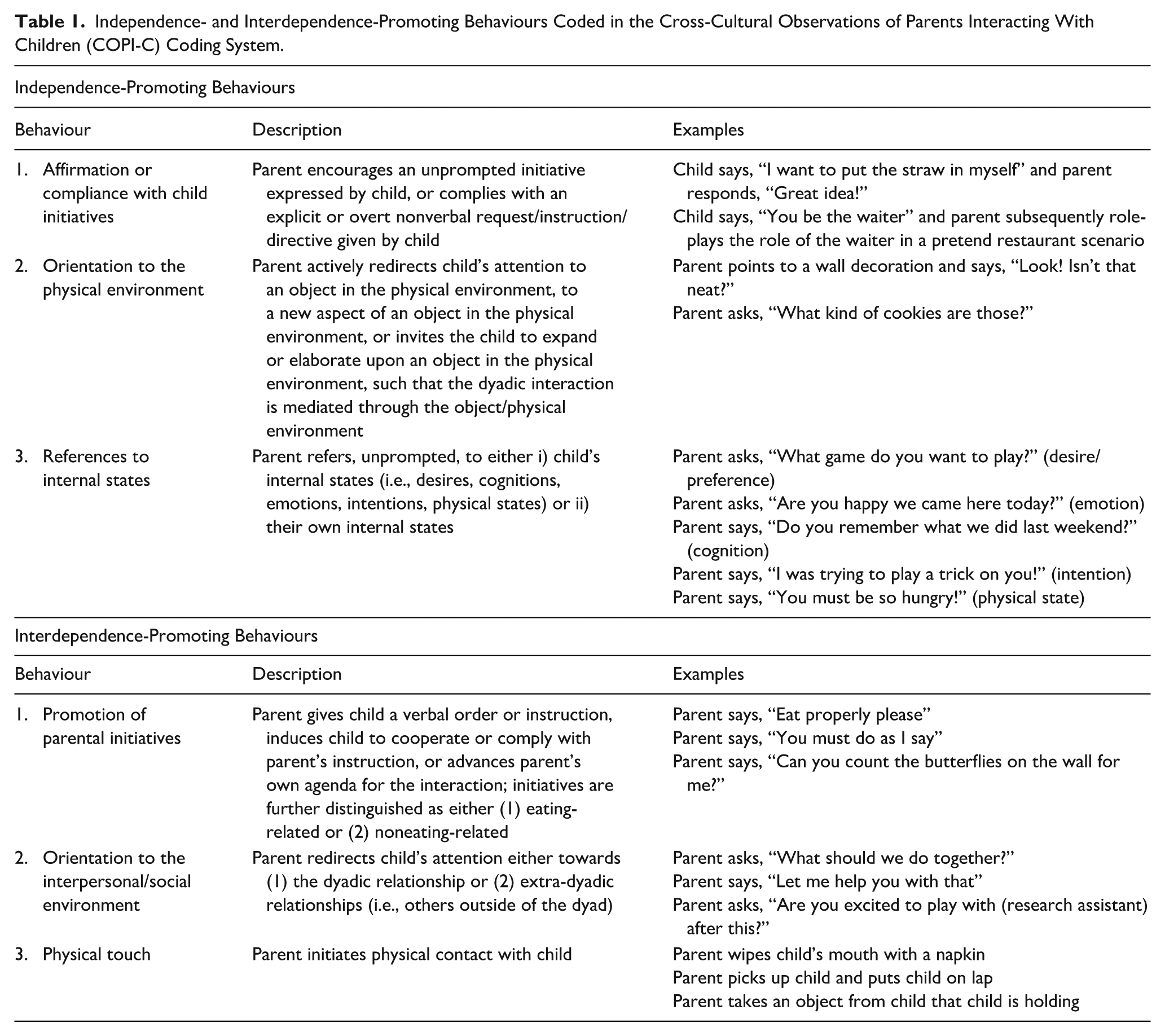
Interdependence-promoting behaviours include (1) promoting parental initiatives, (2) orientation to the social environment (dyadic relationship vs extra-dyadic relationships), and (3) parent-initiated physical touch. Promoting parental initiatives comprises instances in which the parent induces the child to comply to a command. In this study, for reasons related to the larger cohort study, Singaporean parents were told explicitly not to influence the eating behaviour of their children; therefore, we distinguished eating from noneating-related commands to account for the possibility that differences in eating-related commands may emerge as a procedural artefact. Orienting to the social environment comprises instances in which the parent draws the child’s attention to the social environment, with a further distinction between whether the dyadic or extra-dyadic environment is the focus of discussion. Physical touch comprises any instance in which the parent initiates physical contact with the child.
Each COPI-C scale yields a score ranging from 0-20, based on the number of 15 second intervals in which the behaviour was observed. Coding of the COPI-C across the two sites was coordinated by the current study’s first author, a Chinese Canadian, who trained and managed a team of one European Canadian coder, one Chinese Singaporean coder, and one Malay Singaporean coder. Once coders achieved an acceptable level of inter-rater reliability with the criterion coder, they coded cases independently, with approximately 20% of cases in each sample double-coded. The mean intraclass correlation for COPI-C scales among Canadian cases was .85 (range: .68 to .97), and the mean for Singaporean cases was .81 (range: .65–.94).
Parental Expectations of Children’s Social Development (PECSD)
The PECSD was used to assess mothers’ self-reported socialization goals for their children. The PECSD is a self-report questionnaire that was adapted by this study authors from the Self-Construal Scale (SCS; Singelis, 1994). The SCS is both a valid and reliable (Singelis, 1994) measure of the relative strength of an individual’s independent versus interdependent self-construals, which are individual-level constructs closely associated with the individualism-collectivism constructs used to describe cultures as a whole (Markus & Kitayama, 1991). For example, the independent scale includes items such as ‘I enjoy being unique and different from others in many respects’, while the interdependent scale includes items such as ‘I will sacrifice my self-interest for the benefit of the group I am in’. In the adapted PECSD, however, respondents are asked not to report on traits about themselves, but the respondent’s intentions/desires for the development of an independent and/or interdependent self-construal in their child instead. Specifically, in the adapted PECSD, respondents are first told to think about the type of person they want their child to become or develop into. Then, each item begins with the stem ‘I want my child to become a person who . . .’ followed by either an independent item (e.g., ‘. . . enjoys being unique and different from others in many respects’) or an interdependent item (e.g., ‘. . . sacrifices their own self-interest for the group they are in’), which was taken verbatim from the SCS. Like the SCS, the PECSD is comprised of 24 items: 12 items each for the independent and interdependent subscales. Participants respond on a scale ranging from 1 (strongly disagree) to 7 (strongly agree), and scores are averaged across items for each subscale separately to yield a score for independent socialization goals and a score for interdependent socialization goals. As the SCS was originally developed to be a measure of personality (which is expected to be relatively stable over time), scores from the PECSD are also expected to measure a trait-like construct that should remain relatively consistent within a caregiver across time. Indeed, to reinforce this aim, instructions for respondents and question stems were specifically written to iterate a long, broad, yet unspecified time frame regarding the development. The overall internal consistency (Cronbach’s alpha) across samples was .82 for the independent subscale and .87 for the interdependent subscale.
Data Analysis
First, we conducted routine data cleaning procedures to screen for outliers, skewness, and to ensure that the data met all statistical assumptions for the planned analyses. Next, we conducted t-test and chi-square analyses to determine whether child age and child sex differed across the two samples and therefore would need to be retained as covariates. To determine whether maternal interaction behaviours or maternal socialization goals differed across samples, we conducted a series of ANCOVAs comparing mean scores on each COPI-C behaviour and each PECSD subscale across countries, while controlling for any identified covariates. Finally, to determine whether maternal interaction behaviours were associated with maternal socialization goals, we computed the correlations between each COPI-C behaviour and each PECSD subscale (while controlling for any identified covariates) – first across both samples and then within each sample separately. In cases of missing data, we used listwise deletion as Little’s MCAR test showed that data were missing completely at random in the combined sample (χ211 = 6.94, p = .804), and in each of the separate country samples (Canada: χ211 = 9.08, p = .614; Singapore: χ211 = 11.60, p = .394).
Results
Table 2 displays the descriptive statistics for all study variables separately for Canadian and Singaporean samples. Raw scores from the following dimensions from the COPI-C were found to have significant skew in one or both of the samples (see Supplemental Table 1): affirmation/compliance with child initiatives, orientation to physical environment, references to maternal internal states, eating- and noneating-related commands, references to the dyadic relationship and extra-dyadic relationships, and parental touch. Therefore, to address skewness, we applied a square-root transformation to all COPI-C dimensions, with the exception of references to child internal states. The Canadian and Singaporean samples differed significantly on both child age, t(246) = 10.76, p < .001, and child sex (χ21 = 5.70, p = .021), with the Canadian sample being older, on average, and containing more female children than the Singaporean sample. Therefore, we controlled for child age and child sex in all analyses involving cross-sample comparisons.
Raw Means of Study Variables.
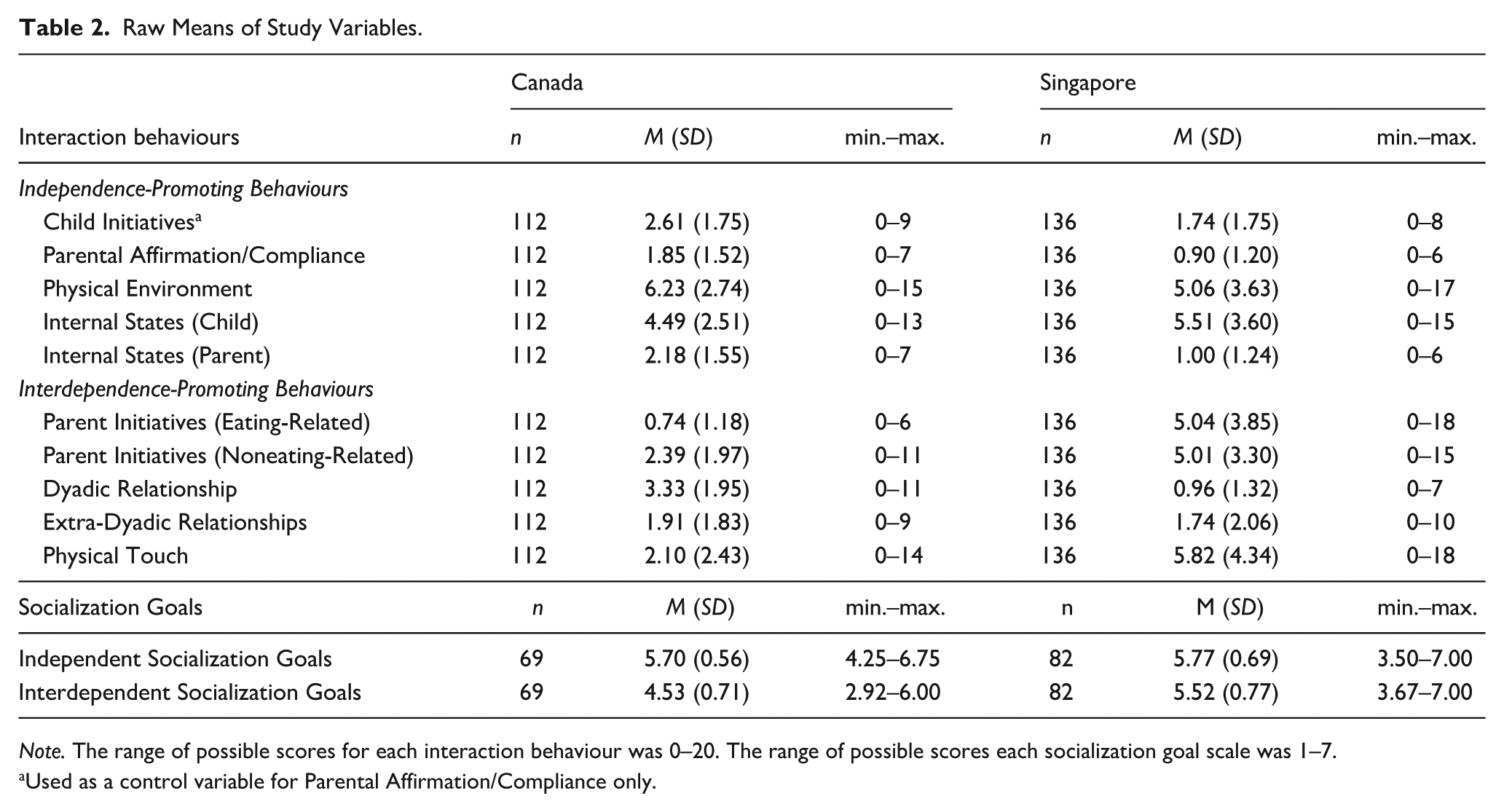
Note. The range of possible scores for each interaction behaviour was 0–20. The range of possible scores each socialization goal scale was 1–7.
Used as a control variable for Parental Affirmation/Compliance only.
Parental Behaviours Across Cultures
Table 3 displays the results of a series of ANCOVAs examining the effect of country on each COPI-C variable, controlling for the effects of child age and child sex. Canadian mothers were more likely to comply with their children’s initiatives (p < .001), to orient their children to the physical environment (p < .001), to refer to their own internal states (p < .001), and to discuss the dyadic relationship (p < .001). Singaporean mothers, on the other hand, were more likely to issue initiatives related to both eating (p < .001) and noneating behaviour (p < .001), and to initiate physical touch of their children (p < .001). Because Singaporean mothers issued significantly more eating-related initiatives, despite being explicitly instructed not to, we continued to include this variable in all subsequent analyses, as the difference in instructions did not appear to have nullified or reversed the expected difference. Canadian and Singaporean mothers did not differ in their references to children’s internal states (p = .091), nor orientation to extra-dyadic relationships (p = .265).
Comparison of Interaction Behaviours Across Countries.
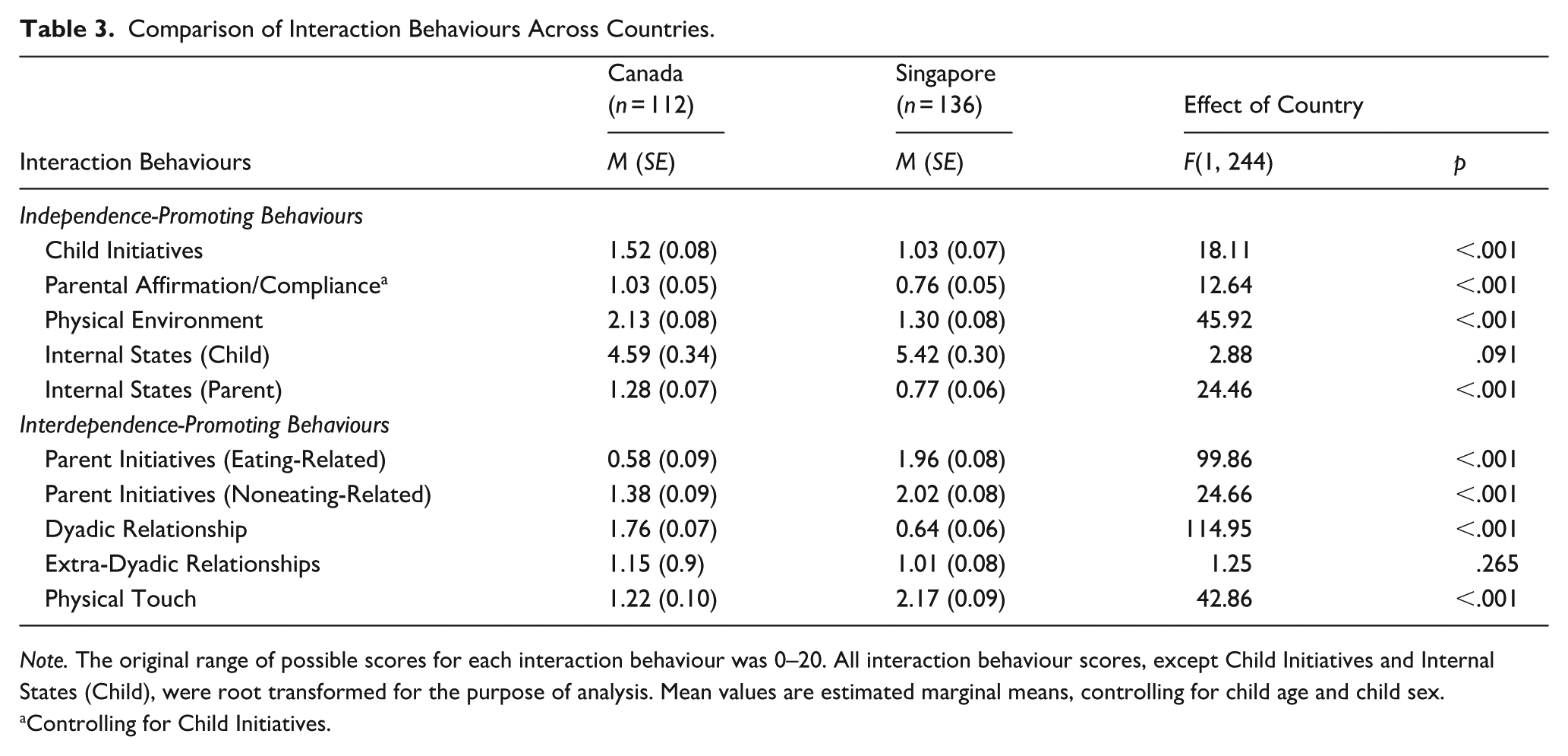
Note. The original range of possible scores for each interaction behaviour was 0–20. All interaction behaviour scores, except Child Initiatives and Internal States (Child), were root transformed for the purpose of analysis. Mean values are estimated marginal means, controlling for child age and child sex.
Controlling for Child Initiatives.
Socialization Goals Across Cultures
Controlling for child age and child sex, Canadian mothers (EMM = 5.68, SE = 0.09) and Singaporean mothers (EMM = 5.79, SE = 0.08) did not differ significantly in their endorsement of independent socialization goals, (F(1,147) = 0.67, p = .488). However, Singaporean mothers (EMM = 5.53, SE = 0.09) endorsed interdependent socialization goals significantly more than Canadian mothers, (EMM = 4.51, SE = 0.10; F(1,147) = 49.28, p < .001).
Parental Behaviours & Parental Socialization Goals
Table 4 displays the partial correlations between maternal interaction behaviours and mother-reported socialization goals across the combined sample, while controlling for child age and child sex. Across the entire sample, mother-reported independent socialization goals were not correlated with any maternal interaction behaviours. Mother-reported interdependent socialization goals, however, were negatively correlated with affirmation/compliance with child initiatives (r = −.27, p = .001) and orientation to the dyadic relationship (r = −.23, p = .004). Mother-reported interdependent socialization goals were also positively correlated with both maternal eating-related initiatives (r = .32, p < .001) and noneating-related initiatives (r = .20, p = .004), and mother-initiated physical touch (r = .20, p = .014). To determine whether correlations could be observed within each sample, we also reran correlation analyses between maternal interaction behaviours and socialization goals within the Canadian and Singaporean samples separately. No significant associations were found between any maternal interaction behaviours and socialization goals when the combined sample was divided by country (p > .05; see Supplemental Table 2).
Partial Correlations Between Interaction Behaviours and Mother-Reported Socialization Goals, Controlling for Child Age and Child Sex.
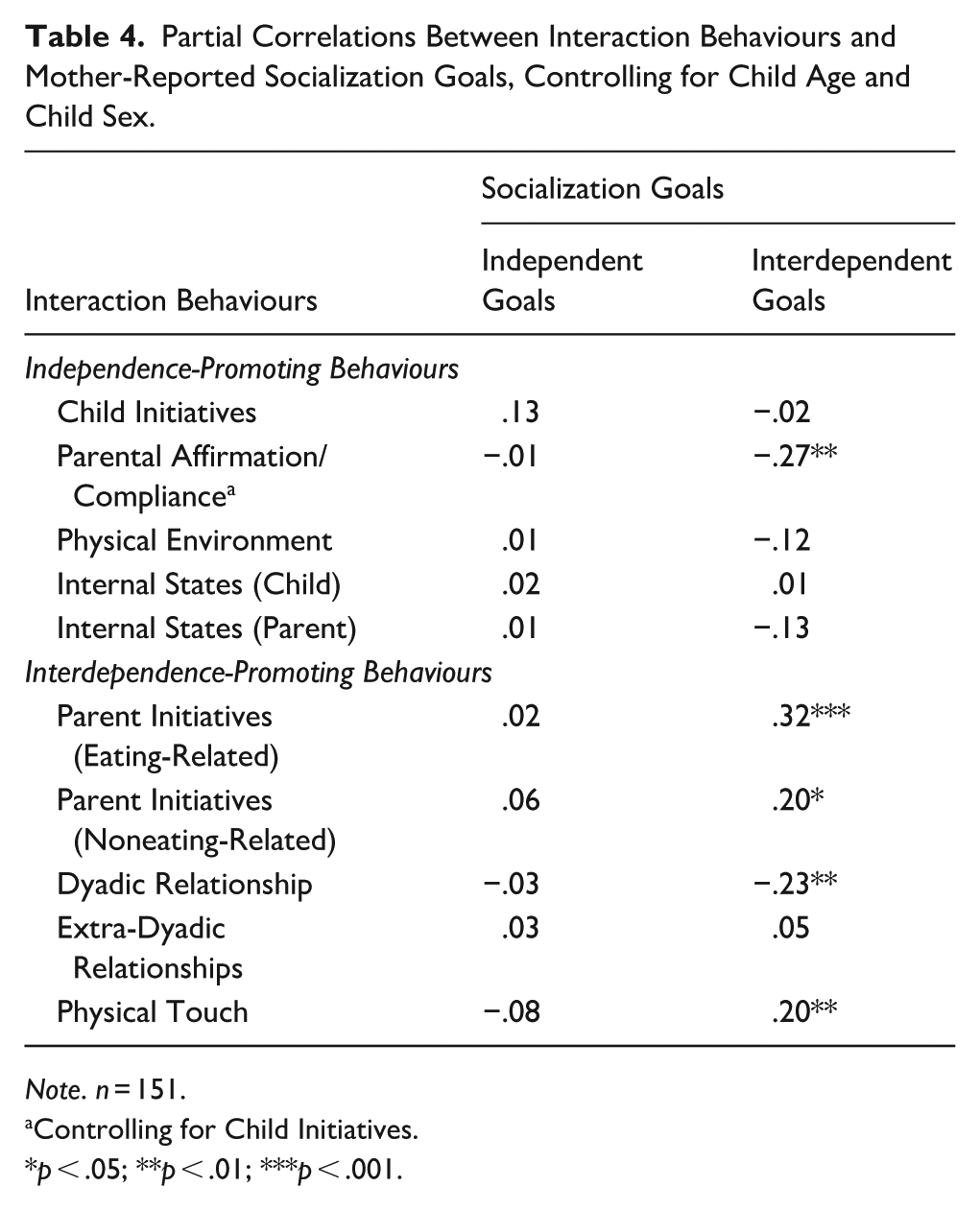
Note. n = 151.
Controlling for Child Initiatives.
p < .05; **p < .01; ***p < .001.
Discussion
This study examined independence- and interdependence-promoting behaviours among mothers of preschool-aged children in two distinct cultural contexts and explored whether these maternal behaviours corresponded with mothers’ self-reported socialization goals. Specifically, we investigated cross-cultural differences in the emphasis placed on independent and interdependent goals and the extent to which these goals were reflected in observed parent–child interactions. Guided by Bronfenbrenner’s (1979) ecological systems theory and Keller’s (2015) cultural framework, this multi-method study used a novel, developmentally sensitive behavioural coding system to extend cross-cultural research into the preschool period and to contribute new empirical evidence from an under-represented Southeast Asian context (Rich et al., 2020).
Independence- and Interdependence-Promoting Behaviours Across Contexts
Our findings confirm that many cultural patterns in early caregiving persist beyond infancy. Consistent with theories that independence-oriented socialization treats the child as an active partner (Keller, Hentschel, et al., 2004), Canadian mothers showed higher rates of (1) compliance with child initiatives; (2) orienting to the physical environment; and (3) references to mothers’ own internal states. These patterns align with prior infant/toddler findings on turn-taking (Bornstein et al., 2015; Keller et al., 2008), object-focused attention (Fernald & Morikawa, 1993), and distal/psychological engagement (Kartner et al., 2010; Little et al., 2016), and our results extend these cross-cultural patterns into the preschool period using a developmentally tuned coding scheme (COPI-C). In contrast, Singaporean mothers displayed higher rates of (1) both eating- and noneating-related commands and (2) parent-initiated touch. These behaviours fit interdependence-oriented caregiving emphasizing social harmony and obedience (Feldman et al., 2006; Keller, 2011; Tamis-LeMonda et al., 2012). Observing these differences during a minimally structured, naturalistic interaction suggests that macrosystem values remain salient beyond infancy, when children’s physical autonomy is increasing.
Contrary to some reports of higher child-focused internal state talk in more individualistic contexts (e.g., Doan & Wang, 2010; Taumoepeau, 2015), we did not detect cross-national differences in references to children’s internal states. We interpret this divergence as potentially task-dependent as our snack interaction task was not explicitly designed to elicit mental-state discourse, unlike the tasks used in past research (e.g., book-reading/emotion discussion tasks). While we did not observe cross-sample differences in extra-dyadic references, Canadian mothers referenced the dyad more frequently than Singaporean mothers, a counter-intuitive finding if ‘social orientation’ is equated with collectivism, as suggested in previous studies (e.g., Doan & Wang, 2010; Rabain-Jamin & Sabeau-Jouannet, 1997; Wang, 2001). We propose, in line with the broader Canadian pattern (higher self-referencing internal state talk; greater compliance with child initiatives), that dyadic references in this context may be indicative of an egalitarian conversational stance (i.e., parent treating the child as a quasi-equal partner), rather than generic sociality. Because our present coding did not capture the specific nature of dyadic references (e.g., self-disclosure vs. relational coordination), we identify this as a concrete target for fine-grained future coding.
Nonetheless, our findings during the snack interaction task highlight noteworthy differences in maternal behaviours that are generally consistent with broader cultural differences along the individualism-collectivism dimension during a period in which both the development of personal autonomy and social relatedness are prominent themes. While comprising only one comparison across two specific contexts, our results re-emphasize the importance of challenging the common assumption that behavioural norms observed in Western contexts are necessarily the norm in non-Western contexts. As our findings were derived from the first formal usage of the COPI-C, our results also highlight a broader array of specific candidate behaviours that should be considered in future studies of diverse families during the preschool period, to ensure that they are not only culturally relevant but also developmentally sensitive.
Socialization Goals Across Contexts
As predicted by cross-cultural models (Hofstede, 2001; Triandis, 2001), Singaporean mothers endorsed interdependent socialization goals more strongly than Canadian mothers. This pattern is consistent with both between- and within-country evidence showing that European Canadians, which comprise the majority of our Canadian sample, tend to endorse less collectivistic values than both Asians and Asian Canadians (Kuo & Gingrich, 2004; Marshall, 2008). In contrast, Canadian and Singaporean mothers did not differ significantly in their endorsement of independent goals. This lack of difference is consistent with literature on cultural hybridization in rapidly modernizing societies (Ang & Stratton, 1995; Greenfield, 2009; Quek et al., 2011), suggesting that individualistic values may be increasingly incorporated into Singaporean family life alongside enduring interdependent values. Within the Singaporean context, such rapid modernization includes dramatic shifts in socioeconomic conditions stemming from increased economic activity, high rates of women’s participation in the workforce, increased urbanism, and technological advancements, which have all contributed to changes in Singaporean family dynamics within the short span of the last several decades (Baum, 1999; Chang et al., 2003; Quek, 2022; Quek et al., 2011; Teo et al., 2003). These include a shift towards nuclear family compositions, with a reduction in multi-generational households (Esteve & Liu, 2017). With major sociodemographic changes such as these, Greenfield’s theory of social change posits that social values should shift in the direction of individualism and that developmental pathways should follow (2009). However, researchers studying the Singaporean context have noted a hybridity in Singaporean culture, in which the rapid demographic changes that have occurred only in recent decades have spurred the adoption of individualistic values, while collectivistic values remain relevant and adaptive (Ang & Stratton, 1995; Chang et al., 2003; Cheung & Lim, 2022; Quek et al., 2011). At the caregiving level, some have observed that this trend manifests in caregivers’ behaviours (and beliefs) being simultaneously influenced by their current context but also by their own child-rearing experiences with generations immediately preceding, who endorse traditional collectivistic values more strongly (Greenfield, 2009), and who may still be deeply involved in the child-rearing process as grand-parents (Esteve & Liu, 2017; Mehta & Thang, 2006; Teo et al., 2003). Although this study consists of a comparison of socialization goals at only a single point in time, it is possible that the pattern we observed is reflective of the shifting, hybrid nature of contemporary Singaporean culture.
Critically, in this study, we go beyond between-group description by linking measured socialization goals (PECSD) to observed practices (COPI-C). Across the combined sample, interdependent goals correlated positively with commands (eating and noneating) and parent-initiated touch, and negatively with maternal compliance with child initiatives and dyadic-reference. This pattern is theoretically coherent with Keller’s (2015) account of parental ethnotheories and Bronfenbrenner’s ecological systems theory, which posit that macrosystem values are translated into day-to-day parental practices through parental beliefs/goals, thereby strengthening the construct validity of our behavioural indicators. Interestingly, interdependent socialization goals were negatively associated with maternal compliance with child initiatives, which was presumed to represent an independence-promoting behaviours. Interdependent socialization goals were also negatively correlated with orientation to the dyadic relationship, which supports our argument that this behaviour may in fact reflect a relatively more egalitarian orientation towards the parent–child relationship that is characteristic of the relatively more individualistic Canadian context. In contrast to the interdependent scale, the independent socialization goals scale did not correlate with any of the observed behaviours. Examining the individual items from the independent socialization scale, it is apparent that while the scale included items about assertiveness and individuality, it also included items that were perhaps less related. For example, there were items that referred to the desire to foster creativity and valuing good health, which are less obviously associated with the core definition of independence. The independent goals subscale of the PECSD also showed a lower internal consistency (albeit still adequate), compared with the interdependent goals subscale.
Taken together, our results identifying an association between certain dimensions of maternal interaction behaviours and interdependent socialization goals suggest that mothers who generally value concepts such as obedience and deference to authority in their children tend to behave in ways that embody these values. That is, by subjecting children to a greater frequency of requests/commands and by physically intervening to regulate their children’s behaviour (e.g., by altering their bodily position in space and the manner in which they eat) more often during routine interactions, parents act as early socialization agents of such values through concrete exposure and practice. This lends further empirical support to theoretical frameworks that discuss everyday parent–child interactions as the mechanism by which cultural information is transmitted from the wider macrosystem to the individual in early life (Bronfenbrenner, 1979; Keller, 2015).
Theoretical and Practical Implications
The present findings make several theoretical contributions. First, they extend Keller’s (2015) cultural models of development to a later developmental stage, demonstrating that the distinction between autonomy- and relatedness-oriented caregiving continues to shape behaviour once children are verbally and cognitively developed enough to engage as active co-participants in interaction. This highlights the continuity in the cultural socialization process across developmental stages. Second, our results refine cross-cultural developmental theory by illustrating that independence and interdependence are not mutually exclusive but can coexist in culturally hybrid forms. The comparable endorsement of independent goals among Singaporean mothers highlights the dynamic coexistence of autonomy and relatedness in modern collectivistic societies, thereby underlining the need to move beyond binary models of individualism–collectivism (Kagitcibasi, 2011). Third, by linking mothers’ beliefs (socialization goals) and observable behaviours, the study provides rare empirical evidence for the cultural transmission pathway theorized by Bronfenbrenner (1979): from macrosystemic cultural values, through parental ethnotheories, to microsystem-level interactions. This represents a substantive advancement over purely descriptive cross-cultural comparisons, offering stronger construct validity for both cultural and developmental constructs.
The study’s methodological and applied implications are also significant. Methodologically, the COPI-C offers a developmentally sensitive and culturally flexible tool for quantifying everyday parent–child interactions during the preschool period. Its capacity to capture subtle relational dynamics makes it valuable for both cross-cultural research and intervention studies targeting parent–child communication. Practically, understanding how cultural values are expressed in daily interactions has implications for early childhood education, parenting interventions, and cross-cultural adaptation programmes. For example, recognizing that directive behaviours in Singapore may reflect normative relational goals rather than authoritarianism can inform culturally responsive parenting guidance and practitioner training (Cheung & Lim, 2022). Similarly, awareness that Western parents’ emphasis on child agency is embedded in an egalitarian framework can refine developmental expectations in multicultural contexts, such as immigrant family support services and early childhood policy.
Limitations and Future Directions
In this study, we chose to examine Canadian and Singaporean contexts because of their similarity on various indicators (e.g., industrialization) but their divergence on one key dimension: individualism versus collectivism. While we found that Canadian and Singaporean mothers differed in a manner that was largely coherent with variation across this dimension, we note that this two-group comparative design, while common in cross-cultural psychology, can over-emphasize a binary perspective on cross-cultural variations in behaviour (Norenzayan & Heine, 2005). Therefore, we cannot rule out the possibility that behaviours did not differ across samples because of variation along a separate, unidentified dimension. We tried to mitigate this possibility by identifying a theoretically viable variable – socialization goals (which make up parental ethnotheories) – to verify that variations in behaviour were tied to variations in maternal beliefs. Indeed, we found that maternal socialization goals, which also differed across the two samples, were correlated with the maternal interaction behaviours that we observed. Still, the study of additional cultural contexts, found at various points on the individualism-collectivism spectrum, would have helped to further mitigate a categorical view of maternal behaviours across cultures and to lend further support for the link between macrosystem-level cultural values and parent–child in the microsystem.
While the 5-minute snack interaction that we observed in this study provided a relatively naturalistic situation in which to observe parent–child interactions, there were some limitations associated with our methodology. First, due to varying study constraints at each site, the specific instructions given to mothers differed slightly between the two samples, with Singaporean mothers being told explicitly not to influence the choice and amount of the child’s eating behaviour. It is possible that this difference may have contributed to differences in mothers’ prescriptive behaviours. To address this issue, we coded for eating and noneating-related parental initiatives separately, and we found that despite being primed to be less prescriptive of children’s eating-related behaviour, Singaporean mothers unexpectedly made more eating-related commands than Canadian mothers, a pattern that was similarly observed for noneating-related commands. This raises the prospect that, given no restrictions, Singaporean mothers could have potentially imposed even more of their initiatives on their children’s behaviours. Still, given that this could have led to biases in our study beyond what could be accounted for, future replication should attempt to maintain as high a degree of equivalence among the research sites as possible. Second, while we observed many differences in interaction behaviours across the two samples during a relatively naturalistic, unstructured situation, the overall rate of many observed behaviours was low. Had we adopted a more structured situation that was designed to elicit specific behaviours as has been done in previous studies (e.g., a book reading or emotion discussion task to elicit mental state talk), we may have observed a greater range and variability in such behaviours. Finally, the one-time measurement of parent behaviour and socialization goals, and the timespan that elapsed between these two measures, means that our results reflect only a specific snapshot in time. Therefore, the relationships reported between these variables, which are correlational in nature, should be interpreted with caution, as both parents’ behaviours and the beliefs underlying them may shift as a function of development in both their child and, indeed, the parent themselves. Furthermore, as we have discussed with respect to the measurement of socialization goals, the independent goals subscale of the PECSD contained items that lacked face validity, and may, as a result have influenced our ability to identify associations between maternal interaction behaviours and independent socialization goals. Indeed, while the independent subscale of the PECSD showed good internal consistency overall, additional analyses showed that Cronbach’s alpha for this subscale was lower in the Canadian sample (.65), compared with the Singaporean sample (.82). We also lacked statistical power in analyses involving maternal socialization goals because of relatively smaller sample size due to missing data. This factor may specifically account for the lack of significant associations between maternal interaction behaviours and socialization goals when the data were analysed separately by country. We therefore propose that future research would benefit from a revision of the PECSD and administering all measures to a larger sample. Finally, we wish to acknowledge the lack of racial diversity in our Canadian sample, the exclusion of dyads of Indian ethnicity in our Singaporean sample (which comprise the third major ethnic group comprising the Singaporean population), and the focus on urban populations in our study. To further improve the generalizability of our findings, future studies should aim for even greater ethnic diversity and to examine populations outside of major urban centres.
Conclusion
This study presented a cross-cultural examination of mother–child interactions across two cultural contexts. Noting that much work in this area has focused on infants, we extended the cross-cultural comparison of mother–child interactions to the preschool period by proposing a novel observational method for the preschool period, which accounted for the increased verbal, cognitive, and social capabilities in children. We also went beyond the process of simple description of cross-cultural differences in caregiver behaviour by examining a theoretical correlate of caregiver behaviour: parental beliefs (i.e., socialization goals) deriving from the macrosystem that may inform or organize these microsystem behaviours. In sum, this study contributes to the growing body of knowledge actively addressing the historical overemphasis in developmental psychology on Western contexts (Henrich et al., 2010; Nielsen et al., 2017; Nielsen & Haun, 2016), showing not only that mother–child interactions differ across North American and Southeast Asian contexts but also that these behaviours may be linked to parents’ intentions for socializing children.
Supplemental Material
sj-docx-1-jbd-10.1177_01650254251411182 – Supplemental material for The promotion of independence and interdependence in parent–child interactions across two cultures: Associations with maternal socialization goals
Supplemental material, sj-docx-1-jbd-10.1177_01650254251411182 for The promotion of independence and interdependence in parent–child interactions across two cultures: Associations with maternal socialization goals by Jeffry Quan, Jean-François Bureau, Audrey-Ann Deneault, Mary Foong-Fong Chong, Fabian Yap, Yap Seng Chong and Anne Rifkin-Graboi in International Journal of Behavioral Development
Footnotes
Acknowledgements
We wish to acknowledge the GUSTO Study Group. This study group includes: Airu Chia, Andrea Cremaschi, Anna Magdalena Fogel, Anne Eng Neo Goh, Anne Rifkin-Graboi, Anqi Qiu, Arijit Biswas, Bee Wah Lee, Birit Froukje Philipp Broekman, Candida Vaz, Chai Kiat Chng, Chan Shi Yu, Choon Looi Bong, Daniel Yam Thiam Goh, Dawn Xin Ping Koh, Dennis Wang, Desiree Y. Phua, E Shyong Tai, Elaine Kwang Hsia Tham, Elaine Phaik Ling Quah, Elizabeth Huiwen Tham, Evelyn Chung Ning Law, Evelyn Keet Wai Lau, Evelyn Xiu Ling Loo, Fabian Kok Peng Yap, Falk Müller-Riemenschneider, Franzolini Beatrice, George Seow Heong Yeo, Gerard Chung Siew Keong, Hannah Ee Juen Yong, Helen Yu Chen, Hong Pan, Huang Jian, Huang Pei, Hugo P S van Bever, Hui Min Tan, Iliana Magiati, Inez Bik Yun Wong, Ives Lim Yubin, Ivy Yee-Man Lau, Jacqueline Chin Siew Roong, Jadegoud Yaligar, Jerry Kok Yen Chan, Jia Xu, Johan Gunnar Eriksson, Jonathan Tze Liang Choo, Jonathan Y. Bernard, Jonathan Yinhao Huang, Joshua J. Gooley, Jun Shi Lai, Karen Mei Ling Tan, Keith M. Godfrey, Keri McCrickerd, Kok Hian Tan, Kothandaraman Narasimhan, Krishnamoorthy Naiduvaje, Kuan Jin Lee, Li Chen, Lieng Hsi Ling, Lin Lin Su, Ling-Wei Chen, Lourdes Mary Daniel, Lynette Pei-Chi Shek, Maria De Iorio, Marielle V. Fortier, Mary Foong-Fong Chong, Mary Wlodek, Mei Chien Chua, Melvin Khee-Shing Leow, Michael J. Meaney, Michelle Zhi Ling Kee, Min Gong, Mya Thway Tint, Navin Michael, Neerja Karnani, Ngee Lek, Noor Hidayatul Aini Bte Suaini, Ong Yi Ying, Oon Hoe Teoh, Peter David Gluckman, Priti Mishra, Queenie Ling Jun Li, Sambasivam Sendhil Velan, Seang Mei Saw, See Ling Loy, Seng Bin Ang, Shang Chee Chong, Shiao-Yng Chan, Shirong Cai, Shu-E Soh, Stephen Chin-Ying Hsu, Suresh Anand Sadananthan, Swee Chye Quek, Tan Ai Peng, Varsha Gupta, Victor Samuel Rajadurai, Wee Meng Han, Wei Wei Pang, Yap Seng Chong, Yin Bun Cheung, Yiong Huak Chan, Yung Seng Lee, Zhang Han.

Funding
The authors disclosed receipt of the following financial support for the research, authorship, and/or publication of this article: In Canada, the study was supported by the Social Sciences and Humanities Research Council of Canada (SSHRC; 410-2009-0724, 435-2013-0230). In Singapore, the study was supported by the National Research Foundation (NRF) under the Open Fund-Large Collaborative Grant (OF-LCG; MOH-000504) administered by the Singapore Ministry of Health's National Medical Research Council (NMRC) and the Agency for Science, Technology and Research (A*STAR). In RIE2025, the study was supported by funding from the NRF's Human Health and Potential (HHP) Domain, under the Human Potential Programme.
Declaration of conflicting interests
The authors declared no potential conflicts of interest with respect to the research, authorship, and/or publication of this article.
Supplemental material
Supplemental material for this article is available online.
References
Supplementary Material
Please find the following supplemental material available below.
For Open Access articles published under a Creative Commons License, all supplemental material carries the same license as the article it is associated with.
For non-Open Access articles published, all supplemental material carries a non-exclusive license, and permission requests for re-use of supplemental material or any part of supplemental material shall be sent directly to the copyright owner as specified in the copyright notice associated with the article.
