




Abstract
Older individuals face increasing societal expectations to remain active. Perceived expectations for active aging (PEAA) refer to individuals recognizing that such expectations are being directed at them. PEAA supposedly are related to everyday aging-related experiences, including perceived age-related gains and losses. We tested whether daily variations and interindividual differences in gains and losses are related to PEAA, and whether this relation varied by age. In a preregistered 14-day diary study with 204 participants (Mage = 65.00, 50–91 years, 66% female), we assessed PEAA and awareness of age-related gains and losses. On the between-person level, individuals who reported higher losses or higher gains reported higher PEAA. On the within-person level, the relation between losses and PEAA varied by age. While middle-aged adults reported lower PEAA on days with more losses, old-old adults reported higher PEAA. Our results indicate that how individuals construed their aging experiences was an important contextual factor for interindividual differences and variations in PEAA. These factors are important for our understanding of how developmental opportunity structures are perceived and used in later life.
Keywords
Introduction
Responding to demographic changes and an increasingly aging population, many Western countries introduced active aging policies defining health preservation, civic engagement, and extended paid work as policy goals (European Commission, 2011; World Health Organization, 2015). How these changes at the societal level permeate different social contexts and how they become psychologically effective has been investigated in research on perceived expectations for active aging (PEAA; Pavlova & Silbereisen, 2012, 2016). PEAA refer to individuals recognizing expectations for active aging that are directed at them personally and perceptibly in everyday life contexts (e.g., being expected to contribute to the common good). Assuming that unequal exposure to expectations for active aging may exacerbate unequal opportunities for aging well, previous PEAA research has mainly focused on variables linked to such inequalities. These variables, including socioeconomic resources or social integration, however, explained only a little variance in PEAA (cf. Pavlova et al., 2023; Radoš et al., 2024).
It has been proposed that to better understand when and how older adults perceive expectations for active aging, it is important to investigate everyday aging-related experiences and challenges (Hughes & Touron, 2021; Pavlova et al., 2023). Thus, in our 14-day diary study, we investigated how individuals construed their daily aging experiences and how those related to PEAA. Concrete and everyday aging experiences were assessed within the scope of the awareness of age-related changes (AARC) concept. AARC entails “. . . individuals’ awareness that their behavior, level of performance, or ways of experiencing their lives have changed due to aging” (Diehl & Wahl, 2024, p. 1). AARC entails that these changes are attributed to age or aging rather than other (situational) conditions. AARC represents age-related aspects of the core self-concept that have stable and flexible facets. As the balance between age-related gains and losses becomes increasingly unfavorable with increasing age, with age-related losses becoming a more normative and expected experience (Baltes, 1987; Heckhausen et al., 1989; Riediger et al., 2014), we also investigated whether the associations between AARC and PEAA varied by chronological age.
Perceiving Expectations for Active Aging
Within the last 50 years, ideas of life in old age have undergone tremendous change in Western societies. Once a phase of deserved rest in which individuals are liberated from work and (social) responsibilities, old age has now become a phase of (prescribed) activity (Foster & Walker, 2015; van Dyk, 2015). Older adults are expected to stay physically and cognitively fit, and to contribute to the common good. These expectations are mirrored in concepts of successful aging (Rowe & Kahn, 1997), can be found in descriptions of lay people’s understanding of active aging (Bowling, 2008), and are part of active aging policy frameworks (World Health Organization, 2002). Empirical research indicates that active aging has also become a societal normative belief. Younger and—even more so—older adults prescribe active aging to the group of older adults (de Paula Couto, Fung, et al., 2022; Ludwig et al., 2024; Wirth, de Paula Couto, et al., 2025; Wirth et al., 2023). Previous studies also indicate that active aging expectations are more strongly endorsed for older compared to younger adults, pointing to age-specificity (de Paula Couto, Huang, & Rothermund, 2022).
These prescriptions can, at least in part, be attributed to the idea that staying active and engaged avoids or mitigates negative changes typically associated with the aging process (de Paula Couto & Rothermund, 2022; Schmitt, 2004). From a societal perspective, by exercising mind and body, older adults can maintain health and functioning. This, in turn, should lower consumption of socially shared resources such as health care. Moreover, many older adults are willing to invest time and energy into achieving an active lifestyle (de Paula Couto & Rothermund, 2022; Tomasik & Silbereisen, 2014). Studies consistently show that middle-aged and older adults perceive moderate expectations for active aging (Pavlova et al., 2023; Pavlova & Silbereisen, 2012, 2016; Radoš et al., 2024; Radoš, Pavlova, Rothermund, & Silbereisen, 2025). These expectations for active aging supposedly engender a more positive image of old age. Instead of focusing on deficits, the active aging discourse emphasizes older adults’ knowledge and competence and highlights the valuable contributions made by older adults (Boudiny & Mortelmans, 2011; Daatland, 2005; Pavlova et al., 2023). Activation expectations directed at older adults could promote positive changes in lifestyles and have been related to better psychological functioning among older adults (de Paula Couto, Fung, et al., 2022; Pavlova & Silbereisen, 2016). Based on these considerations, it has been proposed that unequal exposure to expectations for active aging may exacerbate unequal opportunities for aging well (Pavlova et al., 2023), and previous research tried to better understand factors that predispose individuals to perceive active aging expectations (e.g., personality or motivation, Radoš et al., 2024) or resources that might enable active lifestyles (e.g., socioeconomic status [SES] or social integration, Pavlova et al., 2023). These variables, however, explained rather little variance in PEAA (cf. Pavlova et al., 2023; Radoš et al., 2024).
To identify predictors that might help us to better understand differences in PEAA, it might be important to take a closer look at how PEAA is assessed. Previous studies assessed PEAA as a relatively stable, trait-like construct and linked it to factors that are also relatively stable. Trait-like measures, assessed only once, occlude the view for potential facilitators or barriers to aging well that individuals experience in everyday life, and ignore intraindividual variability in PEAA. Daily diaries, and more generally momentary assessments, allow studying intraindividual processes between PEAA and everyday determinants and would help to identify targets for possible interventions that are more likely modifiable than static factors such as SES (for similar reasoning see Tse et al., 2025). In addition, PEAA has been conceptualized as reflecting older adults’ recognizing expectations that are directed at them personally and perceptibly in everyday life contexts (Pavlova & Silbereisen, 2012, 2016). Assuming that older individuals’ daily life contexts vary (e.g., Weber et al., 2020) would indicate that PEAA underlie, at least to some degree, (daily) variations. Previous research also supports the idea that perceptions of active aging are variable, as they can change across time (Pavlova & Silbereisen, 2016) and can be subject to experimental manipulation (Wirth, de Paula Couto, et al., 2025; Wirth et al., 2023). Thus, complementing previous PEAA research and getting closer to older adults’ lived experience, we assessed PEAA and determinants in everyday life using daily diary assessments.
PEAA and Age-Related Gains and Losses
Previous research has focused on the idea that the potentials and barriers for active aging or an active lifestyle in old age are closely tied to the availability of personal and social resources (Pavlova et al., 2023; Pavlova & Silbereisen, 2012, 2016; Radoš et al., 2024; Schmitt, 2004). There has also been a growing recognition that the changes in functioning that accompany the aging process are relevant for PEAA (Pavlova et al., 2023; Schmitt, 2004). Changes can encompass both losses (e.g., declining cognitive functioning) but also gains (e.g., appreciation of relationships), and an individual’s attribution of changes to their age or aging has been captured by the construct of awareness of age-related changes (AARC; Diehl et al., 2015; Diehl & Wahl, 2024). AARC represents an age-related aspect of the core self-concept that has both stable and flexible facets, and that is shaped by the immediate contexts and situations people are living in (Cohn-Schwartz & Gerstorf, 2022; Shrira et al., 2022). Given that AARC focuses on concrete and everyday experiences that underlie individuals’ self-perceptions of aging (Brothers et al., 2017; Diehl et al., 2015), it has also been investigated in daily diary studies, showing small to moderate variation across days (Neupert & Bellingtier, 2017; O’Brien & Smyth, 2023; Wirth, Kornadt, & Rothermund, 2025).
AARC and PEAA could be related based on two conceptual ideas. AARC represents the age-related self-knowledge that is incorporated into older adults’ self-concept (Diehl et al., 2014). A person’s self-concept provides the framework for the interpretation of their own experiences, but also serves as an interpretative framework for understanding the thoughts, feelings, and behaviors of other people (e.g., Markus et al., 1985). It has even been proposed that people’s beliefs and perceptions about how others view them are based primarily on an individual’s self-perception (Kenny & DePaulo, 1993). Thus, AARC should be related to PEAA because AARC would build the background against which older adults perceive and interpret expectations and demands that other people direct at them (Rothermund et al., 2021; Wirth, de Paula Couto, et al., 2025). Based on previous reasoning regarding self-perceptions of aging, more negative self-perceptions supposedly are related to a higher willingness to adopt societal expectations regarding older adults (Bodner et al., 2021). Thus, if perceiving age-related losses is related to a higher willingness to adopt and accept societal expectations to be active, older adults who perceive more age-related losses should also more readily perceive active aging expectations.
Moreover, AARC entails knowledge about perceived changes in individual resources and is related to forming specific intentions (staying physically fit) and motivating specific behavior (engaging in exercising; Diehl & Wahl, 2010). It has been proposed that PEAA are closely tied to the availability of personal and social resources (Pavlova et al., 2023; Pavlova & Silbereisen, 2012, 2016; Radoš et al., 2024; Schmitt, 2004). The perception of age-related losses should be related to perceiving resource losses and that one is aging less well, which in turn could trigger self-regulatory adjustment processes. Individuals may become more sensitive to active aging expectations because they resonate with their own concerns regarding age-related losses. Put differently, when older individuals perceive age-related losses, societal appeals of delaying or mitigating negative changes associated with the aging process might be particularly salient and more readily perceived. Thus, more age-related losses should be related to more PEAA.
In contrast, age-related gains may signal potential for growth and act as a motivational force for continued development (Diehl & Wahl, 2024; Wurm et al., 2010). Perceiving more gains or generally having a more positive self-perception of aging has been related to taking action to prevent age-related decline (Brothers et al., 2017). Positive self-perceptions are important predictors of active aging indicators such as physical exercise or social engagement (Schwartz et al., 2021; Wurm et al., 2010). Assuming that, at least in part, age-related gains are related to engaging in active aging could mean that more age-related gains are related to lower sensitivity to perceive demands as originating from others, because active aging seems age-normative, and one is already intrinsically motivated to remain fit, healthy, and engaged. In addition, if individuals perceive that they are aging well and also engage in active aging, others might not necessarily impose active aging demands. However, age-related gains could also be interpreted as possessing sufficient resources to deal with active aging expectations and might not necessarily sensitize older adults to others’ active aging demands. Interestingly, previous work indicates that individuals who are already socially engaged perceive more expectations than those who are not engaged (Pavlova & Silbereisen, 2016). Thus, the relation between age-related gains and PEAA may not be straightforward.
When investigating the relation between AARC and PEAA, chronological age might also be relevant. Previous research points to age-related differences and changes in PEAA and AARC such that higher age was related to lower PEAA and fewer gains, but to more losses (Diehl et al., 2021; Jung et al., 2021; Pavlova & Silbereisen, 2016). In addition, age moderated the relation between PEAA and its predictors (Pavlova et al., 2023) as well as between AARC and developmental outcomes such as affect or functional health (Bodner et al., 2021; Brothers et al., 2017; Wirth, Kornadt, & Rothermund, 2025). Specifically, the relation between AARC and outcomes was most pronounced in old-old compared to middle-aged and young-old adults. Whether and how relations between PEAA and AARC vary by age were explored in our study.
Overview of the Current Research
Extending previous work, we investigated PEAA in everyday life and related them to everyday aging-related experiences and challenges using data from a 14-day diary study. We tested intraindividual relations between AARC and PEAA and interindividual differences in this relation. We also explored whether these relations varied by chronological age. We focused on middle-aged and older adults as age-related gains and losses are especially relevant in these life phases (Diehl & Wahl, 2024).
Based on the idea that negative self-perceptions of aging, such as age-related losses, are related to an increased willingness to adopt and accept societal expectations (Bodner et al., 2021), we predicted that more age-related losses would be related to higher PEAA. On the between-person level, we expected that individuals who report more losses than others should also report higher PEAA. On the within-person level, we predicted that on days with above-average losses, participants would report higher PEAA than on days with below-average losses. Based on the idea that positive self-perceptions of aging, such as age-related gains, are related to a more pronounced intrinsic motivation for and engagement in active aging (Schwartz et al., 2021; Wurm et al., 2010), we expected that individuals would be less exposed to and less sensitive to active aging expectations. Thus, we expected that individuals who report more gains than others should report lower PEAA. On days with above-average age-related gains, participants should report lower PEAA than on days with below-average gains. Based on previous studies indicating more pronounced relations between AARC and important developmental outcomes with higher age (Bodner et al., 2021; Brothers et al., 2017; Wirth, Kornadt, & Rothermund, 2025), we expected that losses and gains should be more closely related to PEAA for our oldest participants.
Method
Participants and Procedure
Information needed to estimate the power for multilevel models (e.g., error covariances, reliability of coefficients) could not be obtained from previous PEAA research that used trait measures. Thus, we followed simulation-informed recommendations of Nezlek (2020). Specifically, for studies interested in cross-level interactions, the study should encompass 14 days, and the sample should include at least 125 participants. The original sample comprised 204 adults between 50 to 91 years (M = 65.00, SD = 8.01), with the majority being female (65.2%). Three participants were excluded because they had no daily diary entries. Two participants were excluded because they had fewer than seven daily diary entries. We excluded participants with less than 50% of diaries because the unreliability inherent in person means generated with few observations results in downwardly biased between-person and cross-level interaction effect estimates (Gottfredson, 2019). Demographics of included and excluded participants can be found in Table S1 (supplementary information). Included participants had high compliance (M = 96.1%, range = 57%-100%). Participants were German-speaking and were recruited through personal contacts or social media. Participants first provided written informed consent, completed a baseline questionnaire including demographic information, and received questionnaires on the following 14 consecutive days. Participants received monetary compensation. Ethical approval was granted by the Ethics Committee of the Friedrich-Schiller-University Jena (project title “Expectations for active ageing”; FSV 22/018).
Measures
A complete list of items can be found at
Daily Age-Related Gains and Losses
AARC facets were assessed using 20 items from previous research (Neupert & Bellingtier, 2017). All items started with the phrase “With my awareness of aging in the past 24 hours, I realize that . . . ” and were rated on a 5-point scale from 1 = “not at all” to 5 = “very much.” An example item for gains was “ . . . I pay more attention to my health,” and for losses, “ . . . I am slower in my thinking.” Indicators of AARC were computed by aggregating responses across 10 items for daily gains and 10 items for daily losses. Higher aggregated values indicate higher gains and losses. McDonald’s omega was calculated using omegaSEM (Geldhof et al., 2014) in R (R Core Team, 2025) and indicated good reliability for the gains scale, ω = .735 on the within-person and ω = .929 on the between-person level. Reliability for the loss scale was ω = .672 on the within-person and ω = .929 on the between-person level. Intraclass correlations (ICCs) indicated that 82.6% of the variation in age-related gains and 82.8% of the variation in age-related losses was due to between-person differences.
Perceived Expectations for Active Aging
Daily PEAA in the domains of physical and mental fitness, and social engagement were assessed by adopting items from Pavlova and Silbereisen (2012, 2016) to the daily context. Participants were told that we wanted to ask them about aging and social expectations, and that they should think of their everyday lives. In our society, individuals often face certain expectations of other people, and the following questions relate to these expectations. Participants indicated whether they strongly disagreed (= 1) or strongly agreed (= 5) with each of the following statements: “Today, I was expected to do something for my physical fitness.” “Today, I was expected to keep myself mentally fit by taking on a challenging activity.” “Today, I was expected to engage in social or charitable causes.” We aggregated responses across these three items. The PEAA scale had good within-person (ω = .662) and between-person (ω = .933) reliability. ICC indicated that 59.6% percent of the variation in PEAA was due to between-person differences.
Analytic Plan
Using multilevel modeling (MLM), we predicted PEAA by age-related gains and losses, chronological age, and their interaction. We decomposed the variance of our Level-1 predictors into within- and between-person variation and included both effects into our model. We also ran models including retirement status, education, sex, and subjective health as covariates. As the main results concerning AARC remained significant, we report on models without covariates. We also ran a multivariate MLM, exploring cross-lagged effects (Table S1 in Supplementary Material). This model showed that PEAA were predicted by previous-day AARC, but AARC was not predicted by previous-day PEAA.
MLM analyses were carried out with Level-1 predictors centered around each participant’s mean and Level-2 predictors centered around the sample mean (Enders & Tofighi, 2007). The models included random intercepts for participants and study day. Models including random slopes for participants did not converge. We controlled for the study day. Analyses were conducted using R version 4.5.2 (R Core Team, 2025), the lmerTest (Kuznetsova et al., 2017), interactions (Long, 2019), and ggeffects (Lüdecke, 2018) packages. To decompose interactions including age and to represent different developmental stages (i.e., middle-age, young-old, and old-old age), we calculated simple slopes for the sample mean age (65 years), mean age −15 years (50 years), and mean +15 years (80 years). Model equations can be found in the supplementary information. Detailed information on the region of significance of age moderations can be found in the Supplementary Material (Figures S1—S2).
Results
Descriptive Statistics and Bivariate Relations
As can be seen in Table 1, participants reported low to moderate levels of PEAA and age-related losses as well as moderate age-related gains. PEAA had a significant positive relation with losses on the within- and between-person level. PEAA had a significant positive relation with gains on the between-person level only. Gains and losses were positively correlated at the within-person level. Age was unrelated to PEAA and AARC.
Means, SDs, and Correlations for Main Study Variables.
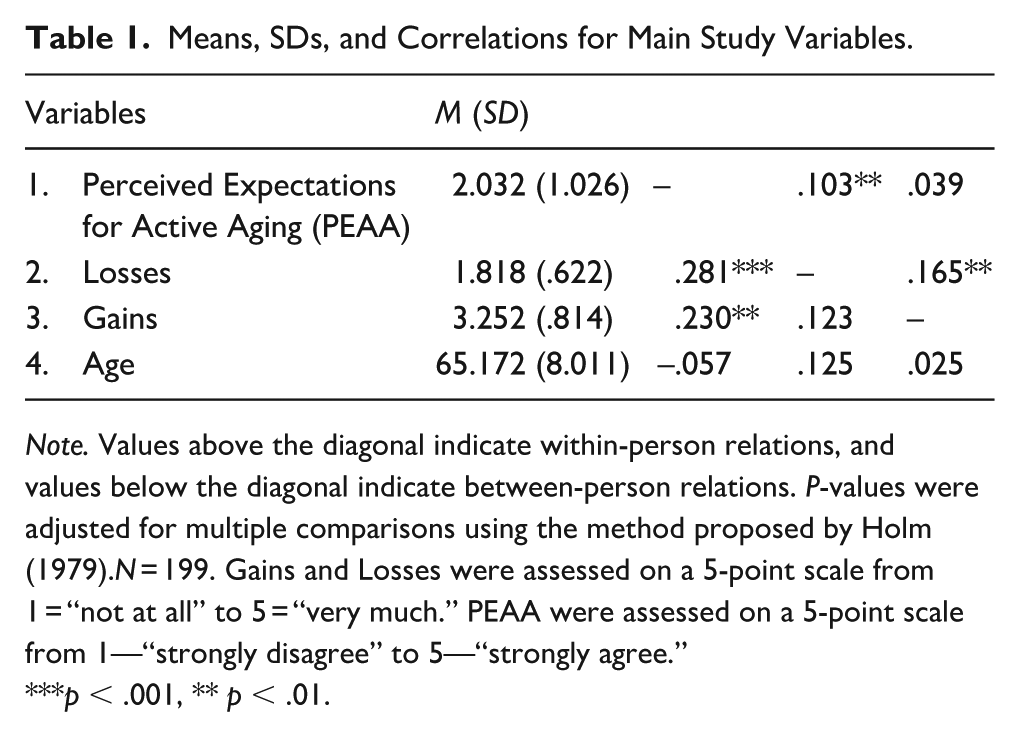
Note. Values above the diagonal indicate within-person relations, and values below the diagonal indicate between-person relations. P-values were adjusted for multiple comparisons using the method proposed by Holm (1979).N = 199. Gains and Losses were assessed on a 5-point scale from 1 = “not at all” to 5 = “very much.” PEAA were assessed on a 5-point scale from 1—“strongly disagree” to 5—“strongly agree.”
p < .001, ** p < .01.
Predicting PEAA
As depicted in Table 2, age had a significant, negative effect on PEAA, indicating that participants with above-average age (older than 65 years) reported lower PEAA. There was a significant main effect of age-related losses on the between-person level. Individuals who reported more losses compared to the sample mean also reported higher PEAA. The within-person effect of losses was qualified by an age interaction. The loss slope was significant and negative at age 50, estimate = −.261, SE = .106, p = .014, not significant at age 65, estimate = .077, SE = .052, p = .136, and significant and positive at age 80, estimate = .416, SE = .097, p < .001. As depicted in Figure 1, at age 50, days with more losses were related to lower PEAA, whereas at age 80, days with more losses were related to higher PEAA.
Multilevel Model Predicting Perceived Expectations for Active Aging (PEAA) by Age and Age-Related Gains and Losses.
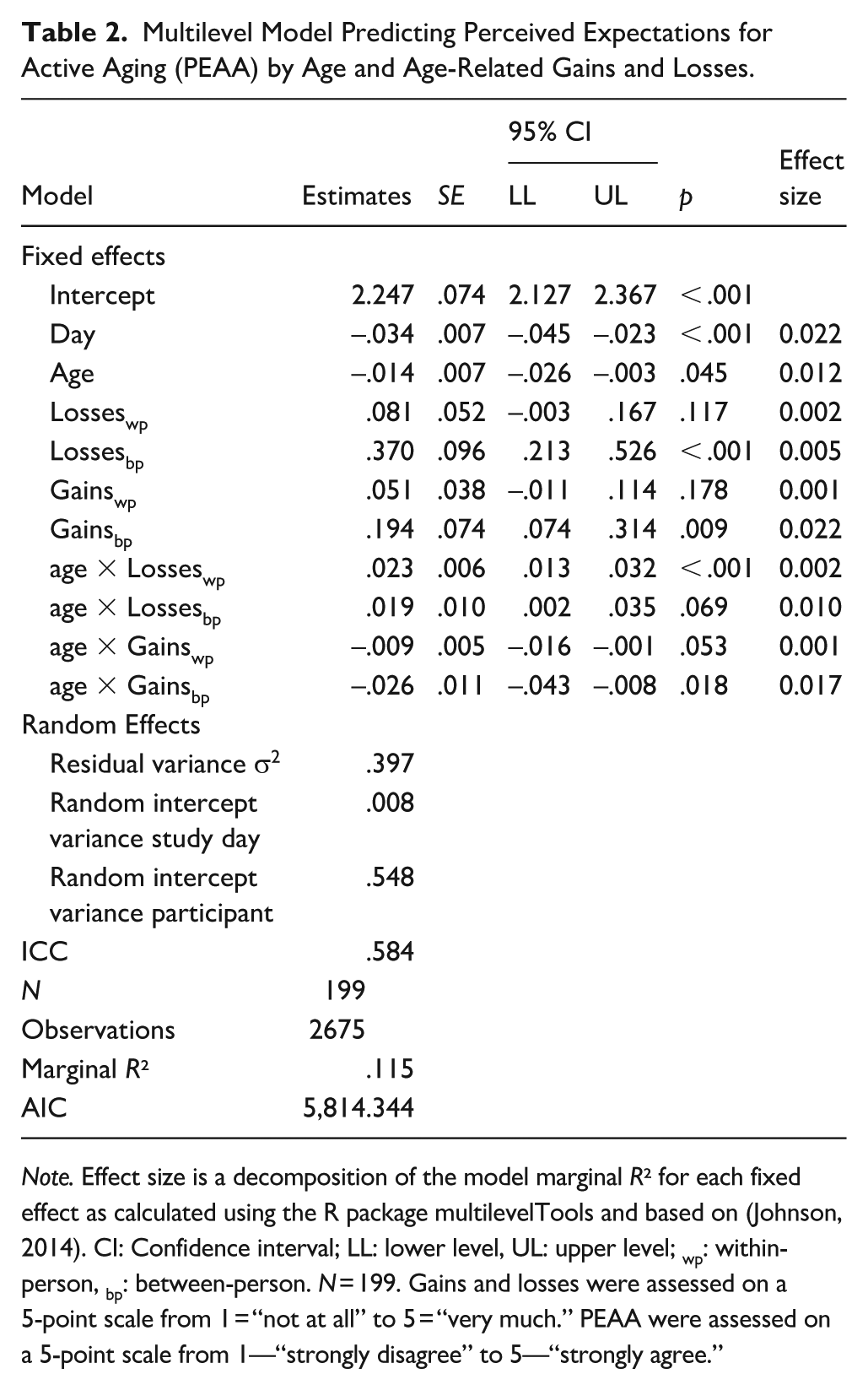
Note. Effect size is a decomposition of the model marginal R² for each fixed effect as calculated using the R package multilevelTools and based on (Johnson, 2014). CI: Confidence interval; LL: lower level, UL: upper level; wp: within-person, bp: between-person. N = 199. Gains and losses were assessed on a 5-point scale from 1 = “not at all” to 5 = “very much.” PEAA were assessed on a 5-point scale from 1—“strongly disagree” to 5—“strongly agree.”
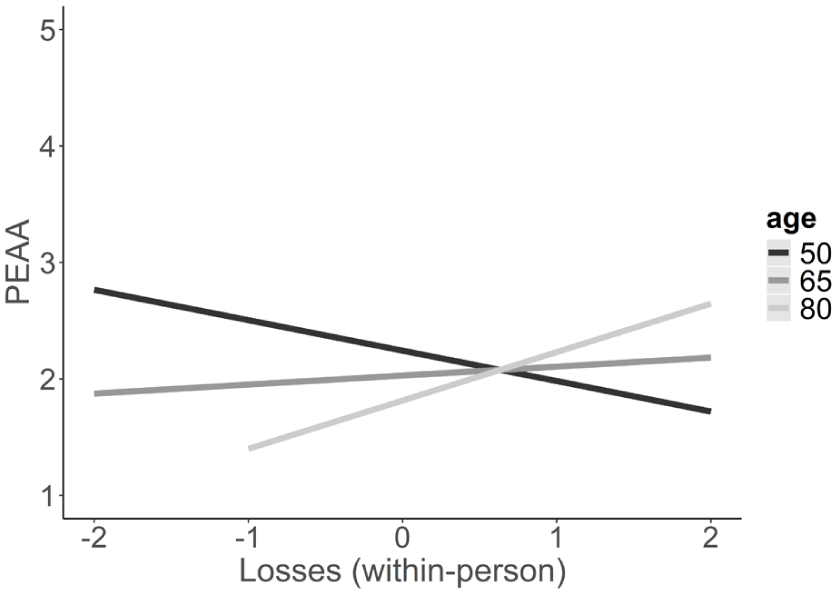
Relation Between Age-Related Losses (Within-Person) and Perceived Expectations of Active. Aging (PEAA) by Age. N = 199, Observations = 2675. Losses were assessed on a 5-point scale from 1 = “not at all” to 5 = “very much” and centered at a person’s mean. PEAA were assessed on a 5-point scale from 1—“strongly disagree” to 5—“strongly agree.”
There was a significant, positive main effect of age-related gains on the between-person level. Individuals who reported more gains overall compared to the sample mean also reported higher PEAA. The effect of gains on the between-person level was moderated by age. The gain slope was positive and significant at age 50, estimate = .582, SE = .171, p < .001, and age 65, estimate = .199, SE = .074, p = .008, but not significant at age 80, estimate = –.185, SE = .185, p = .319.
Discussion
Extending previous research that focused on PEAA predictors linked to inequalities for aging well (Pavlova et al., 2023; Pavlova & Silbereisen, 2012, 2016), we embedded PEAA into everyday life and investigated within- and between-person relations of PEAA and age-related gains and losses. We also explored whether these relations varied by age.
Between-Person Relations
Following the idea that negative self-perceptions of aging, such as age-related losses, are related to an increased willingness to adopt and accept societal expectations regarding older adults (Bodner et al., 2021), we predicted that more age-related losses would be related to higher PEAA. As expected, we found this positive relation at the between-person level. Individuals who reported above-average losses compared to the sample mean reported more PEAA. Put differently, PEAA resonated most with individuals who perceived higher age-related losses. PEAA might also be higher among those reporting above-average losses, as expectations might serve as an appeal to counteract those age-related losses by becoming actively engaged. At first sight, imposing active aging demands on those who are potentially worse off in terms of age-related losses seems counterintuitive. Specifically, previous studies showed that individuals perceiving higher losses are usually those who also have poorer developmental outcomes (Sabatini et al., 2023; Wilton-Harding et al., 2022; Wirth, Kornadt, & Rothermund, 2025). However, active aging demands are rooted in societal expectations; they often express a perceived deficit that should be counteracted and may not necessarily reflect a person’s actual ability to engage in active aging. Moreover, it seemed that participants who reported higher losses also reported higher gains. This means that changes in behavior or functioning were more readily attributed to age as compared to more transient factors in the environment (e.g., “senior moment” vs. “bad day”). It seems, thus, interesting to more closely study the dynamics between gains and losses, potentially offering insights into buffering effects of gains for individuals with high losses (Wilton-Harding et al., 2022).
Interestingly, and unexpectedly, individuals who reported above-average gains also reported higher PEAA, overall. Thus, individuals who were, at least by their evaluation, aging well, were the ones who were more receptive to active aging demands. However, more gains are also related to more active engagement (Sabatini et al., 2023), and, thus, our results are consistent with previous findings that individuals who are already socially engaged report higher PEAA (Pavlova & Silbereisen, 2016). More gains might also be related to a higher confidence in engaging in active aging and perceiving expectation as a recognition of one’s competence and ability to age actively (Pavlova et al., 2023). PEAA might, thus, resonate particularly with individuals who report more gains and who are likely already actively engaged. Our results of multidirectional age differences for the relation between gains and PEAA indicated a positive relation that was most pronounced at age 50 and still significant and positive at age 65. There was a negative but non-significant relation at age 80. These age differences in the relation between gains and PEAA also point to the idea that more gains might be related to a higher confidence in engaging in active aging and a benign interpretation of PEAA. Middle-aged and young-old adults usually have higher cognitive and physical fitness levels compared to old-old adults (DiPietro, 2001; Schrack et al., 2014; Verhaeghen & Salthouse, 1997), which would enable them to engage in active aging. Higher cognitive and physical fitness levels, in turn, are also related to interpreting PEAA as a challenge that one wants to engage with (Pavlova & Silbereisen, 2012).
While previous research indicated that overall, individuals appraise PEAA as a challenge (Pavlova & Silbereisen, 2016; Radoš, Pavlova, & Silbereisen, 2025), future research should investigate whether individuals, especially those having positive self-perceptions of aging, appraise PEAA as benign in terms of recognition of competence. In addition, we need to better understand how AARC and PEAA relate to engaging in active aging behavior (e.g., volunteering; Wirth, de Paula Couto, et al., 2025). While high PEAA in and of themselves could be unrelated to engaging in active aging, high PEAA and high perceived age-related gains could increase the probability of aging actively (Pavlova & Silbereisen, 2016; Radoš et al., 2024). Studying this relation would help to understand whether age-related changes have enabling or constraining effects for active engagement via perceived active aging expectations.
Within-Person Relations
Our results on the between-person level complement previous research and underline the importance of age-related experiences for understanding which older adults are most sensitive to the active aging discourse. More interestingly, we found that daily variations in how our participants construed their aging were meaningfully related to daily PEAA, and we also found multidirectional age differences in this relation. On days with above-average losses, participants reported higher PEAA, but this relation was only found for our oldest participants. At age 65, there was no significant relation between within-person losses and PEAA. Unexpectedly, the relation was negative at age 50, indicating that on days with above-average losses, participants reported lower PEAA. These age-differential relations indicate a complex interplay of contextual and developmental embeddedness of the active aging discourse and its everyday manifestations in terms of PEAA. More generally, aging experiences and their subjective interpretation can have a different meaning at different stages of the adult lifespan. At age 50, people might notice physical changes that are relatively minor, such as graying hair or wrinkles. At age 65, individuals might notice, for example, (mostly subtle) changes in vision and hearing, or muscle strength, whereas aging experiences around 80 usually involve more serious losses in physical health and functional independence (Brothers et al., 2017). More serious age-related losses, as they are typically encountered in very old age, elicit a higher degree of concern because they pose a threat to the autonomy of the aging individual, which also can have far-reaching implications for the environment of the person, indicating a need for care and support. These more serious losses, in turn, might trigger a stronger tendency to engage in active countermeasures (in the aging individual) or to encourage the older individual to do so (in persons who are close to the aging individual), which is a plausible explanation for the positive relation between daily losses and PEAA in our oldest participants.
This does not explain why we found no or even a negative relation between daily losses and PEAA for our middle-aged and young-old participants. In addition to these age-related differences in the seriousness of losses, the rationale of age norms and their social meaning may also change across the lifespan. Societal expectations for active aging may become translated and integrated into an individual’s self-concept during midlife (Levy, 2009; Wirth, de Paula Couto, et al., 2025). Thus, the norm of active aging might already operate as a standard to evaluate one’s own development and actions among middle-aged adults and as a means to distance themselves from the group of “old people” (Kornadt et al., 2023; Weiss et al., 2025). Experiencing more losses than usual might act as a reminder of growing old and a potential failure to maintain a young age identity. Being less sensitive to PEAA on days with more losses could indicate that middle-aged adults try to protect themselves from such an old age identity by being less sensitive to expectations related to an older age identity, as active aging expectations mostly target young-old adults (Paúl et al., 2017; Pavlova & Silbereisen, 2012). Experiencing a few losses could be interpreted as success in maintaining a young age identity, and PEAA could be interpreted as encouragement to maintain a young age. In addition, days with few age-related losses, when resources and functioning are higher than usual, should be days on which individuals are also more likely to engage in active aging. Then again, PEAA might resonate most on days and with individuals who are already active.
Our findings indicate that day-to-day changes in personal resources and functioning were not significantly related to PEAA in young-old age. Around the age of 65, individuals negotiate important transitions related to retirement from work and a loss in social roles and status (de Paula Couto, Erkerdt, et al., 2022). To successfully navigate the process of growing older, young-old adults have to strike a balance between accommodating a new identity but also assimilating an existing (younger) identity (Armenta et al., 2018). Moreover, young-old adults are the ones most targeted by the active aging discourse (Paúl et al., 2017; Pavlova & Silbereisen, 2012). These far-reaching, sometimes fundamental age-related changes might render more temporary changes in age-related losses less meaningful for perceiving active aging expectations.
Our results indicate that the perceptions individuals have of their aging and how those are related to perceived societal expectations are complex, multidimensional, and dynamic. These aging experiences were the background against which middle-aged and older adults perceived and evaluated the active aging discourse and the expectations directed at them personally. While the experience of potentials and barriers for active aging was most closely related to the losses that accompany the aging process, positive aging experiences might also be important for perceiving and utilizing developmental opportunity structures. The dynamic nature of the relation between aging perceptions and perceived expectations indicates that it can be subject to change, and that, based on our age-differential findings, potential interventions should be tailored to individuals’ life stages. Specifically, while age-related losses seem more relevant for PEAA in young-old and old-old age, gains were most closely related to PEAA for middle-aged participants. Interventions regarding changes in AARC could capitalize on within-person encouragement designs (Schmiedek & Neubauer, 2020), potentially combining psychoeducational elements regarding AARC and reflection (e.g., on daily physical or cognitive accomplishments).
Limitations
Embedding research on PEAA into the everyday life of middle-aged and older adults offered important insights into daily dynamics and relations to self-perceptions of aging. However, some limitations deserve note. In line with previous research, our PEAA items did not explicitly address participants’ age as the source of active aging expectations. While research indicates that relating events to one’s age and having personal awareness of aging are fairly ubiquitous in everyday life (Miche et al., 2014), we cannot rule out that perceiving expectations and attributing these to one’s age are separate processes that need to be captured separately (Rothermund et al., 2021). Similar to previous studies, we focused only on participants’ reported perception of active aging expectations, which might not correspond to the actual demands that were imposed by others. Put differently, objective and perceived environments may not align (Radoš, Pavlova, Rothermund, & Silbereisen, 2025; Wahl & Gerstorf, 2018). However, it is the perception of expectations that renders them effective (cf. Tomasik & Silbereisen, 2014). The only study that has tested the relation between individuals’ PEAA and characteristics of their direct environment in terms of household members’ attitudes has found no relation (Radoš, Pavlova, Rothermund, & Silbereisen, 2025). To increase the contextual embeddedness of PEAA research, it would be interesting to investigate who imposes expectations for active aging (e.g., partner, peers, or the media) and to include informant-based assessments of active aging expectations. It is also an open question of whether other contextual factors, such as daily activities or social contact, relate to PEAA. It is possible that on sedentary days with few activities and contacts, individuals are exposed to few expectations, whereas on days with many activities and social contact, expectations might be higher. Accounting for the multidimensional nature of aging experiences (Baltes et al., 2007), we assessed PEAA in the domains of physical and cognitive fitness and social engagement. To keep the complexity of our analyses reasonable, we aggregated PEAA across domains. Similarly, we aggregated AARC gains and losses across the five conceptualized domains. While this increased reliability, it may have prevented us from obtaining a more nuanced understanding of the relation between AARC and PEAA dimensions.
To elucidate the found age moderations, it would have been interesting to investigate potential age-related differences in cognitive or physical functioning, which we did not assess for our sample. Generally, most of our participants reported good subjective health, and most of them lived independently. Although previous research (Pavlova et al., 2023; Pavlova & Silbereisen, 2012) does not necessarily indicate a relation between PEAA and physical or cognitive functioning, recruiting a sample with a more diverse functional status might yield different relations between daily AARC and PEAA.
Results are limited to same-day effects, and all measures were assessed at the same time of day. The directionality of effects was assumed based on theoretical reasoning. Results of our multivariate MLM (Supplementary Table S1) indicated that previous-day AARC predicted next-day PEAA but not the other way around, which supports our theoretical rationale. Experimental and intervention studies targeting AARC or PEAA, however, could further elucidate cause-and-effect relations.
Conclusion
Our study attests to the idea that self-perceptions of aging are the background that shapes expectations and interpretations of experiences individuals have as they grow older (Kornadt et al., 2020; Rothermund et al., 2021). How individuals construed their aging in terms of gains and losses was an important contextual factor for interindividual differences and variations in perceived expectations for active aging. Our findings also illustrate that societal expectations and personal ideas of life in old age might not necessarily align and that such potential mismatches may be more pronounced in some life stages than in others (Pavlova et al., 2023). These multidirectional age differences should be taken into consideration when developing strategies to help individuals manage day-to-day expectations and foster a stable and positive environment that enables active aging.
Supplemental Material
sj-docx-1-jbd-10.1177_01650254251406547 – Supplemental material for Perceiving expectations for active aging in the context of age-related gains and losses
Supplemental material, sj-docx-1-jbd-10.1177_01650254251406547 for Perceiving expectations for active aging in the context of age-related gains and losses by Maria Wirth and Klaus Rothermund in International Journal of Behavioral Development
Footnotes
Ethical Considerations
Ethical approval was granted by the Ethics Committee of Friedrich-Schiller-University Jena (project title “Expectations for active ageing”; FSV 22/018).
Declaration of Conflicting Interests
The authors declared no potential conflicts of interest with respect to the research, authorship, and/or publication of this article.
Funding
The authors disclosed receipt of the following financial support for the research, authorship, and/or publication of this article: This work was supported by the Deutsche Forschungsgemeinschaft, German Research Foundation, to Klaus Rothermund (Grant RO 1272/15-1).
Data Availability Statement
Preregistration is available at https://aspredicted.org/5NR_2SD. Deidentified data, analysis codes, and study material are available at  .
.
Supplemental Material
Supplemental material for this article is available online.
References
Supplementary Material
Please find the following supplemental material available below.
For Open Access articles published under a Creative Commons License, all supplemental material carries the same license as the article it is associated with.
For non-Open Access articles published, all supplemental material carries a non-exclusive license, and permission requests for re-use of supplemental material or any part of supplemental material shall be sent directly to the copyright owner as specified in the copyright notice associated with the article.
