




Abstract
This study investigates whether fear of victimization and finding popularity important are concurrently and prospectively associated with engaging in bystander behaviors (i.e., bully-following, confronting defending, comforting defending) in school bullying situations. Participants included 2,709 Finnish adolescents in Grades 7–9 (Mage = 13.79, SD = .95; 51.5% boys). Contrary to expectations, fear of victimization did not predict a lower likelihood of defending behaviors but was concurrently and longitudinally associated with lower bully-following, suggesting that fear may inhibit harmful peer alignment rather than defending. The importance of being popular was positively associated with bully-following over time but showed no consistent associations with defending. These findings highlight the nuanced role of fear and status motives in shaping bystander behavior and inform intervention strategies that aim to foster prosocial engagement in bullying situations.
Introduction
School bullying remains a critical issue, affecting millions of children worldwide and causing devastating physical and mental strain for many victimized youth (Christina et al., 2021; Gini & Pozzoli, 2009; Schoeler et al., 2018). Difficulties with peers might be especially damaging in adolescence, a period marked by physical, cognitive, and socio-emotional changes, including heightened concern for status among peers (Meeus, 2016). Rather than being an isolated interaction between perpetrators and their victims, bullying is often a group phenomenon, with bystanders taking on distinct “participant roles.” Defenders support those who are victimized and oppose bullying, whereas “bully-followers” either actively assist those who initiate bullying (assistants) or reinforce their actions through approval (reinforcers). While some bystanders intervene, others remain uninvolved (outsiders; Salmivalli et al., 1996).
Both involvement and non-involvement might influence bullying dynamics, either by sustaining the behavior or by helping to stop it and reduce victims’ suffering. Peer interventions in favor of victimized pupils (whether directed at the perpetrator, the victimized student, or both) have been found to stop bullying in up to 57% of bullying incidents in observational research (Hawkins et al., 2001). A recent daily diary study shows that on days in which bullying occurs, victimized pupils experience lower depressed mood and self-blame, and greater positive mood on days when they are defended compared to days when they are not (Laninga-Wijnen et al., 2024). In addition, being defended is associated with stronger feelings of belonging over time among victimized youth (Laninga-Wijnen, van den Berg, et al., 2023). In contrast, when bystanders support those who bully, the classroom prevalence of bullying tends to be higher (Salmivalli et al., 2011), and vulnerable children (i.e., anxious or rejected) experience a heightened risk of victimization (Kärnä et al., 2010), emphasizing the critical role of bystanders may have in shifting bullying dynamics. Thus, it is critical to identify factors that predict whether bystanders will defend those who are victimized or follow the perpetrators.
Although predictors of defending behaviors (e.g., empathy) have been widely studied, less is known about factors that motivate bystander involvement more broadly, and particularly bully-following behaviors (see Monks & O’Toole, 2020 for an overview). Qualitative investigations suggest that fear of victimization (i.e., the concern of becoming a target oneself) plays a key role in inhibiting defending and encouraging bully-following behaviors (e.g., Spadafora et al., 2020; Strindberg et al., 2020). From a cost–benefit perspective (e.g., Bandura, 1986; Do et al., 2017), defending can be seen as a prosocial form of risk-taking, as its moral benefits include helping a victimized peer, but its potential costs include becoming a target of retaliation. Within this framework, fear of victimization is particularly relevant, since fear may lead adolescents to view defending as too risky and therefore avoid it. By contrast, bully-following may be perceived as a way to reduce the likelihood of becoming victimized. Yet, the role of fear of victimization in these behavioral trade-offs remains unexplored empirically. Moreover, the importance individuals place on their popularity among peers potentially also influences their behaviors in bullying situations. A desire for status may lead some youth to adopt pro-bullying stances (LaFontana & Cillessen, 2010; Pouwels et al., 2016). Pupils who bully, and their followers, are often seen as popular, reinforcing beliefs that aligning with them can provide the popularity benefits they might be striving for (Pouwels et al., 2016, 2019). Conversely, defending behaviors may threaten one’s status, as it often involves opposing high-status bullying perpetrators (Meter & Card, 2015; Pouwels et al., 2016), potentially posing a risk to one’s status position. As longitudinal evidence of the role of fear of victimization and valuing popularity in different bystander behaviors is scarce, this study addresses this gap by examining how fear of victimization and valuing popularity are associated with defending and bully-following behaviors over time in a large sample of adolescents.
Fear of Victimization and Bystander Behavior
Empirical studies show that defending behaviors are driven both by individual factors, such as empathy (Deng et al., 2021), self-efficacy for defending (Gini et al., 2022), and feelings of responsibility to intervene (Garandeau et al., 2023; Pozzoli & Gini, 2010; Thornberg et al., 2012), as well as by contextual factors, such as classroom norms for defending or bullying (Garandeau et al., 2022; Kollerová et al., 2018). In interviews with children about their reactions when witnessing bullying incidents, fear of becoming a target emerges as a crucial factor that deters them from defending victimized peers (Strindberg et al., 2020). When deciding whether to intervene, bystanders may weigh the social risks of defending, including becoming a target. Defending in such contexts may qualify as prosocial risk-taking, that is, helping others despite the potential social costs (Do et al., 2017). However, the extent to which fear of victimization influences defending warrants further empirical investigation. In line with social cognitive theory, observational learning and reinforcement might play a critical role in shaping bystander actions (Bandura, 1986). The anticipation of personal risk, or fear of becoming the next target, may deter defending behaviors whether this fear is based on actual observations of retaliation from bullying perpetrators or the mere anticipation of consequences (Lodge & Frydenberg, 2013). Indeed, defending does not necessarily lead to increased victimization (Malamut et al., 2023, 2025; Tian et al., 2025), but both observing others “paying the price” for defending or imagining that one will “pay the price” if one were to intervene may have the potential to discourage defending. This deterring effect might occur especially in youth who fear victimization more strongly.
The extent to which fear of victimization might deter defending could depend on the type of defending. Confronting (or bully-oriented) defending openly challenges the social dominance of the bullying pupil and therefore should be perceived as more likely to provoke retaliation from perpetrators than comforting (or victim-oriented) defending (e.g., providing emotional support), which can happen privately and thus carries less obvious risk of negative consequences (Garandeau et al., 2022; Malamut et al., 2023; Reijntjes et al., 2016). Therefore, we expected that fear of victimization would deter confrontation but not necessarily comforting-defending.
At the same time, fear of victimization may also play a role in bully-following behaviors. Joining in or encouraging bullying may provide a sense of approval by those who initiated the bullying, leading to feelings of safety and protection from being targeted in the future (Boivin et al., 1995; Dijkstra & Gest, 2015).
Importance of Being Popular and Bystander Behavior
Bystander behavior in bullying situations may also be determined by personal motivation in relation to peer group dynamics, such as desires to maintain or gain popularity. Adolescents navigate complex social hierarchies, where concerns about one’s status might shape responses to bullying. Caring about popularity might influence defending behavior in opposite ways. On one hand, in qualitative research, adolescents cite loss of social standing as a key potential cost of intervening in bullying (Spadafora et al., 2020), and therefore, adolescents who find popularity important may be likely to abstain from defending victimized peers. They may fear that it will threaten their own social position (Zhang et al., 2022), especially as those who bully tend to be popular and those who are victimized unpopular (Ojanen et al., 2024). Indeed, finding popularity important was found to be concurrently associated with less defending among boys (Duffy et al., 2017).
On the other hand, defending a peer might also be seen as an opportunity for social gain. Research shows that defending actually increases social status (Laninga-Wijnen, Malamut, et al., 2023; van der Ploeg et al., 2017), which adolescents might observe, especially if they place high importance on popularity. Thus, in line with observational learning and reinforcement theories, this should encourage them to engage in defending themselves with the expectation of similar social rewards. Importantly, popularity motives may differentially predict confronting defending and comforting defending. A recent study has found confronting defending to be positively associated with status-seeking (agentic) goals (Pronk et al., 2019), suggesting that adolescents who care about popularity may use this form of defending as a way to gain status. Conversely, comforting defending was not significantly related to status-seeking (agentic) goals in that study, suggesting that popularity motives are unlikely to encourage comforting defending, perhaps because comforting may be done privately.
Finding popularity important has been suggested in prior research to be influential regarding bully-following behaviors. Supporting the bully generally implies aligning with high-status peers and may be perceived as a way to avoid low status and gain social benefits (Dijkstra et al., 2010; Pouwels et al., 2019). Evidence suggests that adolescents who are highly motivated to secure or elevate their status are more likely to engage in bullying (Hensums et al., 2023; Lansu, 2023; Wiertsema et al., 2023) and in behaviors that support dominant peers (Lansu, 2023). Such behavior may reflect strategic efforts to gain or maintain social dominance, as suggested by findings that even followers report moderately elevated dominance goals (Olthof et al., 2011). We expect that placing importance on being popular is associated with higher levels of bully-following behaviors and will explore whether it relates to confronting and comforting defending.
In sum, prior research has shown that bystander behaviors are shaped by both psychological and social factors. Yet, little is known about whether fear of victimization and the importance of being popular discourage defending and promote bully-following or how these factors relate to distinct forms of defending over time. In the following section, we outline how this article addressed these gaps.
Present Study
This study investigated the concurrent and longitudinal effects of fear of victimization and importance of being popular on bystander behaviors in bullying situations, namely comforting defending, confronting defending, and bully-following behaviors. Our first goal was to examine whether fear of victimization was associated with defending behaviors. We hypothesized that fear of victimization would be negatively associated with confronting defending, as students who fear retaliation may be less likely to oppose the bullying pupil directly (Hypothesis 1). We also explored whether fear of victimization would be negatively associated with comforting defending, given that supporting victimized individuals may also be perceived as socially taxing even though it was less risky. Our second goal was to test whether fear of victimization predicted bully-following behavior. We expected that fear of victimization would be positively associated with bully-following behavior, as students may align with bullying pupils as a form of safety-seeking, to avoid becoming targets themselves (Hypothesis 2). Our third goal was to examine whether the importance of being popular predicted defending behaviors. We treated its association with confronting defending as exploratory, given competing possibilities that it may either encourage defending as a way to gain status or discourage it due to perceived social risk. We also explored the effect of the importance of popularity on comforting defending, with no directional hypothesis, as there was no indication from prior literature that comforting victims would be motivated by status. Our fourth goal was to examine whether the importance of being popular predicted bully-following behavior. We hypothesized that placing more importance on being popular would be associated with greater bully-following behavior (Hypothesis 3). Our hypotheses were the same for the concurrent and the longitudinal associations. Specifically, the prospective analyses examined how fear of victimization and importance of being popular at mid-school year (T1) predicted changes in bully-following and defending at the end of the school year (T2).
Analyses controlled for age, gender, victimization experiences, and actual popularity, as these factors commonly influence bystander behavior (e.g., Reijntjes et al., 2016). Controlling for victimization history helped distinguish whether fear of victimization related to differences in bystander responses regardless of whether participants have actually experienced victimization themselves. Controlling for actual popularity was also important, as it was found to be associated with the importance of popularity (Lansu, 2023) and with the three bystander behaviors analyzed in the present study (Pronk et al., 2020). This allowed us to disentangle the effects of adolescents’ perceived importance of popularity from their actual social status. Given the established role of bystanders in influencing bullying dynamics, identifying factors predicting these behaviors is critical in forming effective interventions.
Method
Participants
The data for this study were collected in 18 public secondary schools (Grades 7–9) across Finland, as part of the STRIVE project aimed at understanding the cognitive and social factors associated with bullying in adolescence. We used two waves collected toward the middle (January 2023, T1) and the end (April 2023, T2) of one academic year. The number of participants was N = 4,039 at T1 (participation rate: 60%) and N = 3,923 at T2 (participation rate: 59%). Their mean age at T1 was M = 13.79 years (SD = .95). To ensure the reliability and validity of peer-nomination scores (Marks et al., 2013), we included only classrooms that had a participation rate of at least 40%. In addition, because peer-nominated defending was only reported by students who reported experiencing at least some victimization, we excluded classrooms in which all students reported that they had not experienced any victimization. This was the case for 55 out of 303 classrooms at T1 and 79 out of 303 classrooms at T2. After applying these criteria, the final sample included N = 2,709 at T1 and N = 2,329 at T2. At T1, participants had a mean age of 13.80 years (SD = 0.95), and 51.5% self-identified as boys.
Attrition analyses were conducted on the full T1 classroom cohort (N = 4,039). Of these, 3,504 (86.8%) were also present at T2, while 535 (13.2%) were not. Adolescents who attrited reported slightly higher victimization at T1 compared to those retained (d = .10). No other systematic differences were observed.
Procedure
Data collection was conducted online during regular school hours, with students completing the questionnaires under the supervision of teachers. Prior to data collection, teachers received detailed instructions to ensure standardized administration across schools. Approximately 200 secondary schools were contacted by email, of which 18 agreed to participate. School principals provided approval for data collection, and designated teachers administered the surveys in classrooms. Participants were informed about the confidentiality of their responses and reminded that participation was voluntary, with the possibility to opt out at any point. Parents were informed about the study in advance by the schools. To encourage participation, all students present during data collection, regardless of whether they consented to participate, were entered into a raffle for small monetary-rewards (i.e., movie tickets). In accordance with the ethical guidelines of the Declaration of Helsinki, all participants received active written consent from their parents and gave their assent to participate. The study protocol was approved by the Ethics Committee for Human Sciences at the University of Turku (approval date: November 18, 2021).
Measures
Fear of Victimization
Fear of victimization was measured at T1 using a three-item self-report scale developed for this project, assessing pupils’ fears of becoming bullied. Items reflected the central dimensions of this construct, which are anticipatory fear, fear when witnessing bullying, and avoidance motives. Respondents were asked the question “To what extent do the following statements apply to you?,” with the following items: (1) I am often scared that I will become bullied or that bullying will continue, (2) When I see others being bullied, I am afraid that the same will happen to me, and (3) I try hard to avoid being bullied. Responses were rated on a 4-point Likert-type scale (0 = does not apply at all, 3 = applies entirely). Internal consistency was strong (filtered data, α = .96), with corrected item-total correlations ranging from .91 to .95. A principal component analysis indicated a single-factor solution (eigenvalue = 2.80) accounting for 93% of the variance, with all items loading strongly (.96–.98), supporting one-dimensionality. Accordingly, the three items were averaged to create a composite score, with higher scores reflecting higher fear.
Defending Behaviors
The two types of defending were victim-reported using a sociometric approach that has been applied in prior bullying research (e.g., Sainio et al., 2011). All participants were first asked, “How often have you been bullied in the past couple of months?” and could answer on a 5-point Likert-type scale: 1 = not at all, 2 = once or twice, 3 = 2–3 times a month, 4 = once every week, and 5 = several times a week (Solberg & Olweus, 2003). If they answered that they had been victimized at least once or twice, they were then asked if they had been defended by a peer. For confronting defending, victimized pupils were asked, “Who among your classmates has defended you when bullying occurs by telling the bully or bullies to stop?” Comforting defending was inquired with the prompt “Who among your classmates has defended you by consoling you or by remaining your friend?” Participants could nominate an unlimited number of classmates. For each participant, the number of nominations received was used as an indicator of their defending behavior. Due to the highly skewed distribution, where the large majority of students received no nominations and only a small proportion received more than one, we recoded the variable into a binary variable (0 = no nominations, 1 = at least one nomination). Specifically, in the sample at T1, 93.9% of students (n = 2,544) received no nominations, while only 6.1% (n = 165) received one or more for confronting defending. For comforting defending, 82.4% (n = 2,233) received no nominations, while 17.6% (n = 476) received one or more. At T2, 90.6% of the students (n = 2,111) received no nominations, and 9.4% (n = 218) received one or more for confronting defending. For comforting defending, 86.3% (n = 2,009) received no nominations, while 13.7% (n = 320) received one or more.
Bully-Following Behavior
Participants’ tendency to join or support those who initiate bullying was assessed using three peer-nominated items, in which respondents were asked to nominate classmates who engaged in specific bully-following behaviors. The following three items were used for the peer-nominations: (1) Classmate(s) who go along with bullying when somebody else starts it, (2) Classmate(s) who are always on the side of the one who starts bullying, and (3) Does not instigate bullying but is on the bully’s side when bullying occurs. For each participant, the number of received nominations was divided by the number of possible nominators. The three items showed strong convergence (α = .86 at T1), which in this context reflects consistency across peer-reports, and they were averaged to form a composite measure of bully-following.
Importance of Popularity
Pupils were asked, “How important is it to you that you are perceived as popular?,” with responses recorded on a 7-point Likert-type scale ranging from 0 = not at all important to 6 = extremely important. This single-item measure is similar to those used in previous studies when measuring popularity concerns (e.g., Dawes & Xie, 2014).
Covariates
We controlled for students’ actual perceived popularity, which was assessed with peer ratings with a similar measure as utilized in numerous studies (e.g., Garandeau & Lansu, 2019; van den Berg & Cillessen, 2015). Pupils were asked, “How popular do you think each of your classmates is?,” with responses recorded on a 7-point Likert-type scale ranging from 1 = not at all popular to 7 = extremely popular. The ratings received were averaged for each participant to create an individual popularity score. Self-reported victimization (see description under Defending Behaviors) was also included as a covariate to account for individual differences in bullying experiences. Age (in years) and gender (0 = girl, 1 = boy) were included as demographic controls.
Analytic Plan
To compute the correlations reported in the descriptive results section, we used the correlation package in R, selecting the appropriate correlation coefficient based on the scale and assumed conceptual properties of the variables. Specifically, we considered three types of variables: (1) binary variables assumed to reflect underlying continuous constructs (e.g., defending), (2) observed binary variables (e.g., gender), and (3) continuous variables. Tetrachoric correlations were used between two binary variables with an assumed underlying continuum. Phi coefficients were calculated for pairs involving one binary variable with an underlying continuum and one observed binary variable. Biserial correlations were applied when a binary variable with an assumed underlying continuum was paired with a continuous variable. Point-biserial correlations were used when an observed binary variable was paired with a continuous variable. Finally, Pearson correlations were computed between pairs of continuous variables. This approach ensured that the relationships among variables were estimated in accordance with their measurement level and theoretical interpretation.
To test our hypotheses, we estimated a series of path models in Mplus 8.9 using robust maximum likelihood estimation (MLR) with Monte Carlo integration as well as full information maximum likelihood (FIML) to handle missing data. Within the analytic data sets, missingness ranged from 0% to 13% in the concurrent models (N = 2,709, 248 classes) and 0% to 15% in the longitudinal models (N = 2,329, 208 classes). Age showed the highest proportion missing, while outcome and peer-nomination variables had little to no missingness. Given the nested structure of the data, with participants clustered within classrooms, all analyses were conducted using the Type = COMPLEX function in Mplus to adjust standard errors using a sandwich estimator, accounting for the non-independence of observations. The models examined the concurrent and longitudinal effects of fear of victimization and importance of being popular on three types of bystander behaviors in bullying situations (confronting defending, comforting defending, bully-following), controlling for victimization, perceived popularity, age in years, and gender (0 = girl, 1 = boy). Each outcome variable (confronting defending, comforting defending, and bully-following) was modeled separately for both concurrent and longitudinal analyses, resulting in a total of six models (three concurrent and three longitudinal). Confronting defending and comforting defending were modeled as binary outcomes, and peer-nominated bully-following as a continuous outcome. The concurrent associations were tested using data from T1. To investigate the longitudinal associations, the models predicted confronting defending at T2, comforting defending at T2, and peer-nominated bully-following at T2, controlling for their corresponding T1 measure, and including the same predictors as in the concurrent models. Importantly, the concurrent and longitudinal models were based on different subsets of the data, with the 40% classroom participation filter applied only at T1 for concurrent analyses, and at both T1 and T2 for longitudinal analyses to ensure the reliability of peer-nomination scores across time points. This also reflects additional exclusions in the longitudinal analyses due to attrition and missing follow-up data.
Results
Descriptive Statistics and Correlations
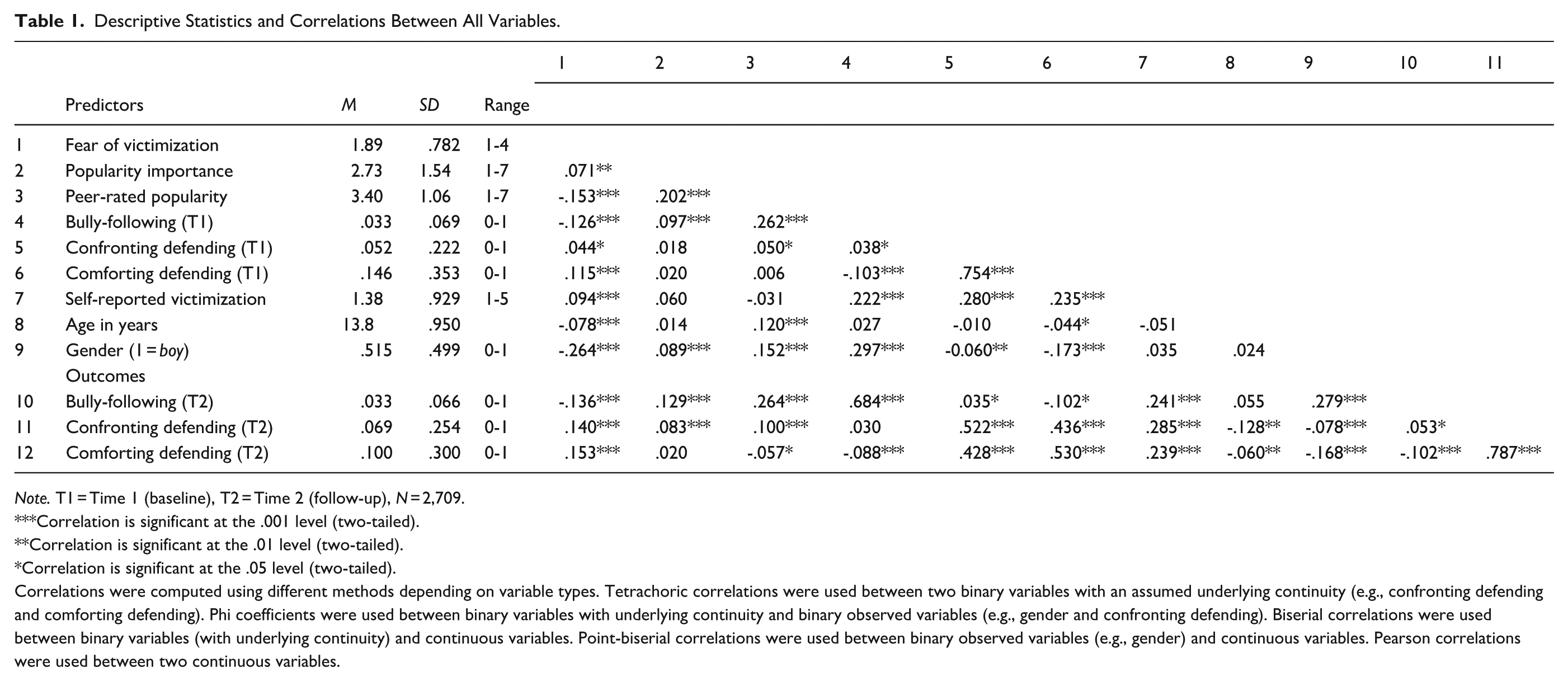
Descriptive statistics and correlations are presented in Table 1. Fear of victimization was positively associated with confronting defending at T1, comforting defending at T1, confronting defending at T2, and comforting defending at T2, while negatively associated with popularity at T1 and bully-following at T1. Popularity importance was positively associated with popularity at T1 (p < .001), bully-following at T1, and bully-following at T2, but there were no significant correlations with confronting or comforting defending.
Descriptive Statistics and Correlations Between All Variables.
Note. T1 = Time 1 (baseline), T2 = Time 2 (follow-up), N = 2,709.
Correlation is significant at the .001 level (two-tailed).
Correlation is significant at the .01 level (two-tailed).
Correlation is significant at the .05 level (two-tailed).
Correlations were computed using different methods depending on variable types. Tetrachoric correlations were used between two binary variables with an assumed underlying continuity (e.g., confronting defending and comforting defending). Phi coefficients were used between binary variables with underlying continuity and binary observed variables (e.g., gender and confronting defending). Biserial correlations were used between binary variables (with underlying continuity) and continuous variables. Point-biserial correlations were used between binary observed variables (e.g., gender) and continuous variables. Pearson correlations were used between two continuous variables.
Popularity at T1 was positively associated with bully-following at both time points and was also positively associated with confronting at T1. T1 popularity was positively correlated with T2 confronting defending but negatively correlated with T2 comforting defending. There was a strong positive correlation between confronting defending and comforting defending at both time points. The two main predictors of interest, fear of victimization and importance of popularity, were weakly positively correlated with each other. Self-reported victimization was positively associated with bully-following, confronting defending, and comforting defending.
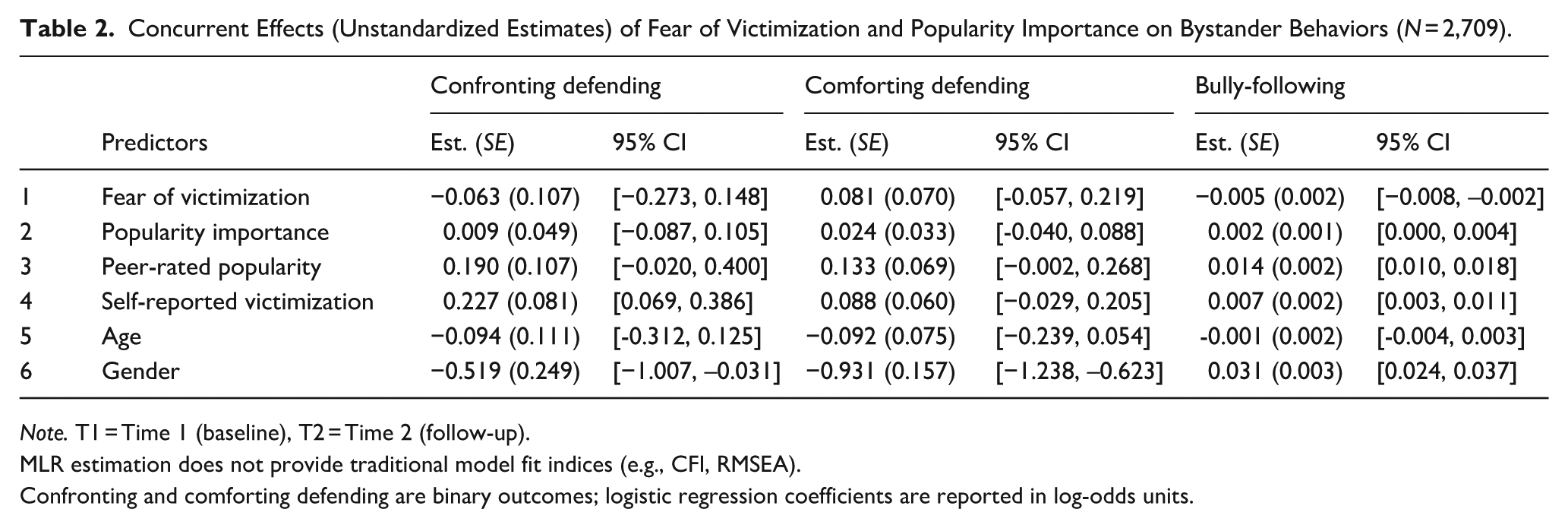
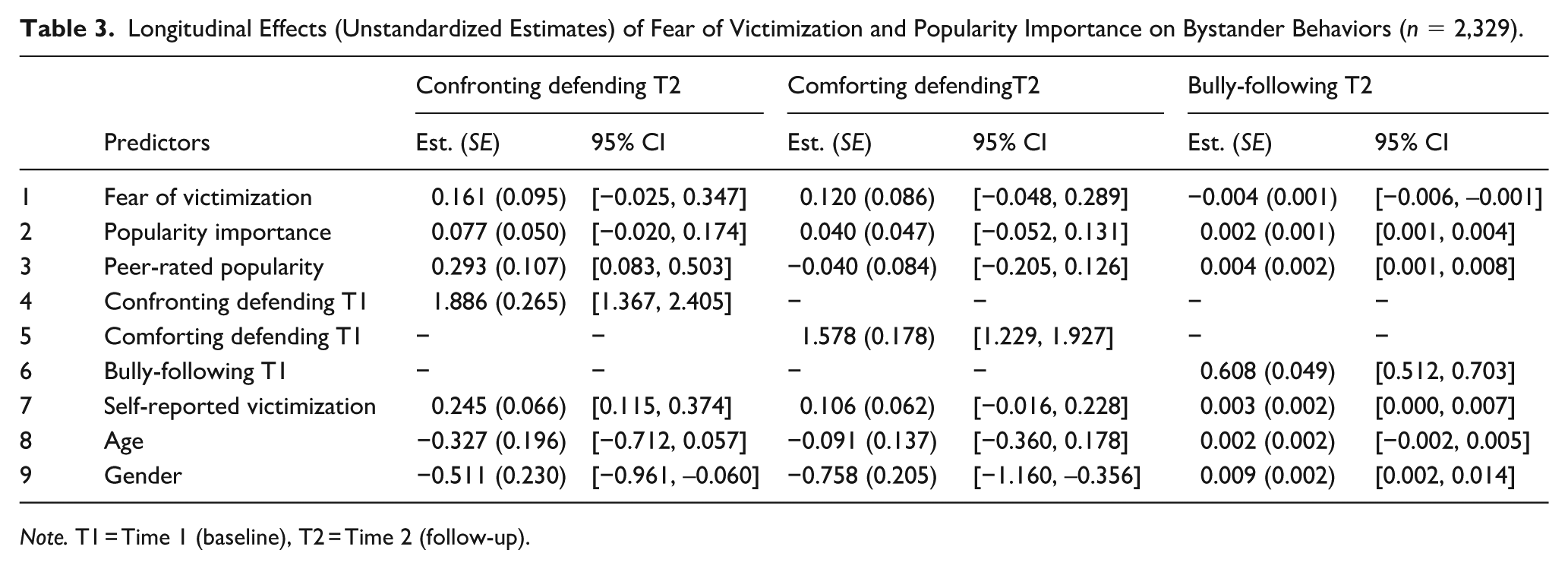
In the following sections, we report the concurrent and longitudinal effects of fear of victimization and importance of popularity on the three bystander behaviors while controlling for covariates. Unstandardized estimates, standard errors, and 95% confidence intervals are presented in Table 2 for concurrent effects and Table 3 for longitudinal effects.
Concurrent Effects (Unstandardized Estimates) of Fear of Victimization and Popularity Importance on Bystander Behaviors (N = 2,709).
Note. T1 = Time 1 (baseline), T2 = Time 2 (follow-up).
MLR estimation does not provide traditional model fit indices (e.g., CFI, RMSEA).
Confronting and comforting defending are binary outcomes; logistic regression coefficients are reported in log-odds units.
Longitudinal Effects (Unstandardized Estimates) of Fear of Victimization and Popularity Importance on Bystander Behaviors (n = 2,329).
Note. T1 = Time 1 (baseline), T2 = Time 2 (follow-up).
Does Fear of Victimization Predict Defending Behaviors?
Our first research goal was to examine whether fear of victimization predicted defending behaviors. Concurrently, fear of victimization was not significantly associated with either confronting defending or comforting defending. Longitudinally, the results showed that both defending behaviors were stable over time. Fear of victimization at T1 did not significantly predict confronting defending at T2, nor did it significantly predict comforting defending at T2. To summarize, fear of victimization was not associated with defending behaviors, either concurrently or longitudinally. Thus, Hypothesis 1, which stated that fear of victimization would be negatively associated with confronting defending, was not supported.
Does Fear of Victimization Predict Bully-Following Behavior?
Our second research goal was to examine whether fear of victimization predicted bully-following behavior. The results indicated that fear of victimization was negatively associated with concurrent bully-following behaviors. This indicates that individuals who reported greater fear of victimization were less likely to engage in following the bullying perpetrator. Longitudinally, bully-following behavior at T1 positively predicted bully-following at T2, indicating stability over time. In addition, fear of victimization at T1 negatively predicted later bully-following. Contrary to Hypothesis 2, higher fear was associated with less bully-following concurrently, as well as at T2, beyond T1 levels of bully-following.
Does Importance of Popularity Predict Defending and Bully-Following Behaviors?
Our third research goal was to examine whether the importance of popularity predicted defending. The results indicated that the importance of popularity did not significantly predict either confronting or comforting defending, either concurrently or longitudinally. Our fourth research goal was to examine whether the importance of being popular predicted bully-following behavior. The concurrent effect of the importance of popularity on bully-following was positive, yet only marginally significant at T1. There was, however, a significant prospective association such that the importance of popularity was positively associated with bully-following over time. To summarize, the importance of popularity was not associated with defending behaviors but was positively associated with bully-following (particularly over time)—consistent with Hypothesis 3.
Discussion
Given the key role of bystander behaviors in the perpetuation of bullying behavior, this study aimed to expand on prior research by investigating possible predictors of whether adolescents stand up for victimized pupils of bullying or support the bullying perpetrators. As bullying is a behavior that often involves the whole peer group, we chose to examine the role of personal characteristics that are directly linked to peer group dynamics, namely whether one is afraid of being victimized by peers and whether one attaches importance to being popular among peers. Drawing on social cognitive and cost–benefit perspectives (Bandura, 1986; Do et al., 2017), this study tested the concurrent and longitudinal effects of fear of victimization and importance of being popular on three types of bystander behaviors: confronting defending, comforting defending, and bully-following behaviors.
Fear of Victimization and Defending Behaviors
Our first research goal was to investigate whether fear of victimization was associated with confronting or comforting defending. Contrary to our hypotheses, higher fear of victimization was not associated—concurrently or longitudinally—with a lower likelihood of either comforting or confronting defending. Qualitative studies had suggested that fear of becoming targets themselves could deter pupils from defending victimized peers, even when they recognize that bullying is wrong (Strindberg et al., 2020). These qualitative accounts had pupils describe complex social hierarchies and how they navigate them, stating that aligning with victimized peers may put them at risk. However, our findings did not detect evidence that fear of becoming a target prevents the classmates of a victimized peer from intervening in their favor. One possibility for the lack of an association between fear of victimization and defending may be that fear of victimization only deters defending behavior in particular contexts. As some classroom characteristics, such as prevailing defending norms or the perceived social costs of defending, were shown to be associated with the prevalence of defending (Lucas-Molina et al., 2018; Pouwels et al., 2019), future research should examine whether these contextual factors might influence whether adolescents act on their fear. That is, whether they moderate the effect of fear of victimization on defending. It is also important to keep in mind that having a general fear of victimization—which the current study examines—is distinct from fearing that one’s actions in a specific situation might lead to being victimized. Therefore, prior qualitative findings and the current findings are not necessarily inconsistent.
Fear of Victimization and Bully-Following Behavior
Our second research goal was to examine whether fear of victimization predicts bully-following behaviors. Surprisingly, fear of victimization was negatively associated with bully-following behavior both concurrently and longitudinally, which contradicts prior theoretical expectations that aligning with bullying pupils serves as a safety-seeking strategy (Boivin et al., 1995; Dijkstra & Gest, 2015). One possible explanation is that students who report higher fear of victimization may adopt avoidance strategies, withdrawing rather than actively supporting bullying peers. Another possible explanation for the negative association between fear of victimization and bully-following behavior may lie in bully-followers feeling socially secure. They may not need to fear, because they feel protected from victimization due to their loyalty to the bully. Although we did not test this temporal direction, it offers a plausible interpretation of the concurrent association. It is also possible that some adolescents experience a milder and non-constant fear of victimization that is not captured by the current fear of victimization scale but that still drives their alignment with bullies.
Importance of Being Popular and Bystander Behavior
Our third and fourth research goals were to explore whether the importance of popularity predicts defending and bully-following behaviors, respectively. We expected that placing more importance on popularity would be positively associated with bully-following concurrently and over time. Although this hypothesis was not supported concurrently (the positive association was only marginally significant), it was supported longitudinally. These longitudinal results extend prior cross-sectional findings that status motives are associated with bully-following roles (Olthof et al., 2011; Pouwels et al., 2018), suggesting that valuing popularity may have longer-term implications for bully-following behavior. Valuing popularity predicts higher levels of bully-following, possibly because some adolescents view aligning with dominant or aggressive peers as a strategy to gain or maintain social status within peer groups (Ojanen et al., 2024). Indeed, those who initiate bullying are generally popular, and affiliating with popular peers is an effective way to increase one’s status (Dijkstra et al., 2010). Adolescents for whom being high in popularity is especially important may be highly aware of this phenomenon and see joining in the bullying as a way to demonstrate their affiliation with high-status bullying perpetrators.
Regarding the association between the importance of being popular and defending behaviors, we had formulated competing hypotheses, but our results did not provide support for either direction. There was no evidence that adolescents defended out of status-seeking motivation or that caring about one’s status deterred defending. Future work should test moderators that might mask status motivation effects on defending (such as classroom defending norms or the perceived social costs of defending), which could clarify when status concerns may deter or encourage defending. However, actual popularity being positively associated with confronting defending over time suggests that being popular provides a form of social security or leverage that enables adolescents to confront perpetrators in bullying situations. These findings highlight that defenders may act from a position of existing social strength, and possibly out of altruistic motivations, rather than from status-seeking motivations.
Practical Implications
The practical implications of this study relate to bullying prevention and intervention efforts within schools. The findings highlight important psychosocial dynamics with the potential to improve intervention strategies. For instance, the negative association between fear of victimization and bully-following suggests that students who feel more vulnerable may be less likely to align with those who engage in bullying. As those low in fear of victimization are more likely to join in the bullying, these findings suggest that they could be primary targets for interventions that increase empathy for victims.
The positive associations between victimization and defending behaviors suggest that bullied students may be more sympathetic toward other victimized pupils and thus motivated to support them (see also Trach et al., 2023). School-based programs could utilize this knowledge by fostering peer support systems that encourage solidarity, potentially empowering more students to take a more active bystander role. Furthermore, since popularity predicted confronting defending over time, educators could consider involving socially prominent students in anti-bullying initiatives, so that defending becomes a part of a high-status behavioral repertoire and is visibly endorsed by influential peers. School interventions could also focus on reshaping popularity perceptions by emphasizing leadership, kindness, and inclusivity, rather than dominance, as exemplified by approaches like the Meaningful Roles Intervention (Ellis et al., 2016), which utilizes peer influence to promote prosocial norms.
Limitations
The current study uses a longitudinal design, multiple informants, and a large sample to investigate whether two psychosocial factors predict bystander behaviors, distinguishing between two types of defending behaviors. Despite these strengths, there are several limitations that should be acknowledged. First, the study relied on self-reports of fear of victimization and importance of popularity, which may have been biased by social desirability. Students who feel afraid of being victimized and those who care a lot about their own status among peers may be reluctant to report it, even in anonymous questionnaires, because they might feel that it makes them look weak. Second, bully-following was assessed via peer-nominations, which increases reliability because of multiple informants and prevents self-report biases but captures reputations rather than the frequency or intensity of the behavior. This is not optimal when testing longitudinal associations. Third, our measures also did not account for whether students were present during bullying incidents. Thus, the absence of bystander behavior may reflect a lack of opportunity rather than a lack of willingness to intervene or participate. Finally, we also did not assess motivation to avoid low popularity, which may be distinct from fear of victimization and has been shown to predict aggressive behavior (Lansu & van den Berg, 2024).
Moreover, the binary coding of defending behaviors did not allow us to capture variation in the frequency of defending actions. Because defending was measured via victim-reports, it may have been underestimated, particularly in cases where victimized pupils did not participate in the study. However, victim-reports are less likely than self-reports to be influenced by social desirability and, unlike peer-reports, do not rely on bystanders witnessing of events. In addition, although the longitudinal design is a strength, the spacing of data collection points (approximately 4 months) may not fully capture short-term fluctuations in bystander behavior or fear of victimization, especially given the dynamic nature of peer relationships and bullying. There was also attrition between T1 and T2 that was not entirely random. Adolescents who discontinued participation reported higher victimization at baseline. This pattern suggests attrition was limited and unlikely to bias results. Moreover, the use of FIML is considered a useful approach under these conditions, as it uses all available information to reduce bias under the assumption of missing at random (Enders, 2022). In addition, since the sample was drawn exclusively from Finnish secondary schools, the generalizability of findings to other education systems, cultural settings, and age groups (e.g., primary or high school students) remains an open question for future research. Also, this study did not collect family- or school-level characteristics (e.g., parental backgrounds, school policies), which may also influence bystander behaviors. Finally, some constructs, such as the importance of popularity, were measured with single items, which can have lower reliability and a higher chance of measurement error. However, these single-item indicators have high face validity and are precise and easily understood by our target group of adolescents.
To address these limitations, future research would benefit from incorporating measures that capture the frequency and context of defending behaviors, rather than relying solely on reputational measures or binary coding. Future studies could also consider shorter intervals between data collection waves to track moment-to-moment shifts in fear of victimization, popularity concerns, and bystander actions, for instance, by incorporating Ecological Momentary Assessment (EMA) to better investigate these day-to-day processes. This would offer richer insight into how these processes unfold as they occur, rather than being recalled afterwards. In addition, future research could include more diverse cultural contexts and educational settings, such as high schools or schools in non-European countries, as well as account for family characteristics. This would assist in determining the extent to which the observed patterns generalize across different social environments. Finally, future studies could integrate additional psychological and social factors such as empathy, moral reasoning, peer group norms, or the quality of adolescents’ relationships with their peers involved in bullying incidents. Doing so may clarify the mechanisms through which popularity motivations and victimization fears translate into either defending or bully-following.
Conclusion
This study investigated how fear of victimization and importance of popularity shape bystander behaviors in bullying situations among adolescents. Contrary to our expectations, fear of victimization did not deter defending behavior. However, it was associated with lower peer-reported bully-following behavior both concurrently and longitudinally, suggesting that adolescents who fear becoming targets themselves may withdraw from harmful peer dynamics rather than align with bullying peers. The importance of popularity was positively associated with bully-following over time but not defending behaviors. This further supports that high peer status motivates engagement in bullying, whereas defending vulnerable peers is more likely to be driven by altruistic motives rather than a desire to elevate one’s own status. Importantly, these findings contribute to our theoretical understanding by illustrating how both individual fears (e.g., fear of victimization) and social goals (e.g., the importance placed on popularity) can shape adolescents’ bystander behavior in bullying situations. While fear of victimization was linked to lower peer-reported bully-following, and importance of popularity predicted increased bully-following over time, their lack of consistent associations with defending behaviors raises important questions about when and how these factors influence prosocial versus harmful bystander responses. Future research is needed to further investigate these mechanisms, such as fear as a potential behavioral inhibitor, or popularity motives as context-dependent drivers of peer-alignment, to inform more targeted anti-bullying efforts.
Footnotes

Funding
The authors disclosed receipt of the following financial support for the research, authorship, and/or publication of this article: This research was supported by the Academy of Finland funding for the INVEST flagship (decision number: 320162), the ERC-StG project DWELL awarded to the fourth author (project number: 101163370), and the ERC-AdG project CHALLENGE (project number: 884434).
Declaration of conflicting interests
The authors declared no potential conflicts of interest with respect to the research, authorship, and/or publication of this article.