




Abstract
Previous findings indicate the utility of the HEXACO model in understanding the personality traits associated with bullying perpetration. However, these studies are all cross-sectional, limiting the understanding of how bullying and HEXACO personality develop alongside one another across adolescence. Therefore, we examined between- and within-person longitudinal associations between bullying and the HEXACO traits in a sample of 392 youth (Mage = 11.88 at Wave 1; SD = 1.42; 49.5% boys) across 3 years of development using random intercept cross-lagged panel models. As expected, we found a between-person association between higher bullying and lower Honesty-Humility, as well as within-person, within-time associations between bullying and lower Honesty-Humility. Unexpectedly, we did not find within-person cross-lagged paths. Our findings suggest that individuals higher on exploitative traits (i.e., lower Honesty-Humility) are more likely to be higher on bullying perpetration. In addition, individuals whose exploitative traits increase are likely to concurrently increase on bullying perpetration. Our findings highlight the importance of understanding developmental processes at the between- and within-person levels. Our results suggest that anti-bullying interventions might benefit from taking note of individuals who possess exploitative personality traits.
Keywords
Bullying includes the deliberate and aggressive abuse of power for personal gain (Volk et al., 2014). This harmful behavior impacts 30% of children and adolescents worldwide (Biswas et al., 2020). These prevalence rates are concerning, given that experiencing bullying victimization is associated with long-term mental health difficulties, including depression, anxiety, and suicide (McDougall & Vaillancourt, 2015; Moore et al., 2017). Bullying perpetration is also associated with problematic outcomes in the long-term, including the continued use of aggression and violence (Farrell & Vaillancourt, 2021; Humphrey & Vaillancourt, 2020; Ttofi et al., 2014). Increasing evidence indicates that bullying is challenging to reduce due to the adaptive benefits that this behavior can afford perpetrators (Volk et al., 2022). Indeed, adolescent bullying perpetration has been associated with increased resources (Volk et al., 2022), social dominance, status (Pouwels & Van Noorden, et al., 2018; Vaillancourt et al., 2003; Volk et al., 2021), perceived popularity (Wiertsema et al., 2023), and dating and/or sexual opportunities (Farrell & Vaillancourt, 2019; Volk et al., 2015). Yet not everyone exploits power through bullying to obtain these potentially alluring benefits (Andrews, 2020). This makes a better understanding of the adolescents who use bullying vital for more effective prevention.
Meta-analyses reveal that bullying perpetration is associated with antisocial personality traits, such as lower empathy, lower Agreeableness, lower Conscientiousness, lower Extraversion (Mitsopoulou & Giovazolias, 2015), and higher callousness (Zych et al., 2019). More recently, bullying perpetration has consistently been associated with lower levels of a personality trait called Honesty-Humility (Book et al., 2012; Farrell et al., 2014; Pronk et al., 2021). Honesty-Humility is a trait uniquely captured in the HEXACO personality model, which at the lower end includes tendencies to be manipulative, exploitative, and selfish (Ashton & Lee, 2007). However, studies on bullying with Honesty-Humility and the other HEXACO personality traits have all been cross-sectional, preventing the understanding of their simultaneous development across adolescence. Gaining a comprehensive understanding of whether the longitudinal associations among bullying and the HEXACO traits occur between versus within adolescent development will be critical for targeting anti-bullying efforts to the individuals involved. Therefore, we examined the longitudinal associations among bullying perpetration and the six HEXACO personality traits across 3 years of adolescence.
Longitudinal Studies on Bullying and Personality
Longitudinal studies indicate that bullying increases across late childhood and peaks during early adolescence (Pepler et al., 2008; Vaillancourt et al., 2023). Similarly, increasing evidence supports adolescence as an important period of change in personality (Slobodskaya, 2021; Soto & Tackett, 2015). Studies based on the Big Five indicate that personality factors among children and younger adolescents are less replicable (Tackett et al., 2012), reflect lower reliabilities, and are less differentiated (Soto et al., 2008). Meta-analyses indicate that rank-order stability of personality traits (i.e., changes in ranking relative to others) increases into young adulthood, whereas mean level changes in personality traits (i.e., average increases or decreases in traits across age) are evident into young adulthood (Bleidorn et al., 2022; Roberts & DelVecchio, 2000; Roberts et al., 2006). Evidence also supports the “disruption hypothesis” during adolescence, where traits reflecting maturity temporarily decrease as reflected by lower levels of Agreeableness, Conscientiousness, and Openness (Slobodskaya, 2021; Soto et al., 2011). These longitudinal studies have been based on the Big Five, but cross-sectional evidence on the HEXACO traits also supports this hypothesis, with mean levels of Honesty-Humility being the lowest during adolescence relative to other developmental periods (Ashton & Lee, 2016). To our knowledge, there are two studies examining HEXACO longitudinally in adolescents. Li et al. (2023) found that Honesty-Humility and Agreeableness decreased, whereas Emotionality and Extraversion increased over adolescence. Two of the traits, Conscientiousness and Openness, were stable. In a more recent study, Brazil et al. (2025) found that Honesty-Humility and Agreeableness decreased across adolescence, as did Extraversion and Conscientiousness. Emotionality and Openness remained stable. Thus, adolescence appears to be an important developmental period to examine the longitudinal associations between the HEXACO personality and bullying perpetration.
To our knowledge, no study has longitudinally examined bullying perpetration with the HEXACO, but existing longitudinal studies on bullying with other antisocial personality traits highlight potential patterns. Several studies have examined joint trajectories of bullying perpetration and antisocial personality traits that may share a significant overlap with Honesty-Humility (Aluja et al., 2022), including narcissism (Farrell & Vaillancourt, 2020; Reijntjes et al., 2016) and hypercompetitiveness (Farrell & Vaillancourt, 2022). In two of these studies, subgroups of individuals revealed patterns of high bullying perpetration and increases in antisocial personality traits. These studies support adolescence as a time when changes in personality simultaneously developed with bullying perpetration. In another study, the associations between bullying perpetration and antisocial personality traits captured in the Dark Triad were examined using a longitudinal random intercept cross-lagged panel model (RI-CLPM; Davis et al., 2022). An RI-CLPM allows for disaggregating between-person developmental processes from within-person developmental processes (Hamaker et al., 2015). Results revealed that between individuals, those who were higher on bullying perpetration were also higher on Machiavellianism (i.e., manipulativeness) and psychopathy (i.e., callousness) relative to peers who were lower on bullying (Davis et al., 2022). Within individuals, increases in narcissism, psychopathy, and Machiavellianism from one’s own expected levels were concurrently associated with increases in bullying at each time point. In addition, within-person increases in narcissism and Machiavellianism predicted subsequent increases in bullying perpetration across 1 year. Bidirectional associations were also found where increases in bullying perpetration predicted subsequent increases in Machiavellianism. These results highlight that the associations between bullying and antisocial personality traits related to Honesty-Humility (Aluja et al., 2022) occur at both between- and within-person levels. Although these longitudinal studies have been informative in demonstrating that bullying develops simultaneously with antisocial traits, longitudinal evidence on the HEXACO and bullying can reveal further understandings of the adaptive functions of bullying across development, and in turn, help better tailor anti-bullying efforts to the youth involved.
Bullying and HEXACO Personality
Of existing personality models, the HEXACO model appears to be useful in understanding traits associated with bullying perpetration because it demonstrates better cross-cultural and empirical validity as well as a comprehensive assessment of antisocial traits (Ashton & Lee, 2020). Three of the HEXACO traits, Extraversion, Conscientiousness, and Openness to Experience, are similar to their counterparts in the Big Five model (Ashton & Lee, 2007). These traits capture the tendencies to expend energy and time. Extraversion (X) is concerned with being social and lively versus being introverted or reserved, Conscientiousness (C) captures being organized and diligent as opposed to reckless and impulsive, and Openness to experience (O) captures tendencies to be creative and innovative rather than unimaginative or conventional. Emotionality and Agreeableness are quite different than their counterparts in the Big Five. Emotionality in the HEXACO excludes the “anger” component of Big Five Neuroticism and instead includes the “sentimentality” component of Big Five Agreeableness. At its lower pole, Emotionality (E) includes tendencies to be low in fear, sentimentality, and emotional empathy. In contrast, Agreeableness (A) in the HEXACO excludes “sentimentality” and at its lower pole includes propensities to be angry, impatient, and reactive toward being exploited. The biggest change in the HEXACO compared to the Big Five is the addition of a sixth factor, Honesty-Humility, that is not captured in the Big Five. At its lower pole, Honesty-Humility (H) includes propensities to be arrogant, selfish, and exploitative. Combined, these latter three HEXACO traits (Emotionality, Agreeableness, and Honesty-Humility) capture tendencies to be antisocial relative to tendencies to be prosocial (Ashton & Lee, 2007). Thus, the HEXACO differentiates tendencies to be exploitative (i.e., lower Honesty-Humility) from reactive tendencies to be angry (i.e., lower Agreeableness) or low in affective empathy (i.e., lower Emotionality), which are not clearly differentiated in other personality models such as the Big Five. The HEXACO is also a comprehensive assessment capturing the full range of personality, relative to models assessing only antisocial personality, such as the Dark Triad or Dark Tetrad models (Paulhus et al., 2021; Volk et al., 2025; see Paulhus & Klaiber, 2020 for the strong overlap between the Dark Triad and the low poles of the HEXACO). Both lower and higher poles of each HEXACO trait also serve adaptive functions. However, the benefits of one pole often come at the cost of the other pole (Ashton & Lee, 2007). For example, it may be advantageous for an individual to be exploitative of others for selfish gain (i.e., low Honesty-Humility), but that comes at the cost of others not wanting to cooperate with or trust that individual. Thus, the HEXACO also demonstrates adaptive features at both lower and higher poles of each trait, unlike models capturing antisocial personality traits such as the Dark Triad or Dark Tetrad, which only capture the absence of antisociality at the higher poles.
An increasing number of studies continue to support the concurrent predictive utility of the HEXACO traits for bullying perpetration. At the univariate level, lower Honesty-Humility, Agreeableness, and Conscientiousness have been associated with higher bullying perpetration among adolescents (Book et al., 2012; Farrell et al., 2014; Volk et al., 2018). Correlations have also been found between bullying and lower Emotionality in some studies on Canadian (Book et al., 2012) and Chinese adolescents, and between bullying and higher Extraversion in some Canadian adolescents (Volk et al., 2018). However, at the multivariate level, lower Honesty-Humility has consistently been the most prominent concurrent predictor of bullying perpetration in adolescents from Canada (Book et al., 2012; Farrell et al., 2014; Volk et al., 2021), China (Volk et al., 2018), and the Netherlands (Pronk et al., 2021). In some studies, lower Conscientiousness (Farrell & Volk, 2017; Volk et al., 2021) and lower Agreeableness (Pronk et al., 2021) were also significant multivariate predictors of bullying, although to a weaker degree than Honesty-Humility. Higher Extraversion was a significant predictor of bullying among some Canadian (Volk et al., 2021) and Chinese adolescents (Volk et al., 2018). Finally, among adolescents, lower Honesty-Humility had significant direct and indirect effects on social dominance (Volk et al., 2021) and the number of sexual partners (Provenzano et al., 2018) through bullying, suggesting that both Honesty-Humility and bullying share similar social outcomes.
Together, these findings indicate that general antisocial dispositions are correlated with bullying perpetration, such as being prone to anger, lacking emotion toward others, and general recklessness. However, the personality trait in the HEXCO that has the strongest overall and unique associations with bullying perpetration appears to be the tendency to be exploitative and predatory (i.e., lower Honesty-Humility). In other words, the effects of the other antisocial personality traits of the HEXACO generally weaken or become non-significant, once accounting for Honesty-Humility. A significant limitation of the existing studies on bullying and HEXACO personality traits is that all studies are cross-sectional. Without longitudinal data, it is unclear how the HEXACO personality traits develop alongside bullying perpetration, including the temporal priority between the traits and bullying.
Current Study
Considering the lack of longitudinal studies on bullying perpetration and the HEXACO, we examined the associations between bullying and each of the HEXACO traits using RI-CLPMs. First, we expected that bullying perpetration would have significant univariate correlations with lower Honesty-Humility, Agreeableness, and Conscientiousness. For the RI-CLPM, at the between-person level, we expected that individuals higher on bullying perpetration would also be lower on Honesty-Humility. At the within-person level, we expected that an individual’s decreases in Honesty-Humility would be concurrently associated with that individual’s increases in bullying perpetration. In addition, we expected that within-person decreases in Honesty-Humility would predict subsequent increases in bullying perpetration to replicate cross-sectional evidence (Book et al., 2012; Farrell et al., 2014; Volk et al., 2018). Given that lower Honesty-Humility has been consistently the most prominent concurrent multivariate predictor of bullying perpetration, but some studies have also found that lower Conscientiousness (Farrell & Volk, 2017; Volk et al., 2021) and lower Agreeableness (Pronk et al., 2021) were also significant concurrent multivariate predictors, we expected to see the same between and within-person associations with bullying and Agreeableness and Conscientiousness as Honesty-Humility, although we expected Honesty-Humility to have stronger associations with bullying. Finally, we expected that bullying perpetration and all HEXACO traits would demonstrate within-person stability across the 3 years (Davis et al., 2022; Guo et al., 2023).
Method
Participants
Data were collected as part of a larger on-going study in collaboration with a local school board focused on peer relationships. For this study, we utilized self-report data from Fall 2019 (Wave 1); Fall 2022 (Wave 2); and Fall 2023 (Wave 3). Time intervals were unequal due to the disruptions from the COVID-19 pandemic, which did not allow for data collection in schools during Fall 2020 and Fall 2021. To be included in the analytic sample, participants had to have data for the HEXACO and bullying perpetration in two of the three waves of data collection. Therefore, the current sample was comprised of 392 youth (49.5% boys) between the ages of 9 and 14 at Time 1 (M = 11.88; SD = 1.42). Self-reported ethnicities of the sample were 57.9% White; 1.3% East Asian; 2.8% Southeast Asian; 0.8% South Asian; 1.0% West Asian or Arab; 3.1% Black; 9.2% Latin American; 0.5% Indigenous; 12.0% Mixed; and 11.5% Other. Compared to the average Canadian family, 65.1% of the sample reported that they were “about the same” in wealth.
Procedure
At Wave 1 (grades 5–9), data were collected from five elementary schools and one high school. These schools were assigned to us by a local school board, and the family of elementary schools fed into that high school. To participate in the study, parental consent was required at the beginning of each school year (active for grades 5–8 and passive for grades 9–12). At each wave, there was a gift card draw for every 10 students who returned a study consent form (positive or negative) in classes that had over 80% returned consents. Schools were also compensated $5/student.
At each time point, research assistants visited the classrooms, and students completed both peer and self-report questionnaires on electronic tablets. Study completion took about 1 hr. All measures and procedures were approved by the research ethics board at Brock University (file number: 23-030, clearance date 8/1/2023) and by the research ethics board of the participating school board.
Measures
Demographics
At each wave, adolescents self-reported their age, grade, gender, ethnicity, and relative socioeconomic status. Demographic data from Wave 1 (W1) was used in this study.
The HEXACO Simplified Personality Inventory (SPI)
This is a simplified version of the HEXACO Personality Inventory-Revised (HEXACO-100; De Vries & Born, 2013; Lee & Ashton, 2018) that was translated and validated in English (Brazil et al., 2025), consisting of 96 items. Participants responded with how much they agree with each item from 1 = Strongly disagree to 5 = Strongly agree. The six factors are: Honesty-Humility (“I want others to see how important I am”), Emotionality (“I worry about unimportant things”), Extraversion (“I easily approach strangers”), Agreeableness (“I often express criticism”), Conscientiousness (“I typically check my work carefully”), and Openness (“I have a lot of imagination”). Sample derived alpha reliabilities for each factor are: Honesty-Humility (W1: .66; W2: .70; W3: .61); Emotionality (W1: .77; W2: .79; W3: .72); Extraversion (W1: .76; W2: .82; W3: .74); Agreeableness (W1: .58; W2: .67; W3: .74); Conscientiousness (W1: .82; W2: .82; W3: .80); and Openness (W1: .71; W2: .75; W3: .73). Higher scores indicated higher levels of each personality trait.
Multidimensional Bullying Questionnaire
Participants responded on a scale from 1 = Never to 5 = Very Often to: “In the PAST FEW MONTHS, how often have YOU DONE the following, against someone who was LESS popular or stronger than you?” (Prabaharan et al., 2024). For this study, we created composite variables that included direct (six items; W1 = .84, W2 = .87, W3 = .92), indirect (four items; W1 = .81, W2 = .81, W3 = .88), and cyber (six items; W1 = .83, W2 = .81, W3 = .92) behavior. We created a mean score of the three subtypes at each time point with sample-derived alpha reliabilities of .78 (Wave 1), .81 (Wave 2), and .87 (Wave 3). Higher scores indicated engaging in bullying behavior more often.
Analytic Plan
Descriptive statistics and bivariate correlations were examined in SPSS, and RI-CLPMs were conducted in MPlus 8.1 (Muthén & Muthén, 1998). Full information maximum likelihood estimation (FIML) and maximum likelihood robust estimation (MLR) were used for missing data and non-normal distribution of bullying, respectively. For RI-CLPM, the following were used to examine model fit: comparative fit index (CFI) values > .95, the root mean square error of approximation (RMSEA) values <.06, and the standardized root mean square residual (SRMR) values <.08 (Browne & Cudeck, 1992; Hu & Bentler, 1999). We also reported the χ2 test of significance, but this test is sensitive to large sample sizes (Kline, 2016).
To examine associations among bullying perpetration and the HEXACO traits, we built six sets of RI-CLPM, one for each of the traits. Separate models were estimated due to the large number of parameters that would be estimated if all HEXACO traits were examined together relative to our sample size (n = 392). RI-CLPM were used to separate the between-person associations from the within-person associations (Hamaker et al., 2015). Between-person associations were examined by estimating random intercepts for bullying perpetration and the given HEXACO trait and the correlation between the random intercepts. Within-person associations were examined by estimating residual variances for bullying perpetration and the given HEXACO trait within each wave. We then estimated the auto-regressive stability paths of the residual variances across each wave (e.g., Wave 1 bullying predicting Wave 2 bullying), the correlation among the residual variances within each wave (e.g., Wave 1 bullying with Wave 1 Honesty-Humility), and the cross-lagged paths of the residual variances (e.g., Wave 1 bullying predicting Wave 2 Honesty-Humility). We estimated several models for bullying with each of the HEXACO traits based on recommendations by Hamaker et al. (2015): (Model 1) unconstrained baseline model, (Model 2) invariance of auto-regressive stability paths, (Model 3) invariance of within-time correlations, (Model 4) invariance of cross-lagged paths, and when applicable (Model 5) final model with all constraints that did not significantly influence model fit. We used the Satorra-Bentler scaled χ2 test to compare each of the models (Satorra & Bentler, 2001). The same series of nested models was repeated to examine the associations between bullying and each of the HEXACO traits. In all models, we controlled for gender and grade by having both variables predict the random intercepts and allowing them to correlate with one another. To reduce the chance of making a Type 1 error, we applied the Benjamini-Hochberg (BH) correction for multiple testing to the final models selected for bullying and each of the HEXACO traits (Benjamini & Hochberg, 1995).
Results
Descriptive Statistics
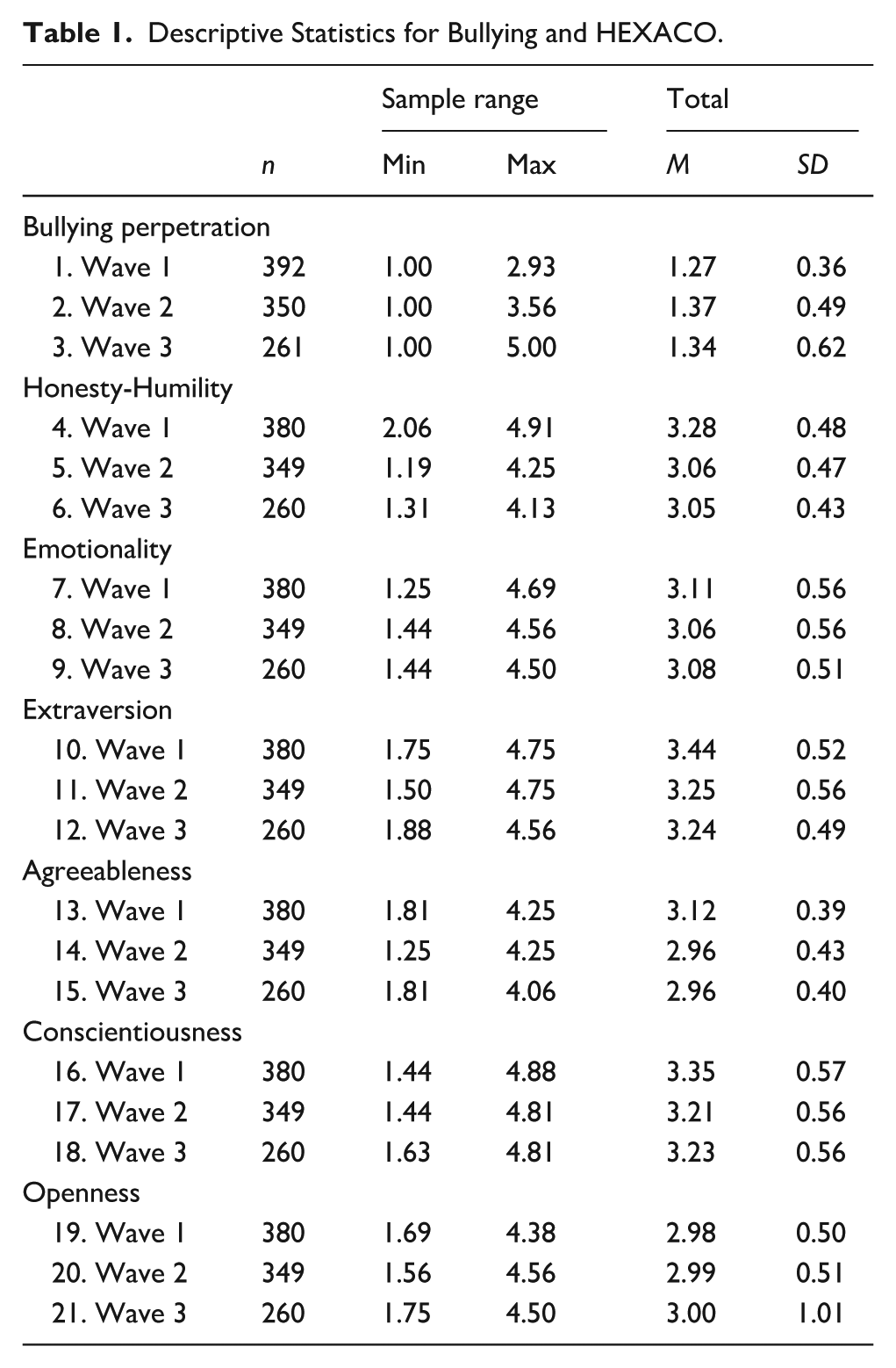
The means and standard deviations of all study variables are presented in Table 1. All variables had acceptable skewness and kurtosis values (<10; Kline, 2016), except for bullying at Wave 1. Winsorizing the top four cases reduced the kurtosis value from 22.31 to 6.09. 1 See Supplemental Table S1 for bivariate correlations. All significant correlations between bullying and the HEXACO traits were small in effect size. Higher bullying was significantly correlated with lower Honesty-Humility at all waves (W) except for W3 bullying with W1 Honesty-Humility. Higher W3 bullying was significantly correlated with lower Emotionality at all waves. Higher bullying at W2 and W3 were significantly correlated with Extraversion at W2. Higher bullying at W1 was significantly correlated with lower Agreeableness at W1, whereas higher bullying at W2 was significantly correlated with lower Agreeableness at W2 and W3. Finally, higher bullying at W3 was significantly correlated with lower Agreeableness at W2. Higher bullying was significantly correlated with lower Conscientiousness at all waves. Higher bullying at W1 and W2 was significantly correlated with lower Openness at W1 and W2. All variables showed significant across-time stability in the correlations, ranging from small to small-to-moderate for Agreeableness, small-to-moderate to moderate for bullying and Honesty-Humility, small-to-moderate to moderate for Extraversion, moderate to moderate-to-large for Conscientiousness and Openness, and moderate to large for Emotionality.
Descriptive Statistics for Bullying and HEXACO.
RI-CLPM Results
Honesty-Humility
See Table 2 for model fit indices and model comparison tests for all RI-CLPM results. For the models examining bullying with Honesty-Humility, there was no significant difference between the baseline model (Model 1) when constraining within-time correlations (Model 3) and cross-lagged paths (Model 4). There was a significant difference from the baseline model when constraining auto-regressive stability paths (Model 2). Therefore, the final model (Model 5) included equality constraints on the within-time correlations and cross-lagged paths, which had adequate model fit. At the between-person level, the random intercepts of bullying and Honesty-Humility were significantly negatively correlated (see Supplemental Table S2 and Supplemental Figure 1A). This indicates that between individuals, starting with lower levels of Honesty-Humility was associated with higher bullying perpetration. At the within-person level, there were significant within-time correlations between bullying and Honesty-Humility, and these were time-invariant. This means that an individual’s deviation from their own average trajectory of bullying was concurrently negatively associated with deviations from their own average trajectory of Honesty-Humility. That is, if an individual reported less Honesty-Humility than expected based on their own trajectory, they also reported more bullying than expected. All effects were small. The between-person effect of being older and starting with lower Honesty-Humility was no longer significant after applying the BH correction.
Summary of Model Fit Statistics for the RI-CLPM Analyses for Bullying and Each HEXACO Trait.
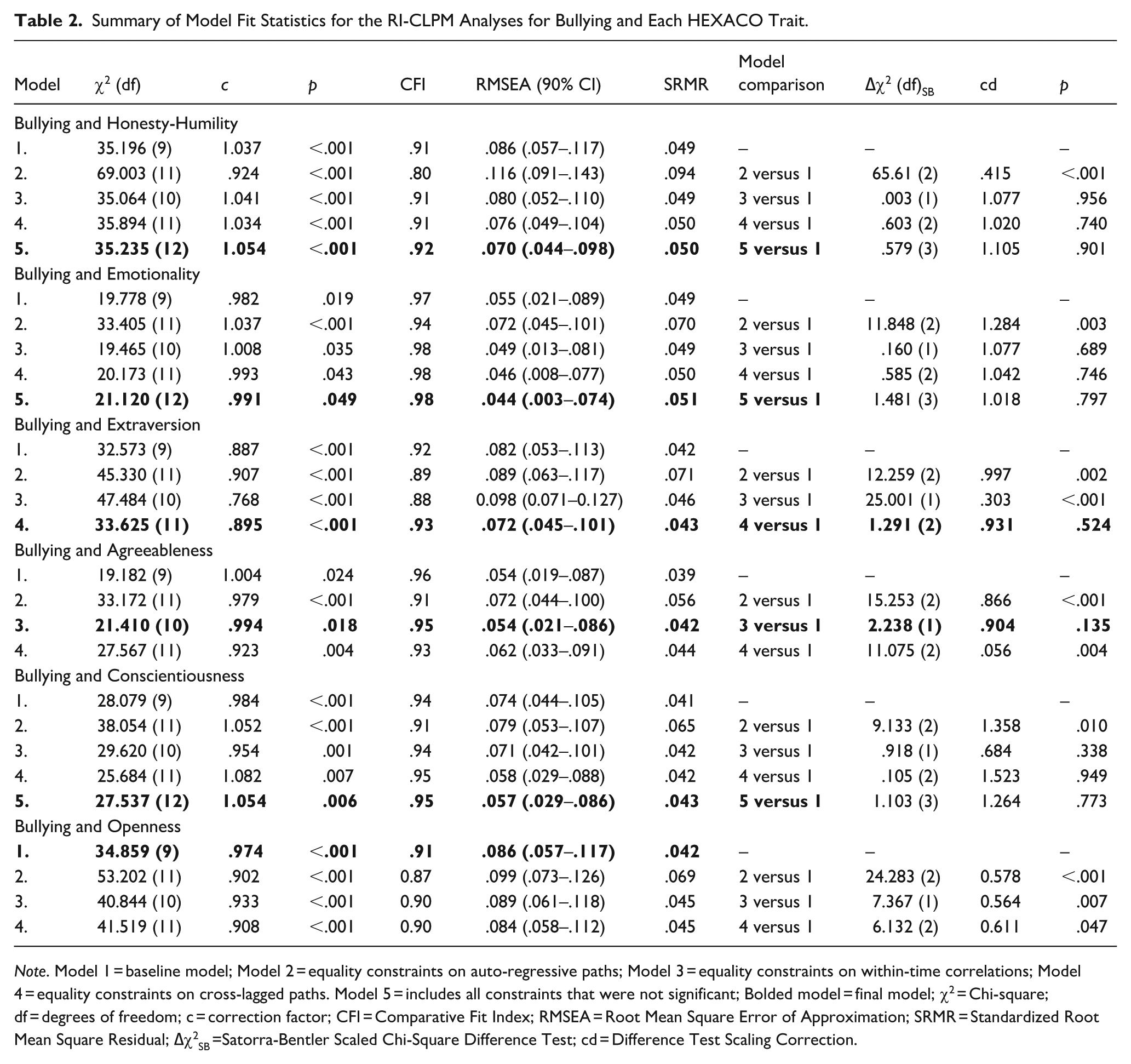
Note. Model 1 = baseline model; Model 2 = equality constraints on auto-regressive paths; Model 3 = equality constraints on within-time correlations; Model 4 = equality constraints on cross-lagged paths. Model 5 = includes all constraints that were not significant; Bolded model = final model; χ2 = Chi-square; df = degrees of freedom; c = correction factor; CFI = Comparative Fit Index; RMSEA = Root Mean Square Error of Approximation; SRMR = Standardized Root Mean Square Residual; ∆χ2SB =Satorra-Bentler Scaled Chi-Square Difference Test; cd = Difference Test Scaling Correction.
Emotionality
For the models examining bullying with Emotionality, there was no significant difference between the baseline model (Model 1) when constraining within-time correlations (Model 3) and cross-lagged paths (Model 4). There was a significant difference from the baseline model when constraining auto-regressive stability paths (Model 2). Therefore, the final model (Model 5) included equality constraints on the within-time correlations and cross-lagged paths, which had good model fit. After applying the BH correction, there were no significant between-person associations (see Supplemental Table S2 and Supplemental Figure 1B). At the within-person level, there were significant time-varying auto-regressive stability paths from W1 Emotionality to W2 Emotionality (small-to-moderate in effect size) and from W2 Emotionality to W3 Emotionality (moderate-to-large in effect size). This indicates that if an individual reported higher Emotionality than expected based on their own trajectory, this predicted prospective increases in Emotionality.
Extraversion
For the models examining bullying with Extraversion, there was no significant difference between the baseline model (Model 1) when constraining cross-lagged paths only (Model 4). There were significant differences when comparing the baseline model to the model with constrained auto-regressive stability paths (Model 2) and to the model with constrained within-time correlations (Model 3). Therefore, the final model included equality constraints only on the cross-lagged paths (Model 4), which had adequate model fit. After applying the BH correction, there was only one significant effect, a within-person auto-regressive stability path from W2 Extraversion to W3 Extraversion (small-to-moderate effect size; see Supplemental Table S2 and Supplemental Figure 1C). This indicates that if an individual reported higher Extraversion than expected based on their own trajectory, this predicted prospective increases in Extraversion.
Agreeableness
For the models examining bullying with Agreeableness, there was no significant difference between the baseline model (Model 1) when constraining within-time correlations only (Model 3). There were significant differences when comparing the baseline model to the model with constrained auto-regressive stability paths (Model 2) and to the model with constrained cross-lagged paths (Model 4). Therefore, the final model included equality constraints only on the within-time paths (Model 3), which had adequate model fit. After applying the BH correction, there were only two significant effects: a between-person effect of being older and starting with lower Agreeableness, and a within-person auto-regressive stability path from W2 Agreeableness to W3 Agreeableness (small-to-moderate effect sizes; see Supplemental Table S2 and Supplemental Figure 1D). This indicates that if an individual reported higher Agreeableness than expected based on their own trajectory, this predicted prospective increases in Agreeableness.
Conscientiousness
For the models examining bullying with Conscientiousness, there was no significant difference between the baseline model (Model 1) when constraining within-time correlations (Model 3) and cross-lagged paths (Model 4). There was a significant difference from the baseline model when constraining auto-regressive stability paths (Model 2). Therefore, the final model (Model 5) included equality constraints on the within-time correlations and cross-lagged paths, which had good model fit. After applying the BH correction, there was only one significant effect, a within-person auto-regressive stability path from W2 Conscientiousness to W3 Conscientiousness (moderate effect size; see Supplemental Table S2 and Supplemental Figure 1E). This indicates that if an individual reported higher Conscientiousness than expected based on their own trajectory, this predicted prospective increases in Conscientiousness.
Openness
For the models examining bullying with Openness, there were significant differences from the baseline model (Model 1) when constraining auto-regressive stability paths (Model 2), within-time correlations (Model 3), and cross-lagged paths (Model 4). Therefore, the baseline model was kept as the final model, which had adequate model fit. After applying the BH correction, there was only one significant effect, a within-person auto-regressive stability path from W2 Openness to W3 Openness (small-to-moderate effect size; see Supplemental Table S2 and Supplemental Figure 1F). This indicates that if an individual reported higher Openness than expected based on their own trajectory, this predicted prospective increases in Openness.
Discussion
The associations between bullying perpetration and each of the HEXACO personality traits were examined across 3 years of development using RI-CLPM. As expected, we found significant associations between bullying perpetration and Honesty-Humility at the between- and within-person levels, but no within-person cross-lagged associations were found. No other HEXACO traits were associated with bullying at between- or within-person levels, but we found evidence for within-person stability for the remaining five HEXACO traits.
Univariate Correlations between Bullying and HEXACO
As expected, bullying perpetration had significant negative correlations with Honesty-Humility and Conscientiousness within and across all waves except for bullying at Wave 3 with Honesty-Humility at Wave 1. For Agreeableness, there were significant negative within-time correlations at Waves 1 and 2, and significant negative across-time correlations between Wave 2 bullying with Agreeableness at Waves 1 and 3 and Wave 3 bullying with Agreeableness at Wave 2. Bullying at Wave 3 was also significantly negatively correlated with Emotionality at all waves. Finally, bullying was negatively correlated with Openness at Waves 1 and 2. The correlations within and across time appeared to be larger between bullying and Honesty-Humility relative to the other traits. These findings broadly replicate the correlations found in cross-sectional studies on bullying perpetration and HEXACO in Canadian, Chinese, and Dutch samples of adolescents (Book et al., 2012; Farrell et al., 2014; Pronk et al., 2021; Volk et al., 2018) and suggest that at the univariate level, bullying is associated with being more conservative, impulsive, fearless, angry, and, especially, exploitative. These correlations indicate that when bullying is examined with each HEXACO trait independently at the univariate level, individuals high on bullying demonstrate tendencies to be antisocial versus prosocial (Ashton & Lee, 2007).
RI-CLPM Results: Between-Person Associations
At the between-person level, we found a significant negative association between bullying perpetration and Honesty-Humility in the RI-CLPM, as expected. There were also significant negative associations between the intercepts of bullying with Agreeableness and Conscientiousness, but these associations were no longer significant after correcting for multiple testing. This confirms the primacy of Honesty-Humility as the most consistent and prominent predictor of bullying perpetration (Book et al., 2012; Farrell & Volk, 2017; Pronk et al., 2021). However, past regression-based analyses conflate between-person associations with within-person associations, preventing a true understanding of how bullying is related to personality. The association between the intercept of bullying and Honesty-Humility indicates that youth who start with higher levels of bullying perpetration relative to their peers also start with lower levels of Honesty-Humility. Thus, youth who engage in higher bullying perpetration are simultaneously more selfishly exploitative and predatory than their peers who engage in lower bullying perpetration.
RI-CLPM Results: Within-Person Associations
At the within-person level, our predictions were partially supported. As expected, we found significant within-person associations between bullying perpetration and Honesty-Humility, but they were only for concurrent within-person associations. We did not find any evidence for significant within-person cross-lagged associations between bullying and Honesty-Humility. Thus, individuals who decrease in Honesty-Humility at a given point in development relative to their expected levels concurrently increase in bullying perpetration at that same time point. In other words, concurrent deviations from expected levels of bullying and Honesty-Humility are related, but past deviations from expected levels of Honesty-Humility are not predictive of future deviations from bullying trajectories, and vice versa. This finding was also time-invariant, meaning that the within-time associations between higher bullying and lower Honesty-Humility are relatively consistent across time.
We did not find any significant within-person cross-lagged effects of bullying and Honesty-Humility despite our initial predictions. The lack of cross-lagged associations could have three possible explanations. First, it may be that most of the associations between bullying and personality across adolescence occur at the between-person level (Davis et al., 2022; Guo et al., 2023). Thus, there may be fewer within-person changes occurring between bullying perpetration and Honesty-Humility. Second, it is possible that we did not find cross-lagged associations due to the high levels of within-person stability of HEXACO personality traits across shorter time intervals of 1 and 3 years, or because changes in expected levels of bullying and Honesty-Humility have concurrent associations rather than longitudinal associations. Indeed, all the HEXACO traits demonstrated significant within-person stability paths from Wave 2 to Wave 3 (1-year lag), and there were time-invariant within-person within-time associations between lower Honesty-Humility and higher bullying perpetration.
This high stability is consistent with previous meta-analytic findings supporting increases in stability of personality across development (Bleidorn et al., 2022; Roberts et al., 2006), as well as adolescence being a time of change in personality (Slobodskaya, 2021; Soto & Tackett, 2015). We extend these findings by demonstrating evidence of both. The HEXACO traits showed significant within-person stability. However, given that these stability paths were within-person, these results indicate that individuals can increase from their own expected trajectories of personality. From a statistical perspective, RI-CLPM are known to have small effects at the within-person level for several reasons (Orth et al., 2024). Within-person effects control for between-person, stable trait-like effects as well as the within-person stability of a variable across time. Stable, trait-like effects and within-person longitudinal stability account for large portions of variance and are expected in personality research, attenuating the possible range of within-person cross-lagged effects. Traditional benchmarks of small, medium, and large effect sizes are often based on concurrent estimates of cross-sectional data. Orth et al. (2024) recommend standardized benchmarks of .03, .07, and .12 as small, moderate, and large within-person cross-lagged effects, such that small effects of .03 can still be meaningful. Moreover, our reliabilities for the HEXACO traits were adequate to good, which is lower than typically found among adults (Lee & Ashton, 2018), but commonly found among adolescents (Sergi et al., 2020). Therefore, measurement error could have also contributed to the lack of within-person cross-lagged effects. Future studies that examine additional assessment periods across adolescence, across longer periods of time with larger sample sizes, can indicate whether results replicate.
Third, it is possible that additional contextual factors may have contributed to the association between personality and bullying, given that both constructs are shaped by multiple social and environmental factors (e.g., Farrell & Volk, 2017). For example, peer relationships play an important role during early and middle adolescence, when the desire for status and popularity increases (LaFontana & Cillessen, 2010). Individuals lower on certain traits, such as Honesty-Humility, may be more likely to desire popularity and engage in bullying to achieve or maintain these social goals (e.g., Volk et al., 2021). With additional time points assessed further apart, such as 3 or more years, there may be more of a time lag that allows for assessing personality change. Examining additional contextual factors such as peer status may also provide insight into the between- and within-person associations.
Taken together, the findings suggest that bullying is used by individuals who are more exploitative relative to others, but that individuals who increase in bullying relative to their previous levels also simultaneously increase in their tendencies to be exploitative of others. This highlights the potentially bidirectional nature of the personality–behavior relationship.
Unexpectedly, we did not find any significant between- or within-person associations between bullying and Conscientiousness or Agreeableness, after correcting for multiple testing. Consistent with previous cross-sectional findings, these results suggest that overarching tendencies to be antisocial, including being impulsive or reckless and being angry or difficult to get along with can be associated with bullying, but the tendency to be exploitative and predatory is the core personality trait that is associated with bullying others (Book et al., 2012; Farrell & Volk, 2017; Pronk et al., 2021). This fits with Honesty-Humility’s role as the core of Dark personality traits (Aluja et al., 2022). That is, bullying perpetration is longitudinally associated with tendencies to be proactively exploitative (i.e., lower Honesty-Humility), rather than reactively angry (i.e., lower Agreeableness) at the between- and within-person levels. Given that other personality models do not capture this distinction, our findings provide further support for the adaptive functions that underlie bullying across adolescence. Our results also suggest that future research on individual differences should focus on exploitative, selfish traits rather than anger, impulsivity, and/or emotional empathy. Moreover, given the adaptive benefits of being higher on Honesty-Humility, anti-bullying efforts may benefit from focusing on promoting higher prosocial behavior, cooperation, and alliance forming to acquire social benefits without resorting to bullying (e.g., Farrell & Dane, 2020).
Limitations
Despite our novel contributions, there are some limitations to our study. First, our ideal RI-CLPM analyses would have included all six HEXACO with bullying in a single model. RI-CLPMs are typically challenging to converge with many variables, and our sample size was relatively small, which is why we ran the associations between bullying and each trait separately. However, the HEXACO traits were designed to be independent from one another (Ashton & Lee, 2007), and we corrected for multiple testing, providing confidence in our results. Future studies with larger sample sizes may be able to simultaneously examine all traits with bullying. Second, we had only three time points with unequal time lag intervals. RI-CLPMs require a minimum of three waves (Hamaker et al., 2015). Future studies with additional time points with equal time-lag intervals may reveal more understanding of the developmental processes of bullying and HEXACO personality. Third, we used self-reports of bullying perpetration with HEXACO to get at the underlying intrinsic motivations contributing to bullying, which may be hidden from peers. We also used an overall composite of bullying rather than subtypes. However, some researchers have found concurrent associations between peer-nominated bullying behavior and self-reported HEXACO personality (Pronk et al., 2021). In addition, HEXACO traits have been differentially associated with subtypes of bullying (e.g., Conscientiousness with direct bullying; Farrell & Volk, 2017; Emotionality with racial bullying; Farrell et al., 2014). Thus, researchers may want to include both peer and self-reports of different subtypes of bullying in future studies to gain a comprehensive understanding of the associations between bullying and the HEXACO (Volk et al., 2017). Fourth, our sample came from a relatively homogeneous region of southern Ontario with respect to race/ethnicity and socioeconomic status. Some evidence suggests cultural differences in the role of HEXACO personality with bullying (e.g., Pronk et al., 2021; Volk et al., 2018). Researchers may want to examine whether our between- and within-person results are replicated in more diverse and cross-cultural samples. Fifth, the reliabilities of the HEXACO traits were adequate to good, ranging from .58 to .82. Despite some traits being lower, these reliabilities are largely consistent with developmental literature. Typically, the reliabilities of personality traits among adolescent samples are lower (e.g., Li et al., 2023; Sergi et al., 2020) than the reliabilities found among adult samples (Lee & Ashton, 2018).
Implications
Our findings are the first to reveal longitudinal associations between bullying perpetration and the HEXACO personality traits. Our findings provide evolutionary explanations of bullying being used by individuals as an adaptive strategy for self-gain, including social status, dominance, and popularity (Pouwels, Lansu, et al., 2018; Vaillancourt et al., 2003; Wiertsema et al., 2023). Previous cross-sectional evidence also supports associations between HEXACO traits, such as lower Honesty-Humility, and social outcomes such as popularity among adolescents (De Vries et al., 2020). Thus, both bullying and Honesty-Humility show evidence for serving adaptive functions. Youth who are generally higher on antisocial personality traits, such as being angry, difficult to get along with, and impulsive, may be more likely to use bullying than peers who are lower on these traits. However, youth who are higher than peers on exploitative tendencies may be more willing to take advantage of others and bully for self-gain. Thus, a tendency for predatory exploitation appears to be the most prominent trait related to bullying, and bullying may be an adaptive strategy among individuals with exploitative tendencies. Individuals who increase in tendencies to exploit others relative to their own previous levels are also likely to concurrently increase in their bullying behavior, and this pattern appears to be consistent across adolescent development. This fits with the characterization of bullying as a proactive and adaptive behavior (Kaufman et al., 2020; Salmivalli, 2010; Vaillancourt et al., 2003; Volk et al., 2014).
Our findings highlight the importance of addressing personality as one of the factors contributing to youth bullying. If bullying is used by individuals who are willing and able to exploit others for self-gain, it is understandable that it would be difficult to prevent this behavior, which can result in adaptive benefits for perpetrators. Anti-bullying efforts must address these social functions and goals of bullying for effective prevention (Hensums et al., 2023). Mobilizing the peer group to encourage bystander interventions or to change the larger social culture may also be effective ways to prevent exploitative tendencies (Gaffney et al., 2019; Garandeau et al., 2014; Kärnä et al., 2011). For example, it is important to limit the opportunities for youth to exploit peers and benefit from bullying behavior by providing alternative prosocial methods to gain similar benefits (Ellis et al., 2016; Farrell & Dane, 2020; Pronk et al., 2021). The meaningful roles intervention is one school-based program developed using an evolutionary framework that aims to provide adaptive status-related benefits for adolescents that can be obtained in prosocial ways (Ellis et al., 2016). Meaningful roles and responsibilities that support academic achievement, social competencies, self-regulation, and skill building are assigned to students to encourage student-led school climates (e.g., door greeter). Peers are encouraged to create public praise notes that reinforce and reward students with status based on prosocial acts. Thus, students can receive social status-related benefits but without resorting to harmful bullying behavior. This peer reinforcement of prosocial means of gaining status may be salient for individuals who are lower on Honesty-Humility (i.e., individuals who are lower on modesty; Ellis et al., 2016). One promising outcome of our findings, combined with findings from previous longitudinal studies, suggests that personality and bullying can be malleable among youth. That is, traits can increase or decrease in relation to social behavior, and social behavior can increase or decrease in relation to behavior (e.g., Guo et al., 2023). Considering the evidence for personality malleability during adolescence (e.g., Soto et al., 2011), including Honesty-Humility (Brazil et al., 2025), adolescence is a crucial developmental period for implementing interventions such as the meaningful roles program to counteract antisocial tendencies and, in turn, increase prosocial behavior. Longitudinal studies are needed in the future to examine whether the implementation of such bullying prevention programs results in increases in Honesty-Humility and decreases in bullying behavior. By altering the larger social climate, we can aim to better counteract and reduce the use of bullying and, in turn, promote healthier and more prosocial peer relationships.
Supplemental Material
sj-docx-1-jbd-10.1177_01650254251382282 – Supplemental material for Bullying perpetration and HEXACO personality: Examining between- and within-person longitudinal associations
Supplemental material, sj-docx-1-jbd-10.1177_01650254251382282 for Bullying perpetration and HEXACO personality: Examining between- and within-person longitudinal associations by Ann H. Farrell, Natalie Spadafora, Andrew V. Dane and Anthony A. Volk in International Journal of Behavioral Development
Footnotes

Ethical Considerations
Ethics clearance was received from the university’s research ethics and the school board’s research ethics boards.
Consent to Participate
Parent and participant consent/assent were received annually.
Author Contributions
AHF: Conceptualization, Formal analysis, Writing—original draft; review & editing. NS: Data curation; Project administration; Writing—review & editing. AD: Data curation, Investigation, Methodology, Project administration; Writing—review & editing. TV: Conceptualization, Data curation, Investigation, Methodology, Project administration; Writing—review & editing, Funding acquisition.
Funding
The authors disclosed receipt of the following financial support for the research, authorship, and/or publication of this article: This work was funded by grants awarded to Anthony A. Volk by the Social Sciences and Humanities Research Council of Canada (grant number 435-2017-0303).
Declaration of Conflicting Interests
The authors declared no potential conflicts of interest with respect to the research, authorship, and/or publication of this article.
Data Availability Statement
Data are available from the corresponding author upon reasonable request. Data are not publicly available due to privacy or ethical restrictions.
Supplemental Material
Supplemental material for this article is available online.
Notes
References
Supplementary Material
Please find the following supplemental material available below.
For Open Access articles published under a Creative Commons License, all supplemental material carries the same license as the article it is associated with.
For non-Open Access articles published, all supplemental material carries a non-exclusive license, and permission requests for re-use of supplemental material or any part of supplemental material shall be sent directly to the copyright owner as specified in the copyright notice associated with the article.
