




Abstract
This study investigates the role of parental warmth in the development and change of the moral self in middle childhood. While previous research has extensively examined the moral self in early childhood and moral identity in adolescence, middle childhood remains underexplored. Yet, middle childhood is a crucial phase marked by significant moral development, making it a critical period for understanding how moral self-concepts evolve. To examine developmental change, True Intraindividual Change (TIC) models were used. This approach estimates both baseline levels and latent change over time. It allowed us to assess how parental warmth at Time 1 predicts both the initial level and change in the moral self across 6 months. Therefore, our sample consisted of 189 children, aged 6 to 12 years (M = 8.48, SD = 1.26), and their primary caregivers were recruited for this longitudinal study. The findings reveal a significant positive effect of parental warmth (T1) on the baseline level of the moral self, indicating that higher parental warmth is associated with a stronger moral self. In addition, the effect of parental warmth (T1) on the change in the moral self (from T1 to T2 6 months later) was also significant. These results underscore the importance of parental warmth in establishing a foundation for moral development and its role in driving intraindividual change in the moral self during middle childhood.
Introduction
Moral Self in Middle Childhood
The moral self refers to the integration of societal norms and values into an individual’s self-concept (Kochanska, 2002), which helps children make moral decisions and see themselves as moral agents (Blasi, 1983; Hardy & Carlo, 2011). Despite its significance, the development of the moral self during middle childhood remains underexplored. Middle childhood is typically defined as the developmental period between approximately 6 and 12 years of age (Schenk-Danzinger, 2006; Schneider & Lindenberger, 2012). Theoretically, the view that the moral self has a rather trait-like character and becomes more stable and coherent with age is widely accepted (Aquino & Reed, 2002; Strauß & Bondü, 2022). However, middle childhood is also a time of increased cognitive, emotional, and social differentiation, which may challenge and reshape developing self-concepts (Kingsford et al., 2022; Malti et al., 2018; Smetana, 2013). In addition, parenting is an influential factor for the moral self in this developmental period (Bäker & Wilke, 2024; Kochanska, 2002; Kochanska et al., 2010; Schütz & Bäker, 2023; Söldner & Paulus, 2025; Wilke & Baker, 2025). As suggested by Kochanska (2002) and Kochanska et al. (2010), children begin to develop a moralized sense of self as early as age four, gradually incorporating moral traits into their self-perception. By around age five, they tend to behave more consistently with this emerging moral self-view. Yet this developmental process is ongoing: self-concepts in childhood are still evolving in both structure and coherence, and thus remain open to change. In line with this, we assume that the moral self may not yet be fully stabilized in middle childhood. Empirical research has primarily focused on the moral self in early childhood (e.g., Gahtan et al., 2024; Kochanska et al., 2007) and on moral identity in adolescence (e.g., Christner et al., 2022; Hardy & Carlo, 2011), leaving a crucial gap in understanding how the moral self evolves during middle childhood. The terms “moral self” and “moral identity” are sometimes used interchangeably (Bäker & Wilke, 2024; Krettenauer, 2013a). However, “moral self” typically refers to the early, developing sense of morality in childhood shaped by socialization and parenting (Kochanska, 2002; Kochanska et al., 2010), while “moral identity” describes the more consolidated, self-defining moral commitments that emerge in adolescence (Kingsford et al., 2018; Krettenauer, 2013a). In our literature review, we use the terminology adopted by each original study when discussing their findings. However, given our focus on middle childhood, we use the term “moral self” when presenting our own results.
Recent studies have begun to address the development of the moral self in middle childhood. Kingsford et al. (2022) found that 9-year-olds were more likely than 7-year-olds to attribute moral shame to norm violations. They discuss that moral identity begins to emerge in middle childhood as children increasingly evaluate transgressions in self-referential terms. Strauß and Bondü (2022) showed that altruistic justice sensitivity in children aged 5 to 12 was positively linked to moral identity, reinforcing the idea that identity-related moral self-evaluations can be meaningfully observed before adolescence. They also found that children aged ⩾9 years had a higher moral identity than children aged <9 years. While Schütz and Bäker (2023) found no age effects in a sample of children aged 6 to 11. Research by Söldner and Paulus (2024) further examined the structure and development of the moral self-concept in early and middle childhood. In their longitudinal study of children aged 4 to 6.5 years, analyses revealed that the moral self-concept becomes increasingly differentiated across three domains of prosociality (helping, sharing, and comforting) by age 5 and 6. However, they found only inconsistent stability over time, suggesting that the moral self-concept in early childhood is still emerging and subject to developmental shifts. The descriptive statistics suggest that the scores in the moral self-concepts slightly increase. Building on this, Söldner and Paulus (2025) investigated longitudinal predictors of the moral self-concept and found that maternal emotional availability in infancy predicted children’s comforting behavior at age three, which in turn predicted their moral self-concepts at age four. Similarly, Schütz and Bäker (2023) found positive effects of parental warmth on the moral self in middle childhood.
However, middle childhood is a critical phase for moral development, as children refine precursor skills such as perspective-taking and self-regulation, which are essential for moral development (Schütz & Koglin, 2023). It is also a key period for self-reflection on moral values and their internalization (Kingsford et al., 2018; Krettenauer, 2013b; Nucci, 2004). Social influences, particularly parental guidance, play a vital role in shaping the moral self. Among these, parental warmth has been identified as a central factor, positively associated with moral development (Kochanska, 2002; Sengsavang & Krettenauer, 2015; Söldner & Paulus, 2025; Wilke & Baker, 2025).
Based on prior research, we hypothesized that children’s moral self is not yet fully stable during middle childhood and thus may show intraindividual change over time. While the direction of change in the moral self has not been consistently established, we expected a slight increase in children’s moral self-concept, reflecting growing internalization of moral values and increasing self-reflection typical for this developmental stage (Kochanska, 2002; Kochanska et al., 2010; Kingsford et al., 2022; Söldner & Paulus, 2024). Some studies suggest that moral traits become more self-relevant and integrated into children’s self-concept as they grow older (Kingsford et al., 2022; Söldner & Paulus, 2024; Strauß & Bondü, 2022), while others found no clear age-related effects or reported inconsistent stability (Schütz & Bäker, 2023; Söldner & Paulus, 2024). This inconsistency underscores the need for more research on within-person change and what predicts this change.
The role of parenting, particularly parental warmth, in this developmental process is well-documented (Bäker & Wilke, 2024; Kochanska, 2002; Kochanska et al., 2010; Schütz & Bäker, 2023; Söldner & Paulus, 2025; Wilke & Baker, 2025). In this study, we define parental warmth as a parenting dimension characterized by affection, emotional support, and responsiveness toward the child. It includes behaviors such as expressing love, demonstrating empathy, offering comfort, and being attentive to children’s needs (Kochanska, 2002; Skinner et al., 2005). Parental warmth fosters children’s moral understanding and is strongly linked to the moral self (Bäker & Wilke, 2024; Kochanska, 2002; Kochanska et al., 2010; Schütz & Bäker, 2023; Söldner & Paulus, 2025; Wilke & Baker, 2025). However, it remains unclear whether parental warmth merely provides a foundation for moral internalization or also predicts intraindividual changes in the moral self over time. Some studies suggest that this association may not persist into adolescence (Bäker & Wilke, 2024), raising the question of whether parental warmth continues to shape the moral self beyond early childhood.
The question arises as to whether parental warmth serves as a necessary foundation for internalizing moral values in children or whether it also plays a role in predicting changes in the moral self during middle childhood. While existing research highlights the importance of parental warmth in moral development, its influence beyond initial moral internalization remains largely unexplored. Understanding whether parental warmth contributes to intraindividual changes in the moral self over time could provide valuable insights into the dynamics of moral development and the ongoing influence of parenting practices as children navigate this critical stage of self-reflection and moral understanding. To address this gap, the current study investigates whether parental warmth predicts not only initial levels of the moral self but also intraindividual changes during middle childhood. To capture these dynamics, we employed True Intraindividual Change (TIC) models (Steyer et al., 2008). TIC models are particularly suited to short-term longitudinal designs with two measurement points, allowing for the estimation of latent change scores while separating true change from measurement error. Unlike Latent Growth Curve Models (LGCM), which require three or more time points and focus on general growth trends, TIC models offer a more direct analysis of individual-level change. Moreover, TIC enables the simultaneous examination of how predictors influence both baseline levels and intraindividual change (Steyer et al., 2008), making them especially appropriate for the current study.
We hypothesize that parental warmth not only predicts the moral self at T1 and T2 but is also accolated with intraindividual changes in the moral self beyond its foundational role in moral internalization.
Parental Warmth and Its Association to the Moral Self
Parent–child interactions are fundamental to moral development (Kochanska, 2002; Smetana, 2013; Söldner & Paulus, 2025). Parenting research differentiates between parenting practices, dimensions and styles (Goagoses et al., 2022; Skinner et al., 2005). While parenting styles offer a broad framework, this study specifically examines parental warmth, given its critical role in shaping the moral self during middle childhood (Bäker & Wilke, 2024; Schütz & Bäker, 2023; Wilke & Baker, 2025). As described above, parental warmth reflects stable affective support and closeness, and is theoretically distinct from mutually responsive orientation (Kochanska, 2002), which stresses reciprocal emotional cooperation, and parental sensitivity. While both constructs highlight emotional quality in the parent–child relationship, parental warmth, as measured here, captures the parent’s consistent affective stance toward the child, rather than mutual synchrony or responsiveness to moment-to-moment signals. Parental warmth is a parenting style characterized by emotional support, affection, and responsiveness toward children. It includes behaviors such as expressing love, offering comfort, demonstrating empathy, and being attentive to children’s needs (Kochanska, 2002; Skinner et al., 2005). As children integrate moral values into their self-concept, parental influence plays a key role in shaping moral understanding and internalization. While classic developmental theories by Piaget (1932/1965) and Kohlberg (1976) focus primarily on cognitive aspects of moral reasoning, they emphasize that moral development is closely tied to children’s social environment and interactions with caregivers and peers. The development of the moral self, as a self-relevant integration of moral values, builds upon these foundations by considering how children begin to view themselves as moral agents (Blasi, 1983; Hart et al., 1999; Krettenauer & Hertz, 2015). Socialization theorists also argue that a warm and emotionally available parent–child relationship facilitates moral internalization, as repeated warm interactions and open communication strengthen both conscience development and the broader socialization process (Kochanska, 1993). In addition, positive mother-child interactions have a lasting impact on the moral self (Kochanska et al., 2007). Warm and positive interactions characterized by emotional support and responsiveness foster an environment where children can internalize moral values such as empathy, kindness, and respect (Kochanska, 1993, 2002; Schütz & Bäker, 2023). Yet during middle childhood, children begin to detach from external authority and increasingly engage in self-reflection, allowing them to deepen their own understanding of morality (Smetana, 2013; Wilke & Goagoses, 2023).
The transition to late middle childhood or adolescence moral identity introduces complexities in this relationship. As children grow, they may become less reliant on parental guidance and more influenced by peer interactions and social norms (Smetana, 2013; Smetana & Ball, 2018). This shift raises questions about whether the positive effects of parental warmth on the moral self persist through development. While existing theoretical models (Hart et al., 1999), structural-developmental theorists (Kohlberg, 1976; Piaget, 1932/1965), socialization theorists (Kochanska, 1993; Kochanska et al., 2007), and empirical research suggests that parental warmth plays a supportive role in moral identity formation (Fatima et al., 2020; Wilke & Baker, 2025), it remains largely unexplored whether it can predict changes in the moral self during this critical transition in middle childhood.
Current Study
This study investigates the relationship between parental warmth and the development of the moral self during middle childhood. To address the gap regarding whether the moral self undergoes change during this developmental stage and to examine whether parental warmth predicts such changes, this study employs TIC models (Steyer et al., 2008). One possible assumption for changes in the moral self during middle childhood is the development of precursor skills that enable children to integrate moral values into their self-concept more deeply. Parental warmth might play a crucial role by fostering precursor skills such as empathy, self-regulation, and perspective-taking, which are essential for the moral self to evolve (Hardy & Carlo, 2011; Kochanska, 2002; Schütz & Koglin, 2023). However, some studies suggest that the association between parental warmth and the moral self may not persist into adolescence (Bäker & Wilke, 2024), indicating that its effect might diminish as children become more autonomous and peer influences grow stronger (Smetana, 2013). It is important to note that the present study does not examine this association in adolescence. Rather, our focus is explicitly on middle childhood.
TIC models allow us to distinguish TICs in the moral self from general developmental trends. By examining how parental warmth affects both the level of the moral self and its development over time, this study aims to clarify the dynamics of moral development during this critical period. We hypothesized that parental warmth (T1) positively predicts the moral self in children during middle childhood (T1 and T2), and also the intraindividual change in the moral self over time, beyond its foundational role in internalizing moral values.
Method
Participants and Procedure
Elementary school children in grades one to four and their primary caregivers were recruited for this study to analyze moral development in middle childhood. The first data collection point (T1) took place from November 2022 to June 2023, involving NT1 = 348 participants, including children (MageT1 = 8.21 years, SDT1 = 1.30; 55.2% girls) and caregivers (MageT1 = 40.30 years, SDT1 = 5.79) from 20 schools in Germany. Caregivers received information letters and consent forms prior to data collection, and only children with signed consent could participate. Participation in the study was voluntary and participants were not compensated. Data were collected from both caregivers and children. The caregiver questionnaires were handed out and returned with the help of teachers. At the first measurement point (T1), children were assessed individually at their schools by members of the project team in quiet, distraction-free rooms. Before beginning, each child received age-appropriate information about the study, including its purpose and the voluntary nature of participation, and gave their verbal assent. The assessments were conducted by trained student researchers. Children were told that there were no right or wrong answers, and that they could skip any question or stop the assessment at any time without consequences. Caregivers received written instructions explaining the purpose of the study, how to complete the questionnaire, and how to contact the project team in case of questions. All questionnaires included written instructions on the front page. For children, these and the items were read aloud by the researchers. At the second data collection point (T2), 6 months later, NT2 = 189 participants took part in the follow-up. Participating children and their caregivers were re-contacted via the schools. Parents and children completed the same questionnaires as at T1 at home, following the same standardized instructions. The questionnaires were redistributed and collected with the support of the teachers, and the completed forms were picked up by the project coordinator at an agreed-upon time at the school. The current analysis focuses on the N = 189 children (MageT2 = 8.48 years, SDT1 = 1.26; range = 6–12; 56.1% girls) and caregivers (MageT2 = 40.89 years, SDT2 = 5.23) who participated in both measurement occasions. A table summarizing the demographic characteristics is available as a Supplementary File on the Open Science Framework (OSF; https://osf.io/sdr69/?view_only=b20061b8d09c4d7ea32c1c91bdcaea68) to enhance clarity and provide an overview of the sample.
Primary caregivers were asked about key demographic characteristics. Regarding the child’s educational context, 89.4% of children attended primary school, 7.4% were enrolled in special education schools, and 2.6% attended other types of schools (e.g., secondary school). Grade levels ranged from first to fifth, with 16.4% in Grade 1, 27.0% in Grade 2, 35.4% in Grade 3, 16.9% in Grade 4, and 4.2% in Grade 5. All children were attending school in Germany, and 16.9% were formally identified as having special educational needs. Socioeconomic background was assessed through parental education. Among mothers, 37% reported a university degree, 10.1% had completed high school (Abitur), 36.0% had completed secondary school (Realschule), 5.8% held a lower secondary qualification (Hauptschule), and 3.2% had no school-leaving certificate. An additional 4.2% selected “other,” including vocational qualifications such as professional training. Educational data were missing for seven mothers (3.7%). Among fathers, 28.0% held a university degree, 11.1% had completed high school, 31.2% had completed secondary school, 13.8% had a lower secondary qualification, and 2.6% reported no certificate. Another 4.8% selected “other.” Educational data were missing for 16 fathers (8.5%). Caregivers were also asked who completed the questionnaire and their relationship to the child. In 78.8% of cases, the mother completed the questionnaire alone, 6.9% were completed by fathers, 10.1% by both parents together, and 4.2% by alternative caregivers (e.g., foster parents or grandparents). Regarding cultural and migration background, 4.2% of children were born outside of Germany. In addition, 2.6% of children and 5.8% of caregivers reported speaking a language other than German most frequently at home. Among caregivers, 14.8% were born outside of Germany. Country of birth was missing for three children (1.6%) and two caregivers (1.1%).
Instruments
Moral Self
The moral self of children was evaluated at both measurement timepoints using a self-report questionnaire (based on Koglin, 2017). This questionnaire asks children to assess the personal significance of nine moral traits (e.g., being friendly or honest) and nine non-moral traits (distractions, for example, being intelligent or powerful) on a 4-point scale, ranging from (1) not important to me at all, (2) less important to me, (3) rather important to me, to (4) very important to me. The items of the questionnaire are available on OSF (https://osf.io/sdr69/?view_only=b20061b8d09c4d7ea32c1c91bdcaea68). Only the moral traits were used to compute the moral self scale. Children who score highly on this scale view moral traits as more significant to themselves. Previous research has supported the validity and factorial structure of this measure in middle childhood (e.g., Bäker et al., 2025; Schütz & Bäker, 2023; Wilke et al., 2024). Moreover, the predictive validity of the scale has been supported by findings linking higher moral self scores with increased prosocial behavior in children and adolescents (Bäker & Wilke, 2024) and with moral decision-making in adolescence (Schipper et al., 2023). The reliability for the nine moral items in the current samples is also satisfactory (α = .70 at Time 1, and α = .79 at Time 2) and the factor structure is also supported (see results section).
Parental Warmth
Parental warmth was measured using the Parenting Style Inventory by Satow (2013). Caregivers assessed their parenting characteristics related to warmth on a 4-point scale, where (1) means “does not apply at all,” (2) means “does not really apply,” (3) indicates “rather true,” and (4) means “applies exactly” (e.g., “I try to give my children as much love and warmth as possible,” T1: α = .89). The items of this scale are also available on OSF (same link as above). Higher scores on this scale reflect greater warmth in parenting. The questionnaire has been psychometrically evaluated previously and shows adequate reliability (Satow, 2013; Schütz & Bäker, 2023) and validity (Satow, 2013).
Analysis
Analyses were conducted using RStudio Version 4.2.2 (R Core Team, 2020) and the R package lavaan (Rosseel, 2012). The R Code and further outputs are available on OSF (https://osf.io/sdr69/?view_only=b20061b8d09c4d7ea32c1c91bdcaea68) We employed TIC models as proposed by Steyer et al. (2008) to assess intraindividual change. TIC models can be calculated when at least two observed variables measure the same latent construct, with data collected at a minimum of two time points. In this process, the change in the latent variable between two measurement points is examined. TIC models have the advantage of separating real change from measurement errors and allow the true change to be correlated with other variables. Therefore, it is assumed that paths values from the observed variables to the latent construct are invariant across time (Steyer et al., 2008). The TIC model, in its state version (state model), measures the observed variables at the different measurement points to capture the same latent construct, while accounting for the influence of a predicting variable. In the change version (baseline model), latent differences between measurement points are analyzed to capture TIC. The baseline model assesses the change relative to an initial time point. Therefore, a baseline and a change variable are created. In TIC models, latent change is explicitly modeled by defining two latent variables: one representing the baseline level (e.g., Moral Self Base) and one representing the change from that baseline (e.g., Moral Self Change). The change factor is specified to load only on the second time point and represents the residual variance in the latent construct at T2 after accounting for the baseline level at T1. This setup enables the estimation of TIC by partitioning the variance in the second latent factor into (a) what is stable (the moral self baseline level) and (b) what has changed (the moral self change factor) (Steyer et al., 2008). At the same time, the influence of a predicting variable is considered to analyze the impact on both the baseline variable and the change variable, providing a detailed understanding of the dynamics of intraindividual change over time. For more detailed information, see Steyer et al. (2008). In our analysis, we specifically applied a TIC model to analyze how parental warmth (T1) predicts the intraindividual change in the moral self of children between two measurement points. The model fit was evaluated using established cutoff criteria: a comparative fit index (CFI) ⩾ .95 indicates good fit, while values between .90 and .95 are considered acceptable. For root mean square error of approximation (RMSEA) and standardized root mean squared residual (SRMR), values below .06 are typically seen as good fit, and values between .06 and .08 as acceptable (Hair et al., 2009; Hu & Bentler, 1999).
Before conducting the TIC analysis, we tested the factor structure of the Moral Self scale using confirmatory factor analysis (CFA). In line with previous studies analyzing the factor structure of the Moral Self scale, we found that the item “selfless” does not load (λT1 = .281 and λT2 = .216) well onto the intended factor (e.g., Bäker et al., 2025; Wilke et al., 2024), whereas the loadings of the other items load sufficient (λT1 = .330–.675 and λT2 = .386–.751). Consistent with previous studies (e.g., Bäker et al., 2025; Wilke et al., 2024), the item “selfless” did not load well and was therefore excluded. Although the item “generous” showed a relatively low loading at T1 (λT1 = .330), its loading improved at T2 (λT2 = .386). Given these fluctuations and its theoretical relevance, we decided to retain the item, as loadings above .30 are commonly regarded as minimally acceptable in CFA, particularly in samples of this size (Hair et al., 2009; Kline, 2016; Tabachnick & Fidell, 2013).
Attrition and Missing Value Analysis
This study included only those children and caregivers who participated in both measurement points, resulting in 45.69% of the sample being absent at Time 2 (NT1 = 348). To assess the nature of the missing data and determine an appropriate method for handling it, a missing value analysis (MVA) was conducted on all relevant study variables. Initially, missing data due to dropout from Time 1 to Time 2 were examined using Little’s (1988) test for missing completely at random (MCAR). The results indicated that the data were not missing systematically but rather occurred randomly (χ2 = 144.834, df = 173, p = .942). In addition, t tests were performed to compare caregivers and children who discontinued participation after Time 1 with those who remained in the study. The findings showed no significant differences in study variables at T1 between these groups.
Further MVA was carried out on demographic variables at T1 to investigate whether children and caregivers who dropped out differed significantly from those who remained for the second measurement point. Chi-square tests confirmed that gender distribution, caregiver education level, migration background, and mother tongue were comparable across groups, with no significant differences between those who were missing at T2 and those who participated in both waves.
For participants who completed both T1 and T2 (NT2 = 189), another round of MVA was performed. The analysis revealed that the proportion of missing values for individual items and variables varied between 1.1% and 8.5% across the different measurements. Moreover, Little’s MCAR test (Little, 1988) reaffirmed that the data were MCAR (χ2 = 114.438, df = 137, p = .920). Therefore, we used full information maximum likelihood (FIML) to handle missing data (Enders & Bandalos, 2001) and applied the robust maximum likelihood estimator (MLR) to account for potential non-normality in the data (Li, 2016).
Results
Descriptive statistics (means and standard deviations), correlations for the T1 and T2 scales, as well as correlations with age and gender are presented in Table 1. Moral self was assessed via a nine item, with responses ranging from 1 (not important to me at all) to 4 (very important to me), resulting in possible sum scores between nine and 36. In the current sample, actual scores ranged from 17 to 36 at T1 and from 15 to 36 at T2. Parental warmth was measured using a 10 item with response options from 1 (does not apply at all) to 4 (applies exactly), yielding possible scores between 10 and 40. In the current sample, scores ranged from 23 to 40. Higher values indicate a stronger moral self or more warmth in parenting, respectively. The key variables (parental warmth and moral self T1 and T2) show high values and correlate moderately to highly and positively with each other. Age T1 and gender, in contrast, were only negatively associated with moral self at T1 with a small effect. Specifically, higher age at T1 was associated with lower moral self at T1, and boys reported lower moral self scores at T1 compared with girls. Age T2 was not correlated with the moral self at T2.
Descriptive Statistics and Correlations.
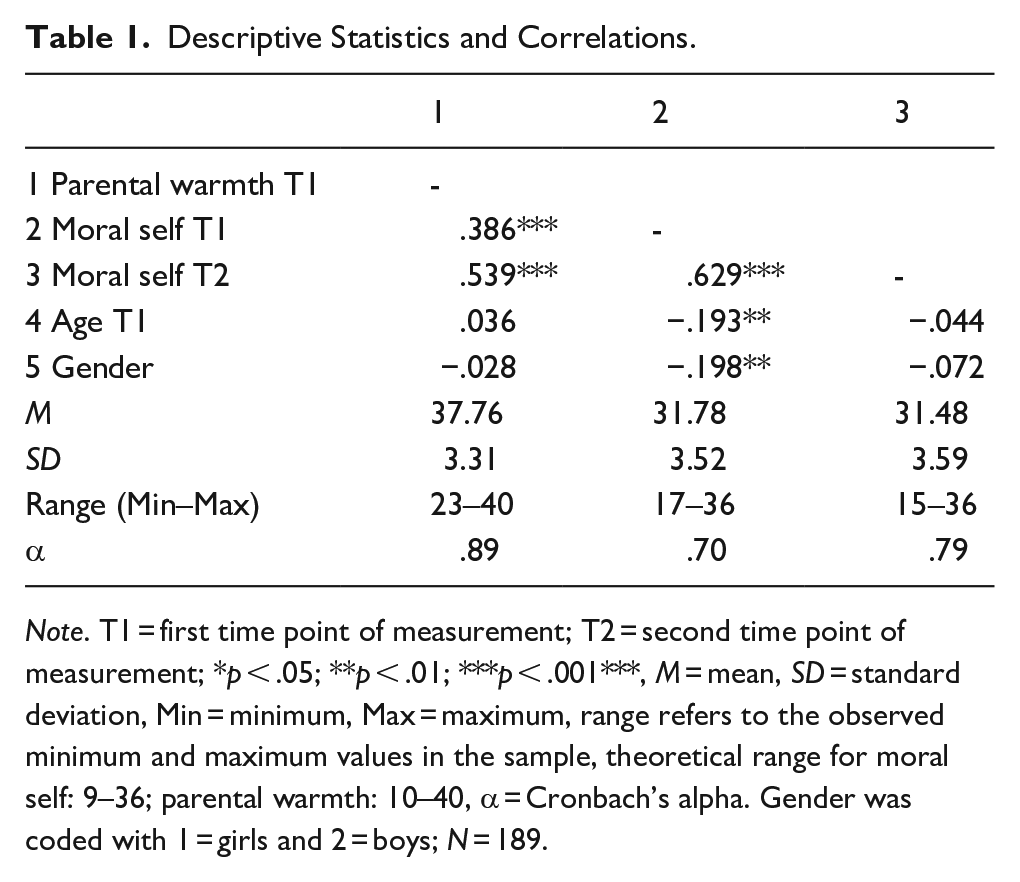
Note. T1 = first time point of measurement; T2 = second time point of measurement; *p < .05; **p < .01; ***p < .001***, M = mean, SD = standard deviation, Min = minimum, Max = maximum, range refers to the observed minimum and maximum values in the sample, theoretical range for moral self: 9–36; parental warmth: 10–40, α = Cronbach’s alpha. Gender was coded with 1 = girls and 2 = boys; N = 189.
Although the sample included children from Grades 1 to 4, age was not included as a covariate because it is conceptually linked to moral development and the possible change that should be detected through the TIC Model. Controlling for age could therefore remove meaningful developmental variance. Moreover, correlations with possible confounders (i.e., age and gender) and the moral self were weak or non-significant, indicating limited explanatory value in this sample.
The path coefficients of both TIC models, the state and the baseline model, are presented in Table 2. The state model showed an acceptable overall model fit (χ2(148) = 210.614, p < .001; CFI = .921; RMSEA = .048; SRMR = .084). According to established cutoffs (Hair et al., 2009; Hu & Bentler, 1999), the CFI falls within the acceptable range (.90–.95), and the RMSEA indicates a good fit (<.05). However, the SRMR slightly exceeds the recommended threshold of .08, suggesting minor misspecifications in residuals. The baseline model also demonstrated an acceptable but comparatively weaker fit (χ2(156) = 239.437, p < .001; CFI = .895; RMSEA = .053; SRMR = .086). While the RMSEA remains within the good fit range, the CFI falls just below the acceptable threshold, and the SRMR again slightly exceeds the recommended cutoff. Together, these indices suggest that both models are generally acceptable and interpretable, although some caution is warranted due to the elevated SRMR values and marginal CFI in the baseline model.
Path Coefficients of TIC Models.
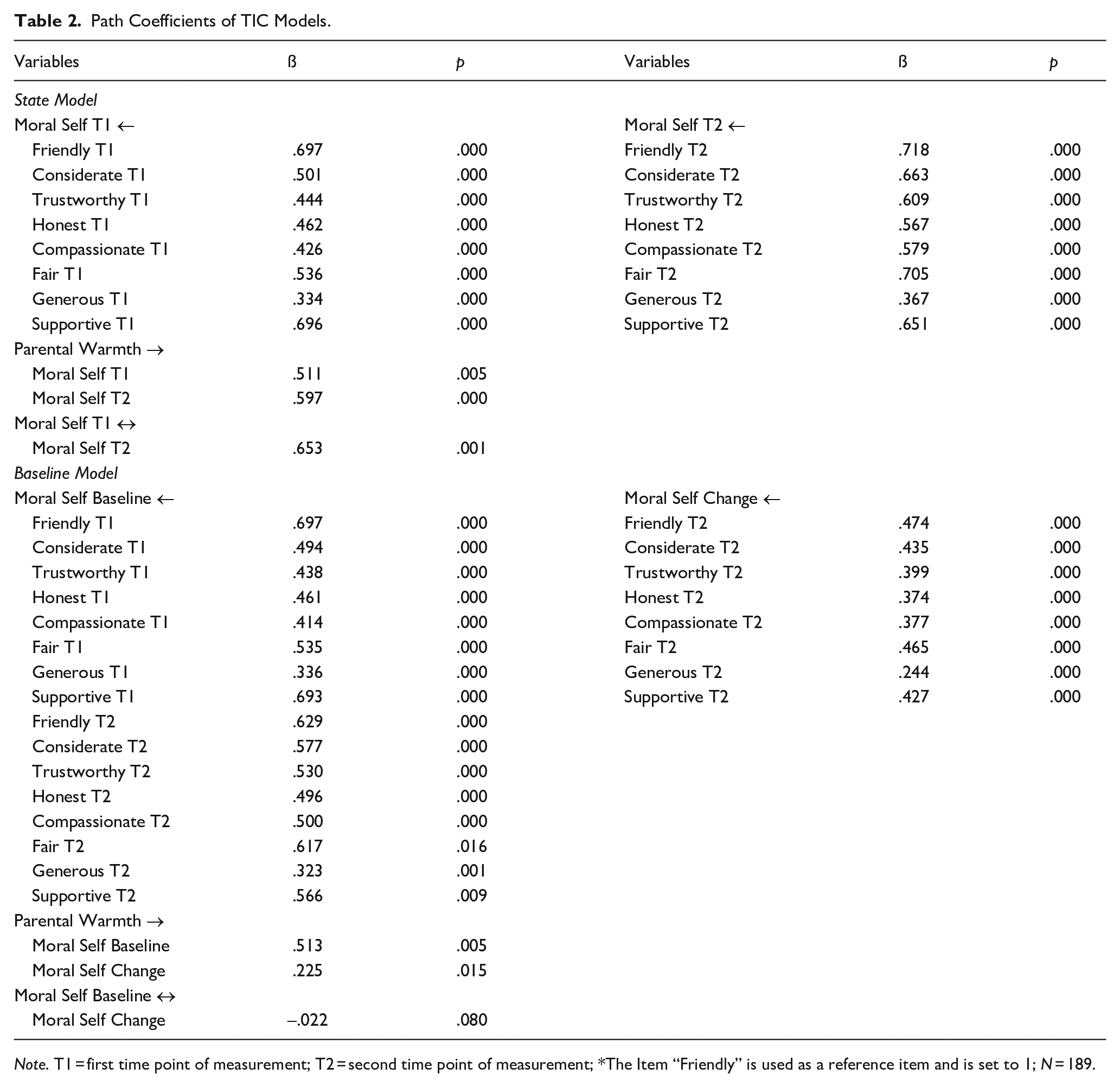
Note. T1 = first time point of measurement; T2 = second time point of measurement; *The Item “Friendly” is used as a reference item and is set to 1; N = 189.
To examine whether the moral self changed over time, latent mean estimates were inspected. The mean estimate for the moral self T1 was M = –0.745, and for the moral self T2, it was M = –0.983, indicating a decrease in moral self between the two time points. In addition, the variance of the moral self change variable was significant (p < .001), supporting the presence of interindividual differences in the degree of change.
Parental warmth was positively associated with moral self at both time points in the state model. Specifically, parental warmth significantly predicted moral self to T1 (ß = .511, p = .005) and to T2 (ß = .597, p < .001). This suggests that children who perceived higher parental warmth also reported higher moral self at both time points.
The effect of parental warmth was also tested in the baseline model which is illustrated in Figure 1, where parental warmth is included as a predictive factor on both the moral self baseline and the change in moral self from Time 1 to Time 2. The results highlight a significant positive effect of parental warmth on the baseline level (ß = .513, p = .005) of moral self and of the change in moral self (ß = .225, p = .015).
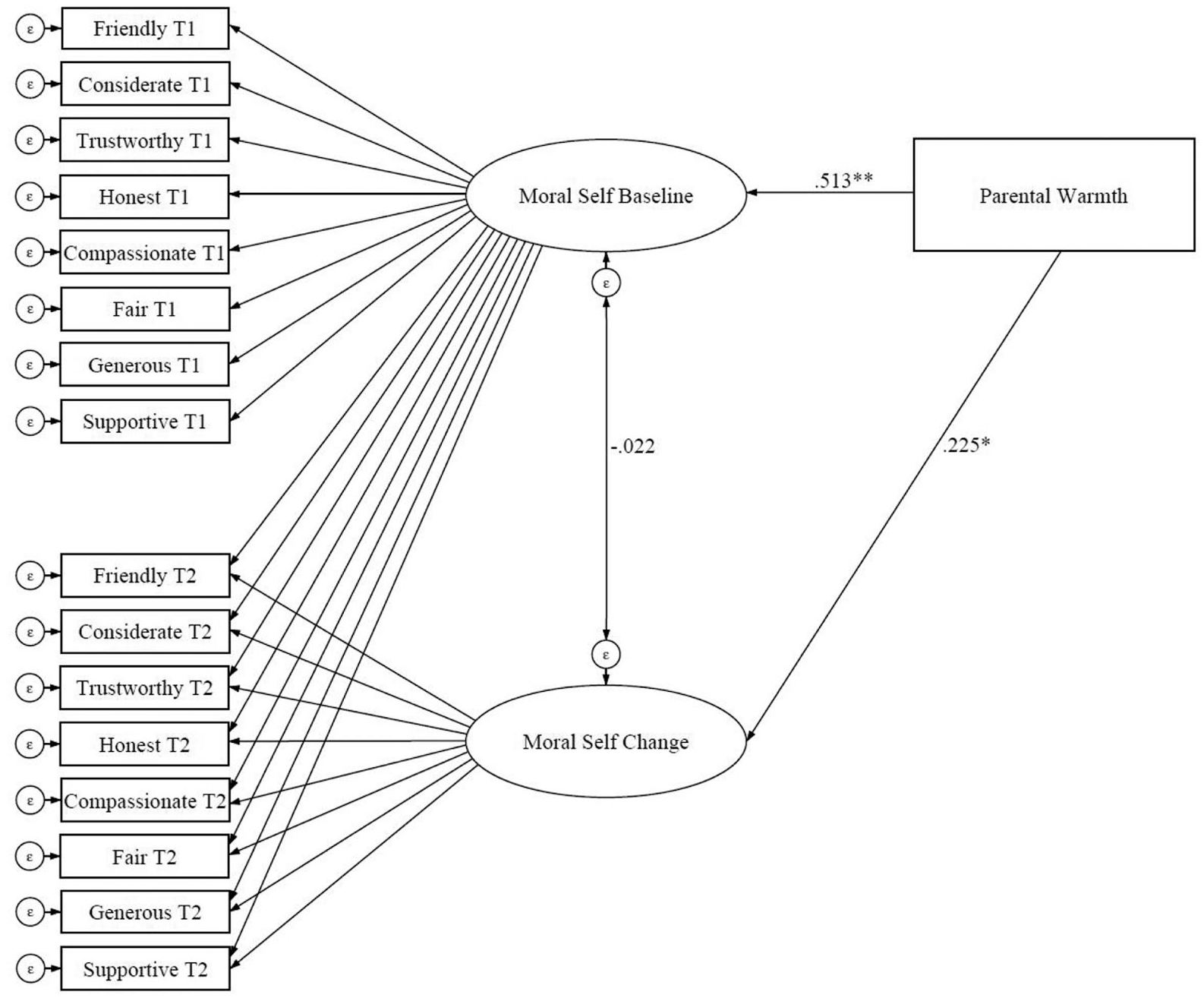
Baseline Model.
In summary the results indicate a decrease in moral self over time, with individual differences in change. Furthermore, parental warmth was positively associated with moral self and its change over time, suggesting its role as a potential protective factor.
Discussion
The current study aimed to investigate the development of the moral self in middle childhood, focusing on intraindividual change over time and the predictive role of parental warmth. Our findings offer two key contributions to the literature on moral development: (1) a significant decrease in the average level of children’s moral self, and (2) the predictive value of parental warmth not only for initial levels but also for intraindividual changes in the moral self.
Contrary to our hypothesis of a slight increase, we observed a decline in children’s reported moral self from Time 1 to Time 2. While this may seem surprising, it aligns with broader theories of middle childhood as a transitional phase in self-development. During this period, children undergo major shifts in self-awareness and begin to compare themselves more critically to others, especially peers (Smetana, 2013; Kingsford et al., 2022). As their self-evaluations become more realistic and socially informed, previously idealized self-views may decline particularly in domains like morality, where social desirability and internalized standards intersect. One alternative explanation is that children’s growing cognitive and emotional differentiation (e.g., perspective-taking) may lead them to judge themselves more strictly, resulting in lower moral self-ratings despite stable or even improved behavior (Strauß & Bondü, 2022). Notably, our findings contrast with those of Strauß and Bondü (2022), who reported an increase over time. This discrepancy may stem from differences in measurement: their instrument focused specifically on justice- and care-related traits, which may be more directly reinforced through socialization and therefore more likely to be internalized during this period. In contrast, our scale also includes broader or more abstract traits (e.g., “compassionate” or “fair”), which may be less consistently modeled or reinforced, making them more susceptible to self-critical reassessment in middle childhood. Early self-concepts, often idealized and rule-based, gradually evolve into more differentiated and realistic evaluations as children begin to engage with moral values more flexibly (Smetana, 2013).
The significant interindividual variability in moral self-change suggests that not all children experience the same developmental trajectory, underscoring the importance of identifying factors that contribute to these differences. These changes can be partially explained by the level of parental warmth, highlighting its foundational role in shaping children’s moral self and its evolution. The evaluation of model fit suggests that both the state and baseline models demonstrated an overall acceptable to good fit. However, certain fit indices slightly exceeded commonly recommended thresholds, indicating that while the models provide a solid basis for interpreting the findings, some caution is warranted. These minor deviations do not undermine the main conclusions but should be considered when interpreting the robustness of the model structure.
Consistent with empirical studies (e.g., Kochanska et al., 2010; Schütz & Bäker, 2023; Wilke & Baker, 2025) and theoretical models on moral socialization (e.g., Hart et al., 1999; Kochanska, 1993; Kohlberg, 1976; Piaget, 1932/1965), parental warmth was positively associated with the moral self at both measurement points. Children who perceived higher parental warmth also reported a stronger moral self, reinforcing the notion that emotionally supportive parent–child relationships provide a critical foundation for moral internalization. These findings align with multiple previous research demonstrating the positive role of parental warmth in fostering moral values (Kochanska, 2002; Kochanska et al., 2010; Schütz & Bäker, 2023; Wilke & Baker, 2025).
Beyond its role as a foundational factor, parental warmth also predicted intraindividual changes in the moral self over time. This finding is particularly relevant, as prior research has primarily focused on the role of parenting in the early formation of the moral self (Krettenauer & Hertz, 2015) rather than its effect on its development during middle childhood (Kingsford et al., 2018). The observed effect suggests that warm and responsive parenting may not only shape initial moral self-perceptions but also be associated with positive moral development over time. Parental warmth may act as a buffer against the self-critical decline described above by reinforcing children’s internalization of moral values, providing consistent emotional support, and affirming the child’s self-worth. This aligns with research showing that warmth in parent–child relationships fosters stable and prosocial self-concepts (Söldner & Paulus, 2025). While some previous research has emphasized that the influence of parental warmth tends to diminish in later adolescence as peer relationships become more central (Bäker & Wilke, 2024), our findings indicate that during middle childhood, parental support remains a significant factor in the development of the moral self. Examining the role of peer relationships alongside parental warmth could provide deeper insights into how the moral self continues to develop and what factors most strongly shape it during this critical transition. While our study does not extend into adolescence, it provides evidence that parental warmth remains a key predictor of moral development during middle childhood, a period often overlooked in moral psychology research (Kingsford et al., 2018). It is crucial that parental warmth remains consistent throughout middle childhood rather than being seen merely as an early-stage factor in moral socialization. Continuity in warm and responsive parenting may provide long-term benefits for children’s moral identity formation. Parents act as moral role models for their children, influencing not only how children internalize moral values but also how they navigate moral decisions over time (Kochanska, 1993; White & Matawie, 2004). By consistently demonstrating empathy, fairness, and moral reasoning, parents can support children’s ongoing moral self-development, ensuring that these values remain central even as external influences, such as peers and societal norms, become more prominent in later developmental stages.
Limitations and Further Research
While this study provides valuable insights into the relationship between parental warmth and the moral self during middle childhood, some limitations should be considered when interpreting the findings. The study spans only 6 months in two time points, which limits the ability to capture long-term developmental trajectories of the moral self. A longer observation period could provide a more comprehensive understanding of how parental warmth influences moral self-development across different stages of middle childhood. Future research should consider extended longitudinal designs to examine whether the observed effects persist over time or whether other socialization factors gain prominence. In addition, this study specifically focused on parental warmth as a key factor in moral development. However, other parenting dimensions, such as parental harshness, autonomy support, or discipline strategies, could also play a role in shaping the moral self. Future studies should investigate how different parenting styles interact with warmth to influence moral self-development.
Furthermore, this study relied on child self-report for moral self and caregiver report on their parental warmth, which provides a more comprehensive perspective but also introduces the possibility of differences in perception. It remains unclear whether changes in the moral self would be more pronounced if parental warmth were assessed solely based on the child’s perception rather than caregiver reports. Future research could examine whether children’s self-reported perceptions of warmth are more closely linked to intraindividual changes in the moral self. To better capture such changes over time, different analytical approaches could be considered. While TIC is well-suited for detecting short-term fluctuations, future studies could apply Latent Growth Curve Modeling to model long-term, continuous growth trajectories or Growth Mixture Modeling to identify potential subgroups with distinct developmental patterns. These approaches would provide a more nuanced understanding of how parental warmth influences moral self-development and whether heterogeneous trajectories exist across individuals.
While parental warmth significantly predicted changes in the moral self, it is possible that additional factors contribute to this development. Temperament, cognitive maturation, or broader environmental influences may also shape moral self-development (Garrigan et al., 2018; Kochanska et al., 2007). Middle childhood also marks a period when peer relationships become increasingly important. Future research should incorporate a wider range of variables to better understand the complexity of intraindividual change.
The assessment of parental warmth may also be subject to bias, as it relied on caregiver self-reports. Given that parental warmth is a socially desirable trait, there is a risk that caregivers present themselves in an overly positive manner, consciously or unconsciously. This potential bias could inflate reported warmth levels and limit the accuracy of the measurement (Bornstein et al., 2015). While the instrument used has demonstrated good reliability, future studies should consider integrating multi-informant approaches (e.g., child reports or behavioral observations) and include control measures for social desirability to enhance the validity of parental warmth assessments. Although the self-report format used to assess the moral self is developmentally appropriate and widely used, responses may still be influenced by social desirability bias. Nevertheless, as the instrument captures the personal significance of traits rather than the frequency of moral behavior, the susceptibility to such bias may be somewhat mitigated.
Another limitation concerns the participant retention rate, as only 54.31% of the original sample participated at both time points. Although missing value analyses indicated that the data were MCAR and no significant differences were found between participants who dropped out and those who remained, the relatively high attrition rate may still limit the generalizability of the findings. It is possible that unmeasured variables influenced continued participation, which could introduce a potential attrition bias.
A related limitation involves the nature of the sample and the conditions surrounding participant dropout. Participants were recruited via schools, and all follow-up contact was coordinated through teachers and school staff. Due to data protection regulations, it was not possible to recontact families who did not return their materials at Time 2. As participation was entirely voluntary, some families may have opted out for personal or situational reasons, which could not be followed up. In addition, the study used an ad hoc sample, which limits the generalizability of the findings to the broader population. Future studies should aim to use more representative sampling methods and consider strategies to reduce attrition and improve participant retention across waves.
Conclusion
This study highlights the crucial role of parental warmth not only in fostering a stronger moral self at a single point in time but also in promoting positive intraindividual changes in the moral self during middle childhood. By applying TIC models, the study provides novel insights into how supportive parenting continues to shape moral development beyond early childhood, offering important implications for moral socialization research.
Footnotes

Ethical Approval and Informed Consent Statements
Ethical approval for this study was granted by the Ethics Committee of the Carl von Ossietzky Universität Oldenburg (approval number: Drs.EK/2021/105-01-01, date of approval: 24.08.2022). Written informed consent was obtained from all participants prior to their inclusion in the study.
Funding
The author(s) received no financial support for the research, authorship, and/or publication of this article.
Declaration of Conflicting Interests
The author(s) declared no potential conflicts of interest with respect to the research, authorship, and/or publication of this article.