




Abstract
This study examined the association between children’s subjective socioeconomic status, their age, and their sharing decision with a needy recipient versus a recipient on whom no information about need had been provided. Children aged 7–12 (N = 222, 50% girls, MAge = 9.60, SD = 1.52) participated in an experiment where they could share tokens with either a needy (poor) child or with one on whom no information about need had been provided. Results revealed that children’s sharing increased as a function of age, and that children shared more resources with a needy recipient than with one whose neediness was unknown. Children’s subjective socioeconomic status did not directly predict their sharing. However, the three-way interaction between children’s subjective socioeconomic status, recipient’s neediness and age was significant: only among older children (but not among younger ones), the higher they perceived their own socioeconomic status, the more they shared with a needy recipient. When older participants did not know how needy the recipient was, a higher subjective socioeconomic status was not associated with more sharing. The findings underscore the importance of the interaction between children’s subjective perception of their own status, and that of the recipient with whom they share, in shaping their sharing decisions.
Do children share more when they have more, or perceive themselves as wealthier than others, or is the opposite true—that the higher their perceived status, the less they share? The socioeconomic status (SES) that children are born into and how they perceive themselves in that context (i.e., their subjective SES) has been linked to a wide range of developmental outcomes across various cognitive, emotional, and social domains (Bradley & Corwyn, 2002; Joffer et al., 2019). Accordingly, this study focused on children’s subjective socioeconomic status (SSS) and its association with their sharing decisions. Specifically, we sought to explore the role of the recipient’s socioeconomic status in that association—namely, does the association between children’s SSS and their sharing decision depend on the description of the recipient as a needy (poor) other?
The association between socioeconomic status and prosocial behavior has been a prominent focus of research among adult populations over the past decade. While early work suggested a negative relation between socioeconomic status and prosociality (e.g., Kraus & Keltner, 2009; Piff et al., 2010; Stellar et al., 2012), more recent studies have found either no evidence for this negative link (e.g., Greitemeyer, 2023; Greitemeyer & Sagioglou, 2018) or, conversely, a positive association (e.g., Andreoni et al., 2021;Korndörfer et al., 2015; Nettle et al., 2011; Vanags et al., 2023; Zwirner & Raihani, 2020). A recent meta-analytic review supports the latter, demonstrating a small but positive effect of social class on prosociality—particularly for costly forms of helping behavior rather than prosocial intentions (Wu et al., 2025). In addition, recent research has identified psychological mechanisms that appear to play a significant role in this association, above and beyond socioeconomic status itself (e.g., personal relative deprivation—that is, the belief that one is worse off than similar others, Callan et al., 2017; Gheorghiu et al., 2021; Greitemeyer & Sagioglou, 2016; perceived economic inequality—Côté et al., 2015; perceived Wang et al., 2021; perception of class mobility—Rao et al., 2022).
Socioeconomic status may be measured in two ways (Kraus & Stephens, 2012): by examining objective criteria such as access to education, employment, and income (Oakes & Rossi, 2003), or by subjective criteria—namely, how individuals perceive their status in comparison with others (subjective socioeconomic status—hereafter referred to as Adler et al., 2000). As suggested by the relative deprivation theory (Crosby, 1976), individuals’ perception of their socioeconomic status is not solely determined by how many resources they possess, but rather how they view their status in comparison with others. Such subjective perceptions are known to have a significant effect on people’s psychological experiences and their actual behaviors (e.g., Boyce et al., 2010; Elbæk et al., 2023; Kraus & Stephens, 2012; Tan et al., 2020).
In this study, we focused on children’s SSS due to its significant presence in day-to-day psychological experiences. Children, especially at a young age, are not always fully aware of their parents’ actual income and status. However, their psychological experience of status and a more developed understanding of its meanings emerges during middle childhood, and is associated with their behavioral inclinations, as we next discuss.
SSS and Prosociality in Children
Studies show that, as early as preschool age, children are already aware of socioeconomic status and recognize its indicators—although they cannot yet explain the reasons for these differences (Ahl & Dunham, 2019; Bigler et al., 2003; Li et al., 2014; Mookherjee & Hogan, 1981; Olson et al., 2012; Ramsey, 1991). As they grow older, children are exposed to ever-broader social circles (Lancy & Grove, 2011), and gain greater cognitive abilities. Thus, they are able to draw more complex comparisons between themselves and others in various respects in accordance with their developing social knowledge (Frey & Ruble, 1990; Harter, 2015; Ruble & Frey, 1991). Accordingly, research into children’s perceptions and understanding of inequality has revealed significant age-related differences in children’s reasoning and perceptions of poverty and wealth between the ages of 6 and 11 (Heberle & Carter, 2015; Sigelman, 2012; Sigelman & Waitzman, 1991). Specifically, only around the age of 8 do children exhibit more accurate social knowledge and descriptions of poor versus rich others, and around the age of 10 are capable of explaining these differences in psychological terms—such as ability, motivation, and effort (Sigelman, 2012). In line with these developmental transitions, children’s self-perceptions of their own status become more accurate during middle childhood. While kindergarten children tend to be positively biased and to perceive themselves as having a higher SES than they actually do (a positive bias found also in other domains—e.g., (Levy et al., 2021; Van Loon et al., 2017), this tendency diminishes as they grow older and develop a greater capacity for relative comparisons (Amir et al., 2019; Mandalaywala et al., 2020; Mistry et al., 2015).
Notably, little research has been done on the association between SES and prosociality in children, and the findings of existing studies have been mixed: while there is evidence for a positive link between socioeconomic status and prosocial behavior among children (Ahl et al., 2024; Benenson et al., 2007; Kuang et al., 2021), there is also support for the opposite association, with children of lower socioeconomic status sharing more than those of higher status (Guinote et al., 2015; Miller et al., 2015). Other studies have examined factors related to children’s SES—such as unequal surroundings—and found that experimental inequity manipulations resulted in inconsistent effects on the prosociality of children aged 4–9 years (Kirkland et al., 2020, 2021).
In summary, the literature on SES and prosociality among children is limited, and inconsistent in its findings. However, these studies mostly measured children’s SES by objective measures (such as information provided by the school—Benenson et al., 2007) or used experimental manipulation to enhance feelings or memories of wealth versus poverty (Ahl et al., 2024; Guinote et al., 2015). In this study, we measured children’s subjective perception of their status, aiming to capture their internal experience of social standing. Moreover, we sought to examine not only the association between children’s sharing and their perception of their own status, but also the interaction between their subjective social status and that of those with whom they share. Thus, while past studies typically involved helping a recipient who was described as needy (e.g., due to illness, or poverty), we directly manipulated the recipient’s neediness, that is, whether they were described as needy or not.
Prosocial Development and Awareness of Neediness Through Middle Childhood
As children grow older, they develop cognitive abilities and social awareness that result in a more nuanced reasoning and judgment of prosocial behaviors (Heyman et al., 2014; Schmidt et al., 2016; Sigelman, 2012). This developmental process is also characterized by greater sensitivity to social norms, which is evident in their increased sharing with age (Blake et al., 2015; House, 2018; House et al., 2013).
One of the quintessential prosociality norms is that of giving to the needy. By the age of 5, children have already internalized the normative expectation that one should give more to a poor than to a wealthy other (Worle & Paulus, 2018). This preference increases as they grow older (Kienbaum & Wilkening, 2009; Malti et al., 2016; Rizzo et al., 2016), along with a greater sensitivity to equal distribution of resources (Shaw & Olson, 2012). From the age of 8 onward, children exhibit a greater sensitivity and sympathy to economically disadvantaged peers, and a willingness to address economic disparities with corrective actions—both in hypothetical scenarios (Dys et al., 2019; Elenbaas, 2019) and in their actual sharing (Kienbaum & Wilkening, 2009; Kogut et al., 2016; Malti et al., 2016; Rizzo et al., 2016; Sabato & Kogut, 2018, 2019, 2020).
To date, less attention has been given to the potential interaction between the status of the giver and the status of a prospective recipient in children’s sharing decisions. Two recent studies have examined this interaction in younger children: Peng et al. (2025) examined the effect of manipulated status of both the prospective giver and the help recipient on resource allocation among 6- to 8-year-old children. They showed that 8 year olds, but not 6 and 7 year olds, shared more with a “poor” recipient (i.e., a child who had fewer resources than them) when they were “wealthier” (had more resources than the recipient). This pattern held true also in third-party distribution tasks. Focusing on children’s subjective perceptions of their status, Straka et al., (2024) examined the association between SSS and children’s social behavior (i.e., inclusion and distribution decisions) among children of the ages of 4–9. They found that children of lower SSS, and older children (ages 7–9, compared with ages 4–6), distributed more stickers to members of a low-SES group than to those of a high-SES group. However, they did not examine the three-way interaction between the recipient’s SES group, the child’s SSS and their age. Moreover, that study focused on distributing resources among low- versus high-SES group members, using cartoon children as the target stimuli, rather than examining actual sharing decisions, with the children’s own resources.
While both studies emphasize the importance of the interaction between the giver’s and the recipient’s status in shaping children’s sharing behavior, the differences in their findings may stem from the variables they focused on (manipulated resource amount vs. perceived status), the age groups they address, and the type of task presented (resource allocation vs. resource distribution). This study aimed to contribute to this limited body of research by investigating the role of the interaction between the giver’s perceived status and the recipient’s status in children’s actual, costly sharing decisions across middle childhood.
The Present Study
This study sought to better understand the role of the recipient’s neediness in the association between children’s SSS and their actual sharing decisions, by directly manipulating the recipient’s neediness and examining children’s actual sharing, at a real cost to themselves, rather than hypothetical distribution decisions. Moreover, we focused on middle childhood—a crucial period in prosocial development, marked by greater frequency (Blake & Rand, 2010; Fehr et al., 2008) and complexity of prosocial behavior (e.g., Schmidt et al., 2016), coupled with a greater awareness and internalization of social norms and values (e.g., Sabato & Eyal, 2022; Sabato & Kogut, 2018). During this period, children’s awareness of, and sensitivity to, their SES grows (Amir et al., 2019; Mandalaywala et al., 2020; Mistry et al., 2015) along with a more established awareness of their own social status in relation to others (Harter, 2015).
We predicted that (H1) with age children would share more resources overall. That is, we expected a positive main effect of age on the amount of resources shared; (H2) children would share more resources with a needy recipient compared with a recipient on whom no information has been provided, due to their sensitivity to the norm of helping those in need. That is, we expected a positive main effect of the recipient’s neediness on the amount of resources shared, and (H3) this effect would become more pronounced with age, as children’s social awareness and internalization of social norms emerge—that is, we expected a significant interaction between the recipient’s neediness and the child’s age on the amount of resources shared; (H4) regarding the association between children’s SSS and their sharing behavior—given the mixed findings in the literature among children mentioned earlier, we adopted an exploratory, bidirectional approach (rather than formulating a priori predictions) to examine the developmental nature of these relations. Specifically, we hypothesized that the interaction between children’s SSS and the recipient’s neediness may follow one of two theoretically plausible patterns: on the one hand, the recipient’s neediness may spark feelings of empathy and identification in individuals who perceive themselves as being of lower socioeconomic status, thus increasing their sharing. Conversely, children who perceive themselves as being wealthier may respond to the status gap between themselves and the prospective recipient by sharing more with a needy other. Thus, we sought to explore these two competing predictions. Moreover, we aimed to explore this interaction from a developmental perspective. Based on previous research that has demonstrated the role of social norms in children’s behavior throughout middle childhood (e.g., Blake et al., 2015; House et al., 2013), we expected this three-way interaction (i.e., between children’s SSS, their age and the recipient’s neediness) to shed a light on the developmental pattern of the association between SSS and neediness, as children grow older and become more aware of their environment’s expectations and values and follow them in their behavior.
The study was conducted at the Bloomfield Science Museum in Jerusalem, which is situated in an urban part of the city. All participating children were native Hebrew speakers and completed the session in that language. Demographics of parents’ sub-sample are presented in the Supplementary Materials file. Overall, the sample represents a WEIRD (Western, Educated, Industrialized, Rich, Democratic) population. The study received ethical approval from the Ethics Committee of the Seymour Fox School of Education at the Hebrew University of Jerusalem (Approval #2022Y0203). Data are available at https://osf.io/guhwk.
Method
Participants
Two hundred and twenty-two children took part in the experiment (50% girls, MAge = 9.60, SD = 1.52). Participants were recruited during their visit to the Bloomfield Science Museum in Jerusalem, using a convenience sampling method: any child who wished to participate could stop at the lab station and take part in the study.
Sensitivity power analysis, conducted with G*Power (Faul et al., 2007) for linear regression analysis with seven predictors (the child’s age, SSS, the recipient’s neediness, all two-way interactions, and the three-way interaction), indicated that, given N = 222, α = .05, and a power of .85, statistical significance would be detected with a small-to-medium effect size (f² = .07, critical f = 2.05).
Procedure and Measurements
The experiment was conducted in privacy, in a separate room within the Bloomfield Science Museum. After obtaining parental consent, each child was interviewed individually by a trained experimenter, following a structured protocol. First, the experimenter introduced herself to the child and asked them if they were willing to take part. Next, participants answered several demographic questions and practiced the scale to be used throughout the experiment. The experimenter then presented the children with six tokens and told them that all participants receive tokens for their participation, which can be exchanged for prizes at the end of the experiment. She asked the child to count the tokens to ensure the number was accurate and presented them with the sharing task.
The Sharing Task
The task was based on the Dictator Game method (Kahneman et al., 1986) that has been successfully employed in research with children (e.g., Blake & Rand, 2010; Cowell et al., 2017; Kogut, 2012; Malti et al., 2016; Sabato & Kogut, 2018, 2021; Santamaría-García et al., 2018). The experimenter asked the child if they were willing to share their tokens with an unfamiliar child (of the same gender as themselves) who had not received any tokens, as they were not participating in the experiment.
We used a between-subjects design in which the recipient’s neediness was manipulated and the children assigned to one of two conditions (based on Sabato & Kogut, 2018, 2019, 2020) a Needy Recipient condition, in which the prospective recipient was presented as a poor child (whose parents cannot afford to buy him presents); and a No-Information Provided condition, in which the participant received no further information about the recipient’s family socioeconomic status. In both conditions, the experimenter explained to the child that they would receive six tokens and can take them all for themselves or, if they want, they may leave some of them for the other child. The experimenter then showed the child a sealed box with a small slit at the top (as in a charity box) and an empty envelope, and explained that the tokens that the child wanted to keep for themselves should be placed in the envelope, while the tokens they wished to give to the other child (should they choose to do so) were to be placed in the box. The experimenter then asked two comprehension questions to confirm that the child understood the task before the sharing decision. To give the children full privacy while making the decision, the experimenter stressed that their decision was private and then turned her back to the child while they completed the task. To enhance the sense of privacy still further, the experimenter instructed the child to place their box among other identical boxes (all empty) that were on the table. Once the child had completed the task and let the experimenter know that they had done so, she asked the child additional exploratory questions, and a few diversion questions that were aimed at distinguishing the child’s rating of their own SSS from their sharing decision (see Supplementary Materials). Finally, the child rated their SSS following the experimenter’s explanation.
SSS (Goodman et al., 2001; Quon & McGrath, 2014): the scale used to measure SSS was adapted from the MacArthur Scale (Adler et al., 2000; Adler & Stewart, 2007), a 10-rung ladder task widely used to assess SSS among adults and adolescents in various contexts (e.g., Cundiff & Matthews, 2017; Martin-Storey et al., 2018; (Sweeting & Hunt, 2014; Tan et al., 2020). The task was also adapted to younger children, from the ages of 4 to 10 (e.g., Amir et al., 2019; Peretz-Lange et al., 2022). The participants were presented with a drawing of a seven-rung ladder, representing different levels of socioeconomic status (see Supplementary Materials for the detailed text) and were asked to point to the level they felt best represented their own situation.
At the end of the experiment, the children were invited to choose a prize from a basket containing several high-value prizes, without being asked about the number of tokens they shared. This procedure was designed based on ethical considerations, to preserve the privacy of the children’s decisions and to avoid disappointment or discomfort that might arise if low-value prizes were offered. The experimenter thanked the child and provided a brief debriefing, explaining that she did not want to ask how many tokens they had decided to share. Therefore, she allowed all children to choose a prize from a basket of our most expensive options, each worth 10 tokens, so that no one would feel disappointed. Once the child had left the room, the experimenter counted the number of tokens left in the box for the other child.
Results
The number of tokens shared by the children ranged from zero to six (M = 2.47, SD = 1.38), see Table 1.
Distribution of Tokens Shared by the Children, in Each Condition.
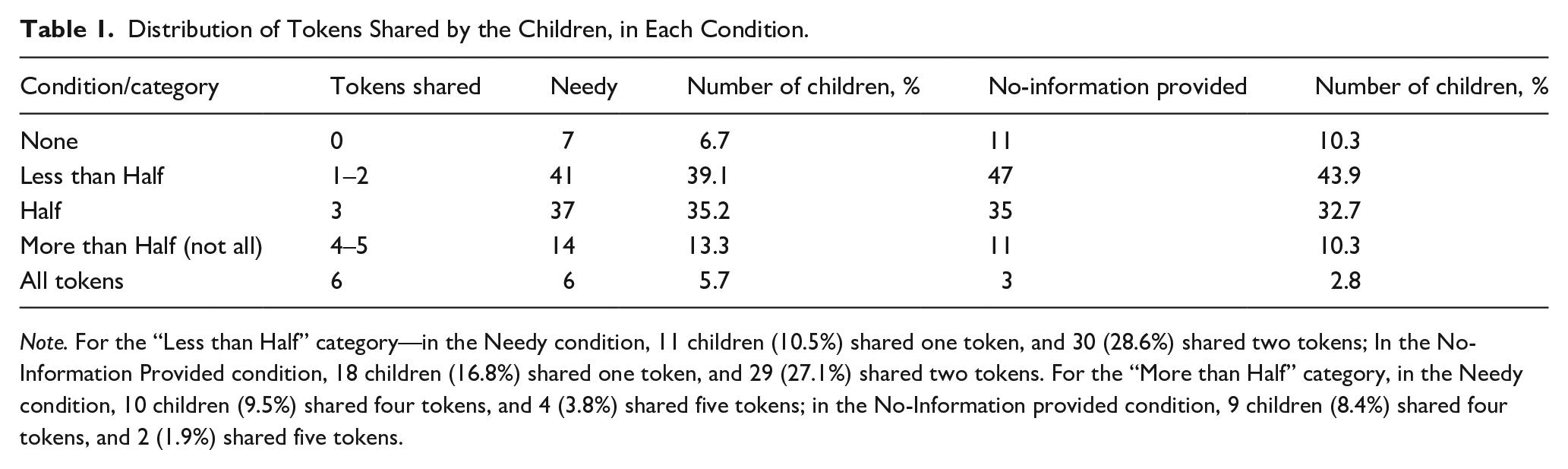
Note. For the “Less than Half” category—in the Needy condition, 11 children (10.5%) shared one token, and 30 (28.6%) shared two tokens; In the No-Information Provided condition, 18 children (16.8%) shared one token, and 29 (27.1%) shared two tokens. For the “More than Half” category, in the Needy condition, 10 children (9.5%) shared four tokens, and 4 (3.8%) shared five tokens; in the No-Information provided condition, 9 children (8.4%) shared four tokens, and 2 (1.9%) shared five tokens.
To examine the role of the child’s SSS, the recipient’s neediness and the child’s age in predicting the number of tokens shared by the children, a linear hierarchical regression analysis was conducted. In Step 1, we included all main effects (the child’s age, SSS rating, the recipient’s neediness); in Step 2, we entered all two-way interactions; and in Step 3, we included the three-way interaction (see Table 2). 1
Results of the Linear Hierarchical Regression Analysis for Variables Predicting the Number of Tokens Shared with the Other Child (N = 212).
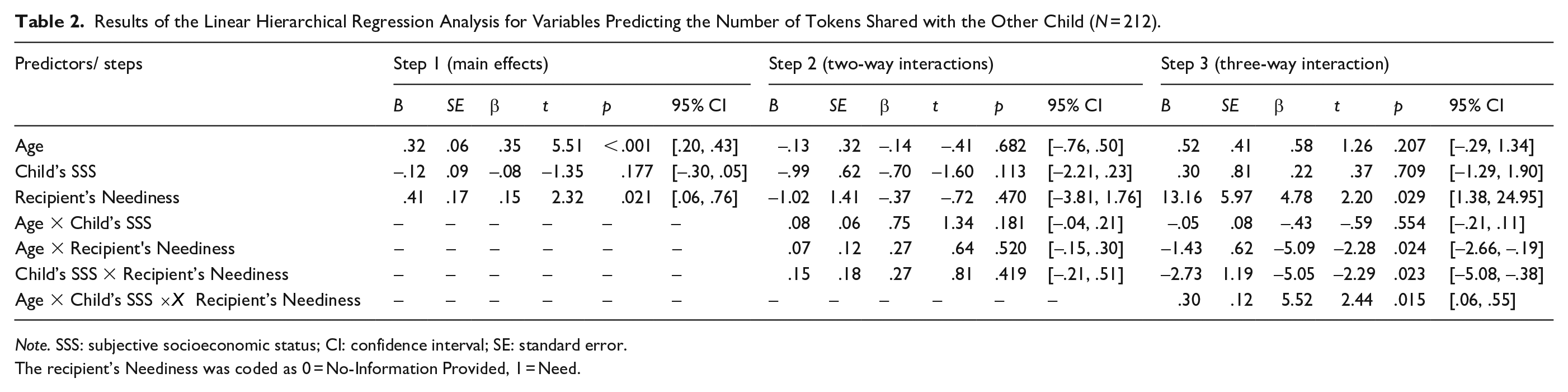
Note. SSS: subjective socioeconomic status; CI: confidence interval; SE: standard error.
The recipient’s Neediness was coded as 0 = No-Information Provided, 1 = Need.
In the first step of the model, F(3, 208) = 11.92, p < .001,
To better understand this interaction, we examined the role of the interaction between the child’s age and their SSS in each of the two experimental conditions (i.e., the needy recipient condition and the no-information provided condition): this was found to be significant only in the Needy-Recipient condition (t = 2.75, β = 2.16, p = .007), but not in the No-Information Provided condition (t = -.59, β = -.46, p = .56). The interaction was plotted (Figure 1) as recommended by Aiken et al. (1991). As evident from the graph, the higher older children rate themselves on the SSS scale, the more they share with a needy other. This was not observed among younger children.
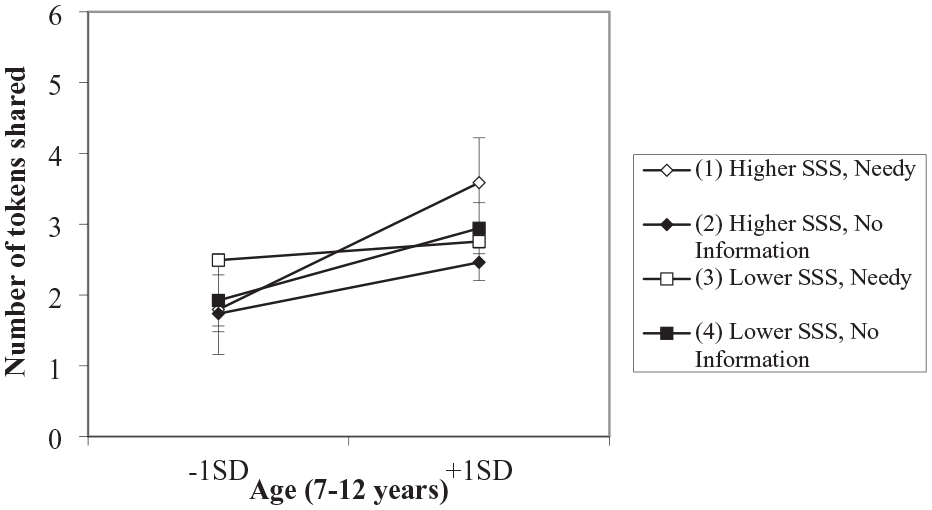
The Interaction between Age, Socioeconomic Status (SSS) and the Recipient’s Neediness on Children’s Sharing Behavior (N = 212).
To detect the age ranges in which the interaction emerges, we conducted a moderated-moderation analysis, using PROCESS macro for SPSS model 3, with 95% bias-corrected bootstrap confidence intervals, based on 5,000 iterations (Hayes, 2017), with age (Z) as a moderator of the link between the recipient’s neediness (X) and the child’s SSS (W) on children’s sharing (Y). The results indicate that older children, at 1 SD above the mean age, showed the above significant pattern (i.e., sharing more with a needy other the higher they rated themselves on the SSS scale), B = .67, F(1, 204) = 5.73, p = .017. A Johnson–Neyman analysis identified the age of 10.35 (32.5% of the children in the sample) as the threshold above which the interaction between the child’s SSS and the recipient’s neediness became statistically significant (p < .05). Younger children did not show this significant pattern, at the average age level: B = .20, F(1, 204) = 1.28, p = .26; 1 SD below the mean age: B = −.25, F(1, 204) = 1.10, p = .29. This analysis suggests that the moderating effect of the child’s SSS on the effect of the recipient’s neediness on sharing emerges during the later stages of middle childhood.
Discussion
This study examined the association between children’s SSS and their sharing behavior toward a needy recipient versus a recipient on whom no information about need has been provided, during middle childhood. Specifically, the study aimed to explore whether these effects differed for younger and for older children.
As predicted, we found an increase in sharing as children grow older, and greater sharing with a needy recipient than with one whose neediness is unknown. These findings are in line with previous research demonstrating the positive effects of age and recipient’s level of neediness on children’s prosocial behavior (e.g., Benenson et al., 2007; Kogut, 2012; Malti et al., 2016; Sabato & Kogut, 2018, 2019; Weller & Lagattuta, 2013). More importantly, we found that when the recipient was described as a poor child, the children’s SSS was positively associated with their sharing as they grow older. That is, among older children (but not among younger ones) the higher they perceived their own socioeconomic status, the more they shared with a needy recipient. This was not significant when the recipient was not described as needy.
This pattern extends previous developmental research that found a positive association between children’s SES and their prosocial behavior (e.g., Ahl et al., 2024; Benenson et al., 2007), by highlighting the recipient’s neediness as a key factor in understanding this link. The findings underscore the complex understanding of status that children demonstrate as they grow older and become more aware of their own status in relation to others (Frey & Ruble, 1990; Harter, 2015; Ruble & Frey, 1991). This awareness, coupled with their increasing aversion to inequity with age (Shaw & Olson, 2012) makes the difference between their perception of their own social status and of the other’s neediness more salient. However, when the difference between the giver and the recipient is not salient (i.e., the latter is not described as needy), the children’s SSS appears to be less relevant to their sharing behavior. Interestingly, children of lower SSS were less responsive to the recipient’s neediness. This ties in with findings of past studies that found that individuals are less attuned to the needs of others when they themselves experience the same ongoing need (Harel & Kogut, 2015). A similar pattern was observed among pre-adolescents during the COVID-19 lockdowns: those who reported fewer social connections were less willing to help a lonely peer, despite sharing similar feelings of loneliness (Sabato et al., 2021).
To date, only a few studies have directly compared the statuses of the prospective giver and the help-recipient. In a study by Kuang et al. (2021), children’s high- versus low-SES was determined by geographic residency (urban vs. rural area in China, respectively). They found that 11-year-old children from both urban and rural areas were willing to share more with a rural child than with an urban one, and this tendency was most pronounced among the urban children. Although this study examined children toward the end of elementary school years, and did not explicitly mention the neediness of the help recipient, its finding supports the positive association found in our study between SSS and sharing with a needy recipient, as children grow older. The findings of this study illustrate the developmental trend of this association during middle childhood, as reflected in children’s actual, costly, sharing decisions.
To the best of our knowledge, the present examination is the first to directly manipulate the recipient’s neediness in the context of SSS and sharing. The recipient’s neediness is a highly influential factor in children’s sharing decisions (Paulus, 2014; Paulus & Moore, 2017; Sabato & Eyal, 2022; Sabato & Kogut, 2018, 2019; Weller & Lagattuta, 2013), and—as our findings suggest—interact with the potential giver’s status in such decisions. Our findings align with those of Peng et al. (2025), who manipulated children’s status based on the number of resources they received in an allocation task. They found that 8 year-olds, but not younger children, shared more with a “poor” child (i.e., one with fewer resources), when they themselves had more. We found a similar developmental pattern across a broader age range, from 7 years onward, when examining children’s subjective perceptions of their own status.
Our findings are not in line with the findings of a recent study showing that children of lower SSS distributed more stickers to members of a low-SES group than to those of a high-SES group (Straka et al., 2024). This inconsistency may stem from the differences in age range (4–9 years in the study by Straka et al., 7–12 years in our study) and suggests a possible shift in children’s preferences between preschool and middle childhood, which should be explored in future research. It may also be related to the different methodologies used in the studies (distribution decisions between hypothetical figures in their study vs. actual resource allocation with another “real-world” child in ours). Specifically, the nature of the decision in their study involved a direct comparison between the two prospective recipients (i.e., a member of a low- vs. high-SES group) with the need to choose one cartoon child over another; whereas in this study, the between-subjects design did not require the children to make such a comparative assessment. Past research in decision-making has emphasized the unique effect of joint evaluation versus separate evaluation in prosocial decisions (e.g., in the context of donation behavior to an identified vs. unidentified victim—Kogut & Ritov, 2005), which also presents an interesting topic for further investigation in the study at hand.
This study innovatively focused on children’s subjective perceptions of their status. Individuals’ self-perceptions play a significant role in their psychological experiences and social behaviors (Boyce et al., 2010; Kraus & Stephens, 2012), and are powerful predictors of behavior in childhood, as well (e.g., Sabato & Kogut, 2019). Such subjective perceptions reflect the child’s perspective and experience, which does not necessarily align with the more “objective” reality (as evidenced by the non-significant correlation between the two in our data—see Supplementary Materials). Given its day-to-day importance, the subjective perception serves as a primary lens through which children view their social interactions and, accordingly, manage their behavior. Future research is needed, however, to systematically compare between the role played by different SES measures in children’s sharing behavior.
Study Limitations
The study has several limitations. First, it focused on one form of prosocial behavior—costly sharing. Although the sharing task is broadly used in research with children (e.g., Benenson et al., 2007; Blake & Rand, 2010; Kogut, 2012; Malti et al., 2016), it measures only one aspect of prosocial behavior. Therefore, future research is needed to measure different types of prosociality—such as helping or comforting—and to examine how these relate to the children’s perceptions of their socioeconomic status.
Second, in this study, SSS was measured rather than manipulated—which precludes causal conclusions. Future research should aim to manipulate individuals’ perceptions of their socioeconomic status to directly examine causal relationships. Such experimental designs should also consider possible psychological factors—such as personal relative deprivation—which may underlie the effect and were not examined in this study.
Third, as reflected in the analysis, the main focus of the current study was on the developmental pattern captured in the significant three-way interaction between age, SSS, and recipient’s neediness. However, the non-significant two-way interactions should be interpreted with caution, as detecting such effects may often require greater statistical power. While several studies have found significant two-way interactions involving the recipient’s neediness (e.g., with age—Sabato & Kogut, 2018; with children’s SWB—Sabato & Kogut, 2019), others did not reveal such significant interaction effects (e.g., Sabato & Eyal, 2022; Sabato & Kogut, 2020). All these studies—like the present one—based their sample sizes on small-to-medium effect sizes. Thus, it is conceivable that with a larger sample size, the two-way interaction effects in this study might have reached significance. Future research should consider this limitation and aim to detect smaller effect sizes when examining similar interactions.
Finally, the procedure was conducted within the specific cultural context of a science museum. The current sample represents WEIRD societies (Western, Educated, Industrialized, Rich, Democratic)—which may limit the generalization of the findings. While the patterns discussed in this study may be applicable within WEIRD societies, cross-cultural research revealed sociocultural effects on costly sharing during middle childhood (Blake et al., 2015; Callaghan & Corbit, 2018). Therefore, although the study focused on children’s subjective perspective of their own SES (which indeed was not correlated with the objective family indicators in the parents’ subsample—see Supplementary Materials), future research should investigate the association between children’s SSS and sharing across diverse cultural contexts, and in more inclusive surroundings as well—such as schools from diverse SES populations.
In summary, this study contributes to the existing literature by proposing a new perspective on the role of the recipient’s neediness in the association between children’s SSS and their actual sharing decisions. The results underline the importance of age in this process, as it is only from middle childhood that children’s awareness of their status in relation to others plays a significant role in their sharing decisions with needy others.
***
Supplemental Material
sj-docx-1-jbd-10.1177_01650254251361788 – Supplemental material for Children’s subjective socioeconomic status and their sharing decisions: The role of the recipient’s neediness
Supplemental material, sj-docx-1-jbd-10.1177_01650254251361788 for Children’s subjective socioeconomic status and their sharing decisions: The role of the recipient’s neediness by Tal Genzel Toberman and Hagit Sabato in International Journal of Behavioral Development
Footnotes
Consent to Participate
Parents provided written consent for their child's participation, and children provided their verbal assent before taking part in the study
Consent for Publication
Not applicable.
Ethical Considerations
The study received ethical approval from the Ethics Committee of the Seymour Fox School of Education at the Hebrew University of Jerusalem (Approval #2022Y0203).
Funding
The author(s) disclosed receipt of the following financial support for the research, authorship, and/or publication of this article: The study was funded by the Israel Science Foundation (ISF) Grant #1830/22, awarded to H.S.

Supplemental Material
Supplemental material for this article is available online.
Notes
References
Supplementary Material
Please find the following supplemental material available below.
For Open Access articles published under a Creative Commons License, all supplemental material carries the same license as the article it is associated with.
For non-Open Access articles published, all supplemental material carries a non-exclusive license, and permission requests for re-use of supplemental material or any part of supplemental material shall be sent directly to the copyright owner as specified in the copyright notice associated with the article.
