




Abstract
As people have the need to belong, receiving negative social cues from group members can lead to poor well-being in the recipient. This may be even more pronounced in victims of bullying, yet these social cues may not only be communicated on a deliberate or explicit level. This preregistered study (https://osf.io/4ksyz) therefore examines classmates’ implicit and explicit attitudes as well as automatic behavior and deliberate behavior intentions toward children and their concurrent and longitudinal effect on these children’s well-being. Self and peer reports of well-being (sadness, anger, withdrawal, reactive aggression) and self-reported victimization were measured twice among 948 Dutch third to sixth graders in 46 classrooms. We measured classmates’ implicit (Approach Avoidance Task [AAT]) and explicit (liking) attitude and automatic (facial expression) and deliberate (intended) behavior toward a victimized and a neutral child. Results show that classmates’ uncivil deliberate behavior intentions toward a child were associated with that child developing more anger and internalizing problems over time. For victimized children specifically, classmates’ uncivil behavior intentions toward them additionally posed a risk for developing more reactive aggression over time. Victims also experienced poorer well-being and received more uncivil deliberate behavior intentions from classmates than their non-victimized counterparts, but classmates’ attitudes and behavior were not related to the continuation of the victimization itself. These results suggest that in addition to efforts to stop the victimization itself, aiming to prevent victims from being exposed to deliberate uncivil acts by peers might benefit their well-being.
As people have a need to belong and value being included, this universal need not being fulfilled is associated with poorer well-being (Baumeister & Leary, 1995; Mellinger et al., 2024). This does not only apply to adults but also to children (Allen et al., 2022). As being included in the group is very salient to individuals, people are thought to use a social monitoring system (Gardner et al., 2000; Pickett et al., 2004), allowing them to pick up relevant social cues that will enable them to successfully navigate social interactions and be included in the group. These social cues can take multiple forms. One type can be information regarding how positively one is evaluated by group members (attitude). Another type could be how friendly or hurtful group members interact with you (behavior). In addition, attitude and behavior cues can be communicated at different levels, ranging from very deliberate and explicit to automatic and implicit. These different cues, at both levels, may impact the recipient’s well-being.
Most research on how youth’s experiences with school peers are related to their well-being has relied on measures tapping into deliberate or explicit processes. Automatic or implicit peer processes, which are non-deliberate and often without awareness (Bargh, 2014), are rarely addressed. This is surprising, as social interactions are often spontaneous rather than planned and deliberate (Fazio & Olson, 2014). The omission of automatic or implicit processes thus limits our understanding of classroom social dynamics and their impact on youth’s well-being. Therefore, this study focuses on classmates’ implicit and explicit attitudes as well as automatic and deliberate behaviors toward children and how they affect those children’s well-being.
Implicit Versus Explicit Attitudes
Attitudes involve the evaluation of entities (Eagly & Chaiken, 1993), which can be objects, concepts, activities, social groups, or a person. These attitudes can be assessed through implicit or explicit measures (De Houwer, 2006). Dual-process models have emphasized implicit and explicit attitudes as distinct constructs (e.g., Gawronski & Bodenhausen, 2006; McConnell & Rydell, 2014, but see, e.g., Corneille & Hütter, 2020; Machery, 2022 for critical discussions), and they often do not completely align (Nosek, 2007; Shoda et al., 2014). Measuring implicit attitudes requires automaticity in the process (De Houwer, 2006) and often takes place through reaction-time paradigms, whereas measuring explicit attitudes requires deliberation, awareness, and control and is usually done with questionnaires (Gawronski & Bodenhausen, 2014).
Peers’ explicit negative attitudes (i.e., disliking) are related to the recipient’s well-being (e.g., Boivin et al., 1995; Prinstein et al., 2018; Zimmer-Gembeck, 2016) and predict poor adjustment later on (e.g., Finan et al., 2018; Kraatz-Keily et al., 2000; Sandstrom et al., 2003). There is also preliminary evidence that others’ implicit attitudes affect the recipient’s social functioning and well-being. These studies show that more negative implicit attitudes of one person toward a known other negatively affect their social interactions and relations above and beyond explicit attitudes (Faure et al., 2018; Lansu, 2018).
This study examines classmates’ explicit and implicit attitude toward a child. As peers’ general liking is an often used explicit-level indicator of evaluation of a child, we use this indicator as well. In addition, we investigate classmates’ approach-avoidance tendencies toward a child as measures of their implicit attitude or “gut-feeling” toward a child. This implicit attitude indicator relies on the seminal work of Chen and Bargh (1999) showing that positively valenced stimuli are more quickly approached than avoided with a joystick, whereas negatively valenced stimuli are more quickly avoided than approached, an effect that is also confirmed in a meta-analysis (Phaf et al., 2014).
Automatic Versus Deliberate Behavior
Whereas attitudes reflect feelings toward a person, behaviors reflect actions toward a person. Behaviors can be classified as deliberate and controlled, or automatic and spontaneous. What people say and choose to do usually requires awareness and control. As such, these behaviors can be labeled as deliberate. However, people are less aware of or less able to control nonverbal behaviors such as eye-contact, interpersonal distance, and facial expressions (Dovidio et al., 2002; McConnell & Leibold, 2001), making them more automatic.
Peers’ deliberate negative behavior (i.e., aggression) is related to the recipient’s well-being concurrently (e.g., Boivin et al., 1995; Casper & Card, 2017; Zimmer-Gembeck, 2016) and over time (e.g., Hanish & Guerra, 2002; Reijntjes et al., 2010; Ttofi et al., 2011). In addition, there is preliminary evidence for others’ automatic behavior affecting the recipient’s well-being. For example, priming negative and positive facial expressions for 50 ms already activates a multitude of concepts related to rejection and acceptance (Heerdink et al., 2015), and a recent meta-analysis on micro-aggressions showed that recipients of micro-signs of negativity experience poorer well-being (Costa et al., 2023).
In this study, we consider classmates’ uncivil behavior intentions toward the child to reflect deliberate behavior. Incivility is only very weakly related to more extreme aggressive behavior such as bullying (Spadafora & Volk, 2021). Examples of uncivil behavior are shoving the child out of the way to get something desirable, or laughing when the child gets hurt. Classmates’ facial expression reflect automatic behavior, because social signals are thought to be communicated without much awareness or control by the valence of facial expressions during interactions (Russell, 1980).
Attitudes and Behavior of Peers as Social Signals
In this study, we aim to capture “medium to mild” negative attitudes and behaviors of peers that are part of everyday interactions among classmates. Therefore, we explore whether these deliberate and automatic repeated micro-signals of negativity may add up at the end of the day, resulting in the recipient experiencing poor well-being. Although not exhaustive regarding all ways of sending “mild” negative signals, the indicators in this study stay close to the daily attitudes and behaviors children are exposed to when interacting with peers in school.
The first goal of this study is thus to examine whether social signals at the explicit and implicit level are related to (the development of) the recipient’s well-being overall. We hypothesize that classmates’ negative attitudes toward a child at the implicit and explicit level, as well as classmates’ negative behaviors toward a child at the automatic and deliberate level, are associated with poorer well-being of the child, concurrently and over time. Our indicators of well-being are internalizing and externalizing emotions (sadness, anger) and behaviors (withdrawal, reactive aggression).
Attitudes and Behaviors Toward Victims Versus Non-Victims
In addition to individual differences in the tendency to evaluate and behave positively toward others, who individuals are responding to also matters. Therefore, children differentiate between classmates in evaluating and behaving toward them (Rogosch & Newcomb, 1989; Rourke et al., 1999). Specifically, being a victim of bullying may be particularly likely to evoke negative evaluation and treatment.
Research has shown that victimized children are less liked (explicit attitudes; e.g., Casper et al., 2020; Kollerová & Smolík, 2016; Romera et al., 2021) and treated more negatively than their classmates (deliberate behavior; e.g., Harbin et al., 2019; Lansu et al., 2014; Perry et al., 1990). However, it remains unknown whether victims also evoke a more negative implicit evaluation in their classmates and are subject to more negative automatic behaviors by classmates than non-victims. As children from marginalized groups have been evaluated more negatively on the implicit level by their teachers than children from non-marginalized groups (Pit-ten Cate & Glock, 2019) and are treated more negatively through automatic (micro-aggressive) behavior (Fu et al., 2024), a similar dynamic of implicit and automatic negativity may apply to victimized children. Therefore, the second goal of this study is to examine whether victims are subject to more negative social signals from classmates, and experience poorer well-being than non-victims. We hypothesize that victims receive more negative implicit attitudes and treatment at the automatic level from their classmates than non-victims.
The third goal of this study is to examine whether classmates’ social signals are differently related to the recipient’s well-being for victims than non-victims. Whereas all children are likely affected by their peers’ attitude and behavior toward them, victims’ well-being may be affected more pervasively, as research shows that their well-being is more heavily impacted by (subtle) signs of negativity by peers than that of non-victimized children (Lansu et al., 2017). We therefore hypothesize that victims’ well-being concurrently and over time will be more strongly negatively associated with classmates’ negative implicit and explicit attitudes, as well as by their negative deliberate and automatic behaviors than non-victimized children’s well-being.
In addition to affecting the victim’s well-being, classmates’ attitudes and behaviors toward the victim might also predict continuation of victimization. If most classmates explicitly or implicitly dislike the victim, there likely is little motivation to intervene when the victim is bullied, or change one’s own behavior toward the victim for the better. Similarly, if most classmates deliberately or automatically treat the victim poorly, there might be a norm that it is okay to mistreat the victim, and more extreme forms of mistreatment such as bullying might be more likely to continue. Therefore, the fourth goal of this study is to examine whether classmates’ social signals play a role in the continuation of victimization. We hypothesize that both negative attitudes of classmates at the implicit and explicit level toward a victim as well as negative behaviors of classmates at the automatic and deliberate level toward a victim are associated with greater risk for continued victimization.
Current Study
This study examines whether classmates’ implicit attitudes and automatic behavior toward a child, in addition to explicit attitudes and deliberate behavior, add uniquely to the social functioning and well-being of this child, concurrently and over time. It also investigates whether these associations are similar for victims and non-victims. Moreover, it examines whether victims are subject to more negative social signals than non-victims, and whether classmates’ attitudes and behaviors play a role in the continuation of victimization.
We preregistered the research questions and hypotheses (https://osf.io/4ksyz) and examine these processes in upper elementary school classrooms. Children typically have been in the same group of classroom peers for multiple years allowing them to have formed clear attitudes toward classmates. School victimization is relatively common in this developmental phase, with 11% (Nederlands Jeugdinstituut, n.d.) to 13% (de Castro et al., 2018) of Dutch children in this age group being a frequent victim of bullying.
This study adds to previous research by including observations of how classmates act toward a specific child. A few studies have measured how certain children are treated differently by peers by directly observing behavior toward the recipient (e.g., Landaeta-Torres et al., 2024; Peets et al., 2007, 2008). However, little is known about how everyday treatment by peers in general, rather than victimization through bullying by one or a few perpetrators, is related to the recipient’s well-being. In addition, this study is conceptually innovative by taking into account processes at both the explicit and implicit level.
Methods
Participants
Participants came from 46 Dutch third- to sixth-grade classrooms that participated in the project “The Role of Implicit Attitudes in a Safe Social Climate in Schools” (https://osf.io/tqvhs/, part of project “Safe At School” (SAS) https://osf.io/57z9a/). Of 1,119 students, 92% received active parental consent and provided assent themselves. Of these students, 948 were present during at least one wave of data collection. They were on average 10 years old (SD = 0.98, range = 8–13), and 48.63% was female (0.21% specified their gender as other). Nearly all children were born in the Netherlands (93.88%) and most children’s parents as well (74.16%).
Procedure
Active informed consent was asked from the head of the school, the teachers of the classrooms as well as children’s parents or guardians. Children were asked for assent. All measures and procedures were evaluated and accepted by the ethics committee of Radboud University (ECSW-2020-047). Due to the COVID-19 pandemic, data were collected in two independent cohorts spread across two school years (2020–2021 and 2021–2022) in two waves with 6 to 12 weeks in between. At each wave, children completed an online survey during a classroom session. Prior to assessment, the researcher explained the general goal, the set-up of the study, and that the data would be processed anonymously and handled confidentially. Students were asked to keep their answers to themselves and to be truthful.
This study uses data from classrooms in which additional small group sessions took place one or two days after the classroom session. During these, children individually completed several computer tasks in a quiet room in the school in groups of four to six students, which took about 20–30 minutes. Furthermore, children recorded two video messages, which took about 5–10 minutes. Due to logistical challenges imposed by the COVID-19 regulations, the video messages could not be collected in 11 classrooms. Children received a small gift after each visit and teachers received a 10-euro voucher for the classroom after the first wave, and a book and lesson package after the second wave. In addition, teachers received two reports on the social functioning of their classroom.
Target Selection
As part of an intervention of the larger project, targets were selected in each classroom. These targets were the focus of the intervention and classmates’ attitudes and behavior (see below) were measured toward these targets. In total, 184 targets were selected. In each classroom, a boy and girl victim target were selected based on self- and peer-reported victimization. Children were presented with a bullying definition and were asked “In the past three months, how often have you been bullied by classmates?” using a 5-point answering scale ranging from 1 (never) to 5 (almost every day; Olweus, 1996). Moreover, they were asked “Who in your classroom is being bullied?.” They could name as many classmates as they wanted. For each child, the number of received nominations was counted and standardized within classrooms.
Selection of the two “victim” targets in each classroom was based on the following criteria, in the following order. First, children who scored 3 or higher on self-reported victimization (e.g., victimized once or twice a month or more frequently) and a z-score higher than 0.5 on peer-nominated victimization were selected. If more than two children were selected, we selected based on gender (i.e., one boy and one girl) and severity (i.e., the boy/girl who reported the highest severity). If fewer than two children could be selected, the peer-reported victimization cut-off was no longer considered, and we selected only based on self-reported victimization. If that still did not result in two children selected, peer-reported victimization was used instead of self-reported victimization. We aimed to select a boy and girl victim target; however, when there were no victimized girls/boys in the classroom, we selected two girl/boy victim targets. This occurred in 12 classrooms. The victim targets were coded as 0, and the non-victim “neutral”targets as 1.
In addition, a boy and girl “neutral” target were selected in each classroom, based on the self-reported and peer-reported victimization items. In addition, peer-nomination questions on bullying (i.e., Who in your classroom bullies others?), popularity (i.e., “Who in your classroom is most popular?” and “Who in your classroom is least popular?”), and likeability (i.e.,’ Who in your classroom is most liked?’ and “Who in your classroom is least liked?”) were used. Thus, neutral targets were children who were not actively involved in the bullying process nor standing out in terms of (high or low) social status. Selection was based on the following criteria in the following order. First, children who scored a 1 or 2 (“never” or “only a single time”) on self-reported victimization were selected. Next, children with a z-score below 0.5 on peer-nominated victimization as well as bullying were selected. If more than one boy and/or one girl were selected, then children closest to a z-score of 0 on both popularity and likeability were selected. If this resulted in more than 1 child per gender, then a child was randomly selected. 1 In case there were two same-sex victim targets (i.e., two boy victims or two girl victims), we also selected two same-sex neutral targets. A total of 184 targets were selected across the 46 classrooms.
Same-sex neutral targets and same-sex victimized targets were presented to classmates. Targets themselves were presented with other children (bully and best friend for victimized targets; best friend and same-sex victimized target for neutral targets) so that they could participate in a similar way as the other children. We only included responses to neutral and victimized targets in this study, which means victimized targets’ responses were not part of the dataset, and for neutral targets, only responses to the victim target were included. In the analyses, we took the average received score of all peers responding to a target (e.g., all boy classmates responding to a boy victim target) for all attitude and behavior toward target measures.
Measures
Explicit Attitude
Children rated how much they liked each classmate on a 7-point scale (1 = Not at all, 7 = Very much). Average ratings received from same-sex classmates were calculated for each target and reverse coded so that higher scores indicated a more negative explicit attitude.
Implicit Attitude
We used the Approach Avoidance Task (AAT) to measure children’s implicit attitude toward each target (Rinck & Becker, 2007). The AAT has been used successfully in previous research on children’s implicit attitudes toward classmates (Lansu et al., 2012) and has been shown to be associated with children’s interpersonal behavior (Lansu, 2018; Lansu et al., 2013; Van Bockstaele, 2024). Participants were presented with photos of the targets, and using a joystick, they had to either pull the photo closer to them or push it away from them, based on an irrelevant stimulus feature (i.e., color of the frame around the photo). In half of the trials, the target photos had to be pushed away and in the other half, they had to be pulled closer (15 trials each). Push/pull responses were accompanied by a visual zoom in/zoom out feature. Response times from onset of photo presentation to completion of push/pull movement were measured. Participants completed this task with photos of the victimized and neutral same-sex targets being presented one at a time, with the order of presentation randomized. An overall AAT score was calculated based on the most reliable pre-processing strategy when data are aggregated on a group level (i.e., aggregating across participants; r = .84) as evidenced by a recent multiverse project (Peetz, 2025). Log differences scores (i.e., taking the difference of the log mean response time of pull trials—log mean response time of push trials) of classmates toward each target were computed, with higher scores indicating a more negative implicit attitude.
Deliberate Uncivil Behavior Intentions
For each target as protagonist (neutral target and victim target), four uncivil behavior vignettes based on the vignettes by Allgaier et al. (2015) were used to measure deliberate behavior intentions. These intended to capture intention to engage in mundane small acts of negativity toward the target peer. What differentiates incivility from other antisocial behaviors such as bullying are aspects of low intensity and ambiguous intent (Farrell et al., 2016). Classmates were presented with descriptions of hypothetical school situations, where they had to indicate for each situation how likely they were to act negatively toward the protagonist. Half of the situations included an inducement (i.e., an element making engaging in antisocial behavior toward the protagonist more attractive) and half did not. An example of a situation with inducement is “You play dodgeball during gym class. You would like to be on the blue team but there is only one blue ribbon left. To still be on the blue team you would have to push < Name > to the side, which might cause him or her to fall. All your friends are already on the blue team. Are you going to push < Name > aside?.” Participants then indicated on a scale from 1 (Definitely not) to 4 (Definitely) how likely they were to engage in the negative behavior toward the protagonist. Reliability indices showed that vignettes with and without inducements could best be combined (αcombined = .77; αseparate < .61). The average likelihood of classmates engaging in uncivil behavior toward each target was computed with higher scores indicating more uncivil behavior intentions toward the target.
Automatic Behavior
Participants recorded a video message for each target. They answered questions about their experiences together with the target, such as “What is the funniest thing that the two of you have experienced together?.” The average duration of the videos was 3 min and videos were analyzed with Noldus FaceReader 8 software. Similar to da Quinta et al. (2023), we used continuous calibration and the general face model. The software detects various action units (AUs) in a child’s face, which represent possible movements in their face (Grafsgaard et al., 2013), triggered by contractions of specific facial muscles (Yang & Dorneich, 2015). The mean valence of the facial expressions of the classmates in the videos for each target was used as the indicator of peers’ automatic behavior toward the target (Landmann, 2023). FaceReader software provides values for valence of facial expression (ranging from −1 to 1) 30 times per second based on activity in these AUs (Borges et al., 2019). The scores were reverse coded with higher scores indicating more negative automatic behavior.
Peer-Reported Social Withdrawal
Participants were asked “Who in your classroom is quiet and prefers to be alone?” They could nominate as many or as few classmates as they wanted, but not themselves. The number of received nominations was counted and divided by the number of potential nominators to obtain a proportion score.
Peer-Reported Reactive Aggression
Similarly, participants were asked “Who in your classroom easily feels threatened or provoked by others (even though others do not mean it that way)?” These kids are not that good at controlling themselves and their feelings and respond aggressively, for example, by calling names and hitting others. Again, the number of received nominations was counted and a proportion score computed.
Self-Reported Sadness
We examined how classmates’ behavior and attitudes related to targets’ sadness. Participants were asked “How sad do you feel in your class?” on a 10-point scale (1 = Neutral; 10 = Very sad).
Self-Reported Anger
Participants were asked “How angry do you feel in your class?” on a 10-point scale (1 = Neutral; 10 = Very angry).
Self-Reported Victimization
Victimization as an outcome variable was operationalized in two ways: frequency of victimization (see Target Selection) and number of bullies. As mentioned, participants indicated how often they had been bullied in the last 3 months on a 5-point scale with higher scores indicating more frequent victimization. In case they indicated being victimized, they were asked who in their class bullied them. The number of classmates the victim nominated as their bully was counted.
Intervention Condition
An evaluative conditioning-based intervention game was administered to this sample for a different study within this research project, and therefore, intervention condition was included in the models as a control variable. Classrooms were randomly assigned to the experimental or control condition. During the game, children saw the avatar of a victimized classmate in the experimental condition, and the avatar of an unknown child from a different school in the control condition. The avatar appeared in a positive manner in the game, providing encouragement and bonuses. During eight consecutive weeks, children played the game once a week.
Data Analysis Plan
The analyses were preregistered. We used t-tests to examine differences between victims and non-victims (aim 2), and linear-mixed-effects models with the lme4 package (Bates et al., 2015) in R (R core team, 2024) to examine the role of classmates’ attitudes and behavior in targets’ well-being (aim 1), the role of target victimization status in this (aim 3) and the role of classmates’ attitudes and behavior in victimization continuation (aim 4). All our analyses were on the target level. We aggregated classmates’ attitudes and behaviors toward each target as mean responses. Missing data on the classmates’ level was thereby taken into account. In some classrooms, we could not record video messages, leading to random missingness. Therefore, 50 targets (27%) had missing data for peers’ automatic behavior toward them. For the outcome variables, 0%–5% was missing at T1, and 9%–14% at T2. There was no missing victimization data at T1, and 14% missingness for victimization frequency at T2. We standardized all predictor and outcome variables within the mixed models to get standardized estimates, and we used Restricted Maximum Likelihood (REML) estimation within our mixed models to get unbiased estimates (Corbeil & Searle, 1976). Bivariate correlations between the main study variables at T1 (across target type) are provided in the Supplemental Materials.
Results
Classmates’ Attitudes and Behaviors Toward Victimized and Neutral Targets
To examine whether classmates’ implicit and explicit attitudes and deliberate and automatic behavior differed for the two targets, we ran four Welch Two Sample t-tests on the T1 attitudes and behaviors. There were no significant differences between victimized and neutral targets with regard to classmates’ implicit attitudes t(179.01) = 1.56, p = .120, explicit attitudes t(179.01) = −1.47, p = .144, and automatic behavior, t(138.35) = 0.26, p = .796. There was a significant difference for classmates’ deliberate uncivil behavior intentions, t(179.01) = −3.21, p = .002. Victimized targets received on average more uncivil deliberate behavior intentions from their classmates (M = 1.69) than neutral targets (M = 1.56).
We also examined whether the targets differed on the well-being indicators using Welch Two Sample t-tests. Victimized and neutral targets did not differ in their level of withdrawal (t(153.92) = 0.54, p = .589). However, there were significant differences for sadness t(135.94) = 5.21, p < .001, anger t(149.89) = 3.97, p < .001 and reactive aggression t(118.55) = 5.31, p < .001. Victimized targets experienced on average more sadness (M = 3.29) and anger (M = 3.12), and showed more reactive aggression (M = 0.15), than neutral targets (M = 1.74; M = 1.91; M = 0.04).
Concurrent Associations of Classmates’ Attitudes and of Classmates’ Behavior With Targets’ Well-Being
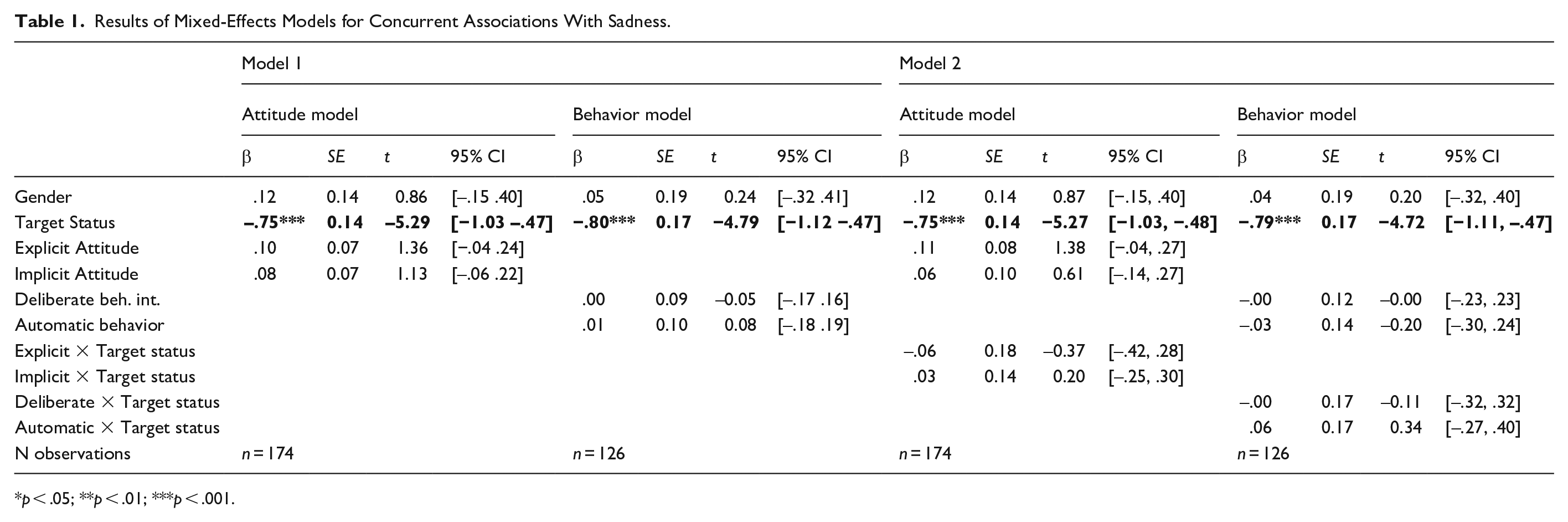
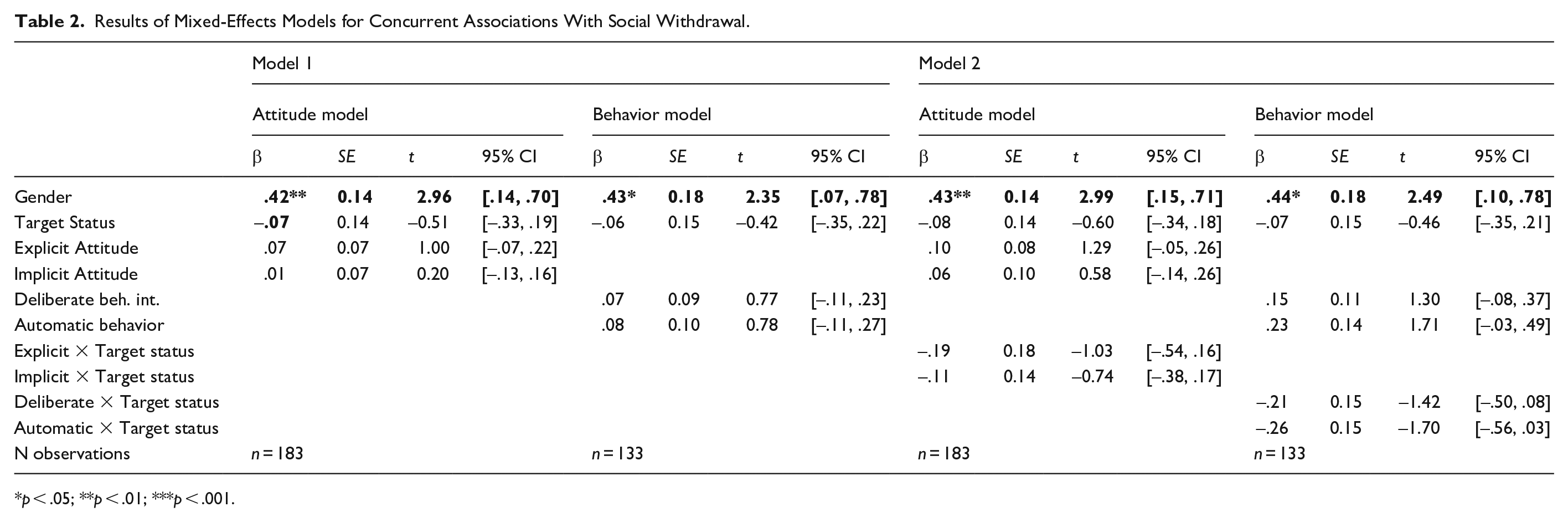
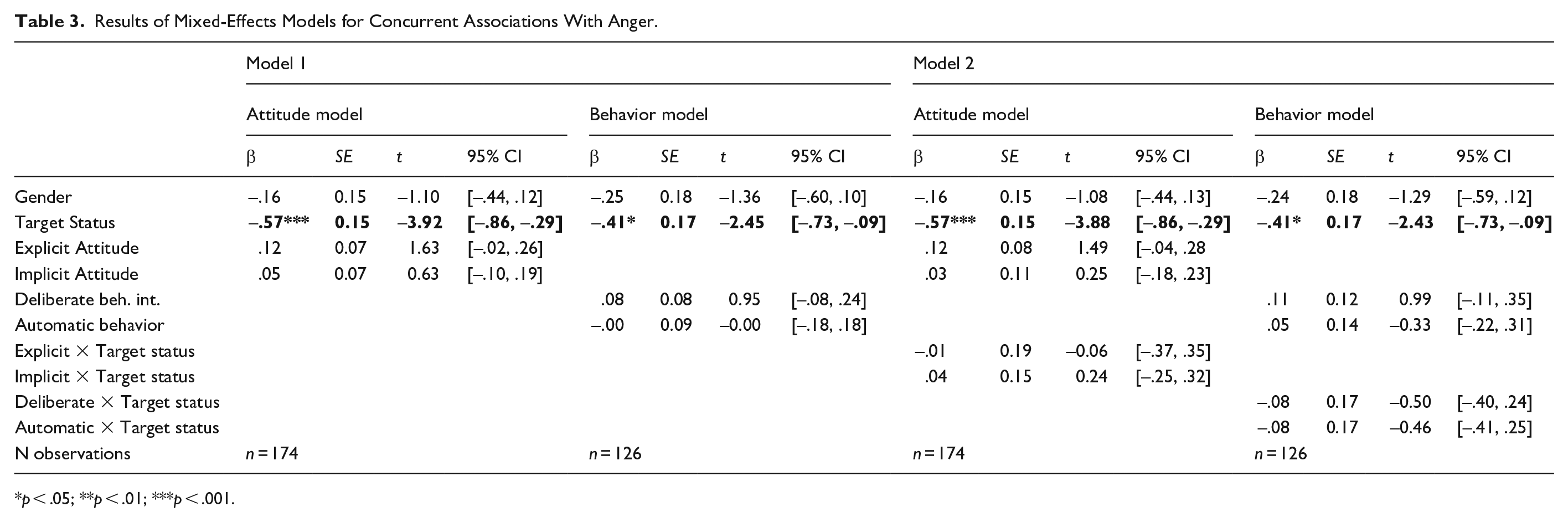
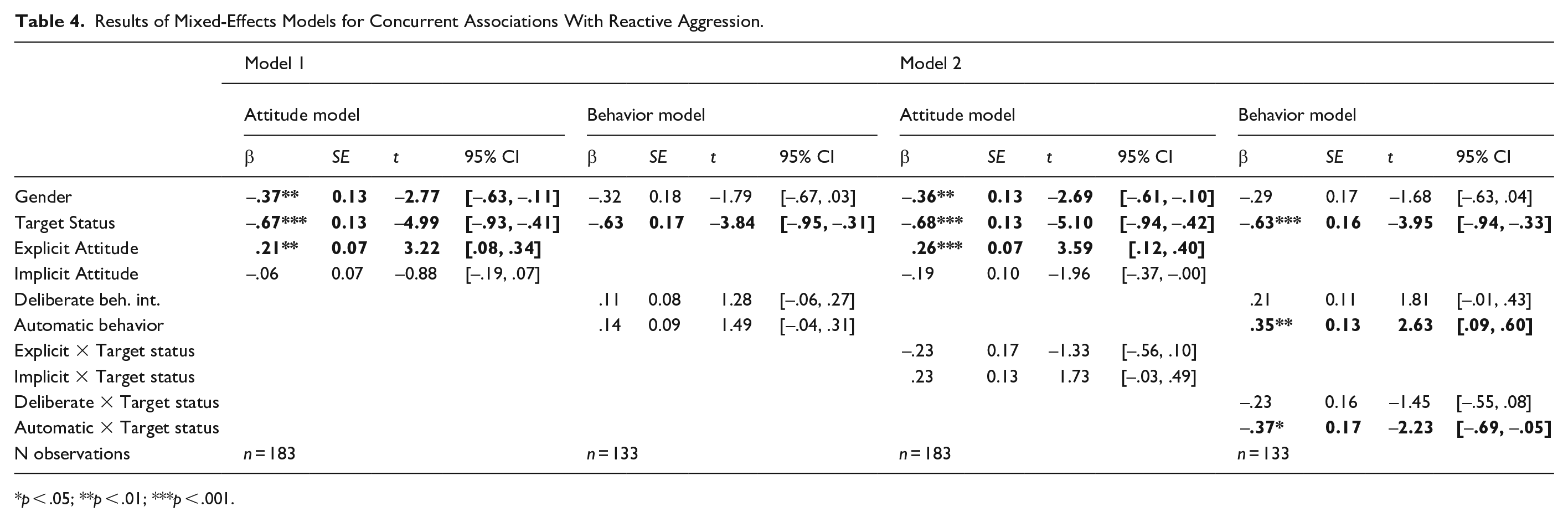
To examine how classmates’ implicit and explicit attitudes were concurrently related to targets’ well-being, we ran mixed-effects models for each outcome variable. We additionally examined whether target status (victim vs. neutral) moderated these associations in a second model. We included a random intercept for the classroom level, and implicit attitudes, explicit attitudes, target status, and gender as fixed effects in the first model (Model 1), and added two-way interactions between attitudes and target status as fixed effects in the second model (Model 2). A similar approach was used for the models with automatic behavior and deliberate behavior intentions as predictors. The results can be found in Tables 1 and 2 for sadness and social withdrawal and Tables 3 and 4 for anger and reactive aggression.
Results of Mixed-Effects Models for Concurrent Associations With Sadness.
p < .05; **p < .01; ***p < .001.
Results of Mixed-Effects Models for Concurrent Associations With Social Withdrawal.
p < .05; **p < .01; ***p < .001.
Results of Mixed-Effects Models for Concurrent Associations With Anger.
p < .05; **p < .01; ***p < .001.
Results of Mixed-Effects Models for Concurrent Associations With Reactive Aggression.
p < .05; **p < .01; ***p < .001.
Regarding the attitude models, for reactive aggression, there was a main effect showing that stronger negative explicit attitudes from classmates were associated with more reactive aggression among targets. This effect occurred irrespective of targets’ status as there was no significant interaction effect in Model 2. For sadness, withdrawal and anger, there were no significant main effects (Model 1) or interactions with target type (Model 2) of classmates’ attitudes.
Regarding the behavior models, for reactive aggression, there were no significant main effects of behavior in Model 1. However, a significant interaction between classmates’ automatic behavior and target status emerged in Model 2. Figure 1 illustrates that for victim targets, the more negatively valenced classmates’ automatic behavior toward them, the more reactive aggression classmates see in them (β = 0.35, SE = 0.13, p = .01). For neutral targets, classmates’ automatic behavior was unrelated to their (low levels of) reactive aggression (β = −0.02, SE = 0.11, p = .85). For sadness, withdrawal, and anger, there were no significant main effects (Model 1) or interactions with target type (Model 2) of classmates’ attitudes.
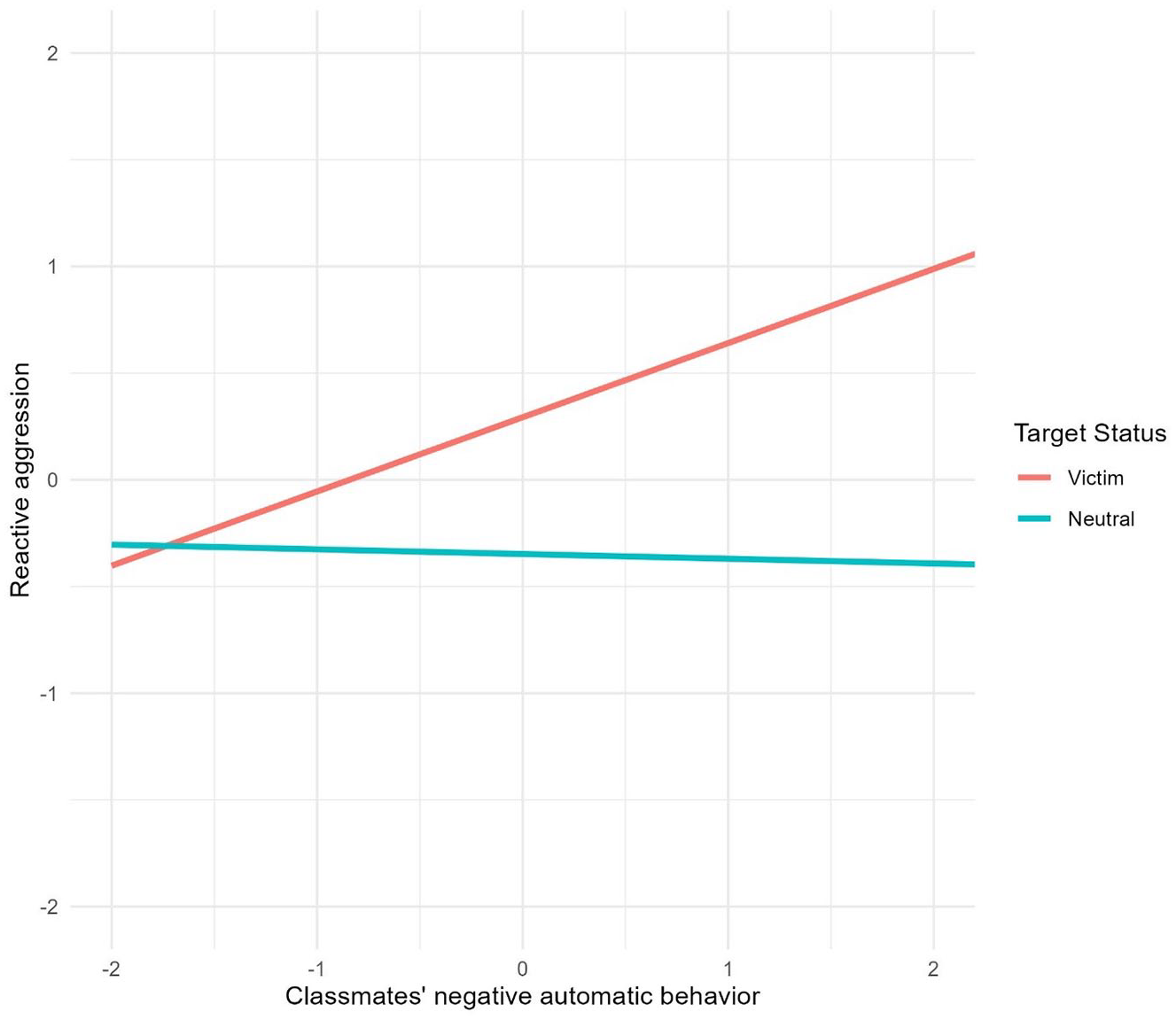
Interaction Between Negative Automatic Behavior and Target Status for Concurrent Reactive Aggression. All continuous variables were standardized.
Longitudinal Associations of Classmates’ Attitudes and of Classmates’ Behavior With Targets’ Well-Being
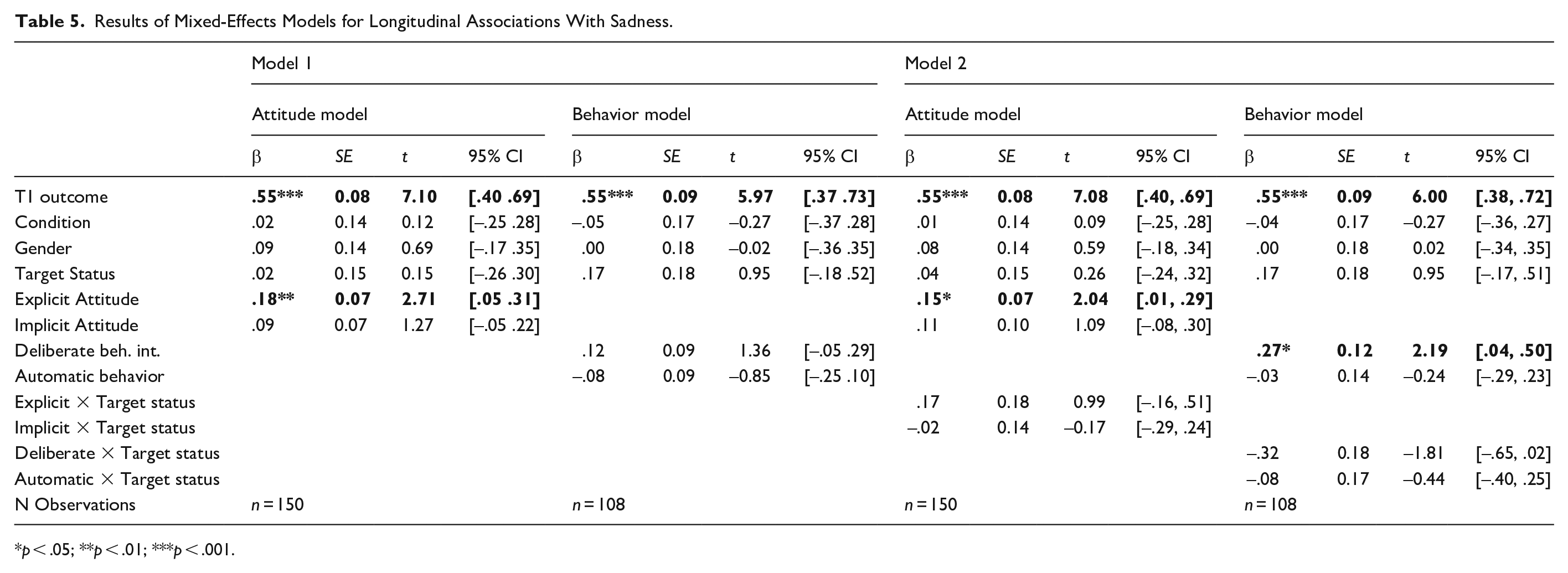
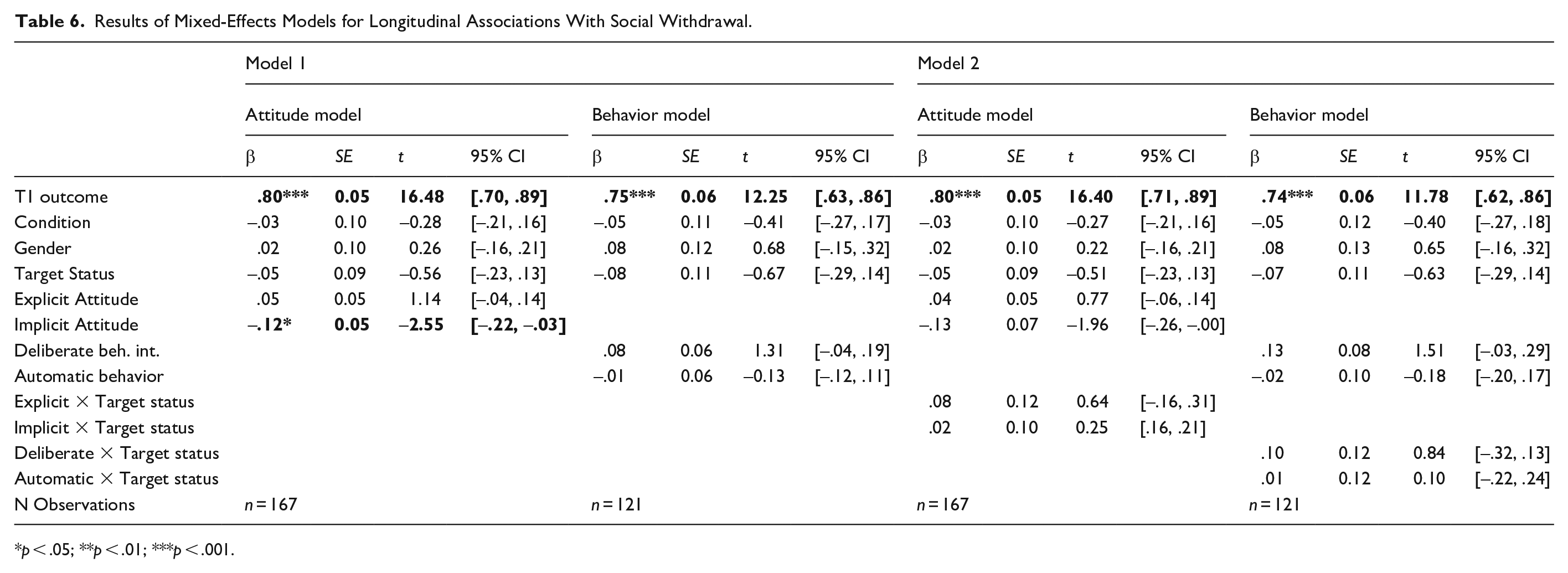
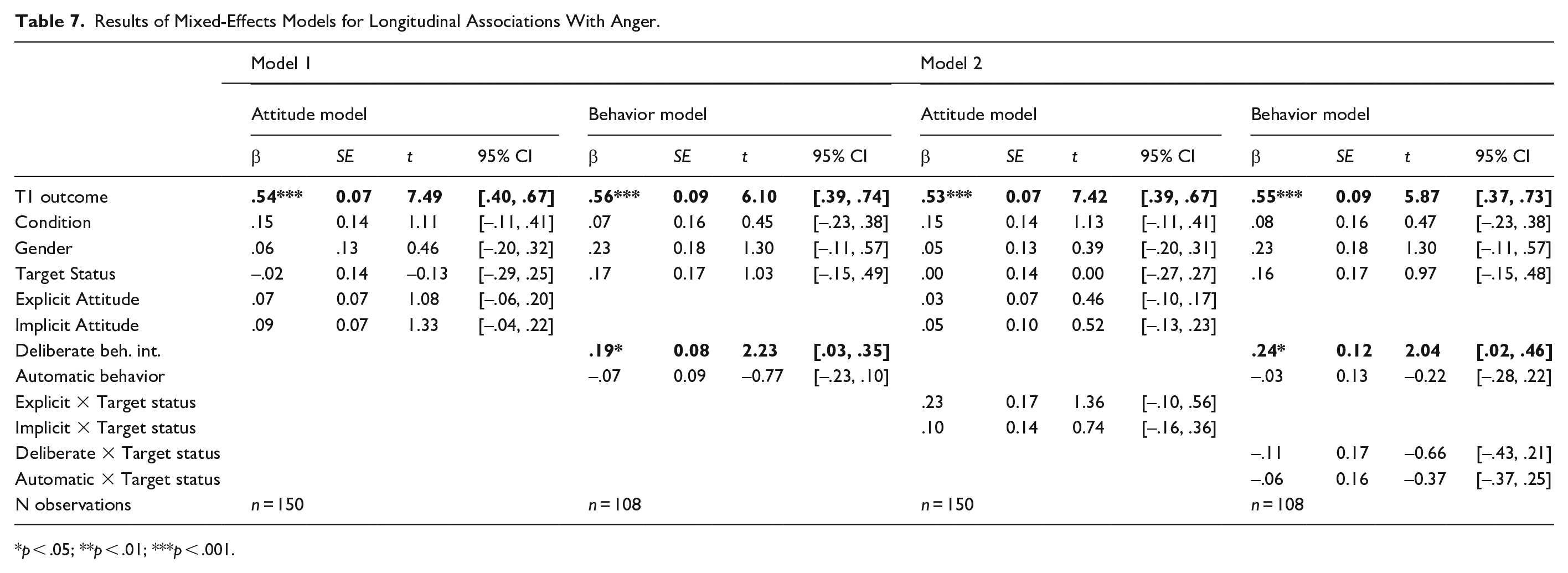
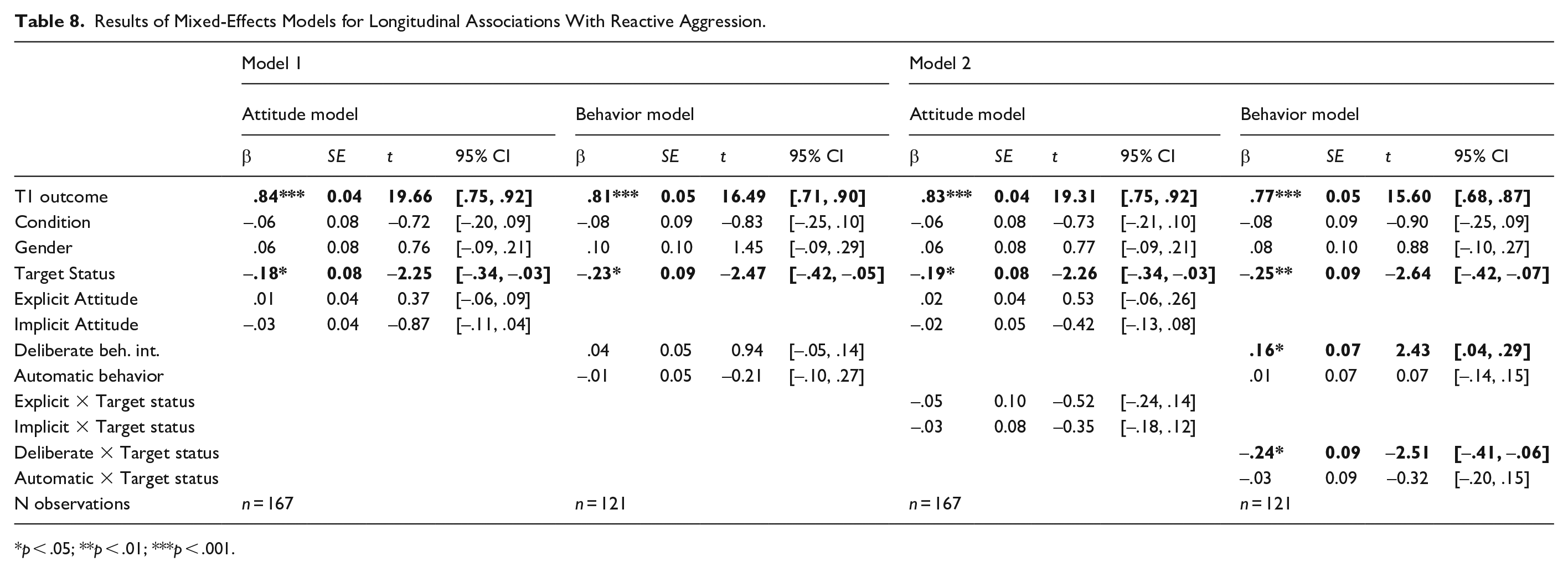
To examine how implicit and explicit attitudes may affect children’s functioning over time, we ran mixed-effects models on the T2 outcome variables. We included classmates’ average implicit and explicit attitudes at T1, target status, gender as well as the outcome variable at T1 as fixed effects and we included a random intercept for the classroom level. We again included the two-way interactions between attitudes and target status to examine potential moderating effects of target status in a second model. A similar approach was used for the models with automatic behavior and deliberate behavior intentions as predictors. For all longitudinal models, we received singularity warnings. As the models without the random intercept showed the same results, we continue to report the results of the mixed-effects models. The results are shown in Tables 5 and 6 for sadness and social withdrawal and Tables 7 and 8 for anger and reactive aggression.
Results of Mixed-Effects Models for Longitudinal Associations With Sadness.
p < .05; **p < .01; ***p < .001.
Results of Mixed-Effects Models for Longitudinal Associations With Social Withdrawal.
p < .05; **p < .01; ***p < .001.
Results of Mixed-Effects Models for Longitudinal Associations With Anger.
p < .05; **p < .01; ***p < .001.
Results of Mixed-Effects Models for Longitudinal Associations With Reactive Aggression.
p < .05; **p < .01; ***p < .001.
Regarding the attitude models, for sadness, a main effect of classmates’ explicit attitudes emerged in Model 1. The stronger classmates’ negative explicit attitude toward the target at T1, the more sadness the target experienced at T2 controlling for sadness at T1. For social withdrawal, there was a main effect of implicit attitudes in Model 1. The more negative classmates’ implicit attitudes at T1, the less social withdrawal at T2, controlling for social withdrawal at T1. These main effects were not moderated by target type in Model 2. For anger and reactive aggression, there were no significant main or interaction effects of attitudes.
Regarding the behavior models, for anger, there was a main effect of deliberate behavior intentions in Model 1. More uncivil deliberate behavior intentions from classmates toward a target at T1 predicted more anger experienced by the target according to classmates at T2 while controlling for anger at T1. For reactive aggression, there was a significant interaction between deliberate behavior and target status. Figure 2 shows that more uncivil deliberate behavior intentions from classmates was related to more reactive aggression at T2 for victim targets (β = 0.16, SE = 0.07, p = .02), but not for neutral targets (β = −0.07, SE = 0.07, p = .28). For social withdrawal, there were no significant main or interaction effects of classmates’ behavior.
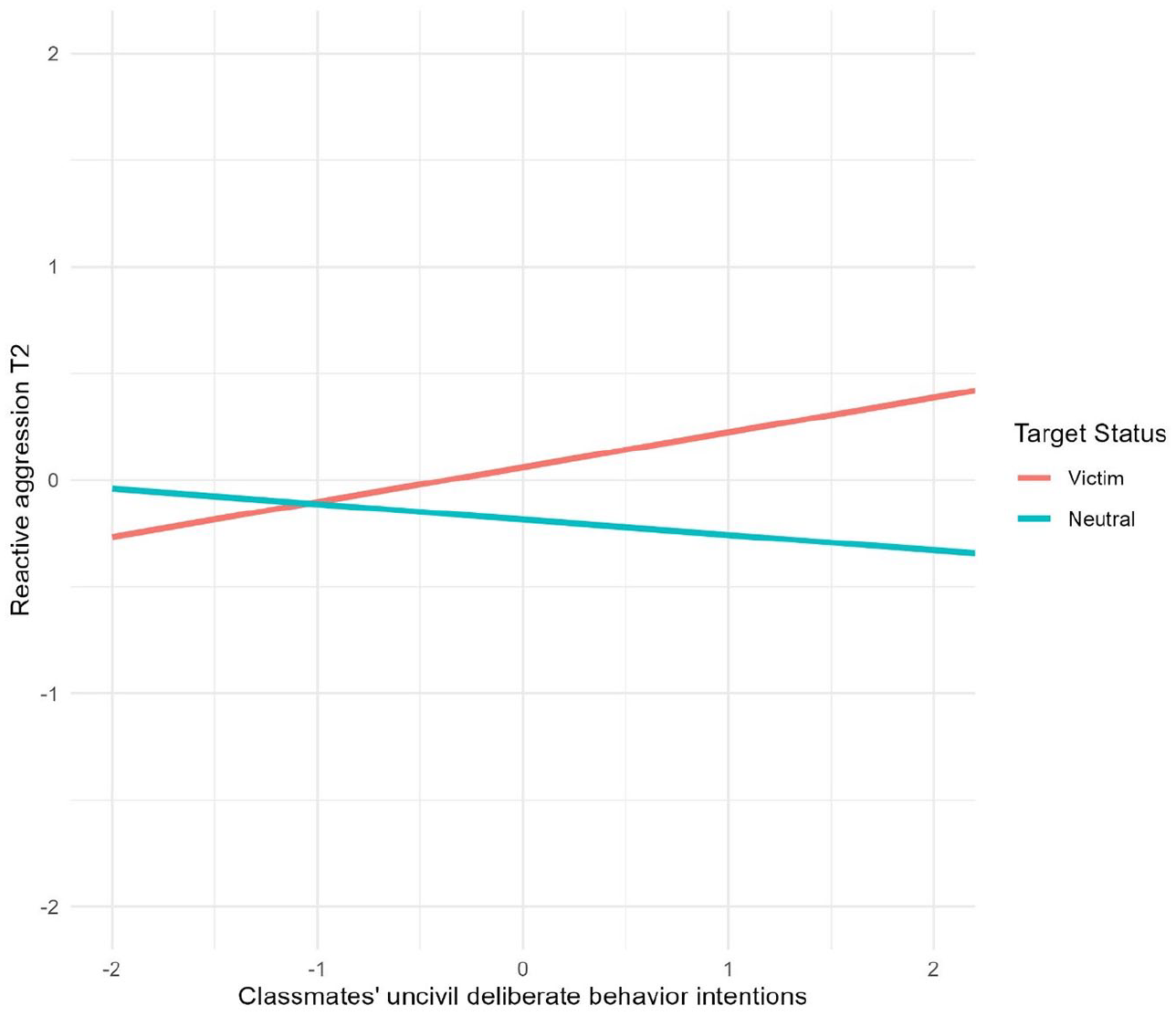
Interaction Between Classmates’ Uncivil Deliberate Behavior Intentions and Target Status for Longitudinal Reactive Aggression. All continuous variables were standardized.
Longitudinal Associations of Classmates’ Implicit and Explicit Attitudes With Victims’ Experiences of Victimization
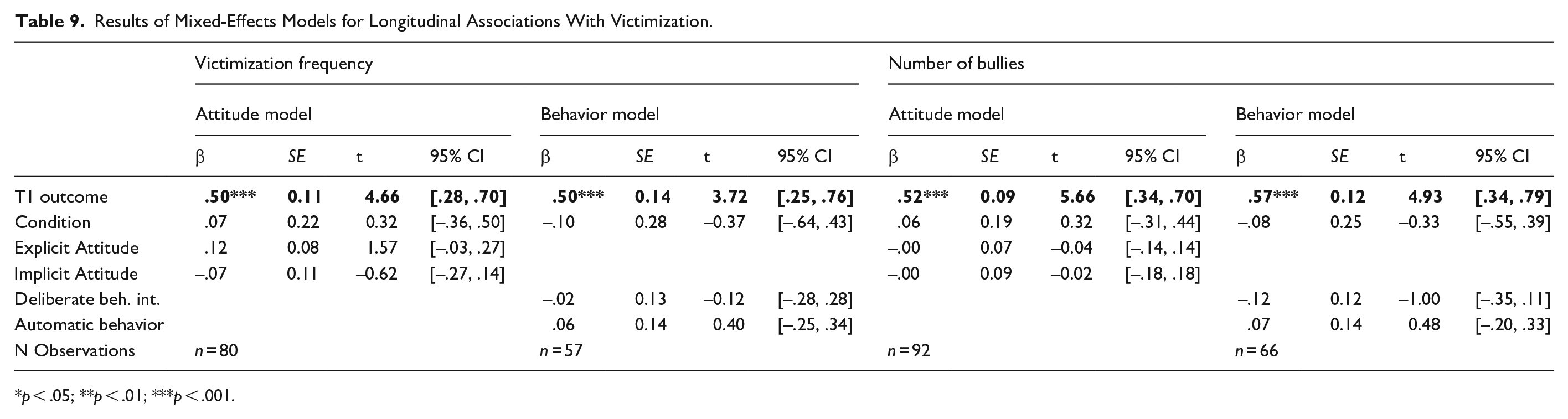
To examine how classmates’ attitudes and behaviors were related to the continuation of victimization, we examined the longitudinal relation between classmates’ attitudes or behaviors at T1 with victimization at T2 while controlling for victimization at T1 in the victim target subsample. We used frequency of victimization and number of bullies as self-reported by victims as indicators for victimization. Descriptive information on the study variables can be found in the Supplemental Materials. None of the T1 correlations between attitudes or behavior, and victimization indicators were significant.
We conducted mixed-effects models for each outcome separately, with the T1 victimization indicator, classmates’ explicit and implicit attitude toward the victim and intervention condition as fixed effects. We included a random intercept for the classroom level. The same model was run with automatic and deliberate behavior intentions as predictors. The results are presented in Table 9. There were no significant effects, with the exception of the autoregressive effects. This indicates stability of victimization over time, but neither classmates’ attitudes nor their behavior (intentions) toward a victimized child were predictive of changes in frequency of victimization, or change in number of bullies over time.
Results of Mixed-Effects Models for Longitudinal Associations With Victimization.
p < .05; **p < .01; ***p < .001.
Sensitivity Analyses
To be transparent about the robustness of our results, we re-ran our models for internalizing problems (composite score of depression, loneliness and social anxiety) as an alternative indicator of self-reported sadness (see Supplemental Materials). In line with the results for sadness in Model 2, these analyses replicate in Model 1 the effect that classmates’ deliberate behavior intentions contribute to longitudinal increases in internalizing problems. The longitudinal effect of classmates’ explicit negative attitude did not replicate for internalizing problems.
Moreover, we re-ran the model on continuation of victimization with victimization alternatively operationalized as victimization severity (see Supplemental Materials). In line with the results for victimization frequency and number of bullies, also for victimization operationalized as victimization severity, attitudes and behaviors were not predictive of the continuation of victimization.
As there was little missingness for the well-being indicators, and the missingness of automatic behavior for a number of targets was completely random (no data collection of variable planned in that classroom because of limited resources), missingness was handled with listwise deletion. Given our small sample size however, we also explored structural equation modeling (SEM) with cluster-robust standard errors and full information maximum likelihood as an alternative to handle missing data (see Supplemental Materials for the results of these analyses and a discussion of the choice for mixed models over SEM with cluster-robust standard errors).
Most effects from the mixed models were replicated in the SEM models, except for the longitudinal effect of deliberate behavior on anger, and the longitudinal interaction effect of deliberate behavior and target status on reactive aggression. However, additional effects also emerged. For concurrent associations, a significant interaction between implicit attitude and target status on reactive aggression emerged (β = 0.37, SE = 0.31, p = .043). And for the longitudinal analyses, an additional significant interaction between deliberate behavior and target status on sadness emerged (β = −0.41, SE = 0.68, p = .010). In conclusion, the robustness of some of the longitudinal effects is limited, and dependent on missing data handling.
Discussion
This study examined how classmates’ explicit and implicit attitudes, as well as their deliberate behavior intentions and automatic behaviors toward a specific child were associated with that child’s concurrent and longitudinal well-being. Overall, classmates’ uncivil deliberate behavior intentions seemed to be the factor most strongly related to the child’s well-being. These deliberate uncivil behavioral intentions were associated with a child developing more anger over time as well as more internalizing problems. There was little evidence that classmates’ implicit social signals would negatively affect the recipient’s well-being, as classmates’ implicit attitude was not associated with poorer well-being.
In addition, we examined whether these associations were similar for victims and non-victims and whether classmates’ attitudes and behaviors played a role in the continuation of victimization. Our results show that victims generally experienced more internalizing and externalizing problems. Moreover, they received more uncivil deliberate behavior intentions from classmates than their non-victimized counterparts. We also found that classmates’ valence of facial expression (i.e., automatic behavior) was concurrently associated with reactive aggression among victimized children only. Classmates’ uncivil deliberate behavior intentions were also associated with a victimized child developing more reactive aggression over time. However, classmates’ attitudes and behavior intentions at the explicit and implicit level did not predict the continuation of the victimization itself.
Classmates’ Attitudes and Behavior, and Children’s Well-Being
The first goal of this study was to examine whether social signals at the explicit and implicit level are related to (the development of) the recipient’s well-being overall. When it comes to classmates’ social signals and concurrent well-being, classmates’ explicit disliking of a child was associated with high levels of reactive aggression in the child, regardless of their victimization status.
The longitudinal effects of classmates’ explicit social signals offer support for their social signals predicting poorer well-being in the recipient over time. Classmates’ willingness to treat a child in an uncivil way in everyday situations more generally contributes to the development of a broad set of self-reported internalizing and externalizing problems of children (depression, anxiety, loneliness, and anger), whether they have a victim status in their classroom or not.
Finding these effects despite having used a behavior intention measure rather than observing actual behavior is striking. Because of ethical concerns, we measured behavior intentions in a hypothetical situation rather than risking children being exposed to actual negative behavior from their peers. Nevertheless, this vignette measure seems to be a good proxy for peers’ actual behavior since it was related to changes in well-being in the target child. Whereas the vignette protagonists were never actually exposed to the negative behavior peers said they would engage in, peers’ willingness to engage in such behavior likely translates into more negative actions toward the target child during everyday interactions. The behavior intentions had to translate in some way in negative social signals actually sent to the target child in real life to affect the development of the target child’s well-being over time.
In contrast to our hypotheses, classmates’ implicit attitudes did not add to explaining (the development of) the receiving child’s well-being. Potentially, peers’ implicit attitudes toward a child do not directly translate into a clear and consistent behavioral pattern toward that individual. A recent meta-analysis indeed shows that implicit attitudes and behavior toward specific groups are only very weakly related (r = .10) (Kurdi et al., 2019). Moreover, elements signaling negative implicit attitudes toward the child may be difficult to perceive, and therefore may not directly affect the attitude recipient. It is also possible that our results are due to how we measured classmates’ implicit attitudes as there is much debate on how to best measure them (e.g., Gawronski et al., 2020; Sherman & Klein, 2021) and the degree to which they predict actual behavior (Dai & Albarracín, 2022). By measuring implicit attitudes toward a specific child rather than an abstract group, we took a first step into capturing the implicit attitude at the same level at which the recipient of the consequences of the attitude experiences it. However, this measurement may still not capture the essence of the implicit attitude well enough.
Victimized Versus Non-Victimized Children
The second goal was to examine differences between victims and non-victims regarding well-being and negative social signals. Matching previous literature (e.g., Arseneault, 2018; Hawker & Boulton, 2003), we found that victims experience poorer well-being than their non-victimized counterparts both concurrently and longitudinally. Moreover, whereas implicit and explicit attitudes as well as the valence of non-verbal behavior toward victimized and non-victimized children were similar, classmates indicated that they would be more likely to engage in negative behavior toward their victimized classmate than their non-victimized classmate.
These results confirm the plight of victims, as victims experience more internalizing and externalizing problems than non-victims and are treated in a more uncivil manner by their larger group of classmates. Although the peer group did not dislike or reject victims more than non-victims in this study, they do seem less inhibited regarding intentions to treat victims more harshly. Non-victims and victims being liked to a similar extent in this study nuances previous findings showing an association between victimization and being disliked or rejected (e.g., Romera et al., 2021).
It is concerning that, despite not being less liked, victims are subjected to stronger intentions of uncivil treatment. Perhaps the victim reputation of a child has set a norm for classmates that it is okay to mistreat that child (Lansu et al., 2014). Such processes might be fueled by moral disengagement and dehumanization toward the victim by bullies (Pozzoli et al., 2012), which might steer the behavioral choices of group members toward the victim. Furthermore, the effect could also be driven by a few (bullying) classmates reporting strong negative behavior intentions toward the victim whereas other classmates treat the victim similarly as their non-victimized classmate. Future research should delve deeper into this matter by also taking into account the distribution of the negative behavior intentions toward victims across peers.
Role of Classmates’ Social Signals in Victims’ Well-Being Specifically
As subtle signs of negativity might worsen victims’ plight and victims may be affected more intensely by signs of negativity from their classmates (Lansu et al., 2017), the third goal was to examine whether classmates’ social signals affected victims differently than non-victims. Our results show that victimization indeed played a role in the association between certain social signals and well-being of the recipient. For victim targets only, classmates’ automatic and deliberate behavior was related to the recipient’s reactive aggression. For victims, more negative non-verbal behavior of classmates was associated with higher levels of concurrent reactive aggression, and classmates’ stronger intention to behave in an uncivil manner was prospectively associated with higher levels of reactive aggression.
The concurrent effect of automatic behavior may represent classmates being more inclined to send non-verbal signals of negativity to victims who engage in reactive aggression, or that victims who encounter more negative non-verbal signals tend to respond more aggressively to these “provocations.” The longitudinal effect for deliberate behavior shows that children whose classmates are more willing to treat them negatively, over time become more likely to respond with aggressive behavior to such situations. These results call for a more detailed examination of peers’ behaviors toward children and more specifically victims known for their reactive aggression during interaction instances, in addition to negative peer relations in general (Hubbard et al., 2010) in the form of rejection (e.g., Morrow et al., 2006; Poulin & Boivin, 2000) and victimization (e.g., Camodeca & Goossens, 2005; Cooley et al., 2018; Salmivalli & Helteenvuori, 2007). This is important to obtain insight into, as in addition to some victims responding in an escalating way to peers’ negative signals, peers treating a child in a more negative way because of their reputation in the group (Lansu et al., 2014) is a dynamic that can also contribute to the maladjustment of reactively aggressive victims.
Role of Classmates’ Social Signals in Victims’ Continued Victimization
Our fourth goal was to test whether classmates’ attitudes and behaviors mattered for future frequency of victimization as well as number of bullies. Analyses showed that attitudes and behavior were not predictive of victimization over time. Prior victimization was the only predictor of victimization 2–3 months later. Factors affecting (changes in) victimization frequency likely reside more within parties directly involved in the victimization process, including the victim’s popularity and likeability (Sheppard et al., 2019) and number of friends capable of defending them (Hodges et al., 1997), as well as the bullies’ popularity status, social goals, or extent to which they feel that their bullying behavior is socially rewarded. Future work could further examine the role of these features, as well as that of bullies’ attitudes and behaviors toward their victim in changes in the frequency of their victimization.
Strengths and Limitations
The unique aspects of this study are the theoretical innovativeness of measuring children’s implicit attitudes toward classroom peers, and the direct measurement of children’s non-verbal behavior and behavior intentions toward specific classmates, all in a large sample of 948 elementary school students. Furthermore, measuring these implicit, but also explicit social signals from classmates, once directed at a victim and once directed at a non-victim, allows for examining how these attitudes and behaviors toward a specific child differ based on the child’s victimization status.
Nevertheless, the study is not without limitations. For example, whereas implicitly measured attitudes from peers at the aggregated level are reliable (Peetz, 2025), the concurrent validity is low with non-significant associations between different implicit attitude measures. The Approach Avoidance Task (AAT) and the Implicit Association Test (IAT) scores measuring the attitudes toward the same attitude object are usually not significantly related to one another (e.g., Peetz, 2025; Van Alebeek et al., 2021), suggesting that when other implicit attitude measures are used, different associations between classmates’ implicit attitude and the recipient’s well-being may emerge.
In addition, target selection criteria could be improved in future studies. The current approach was aimed at a balanced design with four targets per classroom to maximize statistical power. We therefore always selected two victims per classroom. Yet, some classrooms had more victims fitting the profile, and in other classrooms victimization was hardly prevalent, causing us to select the student that fit the criteria best, but may not have had a clear victim position in the classroom. This tension between study design aims and practical reality is demonstrated through the fact that in 12 out of the 48 classrooms, we could not find a boy and a girl victim and therefore all targets in that classroom were of the same sex. Despite these practical challenges, it would be theoretically better fitting if the attitudes and behaviors would only be measured toward children who are clearly victimized.
A more conceptual limitation is that we did not test a mediation model from peers’ attitude to the recipient’s well-being through classmates’ behavior. As attitudes are evaluations in children’s minds, they need to be communicated in some way in order for the “attitude object” to notice this evaluation. We did not test mediation, because it would be extremely difficult to predict through which behaviors and in which situations attitudes would exactly affect the attitude recipient, and to adequately capture these behaviors. These could be the behaviors we measured, but they could also be other behaviors such as interpersonal distance, eye-rolling, sighing or responding very blandly to initiatives from the attitude recipient. As it is largely unknown through which exact behaviors negative implicit attitudes are communicated, and whether the recipients pick up on these, research on these topics is needed. In addition, associations between implicit attitudes and behavior are generally weak (Kurdi et al., 2019), and if they exist, we are likely not able to demonstrate them with limited statistical power (analysis on target level n = 167 at best). Thus, more certainty about capturing the behaviors that signal attitudes, a larger sample size, and preferable also three instead of two time points are needed to have the practical requirements in place to properly test for mediation.
Conclusion
This study showed that explicit rather than implicit signals from classmates are related to the receiving child’s well-being, with deliberate uncivil behavior (intentions) being related to a wider range of well-being indicators in the recipient than explicit disliking. Classmates’ deliberate uncivil behavior intentions were related to increased internalizing problems and anger over time in children regardless of their victim status. For victims but not non-victims, classmates’ negative behavior was related to more reactive aggression concurrently (classmates’ automatic level behavior) and longitudinally (classmates’ deliberate level behavior intentions). Compared to non-victimized children, victims experienced more sadness, anger and reactive aggression and they received stronger uncivil behavior intentions from their peers. Classmates’ social signals were unrelated to victimization continuation.
Our insights emphasize the negative associations of being disliked and treated in an uncivil way in everyday situations by classmates on experiencing negative emotions for any child, and a path toward reactive aggression in victims specifically. In addition to recognizing victims receiving harsh treatment by bullies, and experiencing internalizing and externalizing problems as a consequence, teachers may need to be aware that victims are also being subjected to small everyday acts of incivility by their peers more generally. Negative behavior intentions of classmates are associated with more internalizing problems and anger over time for all children, and in addition to more reactive aggression for victimized children specifically. Given these negative outcomes associated with being subjected to more incivility by classmates, it seems important for teachers to not only intervene in more severe bullying perpetration episodes, but to also prevent more “mundane” uncivil acts of negativity. Preventing victims from being exposed to these milder instances of negativity from peers might already benefit their well-being.
Supplemental Material
sj-docx-1-jbd-10.1177_01650254251356493 – Supplemental material for How classmates’ evaluation of and behavior toward (victimized) children affects their well-being: An examination of implicit and explicit processes
Supplemental material, sj-docx-1-jbd-10.1177_01650254251356493 for How classmates’ evaluation of and behavior toward (victimized) children affects their well-being: An examination of implicit and explicit processes by Tessa A. M. Lansu, Hannah K. Peetz, Nathalie A. H. Hoekstra and Yvonne H. M. van den Berg in International Journal of Behavioral Development
Footnotes
Declaration of Conflicting Interests
The author(s) declared no potential conflicts of interest with respect to the research, authorship, and/or publication of this article.
Funding
The author(s) disclosed receipt of the following financial support for the research, authorship, and/or publication of this article: This research was supported by the Netherlands Initiative for Education Research (NRO) (grant no. 40.5.18300.018) awarded to Tessa Lansu and Yvonne van den Berg.

Supplemental material
Supplemental material for this article is available online.
Notes
References
Supplementary Material
Please find the following supplemental material available below.
For Open Access articles published under a Creative Commons License, all supplemental material carries the same license as the article it is associated with.
For non-Open Access articles published, all supplemental material carries a non-exclusive license, and permission requests for re-use of supplemental material or any part of supplemental material shall be sent directly to the copyright owner as specified in the copyright notice associated with the article.
