




Abstract
Experiences of unpredictability can create significant disruptions for children’s psychosocial development. Despite growing evidence highlighting the importance of predictable caregiving in fostering long-term healthy development, there is still limited understanding of proximal unpredictability within caregiver–child relationships. This study extended prior research on caregivers’ sensory signal unpredictability with infants, by (1) developing an observational measure of caregiver affective and behavioral unpredictability in early childhood and (2) exploring its implications for preschoolers’ development of biobehavioral self-regulation. In this longitudinal study of 98 predominantly White 4-year-old children (50% female) and their mothers, greater caregiver affective and behavioral unpredictability was associated concurrently with greater respiratory sinus arrhythmia (RSA) suppression (i.e., decrease in RSA) during the Day/Night inhibitory control task. Greater caregiver sensory signal unpredictability at 4 years predicted children’s greater RSA suppression during the Day/Night task 2 years later. Neither sensory signals nor affective or behavioral unpredictability were associated with children’s behavioral performance on the inhibitory control task. This study provides initial evidence that unpredictable caregiver signals appear to shape early, non-volitional processes that regulate arousal in novel situations, a central aspect of susceptibility to social withdrawal.
Unpredictability in early life is emerging as a meaningful construct in developmental science with the potential to disrupt the development of self-regulation (Ellis et al., 2022; Smith & Pollak, 2021. Unpredictability may occur across multiple contexts, including moment-to-moment changes in caregiver behaviors, fluctuations in family dynamics, or broader environmental patterns (Ellis et al., 2022; Glynn et al., 2024). As a characteristic of socialization environments, unpredictability may influence developmental processes, particularly during sensitive periods of rapid growth and adaptation. Early socialization theory and evidence from biological research underscore the roles of early-life patterns in shaping neural connectivity and the development of foundational regulatory systems (Birnie & Baram, 2025; Glynn et al., 2024). Despite this theoretical importance, few studies have examined how moment-to-moment caregiver–child unpredictability in early childhood relates to children’s biobehavioral development (Ugarte & Hastings, 2023).
Early childhood is a critical period for the rapid development of multiple components of self-regulation, including executive functioning (Blair & Ku, 2022) and physiological regulation (Hastings & Kahle, 2019), which primarily occurs within the socialization context of caregiver–child relationships (Rubin et al., 2002). Therefore, heightened caregiver unpredictability during this period can undermine normative developmental processes (Davis & Glynn, 2024; Doom et al., 2024), and may confer particular susceptibility to poor self-regulation and risk for internalizing difficulties (Aran et al., 2024; Davis & Glynn, 2024), including social withdrawal, or the tendency of children to isolate themselves from their peers due to wariness and anxiety (Rubin & Asendorpf, 1993; Rubin et al., 2009). To further understanding of how socialization experiences may confer risk for social withdrawal, the present study examined concurrent and prospective associations between caregiver sensory signal unpredictability and behavioral/affective unpredictability at 4 years and children’s inhibitory control and parasympathetic regulation at 4 and 6 years.
Conceptualizing and Assessing Caregiver Unpredictability
Davis and colleagues (2017, 2022) have conducted pioneering studies that show unpredictable patterns of caregiver sensory signals during infancy predict children’s subsequent cognitive, behavioral, and physiological regulation. Caregiver sensory signals include auditory, tactile, and visual input—that is, how a caregiver vocalizes, touches, and shares visual attention with their infant. Unpredictability has been quantified using entropy rate, a measure of the randomness of stochastic processes (Vegetabile et al., 2019), wherein the number of transitions between all possible behaviors is transformed into a probability distribution, with higher values indicating less predictable maternal behaviors (Davis et al., 2022). Greater entropy of maternal sensory signals during play with 12-month-old infants predicted children’s worse performance on cognitive tasks 1 and 5 years later (Davis et al., 2017).
Although focusing on maternal touch, gaze, and vocalizations is logical when examining caregiver–infant interactions in the first year of life, these sensory signals may become less salient as children develop greater cognitive and socioemotional competencies. Infants are highly attuned to light, smell, motion, and sound and have rudimentary capacities for differentiating social-emotional cues, but as they transition into toddlerhood and early childhood, their ability to interpret and integrate affective and behavioral cues strengthens (McLaughlin & Gabard-Durnam, 2022). This developmental shift allows children to detect emotional tone across multiple modalities (e.g., vocal prosody and facial expression) and understand how changes in caregiver affect and behavior convey relational meaning for their own and others’ behaviors (Ruba & Pollak, 2020). As a result, while unpredictable sensory signals may be particularly disruptive in infancy, unpredictable affective and behavioral transitions—such as shifts between warmth and intrusiveness—may carry greater developmental consequences in early childhood when children are reliant upon caregivers to model and scaffold regulatory strategies (Thompson, 2015). Understanding how both sensory and affective-behavioral unpredictability operate across development is critical for identifying how different dimensions of caregiver input influence children’s trajectories of developing physiological, emotional, and cognitive self-regulation, which Rubin has posited as key mechanisms underlying young children’s social withdrawal (Rubin et al., 2001, 2002).
To identify which features of caregiver emotions and behaviors might be particularly disruptive if they are unpredictable during early childhood, we draw upon constructs of parental socialization of emotion (Denham et al., 2015) and autonomy (Mills & Rubin, 1998; Rose-Krasnor et al., 1996), which Rubin has identified as socialization processes that influence children’s developing capacities for self-regulation and risk for social withdrawal (Rubin & Burgess, 2002; Rubin et al., 2002). Parents’ affective tone—the extent to which they convey warmth versus negativity—is an important influence on early socialization. Dyadic interactions characterized by caregivers’ positive affect and relational warmth provide appropriate models of emotion regulation and make children more receptive to caregivers’ socialization efforts, thereby increasing emotional competence in children (Denham et al., 2015; Thompson, 2015). Autonomy-supportive parental behaviors are marked by the provision of choice, structure aimed to support children’s goals, and non-intrusive control (Rubin et al., 1997, 2002). Caregivers who support autonomy buffer their children against problems associated with social withdrawal by fostering children’s developing capacities for making their own decisions, managing their own behaviors, and approaching novel experiences with a sense of confidence and competence (Hastings, Rubin, et al., 2019).
Taken together, young children’s regular experiences of caregivers’ warmth and autonomy support offer opportunities to practice self-regulation in a relational context, modeling well-regulated adult behavioral patterns that eventually may be internalized as self-regulatory skills supporting social competence (Lunkenheimer, Hamby, et al., 2020), including cognitive, behavioral and physiological aspects of children’s self-regulation (Alen et al., 2022; Valcan et al., 2018). If caregiver warmth and autonomy support occur unpredictably, however, this may disrupt children’s own abilities to coordinate their moment-to-moment emotions and behavior with those of their caregiver, undermining their nascent and future self-regulation.
Multiple Systems of Self-Regulation
Self-regulation is a multi-faceted construct consisting of cognitive, behavioral, emotional, and physiological processes, which are interrelated in producing both volitional and non-volitional regulation (Blair & Ku, 2022). Self-regulation helps children manage emotional arousal and organize their behavior in response to external and internal demands, thereby enhancing behavioral adjustment and preventing problems such as social withdrawal (Thompson, 2015).
Inhibitory control, a cognitive component of self-regulation, is the ability to inhibit a dominant response to a stimulus in favor of a less prominent one (Blair & Ku, 2022). This ability undergoes significant development during early childhood due to both neurological maturation and environmental opportunities to practice such behaviors (Morasch et al., 2013; Thompson, 2015). Preschool children with better inhibitory control are more likely to demonstrate social-emotional competence in their day-to-day interactions, such as following rules in games, effectively managing emotions, and behaving in a manner consistent with social expectations (Rhoades et al., 2009). Children with good inhibitory control can manage their impulsive responses effectively in order to engage with novel stimuli and situations appropriately. Conversely, poor inhibitory control has been associated with elevated internalizing problems across childhood, and especially for temperamentally shy children (Grady et al., 2023; Vuontela et al., 2013).
While inhibitory control is considered a “top-down” volitional process, “bottom-up” self-regulation components are relatively non-volitional, emerge early in life and involve multiple neural and physiological systems. The parasympathetic nervous system (PNS) plays a key role in regulating state, motor activity, and emotion. Polyvagal theory (Porges, 2004, 2007) posits that the myelinated vagus promotes affiliative behaviors and social engagement by down-regulating the sympathetic nervous system (SNS) and supporting an orienting response. Research has focused on baseline respiratory sinus arrhythmia (RSA), reflecting PNS activity in a wakeful relaxed state, and RSA reactivity to stimuli, which together indicate the capacity for flexible physiological self-regulation (Porges, 2004, 2007). Baseline RSA is associated with trait-like levels of arousal and emotional reactivity (Hastings & Kahle, 2019), with higher baseline RSA linked to better regulation of attention and arousal, and with less social withdrawal and fewer internalizing problems (Hastings & Utendale, 2008).
Polyvagal theory also suggests that mild to moderate RSA withdrawal supports orienting and attending to critical cues (Porges, 2007). During challenges, vagal influence on the heart decreases, increasing heart rate and promoting active coping. Severe challenges can elicit further withdrawing of vagal inhibition on the SNS, activating the stress response systems. The magnitude or pattern of RSA reactivity has been posited to reflect “neuroception,” the autonomic nervous system’s evidence of sub-conscious appraisals of safety and threat, influencing emotional and social behavior regulation (Porges, 2004).
Children with self-regulation difficulties often exhibit atypical PNS activity, which may vary depending on the task or stimuli chose to elicit reactivity (Hastings & Kahle, 2019). Despite some inconsistent findings, studies indicate that milder RSA suppression is associated with better performance in executive function tasks than is stronger RSA suppression, a pattern that has been observed with the current sample previously (Utendale et al., 2014), suggesting that moderate arousal without full SNS engagement can be beneficial (Marcovitch et al., 2010; Porges, 2007). In this study, we focused on RSA reactivity to an inhibitory control task, and expected that children with self-regulation difficulties would exhibit substantial decreases in RSA from baseline to the task.
Caregiver Unpredictability and Child Self-Regulation
Caregivers play a crucial role in shaping young children’s self-regulation through consistent, structured, and supportive socialization practices (Humphreys et al., 2021; Thompson, 2015). A meta-analysis of 42 studies found that positive caregiving behaviors, such as warmth, responsiveness, and autonomy support, were associated with higher inhibitory control, while intrusive and controlling caregiving behaviors predicted lower inhibitory control performance (Valcan et al., 2018). Another meta-analysis of 103 studies (Alen et al., 2022) found that positive caregiving was linked to higher baseline parasympathetic nervous system (PNS) activity, suggesting that caregiver consistency supports physiological regulation.
Recent studies indicate that caregivers’ unpredictable behavior may disrupt children’s self-regulation and increase risk for internalizing disorders (Doom et al., 2024). Infants experiencing higher sensory signal unpredictability at 5 and 6 months exhibited worse impulse control at 1, 5, and 9.5 years of age, even after accounting for associations with socioeconomic status and maternal sensitivity (Davis et al., 2017, 2022; 2024). Sensory signal unpredictability also has been linked to neuroendocrine responses to acute stressors across species (Davis et al., 2022). In rodents, unpredictable maternal care has been shown to cause enhanced anxiety-like behaviors and anhedonia, and alteration in functional connectivity between reward and fear circuits, underscoring its potential impact on neural systems underlying emotion regulation and conferring risk for anxiety-related difficulties like social withdrawal (Davis & Glynn, 2024). Similarly, human studies have shown that greater unpredictability of maternal sensory signals during infancy predicts greater child fearfulness and anxiety in early and middle childhood (Aran et al., 2024).
Beyond sensory signals, moment-to-moment unpredictability in affect and behavior may be particularly relevant for inhibitory control development. Children learn to regulate their own behaviors through experiences of contingent and predictable caregiver interactions, which provide external support for regulation that gradually becomes internalized (Henderson & Mundy, 2013; Kopp, 1982). Caregiver scaffolding and emotion socialization, and synchronous caregiver–child interactions, have been linked to better inhibitory control, as this provides structure and guidance through which children are able to practice their developing independent regulatory skills (Bernier et al., 2010; Conway & Stifter, 2012; Kahle et al., 2018). As caregivers’ affective and behavioral unpredictability inherently reduce the structure and synchrony of interactions, this may act against children’s development of stable self-regulation strategies. For example, preschool-aged children exposed to more affective dyadic instability exhibited lower inhibitory control 9 months later (Van Dijk et al., 2017), and disruptions in parent–child synchrony have been linked to difficulties in inhibitory control (Scholtes et al., 2021).
Currently, there is limited research on whether and how caregiver unpredictability influences children’s parasympathetic regulation. One recent study found that unpredictability of maternal hostility, including overt negative affect, was not associated with vagal reactivity to a social stressor in early adolescence (Li et al., 2023). However, unpredictability was linked to social wariness and poorer executive function performance for temperamentally cautious youth. The PNS plays a key role in adaptive self-regulation by supporting attentional engagement and goal-directed effort (Porges, 2004). Moderate RSA suppression in response to novelty or challenges can facilitate orientation and cognitive engagement, and prepare for mobilization of resources in support of engagement and active coping (Hastings & Kahle, 2019). Conversely, excessive RSA suppression (large decreases in RSA, relative to baseline) can indicate stressful arousal and defensive reactivity rather than effortful control (Clark et al., 2024; Hastings & Kahle, 2019). Whereas structured and supportive caregiver–child interactions normatively reflect safe contexts within which PNS activity facilitates calm states (Miller & Hastings, 2019), caregiver unpredictability may require children to engage PNS regulatory efforts through TSA suppression, a response pattern that could generalize to future self-regulation challenges. This proposed process aligns with work demonstrating that exposure to unpredictable affective and behavioral signals in infancy predicts poorer effortful control and heightened stress reactivity (Davis & Glynn, 2024; Holmberg et al., 2022). Furthermore, unpredictable caregiving may hinder effective scaffolding of children’s skills and decrease children’s confidence that tasks are manageable (Leerkes & Augustine, 2019; Mattanah et al., 2005). As a result, they may be more likely to interpret novel cognitive challenges as threatening or overwhelming, increasing RSA suppression to mobilize resources to cope with what is perceived to be more challenging, or beyond the child’s capacities (Holochwost & Propper, 2024).
Given that moment-to-moment caregiver unpredictability may undermine children’s developing abilities to engage in goal-directed tasks, particularly during sensitive periods of development, it is critical to examine its influences on physiological and behavioral self-regulation. More research is needed to determine which biobehavioral systems are most affected by different forms of unpredictability and how these processes unfold across development.
Present Study
The goal of this pre-registered study (OSF archive) was to investigate whether 4-year-old children’s exposure to maternal affective and behavioral unpredictability was associated with difficulties in cognitive-behavioral and physiological self-regulation from 4 to 6 years, beyond the variance explained by average levels of maternal affect and behaviors, and by maternal sensory signal unpredictability. Prior analyses of these data have included examining relations between RSA and inhibitory control (Kahle et al., 2018; Utendale et al., 2014), but not maternal behavioral predictors of these indices of self-regulation. Of note, we measured caregiver unpredictability in two distinct contexts—free play and a structured puzzle task—to examine whether unpredictability operates as a domain-general or domain-specific process (Ugarte & Hastings, 2023). Prior research suggests that mothers adjust their affect and behavior based on task demands and children’s needs (Lunkenheimer et al., 2017), but it remains unclear whether unpredictability reflects a stable characteristic of caregiving or varies by context. By assessing unpredictability across both tasks, we aimed to better understand whether its effects on child self-regulation differ depending on the demands of the interaction.
We hypothesized that greater maternal unpredictability would be associated with lower inhibitory control in children, both concurrently at age 4 and prospectively at age 6. We had no directional hypotheses regarding the concurrent and prospective associations between maternal unpredictability and children’s parasympathetic activity during baseline and during an inhibitory control task, given the lack of previous literature.
Method
Participants
The proposed study used data from a study about biopsychosocial processes contributing to positive development in children, conducted in a large metropolitan area in eastern Canada from 2005 to 2010. The sample included 98 preschoolers (50% girls; M = 4.61 years, SD = 0.28) and their mothers (M = 36.43, SD = 4.81) at Time 1 (T1). Two years later (Time 2, T2), 42 girls and 45 boys (n = 87) returned to the lab (M = 6.57 years, SD = 0.30). Families were predominantly White (69.7%), English-speaking (81.6%), two-parent (72%), and from working to upper-middle SES (38% $10–60,000 CND; 30% $60–100,000; 24% > $100,000; 8% did not answer). Children with elevated externalizing problems (EP) were over-recruited using targeted advertising; 37 children (38%) had T-scores ⩾ 60 at screening. Ethical approval for the study was obtained from Concordia University’s Human Research Ethics Committee in 2007.
Procedure
At T1, families were contacted through direct mailing, letters distributed to daycares and preschools, and advertisements in local free magazines. Interested parents contacted the lab and were screened with items on the Child Behavior Checklist (CBCL; Achenbach & Rescorla, 2000) Preschool form (ages 1½–5). During the screening, caregivers provided verbal consent to answer the questions, and to be mailed consent forms and questionnaires prior to the laboratory assessment. Preschoolers and their mothers completed a 3-hr visit to a university laboratory, which began with reviewing the consent forms and addressing any questions about the study. During a 5-min free play, dyads were provided with a variety of age-appropriate toys and asked to play as they would at home. Next, they were given 5 min to complete a puzzle, and mothers were instructed to help their child as much as they thought their child needed. After the dyadic interactions, and approximately 1 hr into the testing session, cardiac monitors were attached, and baseline cardiac data were recorded. Approximately 1 hr later, children completed one task assessing inhibitory control. At Time 2 (T2), cardiac monitors were attached to children 1 hr after arrival, followed by a baseline and the same inhibitory control task. Mothers were financially compensated with $75 for their participation at both T1 and T2, and children received a t-shirt at the end of each visit.
Measures
Mother Unpredictability
Unpredictability of sensory signals
Sensory signals were coded in real-time on a second-by-second basis on BORIS video coding software (Friard & Gamba, 2016) using the Conte Center’s sensory signals coding manual (https://contecenter.uci.edu/shared-resources/). Each maternal auditory (all vocal utterances), visual (i.e., caregiver manipulates an object and child is looking at the caregiver), and tactile (physical contact from caregiver to child) signal (Davis et al., 2017, 2019). Interrater reliability was calculated for 20% of the videos using duration agreement. Interrater agreement averaged 95.06% between independent coders.
To quantify the unpredictability of maternal sensory signals, changes among all possible combinations (n = 8) of caregiver visual, auditory, and tactile sensory signals are identified as transitions. Transition counts are then transformed into a matrix of transition probabilities and into a discrete-state first-order Markov sequence, which is used to calculate the entropy rate of caregivers’ sensory signals (Davis et al., 2017; Vegetabile et al., 2019). Entropy rates of sensory signal unpredictability during play and puzzle were quantified separately (see Supplemental Figure S1).
Unpredictability of affect and behaviors
Maternal affect (positive, neutral, and negative) and behaviors (autonomy support, no behavior, and intrusiveness) were coded in real time on a second-by-second basis (see Supplemental Tables S1 and S2). Codes were mutually exclusive for both affect and behavior; each second, mothers were coded as displaying one affect code and one behavior code. Interrater reliability was examined for 20% of the videos, using duration percent agreement, Cohen’s kappa and observer accuracy (Bakeman, 2022), calculated in KappaAcc (https://bakeman.gsucreate.org/kappaacc/). All three metrics showed good interrater reliability for affect and behavior codes (all percent agreement > 85%; all κ > 0.72; all accuracy > 91.00; see Supplemental Table S3).
To quantify unpredictability, changes between all possible combinations of affect and behaviors codes (n = 9 states) were identified as transitions, and transformed to discrete-state Markov sequences used to calculate entropy rate (see Supplemental Figure S2). Entropy rates for caregiver affective and behavioral unpredictability during play and puzzle were quantified separately.
Biobehavioral Regulation
Inhibitory control
At T1 and T2, children completed the Day/Night Task (Gerstadt et al., 1994), which assesses the inhibition of prepotent responding. Children were presented with laminated cards (measuring 13.5 x 10 cm) and instructed to say “night” in response to cards showing the sun and “day” in response to cards showing the moon and stars. Children were asked to repeat the rules after the experimenter explained them, and were given training trials until they passed both a “night” and “day” trial. The children were then given 16 test trials, with the sum of correct responses being the score for inhibitory control. Interrater reliability was r = 1.00 at both time points.
Cardiac data
At T1 and T2, cardiac interbeat intervals (IBIs) were recorded using MiniLogger Series 2000, an ambulatory monitor with a sampling rate of 250 Hz. IBI data were edited and analyzed using Mxedit software (Delta Biometrics, Inc., Bethesda, MD). RSA in ln(ms)2 was computed using the Porges-Byrne algorithm (Porges & Byrne, 1992), at the natural frequency range of young children’s respiration (0.24–1.04 Hz).
Baseline cardiac data were acquired during three procedures: listening to soothing music (1 min), watching a calming video (3 min), and sitting quietly (1 min). Baseline was calculated as the average of the RSA score across the activities (all rs > 0.82 at 4 and 6 years). Children’s cardiac activity also was recorded during the Day/Night task. Mean duration of the Day/Night task was 62.25 s (SD = 23.71) at 4 years and 46.69 s (SD = 7.78) at 6 years. RSA reactivity was indexed by an arithmetic change score, subtracting baseline RSA from task RSA such that negative scores of RSA reactivity reflected reductions in RSA from baseline to the task (i.e., decreased parasympathetic influence) and positive values denote RSA augmentation. At ages 4 and 6, children showed significant reductions in RSA from baseline to the Day/Night task (both t > 5, p < .001).
Behavior Problems
Child behavior checklist
At T1, mothers completed the Child Behavior Checklist (CBCL), preschool form (ages 1.5–5) (Achenbach & Rescorla, 2000). Given the targeted recruitment, the CBCL broadband T-score for EP (α = .94) was used as a covariate in analyses.
Analytic Strategy
Covariates
Child sex, child age, child EP, and family socioeconomic status (SES) at T1 were considered as possible control variables in all models. SES was an average of standardized family income-to-needs ratio (based on total family income and household roster) and highest achieved level of parent education (r = .45, p < .001).
Average Levels of Mother Behavior and Affect
Across both play and puzzle tasks, we had twelve variables (i.e., codes) that indexed affect and behaviors. Each variable represents the proportion of the duration (in seconds) of each code relative to the total number of seconds of available video data for each task. Scores for each of the 12 affect and behavior codes were examined in a Principal Components Analysis (PCA) (see Supplemental Table S4). PCA-derived factors scores were saved for use in the main analyses.
Main Analyses
To test the a priori and exploratory hypotheses, we used Bayesian estimation, which is an alternative to maximum likelihood (ML) estimation. Bayesian methods are particularly useful when dealing with small sample sizes, a large number of models, and non-normally distributed data and parameters (Asparouhov & Muthén, 2021), providing more conservative estimates of the uncertainty around model parameters, which can help to reduce the risk of false positives. Bayesian estimates provide posterior probability intervals; if the 95% credible intervals do not contain zero, the effects are considered non-null (i.e., significant) (van de Schoot et al., 2014).
We conducted separate analyses for play and puzzle tasks, each including covariances between affective and behavioral unpredictability and sensory signal unpredictability at T1. Separate path analysis models predicted T1 and T2 inhibitory control and T1 and T2 baseline RSA and RSA reactivity from unpredictability during play. Therefore, a total of four models were examined. In each, we included stability paths for outcomes from T1 and T2, as well as significant covariances between predictors and between outcomes. Covariates were retained if they correlated with any dependent variable at p < .05. To account for missing data (which ranged from 7% to 34% across variables; see Supplemental Materials, Section 3), we used the Bayes estimator default method in Mplus which uses full information from all observations to impute missing data, akin to Full Information Maximum Likelihood in ML (for more information on the Bayesian modeling, see Supplemental Materials, Section 4). Finally, we conducted standard path analyses in Lavaan (Rosseel, 2012) using Maximum Likelihood with Robust (MLR) estimators as auxiliary analyses to check whether results across both methods were consistent (see Supplemental Tables S5 and S6).
Results
Descriptive Statistics and Preliminary Analyses
The PCA (Supplemental Table S4) on mothers’ average levels of affect and behaviors yielded four components. Positive Affect had high loadings for positive affect and negative loadings for neutral affect across play and puzzle. Negative Control had high loadings for intrusiveness and negative affect across play and puzzle. Play Non-Involvement had high loadings for neutral affect and no behavior and negative loadings for autonomy support and positive affect during play. Puzzle Autonomy Support had positive loadings for autonomy support and negative loadings for no behavior during puzzle. We saved factor scores for the next set of analyses. For analyses predicting biobehavioral regulation from unpredictability during play, factor scores for positive affect, negative control, and non-involvement were included as covariates. For analyses involving unpredictability during puzzle, factor scores for positive affect, negative control, and autonomy support were included as covariates.
Table 1 displays descriptive statistics for all study variables. Paired samples t-tests revealed significant decreases in sensory signal unpredictability from play to the puzzle, t(78) = −5.56, p < .001. Affective and behavioral unpredictability did not differ across tasks. Table 2 shows bivariate Spearman correlations among covariates, predictors, and indices of biobehavioral regulation. Unpredictability across tasks was weakly stable within each domain (affect and behavior, and sensory signals). Unpredictability across domains was greater within puzzle than within play. Unpredictability of sensory signals during play was negatively associated with RSA reactivity at T2. Affective and behavioral unpredictability during puzzle was positively associated with baseline RSA at T1. Positive affect correlated positively with affect and behavior unpredictability during play, but negatively during puzzle. Unpredictability correlated positively with negative control.
Descriptive Statistics for Study Variables.
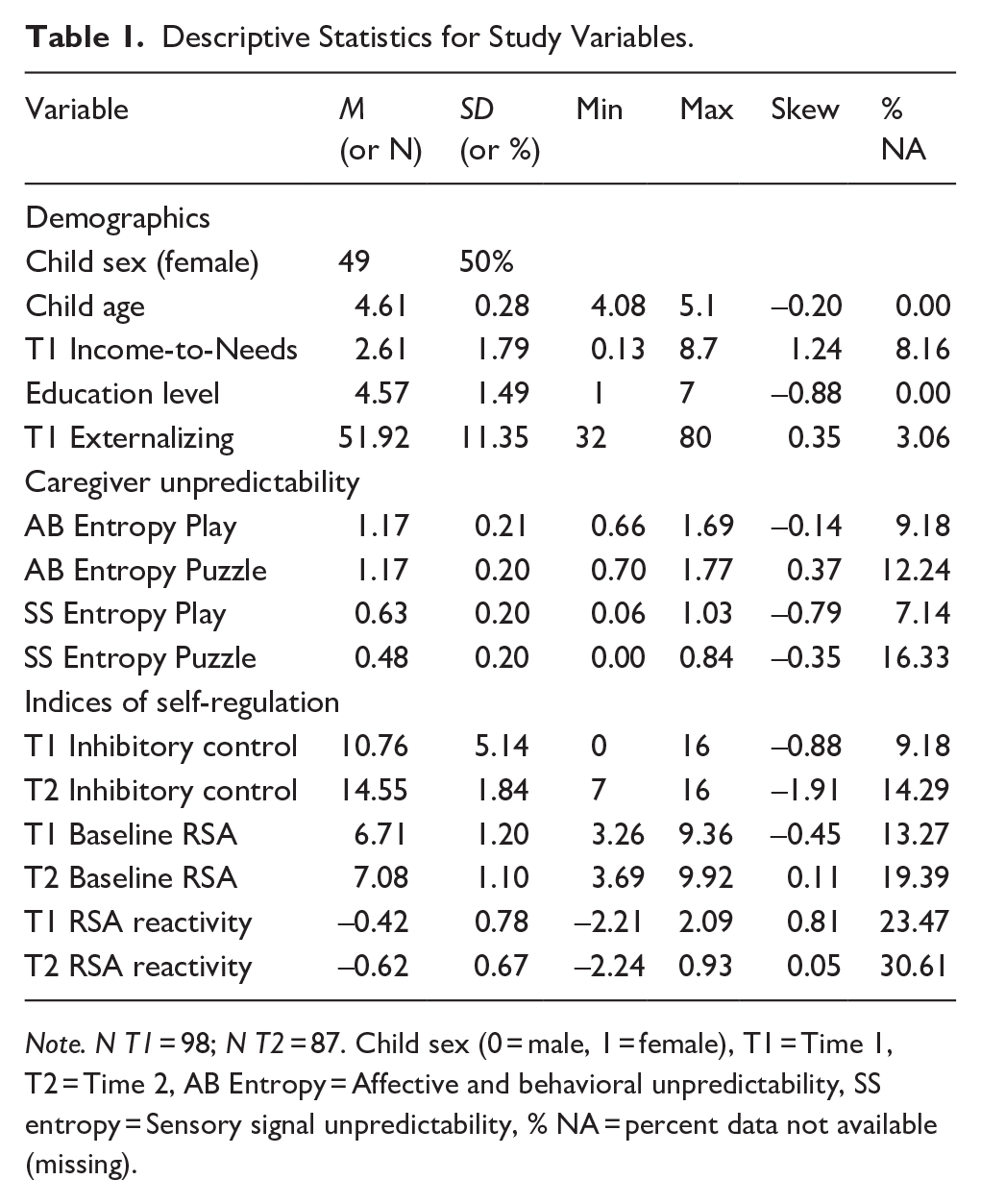
Note. N T1 = 98; N T2 = 87. Child sex (0 = male, 1 = female), T1 = Time 1, T2 = Time 2, AB Entropy = Affective and behavioral unpredictability, SS entropy = Sensory signal unpredictability, % NA = percent data not available (missing).
Spearman Correlations Between Study variables.
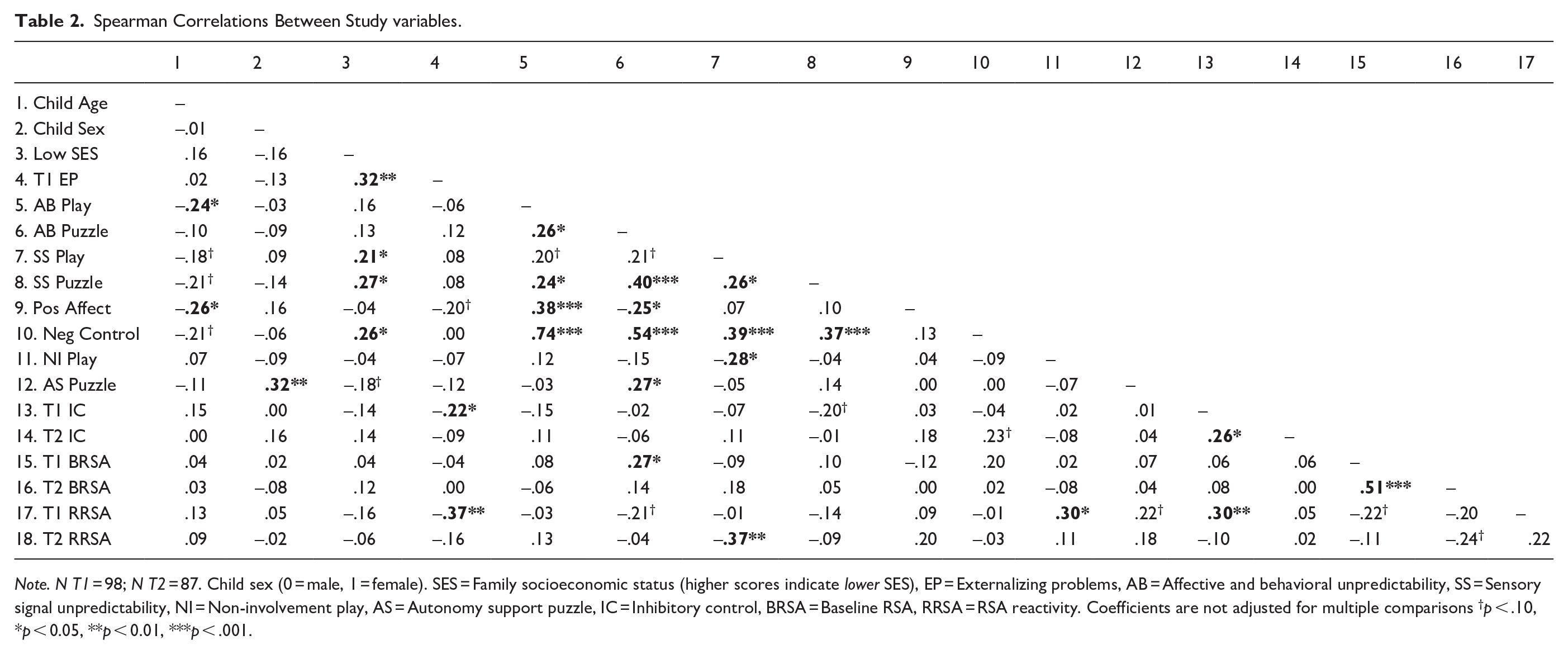
Note. N T1 = 98; N T2 = 87. Child sex (0 = male, 1 = female). SES = Family socioeconomic status (higher scores indicate lower SES), EP = Externalizing problems, AB = Affective and behavioral unpredictability, SS = Sensory signal unpredictability, NI = Non-involvement play, AS = Autonomy support puzzle, IC = Inhibitory control, BRSA = Baseline RSA, RRSA = RSA reactivity. Coefficients are not adjusted for multiple comparisons †p < .10, *p < 0.05, **p < 0.01, ***p < .001.
H1. Inhibitory Control
The standardized posterior distribution medians and Bayesian 95% credible intervals for indices of biobehavioral regulation, covariates, and unpredictability during play and puzzle are displayed in Tables 3 and 4, respectively. There were no associations between affective and behavioral or sensory signal unpredictability and inhibitory control during the Day/Night task. In the model for puzzle, greater negative control predicted greater inhibitory control at T2. The latter finding was replicated within MLR models, which identified two additional associations (see Supplemental Tables S5 and S6).
Associations Between Caregiver Unpredictability During Play and Indices of Self-Regulation.
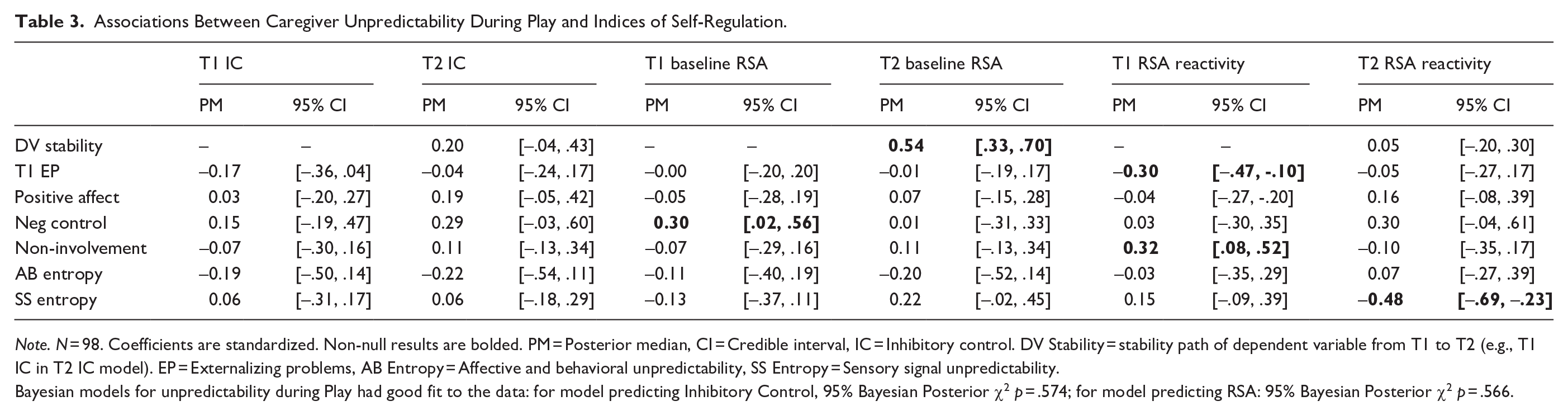
Note. N = 98. Coefficients are standardized. Non-null results are bolded. PM = Posterior median, CI = Credible interval, IC = Inhibitory control. DV Stability = stability path of dependent variable from T1 to T2 (e.g., T1 IC in T2 IC model). EP = Externalizing problems, AB Entropy = Affective and behavioral unpredictability, SS Entropy = Sensory signal unpredictability.
Bayesian models for unpredictability during Play had good fit to the data: for model predicting Inhibitory Control, 95% Bayesian Posterior χ2 p = .574; for model predicting RSA: 95% Bayesian Posterior χ2 p = .566.
Associations Between Caregiver Unpredictability During Puzzle and Indices of Self-Regulation.
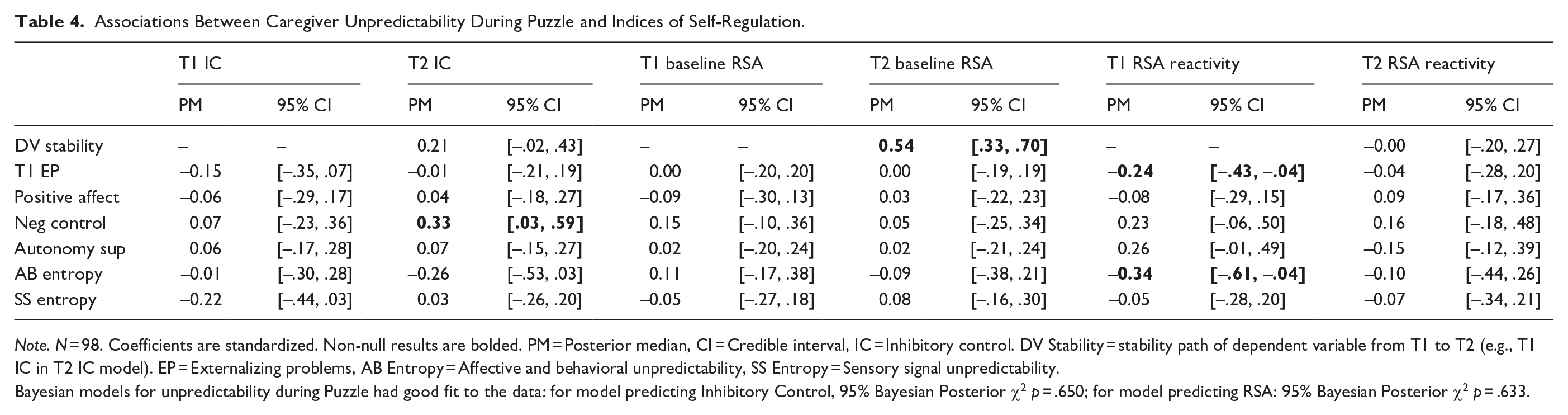
Note. N = 98. Coefficients are standardized. Non-null results are bolded. PM = Posterior median, CI = Credible interval, IC = Inhibitory control. DV Stability = stability path of dependent variable from T1 to T2 (e.g., T1 IC in T2 IC model). EP = Externalizing problems, AB Entropy = Affective and behavioral unpredictability, SS Entropy = Sensory signal unpredictability.
Bayesian models for unpredictability during Puzzle had good fit to the data: for model predicting Inhibitory Control, 95% Bayesian Posterior χ2 p = .650; for model predicting RSA: 95% Bayesian Posterior χ2 p = .633.
H2. Parasympathetic Activity
There were two associations between unpredictability and RSA in which the credible interval did not include zero. Greater affective and behavioral unpredictability during puzzle predicted more RSA suppression at T1 and greater sensory signal unpredictability during play predicted more RSA suppression at T2. Furthermore, in both models, children with more EP exhibited more RSA suppression at T1, in the model for play, more non-involvement predicted less RSA suppression at T1, and in the model for play, more negative control predicted higher T1 baseline RSA. These findings were replicated within MLR models, which identified three additional associations.
Discussion
The overarching goal of this study was to explore how maternal affective and behavioral unpredictability was associated with difficulties in concurrent and future biobehavioral regulation among young children. Our study builds on developmental theory and prior socialization research by highlighting the importance of caregivers’ consistent warmth and autonomy support during early childhood (Denham et al., 2015; Rubin et al., 2002; Thompson, 2015), and showing that children’s exposure to unpredictability in these key facets of parental socialization potentially disrupts their autonomous biobehavioral regulation (Ellis et al., 2022; Smith & Pollak, 2021).
Although we did not make directional hypotheses for RSA, there were two robust associations between maternal unpredictability and children’s parasympathetic reactivity. Higher affective and behavioral unpredictability during the puzzle was related concurrently to greater RSA suppression at T1 and higher sensory signal unpredictability during play was related prospectively to greater RSA suppression at T2. These effects were independent of average levels of maternal affect and behavior, which also had some significant associations with children’s biobehavioral regulation. All findings from the Bayesian models were replicated in the less conservative path analyses conducted in Lavaan; the latter also identified several additional associations, but these are not interpreted further as they may reflect false positive results. Overall, this study provides partial support for the proposal that caregiver unpredictability is a detrimental feature of the socialization context (Doom et al., 2024), with its effects on parasympathetic regulation potentially revealing one previously uncharted path toward childhood social wariness and associated internalizing difficulties (Aran et al., 2024; Li et al., 2023; Rubin et al., 2002, 2009).
Unpredictable Caregiving and Children’s Parasympathetic Regulation
Considering the two associations, first, children whose mothers displayed more affective and behavioral unpredictability during the puzzle task exhibited greater RSA suppression in response to the Day/Night task at age four. Unpredictable caregiving in structured tasks may hinder effective scaffolding of children’s skills and decrease their confidence (Leerkes & Augustine, 2019; Mattanah et al., 2005), increasing the likelihood of perceiving novel cognitive challenges as threatening, necessitating RSA suppression. According to the principle of neuroception (Porges, 2004), novel but non-threatening situations should elicit mild decreases in PNS activity to support attention and task orientation, whereas stronger RSA suppression could indicate that the task is perceived as threatening. As seen in the zero-order correlations (Table 2) and reported previously (Utendale et al., 2014), more RSA suppression was associated with making more errors on the Day/Night task, and children with more EP evinced both more RSA suppression and poorer inhibitory control. Maternal affective and behavioral unpredictability during collaborative problem-solving activities may contribute to preschoolers being primed to react to novel independent activities as more challenging or threatening, such that they disengage the parasympathetic down-regulatory brake and mobilize resources for withdrawal or flight responses (Holochwost & Propper, 2024; Porges, 2004, 2007).
Second, children who experienced more unpredictable sensory inputs during play showed greater RSA suppression at age 6. Sensory unpredictability during play, typically a context for exploration and mutual attunement (Feldman, 2021; Grusec & Davidov, 2010), might be experienced by children as overstimulating or over-arousing as they try to engage with both their mothers and the toys, which could disrupt children’s opportunities to internalize patterns of consistent behavioral and physiological regulation (Rubin et al., 2002; Thompson, 2015). Sensory signal unpredictability during play could contribute to an enduring tendency for children to be physiologically primed to engage with future independent tasks in which they need to regulate their own behavior as potential threats (Hastings & Kahle, 2019; Porges, 2004).
Between ages 4 and 6, IC improves significantly (Geeraerts et al., 2021), and RSA suppression becomes a more normative response to cognitive challenges, supporting attentional engagement (Hastings & Kahle, 2019; Kahle et al., 2018). Notably, some research suggests a developmental shift in RSA reactivity during early childhood, with the magnitude of RSA suppression decreasing after age 5 (Dollar et al., 2020). Whereas less RSA suppression, or even RSA augmentation, has been linked to better IC and fewer EP in preschoolers (Utendale et al., 2014), evincing stronger RSA suppression in response to an IC task may indicate increased stress reactivity in younger children, rather than efficient regulatory engagement. We observed that greater affective and behavioral unpredictability at T1 was concurrently associated with greater RSA suppression, which also was linked to more EP. This suggests that in early childhood, unpredictable caregiving may heighten physiological stress responses, potentially undermining the development of flexible regulatory strategies. Moreover, sensory unpredictability during play at T1 predicted greater RSA suppression at T2, indicating that early unpredictability may shape longer-term autonomic responses to cognitive challenges. The fact that this effect was evident despite IC performance reaching ceiling levels for many children at T2 suggests that early unpredictability may contribute to enduring patterns of stronger PNS reactivity to mild challenges, even when behavioral indicators of IC are no longer sensitive to individual differences. It is intriguing that sensory signal unpredictability predicted future threat-related physiological activation to a challenge that most children were capable of mastering, reinforcing the notion that early unpredictability has lasting consequences for regulatory functioning in daily activities. If this were to extend to children’s physiological regulation during typical social activities, such as peer interactions, it could be a biobehavioral socialization conferring risk for social withdrawal (Hastings, Rubin, et al., 2019; Rubin et al., 2002).
These findings highlight the potential impact of caregiver unpredictability on children’s PNS functioning, which may be more sensitive to unpredictability than other aspects of self-regulation. Predictable caregiver signals appear to shape early, non-volitional processes that regulate arousal in novel situations (Blair & Ku, 2022; Porges, 2007). The topological theory of early adversity emphasizes that some perceived unpredictability could be a key driver of individual differences in biobehavioral development (Smith & Pollak, 2021). Yet, unpredictable behaviors occurring on a second-to-second scale may be hard for children to consciously perceive, and the ability to perceive some—albeit, not complete—consistency and contingency may be essential for scaffolding “adaptive” changes in self-regulatory competencies (Munakata et al., 2023). Chronic stressors such as unsupportive parenting can cause lasting neurobiological changes (Hastings et al., 2023), as seen in infants exposed to unpredictable sensory input, who later exhibit blunted cortisol reactivity and imbalanced neural connectivity (Davis et al., 2022).
This study is the first to examine the relations between second-to-second unpredictability and PNS functioning. As a stress response system, the PNS is particularly sensitive to social demands and experiences (Hastings, Kahle, et al., 2019). Atypical RSA reactivity in early childhood may influence developmental trajectories, even if the RSA-behavior link is not immediately apparent (Hastings & Kahle, 2019; Hastings et al., 2008). Further research is needed, but this study provides initial evidence that sensory and affective/behavioral unpredictability can shape neurophysiological responses such as RSA reactivity to novel tasks. Should this pattern of PNS withdrawal to novelty extend to children’s responses to peer and other social situations, it could be one biobehavioral mechanism of the emerging link between parenting unpredictability and children’s social withdrawal and internalizing difficulties (Glynn et al., 2018; Li et al., 2023).
There were fewer consistent associations between average levels of parenting behaviors and children’s biobehavioral regulation in the Bayesian models. Although negative control was associated with T1 baseline and T2 inhibitory control, each association was evident in only one of the two models in which it was tested. That suggests that the covariances that negative control shared with the entropy scores during play versus puzzle may have contributed to the apparent associations of negative control with RSA measures, and that caution should be exercised in trying to interpret these findings. The finding that children with less involved caregivers during play were likely to show less RSA suppression at T1 may reflect a child-driven effect: more independent children might naturally solicit less maternal involvement in a free play context, leading mothers to take a more passive role. These same children may also be more confident and accustomed to autonomous activities, which could explain why they were not as physiologically aroused by the Day/Night task.
Inhibitory Control
Unexpectedly, there were no significant associations between unpredictability and children’s inhibitory control, an aspect of cognitive-behavioral self-regulation that has been associated with social withdrawal and internalizing difficulties (Grady et al., 2023; Vuontela et al., 2013). It is important to consider that inhibitory control at age six showed a ceiling effect with low variability, which likely reduced the statistical power to detect any longitudinal effects. Consequently, the Day/Night task at age six may not have been sensitive enough to capture potential socialization effects. Previous research has demonstrated that sensory signal unpredictability during infancy is linked to children’s later effortful control, a temperamental trait involving the ability to focus attention and inhibit impulses (Davis et al., 2017; Davis & Glynn, 2024). However, the impact of sensory unpredictability on effortful control appears to diminish by early childhood (Davis et al., 2019), suggesting that infancy may be a sensitive period for the influences of sensory signals on neurocognitive regulation.
Characterizing Unpredictability
Mothers displayed unpredictability of both sensory signals and affect and behavior, especially during the play task. Free play, typically more child-directed and unstructured, may allow for greater variability in mothers’ actions as they attempt (or fail) to match their children’s arousal levels and respect their need for exploration (Grusec & Davidov, 2010). In contrast, the puzzle task’s explicit structure as a parent-assisted task with time constraints limited the range of potential activities and likely prompted more parental scaffolding under pressure. According to Grolnick et al. (2002), when caregivers feel pressured about their children’s performance, they may prioritize outcomes over autonomy, which could reduce children’s influence on caregivers’ behaviors and allow more stable patterns of unpredictability to emerge. These findings suggest that caregiver unpredictability is sensitive to task demands, as indicated by the modest correlations between unpredictability across different tasks.
Moreover, the associations of unpredictability with children’s biobehavioral regulation varied depending on the task, highlighting the importance of examining caregiving across different interactional contexts. Free play provides opportunities for exploration and reciprocity, making sensory unpredictability particularly relevant as it may disrupt co-regulation and overstimulate children (Feldman, 2021). In contrast, the puzzle task requires structured scaffolding, where unpredictable affective and behavioral signals may interfere with children’s ability to sustain effortful engagement and apply regulatory strategies (Leerkes & Augustine, 2019; Lunkenheimer et al., 2017). By including both contexts, our study captures how unpredictability manifests in different socialization settings, allowing for a more nuanced understanding of its influence on biobehavioral regulation.
Considering the associations of unpredictability with the PCA-derived parental factors provides insight into what the entropy measure captures. Affective and behavioral unpredictability during play was positively linked with both negative control and positive affect. This behavioral pattern overlaps with the construct of “oversolicitousness,” where caregivers are highly affectionate, involved, and controlling, beyond a child’s needs (Rubin et al., 1997), and which has been repeatedly identified as a risk factor for children’s social wariness (Hastings, Rubin, et al., 2019). Conversely, affective and behavioral unpredictability during puzzle was negatively related to positive affect and positively related to negative control and autonomy support, reflecting a broader range of behaviors (i.e., behavioral variability) but expressed with less positivity. Lunkenheimer and colleagues (Lunkenheimer, Hamby, et al., 2020; Lunkenheimer, Skoranski, et al., 2020) suggested that such a pattern of behavioral variability combined with low positive content poses risks to children’s regulatory development. Behavioral variability is often conceptualized as flexibility, reflecting the ability to transition between behaviors in response to changing task demands or child cues (Lunkenheimer, Skoranski et al., 2020). Importantly, variability does not necessarily equate to unpredictability; it may instead capture intentional, adaptive shifts that align with the dynamics of the interaction, increasing overall predictability. In our study, the number or rate of behavioral transitions was moderately associated with caregiver entropy (r = .40−.53). However, when we examined the number of transitions as explanatory variables, transitions did not predict children’s RSA reactivity (see Supplemental Materials, Table S7). This suggests that it is not simply the quantity of transitions that accounts for the observed associations, but rather it is the degree of predictability in caregivers’ behaviors. Ultimately, our study indicates that caregiver unpredictability is not a uniform construct; it varies by task demands and caregiver behavior, with distinct implications for children’s physiological and behavioral outcomes.
Limitations and Future Directions
These findings should be considered in light of several limitations: (1) The sample was not representative of the broader population of the region in which the study was conducted, nor of other, more distal communities, necessitating caution when generalizing these results. Specifically, the study primarily included White, middle-class families and intentionally oversampled for children with elevated externalizing problems during early childhood. Cultural norms and socioeconomic contexts play a significant role in shaping caregiver–child interactions, including patterns of behavioral and affective variability. Thus, it remains an open question whether the observed associations would hold in other cultural communities with differing caregiving practices, family structures, or sociocultural expectations surrounding autonomy and emotional expression (Rubin & Chung, 2006). Future research should aim to replicate these findings in samples with greater ethnic, socioeconomic, national, and cultural diversity to determine the extent to which these patterns are generalizable across communities. (2) The study had a relatively small sample with considerable missing data and a low parameter-to-sample size ratio, increasing the risk of Type II errors. To address these issues, we used Bayesian estimation, as recommended by Asparouhov and Muthén (2021). However, sample size can be sensitive to uninformed priors. While the examination of trace plots and posterior distributions suggests that priors did not bias the model parameters (see Supplemental Figure S3), future studies could use more informative priors to enhance robustness (Depaoli & van de Schoot, 2017). (3) Our calculations of maternal unpredictability focused solely on caregiver behaviors, without considering how children’s emotions and behaviors may have influenced caregiver behaviors. During early childhood, children become increasingly active participants in day-to-day co-regulation processes, contributing to dyadic patterns of behavior and affect in which there are reciprocal influences between partners (Feldman, 2015; Lobo & Lunkenheimer, 2020; Lunkenheimer, Hamby, et al., 2020). Although we accounted for caregivers’ reports of children’s EP, our analyses did not account for children’s moment-to-moment actions during the tasks, which may have influenced both the levels and the entropy of material behaviors. Although children’s actions may elicit changes in caregiver behaviors in ways that reflect caregiver sensitivity, and hence may conform to patterned and predictable variations, it will be important for future studies to include coding of children’s behaviors during tasks in order to determine the extent to which caregiver unpredictability may stem from variability in children’s behaviors. (4) Regarding RSA measurement, future studies could account for respiration, speech rate, and movement as covariates to ensure RSA findings are not confounded (Shader et al., 2018). (5) Finally, this study did not employ an experimental design and therefore causal relations between maternal unpredictability and child biobehavioral regulation cannot be inferred.
Conclusion
The present study contributes to our understanding of the nuanced ways that patterns of caregiver behaviors influence children’s biobehavioral regulation. Specifically, these findings suggest that maternal unpredictability contributes to patterns of parasympathetic regulation during early childhood which may confer risk for adjustment difficulties, including social withdrawal. The preschool period is characterized by rapid increases in behavioral, cognitive, and emotional regulation functioning, which largely occur within the socializing context of parent–child relationships (Rubin et al., 1997, 2002). Better regulatory skills are associated with better psychological, social, and scholastic adjustment, setting the stage for a more positive developmental trajectory compared to children with poorer self-regulatory skills in early childhood (Blair & Ku, 2022). It is important to identify factors that facilitate versus compromise the development of biobehavioral regulation during this period, and our study reveals that the unpredictability of maternal moment-to-moment affect and behavior during dyadic interactions warrants greater attention as an aspect of caregiving environment (Davis & Glynn, 2024; Doom et al., 2024; Ugarte & Hastings, 2023). Overall, our examination of the complex interplay between different aspects of unpredictability and children’s regulation has contributed to understanding of how this understudied aspect of caregiving might impact children’s development, offering potential directions for future research and identifying potential targets for prevention and intervention aimed at supporting stability and continuity in the lives of children.
Supplemental Material
sj-docx-1-jbd-10.1177_01650254251349755 – Supplemental material for Caregiver unpredictability and the development of biobehavioral regulation during early childhood
Supplemental material, sj-docx-1-jbd-10.1177_01650254251349755 for Caregiver unpredictability and the development of biobehavioral regulation during early childhood by Elisa Ugarte and Paul D. Hastings in International Journal of Behavioral Development
Footnotes
Acknowledgements
The authors would like to thank the participating families, the students, and staff of the Affective and Behavioral Competence Development Laboratory at Concordia University (Montreal, Canada), and the research assistants of the Healthy Emotions, Relationships, and Development Laboratory at the University of California Davis, especially The authors would also like to thank the research assistants of the Healthy Emotions, Relationships, and Development Lab at UC Davis, especially Nicole Reyes Camacho, Chitra Mukherjee, and Helena Her.
Funding
The author(s) disclosed receipt of the following financial support for the research, authorship, and/or publication of this article: This research was supported by The Canadian Institutes of Health Research (MOP 67117, PI: Hastings) and by the Chilean National Agency for Research and Development (ANID) Doctoral Fellowship program (Grant 72180409 to EU), by the Erna and Orville Thompson Award (EU), and the Provost Dissertation Year Fellowship to EU.

Supplemental material
Supplemental material for this article is available online.
References
Supplementary Material
Please find the following supplemental material available below.
For Open Access articles published under a Creative Commons License, all supplemental material carries the same license as the article it is associated with.
For non-Open Access articles published, all supplemental material carries a non-exclusive license, and permission requests for re-use of supplemental material or any part of supplemental material shall be sent directly to the copyright owner as specified in the copyright notice associated with the article.
