




Abstract
This study explored the mechanisms involved in maintaining visuo-spatial information in working memory in children aged 4 to 8 years. Two experiments were conducted to determine whether different types of visual aid could support a cumulative visuo-spatial rehearsal strategy, a consolidation mechanism, or the goal maintenance in a complex span task. In Experiment 1, children memorized sequences of locations while assessing the orientation of a teddy bear that appeared in these locations marked by houses. During the interstimulus interval, we implemented four conditions of visual aid: absence of cues, all empty houses remained on screen, only the last empty house remained on screen, or a visual goal cue. Experiment 2 introduced two new conditions, one to support cumulative rehearsal by displaying on screen the houses visited in each interstimulus interval, and another with an auditory-verbal goal cue. Visual aids, particularly when presented cumulatively, substantially enhanced recall performance. On the contrary, aids designed to support consolidation or goal maintenance did not yield a substantial increase in span scores. The study underscores the potential of cumulative visual supports in improving visuo-spatial working memory performance in children, while also offering insights into the roles of consolidation and goal maintenance.
Keywords
Working memory is crucial for academic learning, as it supports the ability to hold and manipulate information over short periods (Camos & Barrouillet, 2018; Gathercole et al., 2006; Swanson, 1999). From early childhood, working memory plays a vital role in various learning processes (Alloway et al., 2009; Gathercole et al., 2016). It is involved in learning to read, text comprehension (Carretti et al., 2005), and numerical activities, predicting future success in these areas (De Smedt et al., 2009). In mathematics, working memory is linked to the development of numerical skills and problem-solving abilities (Adams & Hitch, 1997; Bull & Scerif, 2001). In language acquisition and comprehension, working memory helps children make sense of spoken language by maintaining and manipulating verbal information to understand and learn new words (Baddeley et al., 1998; Papagno & Vallar, 1992). This ability is crucial for reading comprehension, where context is used to infer the meaning of unknown words (Cain, 2006; Cain et al., 2004).
Unlike the verbal domain, we know less about how working memory works in the visuo-spatial domain in children. As with the verbal domain, storage capacity increases with age (e.g., Orsini et al., 1987), and various mechanisms are at play in the age-related improvement of memory capacity (e.g., increases in processing speed and attentional capacity, changes in long-term memory, Pickering, 2001). However, the question of strategies used to maintain information, akin to articulatory rehearsal in the verbal domain, has hardly been raised in the literature, especially in children. This study aimed to uncover children’s mnemonic mechanisms at play during a visuo-spatial working memory task by examining the impact of environmental supports.
We recently explored the use of visuo-spatial rehearsal strategy through a visual support to enhance visuo-spatial memory in children aged 3.5 to 6 years (Fitamen et al., 2024). This study implemented a complex span task, a paradigm in which participants have to maintain information while performing a concurrent task. In Fitamen et al. (2024), children had to memorize the locations of a teddy bear that successively appeared in different houses displayed at various locations while they had to evaluate the orientation of the teddy bear (upright vs. upside down). During the 2-s interstimulus interval (ISI), we manipulated the presence or absence of a visual support (see Figure 1, conditions “Without” and “All”). The visual support corresponded to the display of all the houses, while no teddy bear was shown. At recall time, children had to report the successive locations of the teddy bear only (but not its orientation). To report the locations, they had to point to the houses, in the correct order in which the teddy bear appeared. Recall performance increased in children of all ages when the support was displayed during the ISI than when it was not (no houses). This finding suggested that the visual support helped the implementation of a visuo-spatial rehearsal in young children. Visuo-spatial rehearsal of a series of locations can be depicted as the shifting of attention across the memory traces of the locations to maintain them active in working memory. Keeping the houses visible on screen would provide some physical support to this recirculation.
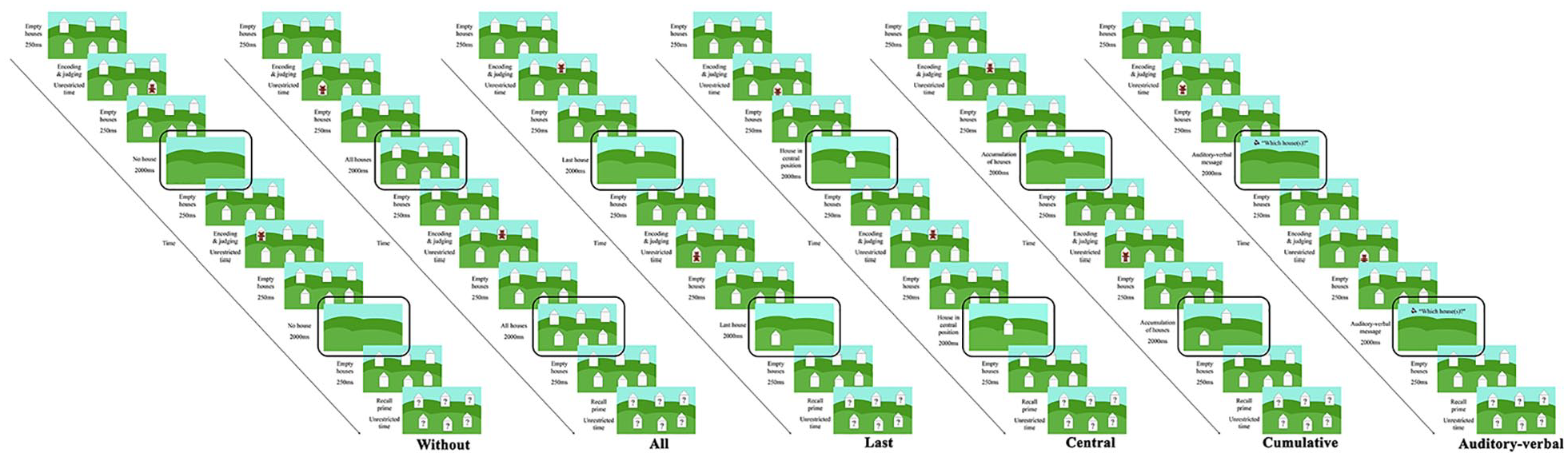
Illustration of the Conditions Presented in Experiment 1 and Experiment 2, Showing a Trial of Length of 2. Screens That Differed Between Conditions Are Circled in Black.
However, several alternative hypotheses can be put forward to account for the beneficial effect of visual cues in Fitamen et al. (2024). First, during the ISI and because this was the last location where the eyes were, children’s attention could have remained focused on the previous house where the teddy bear just appeared. The focus on this previous location would result in a consolidation of the memory trace for that specific location, leading to an improvement of the maintenance of this location in memory. Consequently, overall recall performance would improve, as the memory trace of each location presented before each ISI would be consolidated during the ISI. The consolidation helps to strengthen memory traces after encoding and the perceptual input has disappeared. Its beneficial effect on recall has been evidenced for example by Bayliss et al. (2015) study in which giving the opportunity to consolidate immediately after the presentation of each memory item led to better recall performance in young adults. Moreover, children may need more consolidation than adults as Morey et al. (2018) showed that children spent a larger proportion of time than adults at fixating each spatial position in a visuo-spatial task. A second alternative account is based on the cognitive control literature and the fact that young children tend to more easily forget the goal of a task compared with older children (goal neglect, Marcovitch et al., 2010), one may argue that the presence of the empty houses during the ISI in Fitamen et al. (2024) may play the role of a goal cue, reminding children that they actually have to remember the locations, rather than support visuo-spatial rehearsal. The design of the previous study did not allow teasing apart whether the visual aid supported visuo-spatial rehearsal of the most recent item’s location, consolidation, or goal maintenance.
Hence, in the present study, beside replicating the beneficial effect of a visual support on memory performance, Experiment 1 aimed to test whether this benefit stemmed from greater visuo-spatial rehearsal, consolidation of the most recent item, and/or goal maintenance. Experiment 2 tested the implementation of the rehearsal strategy in a cumulative way and goal maintenance with an alternative goal cue, while continuing to investigate the effect of consolidation of the most recent item as conducted in Experiment 1.
Experiment 1
First, Experiment 1 aimed to replicate the effect of visual support on recall performance previously reported by Fitamen et al. (2024). Second, to tease apart the different alternative hypotheses that could account for this effect, we introduced a new type of visual support that only displayed the location that has just been shown, which should only favor the consolidation of this most recent location without prompting visuo-spatial rehearsal of the entire memoranda. Indeed, the consolidation process has been described as taking place immediately after the presentation of the memoranda (Engle et al., 1992; Jarrold et al., 2011; Vergauwe et al., 2014), to transform transient sensory traces into more stable memory traces (De Schrijver & Barrouillet, 2017). As far as we know, no study has ever examined consolidation in children’s working memory and it remains unknown at what age consolidation may emerge. Consolidation is an attention-demanding process (Jolicœur & Dell’Acqua, 1998; Stevanovski & Jolicœur, 2007), and previous works have shown that attention is not spontaneously involved in information maintenance by children younger than 7 (Camos & Barrouillet, 2011; Oftinger & Camos, 2016; Tam et al., 2010). Hence, children may particularly benefit from a support in consolidating the just-presented location. Finally, we introduced a condition with a visual goal cue to support the maintenance of the goal of the task (i.e., recall the to-be-remembered locations). Previous studies have shown that visual goal cues proved to be efficient in executive control tasks, especially in young children sensitive to goal neglect (Blaye & Chevalier, 2011; Chevalier & Blaye, 2009). Hence, an appropriate visual support may help children to maintain the goal of remembering the teddy bear’s locations, and thus improve recall performance. To dissociate the effect of goal reminder of this specific visual cue from its potential role in supporting the implementation of strategies, we used a visual cue that should not allow for the establishment of a memorization strategy. In the previous study by Fitamen et al. (2024), this dissociation was not feasible because while the houses could serve as goal reminders during the delay, their locations also corresponded to possible encoding locations for the teddy bear. Therefore, in the present study, we displayed a single house in the center of the screen, which did not correspond to any location to be memorized and could only serve as a goal reminder.
To summarize, we expected recall to be improved in any condition that provides an adequate support (named “All,” “Last,” “Central”) in comparison with the baseline condition which has no support (named “Without”).
Method
Participants
Forty-one (25 females and 16 males) children ranging from 4;6 to 8;0 years (Mage = 6;3, SD = 1;10) took part in the experiment. 1 Children were all French speakers. The experiment took place in a quiet room at the children’s school. The experiment was approved by the Internal Review Board of the Department of Psychology of the University of Fribourg (Ref-No.: 182R). We gathered written, informed consent from the parents or legal guardians, and children gave their assent orally before beginning the experiment. Data from additional participants were discarded due to technical issues (eight children), and because their mean response time to the orientation task exceeded from 3 SDs the mean time in at least one of the four conditions (two children).
Materiel
The task was presented on a laptop with a 13-inch screen and was built with E-Prime 2.0 (Psychology Software Tools, 2012). In each trial, a teddy bear appeared sequentially in a random order across locations, all set against a countryside background image (Figure 1), with no location repeated within the same trial. It was oriented randomly (either upward or downward) in one of the six houses (rectangles measuring 3.3 × 3.7 cm). The sequence length varied from 1 to 5 locations, with each length comprising four trials.
Procedure
Children memorized sequences of locations where a teddy bear appeared, while assessing whether the bear was upward or downward (named the “orientation task”). The bear stayed visible until a response was made (key press on one of two keys labeled with a corresponding picture), then it disappeared for 2500 ms before reappearing in another location. At the beginning and at the end of the 2500 ms delay, the houses remained empty for 250 ms. For the remaining 2000 ms, participants were presented with four conditions (Figure 1). In the “Without” condition, the screen showed only the countryside background without any houses. The “All” condition displayed all the empty houses. To test the consolidation hypothesis, the “Last” condition revealed only the last house visited by the teddy bear for each serial position. Finally, to test the goal reminder hypothesis the “Central” condition featured a single house at the center of the screen. This house did not correspond to any of the bear’s potential locations. At the end of a trial, in all conditions, a question mark appearing in each house prompted the onset of the recall phase. The child was instructed to point successively at each house visited by the teddy bear in the order of appearance. As the screen was not a touch screen, an experimenter seated next to the child logged their answers via a numeric keypad. Children completed all four test conditions, in a counterbalanced order. In each condition, the task was discontinued after a child failed to correctly recall all trials of a given length. Recall was considered correct when all locations were recalled in the order of presentation with no omissions or additions. The testing session lasted a maximum of 2 × 20 min, with a 30-min break after two conditions.
The session started with a practice phase. First, children practiced the orientation task. The teddy bear appeared upright or upside down in one of the six houses in a pseudo-random order, six times in a row. Children had to press the corresponding key on the keyboard to judge the orientation of the teddy bear each time it appears. During this training phase, the child was required to answer correctly to proceed to the next trial, otherwise the bear remained on screen. Second, children practiced the memory task with one trial of Length 1 and Length 2. Each trial proceeded in the same way as the experimental phase described earlier, and the experimental condition presented during the training was identical to the first condition presented in the experimental phase.
Data Analysis
Response time and accuracy were recorded for the orientation task. Before analyzing recall performance, we checked that participants complied well with the instructions of maintenance of information in face of a concurrent task (here the orientation task) and showed high accuracy scores. For the memory task, a span score was calculated for each child in each condition. Each correctly recalled series of a given length (i.e., in which all the locations were correctly recalled in the order of presentation) was attributed a score of .25, leading to a maximal score of 1 point per length (Barrouillet et al., 2009; Bertrand & Camos, 2015; Smyth & Scholey, 1992). To complete the span scores, errors were also collected. Three types of errors were observed: repetitions, omissions, and intrusions. A repetition occurs when a child points to the same house two or more times during the recall of a trial. An omission is the failure to recall a location that was presented in a trial. An intrusion is the recall of a location that was not presented in a trial. Each score was converted into a percentage, 2 considering the stop rule.
All Bayesian statistical analyses were performed using JASP 0.18.3 (2024). In each of the following analyses for every type of score, at least one condition exhibited a non-normal distribution. Therefore, we consistently employed a Bayesian Wilcoxon Signed-Rank Test using the default settings (1,000 samples and prior probability of .707). A BF10 between 1 and 3 was considered to provide anecdotal evidence for the alternative hypothesis; a BF10 between 1 and 0.33 was considered to provide anecdotal evidence for the null hypothesis; both ranges were considered inconclusive. Then, a BF10 between 3 and 10 was substantial evidence for the alternative hypothesis, 10 and 30 was strong, 30 and 100 was very strong, and over 100 was decisive. Similarly, a BF10 between 0.33 and 0.10 was substantial evidence for the null hypothesis, 0.10 and 0.03 was strong, 0.03 and 0.01 was very strong, and over 0.01 was decisive (Dienes, 2014; Jeffreys, 1961).
Results
Anonymized data are available at https://osf.io/5angz/?view_only=51d714ff4135421991731b42403cebad.
First, we verified that children complied similarly with instructions across conditions, that is, that performance in the concurrent orientation task, measured in accuracy and response times, did not differ between the “Without” condition and each of the conditions with visual support. The statistical analyses are reported in Table 1.
Type of Scores in Both Experiments With Mean, 95% Credible Interval, and the BF10 of the Comparison Between Each Condition and the Without Condition.
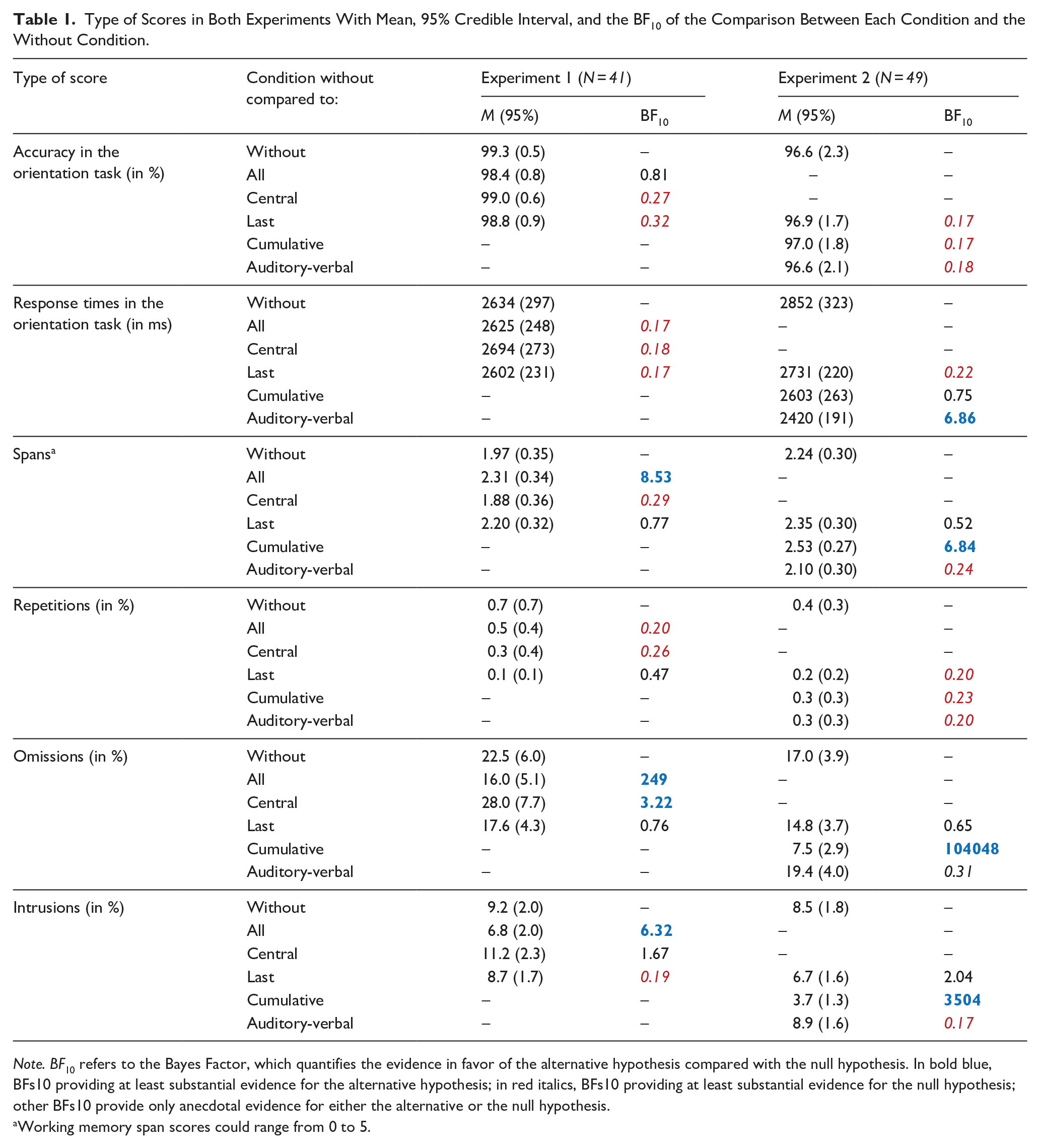
Note. BF10 refers to the Bayes Factor, which quantifies the evidence in favor of the alternative hypothesis compared with the null hypothesis. In bold blue, BFs10 providing at least substantial evidence for the alternative hypothesis; in red italics, BFs10 providing at least substantial evidence for the null hypothesis; other BFs10 provide only anecdotal evidence for either the alternative or the null hypothesis.
Working memory span scores could range from 0 to 5.
Similar analyses were conducted on memory performance assessed by span scores to test the different predictions by comparing each experimental condition to the Without condition (Table 1). We did not use analysis of variance (ANOVA) or a non-parametric equivalent to analyze the four conditions together because we did not have any hypothesis regarding a cumulative effect across experimental conditions or on the superiority of one manipulation over another. To summarize, children’s performance was substantially better in the All than in the Without condition, and comparable between the Central and Without conditions. Finally, the performance in the Last condition was better than the Without condition, yet anecdotally.
Finally, similar analyses on percentages of memory error revealed that the All condition substantially and decisively reduced intrusions and omissions, respectively, yet it did not impact repetitions compared with the Without condition. The Central condition substantially increased omissions, while the Last condition decreased repetitions and omissions, although anecdotally, in comparison with the Without condition (Table 1).
Discussion
The aim of Experiment 1 was to replicate the beneficial effect of the visual support and to disentangle the role of visuo-spatial rehearsal from the impact of consolidation and goal maintenance on working memory performance. First, Experiment 1 replicated the main finding of Fitamen et al. (2024), that is, the presentation of all houses during the ISI benefits recall performance. Error analysis provided further support to this view. The number of intrusions and omissions were, at least, substantially reduced in the All condition compared with the Without condition. Second, the current findings did not provide clear support for the alternative explanation that the presence of all houses supports mostly the consolidation of the last presented item instead of visuo-spatial rehearsal of the entire set. Recall performance in condition in which only the last house remained on screen during the ISI increased, but anecdotally compared with the condition without any houses. Thus, the Last condition was not clearly positioned in favor of either the alternative or null hypothesis, rendering the interpretation in Experiment 1 inconclusive concerning the role of consolidation. The repetition and intrusion errors were reduced, but here too, the Bayes factor was inconclusive. To summarize, these results highlighted, on one hand, the robustness of the effect of the condition with all the houses, although on the other hand, they do not allow to fully discard or confirm a role to consolidation. This latter result may suggest that the consolidation of the last item plays a role in the improvement reported with all houses, but at best to a small extent.
Concerning the second alternative hypothesis referring to a support of goal maintenance, the condition with the central house clearly showed a lack of effect on recall, even substantially increasing omission errors when it was compared with the Without condition. Moreover, the results provide further clarification in a way that they revealed a strong effect supporting a performance difference between the conditions All and Central, BF10 = 17.7. Specifically, the span score was higher in the All condition (confidence interval [CI] = [2.31, 0.34]) compared with the Central condition (CI = [1.88, 0.36]). This suggests that goal cue alone, the central house, without supporting visuo-spatial rehearsal, cannot solely account for the performance improvement observed in the All condition. This finding clearly contradicts the alternative suggestion that houses supported only goal maintenance. However, it cannot be excluded that the visual cue used in Experiment 1 was not the optimal format to elicit goal maintenance (Chevalier & Blaye, 2009), and that at least part of the recall improvement reported in condition with support could result from a better goal maintenance. It is also conceivable that presenting a central house irrelevant for the memorization of locations could have interfered with the locations to be memorized, thus potentially counteracting the aid brought by this type of goal reminder. Thus, in Experiment 2, as an ultimate test to the goal maintenance hypothesis, we tested another type of goal reminder that could not produce any spatial interference. Inspired by Chevalier and Blaye (2009), who showed that best cues are presented in an auditory-verbal modality, we introduced one condition with an auditory-verbal goal reminder. The verbal code has been suggested as the one under which the goal is actively maintained (Gruber & Goschke, 2004). If goal neglect accounts (even in part) for the poorer working memory performance in young children, providing a goal reminder should improve recall performance especially in the younger group of children.
Finally, we took the opportunity of Experiment 2 to test how visuo-spatial rehearsal is implemented, that is, in a cumulative way. Cumulative rehearsal is the more advanced way to implement verbal rehearsal because it requires the repetition of the verbal information to be memorized in their order of presentation with the addition to the series of the new item after its presentation (Gathercole & Hitch, 1993; Halliday et al., 1990; Hitch et al., 1991). In the visuo-spatial domain, empirical evidence for a cumulative implementation of visuo-spatial rehearsal is lacking in children, and only recently has the hypothesis been put forward that young children would use a strategy of covert (visuo-spatial) cumulative rehearsal (Morey et al., 2018). According to the authors, this hypothesis was supported by patterns of eye fixations. However, Morey et al. (2018) only reported adjacent fixations during retention (i.e., the successive fixations of two locations presented one after the other at encoding), and no data were provided on cumulative gaze behaviors (i.e., when the eyes move across all locations in their order of presentation) when locations must be maintained (i.e., in the ISI). Experiment 2 tested the hypothesis of an early implementation of a cumulative visuo-spatial rehearsal strategy by introducing a new condition that presented the houses in a cumulative way throughout the trial to scaffold the cumulative rehearsal.
Experiment 2
The aim of Experiment 2 was to disentangle between different accounts of the recall improvement reported in conditions with all houses (Fitamen et al., 2024) and replicated in Experiment 1. Children were presented four conditions, including the Without condition as the baseline. The Last condition previously presented in Experiment 1 was kept to assess its effect and due to inconclusive results about span increase and reduction of errors in Experiment 1. The novelty of Experiment 2 lies in the addition of a condition in which only the houses previously visited by the bear remained on screen during the ISI. In this condition, children saw the number of houses increasing throughout the trial, which accumulated relevant location cues and should encourage and guide the use of cumulative rehearsal. We expected that this so-called Cumulative condition should lead to better memory performance than the Without condition. Finally, in an attempt to provide a more efficient cue to support goal maintenance, we added a condition with an auditory-verbal goal reminder, named the auditory-verbal condition. Although the goal reminder in Experiment 1 did not impact recall performance, using a verbal modality with a transparent message may provide the adequate goal reminder in children known for goal neglect, leading to an improvement in recall performance.
Method
Participants
Forty-nine (32 females and 17 males) children ranging from 4;1 to 7;7 years (Mage = 6;0, SD = 1;0) participated in the experiment. None of them participated in Experiment 1. Data from additional participants were discarded due to a span score of 0 (one child), because their mean RT (Response Time) to the orientation task exceeded from 3 SDs the mean time of their age group in at least one of the fours conditions (four children), and because their mean accuracy in the orientation task was below chance level (three children).
Materiel and Procedure
Children were tested with a procedure based on Experiment 1 with some changes. Without and Last conditions were identical to Experiment 1. The Cumulative condition showed on screen the houses where the teddy bear had been displayed until the ISI. Hence, the number of houses remaining visible during ISI progressively increased across trials (Figure 1). In the auditory-verbal condition, the countryside landscape without any houses remained on screen during the 2000 ms delay, but a verbal message was auditorily played from the beginning of the ISI saying “Which house(s)?” 3 and was only played once within each ISI (Figure 1).
Results
Similar analyses were performed as in Experiment 1. For the concurrent orientation task, accuracy was high in all conditions and did not differ across conditions. Only the response time was substantially lower in the auditory-verbal condition (Table 1).
Concerning the span scores, the Cumulative condition led to better memory performance than the Without condition. The auditory-verbal condition had no effect on recall, while the Last condition only slightly increased recall, without supporting either the alternative hypothesis or the null hypothesis (Table 1).
Finally, regarding memory errors, the Cumulative condition reduced both omissions and intrusions, while the Last condition also decreased omissions and intrusions but without a clear bias toward either the alternative hypothesis or the null hypothesis. The auditory-verbal condition had no effect on the error scores (Table 1).
Discussion
The novel finding of Experiment 2 was the evidence that providing placeholders in a cumulative way helped children to remember the houses the teddy bear visited, suggesting the implementation of a visuo-spatial cumulative rehearsal. In addition, the Cumulative condition decisively reduced the number of omissions and intrusions. These beneficial effects contrasted sharply with the ineffectiveness of our goal cue on children’s memory performance, aside from a reduction in the response times in the orientation task. This may indicate that goal reminders, at least those used in the present study, are inefficient in young children to improve performance in a visuo-spatial working memory task. Finally, the Last condition did not provide the necessary materials to support recall performance. While it slightly reduced the number of omissions and intrusions, and improved span score, the statistical analyses were once again inconclusive.
General Discussion
The present study addressed the role of visual rehearsal strategies in working memory development. The results demonstrated the robustness of the beneficial effect of the visual support on span scores by replicating in Experiment 1 the effect of the support previously reported in Fitamen et al. (2024). This replication speaks to the reliability of visual supports as a tool for enhancing working memory span and provides a foundation for examining specific mechanisms at play in visuo-spatial rehearsal. Then, in Experiment 2, we specifically tackled the question of how visuo-spatial rehearsal is implemented by introducing a Cumulative condition, in which visual supports appeared cumulatively as the number of to-be-memorized locations increased within a trial. We hypothesized that, like the well-known verbal rehearsal in which verbal items are cumulatively rehearsed, a visuo-spatial rehearsal may also work cumulatively. Experiment 2 showed that the Cumulative condition improved recall compared with an absence of supports. One might question whether recall improvement could be attributed solely to the visual presence of all locations prior to the recall task, as was observed in Morey et al.’s (2018) study where a puppy’s path was color-highlighted only before memory testing. However, our findings suggest that the cumulative aspect of the supports throughout the trial is central to facilitating serial recall in visuo-spatial working memory tasks. Consequently, the ultimate visualization of all locations to be remembered cannot be deemed the sole contributor to recall improvement, given the imperative of retaining the sequence of presentation. It would indeed be through the mimicry of the accumulation of locations throughout the trial and thanks to the support that could have encouraged the children to maintain the locations in order.
The study also allowed some examination of the role of consolidation of the last item, a process whereby information becomes more stably encoded in memory over time, distinct from rehearsal, which involves active repetition to maintain information in memory. The supports in the Last condition, even though they did not lead to a substantial increase in span scores, contributed to reducing the errors and increasing span scores, albeit anecdotally. This suggests that while consolidation may aid in stabilizing representations of the last presented item, it cannot by itself provide the observable advantage of the all houses condition. Hence, supporting consolidation alone may not be sufficient to improve visuo-spatial working memory recall at these early ages.
Finally, we examined the impact of goal reminders on working memory performance. Knowing the negative impact of goal neglect in executive control tasks (e.g., Chevalier & Blaye, 2008; Duncan et al., 1996; Morton & Munakata, 2002), one may question whether goal neglect in preschoolers would impact working memory performance. As a consequence, cues supporting goal maintenance have been shown to help children improve their performance (Kray et al., 2004; Lucenet et al., 2014). In working memory tasks, one can propose that goal cueing would give the necessary support for maintaining sufficiently active the goal so as to improve preschoolers recall performance. We used two different types of goal reminders, either visual or verbal, the latter being more transparent and less interfering in the spatial domain. In none of the two experiments, the goal reminder had a beneficial effect on recall performance. With the restriction that we only tested two different types of cues, and that others may have an effect, which is still to be assessed, the current study speaks against an impact of goal neglect on the age-related change in working memory. Our finding echoes with Fitamen et al. (2019, 2022), who also did not observe any improvement in goal cued condition in verbal working memory.
To conclude, this study shed light on the promising potential of visuo-spatial rehearsal in early childhood. While we offer initial insights into the possible mechanisms of visuo-spatial rehearsal (notably, its cumulative nature), it is clear that visual supports persisting in the environment enhance children’s working memory performance. These findings open the way to a simple and effective strategy for aiding young learners in classroom settings, particularly during tasks that require the memorization and manipulation of visuo-spatial information. Further research is required to fully understand the intricacies of this process and to refine the methods that best support the development of visuo-spatial working memory in children.
Footnotes
Acknowledgements
We thank the participating teaching teams, the children, and their caretakers. We also thank Nicolas Egger, Sabrina Gameiro Lopes, Céline Jaquet, Victoria Messina, Azemina Pargan, Jennifer Savary for their help in collecting data, and Nayla Sokhn for programming.
Declaration of Conflicting Interests
The author(s) declared no potential conflicts of interest with respect to the research, authorship, and/or publication of this article.
Funding
The author(s) received no financial support for the research, authorship, and/or publication of this article.
