




Abstract
In this article, I argue that kindness provides a foundation for realizing our humane potential for goodness and contributes to a flourishing, humane society. Using data from diverse contexts, I describe the development of different dimensions of kindness, as well as central cognitive, biological, and socialization foundations and antecedents. Next, I describe the impacts of kindness on children’s thriving, mental health, and ethical development. Finally, I describe the need for relational practices of care and present attempts to nurture kindness through community-based interventions. Humanity needs to grow kindness to overcome the current age of division and end conflict and violence.
We live in an age of division. No day goes by without us encountering disagreement, conflict, or even violence. Values of caring and justice have been shaken, and chaos has become the new normal. Every day, we are learning to navigate a new world. We can ask ourselves how developmental science and we as researchers and human beings can contribute to a less violent and more caring, more humane world. We can reflect on historical and personal mistakes and how they contributed to a state of disarray. The goal of this article is to discuss the role of kindness in our process of becoming human(e) as a foundation to grow our full potential for goodness. Taking a developmental lens, I will argue that sensitive attempts to nurture kindness are what help us realize our best selves, live peacefully together, and flourish as societies.
In the following, I will outline what kindness is and why kindness is a psychological way to deal with darkness and violence. Taking a scientific approach can not only help us understand the roots, mechanisms, and consequences of kindness but also inform new ways and refine existing attempts to nurture it in every child and community. Next, I will selectively review research about the development of dimensions of kindness, its antecedents and mechanisms, as well as consequences of kindness. I will then summarize relational practices of care as a foundation to strengthen kindness through nurturing relationships in developmentally sensitive ways across different layers of socialization. Finally, I present training efforts to nurture kindness in every child through caregiver and teacher training, and how such approaches can transfigure educational practices aimed at fostering every child’s unique capacities and full potential in school and community settings. Such attempts, I conclude, can help us become humane.
Kindness and Human Nature
Homo homini lupus est
This proverb, literally translated as “man is a wolf to man,” depicts the dark side of human nature, including cruelty, callous-unemotional traits, and brutality. Sigmund Freud, one of the founding fathers of clinical psychology, concluded in Civilization and its Discontents (Freud, 1930), that no one through their life experiences could possibly deny the inherent aggressiveness and destructiveness of human nature. Certainly, this dark conclusion is colored by Freud’s own experiences of WW2, forced migration, and the disaster that the Nazi regime created. While aggression is part of the human nature, humans also are inherently social creatures. With this comes our infinite potentiality for goodness and our capacity to move beyond the mere defense of self-interest and protection of in-group interests and resources through force and power.
From a developmental perspective, we may therefore ask for the roots, mechanisms, and antecedents of the benevolent side of our nature and, relatedly, how we can support the potentiality to become kind and caring in an age where division, disagreement, and violence appear predominant.
Kindness and Its Development
What is kindness? One fundamental way to be kind is to identify and show what we have in common as fellow human beings, such as sharing the same sorrows and joys, rather than highlighting the differences or imaginary walls erected between cultures, religions, or ethnicities (Shafak, 2020). Kindness thus reflects an understanding of the inherent similarity between us and other humans (Buber, 1923/2021). In developmental psychology, the concept of kindness has been defined as a genuine, age-appropriate concern for the welfare of other beings and the self (Malti, 2020b). As such, kindness expresses a particular sensitivity for others, their sorrows, hopes, and needs, as well as for one’s own pain and needs. That is, to treat yourself and others with gentleness and compassion. It is a conscious choice and can be developed from within (Niemiec, 2022). Developing our potential for kindness is an important milestone for self-actualization (Maslow, 1943). Ultimately, kindness reflects a considerate stance toward life, which creates meaning and purpose. It reflects an appreciation of the dignity of every human being and an understanding that all life is valuable, that is, reverence for life (Schweitzer, 1963).
As I have described elsewhere, kindness comprises kind emotions and kind cognitions; both can translate into kind actions, including various types of prosocial behaviors, such as helping, comforting, or sharing (Malti, 2020b). In this article, the focus is on kind emotions because of their central role in the development and expressions of kindness. For a more detailed description of kind cognitions and kind actions, see Malti (2020b) and Malti and Davidov (2023).
Kind emotions involve sympathy and empathy for others, which are elicited when seeing another in distress (Eisenberg et al., 2015; Hoffman, 2001). Sympathy refers to feeling concern for another in distress or need, whereas empathy refers to the ability to feel what another is feeling. Both require a basic awareness of one’s own and others’ emotional states (Eisenberg et al., 2015). Kind emotions can also be directed toward the self. Showing empathy with oneself and being compassionate toward oneself might result in self-care practices such as taking time for oneself (i.e., empathy toward the self; Gibhardt et al., 2024). Figure 1 illustrates a conceptual framework to describe the affective components of kindness, that is, the three Es (Malti, 2020a).
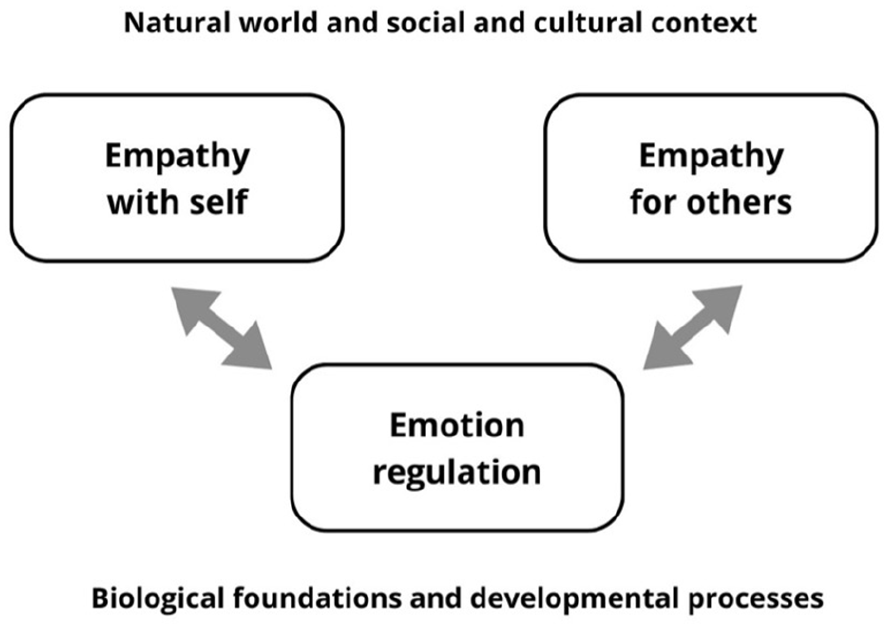
The Three Es (Malti, 2020a).
As can be seen, the three Es include empathy for others, empathy with self, and emotion regulation. Empathy for others often underlies prosocial behaviors. It develops dramatically in the first years of life. Concern for others in distress has been shown to emerge as early as 3 months (Davidov et al., 2021). There is some evidence that such distress (evoked by the stress of another) can predict subsequent empathic concern if sufficient regulatory abilities also develop (Abramson et al., 2019). Thus, other-oriented responses to another’s distress, such as concerned affect focused on the other and exploration of the other’s states, may serve as early precursors of empathic concern. More sophisticated empathic responding, such as expressions of multifaceted empathic concern and nuanced empathic reasoning, gradually increases from early to late childhood (Davidov et al., 2013; Malti et al., 2013; Svetlova et al., 2010).
Research has also shown that children differentiate their empathic and prosocial responses based on recipients’ characteristics. For instance, one study showed that both 4- and 8-year-old children’s sharing increased when recipients were needy (e.g., feels sad or has few toys) or morally deserving (e.g., shares with others; Malti et al., 2016). In addition, there is some evidence that children’s overt empathic tendencies can facilitate empathic responses and prosocial behaviors toward out-group members (Sierksma et al., 2015; Taylor et al., 2022). Witnessing kindness in others can elicit other-oriented kind emotions, such as respect and elevation (Schnall et al., 2010). For instance, respect for others is elicited when witnessing another engage in ethically good behavior (Malti et al., 2020).
Empathy with the self is directed inward and involves feelings of gentleness and warmth, for instance, with one’s pain. As such, it may facilitate prosocial behaviors, such as helping oneself to overcome pain or practices of forgiveness (e.g., forgiving one’s limitations). This may help individuals release the burden of unhealthy guilt (Nhat Hanh, 2020), such as neurotic feelings of sadness that are disproportionate to the amount of wrongdoing or arise after having violated personal norms or social conventions. In contrast, healthy guilt occurs after violating moral principles (such as harming others) and has been shown to facilitate prosocial behaviors (Malti & Krettenauer, 2013).
While I have theorized elsewhere that empathy with the self can help children cope with environmental challenges and develop a sense of inner strength (Malti, 2020b), this notion has only received indirect empirical evidence thus far. More specifically, practicing loving-kindness meditation, which is a way to nurture empathy with the self, has been shown to increase both compassion toward the self as well as empathy for others in adults (Colzato et al., 2012).
Other kind emotions directed inward can also be negatively valanced, such as feeling healthy guilt after transgressing own norms and assuming responsibility (Malti & Ongley, 2014). Children increasingly begin to report sadness over wrongdoing in response to transgressions, such as hurting another child emotionally or physically, between 3 and 5 years (Malti, 2016). Guilt over wrongdoing implies an understanding that one has harmed another (Malti & Keller, 2010). Such self-oriented negatively valanced emotions are considered kind because they motivate children to reflect on themselves and can help them engage in reparative and other prosocial behaviors and refrain from aggression (Colasante et al., 2022).
Finally, the three Es model includes emotion regulation as a foundation for the other two Es. Emotion regulation helps us deal with strong impulses and balance self- and other-oriented needs. Developmental research shows that emotion regulation strongly develops across the first decade of life and continues to develop throughout the lifespan (Eisenberg et al., 2010). In a recent meta-analytic review, emotion regulation predicted empathy with others (i.e., sympathy) positively (Yavuz et al., 2024), showing its foundational role in empathy for others. In sum, kindness is an umbrella term and describes a gentleness and deep feelings of concern for others and the self. It can incorporate emotions, cognitions, and actions. Both kind emotions and kind cognitions are hypothesized to underlie and motivate kind and caring behaviors (Gibhardt et al., 2024), yet kind emotions are particularly relevant for the development of kindness because of their central role in identity formation and development.
The first two Es, empathy with others and empathy with the self, are conceptualized as two distinct, yet interrelated subtypes of kindness and considered necessary components of kindness. In contrast, emotion regulation is considered a foundation for empathy with others and self and, as such, facilitates their development.
Foundations of Kindness
Foundations of kindness are multifaceted and include psychological, biological, and social dimensions (Malti & Dys, 2018). Here, I selectively discuss three foundational mechanisms at the psychological, biological, and social levels.
Regarding psychological foundations, we have investigated cognitive processes as potential mechanisms underlying the development of kindness. More specifically, we explored the role of attention allocation in children’s kindness-related emotions. The ways in which we attend to different environmental cues during ethical conflicts involving others’ welfare inherently relate to our emotional experiences and expressions of kindness. Our capacity to attend to specific cues, such as other-oriented cues, may therefore relate to the development of kind emotions, such as empathy with others or feelings of healthy guilt following our own ethical wrongdoing. Focusing our attention is an important cognitive mechanism to promote concentration, and it can help us perceive subtle cues of others. Based on this theoretical framework, Dys and colleagues (2022) examined whether children’s attention to two types of competing cues (i.e., other-oriented vs. self-serving cues) during transgressions related to their self-reported kind emotions. A sample of 224 4- and 8-year-old children from Canada participated in this cross-sectional study. Using eye tracking, the findings revealed that most 4-year-old children spend more time attending to self-serving cues than other-oriented cues. In addition, higher scores on attentional orientation (i.e., more other-oriented attention compared with self-serving attention or smaller gaps between the two) were related to more kind emotions, but not selfish emotions, across ages. This result indicates attention’s importance in developing kind emotions, such as feeling guilty after transgressing ethical rules. This link between attention focusing and expressions of kind emotions shows that children’s attention modulates to what extent they process different cues. Transgressions involve violating societal norms and focusing on related cues—along with the corresponding decrease in physiological arousal—may help one recognize the serious nature of the violation and its consequences on others, potentially leading to kind emotions (Dys et al., 2022). Thus, attention focus may serve as an antecedent of kind emotions, which, in turn, facilitate kind actions.
Regarding biological foundations of kindness, one body of research has focused on physiological arousal and regulation and its role in the expression of kind emotions. For instance, Colasante and colleagues (2022) examined associations between heart rate (HR) reactivity and reported feelings of guilt in response to an ethical transgression (i.e., pushing another child). Self-reported feelings and HR reactivity were measured while children imagined committing such an ethical transgression in cohorts of 4- and 8-year-olds cross-sectionally and 2 years later. Children who showed greater HR accelerations in response to the ethical versus a nonethical transgression (i.e., violating moral norms vs. personal norms or social conventions) over time tended to show parallel increases in self-reported guilt feelings across ages. This sensitivity at the physiological reactivity level predicted declines in caregiver-reported aggression. Similarly, physiological arousal has been associated with prosocial responses in children. Thus, physiological reactivity may serve as a mechanism that directly facilitates the expression of kind emotions and kind behaviors. Patterns of flexible physiological responding seem to predict indices of prosociality positively, whereas heightened and hypoarousal can undermine prosociality (Miller, 2018).
Another biological mechanism in children’s prosociality and kindness that has received attention in the literature is the neurohormone oxytocin. Oxytocin modulates care systems to support offspring (Marsh et al., 2021). There is evidence that parental oxytocin release and behavioral synchrony between parent and child are associated with prosocial, kind dispositions in the early years (Feldman, 2012). A potential direct link between oxytocin and dimensions of kindness has been explained by the fact that an understanding of other’s and one’s own emotions and regulation of distress are all aspects modulated by oxytocin (Colonnello et al., 2017).
The socialization foundations of kindness are multifaceted and span from dyadic interactions with friends, caregivers, and peers, to group and community influences in the proximal environment, to relationships in the digital world, and to distal environmental influences in the natural environment (Hastings et al., 2015).
Figure 2 displays the Web of Care (Malti & Speidel, 2024), a theoretical model to describe the social and cultural influences on kindness across development. The Web of Care reflects a holistic, relational–developmental approach to human kindness and caring and serves as a conceptual framework to understand the socialization of kindness and caring. 1 Accordingly, caring, kind individuals are embedded in caring communities and relationships between the individuals and others (including caregivers, friends, peers, and groups). Communities are embedded in the natural environment and include interactions between humans with nature and other species. Beyond nature, all layers are part of the cosmos, reflecting relationships between humans and the broader world.
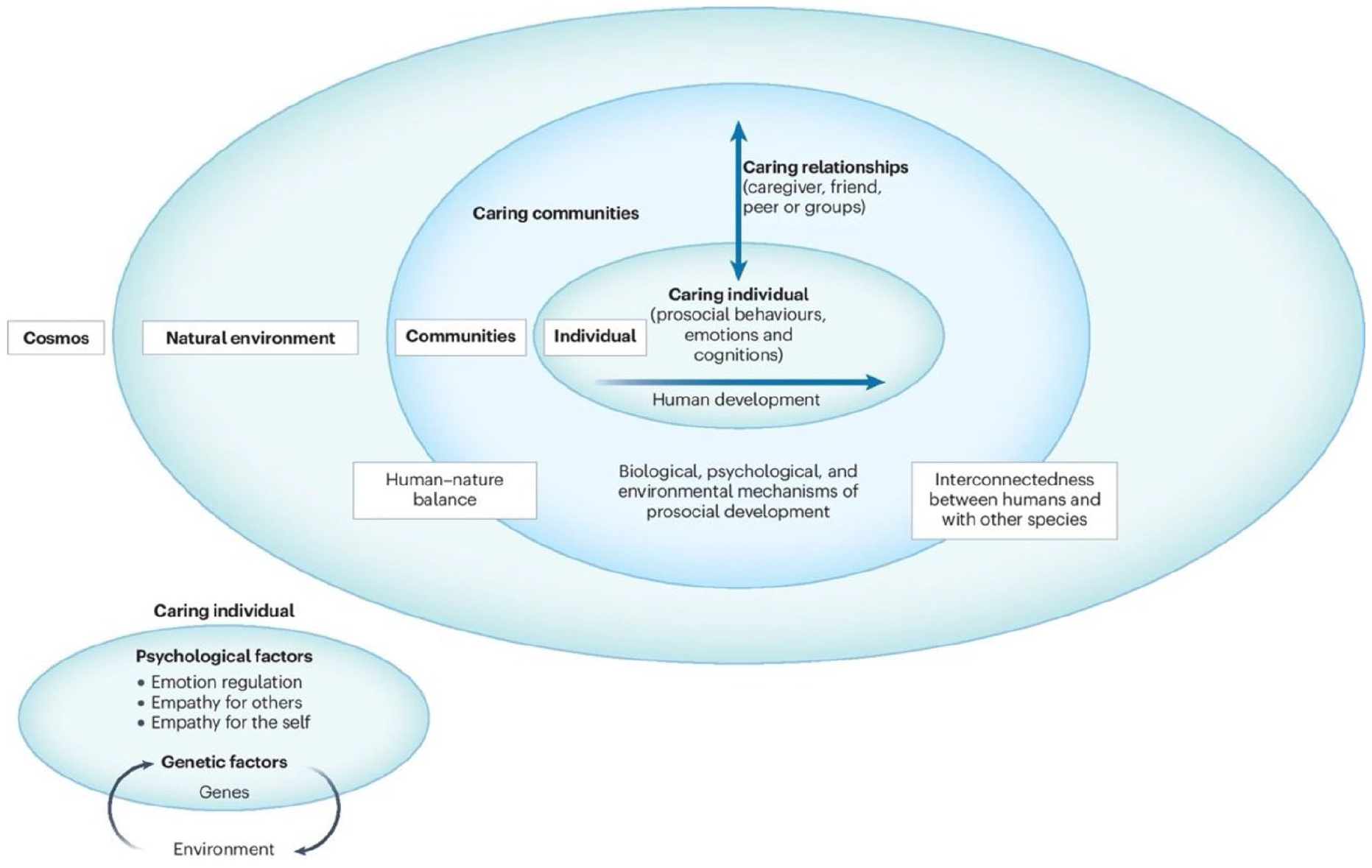
The Web of Care (Reprint from Malti & Speidel, 2024).
The Web of Care acknowledges the interconnectedness of our being with others and reflects the view that kindness and caring are inherently relational, acknowledging that all elements of existence are interdependent (Nhat Hanh, 2017). Developmental research on the socialization and relational antecedents of prosociality and kindness has identified a multitude of factors that can underlie dimensions of kindness and its development (for comprehensive reviews, see Malti & Davidov, 2023). The most prominent dimensions of kindness that have been studied are sympathy/empathy for others and prosocial behaviors, and the selective review will focus on these two dimensions of kindness.
One more recent line of work has explored exposure to environmental adversity at the family and community levels and its role in children’s development of kindness and mental health. For example, Speidel et al. (2021) found a negative link between sympathy (i.e., empathy for others) and aggressive behaviors in a sample of Syrian refugee children who had experienced severe pre-migratory adversity. This finding shows that sympathy can buffer against the deleterious effects of pre-migratory adversity in refugee children. Thus, exposure to adverse circumstances may not always lead to negative consequences in child development if psychological resilience factors, such as sympathy, exist. This interpretation is further confirmed by the concept of altruism born of suffering, which can explain how children become more empathetic toward others’ pain and suffering following adverse environmental event(s), which, in turn, can motivate reparative and other prosocial behaviors (Staub & Vollhardt, 2008).
What has received less attention in the literature is the question of how exposure to positive experiences is associated with the development of kindness. Related research on parenting and prosocial behavior has shown that support, warmth, and general parental positivity are linked to increased prosocial behaviors (Knafo & Plomin, 2006; van der Storm et al., 2021).
Beyond socialization mechanisms of prosocial behavior, a related body of research has inquired about the role of culture in the socialization of children’s empathy/sympathy and prosociality. Cultural socialization models indicate that parenting practices are influenced by personal cultural values and traditions, which, in turn, influence children’s prosocial behaviors (Carlo et al., 2014). Some studies have also explored differences in cultural expressions of kindness. For example, Trommsdorff and colleagues (2007) investigated differences between Western and South-East Asian cultures in expressions of sympathy. Despite such differences, a positive relationship between sympathy and prosocial behavior was found across all cultures, albeit the strengths of the relation were moderated by culture. Cross-cultural research on the development of kindness is multifaceted and remains not without challenges, particularly due to the lack of a shared understanding of culture and its dimensions (de Guzman et al., 2014).
Importantly, the Web of Care assumes that children are typically exposed to a combination of kind and less kind relationships and environments. Children may benefit even from one kind, caring relationship, within an otherwise harsh environment (Mayeroff, 1971). What needs further exploration is what the multifaceted implications of more and/or qualitatively distinct patterns of caring environments on a child’s developing kindness are. In sum, this brief review illustrates select psychological, biological, and socialization antecedents and mechanisms of dimensions of kindness, most prominently sympathy and prosocial behaviors. It shows the complexity and variety of concepts that can shape kindness and its development.
Impacts of Kindness
The consequences of being kind to oneself and others have been studied in developmental, educational, and clinical research. There is some consensus that empathy with others is associated with academic thriving (Feshbach & Feshbach, 2009). Research also indicates that age-appropriate emotion regulation capacity is related to academic functioning (Wong et al., 2023). This is hardly surprising, as being empathic with others and being able to regulate own emotions and impulses in age-appropriate ways helps to engage with others and with what you are learning and therefore increases creativity and focus (Demetriou & Nicholl, 2022). Vice versa, low self-compassion and associated feelings of low self-worth can contribute to academic problems (Zheng et al., 2020) and mental health challenges (Neuenschwander & von Gunten, 2025).
Research has also documented links between empathy with others and children’s mental health. Using a 6-year longitudinal study with a representative sample of 1,273 Swiss children, Zuffianò and colleauges (2018) documented a co-developmental process of empathy with others and aggression. Thus, the more empathy with others naturally increased from age 6 to 12 years, the more aggressive behaviors declined over the same period. In addition, there is evidence that empathy with others promotes prosociality in school contexts (Silke et al., 2024). Using a sample of 9,527 children and adolescents aged 8–17 years, Malti and Colasante (2024) also showed that kindness can be reflected in expressions of bravery and moral courage, that is, by nonviolently upholding to what is fair and just. Such behaviors can be reflected in how children respond when observing bullying. Indeed, prosocial defending behaviors in bullying contexts, that is, children who have the courage to stand up for their ethical principles and intervene in bullying to help the victim, reflect this observation (Evans & Smokowski, 2015; Salmivalli et al., 1996). Similarly, studies regarding moral exemplarity, that is, individuals who have been shown to be extraordinarily committed to moral principles including caring and prosociality, reflect the impact that kindness can have on identity development and moral growth (Klimstra et al., 2023; Walker & Frimer, 2007). In addition to relations between kindness with thriving, prosocial actions, and mental health, empathy with others has been associated with positive relationships with peers and parent–child relationships (e.g., Boele et al., 2019). Prosocial behavior has been shown to contribute to more nurturing mother–child relationships across eight countries with varied sociodemographic characteristics (Pastorelli et al., 2015). Related research on empathy in intergroup relations has shown that children’s dispositional empathy can even impact their empathy toward out-group members in conflict-affected settings (Taylor et al., 2022; see Moran et al., 2024).
Together, these findings illustrate the positive effect that dimensions of kindness can have on children’s and adolescents’ mental health and relational well-being, productivity, and ethical development. They also point to the role of kindness in transcending division, perceived otherness, and aggression and violence. In the following, I describe implications of this selective review on the foundations, mechanisms, and impacts of kindness for educational practices and strategies aimed at nurturing kindness across development.
Becoming Humane: Nurturing Kindness across Development
How do we become humane and overcome division, conflict, and violence? One way is to grow kindness, gentleness, and compassion in ourselves and in children, as well as to nurture its social and psychological foundations, antecedents, and mechanisms from early on. The Web of Care suggests that kind mindsets in children are embedded in kind communities, which are part of the larger society, nature, and the cosmos. Only by acknowledging the inherent inter-relatedness between those dimensions of the social and natural world can we fully understand how kind minds evolve and be nurtured in gentle ways. Paradoxically, the very nature of this interconnectedness also bears great risk to threaten the promotion of kindness in a globalized world, including greater competition, conflict, and unpeace (Leonard, 2021). Similarly, at the dyadic level, if an infant receives love and kindness from a caregiver only when suppressing their true, autonomous self, developing kindness can become more challenging (Gruen, 2007).
Thus, this view puts emphasis on the importance of early caring interactions and relationships, practices of empathy with the self and healthy boundaries, and efforts to create more consensus between individuals within communities. Thus, we can turn to relational practices of care as a key principle in nurturing kind minds (Malti & Speidel, 2023). Such practices are based in close relationships and, if implemented in a developmentally sensitive way, can stimulate growth in the next zone of proximal development and, ultimately, kindness (Malti, 2020b; Mayeroff, 1971). Figure 3 summarizes the components of relational care (Jennings, 2018).
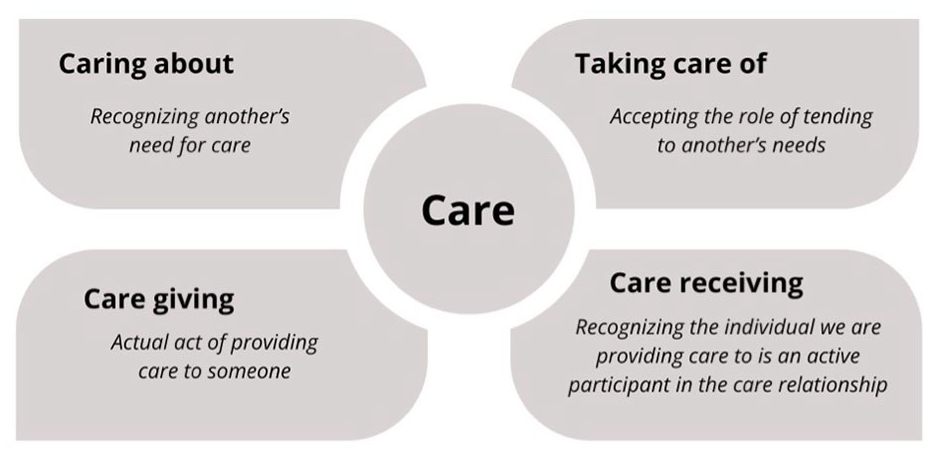
Components of Relational Care.
Practicing care to nurture kindness means that we are aware of these principles of caring relationships and reflect upon them (Malti & Speidel, 2023). One basic ingredient to make a caring relationship possible is knowing, that is, recognizing and understanding the capacities and needs of the other, and what is helpful to their growth (i.e., caring about). This includes that the caretaker, for example, the parent or the practitioner, knows how to respond to their needs and own strengths and limitations (Mayeroff, 1971). One also needs to accept the role of attending to another’s needs (i.e., taking care of) and engage in an act to provide care (i.e., care giving). Finally, a caring relationship involves recognition that the individual we are giving care is an active agent in the relationship (i.e., care receiving).
The first component, that is, recognizing the capacities and needs of another, involves that we can see capacities and needs in them and make them visible for us and others. One way of doing this is to utilize screens and assessment tools. Developmental scientists have developed a range of measures to assess capacities with a focus on personal strengths and social-emotional capacities. The tool that we developed to capture kind capacities in children and adolescents is called the Social-Emotional Responding Task (SERT). The SERT assesses the three Es and provides information on a child’s, classroom’s, or community’s potential for kindness (Malti, 2017). It is useful to complement such assessment approaches with needs assessment to get to know the other’s needs (e.g., Al-Janaideh, Abdulkarim, et al., 2023). Together, such capacity and needs assessments can yield comprehensive information for selecting plans and practices of care, that can be implemented to nourish kindness in school, at home, or in the community. It also helps monitor progress and ensures transparency, as it can be used for communication with different stakeholders. In combination, this strategy ensures that kindness and caring about us and others can be strengthened through this relational–developmental perspective and principles of relational practices of care.
Beyond being embedded in caring relationships, kindness is part of communities. Research and practice stakeholders have emphasized the importance of integrating social-emotional concepts into service delivery aimed at nurturing caring and well-being for children and families (Mahoney et al., 2021). Community-based initiatives to nurture kindness include our training profile of RAISE (Research and Practice Partnership: Building Awareness and Increasing Social-Emotional Capacity in the Early Years). RAISE is a social-emotional training model that uses a bottom-up community-based approach. Based on a developmental–relational framework, it implements a training to strengthen caregivers’ and educators’ capacities to support children’s kind capacities and well-being. More specifically, the approach combines a community needs assessment with a clinical-developmental training curriculum. The central focus of the RAISE training curriculum is supporting caregivers’ and educators’ understanding of children’s development of kindness and social-emotional capacities (i.e., the three Es) and strategies to nurture the three Es at home and in practice. The training also emphasizes nurturing children’s relationships and caregivers’ and educators’ own well-being and stress, as well as protective factors that can support the well-being of children, caregivers, and educators (see Speidel et al., 2024). In addition to increasing an understanding about the child and their needs, educators also gain knowledge and practice to understand their own limitations and capacities and how this affects their response to a child’s or group’s needs. This reflects the principle of caring about. Pedagogically, RAISE focuses on promoting knowledge, practice, and routine. The knowledge component cuts across all elements of the training by mobilizing caregivers and educators with greater developmental, relational, and clinical knowledge of kindness, relationships, own mental health, and strategies to support these components. The practice component involves creating opportunities for caregivers and educators to reflect on their learning, apply knowledge, share experiences, critically evaluate and connect concepts in an interactive setting, and practice new strategies in hypothetical (e.g., case examples) and real-world situations (e.g., participant-shared scenarios). The routine component (e.g., continued learning) is nurtured through strategy-based handouts, reading resources, at-home practice, and follow-up sessions to support continued learning. In addition to this pedagogical approach, efforts were made to align the training with adult learning principles. RAISE has been successfully implemented in diverse populations in Canada, including Syrian newcomer families and Black Canadian children (Al-Janaideh, Speidel, et al., 2023; Speidel et al., 2023).
Educational practices aimed at nurturing children’s potential in schools may be refined through a focus on kindness and goodness in children. Schools offer a particularly valuable context to practice a humanity of education and relational caring. By prioritizing the benevolent side of human nature and taking a developmental–relational framework, all students can be sensitized toward morality, including prosocial norms and an ethic of kindness, for example, through integration into the curricula (Edelstein, 1987; Frankena, 1973), teacher training, and leadership education (Berkowitz, 2021; Speidel et al., 2024).
Beyond relational practices of care and training approaches to nurturing kindness in schools and community settings, knowledge mobilization initiatives can be tremendously useful in making knowledge about how to nurture kindness accessible to diverse stakeholders. Developmental scientists can engage in collaborative community activities to help empower communities. This can be achieved through a variety of activities, such as arts-based workshops with children in the community to let them explore ways to express kindness through art, awareness campaigns, or the co-creation of information materials. Perhaps most importantly for developmental researchers, there is a need to build strong and trustworthy relationships with practice partners and co-create approaches to nurture kindness that fit community needs and strengths and complement existing practices.
Conclusion
In this article, I have argued that kindness plays a decisive role in the process of becoming humane. Taken seriously, this lifelong developmental task can help us reach our full potential for goodness and become our best possible self. In times of conflict and division, emphasizing the more gentle part of our nature can also help to balance self-interest with the needs of others and thus create more caring individuals and communities. This, in turn, contributes to our and others’ well-being and flourishing and peaceful human–nature relationships. We are amid a digital revolution. Yet, there is unused potential to expand our capacity for empathy with us and others and transform our kindness beyond our immediate communities. A positive human revolution, perhaps.
As what we nurture grows. As Charlie Mackesy (2019) notes, “Nothing beats kindness. It sits quietly beyond all things.”
Footnotes
Author’s Note
This manuscript is based on a presidential lecture held at the 27th ISSBD Biennial Meeting in Lisbon, Portugal. This article was supported by an Alexander von Humboldt Professorship from the Alexander von Humboldt Foundation awarded to Tina Malti.
Funding
The author disclosed receipt of the following financial support for the research, authorship, and/or publication of this article: This research was supported by an Alexander von Humboldt Professorship from the Alexander von Humboldt Foundation awarded to Tina Malti.
