




Abstract
It has been reported that infants prefer to look at delayed feedback of their leg movements compared to real-time feedback of their leg movements. In Study 1, 6-month-old infants participated in this delay task and their leg activity was monitored during the task. The infants did not prefer the delayed video image to the real-time video image. There was no robust relation between infants’ leg activity and time spent looking at the delayed video image. In Study 2, we tested the reliability of a preference for the delayed video image at the group level and individual level. Another group of 6-month-old infants were tested twice on the same delay task. Although the infants as a group preferred the delayed video image to the real-time video image at both time points, there was no intra-individual stability of this preference. These results provide mixed evidence for the reliability of a delay preference at the group level and no evidence for a delay preference at the individual level. This finding is a call to action for other areas of developmental psychology to be more cautious about assumptions of intra-individual stability in task performance.
A milestone in the development of the self is the differentiation of one’s own body movements from those of others. In addition to identifying unique visual features of the own body, infants use what has been termed a sense of agency (Gallagher, 2000). Infants are thought to detect the perfectly contingent relation between the motor signal and the visual and proprioceptive feedback that is unique to their own movements (Bahrick & Watson, 1985).
This ability has previously been demonstrated at the group level in infants. Some theoretical accounts suggest that the detection of contingencies involving one’s own body is part of the development of an infant’s self-awareness (e.g., Rochat, 2003). For example, Gergely and Watson (1999) see a preference for less than perfect contingent stimulation as a reason for increased interest in the social world. This assumption implies a certain stability over time. Accordingly, we were interested in the consistency of this ability at the individual level over a short period of time. We also investigated the role of infant activity during contingency detection tasks, on the assumption that activity is necessary to detect a relation between proprioceptive and visual feedback of self-generated movements.
The development of self-awareness begins before infants recognize their mirror image in the second year after birth (Bahrick & Watson, 1985; Gergely & Watson, 1999; Rochat, 2003; for a review see Kollakowski et al., 2023). Two key elements of this early self-awareness have been discussed as a sense of agency and a sense of body ownership (Gallagher, 2000). The sense of agency allows the self to be identified as the cause of a particular action. The sense of body ownership allows one to identify one’s own body. Previous studies have tested early forms of self-awareness at the group level, leaving it unclear whether individual infants can reliably demonstrate these abilities. However, it would be informative to know how stable this ability is in a given task for two reasons. First, correlational studies using these tasks are based on the premise that an individual’s performance reflects the infant’s level of self-awareness (e.g., Geangu et al., 2011). Second, previous theoretical accounts suggest that there is a shift from a preference for perfect contingencies to a preference for less than perfect contingencies, leading to more interest in the social world and away from one’s own body (Gergely & Watson, 1999).
Developmental studies on the sense of agency have shown that infants develop the ability to discriminate between self-generated and other-generated movements within the first few months of life. In one landmark study, infants were presented with two monitors side by side. One monitor displayed real-time feedback of their own leg movements, and the other monitor displayed the leg movements of another infant (Bahrick & Watson, 1985). Five-month-olds, but not 3-month-olds, looked longer at the monitor showing the other infant’s leg movements than at the monitor showing their own leg movements as a real-time feedback. Other studies have also reported that infants prefer non-contingent feedback to perfectly contingent feedback (Schmuckler, 1996). However, there is some mixed evidence regarding the onset of this preference, as Geangu et al. (2011) reported a preference for the other infant’s leg movements only in 9-month-olds, but not in 6- and 3-month-olds.
Another line of studies has reported that the perspective matters as well when both displays show perfectly contingent feedback of the own leg movements. In a series of studies, Rochat and Morgan (1995, 1998) showed leg movements from either an egocentric or an allocentric position. Infants preferred the allocentric view to the egocentric view when they simply observed their leg movements. Similar results were obtained in a study in which infants saw their leg movements in a mirrored view (left-right reversal) and in a non-mirrored view: They preferred the mirrored view. These studies controlled for infant activity by manipulating only the orientation of the real-time feedback.
Another way to keep infant activity identical in both views is to introduce a delay in the feedback of their own leg movements. Some studies suggest that infants as young as 6 months show a preference for delayed over real-time feedback. For example, Rochat and Striano (2000) found no preferential looking behavior in infants between 1 and 5 months of age for delays between 0.5 and 3 s. Hiraki (2006) reported a preference for 2 s delayed feedback over real-time feedback in 7-month-old infants, but not in 5-month-old infants. Similarly, Zmyj et al. (2009) reported a preference for the view with a 3-s delay in 9-month-olds, but not in 3-month-olds, with 6-month-olds showing only a tendency to prefer the delayed view (for similar results, see Zwicker et al., 2012). However, two studies are inconsistent with these findings. Klein-Radukic and Zmyj (2015) and Klein-Radukic and Zmyj (2020) reported no preference for a 7.5-s delayed view over a real-time view in a sample of 6-month-olds.
There are several aspects that might explain the mixed evidence regarding the preference for delayed feedback. The most obvious is the duration of the delay. Delays of around 3 s might be optimal to elicit infants’ preference. However, we do not find this explanation very likely because some studies used completely non-contingent visual feedback by presenting leg movements of another infant (e.g., Bahrick & Watson, 1985). Similar to this non-contingent feedback, a 7.5-s delayed feedback should also be more interesting than the real-time feedback. Another possibility is that the preference for the delayed feedback is an initial response that fades over the course of the experiment. For example, Zmyj et al. (2009) used only a 1-min presentation duration, whereas Klein-Radukic and Zmyj (2020) used a 4-min presentation. Again, this is not a likely explanation because Hiraki (2006) presented infants with both views for 3 min and infants preferred the delayed view. In addition, studies using videos of other infants’ leg movements have also used presentation durations of up to 4 min (e.g., Bahrick & Watson, 1985).
A potential confounding factor in these studies is that leg activity varied among infants. For example, some infants are more active than others. The more infants move their legs, the easier it will be for them to discriminate between self-generated and other-generated movements or between real-time and delayed feedback of own movements. A recent study by Deng and colleagues (2023) showed that the amount of leg movement in infants was positively correlated with performance on a contingency learning task. This finding is echoed in a study in which infants’ arm movements during a day were positively correlated with motor, cognitive, and language skills (Shida-Tokeshi et al., 2018). However, none of the studies on infants’ visual preference for self- and other-generated leg movements has controlled for the relation to infants’ leg activity.
Some theories suggest that a preference for stimuli that are not perfectly contingent is an important prerequisite for showing interest in the social world (Gergely & Watson, 1999). Gergely (2001) showed that children with autism spectrum disorder showed more interest in real-time feedback of their own actions than in delayed feedback of their own actions. Similarly, it was reported that 6-month-olds showed fewer problems in social interactions and more interest in the delayed feedback than in the real-time feedback (Zmyj & Klein-Radukic, 2015). Somewhat contradictorily, 6- to 8-month-olds were more likely to imitate an object-directed action the more they were interested in the real-time over delayed feedback (Klein-Radukic & Zmyj, 2015). Despite these discrepancies, this line of research suggests that infants’ preference for non-perfect contingencies can be reliable tested with this preferential looking paradigm. However, none of the developmental infant studies have examined the reliability of these individual preferences for real-time and delayed feedback in a longitudinal design over short periods of time.
In this series of studies, we were interested in the reliability of infants’ preference for delayed visual feedback over real-time visual feedback of their own leg movements. We tested 6-month-olds because previous reports indicate that this is a transitional age to a preference for delayed feedback of self-generated movements (Hiraki, 2006; Rochat & Striano, 2000; Zmyj et al., 2009). Infants were presented with real-time and delayed feedback of their leg movements, and their looking preference was assessed. In Study 1, the infants’ leg movements were assessed. To discriminate between a real-time and a delayed gaze, the infant has to move the legs. If they are still for a short period of time, both views are identical. Thus, we were interested in whether the amount of movement positively correlated with infants’ preference for the delayed feedback. In Study 2, infants were tested twice with the same visual preference task to test the intra-individual reliability of this task.
In Study 1, we predicted infants’ leg activity was positively correlated with their looking time at the delayed video image and negatively correlated with their looking time at the real-time video image. In Study 2, we predicted that looking time at the delayed video at t1 would positively correlate with looking time at the delayed video image at t2. The same relation was predicted for the real-time video image. Furthermore, we predicted that infants preferred the delayed over the real-time video image.
Notably, the research described below was not reviewed by an Institutional Review Board, because it was conducted in 2012, at a time when IRB approval was not common practice in German universities. Our study was conducted in accordance with the Declaration of Helsinki and the Ethical Principles of the German Psychological Society (DGPs) and the American Psychological Association (APA).
Study 1
To investigate infants’ leg activity and its relation to their preference for delayed visual feedback of these movements, we re-analyzed a data set published in Zmyj and Klein-Radukic (2015) and Klein-Radukic and Zmyj (2020). In this task, infants did not prefer the delayed over real-time video image. In the present study, we additionally analyzed the infants’ activity level. The infants wore white stockings with a black dot on the top of each foot (see Figure 1). These marks allowed automatic tracking of each leg during the task. We hypothesized that the more infants moved their legs over the course of the 4-min experiment, the more they would prefer the delayed video feedback.
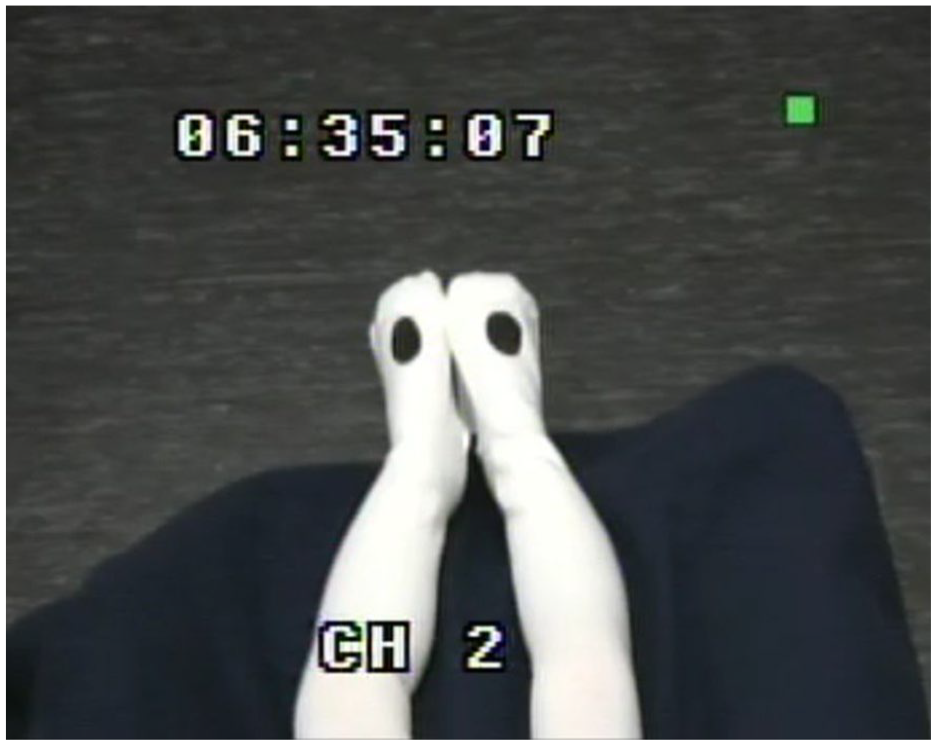
Still Frame From the Video Image That Was Presented to the Infants in a Real-Time and a Delayed View.
Method
Participants
The final sample consisted of 107 infants around 6 months of age (M = 6 months; 5 days, SD = 7 days, range = 5 months; 20 days–6 months 24 days). Sixteen additional infants were tested but not included in the study because they fussed during the experiment. Families were selected from a database of parents who had previously agreed to participate in child development studies. The families were from three medium-sized cities in the Ruhr area and were predominantly white Western Europeans of middle socioeconomic status. Parents gave informed consent to participate in the study. Parents were paid 10 euros for their participation and the children received a small gift.
Design
All infants participated in the delay task. The side of the delay was counterbalanced across infants.
Apparatuses and Procedure
The tasks took place in the laboratory of the Ruhr University Bochum and were conducted by the same experimenter. The test area was divided into two sections enclosed by beige curtains. To maintain a subtle background noise during the tests, a fan generated 30 dB of white noise.
The parent was instructed to place the infant in the car seat (Maxi-Cosi, Dorel-Industries Inc., The Netherlands) in front of the monitors. Then the parent was asked to take a seat behind the infant. The experimenter then left the room, rang a bell behind the curtain to direct the infant’s visual focus between the two monitors, and turned on the monitors.
Camera 1 (Canon Legria HV40, HDV 1080) recorded the infant’s face from a distance of 130 cm. At the same time, an identical camera 2 recorded the infant’s leg movements from an overhead perspective, also at a distance of 130 cm. Flanking camera 1, two 20-inch monitors (Dell, UltraSharp 2007FPb) displayed the video stimuli at a distance of 80 cm between their centers.
The video stimuli used the recordings of the infant’s leg movements made by camera 2. One monitor displayed a real-time video image of the infant’s legs, while another monitor displayed a delayed video image (generated with a 7.5-s delay using Delay Line, Ovation Systems, Milton Common, UK) of the same leg movements. These video images replicated an egocentric perspective, as if the infants were viewing their own legs from above. The duration of the delay task was 4 min.
Coding and Data Analysis
From the video recordings of the infants’ looking direction (camera 1), an observer coded the duration of the infants’ looking at each monitor over the 4-min period. The 4-min duration was subdivided into 1-min periods for further analysis. Analyzing the time spent looking at each video frame allows the investigation of a looking preference (as in Hiraki, 2006; Zmyj et al., 2009). A second naïve coder rated 40 randomly selected infants. For the interrater reliability of infants’ looking times (delayed and real-time video image) we calculated the intraclass correlation coefficients (ICC; 2,1; absolute agreement) which was r > .99, indicating an excellent interrater reliability.
Infants’ leg movements were analyzed using MaxTRAQ software (Informer Technologies, Inc.). The software automatically detects the black dots on the infants’ stockings. Occasionally, the black dot of a leg was not fully visible because the infant turned the top of the foot to the side. During this time, the software could not track the dot. In this case, a coder marked the position where the dot was located. Both legs were analyzed in separate coding sessions.
The output for each leg consisted of 6000 time points (240 s × 25 frames per second) with an x and y coordinate for each time point. The software used a resolution of 800 × 600 pixels. The total frame that the video image captured was approximately 600 mm × 450 mm, which means that one pixel had the length of 1.33 mm. We calculated the distance between the point of a leg from time point to time point and averaged the distance from one time point to the next over the entire 6000 time points. The values do not reflect the actual movements in cm, but are an arbitrary value for the infants’ movement. We calculated a motion score as follows

with xl and yl as the coordinates for the left leg, xr and yr as the coordinates for the right leg, and n as the analyzed frame (25 frames per second).
The corresponding motion score for the first minute was

Data were analyzed using SPSS (29.0). The dataset and syntax are not published and are available upon request. The study and analysis were not pre-registered.
Results
Preference for the Delay Video Image
The looking times to each video image are shown in Table 1. First, we performed a paired t-test on the total looking time to the real-time and delayed video images. There was no difference in looking times, t(106) = 0.89, p = .39.
Mean Looking Time in Seconds for the Real-Time and Delayed Video Image During the Entire 4-Min Duration and for Each Minute Separately.
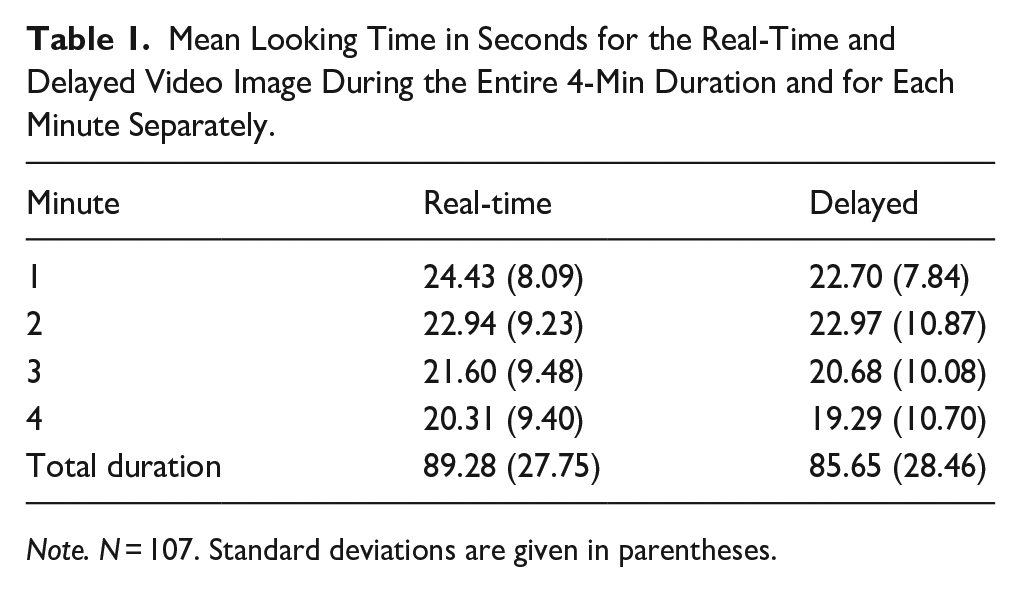
Note. N = 107. Standard deviations are given in parentheses.
We then performed a repeated-measures ANOVA, 2 (timing: real-time, delayed) × 4 (minute: first minute, second minute, third minute, fourth minute). There was only a main effect of minute, F(3,104) = 17.07, p < .001, ηp = .117, indicating a decrease in looking time during the test. There was no interaction between timing and minute, F < 1.
The Relation Between Motion Score and Delay Preference
The mean motion score for the entire test session was M = 4.15 (SD = 2.88), indicating that the legs moved about 4 pixels per 40 ms. The motion score for the first minute was M = 2.75 (SD = 2.37). To test the relation between infants’ leg activity and looking times at the real-time and delayed video image, we calculated a Pearson correlation between the motion score and looking times at the real-time and delayed video image. The negative correlation between the motion score and looking time to the real-time video image failed to reach statistical significance, r = −.174, p = .073, n = 107. There was no statistically significant correlation between the motion score and looking time to the delayed video image, r = .080, p = .412, n = 107.
In exploratory analyses, we tested the relation between the infants’ motion score and their looking times to the delayed video image in each minute. The correlation between the motion score and the time infants spent looking at the delayed video image was r = .193 (p = .047) for Minute 1, r = .145 (p = .136) for Minute 2, r = .055 (p = .577) for Minute 3, r = −.046 (p = .635) for Minute 4 (all ns = 107). Based on a Bonferroni-corrected p-value of .0125 none of these correlations reached statistical significance.
Discussion
Infants did not prefer the delayed feedback over the real-time feedback (see Klein-Radukic & Zmyj, 2020; Zmyj & Klein-Radukic, 2015 for the original report of these data). Additional data analyses revealed that infants did not prefer the delayed view in any minute of the experiment. As reported previously (Klein-Radukic & Zmyj, 2020; Zmyj & Klein-Radukic, 2015), this large data set suggests that a preference for a delayed video image over the real-time video image of one’s own leg movements cannot be reliably replicated.
We could not find robust evidence for the idea that a preference for the delayed video image is related to the infants’ leg activity. A possible explanation for this null finding is that only certain kinds of leg activity are related to a preference for the delayed view. For example, some infants might have shown “testing behavior” (Meltzoff, 1990) while focusing one monitor to check the contingency between the own movements and the video images. Future studies could further investigate this potential relation between testing behavior and looking preferences.
Study 2
Despite the null findings in Study 1, Study 2 was conducted to examine the stability of individual gaze preferences, which is crucial for correlational research. Given prior findings suggesting a preference for non-contingent feedback (e.g., Bahrick & Watson, 1985; Schmuckler, 1996) or delayed (Hiraki, 2006; Zmyj et al., 2009) visual feedback over real-time feedback, it was essential to test whether individual differences in such preferences persist over short time intervals. This would be an important psychometric property for use in correlational approaches (e.g., Geangu et al., 2011). In this study, we investigated the intra-individual stability of infants’ preference for delayed feedback of self-generated leg movements.
Method
Participants
The final sample consisted of 30 infants around 6 months of age (M = 6 months; 19 days, SD = 12 days, range = 5;25–7;10, 16 girls). Three additional infants were tested but excluded due to fussiness (n = 2) and low looking times during the delay task (15 out of 180 s, n = 1). Families were selected from a database of parents who had previously consented to participate in child development studies. The families were from a medium-sized city in the Ruhr area and were predominantly white Western Europeans of middle socioeconomic status. Parents gave informed consent to participate in the study. Parents were paid 5 euros for their participation and the children received a small gift.
Design
Each infant completed the delay task twice. The mean time between the two test points was M = 31 min (SD = 3, range = 28–42).
Apparatuses and Procedure
The apparatuses and the procedure were identical to Study 1 with a few exceptions. First, randomization was different to Study 1, because infants participated twice in the delay task. For the delay task at time 1 (t1), the side presenting the delayed video image was randomly varied for all infants. For time 2 (t2), we pseudorandomized the side presenting the delayed video image so that approximately half of the infants saw the delayed video image on the same monitor as at t1. The other half of the infants saw the delayed video image on the other monitor compared to t1. Second, we had two types of setups (see Figure 2). In the first setup, a blue blanket covered the car seat and we provided parents with white stockings with a black dot (approximately 2 cm in diameter) on the top of each foot to dress their child. This setup was identical to Study 1. In the second setup, an orange blanket covered the car seat and we provided parents with multicolored stockings to dress their child. These stockings had no dot on the top of the foot. We used two different sets of blankets and stockings to reduce transfer effects from t1 and t2 which could result in a side preference across both test points. Each infant was tested in the two different settings, and the order was counterbalanced across infants. Third, the duration of the delay task was 3 min.
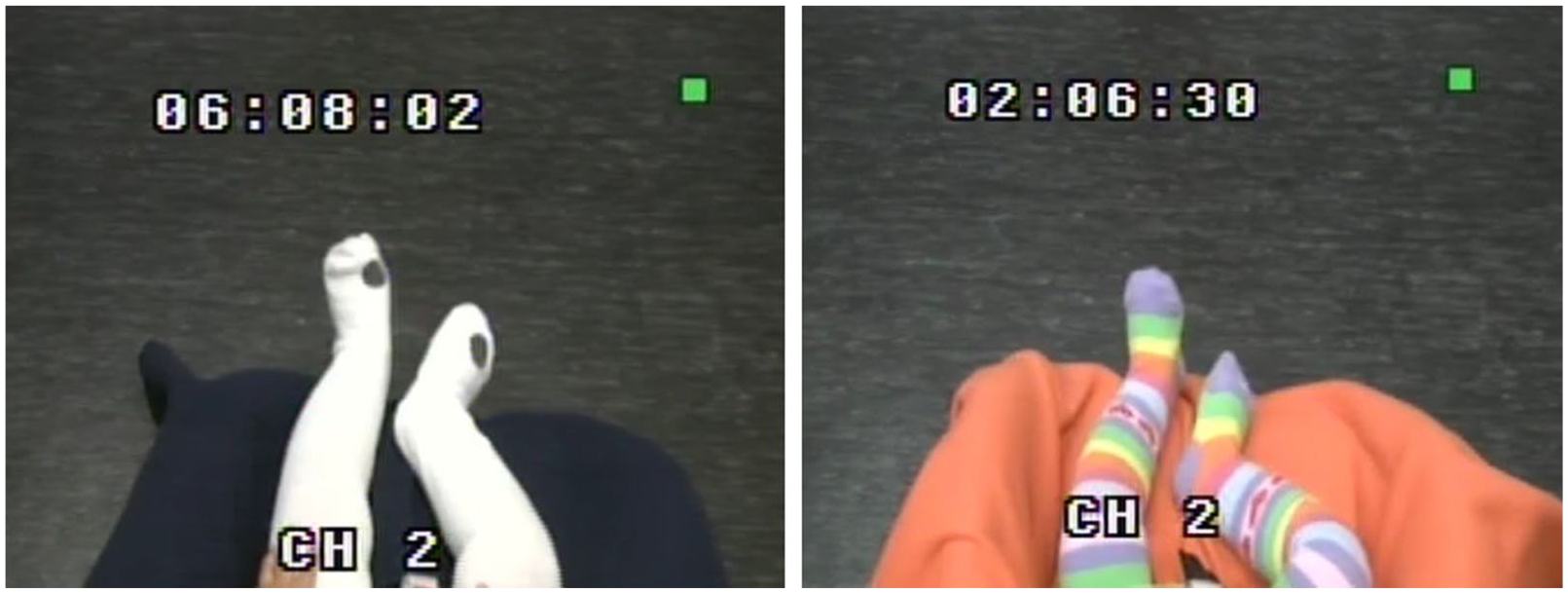
Still Frames From the Video Image That Were Presented to the Infants in a Real-Time and a Delayed View at t1 and t2.
Coding
Coding was identical to Study 1. A second naïve coder analyzed the video recordings of 10 infants, and we calculated the ICCs (2,1; absolute agreement) for total looking times on the right and left monitors at t1 and t2, resulting in four ICCs. The values ranged from .995 to .998, indicating excellent interrater reliability. Data were analyzed using SPSS (29.0). The data set and syntax are not published and are available upon request. The study and analysis were not pre-registered.
Results
Preference for the Delay Video Image
The looking times at each video image for t1 and t2 are shown in Table 2. We first performed a 2 (test point: t1, t2) × 2 (timing: real-time, delay) repeated-measures ANOVA. There was a marginally significant effect of test point, reflecting a decrease in looking time from t1 to t2, F(1,29) = 3.847, p = .059, ηp = .117. There was a significant effect of timing, F(1,29) = 4.764, p = .037, ηp = .141, showing a longer looking time at the delayed view compared to the real-time view. No interaction was observed.
Mean Looking Time in Seconds for the Real-Time and Delayed Video Image During the Total Duration of 3 Minutes As Well As for Each Minute Separately.
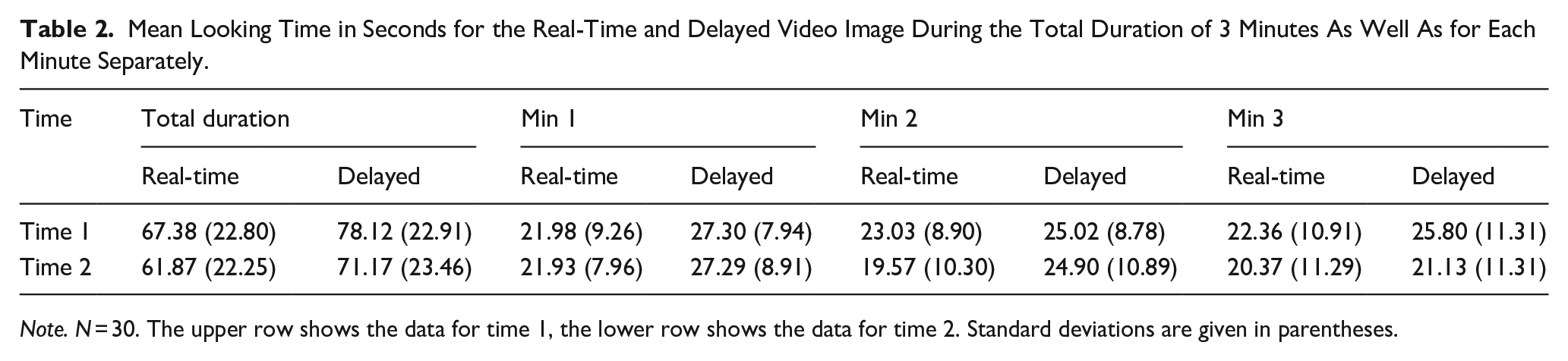
Note. N = 30. The upper row shows the data for time 1, the lower row shows the data for time 2. Standard deviations are given in parentheses.
In an exploratory analysis, we conducted separate t-tests that revealed that for Min 1, there was a significant preference for the delayed video image at both t1 and t2, t(29) = −1.854, p = .037, d = −0.338, one-tailed, for t1, and t(29) = −1.944, p = .031, d = −0.346, one-tailed, for t2. However, in Min 2, there was no preference for the delayed video at t1, t(29) < 1, and a marginally significant preference for the delayed video at t2, t(29) = −1.659, p = .054, d = −0.303, one-tailed. In Min 3, there was no preference for the delayed video at either t1 or t2, both ts < 1.
We also conducted two mixed ANOVAs with setup (white stockings, multicolored stockings) as a between-subjects variable and timing (real-time, delayed) as a within-subjects variable for t1 and t2. There was no significant interaction between setup and timing with respect to infants’ looking time, both Fs < 1. This indicates that the preference for the delayed video image was not influenced by the setup.
Consistency of the Preference for the Delayed Video Image Across Test Points
To investigate whether infants preferred the delayed video image, we conducted several correlation analyses of infants’ looking times to the real-time and delayed video images at t1 and t2. Looking times to the delayed video at t1 did not correlate with looking times to the delayed video at t2, r = .245, p = .191, n = 30. The reliability of looking times to the delayed video image across the two test points was estimated with an intraclass correlation coefficient based on a mean-rating (k = 2), consistency, 2-way mixed effects model (ICC3k). The estimated consistency was .394, 95% CI = [−0.274, 0.711]. Similarly, looking times to the real-time video image at t1 did not correlate with looking times to the real-time video image at t2, r = .056, p = .767, n = 30. The reliability of looking times to the real-time video image across the 2 test points was estimated with an intraclass correlation coefficient based on a mean (k = 2), consistency, 2-way mixed effects model (ICC3k). The estimated consistency was .107, 95% CI = [−0.877, 0.575].
In an additional exploratory analysis, we tested the relation between infants’ preference for the delayed video. We therefore dichotomized the looking time data by calculating a percentage score (looking at delayed video/(looking at delayed video + looking at real-time video). Infants who spent more than 50% of time looking at the delayed video received a score of 1. The other infants received a score of 0. A Chi-square test revealed no significant relation between both preference scores (χ2 = −0.023, p = .880, n = 30).
We conducted separate correlation analyses for infants who viewed the delayed video image on the same monitor at t1 and t2 and for infants who viewed the delayed video image on the other monitor at t2 compared to t1. When the delayed video was presented on the same monitor, there was no correlation for looking times at the real-time video, r = .343, p = .211, n = 15, or at the delayed video, r = .323, p = .241, n = 15. When the delayed video image was presented on different monitors, there was no correlation for looking times at the real-time video image, r = .161, p = .569, n = 15. However, there was a significant negative correlation between looking times at the delayed video image, r = −.740, p = .002, n = 15. This indicates that the longer the looking times were for the delayed video image at t1, the shorter the looking times were for the delayed video image at t2 when the delayed video image was presented on different monitors at t1 and t2.
Discussion
Study 2 showed that previous reports of a preference for delayed over real-time feedback of one’s own leg movements could be replicated in 6-month-olds (Hiraki, 2006; Zmyj et al., 2009). This finding is in contrast to Study 1 and to other studies that did not report a significant preference for a delayed feedback (Klein-Radukic & Zmyj, 2015) at this age.
We found no evidence for stability in infants’ individual preference for a delayed view. This finding is not consistent with the notion that there is a developmental shift from a preference for perfect contingent feedback to non-contingent feedback (Bahrick & Watson, 1985). It is also not consistent with the finding that a preference for perfect contingent feedback correlates with social-emotional problems (Zmyj & Klein-Radukic, 2015). Rather, the lack of intra-individual stability reflects that the preference for delayed feedback is based on current interests that change rapidly. One indicator of this instability in preference was that infants’ looking times to the delayed video image at t1 was negatively correlated with their looking times to the delayed video image at t2 when the side of the delay was switched from t1 to t2.
General Discussion
Our series of studies revisited the delay task, which has been used to investigate infants’ sense of self in the first year of life. The results show that the reliability of this task is mixed. On the one hand, we replicated the preference for a delayed video image at both test times in Study 2. On the other hand, we did not find a relation between infants’ looking preferences between the two test points in Study 2. Study 1 showed there was no clear pattern in the relation between leg activity and looking preference.
Study 2 suggested that the group of 6-month-old infants reliably preferred delayed video feedback of their leg movements to real-time video feedback of their leg movements. However, a closer look at the individual level revealed that there was no correlation between infants’ preference at t1 and t2. This finding addresses a major research gap not only in infant research but also in other areas of developmental psychology (Brosseau-Liard, 2022) and adds to the skepticism expressed regarding looking time studies (Paulus, 2022). Some tasks of childhood cognitive abilities (e.g., selective learning) produce reliable data in the sense that similar group-level means are a replicable (Cossette et al., 2020; Juteau et al., 2019). However, intra-individual reliability was rather low in these tasks, suggesting the presence of situational error, measurement error, or both. A potential situational error in Study 2 could have been inattention indicated by the drop in looking times during the experiment. The same low correlation between different trials of identical tasks has been reported for visual preference tasks (DeBolt et al., 2020). The latter finding suggests that individual task performance in infancy is notoriously unreliable, regardless of the specific task. The current task is no exception. Study 1 investigated whether a potential source of the lack of intra-individual stability may be differences in leg activity, but we did not find robust evidence for this idea.
The low intra-individual stability reported in Study 2 might be related to previous failures to correlate infants’ performance on contingency detection tasks with other cognitive abilities. Byers-Heinlein et al. (2022) highlighted that a high intra-individual reliability is necessary for a high statistical power in correlation approaches. If the intra-individual reliability is low, the statistical power is also low. For example, using the same data set as in Study 1, there was no evidence of a correlation between a preference for delayed feedback of leg movements at 6 months of age and various forms of self-recognition at 18 and 26 months of age (Klein-Radukic & Zmyj, 2020). Likewise, low correlations were reported for the relation between this delay preference and social-emotional development (Zmyj & Klein-Radukic, 2015). Similarly, Geangu and colleagues (2011) found only weak correlations between infants’ preference for looking at another child’s leg movements and emotional behaviors such as crying and expressing anger.
However, other studies have reported correlations between infants’ contingency preference and other tasks. One study reported a positive correlation between infants’ preference for delayed feedback and imitation (Klein-Radukic & Zmyj, 2015). Another study reported moderate to large negative correlations between infants’ preference for synchronous stroking of their own and their mother’s face (compared to nonsynchronous stroking) and difficulties in mother-infant interaction (Maister et al., 2020). These studies suggest that there is some degree of intra-individual reliability in infants’ looking preference in paradigms that involve contingent or synchronous feedback. Accordingly, the lack of correlation in delay preference between the two time points in Study 2 might not indicate a lack of intra-individual stability but rather reflect infants’ responses to familiar (i.e., real-time feedback) versus novel stimuli (i.e., delayed feedback) in repeated measurements. First, an exploratory analysis revealed that delay preference was strongest during Min 1 of t1 and t2. This could reflect an initial novelty preference in each test session that declined over the course of each session. Second, a previous study found that the more often infants participated in looking time experiments, the stronger their preference for novel stimuli was (Santolin et al., 2021). Although we did not observe an overall increase in preference for delayed feedback from t1 to t2, it is possible that some infants remembered their participation at t1, which in turn may have influenced their looking behavior at t2. In sum, these processes could have contributed to the absence of a correlation between test sessions.
This line of research might contribute to other controversial issues in developmental science. For example, looking-time paradigms were used to test infants’ false-belief understanding (e.g., Onishi & Baillargeon, 2005). Although the main result has been replicated multiple times (see Rakoczy, 2022, for an overview), studies employing conceptually analogous tasks reported virtually no correlation of performance between tasks (Poulin-Dubois & Yott, 2018; Yott & Poulin-Dubois, 2016). This lack of correlation has been interpreted as lack of construct validity (Rakoczy, 2022). In the light of the present study, one should consider that the lack of correlation in these false-belief studies might derive from the lack of intra-individual reliability within each task.
The interpretation of the present set of studies is complicated by the fact that in Study 2 we replicated the previously reported preference for delayed feedback around 6 months of age (Hiraki, 2006; Zmyj et al., 2009) across two different test sessions. Infants’ leg activity cannot explain these diverging results. There must be other variables at work that cause infants to have different visual preferences across studies.
The present studies provided some evidence for infants’ preference for delayed feedback of their own movements. However, this preference was not stable at the individual level, nor was it stable across different groups of infants. The amount of infant leg activity cannot explain these inconsistencies. This series of studies reminds infant researchers to think about task reliability when choosing tasks to assess inter-individual differences. As suggested by Byers-Heinlein et al. (2022), reporting task reliability could improve the study of inter-individual differences in infant research. This approach requires that at least two data points be available for each infant.
Footnotes
Acknowledgements
The authors would like to thank the student researchers for coding the videos. We also thank all families who participated in this study. We thank Franziska Sieber, Wibke Eickmann, and Melanie Richter for comments on a previous version of this manuscript.
Declaration of Conflicting Interests
The author(s) declared no potential conflicts of interest with respect to the research, authorship, and/or publication of this article.
Funding
The author(s) disclosed receipt of the following financial support for the research, authorship, and/or publication of this article: Study 1 received funding from DFG (ZM54-2/1).
