




Abstract
Do children infer other’s emotions from situational information, and do they revise their inferences when provided with additional information about the broader temporal context? We invited 333 children (Mage = 72.67 months, range = 47–99 months, 56% girls, 44% boys) to look at pictures of a child protagonist seated next to a set of toys—first in the company of another child and then alone. The protagonist’s facial expression was never visible in either picture. Instead, for each picture, the experimenter provided children with an initial description of the immediate situation facing the protagonist before they asked children to (1) attribute an emotion to the protagonist; (2) express their confidence in this attribution; and (3) justify their attribution. The experimenter then claimed to remember more information about the context surrounding each situation before repeating the three questions. Irrespective of age, children shifted markedly in their attributions based on the additional information provided, although older children were more confident in their attributions than younger children and provided more contextual references when justifying their beliefs. Thus, from an early age, children realize that the emotional implications of a situation are not fixed but can shift and even reverse depending on the broader temporal context.
Introduction
A key aspect of successful engagement in social interaction is to understand and sensitively respond to other people’s emotional states (Hwa-Froelich, 2014). For example, greater emotion understanding is associated with improved social skills (Izard et al., 2001), increased peer acceptance (Mostow et al., 2002) and higher quality peer relationships (Denham et al., 1990). By considering not only how a friend or sibling is currently feeling, but also how they might feel if circumstances were to change, emotionally competent children can adjust their behavior and interactions accordingly during peer interactions. Indeed, from 3 to 4 years of age, children make inferences about others’ emotions not only based on what is currently happening, but also what that person remembers about a past event (Lagattuta et al., 1997) or expects to happen in the future (Harris et al., 1989). However, appropriate emotion understanding can be challenging, because emotions are not always openly expressed. As such, relying solely on facial expressions may not be sufficient to understand how a person feels and children may benefit from attending to alternative, situational determinants. Yet, due to a strong emphasis on children’s developing understanding of facial expressions (inspired by Ekman, 1973), the literature on children’s inferences of emotion from situational cues is sparse. We argue that children not only make good use of situational cues (i.e., cues about the immediate situation that someone is in), but also adjust their attributions appropriately in light of new information about the broader temporal context (notably information about what is about to happen in the future). To frame our proposal that children infer others’ emotions both from the immediate situation and from the broader temporal context, we first review past work showing that children (1) infer emotions from situational cues; (2) make more reliable inferences about emotions following situational as compared to facial cues; (3) recognize that the emotional implications of a situation depend on the broader temporal context.
Children Infer Emotions From Situational Cues
Past work has shown that from around the age of 3 years, children can infer emotions from situational cues (e.g., Borke, 1971; Hughes et al., 1981; for a review, see Gross & Ballif, 1991). For example, 3- to 4-year-olds infer likely emotional reactions to everyday situations and can also generate plausible suggestions for situations in which selected emotions like happy and sad might occur (Borke, 1971). When 5- to 6-year-olds generate suggestions for situations that evoke emotions (e.g., Borke & Su, 1972; Harris et al., 1987) or create drawings depicting social emotions based on situational cues (Bonoti & Misalidi, 2015), their suggestions (and drawings) display greater complexity and breadth with age (Bonoti & Misalidi, 2015; Harris et al., 1987). Taken together, these studies indicate that children infer emotions from situational cues in the absence of facial expression. Next, we ask how children weigh such cues as compared to facial expressions.
Children Are More Sensitive to Situational Cues than to Facial Cues When Inferring Emotions
Children as young as 3 years of age are better at inferring someone’s emotional state when learning about the cause or consequences of their state than when viewing simple facial expressions (Balconi & Carrera, 2007; Widen & Russell, 2004, 2011). They are also more likely to emphasize context over facial expressions (Tell & Davidson, 2015), and by 8 years of age, they emphasize situational cues over an emotional tone of voice (Gil et al., 2014). Children also understand that facial expressions do not necessarily index a person’s actual emotion. For example, when presented with a protagonist in an emotionally charged situation, children increasingly understand that the protagonist’s facial expression may make it appropriate for them to mask their emotions (Banerjee, 1997; Gross & Harris, 1988; Harris et al., 1986). More specifically, a range of studies has shown that children increasingly grasp the distinction between the emotion someone actually feels and the emotion they express. Whereas 4-year-olds are prone to treat expressed emotion as a valid index of felt emotion, children aged 6 years and older typically realize that someone might mask their actual, felt emotion by expressing a different emotion (Harris et al., 1986; Harris & Tang, 2018). Thus, children appropriately attribute a negative emotion to someone in a negatively valenced situation even if the person expresses a seemingly positive emotion (Saarni, 1979). Taken together, these earlier studies indicate that situational cues play a central, and indeed an overriding role in children’s inferences about others’ emotions.
Recognizing That the Emotional Implications of a Situation Shift With the Broader Temporal Context
The emotional implications of a given situation are not always evident. They depend on the broader temporal context surrounding that situation, both what has happened in the past and/or what is about to happen in the future. For example, the emotional attribution of someone playing a game of chess is likely affected by whether one expects them to win or not. As onlookers, can children take this broader temporal context into account? Preliminary evidence from a study of 3- to 6-year-olds suggests that children are able to construct dynamic representations of someone’s emotion as that broader context changes (Ronfard & Harris, 2014). Using the story of Little Red Riding Hood, Ronfard and Harris (2014) showed that as she moved physically closer to a future danger, children’s inferences about her emotions were increasingly affected by that approaching danger. They judged that Little Red Riding Hood felt increasingly scared as she got closer to the house where the wolf was hiding. As such, these findings provide a glimpse into children’s ability to dynamically adjust their inference about the protagonist’s emotion based on an evolving situation. That said, younger 4-year-old children, but not 6-year-olds, misattributed fear to Little Red Riding Hood because she was unaware of the danger. Effectively, these findings leave open the question of how children respond when they are not tasked with having to consider a protagonist’s (potentially) false beliefs. More specifically, we can ask if children appropriately adjust their attributions of emotion when provided with accurate information about the broader temporal context surrounding a given situation.
The Present Study
With this study, we tested the hypothesis that children infer a person’s emotion based on the immediate situation that the person is facing but appropriately revise their inferences when given further information about the broader temporal context. To test this hypothesis, we presented children with two pictures, one showing a child protagonist accompanied by a friend (Picture A) and one showing the child protagonist subsequently sitting alone (Picture B) (see Figure 1). The protagonist’s facial expression was never visible in either picture. Children were given an initial description of the situation depicted in each picture, namely that initially the child protagonist was playing with a friend (Picture A) but was then left sitting alone (Picture B) and asked three questions about each picture: (1) What emotion they believed the main protagonist felt in each picture; (2) How confident they were about the emotion they attributed to the protagonist; and (3) How they knew that the protagonist felt that way.
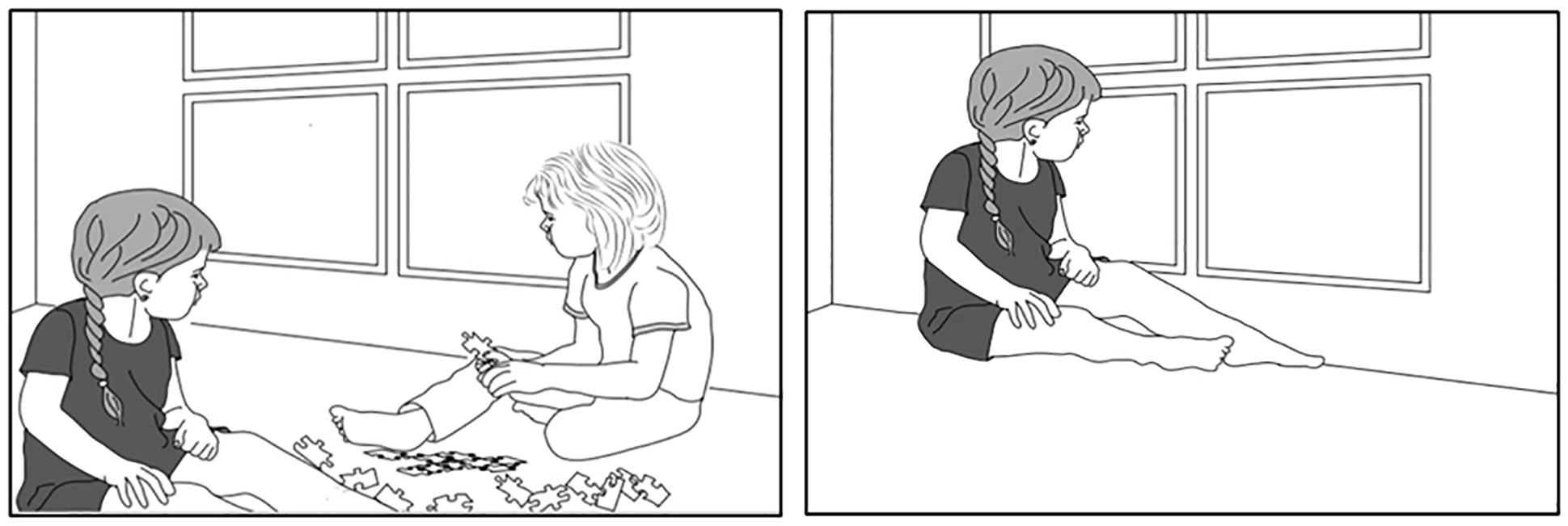
Illustration of the Two Pictures Presented to Girls, the First Portraying a Female Protagonist Sitting With Their Friend Playing With Puzzle Pieces (Picture A, Left Panel) and the Second Portraying the Protagonist Sitting Alone Looking Out the Window (Picture B, Right Panel). For boys, a male protagonist and friend were portrayed in the pictures.
In the second stage of the procedure, the experimenter unexpectedly “remembered” and reported additional information about the broader temporal context surrounding the situation in each picture and repeated the same three questions. More specifically, children were told that Picture A depicted the protagonist playing with their friend for the last time because the friend was subsequently moving away, whereas Picture B depicted the protagonist later on waiting for their friend who was on a return visit.
As described in the pre-registration (https://osf.io/ejd4k), we made three main predictions for children’s emotion attributions in response to Question 1. Hypothesis 1A: If children infer emotions from situational information, we expect their emotion attributions to be more positive following the initial presentation of Picture A compared to the initial presentation of Picture B. Hypothesis 1B: If children also infer emotions by taking the broader temporal context into account, we expect children’s emotion attribution to Picture A to be more negative in the second context as compared to the first. Conversely, we expect children’s emotion attribution to Picture B to be more positive in the second context as compared to the first. Hypothesis 1C: If, with increasing age, children are more sensitive to the impact of the broader temporal context of a situation, older children will be more likely than younger children to shift in their attribution of the protagonist’s emotion from the first to the second presentation of the two pictures.
With respect to children’s confidence ratings in response to Question 2, we made the following predictions. Hypothesis 2A: If additional information regarding the broader temporal context makes children’s emotion inferences more complex, we expected their confidence ratings to be lower following the second presentation of Pictures A and B, compared to the first presentation. Hypothesis 2B: If, with age, children increasingly rely on the broader temporal context to make emotion inferences, we expected confidence ratings to be higher among older children.
Finally, for children’s justifications in response to Question 3, we made the following predictions. Hypothesis 3A: We expected children’s justifications of their attributions to refer to situational information more often with increasing age. Hypothesis 3B: We expected children’s justifications to include more references to that situational information following the second as compared to first presentation of each picture. We expected that increase to be observable for both pictures and to be stronger for younger than for older children given our expectation that older children would be more likely to spontaneously take the broader temporal context into account.
Methods
Participants
The final sample included in the analyses consisted of 333 children (Mage = 72.67 months, range = 47–99 months, 55.7% girls, 44.4% boys), with written informed consent obtained from the child’s parents in advance of testing. Because older 6-year-olds, but not younger, children typically realize that the situation that a person confronts is an especially reliable index of their felt emotion (Gross & Harris, 1988; Harris et al., 1986; Harris & Tang, 2018; Joshi & MacLean, 1994; Tang et al., 2018), we grouped the children as younger (<72 months of age) and older (72 months of age or older) for the main analyses. An additional 20 children were tested but excluded from the final analyses for the following reasons: (1) missing information about child age (N = 16); (2) child age outside the accepted range (i.e., younger than 47 months, N = 1); (3) lack of response to any of the three questions for either of the two pictures (N = 3).
With past developmental work largely focusing on US and European families (Henrich et al., 2010; Nielsen et al., 2017; Rad et al., 2018), we recruited participants from local schools in Moscow in 2021–2022, with data shared with the research group in August 2023. The data collection was enabled by an existing collaboration with researchers at Lomonosov Moscow State University, Faculty of Psychology. All children spoke Russian and were interviewed by native speakers of Russian. Both education and income levels are traditionally higher in Moscow compared to the more Eastern and rural regions of Russia (Lindner, 2024). Such a community sample offered a demographic comparable to that of typically sampled families in prior studies of emotion attribution (Henrich et al., 2010). Indeed, based on the cultural similarities tool created by Muthukrishna et al. (2020) using multiple measures of both genetic and cultural similarities between countries, Russia is one of the countries that is most similar to both the US and China—two large scale economies and cultures often contrasted with each other. Together, these considerations meant that the children tested reflected a comparable, yet distinctive sample, in comparison to what has typically been assessed in prior research.
Sampling Plan and Analytical Plans
We initially based our sampling plan on a model with alpha .05, power .95, two predictors (e.g., Context [0: First presentation, 1: Second presentation]), age (47–99 months), and the expectation of a small-medium effect size (f2 = .05–.08), running separate regressions for our analysis of children’s responses to Pictures A and B. This would require a total sample of 197–312 participants (Gpower 3.1), but anticipating some missing data (e.g., some children not saying anything, or saying “I don’t know” to all the questions), we attempted to recruit approximately 350 children. However, we later realized that a more appropriate, and conservative, analytical approach would be to run a set of repeated measures analyses of variance (rmANOVA) for the emotion attribution and confidence questions, using Picture and Context as within-subjects variables and Age as a between-subjects variable. A post hoc sensitivity analysis shows that this approach using the current sample of 333 allows for the detection of f = 0.09 with 95% power and f = 0.07 with 80% power, thus resembling the expectations of the original analytical plans. For the analysis of the justification question, we ran a set of Generalized Mixed Models (GLMM) with Age, Context, and the Age BY Context interaction term as fixed effects and Participant as a random (nested) factor. Given that both sets of analyses provide similar results, we present the results from the rmANOVAs and GLMMs in the manuscript together with a brief note on the findings from the pre-registered linear regressions (for more details, see the Supplemental Materials). The rmANOVAs were performed using SPSS (IBM SPSS Statistics, version 26), and the GLMMs were run using the lme4-package in R (Bates et al., 2015), with the standard p < .05 criterion to determine significance.
Ethics and Data Handling
The overall project was approved by the Ethics Committee of the Faculty of Psychology at the Faculty of Psychology at Lomonosov Moscow State University (no.: 2021/54). Each testing session was audio-recorded and securely stored for later transcription and translation by a native Russian-speaking research assistant. Only de-identified data were shared with the project group. Participants and their family were not paid for their participation.
Overarching Procedure
Children whose parents had provided written informed consent for the child to participate were tested at their child-care center or school during regular hours by a native Russian-speaking research assistant. Parents who provided informed consent also responded to a brief questionnaire concerning their child’s age, gender, and language.
Experimental Procedure
On the day of testing, and to enable the child to become acquainted with the test situation, the experimenter greeted the child and told them that s/he would ask a series of questions, that these questions were not a (school) test, and that s/he simply wanted to know what children of her or his age think. Then the experimenter introduced the familiarization task (adjusted for the child’s gender) by saying: I have two pictures I would like to show you in a moment. They are pictures of a girl/boy called Sofia/Alexander. Sofia/Alexander is about your age. When I show you the pictures, I would like you to look at each of them and help me to figure out how Sofia/Alexander was feeling that day. You can show me by choosing one of these faces.
The experimenter then placed a sheet (showing five schematic emotional faces arranged from left to right) on the table (see Figure 2). Each face was a plain circle with eyes and a mouth shaped to depict feeling: very happy, a little happy, just OK, a little sad, very sad. The experimenter pointed to each face in turn and said: “Let’s pretend this is Sofia/Alexander. Here (point) s/he is very happy; here (point) s/he is a little happy; here (point) s/he is just OK; here (point) s/he is a little sad; and here (point) s/he is very sad.” The experimenter used a neutral voice each time a response option was presented and left the five schematic emotional faces in front of the child until the end of the experiment.

Illustration of the Schematic Emotional Faces Presented to Children During the Familiarization Task and Used to Report Children’s Inferences About the Protagonist’s Emotion During the Main Experimental Task.
After the child had been familiarized with the schematic emotional faces, the experimenter introduced the experimental task by saying: “Here is the first picture (Experimenter placed Picture A in front of the child above the five schematic emotional faces). This is Sofia/Alexander. See—s/he is playing with her or his best friend.” The experimenter went on to ask Question 1 (Emotion attribution): “Can you show me how Sofia/Alexander was feeling that day? Was s/he feeling (point) very happy, (point) a little happy, (point) just OK, (point) a little sad, or (point) very sad? Which face do you choose?” The experimenter recorded the child’s answer by circling the option chosen, before asking Question 2 (Confidence rating): “OK. You think Sofia/Alexander felt [child’s answer] that day. Tell me—are you: very sure, a little bit sure, or not very sure about how s/he felt.” Again, the experimenter recorded the child’s answer by circling the option chosen before moving on to Question 3 (Justification): “OK. Why do you say that? How to do you know that Sofia/Alexander felt [child’s answer] that day?” For this question, children were not given any options to choose between and therefore had to generate a justification of their own. The experimenter wrote down the child’s answer and moved on to the second picture (Picture B). Having placed this picture on the table, the experimenter said: “Now here is another picture. This picture was drawn a few weeks later. So, this is Sofia/Alexander again. See s/he is on her or his own and s/he is looking out of the window.” The experimenter then repeated Questions 1–3.
After having presented pictures A and B for the first time, the experimenter presented them for a second time, but this time provided new information about the broader temporal context for the two pictures. Thus, the experimenter looked at the back of Picture A, and said with apparent surprise: Hmm . . . On the back of this picture (A) it says: “playing together for the last time.” Ah! Now I remember what happened. This picture was drawn when Sofia/Alexander was playing with her/his best friend for the last time—because his/her friend was moving away the very next day to another country. Maybe, I’d better ask you again about this picture.
The experimenter placed picture A2 in front of the child above the five schematic emotional faces, and repeated Questions 1–3. The experimenter then removed Picture A, turned over Picture B and again with apparent surprise said: Hmm . . . On the back of this picture (B), it says: “back for a visit.” Ah! Now I remember what happened. This picture was drawn when her/his friend was back in town for a visit. So, Sofia/Alexander was waiting for her/his best friend to come over to play. Maybe, I’d better ask you again.
The experimenter placed Picture B in front of the child above the five schematic emotional faces and repeated Questions 1–3.
Children’s responses to Question 1 (Emotion attribution) were coded at the time of testing, with scores ranging from 1 (very sad) to 5 (very happy), and children’s responses to Question 2 (Confidence rating) was coded with scores ranging from 1 (not confident) to 3 (very confident). Children’s responses to Question 3 (Justification) were coded after testing and first by a research assistant blind to the study hypotheses, focusing on whether children made a Reference to the situation the child was in (e.g., “because they are playing with their friend,” “because they have a friend,” or “because they don’t like to puzzle”, coded as 1) or made No Reference to the situation (e.g., “because they have a happy face,” “I don’t know,” or “because it is spring,” coded as 0). Next, to estimate inter-rater reliability for the coding of justifications, one of the co-authors also coded 25% of the responses. Coding reliability was estimated using Cohen’s Kappa and indicated approximately 93% agreement (Cohen’s Kappa = .927). The main source of discrepancy was due to the co-author being more prone to code certain responses as “Reference to the situation” when the research assistant coded these responses as “No Reference to the situation” (N = 4, 1.15%). Given such a low number of discrepancies, and following discussion with the other co-authors, the judgments of the research assistant were used in the final analyses.
Results
Children’s Inferences About Emotion From Situational and Contextual Cues
Children’s inferences of emotion are shown in Figure 3, as a function of Age (Younger vs. Older), Picture (A vs. B), and Context (First vs. Second). Inspection of Figure 3 shows that when first presented with the two pictures, children attributed more positive feelings to the protagonist in Picture A as compared to Picture B. This pattern was reversed in the second presentation of the two pictures, with that reversal being more evident among older as compared to younger children.
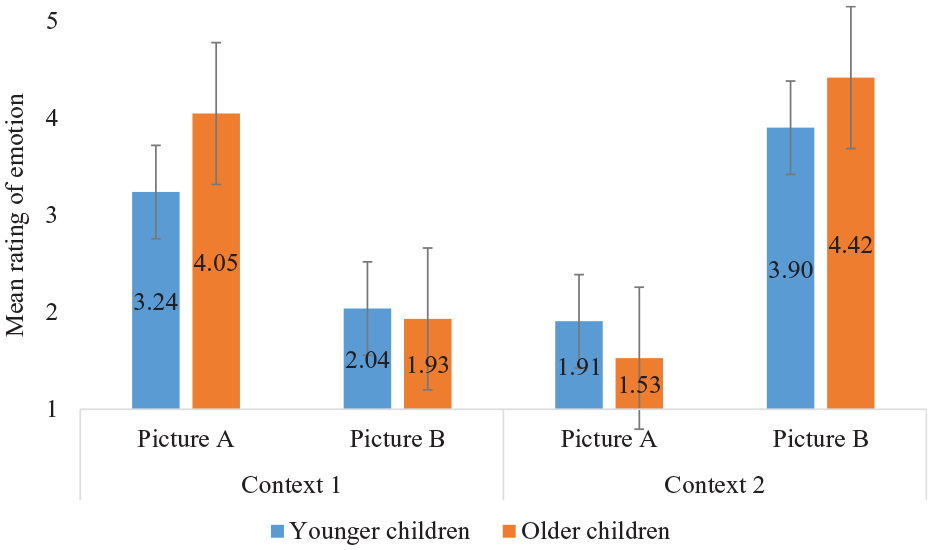
Mean Ratings of Emotion by Younger (<72 Months of Age, Blue Bar, N = 160) and Older Children (⩾72 Months of Age, Orange Bar, N = 172) for Pictures A (Child Sitting With Friend) and B (Child Sitting Alone), as a Function of Context (First vs. Second). Ratings ranged from 1 (very sad) to 5 (very happy). Error bars reflect standard errors.
To check these observations, a mixed rmANOVA with child Emotion attribution (1–5) as the dependent variable, Picture (0 = Picture A, 1 = Picture B) and Context (0 = First context, 1 = Second context) as the within-subjects variables, and Age (0 = Younger than 72 months, 1 = 72 months or older) as the between-subjects variable was conducted. This revealed significant main effects of Picture, F(1,330) = 29.69, p < .001, partial η2 = .083, Context, F(1,330) = 5.96, p = .015, partial η2 = .018, and Age, F(1,330) = 11.90, p < .001, partial η2 = .035. That is, children were more likely to attribute positive feelings to the protagonist in Picture B (M = 3.07, SE = .04), compared to Picture A (M = 2.68, SE = .05), as well as in Context 2 (M = 2.94, SE = .04) compared to Context 1 (M = 2.81, SE = .04), and with increasing Age (Younger: M = 2.77, SE = .04, Older: M = 2.98, SE = .04). There was also a significant two-way interaction of Picture BY Context, F(1,330) = 1,063.75, p < .001, partial η2 = .763, and of Context BY Age F(1,330) = 7.43, p = .007, partial η2 = .022, and finally, the significant three-way interaction of Picture BY Context BY Age, F(1,330) = 51.43, p < .001, partial η2 = .135.
To better understand the three-way interaction, we conducted post hoc analyses of the simple effects of context with Bonferroni correction. These confirmed that older children rated the protagonist’s emotion as more positive when they saw Picture A in the first context as compared to the second, F(1,330) = 456.46, p < .001. Similarly, younger children rated the protagonist’s emotion as more positive when they saw Picture A in the first context as compared to the second, F(1,330) = 119.29, p < .001. However, this context-based shift was more marked among older children—their rating was more positive than that of younger children in the first context, F(1,330) = 30.65, p < .001, and more negative in the second context, F(1,330) = 10.73, p = .001.
Older children rated the protagonist’s emotion as more negative when they saw Picture B in the first context than in the second, F(1,330) = 533.32, p < .001. Similarly, younger children rated the protagonist’s emotion as more negative when they saw Picture B in the first context as compared to the second, F(1,330) = 279.24, p < .001. However, this context-based shift was also more marked among older children. Although their rating was now more negative than that of younger children in the first context, F(1,330) = 0.95, p = .332, and more positive than that of younger children in the second context, F(1,330) = 17.45, p < .001.
In the first context, all children attributed more positive emotion to the protagonist in the situation depicted in Picture A (playing with a friend) as compared to the situation depicted in Picture B (being alone)—confirming Hypothesis 1A. More importantly, both younger and older children’s attributions of emotion to both situations were markedly affected by the shifting contextual information, confirming Hypothesis 1B. Finally, as predicted by Hypothesis 1C, this context effect became stronger with age.
The pre-registered linear regressions confirmed these findings, with a main effect of Picture in the first context, as well as a main effect of Context and an Age BY Context interaction (for details see Supplemental Materials). Post hoc exploratory analyses revealed no main or interaction effect of gender (p > .05), and introducing gender as a between-subjects factor did not change the above models (data not shown).
Children’s Confidence in Their Inferences About Other’s Emotion
To assess whether the introduction of broader contextual information added complexity to the interpretation of another person’s emotion and led to a drop in confidence ratings from the first to the second context (Hypothesis 2A), we asked children how confident they were about the emotions that they attributed to the protagonist. Children’s confidence ratings are shown in Figure 4 as a function of age and context.
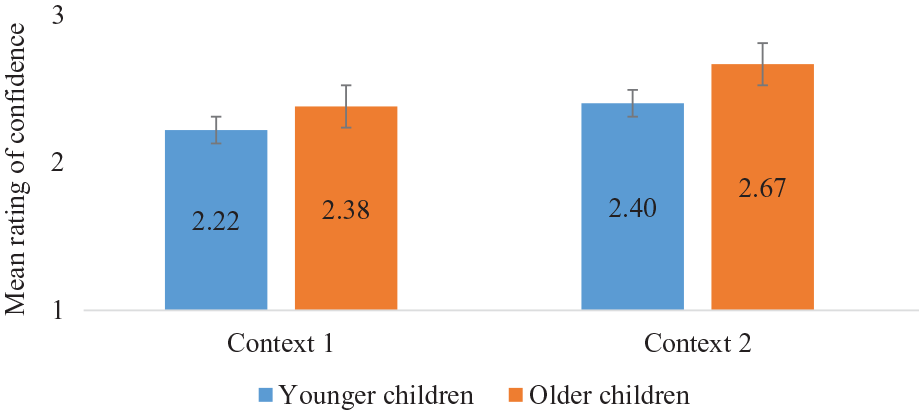
Mean Confidence Ratings by Younger (<72 Months of Age, Blue Bar, N = 160) and Older (⩾72 Months of Age, Orange Bar, N = 173) Children as a Function of Context (First vs. Second). Confidence ratings ranged from 1 (not very sure) to 3 (very sure). Error bars reflect standard errors.
Inspection of Figure 4 shows that children’s confidence increased with age and from the first to the second context. To check these conclusions, a mixed rmANOVA with children’s Confidence rating as the dependent variable (1–3), Context as the within-subjects variable (0 = First context, 1 = Second context), and Age (0 = Younger than 72 months, 1 = 72 months or older) as the between-subject variable was calculated. This confirmed the significant main effect of Age, F(1,331) = 14.29, p < .001, partial η2 = .041 and of Context, F(1,331) = 38.08, p < .001, partial η2 = .103. There was no statistically significant Age BY Context interaction, F(1,331) = 1.92, p = .167, partial η2 = .006.
Contrary to our expectations for Hypothesis 2A, children were more (and not less) confident in their ratings of the protagonist’s emotion when presented with the picture for the second time (M = 2.54, SE = 0.03), compared to the first (M = 2.30, SE = 0.04). Nevertheless, in support of Hypothesis 2B and the prediction that children become more confident with age, older children reported greater confidence in their ratings (M = 2.52, SE = 0.04) than younger children (M = 2.31, SE = 0.04). Thus, irrespective of age, children were more confident in their emotion ratings when provided with additional contextual information regarding the situation that the protagonist was facing. Nevertheless, overall, older children expressed more confidence than younger children.
The pre-registered linear regressions confirmed a significant main effect of Context and of Age for both Pictures A and B. In addition, these analyses revealed an Age BY Context interaction for Picture A, with older 6- and 7-year-old children being more confident in their attributions upon the second presentation of Picture A, compared to younger 4- and 5-year-olds (for details see Supplemental Materials). Post hoc exploratory analyses revealed no main or interaction effect of gender (p > .05), and introducing gender as a between-subjects factor did not change the above models (data not shown).
Children’s Justifications of Their Emotion Attributions
When asked to explain why they believed that the protagonist felt a given way, descriptive data from all four picture presentations showed that most children made a reference to the situation (N = 1,093, 83.56%, e.g., “because they are playing with their best friend,” or “because they are waiting to see their best friend again,” coded as 1). As illustrated in Figure 5, this tendency was more evident among older as compared to younger children and in the second context as compared to the first. Some children produced a response but made no relevant reference to the situation (N = 215, 16.44%; e.g., “because they are tired,” “because it is snowing outside,” or “I don’t know,” coded as 0), and on a small number of occasions, children remained silent (15 children were silent on one occasion, and 4 children were silent on two or more occasions, leading to a total of 24 missing data points).
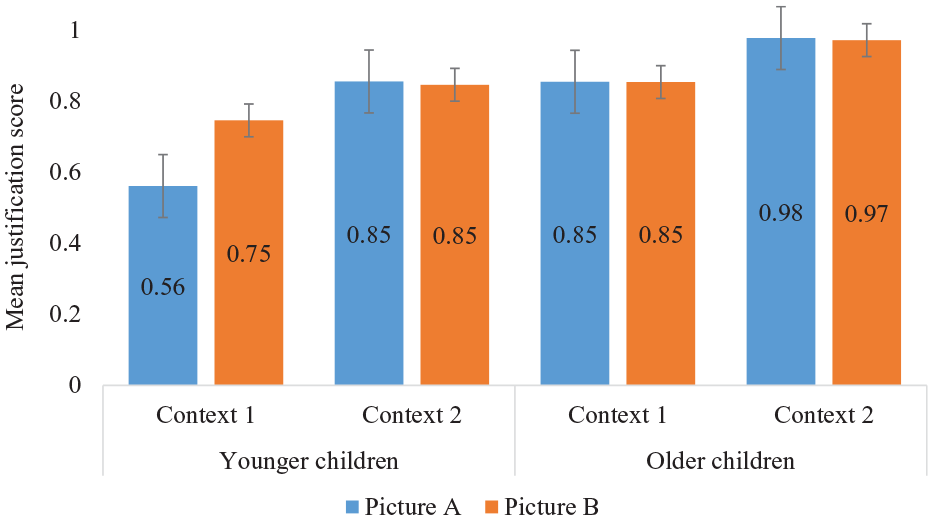
Mean Justification Score for Picture A (Blue Bar) and Picture B (Orange Bar), for Younger (<72 Months of Age, N = 160) and Older Children (⩾72 Months of Age, N = 173), as a Function of Context (First vs. Second). The score ranged from 0 (no reference to the situation) to 1 (reference to the situation). Error bars reflect standard errors.
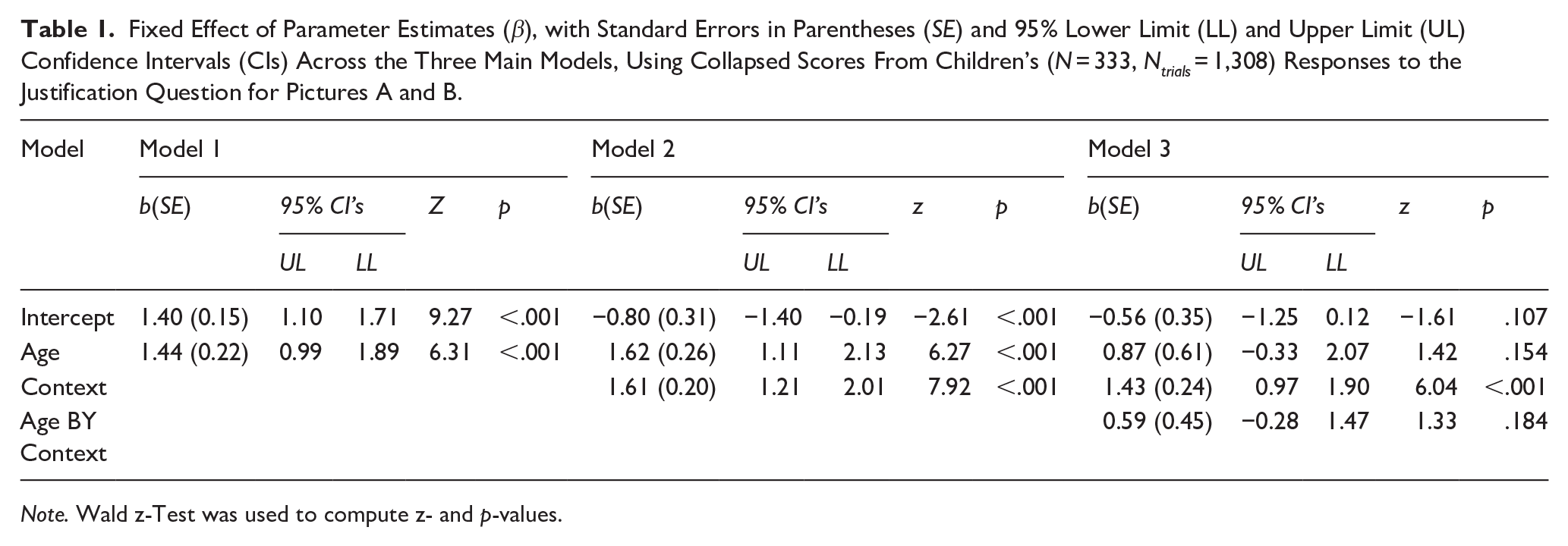
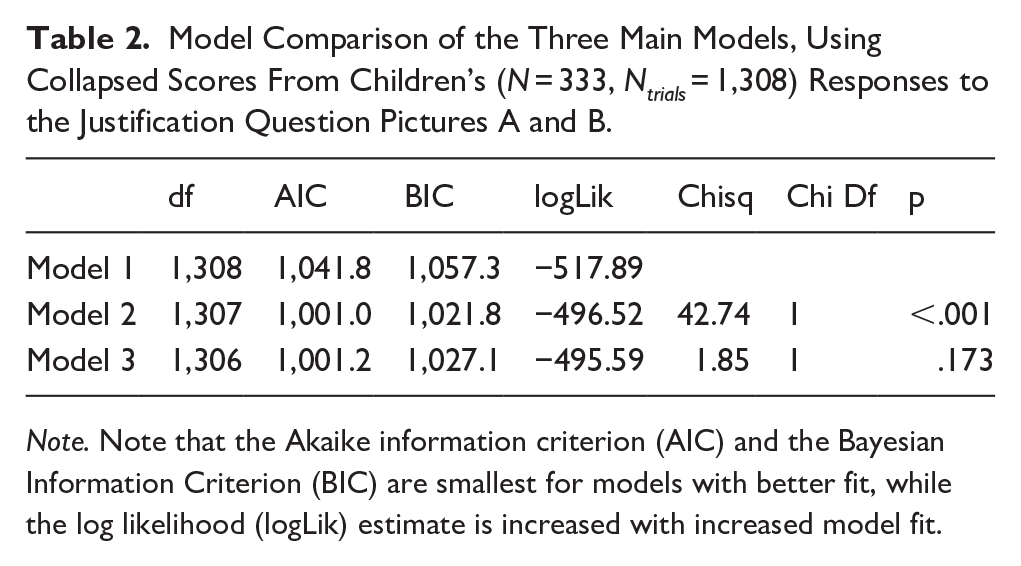
To check these conclusions, a set of GLMMs was run using the glmer function of the lme4-package in R (Bates et al., 2015, see Supplemental Material for model overview). The fixed effects of Age, Context, and the Age BY Context interaction term were added one by one in each model (see Table 1 for details), before model comparisons were run using the anova function in the lme4-package using the likelihood ratio test (see Table 2 for details).
Fixed Effect of Parameter Estimates (β), with Standard Errors in Parentheses (SE) and 95% Lower Limit (LL) and Upper Limit (UL) Confidence Intervals (CIs) Across the Three Main Models, Using Collapsed Scores From Children’s (N = 333, Ntrials = 1,308) Responses to the Justification Question for Pictures A and B.
Note. Wald z-Test was used to compute z- and p-values.
Model Comparison of the Three Main Models, Using Collapsed Scores From Children’s (N = 333, Ntrials = 1,308) Responses to the Justification Question Pictures A and B.
Note. Note that the Akaike information criterion (AIC) and the Bayesian Information Criterion (BIC) are smallest for models with better fit, while the log likelihood (logLik) estimate is increased with increased model fit.
First, to assess Hypothesis 3A and the expectation that, with age, children become increasingly likely to justify their emotion attributions with reference to the situation, Model 1 included children’s Justification score (0 = No reference to the situation, 1 = Reference to the situation) as the dependent variable, Participant as a random (nested) factor, and Age (0 = Younger than 72 months, 1 = 72 months or older) as the fixed effects factor. As shown in Table 1, and confirming Hypothesis 3A, this revealed a significant main effect of Age, while controlling for participant variation,
Investigating Hypothesis 3B and the prediction that new information about the broader temporal context would prompt children to increasingly provide explanations for their beliefs with reference to the situation, we first included Context (0 = First context, 1 = Second context) as a second fixed effects in Model 2. As shown in Table 1, this revealed a significant main effect of Context in the expected direction, when controlling for participant variation and child age. Next, assessing whether this effect was stronger for younger compared to older children, Model 3 included the Context BY Age interaction term as a third and final fixed effect. However, as shown in Table 1, there was no Context BY Age interaction. Table 2 shows a comparison of the three models, indicating a significant improvement in model fit from Model 1 to Model 2, but no significant improvement with Model 3. Re-running the above models separately for Pictures A and B, confirmed a main effect of Age, as well as a significant effect of Context when adding this as a second fixed factor, and no Age BY Context interaction (see Supplemental Materials for details).
Thus, in line with Hypothesis 3A, older children (M = 0.91, SE = 0.02) were more likely than younger children (M = 0.76, SE = 0.02) to justify their beliefs by referring to relevant aspects of the situation. In line with Hypothesis 3B, and true for both pictures, children were more likely to justify their beliefs with relevant references to the situation in the second (M = 0.91, SE = 0.01) than in the first context (M = 0.76, SE = 0.02). However, in contrast to what we had initially expected, this was true for all children, and not only for younger children.
The pre-registered linear regressions confirmed these findings, with a significant main effect of Age and Context for both Pictures A and B, and no Age BY Context interactions (for details see Supplemental Materials). Post hoc exploratory analyses revealed an initial main effect of Gender when this was included as the single predictor of children’s justification score (z (1,308, 1) = 3.61, b = 0.52, SE = 0.22, p = .023), with girls being more likely to justify their attributions with reference the situation (M = .86, SD = .22) compared to boys (M = .81, SD = .25). However, this was no longer significant once Age and Context were included in the model, and introducing gender as a preliminary step did not change the above models (data not shown).
Discussion
The aim of the current study was to test whether children infer other’s emotions from situational cues in the absence of a facial expression, and more specifically whether they revise their inferences when contextual information about the situation changes. Overall, our data support the pre-registered hypotheses that both younger and older children infer a person’s emotions from the situation that the person is in, that they revise their inferences when given additional information about the broader temporal context, and that the magnitude of their revision increases with age. As expected, older children were more confident in their inferences than younger children. However, contrary to what we expected, all children expressed more confidence in their ratings when provided with more information about the broader temporal context even though that information was effectively inconsistent with how they had initially appraised the protagonist’s emotions. Finally, when asked to justify their attributions, all children, irrespective of age, made frequent references to the situation facing the protagonist especially when presented with the second context. Nevertheless, older children were more likely than younger children to justify their attributions by referring to relevant aspects of the situation. Below, we discuss these findings in more detail.
Children’s Inferences About Emotions Are Markedly Affected by Contextual Information
When presented with an image of a child protagonist sitting next to another child with a set of toys and asked how they believed the protagonist might feel, children typically rated the protagonist’s emotion positively. However, when they were later provided with additional information that the protagonist was actually playing with the other child, a close friend, for the last time in a long while, children’s ratings became more negative. This was true for all children, both younger and older. The same context-sensitive pattern emerged when children were presented with a picture of a protagonist sitting alone in front of a window. This time, however, children first inferred that the protagonist was experiencing a negative emotion before rating the protagonist’s emotion more positively when later learning that the protagonist was, in fact, waiting for their friend, whom they had not seen for a long time, to arrive.
There are two key elements to these findings. First, they align with our initial hypothesis and fit well with past work showing that children infer emotions from situational cues (Balconi & Carrera, 2007; Borke, 1971; Hughes et al., 1981; Widen & Russell, 2004, 2011). That is, 4- to 8-year-olds make emotion attributions based on situational cues both when facial expressions are present (as in Balconi & Carrera, 2007; Widen & Russell, 2004, 2011) and absent (as in the current study, and in Pons et al., 2004, component 2 items 1 and 5). Second, the data provide strong support for our proposal that children dynamically update their inferences about others’ emotions as the context surrounding such situational cues becomes clearer. Prior work had shown that children from the age of 4 can update their emotional inferences about Little Red Riding Hood as she approaches a threatening situation (Ronfard & Harris, 2014). However, in that study, children also had to take into account her false beliefs about who was actually waiting for her in the cottage, the grandmother or the wolf, something the youngest 4-year-old, but not the 6-year-old, children struggled with (Ronfard & Harris, 2014). In the current study, when children did not have to reckon with a protagonist’s false beliefs, both 4-and 6-year-olds made appropriate emotional attributions and revised these accordingly when their knowledge about the situation was updated. This finding expands our understanding of children’s developing emotion comprehension in showing that children as young as 4 years of age correctly infer the emotional valence implied by the experimental narrative and radically update those inferences when appropriate. Following this interpretation, it is valid to ask: How sure can we be that children shifted their inferences of their own accord?
Because children’s emotional inferences shifted in line with what the experimental narrative implied, their response pattern could signal that they were naively deferential to what they were told. If this were true, however, one might expect that mixed input from the same experimenter would muddy or weaken their responses. For example, one could imagine that providing children with such mixed input would yield variable shifts in children’s inferences following the second presentation of the pictures, with some children focusing on their initial perception of the situation and others focusing on the more recent information. Instead, three features of the data suggest otherwise: (1) Overall, children provided stronger inferences following the second as compared to the first presentation of the two pictures, with their average responses reflecting more and not less deviation from the mean/neutral emotional valence; (2) Individual differences were no greater for the second as compared to the first presentation, with little change in the standard errors of children’s responses; and, finally, as discussed in further detail below; (3) Children were more confident in their emotion inferences after the second as opposed to the first presentation of information. Taken together, these findings show that, rather than being deferential to the experimenter’s input or confused about what to infer, children used the additional information about the context as a clarification of the protagonist’s emotion. This shift was, however, more prominent for older than younger children, prompting the question: Why did older children make stronger predictions than younger children?
Although children of all ages shifted in their inferences from the first to the second context, older children made more extreme shifts than younger children, both negative and positive. This could suggest that older children are better able to infer emotion from situational cues than younger children. For example, older children may have found it easier to attribute an emotion to the protagonist from the (limited) information available upon the first presentation of each picture because they have more established scripts about the cause of emotions (Widen & Russell, 2010). Younger children, on the other hand, may have found the amount of information limited and only inferred the emotional valence confidently when more information was provided about the context. If so, we would expect younger children’s confidence about their ratings to increase from the first to the second picture presentation (as additional information expanded their understanding of the scenario), whereas older children’s confidence ratings would stay stable. An alternative, although not mutually exclusive, interpretation is that younger and older children may have used different points of reference as a baseline for their assertions. Older children may have been more likely to spontaneously think of alternative situations the protagonist could have been in, leading to more pronounced emotion attributions compared to younger children and more focus on the context. Younger children on the other hand may have become more likely to focus on the context only when concrete alternative scenarios were explicitly presented to them. If so, we might expect younger children to be more likely to refer to relevant aspects of the protagonist’s context as the narrative progressed and they were led to think about alternative scenarios the protagonist could have been in. We discuss the relative support for these notions in the sections below concerning children’s confidence judgments and belief justifications, respectively.
Older Children Are More Confident in Their Inferences
When asked how confident they were in their emotion inferences, older children reported greater confidence than younger children, as predicted. This fits well with prior work showing that children’s descriptions of the situations that evoke certain emotions become increasingly complex with greater age (Harris et al., 1987). Compared to younger children, older children are likely to be more familiar with the kinds of emotions that are evoked by a given situation.
Contrary to our prediction, both younger and older children were more confident in their ratings of the protagonist’s emotion when presented with the pictures for the second time as compared to the first. This is surprising given that the second presentation of the pictures implied a marked shift in valence from positive to negative (for Picture A) and from negative to positive (for Picture B), thereby implying greater complexity in the attribution process. However, the current data imply that the shift in context, rather than confusing children, led them to be more confident in their assertions. Together with the finding that children correctly inferred the emotions that the experimental narrative was intended to elicit, children’s confidence in their emotion ratings strengthens the argument that even young preschoolers use situational cues to reliably infer others’ emotions (Balconi & Carrera, 2007; Widen & Russell, 2004, 2011). It also supports the above proposition that older children made more strongly valenced emotion ratings than younger children because they needed less information. Finally, it aligns with the proposal that children who struggle to interpret emotions from facial expressions alone (e.g., children with autism) might benefit from the provision of additional, situational cues as to how and why someone might feel the way they do (Tell & Davidson, 2015).
Older Children Justify Their Emotion Attributions by Referring to the Context
To understand more about the reasons why children responded the way they did, we asked them to explain their attributions. As anticipated, older children were on average more likely to justify their beliefs by referring to relevant aspects of the situation compared to younger children. This aligns well with the notion that children are increasingly sensitive to the situational causes of someone’s emotional state (Balconi & Carrera, 2007; Widen & Russell, 2004, 2011), as well as prior work suggesting that between the ages of 4 and 7 children get better at reflecting on the origins of their beliefs (Erb & Sobel, 2014; Moeller et al., 2022). When comparing children’s justifications from the first to the second presentation of each picture, we found that children in both age groups were more likely to justify their beliefs by referring to the specific context the protagonist was in when presented with the pictures for the second time. Thus, the provision of additional episodic information about the situation made this context salient for children. These findings consolidate the conclusion that children could appropriately reframe the situational implications in light of what they learned about the broader context.
Limitations and Future Directions
With the current study, we assessed how children dynamically infer a person’s emotions when cues to the situation that the person is in changes using narrative scripts that children are expected to have some experience with, that is, playing with toys and either being alone versus with others, while at the same time leaving out a commonly used cue, notably a facial expression of joy or sadness. The shifting nature of the information provided by the experimenter allowed us to investigate children’s sensitivity to the implications of the broader temporal context. By providing children with future-oriented, novel information we enabled them to arrive at a deeper understanding of the protagonist’s immediate situation. As such, the study provides new insight as to how children flexibly use contextual information to make inferences about other people’s emotions. However, because our conclusions from this study are limited to children’s inferences about two picture-based scenarios intended to elicit either positive or negative emotions, as reflected in their forced-choice responses, we also note a few limitations. First, to assess the generalizability of these findings it will be relevant for future studies to assess children’s inference of other’s emotions across a broader range of situations, that is, whether children expect to succeed or fail to solve a puzzle, or whether they expect their new teacher to be kind or strict. Second, to obtain a richer picture of children’s insights into the situational determinants of emotion it will be important to assess other unfolding situations that trigger complex emotions, such as relief or disappointment. Third, targeting the ecological validity of the findings, future work would benefit from moving beyond the presentation of static images to animated movies depicting real life situations, or events in naturalistic environments. Finally, by using a forced-choice design with a simplified Likert-type scale, it is unclear whether children would have made similar explicit binary judgments if given the chance to respond openly. On the other hand, given that the contextual information changed in valence from the first to the second presentation of each picture, it is possible that children initially attributed more mixed emotions to the protagonist, particularly after the second presentation. As such, the current study may have underestimated the complexity of children’s emotion inferences.
On a broader level, given that information about the situation facing the protagonist markedly impacted children’s attributions of emotion, it is plausible that the situations that children have faced themselves in the course of their upbringing might impact how they reason about a given situation. Studies of adults show that their understanding of, and ability to differentiate between, their own emotions impacts their ability to correctly infer others’ emotions (Israelashvili et al., 2019; Keating & Cook, 2023). Although similar work on children is scarce, past work on individual differences in children’s emotion understanding suggest that this is, in part, explained by variations in their family’s discussion of emotionally charged experiences (e.g., Dunn et al., 1991; Harris et al., 2005). It seems plausible that, as children get older, they will have more frequent experiences of discussing situations of various emotional experiences, such as being separated from or reunited with a friend. If confirmed by future research, this could explain why, in the current data, older children attributed both more positive and negative emotions to the protagonist depending on the situational cues—their own experience of such situations are more prevalent in their mind. For a more in-depth understanding of how prior experiences shape children’s inferences about others’ emotions, particularly in opaque situations where there is no direct access to someone’s facial expression, it will be relevant for future studies to assess a greater variety of emotionally charged situations that children may have more or less experience with at different ages (e.g., being separated from or reunited with a family member rather than a friend, or engaging with objects that have a more complex emotional valence than toys).
Conclusion
A key finding of the current study is that children as young as 4 years of age update their inferences about another person’s emotion when they are provided with more information about the broader temporal context surrounding the situation that the person is in. That is, all children markedly shifted in their emotional attributions to a protagonist when they were given new information about what the protagonist expected to happen. They also became more confident in their emotion assessments when they were provided with that additional information even though it called their initial interpretation into question. By implication, additional contextual cues about what a protagonist expects can serve to clarify why they feel the way they do. This is not a trivial matter because it shows how, from a young age, children (correctly) realize that emotions can be inferred from opaque and shifting narratives—narratives that capture the way that real life unfolds over time.
Supplemental Material
sj-docx-1-jbd-10.1177_01650254251337737 – Supplemental material for Children revise their emotion attributions in light of the broader temporal context
Supplemental material, sj-docx-1-jbd-10.1177_01650254251337737 for Children revise their emotion attributions in light of the broader temporal context by Tone Kristine Hermansen, Aleksander N. Veraksa, Francisco M. P. Pons and Paul L. Harris in International Journal of Behavioral Development
Footnotes
Acknowledgements
We thank the parents and children for their participation in this study as well as Ksenia Mostinets and the amazing team of research assistants that made this work possible.
Data Availability
Anonymized data supporting the findings of this study are openly available in the Open Science Framework at [URL], together with study stimuli and analysis scripts.
Declaration of Conflicting Interests
The author(s) declared no potential conflicts of interest with respect to the research, authorship, and/or publication of this article.
Funding
The author(s) disclosed receipt of the following financial support for the research, authorship, and/or publication of this article: The study materials were created by François Bernaschina and supported by an internal research grant to Francisco M. P. Pons from the Department of Psychology (University of Oslo, no funding number).
Ethical Considerations
The project is approved by the ethical research committee of Lomonosov Moscow State University (approval no: 2021/54).
Consent to Participate
Written informed consent obtained from the child’s parents in advance of testing.

Supplemental Material
Supplemental material for this article is available online.
References
Supplementary Material
Please find the following supplemental material available below.
For Open Access articles published under a Creative Commons License, all supplemental material carries the same license as the article it is associated with.
For non-Open Access articles published, all supplemental material carries a non-exclusive license, and permission requests for re-use of supplemental material or any part of supplemental material shall be sent directly to the copyright owner as specified in the copyright notice associated with the article.
