




Abstract
One important function of accommodative coping is to stabilize the quality of life in the face of age-related losses by adjusting control beliefs and action competence. Preparation for age-related changes is an important preventive resource for a higher degree of independence and quality of life in old age. This study examined the longitudinal associations between preparation for age-related changes, facets of accommodative coping (dispositional tendencies in general positive reappraisal, acceptance, downward comparison, reorientation), and goal detachment. Variables were assessed in a four-wave longitudinal study (intervals of approximately 1 year) with a sample of N = 248 adults, aged 30 to 78 years. In line with our hypotheses, latent growth models showed that increases in accommodative coping were associated with increases in preparation for age-related changes (correlations between the slopes). Cross-lagged panel models showed that mainly the change correlations (concurrent changes) remained significant, as compared with the mostly absent cross-lagged paths. The present findings highlight the interplay between proactive life-management strategies that aim to prevent age-related losses and accommodative-coping processes by which goals are adjusted to limitations in action resources. The adaptive role of both strategies and their implications for maximizing quality of life into old age are discussed in light of developmental-regulation models.
Development in adulthood is characterized by gains and losses (Baltes, 1997; Heckhausen et al., 1989; Sabatini et al., 2023) and people usually try to optimize this balance. In particular, age-related losses and restrictions require adaptations of goals and action strategies to make positive aging more likely. A better understanding of the dynamics of coping processes across time is therefore highly important. The focus of this study is on the interplay of accommodative coping and preparations for age-related changes. Accommodative coping (Brandtstädter, 2009; Rothermund & Brandtstädter, 2021) consists of the modification of goal hierarchies (e.g., through reappraisal, acceptance, or reorientation) when resources are limited. Preparation for age-related changes (Kornadt et al., 2018, 2020; Noone et al., 2009; Stawski et al., 2007) denotes plans and strategies to facilitate the adaptation to age-related challenges that can be expected (see anticipatory and preventive coping, Schwarzer & Luszczynska, 2008). This includes considerations on how to age well and anticipation of what to expect (Sörensen et al., 2021). This study examines whether both processes of developmental regulation are correlated cross-sectionally and over time. Both constructs have not yet been systematically related to each other.
Preparation for Age-Related Changes
Old age has been shown to be associated with an increase in perceived losses (Heckhausen et al., 1989; Sabatini et al., 2023). As people age, they are at increased risk for physical decline and needing help with household tasks. In light of this, a future perspective becomes more important. Several coping approaches, for instance, proactive coping (Aspinwall & Taylor, 1997) or anticipatory or preventive coping (Schwarzer & Luszczynska, 2008), emphasize preventive efforts in advance of expected stressful events. Preparing for aging was shown to be associated with higher ages (Frechman et al., 2022). A study by Lang and Rupprecht (2021) showed that perceived deadlines for late-life preparation were set more narrowly and earlier by older adults than by younger adults. Reasons why there might be links with accommodative coping have not yet been elaborated or investigated.
Accommodative Coping: Facets, Protective Function, and the Regulation of Action
The dual-process model of assimilation and accommodation (Brandtstädter, 2009; Rothermund & Brandtstädter, 2021) distinguishes between two modes of coping in situations of scarce resources. Assimilative activities consist of strategies to modify the situation in line with personal goals. When goals are at stake and cannot be resolved by intentional efforts, accommodative-coping processes may help aging individuals to disengage from blocked goals and retain a sense of control. A similar distinction was made in the goal adjustment model of Wrosch and Scheier (2020). The model differentiated between the capacity to disengage from goals when they have become unattainable and the capacity to engage in other goals under these circumstances.
Within the dual-process model, the construct denoted by accommodative coping is not homogeneous, but rather includes multiple mental processes such as reevaluations or adjustment of aspirations (Loidl & Leipold, 2019). People in life crises sometimes experience personal growth (Calhoun & Tedeschi, 2009), accept the restrictions, or compare their situation with that of others worse off (Bauer & Wrosch, 2011). Sometimes they undergo a cognitive reorientation and select new goals. Disengagement from goals that are unlikely to be reached can help redirect attention to more feasible goals (Wrosch et al., 2003). These diverse mental processes relate to both existing and new goals or life projects; what they have in common is that they involve a shift in valence. A study by Loidl and Leipold (2019) examined the multidimensionality of accommodative coping and showed that facets of accommodative coping (positive reappraisal, lowering of aspirations, downward comparison, reorientation) were more strongly correlated than the correlations with detachment from goals were. In addition, and in contrast to the other facets, detachment was not associated with indicators of positive adaptation such as well-being (Leipold et al., 2023) or resilience (Loidl & Leipold, 2019).
The protective function of accommodative coping has been examined in several cross-sectional and longitudinal self-report studies with measures of well-being (life satisfaction, emotional well-being, self-esteem). It has repeatedly been found to dampen the negative impact of problems or subjective stress on well-being in various developmental contexts (Brandtstädter & Rothermund, 2002; Greve et al., 2018). At the same time, several studies have provided evidence for longitudinal associations with subjective well-being (Leipold et al., 2023; Rothermund & Brandtstädter, 2003; Thomsen et al., 2015).
Another function of accommodative coping, apart from emotional stabilization in times of limited action resources, is the regulation of actions. According to the dual-process model, significant correlations between accommodative coping and preparations for age-related changes can be assumed because accommodative processes contribute to the stabilization of action projects in the face of losses (Brandtstädter, 2006). Health losses, for example, may demand that goals and ambitions be rearranged; some beloved projects may have to be abandoned. Such a situation can activate accommodative processes, and taking precautions in health-related domains or fitness (e.g., changing diet or going to the doctor) is functional to avoid or minimize the negative effects of possible future changes. Decentering attention through reorientation to goals that are feasible serves to maintain or restore action control by means of preparations for age-related changes. Similar arguments have also been made in the motivational theory of lifespan development (compensatory secondary control; Heckhausen et al., 2019). The aim of this study is to examine whether there are cross-sectional correlations and concurrent longitudinal changes in the extent to which people prepare for aging.
Previous Studies
There have been no empirical studies that have examined age-related changes directly associated with accommodative coping, but a few that examine relationships with action-theoretical variables (e.g., self-regulation and mental health). Several studies have documented associations with physical and mental health (Noone et al., 2009; Topa et al., 2009), but also with goal clarity (Stawski et al., 2007) and a higher sense of mastery (Donaldson et al., 2010). In recent years, longitudinal studies have investigated the relationship using variables of self-concept and control. Park et al. (2022) found significant associations between preparations for old age and perceived control across time. Aging preparations were correlated with concreteness of future time (Kornadt et al., 2018) and moderated the relationship between positive future self-views and changes in leisure activities (de Paula Couto et al., 2022).
To summarize, several studies have provided cross-sectional and longitudinal support for a relationship between preparation for age-related changes and health-, action-, or motivation-related variables. They provide indirect support for the expected relation with accommodative coping. This link has not yet been investigated and is thus subject of this study.
This Study
Preparation for age-related change is informed by models of developmental regulation (for an overview, see Sörensen et al., 2021). According to the dual-process model (Brandtstädter & Rothermund, 2002), accommodative coping is assumed to enhance action strategies and maintain them despite age-related losses. Thus, to maintain a sense of control, developing ways to encounter aging could be stimulated by accommodative restructuring. However, if people have been making preparations for age-related changes in different areas of life, we assume that these changes have been anticipated and thus accommodative coping would be enhanced. In other words, by being aware of the possible negative consequences of aging and taking actions to avoid them, the individuals have taken steps to achieve goals, a process through which negative results of age changes (i.e., blocked goals) can be seen in a positive light.
We therefore hypothesize a positive cross-sectional correlation between accommodative coping and preparation for age-related change. In addition, we expect positive covariations over time between accommodative coping and preparations for age-related changes (e.g., slope-slope correlations in latent growth modeling or change correlations in cross-lagged panel analyses). Because we examined inter-individual differences in dispositional trends, rather than specific events, we expect concurrent change, not subsequent changes.
In addition, we also examine the relations between preparation and different facets of goal adjustment (positive reappraisal, lowering of aspirations, downward comparison, reorientation toward new goals, and detachment from goals). We have no specific hypotheses for the individual facets, with the exception of goal detachment. Because goal detachment refers to detaching oneself mentally from a future project, the relationship may be lower or absent.
Methods
Participants
Participants were recruited through an online-platform for social research in Germany and were financially compensated for participation (ca. €4) after each session. The study had been approved by the Ethics Committee of the University of the Bundeswehr München (18 February 2020). Participants gave their informed consent before participating. From the recruiting agency, we requested an age sample between 30 and 79 years that was distributed across five decades (30–39, etc.) and balanced according to sex. There were four assessment points, approximately 1 year apart. Baseline assessment was in May 2020 (t0; N = 399); the second wave was in June 2021 (t1), the third in June 2022 (t2), and the fourth in June 2023. A total of 333 participants was obtained for the second assessment and 305 for the third. At t3, 252 participants took part. Four participants were not included in the analyses. Two of them had an extremely fast (unrealistic) processing time of less than 3 min on average, two showed outlier values in several variables (±3SD). Four subjects had values of less than three standard deviations in one variable. Because control analyses showed that they did not change the main results, they were included in the analyses.
The total loss rate for the data was 38%. No significant differences in sex, education, health concerns, or the main variables were found between the participants completing the study (N = 248) and those who were excluded or did not complete the fourth wave (N = 151). One difference was that the remaining participants were, on average, about 3 years older than those who dropped out, F(1, 397) = 4.594; p = .03; η2 = .01. No significant differences were found in terms of sex, educational level, and the main variables. The mean age of the final sample was M = 55.51 (SD = 13.42), 50% were female. Of the participants, 31.5% had completed vocational training, 33.9% had a degree (university or university of applied sciences), 10.5% had a higher educational level with 12 or more years of education (German Abitur), and 23.8% had a lower level of education with 9 or 10 years of schooling.
Measures
Preparation for Age-Related Changes
Preparation for age-related change was assessed with a brief scale developed by Kornadt and colleagues (2020). Participants were asked to rate on a seven-point Likert-type scale (1 = not at all, 7 = all lot) to what degree they are concerned about active preparation in 11 life domains (financial situation, emergency situations, family, fitness, housing, appearance, social relations, health, leisure, work, and personality). A principal component analysis revealed that all items had loadings of at least .49 on the first principal component, and a one-factor solution was suggested (except for the domains financial situation and work which were the only ones with slightly negative age correlations). We computed the mean value. Reliability of the scale was good (see Table 1 for Cronbach’s alpha for all constructs at t0). The stability coefficients (test–retest correlations) were between .72 and .79 (see Table 2).
Descriptive Statistics and Correlations Between Study Variables at Baseline (T0).
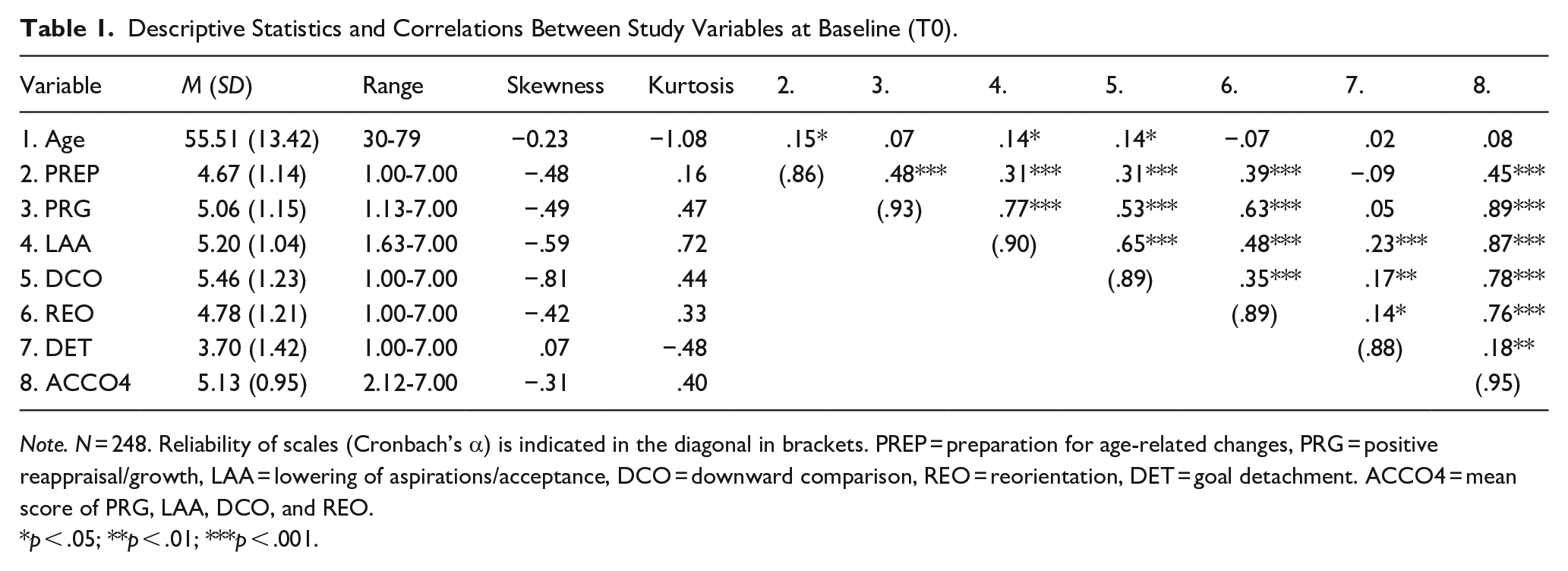
Note. N = 248. Reliability of scales (Cronbach’s α) is indicated in the diagonal in brackets. PREP = preparation for age-related changes, PRG = positive reappraisal/growth, LAA = lowering of aspirations/acceptance, DCO = downward comparison, REO = reorientation, DET = goal detachment. ACCO4 = mean score of PRG, LAA, DCO, and REO.
p < .05; **p < .01; ***p < .001.
Estimated Parameters of the Main Variables.
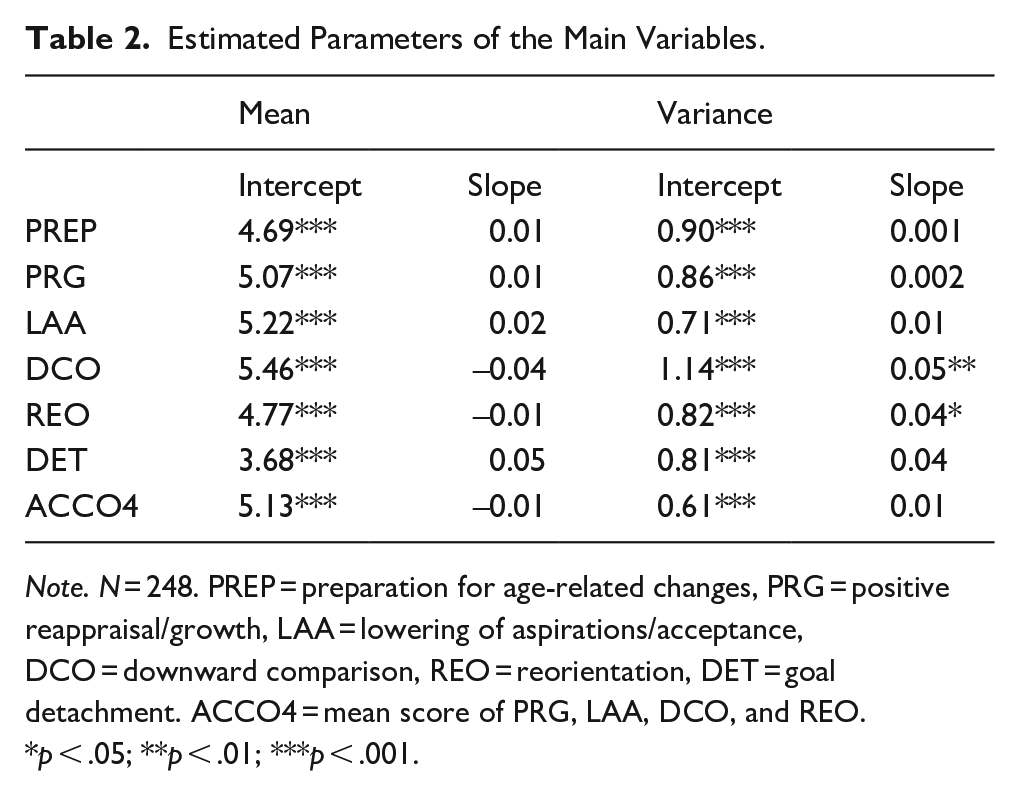
Note. N = 248. PREP = preparation for age-related changes, PRG = positive reappraisal/growth, LAA = lowering of aspirations/acceptance, DCO = downward comparison, REO = reorientation, DET = goal detachment. ACCO4 = mean score of PRG, LAA, DCO, and REO.
p < .05; **p < .01; ***p < .001.
Accommodative Coping
The ACCO-5 scale (Loidl & Leipold, 2019), a questionnaire encompassing 28 items, was used to measure dispositional tendencies in accommodative coping. The scale measures five correlated, but distinct facets: (1) Positive reappraisal/personal growth (PRG); (2) Lowering of aspirations/acceptance (LAA); (3) Downward comparison (DCO); (4) Reorientation toward new goals (REO); and (5) Detachment from goal (DET). The instruction was “The following items relate to how people cope with situations in which desires, goals or plans may not (or no longer) be realized as one wished.” Participants were asked to rate the general appropriateness of each item (e.g., “I accept that I cannot change the situation”; “I show myself that in some aspects I’m luckier than others”) on a 7-point Likert-type scale (1 = not at all, 7 = exactly). Mean values were calculated for the five facets. Cronbach’s alphas ranged between .88 and .95 (see Table 1). The scales PRG, LAA, DCO, and REO were highly correlated and will be used later in structural equation models as manifest indicators of the latent construct of accommodative coping. In addition, we calculated the mean value of these four scales (ACCO4) to test our hypotheses more parsimoniously on a global level before going on to the levels of subscales. The facet of goal detachment will be analyzed separately because the preliminary analyses lead to poor fit scores when detachment loads on the accommodation factor. Previous studies have also shown that detachment has lower stability values (Leipold et al., 2023).
Control Variables
Age, sex (0 = male, 1 = female), and education were used as control variables because they were significantly associated with age preparation. The education variable was coded with two values (0 = lower, 1 = higher) for use in SEM. The lower education group consists of participants who had completed vocational training or up to 9 or 10 years of schooling; the higher education group included participants with a university degree or 12 or more years of education (German Abitur). One item on subjective health concerns was collected as a control variable at each measurement point (“The deterioration of my health worries me”; 1 = not at all, 7 = very much). The correlations between all control variables and main variables can be seen in the Electronic Supplementary Material 1.
Statistical Analyses
Before examining our hypotheses about the longitudinal associations, we focused on bivariate correlations between the central variables at baseline (Table 1) and the mean values across time. Preliminary analyses were conducted with SPSS 29.0. Hypotheses were tested using latent growth models and cross-lagged panel analyses. The models were computed with LISREL 9.3 and based on maximum likelihood estimates.
First, we examined the longitudinal associations by using the global mean value of accommodative coping, before concentrating on the single facets. We used a latent growth model computed with intercepts coded as 1, 1, 1, 1 and slopes coded as 0, 1, 2, 3. To investigate the temporal effects between preparation for age-related changes and accommodative coping, we regressed the slopes on the intercepts. Slopes and intercepts were allowed to covary. The mean values of the coping scales PRG, LAA, DCO, and REO were used to create the intercept and slope factor of accommodative coping. Age, sex, education, and health concerns were used as control variables in the main model to simultaneously examine the latent growth. Subsequently, we specified growth models with each of the facets of accommodative coping. To represent the facets of accommodation, goal detachment, and preparation for age-related changes, we calculated the mean values of their respective items.
Second, we conducted cross-lagged panel analyses to further examine the temporal order between accommodative coping and preparation for age-related changes. We created test halves for each time point to estimate the latent constructs and enhance the power to detect differences in change (von Oertzen et al., 2010). We computed parcels (test halves) to represent the latent constructs preparation for age-related changes and goal detachment. The four facets PRG, LAA, DCO, and REO were used as markers of the accommodative-coping factor for each time point. Covariances of errors across the measurement points were set free (Little, 2013). The basic structure of the latent growth model and cross-lagged panel model can be seen in the Electronic Supplementary Material 2 and 3. All models were estimated using maximum likelihood estimators.
Results
Preliminary Analyses
The bivariate correlations showed that preparation for age-related change was significantly associated with accommodative coping (ACC4) and its four facets (PRG, LAA, DCO, REO). Goal detachment showed no association with age preparation. The correlations with the facets of accommodative coping were not high, so we considered goal detachment separately in the longitudinal analyses. Stability coefficients reached the highest degree for preparation for age-related changes (.72 to .79) and the lowest for goal detachment (.32 to .50). Table 2 illustrates the parameters for the intercepts and slopes of the main variables; the results show no significant increase over the four points of measurement.
Latent Growth Models
Preparation for Age and General Accommodative Coping
To simultaneously examine the longitudinal associations between preparation for age-related change and accommodative coping, we tested a model in which we regressed the slopes on the respective intercepts. Because the main constructs were based on theoretical frameworks of adulthood development, the age variable was included to detect possible age differences. Sex, education, and health concerns were also used as control variables. The intercepts and slopes were regressed on age, sex, and education. Health concerns was measured 4 times and the intercept and slopes were computed. We had no hypotheses suggesting temporal prioritization between preparation for age-related change and accommodative coping. We therefore first tested a model in which the slopes (and the intercepts) between accommodative coping, preparation for age-related changes, and the control variable health concerns were allowed to be correlated. The slopes were regressed to the respective intercepts. In the main model we used ACCO4 (the mean of the facets positive reappraisal, acceptance, downward comparison, and reorientation) as the indicator for accommodative coping. The general conceptual model is depicted in Electronic Supplementary Material 2.
The fit of this model was acceptable: χ²(66) = 88.52, p = .03, root mean square error of approximation (RMSEA) = .037, normed fit index (NFI) = 0.961, non-normed fit index (NNFI) = 0.983, comparative fit index (CFI) = 0.990; goodness of fit index (GFI) = 0.956. Figure 1 depicts the model that includes only the significant associations. The values of all paths and correlations can be found in the Electronic Supplementary Material 2 (Model M1). As expected, the intercepts of accommodative coping and preparation for age-related changes were positively correlated. In addition, increases in accommodative coping were associated with increases in preparation for age-related changes. The paths from intercepts to slopes were not significant.
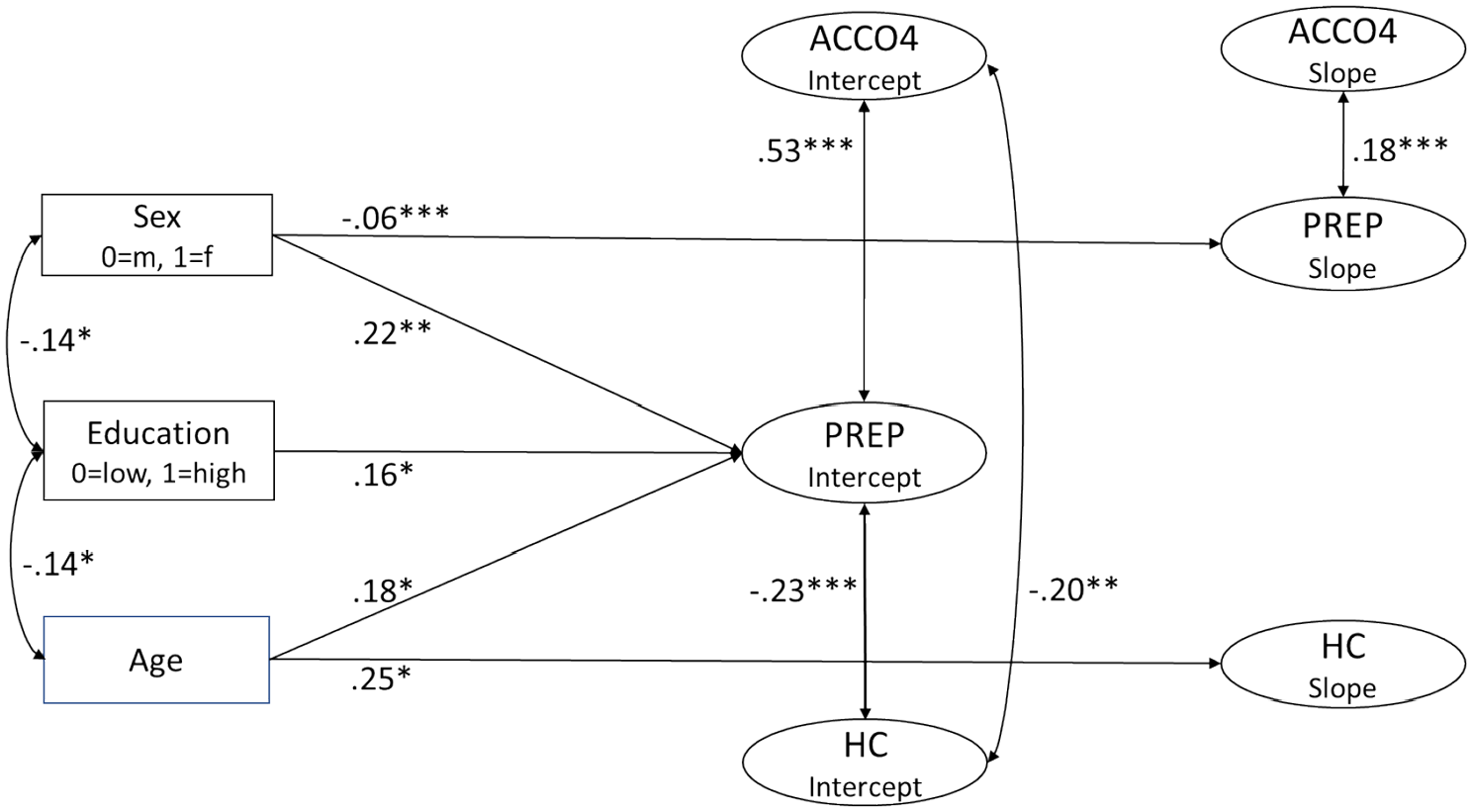
Latent Growth Model for the Association Between Accommodative Coping and Preparations for Age-Related Changes. N = 248. Depicted are the significant slope correlations and standardized paths. PRE = preparation for age-related changes, ACCO4 = accommodative coping (positive reappraisal/growth, lowering of aspirations/acceptance, downward comparison, reorientation), HC = health concerns.
We tested in additional analyses whether age was associated with the slopes. The correlations were not significant. 1
Preparation for Age and Facets of Accommodative Coping
We also tested whether the slopes of the facets of accommodative coping were positively related to the slope of preparation. These models showed that an increase in all four facets (PRG, LAA, DCO, REO) was associated with an increase in age preparedness for aging (Models M2–M5 in the Electronic Supplementary Material 2). The change correlations were significant (.27, .15, .10, .09; p’s < .01). M6 shows that there were no significant relationships with detachment from goals.
Cross-Lagged Panel Analyses
Preparation for Age and General Accommodative Coping
The aim of the following analyses was to examine whether the correlations in concurrent change between accommodative coping and preparation for age-related changes remain stable when using a cross-lagged panel model. The change correlations show whether the longitudinal associations remain stable after controlling for the autoregressive effects. We tested models with fully cross-lagged paths. We created parcels (test halves) for each time point to estimate the latent constructs of preparation for age-related changes and goal detachment. The four facets PRG, LAA, DCO, and REO were used as markers of the accommodative coping factor for each time point. Covariances of errors across the measurement points were set free for parcels with identical items (test halves).
We tested two models: the first model examined the relationships between accommodative coping and age preparations, with control variables (age, sex, education, and health concerns). The second model, without control variables, checked whether the change correlations remained stable when a random intercept was included. This is recommended when stability values of the constructs are high (Hamaker et al., 2015). In both models, all cross-lagged paths were tested and all covariances between the latent constructs were set free.
Electronic Supplementary Material 3 depicts the results of the cross-lagged panel model. As expected, the change correlations were significant at t1, t2, and t3. In this model, three cross-lagged paths reached significance: accommodative coping at t1 predicted preparation for age-related changes at t2 which in turn predicted accommodative coping at t3. Interestingly, accommodative coping at t2 negatively predicted preparation for age-related changes. The Electronic Supplementary Material 3 presents the structure of the general model that was estimated and all parameters (paths, correlations).
If the stability of constructs is high or trait-like, the lagged parameters do not represent the actual within-person relationships over time. As Hamaker and colleagues (2015) have argued, this may lead to erroneous conclusions regarding the presence and sign of causal influences. According to their suggestion, we tested a model that separates the within-person process from stable between-person differences through the inclusion of random intercepts. Figure 2 depicts the cross-lagged panel model with random intercepts (RI-CLPM). As can be seen from the figure, only the change correlations remain significant; the significant cross-lagged paths failed to remain significant.
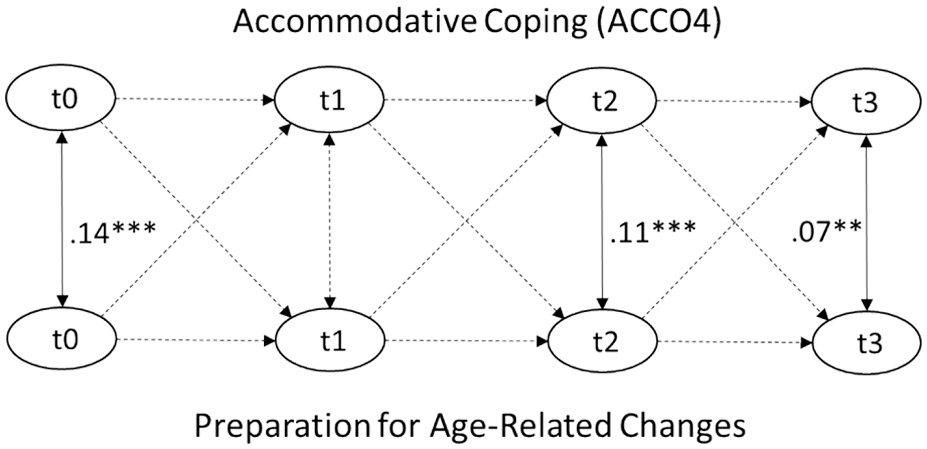
Cross-Lagged Panel Model With Randomized Intercepts. N = 248. Depicted are standardized coefficients. Dotted arrows were tested and not significant. χ2 (197) = 321.97, p < .001, RMSEA = 0.050, NFI 0.941, NNFI = 0.966, CFI = 0.976, GFI = 0.904. ACCO4 = accommodative coping (positive reappraisal/growth, lowering of aspirations/acceptance, downward comparison, reorientation).
Preparation for Age and Facets of Accommodative Coping
The analysis of the individual facets of accommodative coping and PREP supports the pattern of findings, in that the cross-lagged panel models most of the change correlations remained significant. For detachment, one change correlation was significant at T2 (rchange = .12; p < .01), but not in the following RI-CLPM. The RI-CLPMs showed that only the change correlations to t2 and t3 remained significant for PRG, LAA, and REO but not the cross-lagged paths. No longitudinal associations were found between PREP and DCO in the cross-lagged panel models. The cross-lagged path from PREP at T2 to LAA at T3 (β = .16; p < .05) reached significance.
Discussion
This study examined the relationships between preparation for age-related changes and accommodative coping over a time span of 3 years. It builds on studies that have investigated preparation for age-related changes in relation to self-concept (i.e., goal- and control-related processes; Donaldson et al., 2010; Kornadt et al., 2018; Park et al., 2022; Stawski et al., 2007) and supplements the existing findings by analyzing longitudinal dynamics from a four-wave panel study.
As expected on the basis of the dual-process model (Brandtstädter & Rothermund, 2002), accommodative coping and preparation for age-related changes were correlated. Latent growth models suggested that an increase in preparation is associated with an increase in accommodative coping in general, and in its facets of positive reappraisal, acceptance, downward comparison, and reorientation. The results of the cross-lagged panel analyses support longitudinal associations in that the change correlations became significant. The significant cross-lagged paths between the measurement times were not significant when testing a CLPM with randomized intercepts (Hamaker et al., 2015), as suggested by Hamaker and colleagues for data with high stability coefficients. Causal conclusions should therefore be avoided. One reason for the mostly absent or instable cross-lagged paths could be that we have examined dispositional tendencies and not concrete events that possibly trigger accommodative coping processes or preparations for aging.
The present findings allow the interpretation that accommodative and preparation processes reinforce one another, but not that they increase continuously from measurement time to measurement time. In longitudinal data, we do not see concrete causes. In the face of blocked goals or age-related losses, emotional regulation and preserving quality of life and action resources may become dominant concerns. Indicators of functional or health status or an individual’s awareness of age-related gains and losses (Sabatini et al., 2023) might have been more revealing in explaining the variance in the temporal change. The results are in line with studies showing that people use more proactive coping strategies when their situation is appraised as more threatening (e.g., Ouwehand et al., 2006). One explanation could be that the previous use of accommodative processes in one’s past might provide a sense of control and the ability to influence effects of the aging process. This could affect preparing for age-related changes because of the positive effects of maintaining control. The processes of secondary control in the motivational theory of lifespan development (Heckhausen et al., 2019) are similar to accommodative coping. This theory and the dual-process model make similar statements in that they assume that these processes contribute to the maintenance of efficacy. Successful earlier use of accommodative processes can lead to experiencing control, which contributes continuously to the preparation for aging. Differences or discussions do exist in the extent to which intentional control is ascribed to them (see also Morling & Evered, 2006). In the theoretical framework of the dual-process model, it is the assimilative processes (tenacious goal pursuit) that are intentionally controllable, rather than the accommodative ones, which escape intentional control.
The correlation between age and preparation in this study was rather weak, with some facets of accommodative coping not being related at all. In an additional analysis we found no differences in the correlations between the two regulation strategies that were moderated by the age variable. This may reflect that the slightly older participants (perhaps a particularly fit age group) tended to remain in the study; old age beyond 80 (fourth age, higher multimorbidity) was not included in the study. The use of an online recruiting system and questionnaire format could have led to a positive selection bias for the older adults who are digitally competent and possibly more active. Nonsignificant but nonetheless interesting were findings on the differing age trends for the individual facets of accommodation: Acceptance and downward comparison, as one might expect, were associated with age, but not growth, or reorientation (which was even negatively associated with age). On one hand, this shows that the age variable does not reflect the losses that give rise to accommodative processes well enough. The results of the latent growth analysis show that subjective health concerns increase with age, but are not associated with increases in accommodative coping and preparations for age-related changes. However, there are studies showing that accommodation is also used earlier in the life span (Thomsen et al., 2015). This supports the assumption that it is not age per se that triggers accommodation, but rather restrictions that limit the pursuit of goals.
The Role of Facets of Accommodative Coping
Latent growth models suggested that an increase in preparation is associated with an increase in four facets of accommodative coping, that is, positive reappraisal, acceptance, downward comparison, and reorientation. The results of cross-lagged panel analyses support these findings—except for downward comparison, which failed to reach significant longitudinal association in control analyses. These are processes of reinterpretation and reorientation.
Goal detachment, however, was neither cross-sectionally nor longitudinally associated with preparation for age-related changes. One explanation could be that goal-detachment tendencies include a mind-set that is contrary to one that aims at pursuing future projects such as planning ones aging process. Also, previous studies have shown less pronounced associations between detachment and other constructs; goal detachment was positively but only moderately associated with processes of developmental regulation (e.g., reengagement and acceptance), but was unrelated to positive indicators of adaptation (e.g., life satisfaction and positive affect; Barlow et al., 2020; Leipold et al., 2023; Loidl & Leipold, 2019).
Compared with the facets of accommodative coping, it was also striking that the stability coefficients of detachment were the least pronounced, which is not due to low reliabilities. Perhaps when responding to the items about one’s tendency to detach from blocked goals, agreement is more tied to the experiences from recent examples. The mean values of this facet were on average the lowest, which could be an expression of protective self-regulation: of not having to abandon one’s plans permanently in difficult times.
Limitations
Our focus was on general coping tendencies with their longitudinal relationships being examined in a 3-year interval on the basis of four measurement points. Examining the structural dynamics of the regulation processes in more detail or in concrete situations would require short-term repetitions of measurements or experimental settings. We examined the developmental regulation processes from the perspective of interindividual differences in their motivational or goal-related tendencies and have assumed that individuals have access to their coping processes and describe them via self-ratings. This may lead to an underestimation of the automatic processes involved in development regulation. As preparation for age-related changes also depends on financial resources or health-related support (Sörensen et al., 2021), the availability of community factors and support offers should also be considered. However, this study lacks the insight and arguments that look to evolution to try to order the history of intentional self-development from the past (Greve, 2023), or from the short-term interactionist perspective of development and the person-context fit (Lerner et al., 2010).
Future Directions and Outlook
Preparation for age-related changes and accommodation become central in midlife and older age. The correlations with the age variable were rather weak in this study and not all facets followed the positive age correlation one would expect from the dual-process model. As expected, they were positive for the facets of acceptance and downward comparison, but in the other direction for reorientation. The facet of detachment showed the clearest differences in relation to preparation for aging. This shows, overall, that accommodation is not a homogeneous process, but rather involves different mechanisms. The differentiation of these should be revealing in further research. Future studies should also consider potential limitations or events that may threaten goals and thus make age preparations likely or necessary. As Lang and Rupprecht (2021) found, perceived deadlines for aging preparations (the first and last adequate points at which to begin) remained fairly stable across a time interval of 6 years, but also showed some variation and change in specific domains.
The results of this study can also be useful for developmental counseling or gerontologists, who, in their practical work, are confronted with questions about when and how proactive competencies and proactive orientation should be induced, and which mental processes are involved in decisions to plan one’s aging. Based on proactive coping theory, Bode et al. (2006) developed an educational program for preparing for aging and provided evidence for changes in proactive competencies, but not in behavior or orientation. However, adults become active when their goals are threatened (Ouwehand et al., 2006). The present results show that preparations for old age differ with the degree of accommodative coping, which has an emotionally stabilizing function and serves to maintain control, especially in face of blocked goals and life crises. Perhaps people need to be aware that their life has changed as a consequence of having grown older (Diehl & Wahl, 2010) and the experience of limitations, in order for preparation to be initiated.
In sum, findings showed that preparation for age-related changes is related to accommodative coping across time. Both processes of developmental regulation are goal-related constructs related to perceived discrepancies or age-related losses (e.g., Sabatini et al., 2023), but with different foci: on the one side, preparation as the future-oriented mode of action in terms of intentional self-control, anticipating what to expect, planning, prospective coping. On the other, facets of accommodative coping, consisting of more subintentional processes, are mental reactions, triggered by difficulties and goal blockages that cannot be easily eliminated by instrumental coping efforts. In this study, the longitudinal dynamics between emotion regulation and the future-oriented action strategies were investigated, thereby describing the relationship between developmental regulatory processes that contribute to the maintenance and defense of self-definition across the lifespan.
Supplemental Material
sj-docx-1-jbd-10.1177_01650254241312144 – Supplemental material for Accommodative coping and preparation for age-related changes: Results from a four-wave panel study
Supplemental material, sj-docx-1-jbd-10.1177_01650254241312144 for Accommodative coping and preparation for age-related changes: Results from a four-wave panel study by Bernhard Leipold and Tim Loepthien in International Journal of Behavioral Development
Footnotes
Acknowledgements
The authors acknowledge many fruitful discussions with Amy Michéle-Malkowsky.
Declaration of Conflicting Interests
The author(s) declared no potential conflicts of interest with respect to the research, authorship, and/or publication of this article.
Funding
The author(s) disclosed receipt of the following financial support for the research, authorship, and/or publication of this article: The authors acknowledge the financial support by the University of the Bundeswehr Munich.

Supplemental Material
Supplemental material for this article is available online.
Notes
References
Supplementary Material
Please find the following supplemental material available below.
For Open Access articles published under a Creative Commons License, all supplemental material carries the same license as the article it is associated with.
For non-Open Access articles published, all supplemental material carries a non-exclusive license, and permission requests for re-use of supplemental material or any part of supplemental material shall be sent directly to the copyright owner as specified in the copyright notice associated with the article.
