



Abstract
To investigate children’s and adolescents’ reasoning about distributive fairness in a rural area of Nepal, we asked participants (53% girls, N = 706, Mage = 13.48; SDage = 1.79) to distribute educational resources to schools that varied by social class (SC) and to justify their allocation. Most participants allocated equally or equitably; only a minority rewarded the higher-SC school with extra resources. Novel results revealed multiple forms of reasoning coexisting in children’s and adolescents’ explanations about distributive fairness; participants’ reasoning did not just mirror their numeric allocation. Those who allocated equally were primarily concerned with nondiscrimination, whereby some participants focused on social equality and emphasized removing structural barriers. Furthermore, participants’ allocation and reasoning depended on their SC and positive experiences at school.
Understanding how children and adolescents conceptualize educational and societal inequalities and whether, and under which conditions, they would rectify existing inequalities provides information for reducing bias and enhancing equity approaches to learning and education. Accordingly, recent research has expanded the focus on children’s and adolescents’ resource allocation and reasoning about inequalities within their peer world to their perception and evaluation of societal-level inequalities (Ruck et al., 2019). Thereby, it is important to gain insights from different countries, as these inequalities are rooted in different societal ideologies or historical backgrounds, creating different economic opportunities for different status groups (Iversen et al., 2021; Kraus et al., 2017).
This study investigated Nepalese children’s and adolescents’ conceptualization of fairness regarding the allocation of resources in education. Nepal is a low-income country in Southern Asia and represents a context characterized by pervasive societal inequalities, which are proximal to individuals’ living conditions. These inequalities are rooted in the caste system, which was the cause of a long history of exclusion and discrimination based on people’s caste as it restricted their opportunities with regard to education, occupation, personal rights, and social relationships. The caste system was formally abolished in 1963; however, discrimination remains and is nowadays mirrored in strong social class (SC) divisions, whereby the lowest status groups are affected by lower access to high-quality infrastructure and social services, including education (Gurung, 2022). Families of lower SC struggle to pay for basic education services (food, transportation, uniforms, books), often drop out of school early and are overrepresented in schools with very few educational resources, which in turn widens the social gap (Bhatta, 2014; Gurung, 2022). In addition to these structural inequalities, ideology about power structures continues to shape peoples’ beliefs about social hierarchies, including discriminatory attitudes toward individuals from lower social status groups (Gurung, 2022; World Bank, 2006).
This study aimed to find out how children and adolescents growing up in this context reason about societal and educational inequalities by investigating how they allocate necessary educational supplies (books) to schools that either already had very few or many resources. In particular, we aimed to find out how they justify their allocation and whether their reasoning about distributive justice reflects these structural barriers and pervasive power structures. Moreover, an important goal was to determine whether there were age-related differences in these allocations and concerns when reasoning about distributive fairness and whether children’s and adolescents’ relative SC corresponded to their allocation and reasoning. From a social-ecological perspective, we aimed to investigate whether positive experiences at school would relate to higher concern for social justice within a divided society that does not necessarily convey messages about equal treatment and inclusion (Rogers et al., 2021).
Reasoning About Distributive Fairness in Societal and Educational Inequalities
Research based on the Social Reasoning Development (SRD) model (Rutland & Killen, 2017) suggests that addressing social inequalities and allocating resources involve multiple concerns which are often challenging for individuals to consider simultaneously. These include moral concerns that focus on equality, equity, and others’ welfare; group concerns that reflect group functioning, dynamics, and norms; and societal issues regarding status hierarchies (Rutland & Killen, 2017). Thus, children’s and adolescents’ allocation strategies depend on their identification with various social groups, often resulting in strategies that benefit their in-groups (i.e., the groups they identify with; Plötner et al., 2015; Xiao et al., 2019). Moreover, from a societal perspective, such processes related to group identity often go along with group biases and discrimination, whereby lower-status groups end up with fewer resources than higher-status groups, resulting in group-level disparities (Rutland & Killen, 2017). However, at the same time, knowledge about group dynamics and the history of prejudicial attitudes toward those who are disadvantaged can contribute to an awareness of what makes discrimination wrong (Chung & Turiel, 2022). If children and adolescents acknowledge the situation of disadvantaged groups, they may be more likely to rectify social inequalities (Gönül et al., 2023; Grütter et al., 2022).
Studies adopting the SRD model show that, during middle childhood, individuals increasingly consider preexisting inequalities when making decisions about the distribution of resources (Elenbaas & Killen, 2018; Rizzo et al., 2016). Importantly, during this period, individuals increasingly take societal-level disadvantages into account, considering that certain groups have experienced a history of discrimination when deciding how to allocate resources (Elenbaas, 2019). Work from different contexts emphasizes that when reasoning about pervasive societal and peer inequalities, intergroup dynamics based on SC are increasingly salient during late childhood and adolescence (United States: Elenbaas & Killen, 2018; Türkiye: Gönül et al., 2023; Nepal: Grütter et al., 2021; Madjdian et al., 2022). While adolescents’ growing understanding of structural causes of inequality and their desire for societal fairness have been documented in multiple countries (Argentina: Barreiro et al., 2019; Türkiye: Gönül et al., 2023; South Korea: Kim & Gewirtz, 2020), little is known about how adolescents conceptualize fairness regarding the allocation of resources in the context of social and educational disadvantages.
One of the very few studies on children’s reasoning about distributive fairness in educational inequalities showed that, with age, children were more likely to consider past disparities about group membership when witnessing inequalities of school supplies between peers of different racial backgrounds (Elenbaas et al., 2016). In addition, recent previous work from Nepal with a qualitative approach revealed that while adolescent girls perceived education as an important goal for upward mobility, they were well aware of structural barriers restricting their educational opportunities (Madjdian et al., 2022). However, it remains to be determined whether Nepalese children and adolescents consider social disparities when reasoning about distributive justice in education and whether they give priority to different concerns depending on their age.
Developmental Considerations in Reasoning About Distributive Fairness
Evidence from research on children’s resource allocation in interpersonal situations documents an early emerging sensitivity for equal treatment and a strong favor for equal distributions (Blake et al., 2015). However, given social inequalities, such equal allocation strategies may not be enough to bring disadvantaged groups to an equal level as advantaged groups; hence, scholars advocated that more advanced conceptions of distributive fairness (i.e., equity) consider previous inequalities, rectifying imbalances through allocating more resources to disadvantaged groups, rather than equal allocations (Olson et al., 2011; Rizzo et al., 2016). Research shows that children around 8 years of age are more likely to judge equitable rather than equal allocations as fair (Paulus et al., 2018; Rizzo & Killen, 2016; Zhang et al., 2021).
Since most previous research on resource allocation has focused on emerging concepts of fairness in childhood, there is limited evidence concerning adolescents’ reasoning about distributive fairness. To address this gap, this study covered a wide developmental range from late childhood to late adolescence. When including adolescents’ reasoning, it is necessary to account for their more developed understanding of structural barriers as obstacles to societal equality (Gönül et al., 2023; Kim & Gewirtz, 2020), whereby they judge social inequalities as increasingly negative with age (Barreiro et al., 2019). Thus, adolescents’ reasoning about distributive fairness within the context of existing inequalities may take on more complex considerations (Chung & Turiel, 2022), which may have different implications for their allocation strategies.
When studying notions of distributive equality in developmental psychology, moral philosophy has been fruitful for theories and research on moral development (Killen et al., 2016). The concept of social equality emphasizes social goods, such as power, opportunities, or respect as the primary good to be equalized, whereby social hierarchies and privileges related to SC clearly violate it (Fourie, 2015, 2022). Thus, social equality requires knowledge of the recipients involved, including their status, needs, and previous inequalities (Chung & Turiel, 2022; Killen et al., 2016). When adolescents reason about fairness, such notions of social equality would then be reflected in moral considerations of respect and concern for all that are based on the recognition of politics or social structures that create status differences between individuals. Since the primary concern of social equality represents the social egalitarian commitment rather than the distribution of resources (Fourie, 2015), it may be possible that adolescents’ resource allocation does not necessarily mirror their reasoning.
Depending on the notion of social equality, different patterns of distribution could result. For example, social equality could be mirrored in equal distributions of resources, when the primary concern relates to providing equal opportunities and capabilities while rejecting power relations that lead to relative deprivation and structural discrimination (Fourie, 2015; Scheffler, 2015). When considering opportunities for the worst off, discrimination related to status differences and objections to power would need to be differentiated from providing the worst off with the best possible options, which may also entail the provision of just enough resources to improve their situation. While the first reasoning is in line with the idea of social equality, the latter does not include references to social barriers that limit social participation (Fourie, 2022). With regard to the context of Nepal, this study investigated whether adolescents’ growing understanding of the roots of societal inequalities would translate into more differentiated concerns related to distributive fairness in educational resources. Given the long history of discrimination and exclusion of minority groups in Nepal, we expected differentiated reasoning with concerns related to equity and various forms of equality. Thereby, the current work builds on one of the scarce previous studies in which adolescents considered resource inequalities that were based on group disparities as wrong for reasons due to social equality (Chung & Turiel, 2022).
The Role of SC in Distributive Fairness in Education
In Nepal, individuals are easily identified by status categories, whereby groups with a long history of social discrimination obtain the lowest positions within the SC spectrum, including low access to educational opportunities (Gurung, 2022). Therefore, we investigated whether participants’ own SC differently corresponded to their reasoning about distributive fairness. It is possible that children and adolescents with a lower SC may be more likely to rectify given inequalities as compared to participants from higher SC backgrounds. A recent study investigated Turkish children’s and adolescents’ reasoning about the exclusion of lower SC characters from educational opportunities, whereby adolescents (age: 14–16) from lower SC backgrounds perceived exclusion based on SC as less okay than children (age: 8–10), referencing reasons related to nondiscrimination and restoring equity (Gönül et al., 2023).
In contrast, from a social identity perspective, individuals from higher SC backgrounds may be more likely to refer to the status quo and voice negative biases about lower-status individuals, whereby discrimination serves to prevent the social mobility of lower-status groups (Kraus et al., 2017). Previous work in Indian schools revealed more frequent rates of children of lower SC being the victim of physical aggression, as students of lower SC may be devalued by their peers for being poor (Malhi et al., 2015). With regard to resource allocation, children in the United States often expect higher-status groups to benefit their group (DeJesus et al., 2014; Elenbaas & Killen, 2018). This awareness of how status differences result in unfair allocation of resources may inform children’s and adolescents’ reasoning about distributive fairness and their allocation of resources. Thereby, it is possible that children and adolescents growing up in contexts with scarce resources, in which societal inequalities and discrimination are very salient issues may have a high awareness of structural barriers, independent of their relative status within the society. Therefore, these individuals may voice a strong desire for social equality regardless of their SC. For example, evidence from China and South Korea shows that higher levels of perceived wealth inequality go along with a greater desire for redistributing resources (H. Kim et al., 2018).
Moreover, from a social-ecological perspective, in addition to these considerations about the macro-context, it is possible that positive experiences within the micro-context of schools, such as feeling connected and committed to the school environment, increase concerns about equal treatment when allocating educational resources (Rogers et al., 2021).
The Role of Positive Experiences at School in Distributive Fairness in Education
When children and adolescents have positive experiences with their school environment, such as their teachers, peers, and academic content, they are emotionally engaged with school and feel connected and committed (Fredricks et al., 2004). This positive emotional connection and higher identification with school is closely related to experiencing positive social relations at school (Fredricks et al., 2004), where such relationships provide learning environments for children and adolescents as they are required to coordinate their goals and actions with others and learn about the consequences of their actions for others (Carpendale et al., 2013). Accordingly, a recent longitudinal study in Italy showed that higher emotional engagement with school can increase the recognition of interpersonal justice at school, such as being treated fairly and with respect (Mameli et al., 2022). In addition, previous work with adolescents in Hong Kong suggests that emotional engagement with school predicts future civic participation, as students who feel more positively connected and committed to school are not only more likely to voice personal opinions about social issues and discuss them with peers but also more frequently participate in extracurricular events that strengthen feelings toward the community (Yuen, 2013). Expanding on these previous findings, we examined whether students who feel more emotionally engaged with school would consider equal treatment as a high priority when reasoning about distributive justice, particularly in a context, where strong social boundaries exist.
The Current Study
This study investigated Nepalese children’s and adolescents’ reasoning about distributive fairness in education. Nepal represents a low-resource context with a long history of inherent status inequalities (Gurung, 2022). We investigated how children and adolescents allocated essential resources between a relatively advantaged and a disadvantaged school and how they reasoned about their distribution. Importantly, we conducted extensive pilot work to apply measures developed in multiple countries to fit the context of Nepal. Given that we analyzed adolescents’ reasoning, we identified different forms of reasoning that would be relevant to participants’ explanations for their judgments based on pilot data and previous literature (Chung & Turiel, 2022; Elenbaas, 2019; Gönül et al., 2023). We distinguished between conceptions related to (1) maintaining the status quo, and (2) promoting equity for disadvantaged groups referencing that these would require more resources given previous inequalities or societal obstacles. Moreover, we captured different notions of equality, namely, (3) equality referencing numeric equality or equal opportunities without acknowledging societal obstacles or given inequalities, (4) equality referencing an improvement of the situation of the disadvantaged (at least giving them something), or (5) social equality referencing the value of equal social relationships and at the same time acknowledging societal obstacles or given inequalities (for details, see methods).
The hypotheses were based on several lines of research on conceptions of distributive fairness including prior research about the distribution of resources to those from disadvantaged backgrounds (Chung & Turiel, 2022; Elenbaas & Killen, 2018; Kraus et al., 2017), as well as adolescents’ growing understanding of societal obstacles described in research from a range of different countries (Barreiro et al., 2019; Gönül et al., 2023; Kim & Gewirtz, 2020; Madjdian et al., 2022). With regard to age differences, we expected that, with age, participants would be less likely to perpetuate the status quo (H1a) and more likely to reference equity or social equality (H1b). In addition, we explored whether adolescents would be willing to accept some levels of inequality to improve the situation of disadvantaged social groups, since a better understanding of the roots of societal inequalities may translate into a more realistic understanding of restricted possibilities for improving the status of lower SC characters.
Given the wide age range from late childhood into adolescence and the focus on educational inequalities within a low-resource context with a long history of inherent status inequalities, we formulated competing hypotheses related to the role of participants’ own SC for their reasoning about distributive fairness. Based on previous work (Gönül et al., 2023; Kraus et al., 2017), we assumed that individuals from relatively lower SC backgrounds would be more likely to rectify educational inequalities in their allocation and reference reasons related to equity, while individuals from relatively higher SC backgrounds would more likely perpetuate the status quo in their allocation and reasoning (H2a). As a competing hypothesis, however, we assumed that there would be no difference between participants from relatively lower and higher SC in their allocation and reasoning since they would both voice a strong desire for social change (H2b). Furthermore, expanding previous work on positive experiences at school and interpersonal justice (Mameli et al., 2022) respective civic concerns (Yuen, 2013), we expected that higher emotional engagement with school would correspond to fewer allocations and references related to maintaining the status quo since children and adolescents would focus more on fairness concepts related to equity or reasons related to different forms of equality (H3).
Method
Participants and Procedure
The sample consisted of 706 Nepalese children and adolescents attending Grades 5 to 10 (53% girls, Mage = 13.48; SDage = 1.79; range = 9–19 years, 75% of the sample was between 12 and 15 years old). The study participants lived in a rural area in the Kathmandu valley (Lalitpur District) and the estimated mean real per capita consumption was M = 38,075 Nepalese rupees per month (SD = 17,372 NPR; range = 4,323–88,539 NPR), which equaled US$360 in 2017 when the data were collected. This estimate was representative of the average real per capita consumption for the district in which the study was conducted, which was 39,890 NPR (SD = 30,191; range = 4,598–227,810 NPR) and the average real per capita consumption of Nepal (M = 34,196 NPR; SD = 25,341; range = 4,598–570,082 NPR) according to the data of the Nepal Living Standard Survey (NLSS) (Central Bureau of Statistics, 2011). With regard to the cultural context, nearly one-fifth of participants (18%) were from ethnic minority groups (former lower caste individuals, ethnic minority groups typically not classified within the Hindu caste system, and religious minority groups).
The local research assistants conducted individual face-to-face interviews in Nepalese at school. The study procedure was in line with the ethical recommendations of the Helsinki Declaration, the American Psychology Association, and the World Health Organization (WHO) and approved by the ethics committee of the Teacher University Lucerne [protocol number 176]. Primary caregivers were asked to provide active consent for their child’s participation (for illiterate parents, the additional signature of a witness was requested). Overall, 2% of all primary caregivers did not give their consent. Child and adolescent assent was requested, whereby all students participated (for more details, see Supplemental Materials, S1).
Resource Allocation Task
The resource allocation task was a modification of prior work (e.g., Elenbaas et al., 2016; Rizzo et al., 2016) adapted in regional focus groups to the context of this study. Participants listened to descriptions of students in two different schools, which either had many or few resources available (presented in random order, see Figure 1). The descriptions and pictures of the schools were developed in multiple focus groups with Nepalese children and adolescents (see Supplemental Materials, S0). For example, the description of the lower SC school was as follows: This school has 200 students. This school has an old fence, but no security guard. The children of this school only have one uniform and some children wear their out-dresses because they do not have money to buy the uniform. There is not much space for the children in the classroom and benches to sit on look old. There is no library and the children do not have enough school materials. During break time, children do not have many materials to play with. Some children also need to leave the school to work at home (see Supplemental Materials, S1, for details on the complete task).

Resource Allocation Task.
Participants answered a control question after listening to both story descriptions (i.e., “Can you tell me which school has more school facilities?”) and the descriptions were revealed a second time if the answer was not correct. Forty participants needed a second explanation and 25 then answered correctly; hence, 15 participants were excluded. Participants were asked the following questions: (1) Allocation of resources: “Here are six boxes of books. Can you show me how many boxes you think each school should get?”; participants placed the boxes below the pictures of the two schools; (2) Reasoning: “Why did you give X boxes to this [pointing to the picture of the first school] and X boxes to this [pointing to the picture of the second school] school?”.
Coding of Reasoning Data
The reasoning data were transcribed by the research assistants and translated by professional translators from Nepalese to English. The coding system was developed based on the SRD model (Killen et al., 2016), previous research about resource allocation (Elenbaas & Killen, 2018; Rizzo et al., 2016), references to social obstacles (Gönül et al., 2023), and considerations about social equality and the distribution of resources (Chung & Turiel, 2022; Fourie, 2015). The coding categories were (1) Status quo (“This school [lower SC] is not a good environment for studying and the students are not very disciplined, which is why 2 boxes are enough here.”); (2) Equity, referencing previous inequalities and emphasizing that more resources are needed for disadvantaged groups (e.g., “There is a need of books in this school [lower SC]. Students here cannot buy books. This school [higher SC] already has many books. Instead of giving to those who already have it, it’s better to give it to those who don’t”); (3) Equality with no references to existing inequalities, including references to numerical equality, equal access to resources, and equal treatment (e.g., “Books are equally important in both schools. They have to study equally”); (4) Equality also helps disadvantaged status, referencing an improvement of the disadvantaged (e.g., “Because I wish they [lower SC] could as well get 3 boxes of books. So that they would have at least something and could learn better.”); and (5) Social equality and education for all, referencing equal social relationships and acknowledging societal obstacles or given inequalities (e.g., “Because people of this school [lower SC] are also human. We should think good for them too. But yet, I have distributed equally, as we should distribute without having any discrimination that’s why.”). Missing or unelaborated statements were not considered in the analyses (3%, N = 21). A team of two researchers familiar with the context of the study coded the answers based on the coding scheme after receiving extensive training and attending multiple sessions to discuss the codes with the team of Nepalese research assistants. In out of 354 cases, the two coders did not agree regarding 25 cases (i.e., 7%), suggesting high interrater reliability (Kappa = .92).
Independent and Control Variables
Emotional Engagement with School
After piloting different scales to capture positive experiences at school with the current sample, we adapted the emotional engagement with school scale by Fredricks et al. (2004) for simplicity (e.g., “I feel happy in school.,” “My classroom is a fun place to be.”; 5-point Likert-type-scale, 0 = never, 4 = always; see Supplemental Materials S1, for a full item list). The reliability of the current sample was ω = .70 (M = 3.92, SD = 0.50).
Social Class (SC)
We calculated participants’ SC based on their answers to questions regarding their housing situation and family property, whereby we estimated the real per capita consumption (RPC) of each student’s family (see Supplemental Materials, S1, for details regarding our approach). We conducted our analyses with the continuous measure but made an additional differentiation as we wanted to distinguish the poorest students in our sample from students with a relatively higher SC. Therefore, we created four categories for students’ SC. These four categories were based on a nationally representative sample (NLSS data set), whereby the 25th percentiles were calculated for the district of the current data collection and applied to the current data to draw meaningful inferences regarding our sample (0 = lowest 25% of the region, 1 = between 25% and 50%, 2 = between 50% and 75%, and 3 = highest 75% of the region). Most of the students in our sample of the poorest quartile (75% of the poorest students) lived in basic housing (i.e., walls built of mud, wood, or tin sheets) while only 29% of the students classified above the 25th and 13% of participants classified above 75th percentile lived in basic housing. Moreover, within the poorest 25th percentile, 56% of mothers and 28% of fathers were illiterate, while among the 75th percentile, 18% of mothers and 8 % of fathers were illiterate (for more information, see S1).
Control variables
In all analyses, we controlled for gender effects (0 = male, 1 = female) and the percentage of students from the lowest SC backgrounds in a school class (i.e., within the lowest 25% of the region in which the data was collected). The percentage of students belonging to the lowest 25% of the sample within each school class ranged from 5% to 62% (M = 0.22, SD = 0.14, range = 0.06–0.50).
Data Analytic Strategy
Importantly, students attended 29 different school classes; thus, for each dependent variable, we examined whether there were significant differences between school classes to be accounted for and concluded that, for resource allocation and reasoning, the models with random effects did not fit the data better than the model without random effects. We thus conducted multinomial logit models (MLM) without random effects (for more details, see Supplemental Materials S2).
We conceptualized children’s and adolescents’ resource allocation and reasoning as categorical (nominal variables), representing qualitatively different reactions to social inequality (Corbett et al., 2023); therefore, we used MLMs for analyses. In contrast to treating the allocated resources as a linear variable and assuming that higher allocations to the relatively poor school would reflect higher values of fairness, we assumed that how participants allocated resources would represent different conceptualizations of fairness (status quo, equality, equity). To increase statistical power, we merged participants’ allocations into three categories: status quo (more resources to the higher SC school), equality (equal resources for both schools), and equity (more resources to the lower SC school). To examine our hypotheses, we chose equality as our reference category since most of the comparisons specified in our hypotheses concerned differences between equality and status quo or equality and equity. The same procedure applied to the analyses concerning participants’ reasoning. For each dependent variable (allocation, reasoning), we included the control and independent variables, whereby we included SC as a categorial variable to contextualize our data. In addition, we ran the same model with SC as a continuous variable to increase the comparability of our data with other studies (see Supplemental Materials, S3, for details on these analyses).
Results
Resource Allocation
Descriptive results showed that participants were almost equally likely to allocate resources equally (51%) and equitably (44%), while a small minority (5%) allocated more resources to the higher SC school. The MLM with equal distributions as a reference category (see Table 1) revealed that, in line with H1a, older participants were less likely than younger participants to perpetuate the status quo. With regard to participants’ own SC, analyses revealed that children and adolescents from relatively higher SC backgrounds were more likely to allocate resources equitably than participants from the lowest SC background (see Table 1 respective Supplemental Table S3-A). When plotting the estimated likelihood for allocating resources based on the MLM that included SC as a categorical variable relative to a representative sample (see Figure 2), it became apparent that participants of the lowest 25% were significantly more likely to distribute resources equally rather than equitably (and rather than perpetuating the status quo). A similar pattern emerged for participants below the 50th percentile; however, the difference between equal and equitable allocations was much smaller and not significant. Participants from relatively higher SC backgrounds (see Figure 2) were equally likely to allocate resources equally or equitably. Taken together, none of the competing hypotheses (H2a, H2b) was confirmed. Finally, in line with hypothesis H3, higher emotional engagement with school was associated with a lower likelihood of maintaining the status quo (see Table 1).
Multinomial Logit Model on Participants’ Resource Allocation.
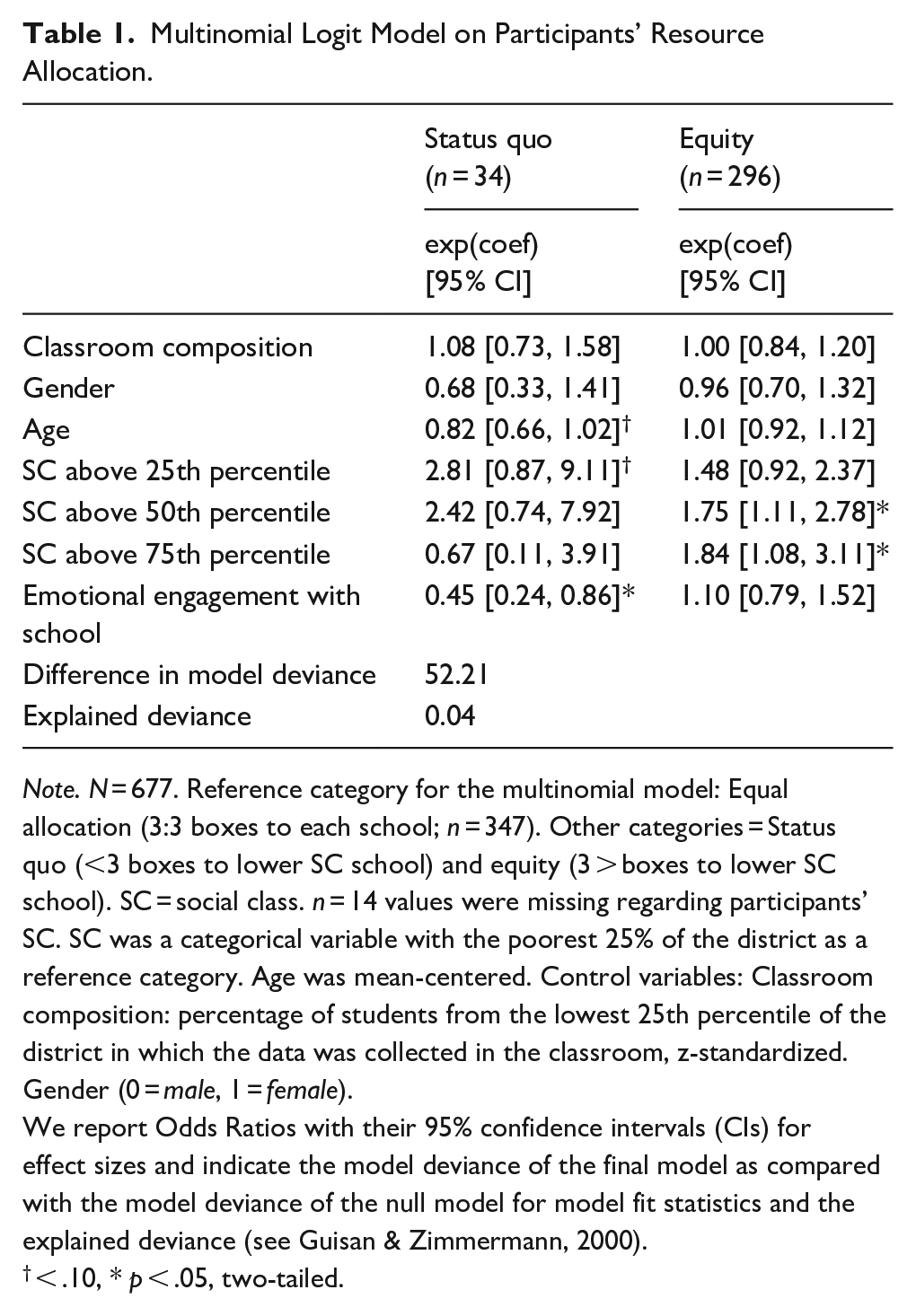
Note. N = 677. Reference category for the multinomial model: Equal allocation (3:3 boxes to each school; n = 347). Other categories = Status quo (<3 boxes to lower SC school) and equity (3 > boxes to lower SC school). SC = social class. n = 14 values were missing regarding participants’ SC. SC was a categorical variable with the poorest 25% of the district as a reference category. Age was mean-centered. Control variables: Classroom composition: percentage of students from the lowest 25th percentile of the district in which the data was collected in the classroom, z-standardized. Gender (0 = male, 1 = female).
We report Odds Ratios with their 95% confidence intervals (CIs) for effect sizes and indicate the model deviance of the final model as compared with the model deviance of the null model for model fit statistics and the explained deviance (see Guisan & Zimmermann, 2000).
< .10, * p < .05, two-tailed.
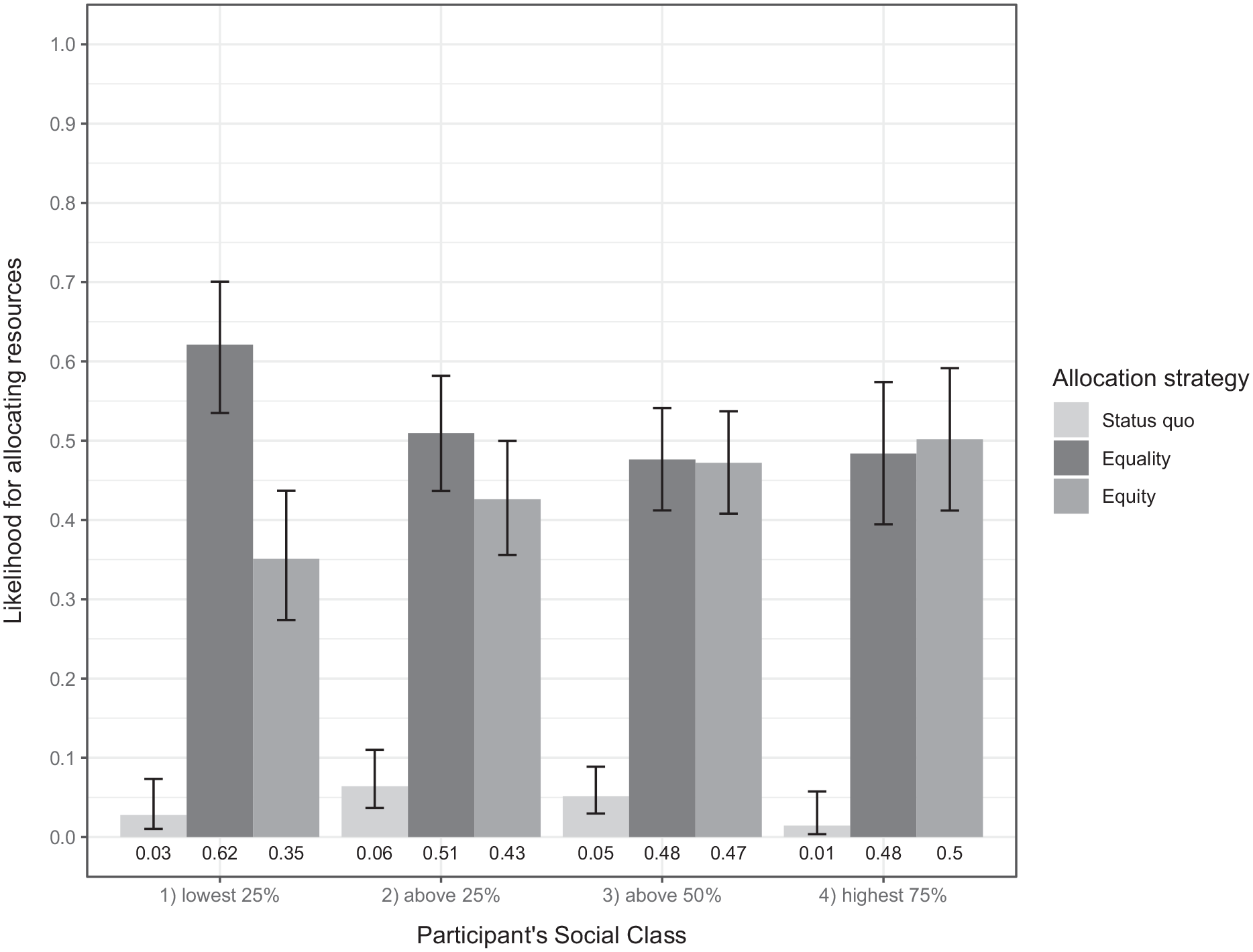
Resource Allocation Depending on Participants’ Relative SC.
Reasoning About Resource Allocation
When providing justifications for their allocation choices, only a minority of participants, namely, 7%, referenced preserving inequality. Participants most frequently (45%) referenced reasons concerning equity, followed by equality without references to previous inequalities (30%), social equality and education for all (10%), and equality also helps disadvantaged status (8%).
To analyze our hypotheses, we conducted an MLM with equality reasoning without references to previous inequalities selected as the reference category (see Table 2), whereby the average likelihood to reference each category based on the model is plotted in Figure 3. Concerning our hypotheses related to age differences, the results showed that older participants were significantly less likely to reference the status quo than younger participants (supporting H1a). Moreover, older participants were significantly less likely to reference equality also helps disadvantaged status than younger participants. Regarding our hypothesis H1b that, with age, participants would be more likely to reference equity or social equality, there was no significant difference. From a descriptive perspective, equality without referencing previous inequalities and social equality reasoning were both relatively higher among older adolescents than among older children, while equity was equally high across all age groups (see Figure S4 in Supplemental Materials for more details regarding age).
Multinomial Logit Model on Participants’ Reasoning About Their Resource Allocation.
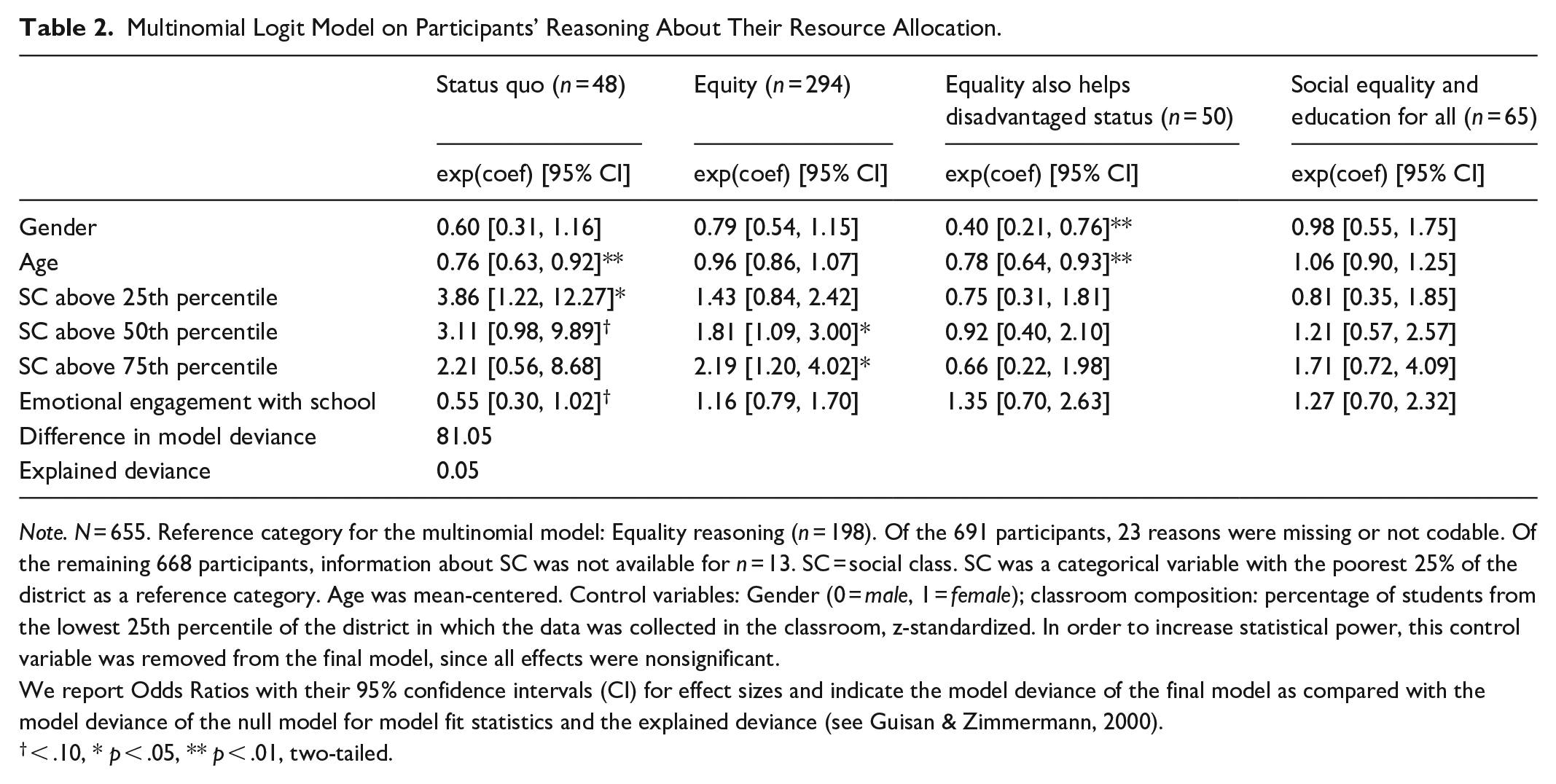
Note. N = 655. Reference category for the multinomial model: Equality reasoning (n = 198). Of the 691 participants, 23 reasons were missing or not codable. Of the remaining 668 participants, information about SC was not available for n = 13. SC = social class. SC was a categorical variable with the poorest 25% of the district as a reference category. Age was mean-centered. Control variables: Gender (0 = male, 1 = female); classroom composition: percentage of students from the lowest 25th percentile of the district in which the data was collected in the classroom, z-standardized. In order to increase statistical power, this control variable was removed from the final model, since all effects were nonsignificant.
We report Odds Ratios with their 95% confidence intervals (CI) for effect sizes and indicate the model deviance of the final model as compared with the model deviance of the null model for model fit statistics and the explained deviance (see Guisan & Zimmermann, 2000).
< .10, * p < .05, ** p < .01, two-tailed.
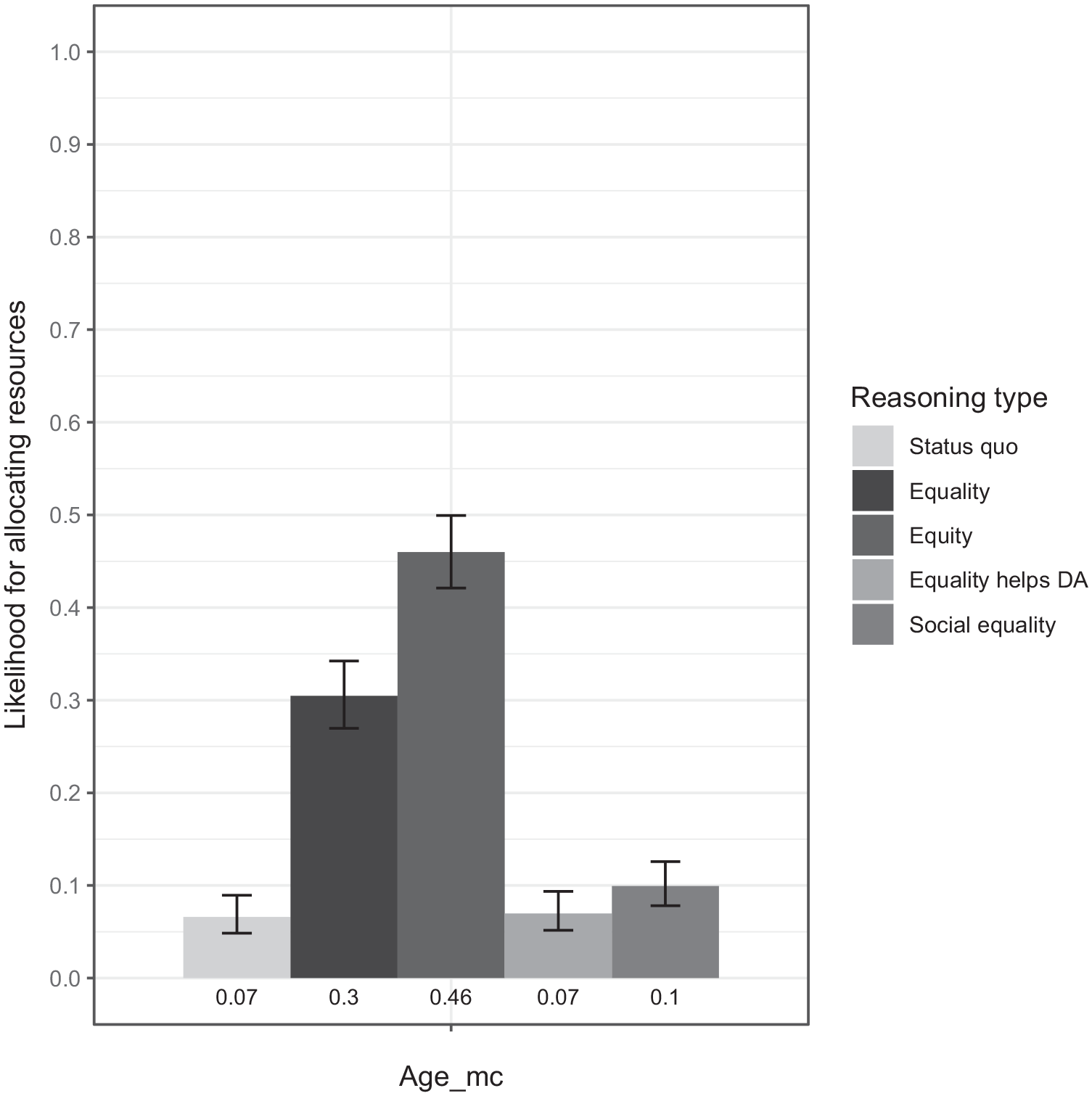
Reasoning About Students’ Own Resource Allocation.
Concerning participants’ SC, the results did not support the competing hypotheses, but rather, the results revealed a complex picture. In contrast to our assumption that participants from relatively lower SC backgrounds would more likely reference equity, the opposite pattern of results was found. Consistent with the findings from their allocation, participants from relatively higher SC backgrounds were significantly more likely than participants from relatively lower SC to reference equity rather than equality (see Supplemental Table S3-B). When investigating differences between the poorest 25% and participants with a relatively higher SC, those above the 50th percentile (relative to the district in which participants lived in) were significantly more likely to reference equity (see Table 2). However, those participants that were slightly above the poorest participant group (above 25%) were significantly more likely to reference the status quo than participants of the lowest SC. The analyses revealed no significant differences based on SC with regard to social equality, which was equally displayed as equality reasoning for participants from relatively lower and higher SC backgrounds. Finally, the results supported hypothesis H3, whereby higher emotional engagement with school was significantly related to a lower likelihood of referencing the status quo in comparison with equality (see Table 2).
Interestingly, when looking at the reasoning and the allocation strategy at the same time in a cross-table, there was a full overlap of reasons concerning equity with allocating more resources to the disadvantaged school. Moreover, all participants referencing equality without specifically acknowledging previous inequalities allocated resources equally to both schools. In contrast, all participants who referenced social equality and education for all and those who referenced equality also helped disadvantaged status allocated an equal number of resources to both schools. Those who referenced the status quo were divided between giving more resources to the higher SC school (N = 33%) and those who allocated equally (N = 16%). Thus, children’s and adolescents’ reasoning did not fully mirror their allocation strategy.
Discussion
This study investigated children’s and adolescents’ reasoning about distributive justice in Nepal, a context with scarce resources, high social stratification, and large educational inequalities (Gurung, 2022). Older children and adolescents distributed essential resources (boxes of books) to schools described as relatively advantaged (having already many resources) and schools described as relatively disadvantaged (having very few resources). Half of the sample allocated resources equally, followed by a large proportion of participants that allocated more resources to the disadvantaged school.
The novel findings for this study were that participants showed high awareness of previous inequalities within education and their associations with societal stratification despite living in a traditional society with little upward social mobility. As an example, one participant stated, The students of this school cannot buy books. The other school has been developed and, in such schools, mostly children from rich families are enrolled. In the less developed school, mostly children from poor families would study. If this school [lower SC] is given resources, children will study and, in the future, develop the school.
Thereby, this study builds on scarce previous work conducted in India and Nepal regarding adolescents’ voice and agency against gender inequalities. Most adolescents disagreed with traditions that excluded girls from equal educational opportunities through early marriage and anticipated standing up, even against their family, if needed (Chandarana et al., 2023). When recognizing the detrimental effects of barriers to social justice, children and adolescents can raise their voice and stand up for distributive justice.
Reasoning About Barriers to Social Justice and Equal Opportunities in Education
Expanding previous work on adolescents’ understanding of social structures (Barreiro et al., 2019; Diaz et al., 2023; Kim & Gewirtz, 2020) with data from children’s and adolescents’ allocation decisions and reasoning, we identified a high understanding of structural barriers that restrict social equality, given existing inequalities. This understanding of societal-level disadvantages related to group membership is an important component for rectifying inequalities, which is assumed to increase beyond late childhood (Elenbaas et al., 2016; Olson et al., 2011). In this study, age was negatively associated with perpetuating the status quo. Based on the analyses, around 10% of the younger participants (approximately age 10) justified their allocation with references to the status quo that mostly included biases about lower SC students. In contrast, only 4% of the 17-year-olds voiced such reasons. This finding resonates well with prior literature on moral development, whereby older adolescents are more likely to perceive negative consequences of stereotypes than children or younger adolescents (Killen et al., 2010) and mention fewer stereotypes when asked about the causes of poverty (Diaz et al., 2023).
Nepalese children and adolescents expressed a strong focus on equity (45%) and the need to account for existing inequalities when distributing educational resources. However, in contrast to the assumption that equity reasoning would be even higher among older participants, there were no age differences, as equity reasoning was high—independent of age. Similarly, there was not enough statistical evidence for our hypothesis that older participants would more likely refer to notions of social equality and education for all and we only identified a descriptive increase with age. Similar to the notion of equity, approximately 10% of all participants acknowledged previous inequalities and structural barriers, but mainly voiced reasons that predominantly focused on equal respect, opportunities, and nondiscrimination as a way forward, for example, These students [lower SC] are also human. We should not discriminate just because one school has more than the other. No matter the type of school, they deserve equal importance as there should be equality. They both need to study. Education should be equal. Students are the future of our country, that is why.
In line with their focus on equality, these participants allocated resources equally to both schools and justified their allocation of educational resources intending to prevent discrimination and enable equal treatment within a society that traditionally excluded social minority groups from educational opportunities. Thereby, our study builds on previous work on adolescents’ evaluation and reasoning about social justice with regard to groups that are traditionally discriminated against in society (based on gender and race), whereby adolescents voiced strong concerns regarding equality and particularly the equality of persons (Chung & Turiel, 2022). However, extending that study, this study suggests that reasoning about distributive justice and resource allocation do not necessarily overlap, as participants allocated resources equally, even when being aware of these structural inequalities.
Within the philosophical conceptualization of social equality, respect and equal treatment are the primary social goods to be allocated, whereby the primary concern represents the social egalitarian commitment rather than the distribution of resources (Fourie, 2015; Scheffler, 2015). For example, social equality could be mirrored in equal distributions of resources, when the primary concern relates to providing equal opportunities and capabilities while rejecting power relations that lead to relative deprivation and structural discrimination (Fourie, 2015). Thus, our finding resonates well with the idea that the means to equality as mirrored in participants’ allocation of educational resources should not be confused with the goal of an equal society apparent in children’s and adolescents’ reasoning. Participants differed in the way how they justified their allocation. They either provided more resources to the disadvantaged because of recognizing their higher need to progress through society, or they provided equal resources, even though they acknowledged previous inequalities, but placed higher importance on the social good of equal respect and equal treatment as a means to reaching education for all.
Next to equity and social equality and education for all, this study identified a strong focus on equality (30%) without explicitly referencing existing inequalities, which descriptively increased with age, but there was not enough evidence for significant age differences. When looking at participants’ equality reasoning more deeply, some participants focused on more simple conceptions of giving out equal amounts of resources to an equal number of students, but many participants’ reasoning involved more complex notions of equality that were related to social justice and nondiscrimination. The following statements illustrate this type of reasoning: “Every school should be equal and provide high-quality education. Every student should have a chance to learn the same thing. People can become successful by studying and everyone will respect them.”; “We should not discriminate between schools and between students whether they are rich or poor.” Thus, overall, participants’ reasoning reflected a strong desire for a more egalitarian society.
Allocation of Educational Resources and Their Underlying Justice Considerations
When considering the overlap between participants’ allocation and reasoning, it became apparent that children’s and adolescents’ allocation cannot just be equalized with their reasoning: while the 44% of participants who allocated more resources to the disadvantaged school all justified their allocation with equity reasons, the 51% of participants that allocated equally did so out of various reasons. In the context of Nepal, older children and adolescents may consider different means of how social justice can be achieved. First, being aware of the long tradition of discrimination within the caste system and restricted mobility within the Nepalese society (Madjdian et al., 2022) and few resources within the country, they may consider equality as their priority when reasoning about social justice. Alternatively, given their vast experience with these social obstacles, adolescents may be more realistic about the restricted opportunities, and therefore, perceive some form of improvement of disadvantaged students as progress. However, this explanation seems unlikely, as only a few, and mostly younger participants used this justification (8%). From a philosophical perspective, this form of reasoning may entail that adolescents would provide “just enough” resources to improve the status of the disadvantaged, and thus, not addressing power imbalances or discrimination related to status differences. In contrast to the notion of social equality, social barriers that limit social participation would not be addressed (Fourie, 2022). With regard to this study, this suggests that Nepalese adolescents may indeed focus on social barriers to equality and not just on improving the situation of the worst off. Still, future work could disentangle these potential explanations underlying adolescents’ justice reasoning. Taken together, Nepalese youth voiced complex reasons, considered different moral concepts and coordinated them with regard to societal challenges. Thus, our findings showcase adolescents’ increased capacity to coordinate different moral concepts with the demands of the social context (Chung & Turiel, 2022; Grütter et al., 2021; McGuire et al., 2018).
Differences Related to Relative SC
This study points to differences in allocation and reasoning between participants depending on their SC. Studying their allocation, the poorest participants were significantly more likely to focus on equal allocations while participants with relatively higher SC backgrounds were equally likely to allocate resources either equitably or equally. Accordingly, participants from relatively higher SC backgrounds were more likely to focus on equity reasoning compared with the poorest participants. These complex results did not confirm any of our competing hypotheses, assuming higher equity reasoning among the poorest participants or no differences due to SC. Previous work from Türkiye showed that children (8–10 years) and adolescents (14–16 years) from lower SC backgrounds perceived exclusion from educational opportunities based on SC as less ok than participants from higher SC backgrounds, whereby older participants more likely recognized discrimination and focused on restoring equity (Gönül et al., 2023). Similarly, the poorest participants in the current Nepalese sample may have faced salient issues of discrimination and low mobility (Gurung, 2022; Madjdian et al., 2022). While their allocation strategy and reasoning voice a strong desire for equal treatment, opportunities, and nondiscrimination, these youth from the lowest SC spectrum may be less optimistic about social change; and thus, primarily wish for equal treatment and respect as a social good, given the long tradition of exclusion of the lowest social groups.
As an alternative explanation, the poorest students of the sample may have focused on the primary needs of mastering daily challenges associated with poverty, not taking on any risks of losing potential resources. In contrast, children and adolescents from relatively higher SC backgrounds may perceive more opportunities for allocating educational resources to disadvantaged schools as they have more resources in their environment that can be shared. With their awareness of Nepal’s social inequalities, they may opt for a more just society, given the privileges that may be associated with social safety. Moreover, previous work on civic engagement among American adolescents points to more discussions in families from higher SC backgrounds about social inequalities as these families may have more education and knowledge about inequalities to share with their offspring; in addition, children of higher SC are more likely to attend schools with higher educational quality in which they may have more learning experiences for civic engagement (Kahne & Middaugh, 2009). Similar mechanisms may apply to Nepalese children and adolescents from relatively higher SC backgrounds as they did not just ignore obstacles in society for their own good. Further work will need to carefully disentangle the complexity and different reasoning of children and adolescents from the relatively least, average, and most privileged social status groups.
Positive Experiences at School and Reasoning About Distributive Justice
Schools are an important context in providing opportunities for children and adolescents to learn about treating other people with respect and not perpetuating situations in which certain groups are put at a systematic disadvantage (Mameli et al., 2022; Yuen, 2013). This study adds new insights to a social-ecological perspective on children’s and adolescents’ reasoning about distributive justice, demonstrating that participants reporting more positive experiences at school (i.e., higher emotional engagement with school) were less likely to perpetuate the status quo.
When children and adolescents have positive experiences with their school environment and feel emotionally engaged and committed to school, they may more strongly pay attention to the needs and goals of others and notice if peers are not treated equally (Barth & Grütter, 2024; Carpendale et al., 2013; Mameli et al., 2022). Given Nepalese children’s and adolescents’ high sensitivity to issues of systematic discrimination, they may pay particular attention to not perpetuating educational inequalities that increase disparities between groups when feeling more committed to school. Future work will need to determine the source of participants’ emotional engagement with schools and distinguish between the role of interactions with peers and teachers for their concerns about social justice, and identify whether schools place high importance on discussing issues of social justice (Encina & Berger, 2021; Yuen, 2013). For example, concerning peers, previous cross-cultural work documents that collaboration with peers increases trust and affiliation among peers, resulting in more equitable allocations of resources (Plötner et al., 2015).
Limitations
This was a first study regarding how Nepalese adolescents reason about distributive justice and educational inequalities. There are multiple new avenues to pursue to address factors that this study was not able to fully investigate. First, despite variance in our sample with regard to participants’ SC and a similar distribution of our sample with the representative data of the district in which the data was collected, the sample did not include participants who belong to the highest end of the social hierarchy, namely, the richest SC groups in Nepal. Within low- and middle-income countries, the gap between the poorest and richest is wider than in higher-income countries, whereby most often only a small minority belongs to the highest SC groups, possessing a large share of a country’s wealth (Iversen et al., 2021). Thus, the reasoning of the highest status groups within Nepal may look different and add additional layers to understanding cycles of social inequalities. Second, as the data are cross-sectional, the insights gained are of a more descriptive nature. It would be interesting to conduct a longitudinal study to determine whether children’s and adolescents’ reasoning about distributive justice is relatively stable over time and whether it predicts their reasoning later on. Thereby, future research could track age-related changes for different age groups and investigate specific associations with SC.
Previous work on resource allocation suggests that the social and economic structures that children and adolescents grow up in shape their allocation strategies (Blake et al., 2015; Huppert et al., 2019; Schäfer et al., 2015). Previous research has documented a delay of equitable versus equal allocations when children played distributive justice games in contexts that are determined by collectivistic cultures (Huppert et al., 2019). However, these studies differed from the current one as they focused on the distribution of food items between two recipients without providing information about existing inequalities, and importantly, these studies did not investigate their participants’ reasoning behind their allocation. Thus, it remains unclear whether children and adolescents equalized only equity with social justice or—in the case of this study—voiced a strong desire for equal treatment and nondiscrimination. Thus, we encourage cross-cultural comparison research that captures children’s and adolescents’ reasoning about distributive justice to systematically determine how the social and cultural contexts shape their decisions and justifications given previous inequalities.
Conclusion
This study provided novel results regarding how underrepresented groups allocate educational resources within contexts of existing inequalities and how they justify their allocation decisions. Importantly, multiple forms of fairness reasoning coexisted in older children’s and adolescents’ explanations about distributive fairness, whereby existing educational inequalities, social stratification, and traditions of discrimination were salient issues. Some participants who allocated resources equally still considered issues about societal inequality in their reasoning, highlighting that reasoning provides a larger perspective on participants’ knowledge than allocation alone. Furthermore, the current findings illustrate how social background and positive experiences at school may shape children’s and adolescents’ reasoning about distributive justice. Future research on the role of culture and context could shed more light regarding the different explanations related to the socialization experiences of marginalized groups, which may strongly contrast with the experiences of more privileged youth. This would enable policy implications to consider the voices and needs of underrepresented groups and include them in debates about ways forward to a more just society.
Supplemental Material
sj-docx-1-jbd-10.1177_01650254241308503 – Supplemental material for Children’s and adolescents’ reasoning about distributive fairness and educational inequalities
Supplemental material, sj-docx-1-jbd-10.1177_01650254241308503 for Children’s and adolescents’ reasoning about distributive fairness and educational inequalities by Jeanine Grütter, Carmen Barth, Iren Karki, Riley N. Sims and Melanie Killen in International Journal of Behavioral Development
Footnotes
Acknowledgements
The authors are grateful to the research assistants, translators and undergraduate students who assisted in the data collection, translation, and coding of the data (Anup Acharya, Prajjwal Acharya, Manoj Baral, Sushmita Baral, Janaki Ghimire, Alish Rajopadhyaya, Manjila Shackya, Mina Sharma, Melita Tamang). We thank Sandesh Dhakal for his support and feedback regarding the data collection and Manishi Shrivastava, Stephanie Farah, Pramod Bhatta, and Lena Dändliker for providing helpful feedback for the manuscript. We also would like to express our gratitude to the local community members, principals, teachers, and students who supported and participated in the study.
Funding
The author(s) disclosed receipt of the following financial support for the research, authorship, and/or publication of this article: The first author has been funded by the Swiss National Science Foundation [grant number: P2ZHP1-171913] and the Biäsch Foundation for the Funding of Applied Psychology.
Data Availability Statement
The dataset analyzed during the current study is not publicly available but is available from the corresponding author on reasonable request.
Ethics Approval Statement
The study procedure was approved by the ethics committee of the Teacher University Lucerne and in line with the ethical recommendations of the Helsinki declaration, the American Psychology Association, and the World Health Organization (WHO).

Supplemental Material
Supplemental material for this article is available online.
References
Supplementary Material
Please find the following supplemental material available below.
For Open Access articles published under a Creative Commons License, all supplemental material carries the same license as the article it is associated with.
For non-Open Access articles published, all supplemental material carries a non-exclusive license, and permission requests for re-use of supplemental material or any part of supplemental material shall be sent directly to the copyright owner as specified in the copyright notice associated with the article.
