




Abstract
The ability to remember future actions (prospective memory) is an important determinant of daily functioning in older adults. While social wellbeing is associated with better cognitive function generally, it is unknown how social wellbeing affects, and is affected by, prospective memory. Using a two-wave longitudinal design, we investigated the relationship between prospective memory and social wellbeing over 3 years. Data come from the first two waves of the Canadian Longitudinal Study on Aging (n = 23,609, age: 45–86), collected between 2011–2018. Event-based and time-based prospective memory were measured using a standardized laboratory task, and social wellbeing was operationalized as self-reported social support and social participation. We used latent change score modeling to evaluate longitudinal associations between prospective memory and social wellbeing. There was a positive bidirectional relationship with higher baseline social support predicting better prospective memory, and vice-versa. However, no similar relationship was observed for social participation. Time-based and event-based prospective memory did not differ in their association with social wellbeing. Social support may buffer stress and promote a richer, mentally stimulating environment, thereby improving prospective memory. Conversely, better prospective memory may increase social support, for example, by reducing the risk of memory lapses interfering with supportive relationships (e.g., forgetting appointments).
Introduction
Protecting cognitive health in older adults is a global health priority (World Health Organization [WHO], 2017). Social wellbeing, a person’s assessment of their social connections and interactions with social institutions and community (Keyes, 1998; Larson, 1993), has been linked to enhanced cognitive performance in older adults (Kelly et al., 2017; Piolatto et al., 2022). However, the relationship between social wellbeing and memory, in particular, prospective memory, which is vital for daily functioning (Mogle et al., 2019; Woods et al., 2012), remains poorly understood.
Prospective Memory
Prospective memory is the ability to remember future actions (Kliegel et al., 2016; McDaniel & Einstein, 2007). It can be event-based, when individuals remember to act in response to an event (e.g., taking medication after waking up), or time-based, when individuals act after a certain amount of time (e.g., to turn off a stove after 30 min), and depends on both strategic and automatic components (McDaniel & Einstein, 2000). Prospective memory supports instrumental activities of daily living in old age such as medication adherence or organizing routines (Woods et al., 2012). In diary studies, failure to remember intentions and planned actions such as appointments is rated among the most consequential memory lapses (McAlister & Schmitter-Edgecombe, 2016). Furthermore, prospective memory impacts older adults’ functional independence over and above the effect of other cognitive abilities, for instance, processing speed and crystallized knowledge (Hering et al., 2018).
Social Wellbeing
“Social wellbeing” comprises several key components, including feelings of connectedness, being supported by others, and participation in community life (Keyes, 1998; Larson, 1993). For a given individual, social wellbeing entails (a) structural aspects like the number of relationships, or frequency of social activities, and (b) the functions those relationships and activities fulfill—such as enforcing social norms or providing social support (Berkman et al., 2000; Huppert et al., 2009; Kelly et al., 2017). A key structural aspect of social wellbeing is social participation, defined as “the enactment of potential ties through real life activity” (Berkman et al., 2000, p. 849), including activities like volunteering or interactions with friends. Social support is a key functional dimension of social wellbeing, encompassing instrumental support (e.g., help with chores), informational support (e.g., guidance and information), and emotional support (e.g., warmth, connection, and belonging; Sherbourne & Stewart, 1991; Taylor, 2011).
Prospective Memory and Social Wellbeing
While research on the association between social wellbeing and prospective memory is scarce, social wellbeing is associated with better cognitive performance in older adults (>50 years) more generally. Among older adults, social participation is linked to improved executive functioning, processing speed, visuospatial performance, and working memory (Kelly et al., 2017; Piolatto et al., 2022). Similarly, older adults with higher levels of social support show better performance on global measures of cognition as well as episodic memory (Kelly et al., 2017; Piolatto et al., 2022).
Selectivity, Optimization, and Compensation (SOC) Theory (Baltes & Baltes, 1990) posits that aging entails losses (e.g., declines in processing speed). However, older adults can adapt to the challenges of aging (Baltes & Baltes, 1990) by strategically selecting goals, optimizing resources, and compensating for losses. As older adults experience cognitive decline, they may choose to disengage from certain social activities (e.g., a club membership) to prioritize highly valued activities, such as spending time with family (English & Carstensen, 2014). Most social activities require some prospective memory: A person may need to remember to call a family member or to attend a club meeting. Consequently, uncompensated declines in prospective memory could lead to a decrease in social participation. Similarly, prospective memory lapses may interfere with social activities and thus, social wellbeing (Mogle et al., 2019). For example, forgetting to keep commitments could erode trust (Tomlinson, 2012), strain social relationships, and reduce opportunities to garner social support. Thus, better prospective memory might be linked to improved social wellbeing in older adults.
Conversely, environmental enrichment approaches (e.g., Hertzog et al., 2008) posit that a stimulating social milieu which entails more frequent and engaging social interactions may sustain cognitive functioning in aging (Dause & Kirby, 2019; Hertzog et al., 2008). These theories argue that a rich social environment provides various opportunities for learning and engagement, which in turn can lead to improved brain function (Hertzog et al., 2008). In fact, more frequent social interaction is linked to better cognitive performance on the Mini-Mental State Examination (Li & Wu, 2022), and social activity has a positive effect on global cognition, overall executive functioning, working memory, visuospatial processing, and processing speed (Kelly et al., 2017). In addition, the relationship between social activity and cognition has been shown to be mediated by increased cognitive stimulation (Brown et al., 2016). More frequent and diverse social interactions with close others are associated with better cognitive performance on the same day (Zhaoyang et al., 2021). Furthermore, social wellbeing may improve cognition by buffering stress (Sneed & Cohen, 2014). For example, environmental enrichment reduces the deleterious effects of stress on frontal circuits during aging (Segovia et al., 2009), which are key in remembering future intentions (e.g., Cona et al., 2015). Therefore, higher social wellbeing (i.e., more frequent social participation and greater social support) might be associated with improved prospective memory with age.
Furthermore, different kinds of prospective memory may impact social wellbeing in various ways. In some studies, event-based prospective memory has been shown to be more strongly related to daily functioning than time-based prospective memory (Au et al., 2014; Woods et al., 2012). This may reflect higher demands on cue monitoring or stronger involvement of retrospective memory during event-based prospective memory tasks (Woods et al., 2012). Consequently, we aim to explore if this finding extends to social aspects of functioning, particularly determinants of social wellbeing such as social participation and social support.
The Current Study
Prospective memory plays an important role in daily functioning for older adults (e.g., Hering et al., 2018). thus, there is a need to understand how it affects (and is affected by) our social wellbeing. This study aims to investigate the longitudinal relationship between prospective memory and social wellbeing. Specifically, this study will test the bidirectional associations of social wellbeing and both time- and event-based prospective memory in older adults across a 3-year period. We will adjust for potentially confounding covariates associated with social wellbeing or prospective memory (e.g., age, education; Kliegel et al., 2016). Hypotheses were preregistered at https://osf.io/e942z. We expect that
H1: Within a time point, better time- and event-based prospective memory will be associated with better social wellbeing (social participation, social support).
H2: Higher social wellbeing at baseline will predict positive changes in event-based and time-based prospective memory performance over time. Higher time-based and event-based prospective memory at baseline will predict positive changes in social wellbeing over time.
H3: Associations of social wellbeing with event-based prospective memory are expected to be stronger than with time-based prospective memory.
Method
Study Design and Data Source
This project uses data from the Canadian Longitudinal Study on Aging (CLSA; Raina et al., 2019; https://ww.clsa.elcv.ca), an ongoing study of middle-aged and older adults. National representativeness was ensured using a sampling frame adapted from the Canadian Community Health Survey (Statistics Canada, 2010), drawing on 10 Canadian provinces. Adults living in the Canadian Territories, First Nations reserves and settlements, or institutions providing full-time care were excluded. Baseline data were collected from 2011 to 2015 (total n = 51,338), and a first Follow-up (FU1) between 2015 and 2018 (total n = 44,817). Only the comprehensive cohort (n = 32,388 at baseline) of the CLSA completed prospective memory tests. Including all participants with prospective memory, social support and social-participation data at both time points yielded a sample size of n = 23,609. The mean age was 62.0 (SDage = 9.8, range = 45–86, median = 62) years, with 50.5% reporting their sex as female and 69.3% being married. Their reported median household income was $50,000 to $100,000 per year, 54.9% had at least a bachelor’s level degree, 11.5% of participants were fully retired, and 41.8% were in partial retirement.
Data collection involved home visits and in-person cognitive testing at a laboratory. Consent to participate was obtained for all participants under the CLSA harmonized multi-university ethics process approved by the Hamilton Integrated Research Ethics Board (HiREB), Hamilton Health Sciences/McMaster University. Written consent was obtained from all participants before enrolment. Individuals with cognitive impairment were excluded. Interviewers categorized participants as cognitively impaired if the participant was unable to understand the purpose of the study and/or give reliable answers. Simon Fraser University was a participating institution in the CLSA data collection, and the Simon Fraser University Ethics Committee reviewed all consent material before data collection. Ethics approval for secondary data analysis was obtained from the Simon Fraser University Ethics Review Board (Approval number 30001545; Approval date: May 23, 2023).
Psychometric Measures
Full descriptive statistics are reported in Table 1.
Descriptive Statistics of Main Outcomes and Covariates.
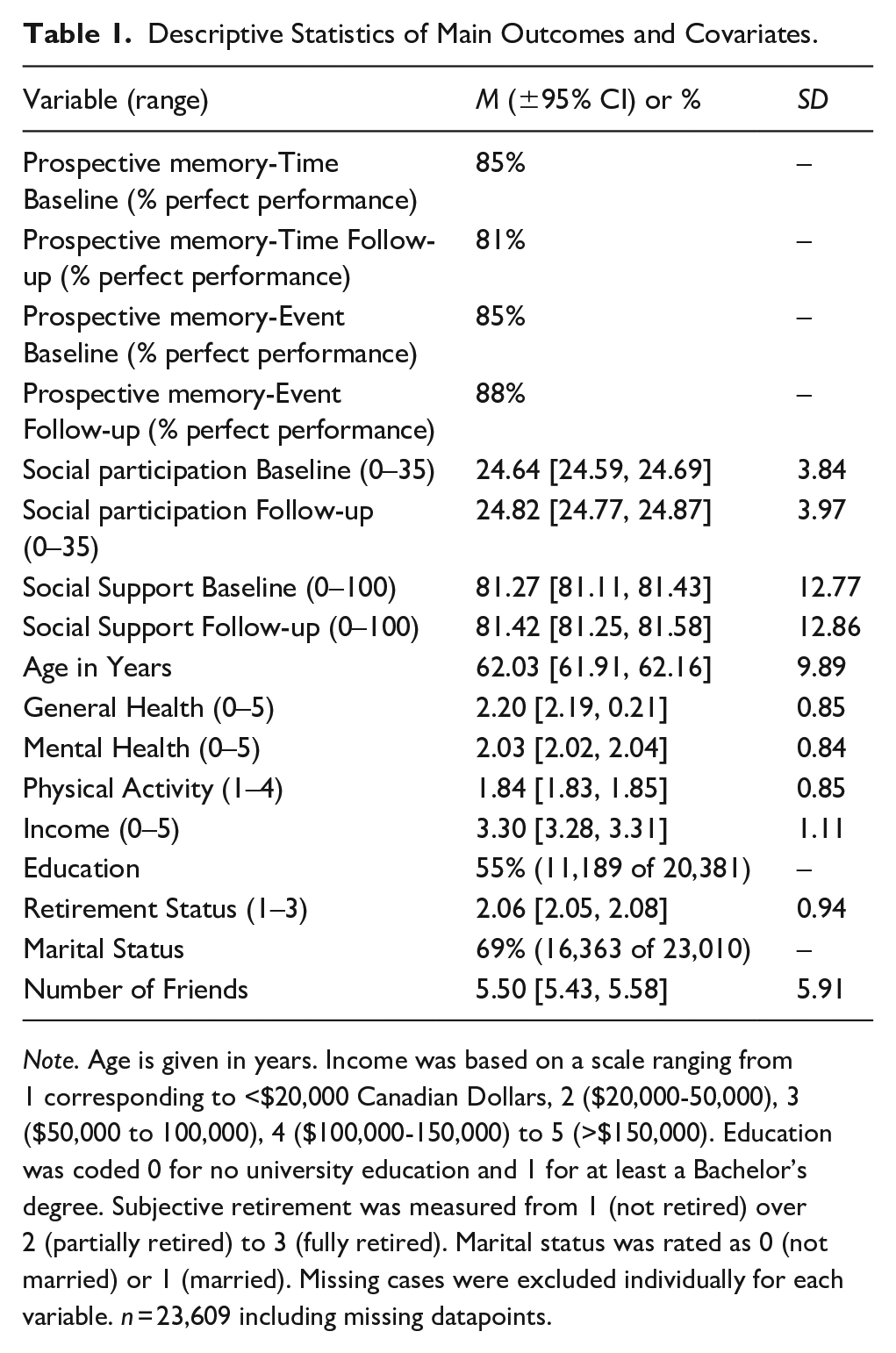
Note. Age is given in years. Income was based on a scale ranging from 1 corresponding to <$20,000 Canadian Dollars, 2 ($20,000-50,000), 3 ($50,000 to 100,000), 4 ($100,000-150,000) to 5 (>$150,000). Education was coded 0 for no university education and 1 for at least a Bachelor’s degree. Subjective retirement was measured from 1 (not retired) over 2 (partially retired) to 3 (fully retired). Marital status was rated as 0 (not married) or 1 (married). Missing cases were excluded individually for each variable. n = 23,609 including missing datapoints.
Prospective Memory
Prospective memory was assessed with the Miami Prospective Memory Test (Lowenstein & Acevedo, 2001; Simard et al., 2019), measuring time-based and event-based prospective memory. In both tasks, participants received an envelope containing various items (e.g., dollar bills) and were told to perform a specific action on some items (e.g., give a 10-dollar bill to the experimenter). The action was to be performed (a) after 30 min (time-based; a clock was available) or (b) after a timer rings (event-based). For both types, participants were scored on three 3-point scales for: intention to perform an action (remembering that there was something they had to do), accuracy of response (selecting the correct objects), and the need of reminders (total score from 0 to 9; see Supplementary Materials for details).
In this sample, prospective memory scores were left-skewed, with over 80% of participants scoring perfectly at a given time point for either type. To prevent nonconvergence issues and biased parameter estimates (e.g., Wang et al., 2008), we deviated from the preregistered analysis, transforming prospective memory scores into binary variables (score of 9 = 1, score <9 = 0). For time-based prospective memory, 85% and 81% of participants and for event-based prospective memory 85% and 88% of participants successfully completed the task at Baseline and Follow-up, respectively.
Social Participation
Social participation was measured as the frequency of seven social activities (e.g., family activities, church activities, sports) using a scale adapted from the Canadian Community Health Survey (Statistics Canada, 2010) and the English Longitudinal Study on Ageing (Steptoe et al., 2013). For each activity, participants responded on a 5-point scale from 1 = at least once a day to 5 = never such that by default higher scores indicated less participation. To preserve the interpretation that higher values should indicate more participation, all items were reverse-coded (i.e., 1 = “Never,” 5 = “At least once a day”) and summed together, ranging from 0 to 35. The mean score was 17.36 at baseline (SD = 3.84, α = .59), and 17.18 (SD = 3.97, α = .61) at follow-up.
Social Support
Social support was measured using the 19-item Medical Outcomes Survey Scale (MOS; Sherbourne & Stewart, 1991). The MOS measures the perceived availability of social support in different circumstances (e.g., “someone to give you information” or “someone who hugs you”). For each item, scores were obtained on a 5-point Likert-type scale, and scores were summed into a scale. At baseline, mean social support was 81.27 (SD = 12.77); at follow-up, it was 81.42 (SD = 12.86) out of 100. Internal consistency was Cronbach’s α = .95 at baseline and Cronbach’s α = .96 at follow-up.
Covariates
A total of 10 of covariates which have been shown to be related to cognitive functioning (e.g., Yaffe et al., 2009) and/or social wellbeing (e.g., Keyes, 1998; Larson, 1993) were assessed (see Table 1). This included demographics (total household income, age, sex, education, subjective retirement status), social relationships (marital status, number of friends), and health (general health, mental health, and physical activity). Covariates that displayed a bivariate correlation of r > ± .10 with any primary outcome were included (see Supplementary Materials). All covariates except sex and physical activity were retained.
Statistical Analysis
To examine the bidirectional association between social support and prospective memory over time, we conducted latent change score models in R Version 4.1.0 using lavaan Version 0.6 (Rosseel, 2012). These models estimate individual values of within-person change in the outcome variables as a latent variable (McArdle, 2009) by regressing the change in each outcome at follow-up on baseline scores. This enables the investigation of time-lagged coupling parameters that describe how change in one variable from baseline to follow-up is related to the baseline level of another. The autoregressive parameters denote the association of a variable at baseline with change in that variable over time. The model also estimates the covariance of baseline levels and change scores. Significance tests for individual model parameters were conducted at the 5% significance threshold. To interpret the intercept of the latent change variables as the estimated average change, we centered social wellbeing measures on their baseline means. Covariates were regressed against both baseline scores and change scores. All nonbinary covariates (i.e., all but marital status and education) were centered on their baseline mean. Consequently, their intercepts were restricted to zero.
For the third hypothesis, we tested whether time-lagged paths significantly differ from each other by estimating a restricted model constraining to equality the time-lagged paths from both prospective memory measures to social participation. The restricted model was then compared with the full model using log-likelihood ratio tests. Model fit was evaluated using the comparative fit index (CFI), the Tucker–Lewis index (TLI), the root mean square error of approximation (RMSEA), and the standardized root mean squared residual (SRMR), using the following thresholds for good model fit: CFI > .95, TLI > .95, RMSEA < .06, SRMR < .08 (Hu & Bentler, 1999).
Missings were treated as randomly distributed and full information maximum likelihood estimation was used. We did not explicitly compute statistical power. While no set guidelines for power in latent change score models exist (Kievit et al., 2018), our sample size of n = 23,609 far exceeds proposed lower bounds for sample sizes in structural equation models more generally (of up to n = 10,000 for models estimating many parameters; see Westland, 2010).
Results
Model Fitting
Bivariate Pearson correlations for all outcomes are reported in Table 2. Full latent change score models for social participation (df = 6, CFI > .99, TLI > .99, SRMR < .01, RMSEA < .01) and social support (df = 6, CFI > .99, TLI > .99, SRMR < .01, RMSEA < .01) were estimated. Next, we estimated the same models constraining coupling parameters from both prospective memory measures onto social wellbeing to equality (social participation: df = 7, CFI > .99, TLI = .99, SRMR < .01, RMSEA < .01; social support: df = 7, CFI > .99, TLI > .99, SRMR < .01, RMSEA < .01). Both models fell within the cut-offs for acceptable fit and there was no evidence that removing the equality-restriction significantly improved model fit (log-likelihood ratio tests; social participation: χ2(1) = 2.16, p = .14; social support: χ2(1) = 0.05, p = .82). Thus, the restricted models were retained for all further analyses (see Figures 1 & 2). The full specifications of all models are reported in the Supplementary Materials. All regression coefficients are reported in standardized form.
Bivariate Correlations of Outcome Variables.
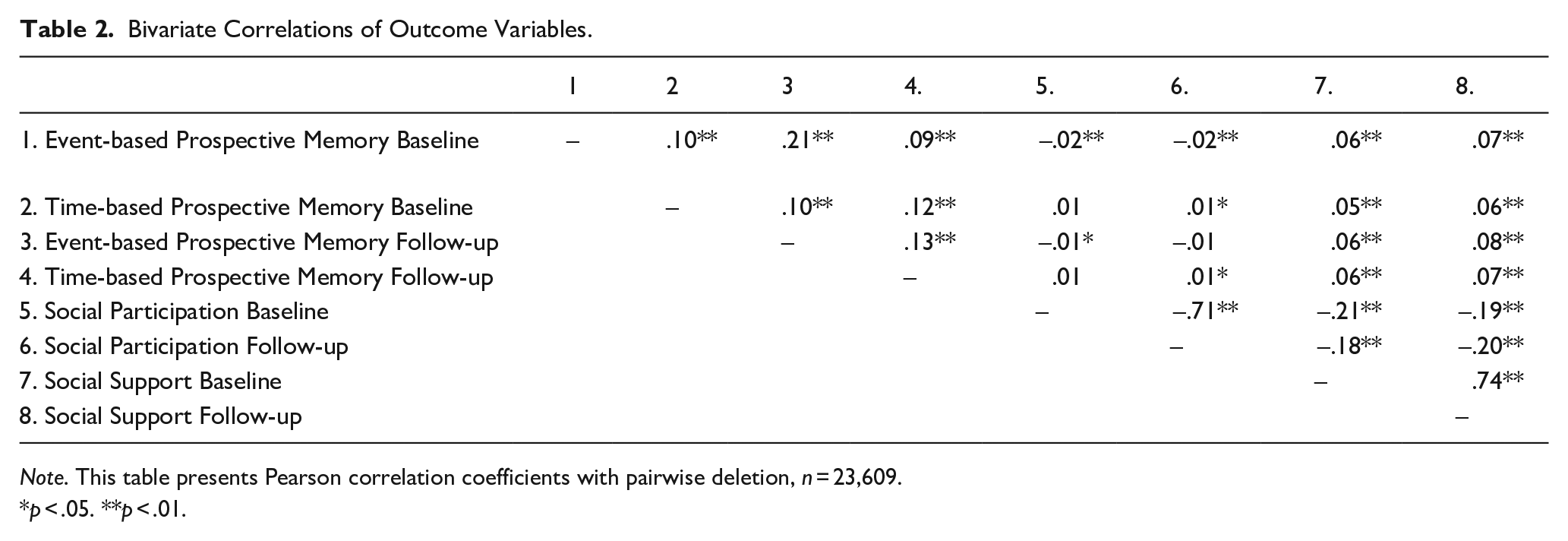
Note. This table presents Pearson correlation coefficients with pairwise deletion, n = 23,609.
p < .05. **p < .01.
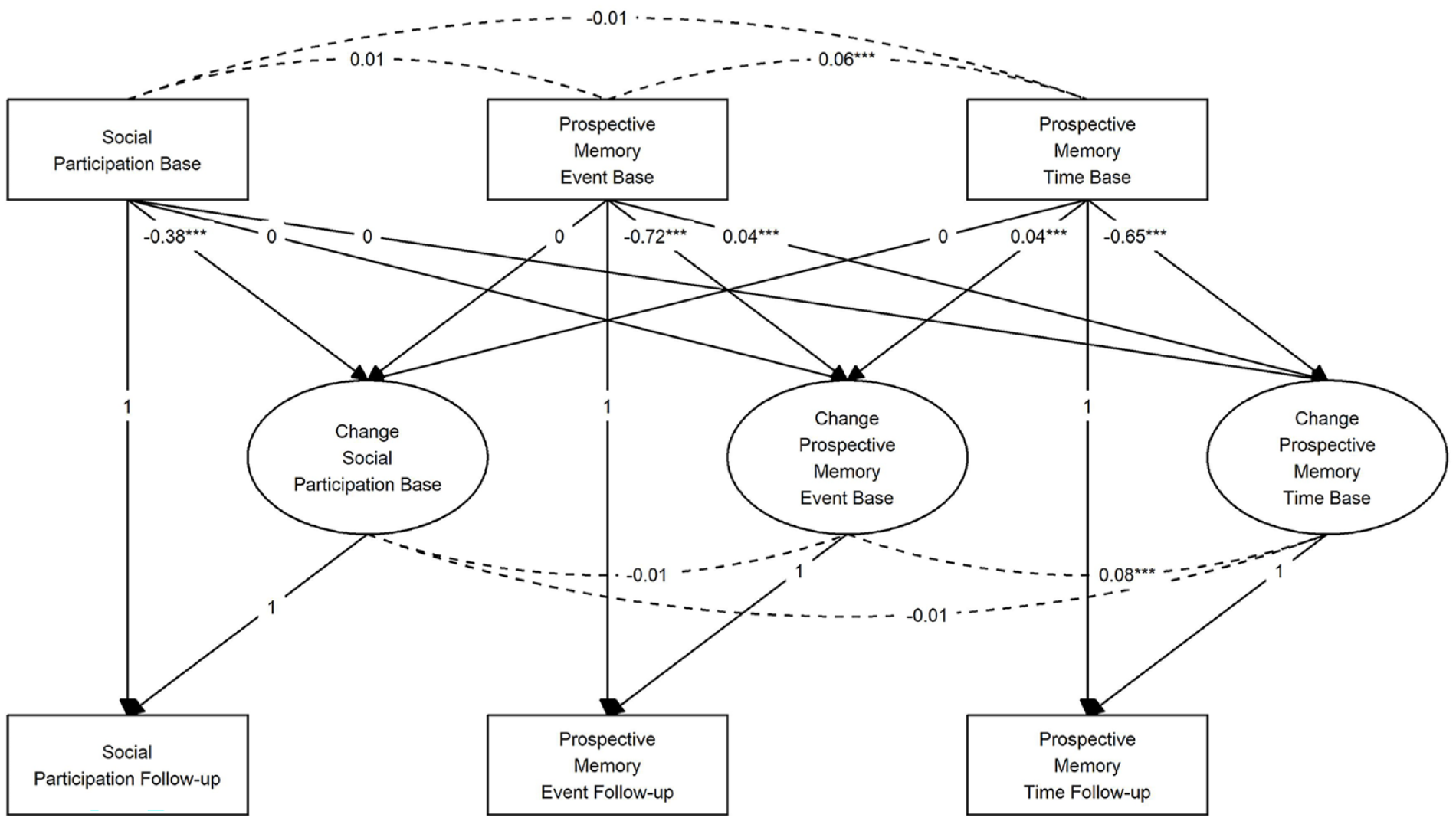
Path Diagram for Change in Social Support and Prospective Memory. Latent change score model for social participation, coefficients on directed lines are standardized beta coefficients. Coefficients on two-headed arrows are standardized covariances. Latent change scores are marked with a “d.” CFI > .99, TLI > .99, SRMR < .01, RMSEA < .01; r2PM-Event-Base T0 = .05, r2PM-Event Change = .48, r2PM-Time-Base T0 = .03, r2PM-Time-Change = .42, r2Social Participation T0 = .10, r2Social Participation Change = .13. Abbreviations:PM = Prospective Memory. n = 23,609.
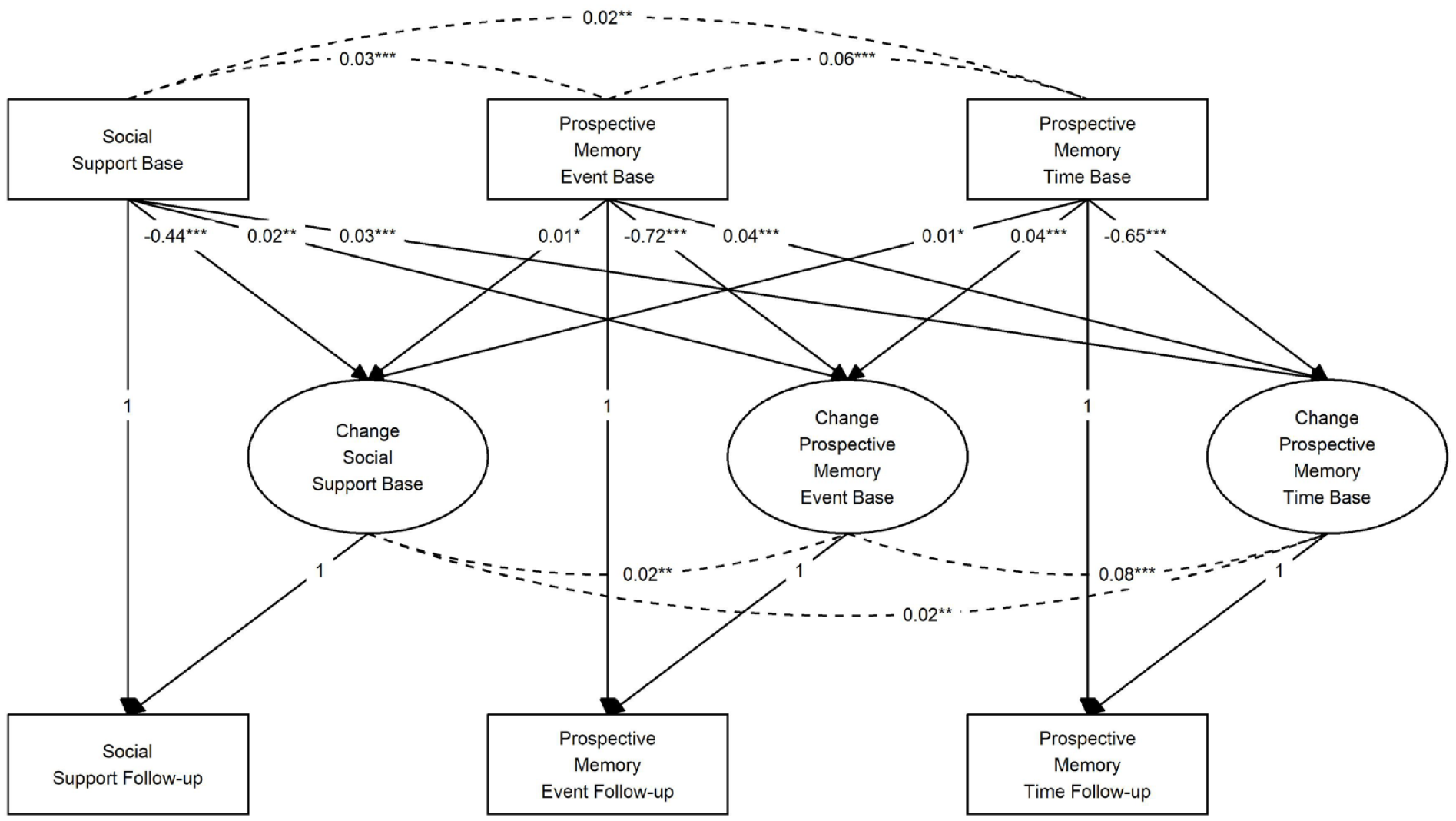
Path Diagram for Change in Social Support and Prospective Memory. Latent change score model for social support, coefficients on directed lines are standardized beta coefficients. Coefficients on two-headed arrows are standardized covariances. Latent change scores are marked with a “d.” CFI > .99, TLI > .99, SRMR < .01, RMSEA < .01; r2PM-Event-Base T0 = .05, r2PM-Event-Change = .48, r2PM-Time-Base T0 = .03, r2PM-Time-Change = .42, r2Social Support T0 = .22, r2Social Support Change = .14. Abbreviations: PM = Prospective memory. n = 23,609.
Prospective Memory
In both the social participation and social support models, participants’ prospective memory scores increased over time for event-based (raw intercept = 0.52, SE = 0.03, p < .001), but decreased for time-based prospective memory (raw intercept = −0.31, SE = 0.03, p < .001). For both event-based (raw s2 = 0.09, SE < 0.01, p < .001) and time-based prospective memory (raw s2 = 0.14, SE < 0.01, p < .001), there was significant unexplained variation in change over time.
Higher baseline time-based prospective memory predicted larger increases in event-based prospective memory at follow-up (β = 0.04, SE < 0.01, p < .001). Conversely, participants with higher baseline event-based prospective memory had smaller decreases in time-based prospective memory at follow-up (β = 0.04, SE < 0.01, p < .001). Autoregressive parameters were negative, with higher baseline prospective memory predicting smaller changes in prospective memory at follow-up, for both event-based (β = −0.72, SE < 0.01, p < .01) and time-based prospective memory (β = −0.65, SE < 0.01, p < .01).
Social Wellbeing
Social participation did not significantly change over time (raw intercept = −0.47, SE = 0.23, p = .04), whereas average social support increased (raw intercept = 2.56, SE = 0.71, p < .001). Participants showed significant variation in their rate of change in both social participation (s2 = 7.70, SE = 0.08, p < .001) and social support (s2 = 71.61, SE = 0.97, p < .001). Higher baseline social wellbeing was negatively associated with change in social wellbeing at follow-up (social participation: β = −0.38, SE = 0.01, p < .01; social support: β = −0.44, SE = 0.01, p < .01).
Association of Social Wellbeing and Prospective Memory Within Time Points
Social Participation
Our first hypothesis was that there would be a same-time association between prospective memory and social wellbeing. For social participation, this was not supported. The within-timepoint bivariate correlations between event-based prospective memory and social participation were significant, but negligible at baseline (r = −.02, p < .05), and nonsignificant at follow-up (r < .01, p > .05). Similarly, time-based prospective memory had nonsignificant within-timepoint correlations with social participation at baseline (r = −.01, p > .05), and a significant but negligible correlation at follow-up (r = .01, p < .05). In the latent change score model, the unexplained covariance between baseline social participation and prospective memory was not significantly different from 0, for both event-based prospective memory (s2cov = −0.01, SE = 0.01, p = .14) and time-based prospective memory (s2cov < 0.01, SE = 0.01, p = .37). Similarly, covariances between latent change scores in social participation and prospective memory were not significantly different from 0, neither for event-based prospective memory (s2cov < 0.01, SE = 0.01, p = .34) nor for time-based prospective memory (s2cov < 0.01, SE = 0.01, p = .09).
Social Support
For social support, the first hypothesis was generally supported by the data. For event-based prospective memory, there was a significant within-timepoint correlation with social support at baseline (r = .05, p < .01) and follow-up (r = .08, p < .01). Similarly, time-based prospective memory correlated positively with social support at baseline (r = .06, p < .01) and follow-up (r = .07, p < .01). In the latent change score model, the unexplained covariance between social support and prospective memory was significantly different from 0 for both types of prospective memory (event-based: s2cov = 0.03, SE = 0.01, p < .01; time-based: s2cov = 0.02, SE = 0.01, p = .01). Similarly, latent change scores in social support covaried with changes in event-based prospective memory (s2cov = 0.02, SE = 0.01, p < .01) and time-based prospective memory (s2cov = 0.02, SE = 0.01, p = .01).
Dynamic Associations of Prospective Memory and Social Wellbeing Over Time
Social Participation
The second hypothesis was that there would be a bidirectional positive relationship between prospective memory scores and social wellbeing. In contrast to our hypothesis, prospective memory at baseline did not significantly predict changes in social participation between time points (β = −0.02, SE = 0.04, p = .65). Similarly, social participation at baseline did not significantly predict changes in event-based prospective memory (β < 0.01, SE < 0.01, p = .82) or time-based prospective memory (β < 0.01, SE < 0.01, p = .59).
Social Support
Both event-based (β = 0.01, SE < 0.01, p = .03) and time-based prospective memory (β = 0.01, SE < 0.01, p = .03) at baseline significantly predicted higher increases of social support at follow-up, though effect sizes were small. Similarly, higher perceived social support at baseline predicted higher levels of event-based prospective memory (β = 0.02, SE < 0.01, p = .01) and time-based prospective memory (β = 0.03, SE = 0.01, p < .01). These cross-lagged associations are illustrated in Figure 3.
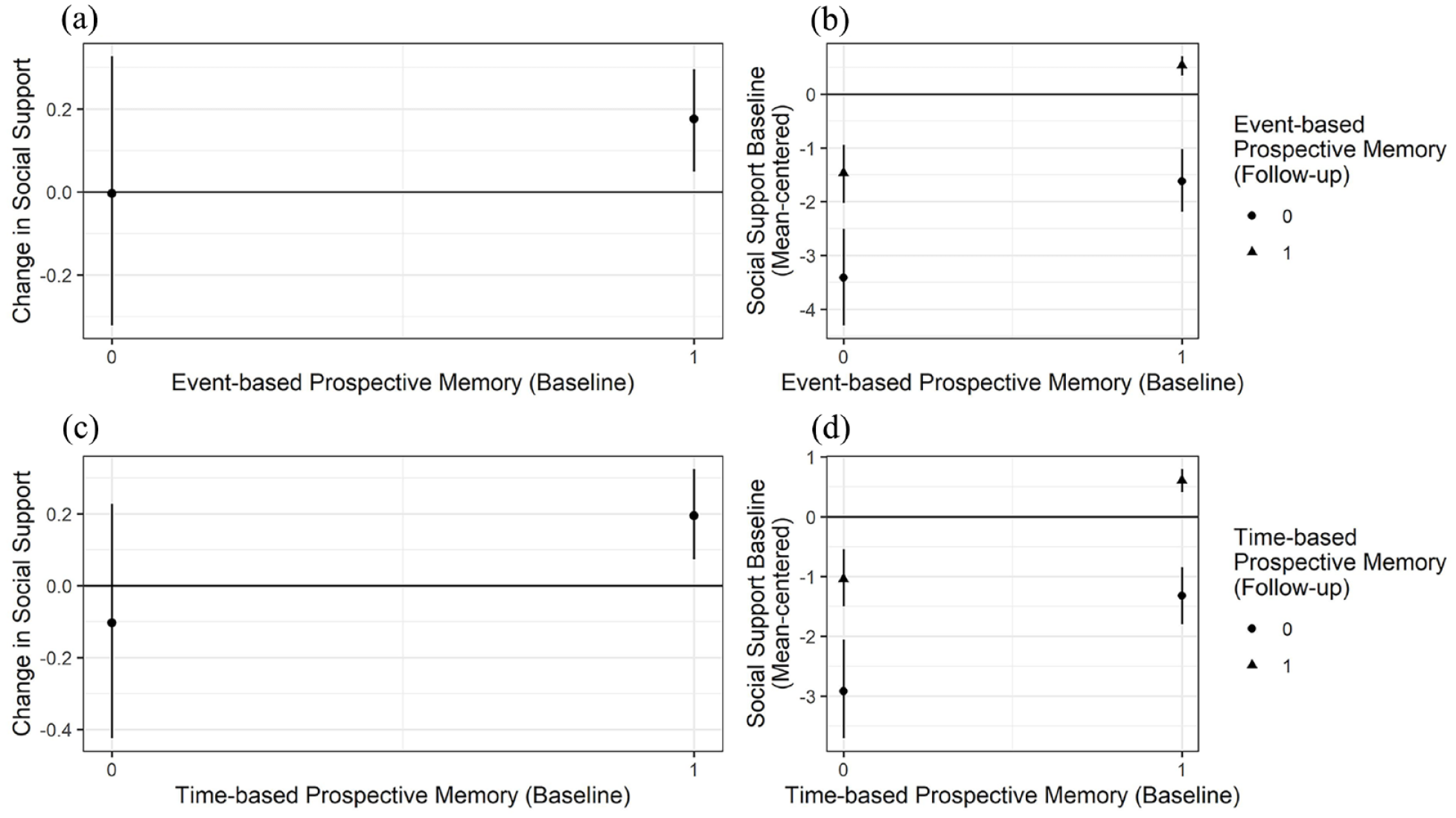
Change in Social Support and Prospective Memory. (a) Change in Social Support against Baseline event-based Prospective Memory. (b) Change in Prospective Memory against baseline Social Support. (c) Change in Social Support against Baseline time-based Prospective Memory. (d) Change in time-based Prospective Memory against baseline Social Support. Illustration of cross-lagged associations between social support availability and prospective memory. Error bars represent 2 standard errors. n = 23,609.
Associations With Different Forms of Prospective Memory
During model fitting, constraining the associations between the two prospective memory types and social wellbeing to be equal did not result in significantly decreased model fit. Consequently, we found no evidence for our third hypothesis that social wellbeing would be more strongly associated with event-based as compared with time-based prospective memory.
Discussion
This study investigated the longitudinal associations between event- and time-based prospective memory and social wellbeing, operationalized as social support and social participation. Higher social support at baseline predicted increases in both time- and event-based prospective memory 3 years later, whereas baseline scores for both types of prospective memory were associated with larger increases in social support. However, for social participation, no significant longitudinal associations with prospective memory were observed.
Changes in Prospective Memory
In this sample, participants’ average event-based prospective memory scores increased over time, while time-based prospective memory decreased. This contrasts with a longitudinal study by Sullivan et al. (2022) that found decreases in event-based, but no change in time-based prospective memory over a 3-year period. This discrepancy may reflect task differences. Sullivan et al. used the memory for intentions test (Raskin et al., 2010), while we used the Miami prospective memory test (Lowenstein & Acevedo, 2001). The tests may diverge in demands on executive function, which is central to prospective memory (McDaniel & Einstein, 2007). Executive function is the ability to inhibit distractions, shift between tasks, and maintain information in working memory. This may partially explain the life-course trajectory of prospective memory (Zuber & Kliegel, 2020).
Sullivan et al.’s time-based prospective memory task placed less demands on updating, with events spaced in 2- or 15-min intervals while ours employed a 30-min interval. Consequently, their measure may have registered smaller improvements and training effects, which are offset by age-related declines in updating ability for more demanding tasks (like the half-hour interval used herein). Conversely, Sullivan et al.’s event-based task may have been more taxing on shifting. A distinction exists between focal prospective memory tasks (which involve a salient event) and nonfocal tasks which require monitoring for a specific, complex event (e.g., being handed a specific playing card, McDaniel & Einstein, 2007). Both tasks require shifting between an ongoing task (e.g., continuing the interview) and target event monitoring, but nonfocal tasks rely more on shifting ability (Zuber & Kliegel, 2020). Herein, a very focal target event was used (ringing timer), whereas Sullivan relied on a nonfocal event (being handed a specific card). Thus, the observed decrease in event-based prospective memory in Sullivan et al.’s study may reflect declining shifting ability. In our study, this decline may have been offset by practice effects as the ringing timer was a highly focal and familiar target event. Finally, higher baseline prospective memory scores were associated with smaller changes over time. A large share of participants achieved a perfect score at baseline, having little room to improve. Still, this unexpected finding highlights that task details may have an effect on observed longitudinal change in prospective memory.
Changes in Social Wellbeing
We observed a small mean increase in social support over time, whereas there was a slight decrease in social participation. This finding is consistent with socioemotional selectivity theory (Carstensen et al., 1999), and studies on social support (Lestari et al., 2021) and participation (Kim & Yoon, 2022). Socioemotional selectivity theory suggests that, as adults age, they prioritize supportive relationships over a wider social network. A negative autoregressive association indicated that higher social wellbeing at baseline predicted smaller changes in wellbeing at follow-up. This may also reflect a ceiling effect: Participants’ social wellbeing scores were left-skewed, potentially deflating observed increases for high scorers.
Associations of Prospective Memory and Social Wellbeing
In addition to significant within-timepoint covariance, we found a small, but statistically significant bidirectional relationship between prospective memory performance and social support over a 3-year period, but not for social participation. Higher levels of social support predicted more positive changes in prospective memory over time. First, this speaks to environmental enrichment theories (e.g., Hertzog et al., 2008). Socially supportive environments may provide more opportunities to exert one’s cognitive resources and maintain cognitive functioning. Also, the effect of social support on prospective memory may reflect improvements in overall mental wellbeing: Higher levels of social support are associated with less stress, depressive symptoms, anxiety, and loneliness (e.g., Gabarrell-Pascuet et al., 2023), which may in turn enhance cognitive function. In fact, loneliness (Ellwardt et al., 2013) and depressive symptoms (Suanet et al., 2020) may partially mediate the relationship between social support and cognitive functioning, and higher levels of loneliness at baseline predict decreases in prospective memory over time (Kyröläinen & Kuperman, 2021). Second, higher availability of social support may make social activities more frequent, enhancing cognitive functioning (and possibly prospective memory) through cognitive stimulation (Brown et al., 2016).
Conversely, higher prospective memory at baseline predicted better support at follow-up, albeit with small effect size. This may have several reasons. In line with selective optimization with compensation (Baltes & Baltes, 1990), participants with poorer prospective memory may prioritize relationships or conversation topics which do not strain their cognitive resources. For example, they could prioritize familiar discourse topics (e.g., weather) over more complex, emotionally laden ones (e.g., disclosing difficult feelings). This may come at the expense of emotionally supportive relationships. Alternatively, lapses in prospective memories can be consequential (Mogle et al., 2019) and could interfere with supportive relationships—for example, by eroding trust (Tomlinson, 2012).
However, surprisingly, we found no similar bidirectional association between social participation and prospective memory. This unexpected finding may reflect measurement limitations, as our social participation measure had poor internal consistency (Cronbach’s αs < .61), which can deflate effect sizes, potentially masking a true relationship. Similarly, effect sizes may have been attenuated, as prospective memory performance was at the ceiling for most participants and thus could not capture variation between high-performing participants. Ceiling effects are common when using neuropsychological prospective memory tests with healthy participants (Blondelle et al., 2020). Future laboratory research should thus employ experimental prospective memory tasks designed for highly functioning participants, such as the prospective remembering video procedure (Titov & Knight, 2001).
Differential Associations of Event-Based Versus Time-Based Prospective Memory With Social Wellbeing
Previous research indicates that event-based prospective memory is a stronger predictor of community living skills (Au et al., 2014) and daily functioning (Woods et al., 2012) than time-based prospective memory. However, in this study, we found no such differential association with social support. This may reflect study design: Au et al.’s study recruited only participants with schizophrenia—limiting generalizability to healthy older adults. Similarly, Woods et al. (2012) operationalized daily functioning as the ability to carry out instrumental activities of daily living, which—while they may have a social component (e.g., managing transport)—do not necessarily reflect social wellbeing.
Future studies could consider assessing prospective memory performance, and its implications for social functioning in daily life. For example, Luo et al. (2023) measured event-based prospective memory once a day using an app over a 14-day period and found that shifts toward negatively aroused mood predicted subsequent decreases in event-based prospective memory performance. Ambulatory assessment studies can help examine associations of both time-based and event-based prospective memory with social wellbeing over shorter timescales.
Strengths, Limitations, and Further Directions
This study demonstrated a bidirectional association between social support and prospective memory in a large-scale longitudinal data set. However, there are important limitations. First, our design can establish time-ordered, but not causal relationships. As social support interventions may improve cognition more generally (Pitkälä et al., 2011), future randomized controlled studies may investigate their impact on prospective memory.
Second, our data only included healthy community-dwelling adults. Consequently, our findings may not generalize to individuals with significant cognitive impairments. Our fairly young and well-functioning sample may also explain the relatively small effect sizes. Considering that the CLSA will continue to collect data until at least 2033, future investigations could replicate our analysis once participants experience stronger cognitive declines.
Similarly, we operationalized social wellbeing as social support and social participation. However, other aspects of social wellbeing, like relationship satisfaction, also protect against cognitive decline (Samtani et al., 2022). Thus, future research should investigate the relationship between prospective memory and those factors, too. Also, herein, subtypes of social support were not distinguished, even though they may affect cognition in different ways: For example, a cross-sectional study by Ellwardt et al. (2013) found that cognitive functioning correlated positively with emotional, but negatively with instrumental support. Further research is needed to understand how different subtypes of social support affect prospective memory.
Fourth, a laboratory-based measure of prospective memory was used (Lowenstein & Acevedo, 2001). However, there are inconsistencies between performance on lab-based, and more naturalistic prospective memory tasks. For example, Rendell and Thomson (1999) found that young adults outperformed older adults on laboratory tasks comparable with the Miami prospective memory test. However, this pattern reversed for a more naturalistic prospective memory task (logging the time at different points of the week). Thus, the present findings may not generalize to more naturalistic prospective memory tasks, or prospective memory failures in daily life.
Finally, prospective memory is a complex phenomenon supported by more fundamental processes mediated by frontal and mediotemporal circuits (McDaniel & Einstein, 2007). Thus, there is some risk of confounding the observed association between prospective memory and social support. This may, in fact, reflect functional declines in a neural structure that is involved (perhaps somewhat independently) in both prospective memory and social cognition. For example, the hippocampus is not just important for prospective memory, but also crucially involved in simulating social scenes (Wilson, Ahmed, et al., 2020; Wilson, Ramanan, et al., 2020) and may play a role in social norm judgments (Wilson et al., 2024). Thus, future research may consider if the link between prospective memory and social functioning holds when social cognitive processes supported by the same neural structures involved in prospective memory are controlled for.
Conclusion
Higher levels of social support predicted better prospective memory 3 years later, and better prospective memory predicted more subsequent social support, with no significant differences for time-based versus event-based prospective memory. We did not find a comparable bidirectional association between prospective memory and social participation. Further research will need to uncover the mechanisms underlying the link between social support and prospective memory.
Supplemental Material
sj-docx-1-jbd-10.1177_01650254241305547 – Supplemental material for Association of prospective memory and social wellbeing in midlife to old age in the Canadian Longitudinal Study on Aging
Supplemental material, sj-docx-1-jbd-10.1177_01650254241305547 for Association of prospective memory and social wellbeing in midlife to old age in the Canadian Longitudinal Study on Aging by Johannes Keil, Andrew Wister and Theresa Pauly in International Journal of Behavioral Development
Footnotes
Acknowledgements
This study was preregistered, and the full analysis code is publicly available under: https://osf.io/pbw3u/. Data analysis used R (version 4.2.2; R Core Team, 2018) including tidyverse (v1.3.0; Wickham et al., 2019), lavaan (version 0.6; Rosseel, 2012), and tidySEM (version 0.2.4; van Lissa, 2023).
Author Contributions
Johannes Keil: Conceptualization, Methodology, Formal Analysis, Writing—Original Draft, Writing—Review & Editing, Visualization. Andrew Wister: Methodology, Writing—Review & Editing, Funding Acquisition. Theresa Pauly: Conceptualization, Methodology, Formal Analysis, Resources, Writing—Original Draft, Writing—Review & Editing, Supervision, Funding Acquisition, Project Administration.
Data Availability Statement

Declaration of Conflicting Interests
The author(s) declared no potential conflicts of interest with respect to the research, authorship, and/or publication of this article.
Funding
The author(s) disclosed receipt of the following financial support for the research, authorship, and/or publication of this article: This research was supported by the Canada Research Chairs Program support to Theresa Pauly. This research was made possible using data collected by the Canadian Longitudinal Study on Aging (CLSA). Funding for the CLSA is provided by the Government of Canada through the Canadian Institutes of Health Research (CIHR) under grant reference: LSA 94473 and the Canada Foundation for Innovation, as well as the following provinces, Newfoundland, Nova Scotia, Quebec, Ontario, Manitoba, Alberta, and British Columbia. This research has been conducted using the Comprehensive Baseline dataset version 7.0, and the Comprehensive Follow-up 1 dataset version 5.0, under Application Number 2301002. The CLSA is led by Drs. Parminder Raina, Christina Wolfson, and Susan Kirkland.
Supplemental Material
Supplemental material for this article is available online.
References
Supplementary Material
Please find the following supplemental material available below.
For Open Access articles published under a Creative Commons License, all supplemental material carries the same license as the article it is associated with.
For non-Open Access articles published, all supplemental material carries a non-exclusive license, and permission requests for re-use of supplemental material or any part of supplemental material shall be sent directly to the copyright owner as specified in the copyright notice associated with the article.
