




Abstract
Parental knowledge is often the result of parents soliciting information from their child and their child’s disclosure of that information. Although child disclosure is most closely (and negatively) associated with behavior problems in adolescence, it is not yet known whether this is also the case in childhood. The aim of this study was to examine the longitudinal associations between child disclosure, parental solicitation, and behavior problems in Grades 1 to 4 in a Canadian sample, taking into account intra-individual stability, the child’s gender, and socioeconomic status. The mothers and teachers of 911 children (62.7% boys) completed questionnaires in Grades 1, 2, 3, and 4. A Random Intercept Cross-Lagged Panel Model (RI-CLPM) showed that behavior problems in Grade 2 predicted an increase in parental solicitation in Grade 3. In contrast, behavior problems in Grade 3 predicted a decrease in parental solicitation in Grade 4. No cross-lagged association with child disclosure was observed. Although these results differ from those reported in adolescence, they suggest that middle childhood is a sensitive period for parent–child communication and behavior problems.
Keywords
Parent–child interactions and the definition of problematic behaviors are influenced by cultural beliefs (Stafford, 2021; Weisner, 1984). In Western cultures, the parent is the main agent responsible for the positive socialization of the child. During middle childhood (ages 5 to 12; Collins & Madsen, 2019), this involves promoting the child’s good functioning at school and parents’ socialization practices are largely aimed at helping their child integrate into their peer group and, ultimately, the community at large (DelGiudice, 2018). With this in mind, parents ensure that the child learns the necessary skills to form harmonious social relationships and monitor the choice of activities and peers. The parents thus use various monitoring strategies (Pelham et al., 2024), many based on establishing a healthy relationship and good communication with the child, that enable them to exchange information about their activities and peers outside the home (Ladd & Parke, 2021). Such communication implies the parents’ ability to seek out useful information from their child (parental solicitation) and, in return, the child’s willingness to share this information spontaneously (child disclosure) (Keijsers & Poulin, 2013).
In theory, these communication channels protect against the emergence or increase of behavior problems (Kerr et al., 2010). To date, these issues have been extensively examined in adolescence but rarely in childhood. Furthermore, in Western cultures mothers are stereotypically more aware of their child’s social life than fathers (Crouter & Head, 2002) and are more involved with their child (Keown & Palmer, 2014). This study focuses on the longitudinal links between parental solicitation and child disclosure reported by mothers and behavior problems reported by teachers during middle childhood.
Parent–Child Relationship in Middle Childhood
During middle childhood, children experience rapid development in social, cognitive and behavioral skills which allows them to better monitor their own and others’ communication (Haslett & Samter, 1997/2020) at the same time as their aggression becomes more antagonistic and person oriented (Hartup, 1974). As children expand their conflict resolution skills (Stafford, 2003), they need the continuing support of their parents to improve their self-regulation capacities and to further their moral reasoning through parent–child conversations (Collins & Madsen, 2019). Parent–child conversations become more cooperative (Maccoby, 1984) and more supportive of children’s need for autonomy and developing problem-solving skills (Costa et al., 2019). However, when children start school, new challenges arise as the time children spend with their peers and other adults increases (at school and in the context of organized after-school activities outside the home), while the time spent with parents decreases (Collins & Madsen, 2019). According to Olson and colleagues (2019), communication is an essential skill that enables the family to negotiate developmental changes. Parent–child communication is a two-way process that facilitates co-regulation of the dyad and the achievement of parenting goals (Stafford, 2021).
Middle childhood could therefore be a key period for parents and children to establish good communication patterns. While parent–child exchanges are frequent between the ages of 6 and 10 (Desmarais & Poulin, 2023), early adolescence is typically characterized by an increase in parent–child conflicts and adolescent autonomy and privacy needs, which can disrupt parent–child communication processes (Keijsers & Poulin, 2013; Laird, Marrero, & Sherwood, 2010). Nonetheless, the specific parenting practices and parent–child communication patterns that are conducive to a positive socialization remain relatively unknown during middle childhood (Stafford, 2021) even if individual differences in problematic behavior emerging during this developmental period often persist into adulthood (Huston & Ripke, 2006).
Parent–Child Communication and Behavior Problems
Parent–child communication about the social lives of the child has mostly been discussed in the parental monitoring literature since Kerr and Stattin (2000; Stattin & Kerr, 2000) proposed a reinterpretation of the concept. They pointed out that the instruments used in studies conducted during adolescence essentially measure parental knowledge (e.g., “Do you know who your child is with? Do you know where he or she is? Do you know what he or she is doing?”). According to these authors, the question then becomes how parents access this information. Kerr and Stattin (2000; Stattin & Kerr, 2000) proposed three possible sources: information shared spontaneously by the child (child disclosure), questions asked by the parent (parental solicitation), and parental use of rules and restrictions on the child’s activities as a mean of limiting what they can do without informing their parents (parental control). Their work, and that of several other researchers thereafter (Liu et al., 2020; Racz & McMahon, 2011), showed that in adolescence, parental knowledge is mainly derived from child disclosure and that the other two sources contribute to it to a much lesser extent.
Moreover, of these three sources, child disclosure is most closely (and negatively) associated with various problematic behaviors. It is therefore in parents’ interest to maintain good communication channels with their child as to encourage child disclosure (Keijsers & Poulin, 2013). Longitudinal studies show that the links between child disclosure and behavior problems are bidirectional. Indeed, child disclosure predicts a decrease in behavior problems, and behavior problems predict a reduction in child disclosure (Kapetanovic et al., 2020; Keijsers et al., 2009; Kerr et al., 2010). The results are less clear-cut for parental solicitation and are more often than not unidirectional. In some studies, parental solicitation was a predictor of fewer behavior problems (Laird, Marrero, & Sentse, 2010), while in others, it was a predictor of an increase (Kerr et al., 2010; Willoughby & Hamza, 2011) or showed no direct link (Keijsers et al., 2010).
The studies mentioned above are based on samples of children aged 10 and over, with the vast majority aged between 14 and 17. Therefore, we know very little about how parent–child communication is linked to behavior problems in middle childhood. Desmarais and Poulin (2023) recently examined parental knowledge and its sources (parental solicitation and child disclosure) among mothers of children followed annually from Grades 1 to 4. They observed that knowledge was equally based on parental solicitation and child disclosure throughout the period covered, thus differing from the results obtained in adolescence.
However, the links (and their direction) between parental solicitation, child disclosure, and behavior problems have not been systematically examined during middle childhood. Patterson’s (1982) coercion model can provide a framework for such an analysis. This model states that the child’s behavior problems would provoke negative reactions from the parents, such as the use of harsh and punitive discipline, leading to a hostile parent–child dynamic. Such a dynamic would, in turn, exacerbate the child’s behavior problems. The parents would then feel increasingly frustrated and incompetent, disengage from their parental role, and communicate less with their child. According to this model, the child’s behavior problems and parent–child communication are negatively linked. The few studies that have examined the links between mother–child communication and behavior problems during middle childhood seem to support this model. Indeed, behavior problems are associated with poor levels of parent–child communication, although parental solicitation and child disclosure were merged with other parental monitoring behavior subscales (Pardini et al., 2008; Patrick et al., 2005). However, more longitudinal studies are needed during middle childhood to confirm these findings and clarify the direction of these links.
Between-Family Versus Within-Family Effects
Keijsers (2016) cautioned against interpreting the results of longitudinal studies on the links between behavior problems, child disclosure, and parental solicitation. She warned that the characteristics of the family environment (e.g., socioeconomic context, living in an unsafe neighborhood), the parent (e.g., caring attitude, level of education), and the child (e.g., social and emotional development, temperament) could have a significant influence on the results obtained in these studies. These differences between families complicate the use of group trend indicators to describe within-family processes and to generate recommendations applicable to all individuals in a population, each of whom may have particular characteristics or be statistical outliers (Kievit et al., 2013). For example, while greater parental solicitation may reduce behavior problems within each family, group-level results could otherwise indicate that the families who solicit the most are those whose children exhibit the most problematic behavior. Such group results could then be erroneously interpreted as meaning that higher levels of parental solicitation are associated with more behavior problems over time in the mother–child dyad (Keijsers, 2016). Distinguishing between within-family differences (changes over time within the same family) and between-family effects (differences between families, sometimes due to a trait or stability effect) is therefore essential, although rarely achieved (Hamaker et al., 2015).
Keijsers (2016) tested these ideas with a Random Intercept Cross-Lagged Panel Model (RI-CLPM) by reanalyzing data collected in a study in which behavior problems, child disclosure, and parental solicitation were measured on four occasions between the ages of 13 and 16. In the first series of analyses that did not distinguish within-family from between-family differences, Keijsers and colleagues initially showed that a decrease in child disclosure was associated with an increase in behavior problems (Keijsers et al., 2009). Applying the RI-CLPM to the same data, Keijsers (2016) found no within-family effects, meaning that no predictive link emerged between child disclosure and behavior problems nor between parental solicitation and behavior problems. Kapetanovic et al. (2019) tested a similar model with another sample of children assessed three times between 13 and 15 years of age. At the within-family level, they reported a reciprocal and negative cross-lagged association between child disclosure and behavior problems. The sample size, larger than Keijsers’ (1,515 vs 309), could explain this difference in results due to greater statistical power.
The Present Study
Parent–child conversations about the child’s activities with peers outside the home take on greater importance as the child enters school. The processes of communication (parental solicitation, child disclosure) that then develop persist throughout adolescence and are observed in many countries (Ahmad et al., 2015; Kapetanovic et al., 2020; Keijsers et al., 2010; Kerr et al., 2010; Soenens et al., 2006; Vieno et al., 2009). The literature on the longitudinal links between parental solicitation, child disclosure, and behavior problems during adolescence is extensive (Gault-Sherman, 2012; Keijsers et al., 2009; Keijsers & Poulin, 2013; Kerr et al., 2010; Racz & McMahon, 2011; Tremblay-Pouliot & Poulin, 2021; Willoughby & Hamza, 2011). There are, however, some differences in parental solicitation and child disclosure during middle childhood (Desmarais & Poulin, 2023), and the longitudinal bidirectional links between these variables and the child’s behavior problems, have seldom been examined during this developmental period.
This study is one of the first to examine these phenomena during middle childhood in line with the most recent recommendations concerning the methodological importance of distinguishing within-family differences from between-family differences. Therefore, the goal of this study is to examine the bidirectional links between child disclosure, mothers’ solicitation, and child behavior problems from Grades 1 to 4 using the approach recommended by Keijsers (2016). The first hypothesis concerned differences between families; it was expected that child disclosure and parental solicitation would be negatively associated with behavior problems (H1a) and that child disclosure and parental solicitation would be positively linked to each other (H1b) (Kapetanovic et al., 2019; Keijsers, 2016). The second and third hypotheses concerned within-family effect. It was expected (H2a) that negative concurrent links would be observed between child disclosure and behavior problems, and (H2b) positive concurrent links between child disclosure and parental solicitation (Kapetanovic et al., 2019). Regarding the cross-lagged associations, it was expected that behavior problems would predict a decrease in parental solicitation (H3a) since similar results have been observed during this period (Pardini et al., 2008) and that the level of parental solicitation is generally higher during middle childhood (Desmarais & Poulin, 2023). Similarly, child disclosure at each time point was expected to predict a reduction in behavior problems the year after and vice versa (H3b).
These hypotheses were tested while controlling for gender and socioeconomic status. Racz and McMahon (2011) report in their literature review that parents are more likely to monitor girls and be better informed about their activities than they do for boys, but they report no gender differences regarding the links between child disclosure and behavior problems during adolescence. However, gender is an important dimension of social behaviors during middle childhood (e.g., gender segregation in games and choice of friends; Rose & Rudolph, 2006; Rose & Smith, 2018). Finally, socioeconomic stress is shown to negatively impact parent–child communication leading to parental knowledge (Racz & McMahon, 2011), especially the links between parental solicitation and behavior problems during adolescence (Rekker et al., 2017).
Method
Sample
Participants came from a sample of 1,038 children (38% girls, mean age 56.52 months) recruited from 250 kindergarten classes in 43 elementary schools in a Montreal (province of Quebec, Canada) suburban school board and recruitment took place over three consecutive cohorts. The participants were originally recruited for an effectiveness evaluation of a violence and school dropout prevention program (Poulin et al., 2013). Of the participants, 72% came from an intact family, and 69.1% of mothers and 64.0% of fathers graduated from high school. The average family income was $60,900 per year, with 18% of families having an average annual income greater than $100,000 and 7% having an average yearly income less than $20,000. According to Quebec Government data, the average annual family income ranged from $42,800 to $59,800 during this period (Fontaine, 2022). Most families were Canadian-born (84.0%), with the remaining families being first-generation immigrants (4.2% Europe; 3.3% Africa; 3.2% Middle East; 2.0% Latin America; 1.8% Caribbean; 1.2% Asia; 0.3% United States). The data used in this study were collected in the spring of Grade 1, spring of Grade 2, spring of Grade 3 and spring of Grade 4.
Sociocultural Specificity and Parent–Child Communication About Activities Outside the Home
The province of Quebec, Canada, is a distinct and unique secular society in North America as French is the province’s official language, a legacy of its colonial past. Also, Quebec’s social economy, free healthcare, and political functioning are based on a system of public infrastructure and services (Mendell & Neamtan, 2010). Attending school is mandatory in Quebec between the ages of 6 and 16, elementary schools are managed by the provincial Ministry of Education and offer after-school care (Education Act of Quebec, 2020). Registration of the child by the parent or guardian is compulsory and free of charge and access to public services is also granted to all citizens and immigrants (Education Act of Quebec, 2020; Ministry of Education Quebec [MEQ], 2023a, 2023b). Municipal and provincial systems maintain family-friendly infrastructures (e.g., public parks and swimming pools) and offer extracurricular activities at reduced costs, such as organized activities (e.g., little hockey leagues), which can positively affect academic and behavioral development during childhood (Aumètre & Poulin, 2018). For school-aged children, time outside the home is therefore usually spent in safe and adult supervised contexts.
Regarding family structure and parenting, Canadian families are usually made up of one or two parents or guardians and their children residing in a single-family home. The children’s contacts with other family members (e.g., uncles, grandparents) are variable in frequency depending on the preferences and needs of each child and are structured differently than those of European children (Claes et al., 2001). In Quebec, parents of both genders have access to the job market (Statistique Quebec, 2023), but they are also expected to bear most of the burden of raising their child. Parenting practices are also guided by the recommendations of health professionals and non-profit organizations dedicated to the dissemination of research-based information on children’s development (Naître et Grandir, 2022). Consequently, in Quebec, children tend to spend more time with parents than any other family member and parents are expected to be responsible for their child’s harmonious development.
Procedure
Parents and teachers completed paper/pencil questionnaires. Research assistants went to the school and gave teachers the questionnaires for participating students to fill out in their class, as well as the questionnaires to be sent to their mothers in students’ school bags. Once completed, mothers returned the questionnaire to the school in a sealed envelope. A research assistant collected all these questionnaires from the school. For each child, a different teacher completed the questionnaire at each school year. Parents and teachers received a gift certificate in appreciation of their participation. Parents gave their written consent annually. The project was approved by the Internal Review Board of the authors’ university (approval number R1-081189).
Instruments
Parental Solicitation and Child Disclosure
These two variables were measured using the “Mothers’ Perceptions of Knowledge, Solicitation and Disclosure in Middle Childhood Questionnaire” adapted by Desmarais and Poulin (2023) from Kerr and Stattin’s (2000) work. The mothers were asked to respond to four parental solicitation statements (e.g., “You ask your child to tell you about his or her day at school.”) and three statements about child disclosure (e.g., “Your child tells you about what he or she did outside the home; e.g., at childcare services, at school, at a friend’s house.”). They were given the following instructions: “Circle the number corresponding to the answers that, in your opinion, best describes your situation.” They had to respond using a 5-point Likert-type scale ranging from 1 = “Never” to 5 = “Always.” Desmarais and Poulin (2023) confirmed the factorial structure of the instrument. The scores were calculated for each scale by averaging all the responses to the corresponding items. At each measurement point, the internal consistency of these scales was good (Cronbach’s alpha of .87 to .88 for child disclosure and .76 to .81 for parental solicitation).
Behavior Problems
Teachers completed the Social Behavior Questionnaire originally developed for the Québec Longitudinal Study of Child Development (Institut de la statistique du Québec, 2016) combining items from a set of validated measures (Achenbach, 1991; Boyle et al., 1993; Tremblay et al., 1987). This instrument includes three subscales measuring externalizing problems, internalizing problems, and prosocial behavior. The externalizing scale was used in the present study to measure behavior problems. This scale included 35 items on aggression, opposition, behavior problems, hyperactivity, and inattention (e.g., “The child broke or damaged his or her own objects,” “The child was rebellious or refused to cooperate with instructions,” “Hit, bit, or kicked other children”). Teachers responded to statements using a 6-point Likert-type scale ranging from 1 = “Never” to 6 = “Frequently.” Each child’s score was calculated by averaging all responses to the scale items. Internal consistency was excellent at each measurement point (Cronbach’s alpha from .93 to .97).
Analysis Plan
A single model was used to simultaneously examine the longitudinal links between parental solicitation, child disclosure, and behavior problems. Intra-class correlation (ICC) analyses were first conducted to verify whether the within-person variance was high enough to justify using an RI-CLPM model. To test the extent to which parental solicitation and child disclosure are associated with behavior problems between Grades 1 to 4, an RI-CLPM analysis was then performed. This type of model distinguishes between longitudinal within-family and between-family differences (stability effects) (Hamaker et al., 2015), which means that it separates sources of stable (time-invariant traits) and time-fluctuating (individuals’ deviations from their own expected score) variance. When applied to non-experimental and developmental variables, this model can be used to verify causal associations between behaviors taking place within each family while controlling for unobserved confounding time-invariant variables, an important advantage of the RI-CLPM over other cross-lagged methods (Keijsers, 2016; Lüdtke & Robitzsch, 2021). Furthermore, the specific effects of the child’s gender and family socioeconomic status on the stable differences between families (random intercepts) for parental solicitation, child disclosure, and behavior problems were specifically controlled as their effects on the links between parent–child communication and children’s behavior problems are well documented (Racz & McMahon, 2011; Rekker et al., 2017). These analyses use the full information maximum likelihood (FIML) method to account for missing data. Finally, the comparative fit index (CFI), Tucker–Lewis index (TLI), root mean square error of approximation (RMSEA), and standardized root mean square residual (SRMR) were used to assess the fit of the model to the data (Wu et al., 2009). Analyses were conducted using MPlus software, version 7.11 (Asparouhov & Muthén, 2014).
Results
Descriptive Analyses
Table 1 presents the descriptive statistics for parental solicitation, child disclosure, and behavior problems at each measurement point and their intercorrelations. Examination of the means showed that all three variables appeared to have decreased very slightly over this period, showing a pattern of relative stability. Parental solicitation in Grades 1, 2, 3, and 4 was negatively correlated with behavior problems in Grade 3. Parental solicitation in Grade 4 was negatively correlated with behavior problems in Grade 4. Child disclosure and behavior problems were negatively correlated at all four measurement points, except for child disclosure in Grade 1 and behavior problems in Grade 4. Finally, parental solicitation and child disclosure were significantly and positively correlated at each measurement point.
Correlations Between Variables Under Study and Descriptive Statistics.

Note. N = 911. M: mean; SD: standard deviation. Mothers’ perceptions of parental solicitation and child disclosure were measured using a 5-point Likert-type scale ranging from 1 = “Never” to 5 = “Always.” Behavior problems were measured using a 6-point Likert-type scale ranging from 1 = “Never” to 6 = “Frequently.”
p < .05. **p < .01. ***p < .001.
Missing Values and Attrition
From the initial sample of 1,038 families, data were collected for 813 participants in Grade 1, 613 in Grade 2, 580 in Grade 3, 572 in Grade 4. Families who took part in at least one of these four data collections were included in the analyses (n = 911; 62.7% boys). Compared to mothers excluded from the sample (n = 127), mothers from selected families had completed a similar level of education (M = 13.57 years vs 13.24; t(981) = 0.934, p = .35; had a higher family income) (M = $71,400/year vs $57 300/year; t(962) = 3.78, p < .001), and were older at the birth of their first child (M = 29.45 years old vs 28.05; t(985) = 3.00, p < .01).
Only 351 of the participating families had no missing data between Grade 1 and Grade 4 (completers), and 560 families participated at least one time to data collection (non-completers). Compared to non-completers, mothers from the completers families had completed a higher level of education (M = 16.18 years vs 14.98; (t(624) = 4.04, p < .01) and the completers families had a higher family income (M = $95,999/year vs $51,800/year; t(611) = 6.36, p < .001). There were no differences between completers and non-completers families regarding mothers’ age at the birth of their first child (M = 29.68 years old vs 29.10; t(625) = 1.40, p = .16).
To account for lost data due to longitudinal attrition, the standard practice is to handle missing data with the FIML approach that uses all available information to produce unbiased parameter estimates and standard errors (Hox et al., 2017; Kapetanovic et al., 2019).
ICCs
ICC analyses were first carried out to verify whether the within-family variance was high enough to justify the use of an RI-CLPM model. The ICC value represents the percentage of the variance of the variable explained by between-family differences (trait or stability effect), the rest of the variance being explained by within-family differences. For behavior problems, the ICC was .5916, indicating that within-family differences explained 40.84% of the variance. For parental solicitation and child disclosure, ICCs were .6342 and .5866, respectively. Thus, within-family differences explained 36.58% and 41.34% of the variance in parental solicitation and child disclosure behaviors, respectively. These results confirmed the relevance of using a statistical model to distinguish between- and within-family differences.
RI-CLPM
A RI-CLPM was tested to verify the concurrent and longitudinal links between behavior problems, parental solicitation, and child disclosure between Grades 1, 2, 3, and 4 (see Figure 1). The model incorporated a random intercept to account for the stability effect (stable between-family differences) for behavior problems, parental solicitation, and child disclosure. The child’s gender and the family’s socioeconomic status were included as control variables. Each variable (parental solicitation, child disclosure, behavior problems) was regressed on its latent factor, with each loading constrained at 1 (Mulder, 2023b). Autoregressive effects (the effect of one variable on itself from one time point to the next) and cross-lagged effects (the effect one variable has on another at the next time point) of within-family trajectories were modeled for each of the four measurement times. Error variances and correlations between individual factors and exogenous variables were constrained to a value of 0, the recommended practice when analyzing the RI-CLPM model (Hamaker, 2018; Hamaker et al., 2015; Mulder, 2023a). As recommended by Keijsers (2016), when analyzing variables subject to developmental changes, the mean structure of the observed variables was unconstrained. The model fit was very good, χ2(36) = 59.59, p = .008; TLI = .984; CFI = .994; RMSEA = .027; SRMR = .031. Table 2 presents the correlations between the variables.

Results of Random Intercept Cross-Lagged Panel Model (RI-CLPM) for Mother’s Solicitation, Child’s Disclosure, and Child’s Behavior Problems between Grades 1 and 4.
Correlations for Standardized Random Intercepts and Behavior Problems, Parental Solicitation and Child Disclosure.
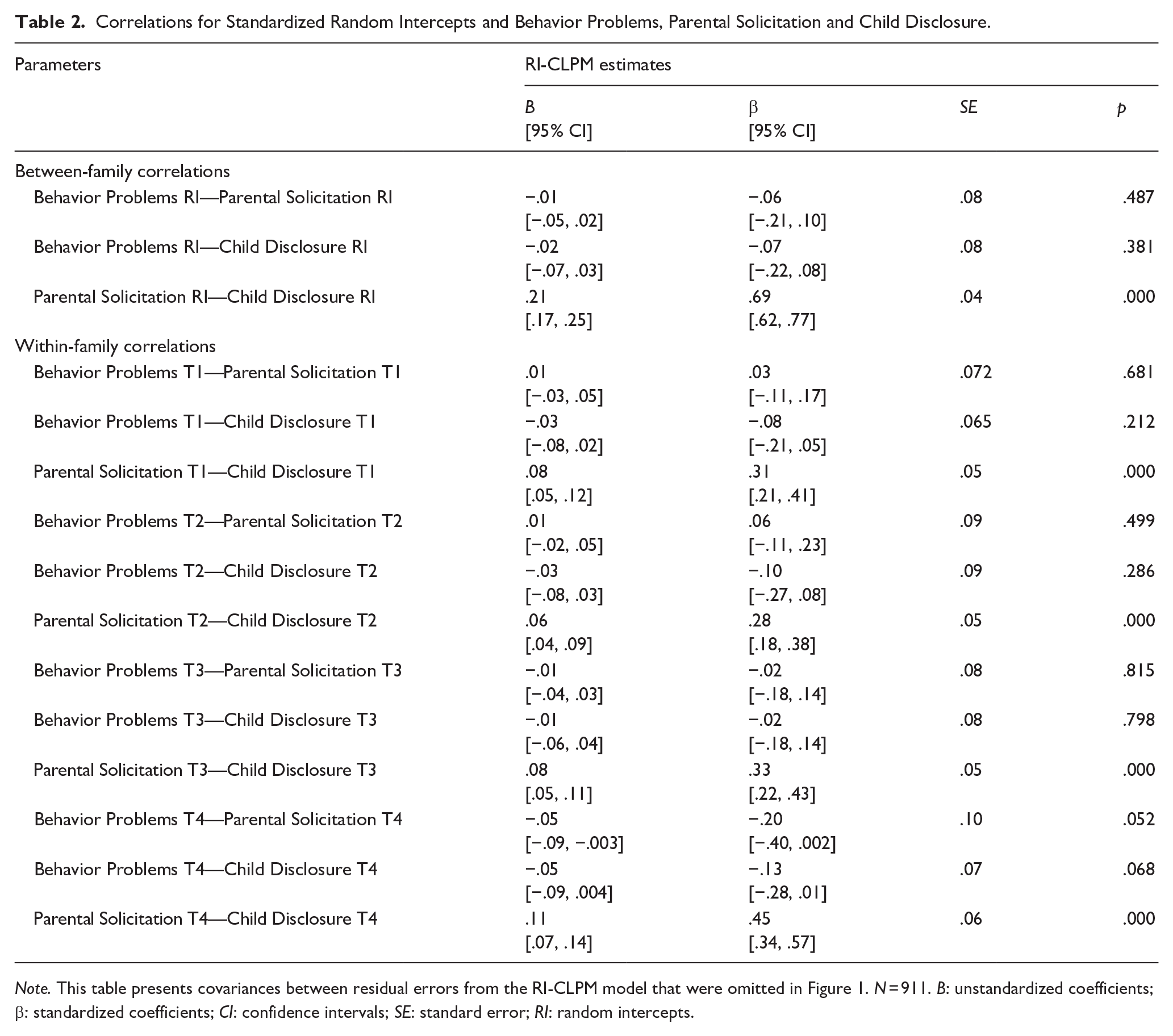
Note. This table presents covariances between residual errors from the RI-CLPM model that were omitted in Figure 1. N = 911. B: unstandardized coefficients; β: standardized coefficients; CI: confidence intervals; SE: standard error; RI: random intercepts.
Between-Family Differences
At the between-family level, the correlation between stable traits of behavioral problems and child disclosure (β = −.07, p = .381) and the correlation between stable traits of behavior problems and parental solicitation (β = −.06, p = .487) were not significant. However, the correlation between the stable traits of child disclosure and parental solicitation was significant at all four measurement points (β = .69, p < .001), indicating that mothers who solicited more reported that their children disclosed more.
Autoregressive Effects
The autoregressive effects measured by the RI-CLPM were used to determine the variation in an individual’s behavior in relation to their average when the stability effects of the variable were controlled (trait effect). The results showed that behavior problems in Grade 3 positively predicted behavior problems in Grade 4 (β = .24, SE = .063, p < .001). The results showed a positive predictive effect for parental solicitation from Grade 1 to Grade 2 (β = .33, SE = .081, p < .001) and from Grade 2 to Grade 3 (β = .20, SE = .095, p < .05), but no effect from Grade 3 to Grade 4 (β = .006, SE = .092, p = .946). Finally, child disclosure in Grade 1 was positively predictive of child disclosure in Grade 2 (β = .16, SE = .077, p < .05), and child disclosure in Grade 3 predicted child disclosure in Grade 4 (β = .15, SE = .068, p < .05), but showed no effect from Grade 2 to Grade 3 (β = .077, SE = .089, p = .385).
Concurrent Effects
As reported in Table 2, no significant concurrent link was found between child disclosure and behavior problems, nor between parental solicitation and behavior problems between Grades 1 and 4. Nevertheless, a significant positive concurrent link was observed between child disclosure and parental solicitation at each of the four measurement points (T1:β = .31, p < .001; T2:β = .28, p < .001; T3:β = .33, p < .001; T4:β = .45, p < .001), indicating that an increase in child disclosure was associated with an increase in parental solicitation.
Cross-Lagged Effects
The results of the cross-lagged effects for the variable of interest (parental solicitation, child disclosure, and behavior problems) showed two significant links. First, behavior problems in Grade 2 predicted an increase in parental solicitation in Grade 3 (β = .19, SE = .083, p < .05). Second, behavior problems in Grade 3 predicted a decrease in parental solicitation in Grade 4 (β = −.21, SE = .095, p < .05).
Regarding the controlled variables, the results showed that when accounting for between-family differences at baseline, boys disclosed more information to their mothers (β = −.22, SE = .038, p < .001) and had more behavior problems than girls (β = .25, SE = .032, p < .001). No gender difference emerged for parental solicitation (β = .05, SE = .041, p = .19). Also, a higher socioeconomic status was associated with more parental solicitation (β = .16, SE = .040, p < .001), more child disclosure (β = .27, SE = .037, p < .001), and less behavior problems (β = −.58, SE = .030, p < .001) at baseline.
Discussion
Many studies have reported links between parent–child communication and behavior problems during adolescence, most notably that child disclosure is negatively associated with problematic behaviors (Kapetanovic et al., 2020; Kerr et al., 2010; Stattin & Kerr, 2000). However, the associations between child disclosure, parental solicitation, and behavior problems during middle childhood have seldom been studied (Patrick et al., 2005; Racz et al., 2019), let alone from a longitudinal perspective that distinguishes between-family and within-family differences. Given that problematic behavior emerging during middle childhood is shown to persist into adulthood (Huston & Ripke, 2006), it is therefore relevant to examine whether the dimensions of parent–child communication equally protect against the increase of behavior problems during this period. The goal of this study was to examine the longitudinal associations between child disclosure and parental solicitation reported by mothers, and child behavior problems reported by teachers from Grades 1 to 4 using the approach recommended by Keijsers (2016) while controlling for gender and socioeconomic status.
Differences Between Families
Contrary to what was expected (H1a), there was no difference between families regarding the link between behavior problems, on the one hand, and child disclosure and parental solicitation, on the other. Research conducted during middle childhood shows that increased behavior problems negatively affect parent–child communication and parental monitoring (Pardini et al., 2008; Patrick et al., 2005) but does not account for the specific effect of parental solicitation and child disclosure nor for differences between families. However, differences between families do emerge during adolescence, showing that child disclosure and parental solicitation were associated with fewer behavior problems (Kapetanovic et al., 2019; Keijsers, 2016). It is therefore possible that the link between these variables is similar for all the families in this sample during middle childhood or that the differences between families become more marked during adolescence.
As anticipated (H1b), between-family differences emerged regarding the link between child disclosure and parental solicitation. Children who disclose more have mothers who solicit more. In other words, the mother asks the child questions, and the child shares information without her having to ask them. Thus, some families actively communicate bidirectionally more about their children’s activities outside the home as early as middle childhood. This finding is consistent with the results observed during adolescence (Kapetanovic et al., 2019) and in cross-cultural samples (Kapetanovic et al., 2020). It then seems that some characteristics specific to the child, the mother, or the family context could predispose certain mother-child dyads to communicate more from childhood through adolescence (Racz & McMahon, 2011).
Within-Family Differences and Effects
Concurrent Effects
The hypothesis (H2a) that there would be negative concurrent links between child disclosure and behavior problems was not supported. However, such a link is observed during adolescence (Kapetanovic et al., 2019). This result suggests that different processes might operate during middle childhood. First, children may handle the information (positive or negative) they share with their mothers differently from adolescents. Since school-aged children rely more on their parents to understand their social environment (Collins & Madsen, 2019), they may seek to be listened to and supported more than adolescents would. They may also want to talk to their mother about their friends, activities, and problems without distinguishing between the topics discussed. Keown and Palmer (2014) have documented that school-aged children discuss a variety of topics with their parents (e.g., daily activities and hobbies, interpersonal relationships, school routines). Therefore, behavior problems could be just one of the issues children discuss with their mothers. Second, adolescents self-disclose less, and their relationship with their parents is generally more conflictual and less intimate than that of school-aged children, reflecting a greater need for autonomy (Smetana et al., 2014). The function of disclosure during childhood could therefore be different, or even more complex, than that of adolescent disclosure, evidenced by different concurrent effects relating to social functioning and behavioral problems.
There were significant concurrent links between child disclosure and parental solicitation at all four measurement points (H2b). These results show that an increase in child disclosure was simultaneously linked with an increase in parental solicitation. It, therefore, appears that the mother’s soliciting behaviors encouraged the child’s disclosure and vice versa. Stattin and Kerr’s (2000) hypothesis that parents can actively facilitate communication with their child seems to be confirmed during middle childhood. These results also support those of Kapetanovic and colleagues (2019) that showed child disclosure and parental solicitation are mutually reinforced within families during adolescence.
Cross-Lagged Effects
It was expected (H3a) that behavior problems would reduce parental solicitation behavior, and vice versa. The results observed are more complex and vary according to the age of the children. Analysis shows that a high level of behavior problems in Grade 2 (ages 7–8) predicts an increase in parental solicitation in Grade 3 (ages 8–9), whereas the same behavior measured in Grade 3 predicts a decrease in parental solicitation in Grade 4 (ages 9–10). This reversal could occur at a critical age, not only in the child’s development but also in the mother’s perception of her child and of her own parenting skills. In the school system where this study was conducted, Grade 3 marks the entry of the child in the second of the three cycles of elementary school (i.e., Grades 1–2 vs 3–4 vs 5–6). This transition could influence mothers’ expectations toward the child as they tangibly mature. In fact, parents’ perceptions of their child’s behavior are affected by their attribution of responsibility. A generally held belief underpinning early Western parenting practices is that children are vulnerable and that parents actively determine their developmental outcomes (Stafford, 2021). However, during middle-childhood parents would gradually attribute behavior problems to the internal disposition of the child rather than their immaturity, and consequently react with increased authoritarian parenting in response to perceived age-inappropriate behaviors (Dix et al., 1989; Mills & Rubin, 1990). Indeed, Pardini and colleagues (2008) reported that parents offer more positive reinforcement to their child before Grade 3, even when their child has demonstrated behavior problems since kindergarten. According to these authors, this reinforcement is an attempt by parents to support an improvement in their child’s behavior through the teaching of social skills and parent–child communication. This could explain the increase in parental solicitation in response to behavioral problems in Grade 3, as mothers may attempt to better support the child’s regulatory abilities through communication (Collins & Madsen, 2019). In fact, it is around Grade 3 that children consolidate their understanding of the social rules of language and behavioral regulation skills previously acquired (Collins, 1984; Weisner, 1984) and that they then begin to understand the implicit uses of language (Stafford, 2021). However, as behavior problems persist, feelings of frustration and powerlessness would grow on the part of the mothers, who would, in turn, react by gradually reducing their socialization and communication efforts. In his coercion model, Patterson (1982) described this process, whereby parents tend to become more controlling and later to disengage from their child when behavior problems persist. Parents could therefore be more tolerant, or even curious and concerned, about their child’s behavior problems until they reach Grade 2. However, the results suggest that parents of children who continue to display problematic behaviors in Grade 3 could take on an attitude of withdrawal and avoidance, thus reducing their solicitation behaviors.
Also, around 8 years of age children’s attitude toward parental authority would shift as their respect for the expert knowledge and skills of the parent become more important than the anticipation of negative consequences (Braine et al., 1991; Maccoby, 1984). This idea might suggest that previously used methods to socialize the child could then become ineffective throughout Grade 3, thus reinforcing the coercive patterns in the mother–child dyad and explaining the shift in parental solicitation efforts by the mothers associated with behavior problems in Grade 4. This explanation needs to be substantiated by new studies investigating the link between behavior problems and parent–child communication, in which the effect of the quality of the parent–child relationship during this period would be considered.
It was also expected (H3b) that more child disclosure would predict a decrease in behavior problems, and that more behavior problems would predict a decrease in child disclosure between Grades 1 and 4. No cross-lagged association emerged between these variables, a surprising result that runs counter to that observed in adolescence. Indeed, it is generally found that child disclosure is linked to a decrease in behavior problems during this period (Kerr et al., 2010), and vice versa. Those results are maintained when within-family differences are isolated (Kapetanovic et al., 2019). The results reported during middle childhood (Patrick et al., 2005) may represent between-family differences rather than longitudinal within-family effects, as suggested by Keijsers (2016). As mentioned above, different processes may also underlie parent–child communication during middle childhood. Moreover, between Grades 1 and 4, children disclose much about themselves to their mothers (Desmarais & Poulin, 2023). School-aged children are also more likely than adolescents to accept their parents’ right to know, an attitude that encourages child disclosure (Hawk et al., 2013; Rote & Smetana, 2016). It is then possible that the protective effect of child disclosure only emerges if this behavior is maintained during adolescence, a period when more differences emerge between older children regarding their desire to disclose (frequency and quantity of information) to their mother (Keijsers & Poulin, 2013).
Strengths, Limitations, and Future Research
This study has several strengths, including the use of a 4-year longitudinal design with annual measurements, a large sample size, and data collected from different informants (mothers and teachers). In addition, the analyses were conducted using the most recent recommendations specific to this field of study, the RI-CLPM (Hamaker et al., 2015; Keijsers, 2016), that makes it possible to distinguish within-family differences from between-family differences attributable to an effect of stability or trait.
However, some of this study’s limitations must be highlighted. First, although large, the sample is relatively homogeneous. Current results will need to be replicated with other, more culturally and socioeconomically diverse samples. Second, in addition to the mother’s perspective, it would be desirable to include the father’s to better understand the communication processes between the children and their parents. The interactions between children and their fathers differ from those with their mothers (Smetana et al., 2006). Including the father’s perspective could reveal effects that are different from or complementary to those observed in this study. Third, it should be noted that the measurement of behavioral problems was provided by a different teacher as the students progressed in the next grade year after year. Although the statistical model employed in this study allowed us to isolate intra-family effects, the variability in measurement introduced to the model by this change must be considered when interpreting the results. However, the use of a second informant privy to the child’s behaviors at school has methodological benefits as maternal reports of their child’s problematic behaviors are related to their own emotional and psychological well-being (Huston & Ripke, 2006). Also, the mothers reported on both parental solicitation and child disclosure. The broader literature would suggest that children’s perceptions of communication processes often diverge from their parents (Tremblay-Pouliot & Poulin, 2021). The findings must therefore be interpreted with this limitation in mind. Fourth, missing data were observed due to attrition. The families retained among the initial participants pool had higher family income, and the mothers were older at the birth of their first child. Also, longitudinal attrition was higher among families of lower income and among families where the mothers had lower levels of education. However, confounding variables such as differences between families are taken into account by the statistical model used in this study (RI-CLPM), and the use of a robust analytical method to account for missing data (FIML) is a strength of the study (Hobden et al., 2011). Fifth, it is important to state that while the RI-CLPM makes it possible to distinguish between- and within-family effects, Keijsers (2016) pointed out that it does not allow to examine the heterogeneity of the processes occurring within each family but instead is intended to present the average of the within-family effects of the sample used. It also remains unclear whether the statistical model used in this study adequately controls for the effect of a shared cultural context on the intra-familial processes. This study would need to be replicated in different countries and cultural contexts to verify if the observed effects are universal for this developmental period.
Further longitudinal studies covering the transition from middle childhood to early adolescence are needed to ascertain how these communication processes evolve. It would be interesting to observe how and when the parent–child communication processes become more child-centered, such as the emergence of the reciprocal negative link between child disclosure and adolescent behavior problems (Kapetanovic et al., 2019). In addition, a more detailed examination of parents’ reactions to the information disclosed during middle childhood in the context of the evolution of within-family communication processes could be studied since there is a negative link between negative parental reactions and child disclosure behavior on the part of the child and solicitation behavior on the part of the parent during adolescence (Kerr et al., 2008; Tilton-Weaver et al., 2010).
This study makes several contributions to the literature on parent–child communication. It shows that parental solicitation and child disclosure positively influence each other from childhood onwards, but also that family differences foster that bidirectional influence. Those results support the importance of encouraging parents to ask their children about their social life outside the home as soon as they start school. This strategy of daily communication seems to encourage future child disclosure behavior from middle childhood onwards, a factor that subsequently becomes strongly linked to a low level of behavior problems during adolescence. However, this study also showed that parent–child communication has no direct effect on behavior problems in middle childhood, which suggests that the protective effect of children’s disclosure has a developmental component. The results also give credence to Patterson’s (1982) theory of coercion and Pardini et al.’s (2008) suggestion that middle childhood is a period of change in parents’ perception of their child. It seems advisable to offer support to mothers of children whose behavior problems persist after Grade 3 to encourage them to continue to communicate with their child. This study thus ultimately aims at understanding the longitudinal links between parental solicitation, child disclosure, and behavior problems during middle childhood to better inform prevention and promotion of good parenting practices, as are taught in programs offered to parents of children globally and locally (Gagné et al., 2023; Mageau et al., 2022; Schwarz-Torres et al., 2024; Turner et al., 2020).
Conclusion
The results show that throughout middle childhood, child disclosure favors parental solicitation and vice versa. They also show that behavior problems in Grade 2 lead to more parental solicitation the following year, while behavior problems in Grade 3 lead to less parental solicitation in Grade 4. These results suggest that parents play a central role in these communication processes during middle childhood. While behavior problems are more closely (and negatively) linked to child disclosure during adolescence, it is interesting to note that behavior problems are more closely related to parental solicitation during childhood. The parent’s soliciting behavior also seems to support positive family communication and the child’s desire to continue to self-disclose over time.
Supplemental Material
sj-docx-1-jbd-10.1177_01650254241303722 – Supplemental material for Reciprocal associations between child disclosure, parental solicitation, and behavior problems during middle childhood
Supplemental material, sj-docx-1-jbd-10.1177_01650254241303722 for Reciprocal associations between child disclosure, parental solicitation, and behavior problems during middle childhood by Cloé Desmarais and François Poulin in International Journal of Behavioral Development
Footnotes
Acknowledgements
We would like to thank all participants of the study. This research was conducted in partial fulfillment of the requirements for the first author’s doctoral degree at Université du Québec à Montréal (UQÀM).
Data Availability
The data that support the findings of this study are available from the corresponding author upon reasonable request.
Declaration of Conflicting Interests
The author(s) declared no potential conflicts of interest with respect to the research, authorship, and/or publication of this article.
Funding
The author(s) disclosed receipt of the following financial support for the research, authorship, and/or publication of this article: This study was supported by research grants from the Social Sciences and Humanities Research Council of Canada, the Fonds de Recherche du Québec—Société et Culture and the Canadian Institutes for Health Research.
Ethics Approval
All procedures performed in this study were in accordance with the ethical standards of the Université du Québec à Montréal’s institutional Research Ethics Board (approval number R1-081189). Informed consent was obtained from all parents and verbal acquiescence was obtained from all children participating in this study.
Permission to Reproduce Material From Other Sources
No material displayed in the submitted article came from outside sources. We give the International Journal of Behavioral Development the rights to use and distribute the content of this article.

Supplemental Material
Supplemental material for this article is available online.
References
Supplementary Material
Please find the following supplemental material available below.
For Open Access articles published under a Creative Commons License, all supplemental material carries the same license as the article it is associated with.
For non-Open Access articles published, all supplemental material carries a non-exclusive license, and permission requests for re-use of supplemental material or any part of supplemental material shall be sent directly to the copyright owner as specified in the copyright notice associated with the article.
