




Abstract
Involvement in out-of-school activities, such as sports and clubs, is linked to greater intrinsic motivation and positive mood in children and adolescents, as well as opportunities for social skill development. However, the impact of out-of-school time (OST) activities varies with youths’ perceptions of their quality, and few studies have examined these effects longitudinally. While higher quality OST relates to improved social skills, children with stronger social skills tend to receive more positive responses from their environments. In this brief report, we explored whether quality OST was linked to increases in social skills from early to middle adolescence and/or whether having social skills leads to higher quality OST experiences. In a sample of 996 mother–child dyads (45% female, 78% white, 24% low-income), we used cross-lagged path modeling to examine bidirectional relations between sixth-grade OST quality and ninth-grade social skills, as well as sixth-grade social skills and ninth-grade OST quality. The cross-lagged path model accounted for child sex, family income, father in the home, closeness with mothers, teachers, and peers, and number of OST activities. The cross-lagged effects were bidirectional: sixth-grade social skills were associated with increases in OST quality (β = .08, p = .014), and sixth-grade OST quality was related to increases in social skills (β = .10, p < .001). These findings have important implications for parents, teachers, and coaches who manage adolescents’ extracurricular activities.
Adolescents’ activities when they are not in school (out-of-school time, OST) make up an important part of their day. Approximately 7.7 million or about 75% of U.S. adolescents aged 10 to 16 take part in organized after-school activities (Black et al., 2022). Researchers, policymakers, practitioners, and parents have become increasingly interested in the opportunities and risks associated with how youth spend this time.
Organized OST activities include supervised programs that youth regularly attend when school is not in session (Centers for Disease Control and Prevention [CDC], 2023). OST activities fall under the umbrella term of afterschool care. These activities can include specialty lessons like piano, dance, computer, or academic programs like math training or standardized test preparation, or clubs like scouts and organized sports activities. They are usually offered for a specific duration and attendance may not be mandatory. Almost all parents (96%) report that their child’s afterschool program offers the opportunity to build socioemotional skills and competencies (Wallace Foundation, 2020). An ecological study of afterschool care found that third graders who were part of afterschool activities had better grades, work habits, peer relationships, and emotional adjustment as compared to their peers who did not take part in such activities, and these benefits continued through high school (Pierce et al., 2010).
Social-ecological perspectives (Bronfenbrenner & Morris, 2006) emphasize the importance of various settings in which children spend their time. Coaches, club advisors, and teachers often act as mentors, friends, and problem solvers and spend a large amount of time and attention on these activities (Elder & Conger, 2000). Youth who perceive high social support from their activity leaders have better mental health (Mahoney et al., 2009), and involvement in these activities leads to increased access to career mentors (Fredricks & Eccles, 2010). OST activities provide an array of opportunities for youth such as to acquire specific social, physical, and intellectual skills that are applicable in a variety of settings; to be an active member of one’s community; to belong to a recognized and valuable social group; to build a network of supporting individuals; and to be able to deal with life challenges (Pittman et al., 2001). Involvement in OST activities, such as sports and clubs, has been linked to greater student intrinsic motivation and positive mood (Shernoff & Vandell, 2007). Moreover, these activities provide a space for exploring roles, learning cultural norms, and other social skills (Lerner et al., 2011).
The decision to enroll in afterschool activities tends to be motivated by several factors, including keeping children of working parents monitored (Mahoney et al., 2006), and increasing child safety and health (Lam et al., 2014). However, OST-related child outcomes are poor when OST activities are poor in quality (Bodilly & Beckett, 2005). Although there is evidence for the importance of superior quality afterschool programs, few programs meet quality standards (Pierce et al., 2010). Hence, to assess the question of whether a child’s behavioral development is related to OST activity engagement, it is important to consider the child’s perspective on the quality of their activities.
While past research suggests higher quality OST relates to greater social skills over time (Vandell et al., 2005), longitudinal research that accounts for concurrent associations between these two variables and the other direction of effects is needed to elucidate directionality. Children with greater social skills tend to elicit more positive responses from their environments (Scott et al., 2018), and thus may be more likely to experience high-quality afterschool programming. A better understanding of the longitudinal associations between quality OST and child social skills is needed to realize the full potential of afterschool activities.
The Current Study
In this brief report, we aimed to explore whether OST quality relates to increases in social skills from early to middle adolescence and/or whether having social skills leads to higher quality OST experiences. Using data from the NICHD Study of Early Child Care and Youth Development (SECCYD), we tested longitudinal associations between the quality of OST and social skills in sixth grade with the quality of OST and social skills in ninth grade. This allowed us to explore bidirectional associations while accounting for baseline levels of each variable and concurrent covariances. We predicted that not only would OST quality in sixth grade predict increases in social skills, as suggested in past research, but also that social skills in sixth grade would predict increases in the quality of OST.
Method
Participants
Participants were drawn from the Study of Early Child care and Youth Development (SECCYD), a longitudinal study of new mothers conducted at 10 sites across the United States. The sample excluded families with mothers below age 18, with substance abuse, non-English speakers, infants with a disability, multiple births or required postnatal hospital care, and families who lived or planned to move beyond a 1-hr radius of the site. Of the mothers who gave birth during a selected 24-hr period, 5416 met the eligibility criteria and were contacted; 1362 were enrolled in the first assessment. Data collection proceeded at set time intervals across infancy, early childhood, middle childhood, and adolescence. The longitudinal study consisted of 4 phases of data (1991-94 Phase I: ages 0-3; 1995-99 Phase II: through first grade; 2000-04 Phase III: through sixth grade; 2005-07 Phase IV: through ninth grade). We used data from the sixth-grade wave within Phase III and the ninth-grade wave within Phase IV because these are the only two waves where OST data were collected.
The current analytic sample consisted of 1002 mother–child dyads who had OST and social skills data available at the sixth-grade wave. Retention from the sixth-grade wave to the ninth-grade wave in this analytic sample was 94.8%. There were no significant differences in sixth-grade study variables between retained families and those lost to attrition. Forty-five percent (N = 449) of the children are female; 78% are white, 12% Black, 4% Hispanic; and 24% are low-income (income-to-needs ratios < 2). The University of Texas at Dallas ethics board approved (#24-296) these secondary analyses on the SECCYD archival dataset (additional recruitment details here: https://www.nichd.nih.gov/research/supported/seccyd).
Measures
Quality Out-of-School Time
Following past research on OST using the SECCYD (Vandell, 2000), we created an overall quality composite score using OST items that adolescents rated based on the perceived quality of their experiences at 6th and 9th grade. This original measure was developed using the Promising Practices Rating System (PPRS), a valid measure of the quality of afterschool programs (Yohalem & Wilson-Ahlstrom, 2010). Based on the National Research Committee’s recommendations of components of high-quality afterschool programs (Gootman & Eccles, 2002), trained and reliable raters agreed that a high-quality afterschool program includes supportive relations between adult staff and students, supportive relations between students, student engagement in activities, opportunities for cognitive growth, mastery orientation, and appropriate program structure. Consistent with this framework, the SECCYD measure asked adolescents to report how much they liked the activity, the extent to which the adolescent thought the coach was supportive (trust, listen, care), the extent to which the coach helped the adolescent learn new skills, and how well the adolescent got along with other kids in the activity.
In sixth grade, 65.9% of students took part in sports-related OST activities (3 days per week, on average); 47.1% took part in religious OST activities (1.5 days/week); 41.3% took part in music, dance or arts OST activities (2 days/week); 20.7% took part in non-academic clubs or interest group OST activities (1.5 days/week); and 8.2% took part in academic/homework club OST activities (2 days/week). Most students (89.3%) took part in more than one OST activity; 27.87% took part in one OST activity category; 31% of students took part in two, 23.52% took part in three; 7.11% took part in four; and 1.09% took part in all five OST activity categories. Only 8.6% of adolescents took part in zero OST activities; these students were excluded from the primary analyses, as participants had to have reports on OST activity quality to be included in the current analyses. Students who participated in activities had significantly higher social skills, t =−2.04, p = .042, and family incomes, t =−2.17, p = .030, than those who took part in zero activities. They were also more likely to be female than male, χ²= 5.71, p = .017.
At 9th grade, 74.3% of students took part in sports-related OST activities (4 days a week, on average); 54% took part in religious OST activities (2 days/week); 46% took part in music, dance or arts OST activities (4 days/week); 17.1% took part in nonacademic clubs or interest group OST activities (2 days/week); and 13.7% took part in academic/homework club OST activities (2 days/week). Most ninth-grade students (94.4%) took part in more than one OST activity; 16.5% took part in one OST activity category; 27.0% of students took part in two; 24.2% took part in three; 17.3% took part in four; and 10.73% took part in five OST activity categories. Only 4.3% took part in zero OST activities and did not provide OST quality data. Again, students who participated in activities had significantly higher social skills, t =-4.84, p < .001, and family incomes, t =-7.74, p < .001, than those who took part in zero activities. They were also more likely to have a second adult living in the home, χ²= 7.25, p = .007.
The 20-item OST quality items were rated on a 4-point scale. Four items (“how much do you like the activity?”; “coach helps you learn new skills”; “How well do you get along with other kids in the activity?”; “coach acts like you can trust, listen, care”) were asked across 5 activities (sports, music/dance/drama, academic and religious activities) at both sixth and ninth grade. Although two items were on a four-point scale, one item was on a three-point scale and one was on a five-point scale. After rescaling so that all items were on the same four-point scale (1 = Very much, 4 = Not at all), we reverse-scored items so that higher scores indicated higher quality and averaged scores across all activities, sixth: α = .70, ninth: α = .81.
Adolescent Social Skills
Mothers reported on youth social skills in sixth and ninth grades using the Social Skills Rating System (SSRS; Gresham & Elliott, 1990). The 38-item scale measures adolescent cooperation, responsibility, self-assertion, and self-control at sixth-grade, α = .94; 40 items were administered across the same domains at ninth grade, α = .93. We used the averaged total scores to account for the different number of items at the two time points. The response options for each item are 0 = Never, 1 = Sometimes, and 2 = Very often.
Control Variables
Closeness with mothers was assessed with the 15-item, mother-report Child–Parent Relationship Scale (Pianta, 1994) at 6th and 9th grade, α = .76. Closeness with teachers was measured with the teacher-report Student Teacher Relationship Scale Short Form (Pianta, 2001) at 6th grade, α = .84. At 9th grade, the Teacher Relations Questionnaire (Furman, 1996) measured teachers’ perceptions of their relationship with the study child using 16 items, α = .93. Mothers reported on the child’s closeness with peers using a measure of peer network characteristics at sixth and ninth grades. The eight-item positive peer group subscale was used, α = .81-.85.
Procedure
Questionnaires were administered at the sixth-grade and ninth-grade assessments to study children, their parents, and their teachers. Mothers reported on the child’s social skills, mother–child closeness, and the child’s closeness with peers. Teachers reported on teacher–child closeness. Study children reported on their OST activities and quality.
Analysis Plan
Preliminary analyses examined descriptive statistics, correlations among variables, and distributions using SPSS software v.28. Given the different metrics of the OST quality and social skills outcomes, paired with the need to maintain nonzero means to examine change over time, we rescaled to make the two measures comparable using an equation proposed by Kenny and colleagues (2006, “brute-force”).
To test our research question, we ran a cross-lagged path model in Mplus v.8.10. Missing data among study variables were minimal at 8.91% and were handled in the path models using full information maximum likelihood estimation. A missing value analysis showed a higher family income-to-needs ratio related to a lower likelihood of missing OST quality ratings, t’s = 2.50-5.20, p’s = .001-.015.
We controlled for family income-to-needs ratio and whether a second adult lived in the home, both of which relate to adolescents’ participation in OST activities (Vandell et al., 2015), along with child sex. Controls to account for the quality of relationships in other contexts included sixth- and ninth-grade closeness with mothers, teachers, and peers. Finally, to ensure that the effects of OST quality were not confounded by quantity, we controlled for the number of activities adolescents engaged in sixth and ninth grades. Covariances were modeled between these controls and all study variables. Chi-square difference tests were used to compare the strength of the cross-lagged paths. The chi-square value and degrees of freedom in a freely estimated model were compared to a model where the cross-lagged paths were constrained to be equal. A significant difference value suggests adding the constraint results in a significant decrease in model fit and the freely estimated model should be selected.
Results
Descriptive data for study variables are shown in Table 1. All study variables were significantly positively correlated, with the strongest association between social skills at Grade 6 and social skills at Grade 9.
Descriptive Data for Study Variables after Rescaling.
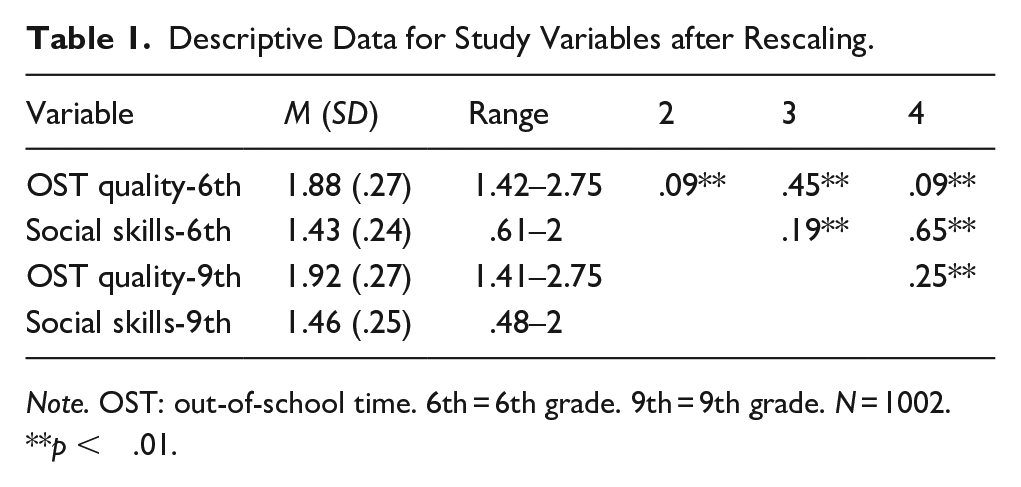
Note. OST: out-of-school time. 6th = 6th grade. 9th = 9th grade. N = 1002.
p < .01.
The path model fit well, which controlled for child sex and family income, number of parents living with the child, closeness with mothers, teachers, and peers, and number of OST activities at sixth and ninth grades, χ2(40) = 145.40, p < .001; RMSEA = .05 (.04-.06); CFI = .97; SRMR = .05. Coefficients for the effects of the control variables on the main study variables are displayed in Table 2. As shown in Figure 1, greater social skills in sixth grade are related to greater social skills in ninth grade. Similarly, greater sixth-grade OST quality related to greater ninth-grade OST quality. Both of the cross-lagged paths were significant with greater 6th grade social skills relating to increases in OST quality and greater sixth-grade OST quality relating to increases in social skills. A comparison of the two significant cross-lagged paths using a chi-square difference test revealed that these paths were significantly different in strength, Δχ2(1) = 12.73, p < .001. The path from sixth-grade OST quality to increases in social skills was significantly stronger than the path from sixth-grade social skills to increases in OST quality.
Associations between Study Variables and Controls in the Path Model.
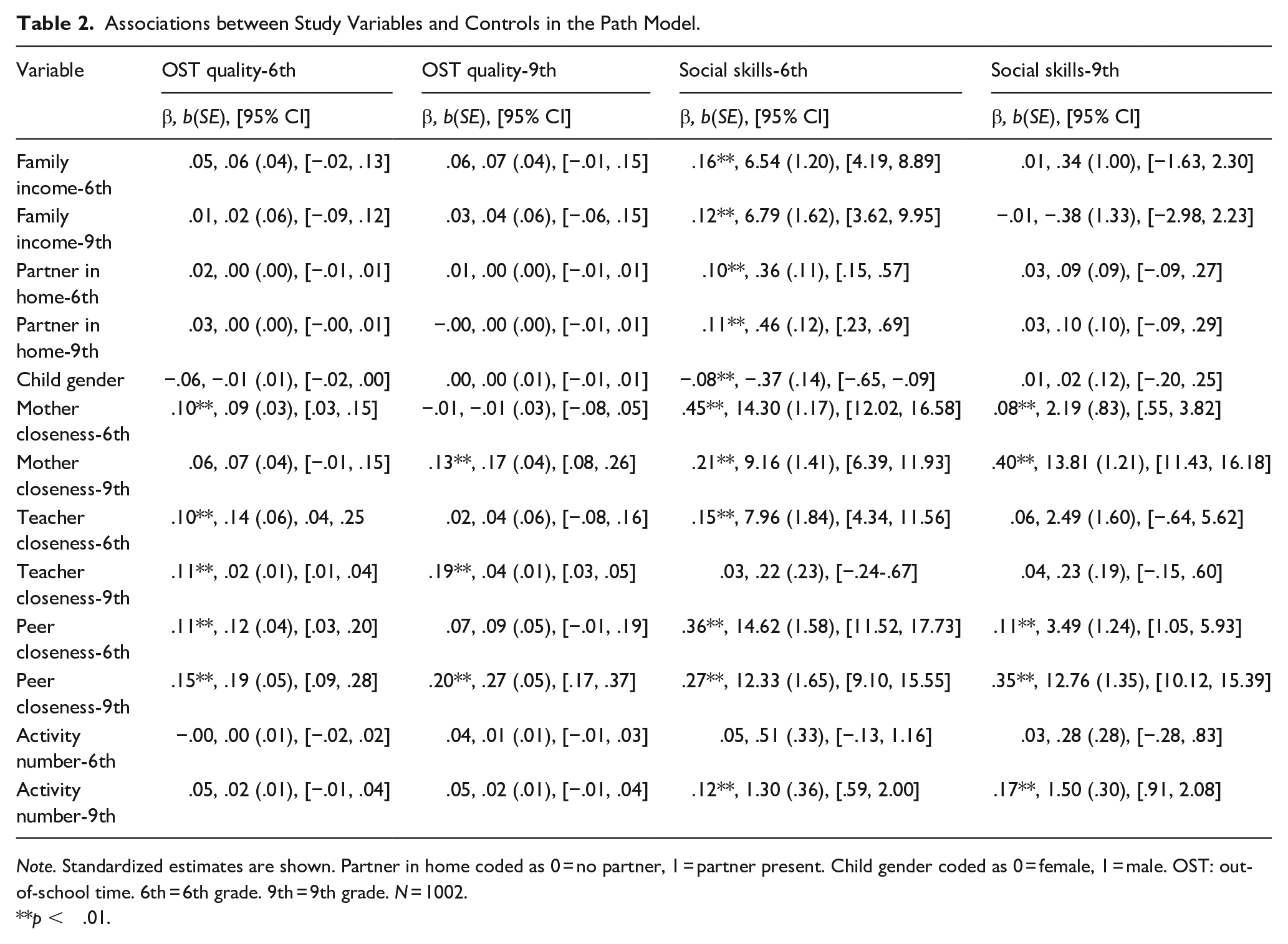
Note. Standardized estimates are shown. Partner in home coded as 0 = no partner, 1 = partner present. Child gender coded as 0 = female, 1 = male. OST: out-of-school time. 6th = 6th grade. 9th = 9th grade. N = 1002.
p < .01.
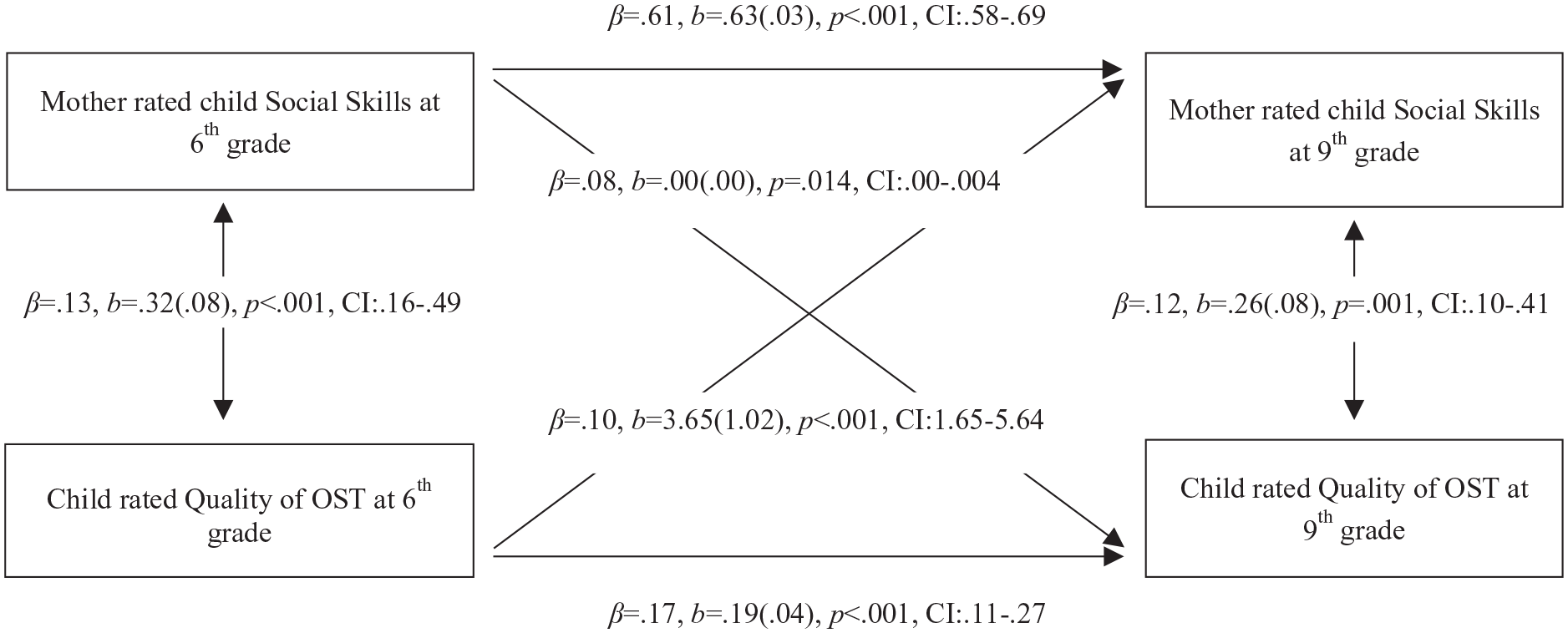
The estimated cross-lagged path model.
Discussion
In this brief report, we found bidirectional associations between adolescents’ social skills and the quality of OST experiences from sixth to ninth grades, even after accounting for the number of different activity types adolescents were engaged in and their positive experiences in other aspects of their lives with mothers, teachers, and peers. An important aspect of positive youth development is the ability to build positive and supportive relationships with others (Gardner et al., 2008). Quality OST experiences encourage healthy development because of the opportunities to engage in social circles that may be different than those available during school hours.
This report is the first to our knowledge to test bidirectional longitudinal effects between OST quality and adolescent behavioral outcomes. In addition to higher OST quality relating to increases in social skills consistent with past research (Vandell et al., 2005), we also found greater social skills related to increased OST quality. This suggests that while high-quality OST programs can contribute to social development, adolescents who already possess well-developed social skills are more capable of engaging with and leveraging these programs effectively. Personal agency and a tendency to highlight contributions, which is characteristic of more advantaged individuals, may allow those who are already socially skilled to benefit even further from activity engagement compared to other adolescents in a kind of social capital resource multiplication process (Mele et al., 2023; Ross & Mirowsky, 2006). This nuanced understanding does not undermine the value of high-quality OST programs—and in fact, that direction of effects was strongest—but rather points to the fact that their impact may be amplified for adolescents with existing social competencies.
Participating in any OST activities was related to higher family income, two parents in the household, and female gender. This aligns with previous research in that children and adolescents with greater financial resources have greater access to extracurriculars (Vandell et al., 2015); two-parent households are more likely than one-parent households to provide the support for extracurricular involvement (Coley et al., 2020); and traditional gender norms tend to encourage girls toward organized, cooperative activities (Barber et al., 2005). In addition to the relevant demographic controls, we also accounted for positive experiences in other aspects of adolescents’ lives by controlling for closeness with mothers, teachers, and peers to better isolate the effects of OST quality. Indeed, these positive relationships related to higher social skills and higher OST quality at both time points. But even after accounting for closeness with mothers, teachers, and peers, OST quality and social skills continued to demonstrate bidirectional associations, highlighting the salience of OST activities in children’s and adolescents’ lives.
Limitations
Although this study advances our understanding of the bidirectional effects between quality OST and adolescent social skills, it is not without limitations. First, 9th graders may have specialized and consolidated their activities more so than 6th graders, who may be more likely to engage in a variety of activities with different features. Different types of OST activities may offer varying levels of benefits to participating students, leading to differences in quality scores across activity types, which were aggregated in this study consistent with past OST research using this same archival dataset (Vandell, 2000). Second, we were unable to determine the social nature of the OST activities from the dataset. For instance, academic activities could range from solitary homework to group-based clubs. Exploring the social dynamics of each activity represents a significant area for future research. Third, the data collected in mid-2000s cannot account for technological advancements, cultural shifts, and changes in educational policies, thus impacting the relevance of the findings to today’s adolescents. Fourth, although incorporating both youth and mother reports was a strength of the current design, each reporter may be biased to some degree. Youth reports of activity quality may be impacted by transient mood, and mothers may not regularly see a full range of youth social behaviors around peers. Finally, with only two waves, we were unable to disentangle within-person effects from between-person effects in our model.
Implications
The implications of these findings extend to youth, parents, and OST activity providers. Coaches and teachers should be aware that while quality OST experiences that allow children to have fun, learn new things, and feel valued relate to increases in social skills over time, children with higher social skills are garnering more attention and benefits from the programs. While this effect was observed across 3 years with potentially different activities across time, coaches should be aware of whether they are providing more stimulating experiences to children who are initially more cooperative. Tailoring afterschool programming to meet individual children’s needs rather than using a “one size fits all” model and encouraging family engagement to support socially inhibited youth’s participation are strategies recommended by experts in OST programming (Vandell et al., 2020) to enhance the effectiveness of OST activities.
Footnotes
Acknowledgements
The data collection of the National Institute of Child Health and Human Development (NICHD) Study of Early Child Care and Youth Development was funded by a cooperative agreement (5 U10 HD027040). The authors of this paper express their gratitude to NICHD SECCYD network for their 20-year long work and indicate that this paper does not represent the official view of the funders and is the sole responsibility of the authors.
Funding
The author(s) received no financial support for the research, authorship, and/or publication of this article.
